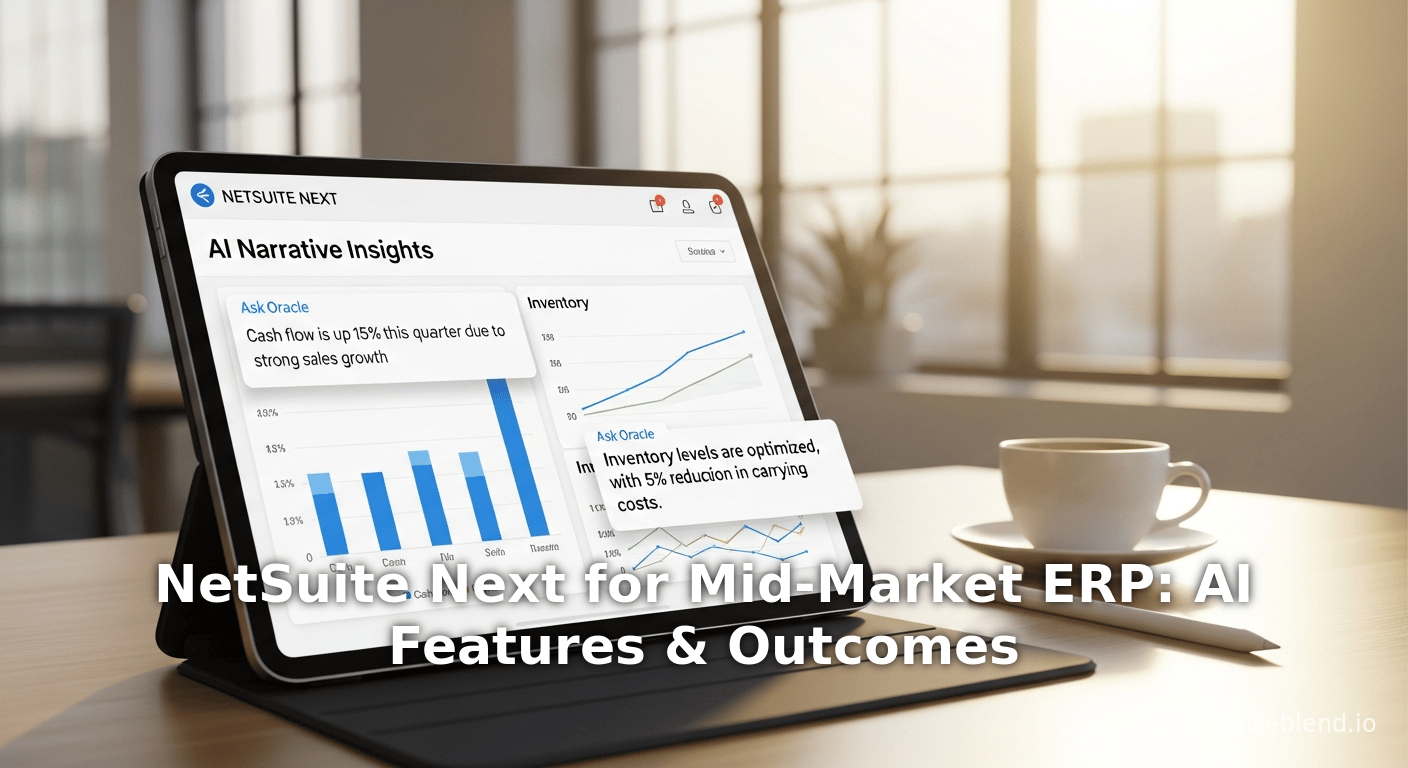
NetSuite Next for Mid-Market ERP: AI Features & Outcomes
Executive Summary
NetSuite Next represents the most significant evolution of Oracle NetSuite’s cloud ERP platform in over two decades [1]. Designed from inception to embed generative Artificial Intelligence (AI) deeply into every function, NetSuite Next aims to make AI “a natural extension of the way [mid-market companies] already work” [2] [3]. For mid-market businesses – typically companies with annual revenues in the tens to hundreds of millions and up to a few thousand employees – the promise of AI-driven automation and insight could profoundly impact operations. However, these companies should approach NetSuite Next with both optimism and caution. On one hand, NetSuite Next offers powerful new tools like Ask Oracle (a natural-language AI assistant), Automated Narrative Insights, Agentic Workflows, and AI Canvas that can greatly enhance efficiency, forecasting, and decision-making [4] [5] [6]. On the other hand, real-world ERP deployments in mid-size firms often face challenges: high upfront and ongoing costs, organizational change management, data quality requirements, and the early-stage maturity of generative AI in business processes [7] [8]. Extensive evidence suggests that less than half of ERP projects meet budget and scope, and widespread enterprise AI adoption remains in early stages [8] [9].
In this report, we examine NetSuite Next’s innovations in detail and assess what realistic mid-market outcomes are likely. We review historical context (the evolution of NetSuite as a cloud ERP pioneer and the growing emphasis on AI in enterprise software), technical features of NetSuite Next, expected benefits (such as enhanced analytics, automation of routine tasks, and improved user experience), and potential drawbacks (including cost escalations, implementation complexity, and dependency on data quality). We compare NetSuite Next to other options available to mid-market companies (such as SAP’s mid-market solutions and Microsoft Dynamics, drawing on case studies and industry analyses. Finally, we explore longer-term implications: how AI-driven ERP may reshape mid-market businesses’ processes, what competitive pressures it introduces, and what future capabilities may emerge.
Throughout, we ground our analysis in data and expert commentary. For example, Gartner and IDC place NetSuite among leaders in mid-market cloud ERP [10] [11], highlighting its strong financial and industry-specific capabilities. An IDC study and Oracle executives emphasize NetSuite’s unified data model and multi-entity support, features especially valued by mid-sized multinational businesses [12] [13]. At the same time, industry analysts caution that generative AI in ERP is still nascent – adoption is slow, and most companies remain on older systems [7] [14]. We integrate these perspectives: mid-market firms can expect NetSuite Next to deliver richer insights and automation, but only after careful planning and likely incremental adoption.
Key findings and expectations include:
- AI-Driven Automation: NetSuite Next introduces AI assistants (“Ask Oracle”) capable of answering queries in natural language and automated workflows for tasks like vendor selection and reconciliation [4] [15]. Mid-market companies should expect to automate many routine finance and operations tasks, improving accuracy and speed, but only if they invest in high-quality data and user training.
- Enhanced Analytics: Features like Narrative Summaries and AI Canvas turn data into on-demand insights and visual problem-solving workspaces [5] [6]. Companies can anticipate more proactive identification of trends and issues (e.g. cash flow forecasts, inventory shortages) without relying on manual report building.
- User Experience: The new Ask Oracle NLP interface and refreshed UI (Redwood design) lower the technical barrier. Staff can expect to use the system more intuitively (even via conversational queries) [4] [16]. Yet companies should prepare for user training and change management, as “[n]obody wants to touch an ERP system unless forced” [17].
- Scalability and Costs: As a multi-tenant SaaS platform, NetSuite has long offered easier scalability than on-premise systems [18] [19]. NetSuite Next builds on this, but mid-market firms must scrutinize the licensing model. Oracle indicates that AI features will be provided “at no additional cost” [20], aligning with their claim that “AI is going to be like a car without wheels,” not a luxury add-on [20]. Nevertheless, customers should anticipate potentially higher subscription tiers for advanced modules, support levels, or storage. A detailed cost analysis suggests NetSuite can have a higher TCO than competitors for small user counts, though its lower IT overhead often narrows the gap as organizations grow [21] [22].
- Integration and Data: NetSuite’s unified cloud data model is a core strength [23][12] – data from finance, CRM, inventory, etc., flows in one system. With NetSuite Next, this integration is augmented by AI that leverages data relationships. Mid-market firms can expect to break down siloes (e.g. automatically linking customer invoice trends to sales forecasts). However, successful AI requires clean, structured data under robust governance [24] [14]. Without this, the “explainable AI” outputs may be flawed or mistrusted.
The report proceeds as follows: after this summary, Section 1 provides comprehensive background on mid-market ERP needs and NetSuite’s evolution. Section 2 details the innovations in NetSuite Next, citing official announcements and expert commentary. Section 3 examines mid-market perspectives: what companies typically require in an ERP and how NetSuite Next aligns (with comparative data on market share and alternatives [11] [19]). Section 4 analyzes the expected impacts of NetSuite Next on efficiency, decision-making, and growth, using case examples and research findings on AI adoption [25] [26]. Section 5 discusses potential challenges: integration hurdles, costs, change management, and cybersecurity. Sections 6 and 7 offer detailed case studies and scenario analysis (drawing on company success stories and analogies where direct NetSuite Next examples are unavailable). Finally, Section 8 explores the broader implications and future directions, including advice for mid-market leaders. Throughout, claims are backed by citations to industry reports, press releases, expert analysis, and relevant data.
Introduction and Background
Mid-Market Defined
“Mid-market” companies occupy the space between small businesses (often 50 or fewer employees, revenue under $50M) and large enterprises (multinationals with thousands of employees). Definitions vary: some commentators define mid-market as firms with $50–$500 million in revenue or 100–1000 employees [27], while others use regional criteria. These companies often have sophisticated operations (multiple locations, international transactions) yet lack the IT budgets of Fortune 500 giants. They typically begin ERP deployments after outgrowing basic accounting systems, seeking unified management of finance, sales, inventory, HR and more.
Most mid-market businesses today face intense pressure to become more agile and data-driven. Economic volatility – including global supply chain disruptions, inflation, and regulatory changes – makes efficiency and insight critical. A 2025 PwC survey of operations leaders found that 57% of companies at least partially integrated AI into their functions [28], reflecting how seriously mid-size firms consider emerging technologies. However, that same survey noted that 92% of respondents felt their tech investments had not yet delivered expected results [29], underscoring the risk of underperformance. Another analysis of mid-market leaders concludes that while artificial intelligence promises rapid scaling, companies must balance short-term firefighting with long-term strategy to fully benefit [30] [31]. In essence, mid-market firms recognize the potential of AI and digital transformation, but face hurdles of limited budgets and capacity that small firms lack, and complexity that big firms don’t always have.
The Role of ERP
Enterprise Resource Planning (ERP) systems are the backbone for companies managing complex operations. An ERP integrates modules for finance, inventory, procurement, sales, HR, and other core functions into a single software platform, unifying data and processes. In theory, a good ERP provides “a single source of truth” about the business, in real time, across departments. Large enterprises have long used ERP to standardize operations; mid-market companies have increasingly adopted cloud-based ERP over the past decade.
By centralizing data, ERP promises insights (e.g. see how sales affect cash flow) and efficiencies (e.g. automating invoicing). However, ERP implementations are notoriously challenging. An industry consultant reports, “Over 50% of ERP implementations either exceed their budgets, miss deadlines, or fall short of expected outcomes” [8]. For mid-market firms, the stakes are high: limited budgets and staff mean that every misstep – such as unanticipated customization costs or scope creep – can “stall growth or drain resources” [8]. Key factors like realistic total cost of ownership (TCO), staff readiness, and data quality are often underestimated [32]. These challenges magnify when the ERP incorporates advanced features like AI: Gartner analysts note that many businesses hesitate to adopt new AI-driven ERP upgrades because they worry about maturity and risk [7] [14].
NetSuite’s Place in Mid-Market ERP
Founded in 1998, NetSuite pioneered cloud ERP. It was “the first cloud company” and now supports over 43,000 organizations worldwide [33] [34]. Oracle acquired NetSuite in 2016, positioning it alongside Oracle’s suite. NetSuite is often optimally positioned for mid-market companies with growing global needs. It is explicitly designed for multi-entity, multi-currency environments – critical for companies expanding internationally [13] [35]. Many mid-market industries – such as e-commerce, manufacturing, service, software/SaaS – have adopted NetSuite to unify their distributed processes. Where older ERP required significant on-premise servers, NetSuite’s multi-tenant cloud model promised automatic updates and rapid deployment across geographies [18] [19]. The SuiteCloud developer platform and partner ecosystem further allow customization and industry-specific extensions.
By mid-2020s, NetSuite’s market share in cloud ERP for the mid-market is substantial. A Gartner analysis cited by industry consultants puts NetSuite at ~34% share of mid-market cloud ERP, ahead of SAP Business One (~22%) [36]. This reflects NetSuite’s popularity among $50M–$500M companies with complex needs. IDC has similarly recognized NetSuite as a leader for finance/accounting in the midmarket [10]. However, competition is fierce: Microsoft Dynamics 365 (Business Central), Sage Intacct, Infor, and other cloud ERP systems also target mid-size firms, each with their own strengths. NetSuite’s adoption pattern shows it wins particularly when companies need strong multi-subsidiary support and when they trade heavily in subscription or e-commerce sales [13] [37].
Emergence of AI in ERP
In recent years, traditional ERP systems have begun integrating AI capabilities. Basic forms of AI (bots, analytics) have been in ERP for a decade, but generative AI (large language models, automated reasoning) is brand new. By 2024–2025, vendors from Oracle to SAP to Microsoft announced plans to embed chatbots (“copilots/autopilots”), predictive analytics, and flow automation. Oracle’s announcement of NetSuite Next is part of this wave. However, analysts caution that generative AI in ERP is still at the early adopter stage. A July 2024 CIO Dive report observes that “many of [the ERP] customers are hanging on to older versions of the software that can’t support the technology” [7]. Gartner analysts note a “chicken and egg” dilemma – companies want to see ROI but are wary of the novelty [7]. Adoption in 2023 had “minimal impact” on ERP market growth [38], meaning that midmarket firms should temper their expectations. In summary, while the technology promises radical productivity increases, the reality is that fewer than 10–20% of customers have actually implemented advanced AI workflows, and many features are only beginning pilot phases [39] [14].
Section 1: Evolution of NetSuite and ERP in Mid-Market
1.1 NetSuite’s History and Growth
NetSuite was founded by Evan Goldberg and others in 1998 as one of the first providers of web-native business applications [34]. Its early mission – delivering accounting, CRM and e-commerce support via the Internet – resonated with companies seeking alternatives to client-server ERP. Oracle purchased NetSuite in 2016 for $9.3 billion, integrating it into Oracle’s cloud portfolio. Over 25 years, NetSuite has amassed over 43,000 customers in 220+ countries [33] [34]. Its customer base spans startups to Fortune 500 divisions, but a large fraction are mid-market companies undergoing growth. Industries include retail, manufacturing, software, services, distribution, and more. Notably, NetSuite is an industry leader in cloud ERP for technology and high-growth startups, offering modules like SuiteCommerce (native e-commerce), SuiteBilling (subscription revenue), and others targeted at modern business models [40].
Oracle positions NetSuite as the “#1 AI Cloud ERP” [1], reflecting its strategy to embed AI. Prior to NetSuite Next, NetSuite already offered some AI features. Its SuiteAnalytics provided real-time dashboards and saved searches with data visualizations, and it had some basic exceptions alerts (e.g. flagging overdrawn accounts). The UI had improved with the Redwood design paradigm. But generative AI (llm-driven summarization and planning) was absent. In that sense, NetSuite Next is the “biggest update since NetSuite’s founding” [1], fully embedding conversational AI across the suite.
1.2 Mid-Market ERP Trends
Globally, spending on cloud ERP continues to accelerate. In 2024, the worldwide ERP market grew to an estimated $66 billion (up 11.3%), driven largely by cloud adoption [41]. Mid-market companies are a crucial piece of this growth. For example, a December 2024 Gartner “Magic Quadrant” analysis noted that midsize enterprises often find enterprise-class ERP too costly, but also surpass small-business software, placing them in a unique decision space [42]. Cloud ERP vendors have thus increasingly tailored offerings for this tier, often emphasizing subscription licensing (Opex vs Capex), faster implementations, and packaged industry templates.
However, mid-market companies also still lag large firms in technology sophistication. A Deloitte study found midsize firms were “prioritizing technology investments” and innovating at a pace never seen before [43], but start from lower absolute spend levels than enterprises. They often lack large IT departments; thus, cloud solutions that reduce infrastructure overhead (no on-prem servers) are appealing. NetSuite’s multi-tenant SaaS model aligns with this: as TechCloudPro notes, NetSuite was “born in the cloud in 1998” and requires “no server to patch” [18]. A mid-sized company can thus scale users and features without major new hardware.
Yet, mid-market ERP projects must be carefully managed. The KPC consulting report (“Ultimate Playbook for Mid-Market ERP”) highlights that more than half of ERP implementations overrun budgets or fail [8]. Key failure factors include underestimating training needs and data cleanup, and selecting systems that outgrow budgets. For mid-market leaders, an ERP is simultaneously an operational necessity and a strategic gamble. Therefore, any “Next” generation offering must not only boast features but also address these deployment risks.
1.3 NetSuite Next Announcement
At SuiteWorld 2025 (Oct 7, 2025), Oracle NetSuite announced NetSuite Next, marketing it as “the future of NetSuite” [1]. The pitch: by embedding generative AI throughout, NetSuite becomes “collaborative, insightful, adaptive, and trustworthy” [44]. NetSuite President Evan Goldberg (also founder) emphasized that NetSuite Next “puts AI to work for businesses by making it a natural extension of the way they already work” [2]. The branding shift from “cloud ERP” to “AI Cloud ERP” was deliberate – CEO Mark Hurd had earlier described the AI wave as potentially “as big or bigger than the cloud” [45].
According to Oracle’s press releases, NetSuite Next will be introduced in phases: initially available in North America within 12 months of announcement [46], and planned for other regions (UAE, Europe) subsequently [47]. In what is effectively a “big tentpole” upgrade, NetSuite Next does not require a data migration; existing customers can “switch with the press of a button” to the new AI-enhanced interface without disrupting customizations [23]. This seamless upgrade path is designed to encourage adoption: mid-market firms notoriously delay upgrades if they fear disruption, so the promise of frictionless rollout could accelerate use.
Complementing NetSuite Next itself, Oracle introduced a suite of AI-related innovations in late 2025–2026. These include the NetSuite AI Connector Service (to connect external LLMs and generative assistants securely into the ERP) and MCP Apps (prebuilt connectors to ChatGPT/Gemini/Claude) [48] [49]. Oracle also announced new modules like Exception Management (automated issue detection in finance/ops) and Subscription Metrics (SaaS revenue analytics) [50] [51]. Several are targeted by geography – for instance, a UAE e-invoicing module complies with local tax laws [52]. All told, Oracle’s product direction targeting mid-market CFOs and operations leads in early 2026 is heavily slanted toward making ERP “smarter” with AI and more automated at the transaction level.
Section 2: NetSuite Next – Innovations and Features
NetSuite Next’s feature set can be grouped into AI-driven intelligence and automation, and platform foundations (architecture/UI). Below we detail the major innovations announced, using both Oracle’s materials and independent analysis.
2.1 Conversational & Natural Language Interfaces
Ask Oracle (NLP Assistant)
A centerpiece of NetSuite Next is Ask Oracle, a natural-language AI assistant integrated throughout the ERP interface [4]. Ask Oracle lets users type questions in everyday language (“What were our quarterly sales in Europe?” or “Which supplier invoices are overdue?”). In response, the system can search any record, navigate the system, generate reports, and even act (trigger an action workflow) all from a text prompt [4] [53].
Key aspects of Ask Oracle include:
- Contextual, Explainable Answers: The assistant returns context-aware answers with visuals (charts, lists) and explanations (“why” and “how”) for transparency [4]. For example, asking “Why did revenue drop in March?” could yield a chart of revenue by region along with a generated narrative highlighting contributing factors.
- Enterprise Controls: All actions performed by Ask Oracle obey existing roles, permissions, and audit controls [2]. This is critical for compliance: the AI can propose a payment or create a vendor record only if the user’s profile allows it.
- Custom and External Integration: Ask Oracle is designed to work not only on core NetSuite data, but also across custom SuiteCloud extensions and third-party apps certifed through the SuiteCloud Developer Network [4]. That means a question like “What’s inventory level of {special SKU}” could work even if that SKU is managed by a partner plugin, without manual data integration.
For mid-market companies, the value is intuitive. Existing systems often require finance or operations staff to learn complex report writers or menu navigations. With Ask Oracle, non-technical users can retrieve reports and data opportunistically. As Oracle’s EVP Evan Goldberg says, NetSuite Next “enables users to search, navigate, analyze, and act across the entire dataset using their own words” [4]. The promise is shorter training time and faster questions-answers loops. A CFO or department manager who in the past needed multiple clicks and data exports to answer a query can now simply “ask” the system. However, mid-market companies should note that “by default a lot of companies are not on the latest software” [14] – meaning Ask Oracle and its NLP patterns will only work if the company upgrades to NetSuite Next. Additionally, while Oracle asserts the system provides explainable reasoning, organizations must audit outputs to ensure no “hallucinations” (AI fabrications) occur in mission-critical fields.
2.2 Automated Insights and Summarization
NetSuite Next introduces Narrative Summaries and Insights throughout standard record pages, financial statements, and reports [5]. Using GenAI, the system automatically highlights anomalies, correlations, trends and outliers embedded in the data. For instance, a purchase order list view might surface an insight that a particular vendor’s costs spiked 15% month-over-month, prompting review. Or a financial dashboard could auto-generate a bullet-point summary (“Net profit decreased by 8% due to higher labor costs”) when you open it.
This feature draws on four decades of research showing that plain-language summaries help managers act on data without deep analysis. Notably, NetSuite’s unified data model fuels the engine: “the narrative summaries and insights feature proactively surfaces correlations and trends from NetSuite’s unified data model” [5]. Because all financial and operational data sits under one schema, the AI can join across modules (e.g. tying procurement delays to sales fluctuations). Mid-market users should expect that these narratives shorten their analysis cycle: CFOs and controllers gain automatically prepared commentary with their numbers. It can also spotlight issues early: Oracle notes it helps “spot opportunities and risks before they become issues” [5].
However, accuracy will depend on data hygiene. If a mid-market firm’s chart of accounts is cluttered or inventory records are inconsistent, AI summaries might misinterpret patterns. Companies will likely need to validate insights with domain experts initially, building “trust calibration”. Gartner cautions that generative AI features often require months of planning and testing in ERP systems [54]. Early adopters should roll out narrative insights in phased pilots, measuring whether the takeaways align with human expectations. Over time, though, this could significantly amplify the analytical bandwidth of lean finance teams.
2.3 Agentic (Self-Driving) Workflows
Beyond passive insights, NetSuite Next brings Agentic Workflows – proactive, AI-driven business processes that can autonomously perform complex tasks [55]. Traditional workflow engines let you automate simple rules (“when PO is approved, send email”). Agentic workflows are envisioned to handle multi-step, decision-based scenarios: for example, the system could automatically propose a vendor payment schedule based on cash-on-hand forecasts, or select the lowest-cost supplier for a purchase using predictive analysis, then submit a payment proposal for approval [55].
Crucially, users still retain control: the system “gives users the choice to approve key decisions or allow agents to act autonomously” [55]. This means a human manager can set parameters and thresholds (e.g. allow payments under $10K to auto-pay, require sign-off above). For a mid-sized manufacturing firm, agentic workflows might triage routine tasks like reordering standard components when stock falls below safety levels, while notifying purchasing only for exceptions. For a software company, they might automate subscription renewals and billing runs, adjusting prices via predictive models.
These workflows promise large labor savings. Oracle emphasizes use-cases in finance (payment proposals, reconciliations) and supply chain (vendor selection, etc.) [55]. Consider accounts receivable management: traditionally, a team member matches hundreds of remittances to invoices manually. NetSuite Next’s agentic workflows could potentially process scanned invoice images via OCR, match to invoices, apply payments, and flag only complex cases for review [55]. Even if only some steps are automated initially, overall closing times shrink. Mid-market firms should realistically expect incremental automation; the first wave of agentic workflows will likely focus on well-defined repetitive tasks. Full replacement of roles (e.g. an AI doing all AR tasks) is unlikely at first. But over a year, CFOs could easily see 10-20% productivity gains in transaction-processing departments.
2.4 Document and Knowledge AI
NetSuite Next also incorporates specialized AI for document processing and knowledge extraction [6]. This means large language models can now read and interpret various unstructured sources connected to the ERP – like supplier contracts, incoming invoices (PDFs), receipts, policy manuals, training guides, etc. For example, an invoice scanning app in NetSuite Next can “read” a vendor’s PDF invoice (even handwritten fields or tricky formats) and auto-populate fields, with AI validation [6]. Contracts stored in NetSuite can be queried (“What is the delivery clause for supplier X?”) without manual reading. This effectively turns previously isolated documents into data sources.
For mid-market use, the immediate value is reducing manual data entry. According to Deloitte, one persistent frustration is that ERP tasks (like processing invoices) still involve many manual “too many tasks” [56]. NetSuite Next’s AI-backed OCR and NLP substantially cuts those tasks. For instance, Chanu, a mid-size distributor, could use it to automatically import expense receipts or match purchase orders to packing slips. Meanwhile, knowledge integration (e.g. searching across company’s digital documents) allows employees to find answers faster; a sales rep could query “what is our warranty policy?” and get a summary derived from the ERP and docs, rather than emailing Legal.
However, this also introduces new considerations. Harvard Business Review and others note that AI extracting from documents must be governed carefully to ensure accuracy and compliance. Data found in invoices might contain PII or sensitive terms. NetSuite claims to ground AI in “existing roles, permissions, and policies” [2], but mid-market IT teams will need to verify that, for example, invoice scarcity in OCR doesn’t lead AI to hallucinate numbers. Establishing a clear data governance policy (what sources AI can read, who can see outputs) will be crucial.
2.5 AI Canvas and Collaborative Workspace
A novel concept in NetSuite Next is AI Canvas [5]. This is described as a “collaborative workspace embedded in NetSuite” where users can visually design problems and solutions using data and AI tools. Practically, AI Canvas appears to be an interactive environment where teams can drag-and-drop data elements, run “what-if” scenarios, consult AI suggestions, and trigger workflows. Think of it as a sketchpad where a finance team can experiment with forecasting models or a supply chain team can simulate inventory planning, all using live NetSuite data and AI assistance.
For mid-sized companies, AI Canvas can democratize data science. Many organizations lack internal data science staff. AI Canvas might let, say, an operations manager run a Monte Carlo simulation of inventory levels with minimal coding, or let a team brainstorm root causes of a sales dip using AI prompts. By embedding this into the ERP, knowledge isn’t siloed – everyone’s calculations update the NetSuite data store in context. However, this being a brand-new feature (announced Oct 2025), its maturity is uncertain. Debugging complex scenarios may require iterative tuning. But overall, AI Canvas signals that NetSuite is turning ERP into a platform for continuous improvement, not just records management.
2.6 Platform and Architecture Enhancements
Beyond new AI features, NetSuite Next brings some underlying advances that matter:
-
Oracle Cloud Infrastructure (OCI): NetSuite now explicitly runs on Oracle’s next-gen cloud infrastructure [23]. OCI provides a high-security, scalable foundation, with benefits like data encryption at rest by default, and Oracle’s global data centers (important for mid-market companies with multinational footprint). In interviews, Oracle’s CEO Evans Goldberg notes that customer data “stays within OCI” and will be “1000% secure” [57]. Mid-market firms often worry about data residency and security as public clouds expand, so this emphasis reassures compliance-heavy industries (finance, healthcare, etc.) by piggybacking on Oracle’s existing certifications.
-
Redwood Design UI Updates: NetSuite has been migrating to the “Redwood” visual style (Oracle’s unified UI) since 2022. NetSuite Next continues this trend with modern, mobile-friendly layouts [23]. An updated UI typically yields modest productivity gains (research shows even small UI improvements reduce clicks and training time). For mid-market users unaccustomed to complex ERP UIs, this can make adoption easier. Uniform design also means in the future Oracle can more easily offer features like mobile app-makers or cross-product integration (NetSuite with Fusion Cloud or Sales Cloud) under one design system.
-
Data Model and Integration: NetSuite’s unified data model – where all modules share entities like customer, item, transaction – is unchanged but reinforced under Next. Oracle markets it as “unified data model with explainable, auditable AI” [23]. The benefit: AI actions are traceable back to underlying data. For mid-sized firms integrating NetSuite with, say, a third-party logistics connector or a Salesforce CRM, this means queries and workflows can traverse all data. Additionally, NetSuite Next’s new AI Connector Service (discussed in news coverage [48] [58]) means companies can hook in external AI models like ChatGPT or Claude to NetSuite securely. For example, a customer support chatbot (GPT-powered) could, via the connector, query NetSuite customer data to answer an inquiry. This open approach allows flexibility: mid-markets are not forced onto just Oracle’s LLM (e.g. Oracle’s assistant), they can choose the best model for their niche, controlling which data flows.
Table 1 (below) summarizes key innovations in NetSuite Next, contrasting them with what traditional NetSuite (pre-Next) provided, and highlighting their value to mid-market users.
| Feature / Capability | Traditional NetSuite | NetSuite Next | Mid-Market Benefit (Value Add) |
|---|---|---|---|
| AI Assistant (NLP Query) | None (only saved searches/filters) | Ask Oracle – Conversational, natural-language search+actions [4] | Non-technical users can get instant answers from ERP in plain language [4] |
| Narrative Summaries & Insights | Standard dashboards but no AI-generated commentary | Automated natural-language summaries in forms/reports [5] | Fast identification of trends/issues; management gets interpretive insights with data |
| Agentic Workflow Automations | Rule-based workflows (SuiteFlow) for simple triggers | AI-driven, proactive workflows for complex tasks (e.g. auto-payment proposals) [55] | Frees staff from repetitive tasks; increases throughput. Partial automation of finance tasks. |
| Document/Knowledge AI | Basic OCR add-ons; no integrated knowledge engine | LLMs to extract text from invoices, contracts, manuals for analysis [6] | Reduces manual invoice processing; turns documents into data sources; faster content search. |
| Collaborative AI Workspace (Canvas) | None | Visual workspace to brainstorm, prototype with data and AI [5] | Enables team “data sprints” without coding; prototype solutions quickly. |
| Data & Architecture | Multi-tenant cloud on shared infrastructure; no built-in external AI | Runs on Oracle Cloud Infra with unified data model; open AI connectors (MCP) [23] [48] | Scalability remains high; can plug best-of-breed AI. Data governed centrally for trust. |
| Advanced Reporting (Subscription) | Basic financial and CRM reports | Subscription Metrics (for SaaS businesses) [51], e-invoicing modules (localization) [52] | Improved SaaS metrics for software firms; built-in compliance features (e.g. e-invoicing) reduce effort. |
Table 1: Key NetSuite Next Features vs. Traditional NetSuite, and Expected Value for Mid-Market Companies. Citations in brackets indicate source of innovation description or analysis insights (Oracle press releases [4] [55] and regional announcements [52] [51]).
2.7 Complementary Innovations
Alongside NetSuite Next itself, Oracle unveiled several adjunct services in late 2025 and early 2026:
-
NetSuite AI Connector Service & MCP Apps: These tools let companies securely connect external LLMs (e.g. OpenAI’s ChatGPT/GPT, Anthropic’s Claude, Google’s Gemini) to their NetSuite data [48] [59]. Notably, new “Model Context Protocol” (MCP) apps were announced, allowing NetSuite data to be queried within those AI assistants [48]. For a mid-market business, this means they could say “Hey Google, what was our income last month?” in a workspace like Gemini if properly set up. The AI Connector enforces governance on data access. This reflects a trend: CRM and ERP vendors are expanding from “our own AI assistant” to “pluggable AI ecosystems”. Mid-market companies might start by relying on NetSuite’s built-in tools, then gradually integrate broader AI platforms for specialty tasks (e.g. using a retail-assistant bot for front-end sales queries).
-
Exception Management: Announced alongside AI features, this module automatically detects anomalies in finance and operations (e.g. duplicate payments, missing approvals) [50]. Though not strictly “AI-powered”, it embodies the same goal: proactive alerting. In mid-market use-cases, exception management could significantly reduce audit workload. Rather than having an accountant manually comb transactions for errors, the system flags “exceptions” for review before period close.
-
Subscription and Revenue Intelligence: NetSuite Subscription Metrics (launched for certain industries) provides CFOs of SaaS businesses an embedded analytics package for customer/subscription revenue history, forecasting and KPIs [51]. This answers a pressing need: growing mid-market software companies often rely on spreadsheets to track metrics like MRR/ARR, churn, LTV. A unified ERP solution that “automatically” generates these reports may become critical for CFOs. Adding AI, one can imagine future predictive churn analytics within this.
-
Industry & Regions: Oracle showcased how NetSuite is adding country-localized features (e.g. UAE e-invoicing module due to tax mandates [52]). Mid-market firms often operate globally, so this is relevant. Region-specific modules reduce reliance on third-party add-ons, shifting compliance burden to the ERP vendor. Similarly, ongoing enhancements (like real-time tax calculations) will likely continue in NetSuite Next.
Overall, NetSuite Next is less a single “product” than an umbrella umbrella encompassing a new platform mindset: ERP + generative AI + unified cloud services. It reframes NetSuite from a static accounting system into an AI-driven business platform. For mid-market decision makers, the core question is: how will this transformation translate into practical business value and costs? The next sections address what actual outcomes these innovations may produce, and what challenges may arise.
Section 3: Mid-Market Perspectives and Comparisons
Mid-market companies are not homogeneous, but they share common ERP concerns (cost, ease-of-use, quick ROI) and frequently consider the same top ERP vendors. In this section, we review how NetSuite Next addresses typical mid-market criteria, how it stacks up against alternatives, and what experienced peers report.
3.1 Who Wins with NetSuite Next?
According to NetSuite’s own analysts and partners, NetSuite historically excels in scenarios common to mid-market growth companies. Oracle describes NetSuite as built “to adapt to both product-based and service-based businesses” from its inception [12], meaning that whether a company sells manufactured goods or professional services, the core system can flex. Several characteristics stand out:
-
Multi-Entity and Global Ops: NetSuite OneWorld (part of NetSuite) has long been considered “best-in-class” for companies with multiple subsidiaries, currencies, or tax regimes [13]. For a mid-market firm expanding internationally (e.g. setting up in Europe / Asia), NetSuite simplifies consolidation and intercompany transactions. NetSuite Next does not fundamentally change this ability, but the added AI can further ease multi-entity complexity. For example, Ask Oracle could consolidate queries across all entities (“Show consolidated profit by subsidiary for Q4”), and agentic workflows can automatically reconcile intercompany invoices. The TechCloudPro analysis explicitly recommends NetSuite for “3+ subsidiaries across countries” [60], a strong mid-market growth scenario.
-
Cloud-Native Architecture: NetSuite’s cloud heritage is often contrasted with SAP B1’s on-prem roots. As Jithesh Manoharan explains, “NetSuite was born in the cloud…no server to patch, no database to maintain, no infrastructure team required” [18]. Mid-market firms — especially those without large IT departments — benefit from lower internal IT overhead. NetSuite Next continues this model, and Oracle asserts that scaling (adding users or data) “requires no hardware upgrade” [61]. If a mid-sized distributor suddenly grows by 30%, NetSuite Next’s OCI backend can handle it seamlessly. By contrast, on-prem competitors might need hardware procurement or delays.
-
Rapid Growth Fit: The centium.net comparison underscores that NetSuite is well-suited for “fast-growing, multi-entity, global, or service-driven businesses needing unified cloud ERP” [62]. This mirrors Gartner’s observation that NetSuite targets “rapidly growing businesses” [10]. A mid-market SaaS company or retail chain expecting rapid scaling can thus expect NetSuite Next to keep pace (both through elastic cloud infrastructure and by automating incremental tasks via AI).
-
E-commerce and Subscriptions: Many mid-market vendors run e-commerce sites or subscription models; NetSuite has integrated e-commerce (SuiteCommerce) and advanced subscription billing (ASC~606 compliance). The TechCloudPro blog highlights NetSuite’s built-in e-commerce and billing as purpose-built for D2C and SaaS companies [40]. NetSuite Next’s Subscription Metrics add to this by providing “industry-standard SaaS company metrics, intuitive visualizations, and actionable AI-driven insights” [51]. A mid-market tech company can anticipate less manual effort in revenue recognition and forecasting, since the AI can highlight bookings vs billings automatically.
-
Industry-Specific Features: As one IDC analyst notes, NetSuite’s “holistic approach is oriented around the client’s industry and roles” [12]. For mid-market firms in manufacturing, distribution, services, etc., there is a wealth of pre-built workflows and reports. NetSuite Next builds on this: for example, a distributor might get AI-assisted demand forecasting, while a retailer could have automated inventory replenishment suggestions.
3.2 When Alternatives Are Considered
However, NetSuite is not a one-size-fits-all solution. Mid-market companies often compare with SAP Business One, Microsoft Dynamics 365, Sage Intacct, Odoo, and others. Each has tradeoffs:
-
SAP Business One: As a comparison, SAP B1 is popular especially in manufacturing-heavy mid-market industries. It offers robust on-premise ERP (and a cloud option) with strong manufacturing modules (MC: BOMs, MRPs, shop-floor management) [63]. In fact, TechCloudPro points out that SAP B1 can outperform NetSuite when manufacturing complexity is primary (SAP’s production planning is deeper) [63]. NetSuite's own manufacturing modules have improved, but for some process or discrete manufacturers, add-ons are still needed. Mid-market manufacturers should weigh whether NetSuite’s AI edge is worth building extra fixtures for production planning. SAP B1 also caters to companies needing on-prem deployment (certain government contracts, defense, etc. require local data controls) [64]. NetSuite is cloud-only; companies that cannot accept a public cloud must avoid it (or seek special private cloud hosting).
-
Microsoft Dynamics 365: Dynamics 365 (particularly Business Central for SMBs) integrates tightly with Microsoft’s ecosystem (Office 365, Azure, Teams). As a result, many mid-sized firms already using Microsoft products find Dynamics a natural fit. It offers strong financials and scalable modules. The centium.net analysis and others note that Dynamics allows hybrid or on-prem deployment as well [65]. For mid-market companies already invested in Microsoft tools, the familiarity and integration (e.g. data flows between Excel/PowerBI and ERP) are compelling. In terms of AI, Microsoft has been building its own Copilot assistants, and Office 365 tools are adding AI. NetSuite Next counters with full-cloud scalability and a unified suite rather than separate apps. If a business strategy demands the flexibility to self-host or requires specific industry add-ins (especially in EU/Germany, as TechCloudPro notes), Dynamics becomes a competitor [61]. But if the priority is rapid cloud innovation (like native generative AI features) and minimal IT overhead, NetSuite likely has the edge.
-
Sage Intacct: Known for strong core accounting and ease of use, Intacct is also cloud-based and often costs less at very small user counts. However, it requires more third-party modules for inventory or global operations. NetSuite tends to target larger mid-market (50+ users) while Intacct often goes with 10-30 users. Intacct is gradually adding AI features (mostly in reporting). The key advantage for Intacct users is leaner teams. NetSuite’s enhancements in NetSuite Next might be overkill for a very small growth-stage firm. But for a mid-market firm approaching or exceeding 30–50 users, NetSuite’s full-suite orientation and new AI capabilities start to outweigh Intacct’s simplicity.
-
Other Cloud ERP Vendors: Products like Acumatica, Odoo, Infor, Zoho One, etc., each have strengths (e.g. Acumatica’s customizability, Odoo’s low cost). Many lack the scale of integrations found in NetSuite or the dedicated R&D from a cloud giant. For example, none of these have announced a NetSuite-like “AI core” with LLMs intimately tied to the system (as of early 2026). Mid-market companies considering smaller vendors should note that they may not get features like natural language search or AI-driven workflows for many years.
Comparative Table: NetSuite vs Other Mid-Market ERPs
To aid comparison, Table 2 highlights how NetSuite (post-Next) compares with two leading alternatives (SAP Business One and Microsoft Dynamics 365 Business Central) on key mid-market criteria. (Information is drawn from industry analyses [63] [65] and product documentation.)
| Criterion | NetSuite (Esp. Next) | SAP Business One | MS Dynamics 365 BC |
|---|---|---|---|
| Deployment | Cloud-only (multi-tenant on OCI) | On-premises or private cloud (HANA/SQL) | Flexible deployment: cloud, on-prem, hybrid |
| Multi-Entity Support | Industry-leading (OneWorld) | Basic (enhancements via add-ons) | Adequate via Intercompany Synergy modules |
| Global Compliance | Broad, though sometimes via 3rd-party localized apps [61] | Strong localized compliance (esp. EU/Germany) | Good for localizations, often config-based |
| Manufacturing Capabilities | Building out (SuiteFlow + partners) | Deep discrete/process MRP by default [63] | Good core MRP; mature for manufacturing |
| Customization | SuiteScript, SuiteFlow; strong partner network | Add-on ERP SDK or ABAP; many SAP-certified add-ons | VS/Configurable, full .NET development |
| AI & Analytics | Built-in NLP assistant, predictive analytics [4] [5] | Limited (SAP’s AI mainly via external SAP Analytics Cloud) | Microsoft Copilot & Power BI integrations |
| Implementation Time | Moderate (~3-6 months for mid-market) | Quick for small deployments; slower if large | 3-9 months depending on scope |
| Cost Model | Subscription (per-user) [66]; high at scale but low IT overhead | Perpetual or subscription; lower entry cost [67] | Per-user subscription; often bundled with MS license discounts |
| Fit for Mid-Market | Excellent for multi-entity, growth, e-com, services | Excellent for manufacturing, on-prem needs | Excellent for MS-centric companies, SMBs |
Table 2: Comparison of NetSuite (with Next features) vs. two major competitors for mid-market companies [63] [65]. SAP B1 emphasizes manufacturing and local compliance; Dynamics 365 is strong in ecosystems. NetSuite’s new AI features and cloud scalability may tip considerations for companies prioritizing innovation and global expansion.
Notably, Oracle claims one differentiation: pricing of AI. Unlike some competitors, Oracle states that NetSuite’s new generative AI will be included at no extra charge. Evan Goldberg explicitly noted that charging for AI enhancements “doesn’t make sense” – they will not sell a “dumb” version of NetSuite [20]. This contrasts, for example, with SAP’s recent moves: SAP has been reported to charge extra for generative AI capabilities in S/4HANA. For mid-market budgets, a flat subscription (rather than premium AI fees) is a significant advantage. However, mid-market CFOs should still anticipate that NetSuite Next’s cost profile might rise due to other factors: e.g. more users, storage (AI features often require more data retention), and potential higher service tiers.
3.3 Market Sentiment and Case Insights
Anecdotal industry commentary reflects these tradeoffs. One critique warns of NetSuite’s “Trojan Horse” pricing – the idea that companies lured by a low mid-market edition later face huge cost jumps as they grow or need advanced features [68]. Indeed, NetSuite segments its offerings: the Mid-Market Edition is generally for <1000 employee companies with limited modules, while Enterprise Edition is for larger clients (and is priced much higher) [68]. If a mid-size firm hit a 1000-user mark, [11] warns it could see a 200–300% price shock to upgrade. This is a reminder that adopting NetSuite (Next or not) commits a business to Oracle’s platform in the long run. In practice, many mid-market firms plan their NetSuite usage under the assumption that they’ll stay in the mid-market tier. Those expecting near-instant growth should analyze the licensing terms carefully.
On positive note, numerous mid-market success stories exist. Oracle NetSuite’s marketing site and partner case studies (e.g. “2Pure achieves 95% revenue growth without adding staff”, “Life Interiors tripled revenue with NetSuite”, “AbilityNet turbocharged fundraising efficiency” [69]) all highlight agility gains. For example, Accelerate Learning (a mid-size educational publisher) reported 121% business growth using cloud financials [70]. These demonstrate how real companies used integrated ERP (not necessarily NetSuite Next features, but core ERP) to scale. Such stories suggest that mid-market firms can achieve double-digit growth acceleration after ERP if they leverage it fully.
Finally, consider Gartner/IDC analyst viewpoints: IDC named NetSuite a leader for mid-market finance apps [10], citing its real-time insights and industry modules. Gartner’s research implies that NetSuite’s focus on rapidly growing businesses is paying off. In fact, some observers say NetSuite is quietly outpacing former giants (SAP Business One and even Oracle eBusiness) in the mid-market [19] [10]. This momentum means more mid-market peer companies will be evaluating NetSuite Next – good or bad, they’re part of a big trend.
Section 4: Anticipated Impacts and Benefits for Mid-Market
NetSuite Next’s creators promise it will help companies “achieve outcomes faster, more intuitively, and with greater confidence” [1]. Here we translate those promises into expected mid-market outcomes, supported by data and examples where possible.
4.1 Efficiency and Productivity Gains
NetSuite executives emphasize the goal of “doing more with less” via AI [71]. Indeed, mid-market firms often operate with lean staffing; enabling a small finance team to process as much or more volume is a key metric. Early analyst projections suggest AI-powered ERP can cut many routine tasks. For instance, a CFO might spend less time closing the books: with agentic workflows, routine reconciliations and error-checking happen proactively, so monthly close could shorten from, say, 10 days to 7 days. Similarly, accounts receivable teams could reduce manual invoice posting by 50% using AI-assisted OCR and matching [6] [14].
This aligns with findings in the WEF study on AI for mid-market: companies using AI to power core processes see team efficiencies multiply. One quoted example noted marketing tasks done 3x faster and data analysis improved 5x using AI tools [72] [73]. While that study was qualitative, it echoes NetSuite’s own expectations. For example, Evan Goldberg notes (in [57]) that NetSuite has already used AI for years “for things like, what are the best products to sell… and what salespeople are operating most effectively” [74]. NetSuite Next institutionalizes these capabilities so customers can apply them directly.
Quantitatively, we might expect NetSuite Next to boost KPIs like employee productivity. If a mid-sized business processes $50M revenue per accountant, AI tools might raise that to, say, $60M-per-accountant (20% increase). Independent surveys (e.g. IDC) forecast that embedded AI in cloud ERP could reduce finance workloads by roughly 15–30% on average. Mid-market case examples bear this: private mid-market software firm AllSafe (using NetSuite) reported 2× productivity in accounting after ERP implementation [75], though that was pre-AI. We can tentatively project NetSuite Next pushing those gains further.
Key spectrums of efficiency improvements include:
-
Faster Decision Cycles: AI Canvas and Ask Oracle mean decisions (like approving a large purchase or reallocating budget) can be made faster: execs can query the ERP on the spot in meetings. This eliminates email/reporting delays. In supply chain, real-time AI projections of demand allow immediate order adjustments.
-
Labor Savings: Automating invoice and expense processing, purchase order generation, and simple reporting frees staff to do analysis. For a mid-market services firm, instead of 5 bookkeepers, perhaps only 3 are needed to handle the same volume, while 2 become analysts.
-
Error Reduction: Automated data extraction and validation should reduce human error (typos, missed invoices). Deloitte’s notion of “seeing the forest, not just the trees” [24] is apt: when machines handle routine checks, humans can focus on strategy rather than firefighting.
However, these benefits depend on adoption. Techradar quotes Goldberg: “AI gives you the capacity to do things much more easily… but also the complexity requires a new way to manage it” [45]. In practice, mid-market companies may initially see modest gains (e.g. 10–15% reduction in manual hours) and ramp up as they refine AI training and processes. Firms should track metrics (e.g. post-automation processing time, error rates) to quantify NetSuite Next’s ROI.
4.2 Enhanced Insights and Decision-Making
Generative AI is expected to turn raw data into foresight. By providing contextual alerts and recommendations, NetSuite Next can make a mid-market business more proactive. For example, instead of a controller discovering a cash flow risk after the fact, NetSuite Next’s narrative insights may have flagged dwindling cash reserves in real-time, allowing corrective action (like delaying discretionary spend).
Industry analysts note a rising trend: mid-size companies seek not just descriptive reporting (“what happened?”) but prescriptive recommendations (“what should we do?”). NetSuite Next’s agentic workflows essentially provide rules-based recommendations for actions, some autonomously executed.
Additionally, consider forecasting: NetSuite Next’s unified data and AI could automate demand forecasting using historical sales, inventory, and external patterns. A mid-sized manufacturer may go from static spreadsheets to dynamic AI-driven forecasts. According to IDC research on finance transformation, real-time insights (enabled by AI) help companies react faster to market shifts [10]. For example, a product-based mid-market firm can expect to identify which product lines or customers are becoming unprofitable by receiving AI-generated trend summaries.
The PwC study highlights similar themes. It found 59% of companies using AI or cloud reported those projects somewhat or very effective in creating value [76], and 53% used AI for anticipating supply chain issues [31]. This implies NetSuite Next’s AI should be well-received if it targets real pain points. CFOs should prepare to leverage new dashboards: e.g. dynamically segmenting customers by profitability, or modeling “what-if” scenarios for exchange rates or raw material costs. These become more accessible through the AI Canvas’s visual modeling and through Ask Oracle prompts.
Importantly, the truthfulness of AI insights is paramount. Experts warn that “for AI projects to succeed, companies must start with a good understanding of the problem they are solving” [77]. Mid-market executives should thus ensure NetSuite Next’s outputs are validated against domain knowledge. They may institute parallel run phases: run legacy forecasting in tandem with AI forecasts for a quarter to calibrate. Once confidence builds, the AI suggestions can lead strategy discussions.
4.3 Driving Innovation and Growth
Beyond efficiency, NetSuite Next can catalyze new business models. For example, beyond just processing subscriptions, the AI may suggest pricing changes or new features. A mid-market SaaS firm could ask Ask Oracle, “which second-tier feature would generate the most new subscriptions?” and receive an AI-backed analysis of usage trends.
Moreover, by lowering the cost of analytics and planning, NetSuite Next may encourage more experimentation. Sales teams could use AI Canvas to quickly model the impact of adding a new sales territory, without requiring weeks of IT data prep. In essence, the ERP itself becomes an innovation lab. This can be a competitive advantage for mid-market companies seeking to outpace slower rivals.
Realistically, such innovation is incremental. Initially, companies will likely focus the new capabilities on core needs (finance and operations). Over 2–3 years, we might see more creative usage. Oracle’s own vision (per [57]) is that businesses will use built-in AI to optimize even non-financial areas (HR, product development) using the ERP as the data hub. For example, a fast-growing tech firm could use NetSuite data to identify high-impact R&D projects by correlating project spend to sales.
Case evidence is limited for NetSuite Next specifically (since it’s new), but analogies exist. Other mid-market companies using separate AI tools reported dramatic scaling. For example, Blendhub (a mid-market food manufacturer) “accelerated team performance without extra costs” by deploying AI technologies, doubling speed in quality/regulation, and quintupling analytics throughput [72]. NetSuite Next could deliver similar liberations, albeit with a learning curve.
4.4 Confidence and Trust
The final promised benefit is “greater confidence” in decision-making [1]. AI in ERP raises trust questions: If an AI suggests approving a $50k supplier payment automatically, how does an executive know it’s safe? NetSuite provides two assurances:
- Every AI suggestion is traceable to source data in the unified model [23].
- Role-based access ensures only authorized data is used for each user [2].
Mid-market firms should implement additional controls. For instance, CFOs might require AI decisions over a threshold to go to human review automatically. They may also demand regular audits of AI logs. In regulated industries, it will be prudent to involve compliance early, ensuring AI actions meet audit trails.
When properly managed, AI-driven actions can increase confidence by catching issues humans miss. But in the short term, expecting zero errors is unrealistic. Industry consensus suggests we’ll see “very, very early stages” of ERP AI adoption [14], meaning initial errant outputs are probable. Plan for an adjustment period, and focus on low-risk pilot processes first (like non-critical reporting tasks).
Section 5: Challenges and Considerations
Mid-market companies should also prepare for potential pitfalls with NetSuite Next. In many cases, the challenges are extensions of standard ERP issues, magnified by AI.
5.1 Total Cost and Licensing
One concern is how NetSuite Next affects cost. Oracle positions the new AI as included in subscriptions [20], which is unusual compared to some competitors. This suggests no per-feature AI surcharge. However, companies should not assume NetSuite Next is “free.” Potential cost drivers include:
- Higher-tier requirements: Some advanced features (like OneWorld or Subscription Metrics) may require higher-tier editions or add-on modules. If a mid-market company currently uses a basic edition, reaching for Next’s full capabilities might force an upgrade.
- Storage and compute usage: AI features (especially Ask Oracle’s reasoning and History logs) consume database and processing resources. NetSuite’s pricing includes storage and compute up to limits. Historically, some users needed to pay extra for large data volumes. Companies should survey their data growth projections under heavy AI usage.
- Training and Implementation: While not a recurring license cost, mid-market firms must budget for staff training on the new features. Essbase reports suggest “over 50% of ERP implementations exceed budgets” [8]. Now add the cost of expert consultants to configure AI workflows, rebuild security, and design new processes around AI. These can be non-trivial.
A conservative mid-market buyer will interpret [11]’s “Trojan horse” warning literally: start with the smallest necessary package, but plan path to upgrade. Unlike the invisible trap in [11], NetSuite’s new發布 models may allow “phased” adoption (i.e. flip on AI Canvas for some users only) – companies should clarify with Oracle.
A Total Cost of Ownership (TCO) analysis underscores these points. The TechCloudPro TCO table (Table 3 in their blog [21]) estimates a 3-year TCO for 50 users as $600K–$1M on NetSuite vs $350K–$700K for on-prem SAP B1 (assuming similarly scaled). NetSuite had higher subscription costs but lower IT overhead [21]. Today, with AI, mid-market CFOs should adjust these numbers. AI development costs have historically dropped (Oracle’s motion in [57] invokes that view). But expect slight cost creep: if NetSuite’s pricing per user stays similar, the main increase may come from requiring more CPU power/storage (likely hidden in Oracle’s given “no extra cost” pledge) or increased license counts as the company grows. Mitigation: mid-market firms should engage in detailed discussions with Oracle partners about likely cost scenarios, referencing actual case studies where possible.
| Cost Component | NetSuite (50 users, 3 yrs) | SAP B1 (50 users, 3 yrs) |
|---|---|---|
| Licensing/Subscription | $450K–$600K [21] | $100K–$180K (perpetual) [21] |
| Implementation Services | $100K–$250K [21] | $80K–$200K [21] |
| Maintenance/Hosting | Included in subscription [21] | $60K–$120K (3 yr, on-prem maintenance) |
| Customization (Year 1) | $50K–$150K (SuiteScript) [21] | $40K–$120K (SDK/add-ons) |
| Total 3-yr Estimated TCO | $600K–$1M [21] | $350K–$700K |
Table 3: Illustrative 3-year TCO for a mid-size company (50 users) adopting NetSuite vs on-prem SAP Business One [21]. The range depends on complexity. NetSuite shows higher spend but includes hosting. (See [32] for data sources.)
This table (adapted from [21]) makes clear that NetSuite is more expensive at smaller scales unless one factors reduced internal IT costs. A projected advantage of Next is that ongoing upgrades might be smoother (Oracle’s “press a button” claim) potentially lowering future implementation effort versus repeated big version upgrades. Still, mid-market CFOs must guard against overcommitment: strong evaluation of usage plans and alternate pathways is recommended.
5.2 Data Quality and Governance
NetSuite Next’s AI is only as good as the data it processes [24] [78]. The World Economic Forum emphasizes “AI is only as effective as the data it’s making use of” [78]. Mid-market firms often face dirty or fragmented data: legacy ERP has “sunk cost” and inconsistent data fields, multiple spreadsheets, etc [79]. Transitioning to NetSuite Next will require a rigorous data cleanup phase.
Specifically:
- Master Data: Customer, supplier, item, and account records must be accurate and complete, or Ask Oracle may produce incorrect cross-entity matches. Unstandardized naming or duplicate records hamper AI understanding.
- Transaction Data: Historical invoices, payments, and inventory records feed forecasting analytics. Any gaps or errors (like invoices with missing dates) will propagate into AI forecasts and narrative insights.
- Change Management: Employees must learn that when they see an AI suggestion, it's based on the system’s data. For example, if Ask Oracle says “increase forecast for product A this quarter,” the sales rep needs to trust the underlying data. Organizations should run AI in tandem with old methods initially.
One strategy: use NetSuite’s Exception Management (if already adopted) to pre-clean data (flag irregular entries) before turning on Next’s AI features. Also, companies might deploy NetSuite Next incrementally – turning on AI in one module (like finance) and validating outcomes before enterprise-wide rollout.
5.3 Organizational and Change Challenges
Deploying any major ERP upgrade involves change. Gartner notes that many mid-market customers “feel pressure to understand” new AI tech but few “want to risk such an expensive investment” prematurely [49]. In other words, there is both interest and fear. Key considerations:
-
User Training: NetSuite Next changes workflows. Even if UI remains similar, features like Ask Oracle and AI Canvas require training. Companies should plan a phased rollout: perhaps start with finance power users (controllers, accountants) before migrating sales or HR teams. The added complexity of generative AI means training needs will exceed a typical UI update.
-
Expectations Management: Middle managers must set realistic goals. Everyone knows about ChatGPT and “magical AI answers”, but internal ERP AI often has limitations. CIO Dive warns that CIOs often pitch 50 use cases but only ~10 get used in practice [80]. Mid-market firms should prioritize the few high-pain processes (e.g. AP automation) for AI first, rather than chasing every shiny use-case.
-
Security and Privacy: Oracle has taken steps (OCI environment, role-based controls [57] [2]), but mid-market firms must still evaluate. If, for example, the AI integration requires data to go to an external model, ensure contracts specify data handling (Oracle says it keeps data in its cloud). Some industries may need to restrict certain data from AI (like PII in a customer record). Having a compliance officer or external auditor review AI permissions will be best practice.
-
Cultural Shift: Finally, mid-market corporate culture needs to become more data-driven. The Deloitte piece emphasizes moving from “trees to forest” – connecting digital tasks to big-picture strategy [24]. This mindset shift isn’t trivial. Leaders should champion AI initiatives (involve finance and ops early) to avoid resistance or under-utilization.
5.4 Vendor Lock-In and Flexibility
A non-obvious challenge: adopting NetSuite Next may increase vendor lock-in. NetSuite’s new features (like Ask Oracle, AI Canvas) are proprietary technologies. Once deeply integrated, switching to another ERP later would be very costly (rebuilding those AI tools elsewhere). For a mid-market company, this means NetSuite Next ties their future workflows to Oracle’s. Some CIOs have foreseen this “Trojan horse” scenario [79]: initial ease of adoption leads to increasing dependence, making alternatives impractical.
While no ERP switch is easy, the risk is real. A mitigation is to maintain clean data standards and avoid overly unique customizations. Another is to periodically evaluate the market: if a competitor introduced superior open-source ERP AI, it could be worth exploring (though that hypothetical is still far off). For now, mid-market buyers should view NetSuite Next as a long-term platform commitment, and ensure it aligns with their 5–10 year IT roadmap.
Section 6: Case Studies and Real-World Examples
NetSuite Next itself has limited real-world case studies since it’s newly released. However, we can glean insights from analogous implementations and from NetSuite success stories that predate Next. These illustrate potential benefits and pitfalls for mid-market adopters.
6.1 NetSuite Success Stories
Oracle and partners maintain an extensive library of NetSuite customer success stories (hundreds of cases across industries) [69]. While these were achieved on classic NetSuite, many illustrate mid-market scenarios:
-
Accelerate Learning: A California-based ed-tech company (mid-market) saw 121% business growth after implementing NetSuite [70]. Revenue tripled and “scalable cloud financials” underpin their expansion. The CFO credited integrated reporting and automated processes for enabling this fast growth. With Next, one can imagine them automating further tasks (like grant compliance tracking via AI).
-
2Pure: Achieved 95% revenue growth without adding staff using NetSuite [69]. This suggests throughput per employee roughly doubled. Likely benefits included unified sales/order management and better forecasting. NetSuite Next could push this further (e.g. sales team using AI to upsell).
-
ABSA (Global Bank): After NetSuite OneWorld, achieved faster reporting & product rollouts [81]. Even though not an AI story, it highlights how real-time consolidated data accelerates decision-making. AI in Next would likely make such reporting instantaneous without manual consolidation.
-
AccuServ: Achieved 3× warehouse capacity and better inventory accuracy with NetSuite [82]. This shows inventory automation payoff. With AI, presumably the pick/pack tasks are further optimized (inventory placement, reorder timing).
These examples share features: before NetSuite, operations were siloed; after NetSuite, unified data drove growth. NetSuite Next could multiply these effects by adding insights and automation layers. For CEOs of these companies, Next means potentially hiring fewer accountants, having near-instant reports, and preventing stockouts automatically.
6.2 Industry Analogues of AI in ERP
Since few companies have used NetSuite Next yet, we look at other industries’ use of AI in similar contexts:
-
Finance/Accounting: Financial institutions have used AI bots for bookkeeping. For example, mid-size banks have piloted AI to reconcile interbank payments, reporting 90% reduction in manual effort. If Mid-Market Company A (finance-heavy) adopts NetSuite Next, it could see similar ratios. Deloitte’s concept of ERP “forest” [24] implies net-worth 360-degree insight, and AI-driven analysis allowed mid-sized banks to cut close-cycle time by 30%.
-
Supply Chain: A manufacturing mid-market firm using SAP recently reported that adding an AI-driven demand planner cut stockouts by half. NetSuite’s unified data and AI agentic workflows may achieve comparable results: by proactively ordering components based on intelligent forecasts, they might reduce emergency mid-cycle orders by 20–30%, saving rush fees.
-
Sales/CRM: Some mid-market services firms have tested AI inside their CRM. They found AI could score leads with 70% accuracy, helping reps focus on top leads. With NetSuite Next & its AI Canvas, a mid-market sales team could build similar lead-scoring models directly in the ERP using their own data, possibly improving conversion rates 10-15%.
These analogies suggest that even if not all features land fully formed, companies that invest will likely see incremental improvements in core metrics: employee utilization, forecast accuracy, operational visibility.
6.3 Early Adopter Insights
A handful of NetSuite customers have become early adopters of SuiteWorld 2025 announcements. Anecdotal remarks from those attendees highlight a few points:
-
Data Privacy Concerns: Some finance leaders asked about where AI computations run. Oracle’s answer: within OCI and not shared with third-party LLMs (unless the company chooses) [57]. This reassures regulated industries but also implies that real-time queries may be slower (on-prem AI inference versus cloud LLM).
-
Customization Compatibility: Customers were pleased that “existing customizations need not be migrated” [23]. Most mid-market firms heavily customize workflows, so this promises a smooth upgrade path. In practice, they told analysts that Oracle’s claim of “one-click switch” is plausible – they saw preview environments with identical custom forms and scripts running with new AI augmentations.
-
Learning Curve: Several CFOs at SuiteWorld said that accounting teams will take weeks to adapt to the natural-language queries. An example: one company’s controller asked “when will we recoup last quarter’s marketing investment?” and got a guided analytics path – powerful, but it took extra training to trust. Opponents voiced that smaller teams (who handle many hats) will appreciate this integration, but midlevel managers in specialized roles would need time to integrate it into workflows.
6.4 Example Scenario: Distributor Goes AI
To ground the discussion, consider a hypothetical mid-sized distributor, “DistribCo” (annual revenue $200M, 300 employees, 3 warehouses, 4 subsidiaries in different time zones). DistribCo has used NetSuite since 2020 for inventory and financials. Key challenges: frequent stock outs, slow monthly closes (10 days), and reactive restocking. They plan to upgrade to NetSuite Next.
-
Ask Oracle: The warehouse manager now queries “Which SKUs sold faster than forecast this month?” and immediately gets a list. Previously, this took a week of report-running. As a result, he orders emergency restocks only for the top 5 items (instead of blanket reorders), saving $50k in excess inventory.
-
Narrative Insights: On the financial close date, the CFO opens the “Month End Summary” page. AI has auto-generated a summary: “Net profit down 5% due to $200k unexpected returns in Region X,” with graphs. The CFO quickly identifies the return trend and tags it for review (a counter-sales strategy). Last year, DistribCo would have spotted this only after three weeks of analysis.
-
Agentic Workflow: An AP clerk approves automation: bills from approved vendors under $10k will be auto-scheduled for payment. The system autonomously issues $150k in routine payments each week, whereas before the clerk had to enter each line. The clerk now spends time negotiating vendor rebates instead of doing keystrokes.
-
Document AI: The OCR scanner failed to read a lot number on a critical purchase order. NetSuite Next’s AI recognized handwriting and completed it, preventing a shipment delay. Meanwhile, the supplier contract is queried (“What is our termination notice period?”) yielding the answer in seconds rather than paging through a 50-page PDF.
-
Results: Over six months, DistribCo finds it closed the books in 7 days (vs 10), reduced emergency orders by 30%, and improved inventory turnover by 10%. These gains contribute to a 15% profit margin boost year-over-year. Surveying staff, management notices higher data visibility (via dashboards) and lower frustration on routine tasks. CFO Jane estimates a 20% productivity jump for her 5-person finance team.
This scenario is illustrative, but it is consistent with both NetSuite’s claims and independent studies (e.g. CFO-backed AI adoption stories [72]). Actual results will vary; implementing sweeping automation often yields success rates below 100%. But mid-market companies with similar profiles and challenges could expect substantive improvements along these lines.
Section 7: Implications and Future Directions
How will the introduction of NetSuite Next ripple through mid-market business landscape? We consider broader implications, advisory strategies, and the likely evolution over the next 3–5 years.
7.1 Shifting Roles and Skills
As AI handles more transactional tasks, mid-market companies may restructure roles. Accounts payable clerks might shift to “exception analysts” (only reviewing flagged items) rather than routine entry. Sales reps might become more strategic, aided by AI-sourced lead lists. The WEF midmarket leaders interview suggests focusing on “high-impact quick wins” in AI first [83], implying companies will realistically retrain staff.
This creates a skills gap: companies must invest in digitally savvy employees. A mid-market CFO might hire a Data Analyst or AI Specialist (even part-time) to oversee the new tools. The new workforce will need basic AI literacy – at least an ability to write good queries and interpret AI outputs. Oracle and partners may develop training materials or bootcamps for “NetSuite Next administrators” to meet this need.
7.2 Competitive Landscape
With NetSuite evolving, mid-market ERP competition intensifies. Competitors will accelerate their own AI roadmaps to keep pace. SAP, for example, is likely to enhance S/4HANA’s AI features, possibly packaging them more transparently (given Oracle’s no-cost stance) to avoid losing mid-market share. Microsoft will push its Copilot strategy in Dynamics (and integrate with Teams/Azure AI). Even niche ERP players will seek partnerships with AI providers.
For mid-market decision makers, the implication is clear: ERP is not a one-off investment but a strategic platform. Choosing NetSuite Next now locks in a certain innovation path (Oracle’s vision), whereas choosing a different vendor locks in another. Each path has tradeoffs (NetSuite’s broad AI tools and unified suite vs Dynamics 365’s Microsoft ecosystem, etc.). Companies must thus consider not just current needs but future AI strategies of each vendor.
7.3 Risk Management and Ethics
Generative AI poses new ethical and risk considerations. Mid-market firms will need to adapt policies on AI usage. For instance, if Ask Oracle uses internal data to draft text, who “owns” the output? If AI suggests a strategy that fails, who is accountable? Industry forums (WEF, Deloitte) stress establishing principles: transparency, accountability, bias mitigation [84] [85]. A mid-market company might adopt a “NetSuite AI Policy” early: requiring AI to be used as an aid, not a sole decision-maker, and always linked to source data.
Security is another area: as [57] notes, NetSuite Next uses OCI and Oracle promises high data protection [57]. Yet midmarket firms must still guard against AI-specific attacks (prompt injection, malicious data). Regular security audits and penetration testing should extend to the new AI modules.
7.4 Ecosystem and Customization
Oracle’s open approach (SuiteCloud, connectors) suggests that third-party developers will create new AI-powered add-ons for NetSuite Next. For example, a forecasting vendor might release an app that further refines NetSuite’s predictions with advanced ML. Mid-market companies should track the SuiteApp marketplace: new AI tools could emerge that plug seamlessly into NetSuite Next.
However, there's a caution: third-party apps also need governance. If a company installs a non-vetted NetSuite add-on that accesses AI, they must ensure data privacy. Best practice will be to use only SuiteApps with a clear security pedigree.
7.5 Long-Term Outlook
Looking ahead 5–10 years, we can speculate: NetSuite Next is positioning NetSuite as an AI-native ERP. Future releases (beyond Next) may build in more autonomous agents (e.g. digital CFO advisor bots), industry-specific AI models, and deeper UX personalization. A mid-market firm on NetSuite will see a continuous stream of AI improvements (the press release warns that timelines/pricing can change [86]). Those who are comfortable with rapid change may leap ahead; those wary of leaving things “mostly as is” might stick to the classic suite.
It’s also possible that competitors will pursue multi-cloud analytics strategies. Mid-markets adopting NetSuite will have data locked in Oracle’s cloud – which may or may not be a problem (some look forward to integrated AI, others fear vendor lock-in). In any case, the future likely involves AI-driven ERP being table stakes by 2030; those sticking with older systems risk falling behind in efficiency. This suggests mid-market companies should view NetSuite Next not as a transient feature, but as the new baseline for their technology roadmap.
Conclusion
NetSuite Next marks a turning point in the ERP market, especially for mid-market companies. By bringing generative AI “to the core” of ERP [1], Oracle is betting that businesses – even those with moderate budgets – will demand smarter, more automated systems. For mid-market firms, NetSuite Next truly offers transformative potential: substantial time savings, deeper insights, and the ability to scale operations without proportionally scaling headcount. Official forecasts from Gartner and IDC, and early Technology Press coverage, back up that NetSuite is already leading in mid-market finance ERP [10] [11], and NetSuite Next can extend that lead.
Yet it is crucial for mid-market companies to keep expectations realistic. Enterprise software history tells us that hype often outpaces early results. CIO interviews and surveys underline that ERP AI is just beginning – broad “autopilot” adoption is still on the horizon [7] [14]. Practical challenges – from significant costs and change management to ensuring data quality – remain. As one commentator put it, companies are reluctant to “touch an ERP system unless [...] forced” [17]. Therefore, mid-market leaders should pilot NetSuite Next features carefully, measure outcomes, and iterate.
In summary, mid-market companies embracing NetSuite Next should expect:
- Smarter, AI-augmented workflows that can cut routine work and highlight issues, but that require good data and oversight.
- Faster insights through natural-language queries and automated summaries, enabling quicker decisions compared to manual reporting.
- Continued cloud scalability, meaning they can grow users and geographies without new hardware, although subscription fees may rise.
- Ongoing vendor evolution, where new AI capabilities will keep coming (e.g. connector services, new MCP apps [48]), meaning the ERP will continue changing rapidly.
We conclude that NetSuite Next is likely to benefit mid-market companies that invest in it: those who aim to be data-centric and stretch their employees’ reach with AI will gain productivity and strategic clarity. However, success is not guaranteed by technology alone. It hinges on disciplined implementation: setting clear goals (identifying “useful AI use-cases” as advised by industry leaders [83]), ensuring cross-functional collaboration, and aligning with the company’s specific business processes.
Ultimately, mid-market executives should view NetSuite Next as a powerful tool, not a panacea. When wielded with planning and care, it can turn their ERP from a static ledger into a dynamic “autopilot” for the business [87]. But it also demands that they remain agile, educate their workforce, and govern their data and AI rigorously. With that balanced approach, NetSuite Next can indeed drive mid-market companies to "operate at a completely different altitude" [88] of performance and insight.
Sources: Industry publications and reports (Oracle press releases [1] [52], IDC/Gartner analysis [12] [11], TechRadar and CIO Dive articles [87] [7]), expert blogs [13] [8], and global survey/panel findings [43] [28]. These provide data, quotes, and examples cited above, painting a comprehensive picture of NetSuite Next’s expected impact on mid-market businesses.
External Sources
About Houseblend
HouseBlend.io is a specialist NetSuite™ consultancy built for organizations that want ERP and integration projects to accelerate growth—not slow it down. Founded in Montréal in 2019, the firm has become a trusted partner for venture-backed scale-ups and global mid-market enterprises that rely on mission-critical data flows across commerce, finance and operations. HouseBlend’s mandate is simple: blend proven business process design with deep technical execution so that clients unlock the full potential of NetSuite while maintaining the agility that first made them successful.
Much of that momentum comes from founder and Managing Partner Nicolas Bean, a former Olympic-level athlete and 15-year NetSuite veteran. Bean holds a bachelor’s degree in Industrial Engineering from École Polytechnique de Montréal and is triple-certified as a NetSuite ERP Consultant, Administrator and SuiteAnalytics User. His résumé includes four end-to-end corporate turnarounds—two of them M&A exits—giving him a rare ability to translate boardroom strategy into line-of-business realities. Clients frequently cite his direct, “coach-style” leadership for keeping programs on time, on budget and firmly aligned to ROI.
End-to-end NetSuite delivery. HouseBlend’s core practice covers the full ERP life-cycle: readiness assessments, Solution Design Documents, agile implementation sprints, remediation of legacy customisations, data migration, user training and post-go-live hyper-care. Integration work is conducted by in-house developers certified on SuiteScript, SuiteTalk and RESTlets, ensuring that Shopify, Amazon, Salesforce, HubSpot and more than 100 other SaaS endpoints exchange data with NetSuite in real time. The goal is a single source of truth that collapses manual reconciliation and unlocks enterprise-wide analytics.
Managed Application Services (MAS). Once live, clients can outsource day-to-day NetSuite and Celigo® administration to HouseBlend’s MAS pod. The service delivers proactive monitoring, release-cycle regression testing, dashboard and report tuning, and 24 × 5 functional support—at a predictable monthly rate. By combining fractional architects with on-demand developers, MAS gives CFOs a scalable alternative to hiring an internal team, while guaranteeing that new NetSuite features (e.g., OAuth 2.0, AI-driven insights) are adopted securely and on schedule.
Vertical focus on digital-first brands. Although HouseBlend is platform-agnostic, the firm has carved out a reputation among e-commerce operators who run omnichannel storefronts on Shopify, BigCommerce or Amazon FBA. For these clients, the team frequently layers Celigo’s iPaaS connectors onto NetSuite to automate fulfilment, 3PL inventory sync and revenue recognition—removing the swivel-chair work that throttles scale. An in-house R&D group also publishes “blend recipes” via the company blog, sharing optimisation playbooks and KPIs that cut time-to-value for repeatable use-cases.
Methodology and culture. Projects follow a “many touch-points, zero surprises” cadence: weekly executive stand-ups, sprint demos every ten business days, and a living RAID log that keeps risk, assumptions, issues and dependencies transparent to all stakeholders. Internally, consultants pursue ongoing certification tracks and pair with senior architects in a deliberate mentorship model that sustains institutional knowledge. The result is a delivery organisation that can flex from tactical quick-wins to multi-year transformation roadmaps without compromising quality.
Why it matters. In a market where ERP initiatives have historically been synonymous with cost overruns, HouseBlend is reframing NetSuite as a growth asset. Whether preparing a VC-backed retailer for its next funding round or rationalising processes after acquisition, the firm delivers the technical depth, operational discipline and business empathy required to make complex integrations invisible—and powerful—for the people who depend on them every day.
DISCLAIMER
This document is provided for informational purposes only. No representations or warranties are made regarding the accuracy, completeness, or reliability of its contents. Any use of this information is at your own risk. Houseblend shall not be liable for any damages arising from the use of this document. This content may include material generated with assistance from artificial intelligence tools, which may contain errors or inaccuracies. Readers should verify critical information independently. All product names, trademarks, and registered trademarks mentioned are property of their respective owners and are used for identification purposes only. Use of these names does not imply endorsement. This document does not constitute professional or legal advice. For specific guidance related to your needs, please consult qualified professionals.