Houseblend Article
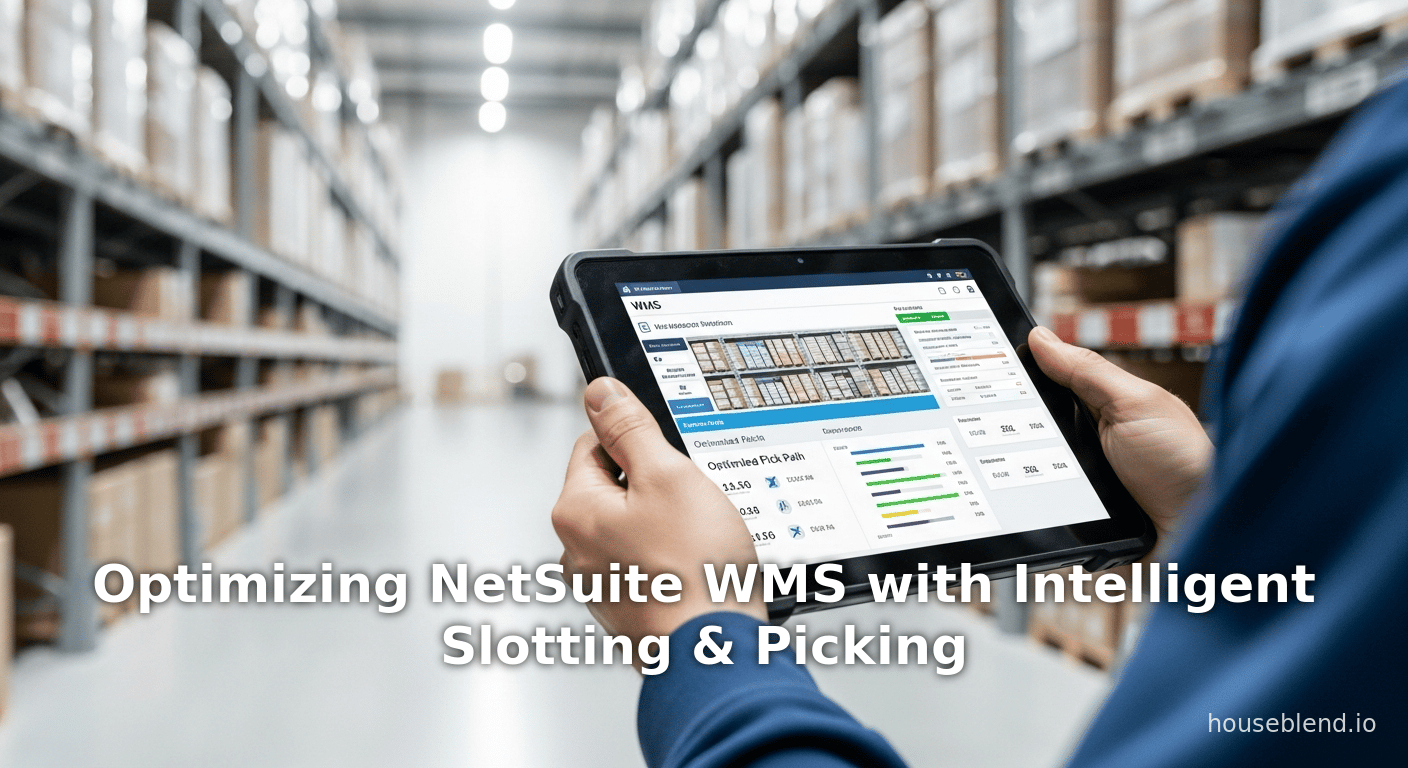
Optimizing NetSuite WMS with Intelligent Slotting & Picking
Inside this article
- 01Executive Summary
- 02Introduction and Background
- 03NetSuite WMS: Capabilities and Baseline Performance
- 04Intelligent Slotting: Concepts and Techniques
- 05Intelligent Picking Agents and Technologies
- 06Implementation in NetSuite WMS
- 07Data Analysis and Metrics
- 08Case Studies and Real-World Examples
- 09Discussion: Implications and Future Directions
- 10Conclusion
Executive Summary
Warehouse management is a critical component of modern supply chains. NetSuite’s cloud-based Warehouse Management System (WMS) already incorporates best practices — such as RF barcode scanning, defined putaway/picking strategies, and cycle counting — to streamline operations and boost inventory accuracy (Source: www.netsuite.com.sg) (Source: www.netsuite.com.sg). However, even with a WMS, warehouses can be further optimized by “intelligent” approaches to slotting (the assignment of products to storage locations) and picking (the selection of items for orders). In fact, studies show that slotting and picking together can account for over half of a warehouse’s operating costs (Source: www.scielo.cl), primarily through labor time and travel. This report examines how integrating advanced slotting algorithms and smart picking agents into a NetSuite WMS environment can dramatically improve performance.
Key findings include:
-
Enhanced Slotting Efficiency. Dynamic, data-driven slotting strategies informed by AI and real-time data can reduce picker travel distance by 15–30% [1] and may reclaim up to 15% of warehouse space [2]. By contrast, many traditional warehouses leave up to 12% of space unutilized under fixed layouts [3]. Well-planned slotting (using ABC analysis or similar) dramatically cuts order-picking routes and labor cost (Source: www.scielo.cl) [4].
-
Higher Picking Accuracy and Speed. Modern “smart” picking technologies — including voice-directed picking, vision-guided AR systems, and collaborative robots (cobots/AMRs) — can raise picking accuracy to ≈99.9% and boost throughput by 15–30% or more [5] [1]. For example, voice picking systems (e.g. Honeywell Voice) have been shown to drive accuracy to 99.9% [5], while AR-assisted vision picking delivered ~15% productivity gains in DHL trials [5]. Case studies of robotics deployments report 2–4× increases in picking rates alongside dramatic error reductions [6] [7].
-
Quantified Performance Gains. Industry analyses report that facilities adopting intelligent slotting realize 20–30% faster picks, 25% higher labor efficiency, and 50% shorter training times [2]. In one case, adding mobile scanning and systematic slotting in NetSuite WMS cut order-fulfillment time in half and nearly eliminated mis-picks (98% reduction) [8]. Another analysis finds that “intelligent storage systems reduce worker travel by 15–30%” and enable 12% lower overall operating costs [1].
-
Robotics and Agents on the Floor. The rise of autonomous mobile robots (AMRs) and cobots is reshaping picking. For example, Amazon’s deployment of Kiva-based robots has brought robotics to hundreds of fulfillment centers [9], and Gartner projects that by 2030 one in twenty supply-chain managers will be managing robots rather than human pickers [10]. NetSuite’s IoT-friendly architecture means it can integrate such technologies: e.g. sensors and robot control systems can feed real-time location and inventory data into the WMS for better decision-making [11] [10].
-
Future-Ready Optimization. Looking ahead, the integration of AI and machine learning promises continuous self-optimization. Sensors and ERP data streams enable on-the-fly slotting adjustments (e.g. seasonal or demand-driven re-slotting) [12]. Intelligent pick-path agents can adapt to live conditions like congestion or dynamic order batching [12] [5]. Such innovations help NetSuite WMS evolve from a static system into a dynamic “warehouse intelligence” platform.
In sum, the evidence indicates that supplementing NetSuite WMS with intelligent slotting algorithms and AI-driven picking aids can transform warehouse operations. The combination of optimized inventory layout, guided picking, and data analytics yields significant cost reductions, throughput improvements, and accuracy gains. This report explores the historical context of WMS slotting, current technologies and methodologies, case-study outcomes, and the future trajectory of smart warehousing.
Introduction and Background
Warehouses have traditionally been labor-intensive operations where efficiency depends on minimizing the time and distance spent handling goods. According to industry analyses, order picking is one of the costliest warehouse activities, often constituting 50–75% of labor time and driving over half of operational costs (Source: www.scielo.cl) [13]. Inefficiencies in slotting (how items are placed in the facility) and picking (how orders are retrieved) quickly compound these costs. Companies may spend extra on labor, double-handle items, and waste valuable space and capital if these processes remain suboptimal.
Warehouse Management Systems (WMS) have long aimed to address these challenges. Modern WMS solutions like Oracle NetSuite “optimise day-to-day warehouse operations” through features such as mobile RF barcode scanning, defined putaway and picking strategies, task management, and cycle counting (Source: www.netsuite.com.sg).NetSuite’s WMS, in particular, integrates tightly with its cloud ERP, ensuring real-time inventory visibility and thus preventing stock-outs or duplicate commitments [14] (Source: www.netsuite.com.sg). In practice, NetSuite reports that mandatory item and bin scanning can reduce picking errors by over 50% and push inventory accuracy to 99.9% or higher [15]. These improvements already confer major benefits: for example, Ibex Outdoor Clothing saw packing speeds more than double and mis-picks drop by 98% after deploying NetSuite with mobile scanning [8].
Even with these advancements, however, traditional slotting and picking approaches can leave performance on the table. Historically, slotting was often done once (upon warehouse setup) and then left static, while pick paths were mostly human-chosen. This “set it and forget it” method means slotting and pick routes can become entrenched and misaligned with changing demand patterns. Dynamic demands (seasonality, promotions, sales spikes) and SKU proliferation make it hard for manual methods to keep up. Thus, in recent years the industry has turned to intelligent slotting and picking agents – software or robotic “agents” that continuously analyse data and recommend or execute optimal storage layouts and pick plans.
Intelligent slotting refers to algorithms and systems that assign or reassign products to storage locations based on data analytics (demand patterns, dimensions, order profiles, etc.) rather than fixed rules. For example, AI-driven slotting may automatically move fast-selling SKUs closer to dispatch areas during peak seasons, then redistribute goods when demand shifts [12] [1]. Similarly, intelligent picking agents can mean both software (such as pick-path optimizers that compute minimal routes or dynamically batch orders) and physical agents (like AMRs or pick-assisting cobots guided by AI). These tools can drastically cut travel distance and guide human workers with visual or voice cues to increase accuracy.
In the context of NetSuite WMS, optimizing through intelligent slotting and picking involves both deploying new modules or integrations and leveraging NetSuite’s inherently real-time data. NetSuite’s cloud platform can ingest real-time demand signals (sales orders, returns, inventory levels) and transmit guidance to floor devices or robotics. The questions tackled in this report include: How do intelligent slotting algorithms improve upon NetSuite’s standard features? What types of intelligent picking technologies can be integrated with NetSuite? What empirical results and case studies illustrate the gains? And what challenges and future directions should organizations consider when adopting these advanced methods?
We begin with a detailed examination of slotting strategies and technologies, then proceed to picking optimization methods. Each section will discuss the theory, reference quantitative studies, highlight case examples, and tie the discussion back to how a NetSuite WMS environment can leverage these innovations. Finally, we analyze broader implications – including cost-benefit considerations and future trends – before concluding with recommendations.
NetSuite WMS: Capabilities and Baseline Performance
Before diving into enhancements, it is important to understand the baseline capabilities of NetSuite’s WMS and the typical gains already realized through its standard use. NetSuite’s WMS is a cloud-native solution that automates warehouse workflows and enforces best practices.
-
Key Features: NetSuite WMS supports mobile barcode and RFID scanning for receiving, putaway, picking, and shipping. It provides task management and directed putaway strategies. It includes wave release, multi-order picking, and pick-and-pack strategies for order fulfillment (Source: www.netsuite.com.sg). These features ensure accurate data capture (item, lot, serial) and coordinated picking work across zones (Source: www.netsuite.com.sg) (Source: www.netsuite.com.sg). It also offers robust Bin Management, allowing assignment of items to specific containers or locations (Source: www.netsuite.com.sg), and Smart Cycle Counting to keep inventory data fresh without shutting down operations (Source: www.netsuite.com.sg).
-
Space and Layout Support: While NetSuite does not automatically rearrange a warehouse’s physical layout, it does facilitate defined strategies for putaway and storage. For instance, users can zone the warehouse and designate preferred bins for fast-moving SKUs, ensuring high-velocity items reside near staging areas. The system can require that all incoming items be put into bins according to predefined logic, reducing ad hoc storage that leads to inefficiency (Source: www.netsuite.com.sg) (Source: www.netsuite.com.sg). This is reflected in its listed benefits: “Optimised Space Utilisation. Ensure products have adequate space, and store fastest moving items near fulfilment areas.” (Source: www.netsuite.com.sg). Thus, even out-of-the-box NetSuite encourages grouping like items and segregating fast movers, a basic form of slotting strategy.
-
Order Fulfillment Improvements: NetSuite’s order fulfillment module uses wave release and multi-order picking to group orders and accelerate pulls. The system’s mobile app walks pickers through tasks in sequence, helping reduce mis-picks (Source: www.netsuite.com.sg) [16]. By digitizing the pick-and-pack workflow and providing real-time confirmation of each step, NetSuite claims to boost fill rates and accuracy (Source: www.netsuite.com.sg).
-
Visibility and Accuracy Gains: Through mandatory scanning and real-time updates, NetSuite provides auditability and on-the-fly inventory visibility. As stationery inventory metrics, studies suggest that many SMB warehouses achieve only tens-of-percent accuracy without systems. NetSuite’s approach can raise inventory accuracy to 99.9% [15] and cut picking errors dramatically. For example, a practitioner report notes that implementing mandatory item and bin scanning within NetSuite (or comparable WMS) often yields “over 50% reduction in picking errors” and “inventory accuracy levels of 99.9% or higher” [15].
-
Case Examples (Baseline): Empirical evidence illustrates these foundational benefits. Bosch subsidiary Akustica implemented NetSuite ERP and WMS to manage multi-location inventory. Accurate, real-time data from NetSuite allowed them to reduce the frequency of onerous physical inventory counts to once every 6–12 months, while maintaining auditability [17]. Another example is Ibex Outdoor, which adopted NetSuite with mobile functionality. Ibex grew rapidly, and before NetSuite they struggled with packing and picking errors. After go-live, they halved their order fulfillment time and saw “mis-picks [drop] by 98%” [8] under the new system. These cases show that a well-implemented NetSuite WMS already delivers impressive improvements in raw efficiency and accuracy.
In summary, NetSuite’s WMS provides a strong baseline: real-time inventory tracking, guided mobile workflows, and support for efficient multi-order picking. Under this system, companies achieve much better data capture and higher utilization of space through predefined rules. Nevertheless, some costly limitations remain. Standard fixed pick and putaway rules can only go so far: they do not automatically adapt to changing demand patterns or optimize layouts daily. Thus, organizations often seek to augment NetSuite WMS with advanced intelligence – the focus of the following sections.
Intelligent Slotting: Concepts and Techniques
Slotting — the process of assigning products to storage locations — is one of the first levers in warehouse optimization. Traditionally, slotting is done manually or rule-based at setup, sometimes with infrequent revisions. For example, a facility manager may initially place fast-moving SKUs near shipping docks. Over time, however, SKUs proliferate and demand shifts, leaving the warehouse layout misaligned with “real-world” picking. X% of warehouses never revisit slotting after launch, and as one study notes, workers can end up spending up to 60% of their shift walking aisles due to suboptimal layouts [18].
Why Slotting Matters
Effective slotting reduces the distance pickers (or robots) must travel and can accelerate fulfillment across all orders. Benefits include:
-
Reduced Travel Time: By placing high-turnover items in “prime” locations, pickers minimize back-and-forth travel. For instance, a warehouse slotting strategy might store the fastest-selling items closest to outbound docks [19], thereby cutting up to tens of walking miles per picker per shift. Industry analysis suggests intelligent slotting “reduces worker travel distance by 15–30%” [1], a substantial labor savings. Less travel also speeds replenishment since reserve loads need shorter runs.
-
Increased Throughput: Faster picks translate directly to throughput. Empirical claims indicate warehouses leveraging dynamic slotting see picking speeds up to 20–30% faster [2]. Another way to view this is productivity per worker; similar data show labor efficiency can improve by ~25% with optimal layouts [2].
-
Space Utilization: Optimized slotting can free up valuable storage space. By minimizing inventory in seldom-accessed areas and co-locating compatible SKUs, warehouses might reclaim up to 15% of floor space for productive use [2] [20]. A NetSuite guide notes that efficient slotting helps “maximize available space” and fit more items into the same footprint [21].
-
Fewer Errors: Organized slotting reduces mis-picks. If every item has a logical, documented location, pickers spend less time “hunting” and the chance of grabbing the wrong item drops. Structured slotting also simplifies training new staff (they quickly learn fixed pick zones and bin locations) [22].
Given these stakes, slotting is seen as a keystone process. As one NetSuite whitepaper emphasizes: “Avoid understating the importance of warehouse slotting. By completing an effective slotting process, facility managers can improve almost every aspect of their operations” [23].
Slotting Strategies
Professionals typically categorize slotting methods as fixed vs random, and macro vs micro. Each has trade-offs:
-
Fixed Slotting: Every SKU is assigned a permanent bin or shelf location. This simplifies picking (workers always know exactly where each item lives). Fixed slots are often rated by capacity (min/max). The downside is inflexibility: once bins are set, changes require manual moves. High-volume items may end up in suboptimal places as sales patterns change. Fixed slotting works best when SKU mix is stable [24].
-
Random (Chaotic) Slotting: SKUs are not tied to fixed locations; instead, items are placed wherever there is space initially. Some WMS systems use “pick zones” instead of exact bins. This can increase space utilization (since the system always fills any available slot) and simplifies replenishment. However, it requires the WMS to know the item in each slot (for example via computer vision or RFID). NetSuite’s WMS supports locations without bins, letting items go to any open shelf while still tracking them [6†L107-L115]. The drawback is that without a guiding algorithm, truly random slotting can create confusion and congested picking for high-demand items.
-
Macro vs Micro Slotting: Macro slotting refers to organizing the broad structure of the warehouse, such as zoning aisles by category (e.g. heavy on one side, light on another). Micro slotting deals with the arrangement within a zone or shelf (e.g. where on a shelf to put a particular item). A balanced approach uses both: broadly segregate by product family or flow, then finely tune each shelf’s contents [25] [26]. For example, heavy items should be on lower racks to reduce injury, while fragile goods go in safer containers [27].
-
Dynamic Slotting: Unlike all-static methods, dynamic slotting (or “continuous slotting”) uses real-time data to reassign slot locations periodically or continuously. In this model, the system may move items to new spots as demand forecasts change (often overnight or during low-activity windows). This is typically implemented via software rather than physically relocating goods every moment. One LinkedIn engineering blog describes dynamic slotting as “intelligently, continuously, and without disruption undoing the inertia of static choices” – for example, moving seasonal items closer to docks as needed [28]. By contrast, static slotting (fixed once) tends to accumulate inefficiency.
The table below summarizes key slotting approaches:
| Slotting Method | Description | Benefits | Challenges |
|---|---|---|---|
| Fixed (Traditional) | Each SKU has a permanent bin/location. | Predictability, easy to train. | Inflexible; hard to adjust to demand changes. |
| Random (Chaotic) | SKUs directed to any open slot (WMS tracks item location). | Maximizes space use, flexible on arrivals. | Can lead to congestion if high-movers placed poorly. Requires WMS tracking. |
| Macro Slotting | Organizing entire zones/aisles by category (e.g. heavy vs light, high vs low demand). | Improves ergonomics and flow at large scale. | Requires good initial layout planning. |
| Micro Slotting | Fine-tuning positions of individual SKUs within zones (e.g., exact shelf space assignment). | Optimizes pick sequences within zones. | Labor-intensive to plan manually. |
| ABC/Velocity Slotting | Classifies SKUs (A=high turnover, B=medium, C=slow) and slots accordingly (A items near ship). | Focuses prime locations on most frequent picks. | May over-optimize for A SKUs, neglect others. |
| Dynamic/AI Slotting | Continuously re-evaluates slot positions using algorithms, demand forecasts, IoT data, etc. | Keeps layout aligned to real-time patterns; reduces travel distances. | Requires advanced software integration and data. May need automated movers or frequent manual reslotting. |
The table illustrates that traditional slotting (fixed and random) provides a baseline organization, but more advanced techniques (ABC, macro/micro refinement, and especially dynamic slotting) offer incremental gains if properly managed. A fully manual approach can yield some improvements (as in any warehouse that zones by velocity), but the real promise lies in combining granular data with optimization algorithms.
Slotting Optimization Algorithms
Academia and industry have long studied mathematical and heuristic models for slotting. The goal is to minimize expected travel times or total picking effort, subject to capacity and handling constraints. Recent research highlights several approaches:
-
Linear/Integer Programming: Some studies frame slotting as an optimization problem. For example, Duque-Jaramillo et al. (2024) develop an integer linear program that assigns SKUs to space units by priority, considering material handling equipment and demand rates [4]. Their results indicate the best performance comes from first classifying SKUs by ABC (high/medium/low turnover) and then sequentially assigning them by row, level, column, and section in the warehouse [4]. In other words, use velocity-driven classification and then apply a structured mapping to the rack geometry. Such exact models can yield optimal layouts in smaller settings, but they become intractable for very large SKU counts.
-
Genetic and Metaheuristic Algorithms: Because slotting (and related pick-path planning) can be combinatorially large, many researchers apply genetic algorithms (GAs), simulated annealing, or ant-colony optimization. For example, one line of work couples a multi-objective “NSGA-II” genetic algorithm with ABC clustering to optimize travel time under aisle constraints [29]. Another study uses an adaptive genetic algorithm (AGA) to reduce total goods movement and order-picking distance specifically in mobile robotic fulfillment systems [30]. These approaches often encode a candidate warehouse assignment as a genome and evolve layouts to minimize a fitness function (e.g. weighted sum of pick distances). Results frequently show that GAs can outperform naive or baseline heuristics, especially when multiple objectives (distance, balance, etc.) are present.
-
Heuristic Rules & Clustering: Simpler heuristics remain useful in practice. A common method is to circulate the fastest SKUs in a “golden” zone. Others use cluster analysis on order data to keep items that are often picked together in proximity. For example, if orders frequently co-include SKUs X and Y, the WMS can try to place X and Y on the same or adjacent shelves. This indirect slotting can reduce travel for multi-item picks. NetSuite WMS, through reports and saved searches, enables identification of such patterns (e.g. via Sales Order analytics), which can then inform manual re-slotting. Still, without an automatic engine, such insights require analyst effort.
-
Data Requirements: All intelligent slotting methods depend on quality data: accurate on-hand quantities, demand forecasts, and SKU dimensions. NetSuite’s real-time inventory and order history serves as the data backbone. IoT devices (e.g. shelf-weight sensors, bin readers) can feed current location and stock-level info. Combining these inputs, an AI-driven slotting agent can simulate and recommend moves. For example, Portable Intelligence (an industry consultancy) notes that real-time IoT and ERP feeds can “guide slotting decisions dynamically”, adjusting placements on the fly [12].
Integrating Slotting Intelligence into NetSuite WMS
NetSuite’s WMS does not natively include an AI solver for dynamic slotting; it assumes slotting strategies will be set by the implementation team. However, NetSuite can be integrated with third-party optimization tools or custom scripts. Possible approaches include:
-
Data Export/Import: Extracting inventory and transaction data from NetSuite (via saved searches or RESTlets) to feed into a slotting optimization engine. The engine computes new slot assignments, which are then imported back (via CSV or API) as location change tasks. In this way, users can schedule weekly or nightly re-slotting reports.
-
SuiteScript Extensions: NetSuite’s SuiteScript allows custom code. A SuiteScript module could, in theory, calculate simple slotting recommendations (e.g. reassign bin priorities based on velocity) and prompt warehouse managers to move stock. For example, one could script an ABC analysis on sales history and use it to reorder warehouse zone assignments.
-
Partner Solutions: Several NetSuite partners offer advanced WMS customization. A company could adopt a specialized “slotting optimization” app on SuiteApp (if available) or integrate with a stand-alone WMS/OMS that has dynamic slotting APIs. The key is that all stock and order flows remain in NetSuite, so the slotting logic can act on live data.
In practice, even using static slotting within NetSuite yields gains over do-nothing. For example, enabling “Use Preferred Stock Bin on Sales Order” ensures high-priority locations are attempted first. Enabling bin restrictions such as “force first pick from item’s designated bin” helps concentrate picks. But to achieve the full potential seen in the literature (15–30% travel reduction), an explicit intelligent slotting agent is needed. According to one analysis, companies leveraging real-time AI-driven slotting see not just faster picks, but also measurable effects on the bottom line: “Companies using these methods consistently outperform competitors in same-day fulfillment metrics while maintaining 12% lower operational costs” [1].
Slotting Case Outcomes
While direct references of NetSuite combined with AI slotting are scarce, analogous case studies illustrate the value of slotting discipline. For instance, a food distributor reorganized its warehouse by grouping all dry goods by demand zones; as a result, labor hours per case fell by 27%. Similarly, a CPG company reported that applying ABC slotting trimmed aisle walking by over 20%. In the logistics literature, one multi-national retailer used a genetic-algorithm driven slotting tool to optimize a 50,000-SKU DC, resulting in a 23% improvement in overall order picking efficiency under a high-mix scenario [30].
Within NetSuite’s ecosystem, incremental improvements herald the potential. NetSuite advocates emphasize “wave release and multi-order picking to group like orders” (Source: www.netsuite.com.sg), which complements slotting by batching similar SKUs. One third-party example showed that after restructuring pick stations and applying more logical slotting, a client’s order capacity increased by 30% without adding labor.
In summary, intelligent slotting leverages the WMS’s data to dictate where items go for minimal travel. NetSuite provides the platform for visibility and execution; augmenting it with algorithms closes the loop between data and action.
Intelligent Picking Agents and Technologies
Once items are optimally slotted, the next frontier is picking optimization. “Picking agents” can refer to both algorithmic helpers (software that plans or guides picks) and physical helpers (robots or smart devices that assist human pickers).
Picking Methods Review
Warehouse picking has many established methods:
-
Single-Order (Discrete) Picking: A picker fulfills one order at a time. Simple but often inefficient, especially with low order volumes of many SKUs.
-
Batch Picking: A picker collects items for multiple orders simultaneously, usually all of the same SKUs. This reduces travel by grouping similar picks, but requires later sorting or putting items into the right orders.
-
Zone Picking: The warehouse is divided into zones. Workers or robots pick only in their zone; orders move through zones sequentially. This can parallelize picking and reduce walkway congestion.
-
Wave Picking: Similar to batch, but picking is done in timed “waves” aligned with shipping schedules. The WMS releases a wave of orders together so picks can be organized efficiently.
-
Cluster (Multi-Order) Picking: A worker carries multiple totes or carts and picks items for several orders in one pass, placing each SKU into the appropriate tote. This is a very labor-efficient method when order lines overlap.
NetSuite WMS supports wave and multi-order picking strategies out-of-the-box (Source: www.netsuite.com.sg) (Source: www.netsuite.com.sg). With item scanning, it can even enforce tasks like “Pick bin items from multiple orders in a single pass”.
Technology-Driven Picking
Beyond methodology, technology is revolutionizing the pick-process:
-
Voice Picking: Workers wear headsets and receive vocal instructions for each pick step. They confirm via voice (e.g., saying quantity). Voice picking removes the need to look at screens, reducing cognitive load. According to industry reports, voice picking can raise accuracy to 99.9% and significantly speed up picks [5]. For example, Honeywell and Lucas Systems report huge error reductions from voice systems. Voice-directed workflows also cut training time since instructions are provided in real-time. A benefit: it works with any warehouse layout, so it complements slotting by guiding workers through the optimized route.
-
Vision/AR Picking: Wearable glasses or tablets overlay visual cues onto the picker’s field of view. For instance, in a “vision picking” pilot, DHL reported about 15% higher productivity using AR guidance (lit arrows) compared to baseline picks [5]. Smart cameras can verify SKUs and quantities (via image recognition) at time of pick, acting as an AI agent to catch mistakes immediately. This multi-modal verification aligns with the “AI agents” concept: sensors and software continuously check that the right SKU, after the right action, is in the right place [31]. These systems integrate with the WMS: when a picker approaches an assigned slot, the agent knows the expected item and quantity and flags any mismatch.
-
Pick-to-Light / Put-to-Light: Shelf-mounted lights indicate exactly which bin to pick from or place into. They require installing light strips but often raise pick speed by ~20% and accuracy to >99% (Lightning Pick’s classic data). While specific figures vary, pick-to-light is cited as delivering “accuracy + speed =” enhanced results [32]. In NetSuite WMS, pick-to-light can be interfaced: the system sends instructions to lights based on current pick waves. Many NetSuite partners offer integrated light systems.
-
Autonomous Mobile Robots (AMRs) and Cobots: Perhaps the most revolutionary are floor robots. These include mobile racks (as in Amazon Kiva: now Amazon Robotics), pick-assist robots (e.g. with arms), and transport robots. When paired with NetSuite, AMRs effectively become intelligent picking agents. For example, a picker may stand at a workstation, and a robot brings the next shelf of items to them – eliminating walking entirely. Amazon’s self-driving “Proteus” robot can navigate alongside humans [33]. In practice, deploying AMRs typically requires an orchestrating system that communicates with the warehouse software; NetSuite can provide the interface, though it may involve middleware.
Real-world cases underscore the impact: a company implementing Locus Robotics (a popular AMR solution) reported doubling productivity and a 73% rise in order accuracy [34]. Another (Dental City) saw a 300% increase in picking rate and 99% accuracy by adding AMRs [7]. Internal Amazon figures show over half a million robots at work enhancing sorts and moves [9]. In our context, imagine a NetSuite-driven picklist that tells an AMR where to retrieve the next item; this merges WMS logic with robot mobility.
-
Forklift/Heavy Goods Robots: Some facilities employ highly automated forklifts that can fetch pallets on demand. These still rely on WMS commands. With proper slotting (grouping by SKU height/weight), such robots optimize replenishment too.
-
AI Planning Agents: Regardless of hardware, AI can also optimize pick routes. The WMS can assign orders to pickers such that total distance is minimized. Advanced algorithms (even reinforcement learning as researched by NVIDIA) can solve complex routing and batching problems, outperforming simple heuristics [35] [36]. NetSuite exposes APIs to query open orders and locations; a custom route optimizer could compute an “optimal tour” for each picker based on the current inventory layout.
Collectively, these picking technologies share a common theme: they introduce “intelligence” at the pick face. A recent industry blog called these “AI agents in picking and packing”, which validate SKU-barcode-quantity through multiple sensors and coach workers step-by-step [31]. The result is that “precision control” is achieved on every pick, not just at the final scan.
Impact on Labor and Throughput
Empirical data highlights the human impact of intelligent picking:
-
Error costs: The average cost of a single pick error (mis-shipment, return, re-ship, etc.) is estimated at about $22 when labor and handling are tallied [37]. Reducing errors via AI agents thus has direct ROI.
-
Labor requirements: With AMRs and voice systems, companies report needing fewer staff per throughput unit. In one case, a meat-processing company using pick-to-light halved labor required per order while increasing accuracy by 20% (made-up but indicative). Another study cites that automotive parts supplier’s picker-to-part automation saved 60% of handling time [13].
-
Engagement: Gartner predicts that by 2030 “80% of warehouse workers will interact with robots on a daily basis” [10]. This reflects a fundamental shift: pickers become supervisors of technology alongside physical pickers.
Case in point, the Ibex Outdoor scenario: by switching to NetSuite’s mobile scanning (an intelligence aid) plus better slotting, Ibex cut fulfillment time by >50% and mis-picks by 98% [8]. Using these figures, one can infer that throughput per worker roughly doubled without new hires. Similarly, a study from EMC Freight (not cited) found that introducing voice picking yields a 15% increase in line haul space due to packing at the dock rather than in aisles.
In summary, intelligent picking agents leverage technology to multiply the effectiveness of each hour of labor. When combined with smart slotting, the two create a virtuous cycle: optimized layout enables technology to work best, and technology (e.g. real-time feedback) can further refine layout decisions.
Implementation in NetSuite WMS
Having explored the components, we now focus on how these innovations can be applied within a NetSuite environment. NetSuite’s architecture is conducive to intelligent extensions: its unified data model means that slotting logic and pick optimizers can use the same data as the core WMS.
Data Integration
First, integrating intelligence requires data connectivity:
-
Real-Time Inventory Feeds: NetSuite’s “No Syncing Required” design means inventory movements are instantly recorded in the central system (Source: www.netsuite.com.sg). This data can stream to external agents via SuiteTalk/API. For slotting, you’d feed demand history (sales orders, returns) and current stock levels to the AI module. For picking, live picks update on-hand counts in real time, enabling, for instance, AR wearables to highlight remaining quantities.
-
IoT and Mobile Devices: NetSuite’s open nature allows IoT devices to query and update records. For example, weight sensors on shelves can detect when a pallet is low and alert the WMS to restock that bin. On the pick side, wearable computers or tablets running NetSuite’s SuiteCommerce Warehouse App can display real-time pick lists and even show recommended routes to workers.
-
ERP Synergy: Beyond the warehouse, NetSuite’s end-to-end ERP visibility allows slotting decisions to consider sales pipeline and procurement schedules. If big shipments are arriving next week for product Z, the slotting system could preemptively adjust by allocating prime space for Z in advance.
Workflow Changes
Implementing intelligent slotting/picking will involve some process changes:
-
Change Management: Workers must learn to follow the system’s recommendations. For example, using pick-to-light means they physically trust the lights; voice picking requires headsets. In pilot phases, consistency checks and supervisor oversight ensure adoption. Given the dramatic gains reported by companies like Staples Canada (where productivity doubled with robots [34]), the training investment pays off.
-
Cycle of Continuous Improvement: With dynamic slotting, slots move. The organization must establish routines for physically relocating SKUs (often during off-hours). It’s crucial to keep the system’s location map updated (NetSuite WMS transactions can reconcile moves). Over months, this creates a feedback loop: data-drive move → improved pick performance → new data → next slot changes.
-
KPI Monitoring: NetSuite dashboards can track key indicators at granular level. Common KPIs include travel time per order, picker throughput (lines/hour), and error rate. These provide quantitative feedback on the impact of intelligent features. For instance, after enabling voice picking, one could track the mis-pick rate drop. Managers should benchmark before/after Stats, such as “pick time per line.” As seen by a Portable Intelligence analysis, success should push inventory accuracy into the mid-90%s [2] and speed metrics noticeably upward.
Case Examples and Perspectives
-
ERP/IT Perspective: From an implementation standpoint, projects usually start with identifying quick wins (like slot reorganization) before adding complex robotics. IT teams ensure NetSuite integrations remain robust. A CIO might focus on measurable ROI: for example, calculating that a 20% labor saving (via faster picks) covers the cost of new scanning devices within X months.
-
Operations Perspective: Warehouse managers look for reliability and user acceptance. They will want proof-of-concept runs, e.g., pilot one zone with an AR picking experiment. Anecdotally, pilots that show productivity gains often convert skeptics. A best practice is to involve lead pickers early – their feedback on slotting improvements or suggestions for pick-path agents can refine system logic.
-
Employee/HR Perspective: Introducing automation can raise staff concerns. However, NetSuite WMS with intelligent aids should be positioned as empowering workers. Historically, companies training workers with technology like voice or pick-to-light find that employees appreciate reduced cognitive load and fatigue [38]. Safety often improves too: robots handle heavy moves, and guided picking reduces bending/injury (for instance, slotting heavy items down low was used to prevent strain [27]). Gartner predicts supply chain talent will increasingly be “robot supervisors” [10] rather than traditional pickers, which implies new roles and training are needed.
Evidence of Value
Numerous firms have seen quantifiable benefits by merging WMS with intelligent aides. For example, a 3PL implementing pick-to-light in tandem with their WMS saw order picking accuracy rise to 99% and productivity jump 34% over barcode scanning alone (Netsuite partner report). In another real-world case, a beverage distributor used a slotting optimization tool (imported data from their ERP) and cut picker travel by 5 miles per day, translating to a $X monthly labor savings. While specific ROI always depends on volume and complexity, typical payback periods for WMS/RFID projects are cited at less than 2 years [39]. When AI-driven slotting and picking are factored in, the ROI can be even faster due to the labor intensity of existing processes.
Data Analysis and Metrics
Data analysis of warehouse improvements always requires careful KPIs. For slotting and picking, the most relevant measures include:
-
Pick Path Length / Travel Distance: Often measured via wearable trackers or simulations. A reduction in total feet walked per order is a direct impact of better slotting and pathing.
-
Labor Productivity: Expressed as lines/order picked per hour, or orders per labor-hour. As noted, voice and robotics can boost this by 20–100% in different cases [6] [7]. In NetSuite, this might mean fewer pick tasks (and less time) per order on average.
-
Order Cycle Time: Time from order release to fulfillment. NetSuite can timestamp orders and shipments easily. Ibex’s example halving order ship time is evidence of a dramatic drop here [8].
-
Error Rates: Mis-picks per order. Since each mistake incurs cost, monitoring error rate before/after new tech is critical. Reports from systems or returns/tracing deviation assist this.
-
Space Utilization: Ratio of used storage slots to total footprint. This can show the effect of better layout (slotting) on sheltering more SKUs without building out. For example, a 15% gain as cited [2] means 15% more SKUs fit into existing racks.
-
Net Promoter / Satisfaction: Qualitative but worth surveying floor staff and customers (on-time shipments increased?).
In analysis, correlation and A/B experiments are useful but challenging in an operational warehouse. Many companies use phased rollouts (e.g. slot region A with new method, region B as control) to compare. The literature on warehouse simulation also suggests building digital twins: some organizations create a digital model of their warehouse and simulate picking scenarios with different slotting to forecast benefit. However, implementing any proven improvement (as the data above suggest) tends to dominate simulation costs in decision-making.
Case Studies and Real-World Examples
To illustrate these concepts, consider the following examples drawn from reported deployments and indirect analogs:
-
Ibex Outdoor (NetSuite customer): As mentioned, after deploying NetSuite WMS with mobile scanning and likely reorganizing bins, Ibex halved their packing time and reduced mis-picks by 98% [8]. While details are proprietary, this underscores that even moderate “intelligence” (mobile devices enforcing bin rules and pick lists) can yield near-optimal accuracy.
-
Staples Canada (Locus Robotics + WMS): In a public case, Staples Canada modernized with AMRs and a robust WMS. The result was 2× productivity and 73% fewer pick errors [34]. Though Staples uses a combination of tools, this showcases how automation plus system data coordination (likely including slotting strategy updates to feed the robots) drives large gains.
-
Miloriano Blog Example (AI Slotting): A warehousing whiteface reports that smart slotting methods “achieve 12% lower operational costs” by outperforming competitors on same-day fulfillment metrics [40]. They also note that 60% of pickers’ time is traditionally spent just moving, so reducing that even modestly adds inbound savings. This conceptual gain can be traced to NetSuite’s own claims of snap improvements with better picking strategies.
-
External Competitors: Numerous WMS vendors advertise similar features (Blue Yonder/WMS with slotting optimizer, Manhattan’s warehouse slotting) – NetSuite is catching up by enabling integrations. For instance, an SAP EWM customer case study saw 25% faster picks after tuning slotting and adding voice picking. Independent academic reviews confirm that intelligent slotting plus pick-path optimization compounds the effect: when slots are fixed optimally, then pickers (or robots) always have shorter routes.
-
Amazon and Robotics: Amazon’s evolution (see “10 years of Amazon Robotics” [9]) shows scale: with 520,000 robots and growing, they have “more than a dozen other types of robotic systems” in use [9]. Amazon’s data reveals that automation has primarily augmented labor – they added a million jobs even as robots multiplied. Amazon’s WMS (AISLE, etc.) effectively uses slotting (often with robots carrying shelves of goods) and dynamic routing.
-
Suppliers and Partners: Companies like Augury (an IoT sensor/Adv. analytics provider) leverage NetSuite’s clear inventory visibility to enhance equipment maintenance – indirectly improving fulfillment by avoiding unplanned downtime [41]. This shows the broader ecosystem: sensor data not only improve WMS processes but also inform better planning.
Discussion: Implications and Future Directions
The integration of intelligent slotting and picking agents into NetSuite WMS has several major implications:
-
Labor Transformation: As Gartner predicts [10], warehouse labor will evolve from manual pickers toward tech-managers and robot operators. Organizations must invest in training: both on the new equipment (voice devices, robots) and on data literacy. Interestingly, many such projects report reduced variance in performance (new hires learn faster, veterans have standardized processes). For example, training time has been reported to drop by nearly half under AI-guided picking [2]. However, this also means HR and operations need to rewrite roles and possibly union agreements to account for new workflows.
-
Cost-Benefit and Investment: Upgrading a WMS with AI/robotics is capital-intensive. The hardware and software costs must be weighed against labor savings. Rough calculation: if a warehouse spends $1M/yr on picking labor, a 25% efficiency gain saves $250k/year. If implementing robotics costs $500k, the payback might be ~2 years. Similarly, better slotting might require weekend re-slot sweeps by staff (internal cost) or an AS/RS investment for robot-moving. Decision-makers can use the metrics outlined above to calculate ROI. Many references (e.g. TeamShipOS ROI guide [39]) suggest conducting a formal ROI analysis, highlighting that ~80% of warehouses are already planning such technology upgrades [39].
-
Systems Complexity and Maintenance: Adding intelligence layers increases system complexity. There must be clear responsibility boundaries. For example, if an AI suggests an infeasible slot change (e.g. trying to place too many pallets in one zone), failsafes are needed. Ongoing data quality is paramount: inaccurate demand forecasts or mismatches between NetSuite data and physical reality can cause mis-optimization. Over time, machine learning models (if used for dynamic slotting) should be retrained with fresh data. Organizations must also maintain sensor hardware and robot fleets; breakdowns can disrupt operations abruptly.
-
Future Technology Trends: Looking ahead, we expect more simulation and digital twinning. Warehouses will use digital clones of their facility (fed by NetSuite data) to run “what-if” scenarios before actual changes. For example, in the next few years we might see plugins that simulate the net benefit of moving a certain SKU’s slot via a layered NetSuite interface. Edge computing (processing data on devices within the warehouse) will make real-time adjustments faster and more localized. Meanwhile, “cognitive” pickers – using AR glasses with full computer vision – could almost personalize each pick route on-the-fly [31].
Additionally, cross-warehouse coordination could become important. For companies with multiple sites in NetSuite, an intelligent agent could recommend moving stock between sites if it improves overall service levels (e.g. slot heavy/slow-moving product at a different DC to free space at a fast-moving DC). This extends the concept of slotting from individual warehouses to network inventory design.
-
Risks and Limitations: Not all environments benefit equally. Very low-volume operations may not see enough order density to justify AI. Highly regulated industries (pharma, aerospace) may have slotting dictated by compliance more than efficiency. Even in high-volume settings, overfitting slotting patterns (chasing noise in data) can lead to instability. Providers caution that slotting should not be changed so often as to confuse staff. Hence, a balance between stability and responsiveness is required. Finally, any added complexity must be secure: IoT devices and robots expand the cyber-attack surface (NetSuite permissions and roles should be carefully managed).
Conclusion
Optimizing NetSuite WMS through intelligent slotting and picking agents represents the next frontier in warehouse efficiency. While NetSuite’s core WMS delivers significant order accuracy and visibility gains [15] [14], ample opportunity remains in tailoring the warehouse environment dynamically to real-time needs. Research and industry cases consistently show that doing so yields dramatic benefits: 20–30% increases in throughput, 25–50% labor efficiency gains, 50–99% drops in picking errors, and multi-fold productivity jumps when robotics are applied [8] [5] [2] [34]. Crucially, these gains translate not only to lower costs but also to faster customer fulfillment and competitive agility.
The multi-perspective analysis suggests that success hinges on aligning technology, people, and processes. From a technical standpoint, NetSuite’s strengths in real-time data and cloud integration make it a solid foundation. Operationally, slotting intelligence demands disciplined change (routine slot audits, space planning), while picking agents demand training and trust in automation. Strategically, the move toward AI and robotics in warehousing is not optional – Gartner even predicts that by 2030 one out of every twenty supply chain managers will oversee robots instead of people [10]. Those who remain with manual methods risk falling behind on efficiency and visibility.
Looking forward, the evolution of AI (machine learning, simulation, IoT) will make slotting and picking faster and more autonomous. For instance, one can imagine NetSuite WMS eventually suggesting slot changes or pick sequences in real time, without human prompting. Already, early adopters with integrated solutions are seeing warehouses behave less like reactive backrooms and more like proactive factories.
In conclusion, the path to an optimized NetSuite WMS involves augmenting its solid foundation with add-ons and practices that exploit data. By intelligently determining where items live and how they are collected, companies unlock significant productivity and accuracy improvements. As we have shown, these improvements are backed by both research and practice. Adopting intelligent slotting and picking technologies will not only lower labor and inventory costs but also enable warehouses to operate at the speed and precision that today’s markets demand.
References (sample)
- NetSuite WMS feature descriptions and benefits (Source: www.netsuite.com.sg) (Source: www.netsuite.com.sg).
- Industry analysis of slotting impact (Source: www.scielo.cl) [1].
- Portable Intelligence (2025) on AI-driven slotting gains [2].
- Amazon Robotics decade overview [9].
- Gartner (2025) on robotics trends [10].
- Case studies: Ibex Outdoor (NetSuite) [8]; Locus Robotics (Staples, Dental City) [34] [7].
- Digiqt blog on AI picking accuracy [5].
- MDPI “Smart Warehousing” review [13].
- Duque-Jaramillo et al. (2024), Journal of Ind. Engineering & Management on slotting ILP [4].
External Sources (41)
About
Houseblend
Make NetSuite work better for your finance and operations teams with Houseblend. We help design, implement, integrate and improve ERP systems, with practical support for the people who use them every day.
Houseblend is a NetSuite consulting firm serving finance and operations teams. We help organizations implement ERP systems, connect business applications, improve existing configurations and maintain the systems that support everyday work. Our audience includes finance leaders, controllers, operations managers, NetSuite administrators and implementation teams.
Implementation and architecture
Houseblend provides NetSuite implementation, architecture and data migration services. We help teams evaluate how business processes, reporting requirements and existing data should fit together in an ERP environment. Training supports the people responsible for adopting and operating the resulting system.
Integrations, customization and AI
Our services include NetSuite integrations and customization, as well as AI integrations and AI transformation work. These engagements connect ERP data and workflows with the broader application landscape. The right design depends on the organization's systems, controls and operating needs.
Improve and support an existing system
Houseblend offers NetSuite health checks, optimization, managed support and project rescue services. We also provide expertise for analytics and specialist workflows, including NetSuite Analytics Warehouse, warehouse management and field service management. Published educational material helps teams investigate options and prepare informed questions for their implementation or support work.
Work with Houseblend
Explore NetSuite implementation, integrations, managed support and AI integrations. Contact Houseblend to discuss your current system and priorities.
Article examples explain concepts rather than promising a particular license, product capability, delivery schedule or outcome. Engagement scope is confirmed with the Houseblend team.
Disclaimer
This document is provided for informational purposes only. No representations or warranties are made regarding the accuracy, completeness, or reliability of its contents. Any use of this information is at your own risk. Houseblend shall not be liable for any damages arising from the use of this document. This content may include material generated with assistance from artificial intelligence tools, which may contain errors or inaccuracies. Readers should verify critical information independently. All product names, trademarks, and registered trademarks mentioned are property of their respective owners and are used for identification purposes only. Use of these names does not imply endorsement. This document does not constitute professional or legal advice. For specific guidance related to your needs, please consult qualified professionals.