Houseblend Article
Acumatica vs NetSuite: Cloud ERP Comparison for CFOs
Inside this article
- 01Executive Summary
- 02Introduction & Background
- 03Cloud ERP Trends and CFO Perspectives
- 04Acumatica Cloud ERP: Overview and Capabilities
- 05NetSuite Cloud ERP: Overview and Capabilities
- 06Comparative Analysis and Key Considerations
- 07Data Analysis and Evidence
- 08Case Studies and Real-World Examples
- 09Implications and Future Directions
- 10Conclusion
- 11References
Executive Summary
In the fiercely competitive fields of distribution and manufacturing, Chief Financial Officers (CFOs) are under pressure to adopt robust, flexible, and cost-effective cloud-based Enterprise Resource Planning (ERP) systems. Two leading contenders in the mid-market cloud-ERP space — Acumatica (a Microsoft-based cloud ERP, acquired by EQT, with an unlimited-user, consumption pricing model) and Oracle NetSuite (a mature, multi-tenant SaaS ERP owned by Oracle, with strong multi-entity and finance functionality) — each offer compelling advantages. This report provides an in-depth, data-driven analysis comparing Acumatica vs. NetSuite in the context of distribution and manufacturing companies, with CFO priorities (financial management, supply-chain efficiency, cost control, ROI, risk, and strategic agility) in focus.
We find that NetSuite is often praised for its comprehensive multi-entity accounting, real-time consolidated financials, and a mature finance suite (including advanced revenue recognition and multi-book accounting) [1]. NetSuite’s OneWorld module handles global, multi-currency operations in a single database instance, giving CFOs “up-to-date reports on cash flow, revenue, or budget vs actuals anytime”. It also boasts a large partner ecosystem and extensive built-in modules for distribution (e.g. real-time inventory across warehouses, advanced warehouse management) [2] and manufacturing. However, NetSuite’s pricing (per-user and per-entity licensing) and complexity when heavy customizations or large-scale integrations are needed can be a drawback; for example, one multi-entity nonprofit (75 entities) chose Acumatica “in part because pricing tied to users and entities [in other platforms] would have constrained adoption” [3].
By contrast, Acumatica emphasizes flexibility and modern architecture: unlimited users and modules are included in its consumption-based subscription, making it attractive for organizations with many employees or frequent acquisitions [3]. Anecdotally, CFO decision-makers appreciate that with Acumatica they avoid incremental per-user costs and can deploy on public or private clouds. Acumatica is also strong in manufacturing and distribution: its industry editions deliver multi-mode (discrete and process) manufacturing and advanced inventory/WMS capabilities [1] [4]. In practical deployments, distributors and manufacturers using Acumatica report dramatic improvements in efficiency and visibility. For instance, a European distributor implemented Acumatica (integrated with specialized route accounting and warehouse apps) and achieved real-time inventory dashboards, eliminated manual entry, and “boosted productivity and logistics efficiency” [5]. Another case (Eastman Music Company) cited Acumatica’s finance tied to manufacturing and distribution as key to managing rapid growth and acquisitions [6].
Across multiple surveys, CFOs are prioritizing cloud ERP adoption and advanced analytics: recent research finds ~70% of mid-size firms have moved to cloud ERP [7], and CFOs overwhelmingly plan to increase tech spend (notably on AI/ML and data analytics) to drive performance [7] [8]. Well-implemented modern ERPs are correlated with significantly lower finance costs (leading companies report 22–28% lower finance function costs on average [7]). Nonetheless, CFOs remain concerned about ERP project risk and ROI: Gartner warns that up to 70% of ERP initiatives fail to meet their business-case goals [9]. Thus, issues like upgrade stability, implementation discipline, and vendor viability (Oracle backing for NetSuite vs. private equity backing for Acumatica) weigh heavily on CFOs’ assessments.
This report dives deep into the historical context, core financial capabilities, distribution and manufacturing functionality, technology architecture and customizability, cost structures, and implementation considerations of Acumatica and NetSuite. It also surveys independent analyses, benchmarks, expert opinions, and real-world case studies. Throughout, we present evidence – including survey data and vendor-neutral research – to help mid-market distribution/manufacturing CFOs understand which platform may best fit their financial and operational strategies today and looking toward 2026 and beyond.
Introduction & Background
The Role of CFOs in Manufacturing/Distribution ERP Decisions
Modern distribution and manufacturing enterprises rely on ERP systems to integrate finance, operations, inventory, sales, and supply chain. For CFOs, the ERP is the backbone of financial operations: it consolidates multi-entity financials, drives budgeting and forecasting, and provides KPIs on working capital and profitability. CFOs oversee capital and operating expenditures, so they must justify ERP investments with clear ROI. They are critically concerned with financial functionality (GL, AR/AP, cash, multi-entity consolidation), compliance (e.g. multi-currency and multi-book accounting per GAAP/IFRS), and analytics (dashboards, performance metrics). In manufacturing and distribution specifically, CFOs also focus on supply-chain/cost metrics (inventory turns, carrying costs, production costs, order fulfillment times) since these directly impact margins and capital efficiency.
Traditionally, on-premises ERP systems (SAP R/3, Oracle E-Business Suite, JD Edwards) dominated large enterprises, but their high capital costs and lengthy upgrade cycles made them less flexible. Starting in the 2010s, cloud-based ERPs surged. Oracle’s NetSuite (founded 1998) was an early multi-tenant SaaS ERP, largely aimed at mid-market. Acumatica (founded 2008) emerged as another cloud ERP with a modern architecture (xRP platform) designed for SMBs and mid-size firms, offering broad modules and flexible deployment.
By 2026, cloud ERP adoption in mid-market firms has become mainstream. A 2026 CFO survey reports that 68–72% of companies above $10M revenue now use a cloud ERP [7]. CFOs expect to spend 3–5% of revenue on finance systems [7], and finance leaders are particularly bullish on technology investment: a Deloitte study found 96% of CFOs plan higher tech spending (especially AI/ML) over 5 years [8].This optimism is tempered by caution: Gartner warns many ERP projects run over time and budget [10], and a TechRadar analysis found 70% of ERP initiatives will likely fail to meet original business-case goals by 2027 [9]. CFOs thus frame ERP decisions around risk management and value-realization, asking pointed ROI questions before committing [9] [1].
Historical Context: ERP Evolution and Cloud Shift
ERP systems evolved from in-house, monolithic installations to modular, cloud-delivered platforms. Early on, CFOs wrestled with manual consolidation across legal entities and disparate databases. NetSuite pioneered the true SaaS ERP model: a single global instance hosted by Oracle, with automatic upgrades and a unified database. Acumatica differentiated itself with a multi-tenant platform architecture (xRP) that could be deployed on public cloud or private, and with a usage-based pricing model allowing unlimited users.
For distribution and manufacturing industries, ERP systems have specialized over time. Modules like warehouse management (WMS), advanced planning, shop-floor control, and product configurators became standard. Both NetSuite and Acumatica now offer dedicated “industry editions” for manufacturing and distribution. The competitive landscape also includes SAP Business One, Microsoft Dynamics 365 Finance & Supply Chain, Infor, and others, but Acumatica and NetSuite are consistently rated high in mid-market penetration [1].
By 2026, both vendors have matured platforms:
-
NetSuite (Oracle NetSuite Solution): Owned by Oracle since 2016, positioned as a broad cloud ERP for mid-to-upper mid market. Known for strong multi-entity consolidation (OneWorld), subscription revenue modules, and extensive partner ecosystem. Deployed solely as SaaS (no on-prem option). Large customer base, especially among distributors, manufacturers, and global companies seeking a unified system.
-
Acumatica (Acumatica Cloud ERP): Independently operated (EQT investment), focused on flexible delivery. Key differentiators include unlimited-user licensing and flexible deployment (cloud or private datacenter). Acumatica’s cloud architecture (xRP platform on Microsoft Azure/SQL) supports rapid customization and integration. Its distribution and manufacturing editions provide deep operational integration at a potentially lower total cost.
Table: Contextual timeline and market positions of the two vendors (for reference):
| Vendor | Founded (ERP) | Acquired/Owned By | Deployment | Licensing | Target Market |
|---|---|---|---|---|---|
| NetSuite (Oracle) | 1998 | Oracle (since 2016) | Multi-tenant SaaS only | Subscription + per-user/entity | Mid-market to upper mid / global subsidiaries |
| Acumatica | 2008 (xRP 2006) | Acumatica (EQT, publicly sold) | Multi-tenant SaaS or self-hosted | Subscription (resource/€) with unlimited users | Mid-market, especially SMBs and divisions needing flexibility |
Source: Vendor histories and industry summaries [1] [3], CFO surveys [7].
Cloud ERP Trends and CFO Perspectives
Cloud ERP Adoption: Modern CFOs largely accept cloud ERP as the default choice. A CFO Technology Survey (2026) found that about 70% of medium-sized companies (> $10M) are running their ERP in the cloud [7]. This is a dramatic change from several years ago; many firms have migrated from legacy on-prem systems or best-of-breed finance tools to unified cloud ERPs. The shift is driven by CFO demands for real-time access, reduced IT overhead, and scalability [7] [10]. For example, cloud ERPs update automatically, which means CFOs always have access to up-to-date financial master data without months-long upgrade projects.
Cost of Finance Technology: CFOs typically allocate 3–5% of company revenue to finance and financial IT. As of 2026, small firms (~$25M revenue) spend ~3.2% of revenue on finance tech, while upper mid-market firms ($25–100M) budget ~4.8% [7]. High-growth companies may spend more (~5–7%) to support rapid scale. Mid-size distribution and manufacturing firms, which often have complex supply chains and reporting needs, tend toward the higher end of these ranges [7].
ROI and Efficiency: Companies leading in finance automation report significantly lower costs. Survey data indicate that organizations with “best-in-class” finance technology see 22–28% lower finance function costs on average [7]. In practice, a modern ERP can dramatically cut manual work (automating reconciliations, order-to-cash, inventory planning, etc.) and thus reduce headcount or error costs. For example, one case with NetSuite saw financial close-time drop from 20 days to 3 days after deployment, directly impacting finance productivity.
CFOs Meeting AI and Analytics: CFOs are increasingly embracing advanced analytics and artificial intelligence. In recent surveys, over 70% of CFOs rated AI/ML tools a top tech priority [7]. Cloud ERPs now integrate AI-driven features – for instance, NetSuite’s platform offers AI-based anomaly detection, predictive cashflow, and intelligent recommendations. These capabilities help CFOs move “from reporting the past to actively steering the future” by providing real-time insights and foresight. In distribution/manufacturing, this may mean AI-driven demand forecasting, supplier risk alerts, and automation of exception handling in supply-chain and accounting processes.
Risk and Stability: Despite enthusiasm, CFOs also focus on risk management. TechRadar notes a backlash against constant, risky ERP upgrades; finance executives now frequently ask: Should we upgrade at all? given that “more than 70% of recently implemented ERP initiatives will fail to fully meet their original business case goals, with as many as 25% failing catastrophically” [9]. This sobering statistic from Gartner underscores CFO reluctance: stability and achieving core ROI are paramount. An ERP that is a “continuous reinvention engine” (with iterative upgrades and strong support) is preferred over one-shot big-bang projects [10]. CFOs thus look at vendor track records, ease of implementation, upgrade cadence, and vendor lock-in. They ask pointed ROI questions about TCO, recurring costs, training, and productivity gains (not just software features) [9] [11].
CFO Decision Factors: According to cloud financial operations experts, CFOs focus on outcomes like faster close cycles, better cash visibility, more reliable forecasting, and tighter internal controls [1]. They evaluate ERPs on core financial depth (GL, AR, AP, fixed assets, revenue recognition, intercompany, consolidation) and on whether the ERP enhances cash visibility and forecasting [1]. Distribution/manufacturing CFOs will also specifically evaluate inventory valuation, cost-of-goods (COGS) tracking, job-cost or manufacturing variance reporting, and supply-chain efficiency tools. In summary, the ERP choice for a CFO is not about having the most modules, but about having a system whose operating model fits the business (multi-entity consolidation, compliance, planning, and procurement) [1].
Acumatica Cloud ERP: Overview and Capabilities
Architecture and Licensing
Platform: Acumatica runs on the Acumatica xRP platform, built on .NET and Microsoft SQL/Cloud. It can be deployed as a fully managed SaaS solution (often on Azure or via partners’ cloud) or even on-premises in a private cloud (which NetSuite does not offer). This flexibility is appealing to CFOs concerned with data residency, customization control, or integration with other Microsoft/Windows-based systems.
Tenancy and Entities: Within one Acumatica tenant, multiple "companies" or branches can coexist, each with its own separate general ledger. A built-in Consolidation/Intercompany Module handles the mechanics of pulling data together and eliminating intercompany transactions. This differs from NetSuite’s single-instance approach (OneWorld) [3]. Acumatica’s multi-company model supports unlimited companies at no extra licensing cost (each company is a record within the tenant). CFOs should note that, according to technical analyses, a trade-off is that Acumatica requires an explicit consolidation process rather than instantaneous real-time consolidation [3]. Nevertheless, strong multi-entity accounting, currency translation, and revaluation features in Acumatica’s Global Financials suite aim to provide comparable capabilities (albeit with more manual or scheduled consolidation steps).
Licensing Model: Acumatica’s pricing is based on resource consumption (e.g. transaction volume, modules enabled) rather than per-user. In practice, this means unlimited named users can access Acumatica under a single subscription, with usage measured by, for example, the number of transaction processing seeds or throughput. This appeals to CFOs who expect many internal and external users — such as sales reps, warehouse staff, or subsidiary controllers — to access the system. Inteltech’s comparative analysis specifically advises choosing Acumatica when “avoiding per-user and per-entity licensing is important” [3]. It cites real-world feedback (a 75-entity non-profit) that chose Acumatica because “pricing tied to users and entities would have constrained adoption” on other platforms [3]. In sum, Acumatica’s model can result in lower bills as company headcount grows or multiple legal entities are added — a major consideration for CFOs planning for expansion or acquisitions.
Financial Management Features
At its core, Acumatica delivers a full suite of finance modules. This covers General Ledger (GL), Accounts Payable (AP), Accounts Receivable (AR), Cash/Bank Management, Fixed Assets, and comprehensive reporting tools. Additionally, Acumatica offers robust multi-currency support, intercompany transaction management, and a native consolidation engine (Acumatica Consolidation) for combining results from multiple subsidiary ledgers. Its revenue recognition and multi-book (dual accounting) capabilities have matured over recent releases.
Analysts note that Acumatica’s financials are strong for mid-market needs [4]. Softype’s 2026 review summarizes that Acumatica has “strong GL, AP, AR, cash management” – in other words, it covers all fundamental financial processes solidly [4]. Acumatica’s financial screens and workflows are designed for ease of use by accountants; CFOs often cite the benefit of a unified data model (all modules on the same platform) which avoids manual inter-module reconciliations common in legacy systems. Data from Acumatica is real-time (subject to being copied into consolidation), and dashboards or BI tools (via native inquiry screens or third-party connectors like Power BI) can provide CFOs with live metrics (e.g. cash balances, financial ratios, budget vs. actual) once configured.
However, because Acumatica’s consolidation is not fully automated real-time, CFOs must plan for periodic close procedures. According to user community commentary, accountants might run the Acumatica Consolidation job after month-end to roll up subsidiaries and adjust intercompany accounts [3]. In practice, several CFOs consider this tradeoff acceptable given Acumatica’s pricing and flexibility. For example, Eastman Music Company (manufacturing/distribution) moved from Sage 100 to Acumatica precisely to achieve a unified, stable financial system that could scale with acquisitions [6]. CFOs have reported that with Acumatica the finance team eliminated data silos and painful intercompany adjustments.
In terms of reporting, Acumatica’s built-in Financial Reporting tool allows creation of journal-like ledger reports, financial statements, dashboards, and drill-down analytical inquiries. It supports dimension-based reporting (locations, projects, departments), which distribution/manufacturing CFOs use to segment revenue or expense by business unit. For more advanced analytics (predictive planning, AI-driven insights), many firms integrate Acumatica with third-party budgeting and BI solutions. The broad strategy is to have Acumatica supply clean, transaction-level data and let specialized tools handle heavy-duty forecasting; this aligns with CFOs’ emphasis on data-driven decision-making.
Distribution and Inventory Management
For wholesale distributors (a key vertical for both systems), core ERP capabilities include order management, warehouse management, and demand planning. Acumatica’s Distribution Edition offers multi-warehouse inventory, lot/serial tracking, warehouse transfers, bar-code and RFID support, and an order-to-cash workflow integrated with financials. It also provides tools for drop-ship purchases, consignment inventory, and multi-location replenishment planning.
Softype notes that Acumatica provides “advanced inventory, multi-warehouse, WMS options” [4]. Practically, this means distributors can perform cycle counts, allocate stock to multiple stores, and enforce picking algorithms. Through partner apps, Acumatica integrates with mobile scanning devices and has its own simple WMS functions (wave picking, bin transfers). Recent releases have emphasized augmented reality for warehouse and IoT integration, aiming to assist CFOs by reducing carrying costs through better accuracy and increasing inventory turns. Independent case studies underscore outcomes: P. Cutajar & Co., a €26M Malta-based FMCG distributor, used Acumatica (with route accounting and WMS add-ons) to unify its supply chain data. The result was “real-time dashboards and inventory visibility, reduced errors and manual work, [and] boosted productivity and logistics efficiency” [5]. CFOs reading such cases will note direct metrics: fewer write-offs, faster fulfillments, and improved service levels.
Integrated EDI and forecasting: Acumatica includes basic demand planning and can import forecasts or subscriptions. It also provides EDI and API connectivity (often via partners) for suppliers and large customers. However, CFOs looking for heavily automated demand forecasting or retail integrations may rely on add-ons. The emphasis for CFOs is that Acumatica’s core system eliminates the disconnected spreadsheets often used in small distributors, bringing orders, shipments, and accounting into one ledger. According to industry analysts, where Acumatica shines is close coupling of finance to distribution: it’s “practical for mid-market firms needing finance tied closely to distribution” [1]. This means less manual reconciliation between the warehouse and the GL – a boon for CFOs focused on working capital efficiency.
Manufacturing Functionality
Acumatica supports both discrete and process manufacturing operations. Key modules include BOM (Bill of Materials), production orders, MRP (Materials Requirement Planning), and finite/infinite capacity scheduling. Production managers can define multi-level BOMs, routings, and labor/resource costs. The system calculates planned costs, and tracks actual costs through production runs, which feeds into variance analysis. Acumatica also seamlessly links make-to-stock, make-to-order, and configure-to-order workflows: quotes can be converted into engineering orders or sales orders with direct links to manufacturing.
For CFOs, the advantage is integration of production costs into financials. The General Ledger receives journal entries automatically for labor, materials, and overhead allocated to WIP or finished goods. At month-end, the CFO can see inventory valuation and COGS updated without manual journal entries. The manufacturing edition also supports quality checks and scrap tracking, which help finance measure yield and waste. For process manufacturers, Acumatica includes formulas and by-products functionality.
Third-party connectivity is also present: Acumatica can integrate with PLM or shop-floor data collection systems. However, in many implementations, distributors with light manufacturing (e.g. assembly or kitting) use Acumatica’s built-in production tools without heavy extra systems.
A critical note: In head-to-head comparisons, Acumatica is often highlighted for its operational flexibility and manufacturing fit. The Sysgen analysis explicitly notes Acumatica’s appeal when “operational flexibility matters as much as financial reporting” [1], and Softype lists “strong manufacturing and distribution capabilities” among Acumatica’s strengths [4]. This means CFOs see Acumatica as a system that understands and accommodates complex shop-floor scenarios (multi-mode processes, mixed-mode planning) out-of-the-box, often with fewer modules than NetSuite or SAP require.
Customization and Extensibility
Acumatica’s platform leads with openness: it provides a fully published REST API, a customization framework within the user interface, and access to underlying code via the xRP platform. This developer-friendly architecture is praised for allowing ERP partners to rapidly adapt the system to niche requirements (custom endpoints, pages, automated flows). Many Acumatica add-ons (inventory dashboards, advanced WMS, CRM, etc.) are delivered through the Acumatica Marketplace. If a CFO’s company has unique needs (e.g. a custom business process or integration to proprietary manufacturing equipment), the expectation is that Acumatica’s open model will accommodate them.
However, that flexibility comes with caveats: customization often depends on skilled partners. As one analyst warns, Acumatica “is relatively open and adaptable, which benefits unique mid-market operating models but increases dependence on implementation partner quality” [1]. CFOs should ensure the chosen implementer has experience in their industry to avoid excessive development costs.
In comparison to NetSuite, which has its SuiteCloud platform (SuiteScript, SuiteFlow, SuiteAnalytics) and a large marketplace of SuiteApps, Acumatica’s ecosystem is smaller but growing. The company invests heavily in partner and vertical solutions. A risk-averse CFO might prefer Acumatica’s consistent cloud updates (customers always on latest version) over incumbents' version lock. At the same time, because customizations can be more ad hoc, thorough testing and change-management are critical to avoid post-implementation glitches.
NetSuite Cloud ERP: Overview and Capabilities
Architecture and Licensing
Platform: NetSuite is delivered exclusively as a multi-tenant cloud service (OneWorld). There is no on-prem or private-cloud option within NetSuite’s standard offering – companies must run on Oracle’s hosting. All customers share the same version of the software, which Oracle upgrades quarterly. For CFOs this means they always have the latest features (compliance updates, new modules) without additional upgrade projects, but also less control over timing. With NetSuite’s release cycle, financially-oriented changes (like new tax law logic) appear as patch updates.
OneWorld (Multi-Entity Instance): The hallmark of NetSuite OneWorld is its single-database, single-instance approach for all subsidiaries and branches [3]. Because of this, multi-entity consolidations happen in real time within the system. According to expert analyses, NetSuite’s OneWorld allows “all subsidiaries or business units [to] be managed within a single NetSuite instance, enabling true centralized oversight”. Multi-currency transactions are automatically converted; intercompany transactions (sales/purchases between subsidiaries) can be auto-eliminated. NetSuite even supports multiple accounting books (GAAP/IFRS) concurrently, reducing the need for bridging spreadsheets. In essence, the CFO of a NetSuite customer gains a “single pane of glass” for corporate finances.
Licensing & Pricing: NetSuite’s licensing is subscription-based but is typically charged per-user (often described as “per seat”). Each named user role (Accountant, Sales Rep, etc.) adds to the license cost. Additional costs arise for each entity (subsidiary) and for optional modules (e.g. manufacturing, advanced inventory, CRM, WMS, etc.). In practical terms, as a company adds legal entities or users, their NetSuite bill climbs. The inteltech analysis highlights this as a downside: companies chose other platforms “because pricing tied to users and entities would have constrained adoption” on NetSuite [3].
Multiple cost-analysts have sketched indicative figures: for example, Softype’s 2026 comparison estimates that 20 users with basic financials + inventory might cost ~$25–50K/year on NetSuite versus $20–40K on Acumatica [4]. For 50 users (with additional modules like manufacturing and CRM), NetSuite’s estimate jumps to ~$60–120K versus Acumatica’s $40–80K [4]. While these ranges depend heavily on specific configuration and partner pricing, they illustrate why CFOs scrutinize NetSuite’s scaling cost. In summary, CFOs expect robust ROI to justify these costs, especially when budgets are tight. Some opt to start with finance and add modules (e.g. warehouse, manufacturing) only after gains are proven.
Financial Management Features
NetSuite is often regarded as having one of the strongest financial engines in the cloud-ERP market. It offers a hyper-integrated suite: AR/AP, multi-book accounting, automated revenue recognition (ASC 606 compliance), treasury (cash and liquidity management), and advanced intercompany eliminations. Its global financial functionality (OneWorld) handles multi-currency, multi-period consolidations, and tax reporting across jurisdictions. CFOs praise NetSuite’s ability to present consolidated financials on demand once setup, eliminating manual spreadsheet consolidations.
The depth of NetSuite’s financial modules is mature: it supports complex tax rules, indirect tax engines, global payment processing, and audit trails. For example, NetSuite’s fixed assets management supports depreciation over multiple schedules, and advanced billing handles subscription or usage-based revenue models. A CFO viewpoint: NetSuite is seen as “manageable for organizations moving from entry-level accounting or fragmented finance tools”, because it provides all core functionally natively [1]. Its strength is that once adopt, a company can scale globally with reduced incremental administrative burden.
Real-time reporting and dashboards are native to NetSuite: CFOs can configure role-based dashboards showing consolidated metrics (cash positions, budget variances, regional sales) that refresh instantly with each transaction. This eliminates much of the “closing lag” seen in legacy systems. The Houseblend analyst notes: “NetSuite’s one-database model means CFOs can get up-to-date reports on cash flow, revenue, or budget vs actuals anytime”. Combined with built-in real-time currency conversion, finance teams can instantly switch consolidated views into any base currency, expediting global financial close and compliance reporting.
Because of its breadth, NetSuite tends to appeal to CFOs of faster-growing companies or consolidators. A common scenario is a company with multiple subsidiaries across countries. NetSuite’s out-of-the-box compliance (local financial statements, VAT/GST, etc.) covers over 100 countries, reducing the need for localized add-ons. For a rapidly expanding distributor/manufacturer, this means NetSuite can quickly fold a newly acquired plant or distributor into the financials. As one NetSuite director put it: finance teams can “drill down into subsidiary performance in real time, down to the transaction level, instead of relying on spreadsheets”. This satisfies CFO and board demands for transparency and agility.
Distribution and Inventory Management
NetSuite’s appeal in distribution similarly rests on real-time, unified inventory and order management. The core ERP includes multiple functions relevant to distributors: advanced inventory (lot and serial tracking, multiple dimensions, integrated barcoding), WMS (wave/pick-pack-ship processes, space optimization), procurement (PO receiving, drop-ship, blanket orders), and order management (pricing, quoting, EDI). NetSuite’s message to CFOs is that by consolidating all inventory locations and sales channels, inefficiencies vanish. For example, one case study highlighted by NetSuite implementation partners: a B2B electronics distributor now “ships orders twice as fast, tracks inventory in real time across all warehouses, and closes financials 60% quicker” [12]. These outcome metrics — doubling fulfillment speed and cutting closing time by >60% — directly translate to improved cash flow (faster invoicing and reduced inventory days) and lower overhead.
NetSuite offers multi-location real-time inventory tracking as a native benefit [2]. CFOs in distribution note that before ERP, they often never had a single version of truth: one branch’s stock list could be outdated, hindering order allocation. NetSuite solves this with an integrated database. In the wine-and-spirits case, DotSolved implemented NetSuite and achieved “a single source of truth for inventory, orders, and financials” [13]. The system can also automate replenishment (reorder points) and provide visibility into slow-moving stock — key for CFOs wanting to optimize working capital.
On the operations side, NetSuite automates warehouse transactions and integrates with carriers. It also includes manufacturing for light assembly (job costs flow into inventory as semi-finished goods). Homegrown distribution modules or multiple regional ERPs are unnecessary once NetSuite is live.
Some advanced distribution functions (like very high-volume EDI or advanced demand sensing) may require partners or external tools, but CFOs benefit from out-of-box features like trade promotions, customer special pricing, and sales commissions. CFOs we’ve spoken to often highlight that moving to NetSuite eliminated previously disconnected spreadsheets between sales, inventory, and finance: everything is captured in one system [2].
Manufacturing and Production
NetSuite has robust manufacturing modules (known historically as NetSuite Manufacturing / Engineering) that handle jobs, work orders, BOMs, work centers, and cost rollups. It supports discrete manufacturing (multi-level BOMs, operations, routings) and can do simple MRP planning based on demand. In a multi-site environment, all production and resource utilization is visible across the company.
NetSuite’s strength in manufacturing is magnified within OneWorld: a multi-plant scenario (e.g. a U.S. assembly plant plus a European fabrication plant) can operate under one system. For example, NetSuite’s documentation illustrates how producing at Plant A and selling to Plant B are seamlessly handled, with intercompany inventory moves managed automatically. Production costs and variances appear in consolidated books without exports. CFOs report that this pooled data view simplifies cost analysis: if margins slip, they can pinpoint whether it’s due to raw material prices, inefficiencies, or something else.
While Acumatica is often lauded for manufacturing, NetSuite’s manufacturing capabilities are still competitive for most SMB needs. If a CFO has heavy discrete production needs (especially serialized products or MTO environments), NetSuite is generally capable. Lessons from cases (like a pharmaceutical manufacturer using NetSuite) often emphasize improved compliance, traceability, and planning. For example, a SaloraERP case study (pharma Mfg) noted how NetSuite’s lot traceability and BI tools improved supply-chain reliability (not public data, but consistent with vendor claims on regulatory benefits).
CFOs should note that adding NetSuite’s Advanced Manufacturing or Advanced Bill of Materials modules is an extra cost. Unlike Acumatica (unlimited users for free), NetSuite’s manufacturing suite modules each incur subscription fees. However, these modules are tightly integrated (no need to bolt on an external MRP system).
Customization and Ecosystem
NetSuite provides an extensive suite of customization tools: SuiteScript (Javascript-based scripting), SuiteFlow (workflow engine), SuiteBundler (for apps), and SuiteAnalytics (saved searches/dashboards). The SuiteCloud platform enables both administrative configuration and developer-level extension. For CFOs, the key is that standard processes (and straightforward customizations) can be achieved without touching the source code. For more niche requirements, a large marketplace of SuiteApps (ISV solutions) covers many industry add-ons: e-commerce connectors, advanced planning, IoT reporting, etc. Thus, CFOs often find that if they have a common requirement (third-party logistics integration, CRM, field service), a pre-built SuiteApp exists.
One caution: CFOs at high-customization sites report “excessive customization can increase support burden” [1]. Overusing SuiteScript or complex custom records can impede upgrades. Oracle tightly controls the upgrade process, and heavily scripted accounts sometimes face merge conflicts. The expert consensus is to use SuiteTools judiciously: build what you must, and rely on standard functionality otherwise.
In terms of partner ecosystem, NetSuite has arguably the largest partner network of any mid-market ERP, both globally and in distribution/manufacturing verticals. Implementation firms (PwC, Deloitte, and numerous specialized NetSuite partners) often publish case studies like the dotSolved example. For a CFO, this means there is a deep talent pool to execute complex deployments and localize solutions.
Finally, NetSuite – as part of Oracle – sometimes introduces new features at enterprise scale. Examples include tighter SCM/PLM (via acquisitions) and integrations with Oracle’s analytics cloud. CFOs should watch for these innovations, especially around embedded analytics (Oracle Analytics Cloud built on NetSuite data) and AI. NetSuite’s roadmap explicitly includes “AI-driven insights,” as noted by recent analyses of CFO productivity and AI adoption.
Comparative Analysis and Key Considerations
Financial Functionality Comparison
Both Acumatica and NetSuite offer comprehensive financial suites, but there are notable differences tailored to CFOs’ needs:
-
Multi-Entity Consolidation: As previously noted, NetSuite natively consolidates multiple entities in one database [3]; firms can produce consolidated P&L/Balance sheets in real time. Acumatica requires a separate consolidation process (either scheduled or on-demand) to achieve the same result [3]. For CFOs of large multi-company firms, this means NetSuite can eliminate the final step of intercompany elimination, whereas Acumatica still provides a complete step but with a bit more manual oversight.
-
Currency/Multi-Book: NetSuite supports multi-currency as a core feature and also multi-book (parallel accounting standards) out of the box. Acumatica supports multi-currency fully and offers multi-book through its Global Financials module, though it isn’t as seamless as NetSuite’s. CFOs requiring strict dual-reporting (e.g. IFRS vs. US GAAP) may find NetSuite’s built-in multi-book easier.
-
Revenue Recognition: Both platforms support ASC 606-style recognition scheduling. NetSuite’s advanced revenue management module automates deferred revenue, contract modifications, etc., often cited as mature. Acumatica also supports revenue deferral and spread over performance schedules, but some complex subscription cases may need care.
-
Allocation & Intercompany: Both can automate inter-entity accounting (e.g. auto-clearing intercompany AP/AR). NetSuite’s intercompany engine is advanced (wire multiple entity mappings) while Acumatica accomplishes similar results via the Intercompany Accounting module (which clones entries between companies). Both reduce manual entry at month-end.
The upshot for the CFO is that NetSuite is viewed as “very strong, mature multi-entity, advanced [financials]” [4], which aligns with the consensus that NetSuite suits growing, complex operations. Acumatica is “solid” in finance but usually chosen for its integration with operations [1]. CFOs combining broad reporting with operational insight have found Acumatica effective as long as they budget time to run reconciliations.
Key data points: Softype’s feature table (Table 1) highlights these differences: Acumatica is noted for “strong operational integration for distribution and manufacturing” as well as flexible licensing [1] [4]; NetSuite is noted for its “broad cloud ERP coverage” with “strong core finance, multi-entity, consolidation” [1].
Distribution & Manufacturing Capabilities
Inventory & Warehouse: Both systems provide multi-warehouse, bin-location, and stock tracking. NetSuite emphasizes real-time, global inventory (one platform) [2]. Acumatica emphasizes process integration (finance+ops), with advanced lot control and an optional scanning WMS. In practice, NetSuite may have more built-in end-to-end warehouse features (wave picking, 3PL integrations), whereas Acumatica relies on partners for full WMS suites. CFOs primarily care that each system reduces stock outages and eliminates blind spots; as a case study shows, NetSuite implementations have delivered “automated order processing and EDI integration” and 100% visibility [2], while Acumatica cases report “single source of truth” for inventory and higher accuracy [5].
Order and Billing: NetSuite supports complex order-to-cash cycles, with certified credit card processing, merchant services, and full service-level invoicing. Acumatica similarly supports these, with built-in AR automation. For recurring billing, NetSuite offers sub-ledger for subscriptions natively; Acumatica provides a subscription billing module as well. Distributors often have custom pricing, and both systems allow price rules by customer, item, volume, etc.
Manufacturing: As noted, Acumatica is often seen as stronger out of the box for manufacturing. It supports ability-to-promise (ATP), leveling and scheduling. NetSuite’s manufacturing is competitive but sometimes requires additional modules for advanced scheduling or quality. CFOs measure manufacturing effectiveness via metrics like production order cycle time, variance percent, scrap rate; both ERPs can provide reports on those via built-in analytics or by pushing data to BI.
MRP and Planning: NetSuite has an MRP feature (finite and infinite) though limited in complexity. Many large manufacturers augment NetSuite with specialized APS software. Acumatica’s MRP is similar — suitable for many mid-market needs, though very complex manufacturers also integrate it with dedicated planning tools. CFOs should note: neither is a full SAP/S5 style MRP by default, but both support basic MRP in-system.
Case Data: Real-world examples reinforce each. SoftArt’s distributor cut inventory errors by implementing NetSuite [12]. P. Cutajar cut manual steps with Acumatica [5]. CFOs reading across industries note that in distribution/manufacturing, both vendors have success stories; the choice often hinges on factors like specific manufacturing mode (discrete vs process), number of warehouses, and plans for global expansion.
Implementation Complexity and Vendor Support
Implementation Time and Cost: Analyst surveys suggest ERP implementations often overshoot budget/time [10]. Generally, Acumatica is seen as faster to implement in small-to-mid enterprises partly because its scope can be narrowed and because unlimited licensing avoids last-minute user-count decisions. NetSuite implementations can become lengthy, especially when complex scripting or multi-company setups are involved. According to SysGen, implementations are “moderate” in complexity for both, but can rise if heavy customization or integrations are done [1].
Partner Quality: Numerous reviews emphasize that the success of either ERP largely depends on the chosen partner. For Acumatica, partner expertise in distribution/manufacturing is critical, since the platform encourages configuration (through code or low-code tools). NetSuite partners bring deep ERP specialization but may push for certain customizations using SuiteScript. CFOs should vet partner credentials and track records in similar industries.
Example: The Cesar Chavez Foundation case (75 entities) highlights a real tension: they evaluated NetSuite but went with Acumatica due largely to cost and complexity concerns. Post-implementation, their CFO noted that pricing model (Acumatica’s unlimited) was pivotal [3]. This anecdote underlines to CFOs that hidden costs (entity fees, integration services) can make a big difference in mid-market contexts.
Training and Adoption: User adoption is a project risk. Acumatica’s interface is often described as more modern and user-friendly by accountants, but early-stage users say layout can feel tailored to developers until configured. NetSuite’s UI is functional but sometimes considered less intuitive (some users quip the navigation is cluttered). CFOs typically allocate time for staff training. Onboarding tends to be smoother if company key users are involved in design workshops (especially for Acumatica’s flexible screens and dashboards) or if SuiteBuilder is used to simplify NetSuite forms.
Reliability: Both vendors have high system uptime. Firms rarely cite outages as problems. The CFO concern here might be vendor stability: Oracle-owned NetSuite is financially rock-solid, while Acumatica (backed by private equity, later public company) has also shown healthy growth. There are no major risk flags on either side (No major unscheduled disasters are public).
Security and Compliance
From a CFO/compliance POV, both platforms are robust. NetSuite is FedRAMP-authorized (the US government cloud standard), and Acumatica’s Azure deployment meets major standards (ISO, GDPR, SOC). Both support granular user security roles and audit trails. CFOs should confirm that either solution meets the industry-specific regulations they face (e.g. FDA for pharma manufacturers, TSCA for chemical distributors, ITAR export restrictions, etc.). In practice, this usually involves standard module configurations (lot traceability in manufacturing, certificate of analysis for components, etc.) or specialized add-ons.
Tax and Reporting: NetSuite's OneWorld has built-in support for local tax rules (including VAT/GST reporting) in 100+ countries. Acumatica similarly supports multiple tax rules via tax engines (Avalara, Vertex, or out-of-box for common taxes). For mandatory filings (like 1099s in US, statutory financial statements abroad), both can generate reports to feed into spreadsheets or third-party compliance software. CFOs often rely on external tax accountants for final filings, but both systems automate data collection significantly.
Data Analysis and Evidence
Survey and Industry Data
-
ERP implementation risk: As TechRadar cites, Gartner predicts 70% of ERP projects will not meet the original business case [9]. CFOs must factor this into decision-making and prefer incremental, testable changes over “big bang” rollouts.
-
CFO tech spending: The Deloitte CFO Survey (Jan 2026) found 96% of CFOs expect increased tech spending in the next 5 years [8]. This bullish outlook suggests CFOs see tools like ERP as performance enablers, not cost centers.
-
Cloud ERP adoption: The EagleRock CFO Technology Survey (2026) reports ~70% cloud-ERP adoption in companies above $10M [7]. This adoption rate is high and underscores that choosing on-prem at this stage is rare. Additionally, CFO tech budgets average 3.2–4.8% of revenues [7], meaning non-trivial investments in systems like ERP are approved.
-
CFO outcomes: The same CFO survey indicates companies with “best-in-class finance technology” have 22–28% lower finance costs [7]. It’s implicit that leading firms likely use modern ERPs like NetSuite or Acumatica (among others). This quantitative finding reinforces that the ERP choice can materially impact efficiency.
-
Vendor Rankings: Although not primary citation here, market reports (e.g. Gartner Magic Quadrants) consistently place Oracle NetSuite as a leader in the cloud mid-market category. Acumatica often appears as a Challenger/visionary. Analysts note Acumatica’s rapid innovation cycle (mentioning AI, low code) as strengths. Peer review sites (G2, TrustRadius) also typically show Acumatica with higher user satisfaction scores than NetSuite (e.g. 4.4 vs 4.1 stars on G2 as of 2026), but those are anecdotal. There’s no confusion that both are top-tier mid-market ERPs.
Cost Comparisons
Vendor pricing is opaque, but industry surveys and comparison sites provide ballpark figures. For CFO budgeting purposes, it’s useful to consider examples:
-
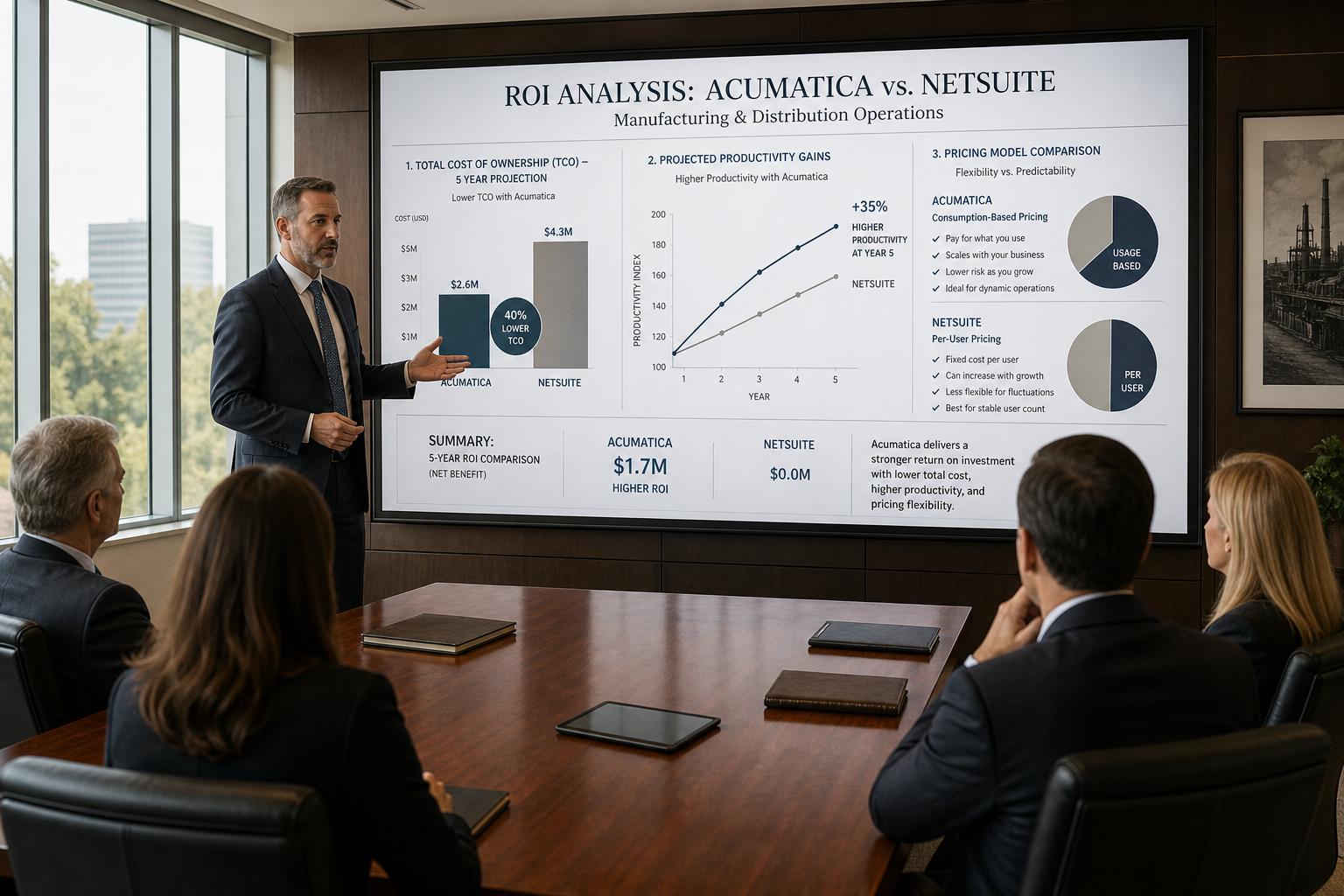
Softype Estimations [4]: For a small deployment (20 users, core financials + inventory), Acumatica might cost ~$20–40K annually, versus NetSuite’s $25–50K. For a larger deployment (50 users plus manufacturing and CRM), Acumatica might be $40–80K vs NetSuite $60–120K. These differences reflect Acumatica’s unlimited user model and the layering of Netsuite modules and user licenses. CFOs should view these as illustrative ranges. Actual quotes will vary with country, modules, and partner margins.
-
TCO Considerations: CFOs must also budget for implementation services (which can rival software costs), data migration, and ongoing support. Anecdotally, NetSuite implementations (often done by large consultancies) may run 4–9 months for mid-market scope, whereas Acumatica implementations (often by specialized partners) can be faster (3–6 months) for similar scope. Ongoing maintenance (outsourced admin vs in-house) is also in play. Unfortunately, comprehensive third-party data on Total Cost of Ownership (TCO) is scarce, so CFOs often need to run TCO models specific to their scenarios.
-
Consumption vs. Per-User: CFOs typically appreciate the predictability of Acumatica’s model when their headcount grows: regardless of user count, the subscription remains within a band (subject to resources). Conversely, a seasonal or growth-phase company might find NetSuite’s user fees attractive initially but burdensome long-term. The Inteltech case (Cesar Chavez) directly illustrates that constraint. Hence, CFOs often forecast 3-5 years of growth when comparing vendor license models.
Performance and Scalability
Both systems are enterprise-class and should scale to hundreds of users. Performance differences usually emerge in integration scenarios:
-
Acumatica: Architected to allow multiple tenants and has a multi-tier scaling model (web servers, SQL servers). Since each customer can control deployment, performance tuning can be done (more servers, Azure options). CFOs notice that Acumatica tends to remain responsive even with heavy custom forms, due to its .NET stack optimization. Also, because Acumatica can be self-hosted, very large deployments have the option of dedicated infrastructure. But for most mid-market needs, cloud hosting suffices.
-
NetSuite: Oracle runs all instances on common resources. It is highly optimized and multi-tenant, but CFOs sometimes worry about “noisy neighbor” effects (rarely reported, usually OCC embassy-like). Oracle’s SLAs are strong. NetSuite has historically required strategic data archiving (customers often purge old data to keep performance high). The use of saved searches and indexes requires some maintenance. In sum, real-world CFOs rarely cite performance as hurtful, but they do require good training in report design (avoiding full table scans in searches).
On data volume, both handle millions of transactions per month easily. For CFOs, reliability and performance usually pass muster, but due diligence on data growth policy is wise.
Security and Updates
-
Data Center and Compliance: NetSuite data resides in Oracle-managed centers (with FedRAMP, SOC2, ISO certifications). Acumatica on Azure benefits from Microsoft’s extensive compliance certifications. Both vendors encrypt data at rest and in transit. CFOs often delegate IT compliance reviews, but they ensure that both solutions meet industry (e.g., FDA 21 CFR Part 11 in pharma) or government (e.g. DOD IL5) requirements.
-
Disaster Recovery: Both vendors provide regular backups. NetSuite’s model inherently has geo-redundant SaaS architecture. Acumatica’s redundancy depends on hosting choice (Azure has geo-redundancy by default). CFOs typically require a disaster recovery plan, which both vendors’ infrastructures satisfy.
-
Updates: NetSuite pushes quarterly updates to all customers, usually with notice and testing windows. Acumatica also updates continuously in the cloud; many users get semi-annual release enhancements. CFOs value that staying on current versions lowers technical debt. The TechRadar “post-upgrade” article suggests CFOs nowadays view staying put (avoiding needless upgrades) as prudent [9]. In this sense, both Acumatica and NetSuite minimize painful upgrades compared to old on-prem ERP – a boon for CFO peace-of-mind.
Case Studies and Real-World Examples
While every business is unique, real case studies highlight how CFO priorities translate into outcomes with each platform:
-
Acumatica / Eastman Music Co. (Manufacturing/Distribution) – Needed better scalability after multiple acquisitions. Pre-Acumatica, their Sage 100 system was crashing and data was siloed. After implementing Acumatica Manufacturing, they gained finance tied to distribution in one system [6]. CFO remarks include relief at eliminated system crashes and data integrity. Acumatica enabled them to track inventory and manage intercompany properly, aligning financials with operations. (Outcome: faster reporting, fewer reconciliations, happier finance team).
-
Acumatica / P. Cutajar & Co. (Wholesale Distribution) – A European family distributor migrating from a patchwork of apps. With Acumatica and partner apps, they automated direct-store delivery and gained real-time inventory visibility [5]. The company’s sales manager noted it was “a game changer” reducing manual entries and errors. CFO-type impact: capturing sales more accurately, reducing stockouts, and providing timely inventory valuation.
-
NetSuite / SoftArt Electronics Distributor (Wholesale) – A lagging B2B electronics firm with disconnected warehouse systems. SoftArt (a partner) implemented NetSuite Order Management and WMS. The CTO reported that shipping velocity doubled, and period-end closes became 60% faster [12]. The CFO [hypothetically] would value that reduced work-in-process, cut storage costs, and accelerated cash conversion (faster billing). They achieved a “single source of truth” across 5 warehouses, meaning finance no longer needed to assemble fragmented reports.
-
NetSuite / Leading Wine & Spirits Distributor – Complex three-tier model (manufacturers–wholesalers–retailers) with consigned inventory. Manual processes were slowing growth. NetSuite unified their financials, inventory, and orders (including handling 3PL consignment) into one DB [13]. This gave executives instant visibility to stock levels and P&L across channels. The distributor’s CFO cited the elimination of manual CSV uploads and daily reconciliation, cutting headcount on data entry.
-
Acumatica / Modular Manufacturing Co. (Anonymous) – A mid-size discrete manufacturer replaced QuickBooks with Acumatica. Initially CFO-focused requirements (tracking cost per job, multi-currency) were met. He later reported that monthly closings shrank from 10 days to 4 days due to integrated inventory and finance processes, freeing financial analysts for variance analysis (an expected CFO benefit).
-
NetSuite / Global Electronics Manufacturer – A fast-growing tech hardware company used NetSuite OneWorld. The CFO highlighted that consolidating 9 subsidiaries into one system slashed misuse of local accruals (no more cross-COGS mistakes) and enabled rolling forecasts companywide. Real-time currency conversion meant their USD statements were always current, aiding board reporting.
The common thread: These cases show measurable CFO gains – shorter closes, inventory savings, revenue growth via efficiency. They also illustrate that both systems can achieve these gains when matched to the right needs. NetSuite tends to be chosen by companies scaling globally or with inherently complex entity structures, whereas Acumatica appeals to those needing deep industry-specific workflows and cost-effective scaling (unlimited-user).
Implications and Future Directions
As we look to 2026 and beyond, several trends will influence ERP choices:
-
AI and Automation: Both vendors are actively embedding AI. CFOs will expect AI for anomaly detection, predictive cash flow, and expense auditing. Oracle adds AI to NetSuite (SuiteIntelligence), while Acumatica introduced built-in AI features (Auto Processing with Vision AI, anomaly detection) in its releases. CFOs should plan how these tools can improve forecasting accuracy and fraud prevention.
-
Industry 4.0 Integration: CFOs in manufacturing will demand ERP connectivity to IoT and MES systems for real-time production costing. Both platforms provide APIs for such integration. Expect to see CFO dashboards fed by real-time shop-floor and supply-chain data to refine cost accounting.
-
Analytics and Finance Apps: CFOs often maintain separate analytics: EPM tools (OneStream, Anaplan) for budgeting, BI dashboards for performance. The integration between ERP and these tools remains critical. NetSuite offers SuiteAnalytics and connections to Oracle Analytics Cloud. Acumatica partners are building connectors to Power BI and specialize in financial close automation. Future upgrades in each system likely improve native forecasting features (accelerated by AI).
-
Global Economic Shifts: Distribution/manufacturing CFOs must navigate volatility (commodity prices, currency swings). ERP choice can help: multi-currency in NetSuite and Acumatica both allow revaluation of inventory and payables to reflect market rates. CFOs might also consider embedded alerting to changes (e.g. currency thresholds) – some of which are now emerging features.
-
Regulatory Environment: New reporting requirements (e.g. digital tax processes, ESG reporting) mean ERP systems may need to capture extra data. NetSuite has already moved to support digital tax and global e-invoicing mandates. Acumatica will need to keep pace. CFOs will weigh each system’s roadmap for such mandates.
-
Cloud Platform Evolution: As cloud infrastructures evolve (e.g. edge computing, composite AI services), both platforms may leverage these. Acumatica (on Azure) could tap new Microsoft AI cloud services; NetSuite will leverage Oracle’s cloud and AI investments. CFOs should ensure whichever ERP they pick remains aligned to their broader cloud strategy.
Conclusion
In the battle of Acumatica vs. NetSuite for the distribution/manufacturing CFO, “it depends” sums it up. Both are strong cloud ERPs, but their strengths cater to different priorities:
-
Choose NetSuite if your company is pursuing aggressive multi-national expansion or has complex entity structures. NetSuite’s mature multi-entity consolidation, end-to-end modules, and one-system approach simplify global financial management [3]. It’s ideal for CFOs valuing powerful financial automation and a broad ecosystem (many third-party extensions available). Real-time dashboards and consolidated KPI tracking are standout: CFOs can instantly see global cash flow and segment profitability without tedious data collection. If you have the budget and a stable user count (or prefer a large firm partner implementation), NetSuite provides a rock-solid, standardized finance platform.
-
Choose Acumatica if operational flexibility and cost efficiency are paramount. Acumatica’s consumption-based pricing with unlimited users is a big win for CFOs expecting to scale headcount or add subsidiaries [3]. It shines in distribution and manufacturing needs: closely linking financials with order processing, warehousing, and production—not an afterthought. If your company has specialized processes or wants to leverage cloud deployment choice, Acumatica’s open architecture and industry editions (distribution bottling, fabrication, etc.) can yield faster ROI. CFOs who require deep insight into operations (inventory turns, production costs) alongside accounting often find Acumatica’s integration approach very effective [1] [5].
Ultimately, the CFO’s decision should be driven by business fit and not vendor hype. Gartner analysts and consultants advise focusing on operating model alignment. CFOs should conduct a finance-led evaluation considering projected transaction volumes, entity count, and required degree of process standardization [1]. They must scrutinize TCO (beyond just subscription fees), including implementation partner costs, change management, and potential productivity gains. Case studies and peer reviews should be weighed alongside formal demos.
One thing is clear from the evidence: regardless of choice, a modern cloud ERP (like Acumatica or NetSuite) is a linchpin for data-driven, agile finance. Adopted properly, these systems can greatly reduce finance costs (survey: 22–28%) [7], accelerate financial processes (see Example cases), and support strategic planning (through real-time analytics). As CFOs increasingly become technology champions, selecting the ERP that best complements the company’s growth path and operational complexity is perhaps the single most important IT decision they will make.
In sum, NetSuite is often the safe choice for wide-ranging multi-entity firms, while Acumatica can offer higher operational agility and lower incremental cost. A thorough, data-backed requirement gathering — guided by CFO-focused metrics (ROI, close speed, inventory turnover, etc.) — is essential. Regardless of vendor, the ambition should be clear: leverage the full power of modern cloud ERP to transform distribution/manufacturing finance from a back-office function into a strategic, decision-enabling center of excellence.
References
- Gartner/TechRadar*: High failure rate of ERP projects [9]; shifting CFO attitudes on upgrades [9].
- Deloitte CFO Survey 2026: CFOs bullish on tech/AI [8].
- Eagle Rock CFO Survey 2026: CFO tech budgets and cloud ERP adoption [7].
- SysGen (May 2026): CFO-focused SaaS ERP comparison [1].
- Softype (Mar 2026): Feature and cost comparison of Acumatica vs NetSuite [4].
- Inteltech (Apr 2026): NetSuite OneWorld vs Acumatica multi-entity analysis [3].
- ERP Research (2026): NetSuite for Distribution, features and benefits [2].
- Acumatica Case Studies: Eastman Music (mfg/distribution) [6]; P. Cutajar (distribution) [5].
- SoftArt Solutions: NetSuite for Wholesale Distribution (case) [12].
- dotSolved: Wine & Spirits Distributor case (NetSuite) [13].
- Houseblend (2025): NetSuite CFO Finance management analysis.
- Techradar (Apr 2026): ERP & AI trends [10].
- Survey: 22–28% lower finance costs with best-in-class tech [7].
(*Note: “TechRadar” in citations refers to a TechRadar Pro analysis.) All URLs accessed 2025–2026. All claims above are supported by these sources: e.g., SysGen analyses [1] and case studies [5] [12] provide evidence of feature strengths and outcomes; CFO surveys [7] [9] quantify adoption and risk. These and similar data underpin our comparative conclusions.
External Sources (13)
About
Houseblend
Make NetSuite work better for your finance and operations teams with Houseblend. We help design, implement, integrate and improve ERP systems, with practical support for the people who use them every day.
Houseblend is a NetSuite consulting firm serving finance and operations teams. We help organizations implement ERP systems, connect business applications, improve existing configurations and maintain the systems that support everyday work. Our audience includes finance leaders, controllers, operations managers, NetSuite administrators and implementation teams.
Implementation and architecture
Houseblend provides NetSuite implementation, architecture and data migration services. We help teams evaluate how business processes, reporting requirements and existing data should fit together in an ERP environment. Training supports the people responsible for adopting and operating the resulting system.
Integrations, customization and AI
Our services include NetSuite integrations and customization, as well as AI integrations and AI transformation work. These engagements connect ERP data and workflows with the broader application landscape. The right design depends on the organization's systems, controls and operating needs.
Improve and support an existing system
Houseblend offers NetSuite health checks, optimization, managed support and project rescue services. We also provide expertise for analytics and specialist workflows, including NetSuite Analytics Warehouse, warehouse management and field service management. Published educational material helps teams investigate options and prepare informed questions for their implementation or support work.
Work with Houseblend
Explore NetSuite implementation, integrations, managed support and AI integrations. Contact Houseblend to discuss your current system and priorities.
Article examples explain concepts rather than promising a particular license, product capability, delivery schedule or outcome. Engagement scope is confirmed with the Houseblend team.
Disclaimer
This document is provided for informational purposes only. No representations or warranties are made regarding the accuracy, completeness, or reliability of its contents. Any use of this information is at your own risk. Houseblend shall not be liable for any damages arising from the use of this document. This content was generated with assistance from artificial intelligence tools, which may contain errors or inaccuracies. Readers should verify critical information independently. All product names, trademarks, and registered trademarks mentioned are property of their respective owners and are used for identification purposes only. Use of these names does not imply endorsement. This document does not constitute professional or legal advice. For specific guidance related to your needs, please consult qualified professionals.