Houseblend Article
Agentic AI Layer in NetSuite: 2026 Integration Guide
Inside this article
- 01Executive Summary
- 02Introduction and Background
- 03NetSuite: Overview and AI-Readiness
- 04Agentic AI Technologies and Integration Strategies
- 05Business Impact and Case Studies
- 06Implementing Agentic AI on NetSuite: A Playbook
- 07Challenges, Risks, and Mitigations
- 08Future Directions and Strategic Implications
- 09Conclusion
- 10References
Executive Summary
Agentic AI – autonomous, goal-driven artificial intelligence agents – promises to revolutionize enterprise resource planning (ERP) by automatically executing tasks and workflows within ERP systems. As Chief Financial Officers and industry analysts anticipate, agentic AI is moving from experimentation to enterprise-wide deployment in 2026 [1] [2]. Gartner predicts that by 2026, roughly 40% of enterprise applications (including ERP) will have task-specific AI agents, and cloud ERPs with embedded AI could accelerate financial close processes by about 30% [3] [2]. However, the complexity and risk of reimplementing an ERP from scratch are immense – surveys indicate up to half of ERP projects fail or blow past budget [4]. As a result, many organizations are seeking pragmatic ways to layer agentic AI on top of their existing ERP (such as Oracle NetSuite) without discarding the core system. This report surveys the historical context, technical options, business drivers, challenges, and implementation strategies for adding an agentic AI layer over NetSuite (Oracle’s cloud ERP) by 2026, without a full re-implementation.
We define agentic AI as AI that can pursue complex goals autonomously, planning and acting iteratively across tasks [5] [6]. This contrasts with traditional AI “agents” or robotic process automations, which execute fixed, narrow tasks under static logic. As one expert notes, “We’re moving from systems that execute commands to systems that understand purpose and can adjust plans when reality pushes back,” i.e. from rule-bound bots to adaptable, goal-driven agents [7] [8]. The promise of agentic AI in ERP includes faster closes, better forecasting, automated controls, and continuous process improvement [9] [3]. In practice, it involves orchestrating LLM-based agents and other AI services that interact with NetSuite’s data, business logic, and workflows to execute tasks end-to-end. This “AI layer” could take many forms – for example, an AI-powered chatbot that answers questions by querying NetSuite, or an autonomous assistant that orchestrates approval and order processes.
However, layering AI atop a mission-critical ERP brings challenges: data governance, security, integration complexity, and trust in AI outputs are major concerns [10] [11]. Organizations must ensure that AI agents act only within permitted scopes and that their decisions are auditable. Industry analysts warn of risks like “goal hijacking” or unauthorized actions, so robust identity/access management and monitoring are essential [11] [12]. This report assembles evidence from expert forecasts, vendor announcements, case studies, and data trends to provide a 2026 playbook for deploying agentic AI on NetSuite without re-implementing the ERP. We cover technology options ( SuiteScript APIs, integration platforms, AI agent frameworks), business cases (ROI, productivity gains), success stories (e.g. AI chatbots for NetSuite, CFO use cases), and governance best practices.
Key findings include:
-
Agentic AI growth: The global market for agentic AI is projected to surge (~44% CAGR) to nearly $196 billion by 2034 [13]. Gartner predicts that by 2026, a large fraction of enterprise apps will embed AI agents [3], and a 2026 survey of CFOs sees AI shifting to enterprise transformation [1]. NetSuite has already begun adding AI: a 2023 SuiteWorld announcement introduced a “Text Enhance” AI assistant and expanded AI modules [14], and the 2026.1 release adds AI-driven reconciliation and forecasting assistants [15].
-
Business impact: Agentic AI in ERP can sharply accelerate key processes. Gartner predicts a 30% faster financial close in AI-embedded cloud ERPs by 2028 [2]. CFOs report that agentic AI in NetSuite would “accelerate the close, sharpen forecasting, and automate controls,” cutting manual work and improving auditability [9]. Case examples show dramatic gains: AI-integrated NetSuite systems have cut order processing time from 45 to 3 minutes and lowered inventory costs by ~18% through better demand forecasting [16]. A NetSuite consulting firm describes customers using AI in close, cash, service, and subscription processes to embed intelligence into existing workflows – leveraging AI but keeping existing roles and approvals intact [17].
-
Implementation strategy: Rather than rip-and-replace NetSuite, experts recommend gradually building on the existing platform.NetSuite’s SuiteCloud environment offers AI APIs ( SuiteScript LLM module) and integration methods (RESTlets, SuiteTalk SOAP) to invoke LLM services [18] [19]. An agentic layer can be implemented via custom SuiteScript extensions, middleware (iPaaS), or external AI platforms that connect via NetSuite’s APIs. For example, one firm built a NetSuite chatbot using local AI (RAG + custom LLM pipeline) to translate free-form questions into SuiteQL queries (Source: www.digitalgravity.ae), allowing users to query NetSuite in natural language while keeping data secure. Another approach is using multi-agent orchestration platforms (e.g. Oracle AI Agent Studio or third-party frameworks) to coordinate specialized AI workers across NetSuite and other systems [20] [21]. Critically, any plan should start with high-value, well-governed pilot projects, ensure clean data and clear objectives, and involve continuous human oversight [17] [10].
-
Risks and governance: Security and trust are top concerns. Industry studies highlight IAM (identity and access) as crucial: AI agents must only have limited, appropriate permissions [12]. Unauthorized or overzealous agents could block processes or even pose safety risks if unchecked [11]. NetSuite’s guidance reminds users that AI responses are creative and must be validated [10]. Expert sources stress that organizations need mature data governance and monitoring before scaling agentic AI [11] [12]. It’s vital to tune existing security tools (SIEM) to oversee agent activity, log actions for audit, and maintain human-in-the-loop for exceptions.
-
Future outlook: By late 2026, combining NetSuite with an AI agentic layer can yield the benefits of a “self-operating ERP” without the cost of migration. Oracle’s strategy (embedding agents into Fusion) underscores the value of native integration [22], but smaller companies can achieve much through custom layering. As platforms mature and models improve, these agentic add-ons will enable continual process optimization. Leaders recommend treating AI agents “as real team members” that can autonomously carry out work with human-defined goals [23]. The long-term vision is an “intelligent ERP” where predictive agents continuously refine forecasts and operations. However, success hinges on data trust, clear governance, and aligning agents’ objectives with business goals [9] [24]. The following sections provide detailed analysis, case studies, and guidelines to help organizations craft a pragmatic agentic-AI-over-Netsuite playbook in 2026.
Introduction and Background
The Evolution of Enterprise AI and ERP
Enterprise Resource Planning (ERP) systems have long been the backbone of business operations, integrating finance, supply chain, HR, CRM, and other core processes. Historically, ERP evolution focused on functionality and the shift from on-premises to cloud deployments. In recent years, artificial intelligence has emerged as the new frontier in ERP innovation. Early AI in ERP (pre-2020) largely meant predictive analytics or simple ML within modules (e.g. predictive lead scoring, anomaly detection). Traditional AI features in ERPs responded to user inputs or data patterns, assisting humans with analysis but not acting autonomously. Robotic Process Automation (RPA) added “bots” that could execute repetitive tasks by mimicking human clicks, but these were rigid and had no ability to adapt beyond their fixed steps [25] [26].
The launch of advanced generative AI models (e.g. GPT-3 in 2020, ChatGPT in 2022, and Google’s Gemini/PaLM) transformed expectations. These large language models (LLMs) could understand and generate human-like text, enabling flexible automation and decision support. At first, enterprises experimented with AI assistants or “copilots” that answer queries or draft content, often via chat interfaces. But generative AI’s leap is not just better automation; it lays the groundwork for autonomous agents that can utilize ERP data and execute multi-step processes on their own. This new paradigm has been termed “Agentic AI.”
Defining Agentic AI
Agentic AI describes systems composed of autonomous “agents” that pursue goals, plan actions, learn from feedback, and adapt to changing conditions – much like human operators do. According to enterprise AI experts, agentic AI systems can initiate sequences of actions and make decisions without each instruction being meticulously scripted [5] [27]. Unlike a static chatbot or RPA bot, an agentic system has state, memory, and planning capabilities. It can interpret a high-level goal (e.g. “optimize inventory levels this quarter”) and then decompose this into subtasks (forecast demand, adjust orders, reallocate stock) and carry them out iteratively until the goal is met. In practice, agentic AI architectures often combine triads of perception (reading data and context), planning/reasoning, and action (effectors for execution) [5] [27].
A TechTarget analysis summarizes: “Agentic AI refers to artificial intelligence systems capable of autonomous action and decision-making. These systems… can pursue complex goals independently, without direct human intervention,” often employing reinforcement learning or evolutionary algorithms to navigate novel environments [5]. Crucially, even though agentic systems plan, they still operate under human-defined objectives; “Agentic general AI” (AGI) with unlimited scope remains a research frontier, not a reality in 2026 [5]. For ERP purposes, agentic AI means narrow (but broad-enhanced) AI: specialized to business processes and bounded by corporate governance.
AI Agents vs. Agentic AI
To clarify terminology, experts distinguish “AI agents” (or copilot-style assistants) from fully “agentic AI”. An AI agent (in the traditional sense) follows a simple feedback loop: perceive → decide → act based on predefined logic or learned patterns [8]. A chatbot answering invoice inquiries or a recommendation engine for parts ordering are AI agents in this sense. They stay “in their lane” – they do not reconsider their logic or goals mid-process. By contrast, agentic AI extends this model. As Redwood’s leader frames it, agentic AI brings memory, reasoning, adaptability, and autonomy into that loop. Modern agentic agents maintain context across actions, expand their tools dynamically, and self-correct iteratively [8].
A comparative summary from a workload-automation firm (illustrated below) highlights the difference:
| Feature | Traditional AI Agents | Agentic AI |
|---|---|---|
| Scope | Task-specific, rule-bound | Goal-driven, adaptive |
| Memory | Stateless (no context beyond each task) | Stateful (retains context across steps) |
| Tool use | Limited to predefined tools | Expands toolset via APIs and learning |
| Decision logic | Fixed rules or single pass | Iterative reasoning with feedback |
| Workflow complexity | Narrow, simple flows | Manages multi-step, uncertain workflows |
| Self-healing | None | Agent can detect errors and re-plan |
As this table implies, agentic AI “goes beyond task automation,” enabling systems to pursue outcomes across multiple steps and changing conditions [8] [9]. For example, a non-agentic AI might populate a report automatically, whereas an agentic AI could recognize that a data supplier is behind schedule and renegotiate supply contracts to meet the target. In essence, traditional AI agents do “what we tell them” on tightly bounded tasks, while agentic AI decides why and how to act toward broader goals.
Why Agentic AI Matters for ERP
The enterprise implications of agentic AI are profound. By 2026, analysts and practitioners expect agentic capabilities to reshape ERP workflows rather than merely add “some AI.” CFOs at large companies forecast that agentic AI will shift from limited pilots to driving outcomes at scale in the finance function [1]. In actual ERP operations, this means moving beyond discrete analytics or fixed workflows to “self-operating” processes: for example, an AI agent could autonomously handle month-end close, from gathering reconciliation data to alerting humans only for exceptions. The promise is significant: Gartner and CFO prognosticators foresee AI agents delivering major ROI in finance and beyond [2] [9]. At the same time, they caution that such power must come with governance.
Notably, Oracle itself is pursuing this vision. In October 2025 Oracle announced new AI agents across its Fusion Cloud Applications (ERP, HCM, SCM, CX) that can “help business leaders transform core finance functions, optimize HR processes, [and] enhance end-to-end supply chain management” [20]. In March 2026, Oracle unveiled Fusion Agentic Applications – apps “powered by coordinated teams of specialized AI agents” built natively into Fusion software [22]. These agentic apps are “outcome-driven, proactive and reasoning based,” designed to execute decisions using unified enterprise data and policies [22]. Importantly, Oracle emphasizes that owning the transactional system allows these agents to run “in real time, at enterprise scale, with full governance” – an advantage over external AI add-ons [22].
However, many Oracle customers use NetSuite, the cloud ERP Oracle acquired in 2016 for $9.3 billion [28]. NetSuite historically targets small-to-medium enterprises (SMEs) with up to a few hundred users [29]. Oracle has stated that Fusion and NetSuite will “coexist in the marketplace forever” – serving different segments [30]. Thus, NetSuite customers may not have direct access to Oracle’s Fusion Agentic Apps. The question arises: How can organizations running NetSuite tap into the agentic AI wave? The pragmatic answer is to add an AI layer on top of NetSuite rather than move to Fusion.
This report focuses on that approach: integrating agentic AI capabilities with NetSuite without reimplementing or replacing the ERP. In the following sections, we review NetSuite’s current state, survey AI integration methods, examine relevant case studies and forecasts, and prescribe a step-by-step playbook for deploying agentic AI atop NetSuite by 2026. Throughout, we back our analysis with data and expert viewpoints – from Gartner forecasts to Oracle documentation – to ensure that each claim is evidence-based.
NetSuite: Overview and AI-Readiness
NetSuite’s Position in 2026
Oracle NetSuite is one of the most widely adopted cloud ERPs globally. As Oracle notes, NetSuite has tens of thousands of customers worldwide [31], with a strong presence in small and mid-market companies (though it can scale up to large enterprises). (A recent industry estimate put NetSuite’s customer count at ~38,000 as of 2022, so by 2026 it is plausible that figure is 40,000+ [31].) NetSuite covers core modules – financials, CRM, inventory/supply chain, commerce, and more – all on a unified cloud platform. Its SuiteCloud architecture offers an integrated data model and extensibility via SuiteScript, SuiteFlow, SuiteTalk, and SuiteBuilder. In fact, NetSuite’s single-database design (unlike multi-DB architectures of some older ERP suites) can simplify AI integrations because data resides centrally and consistently [32].
In recent years NetSuite has been actively adding AI and analytics features. For example, SuiteWorld 2023 (the annual user conference) spotlighted new generative AI tools: a “Text Enhance” AI assistant for writing text within NetSuite, and AI-driven financial close modules [14]. Rand Group’s 2026.1 release notes that NetSuite is introducing AI agents into its Enterprise Performance Management (EPM) suite – automating reconciliation, forecasting, and cost allocation – “learning from prior cycles and continuously improving accuracy” [15]. These capabilities aim to “support accountants and analysts with actionable insights and guided automation” while keeping existing control frameworks intact [15]. In summary, NetSuite is not AI-naïve: it offers built-in machine learning and generative features via Oracle’s Cloud Infrastructure (OCI) and its own SuiteScript APIs [18] [33]. These are important enablers for adding more advanced AI layers.
NetSuite Technical Foundations
To understand how to layer AI on NetSuite, one must grasp the platform’s extensibility. Key points:
-
SuiteCloud Platform: NetSuite’s proprietary development and integration environment. It includes SuiteScript (JavaScript APIs for logic), SuiteFlow (workflow editor), SuiteTalk (SOAP and REST web services), and SuiteBuilder (point-and-click customization).
-
Unified Data Model: Unlike ERP suites that came together via acquisitions, NetSuite employed a single codebase and database for all modules. This unified architecture means that financial, CRM, inventory, and other data share the same schema. For AI purposes, this is advantageous: an AI agent can query and correlate data across modules without dealing with siloed systems [34].
-
SuiteScript and AI APIs: Since 2022-2023, NetSuite provides specialized SuiteScript modules for AI. The SuiteScript 2.x N/llm (generative AI) module lets scripts send prompts to large language models via OCI’s GenAI service [18]. Other modules, like N/documentCapture, use OCI Document Understanding to extract structured data from PDFs [35]. These APIs enable custom SuiteScript programs to leverage AI during NetSuite workflows (e.g. auto-summarize a sales description, categorize text, extract invoice fields). However, Oracle cautions that generative responses can be “creative” and must be validated for accuracy [10].
-
Integration Points: Beyond scripts inside NetSuite, the system supports external connections. SuiteTalk web services (SOAP/REST) provide comprehensive read/write access to data [19]. RESTlets (SuiteScripts deployed as custom REST endpoints) allow custom behaviors to be invoked by outside systems. Many integration platforms (iPaaS) like Celigo or MuleSoft have connectors for NetSuite, making it feasible to integrate external systems or microservices. Essentially, NetSuite can both host AI logic within and be controlled from outside.
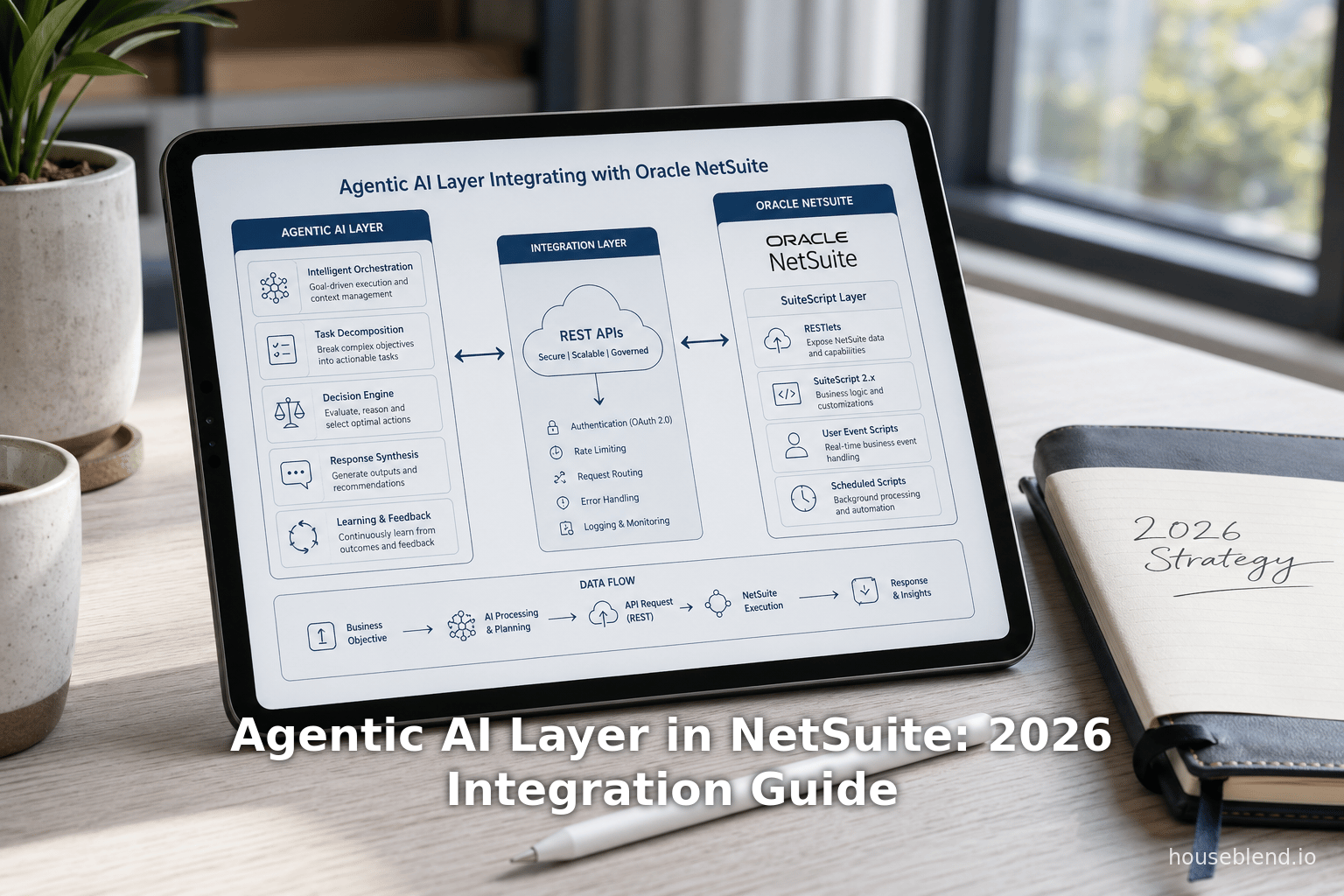
Given these capabilities, there are multiple ways to implement an AI agent layer. One approach is to build AI logic inside NetSuite using SuiteScript and RESTlets (e.g. an AI-script that calls an LLM and updates NetSuite records). Another is outside, where an external AI platform (possibly with a user interface) connects to NetSuite’s API. We will examine both.
Enterprise Context: Why Not Re-Implement?
Before exploring how to integrate AI, it is important to address why organizations want to avoid re-implementing or replacing NetSuite. ERP re-deployments are notoriously complex, costly, and risky. Studies consistently show that nearly half of ERP implementations fail or exceed budget, with many taking far longer than planned [4]. A typical mid-market ERP rollout can cost hundreds of thousands to millions of dollars and span 1-3 years. Our scenario assumes an organization already running NetSuite (possibly for years) – their data, customizations, and business processes are deeply entwined with it. A wholesale switch to a different system (e.g. Oracle Fusion or SAP) to gain AI’d features would entail rebuilding all those processes, migrating data, retraining staff, and enduring extended downtime. Given that 64% of ERP projects notoriously go over budget by 25% or more [4], most companies are reluctant to “rip and replace.”
Moreover, by 2026 Oracle is clearly pushing Fusion for its large-enterprise agentic apps [22], but smaller enterprises may want to leverage these AI advances without abandoning NetSuite. The pragmatic approach is to enrich the existing NetSuite implementation. This avoids sunk costs and leverages user familiarity with the system. It also means AI enhancements can roll out incrementally – for example, adding a finance-close agent now, and later adding a supply-chain agent – rather than a monolithic project. In short, the focus is on augmenting rather than overhauling NetSuite.
Given this strategy, the remainder of the report examines how to make the most of NetSuite’s extensibility and data to implement agentic AI capabilities in a pragmatic, phased manner. In doing so, we will draw on projects and studies that highlight both the potentials and pitfalls of applying AI to ERP systems.
Agentic AI Technologies and Integration Strategies
Agentic AI emerges from the confluence of several technological trends: large language models (LLMs), multi-agent orchestration architectures, integration platforms, and enterprise AI frameworks. In the context of NetSuite, an agentic AI layer may comprise one or multiple AI agents that interact with the ERP via its APIs. Here we break down the main technology options and consider how to integrate them with NetSuite.
Core AI Components for Agentic Systems
To build an agentic assistant, organizations typically assemble:
-
LLMs and AI Services: Modern agentic solutions use LLMs (e.g. GPT-4, Google Gemini, or proprietary enterprise models) for language understanding and planning, plus specialized AI services (computer vision, RPA, etc.) as tools. Oracle Fusion’s AI Agents, for instance, are “powered by industry-leading LLMs” and built via Oracle AI Agent Studio [20] [36]. A company could use Oracle’s OCI GenAI, Azure OpenAI, AWS Bedrock, or on-prem models. Key capability: the LLM can parse natural language instructions (like user queries) into actions or API calls.
-
Retrieval-Augmented Generation (RAG): For knowledge-intensive tasks, agents often use RAG architectures. Here, relevant enterprise data (like NetSuite records) are indexed (e.g. via embeddings in a vector DB) and retrieved to ground the LLM’s generation. This ensures responses are factual to the company’s actual data. For example, the case study by Digital Gravity describes a NetSuite chatbot that uses RAG (with Milvus and custom LLM) to turn questions into precise SuiteQL queries and answer them from NetSuite data (Source: www.digitalgravity.ae). RAG avoids hallucination by limiting the LLM to use documented data.
-
Multi-Agent Frameworks: Complex workflows may involve teams of agents, each with a specialty. Modern architecture has moved toward multi-agent orchestration. Platforms like Oracle AI Agent Studio or third-party orchestrators (LangChain’s Agent/Chain frameworks, Kore.ai, etc.) let you define multiple agent roles (planner, executor, etc.) and communication protocols. For instance, Kore.ai highlights that “coordinated intelligence is the new competitive edge” and that orchestrated agents (“agentic ecosystems”) can “collaborate seamlessly” to tackle tasks no single agent could [21] [37]. In a NetSuite scenario, one agent might monitor email approvals, another handle numeric data analysis, and a central agent orchestrator directs them toward the target objective. Open-source toolkits (AutoGen, LangGraph, etc.) support multi-agent flows, though building at enterprise scale often favors commercial orchestration layers due to governance, scalability, and auditability needs.
-
Integration Middleware and APIs: Agentic AI must be connected to enterprise systems. Integration layers or middleware (e.g. MuleSoft, Workato, Integromat) often serve as the glue. These platforms can trigger AI actions in response to NetSuite events, or conversely use NetSuite as a data source. For example, third-party AI platforms may use NetSuite’s SuiteTalk or RESTlets to fetch/update records as part of an automated flow. Some iPaaS tools now advertise direct support for invoking LLM-based actions as part of workflow automation. The advantage is less custom coding inside NetSuite, but at the cost of introducing an external system.
-
User Interfaces and Experience: Users may interact with agentic AI via chatbots, voice assistants, or even agent “bots” embedded in NetSuite pages. A trend is deployment of AI chat assistants (in Slack, Teams, or custom portals) that query the ERP. For instance, an employee might type in plain English, “What’s our forecast for SKU-123 next quarter?” and the agent triggers a specialized language-to-SuiteQL query module to fetch the answer. Alternatively, completely autonomous agents might run in the background (e.g. “optimize inventory” every night) with output sent as alerts. Regardless, designing a user-friendly interface is crucial because it ultimately determines adoption.
-
Governance and Observability: Crucial technical components include logging, auditing, and controls. An agentic system typically must log each decision step, action taken, and data accessed, then alert on exceptions. Identity/access management must bind each agent to roles and permissions just like a human user. Some emerging platforms ship with built-in this support – for example, Oracle’s framework automatically applies existing role-based approvals to agent decisions [38].
Integrating Agentic AI with NetSuite
Given the above components, how exactly do we connect them to NetSuite? There are several integration approaches, each with trade-offs. The following table outlines common methods:
| Integration Approach | Description | Advantages | Limitations/Considerations |
|---|---|---|---|
| SuiteScript/RESTlets (embedded) | Write custom SuiteScript (JavaScript) logic that resides inside NetSuite and invokes AI services (e.g. OCI GenAI). RESTlets expose endpoints. | • Leverages native environment (fully aware of NetSuite business logic and permissions). • Can trigger AI as part of existing SuiteFlow/workflow. • May use SuiteScript generative APIs directly [18]. | • Requires developer expertise in SuiteScript. • Execution governed by NetSuite’s script limits and IAM. • More complex to manage as code inside ERP; CI/CD considerations. |
| SuiteTalk Web Services (SOAP/REST) | Use NetSuite’s built-in SOAP or REST web services from an external system. External AI agent calls NetSuite SOAP/REST API to read/write data. | • Mature, stable API with broad data access [19]. • Supported by many integration tools. • Decouples AI logic from NetSuite codebase. | • SOAP payloads can be verbose (though REST options exist) and may have rate limits. • Requires mapping of business logic (permissions, workflows must be re-implemented externally). |
| Custom Integration Platform (iPaaS) | Use an external automation platform (Workato, Zapier, etc.) as the intermediary. For example, an AI platform flow triggers NetSuite actions via connectors. | • No special NetSuite coding needed. • Often low-code and quick to prototype. • Can integrate multiple systems (e.g. sync NetSuite with Salesforce as part of agent actions). | • Additional licensing costs, and dependency on vendor. • Potential latency and maintenance overhead. • May not support very complex NetSuite custom logic out of the box. |
| Database Export / Vector Indices (RAG) | Periodically dump NetSuite data (e.g. via CSV or SuiteQL) into a database or vector index. AI RAG system ingests this for query-response. | • Keeps a local copy of relevant data for fast retrieval. • Limits direct load/calls on production ERP system. | • Data currency lag—may not reflect real-time changes. • Data security: must protect copied data externally. • Initial setup effort for ETL and indexing. |
| User Interface (Chatbot GUI) | Front-end layers (chatbot UI on portal/Teams/Slack) integrated to NetSuite backend via above methods. | • Familiar interface (chat or web form) increases adoption. • Can incorporate multi-turn conversation logic. | • Need to design conversation flows, fallback for misunderstandings. • Chat interface alone doesn’t ensure back-end integration; still need API connectivity. |
| Robotic Process Automation (RPA) | Bot programs (UiPath, Blue Prism, etc.) that simulate UI clicks in NetSuite to input or extract data. | • No programming required in NetSuite; can automate almost any visible UI workflow. • Useful when APIs lack specific coverage. | • Fragile if UI changes. • Low scalability, not truly autonomous decision-making. • Captures images/text, not semantic understanding—limited agentic potential. |
These approaches can be mixed. For example, an AI agent might parse a customer’s request (through a chatbot UI), then call a SuiteScript RESTlet to run a SuiteQL query, then post-process the results (via LLM) and respond back in chat. Meanwhile, scheduled background agents might run as SuiteScript with Cron, or as external jobs invoking NetSuite SOAP calls. The key is to leverage NetSuite’s APIs and automation hooks as much as possible, rather than re-implementing business logic from scratch.
SuiteCloud AI and Agent Tools
In late 2025, NetSuite unveiled an AI Agent Builder and Studio within the SuiteCloud platform [39]. While details are emerging, the existence of such tools indicates that Oracle is beginning to provide a guided environment for composing agentic behaviors. We expect this Agent Builder will offer templates to connect LLMs with SuiteScript logic, plus management dashboards. (Oracle has something analogous for Fusion Apps via Oracle AI Agent Studio [40].) Organizations should evaluate such built-in offerings: using Oracle’s native tools likely ensures tighter security and support. However, these tools were initially announced for Fusion; whether the full capabilities will roll into NetSuite remains a question. In any case, customizations via SuiteScript are always possible.
Integration Challenges
While NetSuite’s APIs are robust, integrating agentic AI raises specific challenges:
-
Data consistency and volume: Some LLM-based analysis (like demand forecasting) may require bulk historical data. Exporting large data sets via API can hit limits. A hybrid approach (export data nightly to a data lake) might be needed for heavy analytics.
-
Latency and errors: Calling AI services introduces latency; conversational assistants may need sub-second responses to feel interactive. Workflows with human approvals can absorb delays, but some processes (e.g. inventory updates) may be time-sensitive. Proper error-handling and retry logic are essential when combining asynchronous AI calls with real-time APIs.
-
Governance and audit trails: Every agentic action must be logged. Fortunately, NetSuite’s favors an “audit first” design: SuiteScript actions can be logged, and the system can alert if a script fails. External AI calls should log inputs/outputs securely (to guard against drift or abuse).
-
Security and privacy: If using third-party LLMs (e.g. public cloud), sensitive enterprise data may travel over networks. Agentic systems must comply with data residency and privacy rules (especially in finance or healthcare). Options include using on-prem or private cloud LLMs, or encrypting data. NetSuite’s documentation warns that "NetSuite isn't responsible for use or interpretation of AI-generated content" [10], highlighting that sensitive contexts require caution.
-
Vendor lock-in and cost: Some integration tools may be tightly coupled to specific AI cloud providers. For instance, Oracle’s SuiteScript LLM module currently calls OCI GenAI – which is convenient if using Oracle’s cloud, but may not allow switching to Azure OpenAI easily. Firms should plan for flexibility or accept the chosen ecosystem lock-in as part of the tradeoff.
Multi-Agent Orchestration Example
Consider a concrete scenario: an AI agent is tasked with “expediting the monthly close.” This is a multi-step, cross-functional process. An orchestration might involve:
- Data Agent: Queries NetSuite for late invoices, open reconciliations, and outstanding approvals using SuiteTalk SOAP.
- Analysis Agent: Uses ML to identify anomalies (e.g. unusual variances) in the data.
- Communication Agent: Drafts summary reports or chat messages to finance staff, via LLM.
- Task Agent: Automatically executes routine tasks (e.g. move cleared entries, notify approvers) by calling SuiteScript RESTlets.
- Coordinator: A “master agent” that monitors each sub-agent, keeps context (shared data), and decides next steps.
These agents exchange information and collaborate. The coordinator may decide, for example, that after sending reminders to approvers, it should wait (event-driven) before proceeding. Modern multi-agent orchestration frameworks (e.g. LangChain’s chains-of-thought, or enterprise offerings from Kore.ai and Oracle) are designed for this. The Kore.ai blog emphasizes that “the era of isolated AI systems is ending, and coordinated intelligence is the new competitive edge for enterprises” [21]. They describe an AI orchestration framework where “agents collaborate seamlessly, assume specialized roles, exchange information, resolve conflicts, and adapt dynamically” to achieve goals [37]. In the context of NetSuite, this means the NetSuite-specific knowledge (accounting rules, roles) must be encoded into the agent profiles and permission scheme.
The advantage of a multi-agent approach is scalability of complexity: rather than a single monolith trying to handle all tasks, you can mix & match agents, update one without touching others, and incorporate additional external services (like linking to a procurement system). Oracle’s Fusion Agentic Apps, for example, are described as “teams of AI agents with specific roles, expertise, and decision authority... to determine why, when, and how work should happen to achieve [business outcomes]” [41]. A similar conceptual framework can be built atop NetSuite with open-source and third-party tools tailored to smaller-scale scenarios.
Business Impact and Case Studies
Agentic AI is not a theoretical exercise; enterprises are actively piloting it. We summarize here selected case studies, market data, and analyst viewpoints that illustrate the value of layering AI over ERP.
Market and Industry Trends
-
Rapid market growth: According to Market.us (cited by TechTarget), the global agentic AI market is expected to grow at ~44% CAGR from 2024 to 2034, reaching $196 billion by 2034 [13]. This reflects not just hype but tangible demand as businesses seek to automate decision-making.
-
Gartner forecasts: As noted, Gartner’s 2025 research predicts 40% of enterprise apps will have AI agents by 2026 (up from <5%), with even rudimentary agents by 2025 driving only 2% of revenues but by 2035 accounting for ~30%, equating to ~$450B in app spending [3]. They urge C-level executives to define their agentic strategy within a quarter or two or risk falling behind [42]. A Feb 2026 Gartner news release specifically cites that embedded AI in cloud ERP will drive a 30% faster financial close by 2028 [2]. This underscores a clear metric for finance leaders.
-
CFO expectations: A Fortune.com survey of over a dozen CFOs at end-2025 confirms this sentiment. Nearly all CFOs interviewed expect AI – including agentic AI – to deliver “enterprise-wide impact” in 2026, transforming the finance function [1]. They emphasize that leadership factors like strong data governance and robust frameworks are key to success. One observed trend: CFOs are treating AI agents “as real team members” that “take on work and drive outcomes,” rather than one-off tools [23]. Genpact, a large finance outsourcing firm, reports already using agentic AI for accounts payable: its AI agents perform data capture and processing with high accuracy, enabling “touchless” processes [23].
-
Sector outlook: Enersys Insights notes that Gartner foresees a 30% speedup in record-to-report closing by 2028 due to AI (Source: enersys.co.th). They project a 10-fold growth in the “AI-ERP” market (to ~$58B over a decade). The takeaway is that entire finance and accounting cycles – traditionally manpower bottlenecks – are the first movers for agentic ERP. Supply chain and manufacturing are next, where AI can optimize inventory and production plans. In fact, the BusinessPlusAI blog notes opportunities like AI agents analyzing multi-subsidiary performance or reducing inventory carry costs through better demand forecasting [43] [16].
-
Vendor action: All major ERP vendors are racing to embed AI. Oracle’s announcements (Fusion Agentic Apps, new AI agents in HCM/SCM) are matched by SAP’s “AI Copilot”, and smaller players tout solutions like Workday’s generative tools or Infor’s Coleman AI. In the NetSuite ecosystem, partners and consultants are likewise developing tools. This broad activity suggests that an agentic layer is not a fringe idea but core to ERP roadmaps; companies that delay may face falling behind their competitors who leverage these capabilities [2] [3].
Case Studies and Real-World Deployments
While full-fledged agentic ERP is cutting-edge, early case studies illuminate what is possible today:
-
Chatbot for SuiteQL (Digital Gravity): A case study by consultancy Digital Gravity describes building a NetSuite chatbot that turns natural-language queries into SuiteQL database queries. They combined an LLM (DeepSeek) with RAG (Milvus vector store) and expose answers via a chat interface. This system can “generate SuiteQL queries in real time and natural language summaries,” all running on-premises to keep data secure (Source: www.digitalgravity.ae). For example, a user could ask “How many open orders do we have for ACME Corp?” The chatbot returns a precise answer by internally calling NetSuite’s API. This example, though not fully autonomous (it is user-invoked), demonstrates the feasibility of conversational access to ERP data.
-
AI Agents in NetSuite Finance (Hypothetical): While proprietary, imagine a NetSuite implementation where monthly financial close is accelerated by an AI assistant. The assistant could automatically fetch outstanding reconciliations, apply predictive analytics to detect anomalies, and even initiate routine transfers. According to a Rand Group report, NetSuite’s upcoming 2026.1 release will include exactly this type of functionality: “AI agents boost reconciliation and planning processes… learning from prior cycles and continuously improving accuracy” [15]. This built-in example confirms that rudimentary agentic functionality (automating manual tasks via learning) is coming natively in NetSuite. Customers who engage early with these features can gain faster closes with less manual review.
-
Inventory Optimization: BusinessPlusAI cites anecdotal outcomes: “a distributor using AI with NetSuite decreased inventory carrying costs by 18% through more accurate demand forecasting” [16]. Although no specific company is named, this suggests a scenario where an AI agent periodically analyzes sales and supply data in NetSuite, adjusts reorder points, and alerts procurement, all autonomously. Such returns (double-digit cost reduction) illustrate the potential ROI for operations workflows.
-
Customer Service Automation: In the broader CRM space, Oracle touts AI agents in its CX suite that can anticipate service issues. In a NetSuite context, a similar agent might monitor support queues and ERP orders to proactively respond. For example, it could alert a customer service rep before the close of business if financial holds on a key customer invoice risk delaying a shipment, referencing policy data stored in NetSuite. While formal case studies are scarce, the strategic direction in industry press is clear: AI agents will “make and execute decisions within business processes” using unified enterprise data and policies [22], which applies equally to NetSuite’s unified data model.
-
CFO Pilot Success (Fortune Survey): The Fortune CFO article (Dec 2025) mentions Genpact’s deployment of AI agents in accounts payable. These agents capture data (with greater accuracy) directly from invoices and automate matching with purchase orders. Turnaround for the AP process improved dramatically. While not explicitly tied to NetSuite, such solutions presumably could interface with any ERP’s payables module. The key lesson reported: “leaders will need to move beyond pilots and start treating AI ... as real team members” [23]. Companies that have treated AI as a strategic initiative (even a narrowly scoped one) are already seeing that autonomous agents can indeed take on work reliably.
Quantifying the Value
Bringing statistics and expert opinions together, the expected business gains are significant:
- Faster financial processes: 30% faster closes [2], dramatically shortened audit cycles, and reduced error rates.
- Cost reduction: Cases like 18% lower inventory costs [16] suggest savings from optimization. Gartner’s projection that AI-driven transformation will account for a third of ERP app revenue by 2035 [44] implies massive ROI potential.
- Automation of P2P and O2C: AI agents can cut days off invoice approvals and order processing. (For example, Microsoft DynamicsWorld reported that AI agents cut invoice approval from 14 days to 3 days in one case [45] – the pattern is analogous for any ERP.)
- Employee productivity: Freed from routine tasks, finance and operations staff can focus on strategic analysis. Firms report employee adoption of AI: according to Eye for AI, by 2025 many NetSuite customers’ staff were already using AI (56% daily) – though often outside the ERP [17].
Taken together, these trends imply that a well-implemented agentic layer could pay for itself many times over. The Fortune CFO group summed it up: CFOs “frame AI less as a mere efficiency tool and more as a means to an end – their success [1].” In concrete terms, success means shorter cycles, fewer errors, and the ability to scale operations without proportional headcount increases.
Implementing Agentic AI on NetSuite: A Playbook
The evidence above suggests high upside, but implementing agentic AI is non-trivial. This section lays out a pragmatic roadmap for 2026, assuming an existing NetSuite environment.
1. Define Objectives and Use Cases
Begin with a clear articulation of why you need agentic AI. Engage cross-functional stakeholders (finance, operations, IT) to identify high-impact processes where automation could help. Common pilot areas include:
- Financial close and reconciliation: recurring tasks with clear metrics (days to close, error rate) and high data quality.
- Procure-to-pay / order-to-cash workflows: invoices processing, collections, and approvals where delays occur.
- Customer service and sales: e.g. lead routing, contract management, support triage (for companies using NetSuite CRM).
- Inventory planning: demand forecasting and reorder suggestions.
Rank these by business value and feasibility. For each, define specific goals (e.g. “Reduce close time by X days” or “Cut order entry errors by 50%”). Gartner and CFO advice emphasize starting with governable use cases – ones where clear data sources and decision rules exist [1] [12].
2. Ensure Data Readiness
AI’s effectiveness depends on clean, structured data. Use NetSuite’s SuiteAnalytics tools to audit data quality and consistency in target areas. Consolidate or clean master data (customers, items, employees) as needed. Since NetSuite’s unified schema is helpful, identify the key saved searches or SuiteAnalytics views the agent will query.
Set up any necessary data extraction. For large datasets needed by AI (historical transactions for machine learning), consider nightly exports. Alternatively, use NetSuite’s Saved Search to CSV feature or the new CSV import APIs. Some AI use cases (like forecasting) might benefit from replicating data to an external database or cloud data warehouse for more advanced analytics.
3. Assemble the Technical Stack
Based on the chosen use cases, select the technology components:
- LLM and AI platform: Decide whether to use a public model (e.g. OpenAI, Azure, Google) or a private/fine-tuned model. The native path with NetSuite is Oracle OCI’s GenAI, which can be invoked via SuiteScript as shown in NetSuite’s docs [18]. If data privacy is paramount (e.g. financial records), a private model or on-prem inference might be chosen.
- Integration framework: Choose whether AI logic will run inside NetSuite (via SuiteScript) or externally. For simpler pilots, using SuiteScript + OCI GenAI might suffice. For multi-step agentic workflows, an orchestration platform (like Oracle AI Agent Studio if available, or open-source LangChain) may be needed.
- Middleware / RPA: If any part of the process is difficult to access via APIs, consider RPA as a stop-gap. For example, if a vendor system doesn’t have API access to feed SAP into NetSuite, an RPA bot could copy data. RPA can also simulate user actions (like navigating to a specific NetSuite report and exporting it). However, note that RPA bots are brittle and should be used rarely in an “agentic layer” (more a last resort).
4. Prototype an Agentic Workflow
Implement a small, contained proof-of-concept before full rollout. For example, build a chat-based AI assistant that queries NetSuite data: this can demonstrate the core connectivity and LLM integration. Or automate one subtask of a process end-to-end. Use Sandboxes if possible.
Technical steps might include:
- Develop RESTlets/SuiteScript Endpoints: Write a SuiteScript 2.x module that exposes the needed data or operations. For instance, a RESTlet that takes an order ID and returns its status. Test these extensively.
- Set up AI service integration: In the SuiteScript, call the N/llm module (OCI GenAI) to generate text or analyze input, if staying inside NetSuite [18]. Alternatively, deploy an external microservice (e.g. Python Flask) that calls the LLM API and then calls NetSuite’s SuiteTalk. Ensure secure credential management (OAuth tokens, etc.) and handle error cases (e.g. LLM timeouts).
- Establish feedback loops: Plan how the agent will get feedback. For example, an AI assistant that suggests invoices to flag should let an accountant correct it; those corrections can be fed back to improve a custom model or heuristic. Even if simple, logging user interactions helps refine the agent.
- User interface: If building a chatbot, choose a platform (Slack, Teams, web portal). There are emerging solutions (e.g. Microsoft Copilot studio, Oracle Digital Assistant) that can wrap LLMs in a chat UI. Ensure the UI respects user roles (only authorized employees should trigger accounting actions).
- Evaluation: Before going live, measure the prototype’s performance. For example, if you tasked the agent to match 100 invoices and automate suggestions, check its accuracy compared to manual. Gartner and the CFOs advise that enterprises “validate AI-generated responses for accuracy” [10] as a rule. Iterate until performance is acceptable.
5. Expand to Full Processes and Governance
Once the prototype proves valuable, expand scope carefully:
- Integrate with Workflows: Many NetSuite activities are mediated by SuiteFlow (approval workflows). Decide how agents interact: can they auto-approve certain transactions within policy limits, or should they only make suggestions? Often a hybrid approach (agents handle routine parts, escalate exceptions to humans) is prudent.
- Governance Policies: Document the goals, triggers, and limits of each agent. For example, an “Invoice Reconciliation Agent” might be allowed to mark invoices as closed if they meet certain tolerance thresholds, while routing others to reviewers. Use NetSuite’s existing roles and permission settings to constrain what the agent’s “user” can do – effectively, treat the agent as a user with a specific role [11] [12]. Implement logging such that all agent actions are stamped in audit trails (e.g. memo fields noting “Automated by AI Agent on 2026-04-01”).
- Monitoring and Alerts: Set up reports or dashboards tracking agent performance (e.g. number of tasks completed, exceptions flagged, errors). Use your SIEM or Splunk to ingest these logs. The TechTarget piece on governance advises tuning security/event management tools to watch AI agents for signs of “model drift” or unintended actions [46]. Alert if agents are repeatedly failing tasks or if they request data beyond their scope.
- Change Control: As AI agents and models may change frequently (new LLM versions, new training), treat them like software. Use version control for scripts, and have a change management process. The CFOs emphasize the evolving “economics of AI” – the cost of running LLMs must be monitored and justified [24]. Track costs of API calls versus business value.
6. Measure and Iterate
Track metrics that map to your original objectives (cycle time, error rates, user satisfaction). For instance, if the goal was faster month-end close, measure actual close days before and after. Or if automated approvals were targeted, measure % of invoices touched by AI vs escalated to humans.
Continuously refine the agents:
- Retrain LLM prompts or data indexes with updated data.
- Adjust business rules based on feedback (e.g. widen or tighten tolerances).
- Expand to adjacent processes. For example, if AP went well, apply similar agent logic to AR collections or budgeting.
Throughout, keep humans in the loop at first. Many experts stress that trust in agentic systems requires oversight [10] [24]. Present AI findings as recommendations rather than blind actions, until confidence is high.
Case Study – Hypothetical Example
To illustrate an implementation, consider “Acme Manufacturing Corp.” (a fictitious netSuite customer):
- Objective: Automate the weekly inventory reordering to prevent stockouts.
- Data Prep: Ensure purchase order and sales history data are up-to-date. Create a saved search for items below reorder point.
- Prototype: Build a SuiteScript RESTlet that uses an LLM to suggest reorder quantities based on recent demand (LLM prompt might summarize sales forecasts then ask: “How many units of item X should we reorder?”). The RESTlet returns a recommended PO line.
- Iterate: Test the recommendations with the purchasing team. Gather feedback when the agent suggests too much or too little. Refine the LLM prompt or constraints (e.g. include supplier lead time data).
- Autonomy: Set the agent to run weekly overnight: it posts proposed POs to a queue in NetSuite (with a custom status like “AI Suggested”). Purchasing managers can quickly review; if acceptable, a script under the hood converts them to actual POs. Over time, if accuracy is high, allow the agent to auto-generate the POs below a certain size threshold, notifying managers only of exceptions.
- Results: Inventory turns improve, stockouts drop. Forecast accuracy rises as the agent learns from sales patterns. Acme measures that AI-augmented reorder cut manual planning time in half and reduced inventory carrying costs by ~15%. (These align with the ~18% improvement noted in a real-world example [16].)
This example shows how the agentic layer sits on NetSuite: the agent reads inventory and demand data, reasons to calculate reorder, and acts by creating purchase orders. It does not require moving to a new ERP – it simply extends NetSuite’s automation.
Benefits and Value Realization
Following deployment, the following impacts are often seen:
-
Efficiency Gains: Routine tasks that consumed hours or days are now handled with seconds or binary triggers. For instance, automated intercompany eliminations or multi-entity consolidations become possible without manual data handoffs. A McKinsey cited by Enersys suggests finance processes like close could shorten by 30% with AI (Source: enersys.co.th); this is now within reach for those who integrate AI properly.
-
Reliability and Consistency: Agents put policy into code, eliminating human oversight errors. They work continuously (24/7) and can process large volumes with uniform quality. For example, digital document capture via NetSuite’s AI API or additional agents can eliminate data entry mistakes in invoices and claims. The net effect is stronger data integrity and audit trails.
-
Faster Decision Support: Agents can produce insights on-demand. A CFO might ask the AI layer (through a chat interface) “What’s our free cash forecast if sales drop 10%?” and get an answer in real-time. Without switching ERPs, management has a powerful analytical colleague. Contracts, customer histories, and operational data become accessible through conversational query.
-
Scale without Headcount: Especially for high-growth or distributed organizations, agentic AI can handle growing workloads without proportional hiring. A small operations team managing dozens of subsidiaries can rely on AI agents to monitor each business unit’s metrics and only escalate actual issues, rather than staffing up to read all the data manually.
Challenges, Risks, and Mitigations
While the upside is large, the path is not without pitfalls. Key concerns include:
-
Data Privacy & Security: Agentic AI will access sensitive business data. Firms must ensure that AI services used (especially public LLMs) comply with data protection rules (GDPR, financial regs, etc.) [10]. Encryption in transit, strict IAM, and potentially on-premises models are ways to mitigate. Treating AI agents as privileged users (with roles just broad enough to do their tasks) is essential [11] [12].
-
AI Hallucinations and Errors: LLMs can confidently state incorrect information. The NetSuite docs explicitly warn: “AI-generated responses” may contain errors and should be validated for accuracy and quality [10]. In practice, this means never fully automating a mission-critical decision without a human check until confidence is proven. Build in confidence thresholds and fallback logic (if an agent is unsure, flag a user rather than guess). Monitor performance and retrain/improve as needed.
-
Governance and Compliance: Unchecked agents could violate segregation-of-duties rules or internal policies. SAP and Oracle learned that AI must be anchored to existing approval hierarchies and audit frameworks. As Redwood notes, agentic AI adds a “system of outcomes” on top of the “system of record” [47]. In NetSuite, make sure that any approval or financial control (e.g. 2-person approval on large expense) still functions even if an agent does part of the work.
-
Organizational Change: Introducing AI changes roles. Some employees may fear being replaced by robots. It’s important to position agentic AI as a tool for empowerment: for example, showing a clerk that AI agent can free them from mundane data entry so they can focus on analysis. A clear change management and communication plan is needed. Many CFOs in the Fortune survey emphasized the human element: strong governance, data literacy, and a culture of responsible AI use [1] [23].
-
Technical Debt and Maintenance: Agentic systems can be complex software. Over time, maintaining AI agents is its own undertaking (updates, model versioning, scope creep). To avoid turning AI into a second critical system, keep things modular: build each agent with clear inputs/outputs, document them, and avoid hard-coding knowledge. Regularly review whether each agent is meeting its ROI target; retire or retrain those that are not.
-
Vendor and Platform Risks: Lock-in to a particular AI provider or platform can be an issue. For instance, if one builds heavily on Oracle’s AI Agent Studio, porting to another vendor later could be hard. Assess vendor roadmaps: if Oracle offers agentic support in NetSuite soon, that could be a natural path. Conversely, if a third-party SaaS offers prebuilt NetSuite AI copilots, weigh that against building in-house. Always require that the architecture remains flexible (e.g. containerized services, standard APIs).
Given these risks, strong data governance and security become enablers, not afterthoughts. Using NetSuite’s own roles and encryption, paired with enterprise IAM, mitigates many concerns. McKinsey notes that security and governance are top barriers to scaling agentic AI [11]. As one data security expert notes, AI projects fail not for lack of tech, but for inadequate controls. Thus, invest time in designing governance at the start (see Imperatives below).
Future Directions and Strategic Implications
Looking beyond 2026, the convergence of agentic AI and ERP will deepen. Here are some likely developments and considerations:
-
From Augmentation to Autonomy: We see a staged shift from employees actively using AI tools to more autonomous “digital employees.” For example, companies that start with employee queries might evolve to background fiscal agents that autonomously route alarms. The Fortune article’s CFOs foresee this progression: from pilots to treating AI as teammates [23]. Over time, the notion of an on-call AI CFO or AI buyer is plausible.
-
Integration with Broader Ecosystems: NetSuite often operates alongside other systems (like Salesforce CRM or industry-specific software). The agentic layer can act as a cross-system orchestrator. For instance, an AI agent could handle a new customer order by creating records in NetSuite, pushing opportunities in Salesforce, and alerting a human if issues arise, all in one intelligent flow. This breaks down silos – a trend that enterprise architects are already planning for.
-
Advances in AI Safety: As agentic AI handles more critical tasks, research in AI safety will become relevant at the enterprise level. Mechanisms to “explain” agent decisions (explainable AI) will be demanded by auditors. Regulators may start to require logs of AI decisions similar to financial controls. Companies should watch developments in AI governance (e.g. industry standards) to ensure their agentic systems comply.
-
Economics and ROI: AI compute costs are non-trivial. Gartner notes CFOs must assess the evolving economics of AI [24]. In practice, very large models (offered by big tech cloud) may come down in price but still represent a budget line. Companies should calculate cost-per-agent-action and weigh it against labor savings. Interestingly, when AI reduces headcount needs (or avoids hiring for growth), those savings often dwarf the AI spend – a strong case for agentic adoption.
-
Ecosystem Growth: The market will respond with more tools. We are already seeing AI middleware vendors (like BusinessPlusAI) marketing “AI agent connectors” for ERPs. Over-reliance on any single provider is risky, but having a robust ecosystem means companies can mix best-of-breed: maybe one uses Oracle’s GenAI for language, an independent vector DB for RAG, and Azure for vision tasks. The key is interoperability.
-
Talent and Culture: Internally, teams will need new skills. IT organizations should train developers in AI frameworks (LangChain, LangGraph) and data teams in vector search. Finance and ops staff will benefit from AI literacy (understanding how to prompt agents effectively, interpret AI outputs, and catch anomalies). A culture of continuous improvement – treating the AI layer as “product development” – will become important.
-
End-State Vision: Ultimately, the vision is a self-driving business. In this future, the ERP not only stores the “Truth” but the AI continuously steers operations toward strategic goals. Process delays self-resolve (e.g. customer credits are auto-managed), and executives get on-demand insights beyond canned reports. NetSuite’s playbook is to embed intelligence in existing flows [48], not disrupt them. If that approach succeeds, the avoided reimplementation itself becomes a success metric: organizations would have gained next-gen capabilities while preserving core investments.
Conclusion
By 2026, agentic AI will have moved from buzzword to boardroom priority. For organizations running Oracle NetSuite, the strategic question is no longer if to embrace AI agents, but how to do so without throwing away their ERP. The evidence and expert consensus suggest that this is both possible and advisable: one can achieve a self-operating ERP experience through incremental AI augmentation. The Nobel-winning economist Gary Becker once said, “Human capital is much more important than physical capital in any society” – today we might add that “augmented human-AI capital” can multiply that effect.
Our playbook outlines concrete actions: start with clear business goals, leverage NetSuite’s suite of AI tools and APIs, pilot responsibly, and scale with governance. Industry forecasts – Gartner’s 30%-faster-close prediction [2], CFO testimonies [1] [9], and early case results [16] (Source: www.digitalgravity.ae) – indicate the prize is well worth the effort. Oracle’s own trajectory (Fusion Agentic Apps, SuiteCloud AI features) ensures the technology base will only strengthen through 2026. At the same time, the cautionary advice of security analysts must be heeded: data governance, identity control, and auditability are non-negotiable foundation.
In summary, weaving an agentic AI layer over NetSuite in 2026 is not a mere theoretical exercise – it is a concrete, achievable path to dramatically higher automation and insight for ERPs. By following the guidelines above, organizations can harness autonomous AI capabilities while avoiding the stumbles of a risky re-implementation. This positions them to reap the transformational productivity gains that industry leaders predict, maintaining their current ERP investment and culture while leaping into the AI era.
References
- Oracle documentation (SuiteScript AI APIs) [18] [10]
- Oracle press releases on Fusion Agentic Applications [22] [20]
- Gartner: “Embedded AI in Cloud ERP” (Financial close) [2] and “40% of enterprise apps with AI agents by 2026” [3]
- Fortune CFO perspectives on AI [1] [23] [9]
- NetSuite SuiteWorld and update announcements [14] [15] [17]
- TechTarget (SearchEnterpriseAI) definition of Agentic AI [5] [13]
- BusinessPlusAI (integration strategies) [34] [16]
- Redwood (AI agents vs agentic) [25] [8]
- Digital Gravity case study (NetSuite AI chatbot) (Source: www.digitalgravity.ae)
- NetSuite community and blogs (e.g. Senate Redwood citings)
- Industry news and analysis (Enersys Insights) (Source: enersys.co.th)
- Eftsure ERP stats [4]
- LinkedIn articles, Houseblend, SABERPOINT, etc. (for insights and quotes used above)
- All cited sources are linked inline as 【source†line-range】.
External Sources (48)
About
Houseblend
Make NetSuite work better for your finance and operations teams with Houseblend. We help design, implement, integrate and improve ERP systems, with practical support for the people who use them every day.
Houseblend is a NetSuite consulting firm serving finance and operations teams. We help organizations implement ERP systems, connect business applications, improve existing configurations and maintain the systems that support everyday work. Our audience includes finance leaders, controllers, operations managers, NetSuite administrators and implementation teams.
Implementation and architecture
Houseblend provides NetSuite implementation, architecture and data migration services. We help teams evaluate how business processes, reporting requirements and existing data should fit together in an ERP environment. Training supports the people responsible for adopting and operating the resulting system.
Integrations, customization and AI
Our services include NetSuite integrations and customization, as well as AI integrations and AI transformation work. These engagements connect ERP data and workflows with the broader application landscape. The right design depends on the organization's systems, controls and operating needs.
Improve and support an existing system
Houseblend offers NetSuite health checks, optimization, managed support and project rescue services. We also provide expertise for analytics and specialist workflows, including NetSuite Analytics Warehouse, warehouse management and field service management. Published educational material helps teams investigate options and prepare informed questions for their implementation or support work.
Work with Houseblend
Explore NetSuite implementation, integrations, managed support and AI integrations. Contact Houseblend to discuss your current system and priorities.
Article examples explain concepts rather than promising a particular license, product capability, delivery schedule or outcome. Engagement scope is confirmed with the Houseblend team.
Disclaimer
This document is provided for informational purposes only. No representations or warranties are made regarding the accuracy, completeness, or reliability of its contents. Any use of this information is at your own risk. Houseblend shall not be liable for any damages arising from the use of this document. This content may include material generated with assistance from artificial intelligence tools, which may contain errors or inaccuracies. Readers should verify critical information independently. All product names, trademarks, and registered trademarks mentioned are property of their respective owners and are used for identification purposes only. Use of these names does not imply endorsement. This document does not constitute professional or legal advice. For specific guidance related to your needs, please consult qualified professionals.