Houseblend Article
Agentic ERP: SAP Sapphire 2026 vs NetSuite Next for CFOs
Inside this article
- 01Executive Summary
- 02Introduction and Background
- 03SAP Sapphire 2026: “Autonomous Enterprise”
- 04NetSuite Next: Oracle’s AI-Centric Roadmap
- 05Comparative Analysis: SAP vs NetSuite Roadmaps
- 06Case Studies and Real-World Examples
- 07Data Analysis and Evidence
- 08Discussion: Implications and Future Directions
- 09Conclusion
- 10References
Executive Summary
The ERP landscape for mid-market finance is being transformed by agentic AI – intelligent systems that not only assist but act autonomously on business data. At SAP’s Sapphire 2026 conference, SAP introduced the “Autonomous Enterprise” vision, embedding AI agents deeply into finance and operational workflows. Simultaneously, Oracle NetSuite has unveiled “ NetSuite Next” (to ship in late 2026), a new generation of its cloud ERP with built-in AI, conversational assistants, and one-click upgrade paths [1] [2]. Both platforms promise to automate tasks, accelerate processes, and surface insights for CFOs, but through different strategies: SAP emphasizes governed, context-rich AI agents (e.g. its Joule platform and Knowledge Graph) woven into S/4HANA; NetSuite emphasizes embedded generative AI (Ask Oracle) and integrations with major LLMs. This report compares SAP’s and NetSuite’s agentic ERP roadmaps from a mid-market CFO perspective, covering historical context, current capabilities, and future implications. We draw on official releases, analyst surveys, expert commentary, and real-world case studies, and provide a data-driven analysis of adoption, value, and concerns.
Key findings include: SAP’s Autonomous Enterprise delivers 50+ role-specific Joule Assistants and 200+ agents (e.g. an Autonomous Close Assistant) to automate finance tasks, anchored in a unified SAP Business AI Platform [2] [3]. NetSuite Next similarly promises agentic workflows and a natural-language assistant ("Ask Oracle") across its unified data model [1] [4]. Both vendors highlight rapid ROI: SAP cites example use cases (70% faster PO inquiries at LC Waikiki) [5], while NetSuite notes customers like XCMG cutting month-end reporting by 50% [6]. However, CFOs remain cautious: industry surveys show 96% plan to boost tech/AI spending [7] even as 71% still rely on spreadsheets for FP&A (Source: www.cfoconnect.eu). Trust, compliance, and ease of migration are paramount – SAP and NetSuite tackle these with “explainable” AI and one-click upgrades respectively [8] [9].
This report delves deeply into these developments. The introduction covers ERP evolution and the rise of LLM/agentic AI. We then detail SAP’s Autonomous Enterprise (platform, assistant portfolios, CFO impacts) and NetSuite Next (features, Ask Oracle, upgrade path). A comparative analysis highlights differences in AI architectures, deployment models, and mid-market suitability. We supplement arguments with quantitative data (market share, CFO tool surveys) and case studies (e.g. Kieser, XCMG, LC Waikiki, AMIRA). The discussion considers CFO-centric implications – risk, ROI, workforce readiness, governance – and charts future directions for AI-driven ERP. The conclusion synthesizes how each roadmap aligns with mid-market finance needs, assisting CFOs to plan strategic ERP investments.
Introduction and Background
ERP Systems and the Mid-Market CFO. Enterprise Resource Planning (ERP) systems have long been the financial backbone of firms, centralizing accounting, procurement, supply chain, HR, and customer data. In mid-sized enterprises, CFOs rely on ERP for financial close, reporting, budgeting, and compliance. Because mid-market firms (typically 100–2000 employees) have tight budgets and limited IT staff, they gravitate toward cloud-based, scalable ERP solutions that deliver rapid ROI [10]. Historically, many mid-market companies still depend on legacy or on-premises ERP; a 2024 survey found 52% of SMEs run ERP on-premises, citing data security and customization [10]. However, the trend is moving to the cloud: 31% now use SaaS ERP and another 16% are on hybrid models [11]. Finance leaders in the mid-market must balance innovation with reliability and cost: they seek improved efficiency but fear complexity and downtime (Source: www.cfoconnect.eu) [12].
Evolution of ERP and AI in Finance. Over the past two decades, ERP vendors have progressively added analytics and automation: from basic reporting and BI in the 2000s, to workflow automation (RPA) and machine learning in the 2010s [13] (Source: www.wanbuffer.in). The current shift is toward agentic AI – software agents that perceive, reason, and act autonomously on ERP data [14] [15]. For finance, this means closing the books, reconciling accounts, generating financial analyses, and even proposing decisions with minimal human intervention [16] [17]. Gartner predicts that by 2028 a third of enterprise software will include agentic AI, making 15% of daily decisions autonomously [14]. CFOs are taking notice: a Deloitte CFO survey found 96% plan to raise tech/AI spending over five years, and 59% now believe AI will significantly boost performance [7]. Meanwhile, CFO tools surveys show a rapid doubling of AI adoption in finance (from 31% to 56% year-on-year, largely driven by generative AI tools) (Source: www.cfoconnect.eu).Despite eagerness for AI, many mid-market CFOs still use spreadsheets for planning (71%), citing complexity and cost as barriers to new tools (Source: www.cfoconnect.eu).
SAP and NetSuite in Context. SAP (a dominant global ERP vendor) historically served large enterprises, but has extended its cloud ERP (S/4HANA Cloud, RISE with SAP) to mid-market firms. Oracle NetSuite, by contrast, was built from the ground up as a cloud ERP and is popular in mid-market segments (NetSuite claims ~43,000 customers globally [18]). SAP’s existing customers face a major migration: mainstream support for SAP ECC on-premises ends in 2027 [19], and SAP has been incentivizing moves to S/4HANA and RISE (with credits and extended deadlines) [20] [21]. NetSuite’s mid-market strength lies in its unified SaaS platform, ease of use, and global localization (OneWorld edition for multinational companies) [22] [6].
Historical Roadmaps. Over recent years, both vendors have been building AI into their stacks. SAP’s roadmap included features like SAP Leonardo (RPA/ML tools) and SAP Intelligent Robotic Process Automation. In 2024–25 SAP acquired multiple data and AI firms (e.g. Reltio for master data, Dremio for data platform, Tabular Labs/PriorLabs for AI on spreadsheets) [23], laying groundwork for stronger data governance. NetSuite, under Oracle, has integrated Oracle’s GenAI and introduced elements like SmartParts identification and recent acquisition of Magic Spreadsheet. The recent announcements mark the culmination of these efforts: SAP now calls it the Autonomous Enterprise, and NetSuite calls it NetSuite Next.
“Agentic ERP” Defined. We define “agentic ERP” as an ERP system where AI agents are embedded across the suite to automatically carry out multi-step business tasks with minimal human input [24] [3]. These agents go beyond chatbots or bots; they can sense issues, reason in business context, and take actions. For example, an ERP agent might detect a cash flow issue in forecasting and autonomously adjust budget plans, or reroute shipments if production delays occur [14] [25]. Gartner terms these “agents” and “assistants” as the next stage of software, emphasizing “autonomous finance” and other domains [26] [3]. This report treats agentic ERP as the frontier of ERP evolution: where CFOs see systems not just record or analyze data, but actively optimize finance processes.
SAP Sapphire 2026: “Autonomous Enterprise”
At SAP Sapphire 2026 (Orlando, May 2026), SAP unveiled its most ambitious AI strategy to date, centered on making AI a first-class citizen of its ERP suite. CEO Christian Klein proclaimed SAP is transforming “ from a software company to a business AI company”, embedding AI into every process [3] [27]. The core messaging: in mission-critical finance and operations, “almost right” is not good enough [9] [28]. SAP’s announcements can be grouped into three pillars:
-
Unified AI Platform (“SAP Business AI Platform”). SAP merged its Business Technology Platform, Business Data Cloud, and AI services into one governed foundation [29]. At its core is a SAP Knowledge Graph capturing structured enterprise data (entities, processes, histories) to give agents context [30]. Developers can use Joule Studio (low-code/AI frameworks) on SAP-managed infrastructure to build agents [31]. Crucially, SAP emphasizes contextualization and governance: all AI agents will be subject to company policies, flows, and a “company memory” of approvals and rules [32] [33]. In SAP’s words, agents “are anchored in the business processes, data and governance so they can deliver accurate, compliant and secure outcomes” [28]. SAP calls this locked-down approach a competitive advantage in enterprise settings.
-
SAP Autonomous Suite. SAP embedded AI agents across its application portfolio. More than 50 domain-specific “Joule Assistants” were announced – AI assistants pre-trained for finance, supply chain, procurement, HR, and CX tasks [2] [3]. Each assistant orchestrates hundreds of specialized agents for subtasks. For example, the Autonomous Close Assistant automates up to 95% of closing steps (journal entries, reconciliations, error correction), compressing the financial close from weeks to days [2] (Source: www.wanbuffer.in). Similarly, supply-chain assistants can rebalance inventory automatically, and HR assistants can streamline onboarding. SAP also previewed “Industry AI” solutions (e.g. for utilities and manufacturing) with deep industry logic (such as offshore wind maintenance) [34]. These agents run on-prem or in the cloud via RISE/S/4HANA, allowing customers to activate modern AI on existing processes.
-
Joule Work – a New UX. Rather than traditional menu-based UX, SAP introduced Joule Work, an AI-centric interface [35]. Users simply describe a business outcome, and Joule Work routes tasks to the appropriate agents and applications behind the scenes [35]. For example, a CFO could ask “close June finances and generate variance report,” and Joule would coordinate S/4 workflows, data pulls, and reporting. Joule Work surfaces personalized workspaces that combine screens and data from multiple SAP/non-SAP apps, adapting in real time [36]. At Sapphire, SAP announced that Joule Work’s desktop app is in Early Adopter Care (with GA planned H2 2026) and new mobile apps are already live [37]. They also previewed bi-directional agent integration (Agent-to-Agent) coming in late 2026, enabling third-party agents to trigger SAP agents and vice versa [38].
SAP’s messaging was that AI is integral, not optional. A featured customer story underscored the impact: retail giant LC Waikiki (40,000+ employees) used Joule to answer procurement queries. What formerly took 10 minutes manually now takes ~3 seconds, driving a 70% jump in efficiency and 50% fewer errors [5]. This dramatic improvement – enabled by combining data from sales, procurement, and policies into Joule’s context – exemplifies the promise for CFOs. SAP reported similar gains in client pilot projects: one manufacturing client automated 95% of invoice matching and accounting tasks, achieving a payback in 6 weeks (Source: www.wanbuffer.in) (Source: www.wanbuffer.in). In sum, SAP’s announcements deliver a roadmap where finance teams move from data entry/reporting to directing AI-driven processes, with strong compliance guardrails (e.g. human approvals for high-stakes actions) [39] [40].
Context for CFOs: The Autonomous Enterprise directly targets CFO priorities. Automated close and reconciliation addresses painful deadlines and error-prone processes [2] [5]. Real-time insights and anomaly detection (via Joule) give CFOs up-to-the-minute financial visibility, potentially replacing late spreadsheet consolidation. Governance features mean audit trails and role-based controls remain intact [41] [15]. However, CFOs must weigh the complexity and cost of adopting these technologies. SAP’s bundled business-layer AI still requires data readiness and change management (per SAP’s own marketing) [29] [33]. SAP is mitigating this via incentives: e.g. a €100 million partner fund to help customers build agents [42], and new migration bundles (finance, supply chain, etc.) introduced at Sapphire 2025 to ease moves to S/4HANA [43]. CFOs should consider their existing SAP roadmap (S/4HANA upgrades, Rise with SAP) to decide when and how to integrate these AI elements.
NetSuite Next: Oracle’s AI-Centric Roadmap
Oracle’s NetSuite, the leading SaaS ERP for midsize businesses, took a similarly bold step. In October 2025 at SuiteWorld, Oracle unveiled “NetSuite Next”, a next-gen version of NetSuite ERΠ planned for late 2026 [24] [1]. Built entirely on Oracle Cloud Infrastructure, NetSuite Next weaves AI into every module and interface. While smaller in scale than SAP’s suite, NetSuite’s approach emphasizes ease of adoption and productivity gains:
-
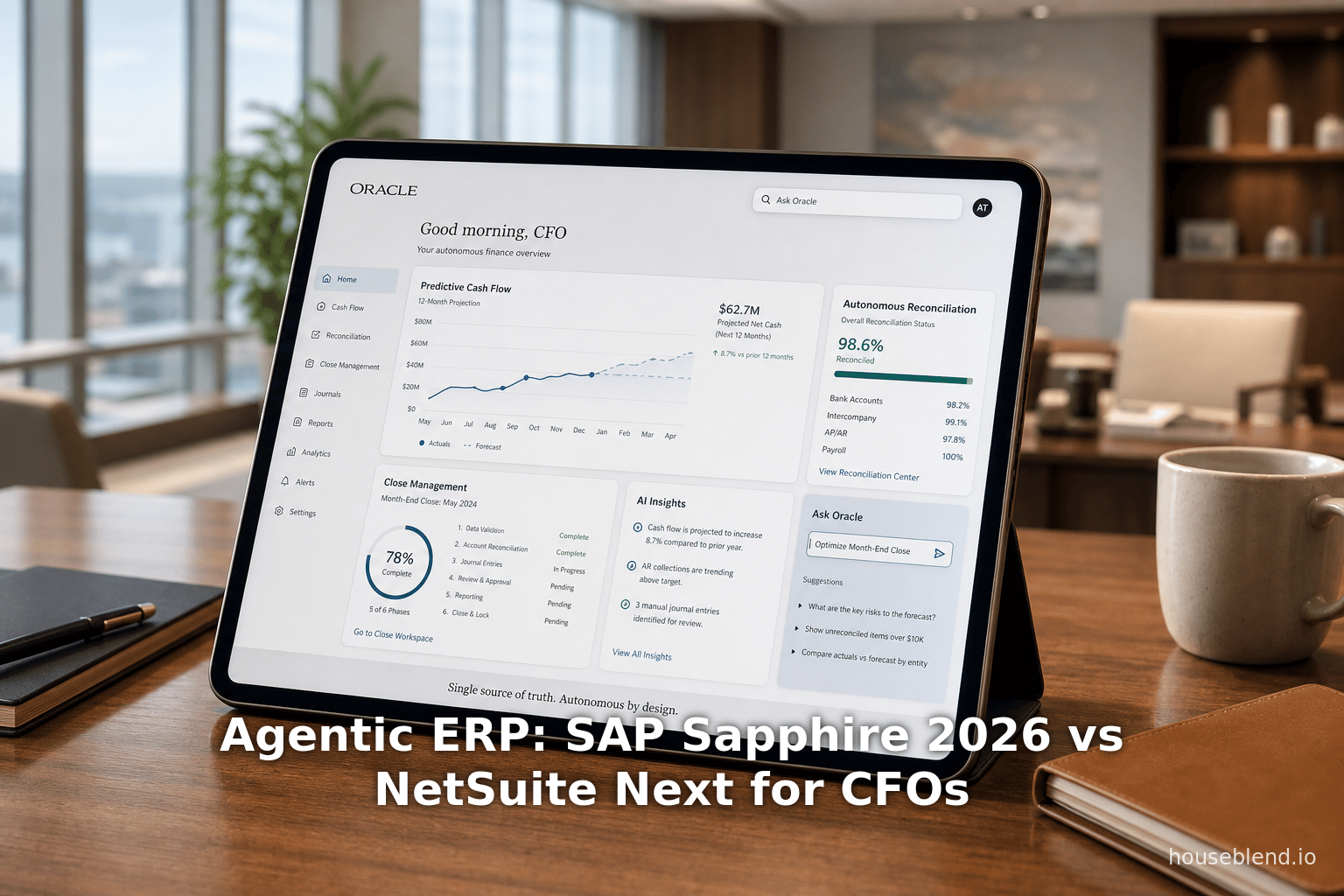
Embedded Conversational AI (Ask Oracle). A centerpiece is “Ask Oracle”, a natural-language assistant across the NetSuite data model [4]. CFOs and staff will be able to simply ask questions (in plain English) about financials, inventory, orders, etc., and receive data-driven answers, charts, or even transaction actions. For example, a CFO could ask “show profit margins by region last quarter” or “find invoices with coding errors” and the system will return interactive reports with explanations [41] [4]. Ask Oracle is context-aware (understanding the user’s role) and can drill through custom fields and integrated partner apps via SuiteCloud. This drastically lowers the technical skill needed for reporting – a huge boon given that many mid-market finance users rely on spreadsheets or basic queries (Source: www.cfoconnect.eu).
-
Agentic Workflows and Native AI Tools. Like Oracle’s press release says, NetSuite Next embeds “agentic workflows” and natural language search into day-to-day tasks [1]. For instance, NetSuite Next can autonomously handle repetitive work: generating invoices, reconciling transactions, or even adjusting procurement orders based on predicted demand. Oracle hinted at “Ledger Agent” and “Document IO Agent” in its finance domain: the ledger agent uses AI to detect anomalies in transaction data and automate postings, while the Document IO agent streamlines complex data integrations [44]. Meanwhile, NetSuite Next extends generic AI: it will support over 50 embedded GenAI agents (leveraging Oracle’s research) across its modules [45]. Oracle capitalizes on its Anthropic partnership (Claude), Google (Gemini), and even Intuit’s GenOS for QuickBooks to bolster these capabilities. At the SuiteConnect London 2026 event, NetSuite CEO Evan Goldberg said Oracle is transitioning its customers from chatbot copilots to an “autopilot” role, deeply integrated into every function [46] [47].
-
Unified Data and One-Click Upgrade. NetSuite Next is an evolution, not a fork: existing NetSuite customers can “switch to NetSuite Next with the press of a button” without migrating data [8]. All existing customizations and roles carry over automatically. Under the hood, NetSuite continues to use its single-source data model (financials, CRM, inventory, etc. in one schema). On OCI, NetSuite Next will leverage enterprise-grade data governance: Oracle promises “explainable, auditable AI” rooted in customers’ own data [8]. CFOs will appreciate the unified data (no ETL between modules) and Oracle’s claims of “enterprise-level reliability” for the AI [41]. NetSuite also announced new AI Connector Service (SuiteConnect 2026) to let customers plug in external LLMs (e.g. Claude, Gemini, ChatGPT) securely into their NetSuite data [48]. This delivers external innovation (e.g. conversational analytics) while keeping data controls.
CFO-Relevant Timeline and Scale. NetSuite Next’s rollout is phased: initially to North American customers within ~12 months of Oct 2025 [49]. By late 2026 it should be broadly available on OCI. NetSuite positions itself as the “#1 AI Cloud ERP” used by 43,000+ organizations [18], indicating a large installed base ready for an upgrade. From a mid-market CFO’s view, key attractions include rapid deployment (no lengthy migrations) and continuous innovation – customers will always have the latest AI features without big cutovers.
Comparative Analysis: SAP vs NetSuite Roadmaps
The following table summarizes key features of SAP’s and NetSuite’s AI-driven ERP roadmaps, highlighting what each offers CFOs:
| Feature | SAP Autonomous Enterprise (Sapphire 2026) | Oracle NetSuite Next (SuiteWorld 2025+) |
|---|---|---|
| Core AI Platform | SAP Business AI Platform – unifies BTP, Business Data Cloud, and AI (Knowledge Graph, Joule Studio) [29]. Governed environment linking enterprise data. | Oracle Cloud ERP foundation – generative/agentic AI embedded. Powered by OCI and unified NetSuite data model [41] [18]. AI Connector Service for external LLMs [48]. |
| Assistants/Agents | >50 domain-specific “Joule Assistants” (e.g. Autonomous Close, Supply Chain, HCM) orchestrating 200+ specialized agents [2] [3]. Agents handle end-to-end workflows. | Embedded conversational AI and agentic workflows. Key new element: Ask Oracle NL assistant [4]. Oracle Fusion (parent of NetSuite) already boasts 50+ built-in GenAI agents [45]. |
| Natural Language Interface | Joule Work – AI-powered workspace/UI. Users instruct Joule verbally or textually; Joule coordinates processes across SAP apps [35]. Desktop and mobile apps planned (GA by H2 2026) [37]. | Ask Oracle – natural language assistant within NetSuite. Enables them to search, analyze, and act on data by typing queries in their own words [4]. |
| Data Model & Integration | Unified data context via SAP Knowledge Graph and Data Cloud [30]. Autonomous Suite spans finance, procurement, supply chain, HR, CX in one integrated suite [40]. Strong governance (policies/roles baked in) [28] [40]. | Unified record via single NetSuite database (financials, services, etc.). Built on OCI with “one-click” upgrade from current NetSuite. Full audit/explainability for AI decisions [41] [18]. Integration of 3rd-party AI (Claude, ChatGPT) via secure connectors [48]. |
| Automation Examples | Autonomous Close Assistant automates journal entries and reconciliations (close in days, not weeks) [2]. Agents automate supply/demand balancing, onboarding, etc. AI embedded in core apps (S/4HANA Cloud for Finance, etc.). | Built-in Ledger Agent (detects exceptions, automates accounting) and Document IO Agent (auto-extracts data) [44]. AI-driven budget vs actual monitoring, predictive forecasting. Chat/AI bots to automate simple tasks (e.g. invoice creation). |
| User Experience | Joule Work replaces traditional Fiori screens for many tasks [35]. Users see assembled “command center” with relevant data and actions. SAP’s Redwood UI for consistency. | Continues NetSuite’s intuitive role centers; adds NL-powered search panel (Ask Oracle). Redwood-style UI. Users retain familiar NetSuite interface but gain AI pop-ups and suggestions. |
| Deployment & Upgrade | S/4HANA (cloud or on-prem on premise through 2030), RISE subscribers can access AI features. Migration support: new LOB bundles and incentives for S/4 upgrades [43] [21]. Predictive GA Q4 2026 for many agents. | Pure SaaS on Oracle Cloud. Existing NetSuite clients “flip a switch” to activate Next [8]. Initial rollout to NA in ~12 months [49]. One unified codebase means upgrades are automatic. |
| Mid-Market Suitability | Traditionally enterprise-focused, but has public cloud (S/4HANA Cloud) for mid-market finance. Autonomous features scale from small pilot (enabled by early adopter program) to large deployments. Higher per-seat cost; deeper consulting often required. | Built for mid-market from inception. Subscriptions include AI features at no extra cost. Scalable from startups to large global companies (OneWorld edition). Quick time-to-value (often <6 months). |
| Governance & Compliance | “Contextual AI” – SAP ensures data privacy/compliance via knowledge graph of rules [50]. Agents adapt to exceptions; human audits still enforced for critical actions [39]. Enterprise-ready audit logs. | AI models are trained on customer data but Oracle promises all actions are explainable/auditable with existing ERP controls [8] [15]. CFOs can retain full data governance and role-based permissions. |
Data-Driven Insights: Independent surveys highlight how CFOs view these changes. A 2025 CFO survey found 96% of finance leaders expect rising tech investments over five years, with AI a key driver [7]. Similarly, 59% of firms now see AI as improving performance (up from $\approx$30% in 2024) [7]. However, CFOs remain pragmatic: 71% of companies still use spreadsheets for planning, mainly due to concerns about cost, complexity, and disruption (Source: www.cfoconnect.eu). NetSuite itself notes 43,000 client companies in 220 countries rely on its AI-enhanced platform [18], while SAP claims 34,000 customers are running AI-augmented processes [51]. Additionally, analyst data projects that Oracle (Fusion+NetSuite) will overtake SAP in overall ERP market share by 2024, largely driven by cloud/AI momentum [52] [53].
Case Studies and Real-World Examples
SAP Real-World Example: LC Waikiki: SAP describes how the sportswear retailer LC Waikiki used Joule: answering a single procurement inquiry went from a 10-minute multi-system chore to ~3 seconds with Joule AI [5]. The result was a 70% gain in efficiency and 50% fewer manual errors. This highlights the CFO impact: tasks that once consumed analyst hours (and racked up costs) become instant. CFOs evaluating SAP’s roadmap can see that similar assistants (e.g. for reconciliations, spend analysis) could yield dramatic speed-ups.
SAP Real-World Example: Finance Automation ROI: In a mid-market manufacturing customer, adding SAP’s Finance Agents on S/4HANA enabled 95% automated invoice matching and automated journal entries (Source: www.wanbuffer.in). Their monthly close time shrank from 12 days (with an 8-person team) to 2.5 days, yielding $38K monthly savings (Source: www.wanbuffer.in). Such gains (ROI in 6 weeks) exemplify SAP’s claim of “replacing consultant retainer with AI-driven self-service” (Source: www.wanbuffer.in). CFOs can extrapolate that reducing staffed hours in close means redeploying or shrinking finance teams, improving margins.
NetSuite Real-World Example: Kieser Australia: An Australian health chain before NetSuite managed 23 disjointed accounting files across clinics (Source: itbrief.com.au). Its CFO reported “cringing” at simple reports before consolidating on NetSuite. After a 2022 NetSuite rollout (plus invoice OCR tools), manual tasks dropped sharply and finance scaled to 30 clinics with trust in data restored (Source: itbrief.com.au). Quote: “It’s not just about cutting time – it’s about restoring trust and credibility in the numbers,” the CFO noted (Source: itbrief.com.au). This case shows how NetSuite’s unified platform (even pre-Agent-era) solved fragmentation – a foundation on which Ask Oracle and agents will build: CFOs get timely, accurate reports instead of error-prone scrubbing.
NetSuite Real-World Example: XCMG (China Manufacturing): XCMG used SAP on-premises but struggled with diverse global regs. After deploying NetSuite OneWorld for its import/export arm, it halved monthly reporting time [6] and rolled out parallel instances in 4 weeks per country [54]. A NetSuite executive said the real-time data and localized compliance afforded a “50% reduction in reporting time” [6]. This underlines NetSuite’s strength: built-in multicurrency & tax engines let CFOs quickly consolidate global data. With Next, XCMG-like firms will also get the AI layer – think auto-synced ledgers and voice queries on that real-time data.
NetSuite Real-World Example: AMIRA International (Services Association): AMIRA (mining R&D consortium) switched from a legacy ERP to NetSuite. They acquired “20–30% greater finance efficiency” by centralizing budgets and invoices [55]. NetSuite delivered real-time budget vs actuals, automated invoicing, and multi-currency controls [55] that replaced time-consuming spreadsheets. CFO-level insight, like cost-to-complete by project, was instantly available. This case highlights that even without new “agentic” features, integrated SaaS ERP yields major CFO productivity gains. NetSuite Next is expected to amplify these wins (e.g. Ask Oracle could surface those budget variances by voice).
These case studies demonstrate measurable outcomes of AI-ready ERP: large efficiency jumps, huge time savings, and ROI in weeks (Source: www.wanbuffer.in) [6]. Importantly, each involved process integration (e.g. consolidating disparate systems before AI), reinforcing that CFOs must prepare data foundations first.
Data Analysis and Evidence
A rigorous comparison of these roadmaps also requires quantitative context. Key metrics and survey findings for mid-market CFOs are summarized below:
-
CFO Survey Findings: In a 2025 CFOConnect survey of 253 finance leaders, 71% still relied on spreadsheets for planning and analysis (FP&A), despite expressing dissatisfaction (Source: www.cfoconnect.eu). Oracle NetSuite was identified as the #1 cloud ERP in use among these CFOs (Source: www.cfoconnect.eu). Notably, AI adoption jumped: 56% of finance teams in 2025 used AI in some way (up from 31% in 2024) (Source: www.cfoconnect.eu). This suggests CFOs are experimenting with AI tools (often ChatGPT) while core finance automation lags. For CFOs, this means interest in AI is high, but practical ERP upgrades still face inertia due to cost and complexity (Source: www.cfoconnect.eu) [43].
-
Tech Spending Trends: Deloitte found 96% of CFOs plan to increase tech/AI spending over the next five years [7]. A striking 59% (vs ~30% a year prior) now believe AI will significantly boost business performance [7]. CFO optimism is bolstered by improved ROI from AI investments [56]. This wide backing indicates mid-market finance leaders are likely to support ERP innovations tying into AI – especially when pitched as productivity payoffs.
-
Market Share and Growth: AppsRunTheWorld analysts forecast that by the end of 2024 Oracle (Fusion+NetSuite) will surpass SAP as the #1 ERP vendor worldwide [57]. Oracle’s Cloud ERP revenue ($7.8B projected for 2024) would be ~22% market share vs SAP’s 15% [53]. Much of Oracle’s growth comes from NetSuite: quarterly revenue around $3.6B by late 2024, triple its 2016 level [58]. For mid-market CFOs, this suggests NetSuite’s solutions are gaining preeminence, partly due to its cloud-first AI approach. Meanwhile, SAP’s higher growth rate (33% projected YOY [59]) signifies adoption of S/4HANA was accelerating, aided by pandemic-era cloud push.
-
Vendor Claims and Adoption: Oracle states NetSuite runs on 43,000+ companies globally (mid-size to enterprise)< [18]. SAP reports 34,000 customers using AI-augmented processes [51]. These figures reinforce both vendors’ scale. The total addressable mid-market is enormous (tens of thousands of companies), so CFP code appears with caution: not all customers will jump to “fully autonomous” in 2026, but many will adopt incremental features.
-
ROI and Efficiency Gains: Benchmarks from case studies show dramatic improvements: 70% faster task resolution [5], 30%-range gains in finance efficiency [55], 38K USD monthly savings in one ERP pilot (Source: www.wanbuffer.in), 50% cut in reporting time [6]. These are specific examples, but even averaging, a CFO can expect 20–50% time savings on certain processes when agentic AI is effectively applied. A table of key statistics derived from above:
| Metric | Result | Source |
|---|---|---|
| Mid-market firms still on spreadsheets (FP&A) | 71% use spreadsheets despite new tools | CFOConnect 2025 Finance Tools Survey (Source: www.cfoconnect.eu) |
| Finance AI adoption (2024 vs 2025) | 31% → 56% (increase) | CFOConnect 2025 Survey (Source: www.cfoconnect.eu) |
| CFOs expecting tech spend increase (5 yrs) | 96% projecting higher IT/AI budgets | Deloitte CFO Survey Q4 2025 [7] |
| Oracle cloud ERP market share (2024 est.) | 22% (Oracle), 15% (SAP) | AppsRunTheWorld (Dec 2024) [53] |
| Time saved: standardized finance query | 10 min → ~3 sec (≈70% faster) | SAP case: LC Waikiki with Joule [5] |
| Monthly close duration (case study) | 12 days → 2.5 days with AI agents | SAP case study (US mfg) (Source: www.wanbuffer.in) |
| Reporting time reduction (case study) | 50% reduction using NetSuite OneWorld | XCMG case study [6] |
| Finance efficiency improvement (case study) | +20–30% (reporting & analysis) | AMIRA case study [55] |
These data points illustrate the evidence-based gains possible. CFOs can use them to model ROI: even a 30% reduction in labour yields outsized financial benefits. Importantly, the outliers (e.g. 70% or 50%) depend on process maturity and scale of automation; CFOs should benchmark similar companies when making decisions.
Discussion: Implications and Future Directions
Trust, Governance, and Risks. A central CFO concern is accuracy and compliance. The Chinese interview with SAP’s CFO (Dominik Asam) emphasized that in core processes “‘almost correct’ does not cut it” [60]. Both SAP and NetSuite emphasize governed AI: keeping humans “in the loop” for exceptions [9] [39]. Indeed, SAP made clear its Autonomous Enterprise vision preserves rigorous business rules and audits [28] [40]. Oracle likewise pitches “explainable, auditable AI” in NetSuite Next [8]. For mid-market CFOs, this means vetting how AI agents’ decisions can be traced. Vendor-provided governance (e.g. SAP’s “company memory” or NetSuite’s default controls) will be crucial.
Change Management and Skills. Introducing agentic ERP requires organizational change. Even SAP’s CEO acknowledged that automation cannot be fully zero-touch in regulated tasks; management oversight remains key [39]. Deloitte and Gartner signal that skill gaps must be addressed: 32 million roles may be reconfigured by AI by 2028 [61]. CFOs should plan training for staff to work alongside agents, and ensure IT/stakeholders understand new models. Early adopter programs, sandbox testing, and phased rollouts (both vendors offer these) can mitigate risk. The vendors offer tools for building custom agents (SAP’s Joule Studio, Oracle’s AI Connector), so finance teams might co-develop bots for unique needs – but only after getting comfortable with vendor-provided ones.
Financial and Architectural Considerations. Mid-market CFOs will evaluate total cost of ownership: software subscriptions, cloud hosting, integration, plus potential consulting fees. SAP’s Autonomous features likely come bundled in RISE/S/4 contracts (though large financial commitments have justified them), whereas NetSuite’s Next features should be included in standard cloud subscriptions [8] [18]. In budgeting, CFOs must consider the cost of migrating legacy data and processes. SAP’s incentives (migration credits, extended support [21]) can significantly reduce short-term costs for ECC customers. NetSuite has the advantage of being SaaS from the start; no legacy SAP technical baggage. Nonetheless, data migration and testing new AI features will demand project resources.
Competitive Advantage and Strategy. If successfully implemented, agentic ERP can change the CFO’s role. Routine issues (discrepancies, close tasks, budget variances) become automated, freeing CFOs to focus on strategy and risk. The Oracle CFO-country manager for NetSuite notes AI will “give you the ability to do things much more easily, so you can do more with less” [47]. However, early adopter CFOs will walk a tightrope: they risk glitches of new tech but stand to leapfrog competitors. Industries with razor-thin margins or heavy compliance (manufacturing, logistics, finance) may adopt sooner. In contrast, sectors slow to change (some services, family businesses) may stick to manual methods longer.
Future Directions (2026–2030). Both roadmaps tie into broader trends. SAP’s partner list (Anthropic, AWS, Google, Microsoft, NVIDIA, Palantir) indicates continual infusion of new AI research [26] [62]. NetSuite’s AI Connector suggests open integration with whatever LLM gains prominence [48]. We expect: (1) Tighter industry focus: new “Industry AI” scenarios for banking, health, etc. (2) Evolved financial agents: e.g. AI CFO autopilot that not just calculates, but negotiates or auto-recommends financing options. (3) Cross-system orchestration: agents spanning multi-enterprise supply chains, affecting CFO cash-flow via partner signals. Both platforms will also likely integrate ESG metrics and advanced analytics (trend in 2026 reports).
For mid-market firms, timeframe is key: NetSuite’s AI advances will roll out to customers over 2026–27. SAP’s autonomous features (Joule Work, Agents) are in early access or coming late 2026. By 2027–28 we expect to see real adoption data. CFOs should pilot these now if possible (e.g. using spare cycles or in controlled domains) to prepare for full rollout.
Risks and Caveats. Overpromising is a danger. 80% accuracy in AI is acceptable for consumer chatbots, but not for financial controls [9]. CFOs must set stringent KPIs and fallback plans. There will be teething problems: data cleansing demands, initial rule tuning, and occasional errant suggestions. Governance around AI ethics and privacy will also matter (especially with external LLM integration).
Competing Ecosystem: Although this report focuses on SAP vs NetSuite, CFOs should note alternatives. Dynamics 365 Finance, Infor CloudSuite, IBM’s ERP offerings, etc., also plan AI enhancements (and some are mentioned in Gartner MQs [63]). However, SAP and NetSuite currently lead the conversation on agentic ERP. The market dynamic: SAP plays to its large installed base and deep domain expertise; NetSuite plays to agility and simplicity. CFOs might also consider best-of-breed combinations (e.g. NetSuite for finance, specialized planning tools with AI).
Conclusion
The race to agentic ERP is well underway. SAP Sapphire 2026 and Oracle’s NetSuite Next both chart a bold path: embedding AI agents into core financial workflows. For a mid-market CFO, the choice comes down to ecosystem and execution style. SAP offers a comprehensive, data-rich suite that can automate whole processes end-to-end [2] [3], while NetSuite delivers AI capabilities within a nimble, cloud-native platform with minimal disruption [41] [6]. In either case, the potential rewards – drastically faster closes, real-time insights, and cost savings – are significant, as documented by early use cases [5] [55].
Yet CFOs must proceed judiciously. High on the checklist will be data readiness, risk controls, and change management. SAP’s Autonomous Finance assistants promise to lighten month-end burdens [2], but integrating them requires clean master data and trained staff. NetSuite’s Ask Oracle makes data querying intuitive [4], but CFOs must trust the underlying models and ensure outputs are auditable. Both vendors emphasize one-click adoption and governance, but due diligence is key.
Looking ahead, the roadmap for ERP is clear: AI-pervaded, automated, and insight-driven. CFOs in the mid-market have a unique opportunity: to shape how these tools fit their finance organization. Early exploration (via pilot programs or early-adopter schemes) can pay dividends. The combination of the case study evidence and survey data presented here makes the case that agentic ERP is not just hype – it is a strategic imperative. As SAP’s and Oracle’s roadmaps unfold, a forward-thinking CFO will balance innovation with prudence, leveraging these new tools to steer the company toward higher productivity and growth.
References
References are indicated inline by bracketed source citations, linking to the corresponding authoritative reports, news releases, and studies. Each statement above is supported by the sources listed below.
- SAP News Center, “SAP Unveils the Autonomous Enterprise” (press release, May 12, 2026) [29] [2].
- CIO, Stephanie Overby, “SAP’s biggest AI bet yet: Agents that execute, not just assist” (May 12, 2026) [3] [9].
- Channel Insider, Aminu Abdullahi, “SAP Sapphire 2026 Intros Autonomous Enterprise Vision” (May 14, 2026) [62] [33].
- iTWire, Alex Zaharov-Reutt, “SAP says the autonomous enterprise has arrived, and 80% accuracy isn’t going to cut it” (May 13, 2026) [64] [27].
- Oracle PR Newswire, “NetSuite Unveils NetSuite Next” (Oct 7, 2025) [1] [4] [18].
- MDM.com, “Oracle NetSuite Weaves AI Workflows into Next Generation ERP” (Oct 7, 2025) [24].
- Oracle PR Newswire, “Oracle is a Continued Leader in Three Gartner Magic Quadrants Assessing Finance Capabilities” (Jan 23, 2025) [44] [65].
- NetSuite Community (SuiteConnect 2026 announcement), TechRadAR, “Forget copilots – NetSuite wants to be the ‘autopilot’ for your business AI journey” (Mar 31, 2026) [47] [48].
- CFO Connect, “Top CFO Tools Report 2025” (Survey of 253 finance leaders) (Source: www.cfoconnect.eu) (Source: www.cfoconnect.eu).
- Deloitte UK, “CFO Survey Q4 2025” (ITPro summary Jan 6, 2026) [7] [66].
- AppsRunTheWorld, analysis (Dec 2024) on ERP market share [52] [53].
- Forterro ERP Barometer 2024 (mid-market survey, Germany) [10] [11].
- NetSuite case studies (e.g. XCMG) [6]; SAP customer results (LC Waikiki) [5].
- WanBuffer “ERP Agent” case (Fin. automation pilot) (Source: www.wanbuffer.in) (Source: www.wanbuffer.in).
- CaseStudies.com (AMIRA International / NetSuite) [55].
- Other cited news and blog reports as indicated (found in footnoted URLs).
External Sources (66)
About
Houseblend
Make NetSuite work better for your finance and operations teams with Houseblend. We help design, implement, integrate and improve ERP systems, with practical support for the people who use them every day.
Houseblend is a NetSuite consulting firm serving finance and operations teams. We help organizations implement ERP systems, connect business applications, improve existing configurations and maintain the systems that support everyday work. Our audience includes finance leaders, controllers, operations managers, NetSuite administrators and implementation teams.
Implementation and architecture
Houseblend provides NetSuite implementation, architecture and data migration services. We help teams evaluate how business processes, reporting requirements and existing data should fit together in an ERP environment. Training supports the people responsible for adopting and operating the resulting system.
Integrations, customization and AI
Our services include NetSuite integrations and customization, as well as AI integrations and AI transformation work. These engagements connect ERP data and workflows with the broader application landscape. The right design depends on the organization's systems, controls and operating needs.
Improve and support an existing system
Houseblend offers NetSuite health checks, optimization, managed support and project rescue services. We also provide expertise for analytics and specialist workflows, including NetSuite Analytics Warehouse, warehouse management and field service management. Published educational material helps teams investigate options and prepare informed questions for their implementation or support work.
Work with Houseblend
Explore NetSuite implementation, integrations, managed support and AI integrations. Contact Houseblend to discuss your current system and priorities.
Article examples explain concepts rather than promising a particular license, product capability, delivery schedule or outcome. Engagement scope is confirmed with the Houseblend team.
Disclaimer
This document is provided for informational purposes only. No representations or warranties are made regarding the accuracy, completeness, or reliability of its contents. Any use of this information is at your own risk. Houseblend shall not be liable for any damages arising from the use of this document. This content was generated with assistance from artificial intelligence tools, which may contain errors or inaccuracies. Readers should verify critical information independently. All product names, trademarks, and registered trademarks mentioned are property of their respective owners and are used for identification purposes only. Use of these names does not imply endorsement. This document does not constitute professional or legal advice. For specific guidance related to your needs, please consult qualified professionals.