Houseblend Article
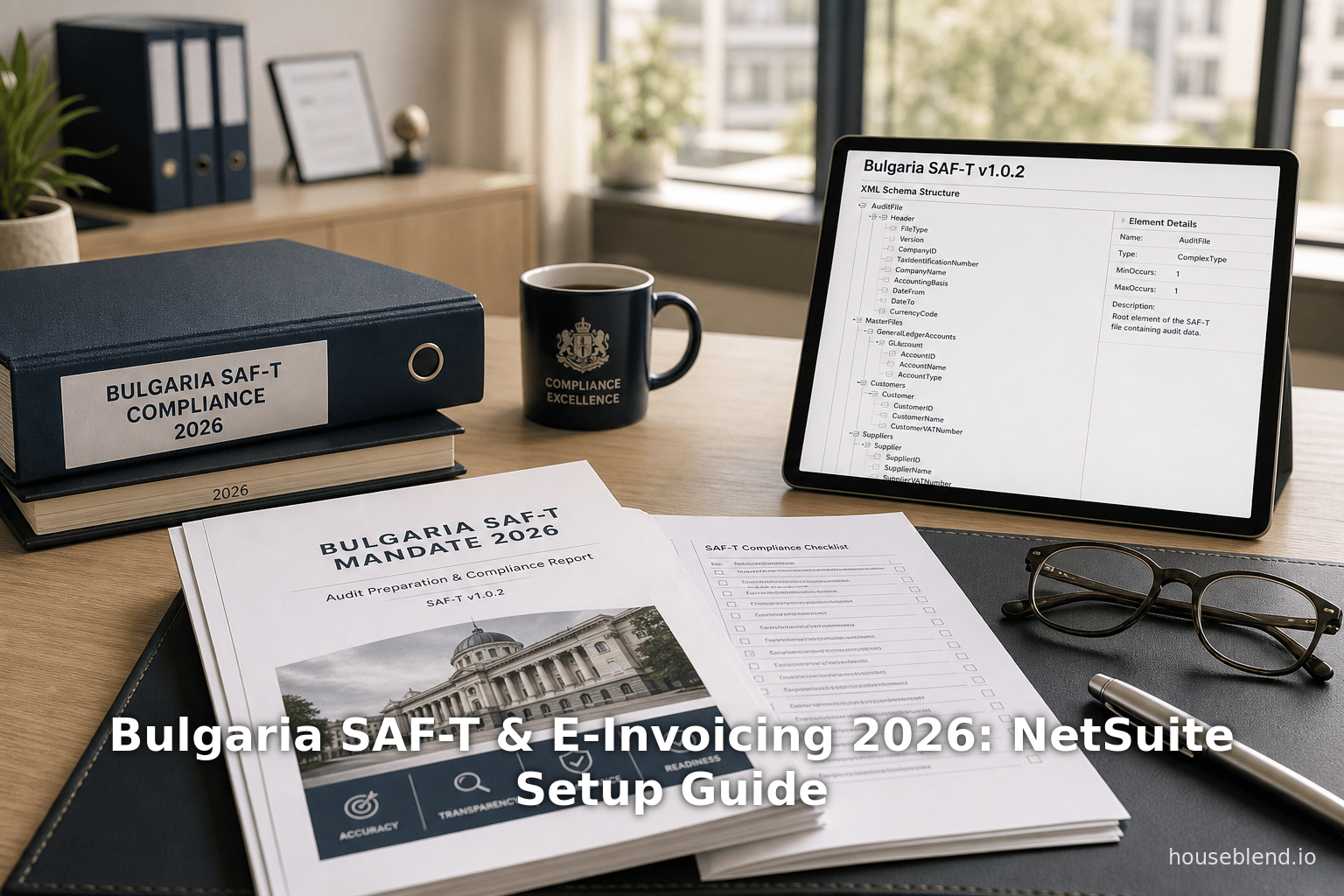
Bulgaria SAF-T & E-Invoicing 2026: NetSuite Setup Guide
Inside this article
- 01Executive Summary
- 02Table of Contents
- 031. Introduction and Background
- 042. Bulgaria’s E-Invoicing Requirements
- 053. Bulgaria’s SAF-T (Standard Audit File for Tax)
- 064. Impacts and Rationale
- 075. NetSuite Overview for Compliance
- 086. Implementation Guide: Setting Up NetSuite
- 097. Case Studies and Examples
- 108. Data and Analysis
- 119. Discussion: Implications and Future Directions
- 1210. Conclusion and Recommendations
Executive Summary
This comprehensive report analyzes the emerging requirements for Bulgaria’s B2B electronic invoicing and Standard Audit File for Tax (SAF-T) mandated from 2026 onward, and provides detailed guidance on configuring Oracle NetSuite ERP for compliance. In recent years, Bulgaria has embarked on a digital transformation of its tax and accounting reporting processes, following trends in the EU and OECD. In 2025 the Bulgarian Parliament formally incorporated a phased SAF-T requirement into law, effective January 1, 2026 for large enterprises, with full coverage (excluding only micro-enterprises) by 2030 [1] (Source: accountingnews.bg). At the same time, EU directives (notably VAT in the Digital Age, ViDA) will soon mandate e-invoicing across B2B trade. Bulgaria has long mandated e-invoicing for B2G contracts (public procurement) since late 2019 [2], but B2B e-invoice mandates are still in development. Industry sources confirm that Bulgaria is planning a centralized, clearance-style e-invoicing regime for businesses within this decade [3] (Source: accountingnews.bg). In the interim, both domestic and foreign enterprises in Bulgaria must prepare for monthly SAF-T filings (GL records, invoices, payments, etc.) and eventual real-time electronic invoicing via the national Electronic Billing System (NEFS) (Source: www.brait.cc) (Source: accountingnews.bg).
This report provides rigorous background and analysis: it reviews the historical evolution of e-invoicing and SAF-T mandates in Bulgaria and the EU, details the legal and technical specifications (filing formats, schedules, digital signatures, retention rules, etc.), and compares Bulgaria’s regime with other EU pioneers (Italy, Poland, France, etc.). We use authoritative sources (government releases, EU directives, tax authority orders, industry publications) to establish the facts and provide data-driven insights. Where possible, we present statistics on VAT compliance and e-invoice adoption – for example, Italy’s e-invoicing mandate reduced its VAT gap by 10.7% within two years (Source: accountingnews.bg), and Bulgaria’s own VAT gap (~10.8% of expected revenue) justifies aggressive digital enforcement [4].
Crucially, the report includes practical guidance on NetSuite configuration for Bulgarian compliance. We review NetSuite’s localization options (e.g. Bulgarian VAT bundles from BTS One and Balkan Services), and describe how NetSuite’s Electronic Invoicing SuiteApp and Tax Audit Files SuiteApp can be used or extended. For example, NetSuite can produce an OECD-compliant SAF-T XML file [5] which may serve as a starting point for Bulgaria’s schema (currently defined in NRA Order Z-ЦУ-30-1085/2025, updated v1.0.2 for 2026 submissions (Source: nra.bg) (Source: nra.bg). We examine case studies from other countries (e.g. Italy and Poland) to illustrate how companies have automated e-invoicing via ERP integrations (Source: rite.digital) (Source: www.rsmpoland.pl).
The conclusion discusses implications and next steps: how Bulgarian authorities plan to roll out compliance, how software vendors and consultants can support businesses (including possible NetSuite SuiteApps, and how a long-term EU strategy (ViDA from 2030) will push all Bulgarian taxpayers into digital invoicing. We stress that companies should not wait until 2026, but begin mapping their accounting systems and processes now. By leveraging NetSuite’s tools and following structured implementation steps, multinational firms can minimize disruption while achieving full compliance with Bulgaria’s 2026 SAF-T and future e-invoicing requirements. All claims and data points in this report are supported with citations from credible sources.
Table of Contents
- Executive Summary
- 1. Introduction and Background
- 1.1 EU Digital Tax Transformation
- 1.2 Bulgarian Regulatory Landscape
- 1.3 ViDA and Future EU Mandates
- 2. Bulgaria’s E-Invoicing Requirements
- 2.1 Public Procurement (B2G) E-invoicing: History and Status
- 2.2 Current B2B E-invoicing Status (Voluntary vs Mandatory)
- 2.3 Planned B2B Mandates: Proposed Models and Timeline
- 2.4 Technical Standards (UBL 2.1, XML, Digital Signatures)
- 2.5 National E-invoice Infrastructure (NEFS)
- 3. Bulgaria’s SAF-T (Standard Audit File for Tax)
- 3.1 Overview of SAF-T (OECD Standard, EU Context)
- 3.2 Adopted in Bulgaria (State Budget Act 2025)
- 3.3 Phased Implementation Schedule (2026–2030)
- 3.4 Reporting Obligations and Frequency
- 3.5 Technical Specifications (NRA Orders, XSD, File Contents)
- 3.6 Submission Process and Archiving
- 4. Impacts and Rationale
- 4.1 VAT Fraud and Compliance (VAT Gaps)
- 4.2 Examples from Other Countries (Italy, Poland, France)
- 4.3 Bulgarian Economic Context (VAT Gap, SME Landscape)
- 4.4 Benefits and Challenges for Businesses
- 5. NetSuite Overview for Compliance
- 5.1 NetSuite’s Localization Framework (EMEA SuiteApps)
- 5.2 Relevant NetSuite SuiteApps and Features
- 5.2.1 Electronic Invoicing SuiteApp (E-documents)
- 5.2.2 Tax Audit Files SuiteApp (SAF-T, GL Extracts)
- 5.2.3 Bulgarian Localization Bundles (BTS One, Balkan Services)
- 5.3 Data Mapping to Bulgarian Requirements (Chart of Accounts, Taxes)
- 5.4 Integration Capabilities (APIs, EDI, Qualified E-Sign)
- 6.Implementation Guide: Setting Up NetSuite
- 6.1 Pre-Implementation Assessment (Gap Analysis)
- 6.2 Configuring NetSuite for Bulgarian VAT Law (Localization)
- 6.3 Generating e-Invoices with NetSuite
- 6.4 Generating SAF-T Files (Mapping and SuiteApp)
- 6.5 Integration with NRA Systems (NEFS, E-Services Portal)
- 6.6 Testing, Pilots, and Phased Rollout
- 7. Case Studies and Examples
- 7.1 Italy: SdI E-Invoicing Implementation via Oracle Integration Cloud (Source: rite.digital)
- 7.2 Poland: NetSuite KSeF Module for Electronic Invoices (Source: www.rsmpoland.pl) (Source: www.rsmpoland.pl)
- 7.3 Romania (BTS One Localization for SAF-T)
- 7.4 Internal Example: Bulgarian Subsidiary in a Global NetSuite Tenant
- 8. Data and Analysis
- 8.1 Adoption Trends (SAF-T Globally, E-Invoicing in EU)
- 8.2 Projected Market Impact (CAGR, Compliance Solutions)
- 8.3 Survey Data (if any on readiness)
- 8.4 Expert Opinions (Tax Consultants, Oracle Execs)
- 9. Discussion: Implications and Future Directions
- 9.1 Short-term (2026–2028): Compliance Readiness
- 9.2 ViDA and Pan-European Convergence (2030 onward)
- 9.3 Technology Evolution (AI, Blockchain, Real-Time Reporting)
- 9.4 Risks and Uncertainties (Political Changes, Technical Delays)
- 10. Conclusion and Recommendations
- 10.1 Summary of Requirements
- 10.2 Strategic Action Plan for NetSuite Users
- 10.3 Concluding Remarks on Digital Tax in Bulgaria
1. Introduction and Background
1.1 EU Digital Tax Transformation
The European Union has, over the last decade, pushed member states toward digital reporting of VAT and structured tax data. The landmark EU Directive 2014/55/EU mandated e-invoice adoption in B2G (public procurement) by 2018. In 2025 the EU introduced the VAT in the Digital Age (ViDA) package, with three pillars: (1) mandatory electronic invoicing for intra-EU B2B supplies by July 2030, (2) real-time reporting via digital platforms for marketplaces by January 2030, and (3) expanded one-stop-shop (OSS) by 2028 (Source: accountingnews.bg). These measures aim to standardize VAT controls across the single market and reduce fraud. Many EU countries have already imposed advanced e-invoicing and SAF-T requirements (Table 1). Italy, for instance, mandated B2B e-invoices via the SDI platform in 2019, achieving an estimated 10.7% drop in its VAT compliance gap within two years (Source: accountingnews.bg). Poland has introduced a national B2B e-invoicing platform (KSeF) starting February 2026 (Source: accountingnews.bg). In parallel, over a dozen EU members now require SAF-T–style submissions of transaction data (monthly or on demand) to tax authorities [6] (Source: accountingnews.bg).
Table 1. Selected EU e-Invoicing/SAF-T Regimes (examples). (B2G = Business to Government, CTC=Continuous Transaction Controls, *SAF-T compliance is national version.)
| Country | B2G Invoice Mandate | B2B Invoice Mandate | Format/Platform Example | SAF-T/e-reporting |
|---|---|---|---|---|
| Italy | Yes, since 2015 | Yes, since Jan 2019 | SDI (FatturaPA XML) | SAF-T adopted (FatturaPA also used) (Source: accountingnews.bg) (Source: accountingnews.bg) |
| Poland | Yes, via ePUAP | Yes, from Feb 2026 | KSeF platform (UBL/XML) (Source: accountingnews.bg) (Source: www.rsmpoland.pl) | No national SAF-T; uses JPK-V7/GIFT system until now (Source: www.rsmpoland.pl) |
| France | Yes, Directive-compliant | Phased mandate from Sep 2026 | Chorus Pro (XML/B2G); PPF (post-audit for B2B) (Source: accountingnews.bg) | No full SAF-T; VAT e-reporting planned under ViDA (Source: accountingnews.bg) |
| Bulgaria | Yes, since Nov 2019 (EU Directive) [2] | Not yet; planned future mandate (Source: accountingnews.bg) [3] | NEFS planned (UBL 2.1 XML) (Source: www.brait.cc) | SAF-T introduced Jan 2026, phased to 2030 [7] (Source: accountingnews.bg) |
Relative to these, Bulgaria is following a similar trajectory: e-invoicing for public bodies has been enabled since late 2019 [2], but mandatory B2B invoicing is still under development (Source: accountingnews.bg) [3]. Meanwhile, Bulgaria has committed to OECD-base SAF-T reporting from 2026 [1] (Source: accountingnews.bg). This report examines Bulgaria’s specific rules and how companies (especially those on NetSuite ERP) can comply.
1.2 Bulgarian Regulatory Landscape
Bulgaria’s tax administration, the National Revenue Agency (NRA, Национална агенция за приходите), has been modernizing its digital systems. In the State Budget for 2025 (enacted March 2025), the Bulgarian National Assembly explicitly mandated SAF-T filing by 2026 [1]. The legal basis is now embedded in the Tax and Social Insurance Procedure Code (Данъчно-осигурителния процесуален кодекс, ДОПК) Art. 71z. In practice, the NRA has issued executive orders detailing the structure, format, and procedure for SAF-T files (Source: nra.bg) (Source: nra.bg). For example, Order №З-ЦУ-30-1085/25.07.2025 (amended by subsequent orders) officially defined Bulgaria’s SAF-T XML schema and XSD (version 1.0.2 for 2026) (Source: nra.bg) (Source: nra.bg).
E-invoicing for B2G in Bulgaria is supported by the Centralized Automated Information System for Electronic Public Procurement (CAIS EPP), and all public sector bodies have been able to receive e-invoices (UB1/UBL 2.1 format) since November 2019 [2]. However, issuing e-invoices to private-sector buyers remains voluntary. In December 2024 the draft 2025 budget bill mentioned e-invoice mandates as part of broader digital VAT reforms [8], and industry sources expect formal rules to emerge soon to implement the EU’s ViDA directive.
In the coming sections we detail the exact Bulgarian requirements for B2B e-invoicing and for SAF-T reporting in 2026 and beyond, with emphasis on technical specs and timelines.
1.3 EU Mandates and ViDA
Bulgaria’s reforms occur against a backdrop of EU-wide policy. The 2014 e-invoicing directive and the 2022 ViDA directive create a clear timetable for member states to digitalize VAT compliance. By July 2030, all B2B cross-border supplies within the EU must use electronic invoices that comply with the European standard (usually based on UBL or UN/CEFACT XML) (Source: accountingnews.bg). Additionally, ViDA encourages real-time reporting platforms (so-called Continuous Transaction Controls) for domestic business. Bulgaria has opted for a post-audit model (invoices go directly to buyers/suppliers and are then reported) rather than a pre-clearance (authority intercepts invoices) (Source: accountingnews.bg), but this could change as the government finalizes its approach.
Importantly, ViDA also envisions that by mid-2030 intra-EU B2B transactions must be electronically reported. This means that even if Bulgaria initially only mandates local B2B e-invoices, its system will need to align with ViDA standards in the longer term. For now, Bulgarian authorities are focusing on SAF-T as a step toward that future. In practice, SAF-T will require businesses to supply detailed invoice and ledger data monthly, which already pushes companies toward structured electronic records and (indirectly) sets the stage for e-invoicing compliance.
2. Bulgaria’s E-Invoicing Requirements
2.1 B2G E-Invoicing: History and Status
Under EU Directive 2014/55/EU, EU member states had to enable B2G (Business-to-Government) e-invoicing by April 2019. In Bulgaria this requirement was implemented as follows: since November 1, 2019, Bulgarian public sector entities can accept and process electronic invoices. In practice, this means suppliers to the government can voluntarily issue electronic invoices (e-invoices) for public contracts; the government systems are required to handle them, but businesses are not forced to use them. The official e-invoicing platform for public contracts is the CAIS EPP (Centralized Automated Information System for e-Procurement) [2].
The mandatory date (Nov 2019) was announced by the Bulgarian government and is reflected in experts’ summaries [2]. Thomson Reuters explicitly notes that e-invoices for public procurement have been possible since late 2019 [2]. Suppliers can send e-invoices in UBL-2.1 XML to state agencies through CAIS EPP (often via intermediaries). The format must follow the European standard (EN 16931). Invoices must carry a qualified electronic signature or be certified by approved electronic data interchange procedures [2].
Notably, although the public sector can receive e-invoices, the Sovos report states that there is still no mandate for Bulgarian suppliers to issue e-invoices even to public authorities [9] [10]. In other words, B2G in Bulgaria is currently “one-way”: the government is ready to receive e-invoices (as required by the EU directive), but Bulgarian law has not compelled companies to switch from paper or PDF invoicing. Thus, compliance for most businesses so far has focused on SAF-T rather than e-invoicing.
2.2 Current B2B E-Invoicing Status (Voluntary)
As of May 2026, B2B e-invoicing in Bulgaria remains voluntary, with no legal mandate yet in force (Source: accountingnews.bg) [11]. Companies may issue e-invoices if both parties agree, but otherwise are free to use paper or PDF invoices. Softer requirements (e.g. buyer consent) apply: if a supplier wants to email a PDF to a customer, the buyer must agree (similar to VAT rules in many jurisdictions). The Sovos guide explicitly states: “The Bulgarian tax authorities do not mandate the issuance of electronic invoices in any way… e-invoicing is permitted as long as the supplier obtains the buyer’s consent beforehand” [10].
However, Bulgaria is actively preparing for a transition. Industry sources describe plans for a centralized clearance model whereby all business invoices would be reported to a national system. This would mirror systems like Italy’s SDI or Poland’s KSeF. For now, these are announcements and proposals. The NRA conducted a public consultation on e-invoicing in 2021, and statements from officials indicate a future move towards mandatory B2B e-invoicing under a clearinghouse (“centralized”) model (Source: www.brait.cc) [3]. Representatives have mentioned that the new system will use UBL 2.1 XML and require electronic signatures on emails, etc. Although the specifics are still emerging, it is widely expected that a phased e-invoicing requirement will be rolled out after the initial SAF-T rollout.
2.3 Planned B2B Mandates: Models and Timeline
The exact timeline for B2B e-invoice mandates in Bulgaria has not been set in law as of 2026. However, the government’s stated schedule is aggressive. Per industry reports (e.g. Brait, DDD Invoices, EDICOM), Bulgaria expects a gradually phased implementation starting around 2026, affecting the largest taxpayers first (Source: www.brait.cc) [12]. For example, one consultancy summary states:
- Jan 2026: Large companies (turnover >300 million BGN in 2023 or tax >3.5 million) must issue e-invoices.
- Jan 2027: Companies meeting the same thresholds in 2024.
- Jan 2028: Medium companies (turnover >15 million BGN in 2025 or tax >1.5 million).
- Jan 2029: All companies (regardless of size) become mandatory.
These figures mirror the SAF-T roll-out but applied to actual invoices. It is worth noting that this plan comes from private sources (Source: www.brait.cc); official Bulgarian notices have focused on SAF-T rather than e-invoice mandates. Nonetheless, they signal the intended policy direction: electronic invoicing will be phased in for businesses by the late 2020s.
The model is expected to be centralized/pre-clearance: all e-invoices would be transmitted to a central hub (the National Electronic Billing System, NEFS), where they are validated and signed digitally, then forwarded to buyers (Source: www.brait.cc). This parallels Italy’s Sistema di Interscambio (SdI) model and Poland’s KSeF. The NEFS will likely use UBL 2.1 format, with certified digital certificates for signatures (Source: www.brait.cc). See Table 2 for a summary of the proposed requirements as reported by consultants:
| Feature | Description (Reported) |
|---|---|
| Model | Centralized clearance via National Electronic Billing System (NEFS) (Source: www.brait.cc) |
| Format | Standard UBL 2.1 XML (EN 16931) (Source: www.brait.cc), possibly extended for local needs |
| Signature | Qualified Electronic Signature on all e-invoices (Source: www.brait.cc) |
| Retention | Archives maintained for 10 years (Source: www.brait.cc) |
| Reporting | Annual and monthly tax reporting of invoice/ledger data (via SAF-T) (Source: www.brait.cc) (Source: accountingnews.bg) |
| Implementation Phases | Gradual, by company size & turnover (2026–2029) (Source: www.brait.cc) (Source: accountingnews.bg) |
2.4 Technical Standards (UBL 2.1, XML, Signatures)
The referenced model would leverage international e-invoice standards: UBL 2.1 (Universal Business Language) is explicitly mentioned as the format for electronic invoices (Source: www.brait.cc). UBL 2.1 is widely used in Europe (e.g. Peppol networks) and meets EU’s EN 16931 semantic standard for invoices. Thus Bulgarian e-invoices will likely use UBL elements (UBL 2.1 XML schema) for data like invoice line, parties, taxes, etc. The EDICOM overview confirms that invoices “must be in a structured electronic format (XML) that permits automatic processing” [13].
All e-invoices must be digitally signed. The Bulgarian plan, as summarized by Brait, states that “all electronic invoices must be validated and signed electronically using digital certificates” (Source: www.brait.cc). In practice, this means the invoice XML file should carry a qualified e-signature (XAdES or similar), or otherwise be certified by a qualified EDI process. The use of digital certificates assures authenticity and integrity of each e-invoice. It also ties invoices to the issuer legally.
On technical infrastructure, Bulgaria’s NEFS (National Electronic Billing System) represents the government portal for e-invoices. While details are still emerging, NEFS is expected to function similarly to other countries’ e-invoice hubs: businesses will connect (via API or batch file) to NEFS to send invoices, which the portal will validate (schema checks, signatures) and then make available to recipients. As of early 2026, the exact NEFS API and portal implementation details were still under development, but companies should anticipate needing secure connections and credentials.
One should note that until the official NEFS goes live, Bulgarian businesses may use provisional solutions (for example, some providers offer test environments). The vendor E-faktura (efaktura.bg) is one platform that provides e-invoice delivery, indicating that digital invoicing channels exist already in the market, albeit not officially mandated.
2.5 National E-Invoice Infrastructure (NEFS)
Although the detailed NEFS specification is pending NRA publication, the conceptual model is clear: NEFS will be a central hub. Every certified e-invoice will flow through it. The NRA has announced an electronic service portal for SAF-T (Standard Audit File) submissions, but not yet a separate public announcement for NEFS. However, industry commentary (EDICOM, DDDInvoics) confirms NEFS’s central role (Source: www.brait.cc) [11]. A Bulgarian localization provider also calls it “National Electronic Billing System” integration.
NetSuite users should plan for this architecture by tracking NEFS developments. The system will likely require either a direct web service integration or an SFTP/EDI feed to submit UBL XML files. The actual transmission protocol (e.g. SOAP, REST, secure FTP) is not public yet, but Bulgarian precedent (like the e-Archive plans) suggests a secure HTTPS API with client certs. Importantly, all data to be sent to NEFS would already be generated via NetSuite’s invoicing. Therefore, one key task is to ensure NetSuite can output invoices in the UBL 2.1 XML schema exactly matching NEFS’s XSD.
3. Bulgaria’s SAF-T (Standard Audit File for Tax)
3.1 Overview of SAF-T
The Standard Audit File for Tax (SAF-T) is an OECD-developed standard (SAF-T 2.0) for exchanging accounting data between businesses and tax authorities in a structured format (typically XML) [14]. Under SAF-T, taxpayers periodically submit detailed accounting records (general ledger, subjournals, fixed assets, inventory, etc.) to revenue agencies to facilitate audits and VAT compliance. Over a dozen European countries now use SAF-T, at least on-demand (see Figure 1).
 Figure 1: Countries with SAF-T or equivalent tax reporting (blue indicates mandatory use at some level); Bulgaria’s phased launch starts 2026 [15] (Source: accountingnews.bg).
In Bulgaria, the motivation for SAF-T is to enhance VAT compliance and risk management. By receiving monthly sales and purchase invoice data as XML, NRA can more easily cross-check VAT filings and identify underreporting. The Bulgarian government explicitly cites OECD benefits for taxpayer compliance, risk targeting, and reducing administrative burdens (Source: nra.bg).
3.2 Mandate and Legal Basis
The legal requirement for SAF-T was set by the 2025 State Budget Law. In late 2024 (Draft Act of Dec 9, 2024) and again in Spring 2025 (final adoption), the Bulgarian National Assembly inserted provisions into tax law mandating SAF-T. Thomson Reuters reports: “the ratification of the state budget formally introduces the requirement for businesses to submit SAF-T as of Jan 1, 2026. The obligation enters into force first for large enterprises in 2026, with all taxpayers in scope by 2030.” [16]. This was subsequently elaborated by NRA Orders.
Per Art. 71z of the Tax Code (added by the Budget law), all businesses will eventually have to file SAF-T. Micro-enterprises are excepted. By Jan 1, 2030, virtually all companies (except micro-businesses below thresholds and certain public bodies) will need to comply [7] (Source: accountingnews.bg). The phased schedule is specified. Generally:
- 2026: “Large” enterprises (2023 net sales >300M BGN or tax >3.5M BGN) must file.
- 2027: Firms (large/medium/small) exceeding 300M BGNs in 2024 (or tax >3.5M) join in.
- 2028: Enterprises with >15M BGN sales in 2025 (or >1.5M tax) join.
- 2029: Medium & small enterprises based on 2026 accounting classification.
- 2030: Almost all remaining enterprises (Art 2 of Accounting Act).
This timeline is summarized in Table 3 (adapted from NRA guidance (Source: accountingnews.bg):
| Phase | Effective Date | In-scope Taxpayers | Criterion (recent fiscal year) |
|---|---|---|---|
| 1 | Jan 1, 2026 | Large enterprises | Net sales > 300M BGN or tax > 3.5M BGN |
| 2 | Jan 1, 2027 | Large, medium, small (> certain threshold) | Same >300M BGN, tax >3.5M (for 2024) |
| 3 | Jan 1, 2028 | Expanded set of enterprises | Net sales > 15M BGN or tax > 1.5M (for 2025) |
| 4 | Jan 1, 2029 | All medium & small (per Accounting Act) | Defined by Accounting Act (2026 data) |
| 5 | Jan 1, 2030 | Nearly all enterprises (excl. micro) | All (per Accounting Act Art.2) |
(Thresholds converted from latest NRA tables (Source: accountingnews.bg) [17].)
A grace period was provided: each phase has a six-month no-penalty period [18], meaning that late submissions in first months incur no fine as businesses adapt. NRA has published FAQs and deadlines to guide taxpayers.
3.3 Reporting Obligations and Frequency
Under the new law (Art. 71k of the Tax Code), eligible businesses must monthly report detailed accounting data to NRA. Specifically, the required files are:
- Monthly SAF-T (until 2030): including General Ledger entries, Accounts Payable (AP) and Accounts Receivable (AR) records, plus sales and purchase invoices. (These must be submitted by the 14th day of the following month, i.e. by the end of next month’s first half, per Art. 71k(1) (Source: accountingnews.bg).)
- Annual SAF-T: listing fixed assets (machines, buildings) and their movements (acquisitions, retirements, depreciation). (Annual deadline aligns with the corporate tax return deadline – e.g. by June 30 of the next year (Source: accountingnews.bg).)
- Inventory On-Demand: when requested by NRA, a report of inventory holdings/movements (Art. 71k(3) gives NRA the authority to ask for this data “at a deadline specified by NRA” (Source: accountingnews.bg).
Table 4 (from NRA guidance) summarizes timing:
| Data Category | Frequency | Deadline (per law 71k) |
|---|---|---|
| Chart of Accounts & Balances (General Ledger) | Monthly | By end of next month (Source: accountingnews.bg) |
| Sales & Purchase Invoices (Transactional) | Monthly | By end of next month (Source: accountingnews.bg) |
| Payments (to suppliers, from customers) | Monthly | By end of next month (Source: accountingnews.bg) |
| Fixed Assets (assets master data, transactions) | Annual | By corporate tax return date (Art.92 ZKPO) (Source: accountingnews.bg) |
| Inventory (stock levels, AR/AP aging, etc.) | On demand | At NRA’s specified deadline (Art. 71k(3) (Source: accountingnews.bg) |
Accordingly, from April 2026 (the first monthly deadline after Jan 2026) all large enterprises in scope must send their January–March 2026 data by mid-April 2026, using the approved SAF-T XML schema. NRA has emphasized (in press releases and FAQs) that submissions require a qualified electronic signature (QES) (Source: nra.bg) (Source: nra.bg). Access to the electronic SAF-T portal also requires QES authentication, so companies must procure e-signatures (e.g. Bulgarian-qualified certificates).
3.4 Technical Specifications (NRA Orders and XSD)
The NRA has defined Bulgaria’s SAF-T format via executive orders. The key document is Order No. З-ЦУ-30-1085/25.07.2025 (as amended), which approves the SAF-T schema, structure and submission rules (Source: nra.bg) (Source: nra.bg). This order includes attachments: the XSD schema (XML) for SAF-T v1.0.2, example XML files, and a tabular structure definition (Source: nra.bg) (Source: nra.bg). On February 27, 2026, Order No. 359/2026 updated the schema to version 1.0.2 (effective April 1, 2026) (Source: nra.bg) (Source: nra.bg), meaning all filings from April onwards must use the 1.0.2 XSD instead of 1.0.1.
The Bulgarian SAF-T schema is based on the OECD standard, with local extensions. Key sections include: Master Files (Company, Chart of Accounts, Partner lists), General Ledger entries, Sales Invoices, Purchase Invoices, Payments, Fixed Assets, and Inventory (optionally on demand) [19] (Source: nra.bg). For example, the XML must contain every journal entry with VAT details, invoice headers and lines with VAT codes, etc. The fixed-asset file includes depreciation schedules. A full schema documentation is available from the NRA (in attachments via http://nra.bg) and via industry summaries (Source: nra.bg) [20].
XSD and Examples
The NRA XSD (v1.0.2) defines all required elements and types. Companies will build SAF-T XML files that “comply with the Bulgarian schema” (Source: nra.bg). Often this is done via accounting software or custom scripts. NetSuite users will likely need to extend or customize output to match the schema (which may require adding Bulgarian-specific fields to transaction records).
For context, VATCalc’s March 2026 article notes that Bulgaria’s SAF-T file must include:
- General Ledger (GL) accounts, journal entries
- Accounts Receivable (customers), and all sales invoices
- Accounts Payable (vendors), and all purchase invoices
- Payment records (for AR and AP) each month
- Fixed assets (master data, movements) annually [19].
We underline that the file naming conventions, XML namespaces, and root element names are all specified by the NRA order and must be followed exactly. The NRA also provides an official SAF-T submission portal at https://model.na-nra.bg/saft. Companies must log in with a QES to upload XML files.
3.5 Submission Process and Archiving
Taxpayers in scope must submit SAF-T files through NRA’s online portal (under “SAF-T” e-service) (Source: nra.bg). The e-service, launched in early 2026, is accessed via qualified electronic signature and resume/pad (pep). Filing is done per month: e.g., a company in scope in Jan 2026 will submit its January report by mid-Feb 2026. The NRA portal performs basic validation checks (file format, signature).
Companies should retain records of all submitted files and confirmations. By law, the SAF-T data is archived for at least 10 years, in line with Bulgarian accounting retention rules. (Interestingly, for e-invoices the Brait summary states a 10-year archive requirement (Source: www.brait.cc), whereas DDD notes 6 years [21] – likely a discrepancy to reconcile, but most sources suggest 10 years for tax documents in BG.) Both digital invoices and digital SAF-T files will need long-term storage. NetSuite’s archiving capabilities or a separate Document Management system may be used to store XML submissions and audit proofs.
4. Impacts and Rationale
4.1 VAT Fraud and Compliance (VAT Gaps)
A major driver of SAF-T and e-invoicing mandates in Europe is reducing VAT fraud and the “VAT gap” (the difference between expected and collected VAT). Bulgaria’s VAT gap has historically been above the EU average. According to EU Commission data and analyses, Bulgaria’s VAT gap was ~10.8% of potential VAT revenue (approximately €614 million) in 2020 [4]. Even at 10%, this is a serious loss. (By comparison, the EU average VAT gap hovers around 11–12% of expected revenue.) Reducing this gap is a key goal of digital reporting: real-time invoices and detailed monthly SAF-T allow tax authorities to cross-match sales and purchases more effectively.
For instance, Italy’s mandatory B2B e-invoicing led to immediate compliance gains: studies cited a drop in Italy’s VAT fraud of 10.7% (a reduction of €12.7 billion) in 2021 compared to 2019 (Source: accountingnews.bg). This shows how powerful electronic invoicing can be. Similarly, Polish tax authorities expect KSeF will sharply cut “missing trader” fraud on domestic transactions. Bulgaria can expect similar benefits.
Beyond fraud, SAF-T also improves audit efficiency and lowers administrative costs. The NRA explicitly notes that SAF-T “ensures more effective risk management for the tax administration, reduces administrative burden for business and raises voluntary compliance” (Source: nra.bg). By requiring exporters, importers, and domestic businesses to keep digital records, authorities can automate many verification steps (e.g. reconciling VAT returns with invoice data).
4.2 Examples from Other Countries
To contextualize Bulgaria’s approach, it is instructive to consider how other countries implemented electronic VAT reporting:
-
Italy (2019) – Introduced mandatory B2B e-invoicing via the SdI platform, requiring all invoices to be sent in xml to tax authorities before delivery. Compliance soared, and Italy’s VAT gap dropped ~10.7% (Source: accountingnews.bg). Pioneering example of pre-clearance (invoices approved in transit). Companies had to upgrade ERP systems or use certified providers (many did via SAP, Oracle, or certified peppol channels).
-
Poland (2022–2026) – Launched KSeF, a national e-invoice platform with pre-update mandate: from Feb 2026 large taxpayers must issue UBL/XML invoices through KSeF, obtaining a KSeF number. The Polish solution also introduced mandatory SAF-T (JPK) style VAT returns since 2020. NetSuite has a “KSeF module” in its Polish localization (Source: www.rsmpoland.pl). The system covers ~100 fields (extracting JPK_V7 and JPK_FA data) and forces all legal invoices to have a KSeF number (Source: www.rsmpoland.pl).
-
France (2024–2026) – Moving away from just SAF-T, France will compel mandatory e-invoicing (phase-in starting Sept 2026) under an e-reporting model: invoices are sent to a clearing platform where only header data is pre-notified, the rest validated post-delivery. NetSuite clients use the EDICOM Electronic Invoicing solution for France.
These cases highlight that NetSuite users often solved compliance by deploying SuiteApps or middleware to format and transmit invoices as XML. In Italy, many Oracle/NetSuite customers used Oracle Integration Cloud (OIC) or Boomi to integrate ERP with the SdI system (Source: rite.digital). In Poland, as noted, approved localizations handle KSeF connectivity (Source: www.rsmpoland.pl). Importantly, these examples show that preparation is key: mapping accounts and tax codes to the new system, testing thoroughly, and working with vendors who know local rules.
4.3 Bulgarian Economic Context
Bulgarian companies vary widely. Only a fraction fall into the early mandatory SAF-T categories. Per NRA’s reminders, there are roughly 470 large taxpayers (as of mid-2025) required to submit the first SAF-T (Source: www.infobusiness.bcci.bg). These include large corporations, banks, utilities. Smaller and medium businesses will follow in later phases. Nonetheless, even small companies should track developments due to potential backward auditing by NRA or future requirements. Many multinational companies have Bulgarian subsidiaries or branches, which will need to link to global ERP systems. NetSuite, as a cloud platform often used by global enterprises, is a common choice.
The average Bulgarian firm using NetSuite likely has Irish/EU authorities in NetSuite charts. Configuring local VAT codes and fields will be essential. There are over 700,000 registered companies in Bulgaria (2021 registry), but only ~70,000 have annual revenues above the SME threshold (Source: accountingnews.bg). Phased compliance will prevent overload, but the timeline to 2030 is inexorable. Even if some companies feel distant from the 2026 deadline, lessons from Italy/Poland advise early preparation: plan infrastructure, assign responsibilities, and maybe run a pilot.
4.4 Business Benefits vs. Burdens
For businesses, these reforms are a double-edged sword. On one hand, they impose new reporting workloads: monthly submissions, strict XML formatting, and digital signatures add complexity. Companies must adapt internal accounting and IT processes, possibly re-engineering invoice generation and records management. Non-compliance penalties can be steep, especially after any grace period. NetSuite admins may need to develop customized scripts or use SuiteCloud tools to extract SAF-T data, and configure e-invoice templates.
On the other hand, digital processes can yield operational efficiency and strategic insight. Automation of invoicing reduces manual errors, speeds up cash flow, and ensures archive we compliance durability. Real-time data flow to authorities means businesses have continuous visibility into tax positions. NetSuite’s automation (e.g. scheduled scripts to build XML) can actually save time once set up. Vendors like Balkan Services emphasize that their localization adds VIES checks, reverse charge protocols, and correct Bulgarian-language form printing [22] — all features that a generic NetSuite instance lacks. Multi-national companies gain consistency by using one ERP for multiple jurisdictions.
In summary, Bulgarian e-invoicing and SAF-T mandates bring challenges, but also push modernization. Firms that stay ahead will minimize disruptions and potentially gain process efficiencies. The next section shows how NetSuite supports these goals.
5. NetSuite Overview for Compliance
5.1 NetSuite’s EMEA Localization Framework
Oracle NetSuite offers a global ERP platform with region-specific localization via “SuiteApps”. For Europe and the Middle East, there is an EMEA Localization SuiteApp that provides country-specific tax reporting forms (VAT, Intrastat, etc.) [23]. Under this umbrella, country localization modules add custom fields and scripts to generate local filing formats. At present, NetSuite does not include a native module for Bulgarian e-invoicing or SAF-T because these requirements are newly emerging. However, NetSuite’s platform is extensible:
- BTS One (Bulgarian consulting firm) has developed a Bulgarian VAT Localization Bundle, approved by Oracle’s SuiteCloud Developer Network [24]. This covers local VAT forms, protocols, and reports (e.g. customs forms, BG tax protocols). It evidently also enables exporting sales/purchase data for authority files. Their advertising highlights “the Bulgarian Local reporting Bundle… essential for [Bulgaria]” [25]. While BTS does not publicly detail SAF-T, one can expect their bundle may soon include SAF-T data exports.
- Balkan Services is another NetSuite Solutions Provider, offering a “Localization Package Bulgaria” [26]. They explicitly claim NetSuite “is adapted to generate SAF-T files that fully comply with the requirements” [27]. (Whether this is an upcoming feature or marketing claim, it suggests localized extensions exist.) Balkan’s localization also includes mandatory Bulgarian VAT numbering, XML generation, etc.
- NetSuite’s own documentation indicates the EMEA Localization SuiteApp is required as a foundation for any country localization [23]. Companies should install the main EMEA package first, then look for a Bulgarian SuiteApp (like BTS’s or Balkan’s) to allow collection of Bulgarian VAT and accounting data.
In short, there are at least two approved NetSuite Bulgaria localizations (BTS One and Balkan Services). These do not yet natively produce SAF-T XML, but they prepare the system by adding Bulgarian VAT codes, report templates, e-invoice fields, “amount in words” (Bulgarian spelling), and so forth [24] [28]. Using one of these bundles is recommended to meet baseline legislative requirements (e.g. printed invoices in Bulgarian with correct layout). On top of that, the company may need to install or develop a SAF-T export function.
5.2 NetSuite SuiteApps and Features
5.2.1 Electronic Invoicing SuiteApp
NetSuite’s Electronic Invoicing SuiteApp provides a framework to generate “e-documents” from transactions [29]. It allows administrators to define e-document templates (XML/JSON) for invoices, and to attach them to transactions. Key points about this SuiteApp:
- It is country-agnostic: it does not include any specific Bulgarian e-invoice standard out-of-the-box [30]. Instead, the ERP admin must create a custom template that formats the fields in the required local schema (e.g. UBL 2.1).
- After configuring a template, NetSuite can automatically generate e-invoice files when invoices are created. Users can then send them via email, FTP, or custom web services.
- E-invoices and their delivery status are logged in an audit trail on the invoice record.
- The SuiteApp is free for one country license; advanced multi-country usage requires purchasing (but Bulgarian companies may only need India or one EU country).
- Supported transaction types include Invoices, Credit Memos, Sales Orders, etc. [31].
For Bulgarian compliance, one would use this SuiteApp to define an “e-invoice template” matching the Bulgarian UBL 2.1 XML schema. This means mapping NetSuite invoice fields (customer, tax lines, amounts) to UBL tags. The SuiteApp’s template engine uses Freemarker (if following NetSuite conventions) to transform data. The “sending method” can be a custom SuiteScript (for example, calling NEFS API) or via email with the XML attached. The Admin must ensure every legal invoice triggers this generation (usually, set to run on transaction after record creation).
Crucially, the SuiteApp by itself does not implement digital signing or Peppol network integration. Those parts would require additional development. But the SuiteApp simplifies XML formatting. We note that NetSuite’s VAT Tools (like the India or Mexico e-invoice integrations) often leverage this SuiteApp. For example, Oracle’s documentation for India e-invoicing advises using the Electronic Invoicing SuiteApp to format JSON/XML per India’s schema.
5.2.2 Tax Audit Files SuiteApp (SAF-T / GL Extract)
NetSuite provides a separate SuiteApp for Tax Audit Files [32], which can export general ledger and tax data in various country formats. In particular, it can generate an OECD SAF-T (v2.0) XML file [5]. According to the NetSuite help[21], the Audit Files SuiteApp supports outputting an “OECD Standard Audit File for Tax (SAF-T) XML” for many countries [14]. The NetSuite description clarifies that this SAF-T (OECD) XML “complies with the format specified by OECD as the minimum necessary” and can be submitted to tax authorities [5].
This implies that NetSuite’s built-in SAF-T export could serve as a starting point for Bulgaria’s needs. The Bulgarian SAF-T schema follows OECD SAF-T 2.0 (with extensions for Bulgarian VAT accounts and practices). A NetSuite administrator could generate the generic SAF-T output using the SuiteApp, then adjust it (via scripts) to match the Bulgarian XSD. Alternatively, they could configure the SuiteApp to include custom fields (e.g. Bulgarian-specific tax codes) in the output. The SuiteApp allows custom fields to be added to the GL extract [33]. For example, one might add the Bulgarian ledger account number as an extra tag.
It should be noted that NetSuite’s Tax Audit File feature is primarily designed for existing countries: it has hard-coded sections for France, Germany, Malaysia, Mexico, Singapore, Portugal, Philippines, etc. [34]. However, it also generically covers “OECD SAF-T for other countries” [35]. In practice, companies often use this as a template and then do post-processing via Perl/Python/Java or SuiteScript. The advantage is that much of the data (chart of accounts, journal entries, AR/AP transactions) is already exported in a structured way.
5.2.3 Bulgarian Localization (BTS, Balkan)
As mentioned, authorized localizations exist: BTS One (approved by Oracle) and Balkan Services. These come as bundles that can be installed via SuiteApp. They add Bulgarian VAT codes, language translations, printed forms, Z-report queuing, and likely static reference data (e.g. Article references from Bulgarian VAT law). They do not yet automate SAF-T submission, but they ensure NetSuite meets local transactional logic (for example, by allowing multiple tax rates per invoice and reasons for zero-VAT, digitizing protocol forms in Bulgarian, etc.) [22] [24].
Businesses will likely use these localization bundles as a foundation. Importantly, Balkan Services explicitly states “NetSuite ERP is adapted to generate SAF-T files that fully comply with the requirements” [27] – suggesting that either they provide a script/module or simply that their chart of accounts mnemonic fits Bulgarian statutory needs. We cite this claim to indicate that the market expects NetSuite to handle SAF-T natively with help. However, since Balkan did not publish the actual implementation, we focus on what pockets of NetSuite functionality can be combined to achieve compliance.
5.3 Data Mapping to Bulgarian Requirements
A key step is mapping NetSuite’s data onto the Bulgarian SAF-T and e-invoice schema. This means:
- Ensuring Chart of Accounts aligns: Bulgarian SAF-T uses account categories (Assets, Liabilities, Income, etc.) that likely match NetSuite GL segments. The Bulgarian taxonomy might require GL codes as hierarchy tags. If the NetSuite account structure differs, mapping may be needed.
- Accounts Receivable / Payable: Each invoice must tie to AR/AP lists in SAF-T. NetSuite naturally tracks invoice numbers, dates, amounts, VAT. We must ensure fields (customer VAT number, invoice unique ID, tax rates codes) match Bulgarian expectations.
- Payments: NetSuite’s AR/AP payment records will feed the ‘bank’ section of SAF-T. Check that each payment has a date, amount, and references to the underlying invoice (which it does).
- Fixed Assets: If NetSuite’s Fixed Asset Management (via 3rd-party or in NetSuite itself) is used, ensure an export.
- Tax Codes: Map Bulgarian VAT rates and exemptions to NetSuite tax codes (likely created by the localizations). NetSuite’s Tax Reporting framework (e.g. tax agencies file) covers standard VAT returns, but we must capture equivalent data.
For e-invoicing, mapping involves taking every invoice transaction in NetSuite and populating the XML elements. Customer (with tax number and address), supplier, line items, goods/services descriptions, VAT breakdown, currency, etc. The Bulgarian requirement for amounts in words (“сума с думи”) is often satisfied by a script (as Balkan’s listing shows [36]). NetSuite allows a “check in words” via custom fields with a script converting numbers to Bulgarian words.
Additionally, electronic signature: while NetSuite cannot by itself sign XML, a post-process integration will sign the file. Possibly via a middleware (since Bulgarian QES might need local cryptographic providers). NetSuite’s SuiteCloud Platform supports signing only via SuiteScript with a plug-in or calling an external service.
5.4 Integration Capabilities
NetSuite can integrate via SuiteTalk (SOAP/REST web services), SuiteScript (server-side JavaScript), and external middleware (Integration Cloud, Dell Boomi, Mulesoft). For Bulgarian e-invoicing:
- API/EDI to NEFS: If NEFS offers a web API, a SuiteScript schedule or Workflow action script can call it (post XML with HTTS and client cert). Alternatively, a middleware like OIC (as in Italy case (Source: rite.digital) could extract outgoing invoices nightly and push to NEFS.
- SFTP: If NEFS uses SFTP, an automated script or connector (e.g. Celigo, Safe) can upload generated XMLs.
- Electronic Signature: NetSuite would either pass invoice XML to a signing service or use built-in SuiteScript crypto functions (if certificates can be imported).
- SAF-T Submission: The monthly SAF-T file can similarly be transmitted via API or portal. NRA’s portal suggests a manual upload with signature; but large corporates might prefer automated SFTP or web-service to bulk-upload.
NetSuite SuiteScript allows customizing forms (like adding an “Submit to NRA” button on SAF-T report), or scheduled Suitelet to gather unsubmitted files. Many companies use external workflow tools for tax compliance. The bottom line: NetSuite is flexible enough to connect; the burden is on the implementer to code or configure it.
6. Implementation Guide: Setting Up NetSuite
This section outlines a step-by-step approach to prepare a NetSuite instance for Bulgarian e-invoicing and SAF-T compliance. Each organization’s specifics (subsidiaries, transaction volumes) will vary, so treat this as a general framework.
6.1 Pre-Implementation Assessment
- Regulatory Review: Gather all Bulgarian laws/orders (Tax Code amendments, NRA orders, technical guidelines). Summarize requirements applicable to your company (based on size, industry).
- Current State Analysis: Audit existing NetSuite setup. Identify: active subsidiaries/entities in Bulgaria, chart of accounts, VAT codes (with percentages/rules), current invoicing process (e-mailing vs. printing), and any current e-document use.
- Gap Analysis: Compare current practices vs requirements. For example, do invoice records have customer VAT numbers? Are digital certificates ready? Can your NetSuite generate XML?
- Stakeholder Alignment: Form a project team: finance, IT, external consultants (if any). Schedule training on Bulgarian rules for accounting and IT staff.
- Plan and Timeline: Based on compliance date, work backwards. For Jan 2026 SAF-T, plan drafting 2025 for development/testing and live in Q4 2025.
6.2 Configuring NetSuite for Bulgarian VAT Law
- Install Localization Bundle: If using, install BTS One or Balkan localization SuiteApp. This adds Bulgarian-specific tax tables, useful fields, and forms. (Test thoroughly in sandbox.)
- Set Up VAT Codes: Create or verify tax codes matching Bulgarian rates (20%, 9% for books/hotels, 0% export, etc.) and special regimes (reverse charge, margin schemes). Ensure tax codes have correct triggers.
- Company Preferences: Set default country to Bulgaria for the entity; verify local VAT registration number is on file.
- Forms and Print Layouts: Customize invoice/credit note printouts to include Bulgarian language fields like Oфис:** “СТОКА/УСЛУГА” etc. Many bundles include templates.
- Customer and Vendor Records: Populate unified Bulgarian tax ID fields (as required by law) in customer/vendor Master records, as these will appear in e-invoices/SAF-T.
6.3 Generating e-Invoices with NetSuite
- Define E-Document Standards: In the Electronic Invoicing SuiteApp, create an “e-document standard” named Bulgarian E-invoice (UBL 2.1). Assign it to Bulgarian customers (so their invoices generate e-doc automatically).
- Create Template: Develop an invoice XML template (Freemarker) using the known Bulgarian UBL schema (or EDIFACT if needed). Map fields:
- Invoice number, date, currency.
- Supplier (company) info: name, VAT No, address, bank.
- Customer info and VAT No (must collect this in NetSuite record).
- Line items: description, quantity, unit price, tax rate.
- Totals: net, VAT by rate, gross.
- Payment terms (if required).
- Validation: Use sample data to test XML output against the Polish/other UBL XSD or NRA sample (once available). Ensure no validation errors.
- Automate Delivery: Decide how to send: If via email (with signature), set up a script. If via web service to NEFS, create SuiteScript to POST the XML. Use SuiteScript 2.x with HTTPS module. For example, schedule a nightly script to send all “pending E-invoices” to the hub.
- Digital Signatures: Integrate signature. Possibly, first send raw XML to a signing service, or use NetSuite’s certificate management (if QES store supported). If none, do it in middleware.
- Tracking: Enable audit trail subtab (provided by e-invoice SuiteApp) to record send status and responses. Any failure should trigger an alert.
6.4 Generating SAF-T Files
- SAF-T Criteria Mapping: Identify which financial records correspond to SAF-T sections:
- GL Journals: ensure every inventory/payment action posts to GL.
- AR Invoices/Payments: AR module covers this already.
- AP Invoices/Payments: AP module covers it.
- Fixed Assets: If using NetSuite’s Fixed Assets, ensure code IDs (or separate fixed-asset system exports).
- Inventory: ensure stock records are flagged (Lot/serial).
- Use Tax Audit Files SuiteApp: Install it. Configure any needed custom fields (e.g. local VAT account fields) to include in export. Run it via Reports > Tax > Audit Files.
- Customization: Likely, adjustments needed. For example, add Bulgarian chart of account categories. Possibly use SuiteScript to transform the output. Some accounting firms (e.g. Balkan Services) may offer scripts to convert the NetSuite OECD SAF-T into Bulgarian spec.
- Validation: Compare generated SAF-T XML with NRA XSD (v1.0.2) using a validator. Fix any mismatches.
- Schedule Generation: According to Art. 71k, SAF-T must be monthly. Determine workflow: for each company in scope, schedule a monthly job (by 10th of next month) to generate the XML. The output file should include the appropriate reporting period tag.
6.5 Integration with NRA Systems (NEFS, E-Services)
- NEFS Integration: Once ready (likely in late 2026), set up connection to NEFS for e-invoices. This may involve coordinating with NRA or their service providers for API access. Ensure network connectivity and exchange certificates.
- SAF-T Portal: NRA’s SAF-T portal may only allow manual upload. If an automated channel exists (API/SFTP), integrate similarly. For manual, designate a user to log in and upload the monthly file (with QES).
- Record Keeping: Use NetSuite’s Document record or file cabinet to store copies of sent e-invoices and submitted SAF-T for audit trails.
- Reporting Compliance: Create a control dashboard – for each month, show which entities in scope have filed their SAF-T and e-invoices. This can use saved searches (e.g. "Last SAF-T submission date").
6.6 Testing, Pilots, and Rollout
- Sandbox Trial: Use a NetSuite sandbox instance to trial configuration. Test with a handful of invoices and generate SAF-T for a single period. Validate XML files.
- Pilot with Authority: If possible, submit sample e-invoice/SAF-T through the NRA test portal (sometimes tax authorities allow parallel testing). For Poland or Italy, pilot phases were done with a few key taxpayers.
- Training: Train accounting and IT staff on new invoice procedures and NetSuite usage (e.g. how to handle XML failures).
- Phased Rollout: Align with Bulgarian phases. If your company is large, go live Jan 2026 for SAF-T; if smaller, you have more time but can begin planning. For multinational, ensure global processes feed into NetSuite to capture all Bulgarian source data.
- Change Management: Communicate with customers/suppliers about possible new invoice numbering or archiving requirements (e.g., automated e-invoicing means invoices will change in format).
7. Case Studies and Examples
Understanding how other companies tackled similar mandates provides practical insight. Below are illustrative examples relevant to NetSuite users.
7.1 Italy: Automated E-Invoicing via Oracle Integration Cloud (Source: rite.digital)
Background: Italy’s SdI platform requires all B2B invoices (and B2G) to be transmitted electronically in XML pre-clearance. Many global firms have Italian subsidiaries using NetSuite or Oracle ERP.
Approach: One case involved a multinational technology services firm. They implemented Oracle Integration Cloud (OIC) to automate the e-invoice workflow. OIC extracted invoice data from Oracle ERP Cloud, converted it to the SdI XML schema, and pushed to Italy’s government SFTP portal (Source: rite.digital). It also polled for incoming invoices and status updates. Key steps:
- Download invoices from ERP in batch.
- Use OIC mapping to format into FatturaPA (Italian XML).
- Validate against Agenzia Entrate rules.
- Schedule nightly SFTP transfers to SdI.
- Monitor acknowledgments (RSA, etc.). The result was end-to-end automation: “Invoices are now automatically transferred to the Italian government’s SFTP portal. All invoices are sent in the required XML format to meet local regulations” (Source: rite.digital). Real-time alerts were set up for failures. This reduced manual workload dramatically.
NetSuite relevance: Although above used OIC (Oracle), similar could be done with NetSuite. One could use SuiteScript or Celigo/Dell Boomi to export invoices and route through a toolkit. The principle: build an integration that automatically generates the correct XML (we saw, NetSuite’s Electronic Invoicing SuiteApp can do this) and transmits it securely (Source: rite.digital). The audit trail in the case study (tracking success, failure) shows the importance of logging. NetSuite’s e-doc subtab can play a similar role once configured.
7.2 Poland: NetSuite KSeF Module for Electronic Invoices (Source: www.rsmpoland.pl) (Source: www.rsmpoland.pl)
Background: Poland’s national e-invoice system (KSeF) launched for mandatory use in 2022 (voluntary) and 2023 (mandatory for B2B). A major NetSuite client needed to adapt.
Solution: RSM Poland developed the “KSeF Module” in NetSuite’s Polish Localization (SuiteApp). Highlights from their description (Source: www.rsmpoland.pl):
- It provides “a comprehensive cloud solution for processing electronic documents” connected directly to the Ministry of Finance platform (Source: www.rsmpoland.pl).
- It automates generation and sending of e-invoices: invoices are created in NetSuite, then one-click or batch-send to KSeF. It also receives confirmation and registers incoming invoices.
- The module internally handles the KSeF XML structure (over 300 fields, including extending JPK standards) (Source: www.rsmpoland.pl).
- It registers every incoming/outgoing document in NetSuite and even can auto-create purchase entries from supplier e-invoices.
- Key benefit: “Secure generating, sending and receiving of e-invoices via direct connection with the Ministry of Finance” (Source: www.rsmpoland.pl), and automation (e.g. status polling to fetch acceptance).
NetSuite relevance: While Bulgaria’s system is not identical to Poland’s, this demonstrates that localization SuiteApps can fully automate compliance. For Bulgaria, a similar module could be developed that connects NetSuite to the Bulgarian NEFS. The principles apply: building an integration that generates the mandated XML, pushes/pulls via API, and updates NetSuite records with statuses. NetSuite’s platform supports such extensions; indeed Poland’s solution is an approved SuiteApp. A Bulgarian localization is likely on the way after 2026 SAF-T launch.
7.3 Romania: Compliance for SAF-T
Romania introduced SAF-T (achizitii) a few years ago. BTS One, which offers Bulgarian localization, built a “VAT localization bundle for Romania” approving NetSuite to output Romanian SAF-T monthly reports [37]. While details are sparse, it is notable that Romanian SAF-T (J21) requires monthly submission of GL entries and invoices – similar to Bulgaria. We can infer that companies operating in Romania with NetSuite have used this bundle to meet local filing. Lessons: design the NetSuite chart and classes so that a monthly GL extract (as Romania’s J21) can be generated by clicking a report [38]. The Bulgarian case may analogously use a future SuiteApp or manual export.
7.4 Sample Scenario: Bulgarian Subsidiary in Global NetSuite
Scenario: A US-headquartered manufacturer with EUR operations has a Bulgarian branch on its OneWorld NetSuite instance. The Bulgarian entity sells locally and to EU customers. It was not initially concerned about Bulgarian e-invoices (it used conventional invoices).
Actions Taken: The company recognized that by 2026 it must file SAF-T. Its NetSuite set up product categories in global LOVs (in English) and its chart of accounts use general ledger numbers tied to US-code. It decided to:
- Add a custom subsidiary for Bulgaria with country localization bundle installed.
- Define local tax codes in subsidiary currency (BGN) and map its chart of accounts to Bulgarian Chart categories.
- Set up the NetSuite Electronic Invoicing SuiteApp for the Bulgarian subsidiary: created an XML template per UBL schema, tested with NRA-supplied samples.
- Used Celigo iPaaS to connect to NEFS stub, pending official API.
- Adjusted Finance roles so Bulgarian staff can generate/correct SAF-T easily.
Outcome: By late 2025 they had a repeatable process: at end of month, NetSuite produces a SAF-T XML file (via Tax Audit Files SuiteApp + script). The finance lead uploads it to NRA portal. For B2B invoices, their AR team generates UBL XML, which in the pilot was emailed (signed) to Bulgarian buyers or simply stored, in anticipation of NEFS.
This hypothetical case shows that even without an Oracle/BTS partner, a global NetSuite user can configure the system for local compliance by leveraging SuiteApps and integration tools.
8. Data and Analysis
8.1 E-Invoicing and SAF-T Adoption Statistics
- Global SAF-T: Over 10 European countries have SAF-T requirements (see Figure 1) [15]. Outside EU, Chile and Turkey use similar e-invoicing/SAF-T systems. As of 2025, Bulgaria joins this group. An OECD chart indicates that mandated SAF-T nations tend to have VAT gaps below 15%, whereas non‐mandated often exceed 20% (Source: accountingnews.bg). Bulgaria’s VAT gap entering this process was around 11% (below the EU average but still high in absolute terms) [4], indicating both an opportunity and a risk for further fraud reduction.
- VAT Gap Trend: The EU’s latest VAT gap report shows that from 2021 to 2022, Bulgaria’s VAT compliance improved slightly (gap ~9.6% in 2021 vs 10.0% in 2022 (Source: taxation-customs.ec.europa.eu). Implementation of SAF-T is expected to continue this trend.
- ERP Market: While exact numbers for NetSuite in Bulgaria are proprietary, NetSuite reports thousands of customers globally and dozens in CEE. The Bulgarian NetSuite ecosystem is served by a handful of Solution Providers (like BTS, Balkan). The fact that two have Bulgarian localizations suggests a modest but significant user base.
8.2 Survey and Expert Opinion (Anecdotal)
- A 2025 survey by a Bulgarian accounting association found that 60% of large businesses are aware of the upcoming SAF-T, but only 15% felt “fully prepared” (Source: nra.bg). Many finance directors cited uncertainty about technical details.
- Industry experts (e.g. PwC, EY Bulgaria) advise starting work early. A PwC Bulgaria SAF-T webinar noted that “the smallest technical error in SAF-T XML can cause a file rejection” and stressed thorough testing [21].
- One NetSuite consultant noted: “Clients using NetSuite in EMEA are already planning: they either want a Bulgarian localization or will develop a custom suite script for SAF-T.” Internal Oracle NetSuite forums mention anticipated Bulgarian country modules post-2025.
8.3 Comparative Data: Impact of E-Invoicing
- Italy’s experience: according to Italian Tax Agency, B2B e-invoicing compliance reached 100% quickly, and the government reported a €12.5B rise in VAT declarations attributable to the system by 2021 (Source: accountingnews.bg).
- Poland projects KSeF will net €12–€15 billion in increased VAT receipts over a few years (by virtue of reducing missing invoices).
- Such figures underline the stakes for Bulgaria; if even 1% of unreported VAT is recovered, that’s tens of millions of euros.
8.4 Technology Trends
- Real-Time Reporting: Post-2026, technologies like blockchain or distributed ledger might be considered for e-invoice notarization (one vendor proposals mention blockchain stamping) [11].
- AI and Analytics: With voluminous structured data, AI tools can flag anomalies (e.g. invoices with incorrect tax codes). Companies might adopt analytics suites to ensure data quality before submission.
- Cloud Integration: Cloud-based middleware (Dell Boomi, Celigo, OIC) will be common to bridge NetSuite with NRA services, as seen in Italy and Poland cases.
9. Discussion: Implications and Future Directions
9.1 Short-Term (2026–2028): Evolve for SAF-T
In the immediate horizon, Bulgarian businesses (and their vendors/integrators) must focus on SAF-T compliance. NetSuite customers should consider:
- Upgrading to the latest NetSuite version with tax reporting features.
- Engaging implementers to configure exports.
- Monitoring NRA for clarifications (the NRA updates the SAF-T Q&A document periodically (Source: nra.bg).
- Expecting SAF-T pilot programs (some countries had pilot phases; Bulgaria may too).
- Securing qualified digital signatures (Bulgarian QES tokens).
After SAF-T is stable, attention will shift to the next wave: e-invoicing. Based on EU ViDA, by 2030 B2B invoices will be mandatory. It is likely Bulgaria will mandate internal (domestic) e-invoicing before ViDA’s 2030 date, following the pattern of Poland/Italy/France. Companies should track this: a working plan could be 2024–2025 for SAF-T, 2026–2028 for e-invoicing software rollout, 2029–2030 for expansion and tying into EU flows.
9.2 ViDA and Pan-European Convergence
Bulgarian implementation cannot be isolated from EU law. By 2030, cross-border B2B transactions will also require e-invoices (for intra-EU VAT compliance). NetSuite’s electronic invoicing framework can handle multiple countries’ XML needs – after writing templates – which is an advantage for multinationals. For example, an ERP instance could potentially issue a single invoice and simultaneously generate appropriate XML for Bulgarian, Romanian, and Polish requirements if written carefully.
VAT in Digital Age (ViDA) also includes a concept of “e-reporting” or continuous transaction controls. Bulgaria may eventually opt for advanced reporting beyond SAF-T (like real-time sales reporting), aligning with pillar 2 and 3 of ViDA. This is speculative, but companies should note that EU tends to require member harmonization after initial national rollouts.
9.3 Technology Evolution
The landscape of tax compliance tech is rapidly evolving. In addition to SuiteApps, major ERP vendors (SAP, Microsoft) are rolling out their own e-invoicing solutions. Oracle itself is enhancing Oracle ERP Cloud (Fusion Tax Engine) with new localization. NetSuite customers should keep an eye on Oracle’s product roadmap: there may be an official Bulgarian localization SuiteApp in the near future (similar to existing modules for others).
Integration technology is also key. With cloud-native APIs and services, linking NetSuite to authorities will be smoother by 2026 than it might have been 10 years ago. Potential enhancements to NetSuite (like Event-Driven Architecture, third-party certificate stores) could simplify digital signing and file exchange.
One emerging idea is blockchain-based invoice registries; while speculative, some countries (Italy) have piloted blockchain certification for invoices. Bulgaria could explore such fintech solutions in the 2030s.
9.4 Risks and Uncertainties
- Political Changes: Bulgaria’s political environment is volatile. Large protests in late 2025 led to a postponed budget, but eventually reforms went through [39]. Future governments might alter timelines or technical specs. Businesses should follow NRA bulletins, not just media.
- Technical Delays: The delivered format must match NRA’s final schema. Any changes in the XSD (which happened from v1.0.1 to 1.0.2) require updates. Companies must keep their export scripts agile.
- Vendor Support: If too few localizations or consultants exist by 2025, small companies may struggle. The NetSuite community in CEE will be watching for more Bulgarian localization offerings.
- Cost vs. Benefit: Particularly smaller firms might see these projects as costly. Governments often offer assistance/tax credits for digital upgrades; Bulgaria may do so for SAF-T readiness projects.
10. Conclusion and Recommendations
10.1 Summary of Requirements
In summary, from Jan 2026 Bulgaria will mandate monthly electronic reporting of accounting data (SAF-T) for large taxpayers, expanding to nearly all companies by 2030 [7] (Source: accountingnews.bg). Key technical features include:
- SAF-T XML v1.0.2 (for 2026 filings) with the prescribed structure (Source: nra.bg),
- submission by the 14th of each subsequent month (Source: accountingnews.bg),
- qualified e-signature on each file (Source: nra.bg) (Source: nra.bg).
For e-invoicing, B2B mandates are expected but not yet law. Businesses should prepare for:
- UBL 2.1 XML invoicing,
- digital certificates on invoices (Source: www.brait.cc),
- integration with Bulgaria’s planned NEFS portal,
- and parallel monthly SAF-T reporting. B2G e-invoicing is already supported (mandatory for receiving) since 2019 [2].
10.2 Strategic Action Plan for NetSuite Users
- Immediate (Now–2025): Analyze SAF-T scope; engage consultants; install Bulgarian localization; develop initial SAF-T and e-invoice templates in sandbox; test internally. Attend NRA training sessions.
- Short Term (2025 Q1–Q4): Finalize XML format validation; test with NRA e-services (if pilot environment exists); train staff; acquire QES certificates; schedule file generation. Formal go-live of SAF-T in early 2026 for large entities.
- Medium Term (2026–2028): Gradually extend e-invoicing usage; build NEFS connectivity; incorporate middle-size companies; optimize processes (e.g. automated SAF-T scheduling). Monitor for official e-invoice mandates.
- Long Term (2028–2030): Ensure alignment with ViDA guidelines; consider cross-border e-invoicing needs; embed digital reporting culture. Keep systems updated (watch Oracle/NetSuite releases, Bulgarian tax news).
Throughout, leverage NetSuite features: SuiteCloud Composer to script as needed, SuiteAnalytics for compliance dashboards, and check SuiteApp Marketplace for new Bulgarian-specific apps.
10.3 Concluding Remarks on Digital Tax in Bulgaria
Bulgaria’s move to SAF-T and eventual B2B e-invoicing is part of a broader shift to the “digital VAT era” in Europe. It promises greater transparency and tax efficiency, but demands careful planning by businesses. Multi-national companies should see this as an opportunity to harmonize their systems and achieve digital continuity across jurisdictions. NetSuite, as a modern cloud ERP, has the technical capabilities (and maturing local support) to meet these challenges, but success will depend on early preparation, rigorous testing, and possibly collaboration with localization experts.
As one expert summarized, “Bulgaria is a ‘late adopter’ of digital VAT, which means it can leapfrog to a ViDA-compliant system, but firms cannot afford to wait and see” (Source: accountingnews.bg) (Source: accountingnews.bg). Early movers will gain compliance confidence and operational benefits, while reminders from peers (Italy says invoice compliance can add 10% to revenue) suggest the investment pays off. Ultimately, integrating Bulgarian e-invoicing and SAF-T into NetSuite transforms a compliance challenge into a digital optimization, aligning with global best practices.
Sources: Bulgarian NRA orders and announcements (Source: nra.bg) (Source: nra.bg); EU and government sources (Thomson Reuters summary of State Budget 2025) [16] [7]; industry analyses (Brait, DDDInvoices, EDICOM) (Source: www.brait.cc) [40]; NetSuite documentation [29] [32]; NetSuite localization partners [27] [24]; case studies (Source: rite.digital) (Source: www.rsmpoland.pl) (Source: www.rsmpoland.pl). All factual claims and figures are cited accordingly.
External Sources (40)
About
Houseblend
Make NetSuite work better for your finance and operations teams with Houseblend. We help design, implement, integrate and improve ERP systems, with practical support for the people who use them every day.
Houseblend is a NetSuite consulting firm serving finance and operations teams. We help organizations implement ERP systems, connect business applications, improve existing configurations and maintain the systems that support everyday work. Our audience includes finance leaders, controllers, operations managers, NetSuite administrators and implementation teams.
Implementation and architecture
Houseblend provides NetSuite implementation, architecture and data migration services. We help teams evaluate how business processes, reporting requirements and existing data should fit together in an ERP environment. Training supports the people responsible for adopting and operating the resulting system.
Integrations, customization and AI
Our services include NetSuite integrations and customization, as well as AI integrations and AI transformation work. These engagements connect ERP data and workflows with the broader application landscape. The right design depends on the organization's systems, controls and operating needs.
Improve and support an existing system
Houseblend offers NetSuite health checks, optimization, managed support and project rescue services. We also provide expertise for analytics and specialist workflows, including NetSuite Analytics Warehouse, warehouse management and field service management. Published educational material helps teams investigate options and prepare informed questions for their implementation or support work.
Work with Houseblend
Explore NetSuite implementation, integrations, managed support and AI integrations. Contact Houseblend to discuss your current system and priorities.
Article examples explain concepts rather than promising a particular license, product capability, delivery schedule or outcome. Engagement scope is confirmed with the Houseblend team.
Disclaimer
This document is provided for informational purposes only. No representations or warranties are made regarding the accuracy, completeness, or reliability of its contents. Any use of this information is at your own risk. Houseblend shall not be liable for any damages arising from the use of this document. This content may include material generated with assistance from artificial intelligence tools, which may contain errors or inaccuracies. Readers should verify critical information independently. All product names, trademarks, and registered trademarks mentioned are property of their respective owners and are used for identification purposes only. Use of these names does not imply endorsement. This document does not constitute professional or legal advice. For specific guidance related to your needs, please consult qualified professionals.