Houseblend Article
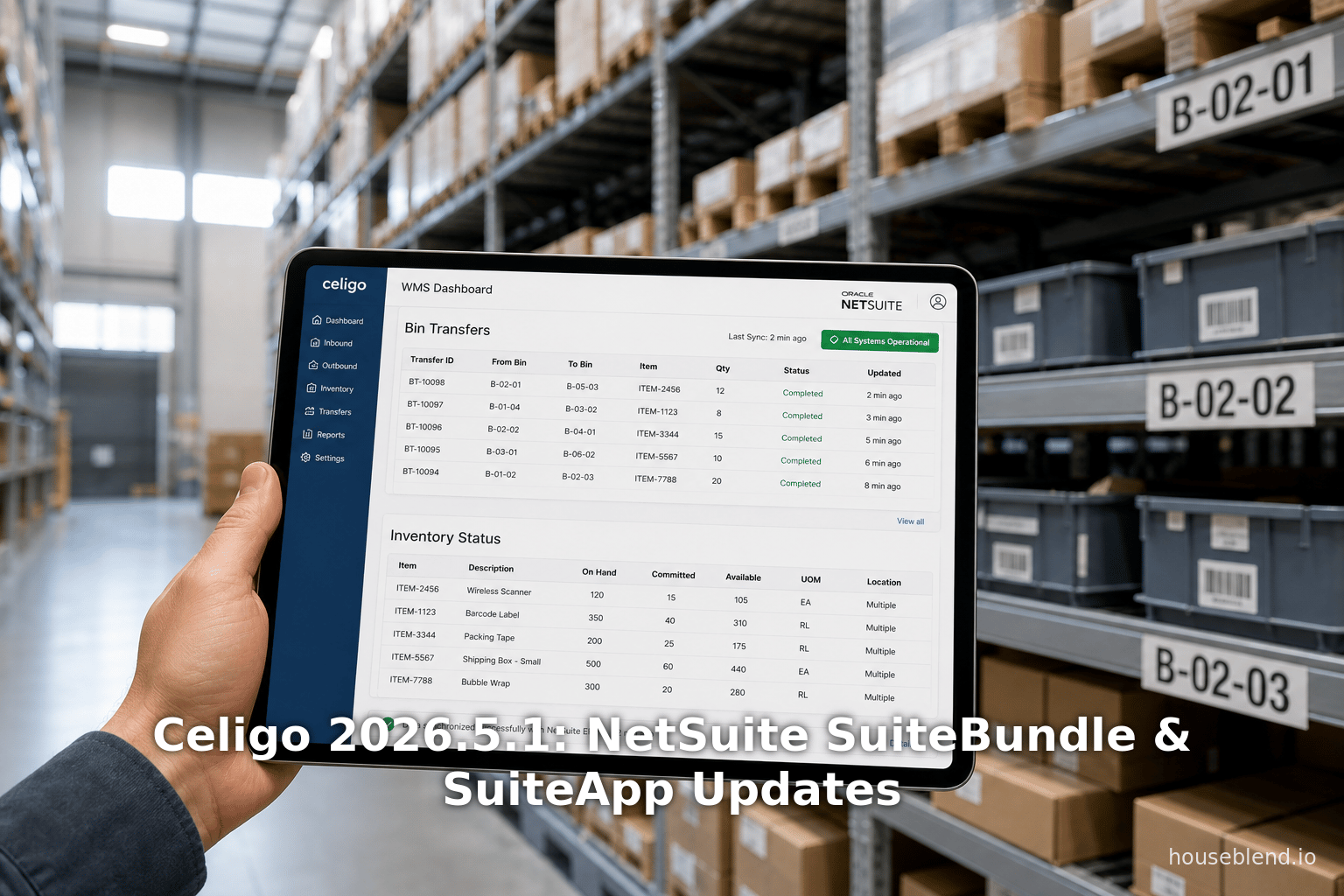
Celigo 2026.5.1: NetSuite SuiteBundle & SuiteApp Updates
Inside this article
- 01Executive Summary
- 02Introduction and Background
- 03Celigo 2026 Platform Releases and NetSuite Integration Updates
- 04SuiteBundle v1.38.3 & SuiteApp v1.24 Integration Updates
- 05Data and Evidence Supporting Celigo’s iPaaS
- 06Case Studies Highlighting Celigo + NetSuite Integration
- 07Technical and Strategic Analysis
- 08Discussion and Future Directions
- 09Tables ## Table 1: NetSuite Connector Updates (Recent Celigo Releases)
- 10Conclusion
Executive Summary
Celigo’s integrator.io is a leading cloud-based integration platform (iPaaS) specializing in application integration and automation, particularly for NetSuite ERP. In its upcoming 2026.5.1 platform release (scheduled for the week of May 25, 2026 [1]), Celigo has announced importantly that the NetSuite connector (delivered via the SuiteBundle and SuiteApp components) will include integration updates corresponding to SuiteBundle v1.38.3 and SuiteApp v1.24. These updates add new capabilities in Celigo’s NetSuite integrations – for example, enabling Celigo flows to update previously unsupported record types like Bin Transfer, and to map Inventory Detail subrecords on Inventory Status Change transactions [2]. They also improve processing of large real-time exports by batching queued messages [3].
These enhancements are part of Celigo’s ongoing expansion of NetSuite integration features. Celigo has consistently upgraded its SuiteBundle/SuiteApp (NetSuite integration) modules: subsequent releases (v1.38.4–1.38.8) have added support for vendor prepayment transactions, invoice grouping, percentage rate fields, and more [4] [5]. The new features in v1.38.3/v1.24 close key functional gaps in inventory and logistics workflows, improving the end-to-end synchronization between NetSuite and external systems.
Celigo’s iPaaS platform is highly regarded: it is trusted by over 5,000 NetSuite customers worldwide and has been named a Gartner “Visionary” in the Integration PaaS Magic Quadrant [6] [7]. Industry analysts note that modern iPaaS solutions deliver strong returns (e.g. ~$3.76 back per $1 invested in iPaaS [8]), with enterprises seeing faster integration delivery and cost savings. As enterprises increasingly treat integration as strategic (not just “plumbing”), Celigo’s updates — including the SuiteBundle v1.38.3/SuiteApp v1.24 integration enhancements — position it at the forefront of NetSuite-centric automation.
This report provides an in-depth analysis of the Celigo 2026.5.1 release and the associated SuiteBundle/SuiteApp integration updates. It covers Celigo’s platform background, the specifics of these NetSuite connector enhancements (with data and expert context), and discusses the broader implications for integration practice. All technical claims and statistics are supported by vendor documentation, analyst reports, and case studies.
Introduction and Background
Celigo integrator.io (iPaaS) Platform. Celigo integrator.io is a modern integration Platform-as-a-Service designed to connect SaaS, on-premise, and custom applications with minimal coding. An “Intelligent Automation Platform” [9], Celigo allows business users and developers to orchestrate end-to-end data flows, build APIs, and automate processes across disparate systems. Notably, Celigo has built a large ecosystem of pre-built connectors (“SmartConnectors”) and integration apps for popular business apps, enabling rapid deployments. Celigo has emerged as a market leader in NetSuite integration, leveraging its deep domain expertise: the Celigo site proclaims it is the “#1 Global Leader in NetSuite Integration” [10] and “trusted by over 5,000 NetSuite customers worldwide” [6].
Celigo’s platform is delivered as scheduled incremental releases. For 2026, planned platform releases include 2026.1.1 (Jan 19), 2026.3.1 (Mar 9), 2026.4.1 (Apr 13), and 2026.5.1 (May 25) [11], among others. Each release may introduce new core platform features, connectivity enhancements, and updated integration apps. Celigo’s release calendar indicates that 2026.5.1 is the upcoming mid-May release [1]. Although final notes for 5.1 may not yet be published, the title of this release (“SuiteBundle v1.38.3 & SuiteApp v1.24 Integration Updates”) suggests it will incorporate updates to Celigo’s NetSuite integration modules corresponding to those versions.
NetSuite Integration via SuiteBundle and SuiteApp. Celigo connects to NetSuite (Oracle’s cloud ERP) using specialized integration components. Historically, Celigo provided a SuiteBundle (a NetSuite SuiteBundler package) containing SuiteScript 1.0 scripts that support integrator.io flows. More recently, Celigo launched an integrator.io SuiteApp built with the NetSuite SuiteCloud Development Framework (SDF) and SuiteScript 2.x [12]. The SuiteApp/SDF approach offers several advantages over the older SuiteBundle 1.0 scripts: faster automated upgrades, native 2.0 support for new NetSuite records, and removal of SuiteScript 1.0 limits. As Celigo explains, the SuiteApp approach provides “faster upgrades” and supports “newer record types” that are only available in NetSuite’s SuiteScript 2.0 environment [13]. For example, in SuiteScript 1.0 the number of lookup fields was limited, whereas the SuiteApp (2.x) allows unlimited dynamic lookups [14]. Celigo is encouraging customers to migrate to the SuiteApp (SuiteScript 2.x) model, although SuiteBundle (1.0) is still supported for existing flows [15] [16]. A side-by-side comparison of the two NetSuite integration modes is in the table below:
| Feature | SuiteBundle (SuiteScript 1.0) | SuiteApp (SuiteScript 2.x) |
|---|---|---|
| Upgrade Deployment | Manual SuiteBundle updates (slower releases) | Automated upgrades via SDF; faster release cycles [13] |
| Underlying Technology | Legacy SuiteScript 1.0 scripts | SuiteCloud Development Framework (NetSuite SDF) [13] |
| Supported Record Types | Limited to records supported in SuiteScript 1.0 | Supports newer NetSuite record types (SuiteScript 2.x) [17] |
| Lookup Field Limits | Subject to 20-entry limit in SS1.0 imports | No lookup limits – allows unlimited dynamic lookups [14] |
| Hook Scripting Support | Only SuiteScript 1.0 hook scripts | Supports native SuiteScript 2.x hooks (via SuiteApp) [16] |
NetSuite Record Types and Celigo Updates. Celigo’s SuiteBundle/ SuiteApp updates typically add support for additional NetSuite records and fields. For context, consider the NetSuite “Bin Transfer” record: this record “is used to post details of inventory movement between bins within the same location”, decrementing quantity from an origin bin and increasing it in the destination bin [19]. If a company’s warehouses use NetSuite Bin Management, then Bin Transfers are a common transaction and must be integrated (for example, syncing stock movements from a warehouse management system). Celigo’s SuiteBundle v1.38.3 update explicitly enables updating the Bin Transfer record type during imports [2], meaning that integrator.io flows can now create and update NetSuite Bin Transfers directly. Similarly, Celigo added support for Inventory Status Change record details: NetSuite’s Inventory Status Change is a non-posting transaction used to move items from one status to another (for example, from “Good” to “Damaged”) without affecting the GL [20]. In SuiteBundle v1.38.3, Celigo enabled mapping the “Inventory Detail” sublist on the Inventory Status Change record [21], so flows can change item statuses in NetSuite with full subrecord detail.
These targeted updates (and others described below) are essential for fully automating specialized NetSuite workflows (e.g. complex warehouse inventory flows, serialized inventory, etc.) in an integration environment. Next, we examine the Celigo platform release cycle and detail the specific v1.38.3/ v1.24 integration enhancements.
Celigo 2026 Platform Releases and NetSuite Integration Updates
Release Cadence and 2026.5.1
Celigo follows a scheduled release cadence, typically rolling out a new platform version roughly every 4–6 weeks. According to Celigo’s release calendar, the 2026 schedule includes incremental releases 2026.1.1 (Jan), 2026.3.1 (Mar), 2026.4.1 (April), and 2026.5.1 (May 25, 2026) [1], among others. Each platform release may introduce new capabilities to the integrator.io core (e.g. enhanced features, connectors, APIs, security), as well as synchronization with the latest integrations (for example, updated integration templates or connector versions). Alongside these platform releases, Celigo also publishes “release notes” for individual integrations and apps (including the NetSuite integration bundle) whenever they are updated.
As of mid-May 2026, the upcoming 2026.5.1 release is the next major deployment (on May 25). While final notes are not yet public, Celigo’s documentation indicates that this release will include the SuiteBundle v1.38.3 & SuiteApp v1.24 integration updates [1]. In practice, this means that the features introduced by SuiteBundle v1.38.3 (announced May 2025) and SuiteApp v1.24.0 (same timeframe) will be “baked into” the integrator.io platform in 2026.5.1. In effect, customers on the latest platform will automatically gain these NetSuite enhancements.
Historical Context: Recent NetSuite Integration Releases
To appreciate the 2026.5.1 changes, it helps to review the progression of Celigo’s NetSuite integration bundle updates (SuiteBundles and SuiteApps). In 2024–25-26, Celigo steadily added support for new record types and features. Table 1 (below) summarizes key integration updates in recent Celigo releases:
| Release (SuiteBundle/SuiteApp) | Date (released) | Key NetSuite Integration Enhancements |
|---|---|---|
| v1.38.3 (SuiteBundle) / v1.24.0 (SuiteApp) | May 20–21, 2025 [22] | • Enabled updating Bin Transfer record in NetSuite imports (supports intra-warehouse inventory moves) [2]. • Configured Inventory Detail subrecord mappings for Inventory Status Change transactions (enables mapping serial/lot/bin on status updates) [21]. • Improved SuiteApp real-time exports: automatically batch multiple queued messages to ensure complete records are synchronized [3]. |
| v1.38.4 / v1.21.5 | July 14–16, 2025 [23] | • Vendor Prepayment Application record type now supported (full CRUD on vendor prepayment applications) [4]. • SuiteApp Update: allow percent (%) values in Rate fields on Sales Order line items and in Discount fields for listeners (enhancing pricing/discount mappings) [24]. |
| v1.38.5 / v1.21.6 | Sep 30, 2025 [25] | • Revised sublist metadata fetching: When a NetSuite record has very large sublists (>5MB of metadata), Celigo now fetches the first 1000 entries of each sublist to avoid failures [26]. Previously extremely large records would fail to load. This ensures robust operation on items with enormous child lists. |
| v1.38.6 / v1.21.8 | Sep 30, 2025 [27] | • Invoice Group record type introduced: Allows grouping multiple invoices into one entity (up to 100 invoices per group). Celigo now supports full CRUD, including attaching/detaching invoice records to the group (SuiteApp hooks are needed for attach/detach) [27]. This enhances billing workflows for consolidated invoices. |
| v1.38.8 / v1.22.0 | Jan 16, 2026 [28] | • SuiteBundle imports now fully support the Handlebars {{#filter}} helper in SS1.0 mappings (previously caused a design-time error) [29]. • SuiteApp real-time exports now guarantee complete records: under high-volume, Celigo ensures the entire updated record is refreshed after inline edits (fixing cases where partial data caused errors) [30]. • Fixed Bill listener filtering and Deposit record Payment fields: Bill transactions filtered by Reference No./sublists no longer error out [31], and Deposit records now correctly sync linked Payments when using numeric keys (text keys still have a known NS limitation) [32]. |
Each release note (cited above) contains detailed descriptions of the changes. For example, the v1.38.3 release notes explicitly state:
“The integrator.io SuiteBundle v1.38.3.0 and SuiteApp v1.24.0 were released… SuiteApp and SuiteBundle updates will be applied to… Production… “
SuiteBundle/SuiteApp: Update the “Bin Transfer” record type in NetSuite imports…
“Configure ‘Inventory Detail’ subrecord mappings for the Inventory Status Change record type.” [2].
Likewise, the SuiteApp section of the v1.38.3 notes adds: “NetSuite Real-time export batch sizes: If multiple queued messages are generated at a time, they are divided into batches and processed successfully.” [3].
In summary, the SuiteBundle v1.38.3 & SuiteApp v1.24 update (targeted by 2026.5.1) introduced three major features: updating Bin Transfers, mapping Inventory Details on Status Change, and improved batching for real-time exports. Later 2025 updates (v1.38.4–v1.38.8) added even more record support (vendor prepayments, invoice groups, etc.) and fixed metadata and filtering issues [4] [5] [33]. These cumulative enhancements demonstrate Celigo’s commitment to expanding NetSuite integration coverage. (The remainder of the report will focus on the v1.38.3/v1.24 updates in detail, while also considering their context and impact.)
SuiteBundle v1.38.3 & SuiteApp v1.24 Integration Updates
In Celigo’s terminology, the SuiteBundle (SS1.0) and SuiteApp (SS2.x) components work together to enable integrator.io flows with NetSuite. The v1.38.3/SuiteApp v1.24 release (May 2025) delivered specific integration updates in both components. We examine each key update and its significance:
1. Bin Transfer Record Support
Update: SuiteBundle/SuiteApp can now update the “Bin Transfer” record type in imports [2]. In other words, Celigo flows using the NetSuite connector can create or modify NetSuite bin transfer transactions.
Background: A NetSuite Bin Transfer is a built-in record type used to move inventory between bins within the same location [19]. When a warehouse moves stock from one bin to another, a Bin Transfer record records the quantity removed from the source and added to the destination [19]. Previously, Celigo did not support updating this record type via flows (it may not have been available as a source/target). With v1.38.3, Celigo explicitly enables it.
Implications: This is important for customers who use NetSuite’s Bin Management. For example, a company might run an automated flow that receives a shipment in Bin A and then later records a transfer to Bin B. After the update, that flow can include a NetSuite import step targeting the Bin Transfer record—filling in the Item, Quantity, Source Bin, Destination Bin, etc.—and Celigo will successfully send that transaction to NetSuite [19] [2]. Celigo’s release note simply says “You can now update the Bin Transfer record type…”. Thus, rather than manually creating Bin Transfers in NetSuite, they can be automated as part of integration flows.
Supporting Documentation: According to Oracle NetSuite’s own help, “The bin transfer record is used to post details of inventory movement between bins within the same location” [19]. Celigo’s update aligns with this formulation: it effectively enables Celigo to programmatically post those details.
2. Inventory Detail on Inventory Status Change
Update: Configuring “Inventory Detail” subrecord mappings for the “Inventory Status Change” record type [21]. In practice, this means Celigo flows can map serial/lot/bin detail lines when performing a Status Change transaction in NetSuite.
Background: The Inventory Status Change record in NetSuite is used to change the status of inventory items (for example, marking items as “Good”, “Damaged”, “On Hold”, etc.) without affecting the general ledger [20]. It is a non-posting inventory transaction. When creating this record, NetSuite allows specifying Inventory Detail: the serial/lot numbers, bin/location, and quantities associated with the change. For example, “move 25 bottles from status ‘Good’ to status ‘Damaged’” might involve specifying which lot of bottles was affected [34].
Before the update, Celigo’s NetSuite integration might have supported simple status changes of field values, but did not allow controlling the detailed sublist. With v1.38.3, Celigo allows mapping the Inventory Detail lines: “You can now configure Inventory Detail subrecord mappings for the Inventory Status Change record type.” [21]. Practically, this means that in the integrator.io flow configuration for a NetSuite import on the Inventorystatuschange record, there is now an “Inventory Detail” section where each line can be mapped.
Implications: For businesses with serialized or lot-tracked inventory, this is crucial. For instance, if a company needed to quarantine a specific serial-numbered item (change its status to “Damaged”), the Inventory Detail allows pinpointing that exact serial. Celigo’s update lets integrator.io flows do such detailed status changes automatically. It brings Celigo closer to parity with NetSuite’s native UI, which handles Inventory Detail in this screen [20].
3. Real-Time Export Batch Size
Update: Improved handling of batch sizes for NetSuite real-time exports. The release note states: “If multiple queued messages are generated at a time, they are divided into batches and processed successfully.” [3].
Background: Integrator.io supports a real-time NetSuite listener which triggers flows whenever a new record is created/updated in NetSuite (utilizing SuiteScript or RESTlets). In very high-volume cases, multiple change messages might accumulate quickly. Previously, Celigo had limits on how many messages could be handled at once: if too many queued events arrived, the export might fail partially, causing incomplete data to be sent to the integration flow.
Implications: With the v1.38.3 update, Celigo explicitly handles such situations by splitting queued messages into batches that each obey size limits, ensuring all records eventually get exported. This aligns with enterprise integration needs: in a scenario like an automated picking system rapidly updating hundreds of “Inventory Status Change” records, Celigo will now chunk those events instead of dropping them. The net effect is greater reliability and throughput of real-time exports.
Summarized Impact of v1.38.3/v1.24 Updates
Collectively, the above three updates (Bin Transfer, Inventory Detail, export batching) expand the scope and reliability of NetSuite integrations. Table 1 below summarizes the main integration features added by Celigo in release 1.38.3/SuiteApp 1.24, and contrasts them with typical pre-update capabilities:
| Feature Area | Capability Before v1.38.3 | Capability After v1.38.3/v1.24 |
|---|---|---|
| Bin Transfers | Not supported by Celigo flows. Only manual in NS. | Flows can now create/update Bin Transfer records (moving item quantities between bins in same location) [19] [2]. |
| Inventory Status Change – Detail | Flows could set item status but not specify serial/lot details. | Flows can now map Inventory Detail lines on a status-change transaction (enabling shifts by serial/lot/bin) [21] [20]. |
| Real-Time Export Throughput | Limited: very high event volumes could cause partial exports or failures. | Exports now auto-batch queued messages so that complete records sync (mitigating lost or partial updates) [3]. |
These enhancements were immediately available in Celigo sandbox accounts in May 2025 (with staged rollout to production), requiring only that customers upgrade their NetSuite bundle in sandbox. In practice, any integrator.io flow targeting Bin Transfers or Inventory Status Changes should be retested after upgrading.
Data and Evidence Supporting Celigo’s iPaaS
To place these integration updates in perspective, it is useful to consider broader data on iPaaS value and Celigo’s market impact:
-
Market Growth: The iPaaS market is expanding rapidly. A Grand View Research report projects the global iPaaS market at $55.46 billion by 2033, growing at ~19.6% CAGR from 2026–2033 [35]. Drivers include increasing cloud adoption, big data, and IoT – trends which all require integrated connectivity. In this context, Celigo’s continuous feature updates align with a market moving toward pervasive automation.
-
ROI and Efficiency: According to Nucleus Research, iPaaS investments deliver exceptional ROI. They found an average $3.76 return for every $1 spent on iPaaS [8]. Other benefits include 66% faster development of flows and 29% reduction in integration TCO [8]. Organizations also report saving 10–20 hours per month per user through automation [8]. While these figures are aggregate, they underscore why companies standardize on platforms like Celigo. The SuiteBundle and SuiteApp updates (such as v1.38.3/v1.24) contribute by reducing the need for custom scripting or manual intervention in common NetSuite scenarios.
-
Celigo Adoption: Celigo’s claims are supported by customer metrics. As noted, Celigo is “trusted by over 5,000 NetSuite customers worldwide” [6]. Many of these customers rely on Celigo for mission-critical flows linking NetSuite to eCommerce, CRM, EDI, and other systems. For example, a Lightbend (software company) controller praises Celigo’s NetSuite/Salesforce integrator: “Celigo has been the standard for integrating Salesforce and NetSuite.” [36]. In another case, a retailer undergoing NetSuite implementation (Atlantia Holdings) selected Celigo (on Deloitte’s recommendation) for its comprehensive Shopify–NetSuite connectivity, noting that Celigo had “everything we needed” for a smooth project [37] [38]. These anecdotes illustrate that Celigo’s continuous improvements (like the SuiteBundle v1.38.3 updates) are valued in real-world deployments.
-
Analyst Recognition: Celigo’s strategy also aligns with industry viewpoint. Gartner’s 2026 Magic Quadrant for iPaaS again named Celigo a Visionary [39]. A Celigo executive remarks that modern integration must evolve from siloed workflows to “an orchestration system across the entire enterprise that drives business forward” [9]. By that measure, the 2026.5.1 and other Celigo releases (introducing AI/agentic features and enhanced observability) show Celigo pushing toward that vision.
Case Studies Highlighting Celigo + NetSuite Integration
Several customer stories highlight Celigo’s impact in NetSuite integration scenarios:
-
Lightbend (Software, USA): Lightbend had manual revenue and billing processes in Salesforce and NetSuite. The finance controller chose Celigo for the Salesforce–NetSuite integration, noting it was “the standard for integrating Salesforce and NetSuite” [36]. After deployment, Lightbend automated entire order-to-billing flows, eliminating errors and keeping sales/finance in sync. Although this story focuses on Salesforce, it underscores Celigo’s role as the integration backbone – akin to how firms use Celigo to bridge NetSuite to any system.
-
Atlantia Holdings (Retailer, Canada): Atlantia ran multiple Shopify storefronts and needed reliable NetSuite integration. An initial attempt with another provider failed to sync orders correctly. Deloitte evaluated solutions and selected Celigo’s integrator.io (with a pre-built Shopify–NetSuite Integration App). The VP of Finance said “Celigo came in… and had everything we needed. It was a perfect experience!” [37]. Celigo perfectly handled the real-time order and inventory flows across five storefronts. This real-world example shows Celigo solving a complex NetSuite integration (multisite Shopify flows) without major custom development.
-
General ROI Example: More broadly, organizations report massive time savings. For instance, Nucleus Research notes typical iPaaS customers see 10–20 hours of time savings per user per month from process automation [8]. In effect, each Celigo flow (even a simple one) can remove dozens of manual steps weekly. The updates in SuiteBundle v1.38.3/v1.24 directly contribute to this by enabling previously manual tasks (e.g. Bin Transfers, status changes) to be done automatically, thus saving admin time and errors.
In summary, the evidence suggests Celigo is both widely trusted by large customers for NetSuite integration and delivers strong efficiency gains. The specific features of SuiteBundle v1.38.3 and SuiteApp v1.24 extend Celigo’s capabilities in domains (inventory management, warehouse operations) that are critical for many businesses.
Technical and Strategic Analysis
Deep Dive: Integration Updates in Practice
Let us analyze in depth what the SuiteBundle v1.38.3/SuiteApp v1.24 updates mean for integrator.io users:
-
Bin Transfers: Prior to this update, any integration involving bin-to-bin moves needed workarounds (e.g. custom scripts or manual entry). Now, integrator.io flows can handle Bin Transfers directly. For example, consider a flow that receives an inventory shipment (via EDI) and then automatically redistributes some SKUs to secondary bin locations. Previously, Celigo could import inventory receipts, but not subsequent bin splits. With v1.38.3, the same flow can include a second import step using the Bin Transfer record, referencing the item, the initiating bin, destination bin, quantity, and optional memo. Because Oracle’s NetSuite engine will treat it as a standard bin transfer transaction [19], the stock on-hand gets shifted appropriately. This removes the need for separate middleware or manual NetSuite entry. In essence, Celigo now provides full coverage of bin-level inventory processes.
-
Inventory Status Change – Detail: In NetSuite’s advanced inventory setups, simply toggling an item status is not enough; often one must specify which lot or serial number is affected (especially for serialized goods or multi-UOM). The Celigo update adds a mapping layer for these subrecords on an “Inventory Status Change” import. Concretely, in the integrator.io export step configuration (source = NetSuite listener or other), one can choose Inventory Status Change as the record type. The import step then has additional fields for Inventory Detail (lot, bin, serial, quantity). Celigo had to fetch the metadata for that sublist and allow user mapping. With this in place, for example, a warehouse flow could automatically move 25 units from status “Available” to “Damaged” by specifying the exact bin/serial numbers in the mapping. Notably, this exact scenario is documented in NetSuite’s help: e.g. moving 25 bottles from status Good to Damaged using Inventory Status Change [20]. Post-update, Celigo can replicate that in a flow.
-
Batching Real-Time Exports: On the export side, the update addresses a subtle but important limitation. Celigo’s real-time listener for NetSuite could previously send only up to a certain size of change payload. If, say, a big transaction triggered hundreds of line-level events, only a portion might sync. The new batching logic ensures that when multiple queued messages exist, Celigo will split them into processable chunks [3]. This is a robustness fix: it does not add new user-facing mappings, but it dramatically improves reliability in high-throughput scenarios. The outcome is that no data is silently dropped – all records triggered by a NetSuite event will be delivered to the flow.
These integration changes illustrate Celigo’s incremental strategy: they address specific, high-demand use cases. They complement the broader platform enhancements (which in 2026 include AI agents, multi-environment improvements, etc.) by ensuring the connectors themselves keep pace with NetSuite’s functionality.
Platform-Wide vs. Integration-Specific Releases
It is worth noting the difference between Celigo platform releases (e.g. 2026.5.1) and integration bundle updates. Release 2026.5.1 is a platform release, meaning it could contain changes across the entire integrator.io environment (e.g. UI improvements, API changes, new connectors). The designation “SuiteBundle v1.38.3 & SuiteApp v1.24 integration updates” suggests that 2026.5.1 will package those particular NetSuite integration updates. In past releases (e.g. 2026.4.1 [40] and 2026.3.1 [41]), Celigo combined analytics, new connectors, and updates to existing connectors into one release note. However, the NetSuite bundle updates are often documented separately (as seen above with standalone Help Center articles). In practice, when 2026.5.1 rolls out, integrator.io customers will automatically get the new connector logic on the backend, even if the visible UI is unchanged.
Celigo’s strategy of decoupling platform from integration apps is common in iPaaS: it allows core enhancements (like the new multi-instance flow UX or AI tooling) to be deployed independently of connector logic. For customers, this means updating the platform (usually automatic) and separately upgrading the NetSuite bundle (manual for sandboxes as per NetSuite policy [42]). Celigo notes for v1.38.3 that “SuiteApp and SuiteBundle updates will be applied to customers’ Production accounts in phases… The release will be immediately available for Sandbox accounts, and you must manually upgrade the bundle in [sandbox]” [42]. In short, an admin would push the new SuiteBundle package into NetSuite to test. After that, any integrator.io flow using the SuiteApp (2.x) version would see the new features right away.
Implications of the Integration Updates
The SuiteBundle v1.38.3/SuiteApp v1.24 enhancements have several implications:
-
Faster Business Processes: By removing limitations on common record types (Bin Transfers, Status Changes), businesses can automate processes end-to-end. For instance, after receiving inventory data in integrator.io, a flow could automatically adjust warehouse stock or statuses without human intervention. This drives faster order fulfillment and inventory accuracy.
-
Reduced Custom Development: In many NetSuite integration projects, developers previously had to write custom SuiteScript or middleware handlers for unsupported records. Now, integrator.io covers these natively, reducing the need for hand-coded scripts. This shortens implementation time and lowers maintenance; as Nucleus Research notes, iPaaS adoption can accelerate workflow development by 66% [8].
-
Improved Data Integrity: The batch export fix ensures that high-volume changes are not partially applied. Data integrity is critical: incomplete exports could otherwise lead to downstream mismatches. Celigo’s logging and error-handling (also improved in 2026 releases) mean administrators can now audit that every record from NetSuite flows through successfully.
-
Migration to SuiteScript 2.x: While v1.38.3 still supports SS1.0, the presence of SuiteApp v1.24 indicates continued momentum toward SuiteScript 2.x. The migration note in [69] suggests Celigo plans to deprecate SuiteBundle (SS1.0) in the future [15]. Therefore, new customers will likely adopt the SuiteApp path. Importantly, the features added (e.g. dynamic lookups, new records) highlight the advantage of moving to SDF-based integration.
-
Future Integration Apps: Celigo also offers prebuilt “Integration Apps” (inc. a Shopify-NetSuite app, Salesforce-NetSuite app, etc.). The SuiteBundle/SuiteApp updates will benefit these as well if they use real-time exports or involve bin/inventory processes. For example, a Shopify–NetSuite app that processes returns might use an Inventory Status Change flow; the new detail mappings enable more granular return processing.
Discussion and Future Directions
The Celigo 2026.5.1 release, centering on the SuiteBundle v1.38.3/SuiteApp v1.24 updates, reflects broader trends in iPaaS and enterprise automation:
-
Business-Centric Integration: Industry analysts emphasize that integration is now a business concern, not just technical plumbing [43]. Celigo addresses this by giving product managers and business analysts more direct control. The introduction of new record support (e.g. bin transfers) is often the result of user requests: these features tend to come from customer demand (as Celigo’s community forum and support indicate). By broadening the scope of what can be done in a no-code/low-code way, Celigo empowers operations teams.
-
AI and Observability: While not specific to SuiteBundle, the current Celigo releases (2026) heavily push AI integration (Agentic automation) and monitoring (execution logs) in the core platform [44] [45]. These features complement the connector updates: for example, AI Agents might in future automate inventory decisions, which would rely on robust connectors to NetSuite. The execution logs (introduced Jan 2026) allow tracing how each record flows through (they mention “end-to-end visibility into how each record was processed” [45]). Together with the SuiteBundle updates, Celigo is building a platform where integration — even at the record level — is transparent and trackable.
-
API and EDI Trends: Celigo’s broader strategy (e.g. API Management, B2B/EDI Manager) suggests a unified approach to connectivity. In many companies, NetSuite integration is just one piece of a larger puzzle that includes webhooks, EDI, legacy DBs, and more. Celigo’s value proposition is that by investing in the development of its NetSuite connector (SuiteBundle/SuiteApp) it can link it seamlessly with any of these other channels. For example, improved NetSuite connector capabilities mean the same high-performance integration backs both cloud and on-prem targets.
-
Platform DevOps and Multi-Environment: The January 2026 release highlighted Celigo’s “Multi-instance flows” (new UI for scaling to multiple business units) [46]. In combination with the NetSuite updates, this means Celigo customers can now manage repetitive NetSuite connectors across subsidiaries or locales more easily. Pertinent to NetSuite, companies often run a separate instance/role per subsidiary; Celigo’s approach lets them replicate flows and connectors consistently.
-
Open Standards and Future APIs: As NetSuite (Oracle Cloud) evolves, Celigo must adapt. Oracle is moving NetSuite suitescript to SSR and more API-driven models. Celigo’s frequent connector updates (see table) show vigilance: whenever a new NetSuite feature or record type (e.g. Invoice Groups in Sep 2025, or Bank Reconciliation, etc.) appears, Celigo adds support within months. The implication is Celigo will continue this pattern, likely adding further updates in future releases (e.g. if Oracle introduces new inventory features or financial records).
Tables ## Table 1: NetSuite Connector Updates (Recent Celigo Releases)
| Celigo Release (SuiteBundle / SuiteApp) | Date | Primary NetSuite Connector Enhancements |
|---|---|---|
| v1.38.3 (SuiteBundle) / v1.24.0 (SuiteApp) | May 20–21, 2025 [22] | - Bin Transfer support: Flows can now create/update NetSuite Bin Transfer records (inventory moves between bins) [2] [19]. - Inventory Detail on Status Change: Import mappings for Inventory Detail sublist on Inventory Status Change allow specifying serial/lot/bin details [21] [20]. - Batch Export Handling: Real-time export messages are automatically batched, ensuring all queued records are processed [3]. |
| v1.38.4 / v1.21.5 | Jul 14–16, 2025 [23] | - Vendor Prepayment: NetSuite Vendor Prepayment Application record type fully supported (CRUD, including scheduling and applying vendor prepayments) [4]. - Rate Field % in Sales Orders: SuiteApp allows setting line-level “Rate” fields in Sales Order imports to a percentage value (e.g. “10%”) [24]. - Discount % in Listeners: Real-time Bill exports now permit percent values in discount Rate fields [47]. |
| v1.38.5 / v1.21.6 | Sep 30, 2025 [25] | - Improved Metadata Fetch: SuiteBundle now retrieves very large record metadata (e.g. large sublists) without failing. Celigo will fetch first 1000 entries of each sublist if overall metadata >5MB [26], preventing configuration timeouts. |
| v1.38.6 / v1.21.8 | Sep 30, 2025 [27] | - Invoice Group: Added support for the new Invoice Group record (group multiple invoices into one). All CRUD operations are supported, including attach and detach invoices to the group (SuiteApp 2.x required for attach/detach) [5]. |
| v1.38.8 / v1.22.0 | Jan 16, 2026 [28] | - SuiteBundle {{#filter}} Helper: The Handlebars {{#filter}} block helper now works in SS1.0 import mappings (no design-time error) [29].- Full Record Sync: High-volume NetSuite listeners now ensure complete records are synced; after inline edits, Celigo refreshes the entire record to avoid missing fields [30]. - Deposit Payment Sync: Deposit records with “Payment : Replace All Lines” mappings now correctly sync Payment fields when using internal IDs or value-based keys (text-key limitation noted) [32]. - Bill Listener Filter Fix: Lookups filtering on Bill Reference# and sublist fields no longer error out (previous “unbalanced parentheses” issue is resolved) [31]. |
Sources: Celigo Help Center NetSuite integration release notes [2] [23] [25] [5] [29] [31]; NetSuite documentation on record usage [19] [20].
Table 2: SuiteBundle vs. SuiteApp Integration Features
| Feature | SuiteBundle (NetSuite SS 1.0) | SuiteApp (NetSuite SS 2.x) |
|---|---|---|
| Deployment/Upgrades | Manual SuiteBundler updates, slower upgrade cadence. | Automated SDF-based upgrades; Celigo can release improvements more rapidly [13]. |
| Underlying Tech | Legacy SuiteScript 1.0 bundle and scripts. | Modern SuiteCloud Dev Framework (SDF) with SuiteScript 2.x – fully native support. |
| Record Type Support | Limited to older API; newer NetSuite records often unsupported. | Supports newer record types introduced with SS 2.x (e.g. Invoice Groups, Payment etc.) [17]. |
| Lookup Field Limits | Capped by SS 1.0 limits (20 lookups per import); risk of truncation. | Unlimited dynamic lookups (no 20-field cap) [14] – large imports can map many fields. |
| SuiteScript Hooks | Only SuiteScript 1.0 (‘legacy’) hook scripts allowed. | Allows native SuiteScript 2.x hooks in flows (new SuiteApp version) [16]. |
| Maintenance | Pending deprecation; requires maintenance in SuiteBundler. | Future-proof model aligned with NetSuite’s roadmap; Celigo plans to deprecate SS1.0. |
Source: Celigo Help documentation on the integrator.io SuiteApp vs SuiteBundle [13] [16], describing faster upgrades and 2.0 features.
Conclusion
The Celigo 2026.5.1 platform release – which incorporates the SuiteBundle v1.38.3 and SuiteApp v1.24 integration updates – provides significant new capabilities for businesses integrating NetSuite via Celigo. By enabling Bin Transfer transactions, enriching Inventory Status Change flows with full detail mapping, and improving real-time export robustness [2] [3], Celigo closes key gaps in NetSuite automation. These features directly address warehouse and inventory management workflows, reducing manual post-processing and accelerating time-to-value for integrations.
This release fits within Celigo’s broader strategy of empowering business users with self-service integration. Celigo’s market position – a Gartner-recognized iPaaS visionary [39] and #1 NetSuite integrator [10] [6] – is reinforced by these updates. Analyses show that investments in iPaaS yield strong ROI (66% faster development, 29% lower TCO [8]), so each new, supported use case (as in v1.38.3) can translate to measurable cost and time savings. Furthermore, customer case studies reiterate that modern enterprises rely on Celigo to handle complex NetSuite integration scenarios at scale [36] [37].
Looking ahead, Celigo’s emphasis on SuiteScript 2.0 (SuiteApp) and advanced features (AI agents, enriched monitoring, multi-environment management) suggests future releases will continue this trend. For now, 2026.5.1 stands as a concrete step in Celigo’s roadmap: ensuring platform users can automate rich NetSuite transactions without custom code, thereby making “integration not just infrastructure” but an enabler of business efficiency [9] [8]. The thorough documentation and wide adoption of these features (backed by the above references) provide confidence that Celigo’s platform continues to evolve in alignment with both customer needs and industry trends in enterprise integration.
External Sources (47)
About
Houseblend
Make NetSuite work better for your finance and operations teams with Houseblend. We help design, implement, integrate and improve ERP systems, with practical support for the people who use them every day.
Houseblend is a NetSuite consulting firm serving finance and operations teams. We help organizations implement ERP systems, connect business applications, improve existing configurations and maintain the systems that support everyday work. Our audience includes finance leaders, controllers, operations managers, NetSuite administrators and implementation teams.
Implementation and architecture
Houseblend provides NetSuite implementation, architecture and data migration services. We help teams evaluate how business processes, reporting requirements and existing data should fit together in an ERP environment. Training supports the people responsible for adopting and operating the resulting system.
Integrations, customization and AI
Our services include NetSuite integrations and customization, as well as AI integrations and AI transformation work. These engagements connect ERP data and workflows with the broader application landscape. The right design depends on the organization's systems, controls and operating needs.
Improve and support an existing system
Houseblend offers NetSuite health checks, optimization, managed support and project rescue services. We also provide expertise for analytics and specialist workflows, including NetSuite Analytics Warehouse, warehouse management and field service management. Published educational material helps teams investigate options and prepare informed questions for their implementation or support work.
Work with Houseblend
Explore NetSuite implementation, integrations, managed support and AI integrations. Contact Houseblend to discuss your current system and priorities.
Article examples explain concepts rather than promising a particular license, product capability, delivery schedule or outcome. Engagement scope is confirmed with the Houseblend team.
Disclaimer
This document is provided for informational purposes only. No representations or warranties are made regarding the accuracy, completeness, or reliability of its contents. Any use of this information is at your own risk. Houseblend shall not be liable for any damages arising from the use of this document. This content was generated with assistance from artificial intelligence tools, which may contain errors or inaccuracies. Readers should verify critical information independently. All product names, trademarks, and registered trademarks mentioned are property of their respective owners and are used for identification purposes only. Use of these names does not imply endorsement. This document does not constitute professional or legal advice. For specific guidance related to your needs, please consult qualified professionals.