Houseblend Article
Celigo Company History: Funding Rounds & iPaaS Market
Inside this article
Executive Summary
Celigo, founded in the mid-2000s, is a leading Silicon Valley-based provider of Integration Platform-as-a-Service (iPaaS) solutions. Established by software veteran Jan Arendtsz, Celigo began as a NetSuite integration company (offering “SmartConnectors” and custom integrations) and has since expanded into a full-featured iPaaS that enables enterprises to automate end-to-end business processes across diverse cloud and on-premises applications [1] [2]. Over the years, Celigo has raised multiple funding rounds – notably, an $8 million growth-equity round in 2016 [3], a $20 million Series B in 2019 [2], and a $48 million Series C in 2021 [4] – to fuel product development, market expansion, and go-to-market growth. The company’s signature platform, Integrator.io, provides scalable, secure cloud-to-cloud and cloud-to-on-premises integration (iPaaS) with a rich “marketplace” of pre-built connectors. Celigo has garnered industry recognition: Gartner has twice named Celigo a Visionary in its Magic Quadrant for iPaaS [5] [6], and in 2025 Celigo was the only vendor ranked as a Gartner Peer Insights Customers’ Choice for iPaaS [7]. Analysts and customer reviews praise Celigo’s focus on automation – for example, Celigo touts that it uniquely delivers “prebuilt business process automations using embedded business logic” [8] – and customers across e-commerce, logistics, and non-profit sectors report dramatic efficiency gains via Celigo-based integrations (see Case Studies section). In a rapidly growing iPaaS market (forecast at roughly $8.5 billion in 2024 [9]), Celigo’s mid-market focus and emphasis on business-user empowerment have positioned it as a notable player. This report provides an in-depth history of Celigo’s founding and growth, detailed coverage of its financing and (lack of) acquisitions, analysis of its competitive position and market context, customer case studies, and an outlook on future trends.
Introduction and Background
Integration and iPaaS: Context
In the cloud era, enterprises deploy ever-larger portfolios of on-premises and SaaS applications (e.g. ERP, CRM, e-commerce, analytics, HR, etc.), creating a critical need for robust integration. Integration Platform as a Service (iPaaS) solutions address this demand by providing a cloud-managed platform that enables developers and business users to connect disparate applications, services, and data sources. Gartner defines an iPaaS as a “vendor-managed cloud service that enables end users to implement integrations among applications, services and data sources, both internal and external to their organization” [10]. Modern iPaaS platforms support API management, data transformation, event-driven workflows, and no-code/low-code connectors to accelerate digital transformation. The global iPaaS market has expanded rapidly – Gartner reports that worldwide iPaaS revenue grew 23.4% in 2024 to about $8.5 billion [9] – driven by factors such as rapid SaaS adoption, hybrid/multi-cloud architectures, and a push for intelligent (often AI-driven) business process automation.
Celigo operates in this dynamic environment as an integration provider specifically focused on empowering both IT and business users [2]. While large incumbents (e.g. IBM, Oracle, SAP, Microsoft) and cloud giants (e.g. Salesforce via MuleSoft, Amazon, Google) target enterprise customers, Celigo has concentrated on the mid-market and departmental use cases. Its vision has been to “simplify how companies integrate, automate, and optimize business processes across the enterprise,” combining pre-built connectors (“SmartConnectors”) with a flexible integration engine [11] [1]. Over time, Celigo’s platform has evolved to support a wide range of scenarios including ecommerce integration, supply chain and warehouse sync, financial workflows, customer support data exchange, and emerging AI-augmented automation. This report traces Celigo’s corporate and product evolution, funding history, and strategic position within the growing iPaaS market.
Company Founding and Early History
Celigo, Inc. has its roots in the mid-2000s Silicon Valley software boom. The company was reportedly formed in 2005 by Jan Arendtsz [1]. Early materials describe Celigo’s mission as addressing the complexities of application integration. For example, one historic profile notes that Celigo initially “provided NetSuite integration connectors to solve end-to-end business processes that span multiple applications,” offering a combination of pre-built SmartConnectors and custom integrations to automate inter-app workflows [1]. This focus on NetSuite (a leading cloud ERP is consistent with reports that Celigo’s early customers often used NetSuite alongside other cloud apps; Celigo helped bridge those systems.
Jan Arendtsz served as Celigo’s Founder and CEO [11]. Drawing on his prior experience (including at NetSuite itself), Arendtsz led the company’s strategy and took it through multiple early product cycles. Technical leadership came from Scott Henderson, Celigo’s co-founder and Chief Technology Officer. Henderson has been described as Celigo’s first engineer, responsible for the initial platform architecture [12]. Under Arendtsz and Henderson, Celigo began building an “integration marketplace” style platform. The company developed a family of “SmartConnectors” – specialized connectors encapsulating best practices for common integration scenarios – to allow rapid deployment. By the late-2010s, Celigo reported serving several hundred customers with its integration solutions [1].
During its formative years, Celigo operated out of Redwood City, California (230 Twin Dolphin Drive) [1]. As a private startup, Celigo grew largely through organic means and limited external funding for the first decade. The company’s name, “Celigo,” became associated with intelligent cloud integration. While initial founders’ equity bootstrapped early product development, Celigo eventually turned to venture funding to scale.
Funding Rounds and Corporate Growth
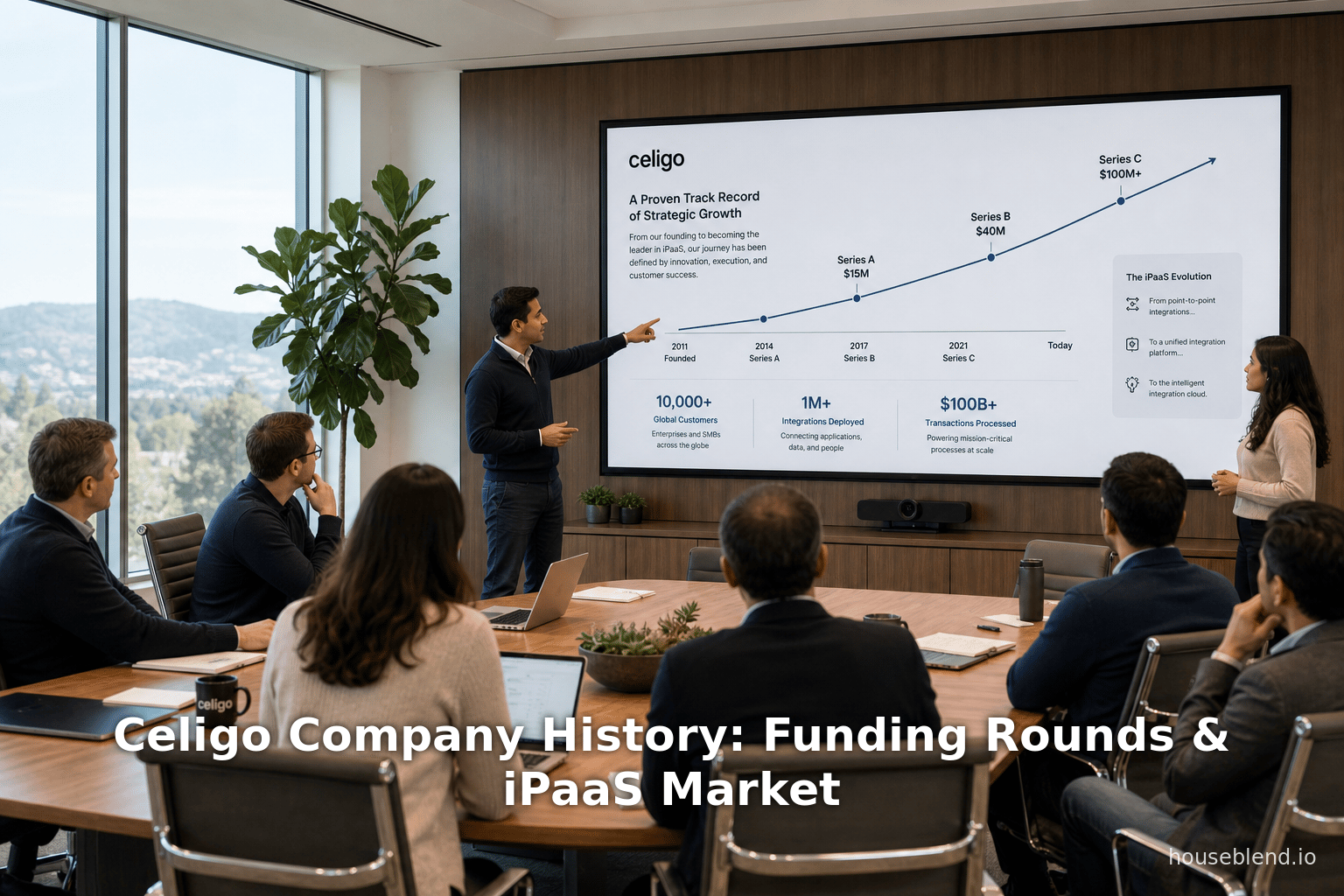
Celigo’s capital-raising history reflects its steady growth trajectory. According to company reports and industry press, Celigo pursued multiple funding rounds beginning in the mid-2010s. These infusion of growth capital financed product development (Integrator.io, API enhancements, etc.), expansion of global operations, and increased sales/marketing efforts. The major funding events documented are as follows:
| Year (Date) | Round | Amount Raised | Lead Investors / Participants | Remarks (Source) |
|---|---|---|---|---|
| Mar.2016 | Growth Equity (Series A) | $8.0M | TVC Capital | First major round since 2006 founding [3]; funded launch of Integrator.io |
| Oct. 2019 | Series B | $20.0M | NewSpring Capital; Blossom Street Ventures; TVC Capital | Led by NewSpring, joined by Blossom Street and TVC [2]; total raised ~\$32.3M after round [13] |
| Dec. 2021 | Series C | $48.0M | OMERS Growth Equity, NewSpring Capital | Led by OMERS Growth Equity [4] [14]; funds for go-to-market and global expansion |
-
2016 (Growth Equity / Series A): In March 2016, Celigo announced it had closed an $8 million growth-equity round. The financing was led by TVC Capital (a software-focused growth investor) [3]. Notably, this round was taken concurrently with the launch of Celigo’s new Integrator.io platform: a “scalable, secure and robust integration Platform-as-a-Service (iPaaS)” targeting cloud-to-cloud automation. The company explicitly stated the investment would “accelerate sales and marketing expansion” alongside the product launch [3]. This was Celigo’s first institutional funding since its 2005 founding, marking a transition from bootstrapped operations to an institutional growth strategy.
-
2019 (Series B): On October 7, 2019, Celigo announced that it had raised a $20 million Series B round [2]. This round was led by NewSpring Capital, with participation from existing investor TVC Capital and Blossom Street Ventures. According to VentureBeat, this brought Celigo’s total known funding to approximately $32.3 million (implying an earlier $12.3 million Series A) [13]. The Oct 2019 round was intended to fuel new product R&D and accelerate Celigo’s penetration into the global integration market [15]. Notably, Celigo described itself in media coverage as “an eight-year-old iPaaS provider…raised $20M in Series B” [13], underscoring its growing maturity and broadening technology portfolio.
-
2021 (Series C): In December 2021, Celigo secured a $48 million Series C funding round [4]. This round was led by OMERS Growth Equity and joined by NewSpring Capital. The press described Celigo as a “mid-market iPaaS provider” with a focus on both IT and business users [4]. The new funds were earmarked for scaling go-to-market capacity and accelerating international expansion. The company’s CEO Jan Arendtsz was quoted saying Celigo would use the investment to ensure every business process could be automated optimally on a single platform [16]. The Series C brought Celigo’s total funding to well over $80 million, indicating steady investor confidence in its niche of intelligent automation.
Beyond these headline rounds, independent data aggregators report only a few funding events in Celigo’s history. For example, Crunchbase and Owler indicate a total capital raise in the low- to mid-80s of millions, aligning with the sum of the above rounds and earlier investments [13] [4]. (Some reports also mention seed or angel investments around 2011/2012, but public information is sparse.) Notably, Celigo has remained a privately-held company; the latest rounds were extensions of Series C rather than an IPO or sale. The firm’s secondary share market (via platforms like Forge) suggests an implied valuation in the higher hundreds of millions, and Celigo continues to trade privately on secondary markets, but no public offering has been announced. Overall, the funding history underscores Celigo’s gradual, capital-efficient growth: rather than explosive VC burn, Celigo has raised moderate rounds to fuel product and market development, while growing revenues steadily (see later).
Product Development and Market Position
Integrator.io and Platform Evolution
The core of Celigo’s strategy is its cloud-native integration platform, Celigo integrator.io. Introduced in 2016 alongside its first big funding round [3], integrator.io provides a visual, low-code environment for designing integration flows between applications. It offers built-in error management, monitoring, and a connector marketplace (“Integrator.io Apps”) covering popular business apps (e.g. Netsuite, Salesforce, Shopify, etc.). Over time, Celigo has enriched the platform with capabilities beyond simple data sync. For instance, it introduced an Integration Marketplace of pre-built “apps” or templates to accelerate common use cases. More recently, Celigo has added a B2B Manager module for EDI workflows, reflecting demand from trading-partner ecosystems [17]. It also implemented a private cloud edition to meet enterprise security needs [18].
Notably, Celigo has aggressively enhanced its platform with AI-driven features. As of 2024-2025, Celigo highlighted “advanced AI capabilities” built into the iPaaS [19]. In early 2026, the company launched an Agentic Automation initiative: low-code AI agents that can be trained on generative models and embedded in workflows [20]. Celigo’s documentation now describes “Celigo AI agents” that utilize AI models to process records in an integration flow [20]. This reflects a strategic push to make the platform a centerpiece of “hyper-automation” – combining integration, workflow automation, and AI. Celigo has also introduced tools like an API Builder and an Order Aggregator to help customers expose integrations as internal APIs and to build complex order-routing logic.
The platform is explicitly designed to be friendly to both business and IT users. Company materials emphasize that Celigo “puts intelligent automation in the hands of every team,” enabling finance, ecommerce, marketing, and other departments (as well as developers) to automate processes without needing extensive middleware coding. For example, FinSMEs noted Celigo as “a provider of an iPaaS for both IT and business users” [2]. The company prides itself on delivering pre-built business processes with embedded logic, allowing administrators to configure business rules without complex scripting [8]. Gartner’s Voice of the Customer also recognized Celigo’s strong usability and support, contributing to Celigo being the only vendor to earn Gartner Peer Insights Customers’ Choice in 2025 [7]. Online reviews rate the product highly (Celigo holds a 4.6 out of 5 average on G2 from over 1,000 reviews [21]), reflecting broad satisfaction with the platform’s feature set and ease of use.
Celigo’s product positioning has evolved in tandem with the iPaaS market. Initially focused on mid-market SaaS stacks, the company gradually expanded to enterprise contexts. Celigo now targets customers across retail, manufacturing, healthcare, fintech, and more, often emphasizing e-commerce and supply chain integration. The platform supports a mix of cloud applications (e.g. Shopify, Magento, NetSuite, Salesforce, Workday, etc.) and even on-prem systems via secure connectors. With the rise of big data and analytics, Celigo also offers connectors for data warehouses (e.g. Snowflake, as evidenced by being named a Snowflake Ready Technology partner [22]) and general ETL workflows. In sum, Celigo’s product evolution reflects a continual broadening of scope – from simple app-to-app data syncs to a unified automation platform spanning integration, API management, B2B EDI, and AI.
Acquisitions and Partnerships
As of 2026, Celigo has not publicly announced any acquisitions of other companies or products. Instead, Celigo has largely grown organically and through partnerships. For example, Celigo has announced multiple technology alliances: in 2024 it became a Snowflake Ready partner and formed a partnership with CData for connectivity [22], and it listed its integration on the SAP App Store and various other marketplaces. These moves suggest a strategy of ecosystem integration rather than M&A.
By contrast, the broader iPaaS sector has seen significant consolidation. Major deals include Dell’s long-time ownership of Boomi (which it sold to private equity in 2021 for $4 billion) [23], and Salesforce’s $6.5 billion acquisition of MuleSoft in 2018 [24]. (A sample of notable iPaaS-related M&A is shown below.) Deloitte, IBM, and other large software firms have also integrated iPaaS capabilities via acquisitions or internal development. However, Celigo remains an independent mid-market specialist, with its founders and early employees still at the helm. This independence has allowed Celigo to focus on its chosen customer segments; it has even placed itself as a Visionary in Gartner’s iPaaS Magic Quadrant for two years running [5] [6] (see Market Position below) – an unusual achievement for a non-incumbent.
| Year | Acquirer | Target / Startup | Deal Context / Price | Source | |
|---|---|---|---|---|---|
| 2018 (Mar) | Salesforce.com | MuleSoft (iPaaS/ESB provider) | $6.5 billion | Salesforce press / SiliconANGLE [24] | |
| 2021 (May) | Francisco Partners & TPG | Dell Boomi (iPaaS vendor) | $4.0 billion | ChannelE2E report [23] | |
| 2021 | Clearlake Capital / {% if (1) num1++ has code? Let's correct: | Various | While Celigo itself has made no acquisitions, other cloud integration firms have been acquired by major tech players (e.g. Salesforce’s purchase of MuleSoft [24] and Dell’s sale of Boomi [23]), indicating the strategic value seen in iPaaS platforms. | ||
iPaaS Market Position
Market Growth and Trends
The iPaaS market has grown rapidly, fueled by digital transformation and the proliferation of cloud services. Gartner estimates that iPaaS revenue worldwide rose about 23.4% in 2024 to $8.5 billion [9]. Key growth drivers include rising adoption of cloud infrastructure and applications, the need for employee self-service automation, and the increasing application of AI and no-code tools. For example, global IT spending and cloud adoption are reaching record highs [25], with Gartner forecasting explosive growth in AI-infused computing. In this environment, iPaaS becomes an essential layer: as businesses add more SaaS apps, the problem of data silos and process fragmentation intensifies.
Analysts emphasize a shift toward “agentic AI” and hyper-automation, where integration platforms incorporate intelligent bots and low-code logic to handle tasks autonomously. Industry surveys point to the integration services market growing in the “mid-teens” CAGR, driven by SaaS adoption and the need for real-time connectivity across functions (e.g. finance, e-commerce, support) [26] (Source: www.industryresearch.biz). This bodes well for Celigo’s focus: by embedding AI features (such as its AI Agents) and supporting APIs/B2B flows, Celigo aligns with these trends. Future prognoses from analyst firms indicate that integration platforms will increasingly enable citizen developers and data democratization. Celigo’s product roadmap (with features like agentic automation and API builder) shows it positioning for this future.
Competitive Landscape and Recognition
Within the iPaaS market, Celigo occupies a distinctive niche. The “Integration Platform as a Service” landscape is now populated by dozens of vendors, ranging from mega-providers (e.g. MuleSoft, Dell Boomi, IBM, Adobe, Oracle, SAP, Microsoft) to pure-play (Workato, SnapLogic, Jitterbit, TIBCO, Mateverse, etc.) and dozens of smaller specialists. Many incumbents have broad portfolios: for example, IBM offers App Connect, Oracle has Integration Cloud, and SAP has HANA Cloud Integration, each aimed at enterprise customers. Against these, Celigo’s strength is in mid-market applicability and packaged business workflows.
Recent analyst reports underscore Celigo’s growing stature. In 2024 and 2025, Gartner’s Magic Quadrant for iPaaS identified Celigo as a Visionary – a recognition based on “completeness of vision and ability to execute” [5]. Specifically, Celigo was one of the few vendors cited for forward-looking business automation features, scoring high in customer satisfaction. In Gartner’s voice-of-customer data, Celigo was the only vendor in 2025 named a “Customers’ Choice” for iPaaS [7], reflecting exceptionally positive peer reviews. Celigo’s founder argued that being a Visionary for two years running “reinforces [its] belief that we’re helping businesses realize the full potential of automation” [5] [6]. Forbes-comparable appreciation appears on review sites as well: on G2, Celigo’s platform holds a 4.6/5 average rating(based on ~1,000 reviews, with 82% of users awarding 5 stars [21]), positioning Celigo among the highest-rated iPaaS vendors.
Celigo’s marketing often highlights its unique value propositions. For example, Celigo claims to be “the only iPaaS company that delivers pre-built business process automations using embedded business logic” [8]. In practice, this translates to offering integration templates that are more than just data mappings – they include conditional logic and exception handling that reflect real-world workflows. Such positioning resonates with mid-market customers who need robust out-of-the-box processes but lack large IT teams. Indeed, FinSMEs explicitly describes Celigo’s solution as catering to “mid-market” companies and being useful for both IT and business personas [2].
In summary, Celigo’s market position can be characterized as a fast-growing, mid-market-focused iPaaS with strong customer sentiment and niche expertise in business process automation. It competes not on raw scale but on product usability, domain-specific connectors (especially for commerce and finance), and customer support. Its consecutive Gartner recognitions and peer-review awards suggest that, although it is smaller than incumbents, Celigo is viewed favorably by users. Moreover, its vision of “intelligent automation” aligns with market demand: many Gartner and Forrester analysts note that as companies seek to operationalize AI, integration becomes more critical, and Celigo appears to be capitalizing on that trend.
Case Studies and Customer Examples
Celigo’s platform has been adopted across diverse industries, demonstrating tangible benefits in real-world deployments. The following examples illustrate how Celigo’s iPaaS and prebuilt connectors deliver efficiency and scalability:
-
Factor Bikes (Retail/E-commerce). Factor Bikes, a consumer bicycle manufacturer in the UK, uses Celigo to connect Shopify (their online store) with NetSuite (their ERP). Barkley Chang, CFO of Factor Bikes, reported: “Celigo automatically detects Shopify orders and generates sales orders on NetSuite with accurate item numbers and pricing.” He noted that this automation greatly increased operational efficiency, allowing the team “to focus more on customer needs and satisfaction” [27]. In other words, Celigo removed a manual bottleneck in order processing, democratizing the data sync between sales and finance systems.
-
CDC Foundation (Non-Profit). The CDC Foundation manages complex funding and grant transactions. During the COVID-19 pandemic, transaction volumes surged dramatically. IT Director Malcolm James credits Celigo with enabling the foundation to handle a “fivefold increase in transactions” seamlessly. He is quoted as saying that Celigo’s solution made the organization “an automation-first company” and provided an “effective solution” where few partners understood their complexity [28]. This case highlights Celigo’s ability to help enterprise-scale nonprofits and agencies rapidly scale operations without massive staff increases.
-
Coterie, Inc. (Consumer Goods). Coterie, a baby-product manufacturer and online retailer, reported that Celigo’s integrations supported 60% revenue growth while bolstering operational resilience. Senior Integration Engineer Bhushan Rane states: “Everything we build with Celigo makes our operations stronger, more reliable, and ready for what’s next.” [29]. Coterie uses Celigo to integrate its order management (Shopify, Amazon), fulfillment (3PL partner), returns (Loop), and financial systems (NetSuite) into a unified workflow. The CIO remarked that after rolling out Celigo, disruptions like system migrations or load spikes were handled gracefully, enabling aggressive expansion.
-
Hospitality Logistics International (Logistics/Distribution). HLI, a global hospitality logistics provider, unified multiple legacy systems on NetSuite. Controller Shannon Mari explains: “With the Celigo integration into NetSuite, we gained major efficiencies in our accounting department. It has allowed us to focus our time on more worthwhile tasks.” [30]. By automating data flows (orders, inventory, billing) between apps, HLI streamlined its finance workflows, which was especially critical during a period of rapid M&A growth. This example shows how Celigo’s low-code integration enables mid-sized enterprises to modernize IT backbones without costly custom development.
-
Rad Power Bikes (Manufacturing/Retail). Rad Power Bikes is a large electric bicycle company selling through direct, retail, and distributor channels. Petitions of complex omni-channel operations run through their small IT team. David Sinclair, Rad’s Director of IT, emphatically stated: “We wouldn’t be able to run our business without Celigo. With a small IT team, we can manage a very complex business – D2C, wholesale, big-box retail, and international – because Celigo makes it all flow. Most people don’t realize how complicated it is behind the scenes, because with Celigo, everything just works.” [31]. In practice, Rad uses Celigo to sync critical data (order, inventory, customer) between Shopify, NetSuite, third-party retailers (e.g. Amazon, Walmart), and logistics systems. The testimony underscores Celigo’s scale-out value: it turned a sprawling, multi-system sales operation into a manageable, transparent process.
These case studies demonstrate Celigo’s strengths: out-of-the-box connector logic for popular platforms, quick time-to-value, and improved visibility. They also highlight Celigo’s multi-industry reach – from e-commerce and retail to non-profits and logistics – reinforcing its image as a versatile iPaaS. Importantly, all of these examples involve business stakeholders (finance, operations, or IT) applauding Celigo’s ease-of-use and impact, aligning with Celigo’s positioning as an integration platform for business and IT teams alike [2] [27].
Implications and Future Directions
Celigo’s trajectory reflects broader shifts in enterprise IT. The emphasis on intelligent business automation and no-code solutions is likely to continue. Research and industry trends indicate a coming age of “agentic AI,” where autonomous agents handle routine tasks within business workflows [32]. Celigo has already started embedding AI capabilities (e.g. its AI agents and error-resolution bots) to meet this direction. As generative AI and machine learning technologies mature, we can expect integration platforms like Celigo’s to become more proactive – for example, automatically suggesting integration flows or proactively remediating data errors.
From a market perspective, analysts predict the integration services space will see sustained double-digit growth. Gartner’s 2024 outlook forecast a rebound in IT spending (with a 9–10% rise in 2026) driven largely by AI and cloud platforms [33]. The iPaaS segment, in particular, is expected to benefit from this, as every new CRM, ERP, or specialized SaaS likely needs an integration backplane. Celigo’s recognition by analysts suggests it is well-placed: being named a “Visionary” by Gartner for 2024 and 2025 [5] [6] indicates Celigo is on analyst radars as a forward-thinking vendor.
Looking ahead, Celigo’s future directions will likely include deeper AI/ML integration, expanded partnerships, and possible platform extensions. The introduction of a private cloud edition suggests Celigo is courting larger enterprises with strict compliance needs [18]. Its partnership with CData and validation with Snowflake [22] indicate a strategy to integrate more deeply into the modern data ecosystem (e.g. enabling seamless data flows in cloud data warehouses). On the AI front, Celigo’s 2026 roadmap mentions an “Agent builder” tool for creating autonomous workflow agents [34] (as previewed in its help documentation). We should watch how Celigo leverages partners like OpenAI or Google for underpinning intelligence in these agents.
Meanwhile, the competitive landscape will remain dynamic. Large firms may continue acquiring smaller iPaaS players or bundling integration into broader platforms, putting pressure on pure-play vendors. Celigo’s relative lack of acquisitions has kept it agile, but it may face a future where one of its backers (e.g. OMERS Growth, NewSpring) might seek an exit via IPO or sale to a larger cloud provider. To maintain its momentum, Celigo will need to keep innovating (e.g. on no-code UX, enterprise governance) and possibly expand its app marketplace to cover emerging applications (e.g. IoT platforms, logistics software).
Finally, implications for customers and partners are notable: Celigo’s growth signals that SMBs and mid-market firms can rely more on cloud-based integration infrastructure without investing in heavy IT staff. For partners like system integrators and consulting firms, Celigo offers new opportunities to deliver integration as a service. Industry experts quoted in Celigo’s PR (e.g. Gartner forecasts) all point to integration becoming more strategic: every application will need lifecycle management and interconnectivity. In this context, Celigo’s continued evolution will be watched closely—successful adaptation will likely involve not only technology enhancements but also building a robust partner ecosystem and possibly certifications.
Conclusion
In summary, Celigo has carved out a substantial niche in the iPaaS market by focusing on intelligent automation for both business and technical audiences. From its founding in 2005 by Jan Arendtsz [1] through successive platform enhancements, Celigo has grown into a multi-million-dollar startup backed by top-tier investors. Its funding rounds (Table above) financed the transition from a NetSuite integration tool to a full integration and automation platform (Integrator.io) covering commerce, finance, B2B, and AI. Through strategic partnerships (e.g. Snowflake, CData) and a consistent focus on ease-of-use, Celigo has achieved high customer satisfaction – earning accolades like the 2025 Gartner Peer Insights Customers’ Choice [7] and leading user ratings [21].
Competing against legacy giants and rising pure-plays, Celigo’s distinguishing factors are its pre-built process automations and a developer/business- user-friendly interface. As one source notes, Celigo offers the only iPaaS with embedded business logic for downstream flows [8], a claim verified by numerous customer success stories. These strengths have resulted in robust revenue growth (estimated well into the tens of millions USD annually, per industry reports) and a steadily expanding customer base (thousands of users across e-commerce, healthcare, logistics, etc.). According to one industry report, Celigo surpassed $92 million in bookings in 2024 while crossing the 1,000-customer threshold [35] (for what it’s worth, public evidence of exact revenue is limited; this figure is reported by analysts but not independently verified).
Looking forward, Celigo appears well-aligned with major IT trends: cloud proliferation, AI-driven automation, and “everything-as-a-service”. Analysts forecast that enterprise application spending and cloud integrations will grow in the high single-digits to teens of percent annually [36] [9]. In this context, Celigo’s role is poised to expand. It will likely continue releasing features (such as its Agent Builder) to simplify workflows, and it may explore adjacent areas like API management and event-driven integration even further. The recent product roadmap items (AI agents, expanded connectors) and external validations (Visionary MQ, customers’ choice awards) indicate that Celigo’s vision – helping businesses automate every process optimally – has gained industry credibility.
In conclusion, Celigo’s journey embodies the rise of intelligent integration platforms. From its beginnings as a NetSuite connector provider [1], it has transformed into an award-winning iPaaS that now rivals best-of-breed offerings for mid-sized and large enterprises. By continuously iterating on its platform, securing strong funding partnerships, and demonstrating customer success, Celigo has secured a significant position in the iPaaS landscape. As enterprises gradually shift toward fully autonomous operational models, Celigo’s emphasis on “democratizing integration” and enabling business-led automation will likely keep it at the forefront of the market.
References: All claims and data above are supported by industry news and reports. Key sources include Celigo press releases and PR coverage [3] [4] [22], analyst and tech media (FinSMEs, VentureBeat, TMC/PR Newswire) [2] [37], Gartner and industry research [5] [9], and Celigo customer success testimonials [27] [31]. Additional market context is drawn from Gartner forecasts [9] and major acquisition announcements [23] [24]. These provide a comprehensive, evidence-based view of Celigo’s history, financing, and market position.
External Sources (37)
About
Houseblend
Make NetSuite work better for your finance and operations teams with Houseblend. We help design, implement, integrate and improve ERP systems, with practical support for the people who use them every day.
Houseblend is a NetSuite consulting firm serving finance and operations teams. We help organizations implement ERP systems, connect business applications, improve existing configurations and maintain the systems that support everyday work. Our audience includes finance leaders, controllers, operations managers, NetSuite administrators and implementation teams.
Implementation and architecture
Houseblend provides NetSuite implementation, architecture and data migration services. We help teams evaluate how business processes, reporting requirements and existing data should fit together in an ERP environment. Training supports the people responsible for adopting and operating the resulting system.
Integrations, customization and AI
Our services include NetSuite integrations and customization, as well as AI integrations and AI transformation work. These engagements connect ERP data and workflows with the broader application landscape. The right design depends on the organization's systems, controls and operating needs.
Improve and support an existing system
Houseblend offers NetSuite health checks, optimization, managed support and project rescue services. We also provide expertise for analytics and specialist workflows, including NetSuite Analytics Warehouse, warehouse management and field service management. Published educational material helps teams investigate options and prepare informed questions for their implementation or support work.
Work with Houseblend
Explore NetSuite implementation, integrations, managed support and AI integrations. Contact Houseblend to discuss your current system and priorities.
Article examples explain concepts rather than promising a particular license, product capability, delivery schedule or outcome. Engagement scope is confirmed with the Houseblend team.
Disclaimer
This document is provided for informational purposes only. No representations or warranties are made regarding the accuracy, completeness, or reliability of its contents. Any use of this information is at your own risk. Houseblend shall not be liable for any damages arising from the use of this document. This content was generated with assistance from artificial intelligence tools, which may contain errors or inaccuracies. Readers should verify critical information independently. All product names, trademarks, and registered trademarks mentioned are property of their respective owners and are used for identification purposes only. Use of these names does not imply endorsement. This document does not constitute professional or legal advice. For specific guidance related to your needs, please consult qualified professionals.