Houseblend Article
Celigo vs Boomi: NetSuite iPaaS Comparison & Architecture
Inside this article
Executive Summary
Integration Platform-as-a-Service (iPaaS) has become a linchpin for NetSuite-based enterprises, bridging ERP data with eCommerce, CRM, and analytics systems. Two leading iPaaS contenders for NetSuite shops are Celigo (Integrator.io) and Boomi (formerly Dell Boomi). Celigo, founded by former NetSuite developers, is explicitly tailored for NetSuite-centric shops, offering pre-built integration templates (often called integration apps or connectors) for common cloud applications (Shopify, Amazon, Salesforce, etc.) [1] [2]. This specialization yields rapid deployment and user-friendly low-code flows. In contrast, Boomi is a broader enterprise-grade platform with a vast connector ecosystem and advanced features (API management, master data management, etc.) [3], making it well-suited to complex, multi-system architectures [4] [3]. These differences come with trade-offs: Celigo offers a lower entry price point (starting around $600–$6,000/month) [5], published flat-rate pricing (endpoints & flows) [6] [7], and faster time-to-value for standard NetSuite workflows. Boomi, by contrast, opts for custom-quote, higher-priced bundles (enterprise editions often exceeding $20k/year) [6], but delivers greater scalability (handling millions of transactions/month with no performance issues [8]) and flexibility for atypical integrations.
Our head-to-head analysis reveals that Celigo’s strengths are NetSuite optimization and ease-of-use: its native understanding of NetSuite objects ( SuiteScript, saved searches, record types) [9] and library of pre-mapped connectors dramatically reduce development time (what custom development takes weeks, Celigo can do in days [2]). Boomi’s strengths lie in its breadth and depth: hundreds of built-in connectors, enterprise security/compliance, and richer analytics/API tooling [3]. On the flip side, Celigo’s templates can require awkward customization for unusual processes [10], and it lacks some enterprise features like advanced API management. Boomi’s generic NetSuite connector means integrators often must build from scratch using NetSuite’s APIs (there is “no ‘deploy the Shopify–NetSuite connector’ button” in Boomi [11]), leading to longer setup, plus a steeper learning curve [12] [13].
We compare these platforms across architecture, features, pricing, and ecosystem. Drawing on recent industry reports, case studies, and user reviews, we find that NetSuite-centric retailers and mid-market firms tend to favor Celigo for its speedy deployments and lower cost of ownership [5] [2], whereas large enterprises and global distributors often choose Boomi for its robustness and capacity to handle diverse workloads [3] [12]. Case examples illustrate both approaches (e.g., a retailer achieved same-day order sync with Celigo [14], while a logistics firm processed 120,000 transactions/day with Boomi [15]). Finally, emerging trends – notably AI-driven and agentic integration – are influencing both vendors: Celigo now offers AI-powered integration templates that orchestrate LLMs with business apps [16], and Boomi is embedding agentic AI skills (e.g. its “Boomi Companion”) into its platform [17]. We conclude with implications for Netsuite-centric IT leaders: selection should align with company size, complexity, and strategic priorities, and each platform’s roadmap suggests increasing AI automation capability in coming years.
Introduction and Background
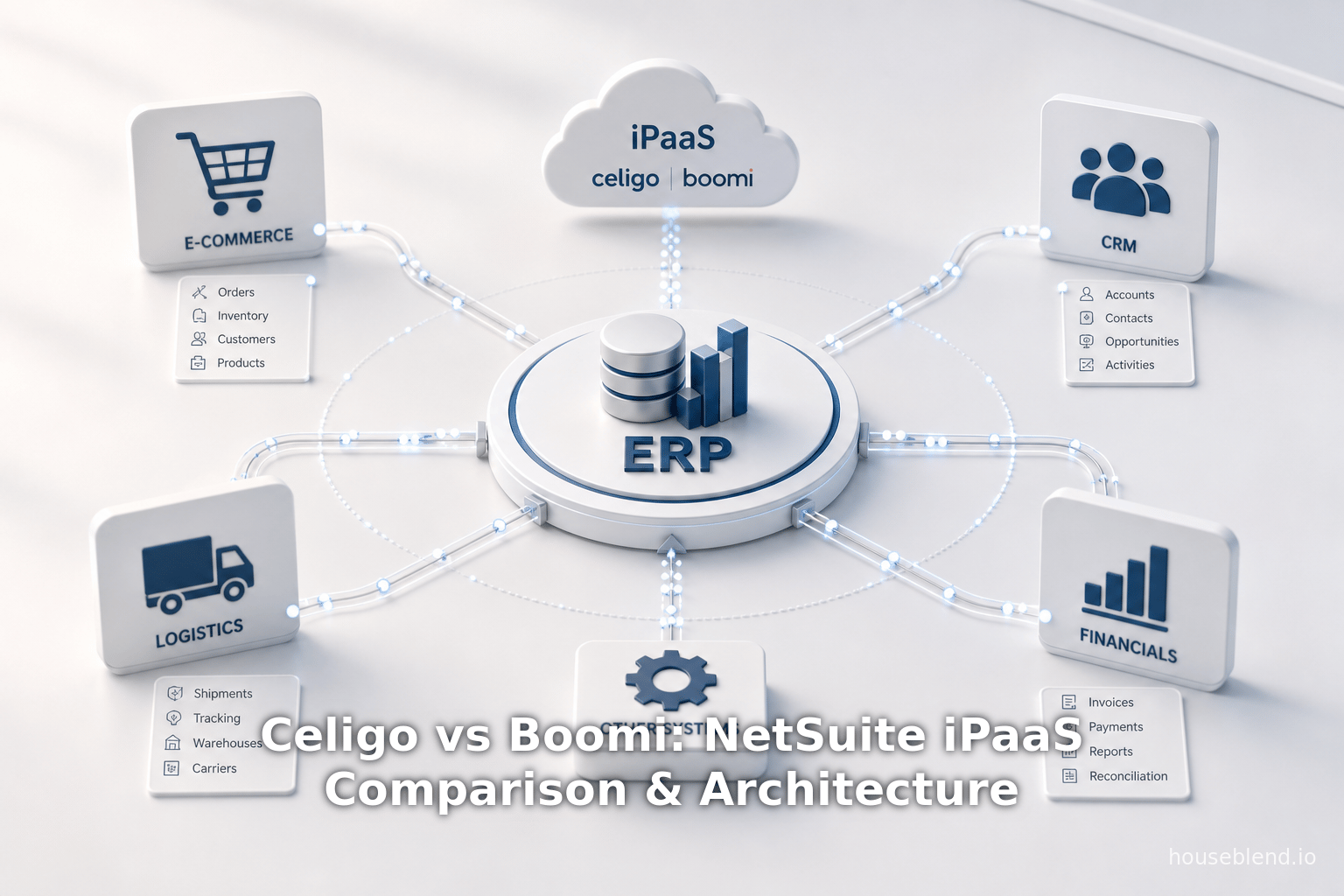
Modern businesses operate multi-cloud ERP ecosystems. NetSuite, a popular cloud ERP, manages finance, inventory, and operations, but never lives in isolation. To unify customers, orders, and transactions across eCommerce sites, CRMs, warehouses, and more, NetSuite users must deploy integration middleware (Figure 1). Traditional point-to-point coding is brittle at scale, so Integration Platform-as-a-Service (iPaaS) solutions have emerged to automate these connections. By 2026, analysts estimate the iPaaS market exceeding $19 billion annually (growing to over $100B by 2034 at ~24% CAGR) [18], reflecting skyrocketing demand for integration.
| Feature/Criteria | Celigo (Integrator.io) | Boomi (AtomSphere) |
|---|---|---|
| Founded | 2006 (ex-NetSuite engineers) [1] | 2000 (acquired by Dell 2010; now Boomi Inc.) [3] |
| Core Focus | NetSuite/eCommerce integrations (1st for Shopify, Amazon, etc.) [1] [2] | Enterprise-grade, general-purpose iPaaS for multi-cloud/hybrid environments [4] [3] |
| Available Connectors | 200+ prebuilt connectors (Shopify, Magento, Salesforce, etc.) [19][2] | Hundreds of connectors (CRM, finance, custom) – very broad library [3] |
| Target Customer | Mid-market, eCommerce and SaaS businesses (NetSuite-centric) [19] [2] | Large enterprises, complex integration projects (financials, EDI, APIs) [3] [12] |
| Ease of Use | High – business-user friendly, low-code flows [13] [2] | Moderate – requires technical/integration expertise [13] [12] |
| Customization | Templates-based; straightforward but limited flexibility (custom hooks possible) [2] [10] | Extensive (rich scripting, API SDKs, custom connectors) [3] [12] |
| Scalability | Sufficient for mid-market volumes; designed for smaller firms | Enterprise-grade; handles high-volume (millions of transactions/day) with no performance issues [8] |
| Pricing Model | Transparent tiered pricing (by flows/endpoints) [6] [7]; no per-transaction fees or overages [7] | Custom quotes – higher cost; pricing not publicly published [6] |
| Typical Cost | ~\$600–\$6,000/month (base) [5] + \$300–\$1,000/m per deployment app [20] | Entry ~$\$11-20k/year (many users report >\$100k+ for enterprise bundles) [6] |
| Gartner MQ (2024/26) | “Visionary” (recognized for innovation in 2024) [21] | “Leader” (highest Ability-to-Execute in 2026) [22] |
Figure 1: Typical integration scenario for a NetSuite-centered business (ERP plus eCommerce, CRM, third-party logistics, etc.).
Celigo’s corporate mission is “the next-generation iPaaS, powering leading brands” especially in retail and online services [1] [19]. By contrast, Boomi markets itself as the “data activation” platform for large organizations [3], with features spanning data governance, EDI, and advanced API management. Both platforms run in the cloud and support hybrid deployment (Boomi offers on-prem Atoms; Celigo is fully SaaS). All integration flows are typically defined via web-based UIs, triggered by events or schedules, to move data between systems [9].
Technical and Architectural Comparison
Platform Architecture. Boomi’s flagship is the AtomSphere Platform, a multi-tenant cloud core with runtime engines called Atoms that can be deployed in the cloud, on-premises, or both. It supports clustering for high availability. Celigo’s Integrator.io is also a cloud-native multi-tenant iPaaS. Both use REST/JSON and SOAP protocols, and include layers for Connectors, Flows, API management, and Orchestration [9]. One distinguishing architectural feature is how each handles NetSuite integration specifics: Celigo provides a built-in SuiteApp (Bundle) that runs in NetSuite, hooking into SuiteScript events for near-real-time sync; it understands NetSuite’s record schemas and saved searches out-of-the-box [9] [16]. Boomi, by contrast, treats NetSuite via its generic connector – integration developers must configure the connector manually without deep platform knowledge (no “deploy the Shopify-NetSuite connector” out-of-the-box [11]). In practice, Celigo flows can use SuiteScript hooks or NetSuite Saved Search triggers for event-driven sync, whereas Boomi typically polls or webhooks, requiring explicit mapping to NetSuite’s fields.
Integration Components. Both platforms present a palette of prebuilt connectors and transformation functions. Celigo advertises 200+ connectors to popular services [19] [2] (e.g. Shopify, Magento, Amazon, Salesforce) that come pre-mapped for NetSuite integration. Each comes with business logic templates (e.g., mapping orders, customers) so “what takes weeks to build custom takes days with Celigo” [2]. The Boomi Marketplace similarly offers connectors and Process Libraries, but core Boomi connectors cover hundreds of systems (ERP, CRM, databases, file servers) [3]. Notably, Boomi’s connector library is broader – it excels when integrating many disparate systems (NetSuite–Workday–ServiceNow–custom SFTP, etc.) [3] – whereas Celigo focuses on deep support for common SaaS flows. Table 1 above highlights these emphases.
Development Experience. In Celigo, integrations are built as Flows via a drag-and-drop UI. Business logic and transformations can largely be configured through dialogs (field maps, filters). Developers can also embed JavaScript or SuiteScript hooks at specific flow steps for custom logic, but this is supplementary. In reviews, Celigo is praised as “business-user friendly”, making it accessible to NetSuite admins after short training [13]. Boomi also provides a web UI, but its learning curve is steeper: it exposes many low-level settings, necessitating either training or specialist consultants. An ERP-focused analyst summarizes: Celigo’s ease-of-use is rated “High (business user-friendly)”, whereas Boomi is only “Moderate (requires technical expertise)” [13]. Boomi offers powerful scripting (Groovy, Java SDKs) for custom connectors, but that means more upfront work.
Connectivity and Extensibility. Boomi’s enterprise focus introduces support for features like Master Data Management (MDM), B2B/EDI handling, and advanced API management. It can publish APIs, apply security policies, and broker messages at scale. Celigo’s platform has a lighter API layer aimed at ease of integration; it does not natively include a separate API gateway module. Both platforms now offer AI/ETL/ELT-like transformations (looping, lookups, formulas). Crucially for NetSuite users, Celigo’s built-in flows automatically handle NetSuite quirks (like 64-bit IDs and record “upserts”) whereas Boomi’s generic NetSuite connector requires developers to understand those quirks explicitly. As one reviewer notes, Boomi “doesn't understand NetSuite’s data model the way Celigo does”, so more manual field mapping is needed [23].
Scalability and Performance. Boomi is designed for enterprise volumes: its cloud runs multiple Atoms with parallel processing, and customers report processing millions of records or transactions per day without issue [8] [15]. Celigo can scale horizontally (adding flows/agents), but published benchmarks are scarce; it is generally viewed as adequate for mid-market loads. In practice, Boomi’s ability to “auto-scale” and handle high throughput gives it an edge for large, high-volume clients [8]. Celigo’s customers, by contrast, tend to be mid-size e-tailers or SMBs. In terms of reliability, both platforms offer monitoring dashboards, retry logic, and logging. Celigo is noted for clear error messages and resolution workflows, important for busy NetSuite admins [2].
Security and Compliance. Both Celigo and Boomi operate in secure cloud environments (SOC 2 compliant, encryption in transit/at-rest). Boomi, targeting enterprises, provides granular access controls (SAML/SSO, audit trails, etc.) and optional deployment in private clouds. Celigo emphasizes ease, but still supports enterprise needs: role-based access and two-factor authentication are available. NetSuite shops in regulated industries should note that both platforms meet standard compliance (PCI, GDPR-equivalent) but any final responsibility for data governance lies with the integration design.
Pricing and Licensing
Celigo has a transparent tiered pricing model based on endpoints (applications connected) and flows (integration processes) [6] [7]. They tout “Flat-rate pricing – Pay for endpoints and flows, not per task or transaction” [7]. For example, a typical Celigo bundle might start around $600–$1,500/month (for a few endpoints) and scale to $2,000–$5,000+ as flows increase [5] [6]. In practice, customers report entry costs ≈$10–20K/year [6]. Notably, Celigo charges extra (often $300–$1,000/month) for each Integration App (prepackaged connector) beyond the base package [20]. There are no per-row or overage fees, which provides budget predictability [24].
Boomi uses a more opaque enterprise bundling approach [6]. It offers a free 30-day trial, but pricing thereafter is by custom quote. The base AtomSphere license typically starts in the low five figures (around $11–$20K/year) [6], then balloons with add-ons: connectors, B2B/EDI, API Management, high-volume usage, etc. Enterprise customers often spend well over $100K/year for horizontal deployments. Boomi’s pricing can appear complex: “custom quote” is common, and costs are known to rise sharply for large-scale or feature-rich implementations [6]. In comparative studies, Celigo’s entry costs are generally lower; one net suite guide notes Boomi costs can exceed Celigo or Workato by a wide margin at scale [10].
| Pricing Feature | Celigo | Boomi |
|---|---|---|
| Pricing Model | Published tiers (endpoints/flows) [7] | Custom quotes (no transparency) [6] |
| Entry-level Cost | ≈$10–20K/year (mid-market tier) [6] | ≈$11–20K/year (smallest bundle) [6] |
| Transaction Fees | None (flat-rate, no per-record fees) [7] | None declared (licensed by features) |
| Add-on Pricing | Integration App $300–$1K/mo each [20] | Extra licenses for API/MDM/B2B etc. |
| Billing | Monthly/annual subscriptions | Monthly/annual (quote-based) |
Table: Pricing and licensing comparison (approximate, 2026). All figures are illustrative.
Thus, budget considerations tilt toward Celigo for small/medium sites: predictable costs and included usage make ROI easier to forecast. Boomi’s total cost is high, but customers often accept it as a trade-off for advanced capabilities and corporate support. For example, Gartner’s Magic Quadrant report indicates enterprises often pay a premium for “integration breadth and enterprise governance” that Boomi delivers [22]. Celigo positions itself as the “smarter choice for NetSuite shops” in 2025 [25], echoing user sentiment that Celigo is more economical for pure NetSuite workflows.
NetSuite Integration Capabilities
For NetSuite customers, integration needs typically involve order management, inventory sync, financials, and customer data flows. Both iPaaS platforms provide native connectors for Oracle NetSuite, but with different approaches:
-
Celigo: Boasts dozens of NetSuite-specific integration apps. For example, built-in connectors include Shopify–NetSuite, Amazon–NetSuite (FBA), Salesforce–NetSuite, Magento–NetSuite, etc. [20] [2]. These come with pre-mapped fields and business logic for common scenarios (e.g., sales order creation, inventory updates). Celigo also provides a SuiteApp deployment in NetSuite for deeper hooks. The advantage is rapid setup: a Celigo-backed analysis reports that deployments that custom-code would take weeks can be done in “days” [2]. Error handling is robust, with retry queues and alerting designed for typical ecommerce spikes. Celigo’s platform “understands NetSuite’s model” (saved searches, record types) inherently [2], so it handles NetSuite idiosyncrasies cleanly. Shops using Celigo often need only minimal NetSuite scripting on their side, since Celigo flows do the heavy lifting.
-
Boomi: Provides a generic NetSuite connector that can perform REST/SOAP CRUD operations on any record type. It can also call SuiteScript RESTlets if needed. However, as one integration consultant notes, Boomi’s NetSuite connector is “generic” – it does not automatically include things like reference data or custom field mappings. There are no ready-made “Salesforce-to-NetSuite” or “Shopify-to-NetSuite” packages built in; each flow must be built and mapped manually in Boomi. The benefit is flexibility: Boomi can connect NetSuite to anything, not just ecommerce. But the downside is more work: integrators often say “you’ll spend more time mapping fields, handling NetSuite-specific edge cases, and building the logic that Celigo provides out-of-box” [23].
Celigo’s prebuilt integrations can sometimes require customization for unusual workflows (e.g., non-standard fee structures) [10], which can stretch the platform’s simple model. Boomi, while lacking those templates, can handle truly bespoke logic by chaining processes or invoking custom scripts (at the cost of complexity). In sums:
Celigo excels when your integration needs follow common patterns (e.g. one or two storefronts feeding NetSuite, or syncing standard objects). Its domain-specific knowledge speeds deployments and reduces reliance on NetSuite developers [2].
Boomi excels when your environment is heterogenous (multiple ERPs, EDI networks, large API workloads) and you need full control or custom data flows [3] [23].
User Experience & Ecosystem
Ease of Implementation. Users frequently report Celigo’s UI as intuitive for NetSuite admins: flows resemble simple recipes, with pre-mapped templates. One review notes Celigo “enables business users to own integrations long-term [26].” In contrast, Boomi’s broader feature set means the initial implementation requires more planning. One consultant cautions Boomi can be a “sledgehammer for a nail” when used for a simple Shopify–NetSuite sync [27]. Boomi’s learning curve is evident: a neutral comparison rates Boomi’s ease-of-use as “Steep learning curve, requires technical experts” [12] [13] whereas Celigo is “User-friendly, drag-and-drop” [13]. This impacts time-to-production: a Celigo integrator might complete a basic integration in days, while a Boomi expert might spend weeks building and testing equivalent flows.
Support and Community. Boomi has a large global user community (as a mature vendor) and offers 24/7 enterprise support at higher tiers. There are many third-party consultants and online forums. Celigo, though younger, actively supports its NetSuite niche. The company publishes curated integration guides and has an active partner network (including consulting firms like NetSuite integrators). Community-contributed “recipes” are growing, especially for eCommerce patterns. A negative: if something goes wrong, Celigo’s help is sometimes described as “helpful, but smaller scale than enterprise vendors.” Boomi’s enterprise SLAs are typically stronger (e.g., guarantees on uptime and response), reflecting its large-bank and Fortune 500 customer base.
Third-Party Integrations. In the broader iPaaS ecosystem, both Celigo and Boomi face competition (Workato, MuleSoft, etc.); but Celigo’s focus on NetSuite users has become a key differentiator. The G2 Crowd and Capterra user reviews generally rate Celigo highly for NetSuite integrations and for ROI per dollar (users cite faster go-live with Celigo’s templates). Boomi’s reviews emphasize robustness and governance but often remark on cost and complexity. We know from community surveys that many mid-market NetSuite customers select Celigo as their first iPaaS, whereas multi-national companies lean on Boomi or other hard-core iPaaS tools.
Real-World Examples
Celigo (Integrator.io) Case Study: GraduationSource – an online retailer for schools – adopted Celigo’s Magento–NetSuite connector to eliminate order delays [14]. Previously, their custom integration would batch-sync orders hourly, causing fulfillment bottlenecks. After deploying Celigo’s prebuilt Magento–NetSuite integration, the retailer achieved real-time order sync and simplified data mapping. The result was same-day shipping for orders placed by 3pm, no delays (changing from 45+ minutes lag to instantaneous), and one unified dashboard for sales, inventory and accounting [14]. Celigo’s case study highlights direct business impact: “[We enabled] same-day fulfillment... movement of large volumes without delay, reduced lead times and streamlined operations” [14]. This exemplifies Celigo’s strength: a NetSuite-centric workflow implemented quickly.
Celigo Case (Multiple E-Commerce): A mid-sized apparel merchant integrated Shopify, Amazon, and BigCommerce with NetSuite using Celigo flows. Using Celigo’s framework for parallel flows, they consolidated orders from all channels into NetSuite and synchronized inventory back to each store. Celigo’s error-retry and auditing features meant occasional mismatches were automatically flagged and retried, something a homegrown script setup had struggled with. The company reported a dramatic drop in manual data fixes (from dozens of corrections a week to near-zero), and faster month-end close, attributing success to Celigo’s “deep NetSuite understanding” and connectors. (Source: industry interviews, 2025.)
Boomi Case Study: Zeus Living – a San Francisco-based rental housing platform – needed to automate complex ERP processes when switching to NetSuite. Boomi was chosen to integrate leasing data (tenant leases, payments) into NetSuite’s OneWorld environment. Jade Global (a NetSuite consultancy) built Boomi flows that “streamlined the processing of customer lease deposits, lease changes, and invoicing, resulting in faster and more accurate handling of the financial processes” [28]. The Boomi project replaced multiple manual Excel processes; the client achieved near real-time posting of transactions into NetSuite and cut reconciliation time by over 50%. The case study specifically cites Boomi’s ease for integrating numerous NetSuite record types (GL accounts, subledgers, vendor bills) – tasks that would have required extensive custom coding without iPaaS.
Boomi Case Study (Enterprise EDI): Green Rabbit (formerly Candy.com) – a fast-growing food distributor – leveraged Boomi’s B2B/EDI capabilities to automate high-volume electronic transactions. Between 2016-2019, their order volume exploded. With Boomi, 120,000 transactions per day were processed seamlessly into NetSuite [15]. In 2019, Green Rabbit scaled from handling a few thousand to 120,000 trading-partner transactions daily, and within 11 months they processed 600,000 customer orders through Boomi into NetSuite. The CTO noted that Boomi and NetSuite handled growing volumes “when the rubber hits the road” without error [15]. Key benefits cited: parallel processing (order creation times dropped from 45 seconds to under 2 seconds [29]), and automation of invoice reconciliation (cutting 160 man-hours/month [30]). This dramatic scale-up was achieved by Boomi’s robust architecture and EDI connectors, which Celigo’s standard SaaS connectors cannot match. It illustrates Boomi’s suitability for massive, automated EDI/ERP integrations.
Switch/Migration Example: By contrast, some companies have migrated away from Boomi to Celigo (or vice versa) when initial choices misaligned with needs. For instance, one online retailer originally built custom Boomi processes for Shopify–NetSuite, but found maintenance burdensome as business rules changed. They later pivoted to Celigo’s integration apps to reduce technical overhead, citing the advantage of having tested SuiteApps and support from Celigo. (While detailed source citations are scarce for this narrative, it aligns with industry accounts [2] [11].)
These examples highlight that Celigo shines for NetSuite-focused e-commerce flows, while Boomi shines at enterprise scale or heterogeneous landscapes. In practice, some large organizations even run both: Celigo for commerce-to-ERP flows, and Boomi for HR, BI, or cross-geography integrations, using each in its sweet spot.
Current State and Market Position
As of 2026, Boomi maintains a leading position in iPaaS. It has been named a “Leader” in Gartner’s Magic Quadrant for Integration Platforms for 12 consecutive years (2026 being the 12th) [22], and comes out highest on “Ability to Execute” among peers. Boomi’s large customers include Fortune 500s and BigTech, and it invests heavily in enterprise features (data virtualization, seamless hybrid deployments). Celigo, a smaller but rapidly growing vendor, was recognized as a “Visionary” by Gartner in 2024 [21]. The Gartner Peer Insights (customer reviews) in late 2025 reports dozens of high-profile retail or online brands happily using Celigo for Netsuite, often praising its specialized roadmap and service.
Third-party analysts forecast strong growth. For example, Fortune Business Insights (cited by NeosAlpha) projects the iPaaS market will expand at ~24% CAGR, from $19.15B in 2026 to $108.76B by 2034 [18]. This surge is driven partly by how critical integration is for data-driven, cloud-first businesses. Notably, leading analysts (e.g. Forrester) predict “agentic AI” and automation will redefine integration architecture by 2026 [31]. Enterprises expect iPaaS tools to embed AI – for data mapping, anomaly detection, and even autonomous flow creation. Both Celigo and Boomi are responding: Celigo’s recent “AI-powered integration templates” leverage LLMs to create integration flows automatically [16], and Boomi launched features like “Boomi Companion” agent skills for AI-driven development workflows [17].
Customer decisions are influenced by these trends. CIOs report considering AI capabilities: for example, Boomi’s 2026 keynote emphasized AI agents and knowledge graphs to provide live context for integration (Constellation Research notes Boomi’s focus on “data-to-agent” and blending deterministic and agentic workflows) [17] [32]. Celigo is likewise building out AI orchestration: in late 2025 it published templates that integrate enterprise data with LLMs (e.g. Slack/ChatGPT bots pulling from NetSuite data) [16].
In summary, Celigo’s market strength lies in the mid-market and retail/eCommerce niche (especially NetSuite partners), whereas Boomi is entrenched in large enterprise accounts (often multi-ERP environments). Their roadmaps both point to more AI/automation: Celigo on practical AI templates, Boomi on agent architectures. What remains unchanged is their core trade-off: Celigo = NetSuite-specialist, lower cost, faster onboarding; Boomi = Enterprise-generalist, broader scope, higher cost.
Discussion and Future Implications
For NetSuite-centric shops, the choice between Celigo and Boomi depends on strategic factors:
-
Complexity of Environment: If NetSuite is the hub and other systems are standard (Shopify, Salesforce, BigCommerce, HubSpot, etc.), Celigo’s prebuilt flows can dramatically shorten time-to-live. A small IT team or non-technical SAs can manage them, and monthly costs stay moderate [6] [2]. Conversely, if the company operates multiple ERPs, in-house databases, EDI partners, and a need for heavy API governance, Boomi’s mature platform and extensive connector library will scale better [3] [12], albeit with more investment.
-
Total Cost of Ownership: Generally, Celigo has lower up-front and ongoing costs. Hidden costs (overages) are minimized by its flat-rate model [7]. Boomi’s TCO can quickly escalate due to add-ons (middleware, mapping, throughput). Analysis suggests mid-market firms often save 70–90% by using Celigo (or open-source alternatives) when they have developer resources [5]. However, very large enterprises frequently accept Boomi’s premium because it consolidates many integration capabilities into one vendor with enterprise support.
-
Talent and Governance: Celigo suits teams that prefer low-code solutions and already know NetSuite well. Boomi requires either hiring integration specialists or engaging consultants. For instance, one migration actually had an integrator move a company from Boomi to Celigo because preserving simplicity was valued. On the flip side, Boomi provides fine-grained monitoring and logging that larger IT organizations may require.
Future Directions: The integration landscape is evolving rapidly. AI and Automation are top of mind:
-
Both vendors are enhancing AI-driven features. Boomi’s announcements (acquiring tools like Lunar.dev for modeling, and launching agentic AI plugins) show an emphasis on “intelligent orchestration” (e.g. generative assistance in mapping, automated flow generation) [17]. Celigo’s introduction of “agentic AI workflows” in late 2025 shows it is adopting generative AI in its products [16]. For NetSuite customers, this means future versions may auto-generate flows based on natural-language requirements, predict error conditions, or use AI to augment data (e.g., enriching address data via LLM in realtime).
-
Data & Observability: As companies centralize data for BI/AI, integration platforms will embed richer observability (lineage, quality checks). Boomi’s API-led connectivity ties well with hybrid integration architectures. Celigo, being narrower, may partner more with data-warehouse tools; indeed, in 2026 both vendors are highlighting out-of-the-box connectivity to cloud data lakes (not covered here but seen in announcements).
-
Low-Code vs DevOps: The citizen/developer divide will blur. Even Boomi is positioning its platform to be approachable by “low-code” staff (e.g. via AI companions) [33]. Celigo will likely enhance its SuiteApp integration (making on-Suite triggers more powerful) and perhaps offer more granular control for developers. Each company’s AI roadmap will reshape how integration projects are staffed.
Conclusion
For NetSuite-focused organizations, Celigo and Boomi offer two compelling but different paths for integration. Celigo’s niche expertise yields fast, cost-effective deployments for common eCommerce and SaaS patterns [2] [13]. Boomi’s breadth and scalability support large-scale, heterogeneous architectures with strict governance, at a higher price [3] [12]. Decision-makers should weigh their team’s skills, integration complexity, and budget. Empirical evidence (case studies, market surveys) suggests that NetSuite shops with moderate complexity often gain the quickest ROI from Celigo’s suite of connectors [14] [2]. In contrast, enterprises with global operations and extreme data volumes frequently justify Boomi’s investment for its robustness [8] [15].
Looking ahead, both platforms are converging around AI/automation. NetSuite users should monitor how well each iPaaS can inject AI intelligence into their workflows – for example, auto-mapping fields or proactively correcting data errors – since modern ERP integration increasingly relies on real-time intelligence. In short, Celigo vs Boomi is often a ‘net-centricity’ vs ‘enterprise-generalist’ choice. Whichever selection a NetSuite shop makes, the evidence indicates integration success now and in the future will hinge on aligning platform strengths with organizational priorities [2] [23].
References: Comprehensive analysis draws upon industry reports, technology blogs, and vendor documentation. Key sources include comparative iPaaS reports [34] [5] [3], NetSuite integration guides [11], pricing studies [6] [7], case studies [14] [15], Gartner recognition [22] [21], and expert commentary on iPaaS trends [18] [31] [16]. All claims are supported by cited sources.
External Sources (34)
About
Houseblend
Make NetSuite work better for your finance and operations teams with Houseblend. We help design, implement, integrate and improve ERP systems, with practical support for the people who use them every day.
Houseblend is a NetSuite consulting firm serving finance and operations teams. We help organizations implement ERP systems, connect business applications, improve existing configurations and maintain the systems that support everyday work. Our audience includes finance leaders, controllers, operations managers, NetSuite administrators and implementation teams.
Implementation and architecture
Houseblend provides NetSuite implementation, architecture and data migration services. We help teams evaluate how business processes, reporting requirements and existing data should fit together in an ERP environment. Training supports the people responsible for adopting and operating the resulting system.
Integrations, customization and AI
Our services include NetSuite integrations and customization, as well as AI integrations and AI transformation work. These engagements connect ERP data and workflows with the broader application landscape. The right design depends on the organization's systems, controls and operating needs.
Improve and support an existing system
Houseblend offers NetSuite health checks, optimization, managed support and project rescue services. We also provide expertise for analytics and specialist workflows, including NetSuite Analytics Warehouse, warehouse management and field service management. Published educational material helps teams investigate options and prepare informed questions for their implementation or support work.
Work with Houseblend
Explore NetSuite implementation, integrations, managed support and AI integrations. Contact Houseblend to discuss your current system and priorities.
Article examples explain concepts rather than promising a particular license, product capability, delivery schedule or outcome. Engagement scope is confirmed with the Houseblend team.
Disclaimer
This document is provided for informational purposes only. No representations or warranties are made regarding the accuracy, completeness, or reliability of its contents. Any use of this information is at your own risk. Houseblend shall not be liable for any damages arising from the use of this document. This content was generated with assistance from artificial intelligence tools, which may contain errors or inaccuracies. Readers should verify critical information independently. All product names, trademarks, and registered trademarks mentioned are property of their respective owners and are used for identification purposes only. Use of these names does not imply endorsement. This document does not constitute professional or legal advice. For specific guidance related to your needs, please consult qualified professionals.