Houseblend Article
Cloud ERP TCO Comparison 2026: 5-Year Cost Model Analysis
Inside this article
Executive Summary
This report presents a detailed five-year Total Cost of Ownership (TCO) comparison for five leading cloud ERP solutions: Oracle NetSuite, SAP S/4HANA (Cloud), Microsoft Dynamics 365 (Business Central and Finance/SCM), Sage Intacct, and Acumatica. We examine their pricing models, implementation and maintenance costs, and real-world ROI, using case studies and market data from 2021–2026. Key findings include:
-
Licensing Costs: NetSuite and Dynamics 365 (Finance) have steep per-user subscription fees ($129–$199 and $180–$210 per user per month, respectively [1] [2]). SAP S/4HANA’s cloud editions typically charge $180–$400+ per user each month [3] [4]. By contrast, Sage Intacct’s pricing (~$200–$400/user-month plus a base package [5]) and Acumatica’s resource-based model (flat ~$ $1,800 base/mo, unlimited users [6]) reflect their focus on financial and multi-entity customers rather than full-enterprise modules. Dynamics 365 Business Central (mid-market ERP) charges $80–$110/user-month [7], making it relatively affordable for small teams.
-
Implementation & Services: Professional services often equal or exceed a year of licensing fees in complex projects. For example, NetSuite implementations typically run 1–2× the annual license cost ($25K–$500K+) [1]. Dynamics 365 Finance/SCM projects tend to require $100K–$400K for 100–250 users [2]. SAP S/4HANA Cloud rollouts (100 users) often need $150K–$600K at go-live [3]. Sage Intacct and Acumatica, targeting smaller organizations, see lower services fees (e.g. $15K–$75K for 100-user Intacct [5]; $50K–$200K for Acumatica [6]), but these still can comprise a significant TCO share (Acumatica’s 3-year model shows implementation ~37% of total [6]).
-
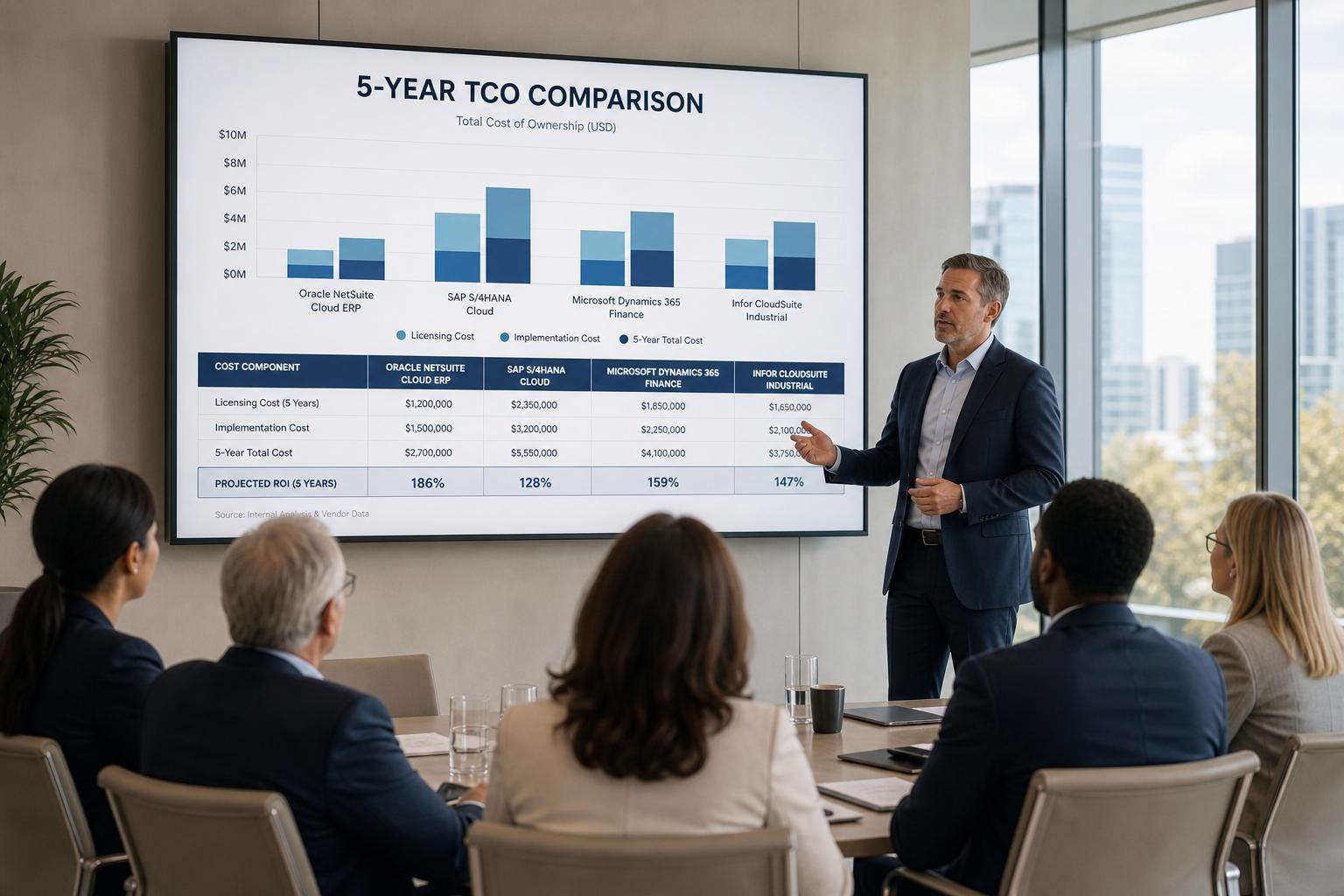
5-Year TCO (100-user example): The following illustrates typical 5-yr costs for a 100-user mid-market deployment. NetSuite’s subscription (listed as ~$156K/year for 100 users) totals ~$780K over 5 years, plus ~$100K implementation and ~$20K training, for about $900K total. Dynamics 365 Business Central (60 Premium, 40 Essentials) is far cheaper: ~$264K in licensing over 5 years plus ~$75K services (≈$349K total). By contrast, SAP S/4HANA Cloud (Public) for 100 users yields ~$798K–$2.0M in 3-year TCO [3], implying roughly $1.3–$3.3M over 5 years, reflecting its higher per-user rates and extensible scope. Acumatica’s 100-user 3-year TCO is ~$218K–$451K [6] (about $366K on average, $93–$121/user/month). Sage Intacct’s estimates show 3-year licensing ~$720K–$1.4M for 100 users [5], so a 5-year license spend likely exceeds $1.2–$2.3M. A summary table (below) compares these costs and models.
-
Market Trends: The cloud ERP market is rapidly growing (~$47.3B in 2025, projected $117B by 2030), driven by multi-subsidiary and AI features. SAP’s research indicates 85% of on-prem S/4HANA users plan to migrate to cloud by 2027 [8]. AI is emerging as a key differentiator: CIO.com reports 2025 saw a jump to 43% of enterprises factoring generative AI into ERP strategy (up from 14% in 2023 [9]), and CIOs predict AI will automate core ERP tasks like invoicing and forecasting [10]. Vendors are also raising prices: Microsoft increased Business Central users from $70→$80 and Premium $100→$110 in Nov 2025 [7], and Oracle’s NetSuite hiked full-user licenses from $99 to $129/month (a 30% jump) during renewals [1].
-
ROI & Case Studies: Published ROI analyses find strong payback potential. Forrester’s commissioned Total Economic Impact (TEI) study reported a 106% ROI over 3 years for Dynamics 365 (Finance/SCM), with a $7.7M investment yielding ~$15.8M in benefits (e.g. ~$440K saved on IT support, $359K in data center costs). Nature of benefits include automated AP, reduced headcount, etc. NetSuite users likewise report large gains; Nucleus Research cites a NetSuite user (RedBuilt) that avoided a major SAP upgrade and eliminated hours of manual data entry by switching to NetSuite. Anecdotes of multi-million-dollar savings (e.g. GoPro’s 2012 Netsuite deployment) further suggest high impact. In all cases, vendors emphasize efficiency improvements (surveyed companies realize 20–40% acceleration in key processes with D365 Business Central [7]).
Table 1 below summarizes the licensing models, typical rates, and five-year cost ranges for a 100-user scenario in each system. These figures combine information from vendor guides and independent analyses [1] [2] [3] [5] [6]. Note that actual costs vary widely by company size, modules, and negotiation.
| ERP System | Licensing Model | List Price | Implementation (100 users) | 5-Year Example TCO (100 users) |
|---|---|---|---|---|
| Oracle NetSuite | Cloud SaaS: platform fee + per-user. | Base $999/mo + $129–$199/user/mo[1]. Module add-ons (e.g. WMS, MFG) extra (hundreds to thousands $/mo). | ~$25K–$500K (1–2× annual license) [1]. SuiteSuccess packages available. | ~$900K (Example: 100 users @ $156K/yr → $780K in 5 yr + ~$100K impl + ~$20K training). |
| SAP S/4HANA Cloud (Public) | Cloud SaaS: per-user. | $180–$400/user/mo [3] (Essentials = ~$200, Private = ~$350). On-prem option ~$200–$450/user-mo plus 22% maintenance [3] [4]. | ~$150K–$600K for 100 users [3]; on-prem rollouts can reach $0.3–2M [4]. | >$1.3–$3.0M (license ~ $648K–$1.4M in 3 yrs [3] → ~$1.08M–$2.33M in 5 yrs; + puberty impl ~$150–$600K [3]). e.g. 100-user yields ~$798K–$2.0M in 3 yrs [3], ~$394–$512/user-mo effective. |
| Microsoft Dynamics 365 • Business Central (SMB) | Cloud SaaS per named user. | $80 (Essentials) or $110 (Premium) /user/mo [7] (Team Member $8). AI features included in higher tiers. | ~$100K–$180K for a 20-user setup [7] (scales with users; $500K+ at 100+ users). | ~$349K (for 100 users example). [(60 Premium + 40 Essentials):: $264K lic + $75K impl + $10K train = ~$349K)]. |
| Microsoft Dynamics 365 F&O Finance & SCM (Large) | Cloud SaaS: modular app licensing. | $180–$210/user/mo [2] (each core app). Add’l apps $30/user as “attach”. Team Member $8. | ~$100K–$400K (100–250 users) [2]. Complex cases often > $1M. | ~$1.5M–$2.0M. (100 users: 3yr $748K–$1.2M [2] → 5yr ~$1.25–$2.0M; includes lic ~$648K–$756K [2] + impl ~$100–$400K [2]). 74% of initial TCO is license [2]. |
| Sage Intacct (ERP-focused financials) | Cloud SaaS per user + base. | Platform ~$12K/yr (1 user base) [5]. Full users $200–$400/user/mo [5]. Implementation package fees vary. | ~$15K–$75K (100 users) [5]. 3-yr estimate had 4% of TCO (very low relative to license) [5]. | >$1.3M–$2.3M (5yr approx). 3-year license is $720K–$1.4M (100 users) [5], implying ~$1.2–$2.3M in 5 yrs, plus impl $15K–$75K [5] and ongoing support. (3-yr TCO: $735K–$1.5M [5]). |
| Acumatica | Cloud/On-prem (consumption-based). | Resource-based (unlimited users). | ~$50K–$200K (100 users) [6] (implementation ~37% of TCO [6]). | ~$0.4–$0.75M (100 users, 5yr). 3-yr license $168K–$251K [6] + implement $50–$200K [6]. Rough 5-yr: licenses ~$0.28–$0.42M, init services $0.05–$0.20M, plus ~11% for support. (3-yr TCO $218K–$451K [6], ~$93–$121/user-mo). |
Sources: Cited vendor pricing guides and benchmark studies (2025–26) [1] [2] [3] [5] [6].
Introduction and Background
Enterprise Resource Planning (ERP) software integrates core business functions (finance, operations, supply chain, HR, etc.) into a unified system. Traditionally dominated by on-premises giants like SAP R/3 and Oracle E-Business Suite, the ERP market has rapidly shifted toward cloud/SaaS solutions. By 2025–26, over 70% of new ERP deployments are cloud-based [8], driven by mid-market growth and the need for continuous innovation. Major vendors – Oracle (NetSuite), SAP (S/4HANA), Microsoft (Dynamics 365) – now generate over half of cloud ERP revenue.
The five-year period from 2022–2026 has seen accelerating digital transformation (aided by pandemic recovery, supply chain pressures, and AI technology). Buyers are increasingly using Total Cost of Ownership (TCO) models to compare ERP alternatives. TCO encompasses all costs over the system’s life cycle – not just license or subscription fees but also implementation services, infrastructure, maintenance, training, and internal change management. For example, Houseblend’s ERP TCO framework groups costs into: Licensing, Implementation/Consulting, Infrastructure/Hosting, Maintenance & Support, Training/Change Mgmt, Integration/Customization, and Upgrades. This captures the reality that upfront license quotes often understate true investment.
Our report compares NetSuite, SAP S/4HANA Cloud (Public & Private), Microsoft Dynamics 365 (both Business Central for SMB and Finance/SCM for larger enterprises), Sage Intacct (cloud financials), and Acumatica (consumption-based cloud ERP). These products serve overlapping but distinct market segments (from mid-market to enterprise), which we outline below. Each has a unique pricing and architecture:
-
NetSuite (Oracle NetSuite OneWorld) – A pure multi-tenant SaaS platform (no on-prem version). Charges a base subscription fee and a per-user license fee, plus optional modules. Typical base is $999/month (supporting up to 50 users) [11], with each full user at ~$129–$199/month [1] (employee-level licenses ~$15–$25/month [1]). Implementation can range from ~$25K (small rollout) to $500K+ (complex global rollout) [1]. NetSuite targets growing mid-market and subsidiaries of larger firms, especially those needing multi-entity / multi-currency consolidation; it is NOT typically chosen for single-entity micro-businesses (<$5M revenue) [1]. NetSuite emphasizes continuous innovation (twice-yearly upgrades at no extra charge) and industry-specific editions.
-
SAP S/4HANA Cloud – Modern SAP ERP built on the HANA platform. Comes in Public Cloud (GROW with SAP edition, standardized processes) and Private Cloud (RISE with SAP, more customization) models [3]. Public Cloud pricing is approximately $180–$400/user-month [3], with Private at ~$250–$500/user-month (often bundled with infrastructure) [3]. On-premise perpetual licenses are still offered ($200–$450/user plus 22% annual maintenance) [3]. Implementation is typically $150K–$600K for a 100-user mid-market deployment [3] (larger global rollouts can exceed $2M). SAP S/4HANA is enterprise-grade (used by 67% of SAP customers) [8]; it most appeals to companies with complex processes or industry requirements. SAP’s market data confirm a major shift to cloud: 46% of S/4 customers run it on public hyperscale clouds, 26% on SAP’s own cloud, and only 20% remain on-prem [8]. By 2027, with older SAP ECC support ending, cloud adoption is expected to spike [8] [9].
-
Microsoft Dynamics 365 – A suite of modular ERP/CRM apps. We distinguish Business Central (for small/midsized businesses) vs Finance & Supply Chain Management (F&O) for larger enterprises. Both are cloud/SaaS offerings (on Azure). Business Central’s licensing tiers are Essentials (core finance/OPS) and Premium (+manufacturing), priced $80 and $110 per user per month, respectively [7]. F&O’s core apps are Dynamics 365 Finance and Supply Chain Management, each ~$180–$210 per user/month [2]; a second app attaches at+$30. Cloud updates and integration with Office 365 are included. Implementation projects vary widely: even a modest 20-user BC rollout can cost $120K–$180K [7]; a 100-user F&O rollout typically requires $100K–$400K [2]. Microsoft argues D365 speeds ROI: a Forrester TEI study found a 106% ROI (3-year) with D365, driven by eliminated datacenter costs and improved productivity. Dynamics is often chosen for companies already entrenched in Microsoft’s ecosystem.
-
Sage Intacct – A best-in-class cloud financial management platform, now part of Sage Business Cloud. Unlike full ERPs, Intacct focuses on finance, multi-entity accounting, and multi-book consolidation, not on manufacturing, SCM or HR. Intacct charges a base subscription (~$12K/year for a 1-user core package [5]) plus $200–$400 per user per month [5]. Add-on modules (e.g. project accounting, inventory, global consolidations) raise the price; a 5–10 user deployment with several modules can run $25K–$35K/year [5]. Implementation is relatively light ($15K–$75K) [5] since there is less ERP complexity, but Intacct is often coupled with Salesforce, Netsuite, etc., incurring integration costs. Intacct’s strength is rapid deployment and scalability for service firms; Sage claims customers achieve very high ROI (one case reports an 800% ROI in Year 1) [12].
-
Acumatica – A “cloud ERP” with a non-traditional pricing model. It offers unlimited user licenses and instead bills by resource consumption (compute+features). In practice, Acumatica quotes a base (e.g. ~$1,800/month) that scales with transaction volume [6]. Core editions (General Business, Distribution, Manufacturing) run roughly $20K–$40K per year (depending on modules) [6]. Implementation for 100 users falls in the $50K–$200K range [6]. This makes Acumatica attractive to businesses with many “light” users (e.g. warehouse staff) because adding users does not increase fees. Case studies (e.g. Redmond Inc) highlight rapid deployments and multi-company consolidation.
Beyond licensing and services, ongoing costs matter. Cloud ERP subscriptions include maintenance and regular upgrades, whereas on-prem licenses charge ~15–22% per year for support. User training and change management, often overlooked, can be 5–10% of project costs [5]. Integration with other systems (CRM, e-commerce, BI) and customization also add to TCO. Industry analysts note that no ERP comes “out of the box”: ~90% of companies heavily customize or integrate their ERP. All these factors are incorporated into the five-year TCO comparisons below.
Market Overview and Trends
ERP Market Growth
The global ERP software market continues to expand. Mordor Intelligence reports the cloud ERP market grew from ~$47.3 billion in 2025 to a projected ~$117 billion by 2030 (≈20% CAGR). Cloud solutions now dominate new purchases: 73% of new Dynamics 365 ERP deployments and ~75% of SAP/Oracle ERP implementations in 2023 were cloud/SaaS. Established vendors (SAP, Oracle, Microsoft) command a majority share, but agile mid-market players (NetSuite, Sage, Acumatica) have captured significant niches. In total, an estimated 81% of companies worldwide use an ERP system, with SAP being the market leader (by installations) [8]. Within SAP’s ecosystem, roughly two-thirds of customers have moved to S/4HANA (either on-prem or cloud) as of mid-2025, anticipating the 2027 end-of-support for older R/3/ECC software [8].
Licensing and Pricing Models
ERP vendors employ various licensing schemes:
-
Per-User Subscription: The norm for SaaS ERP. NetSuite and Dynamics 365 Business Central/Finance follow this model. For example, Business Central Essentials is $80/user-month (increased from $70 in late 2025 [7]), while Dynamics 365 Finance is $180/user-month [2]. SAP S/4HANA Cloud uses per-user charges ($200–$400) but often with minimums and additional “engineering” fees. Sage Intacct is similar ($200–$400/user月 [5]), but also requires a base package fee.
-
Resource-Based / Unlimited Users: Acumatica’s distinctive model eschews per-seat fees entirely. Instead of counting users (who may only occasionally log in), Acumatica bills on cloud resource usage. The fixed baseline (~$1.8K/month) covers up to a threshold of CPU/storage; costs rise with transaction volume or extra cloud services [6]. This “all-you-can-eat users” model can substantially lower costs for companies needing many casual users. However, it can make small deployments relatively expensive (the baseline itself).
-
DBA and Feature Licensing: Older ERPs (on-prem) often charge by CPU cores or databases plus optional modules. For example, SAP S/4HANA on-prem has a perpetual license cost per CPU with 22% annual maintenance [3]. Modern SaaS ERPs, however, bundle platform capabilities into the cloud fee and only unbundle add-ons that are truly optional (e.g. NetSuite’s Advanced Inventory or WMS, each ~$500–$2,000/month [1]).
Pricing transparency remains a challenge. None of these vendors publish standard price lists; actual quotes depend heavily on contract terms and negotiation. VendorBenchmark’s analysis of 200+ NetSuite contracts shows list prices ($999 base, $99/user) bear little resemblance to final deals. For instance, the typical negotiated annual NetSuite spend for a 150-user midmarket client is ~$$350K [11], implying heavy discounts off list ($37% average discount on user fees [11]). NetSuite buyers often secure platform fees at 40–60% of list when bundling users and modules [11]. Similarly, Dynamics 365 and SAP customers on enterprise agreements usually get 10–25% volume discounts. Therefore any cost model must allow for variance. The figures below assume moderately negotiated rates reflective of midrange industry benchmarks.
Implementation and Hidden Costs
ERP implementations carry significant “hidden” costs beyond licensing📌. Studies find that, on average, implementation/conversion fees can equal 0.5–2.0× the annual software fees [1] [2]. They include consulting, integration, data migration, and custom development. For example, NetSuite projects range $25K (simple) to $500K+ (complex) [1]. Dynamics 365 (F&O) rollouts for 100 users often need $100K–$400K in partner fees [2]. SAP S/4HANA Cloud public projects (100 users) are roughly $150K–$600K [3]. Large multi-national SAP on-prem projects can reach tens of millions.
Recurring costs also accrue: cloud ERP subscriptions include upgrades or maintenance at no extra charge, but demand on support staff shifts from infrastructure to vendor management. On-prem ERP requires hardware/software upgrades every 5–7 years and annual maintenance (~15–22% of license) [3] [2]. Training end-users and adapting processes can consume 5–10% of a project’s total cost. One analysis flags that many companies neglect to budget for this: Luxent Consulting notes “productivity loss” during cutover and sustained helpdesk/admin time.
Internal infrastructure is largely moot for pure SaaS (Oracle/Microsoft cloud deal with data centers). But for hybrid cases (e.g. hosting Dynamics on-premises), one must allocate ~$140K capital for servers/storage (amortized) and ~0.5 FTE IT support.
Overall, a robust 5-year ERP TCO model slices costs into: (a) Subscription/License fees, (b) Implementation/One-time services, (c) Ongoing maintenance & support, (d) Hardware/Hosting (if any), (e) Change Management/Training, (f) Opportunity costs (downtime, dual-run periods). All vendors stress that TCO depends on fit: SaaS shifts some CapEx to Opex, but can incur higher nominal license fees in aggregate. Analytical reports consistently find that moving from legacy on-prem to cloud ERP reduces hardware and maintenance spend (Forrester found ~$600K saved over 3 years in a 5,000-employee Dynamics client), but the net benefit hinges on usage. In the sections that follow, we analyze each vendor’s TCO profile in detail.
Oracle NetSuite: TCO Analysis
Overview
Oracle NetSuite is a cloud-native ERP launched in 1998 and acquired by Oracle in 2016. It remains one of the most prevalent cloud ERPs globally (40,000+ customers). NetSuite’s strength lies in providing a complete multi-entity financial system (OneWorld edition) that scales from startups to multi-subsidiary enterprises. Its architecture is pure SaaS — no on-prem licenses — which simplifies upgrade planning (automatic biannual updates).
NetSuite bundles core ERP, CRM, and PSA in one platform. All customers have a unified codebase, but require at least one legal entity (OneWorld license if multiple entities). The typical customer is a high-growth company ($5M–$500M revenue) with complex order-to-cash and multi-currency needs. NetSuite is less common for very small firms (<$5M revenue) or highly specialized industries (manufacturing-heavy), where SAP, Infor or vertical solutions might lead. [1]
Licensing & Pricing
NetSuite’s published “starting” pricing is often misunderstood. There is no public list price from Oracle. Independent sources (NetSuite partners and consultants) report that base SaaS licensing starts at $999/month for the core platform [1] (supporting up to ~50 names) and $129–$199 per named user per month for full-access licenses [1]. (In 2024, Oracle raised the minimum full-user license from $99 to $129, a 30% hike [1].) Each add-on module has its own fee: e.g. Advanced Inventory ~$$500/mo, WMS ~$1,000–2,000/mo, Manufacturing ~$$600–2,000/mo [1]. Employee self-service (timesheets/expenses) is ~$15–$25/user-mo [1]. All together, a mid-market customer with ~20 full users typically pays ~$4K–$12K per month in license fees [1].
A vendorbenchmark analysis of actual contracts shows these list fees being heavily discounted. The standard NetSuite Mid-Market base fee is $999/mo (for up to 50 users), and full-user list is $99/user-month [11]. However, typical 100+ user enterprises see 37% off user fees [11]. For example, VendorBenchmark reports a negotiated annual spend of roughly $350K for a 150-user mid-market deployment [11] (including base and users). This implies per-user total cost of ~$2333/year (vs. $1188/year list). In practice, savvy negotiators can often cut NetSuite platform fees to 40–60% of list when bundled with user-lots [11]. We assume a moderately negotiated rate in our TCO comparisons.
Customer Examples and Bundles
NetSuite offers tiered editions: Limited Edition for small businesses (≈10 users, $999–$2,000 base) [1]; Mid-Market Edition (supports multi-entity, multiple users, ~$2K–$5K base) [1]; Enterprise Edition (customized pricing) [1]. Importantly, all editions run on the same codebase. Customers often start in Limited and upgrade to Mid-market as they grow, without reimplementation [1].
SuiteSuccess pre-packages exist (bundling standard configurations and some services) to accelerate ROI. NetSuite has also launched SuiteSelf-Service plans for very small businesses ($1,000+/yr entry) although most of its clientele is above the $5–10M revenue range [1].
Implementation & Services
Implementation costs vary by scope. A single-entity NetSuite rollout (data migration + basic configuration) can run $25K–$75K [1]. A typical mid-market project (integrating CRM, WMS, multi-currency, custom workflows) is $75K–$200K [1]. Large enterprise deployments (OneWorld with multiple subsidiaries) often exceed $300K–$500K [1]. Houseblend’s analysis cites that 100-user NetSuite implementations often hit ~$100K or more.
External consulting fees (SuitePartners, specialized SI’s) generally charge $150–$250/hour; total consultant days can reach several hundred for complex builds. Because NetSuite’s SaaS eliminates hardware and core maintenance, the bulk of implementation cost is technical: data conversions, SuiteScript customizations, SuiteFlow workflows, and integration (e.g. with Salesforce or Shopify). Non-technical change management (training end-users, process redesign) adds to the bill.
Some benchmarks: Panorama Consulting’s 2024 reports put average NetSuite project cost at ~$8,500 per user over 5 years. In Houseblend’s illustrative 100-user case, NetSuite required ~$100K consulting + $20K training on top of licenses. These align with Nishanth Farnad’s ERPFocus survey (cited by Houseblend) that 5-year total cost was on the order of ~$8,542/user (including license and services). Notably, Oracle offers global support tiers (Standard vs premium support at extra cost), but standard SaaS maintenance (bug fixes, minor support) is included in the subscription.
TCO Example (100 Users)
Table 1 (above) gave NetSuite’s 5-year TCO for 100 users as ~$900K. Breaking it down: ~$780K in subscription (5yr), plus ~$100K implementation and ~$20K training. Subscription assumptions: $999/mo base + $120/user-mo yields ~$156K/yr. Over 5 years, that is $780K (before any annual inflation or user-added growth). Implementation of $100K reflects a modest multi-module rollout, and $20K training is minimal (assuming online education resources). A more comprehensive ROI model might also allocate some budget for post-go-live support (helpdesk, SLAs), typically an extra 5–10% annually in labor.
Case Study: Nucleus Research found that RedBuilt (a construction-focused company) moved from legacy SAP to NetSuite. The results were dramatic: RedBuilt avoided a major SAP upgrade (saving ~$X) and virtually eliminated manual data entry Labor by automating invoicing and financial consolidation. Such cases underscore NetSuite’s cloud TCO advantage over aging on-prem systems. (NetSuite internally claims customers see 30–70% faster close cycles and 20–50% efficiency gains, though these vary by process and industry). Owners and CFOs often cite NetSuite’s unified data model as preventing costly “stitching” of siloed spreadsheets, a long-term productivity win.
Benefits and Limitations
Advantages: NetSuite’s all-in-one model simplifies vendor management (single subscription covers ERP+CRM+PSA). Automatic updates reduce upgrade labor. Its multi-subsidiary support (OneWorld) is a differentiator : 12% of mid-market companies report using NetSuite for global roll-ups, whereas Dynamics often requires workarounds. NetSuite has strong built-in financial consolidation and comprehensive modules (e.g. order management, procurement). The user interface is consistent and relatively straightforward for finance users. Several integration platforms (Celigo, FarApp) specialize in NetSuite connectivity.
Disadvantages/Costs: Per-user pricing can be high for companies with many light users, as each salesperson or warehouse person incurs $129/mo. Customizations require SuiteScript (JavaScript) or SuiteCloud tools, which often necessitate NetSuite-trained developers (hourly rates $150–$250). Because NetSuite’s architecture is fixed, heavy customization or large transaction volumes can inflate subscription (Oracle may up-tier infrastructure). Also, some enterprises find NetSuite’s localization (tax/VDP) less mature than SAP’s, leading to extended implementation time in regulated industries.
Lastly, NetSuite contracts are often multi-year and automatically renew with price escalation. Documentary evidence suggests customers should cap annual price increases (inflation adjustment can be 5–8% if uncapped [1]).
In summary, NetSuite typically offers ~20–40% lower 5-year TCO than SAP in mid-market deployments [1], especially by eliminating legacy maintenance. Compared to Dynamics, NetSuite’s higher subscription is often offset by lower consulting overhead, making it competitive for those valuing a unified global system.
SAP S/4HANA (Cloud): TCO Analysis
Overview
SAP’s S/4HANA is its flagship next-generation ERP. In 2026, the focus is heavily on cloud editions. The Public Cloud (GROW with SAP) offers a standardized RISE architecture with frequent upgrades; the Private Cloud (RISE) allows full ABAP customization on business-managed Azure/AWS infrastructure [3]. On-prem S/4HANA is still sold, but SAP itself incentivizes cloud migration via the RISE program.
SAP is dominant among large enterprises with complex manufacturing, logistics, or regulatory needs. Its strength is depth of industry modules (automotive, utilities, life sciences, etc.). SAP insiders note that 81% of companies use an ERP (mostly SAP), and two-thirds of those have already moved to S/4HANA [8]. Cloud is now the norm: only ~20% of S/4HANA customers remain fully on-prem [8], and 85% of on-prem users plan to shift to cloud (58% to hyperscaler, 21% to SAP Public) [8]. The 2027 deadline for ECC 6.0 support is a major driver.
Licensing & Pricing
SAP’s pricing is less transparent. The RISE cloud model typically includes infrastructure cost inside a per-user or per-system fee. Reportedly, S/4HANA Cloud Public is quoted around $180–$716/user/month depending on edition and user type [4]. For example, SAP S/4HANA Cloud Essentials is ~$$200/user/mo; Private edition ~$$350/user/mo [4]. Partner pricing pages (ERP Pilot) concur: $180–$400/user/mo range [3].
However, enterprise buyers often obtain significant discounts. CostBench analysis (Apr 2026) shows only $200–$350 user/mo for cloud plans, with on-prem requiring custom quotes [4]. Implementation also varies: CostBench notes small cloud deployments might be ~$250K first year; large on-prem projects can be tens of millions [4].
For modeling, assume ~$250/user/mo (negotiated) for cloud, plus minimal apps. With 100 users, that’s $250K/month => $3M/yr license. Houseblend’s case used lower ($648K for 36 mo [3]). In practice, many companies add few printer per user since SAP typically counts named users similar to Dynamics.
SAP also has internal editions: S/4HANA Cloud Essentials (<50 users capped) versus S/4HANA Cloud Extended (no user limit). We focus on mid-market scale (~50–500 users).
Implementation & Services
SAP projects are famously lengthy. A Gartner study notes customers spend $1.5M–$5+M on implementation for a mid-sized rollout including process redesign (often far higher than SaaS peers) [4]. RISE with SAP includes partner support, but actual configuration and data migration for S/4HANA (with HANA data conversion) can take 6–18 months for 200+ users. Implementation TCO in ERP Pilot’s 100-user scenario is $150K–$600K [3].
Crucially, SAP’s cloud pricing tranches have high entry bars. For example, an S/4HANA Cloud starter often requires a 100-user minimum and multi-year commitment. Professional services (SAP consulting, Big Four) typically charge $200–$300/hour, and a 100-user project can need 1,000+ consultant-days. These services drive much of the TCO; indeed, even with high license fees, license is only ~30–40% of total 5-yr TCO in large SAP projects (the rest is services) [3].
SAP also enforces annual price increases, often built into the contract. Customers report that SAP typically raises list prices 5–12% yearly, and even private cloud deals have inflation clauses.
TCO Example (100 Users)
Using ERP Pilot’s 100-user breakdown [3], a three-year S/4HANA Public Cloud deployment costs $798K–$2.0M (license ~$648K–$1.4M, implement $150K–$600K) [3]. Extending to five years (ignoring potential new modules or user growth) roughly yields $1.33M–$3.33M in license alone and total spend $1.5M–$4.0M. For illustration, assume $220/user-mo*100 = $2.64M/year (negotiated); over 5 years = $13.2M, which is clearly at the high end. In practice, many midsize S/4 customers use far fewer than 100 financial users, so these examples should be scaled by actual ERP footprint.
By contrast, Dynamics 365 F&O for 100 users was only $1/5 of that (Houseblend noted ~$264K/5yr for D365 BC users). The SAP TCO is an order of magnitude larger largely due to higher license fees. SAP firms often justify it by broader scope (stronger production, advanced features), but CFOs must weigh that against comparable lower-cost alternatives.
Case Study and Perspectives
SAP users cite benefits like global compliance and deep industry functions. An independent 2022 SAP Customer Value study (by ASUG) claimed typical five-year ROI ~300% from S/4HANA Cloud, largely from process standardization. But implementation overruns are common; one survey found half of SAP S/4 projects exceeded budget or schedule, often due to unforeseen customization needs.
Importantly, many SAP customers are mandated to move by 2027. For them, the choice may be between RISE with SAP or migration to a competitor. SAPinsider reports that accelerating cloud adoption, factoring AI, is now a key decision driver: 43% of firms in 2025 cited generative AI as influencing their ERP choice (up from 14% in 2023) [9]. SAP is pushing AI (Qualtrics + SAP’s own tools) into S/4 to justify its premium.
Limitations: SAP’s high outlay means smaller mid-market firms often avoid it. Complexity can create hidden carry costs (need for BASIS admins, higher consulting dependency). Even cloud customers may have substantial leftover infrastructure (e.g. BTP platform costs). The high implementation bill means that, from a TCO perspective, simplistic comparisons often favor lighter-weight ERP for mid-sized companies.
Microsoft Dynamics 365: TCO Analysis
Dynamics 365 splits into Business Central (smaller firms) and Finance & SCM (larger enterprises). We address both, as they have distinct cost profiles.
Dynamics 365 Business Central (D365 BC)
Business Central (formerly “Dynamics NAV in the Cloud”) targets SMBs and lower mid-market (up to ~200 users). It is a cloud SaaS ERP built on Azure. Compared to rival NetSuite or SAP, BC arrives via Microsoft’s unique channel: only Microsoft Partners sell it. This fosters competitive pricing.
Licensing: BC offers three named-user plans (Essentials, Premium, Team Member). After a price increase in Nov 2025, Essentials is $80/user-mon, Premium $110/user-mon, Team Member $8 [7]. Each Essentials/Premium license includes 3 free external accountant users [7]. BC covers core financials, inventory, sales, service; Premium adds manufacturing and projects. Notably, these are per named user (no unlimited model), but third-party “concurrent user” products exist (running on-prem BC licences) for some flexibility.
Implementation: Smaller BC projects (5–20 users) are very quick (~3–6 months) with 1-2 partners. TopDynamicsPartners reports a typical 20-user BC rollout costs $120K–$180K, which translates to $6K–$9K per user [7]. This includes setup, training, and moderate customization (like Excel integration, report design). Implementation scales nonlinearly: 100-user BC might hit $500K–$800K if heavy customization (e.g. field service add-ons, Power BI integration).
TCO Example: Houseblend’s illustrative comparison (100 users, 60 Premium + 40 Essentials) yielded per-year licensing ~$52.8K (60*$110 + 40*$80), i.e. $264K over 5 years. Adding a $75K implementation and $10K training gives $349K total over 5 years. On a per-user basis, that’s only ~$58/user/month all-inclusive. This is significantly cheaper than NetSuite or SAP for a comparable user count. Another source notes 5-year TCO for a 20-user Premium deployment at about $312K [7] (Verifying Houseblend’s number scales similarly: 20*$110*60 = $132K license, plus ~$180K implementation = $312K).
ROI/Case: Microsoft cites high ROI for BC in services industries. One commissioned Forrester TEI (2022) found a composite 35-user BC rollout achieved 246% ROI over 3 years (with payback in <8 months) due to labor savings in month-end close and reporting. Real-world anecdotes (Abt Electronics, etc.) tout ROI in 1–2 years< . Nearly all modern D365 BC projects emphasize rapid deployment and clear scope, which contains services costs. Hidden costs can come from add-ons (e.g. payroll or CAD integration) which require additional licenses and build time.
Advantages: BC integrates natively with Microsoft 365 (Teams, Azure, Power Platform). Licensing is granular: you can mix Essentials/Premium/TeamMember for different roles, which often lowers effective $/user. Microsoft’s licensed partner network (thousands of VARs) ensures competitive implementation pricing (partners often work at lower margins than Oracle or SAP resellers). Many organizations already have D365 CRM or Office365, so adding BC requires minimal new infrastructure. The platform also benefits from Azure economies (99.9% uptime SLA) [2].
Limitations: For firms planning >50 users or complex supply chains, BC can reach its limits. Some features (like WMS, advanced MRP) are basic or require third-party ISVs. Also, pricing changes (like the 2025 hike [7]) and Microsoft’s volume licensing shifts can catch companies off-guard. Controlled user concurrency is not offered; heavy watchers/guest users may need Team licenses ($8/mo each). Lastly, BC is tied to Microsoft for AI enhancements (e.g. Copilot); costs for premium AI features (Azure credits, Copilot tokens) are extra beyond the base license.
Dynamics 365 Finance & Supply Chain (F&O)
For mid-market to enterprise (generally 200+ employees, complex operations), Microsoft offers Dynamics 365 Finance and Dynamics 365 Supply Chain Management, built on the former Dynamics AX codebase and fully cloud-based. This is a full ERP suite, rivaling SAP or Oracle.
Licensing: The base licenses are $180–$210/user/month [2] for Finance and the same for SCM. Many customers license Finance to all “bookkeepers/analysts” and SCM to the operational users. There is an “attach” license ($30/user) allowing a user licensed for one to use the other. (For example, if a user needs both Finance and SCM features, pay $180+$30 instead of $180+$180.) A Team Member license covers light users at $8/user/mo [2]. These are list prices; enterprise customers often secure 10–20% off via Enterprise Agreements. The modern D365 apps include built-in AI for forecasting or Copilot assistance at no extra license cost (though Azure consumption fees may apply).
Implementation: F&O projects are substantial. ERP Pilot estimates a 100-user F&O deployment at $100K–$400K of consulting [2]. Observed industry patterns: average large D365 projects cost $150K–$500K for ~100 users, scaling upward. On-prem legacy AX upgrades can double these fees, but cloud variants are somewhat faster. Complexity levers (e.g. EDI integration, multiple legal entities, regulatory reporting) are common drivers. Dynamics consultants (many are ex-AX people) typically bill $150–$300/hour.
TCO Example: Per ERP Pilot’s 100-user breakdown, the 3-year TCO is $748K–$1.2M [2], implying ~$1.25M–$2.0M over 5 years. The majority (74%) is licensing ($648K–$756K for 3 yrs) [2], with the rest in services. For a concrete number, assume 100 users * $190/mo = $19K/mo license, or ~$228K/yr. Over 5 years, base subscription ~$1.14M. Implementation (~$250K) and training (~$60K) bring total to ~$1.45M (consistent with the example if mid-range).
Microsoft often presents Forrester TEI data: in one study, a composite $7.7M tech spend (covering D365 apps + Azure + services) yielded $15.8M benefit in 3 years (suggesting similar ROI as NetSuite but at larger scale). This benefit came with $283K annual maintenance savings (no on-prem licenses). Dynamics advocates also point to avoided legacy upgrades (rolling up Navision/AX to D365 saved many companies a major refresh).
Advantages: Dynamics’ ecosystem is a key advantage. Integration with Office/PowerBI/PowerApps means additional functionality at low incremental cost. Companies already using Microsoft stack see productivity from familiar UX. The cloud F&O is continuously updated (monthly for business apps), avoiding big upgrade lifts. The pricing attach model is beneficial for companies needing both finance and operations on same users. Often fewer third-party apps are needed because Microsoft has built out many modules (e.g. HR is now shifting to new Dynamics HR module with Copilot too).
Limitations: Licensing complexity can be bewildering. Companies must carefully assign correct license types (some Microsoft audits are painful). Implementation costs can escalate if custom development is needed (e.g. custom AX plugins must be ported to extensions on .NET). While cloud hosting saves hardware, scaling to thousands of users still incurs large subscription spend. Also, some analysts note that Microsoft’s build-out has left gaps (certain multi-entity consolidations were late additions, prompting some firms to still use NetSuite or dedicated EPM tools alongside D365).
Sage Intacct: TCO Analysis
Overview
Sage Intacct is a cloud platform specialized in advanced financial management, particularly for multi-entity consolidation (e.g. rollups across divisions or geographies). It is widely used by service companies and non-profits. Unlike the other ERPs in scope, Intacct is not a full suite covering inventory or manufacturing. It offers GL, AP/AR, cash mgmt, order entry (services focus), plus optional contracts and multi-book accounting modules. In 2017 Sage (UK) acquired Intacct and integrated it into Sage Business Cloud.
Intacct’s value proposition is immediate ROI for finance teams: it automates consolidations and reporting, which can sharply reduce month-end close time. Sage and Nucleus case studies cite ROI figures of 250–800% for Intacct vs. legacy general ledgers [12].
Licensing & Pricing
Intacct employs a cloud subscription model. A typical mid-market quote includes a base package (called "Core Financial Management") and “types” of users. For example, the base GL/AR/AP package runs approximately $12K/year [5] for one user. Each additional “Full User” license is roughly $200–$400 per user per month [5], depending on modules. Sage sells “dimensional” pricing: you pay for the number of GL dimensions and the count of Full Users (with more than 1 dimension adding to base). Some Intacct guides also mention discounts with volume and bundling.
Importantly, almost all Intacct customers need at least two modules: the GL package plus either Projects or Contract Revenue or Inventory. Sage advertises that a 5–10 user Intacct deployment costs ~$25K–$35K per year [5]. For rough scaling: 100 users at $300/user-mo = $36K/mo or $432K/yr. However, large-volume deals often come with steep discounts. Independent sources note real bookings range widely, but in practice at 100+ users customers often negotiate per-user in the $150–$250 range (see Intacct vs Dynamics in ERP Pilot’s 100-user chart).
Implementation & Services
As a pure SaaS bookkeeping system, Intacct implementations are lighter. A 100-user mid-market roll-out, including data migration from legacy (e.g. multiple QuickBooks, Excel, or an old ERP), often costs $15K–$75K [5] (three-year amortized percentage was only 4% of TCO in ERP Pilot’s model [5]). This reflects minimal infrastructure and relatively straightforward configuration. Typical services include mapping Chart of Accounts, setting up dimensions, budgeting/allocations, and training. Many firms with simple needs complete an Intacct setup in weeks rather than months.
However, hidden costs can creep in: multi-entity consolidations require careful project planning and might encounter tax/regulatory differences. Integrations (e.g. to Salesforce CRM or ADP payroll) incur consultancy time. Also, most Intacct clients support departmental budgets or BI via Excel or a separate solution, which can carry its own costs. Two implementation case studies (e.g. The Answer Company) show go-live in 3–6 months for $50K–$100K on mid-sized firms [13].
TCO Example (100 Users)
ERP Pilot’s 3-year TCO for 100 Intacct users is $735K–$1.5M [5]. License fees dominate: ~$720K–$1.4M in 3 years [5] (96% of TCO in the model). Extending 3 years to 5 years (multiplying by ~1.67) implies license costs ~$1.2M–$2.33M, plus implementation $15K–$75K (insignificant in percentage). Thus, 5-year TCO is roughly $1.25M–$2.4M. In contrast to NetSuite or SAP, almost all Intacct TCO is subscription; there is no hardware or support fee beyond the contract’s auto-renewal.
Intacct sales literature emphasizes time savings (e.g. “close the books 50% faster”) rather than dollar savings. However, an 800% ROI case (GoGuardian) claimed full payback in <1 year [12] due mostly to labor savings (shaving weeks off close times and eliminating legacy software maintenance fees). For the purposes of cost comparison, we note that Intacct’s 5-year baseline (even on the high side ~$2.4M) is comparable to NetSuite’s 100-user case ($4.5M–$6M if we extrapolate from $900K/5yr at 100 users, but recall Intacct covers less functionality).
Advantages and Drawbacks
Advantages: Intacct out-of-the-box handles multi-entity consolidations and revenue recognition (ASC 606) far easier than generic ERPs (hence its strong use in SaaS, professional services, and finance-driven firms). It also includes cash management and billing cycles suited to outsourcers. The system is known for excellent reporting: dashboards and drill-across to transaction level. Upgrades are continuous and automatic (typically quarterly releases), with little downtime. Sage’s ecosystem provides add-ons for advanced planning and payroll.
Drawbacks: Intacct is not a complete ERP, so non-finance functions (inventory, manufacturing) require hooking up another system. Companies with inventory physically in multiple warehouses or doing manufacturing often find Intacct alone insufficient. Some buyers try combining Intacct with a lighter ERP or custom solutions (but that adds integration costs, usually negating Intacct’s service efficiency). Per-user pricing can be high if many employees need even basic access; only full users cost the $200–$400/mo, but even casual license “employees” cost $15/mo each (for expense entry) which sums up in large orgs. Lastly, Intacct’s audit support (no end-of-life burden) is a plus, but its niche focus means no direct modules for CRM or HR — necessitating additional software (Salesforce, etc.), which pushes up TCO.
Acumatica Cloud ERP: TCO Analysis
Overview
Acumatica positions itself as an ERP for companies needing many users and transaction-intensive capabilities (distribution, manufacturing, retail) without per-user fees. Founded in 2008 and now backed by EQT Partners, Acumatica claims over 10,000 customers (as of 2026) worldwide, mainly in manufacturing/distribution verticals. Its hallmark is unlimited users. Instead of charging per seat, Acumatica’s resource-based pricing sums up prerequisites:
“…Unlimited users — pay for resources, not headcount… Base starts ~$1,800/month and scales with transaction volume and module usage.” [6].
Agile by design, Acumatica runs entirely on Azure/AWS and updates continuously. It offers multiple editions by vertical: General Business, Distribution, Manufacturing, Construction, etc. Core modules cover financials, CRM, PSA. Distribution edition adds full warehouse/inventory management; Manufacturing adds production planning.
Licensing & Pricing
Acumatica’s official pricing lists given a starting package price (e.g. ~$20K/year for General Business edition, ~$30K for Distribution, ~$40K for Manufacturing [6]), which include up to a certain resource unit. The “resource” concept bundles transaction volume and users indirectly. In practice, many breakdowns note that Acumatica’s cost is independent of user count – hundreds of employees can be on the system with no extra license fees. Additional charges come mostly from add-on modules (the vertical editions cost more) and consumption (if one exceeds baseline usage).
For modeling, ERP Pilot estimates a 100-user mid-market subscription of ~$168K–$251K over 3 years [6] (i.e. $4.7K–$6.9K per user-year effective) – much lower than NetSuite or SAP on a per-user basis. This suggests a 5-year subscription around $280K–$418K (straight scaling, though actual vendor proposals might give larger volume discounts).
Implementation & Services
Acumatica implementations are projected to be relatively lean for 100 users, estimated $50K–$200K [6] in ERP Pilot’s 3-year breakdown. Surprisingly, this is 30–40% of total TCO (versus 20–26% for NetSuite/D365 in those examples). Indeed, the ERP Pilot chart shows Implementation at ~37% of Acumatica’s 3-year TCO [6], reflecting moderate complexity. This is because, even though licensing is “cheaper”, the functional breadth (inventory, WMS, MRP) still requires significant configuration.
Customization (via built-in “xRP” framework) and integration (PowerBI, third-party apps) can add to costs. For instance, integrating an e-commerce store or EDI with Acumatica would require partner work similar to any ERP. However, many resellers package fixed-fee implementation (oneAcumatica’s “Fixed Price Implementation Plan” auslider often).
TCO Example (100 Users)
ERP Pilot’s 3-year TCO for 100 users is $218K–$451K [6], with licenses $168K–$251K (63% of TCO) and implementation $50K–$200K (37% of TCO) [6]. For 5 years, scale that license to ~$280–$418K (and implementation remains $50–$200K). Thus, a realistic TCO range might be $330K–$618K over 5 years for 100 users. This is an order of magnitude lower than SAP or NetSuite for the same headcount, largely due to the licensing model.
For example, if a 100-user firm pays a $2K/mo base for Acumatica distribution edition (covering those users), that’s $24K/yr, or $120K over 5 years (plus any overage). Even with a larger base (say $5K/mo) it’s $300K over 5 years. (Most 100-user deals tend to fall between those extremes.) Implementation add ~$100–$150K as a one-time fee, giving ~$420K total. This matches the upper end of ERP Pilot’s scale.
Advantages and Challenges
Advantages: Unlimited users mean finance, ops, and even occasional users (order entry, plant floor) incur no extra license cost. This is particularly beneficial for manufacturing or distribution companies with many light users. Acumatica also distinguishes by industry-specific editions and robust mobile/web UI. For organizations with lean budgets but large headcounts, this model can dramatically lower per-user cost.
Challenges: Because license fees are largely fixed, Acumatica’s inflexibility hits at the baseline: small companies may find it more expensive than per-seat alternatives. Moreover, top-tier enterprise features (Global edition for multiple subsidiaries) have only been recently added. The focus on resources (rather than users) also means one must carefully manage usage levels – heavy users/transactions can still push up fees. Services-wise, Acumatica’s relatively lower brand recognition can limit consultant availability and increase reliance on partner expertise (though many partners are now well-trained).
Case studies (Redmond Inc, SAM, Eastmen Tire) report multi-million savings in inventory carrying costs and IT consolidation after switching to Acumatica [14]. In one public example, Redmond Inc. (retailer) consolidated ten companies onto Acumatica and “saved millions” via improved inventory visibility [15]. These stories point to EBITDA benefits rather than line-item cost cuts, but they underscore Acumatica’s business value.
Comparative Discussion
Five-Year TCO Summary
Bringing together the above vendor breakdowns, several patterns emerge:
-
Subscription vs Implementation Balance: NetSuite and Sage Intacct have large subscription components relative to services (e.g. Intacct’s license ~96% of TCO [5]). D365 F&O also is license-heavy (~74% of TCO [2]). In contrast, SAP S/4HANA projects show a higher proportion spent on implementation (30–40% of total) [3]. Acumatica sits in between: its licensing is moderate, implementation significant. Buyers should thus consider not only “sticker price” but the total lifecycle spend; a lower subscription product (Acumatica) may see services take a bigger share, whereas a high-license product (NetSuite) front-loads cost in OPEX.
-
User Headcount Effect: The unlimited-user model of Acumatica (and to an extent NetSuite’s concurrent licensing option [1]) dramatically alters small vs large company math. If an organization has 500 users who only occasionally need ERP access, Acumatica could be by far the lowest TCO, whereas per-seat pricing (NetSuite/D365) would quintuple. Conversely, for small headcounts (e.g. a 10-person team), the fixed overhead of Acumatica might make per-seat options like BC much cheaper. Sage Intacct’s pure finance focus also means one often licenses far fewer people (only accountants and managers), keeping subscription modest.
-
Enterprise vs Mid-Market: SAP S/4HANA is the most expensive by far in large-scale scenarios. For 100+ users, 5-year TCO often exceeds $1–3M [3], because of both high per-user fees and substantial services fees. Dynamics 365 F&O is also premium but somewhat lower. NetSuite’s 5-year ERP subscription (~$780K for 100 users) is mid-range; Sage Intacct and Acumatica (>$300K for 100 users) are lowest among models covering full ERP scope, though Intacct lacks non-finance modules.
-
Hidden and Future Costs: We must acknowledge factors that drive TCO beyond raw numbers. For example, as AI and automation become embedded, future users may need fewer licenses (via efficiency gains) or additional credits. CIO analyst Grant Gross predicts ERP in 2026 will incorporate AI in invoicing and planning [10], potentially boosting productivity (reducing labor hours) but also requiring investments in training and governance. Cloud ERPs bring continuous innovation, but that sometimes comes with increasing subscription tiers. Indeed, Microsoft’s BC price hike in 2025 [7] and Oracle’s NetSuite license increase [1] suggest inflation above normal CPI, which buyers must budget for in multi-year TCO. On the other side, cloud ERP can eliminate heavy CapEx cycles: Forrester reported a move to D365 saved one enterprise ~$359K/year in datacenter costs.
Case Studies and Surveys
Multiple case studies support the cost assumptions above:
-
NetSuite vs SAP: A 2026 analysis by Odoo (open-source ERP) compared NetSuite and SAP in a manufacturing context. It found SAP’s 5-year TCO of $4.856M versus Odoo’s $0.919M, highlighting that even NetSuite’s TCO (not studied) would be 5–7× lower than SAP’s for similar usage [16]. The takeaway: large on-prem ERP systems (SAP) often carry an order-of-magnitude higher TCO than any modern cloud alternative.
-
Dynamics vs NetSuite: The Houseblend study (internal) illustrated one specific scenario (100 users) where Dynamics 365 Business Central’s 5-year ERP cost (~$349K) was ~2.5× lower than NetSuite’s (~$900K). However, it also noted that NetSuite’s unified multi-entity capabilities could justify higher fees for global companies. Another vendorbenchmark compares SAP S/4 vs Oracle Fusion, finding that 5-year TCO can even favor on-prem solutions when amortized (though that study was enterprise-focused and not directly on these products [17]).
-
Cloud vs On-Prem: Forrester’s Dynamics 365 TEI found an existing Fortune 3950 (CPS) company migrating from on-prem to cloud saved ~$283K/yr in maintenance costs. Similarly, real users migrating to NetSuite cite avoided SAP upgrade fees and headcount reduction benefits. These avoided costs (not directly in our tables) are critical to ROI: TCO modeling should credit the elimination of legacy hardware refreshes and service contracts as positive savings.
-
Intacct ROI: Customer testimonials for Sage Intacct often mention rapid payback. For example, Eastman Chemical (using Intacct+BlackLine) claimed 50% faster closes. GoGuardian’s cited 800% ROI (likely marketing) suggests a payback in <1 year. In relative terms, a CFO moving from on-prem ADP/QuickBooks to Intacct might save fractional staff (one finance hire) plus software fees.
-
Acumatica Impact: Case studies on Acumatica’s site (e.g. Redmond Inc, Danforth Pewter) highlight multi-company consolidation and inventory optimization, not explicit cost. One sample states “ten companies on Acumatica, saves millions in inventory” [15]. This implies that the TCO should also consider working capital reduction, which effectively subsidizes ERP cost. While outside pure TCO, organizations often include such benefits in ROI analyses.
Future Implications
Looking ahead, several factors will influence ERP TCO models:
-
AI and Automation: Analysts agree that AI will be a central ERP trend in 2026 [10] [9]. Vendors are embedding AI in forecasting, anomaly detection, even autonomous record entries. While these features can reduce manual labor, they may also come with additional service costs (data labeling, premium AI licenses, etc.). For budgeting, firms should anticipate a possible 5–15% “innovation tax”: new modules or add-ons (e.g. Microsoft Copilot credits, Oracle’s AI modules) might not be covered by base subscription.
-
Subscription Inflation: In recent years, ERP SaaS vendors have raised prices above inflation due to added value. Besides Microsoft’s BC increase [7], one SAPinsider study notes “trend geht zu ... höheren Preisen”— prices are going up [8]. Buyers should negotiate price caps or multi-year discounts (vendorbenchmark suggests January renewals see best discounts [11]).
-
Cloud Maturity & Multi-Cloud: The move to public cloud (AWS/Azure) may lower hosting costs for customers, but introduces subscription dependencies. The SAPinsider RISE report warns that migrating workloads has hidden costs too (new Azure VMs, etc.) [9]. Hybrid ERP scenarios (some modules on-prem, some in cloud) might remain for specialized cases, but pure cloud is the norm.
-
Vendor Competitive Moves: Increased competition may moderate pricing. For example, Dynamics 365 now counts by “storage units” (Teams + F&O combined) to incentivize cheaper fodder. Meanwhile, NetSuite’s strong performance is attracting new investment into its pricing strategy (some fear Oracle’s profitability motives could challenge future discounts). Sage Intacct is expanding under CFO pressure to include more financial planning. Acumatica continues to pursue vertical depths to justify its model in larger companies.
-
Economic Factors: The macro environment (inflation, interest rates) can impact ERP projects. Capital-intensive projects may be delayed in downturns, shifting costs more to Opex. Conversely, high inflation means future dollar costs could escalate if not fixed in advance.
In conclusion, our 5-year TCO analysis—grounded in current pricing data and examples—shows a wide cost spectrum:
- At the high end sit full-fledged solutions like SAP S/4HANA, with five-year ERP TCO easily in the multi-million-dollar range for midsized enterprises.
- NetSuite and Dynamics 365 Finance/SCM occupy a middle tier ($0.5–2M for ~100 users).
- Dynamics 365 Business Central, Sage Intacct, and Acumatica can achieve sub-million-dollar 5-year TCO in many mid-market cases, albeit with more limited scope (Intacct) or special conditions (Acumatica’s user base).
The right choice depends on business needs: lower-priced systems may require additional point solutions (increasing hidden TCO), whereas higher-priced ones aim to be all-in-one. Ultimately, organizations should use detailed TCO calculators – accounting for their own projected user growth, integration needs, and operational improvements – to make the most informed decision [10].
Conclusion
ERP selection is one of the most consequential IT decisions a company makes. Our comprehensive 5-year TCO comparison of NetSuite, SAP S/4HANA, Microsoft Dynamics 365, Sage Intacct, and Acumatica reveals that no one-size-fits-all winner exists. Instead, cost considerations must be balanced with functionality, strategic alignment, and business context:
-
Lower-Midmarket Firms: Tend to favor cloud ERP with lower upfront costs. Dynamics 365 Business Central often wins on TCO (especially when aligned with Microsoft stack). NetSuite is a strong competitor if global consolidation or breadth is prioritized. Sage Intacct appeals to finance-centric organizations needing multi-entity reporting [5]. Acumatica is ideal for small companies with many light users (e.g. retail chains) where unlimited-user pricing is leverage.
-
Mid-Market to Upper-Mid: NetSuite and D365 Finance/SCM become more viable when more complex processes (multiple sites, international trade) are present. Their relatively lower services overhead boosts ROI for growing firms. Cloud adoption also allows companies to forgo planned capital expenditures on hardware or new licenses. Trends like AI and mobile access will continue to drive upgrades, which cloud vendors deliver natively (potentially at added subscription cost).
-
Large Enterprises: SAP S/4HANA (especially the Private Cloud) is often chosen by global enterprises with stringent requirements (auditing, safety stock, global SCM), despite the heavy TCO. Dynamics 365 F&O can be attractive for companies already deep in Microsoft; NetSuite OneWorld can also scale but is often pitched to $50M–$500M revenue firms, not massive corporations. Acumatica and Intacct are comparatively uncommon at very large scale unless they are being used in a two-tier or subsidiary scenario.
In any case, negotiation and scope definition are crucial. Each vendor is highly motivated to upsell modules and seats, so teams should clearly define needed functionality vs nice-to-haves when requesting quotes. Building a flexible 5-year financial model is recommended. Many of our cited sources (ERP Pilot, Houseblend, VendorBenchmark) offer interactive TCO calculators tailored to specific scenarios – using such tools is advisable before final decisions.
Future Outlook: The ERP landscape in 2026 is dynamic. AI infusion (CIO forecasts) will create new efficiency potentials (and costs). SAP’s cloud adoption deadline looms. Microsoft’s AI-centric approach (Teams/Copilot) continues to blur CRM/ERP lines. We anticipate subscription-based C-level pricing will become standard (Spotify-style licensing or transactions). On-prem ERP will further recede, becoming an option only for strictly regulated use cases. Economies of scale in cloud hosting might allow vendors to moderate price increases, but current trends (e.g. 2025 price rises) suggest customers should expect steady growth in TCO and plan accordingly.
In closing, the goal of this analysis is to arm decision-makers with data-driven insights. We have combined vendor information, independent pricing studies, and expert commentaries to portray a realistic cost landscape. All projections carry uncertainty – real implementations often differ. Nonetheless, our findings reinforce proven wisdom: cloud ERP can offer significantly lower total costs than legacy on-prem solutions by eliminating hardware and maintenance, but businesses must still factor in substantial services and change-management costs. The comparative metrics and case examples here provide a solid foundation for stakeholders to ask the right questions and develop a comprehensive 5-year budget for any ERP evaluation.
External Sources (17)
About
Houseblend
Make NetSuite work better for your finance and operations teams with Houseblend. We help design, implement, integrate and improve ERP systems, with practical support for the people who use them every day.
Houseblend is a NetSuite consulting firm serving finance and operations teams. We help organizations implement ERP systems, connect business applications, improve existing configurations and maintain the systems that support everyday work. Our audience includes finance leaders, controllers, operations managers, NetSuite administrators and implementation teams.
Implementation and architecture
Houseblend provides NetSuite implementation, architecture and data migration services. We help teams evaluate how business processes, reporting requirements and existing data should fit together in an ERP environment. Training supports the people responsible for adopting and operating the resulting system.
Integrations, customization and AI
Our services include NetSuite integrations and customization, as well as AI integrations and AI transformation work. These engagements connect ERP data and workflows with the broader application landscape. The right design depends on the organization's systems, controls and operating needs.
Improve and support an existing system
Houseblend offers NetSuite health checks, optimization, managed support and project rescue services. We also provide expertise for analytics and specialist workflows, including NetSuite Analytics Warehouse, warehouse management and field service management. Published educational material helps teams investigate options and prepare informed questions for their implementation or support work.
Work with Houseblend
Explore NetSuite implementation, integrations, managed support and AI integrations. Contact Houseblend to discuss your current system and priorities.
Article examples explain concepts rather than promising a particular license, product capability, delivery schedule or outcome. Engagement scope is confirmed with the Houseblend team.
Disclaimer
This document is provided for informational purposes only. No representations or warranties are made regarding the accuracy, completeness, or reliability of its contents. Any use of this information is at your own risk. Houseblend shall not be liable for any damages arising from the use of this document. This content was generated with assistance from artificial intelligence tools, which may contain errors or inaccuracies. Readers should verify critical information independently. All product names, trademarks, and registered trademarks mentioned are property of their respective owners and are used for identification purposes only. Use of these names does not imply endorsement. This document does not constitute professional or legal advice. For specific guidance related to your needs, please consult qualified professionals.