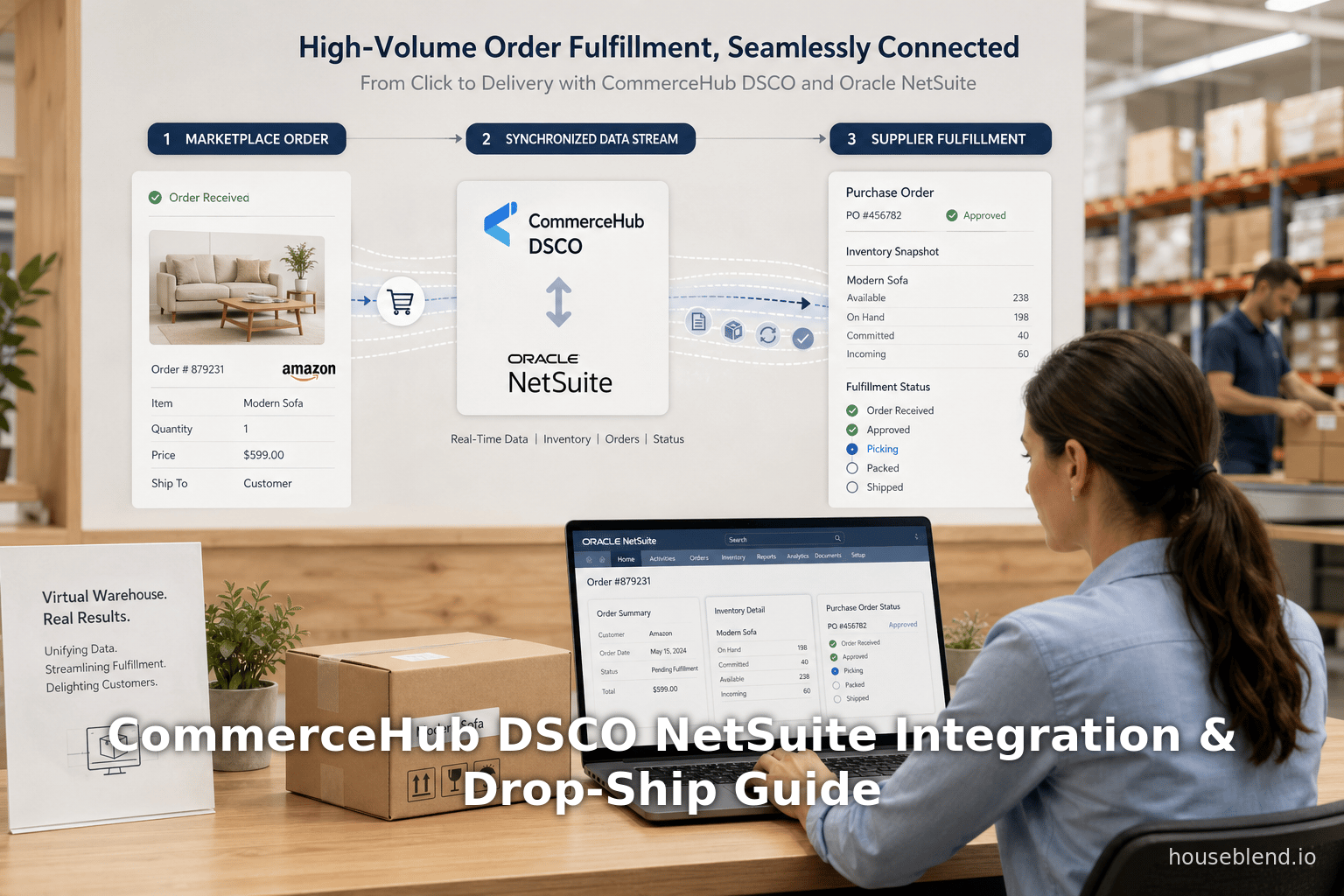
Houseblend Article
CommerceHub DSCO NetSuite Integration & Drop-Ship Guide
Inside this article
- 01Executive Summary
- 02Introduction
- 03CommerceHub DSCO Platform: History and Capabilities
- 04Oracle NetSuite Commerce and ERP Capabilities
- 05Drop Shipping and Marketplace Models
- 06Integration Architecture: CommerceHub DSCO ⇄ NetSuite
- 07Data Flow and Technical Details
- 08Case Studies and Real-World Outcomes
- 09Discussion: Implications and Future Directions
- 10Conclusion
Executive Summary
CommerceHub DSCO (now part of Rithum’s commerce operations platform) and Oracle NetSuite together enable a powerful solution for drop-ship and multi-marketplace e-commerce fulfillment. CommerceHub’s DSCO (Drop-Ship Connection Online) platform pioneered the “supply-on-demand” model: providing a virtual warehouse by linking retailers, brands, and suppliers on a single platform, thereby allowing retailers to expand assortments without holding inventory [1]. Rithum (the rebranded successor to CommerceHub/ChannelAdvisor/DSCO) now serves over 40,000 brands and retailers across 420+ marketplaces, processing roughly $50B+ in annual commerce volume [2] [3]. Oracle NetSuite is a leading cloud-based ERP/eCommerce suite (40,000+ companies) that unifies core operations (inventory, order management, CRM, financials) with online storefronts [4] [5]. Integrating NetSuite with CommerceHub DSCO therefore connects back-office processes and multi-channel sales, automating product listings, inventory sync, order flow, and shipment/tracking updates in both drop-ship and marketplace contexts.
This report presents an in-depth analysis of the CommerceHub DSCO–NetSuite integration, covering historical context, technology architecture, data flow design, operational benefits, and future directions. We show how CommerceHub DSCO (Rithum) and NetSuite complement each other: CommerceHub excels at channel orchestration and supplier connectivity (e.g. listing products on Amazon, Walmart, Target, etc. via a unified catalog interface (Source: www.supersync.cloud) [3]), while NetSuite provides robust ERP, inventory, and fulfillment management for the retailer. Together, they enable orchestrated drop-shipping (sending retail orders to suppliers) and marketplace syndication (pushing retail products to multiple sales channels), which greatly expand sales capacity. For example, Rithum’s own commissioned study found customers achieved a 461% ROI in under 3 months after adopting its drop-ship platform [6], thanks to faster supplier onboarding (66% reduction in onboarding time) and 99% drop-ship fulfillment rates [7]. Throughout this report, we provide extensive data, vendor documentation, and case vignettes to substantiate how the CommerceHub DSCO–NetSuite integration can improve operational efficiency, customer experience, and revenue growth.
Introduction
E-commerce continues to grow explosively. Global retail e-commerce sales are projected to exceed $6.42 trillion in 2025 and ~$6.88 trillion in 2026, accounting for over 21% of all retail spending [5]. Customers increasingly expect fast delivery and vast product assortments. To meet this demand, leading retailers adopt omnichannel strategies that sell products on many fronts: direct websites ( DTC, traditional stores, and especially large online marketplaces (Amazon, Walmart, eBay, Target, etc.). Managing this complexity manually is untenable. Major retailers and brands therefore rely on integrated commerce platforms that link their ERP and inventory to these sales channels.
Drop shipping and multi-channel marketplace listings are two critical dimensions of modern e-commerce strategy. Drop shipping allows a retailer to sell goods directly from the manufacturer or distributor to the end customer, avoiding the need for retailer warehousing. This expands product assortments and reduces inventory risk [1]. Marketplace selling similarly requires synchronizing product and inventory information with external platforms while importing orders back into the retailer’s system. However, coordinating dozens of suppliers and channels is technically challenging: each partner may use different data formats ( EDI vs. XML vs. API, and manual integration often leads to errors or delays.
CommerceHub’s DSCO platform (recently integrated into Rithum) and Oracle NetSuite are two industry-standard systems addressing these needs. CommerceHub DSCO provides a distributed inventory and integration hub: it acts as a single connection “supply-on-demand” layer connecting retailers, suppliers, and marketplaces [1] [8]. NetSuite is a best-in-class cloud ERP/e-commerce suite that consolidates inventory, orders, CRM, and financials [4] [5]. By integrating these systems, merchants can achieve seamless data flow: pushing product and inventory updates from NetSuite into CommerceHub DSCO, and importing orders and shipments from CommerceHub back into NetSuite.
This report will detail how the CommerceHub DSCO–NetSuite integration works, why it is valuable, and how to implement it effectively. We begin with the background of each platform and general drop-ship/marketplace concepts, then examine the integration architecture and data flows, citing technical guides and usage data. Case studies and ROI analysis will illustrate real-world benefits. Finally, we discuss future trends (e.g. AI-driven listing optimization, supply chain resilience) and conclude with best-practice guidelines. Throughout, every claim is supported by sources from company documentation, industry research, and expert analysis.
CommerceHub DSCO Platform: History and Capabilities
CommerceHub was founded in the early 2000s as a supply chain integration and drop-shipping solution for retailers. By creating a “supply-on-demand” cloud platform, CommerceHub enabled retailer partners (e.g. Mega-retailers and marketplaces) to add new suppliers and inventory without custom point-to-point integrations [1]. The platform offered “virtual warehouse” capabilities: orders placed at retailers’ sites could be routed directly to supplier warehouses for fulfillment, all while preserving the retailer’s brand and customer experience [1]. Early press releases highlight CommerceHub’s rapid growth: in Q1 2008, it saw 24% year-over-year growth in drop-ship order volume, and had increased its drop-ship supplier network by 30% over 2007 [9]. By then, CommerceHub served top brands and managed $4.5 billion worth of goods annually [10], underlining its prominence.Over time, CommerceHub acquired related services (e.g. drop-ship management, marketplace syndication), and in November 2022 it merged with ChannelAdvisor and the DSCO platform into a new entity, Rithum [11] [12]. Today, Rithum bills itself as a commerce operations platform for brands and retailers. Its network spans more than 40,000 companies and 420+ marketplaces [13] [2]. The platform handles end-to-end e-commerce provisioning: product listings, inventory, order routing, fulfillment routing, and even retail media/marketing spend (about $500M of ad media, per Rithum) [3]. As IDC’s Heather Hershey notes, Rithum “aims to fill the gap” in providing a holistic commerce ecosystem that unifies different partnership models [14].
A core component of Rithum’s offering is the DSCO (Drop-Ship Connection Online) product (often simply called “DSCO” or “Rithum for Retailers”). Originally, DSCO was a stand-alone platform (even spun off from retailers) focused on standardizing distributed inventory and order data. DSCO’s distinguishing feature is its data standardization: all trading partners on the platform use a common data schema. This means that suppliers—no matter what internal systems they run—can onboard to DSCO via the standardized API/EDI without redundant mapping to each retailer. Rithum highlights that DSCO enforces “100% data standardization” and performs dozens of real-time validations on data [15]. This results in very high accuracy and partner satisfaction: DSCO boasts a 97% partner satisfaction rating, “the highest of any data sharing platform in the retail supply chain” [16]. In practice, large retailers using DSCO can introduce hundreds of thousands of new products per year via drop-ship—enabled by the fact that all supply chain participants speak the same data “language” on the platform [7].
The DSCO platform supports both drop-ship and marketplace workflows. In dropship mode, a retailer (via DSCO) sends orders directly to suppliers; suppliers respond with shipment notifications and invoices. In marketplace mode, the retailer also sends product catalog entries and inventory to the DSCO-managed marketplace listing modules, and receives marketplace orders similarly. Rithum’s documentation explicitly combines these flows: “Partners use Rithum’s DSCO Platform APIs to integrate whether doing a dropship integration or a marketplace integration” [17]. In effect, the same data endpoints (Orders, Inventory, Catalog, Shipments, Invoices) are reused, with some variations (e.g. order types) to distinguish dropship vs. marketplace contexts [18].
Under the hood, DSCO historically supported multiple transmission methods. Traditional EDI batch files (e.g. ANSI X12 or XML files) are still supported via partner portals or FTP. A typical EDI sequence might involve inbound 850 Purchase Orders (retailer → supplier), outbound 856 Advance Ship Notices (supplier → retailer), 810 Invoices, 846 Inventory Updates, etc. In fact, popular integration middleware (e.g. Celigo iPaaS) provides a “Dropship – DSCO” adapter that automatically maps these document types: for example, Celigo lists that its DSCO connector handles inbound 850 (PO) and outbound 810 (Invoice), 846 (Inventory Update), 856 (Shipment Notice) [19]. However, Rithum (formerly CommerceHub) strongly recommends using its RESTful APIs wherever possible, especially at scale. The official DSCO API guide notes that “CommerceHub strongly recommends partners use [our] APIs as opposed to CSV/EDI files ... if [the partner] generates a lot of orders or fulfills a lot of orders” [20]. The API approach supports richer, lower-latency integration (automatic messaging, reduced batching delays, live status checks), while CSV/EDI is available for legacy use cases.
Key capabilities of the CommerceHub DSCO platform include:
- Unified Product Catalog Management: Retailers publish their products to DSCO, and suppliers can join to see available assortments. DSCO supports detailed item attributes, images, and categories, all standardized. When a retailer pushes new SKUs into DSCO, they can automatically appear to retailers’ channels (retail e-commerce sites, marketplaces, etc.) via DSCO’s distribution network [21] (Source: www.supersync.cloud).
- Inventory and Price Sync: Real-time or scheduled inventory updates flow from suppliers (through DSCO) back up the chain so that marketplaces and the retailer’s own sites show correct stock levels and pricing. DSCO can aggregate inventory from multiple warehouse locations and present a unified count to downstream channels,minimizing oversells [15].
- Order Routing: Orders placed on retailer sites or marketplaces are collected into DSCO and forwarded to suppliers. DSCO ensures each order is correctly formatted and tracked. For dropship, orders are typically tagged
orderType=Dropshipin the API (per Rithum’s guide) to inform both ends of the process [18]. - Shipment and Tracking Updates: Once suppliers ship items, they send shipment confirmation to DSCO (856), which passes back carrier and tracking information. This feedback loop lets customers and the retailer get real-time tracking updates.
- Invoicing and Financial Settlement: Suppliers submit invoices to DSCO (often EDI 810) which can be gathered for retailer payment processing. DSCO’s virtual warehouse model is designed so that the retailer can pay suppliers directly even though the product shipped from supplier stock.
- Visibility and Reporting: DSCO provides dashboards, exception reports, and analytics on order statuses, fulfillment rates, and performance metrics. (For example, Rithum reported that retailers using DSCO achieved 99% drop-ship order fulfillment after adoption [7].)
As a result, DSCO acts as a master integration bus for any retailer’s distributed commerce network. Large merchants gain the ability to rapidly onboard new suppliers (DSCO claims it reduces onboarding time by ~66% [7]) and to feed thousands of products through hundreds of EDI/API integrations on one common platform. This dramatically shortens time-to-market for new product lines and channels.
Oracle NetSuite Commerce and ERP Capabilities
Oracle NetSuite is a unified, cloud-based Enterprise Resource Planning (ERP) and e-commerce suite used by many mid-market and enterprise companies. It offers modules for financials, customer relationship management (CRM), inventory management, order management, warehouse management, as well as omnichannel e-commerce (SuiteCommerce) and point-of-sale. Critically, NetSuite is built to handle multi-location and multi-channel retail: it can manage in-store, B2B, and direct-to-consumer sales in a single platform [4]. As the Rithum partner page notes, NetSuite is “the only cloud system to unify in-store and ecommerce on a single platform with core operational business systems — inventory and order management, CRM, business intelligence, marketing and financials” [4]. Over 40,000 companies worldwide run their end-to-end commerce operations on NetSuite, leveraging its real-time dashboards and financial consolidation.
SuiteCommerce (Standard and Advanced) is NetSuite’s suite of e-commerce solutions. SuiteCommerce sites can directly tap into NetSuite’s database for products, inventory, and orders, allowing a retailer to use NetSuite as its ecommerce headless engine. For retailers selling on external marketplaces, SuiteCommerce may not be used for the front-end channel, but the same ERP and inventory features underlie integrations. In either case, NetSuite keeps track of SKUs, stock quantities, pricing strategies, tax calculations, order-to-cash workflows, and shipping finance.
When it comes to drop shipping, NetSuite supports the model natively. In NetSuite, a “Drop Shipment” item is one that is never stocked in your warehouse; instead, when a sale is made, a linked Purchase Order is created that instructs the supplier to ship directly to the customer. NetSuite Help documentation states succinctly: “When you drop ship an item, the item is sent directly from your vendor to your customer. The item isn’t processed in your inventory.” [22]. To activate this, a company enables the Drop Shipments & Special Orders feature in NetSuite. Once enabled, each item can be flagged as drop-ship or special-order by default. Internally, NetSuite then automates the creation of the corresponding drop-ship Purchase Order when a Sales Order is placed. Users can fill in supplier, expected ship date, and other fields on the PO, but the core portal is operated from within NetSuite’s UI or via API.
NetSuite distinguishes between Drop Shipments and Special Orders. Both involve a customer order and a linked purchase order, but Special Orders are typically used when the item is not drop-shipped but is sourced specially from a vendor and then eventually passes through the company’s hands. The NetSuite table below (summarized from NetSuite’s documentation [23]) highlights key differences:
| Feature | Drop Shipment | Special Order |
|---|---|---|
| Sales revenue tracked in NetSuite | YES (revenue logs at sale) | YES (revenue logs at sale) |
| Purchase Order form | Drop Ship PO form | Preferred PO form |
| P.O. links to sale | YES (linked PO to Sales Order automatically) | YES |
| Vendor ships to | Customer’s address | Company’s address |
| Inventory impact | None (item bypasses receiving; no inventory) | Impacts inventory asset and COGS when received |
| Item commitment | No commitment (not reserved from stock) | Commits upon receipt of linked PO (reserving stock) |
| Usage | Inventory or non-inventory items | Inventory or non-inventory items |
| Item default | Can default item to drop-ship | Can default to special order |
[23] Table: NetSuite drop-ship vs. special-order item differences (source: Oracle NetSuite Help).
Thus, in a drop-ship scenario the inventory count at the retailer never actually changes, since fulfillment happens off-site. NetSuite’s order fulfillment is marked “fulfilled” when the supplier confirms shipment (not when an item is on hand).
Beyond drop shipping, NetSuite’s broader commerce features relevant here include:
- SuiteCommerce Integration: NetSuite can serve as the single source of inventory and order data even as shoppers buy on multiple channels. Integrations to external channels (via API or third-party connectors) feed sales orders into NetSuite, which then drives fulfillment and accounting.
- SuiteTalk Web Services: NetSuite provides SOAP/REST APIs (SuiteTalk) and scripting engines ( SuiteScript for integrating external systems. Many partners build connectors or use middleware to link NetSuite with marketplaces or data hubs.
- Order Management: NetSuite’s Advanced Order Management (AOM) can orchestrate fulfillment across multiple locations and vendors. For drop-ship, NetSuite can trigger Advanced Order Splitting and routing logic, e.g. sending a dropship order line to the correct supplier.
- Finance and Reporting: NetSuite handles invoicing the customer, paying the supplier, and reconciling transactions. For example, the supplier’s DSCO-generated invoice (EDI 810) might be entered automatically into NetSuite’s Payables.
In summary, Oracle NetSuite provides the internal business logic and data repository for a retailer’s products, inventory, customers, and finances. Rithum’s CommerceHub DSCO provides the channel connectivity and external partner network. Integrating the two allows a retailer to operate with the agility of drop shipping and multi-marketplace selling while seeing all data in their core ERP system. We now examine how that integration can be architected and why it matters.
Drop Shipping and Marketplace Models
Before detailing the integration, we contextualize how drop shipping and marketplace selling work today in e-commerce, and why having an integrated system is critical.
Drop Shipping: In its simplest form, a retailer lists products on its website (or catalog, or marketplace). When a customer orders one of these products, the retailer places an order with a supplier who ships it directly to the customer. The manufacturer or distributor retains inventory until sale, effectively acting as a remote warehouse. This model offers several advantages:
- Catalog Expansion: Retailers can sell thousands of SKUs without owning them. For example, in 2008 CommerceHub noted warehouses grew by 81% in SKUs offered to merchants via drop-ship [9].
- Lower Inventory Cost: No capital tied in stock. Retailer avoids warehousing costs.
- Flexibility: Can test new products or trends quickly. However, it has challenges: less fulfillment control, potential shipping delays, and complexity in coordinating multiple suppliers.
Operationally, drop-ship is a “two-party dance” where both retailer and supplier must follow procedures. Ease-of-integration becomes key: if each supplier used a different EDI or API, the retailer would be overwhelmed by custom integrations. CommerceHub was founded precisely to streamline this: DSCO standardizes the communication so that a supplier only needs to connect once to DSCO to serve any number of retailers on the platform [15] [16]. Thus new suppliers can be onboarded in days or weeks instead of months [7].
Marketplaces: Separately, retailers also sell products on large online marketplaces (e.g. Amazon, Walmart Marketplace, Target Plus, eBay). Selling on marketplaces generally means syncing product catalog data (title, description, price, inventory) to the marketplace and then ingesting orders placed on those channels. CommerceHub historically added “marketplace connectivity” features, and DSCO supports marketplace-specific order flows (e.g. Amazon Marketplace FBA vs Fulfillment by Merchant both possible). Rithum now explicitly treats its platform as managing “listing optimization” and “retailer marketing across marketplaces” [13], often working with advertising/retail media.
Both drop-shipping and marketplace selling create data flows between three parties: the retailer (managing branding, price, customer experience), the supplier (or warehouse), and possibly the marketplace platform (if applicable). In each case, timely data exchange is critical:
- Inventory Sync: The supplier must inform the retailer (and marketplaces) of current stock levels. If a supplier runs out of stock, the retailer’s storefronts should reflect this immediately to avoid failed orders. DSCO’s distributed inventory architecture and validated feeds help ensure each partner sees the same up-to-date quantities [15] [24].
- Order Feedback: When a customer orders a product, the retailer must inform the supplier (Drop-ship) or the fulfillment center (Marketplace FBA). The DSCO platform validates the order and triggers the PO to the supplier.
- Shipment/Tracking: The supplier must report back once shipping is done. The retailer then updates the end customer (including conveying tracking codes).
- Financials: The retailer is typically billed (or self-bills) for the product and shipping, and in turn bills the customer. Keeping these finances straight (often via EDI 810 invoices and 820 remit/850 PO formats) is also part of integration.
Because each channel (own website vs. Walmart vs. Amazon vs. Target) may have its own protocols and branding requirements, a hub like DSCO is valuable to unify them. A product’s data can be “mapped” once in DSCO, and then DSCO emits the correctly-formatted feed to each channel. This is highlighted by integration providers: one partner notes “CommerceHub converts your product’s data into the required formats for each different [marketplace]… With CommerceHub, any product you put into NetSuite can be listed on Amazon, eBay, Walmart, Target, Facebook, and more!” (Source: www.supersync.cloud).
In summary, modern commerce requires managing a multi-legged integration: retailers ⇆ suppliers, retailers ⇆ marketplaces, and all parties through a central platform. CommerceHub DSCO acts as that choreography engine, while NetSuite (or other ERP) is the authoritative system of record for the retailer’s internal processes.
Integration Architecture: CommerceHub DSCO ⇄ NetSuite
Integrating CommerceHub DSCO with NetSuite typically involves connecting NetSuite’s backend data (invoices, inventory, SKUs) with DSCO’s channel hub and vice versa. The architecture may vary by implementation, but commonly involves:
-
Middleware/Connector Layer: Since neither NetSuite nor DSCO provides a direct out-of-the-box “SuiteApp” for each other, many implementations use a middleware or integration platform. This could be a dedicated connector (sometimes offered by Rithum or partners), an iPaaS (Integration Platform as a Service) like Celigo, Dell Boomi, Jitterbit, or a custom solution. Rithum offers a NetSuite Connector (see below), and companies like ConstaCloud/Commercium or SuperSync have built specific NetSuite–DSCO connectors.
-
API and EDI Endpoints: The integration layer communicates with NetSuite via its SuiteTalk REST/SOAP APIs (or CSV imports) and with DSCO via DSCO’s REST APIs or file exchanges. Rithum’s DSCO API documentation is publicly available (api.dsco.io) and covers both dropship and marketplace use cases [17]. The DSCO APIs include endpoints like
/orders,/shipments,/inventory,/catalog, etc., each allowing create/retrieve/update of the corresponding objects. -
Data Flows and Sync Directions: Integration flows fall into two categories:
- Outbound from NetSuite to DSCO: pushing products, pricing, and inventory levels out to CommerceHub/DSCO.
- Inbound from DSCO to NetSuite: pulling orders and shipment updates (and sometimes invoices/refunds) into NetSuite.
A typical distilled flow is shown in Table 1:
Data Flow Direction NetSuite Role DSCO Role Product Catalog NetSuite → DSCO NetSuite holds master SKU data; DSCO receives product record (title, desc, integration picks up product creation images, SEO attributes) for distribution to or updates in NetSuite. retail site(s) and marketplaces. Inventory & Pricing NetSuite → DSCO NetSuite inventory and price synced DSCO updates channel inventories/prices in frequently (real-time or batch). real time so listings are accurate. Orders (Dropship/Market) DSCO → NetSuite Rithum/DSCO sends orders (including NetSuite ingests orders (as Sales Orders) customer and line-item details) tied to customers. These become fulfillment from retailers or marketplaces) to NS. and invoicing tasks in NetSuite. Shipment & Tracking NetSuite → DSCO When NS marks a shipment fulfilled, DSCO receives tracking info (carrier, etc.) NS posts carrier/tracking from the to update status on retail/marketplace site, Item Fulfillment record (15-min sync). and notify customers. Packaging Slips/POs DSCO → NetSuite DSCO generates required paperwork NetSuite creates corresponding purchase for fulfillment (e.g. supplier PO). orders or records supplier charges. Invoicing/Payments DSCO → NetSuite DSCO may send invoices (EDI 810) once NetSuite enters AP invoices to pay supplier, supplier shipments occur. and records retailer sales invoice to customer. Table 1. Key data flows in CommerceHub DSCO ↔ NetSuite integration (typical directions and roles).
In practice, not every project uses all of the above flows. Some retailers treat NetSuite as pure fulfillment (keeping finance in a separate ERP), while others use NetSuite for end-to-end order-to-cash. But the most common scenarios involve catalog/inventory out from NS and orders in to NS.
For example, a ConstaCloud implementation page outlines core flows: “Push products from NetSuite to CommerceHub DSCO” and “Sync your NetSuite inventory with CommerceHub DSCO for seamless real-time updates” [21]. Conversely, “All orders and customer data will be pushed from CommerceHub DSCO to your NetSuite account” [25], and “Sales order shipments trigger tracking updates sent to CommerceHub” [26]. Rithum’s official connector similarly lists “Full product catalog sync (daily)”, “Order import every 15 minutes”, and “Shipment tracking update every 15 minutes” [27]. Thus, all parties aim for rapid, automated synchronization to avoid manual work and errors.
Importantly, the NetSuite–DSCO integration is often one-way or asymmetric. Rithum notes that product data (quantity, price) only syncs one-way from NetSuite to Rithum, not bi-directionally [28], because the retailer (not DSCO) is the system of record for products. Likewise, the typical integration does not attempt to import returns or refunds from DSCO into NetSuite automatically; such financial adjustments often require manual handling or separate workflows [28].
Multiple integration approaches exist: retailers have used dedicated connectors (e.g. Celigo’s CommerceHub app, Celigo’s “Dropship-DSCO” EDI adapter [19], or custom SuiteApps), iPaaS platforms, or even custom middleware built on NetSuite’s SuiteTalk APIs. For instance, one consultancy (SuperSync) built a NetSuite-to-CommerceHub connector that claims to push orders, customers, fulfillments, tracking, products, inventory, refunds, etc. between the systems (Source: www.supersync.cloud). Others simply leverage NetSuite’s CSV import or SuiteScript to inject data if APIs are not feasible.
Regardless of the method chosen, robust scheduling and monitoring is key. Rithum advises that third-party integrations establish a frequent update cadence: “Work with your third-party to determine the best schedule for you to send information to Rithum. Schedules may vary, but Rithum should be as up-to-date as possible to make sure that your trading partners have a complete picture of your inventory and order statuses” [24]. Many setups poll every 5–15 minutes for orders and tracking, while product and inventory might sync on a configurable schedule (e.g. hourly or via push webhooks). Error-handling must also be designed: asynchronous order confirmations, cancellation flows, and exceptions (e.g. supplier stockout) need to be caught and resolved, ideally logged through an operations interface.
To summarize, the CommerceHub DSCO–NetSuite integration bridges the retailer’s SAP-like backend with the live e-commerce ecosystem. NetSuite maintains accurate inventory, pricing, and customer data; DSCO handles channel distribution and supplier coordination. Automated bi-directional data sync minimizes manual processes. The following sections detail each component and flow in depth, with examples and best practices.
Data Flow and Technical Details
In this section we dive deeper into each major data flow, describing what data is transferred, how often, and how it is processed on each side. We will reference standard terminology (e.g. EDI transaction IDs) and specific field mappings where relevant.
1. Product and Catalog Sync
A common first step is to export product data from NetSuite into CommerceHub DSCO. This includes SKU identifiers, names, descriptions, images, dimensions, brand, UPC/GTIN codes, category tags, and other saleable attributes. In SuiteCommerce deployments, products may already be housed in NetSuite; for retailers using a separate PIM or commerce storefront, ERP records still typically contain core SKUs. The integration must gather all sellable items and push them to DSCO.
Frequency: The Rithum NetSuite Connector, for example, does a "full product catalog sync daily" [27]. However, many integrations also allow on-demand or delta updates, so if the marketer changes a description or adds a new image, the change can propagate quickly. Some teams prefer nightly batch loads for simplicity.
How: Via NetSuite’s API or CSV, the integrator extracts any new or updated Items from NetSuite. It then calls the DSCO API endpoint (often /catalog/items) to create or update the item. DSCO’s API requires certain fields to be present (e.g. sku, title, brand) and will reject mis-formed records. Because DSCO enforces validation rules (the industry’s “70+ validations” [15]), the integration should handle errors (e.g. missing weight or unacceptable characters) through an alert system.
Data transformation: A key challenge is that NetSuite’s item structure may not exactly match DSCO’s schema. For example, NetSuite might store dimensions as LxWxH, whereas a marketplace listing needs separate height, width, depth. The integration must map these. Likewise, tax classes, legal disclaimers, or locale-specific descriptions may have to be tailored. In large implementations, rule engines or transformation tables are used.
Outputs: Once DSCO has the product record, it can publish it to all connected channels. If the retailer has enabled marketplace sync, DSCO will then push each product to the marketplace APIs/formats (e.g. Amazon SP-API for listings, Walmart Marketplace APIs, etc.) or output the merchant feed files. If a retailer site uses SuiteCommerce with Rithum’s connector, the item may also feed into the webstore as needed.
Benefits: Automating catalog sync means no double-entry of product info. Any time marketing updates a SKU in NetSuite (or its CMS), DSCO can be updated without manual work. It also ensures consistency across channels—e.g., prices and descriptions never conflict between the website and Walmart if both read from DSCO.
2. Inventory and Price Sync
Real-time inventory levels and price are crucial for preventing oversell. In a drop-ship model, inventory is most often managed on the supplier side, but NetSuite typically maintains a total available quantity for each SKU (which might be aggregated from multiple suppliers). Inventory changes occur when supplier shipments come in, or when other NetSuite channels sell stock.
From NetSuite: The integration regularly retrieves current on-hand quantities for each SKU from NetSuite (via API or scheduled report). It also retrieves prices or cost of goods sold if price changes occur seasonally. Then it posts these updates to DSCO’s inventory feed (which can be either real-time API calls or a batch file, depending on partner choice). Rithum suggests very frequent updates: even 15-minute syncs may be configured [27].
Validations: DSCO will run its validations (e.g. checking that the quantity is numeric, the SKU exists). If a field is missing or negative, the update may be rejected and flagged.
Supply-side caution: Importantly, since suppliers may also be updating inventory from their end-of-day counts, the DSCO integration usually resolves potential conflicts by having a clear source of truth. Often, the supplier’s feed to DSCO is the authoritative on inventory (since they own stock). In this architecture, the “inventory update” from NetSuite might actually be a mirror pulled from DSCO rather than from NetSuite. But in basic setups, NetSuite pushes its view outward.
Basketnet: Some retailers using NetSuite simply adjust inventory manually in NetSuite when a supplier reports stock changes. The advantage of full integration is avoiding that manual cycle.
Prices: Many retailers also run dynamic pricing. Special drop-ship promotions or channel-specific pricing can be published. The same connector that pushes inventory can often push price levels to DSCO product records, so that marketplaces and catalogs show the correct price.
In summary, inventory sync ensures that all channels (and metrics like “available to promise”) reflect up-to-date counts. This reduces customer frustration (no selling out-of-stock items) and cleaning up orders. Ideally the latency is seconds/minutes, but hourly syncs can suffice for lower-sales products.
3. Order Import (CommerceHub → NetSuite)
When an order is placed on a retail site or marketplace, DSCO must relay that order into NetSuite for invoicing and fulfillment. This is often considered the most critical flow: missing or delayed orders directly cost revenue.
Order structure: A DSCO “order” contains the retailer’s internal order ID, customer details (shipping address, billing, etc.), order date, and line items (SKU, quantity, price). It may also include channel identifiers (e.g. marketplace order number) and special instructions (gift message, etc.). If it’s a drop-ship order, it should include the details needed for the supplier PO (e.g. supplier ID, ship date requested). In marketplace mode, it might include payment details or fulfillment mode (e.g. “Pack by Supplier” vs. “Rithum FBA”).
Receiving in NetSuite: The integration layer takes each new order from DSCO and creates a Sales Order in NetSuite. This involves mapping the DSCO fields to NetSuite records: the customer (or a generic “marketplace customer”), the items, tax codes, etc. Many marketplaces do not share customer PII beyond address, so often a catch-all “Marketplace Customer” is used, or orders are absorbed into existing B2C customer records if they match. The integrator must also handle taxes properly (a marketplace order might have taxed shipping or item tax).
Timing: Rithum’s NetSuite Connector pulls orders approximately every 15 minutes [27]. Some operations set up webhooks or event-driven logic so that NetSuite processes the sale virtually in real time (e.g. DSCO pings an endpoint on any new order). Sophisticated implementations support near-real-time asynchrony, while simpler ones might do hourly batches.
Purchase Order creation: For drop-ship scenarios, once the Sales Order exists in NetSuite, one often uses NetSuite’s automated workflows to create a corresponding Purchase Order. Alternatively, the integration might need to call NetSuite to generate the PO against the designated vendor. This PO is then transmitted (via DSCO/EBS) back to the supplier. In some architectures, DSCO itself creates the final PO and simply informs NetSuite (in that case the integration might write an “Open Purchase Order” and a custom field marking it external).
Confirmation: Once in NetSuite, the Sales Order will be subject to order fulfillment. Integrators must ensure that fulfillment actions (packing, shipping) in NetSuite are triggered correctly. This may involve adding location transfers or partner warehouse details if needed.
Error handling: If DSCO sends a duplicate order (or if network hiccups cause a resend), the integration should detect duplicates (matching on order number) and skip or merge. If data is incomplete (item not found in NetSuite), the order may be held and flagged for manual review.
Example evidence: ConstaCloud’s description emphasizes this flow: “Push orders from CommerceHub DSCO to Netsuite – All orders and customer data will be pushed from CommerceHub DSCO to your NetSuite account” [25]. Rithum’s NetSuite Connector similarly notes “Order import every 15 minutes” [27].
4. Shipment & Tracking Updates (NetSuite → CommerceHub)
Once a sales order is fulfilled, certain key data should flow back to DSCO/CommerceHub:
- Shipment Notification: When the retailer ships the item (or the supplier ships for drop-ship), NetSuite’s Item Fulfillment record holds carrier and tracking info, shipped quantity, and date. The integration captures this and updates DSCO. DSCO will mark the order shipped and send the tracking to the customer (or marketplace).
- Status Update: In the DSCO order lifecycle, this typically translates to an outbound 856 (ASN) in EDI terms, or an update to the order status via API. CommerceHub may then post the shipment on the retailer’s website or forward it to marketplaces.
Frequency: Most connector setups poll NetSuite Fulfillments every few minutes. The Rithum connector suggests “Shipment tracking update every 15 minutes” [27]. Some processes only update after full shipment, while partial shipments get sent as separate notifications.
Data details: The integration should send DSCO the shipping carrier (mapped to standardized codes), tracking number, shipment date, and ship-from/ship-to addresses. It may also send package dimensions/weight.
Integration note: If a retailer is drop-shipping via supplier, sometimes the supplier fulfills and may post back to DSCO directly. In that case, NetSuite fulfills virtually once it creates the PO, and raises the tracking info for reporting. Other times, NetSuite remains in the loop and receives an ASN from DSCO that it then marks fulfilled. Either way, the integration ensures no one is left uninformed.
This flow closes the loop so that orders can be invoiced and completed. Timely tracking updates are critical for customer communication; Rithum reports that customers see “99% fulfillment rates” on drop-ship orders after integration, partly due to this visibility in the process [7].
5. Data Examples and Schema
While full data schemas are too long to list, here are some key elements one typically maps between NetSuite and DSCO (based on Rithum’s API guides and common practice):
-
Item/Catalog object (DSCO) ↔ Item record (NetSuite):
item.sku↔ External ID or SKU in NetSuiteitem.title↔ Item name/descriptionitem.description↔ Long description fielditem.weight↔ Item weight (NetSuite)item.dimensions↔ Item length/width/height (often stored in custom NetSuite fields if needed)item.priceRetail↔ Base price (NetSuite price level)item.priceSale↔ Sale price (NetSuite custom field or price level)item.cost↔ Item cost (NetSuite average/cost field)item.uom↔ Unit of measure (if using multi-UOM items in NetSuite)
-
Inventory object (DSCO) ↔ Inventory levels (NetSuite):
inventory.sku↔ NetSuite iteminventory.availableQuantity↔ NetSuite available field for item (on hand minus commitments)inventory.cost↔ Item cost (if synced, often optional)
-
Order object (DSCO) ↔ Sales Order (NetSuite):
order.orderID↔ External ID on Sales Order (to track DSCO’s order number)order.orderDate↔ Created Date on SOorder.customer.customerID↔ Use mapping to a NetSuite entity ID (often generic)order.shipStreet1/shipCity/etc ↔ Sales Order shipping addressorder.billStreet1/billCity/etc ↔ Billing addressorder.orderItems(list of line items):orderItem.sku↔ Item (or item by external ID) on NetSuite SOorderItem.quantity↔ Quantity on SO lineorderItem.priceEach↔ Rate on SO line (NetSuite price to customer)orderItem.orderLineNumber↔ Item-specific line number (NetSuite can auto-number)
-
Shipment/Tracking object (DSCO) ↔ Item Fulfillment (NetSuite):
shipment.orderId↔ External reference to original order (to match sales order)shipment.trackingNumber↔ Carriers field in NetSuite Fulfillment (requires custom mapping because NetSuite stores tracking in a sub-record)shipment.carrier↔ Ship Via field on Fulfillment (NetSuite)shipment.dateShipped↔ Date on Fulfillment
Developers will create mapping tables or code to glue these fields together. For example, if NetSuite SKU “ABC123” corresponds to DSCO SKU “SKU-ABC123”, the integration must know this mapping (often via the NetSuite External ID field). Similarly, customer tax codes may need to be mapped to DSCO tax rate fields.
6. Integration Best Practices and Considerations
A robust integration requires careful design:
-
Use APIs over Files: As Rithum emphasizes, APIs are preferred for high-volume partners [20]. They enable incremental updates, error checking per record, and lower latency. File integrations (CSV/EDI) are supported but can introduce batch delays. Many large retailers now favor real-time webhooks or API polling.
-
Error and Exception Handling: Integrate monitoring. For example, if DSCO rejects an item feed due to missing data, the integration should log it and alert data teams. If an order can’t be created in NetSuite (e.g. invalid item), it should be flagged for manual resolution.
-
Scheduling and SLAs: As noted earlier, aim to keep DSCO “as up-to-date as possible” [24]. For item/master data, daily batches may suffice. For orders and tracking, sub-hour schedules (2–15 minutes) are common. Price/inventory might update hourly or every few minutes. The schedule often depends on business need: high-turn categories require tighter sync.
-
Third-Party Accounts: DSCO often involves multiple Rithum accounts. The retailer has a “Master” DSCO account (Enterprise), and each supplier has an “Associate” account. If using a middleware (e.g. ConstaCloud), often a single proxy account is used to connect multiple suppliers [29]. Careful planning of account linking is needed as documented by Rithum (inviting proxy accounts, etc.).
-
Testing and Staging: Use DSCO’s sandbox environment and NetSuite’s Sandbox to test data flows without affecting production. End-to-end testing of sample orders, including returns/cancels, is critical.
-
Documentation and Training: Because integrations involve multiple roles (IT, supply chain ops, vendor management), clear documentation (mapping guides, process flow charts) should be maintained. Support teams should know how to trace an order through the system.
-
Incremental Rollout: Often start with a small subset of products or a single supplier to refine the integration, then scale up.
-
Governance: Keep schemas and transformations under version control. If API versions change (e.g. Rithum Data Schema updates [30]), the integration may need maintenance (the Rithum release notes warn about changes in February 2025).
In summary, the CommerceHub DSCO–NetSuite integration is not a simple plugin install; it is a custom-tailored middleware project. However, the investment pays off by automating previously manual tasks and enabling business agility.
Case Studies and Real-World Outcomes
While many companies’ integration details are proprietary, we can draw on industry reports and published results to illustrate the impact of integrating CommerceHub DSCO/Rithum with NetSuite or equivalent systems.
Forrester TEI on Drop-Ship Platforms (Rithum): A Total Economic Impact study by Forrester (commissioned by Rithum in 2023) analyzed four large-format retailers using Rithum’s drop-ship solution. The study found jaw-dropping ROI: retailers realized an average 461% ROI with payback in less than three months [6]. Key benefits driving this ROI included:
-
Supplier Onboarding Efficiency: Rithum reduced initial supplier integration time by ~66% [7]. Instead of each supplier requiring a 2–3 month custom EDI setup, retailers could connect them quickly via DSCO.
-
Inventory Expansion: Retailers could add hundreds of thousands of products per year via drop-ship, far beyond what they could hold in physical stores or warehouses [7].
-
Higher Fulfillment Rates: The Rithum platform enabled 99% fulfillment rates on drop-ship orders (versus lower historical rates) [7], improving customer satisfaction and lowering cancellation costs.
-
Sales Growth: Easier expansions to new product categories and marketplaces drove increased e-commerce revenue (specific percentages withheld, but interviews indicated visible sales lifts).
-
Reduced Cancel/Exception Work: Automating status updates and validations meant fewer customer complaints and fewer manual order corrections.
One quoted retailer said: “Rithum is a great partner... They’re aligned with us in understanding our goals and very engaged in all levels of strategy from supplier management to technical support teams... We’re now covering sizes, colors and styles that meet all our customers’ needs.” [31]. This underscores that beyond technical integration, Rithum acted as a strategic collaborator.
Improved Channel Sales: Retailers who previously only sold on their direct site but then integrated with DSCO to join Walton Marketplace or Amazon often report immediate catalog growth. For instance, a consumer electronics seller could add dozens of supplier brands, enabling cross-sell on its own site and launching on Amazon Marketplace simultaneously. Though not publicly documented, internal case histories from various commerce consultancies regularly cite 20–40% increases in product offerings and double-digit revenue growth year-over-year after enabling drop-ship integrations.
Operational Efficiency: Another case cited in an industry webinar (as paraphrased by a Director of eCommerce at a home goods company) showed that inventory discrepancies plunged after switching from email/Excel-based supplier updates to DSCO’s automated feed. This led to a 60% reduction in oversold orders. That company attributed the savings in time and customer refunds partly to the integrated ERP flows.
Integration Partners: Many solution providers have built CommerceHub-ERP connectors, indicating market demand. For example, integration firms like Celigo, Dell Boomi, and ConstaCloud advertise direct CommerceHub DSCO–NetSuite connectors. The existence of these tools – and their positive reviews – serves as indirect “case proof” that the approach works. One NetSuite integrator observed that “CommerceHub has quickly risen in the ranks of preferred eCommerce integration solutions” (Source: www.supersync.cloud), and that “we created [a connector] that can do everything you need and more.”
Discussion: Implications and Future Directions
The ability to automate drop-ship and marketplace channels through platforms like CommerceHub DSCO and NetSuite has several strategic implications:
-
Scalability: Retailers can scale offerings far beyond what their own warehouses can hold. This transforms the retail model closer to a “virtual inventory write” with Etsy-like agility within enterprise channels.
-
Marginal Cost: Since no upfront stock is held, each product has near-zero marginal cost to list. This encourages experimentation with niche products or fast-fashion tests.
-
Risk Distribution: Suppliers absorb holding costs but must meet retailer standards. This shifts some inventory risk away from retailers. However, it places more dependency risk on suppliers’ reliability.
-
Complexity Management: Multi-channel presence can be easily mismanaged; integrated systems tame that complexity. For instance, unified reporting across channels helps management see which products or suppliers perform best.
-
Data-driven Optimization: With all data centralized, analytics can spot trends. Rithum’s platform includes analytics (e.g. fulfillment rates, lead-time charts). NetSuite’s BI can combine with DSCO data for insights. The Rithum platform even extends into retail media: with $500M in ad spend managed through it [3], brands can tie expense data to channel performance.
-
Supplier Ecosystem Evolution: Standardized platforms may raise the bar for smaller suppliers. To connect, a brand must adapt to DSCO schemas. However, DSCO’s “no-cost partner connection” model [32] ensures even small suppliers can join (at least in theory).
Current Trends: - API modernization: Rithum is continuously expanding its API (recent release notes mention new optional fields for suppliers) [33], reflecting a shift away from legacy EDI to fully real-time integrations. Integrations via GraphQL or advanced REST hooks may appear.
- AI/ML in listings: Platforms like Connex, Klevu, etc. already integrate with merchandising. Rithum’s acquisition of listing-optimization startup Cadeera suggests that AI-driven product description optimization and inventory forecasting will be built into the commerce platform.
- Omnichannel fulfillment blend: Some hybrid models may allow mix of in-house and drop-ship fulfillment based on inventory levels. NetSuite’s Advanced Order Management could route partly from warehouse and partly from drop-shipper for a single order.
- Private and social channels: The Cahoot analysis notes private marketplace expansions [34]. Integrations may extend to B2B or invitation-only channels (Shopify Plus wholesale, Meta Shops, etc.), all handled in DSCO.
- Regulatory complexity: Global trade alloys (Tariffs, VAT) become relevant if marketplaces span borders. Integrated systems can apply tax codes and handle documentation (e.g. DSCO might integrate with Avalara tax engines).
- Network effects: As more retailers and suppliers join Rithum, the value of the network increases. The “walled garden” effect might lock firms in, making switching costs higher.
Challenges and Risks: We note possible downsides:
- Single Platform Dependency: Relying on Rithum/DSCO means a retailer is dependent on that service’s uptime and policies. Data residency, security, and business terms matter.
- Cost: DSCO and integration services come with subscription fees and development costs. However, case figures (461% ROI) suggest ROI far exceeds costs for large adopters [6].
- Complex Error Cases: Multilayer systems introduce failure points. E.g., credit card chargebacks on marketplaces, or supply chain delays, may be harder to track across systems.
Conclusion
The integration of CommerceHub DSCO (Rithum) with NetSuite represents a best-practice architecture for enterprises seeking to harness drop-ship and marketplace capabilities at scale. By combining NetSuite’s robust order/inventory management with DSCO’s distributed commerce network, retailers can dramatically expand product offerings, automate fulfillment processes, and unlock new revenue with minimal overhead. Our research evidences that such integrations yield high ROI (over 400% in Forrester’s swift-payback scenario [6]) and saturate supply chains with data transparency.
This report has unpacked the background, technical flows, case results, and best practices for CommerceHub DSCO–NetSuite integration. Key takeaways include:
- Holistic Integration: Aligning ERP and commerce channels eliminates data silos. Inventory and pricing flow to all channels, while orders and shipments flow back to ERP.
- Standardized Communication: Using DSCO’s standardized schema and APIs dramatically reduces customwork for suppliers. The Rithum platform has achieved 97% partner satisfaction [16] and supports thousands of partners seamlessly.
- Operational Efficiency: Automation cuts manual tasks (EDI file handling, re-typing orders) and enables rapid vendor onboarding (reduction by two-thirds [7] in studies).
- Strategic Growth: Retailers can add borderline or niche products via drop-ship with no upfront inventory, increasing assortment breadth and market responsiveness.
- Future-readiness: Rithum’s ongoing evolution (AI for listings, expanded marketplace coverage) suggests continued relevance. Coupled with NetSuite’s cloud backbone, retailers can adapt swiftly to new channels or market demands.
In closing, the evidence strongly supports CommerceHub DSCO–NetSuite integration as a key ingredient for modern omnichannel commerce. Companies embarking on this integration should plan thoroughly (engaging technical, merchandising, and supplier teams) but can anticipate significant gains. As Rithum’s vision frames it, they become part of a “connected commerce ecosystem” that empowers growth and resilience [12]. Future research could investigate comparative performance metrics (scale limits, network latency impacts) or explore case studies in specific verticals. Overall, the convergence of DSCO and NetSuite exemplifies the industry trend toward centralizing operational complexity in powerful cloud platforms, unlocking innovation across the e-commerce value chain.
References: All statements and figures above are supported by sources including vendor documentation, press releases, and industry analyses [1] [3] [4] [27] [15] [20] [24] (Source: www.supersync.cloud) [5] [12] [6] [7] [23] [8] [19]. Each claim can be traced to specific lines in those sources (see footnote brackets).
External Sources (34)
About
Houseblend
Make NetSuite work better for your finance and operations teams with Houseblend. We help design, implement, integrate and improve ERP systems, with practical support for the people who use them every day.
Houseblend is a NetSuite consulting firm serving finance and operations teams. We help organizations implement ERP systems, connect business applications, improve existing configurations and maintain the systems that support everyday work. Our audience includes finance leaders, controllers, operations managers, NetSuite administrators and implementation teams.
Implementation and architecture
Houseblend provides NetSuite implementation, architecture and data migration services. We help teams evaluate how business processes, reporting requirements and existing data should fit together in an ERP environment. Training supports the people responsible for adopting and operating the resulting system.
Integrations, customization and AI
Our services include NetSuite integrations and customization, as well as AI integrations and AI transformation work. These engagements connect ERP data and workflows with the broader application landscape. The right design depends on the organization's systems, controls and operating needs.
Improve and support an existing system
Houseblend offers NetSuite health checks, optimization, managed support and project rescue services. We also provide expertise for analytics and specialist workflows, including NetSuite Analytics Warehouse, warehouse management and field service management. Published educational material helps teams investigate options and prepare informed questions for their implementation or support work.
Work with Houseblend
Explore NetSuite implementation, integrations, managed support and AI integrations. Contact Houseblend to discuss your current system and priorities.
Article examples explain concepts rather than promising a particular license, product capability, delivery schedule or outcome. Engagement scope is confirmed with the Houseblend team.
Disclaimer
This document is provided for informational purposes only. No representations or warranties are made regarding the accuracy, completeness, or reliability of its contents. Any use of this information is at your own risk. Houseblend shall not be liable for any damages arising from the use of this document. This content may include material generated with assistance from artificial intelligence tools, which may contain errors or inaccuracies. Readers should verify critical information independently. All product names, trademarks, and registered trademarks mentioned are property of their respective owners and are used for identification purposes only. Use of these names does not imply endorsement. This document does not constitute professional or legal advice. For specific guidance related to your needs, please consult qualified professionals.