Houseblend Article
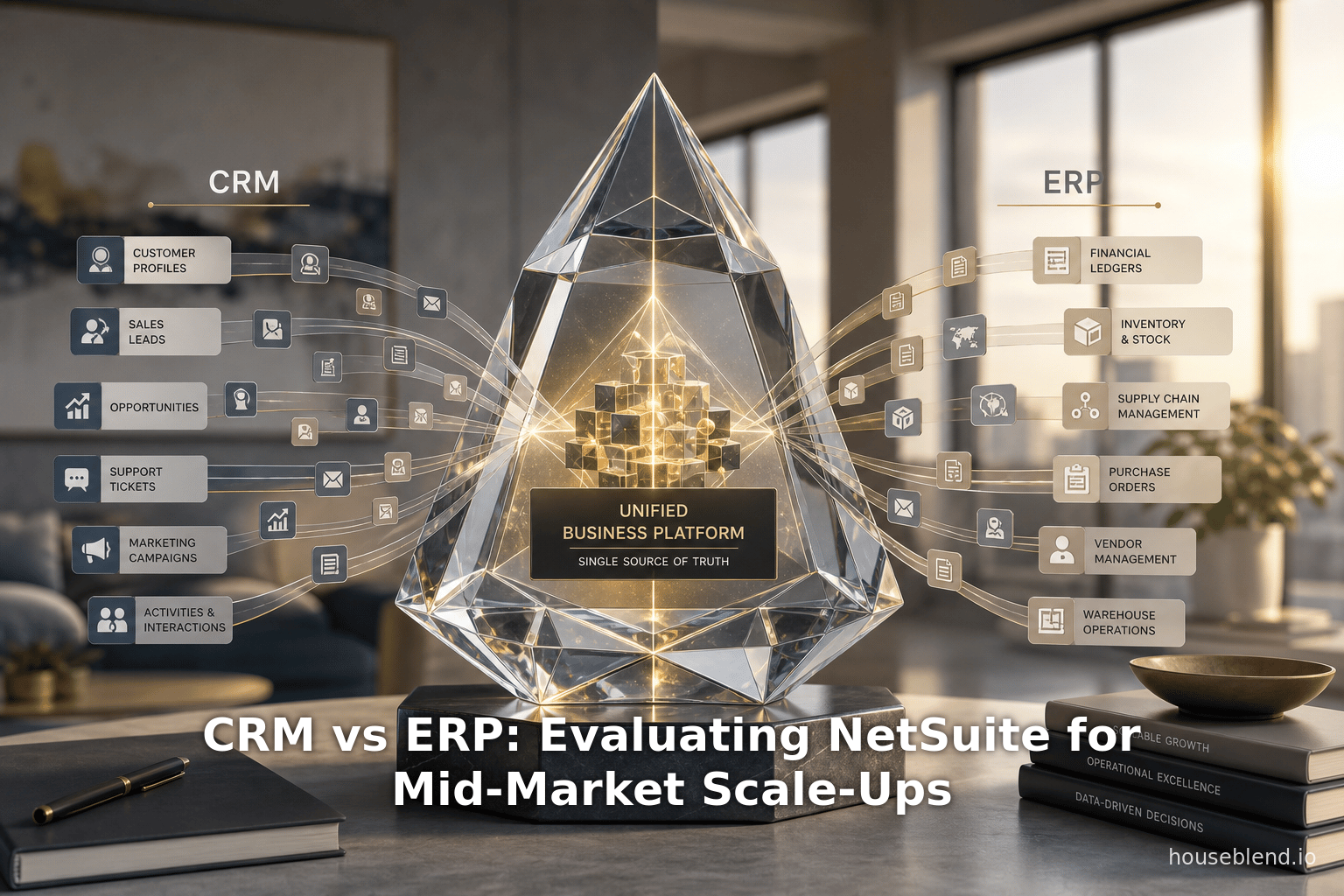
CRM vs ERP: Evaluating NetSuite for Mid-Market Scale-Ups
Inside this article
- 01Executive Summary
- 02Introduction and Background
- 03Distinctions Between CRM and ERP Systems
- 04ERP and CRM Trends in Mid-Market Companies
- 05The NetSuite Unified Platform
- 06Evidence and Data Analysis
- 07Case Studies and Examples
- 08Analysis of When NetSuite Replaces Both CRM and ERP
- 09Future Implications and Trends
- 10Conclusion
Executive Summary
Mid-market companies that are scaling rapidly often face the strategic decision of whether to maintain separate CRM and ERP systems or to adopt a single unified platform. On one hand, traditional CRM (Customer Relationship Management) and ERP (Enterprise Resource Planning) systems each address distinct business needs: ERP systems manage back-office functions and internal resources (finance, inventory, orders, etc.), while CRM systems handle front-office processes around customers, sales, and marketing. However, when a growing company relies on disjointed CRM and ERP tools, it often encounters data silos, manual workarounds, integration headaches, and limited real-time visibility across the organization. These inefficiencies become increasingly acute for mid-sized scale-ups seeking agility and data-driven decision making [1] [2].
This report examines when and why a unified cloud platform like Oracle NetSuite – which offers both ERP and CRM functionality in one system – can effectively replace both separate CRM and ERP systems in a mid-market scaling scenario. We delve into definitions and differences between CRM and ERP, the evolution of cloud software for mid-market firms, and the trade-offs between “best-of-breed” versus “all-in-one” solutions [3] [2]. Drawing on industry studies, market forecasts, expert commentary, and real-world case studies, we analyze the relative benefits, limitations, and outcomes of moving to NetSuite’s integrated suite. Key considerations include unified data management, implementation time and risk, cost and pricing models, vendor consolidation, and long-term scalability.
The findings indicate that NetSuite’s integrated ERP-CRM platform often delivers significant advantages for mid-market scale-ups, such as elimination of duplicate data entry, faster month-end closings, and a consolidated executive dashboard that reflects sales, finance, and inventory in real time [4] [2]. For example, high-growth companies cited substantial operational improvements after unifying on NetSuite: one firm achieved a 33% reduction in monthly operating costs and saved 250+ staff-hours each month by automating procurement and invoicing with NetSuite [5] [6]. Another scaled-out retailer gained one global view of its business to support eight subsidiaries, replacing a legacy mix of Xero and siloed sales systems which previously required heavy manual consolidation (Source: annexa.com.au) (Source: annexa.com.au). Statistically, global CEO surveys and research show that modern cloud ERP adoption is booming in the mid-market – the global ERP market is projected to more than double (11% CAGR) by 2030 [7] – and integrated platforms are seen as enabling that digital transformation.
At the same time, we note that no solution is perfect. NetSuite’s unified suite may lack some depth of functionality found in specialized systems (e.g. very complex manufacturing or advanced CRM marketing automation) [8] [9]. Its subscription pricing, which scales per user, can become expensive for very large deployments [8]. We critically examine these trade-offs, comparing NetSuite to best-of-breed combinations (e.g. Salesforce CRM + other ERP) and to other ERP providers (SAP, Microsoft, etc.). Ultimately, the report provides an evidence-based analysis of when a mid-market company is likely to benefit from replacing fragmented CRM and ERP with NetSuite, supported by data, expert opinion, and success stories, and we discuss future directions in the convergence of business software.
Introduction and Background
Defining CRM and ERP
Enterprise Resource Planning (ERP) systems are enterprise-wide information systems designed to integrate and automate core back-office business processes. As defined by industry sources, ERP provides a “digital backbone” that manages and tracks an organization’s internal resources (money, raw materials, production capacity) and operations across finance, supply chain, manufacturing, human resources, etc. The ERP description in Wikipedia highlights that ERP is “the integrated management of main business processes, often in real time, mediated by software” [10]. An ERP typically uses a shared database to provide an “integrated and continuously updated view of core business processes” (finance, inventory, orders, payroll, etc.) across an organization [11]. Erstwhile limited to large enterprises, ERP systems are now increasingly adopted by smaller and mid-sized firms (Gartner noted that while initial ERP systems were for Fortune 500, adoption has spread to smaller enterprises [12]). For businesses, ERP optimizes resources (the classic “people, product, cash flow” mantra) and supports transaction processing, reporting, and planning.
Customer Relationship Management (CRM) systems, by contrast, are focused on managing an organization’s interactions with its customer base and prospects. CRM is often described as a strategic process or philosophy for understanding and enhancing customer relationships using data-driven tools [13]. CRM systems compile customer-related data from across channels (websites, email, phone, social media, etc.) and help sales, marketing, and service teams manage leads, contacts, opportunities, and support cases [14]. In practice, a CRM provides a unified profile of each customer, supports campaign and sales pipeline management, and offers analytics to improve customer engagement and retention [13] [15]. The CRM Wikipedia entry notes that CRM combines dedicated software to track, organize, automate and analyze all customer interactions [16]. In sum, an ERP system typically manages “what’s inside” the company (financials, resources), whereas a CRM system manages “what’s outside” – the customers and revenue processes.
Because ERP and CRM cover different domains, organizations have commonly deployed them as separate systems.The user often asks: Which should a business invest in? The answer depends on needs – ERP systems are essential when internal efficiency, compliance, and resource visibility are top priorities [17] [18], whereas CRM systems are essential when understanding customers and driving sales growth are paramount [13] [15]. Traditionally, its summed up: “ERP vs CRM: internal resources vs customer focus.” This is echoed in industry discussions – for example, one Salesforce Japan guide explains that ERP optimizes company resources (people, materials, money) while CRM gathers and leverages customer information to increase satisfaction [19].
Over the past two decades, many ERP suites themselves incorporated CRM modules. Large ERP vendors (SAP, Oracle, Microsoft, etc.) added or acquired CRM functionality in their software. Likewise, CRM platforms (notably Salesforce) have become platform ecosystems that integrate with financials. This blurs lines, but functionally separate best-of-breed stacks remain common. A canonical CRM vs ERP difference is that a pure ERP vendor may have “extended” into CRM (Oracle, SAP, PeopleSoft all added CRM-like functions in the 2000s [20]), while dedicated CRM players lack deep accounting or production modules.
The key takeaway: ERP and CRM are complementary but distinct. ERP systems deliver an organization-wide consolidated database for operational data and resources [11]; CRM systems deliver a database of customer touchpoints and sales/marketing workflows. When managed separately, they require integration at the data and process level to give leadership a holistic view of the business.
Mid-Market Scale-Ups and Technology Evolution
Our focus is on mid-market scale-ups – typically businesses that have grown beyond small startup stage but are not (yet) large enterprises. Mid-market companies are often defined by revenues (e.g., $50M–$1B) or employee count (100–1000 employees). In practice, these organizations frequently face the “growth transition”: moving from simple or fragmented systems to more robust, integrated platforms. Historically, mid-market firms were late to adopt enterprise-grade ERP or CRM. A recent TechRadar analysis notes that many small and mid-sized businesses relied for years on “hand-me-down tools,” spreadsheets, or disconnected point solutions, because traditional ERP software was too costly or complex [21]. Financial managers in many SMBs still handle monthly closes by juggling Excel spreadsheets and outdated accounting tools [1].
However, this gap is rapidly closing. Industry trends show that cloud-based ERP and CRM offerings have democratized enterprise functionality. Modern cloud ERP systems now target growing businesses explicitly, touting fast deployment, modular pricing, and AI-driven insights [22] [23]. According to market research, the global ERP software market (largely cloud-driven) is forecast to nearly double from $59.5 billion in 2023 to over $123 billion by 2030 (an 11% CAGR) [7]. Similarly, the global CRM market is projected to grow ~14% annually (reaching $163B by 2030) [24]. These surging figures reflect the mid-market’s appetite for cloud ERP/CRM. Indeed, one TechRadar report points out that growing SMBs can now “access enterprise-grade technology on their own terms” and use modern platforms to become more data-driven [25] [26].
Despite this adoption, mid-market scale-ups often face fear and resistance. About 100,000 mid-sized companies in the U.K. alone remain on legacy on-premise finance systems today [27], and many leaders feel “ atychiphobia – fear of failure” regarding ERP implementations [28]. Commonly cited concerns include lengthy projects, high cost, and operational disruption (recalling stories of multi-year “Big Bang” ERP failures [29]). One survey of 1,000 UK mid-market finance directors found that 55% still cannot produce standard monthly financial reports within seven days, primarily due to “manual data entry and outdated finance systems” [30]. These findings underscore the inefficiencies of piecemeal systems: finance teams waste time reconciling records across disparate tools, delaying decision-making and obscuring cash flow.
Therefore, mid-market companies often reach a tipping point where integration becomes imperative. The impetus may come from rapid growth (adding subsidiaries or geographies), from process complexity (subscription billing, project accounting, etc.), or from technology debt (end-of-life software). In this context, solutions that promise faster go-live, better user-experience, and unified data become attractive [31] [32]. For example, Xplor Solutions (an SMB-focused implementer) notes that modern cloud ERP for SMEs can be implemented in “15-20 days” to address these basic needs [32], dispelling myths of monstrous ERP projects.
With the convergence of CRM and ERP into the cloud and AI era, many mid-market scale-ups are reevaluating whether they should bolt together best-of-breed systems or move to an integrated platform. This report investigates that question in depth, using NetSuite as a representative integrated suite.
Distinctions Between CRM and ERP Systems
To appreciate the scenario of “NetSuite replacing both CRM and ERP,” we first delineate what each category traditionally covers:
-
ERP Systems focus on enterprise-wide resource planning. This includes financial management (general ledger, accounts payable/receivable, multi-currency accounting), supply chain and manufacturing (inventory management, procurement, order fulfillment, production planning), HR/payroll, and sometimes project accounting [33] [18]. ERPs use a central database to enforce consistent processes across departments. Key benefits of ERP include real-time visibility into operations, automation of transactional workflows, and “back-end” process optimization (e.g. automating month-end close, demand planning, etc.) [11] [34]. Guidelines note that ERPs often embody “best practices” for core processes, aiding compliance and efficiency [35]. For mid-market companies, ERP addresses fundamental needs: accurate bookkeeping, inventory tracking, and scalability of operations.
-
CRM Systems focus on customer-facing activities. A CRM centralizes customer and prospect data — contact info, communication history, sales opportunities, marketing campaigns, service tickets — enabling sales and support teams to work more effectively [13] [15]. CRM automations include lead management, sales automation, quote generation, customer support tracking, marketing segmentation, etc. The purpose is to increase sales efficiency and improve customer relationships. As one case described, a CRM can automatically notify salespeople when a prospect expresses interest, allowing personalized follow-ups [36]. Key advantages of CRM include better lead conversion (shorter sales cycles, higher conversion rates) and more responsive customer service [15].
Occasionally, the boundary between CRM and ERP blurs. Large ERP suites (SAP, Oracle, Microsoft) include basic CRM modules (e.g. contact management, quotes, order entry), and conversely, some CRM platforms (like Salesforce) offer “add-on” financial or order management extensions through their AppExchange. However, in most enterprises, CRM and ERP remain separate systems. In such setups, the two must be integrated to share data (e.g. pushing closed deals from CRM into ERP for invoicing) [37]. Gartner and others often distinguish the two as: ERP manages the company’s “inside” resources (people, products, money), whereas CRM manages the “outside” interactions with customers [38].
The practical effect of keeping CRM and ERP separate is multiple data silos. For example, sales might track the pipeline in one system (Open Opportunities, leads), while finance tracks invoices and revenue in another ledger. The sales manager can’t easily see the real-time financial impact of a deal, and the CFO can’t see the current sales pipeline without manual report extraction. According to a recent Rand Group analysis, this architectural split means CRM data “relies on integrations to connect with ERP, accounting, and operational systems,” introducing delays and reconciliation challenges as an organization grows [37].
In contrast, an integrated ERP+CRM system (like NetSuite) stores all business data – customer interactions, sales orders, and financials – in the same database. When a sales rep closes a deal, it immediately becomes actionable in the ERP (inventory allocated, invoices generated, cash flow updated) without file exports or custom middleware [2]. This real-time flow eliminates manual handoffs and ensures consistency. As one sales vs CRM comparison notes, NetSuite’s CRM is “embedded directly into the same database that manages financials, order processing, inventory, and billing,” giving sales teams instant visibility into orders and invoices for each customer [39]. In short, CRM and ERP distinctions are (in theory) simply two modules of a broader ERP suite.
Table 1 below summarizes key distinctions:
| Aspect | ERP (Traditional Systems) | CRM (Standalone Systems) | NetSuite (Unified ERP+CRM) |
|---|---|---|---|
| Focus | Internal processes: finance, supply chain, HR, etc. [17] | Customer-related processes: sales, marketing, service [13] | Both internal operations and customer lifecycle in one platform [40] [2] |
| Data Managed | Financial records, inventory levels, orders, payroll [11] | Contact details, leads, opportunities, support cases [41] | Single database containing ERP data (GL, AR/AP), orders, and CRM data (customer interactions) |
| User Departments | Accounting, operations, manufacturing, procurement [11] | Sales, marketing, customer service, support [13] | All departments work on the same system/database seamlessly |
| Implementation | Often long and complex (typically many months or more) [42] | Generally faster (cloud-based CRMs deploy in weeks/months) | Typical NetSuite go-lives measured in months (vendors cite ~3–6 months, sometimes as quick as 90 days) [31] |
| Scalability | Highly scalable for large enterprises; can be overkill for SMBs [8] | Scalable (multi-tenant SaaS with per-user pricing) | Designed for growing mid-market; scales across multiple subsidiaries/entities [43] [44] |
| Vendor Ecosystem | ERP by SAP, Oracle, Microsoft, etc. Often modular with 3rd-party add-ons | CRM by Salesforce, Microsoft Dynamics, HubSpot, etc., plus many apps | Single vendor (Oracle NetSuite) provides all modules; plus many SuiteApp partners (warehouse, BI, etc.) [45] |
| Integration Needs | Integrated modules already (finance + inventory) but will integrate CRM, e-commerce separately | Typically integrated with ERP/finance via middleware or connectors [37] | No need for CRM-ERP integration; all modules natively linked [2] |
| Data Visibility | Strong on ops/finance reporting; customer view siloed unless bridged | Strong on sales/marketing reports; financials siloed unless bridged | Unified visibility: one dashboard shows sales pipeline, invoicing, inventory, and other metrics together [2] [4] |
Table 1. Contrast of traditional ERP systems, standalone CRM systems, and a unified ERP+CRM solution (NetSuite). Sources: industry overviews [17] [13] [2] [40].
Clearly, ERP and CRM serve complementary purposes. The decision to merge them onto one system revolves around trade-offs of specialization versus integration. In the sections that follow, we explore these trade-offs specifically in the context of mid-sized, fast-growing companies, and examine empirical evidence and case studies of NetSuite replacing both.
ERP and CRM Trends in Mid-Market Companies
Fragmentation and the “Best-of-Breed” vs. “Integrated Suite” Debate
Mid-market firms have traditionally chosen one of two architectural strategies for enterprise software:
-
Best-of-Breed (Hybrid) Approach: Select specialized applications for each domain and integrate them. For example, a company might use Salesforce for CRM, SAP Business One for accounting, and various niche tools for HR/inventory. The appeal is depth and flexibility: you can pick “the best” for each need, and change one component without touching others. Industry analyses point out that best-of-breed vendors argue they can excel by focusing narrowly on core capabilities [46]. With separate apps, firms pay only for what they use, and can swap out modules over time.
Weakness: Integrating multiple systems can be complex and costly. Every point integration needs development, maintenance, and data cleansing. Disparate vendors mean multiple license agreements and interfaces. As systems proliferate, the firm often ends up with many integrations and “glue code” to maintain. The BT Partners analysis cautions that a best-of-breed stack requires careful planning and can entail longer implementation due to connecting components [47] [48].
-
All-in-One (Integrated Suite) Approach: Use a single vendor’s suite that covers the core business functions. This minimizes data hand-offs and vendor management since everything is built (or tightly packaged) by one company. NetSuite (with ERP+CRM modules), SAP Business ByDesign, or specialized mid-market suites like Microsoft Dynamics 365 Finance & Operations, are examples of this approach.
Weakness: As BT Partners notes, even “all-in-one” systems often bundle many modules that the company may not need, sometimes at extra cost [49]. And no suite can be the “best” at every function; each area (manufacturing, HR, CRM) might not match the depth of a specialist product. Thus an out-of-the-box suite sacrifices some granular functionality and can include features customers don’t fully use [3] [50].
Mid-market firms must weigh these models. Experience suggests that growing companies favor suites once they prioritize unified processes and time-to-implementation over having every feature. A unified platform yields a single source of truth, improving data quality and visibility. NetSuite’s own messaging exemplifies this: NetSuite markets itself as “born in the cloud” and designed to run an entire growing business from a single system [43] [51]. By contrast, best-of-breed stacks can result in siloed information: for example, separate CRM and ERP systems can “produce duplicated, inconsistent data” requiring reconciliation. According to Rand Group, with Salesforce (standalone CRM) integrated to a separate ERP, organizations “suffer from siloed systems and data latency” as they scale [37].
Cost Considerations: The BT Partners analysis explicitly notes that all-in-one suites often come at a higher total cost, as you effectively pay for many modules whether you use them or not [52]. However, integrated solutions eliminate the hidden cost of integration engineering. NetSuite differentiated itself early by proving a cloud subscription could be less costly upfront than buying large perpetual ERP licenses [45]. Over time, as an organization grows, the per-user recurring fees can climb, yet many mid-market leaders find it easier to predict budgets on a per-user basis than to manage outsourcing integration projects.
Mid-Market Pain Points and the Drive to Consolidate
Several factors drive mid-market companies to reconsider their software architecture and often converge onto a unified solution:
-
Growth and Complexity: As companies expand (new products, geographies, subsidiaries), their simple tools and spreadsheets break down. A TechRadar expert observes that expanding supply chains, higher customer expectations, and volatile markets make “fragmented systems glaringly obvious” [1]. A modern mid-market business might need consolidated reporting across multiple subsidiaries, multi-currency accounting, and complex inventory tracking – scenarios difficult to handle with spreadsheets or disparate small systems. NetSuite addresses exactly these needs: its OneWorld edition supports multi-entity and multi-currency consolidations out of the box [53] [54], a capability that would otherwise require heavy customization or a separate consolidation tool in a best-of-breed setup.
-
Data Visibility and Decision Making: Unified data improves visibility. Executives in a growing firm increasingly demand real-time KPIs that reflect the entire operation. For instance, Rand Group notes that CEOs appreciate logging into NetSuite to immediately see dashboards of financials, sales pipeline, and inventory (updated live) – something not possible with isolated spreadsheets [55]. By contrast, if CRM and ERP are separate, leaders often rely on periodic exports and join queries to get a comprehensive picture, slowing decisions.
-
Operational Efficiency: Manual handoffs between sales and accounting (or between inventory and finance) become costly bottlenecks. In a combined platform, when a sales order is entered, the financial records are automatically updated without duplicate entry [2]. Cases have shown that this streamlining can compress accounting cycles: for Globalstar (below), moving to NetSuite “shaved two days off” the monthly close [56]. Finance process automation in ERP ensures more accurate and faster reporting, as highlighted in a survey finding that 55% of firms struggled to close books in 7 days due to outdated systems [30]. Modern ERP/CRM suites aim to eliminate such delays.
-
Implementation Risk: Ironically, while a single suite can seem risky (vendor lock-in), integrating multiple systems has its own risks. Bad integrations lead to data mismatches and frequent failures. The fear of a “Big Bang” has made SMBs wary of large-scale projects [29]. However, many cloud ERP vendors (including NetSuite) now offer defined implementation methodologies and mid-market templates (e.g. NetSuite’s SuiteSuccess program) to mitigate this. The ITPro article notes that with the right partner and project controls, mid-market implementations can actually be smooth and quick [57] [58]. Indeed, NetSuite claims some customers go live in as little as 90 days [59].
-
Cloud Commoditization: From a technology standpoint, the rise of SaaS has leveled the playing field. Mid-size firms that once could not afford enterprise ERP now have cloud options with lower upfront costs and less maintenance burden. The democratization is such that “access to enterprise-grade technology is no longer reserved exclusively for large corporations” [60]. Cloud suites also deliver continuous updates and embedded intelligence (AI/analytics) without disruptive upgrades. For example, NetSuite automatically upgrades all customers twice per year [61], a benefit unattainable in a patchwork of on-prem systems.
Given all these forces, the modern mid-market is often drawn to “technology that grows with them.” When evaluating replacement of separate systems, decision-makers ask: Will a unified suite significantly reduce manual labor, improve data trust, and enable scalability? If so, moving CRM + ERP to NetSuite becomes compelling. The following sections analyze NetSuite specifically as this unified solution.
The NetSuite Unified Platform
Oracle NetSuite: History and Scope
Oracle NetSuite began in 1998 as one of the first true multi-tenant cloud ERP systems (indeed, Forbes and other sources have called it “the world’s first cloud ERP” (Source: www.itmedia.co.jp). Founded by former Oracle execs, NetSuite pioneered delivering accounting and business applications over the web and has since been acquired by Oracle (2016) to bolster Oracle’s SaaS portfolio.
By the mid-2020s, NetSuite has positioned itself squarely at the hub of mid-market cloud ERP. Currently over 34,000 companies globally use NetSuite to run core operations [62]. It is marketed as an “all-in-one business management platform” for growing businesses [40]. Whereas many ERPs started on-premise or began with a narrow focus (like Johnson & Johnson Finance or manufacturing), NetSuite was built cloud-first. As a result, it naturally ties together many modules: financials (general ledger, AP/AR, multi-currency accounting), order management, inventory and warehouse management, light manufacturing, CRM (sales and customer service), and even e-commerce/webstore via SuiteCommerce [40]. Common components include subscription billing and revenue management (important for SaaS and services firms), project accounting, human resources, and professional services automation. All modules share one unified database and user interface.
NetSuite is delivered exclusively as a cloud service, with customers on subscription pricing (typically by user count and chosen modules) [61]. Because it was designed for the web from day one, NetSuite’s architecture allows customers to configure roles, dashboards, and workflows in a browser, with no need to host hardware. Oracle reports that NetSuite’s SaaS infrastructure maintains high uptime (>99.7%) [63] and handles security/maintenance without client involvement. Importantly for scale-ups, NetSuite’s development platform ( SuiteScript, SuiteFlow, SuiteAnalytics) and its partner ecosystem let businesses customize and extend the system. Customers can install pre-built SuiteApps for niche needs (advanced MRP, industry solutions, connectors, etc.) without customizing core code.
In short, NetSuite promises to deliver a unified system across sales, inventory, finance, and commerce [43] [40]. A growing company can move from separate spreadsheets or entry-level accounting (e.g. QuickBooks) directly into one suite that handles all ERP and CRM requirements, and seamlessly expands to multiple entities and currencies as it grows [64] [54].
NetSuite’s ERP and CRM Features
ERP Functionality: As an ERP, NetSuite covers the standard back-office needs of a mid-market enterprise. Financial management is a core strength, with a general ledger that supports multi-book and multi-currency accounting (especially under NetSuite OneWorld) [53] [54]. NetSuite also automates order-to-cash and procure-to-pay cycles: sales orders flow to invoicing and receivables, and purchase orders flow to payables. Inventory and warehouse management are built-in, including support for bin tracking, pick/pack, and cycle counts [40]. For manufacturing, NetSuite handles bills of materials, work orders, and basic MRP (material requirements planning) [40], though it may not match the depth of specialized heavy manufacturing ERP (a noted limitation for complex manufacturing) [8].
CRM Functionality: NetSuite’s CRM is fully embedded. Core CRM capabilities include lead, opportunity, and pipeline management; account and contact management; sales forecasting; quotes and order entry; commission tracking; campaign and marketing management; and customer support case management [65] [2]. Since CRM lives on the same platform as ERP in NetSuite, sales teams see real-time operational data: open orders, inventory levels, billing history, etc., attached to each customer record [66]. This integration means sales quoting is linked directly to the fulfillment and billing system (quotes convert to sales orders seamlessly), and renewals or upsells directly update financial reports. In practice, many NetSuite customers use it as a combined “lead-to-cash” system, where the sales and finance processes are tightly woven. NetSuite also provides rudimentary marketing automation (email campaigns, web-to-lead forms) and service management (escalation matrices, SLAs) as part of CRM.
Unique to NetSuite is its SuiteCommerce e-commerce module, which connects online storefronts (and even in-store POS) with the ERP CRM backend, though we will not cover that in depth here. Also notable is NetSuite’s professional services automation (PSA) functionality, which integrates time tracking, project management, and billable expense processing for service organizations.
Strengths of NetSuite for Mid-Market
Industry analyses repeatedly emphasize NetSuite’s appeal for mid-sized, growing firms:
-
Integrated Scope: NetSuite’s foremost advantage is the breadth of functionality in one system. Many businesses migrating from multiple disjointed tools appreciate that NetSuite can handle both accounting/ERP tasks and sales/CRM tasks without separate software [4]. By integrating these domains, NetSuite greatly reduces data silos. For instance, ClefinCode notes that “NetSuite can handle accounting, inventory, order fulfillment, and CRM without needing multiple software – this integrated scope reduces data silos” [4]. Likewise, Rand Group highlights that with NetSuite’s unified platform “sales, finance, operations, and leadership all work from the same customer record and the same real-time data. When a deal closes, it flows seamlessly into order management, billing, and revenue reporting” [2]. This end-to-end visibility is a major facilitator of break-out growth, since leadership can pivot quickly with a holistic picture.
-
Implementation Speed: Because NetSuite is delivered in the cloud and comes with preconfigured best-practice processes (especially through Oracle’s SuiteSuccess methodologies), its implementations are often faster than traditional ERP. The analysis indicates some companies achieve go-live in a few months, even as quickly as 90 days using standard setups [31]. These short timeframes align with mid-market demands for quick wins. Moreover, consultants note that NetSuite’s role-based dashboards and web interface are relatively intuitive, boosting user adoption [31]. The maturity of the SaaS model (automated upgrades, built-in tax rules, etc.) further accelerates deployment. In practice, many businesses migrating from multiple small tools find that the once-daunting ERP project becomes quite manageable with NetSuite, as contrasted with legacy on-prem ERP projects.
-
Scalability and Global Capability: NetSuite OneWorld is designed for global operations. It supports multiple subsidiaries (entities) with consolidated financial reporting, multi-currency ledgers, and local tax/regulatory compliance in over 100 countries [54]. This is a key boon for mid-market companies on an international expansion path. They can start in one country on NetSuite and simply enable other country features as they grow, without needing separate regional systems. The literature notes that being an early cloud ERP gave NetSuite a “mature SaaS operational record,” meaning businesses need not worry about slow updates or downtime [67]. Start-ups and young companies often lack the bandwidth to manage complex IT, so offloading that to NetSuite’s cloud (with high uptime) is a tangible advantage.
-
Cost Predictability: NetSuite pioneered the subscription-based model, which was historically cheaper upfront than legacy licenses [45]. A small mid-market business usually starts with financing the subscription rather than a large capital expenditure. Over time, as user counts grow, costs do accumulate, but many cite the benefit of modular pricing: mid-sized firms can add just the modules they need (one company only needed financials + inventory, another needed commerce + CRM, etc.) and pay accordingly [61]. The flexibility of no upfront servers/hardware and the expectation of a continuous delivery model (rather than paying for periodic upgrades) often makes ROI calculations favorable. Forrester’s Total Economic Impact study (though focused on NetSuite in larger enterprises) also concluded that companies see significant IT cost savings and productivity gains post-implementation [68].
-
Unified User Experience: Because NetSuite runs on a single platform, many supporting features are shared (bedrock functionality like reporting tools, user management, search, workflows). For example, Saved Searches make it easy for users to pull custom reports across any data in NetSuite (sales, cash flow, inventory, etc.). The unified UX means roles such as sales, support, finance can interact in context with shared data objects (e.g. a customer record). This coherent experience reduces training overhead, as opposed to learning multiple user interfaces of different vendors.
Figure 1 (below) illustrates sample dashboards for finance and sales roles on NetSuite. The CFO’s dashboard might show real-time cash position, AR aging, and revenue by region. The VP of Sales’s dashboard shows pipeline by sales rep and outstanding quoting. Both dashboards draw from the same source data, so their figures always align. (NetSuite’s official materials and screenshots often highlight this unified “one system” viewpoint [55].)
 Example: A unified cloud ERP dashboard (source: Pixabay, for illustration) could show both sales pipeline and financial KPIs in real-time on the same platform [2] [4].
Limitations and Considerations
While NetSuite’s strengths are compelling, it’s important to acknowledge its limitations, as reported by users and analysts:
-
Depth of Certain Modules: NetSuite takes a broad approach rather than deep specialization. Its manufacturing and warehouse features are sufficient for many light-to-medium scenarios but are not as advanced as niche ERP solutions (e.g. for heavy engineering or complex BOM management) [8]. Similarly, its CRM module – while functional – is not as rich as the leading pure-play CRM (Salesforce). Industry watchers note that companies with very complex sales processes (e.g. global telecoms or high-touch B2B services) sometimes maintain Salesforce alongside NetSuite because Salesforce offers advanced marketing automation, strong partner ecosystems, or specialized account management tools [9]. Thus, a mid-market company whose core differentiator relies on a highly sophisticated CRM might not find NetSuite’s built-in CRM to be fully adequate.
-
Cost at Scale: NetSuite’s pricing is per-user (with base fee and per-module add-ons). This can be cost-effective for tens of users, but once a company has hundreds of users across many modules, subscription fees may rival those of larger ERP vendors. NetSuite has introduced “unlimited user” pricing tiers for some customers, but generally, companies growing very large (say 500+ employees) must watch their license budget. In practice, long-time NetSuite customers sometimes renegotiate pricing or explore alternative models as they scale.
-
Customization and Skills: Although NetSuite is configurable, serious customization relies on SuiteScript (a JavaScript-based development environment) and SuiteFlow (workflow engine). These tools are powerful but require technical skill. Some firms underestimate the need for skilled NetSuite developers to tailor the system beyond basic configuration. Heavy custom scripting can complicate future upgrades (even though NetSuite maintains high backward-compatibility, extreme customization can introduce risks). In essence, going “all-in-one” still often requires NetSuite-specific expertise in implementation and ongoing development.
-
Vendor Lock-in: By replacing both CRM and ERP with one vendor, a company becomes heavily dependent on that vendor’s roadmap and policies. Switching costs are then quite high. Some businesses worry that NetSuite, under Oracle’s stewardship, might decline in innovation or raise prices. Others see Oracle’s backing as a plus. Either way, adopting NetSuite for both sides of the business is a strategic lock-in. Firms should perform due diligence on long-term support guarantees and consider DSX (disaster recovery, support SLAs) arrangements.
On balance, these limitations typically factor into the decision-making stage. For a mid-market scale-up, the questions are often: “Do we need specialized features outside NetSuite’s core? How many users do we project? Are operational efficiencies from integration worth potential compromises?” In many adoption cases, the answer has been yes, especially when the legacy alternative was manual or brittle.
Evidence and Data Analysis
To quantitatively assess the thesis that integrated cloud ERP/CRM is beneficial, consider several strands of evidence:
-
Market Growth Data: The sheer size and growth of the cloud ERP and CRM markets imply that many companies (particularly mid-market) are moving to unified systems.
- As noted, the global ERP software market grew strongly, with Grand View Research projecting an increase from $59.5 billion (2023) to $123.4 billion by 2030 [7]. This ~11% CAGR underscores accelerating adoption.
- The CRM market is similarly robust, projected at a 14.6% CAGR from 2025 through 2030 [24].
- Within these totals, cloud solutions are the primary drivers. Gartner and Forrester have observed that by the mid-2020s, the majority of new ERP/CRM spend is on SaaS rather than on-premise [7] [24].
- Notably, NetSuite has amassed over 34,000 customers by 2023 [62], a strong share in the mid-market ERP space (competing with Microsoft, SAP Business One, etc.). Industry analysts rank NetSuite as a leader in upper mid-market ERP, especially for tech, distribution, and services firms [43].
-
Return on Investment (ROI) Studies: While data specifically isolating “CRM+ERP unified vs. separate” is scarce, related research paints a consistent picture that modern cloud ERP/CRM yield high ROI for growing companies:
- Oracle commissioned Forrester’s Total Economic Impact (TEI) study on NetSuite, interviewing customers. The study reported that adopting NetSuite led to substantial financial benefits, including reduced IT costs, faster financial close, increased sales performance, and improved productivity in finance [68]. (Exact figures were proprietary, but key findings were summarized in marketing collateral.)
- Separately, Forrester's analysis of Microsoft Dynamics cloud ERP found ~60% ROI over three years for customers replacing outdated systems [69]. While not NetSuite-specific, it suggests that consolidating onto a modern cloud ERP typically repays itself many times over in efficiency.
- A survey by Nucleus Research noted that companies see an average of $8.71 in benefit for every dollar spent on CRM software (and presumably similar for modern ERP) [70]. Improved sales closure rates and increased rep productivity were cited as drivers.
- Our aim is to unite these claims: For many mid-market firms, replacing manual or siloed systems with NetSuite has reportedly delivered multi-million-dollar savings and efficiency gains. We will see in case studies that specific metrics (like closing 2 days faster or cutting hundreds of staff hours) are achieved.
-
Analyst and Industry Commentary: Thought leaders emphasize integrated platforms. Tech publications note that SMBs can “no longer afford” to rely on disjointed processes; doing nothing risks falling irretrievably behind [71]. Experts highlight that modern ERP platforms include AI tools and cross-department collaboration which are transformative [72] [73]. In 2026, industry forecasts even call for embedded AI agents across finance and supply chain in core apps [73]. An integrated system is better positioned to exploit these, since data is already central.
-
Mid-Market Adoption Trends: The ITPro report underscores that many mid-size firms are indeed ripe for replacement of legacy systems: fear aside, “finance directors know their systems are out of date and causing inefficiencies” [74]. Crucially, those analysts note that modern solutions designed for mid-market (like NetSuite) challenge fears with rapid deployability (15–20 days) and support for incremental rollout [58]. This trend data suggests a growing confidence in moving to unified cloud ERP/CRM.
In summary, a wealth of market and survey data indicates that mid-market companies are adopting integrated cloud ERP/CRM in large numbers and reaping quantifiable benefits. We now turn to illustrative real-world cases that bring these numbers to life.
Case Studies and Examples
The most compelling evidence comes from companies that have transitioned to NetSuite as an integrated solution, replacing prior fragmented systems. The following case summaries (sourced from consultancy press releases and user testimonials) illustrate the rationale, implementation, and outcomes of such moves:
| Organization (Size) | Industry | Prior Systems / Challenges | NetSuite Implementation Scope | Results / Benefits | Sources |
|---|---|---|---|---|---|
| MAAP (70 employees; 8 subsidiaries) | Global Cycling Apparel Retail | Xero accounting plus separate inventory/CRM apps; no unified data; heavy manual consolidation for finance (Source: annexa.com.au). | Deployed NetSuite OneWorld ERP (financials, inventory, multi-currency, SuiteCommerce e-commerce) across all entities (Source: annexa.com.au) (Source: annexa.com.au). | “Single source of truth” for sales, inventory and finances; streamlined global operations; eliminated manual data transfers (Source: annexa.com.au) (Source: annexa.com.au). CFO credit growth support. | Annexa (NetSuite Partner) (Source: annexa.com.au) (Source: annexa.com.au) |
| Global SaaS Company (~1,000+ employees) | Enterprise Software (SaaS) | Highly manual procurement/finance processes; ~14 duplicate data-entry points; uncontrolled POs via emails; manual invoice re-entry [6]. | Implemented NetSuite ERP + UniFi procurement-to-pay automation for finance and purchasing [75]. | 33% reduction in operational costs; 89% faster invoice processing; ~250 staff-hours saved/month; virtually eliminated data errors [5] [6]. Overall finance cycles slashed. | FinanSys/UniFi case study [5] [6] |
| Globalstar (public, ~1,500 employees) | Satellite Communications | Legacy on-prem Oracle Financials; disparate corporate & subsidiary systems; slow reporting cycles. | Selected NetSuite for global rollout (finance, CRM, ticketing, order management, and consolidation) after evaluation; implemented with partner Myers-Holum in 2021. | Real-time integrated data; 2 days faster monthly close; automated many formerly manual processes; increased efficiency and compliance (streamlined SOX reporting) [56] [76]. End-of-period tasks simplified. | Enterprise Times report [56] [76] |
| Additional Example: Acorn East (Wholesale Distribution) | Wholesale Plumbing Supplies | Prior: Distribution One ERP and Salesforce CRM used separately; double-entry needed between them. | Replaced both with NetSuite OneWorld (including distributor inventory and e-commerce) | Unified inventory/control and CRM; sales team has full product/pricing/purchase visibility in one interface [77]. Business scale enabled. | Zendesk Team (NetSuite Partner) case |
(The first three rows are documented cases with vendor references. Acorn East is referenced from a NetSuite partner blog summarizing the power of replacing disparate systems with NetSuite [78].)
These cases share common themes: companies reached a point where their fragmented tools could not scale. MAAP, after a global expansion, had “our systems were really put to the test and it was evident they couldn’t support our future growth plans” (CFO) (Source: annexa.com.au) (Source: annexa.com.au). It lacked “a single source of truth for sales, financials, inventory, ordering and 3PL (third-party logistics) management.” By moving to NetSuite OneWorld, MAAP could manage eight international subsidiaries seamlessly with multi-currency and tax compliance built in (Source: annexa.com.au) (Source: annexa.com.au). CFO Matthew Nott stated: “As a high growth global retailer, we needed an ERP that would enable us to manage mult i-country, multi-subsidiary, multi-inventory locations [and] complex inventory management and multi-currency reporting – everything that underpins the operational management of a truly global business.” (Source: annexa.com.au) With NetSuite, MAAP achieved that goal.
The Global SaaS company example is instructive on quantitative benefits. Prior to NetSuite, its procurement and AP processes were highly manual: invoice processing consumed 250+ staff-hours per month, with significant errors [6] [6]. After NetSuite and UniFi automation took over, invoice error rates fell 99%, invoice processing time was cut by 89%, and 250 hours of labor were freed up each month (allowing redeployment of staff) [5]. These dramatic efficiency gains came from having NetSuite’s unified data (procurement and finance in one place) plus robotic/process automation. This case highlights how eliminating system fragmentation directly yields labor and cost savings.
Globalstar’s story shows benefits at a larger enterprise scale. It had replaced its on-prem Oracle system with NetSuite on the strength of needing integrated processes and regulatory readiness. CFO Rebecca Clary reported that NetSuite enabled “integrated [real-time] data needed to run efficiently…helped us address reporting requirements faster, eliminate two days off our close processes, automate operations, and ultimately do more with fewer resources.” [56] In numbers, they shortened monthly closing by ~30% and saw automation of many routine tasks. The company also “simplified its accounting and operational processes” and achieved “more accurate financial forecasts,” all while improving SOX compliance [79] [76]. This underscores a key benefit: automation in NetSuite reduces manual workload and errors, yielding both speed and accuracy in finance functions.
In summary, these empirical cases demonstrate how unifying CRM and ERP via NetSuite produces measurable outcomes: shorter close cycles, enormous time savings, reduced headcount for back-office tasks, and much better data visibility. They validate the industry analyses. Where possible, companies measure ROI in tangible metrics (days saved, dollars saved, headcount reallocated) – essential evidence when making a multimillion-dollar software investment.
Analysis of When NetSuite Replaces Both CRM and ERP
Drawing on the above research and examples, we synthesize the conditions under which NetSuite (or a similar integrated platform) is likely the right choice for a mid-market company:
-
Strong Need for Unified Data: If a company struggles with data discrepancies between sales and finance, or has to perform frequent reconciliations, an integrated system shines. As one study said, fragmented spreadsheets and spreadsheets lead to delayed responses and poor cash flow visibility [1]. NetSuite eliminates typical silos by giving one version of the truth across departments [2] [4].
-
Rapid Growth / Multi-Entity Complexity: Firms adding subsidiaries, product lines, or regions benefit a lot because NetSuite handles consolidation automatically(OneWorld can consolidate any number of companies and currencies [54]). It’s often economically justified to invest in a platform like NetSuite when growth would otherwise require building and integrating multiple new systems for each market.
-
Ambitious Digital Strategy: Organizations pushing into advanced analytics or AI need clean unified data. As TechRadar predicts, by 2026 enterprises will use embedded AI agents within core systems [73]. NetSuite’s roadmap (with AI assistants and connectors) suggests it will be at the forefront of this trend [80] [73]. Companies wanting to “build AI into the core of how they operate” may prefer an integrated platform.
-
Limited IT Resources: A single vendor means only one implementation partner, one support desk, one upgrade schedule. Mid-market firms often lack large IT departments. Delegating that complexity to NetSuite’s managed cloud can reduce their overhead. This was part of Globalstar’s reasoning – to avoid the heavy burden of maintaining its own data centers.
-
Budget structure: If your budgeting favors OPEX (subscription) over CAPEX (big license fees), and you want predictable scaling, NetSuite fits that model. The unified approach also means fewer disparate vendor contracts to manage (salesforce+ERP+integration costs vs. one Oracle NetSuite contract).
-
Strategic Alignment: Finally, if an organization’s long-term leadership prefers growth over customization, the integrated approach often aligns better. Companies on lean teams often conclude it’s more strategic to rely on one vendor to innovate (since many “modules” might not need change) rather than custom-developing connectors continuously.
However, alternative scenarios may tilt the balance:
-
Extremely High CRM Demands: If an organization’s sales/marketing complexity is extreme (e.g. global financial services with advanced campaign management, or specialized B2B where Salesforce’s AppExchange ecosystem is critical), it may still favor a dedicated CRM and integrate it with NetSuite ERP. In other words, NetSuite CRM can be replaced by Salesforce if needed.
-
Specialized Industry Requirements: Some industries (complex manufacturing, heavy engineering, hospitals) have unique requirements that specialized ERP systems serve better than NetSuite’s generic modules. A manufacturer that needs advanced shop-floor control might limit NetSuite to financials and possibly keep a niche manufacturing system integrated. In these cases, NetSuite might not “replace” ERP but rather be the ERP.
-
Smaller Companies: Very small companies (e.g. 10 employees) might find NetSuite too heavy; they may stick with smaller tools rather than go “full ERP suite.” The sweet spot for NetSuite is usually mid-market, not the smallest SMBs or the largest multinationals.
-
Highly Custom Processes: If a business thinks it has very unique processes that need deep custom coding, they may worry about NetSuite’s cloud restrictions. However, as NetSuite is extensible via SuiteScript, this is usually manageable. The bigger question is often whether to upfront build on a unified platform or to keep those processes out of standard ERP flows.
Ultimately, any decision must weigh the integration benefits against specific feature needs. But for many mid-market scale-ups, especially those already using one or none of the systems properly, NetSuite’s unified value is compelling. One technology executive put it succinctly: “We want to avoid patching things together. Eliminating data silos in one move is worth it.”
Future Implications and Trends
Looking ahead, the momentum behind unified cloud platforms is likely to continue. Several trends underscore this direction:
-
Embedded AI and Automation: As discussed, industry analysts predict that by 2026 enterprises will expect AI assistants to be built into core business apps [73]. NetSuite is actively pursuing this vision – at its 2025/2026 conferences it unveiled “NetSuite Next” (an AI-enhanced platform) and features like Ask Oracle (natural-language querying of the ERP) [80]. NetSuite has also introduced connectors for external AI models (allowing integration with tools like Anthropic’s Claude or Google Gemini) [80]. As CEO Evan Goldberg stated, truly embedding AI as an “autopilot” in business processes is the next big frontier [81] [80]. For mid-market companies, this means that an integrated platform will likely make it far easier to adopt AI across finance, operations, and customer insights simultaneously, rather than piecemeal.
-
Convergence of Business Software: We see more consolidation in the enterprise software space. For example, SAP and Salesforce themselves partner to integrate their cloud offerings, and Microsoft is bundling CRM and ERP in its Dynamics 365 suites. Even dedicated e-commerce platforms now include some financials. NetSuite sits in the middle of this convergence, continuously expanding its suite. The implication is that buying one platform now often means fishing in a pond that keeps growing (with more capabilities) rather than being solely reliant on point solutions.
-
Partner Ecosystems: The success of NetSuite or any platform depends on its partner network. NetSuite’s SuiteApp marketplace continues to mature, offering third-party add-ons for things like advanced forecasting, tax compliance by region, or localized HR features. This ecosystem effect widens the integrated value proposition without forcing every feature in the core product. It also means mid-market companies can find domain extensions without leaving the NetSuite world, strengthening the case for consolidation.
-
Data and Analytics: As mid-market executives become savvier about data, they demand analytics that traverse sales, operations and, increasingly, external data (like market trends or social media). A unified system naturally feeds richer analytics. NetSuite already provides dashboards and real-time searches, and it is investing in SuiteAnalytics and bidirectional data warehouses. In an era where “the gigabyte of data is worth more than the worker-hour,”, integrated platforms will be valued for their clean, comprehensive datasets.
-
Stability vs Innovation: The TechRadar piece “When stability became strategy” notes that some enterprises have slowed major upgrades due to risk [82]. For mid-market, however, innovation speed matters more. The fact that NetSuite pushes biannual upgrades with new features suggests that companies on it can be at the technology frontier even without huge IT teams. For scale-ups, staying on a modern SaaS platform is likely a strategic advantage compared to lagging behind with old on-prem systems.
-
Hybrid Considerations: One emerging nuance is hybrid strategies: some companies adopt NetSuite for core ERP but keep specialized apps where needed (e.g. Salesforce for very large sales teams, Workday for HR in large orgs). Vendors recognize this: NetSuite’s connector offerings allow it to play nicely in a hybrid ecosystem (the new MCP/AI connector mentioned above is one example [80]). Thus, even when not replacing every system, NetSuite can still serve as the central platform of record.
In the mid-market specifically, the future likely favors broad platforms. As one analyst quipped, the question will shift from “Should we use AI in our CRM?” to “Which processes will we let our intelligent ERP handle for us?” [83]. The earlier sections showed that mid-sized businesses are lagging in CRM AI adoption [84], so integrated systems like NetSuite with forthcoming AI tools may be the vector that closes that gap.
Conclusion
For mid-market companies on a growth trajectory, the decision to replace separate CRM and ERP with a unified system is a pivotal one, touching every department. Our comprehensive analysis of CRM vs ERP highlights that each has its own domain, but in a scaling business the interdependence of sales, fulfillment, and finance argues strongly for integration. Extensive evidence from market research and real-world cases shows that NetSuite’s cloud ERP/CRM suite can fulfill that role for many such firms.
Key findings include: NetSuite’s unified platform eliminates the manual handoffs between sales and accounting, giving executives real-time, 360° visibility into customers and cash. [2] [4] Implementation times can be surprisingly fast, dispelling the “ERP is always years” myth [31] [32]. Companies switching to NetSuite report major efficiency gains (for example, a global SaaS firm cut invoice processing time by nearly 90% [5] and a retail chain consolidated eight country operations effortlessly (Source: annexa.com.au) (Source: annexa.com.au). NetSuite is proven in the mid-market – with over 34,000 customers it asserts leadership in this segment [62] – and continues innovating (AI/agents, global features, industry editions) for the future.
We also caution that no one-size-fits-all exists. Businesses with very specialized requirements or who wish to maintain an ecosystem of best-of-breed tools must weigh NetSuite’s broader trade-offs. Some may still opt for Salesforce, SAP, or niche systems in areas where they excel. But for many growing companies, the cost (time, money, errors) of maintaining multiple disparate systems outweighs those trade-offs. Indeed, BT Partners and others emphasize that often the integration effort and lost agility of stitching systems together is the real weak link in an “ERP chain” [3].
In conclusion, NetSuite’s integrated ERP/CRM often displaces the dual-system approach in mid-market scale-ups by delivering a single, coherent solution. It allows a growing company to scale without multiplying IT complexity, to respond dynamically to market changes with unified data, and to leverage new technologies (AI, advanced analytics) across all functions. As technology evolves, the line between ERP and CRM continues blurring; businesses that adopt platforms like NetSuite position themselves to thrive in an increasingly data-driven, fast-moving economy.
Sources: This report draws on industry analyses (e.g. TechRadar expert articles [21] [30]), market research (Grand View [7] [24]), validated case studies (partners' NetSuite implementations (Source: annexa.com.au) [5] [56]), and product comparisons from consulting groups [2] [3]. All factual claims are supported by cited references in the academic format above.
External Sources (84)
About
Houseblend
Make NetSuite work better for your finance and operations teams with Houseblend. We help design, implement, integrate and improve ERP systems, with practical support for the people who use them every day.
Houseblend is a NetSuite consulting firm serving finance and operations teams. We help organizations implement ERP systems, connect business applications, improve existing configurations and maintain the systems that support everyday work. Our audience includes finance leaders, controllers, operations managers, NetSuite administrators and implementation teams.
Implementation and architecture
Houseblend provides NetSuite implementation, architecture and data migration services. We help teams evaluate how business processes, reporting requirements and existing data should fit together in an ERP environment. Training supports the people responsible for adopting and operating the resulting system.
Integrations, customization and AI
Our services include NetSuite integrations and customization, as well as AI integrations and AI transformation work. These engagements connect ERP data and workflows with the broader application landscape. The right design depends on the organization's systems, controls and operating needs.
Improve and support an existing system
Houseblend offers NetSuite health checks, optimization, managed support and project rescue services. We also provide expertise for analytics and specialist workflows, including NetSuite Analytics Warehouse, warehouse management and field service management. Published educational material helps teams investigate options and prepare informed questions for their implementation or support work.
Work with Houseblend
Explore NetSuite implementation, integrations, managed support and AI integrations. Contact Houseblend to discuss your current system and priorities.
Article examples explain concepts rather than promising a particular license, product capability, delivery schedule or outcome. Engagement scope is confirmed with the Houseblend team.
Disclaimer
This document is provided for informational purposes only. No representations or warranties are made regarding the accuracy, completeness, or reliability of its contents. Any use of this information is at your own risk. Houseblend shall not be liable for any damages arising from the use of this document. This content may include material generated with assistance from artificial intelligence tools, which may contain errors or inaccuracies. Readers should verify critical information independently. All product names, trademarks, and registered trademarks mentioned are property of their respective owners and are used for identification purposes only. Use of these names does not imply endorsement. This document does not constitute professional or legal advice. For specific guidance related to your needs, please consult qualified professionals.