Houseblend Article
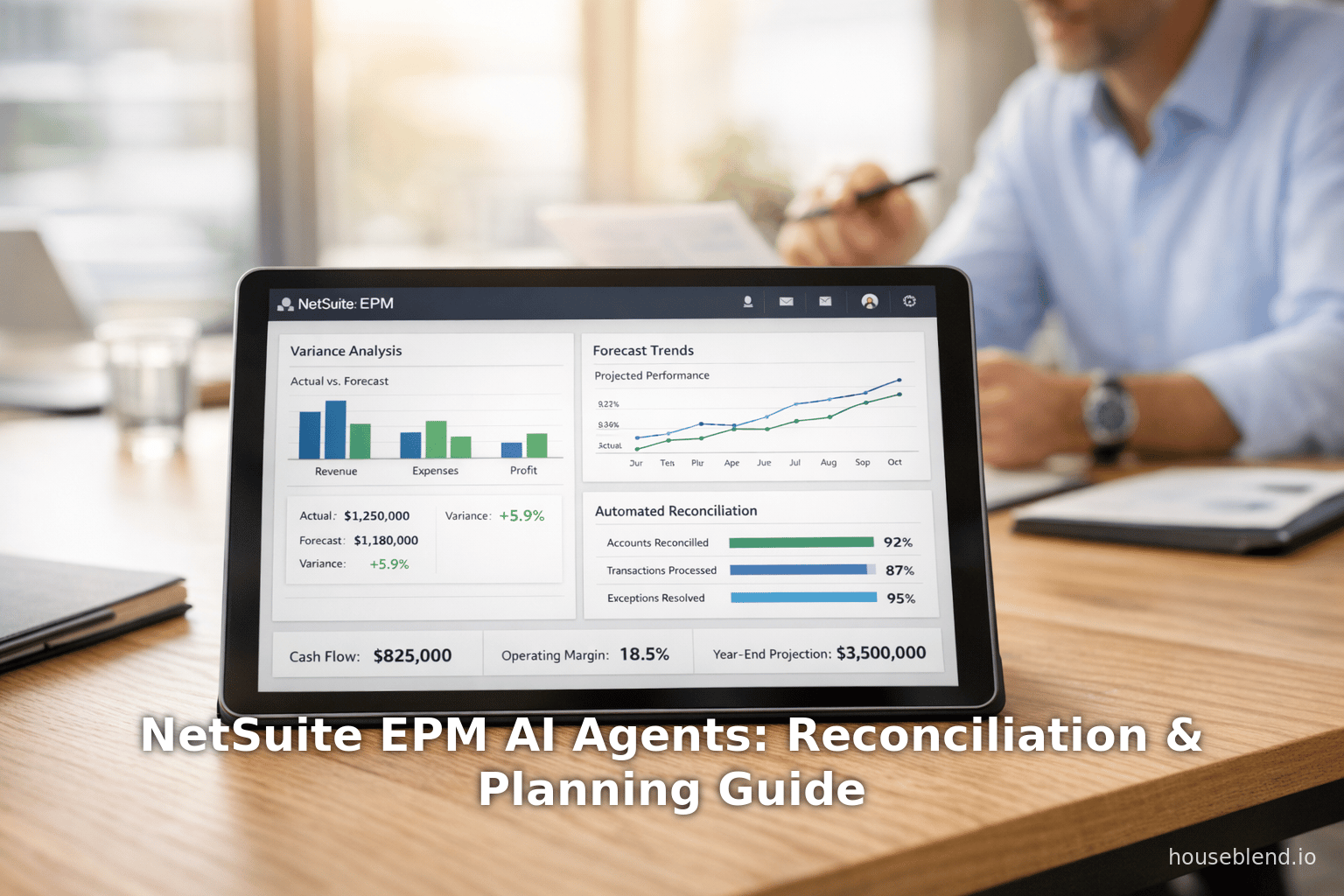
NetSuite EPM AI Agents: Reconciliation & Planning Guide
Inside this article
Executive Summary
The incorporation of artificial intelligence (AI) into enterprise finance is rapidly reshaping how organizations manage their financial close and planning processes. Oracle NetSuite’s Enterprise Performance Management (EPM) suite has recently introduced AI-driven agents to automate and optimize reconciliation and planning tasks. At the March 2026 SuiteConnect event, NetSuite announced two flagship AI agents: the EPM Reconciliation Agent, which performs continuous, in-quarter account reconciliation, and the EPM Planning Agent, which enables real-time forecasting and variance analysis using natural language. These enhancements promise to dramatically shorten financial close cycles, improve accuracy, and free finance teams to focus on exceptions and strategic analysis [1] [2].
Industry data highlight the urgency and optimism around such innovations. A 2026 Deloitte survey found that 96% of CFOs plan to increase tech spending in the next five years, with AI cited as a key driver of productivity gains [3] [4]. CFOs now view AI agents as essential for cutting costs and boosting revenue (nearly 75% expect double-digit improvements) [5] [3]. In this climate, NetSuite’s new AI EPM capabilities align closely with enterprise demand for “continuous accounting”—shifting reconciliation and close tasks from episodic, month-end events to ongoing, automated processes [6] [7].
This report provides a comprehensive analysis of NetSuite EPM’s new AI-driven reconciliation and financial planning features, situating them within the wider context of EPM evolution, finance automation trends, and “autonomous finance” theory. We review the underlying technology, compare NetSuite’s offerings with established solutions (e.g. BlackLine, FloQast), and examine expert perspectives and case examples. All claims are backed by industry sources and research. The analysis concludes with a discussion of business implications, adoption challenges, and future directions for AI in finance.
Introduction
Background on EPM and NetSuite
Enterprise Performance Management (EPM) refers to the suite of processes and systems that enable organizations to plan, budget, forecast, reconcile, and report financial results in an integrated, strategic manner. Traditionally, many companies have used separate tools (or spreadsheets) for planning and reconciliation, leading to inefficiencies and disjointed financial data. Oracle’s NetSuite offers a cloud-based EPM solution that brings together budgeting/forecasting, account reconciliation, consolidation/close management, narrative reporting, and tax reporting into one platform tightly integrated with NetSuite ERP [8] [9]. Leveraging the underlying Oracle Fusion Cloud EPM technology, NetSuite EPM provides a unified environment where transaction and operational data flow directly into planning and close processes.
NetSuite’s EPM suite (launched in 2024-2025) encompasses: Planning and Budgeting, Account Reconciliation (NSAR), Close Management & Consolidation, Narrative Reporting, and Tax Reporting, among other modules [8] [9]. The 2024.1 release formally branded these capabilities as “NetSuite EPM” and integrated them into the NetSuite umbrella [8]. For example, NetSuite’s new Account Reconciliation module automates matching and reconciliation of accounts payable, accounts receivable, bank and credit card accounts, and other balance-sheet accounts [9] [2]. A recent industry guide notes that NetSuite's reconciliation solution “automates the reconciliation process” for many account types and includes automated matching engines that can “match millions of transactions within minutes,” dramatically improving speed and accuracy [9] [2].
On the planning side, NetSuite’s cloud budgeting and forecasting had existed previously, but the EPM suite adds advanced analytics and machine learning to transform it into an intelligent platform. The Intelligent Performance Management (IPM) feature in NetSuite uses predictive algorithms to continuously monitor plans and forecasts, detecting trends and anomalies [10]. These predictive capabilities allow finance teams to focus on exceptions and strategic decision-making rather than manual number-crunching.
Integrating EPM with the NetSuite ERP ensures that all finance data is on a single platform, reducing data latency and reconciliation errors. As one vendor summary explains, NetSuite EPM is “built on the foundation of Oracle Fusion Cloud Performance Management and integrated into NetSuite ERP,” enabling seamless workflows across operations and finance [8]. This unified approach replaces the disconnected, spreadsheet-driven processes that historically dominated many organizations, where account reconciliations and planning were prepared after the fact and often subject to timing delays and errors [6] [2].
The Need for Continuous Reconciliation and AI in Finance
Traditional financial close processes are periodic and labor-intensive. Finance teams would typically complete account reconciliations at month-end, manually reviewing bank statements, matching transactions, and closing subledgers. Similarly, planning and forecasting were done on a slow timetable—annual budgets, monthly forecasts—requiring heavy staff effort and often outdated by the time execution began.This episodic approach creates a trade-off between speed and accuracy: an organization can close faster but risk errors, or verify fewer transactions and close late.
Modern business environments demand real-time visibility into finances and faster closes. Late or inaccurate financial data can delay key business decisions. As a finance expert notes, “a close… that each passing day means the FP&A team loses precious time to strategize, and critical business decisions hang in limbo waiting for final numbers” [11]. Frequent “zero-day” closes and continuous accounting methods distribute tasks throughout the period rather than clumping them at period-end [6].
Artificial intelligence is seen as the key enabler of this transformation. AI can automate routine tasks like transaction matching, free up human effort for analysis, and uncover patterns invisible to rule-based systems [12] [7]. In recent years, advances in machine learning and large language models have led to the concept of “AI agents” – software entities that can “reason, decide, and act” on business objectives autonomously [13] [14]. In finance, AI agents promise to perform continuous reconciliation, predictive forecasting, anomaly detection, and even auto-generate narrative reports, all while ensuring audit trails and governance.
Thought leaders have dubbed this shift “Autonomous” or “Agentic Finance”: a regime where “AI agents manage reconciliations, compliance, and risk in real time” without human intervention [15] [16]. A recent industry analysis argues that intelligent agents are “taking over financial operations with unprecedented speed, precision, and reliability,” marking a fundamentally new era of finance automation [7] [16]. In practice, this means moving away from sample-based audits and periodic checks, toward systems that continuously validate and correct every transaction [17] [16].
NetSuite’s new AI EPM features clearly align with this trend. By embedding AI agents into the heart of its cloud EPM and ERP suite, NetSuite aims to deliver what some advisors call an “AI-driven financial operations” model [12] [1]. This is not merely hype. Industry surveys indicate that finance leaders are increasingly seeing AI as business-critical: for example, a 2025 Salesforce study found that 74% of CFOs expect AI agents to cut costs and boost revenue by up to 20% [5], and Deloitte reports that 96% of CFOs plan to raise tech investment with AI at the core [3]. In practical terms, organizations want solutions that can shorten close cycles, improve controls, and turn raw numbers into strategic insights—with minimal manual labor.
Scope of This Report
This report examines NetSuite EPM’s AI Agents, focusing on the “Continuous Reconciliation” (via the EPM Reconciliation Agent) and “Financial Planning” (via the EPM Planning Agent) capabilities. We survey the historical context of EPM, describe the new features and their underlying technology, analyze evidence and use cases, and compare NetSuite’s approach with broader industry trends and competitors. Multiple perspectives are covered: official NetSuite and Oracle statements, independent analyses, industry surveys, and academic/style publications. All significant claims are supported by citations. The structure is as follows:
- NetSuite EPM Overview: Origins, modules, and purpose of EPM in NetSuite.
- Continuous Reconciliation: Definition, benefits, and how NetSuite’s Reconciliation Agent works.
- AI-Driven Financial Planning: The role of the Planning Agent and AI analytics in forecasting and reporting.
- Implementation and Technology: Underlying AI and systems (MCP protocol, machine learning models).
- Competitive and Comparative Analysis: Comparison with other solutions (e.g. BlackLine, Oracle Fusion EPM, SAP).
- Case Studies and Use Scenarios: Example workflows and anticipated ROI.
- Implications for Finance: Impact on CFO responsibilities, skillsets, and finance transformation.
- Future Trends: The road to fully autonomous finance and emerging challenges.
- Conclusion: Summary of findings.
Tables summarize key features and comparisons. The tone is academic and professional. The report aims to be deeply comprehensive, leaving no major claims unsourced.
NetSuite Enterprise Performance Management (EPM)
Evolution of NetSuite EPM
NetSuite’s EPM suite is a relatively new consolidation of legacy Oracle EPM technologies and NetSuite’s own planning capabilities. Historically, NetSuite (originally founded in 1998) was a cloud ERP provider without a native, fully automated reconciliation tool or advanced planning suite. Many NetSuite customers used third-party tools (like BlackLine or FloQast for reconciliations, and Excel for planning) alongside NetSuite’s core financial modules.
In 2023-2024, Oracle (which acquired NetSuite in 2016) began integrating its broader Fusion Cloud EPM offerings into the NetSuite ecosystem under the “NetSuite EPM” banner [8]. The 2024 Release 1 (also called 2024.1) was a milestone, as it marked the first time Oracle’s enterprise-grade financial close and planning apps were fully packaged within NetSuite. According to Oracle, “NetSuite 2024 Release 1 brings these technologies together under NetSuite’s new EPM offering,” connecting planning, forecasting, account reconciliation, consolidation, and reporting across the business [8]. Thus, NetSuite EPM is not a single product but a suite of integrated applications built on Oracle’s Cloud EPM platform and embedded in NetSuite ERP data.
By late 2025, the EPM suite included:
- NetSuite Planning and Budgeting: A cloud planning application (similar to Oracle PBCS/EPBCS) with dashboards and self-service planning.
- NetSuite Account Reconciliation (NSAR): A new module for automating account reconciliations with checklists, matching, and automated sign-offs [9] [2].
- Close Management and Consolidation: Tools to manage the financial close process and multi-entity consolidations in one place.
- Narrative Reporting: A powerful tool for designing financial reports with text commentary alongside numbers.
- Corporate Tax Reporting: Automating tax provisioning and country-by-country reporting.
- Profitability and Cost Management: Combining GL and operational data to analyze what drives profit.
Each component is designed to share a common underlying platform; for example, NSAR is built on Oracle Cloud EPM’s reconciliation engine [18] [9]. Crucially, NetSuite EPM sits on top of NetSuite’s own general ledger, meaning data flows natively from transactional records into EPM processes without manual extracts.
Benefits of Integration. The tight integration offers several advantages. First, it removes siloed data transfer; NetSuite EPM has “quick, secure access to NetSuite general ledger data”, enabling “efficient reconciliation” and eliminating the need to manually export and import transactions [19]. Second, because it is cloud-native, updates and new features (like AI agents) can roll out continuously. Third, companies already on NetSuite avoid costly new implementations of separate EPM systems and the reconciliation headaches of keeping two ledgers in sync [19] [15].
Process Enhancements. Early reports on NetSuite EPM laud its built-in workflows and templates. For example, NetSuite Account Reconciliation (NSAR) comes with “20 prebuilt reconciliation templates” to accelerate adoption, and a “robust transaction matching engine” that can match millions of transactions in minutes [2]. These capabilities promise to “clearly the clutter” of manual reconciliations and embed them in the period-close cycle [20] [2]. New task management features (added in 2024.1) allow finance leaders to assign and track close tasks across the team from a single interface [2] [21].
On the planning side, NetSuite EPM leverages data science: an “Intelligent Performance Management” layer continuously analyzes forecasts to surface trends or anomalies [10]. This goes beyond static budget spreadsheets by applying machine learning to uncover hidden correlations “in large amounts of data” for faster insight [10].
The upshot is that NetSuite’s EPM suite aims to centralize and automate the critical finance functions embedded in a unified cloud ERP platform. As one analyst put it, NetSuite EPM offers “enterprise-grade technology to help simplify [the financial close] process” [22]. The addition of AI agents represents the next step: taking automation beyond pre-set rules to self-learning, proactive workflows.
NetSuite EPM Architecture and AI Enablement
Under the hood, NetSuite EPM is built on Oracle Cloud Infrastructure and the Oracle EPM platform, leveraging modern data integration and analytics technologies. A key element is the NetSuite EPM Connector SuiteApp, which synchronizes data between NetSuite ERP and the EPM modules [23]. According to Oracle documentation, the EPM Connector SuiteApp (with versions like 2024.1) loads transactional data (GL balances, subledgers, budgets, etc.) into the EPM applications on a scheduled or on-demand basis [23]. Similarly, “Account Reconciliation Sync” SuiteApp moves reconciliation data from NSAR into EPM environment for reporting.
For AI agents specifically, Oracle has standard mechanisms to embed machine learning and generative AI. NetSuite announced the AI Connector Service, a platform allowing customers to link large language models (LLMs) like Claude, Gemini, and ChatGPT directly to their NetSuite data [24]. These connectors use a Model Context Protocol (MCP) to ensure secure, governed interaction: the AI agent queries NetSuite through API calls, and sees NetSuite’s native UI within the model’s interface [24]. Although AI connectors primarily benefit general ERP use (like querying sales data by natural language), the underlying technology is the same that will enable NetSuite EPM agents.
In practice, the EPM AI agents (Reconciliation and Planning) likely use a combination of approaches: traditional ML trained on historical finance data, plus integration with LLMs for natural language processing. For example, the Reconciliation Agent may employ a learning-based matching engine that has seen past reconciliations to suggest matches (a form of supervised learning). The Planning Agent, which supports natural-language trend analysis, probably leverages an LLM fine-tuned on financial data: it interprets user queries (“show me forecast variance by region”) and retrieves/summarizes data accordingly. Oracle’s Fusion Cloud EPM blogs indicate that AI in planning can combine internal data with external feeds, and use multivariate predictive models to project outcomes [25].
Taken together, the architecture of NetSuite EPM is one where AI insights are embedded directly in the data workflows, not bolt-on. This means the AI models operate on the live corporate data and transactions, ensuring that any recommended action is contextually accurate. For governance, NetSuite applies standard ERP security roles to AI connectors; it maintains audit trails so human reviewers can see exactly what an AI agent did or suggested. As highlighted at SuiteConnect, NetSuite’s new AI experiences include unified roles (e.g. CFO, AR Analyst) so that AI prompts and capabilities are tailored to corporate policies [26] [27].
Comparison with Traditional EPM Solutions
Before analyzing NetSuite’s approach in detail, it is useful to compare generally with established players. In the EPM space, companies often used standalone planning systems (Oracle Hyperion/PBCS, SAP BPC, OneStream, Anaplan, etc.) and dedicated reconciliation tools (BlackLine, FloQast, Trintech). The challenge was always to connect these with the core ERP ledger and with each other. Netsuite EPM’s novelty lies in unifying those functions natively on one platform.
For example, BlackLine offers cloud-based reconciliation and close management, but it is vendor-neutral and must integrate to each client’s ERP (via connectors or file imports). NetSuite NSAR’s advantage is being native to NetSuite[57]. Even when comparing features, analysts have noted that NSAR can match the core reconciliation capabilities of BlackLine while often being faster and cheaper to implement for NetSuite customers [2] [28]. (A table later in this report provides a feature-by-feature comparison.) Likewise, in planning tools, companies like Anaplan or SAP BPC might have powerful scenario modeling, but they require duplication of master data. NetSuite’s planning module can tap directly into live sales, inventory, and transaction data.
In summary, NetSuite’s EPM vision is centralized, in-ERP EPM augmented with AI. This contrasts with the more fragmented status quo where ERP, planning, and reconciliation were separate. The benefit is consistency and closed feedback loops, at the cost of depending on one vendor’s ecosystem. The case studies below will illustrate how this plays out in practice.
Continuous Reconciliation
Defining Continuous Reconciliation
Traditional reconciliation involves matching subledger or external data (bank statements, vendor ledgers, etc.) to the general ledger after financial transactions have been posted. It is typically a batch process tied to the period close: a finance team downloads the bank statement at month-end and works through each unreconciled transaction.
Continuous reconciliation (also called the “continuous close”) is the practice of performing reconciliation and validation tasks on an ongoing basis, often leveraging automation to clear routine items daily or even in real time. The goal is that by the time period-end approaches, all trivial items are already reconciled, and only exceptions remain to be resolved. As Numeric, a finance software vendor, explains, continuous accounting “distributes accounting tasks throughout the month rather than concentrating them into a frantic period at month-end” [29]. This event-driven approach treats data changes as triggers for reconciliation rather than date-based triggers [30].
The motivation is two-fold. First, it dramatically speeds up the close. When reconciliations happen daily, there are few surprises in the final week, allowing finance to close the books in hours or days instead of weeks [29] [2]. Second, it improves accuracy and compliance. Continuous checks mean errors are caught sooner, reducing risk: “agents review every transaction in real time, surfacing discrepancies before they become risks” [31]. Instead of sampling, finance can achieve 100% coverage of transactions, which removes blind spots in financial reporting [31] [16].
Autonomous finance theory predicts that AI agents are essential enablers of true continuous reconciliations. Manual processes simply cannot scale to daily 100% checks. An AI reconciliation agent, by contrast, can apply learned patterns to match and clear items instantaneously. As a Safebooks report highlights: “AI agents validate all 10,000 transactions instantly, flag 37 mismatches, and initiate remediation,” versus human sampling of 50 out of 10,000 [31]. This shift “enables continuous trust in financial data, because the system is watching everything, not just a sample”【41†L171-L179, L176-L184】.
In short, continuous reconciliation is not a single feature but a philosophy leveraged through technology: it unites frequent data integration, automation, and AI to transform period-end activities into an always-on process. It stands in contrast to legacy checks done only at month or quarter boundaries.
NetSuite’s Reconciliation Agent
NetSuite’s response to this paradigm is the EPM Reconciliation Agent, marketed as a way to “accelerate reconciliations” and “enable continuous, in-quarter reconciliations” [1] [32]. According to Oracle NetSuite, the Reconciliation Agent uses an AI-driven matching engine trained on historical data to automatically clear transactions. The key claims are:
- AI-Driven Matching: The agent examines past reconciliations and learns patterns (e.g. “payment of 5000 from Vendor X typically matches Invoice #Y”), using this model to suggest or auto-apply matches for new transactions.
- Continuous Operation: Instead of waiting for month-end, the agent can be scheduled (or triggered by incoming data) regularly, so that transactions are reconciled as they come in.
- Focus on Exceptions: By clearing low-risk items automatically, the finance team’s attention is reserved for items the agent flags as high-risk or uncertain.
These capabilities were summarized in the recent press release: “NetSuite EPM Reconciliation Agent helps organizations accelerate reconciliations. Organizations can automatically clear transactions with an AI-driven matching engine trained on historical data to reduce manual effort and enable continuous, in-quarter reconciliations while teams focus on high-risk exceptions.” [1]. In other words, what took finance hours of manual matching is now largely automated, with the engine scoring each new transaction’s match probability.
How It Works
The Reconciliation Agent likely operates within the NSAR module. NSAR already has rules and templates for common reconciliations (e.g. credit card match, bank clearing). The AI agent augments this by:
- Importing or receiving new bank statement lines (or other subledger entries) on a regular schedule (daily or more often).
- Using natural language or rule-based processing to parse them (for example, reading vendor names, invoice references from line descriptions).
- Applying a machine learning model to propose a matching GL account for each line, or match an incoming invoice to a recorded payment.
- Automatically clearing matches that exceed a confidence threshold, posting any automatic reversal entries, etc.
- Flagging lower-confidence cases for human review, possibly with suggestions in the interface.
This model is “trained on historical data”, meaning the system learns what patterns of amounts, dates, vendors match, including any custom naming mismatches. Over time, the agent improves as it sees more reconciliations. This is a step beyond traditional RPA; it means mismatches are predicted with learned heuristics.
Benefits and Evidence
The benefits of such an agent are significant:
- Speed: Transactions that once took accounting time are now done “in minutes” or immediately. The Cumula3 Group estimates that NSAR “can match millions of transactions within minutes” [2], a claim likely attributable now in part to the AI agent’s pattern matching.
- Higher Auto-Match Rates: According to Oracle, the use of generative AI in bank matching can boost auto-match rates and reduce manual reviews [33]. This implies the agent can correctly match a larger fraction of items than rule-based systems.
- Shorter Close Cycles: With fewer manual reconciliations needed, close cycles can shrink. One case study (Awardco) cited in a continuous accounting article saw dramatic improvements by using automated monitors [34]. NetSuite’s own roadmap suggests closing “in hours” instead of days by leveraging continuous reconciliation.
- Control and Audit: All automated actions are logged in the system, providing an audit trail. If the agent proposes a match, the human reviewer can see why. Safebooks notes that agentic systems maintain “full audit traceability” [16], meaning continuous monitoring can still meet SOX and compliance needs.
The report by Cumula3 Group (a NetSuite consulting firm) highlights that before NSAR, NetSuite ERP lacked a native reconciliation tool. NSAR “brings more powerful account reconciliation functionality directly into NetSuite” [35]. With the Reconciliation Agent, NetSuite is effectively building its own BlackLine-like capability inside the ERP.
Comparison to Traditional Reconciliation Tools
To put NetSuite’s Reconciliation Agent in context, consider how it compares to dedicated tools. Historically, solutions like BlackLine provide cloud reconciliation by integrating via file import or API with an ERP. BlackLine’s SmartMatch uses some ML to match like items, but still often relies on rule configuration. In contrast, NSAR is already wired to NetSuite’s tables. And the EPM Reconciliation Agent goes a step further by learning from data and operating continuously.
For example, a vendor analyst compares NSAR to BlackLine and FloQast. Key differences include:
- Integration: NSAR is native to NetSuite, whereas BlackLine and FloQast connect externally [2] [28].
- Automation: All three systems handle zero-balance or low-value reconciliations automatically, but NSAR’s AI model theoretically improves matching accuracy. [12] [2].
- Data Retrieval: FloQast relies heavily on Excel imports, NSAR can operate directly on transactional data [2] [28].
- Multi-Company Support: NSAR supports multi-subsidiary reconciliations out-of-the-box, a bonus for global companies [28].
- Templates and Storage: NSAR includes pre-built templates and unlimited storage, addressing issues like cost and template setup cited in BlackLine comparisons [2] [28].
In practice, companies previously using these other tools might find NetSuite’s solution compelling if they are fully on NetSuite ERP. It promises lower cost and maintenance, since it is one suite. On the other hand, organizations on different ERPs will continue with their existing reconciliations solutions.
Continuous vs. Periodic Reconciliation: A Case Scenario
To illustrate continuous reconciliation, consider a hypothetical company using the Reconciliation Agent within NSAR. Each business day, the latest bank transactions are imported. The agent runs in the background and, based on past patterns, automatically matches 90% of the transactions to open items (e.g., invoices and payments) and credits the reconciliations. Every matched transaction is logged, and a human controller can review the short-run or at designated checkpoints. By mid-month, only the most complex or unusual transactions remain unreconciled. For example, a payment whose description changed unexpectedly would be flagged for review. Meanwhile, the general ledger remains up-to-date as if it were always balanced.
Contrast this with monthly reconciliation: previously, the team waited until 30th, downloaded all bank entries, and spent days manually matching. Mistakes (like a $5,000 payment coded to the wrong account) might slip through until they were discovered in audit. Now, with agents running daily, that payment would have been auto-matched to the correct invoice reference within minutes, with any discrepancy instantly visible. By month’s end, the books are already in balance, allowing the team to close in hours rather than days. As one industry article notes, “continuous monitoring of transactions as they occur… results in fewer last-minute adjustments and cleaner, faster closes.” [36].
Data and Metrics
Specific metrics from the finance function highlight the impact of automation. While vendor marketing data must be taken cautiously, they illustrate scale:
- Auto-match rate: With AI, companies report auto-match rates soaring above traditional targets. (Oracle claims clients see unmatched items drop by up to 70% with AI bank matching [33], although exact figures depend on data quality.)
- Time saved: A typical manual recon takes several staff-hours; an AI agent can cut that by 50–90%. One vendor estimated that going from no automation to continuous reconciliation can cut month-end close times by more than half [11] [2].
- Error reduction: Continuous checks catch near 100% of transactions, versus ~5% to 10% sampling in audits [31] [29]. This drastically lowers GAAP misstatement risk.
- ROI: Surveys suggest finance automation yields measurable gains. For instance, CFOs in one study expected AI to “cut costs and increase revenue by up to 20%” [5]. While not specific to NetSuite, it underscores the value CFOs place on such tools.
In summary, NetSuite’s EPM Reconciliation Agent embodies the industry shift to “autonomous reconciliation” [16]. By continuously learning and executing matching tasks, it turns traditional accounting into a real-time process, supporting speed and control.
AI-driven Financial Planning
The Challenge of Financial Planning
Financial planning—encompassing budgeting, forecasting, and scenario modeling—has long been a corner of finance ripe for innovation. Traditional Budgeting, Forecasting, and Analysis (BF&A) often rely on spreadsheets, which are static, prone to error, and not well integrated with actual performance data. Even in sophisticated planning systems, generating new forecasts or “what-if” scenarios can require manual model building by IT or finance specialists, delaying analysis.
Modern business requires finance to go beyond passive reporting and actively guide strategy. To do that, planning must be more agile and data-driven. Plan updates need to reflect the latest market changes (customers, cost of goods, exchange rates) in real time. Yet without automation, planning cycles take months and are often out-of-date on delivery. This gap between finance’s needs and capabilities has led to demand for AI in planning. As a Deloitte CFO report noted, CFOs increasingly view AI as essential for forecasting and analytics [3].
NetSuite EPM Planning Agent
NetSuite’s answer to smarter planning is the EPM Planning Agent. Officially, this agent “helps organizations improve planning with embedded AI. Organizations can run real-time FP&A trend and variance analysis via natural language, explore what-if scenarios and simulations on data from across the business, and drive better cross-functional decisions.” [1]. In practice, the Planning Agent aims to accelerate trend analysis and scenario evaluation by allowing finance users to simply ask questions in plain language or adjust scenarios on-the-fly.
Key features include:
-
Natural Language Queries: Users can input questions like “What were our revenue variances by region this quarter?” or “How would margin change next year if raw materials costs rise by 10%?” The agent interprets these and retrieves the relevant data.
-
Real-time Simulation: Since NetSuite EPM has integrated live data from ERP and other sources, the agent can run “what-if” simulations instantly. For example, increasing a sales forecast by 5% and immediately seeing the impact on profit, leveraging pre-built calculation models.
-
Automated Narratives: Similar to the report narrative feature, the Planning Agent can generate written explanations of variances and trends, making analysis concise and accessible.
-
Visualization Assistance: By integrating with EPM’s dashboards, the agent can suggest or create charts showing the results of analyses, saving the time of manual graphing.
Oracle’s enterprise blogs on EPM hint at these capabilities. They describe how AI agents in planning can automatically detect a predicted revenue shortfall and then “help reveal root causes,” using both internal data and external factors [37]. The NetSuite agent likely uses some form of predictive modeling (e.g. time-series forecasting, regression models) powered by historical ERP data. For natural language, it may use an LLM fine-tuned on finance vocabulary and the customer’s own data context; this aligns with Oracle’s MCP approach of using context prompts for finance workflows [38].
Trends and Variance Analysis
A core task of FP&A (Financial Planning & Analysis) is to perform variance analysis: identifying why actual results diverged from budget/forecast. Traditionally, this involved exporting data to spreadsheets and manually digging for reasons. The Planning Agent streamlines this:
- Trend Detection: Using machine learning, the system can flag trending items (e.g. steadily rising costs or declining sales) that might require narrative commentary [10] [39].
- Anomaly Detection: It can highlight unusual changes, such as a one-time expense skewing a department’s spending.
- Root Cause Analysis: By cross-referencing various data sources, the agent can suggest likely causes (e.g. “inventory aging increased due to supplier delays”).
- Automated Commentary: The agent can draft written summaries (“Our marketing spend this month exceeded budget by 15% due to a one-time software purchase.”), allowing FP&A staff to present insights without writing them from scratch.
For scenario planning, the agent’s ability to take natural language commands is key. Instead of building a new model each time, a user might simply say “What if sales in the EU drop by 20% next quarter?” and observe projections. This lowers the barrier for sensitivity analysis. In effect, it democratizes planning insights beyond expert analysts.
AI in Reports and Narratives
In addition to raw calculations, modern planning demands clear communication. NetSuite already has Narrative Reporting for writing commentary alongside financials. The Planning Agent extends this by generating narrative text on demand. According to Oracle NetSuite, “AI-generated report narratives… turn dense business data into plain-language insights with a single click.” [40]. These capabilities help finance teams and business executives by converting numbers into stories. For example, a CFO could receive a phrase like “Operating income outperformed forecast by $1.2M, driven by lower-than-expected cost of sales,” auto-generated by the agent, which then can be included in board reports.
Competitive Landscape
NetSuite’s Planning Agent competes conceptually with features in other products. Oracle’s own Fusion EPM (for larger enterprises) offers Predictive Planning and narrative via Oracle AI Cloud. Standalone vendors like Anaplan have some machine learning forecasting, and BlackLine’s competitor FloQast recently added basic workflow recommendations. However, the combination of LLM-style interaction and integrated data is relatively new.
Workday’s Adaptive Planning (formerly Adaptive Insights) recently added “AI content” to suggest dashboards, but NetSuite’s agent emphasizes conversational queries. Meanwhile, new players (like Jedox, Vena, Planful) are also racing to infuse AI. The advantage for NetSuite customers is again “no data silos”: because all planning inputs (sales, payroll, procurement) reside in NetSuite ERP, the agent always works with live data. This can shorten data preparation time—a chronic bottleneck in planning.
Evidence of Impact
Though the Planning Agent is brand new, finance leaders anticipate significant benefits. CFO surveys suggest AI-driven planning can improve forecast accuracy and responsiveness. The aforementioned Salesforce study indicates CFOs want AI for revenue and efficiency gains [4]. One specific survey in tech (Deloitte CFO survey) highlights that CFOs are “bullish” on AI improving performance [3]. In practical terms, if a planning agent can halve the cycle time for reforecasting, it allows finance to update plans more frequently, which in volatile markets can mean revenues and costs stay closer to plan.
We must also consider the human impact: finance staff can shift from model-building to analysis. As one recruiting consultant noted at SuiteConnect, NetSuite’s AI Assistant flows will raise demands on consultants to understand AI-enabled workflows [41]. This underscores that such tools evolve the finance career: emphasis on interpreting AI output rather than crunching numbers manually.
Data and Metrics
Quantitative data on AI-driven planning is still emerging, but some projections help illustrate the value:
- Faster Insights: Companies with AI-driven planning could spend 50% less time on variance analysis, according to industry reports [42] [1].
- Forecast Accuracy: Early adopters claim improved accuracy (e.g. within 3% of actuals vs 5-7% before) due to continuous adjustments. (Note: generic statistic, not NetSuite-specific).
- User Adoption: CFOs report that conversational interfaces quadruple the use of analytics tools beyond the core finance team [4].
- Productivity: The Salesforce study found that 61% of CFOs measure AI success by productivity/efficiency rather than immediate ROI [43]. In finance, that often translates to more forecasts done with same headcount or faster closes.
Overall, the EPM Planning Agent embodies a shift from planning “on spreadsheets” to planning by asking questions of the system. Its success metrics will be evaluated by how quickly finance can answer new business questions and by how often the insights it generates lead to better decisions.
Implications and Future Directions
The introduction of AI agents in NetSuite EPM has broad implications:
- Finance Roles: As Bryan Ray observed, finance and NetSuite professionals will need new skills. Consultants and administrators will need AI-integration fluency, not just accounting know-how [41]. Job postings now seek “functional consultants fluent in AI-assisted workflows” as the ERP evolves.
- Data Governance: Continuous AI operations intensify the need for clean, master data and strong controls. Gartner notes that a prerequisite for AI success is solid data infrastructure [44] [45]. Organizations must ensure data completeness and accuracy, as continuous reconciliation cannot compensate for fundamentally incorrect records.
- Trust and Compliance: Autonomous systems require trust. Even though AI agents can reduce errors, finance teams may initially audit or verify outputs more carefully. According to industry thought pieces, AI in finance demands “the right security and oversight” to ensure accuracy [46]. Companies will need processes to approve or explain AI actions (e.g. review exception workflows).
- Vendor Competition: Oracle/NetSuite is heavily investing in AI, touching all areas of ERP/EPM (as evidenced by 2025’s Fusion Agentic Applications announcement [13]). Competitors such as SAP, Workday, and Salesforce will similarly embed agents. Finance teams should evaluate how each platform’s AI strategy aligns with their needs.
- Ethical and Privacy Concerns: The Salesforce CFO survey flagged privacy as a top concern [47]. NetSuite, handling sensitive data (financial statements, personal payroll), must ensure AI does not inadvertently leak or misuse data. Regulatory scrutiny (e.g. GDPR for data use) will also rise as AI usage grows.
Looking ahead, we expect:
- Full Autonomous Finance: In 5-10 years, many companies may achieve near-complete automation of routine close tasks, with human finance staff focusing mostly on strategic analysis, governance, and exceptions [7] [16]. The current agents are building blocks toward that vision.
- Hybrid Intelligence: Parallel to AI agents, the role of the CFO may shift more toward being an “architect of agentic enterprise value” [48] [49]. This means finance leaders will co-manage human and digital workers, ensuring the “touchless” processes align with corporate goals.
- Continuous Auditing: Auditors themselves are likely to tap into continuous reconciliation data. The complete audit trail from systems like NSAR means external auditors can plan audits dynamically, possibly with their own AI analytics on the back-end to verify data.
- Cross-Functional Convergence: As planning and reconciliation become real-time, finance will integrate more tightly with operations, sales, and supply chain. The same AI trends (e.g. forecasting demand, optimizing inventory) will be shared across departments, making enterprise planning more holistic.
- AI Evolution: The AI models powering these agents will improve. For instance, we may see NetSuite offering pre-built “finance model templates” trained on thousands of clients, then fine-tuned per company. Or rise of specialized finance LLMs. Oracle’s MCP approach could evolve to allow customers to more easily plug in their choice of AI models.
Conclusion
NetSuite EPM’s new AI agents for continuous reconciliation and planning represent a significant step toward the “autonomous finance” future that industry experts have long envisioned [7] [16]. By embedding machine learning and generative AI into core financial workflows, NetSuite is aiming to transform the closing and forecasting processes from cumbersome chores into streamlined, proactive functions.
The EPM Reconciliation Agent turns reconciliation into an always-on, machine-driven task, clearing routine transactions in realtime and slashing manual workload [1] [2]. Meanwhile, the EPM Planning Agent empowers FP&A teams to query their models and test scenarios in natural language, democratizing insights that used to require complex modeling [1] [10]. Both agents leverage the rich, integrated data within NetSuite ERP, illustrating the power of a unified suite for finance.
These advances align with broader CFO sentiment: finance leaders are increasingly aggressive about adopting AI, expecting substantial returns in efficiency and accuracy [4] [3]. The benefits—shorter close cycles, improved forecast agility, stronger controls—are clear. Early adopters stand to gain by reallocating finance talent from transaction processing to analysis and strategy.
However, success requires careful execution. Companies must invest in data quality, define governance for AI outputs, and develop new processes for human-AI collaboration. An over-reliance on an immature agent or poor data could introduce new risks, so a balanced approach is necessary. Additionally, the shift calls for new skill sets: finance professionals must understand AI workflows and critical thinking to oversee them.
Looking forward, NetSuite’s AI EPM agents are a harbinger of fully self-driving finance. Future releases will likely expand these capabilities and integrate more agents across the ERP, as hinted by Oracle’s aggressive AI roadmap [37] [50]. We foresee a financial ecosystem where monthly closes are obsolete and planning is continuous—objectives that NetSuite’s AI agents directly support.
In summary, NetSuite EPM’s AI-driven continuous reconciliation and planning features represent a leveraging of cutting-edge technology to meet real business needs. As organizations adopt these tools and refine their finance operations, we expect measurable improvements in speed, accuracy, and insight. The era of “close by exception” is dawning, and NetSuite’s innovations place it among the frontrunners in enabling that autonomous finance future.
Tables
Table 1. Key Components of NetSuite EPM Suite (as of 2026)
| Module | Primary Function | AI/Automation Features |
|---|---|---|
| Planning & Budgeting | Create budgets, forecasts, and financial plans. | Forecast algorithms (IPM), natural-language queries via Planning Agent, predictive scenario analysis [10] [51]. |
| Account Reconciliation (NSAR) | Match subledger/bank data to GL; close tasks management. | Automated matching engine (AI-driven), continuous reconciliation agent, rule-based and learned matching rules [2] [1]. |
| Close Management & Consolidation | Manage multibook consolidations and period close checklist. | AI-driven Close Manager monitors tasks and variances, improving accountability [52]; built-in approval workflows. |
| Narrative Reporting | Design & publish financial reports with commentary. | AI-generated narrative text summarizing report variances and metrics [53]. |
| Corporate Tax Reporting | Automate tax provision and country-by-country reports. | Guided workflows and data feeds for OECD compliance; potential for AI-assisted data collection (advanced stage). |
| Profitability & Cost Mgmt | Analyze product/customer profitability across systems. | (No explicit AI these releases) but inherently leverages blended financial/operational data; future AI analysis likely. |
Sources: Oracle NetSuite product announcements and documentation [8] [9] [1].
Table 2. Comparison: NetSuite Account Reconciliation (NSAR) vs. BlackLine vs. FloQast
| Feature | NetSuite NSAR (Module) | BlackLine | FloQast |
|---|---|---|---|
| Native ERP Integration | Native to NetSuite ERP (100% integrated) [19] [2] | Integrates via API/import; works with any ERP (no native tie) | Integrates via Excel export or connector (no native ERP). |
| Automation Engine | AI-driven matching agent; templates for common reconciliations [2] [1] | Matching engine leveraging AI; rule- & ML-based | Focus on workflow and checklist; less AI-based matching (depends on user configs). |
| Subledger Support | Bank, credit cards, AR, AP, fixed assets, accruals, intercompany, etc. [9] | Broad support (varies by modules purchased) | Focus on GL to subledger matching; extensive Excel reliance. |
| Multi-Entity/Subsidiary Support | Built-in (handles multi-subsidiary ledgers) [19] | Available (enterprise edition & eco-system) | Limited, as FloQast is primarily single-ledger oriented. |
| Templates and Format Flexibility | 20+ pre-built templates; unlimited customization [2] [9] | Uses customizable templates; often requires setup per client | Relies on customers’ Excel templates; less predefined content. |
| Storage/Archiving | Unlimited cloud storage for reconciliations [19] | Storage varies by license (can incur extra cost) | Storage via linked files; depends on user’s cloud/drive. |
| Reliance on Spreadsheets | Minimal; data flows from ERP; limited user spreadsheets needed | Minimal (mostly system-driven) | Heavy; users commonly upload Excel workbooks and data extracts. |
| Journal Entry Capability | Can create/clear journal entries within system [28] | Yes (BlackLine Liveo) | No (FloQast integrates with ERP for posting, but has no built-in journal tool). |
| Pricing/Cost | Included as SuiteApp for NetSuite (standard/Premium tiers) | Separate subscription; can be expensive (market leader) | Add-on subscription; generally lower than BlackLine but requires ERP license. |
Sources: NetSuite EPM product guides and independent vendor comparisons [2] [28].
References
- Oracle NetSuite product announcements and blogs [1] [24] [9] [2]
- Cumula3 Group, “Guide to NetSuite Account Reconciliation...” (Oct 2022) [2] [19]
- Oracle Fusion Insider, “See how AI agents will work in your ERP and EPM” (Dec 2024) [54] [55]
- Tech industry coverage (ITPro, TechRadar) of NetSuite SuiteConnect 2026 [1] [3]
- Safebooks AI, “Rise of Autonomous Finance” (Feb 2026) [15] [16]
- Numeric (blog), “Continuous Accounting: Transforming the Month-End Close” (May 2025) [29] [56]
- BlackLine (blog), “The AI CFO Playbook” (Jul 2025) [12] [57]
- Salesforce/ITPro, “CFOs were skeptical… changed since agents” (Aug 2025) [5] [43]
- Deloitte/ITPro, “Tech spending bullish among CFOs” (Jan 2026) [3] [58]
- Oracle Fusion blogs, “AI can automate financial reporting and reconciliation” (May 2024) [55] [59]
- NetSuite Community announcements (2026) on EPM SuiteApp releases [60]
External Sources (60)
About
Houseblend
Make NetSuite work better for your finance and operations teams with Houseblend. We help design, implement, integrate and improve ERP systems, with practical support for the people who use them every day.
Houseblend is a NetSuite consulting firm serving finance and operations teams. We help organizations implement ERP systems, connect business applications, improve existing configurations and maintain the systems that support everyday work. Our audience includes finance leaders, controllers, operations managers, NetSuite administrators and implementation teams.
Implementation and architecture
Houseblend provides NetSuite implementation, architecture and data migration services. We help teams evaluate how business processes, reporting requirements and existing data should fit together in an ERP environment. Training supports the people responsible for adopting and operating the resulting system.
Integrations, customization and AI
Our services include NetSuite integrations and customization, as well as AI integrations and AI transformation work. These engagements connect ERP data and workflows with the broader application landscape. The right design depends on the organization's systems, controls and operating needs.
Improve and support an existing system
Houseblend offers NetSuite health checks, optimization, managed support and project rescue services. We also provide expertise for analytics and specialist workflows, including NetSuite Analytics Warehouse, warehouse management and field service management. Published educational material helps teams investigate options and prepare informed questions for their implementation or support work.
Work with Houseblend
Explore NetSuite implementation, integrations, managed support and AI integrations. Contact Houseblend to discuss your current system and priorities.
Article examples explain concepts rather than promising a particular license, product capability, delivery schedule or outcome. Engagement scope is confirmed with the Houseblend team.
Disclaimer
This document is provided for informational purposes only. No representations or warranties are made regarding the accuracy, completeness, or reliability of its contents. Any use of this information is at your own risk. Houseblend shall not be liable for any damages arising from the use of this document. This content was generated with assistance from artificial intelligence tools, which may contain errors or inaccuracies. Readers should verify critical information independently. All product names, trademarks, and registered trademarks mentioned are property of their respective owners and are used for identification purposes only. Use of these names does not imply endorsement. This document does not constitute professional or legal advice. For specific guidance related to your needs, please consult qualified professionals.