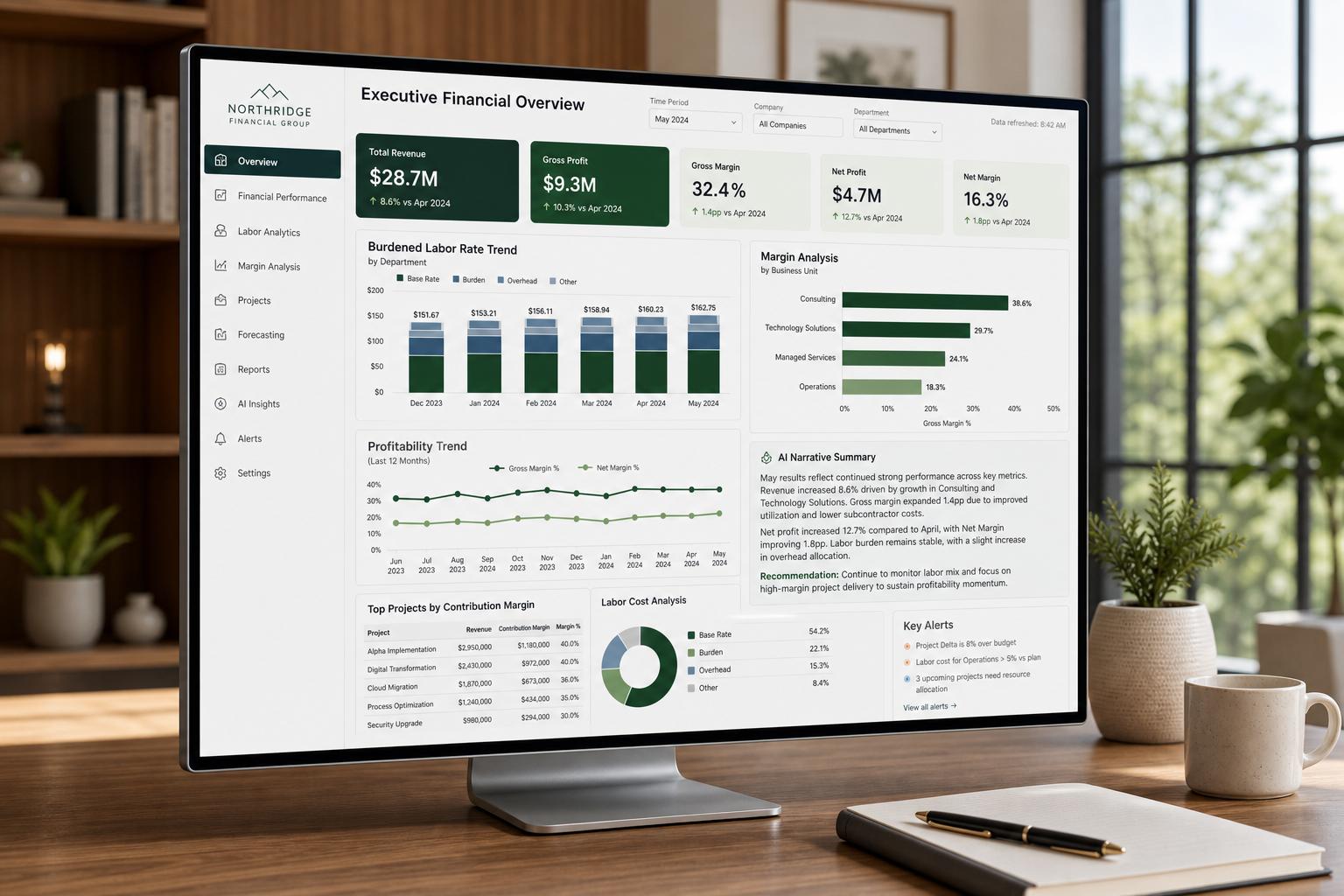
Houseblend Article
NetSuite Labor Cost Insights: Margin & Profitability Guide
Summary
- 01Labor Cost Insights launched July 15, 2026 as part of NetSuite 2026.2, bundled with the NetSuite Connector for ADP Workforce Now, with no independent customer outcomes public yet.
- 02NetSuite's own pricing estimates place a base platform fee of $999 to $5,000 per month plus $129 to $199 per user per month, with typical mid-market deployments costing $50,000 to $150,000 per year.
- 03Rivals already publish concrete results, such as Ceridian Dayforce customer Motivate cutting labor spend by 4%, worth about $1.2 million annualized, a benchmark NetSuite has not yet matched.
- 04Labor costs consume 30 percent or more of revenue in NetSuite's targeted industries, with full-service restaurant labor cost ranging from 34.2% (profitable) to 42.9% (loss-making) of sales.
- 05Market-size estimates for workforce management software diverge sharply: $9.76 billion (Mordor Intelligence) versus $13.09 billion (Fortune Business Insights) for 2026.
- 06Adjacent NetSuite case studies, like CMP Corp's 25 percent cost reduction and Myers-Holum's growth from 10 to 400 employees, show related value, but none used Labor Cost Insights itself.
Inside this article
- 01Executive Summary
- 02Introduction and Background
- 03Product and Platform Architecture
- 04Use Cases and Functional Capabilities
- 05Labor Cost Reporting Across Payroll, Finance, and Operations
- 06Profitability Analysis by Employee: Revenue per FTE and Unit Economics
- 07Workforce Margin Analytics for Shift-Based Operations
- 08Workforce Planning and Headcount Budgeting
- 09HR Analytics and Compliance
- 10Market Share and Adoption
- 11Competitive Landscape: How NetSuite Compares to Dedicated Workforce-Cost Platforms
- 12Data Analysis and Evidence
- 13Case Studies and Real-World Examples
- 14CMP Corp: Lean Manufacturing and a 25 Percent Cost Reduction
- 15Myers-Holum: Scaling a Professional Services Firm from 10 to 400 Employees
- 16Bridgepoint / BECI: Closing a Gross Margin Reporting Gap
- 17SoftArt Solutions: Real-Time Project Margin Visibility for an IT Consulting Firm
- 18Snubbertech: Job Costing for Engineer-to-Order Manufacturing
- 19Implications and Future Directions
- 20Frequently Asked Questions (FAQs)
- 21Conclusion
NetSuite Labor Cost Insights: Margin & Profitability Guide
Executive Summary
NetSuite Labor Cost Insights is a reporting and analytics capability that Oracle NetSuite introduced in the NetSuite 2026.2 release, announced July 15, 2026, and bundled with the new NetSuite Connector for ADP Workforce Now [1] [2]. It gives chief financial officers (CFOs) and finance leaders AI-generated summaries and configurable reports that connect payroll-driven labor costs to revenue and profitability data already inside NetSuite, rather than requiring analysts to reconcile payroll exports against the general ledger in spreadsheets [3]. Oracle positions the feature as most valuable for labor-intensive sectors such as professional services, manufacturing, retail, hospitality and healthcare, where payroll routinely represents 30 percent or more of revenue, as detailed further in this report.
The feature does not stand alone. It sits atop a stack of existing NetSuite capabilities that already touch labor cost: the Job Costing SuiteApp, which calculates labor costs from tracked time and posts them to the general ledger [4]; the Labor Expense Allocation SuiteApp, which spreads payroll costs across functional areas or programs [5]; the Revenue per FTE key performance indicator (KPI), a built-in Benchmark 360 metric [6]; and SuitePeople Workforce Management (WFM), which surfaces labor cost percentages and sales-per-labor-hour metrics inside shift scheduling [7]. Labor Cost Insights is designed to unify these previously siloed views into a single, AI-narrated picture of workforce cost versus revenue trend.
The business case for the feature rests on scale. The U.S. Bureau of Labor Statistics (BLS) reported that private-industry employer compensation costs averaged $46.60 per hour worked in March 2026, with wages and salaries making up 69.9 percent of that figure and benefits the remaining 30.1 percent [8]. In sectors like full-service restaurants, labor represented a median of 36.5 percent of sales in 2024, and loss-making operators saw that figure climb to 42.9 percent [9]. Against that backdrop, the global workforce management software market is valued between $9.76 billion (Mordor Intelligence, 2026) and $13.09 billion (Fortune Business Insights, 2026), a discrepancy this report addresses directly rather than picking a single winner [10] [11].
NetSuite itself reports more than 43,000 customers worldwide [12], giving Labor Cost Insights a large installed base to reach, though as of this report's publication date the feature is newly released and no independent, named customer outcome data is yet public. Instead, this report draws on adjacent, previously documented NetSuite labor-costing deployments, including a manufacturer that cut production lead time from 85 days to 10 and costs by 25 percent [13], a professional services firm that grew from about 10 to more than 400 employees while consolidating separate time, billing, and accounting tools onto NetSuite [14], and an engineering consulting firm that cut manual process time by 40 percent after gaining project profitability and utilization visibility [15].
Competitively, NetSuite Labor Cost Insights enters a field that already includes Workday Adaptive Planning for headcount and cost planning [16], ADP DataCloud for workforce analytics and labor-cost benchmarking [17], SAP SuccessFactors Workforce Planning [18], and Ceridian Dayforce, whose customer Motivate reported a 4 percent reduction in labor spend worth approximately $1.2 million annualized [19]. NetSuite's differentiator is its managed NetSuite Connector for ADP Workforce Now: ADP payroll data remains in ADP and is synchronized to NetSuite, where Labor Cost Insights connects payroll-driven labor costs to revenue performance. The managed data flow replaces manual imports and custom integrations, a point this report evaluates against real licensing costs, which independent NetSuite consultancies estimate at a base platform fee of $999 to $5,000 per month plus $129 to $199 per full user license per month as of 2026, since Oracle does not publish official list pricing [20].
Introduction and Background
Labor is, for most organizations, the largest controllable expense on the income statement. The BLS's Employer Costs for Employee Compensation report put total compensation costs for civilian workers at $49.32 per hour worked in March 2026 [8], and NetSuite's own research notes that additional costs like payroll taxes and benefits typically add 30 percent to 38 percent on top of base wages in manufacturing, what the industry calls the "burdened" labor rate[21]. That burden varies by company size: BLS data cited by NetSuite shows benefits add 29 percent to base wages for manufacturers with fewer than 100 employees, versus 38 percent for manufacturers with 500 or more employees [21].
Despite this scale, labor cost data has traditionally lived in a different system than the financial data needed to interpret it. Payroll systems know what employees are paid; general ledgers know what revenue and margin look like; and project or workforce management tools know how time was actually spent. Reconciling the three has historically meant manual exports, spreadsheet vlookups, and a lag between when a cost is incurred and when a finance leader can see its effect on margin. This is the gap NetSuite's product marketing explicitly targets: "Labor is a major expense for most organizations, but understanding how these costs affect profitability can be difficult when information is spread across payroll, finance, and operations systems" [3].
Oracle NetSuite is a cloud enterprise resource planning (ERP) platform that Oracle has developed for nearly 30 years, helping organizations manage finance, operations, sales, customer service, inventory, projects, and industry-specific processes in one system [22], a heritage that now supports more than 43,000 customers worldwide [12]. On July 15, 2026, Oracle announced NetSuite 2026.2, the twice-yearly release that also began the North American rollout of "NetSuite Next," a redesigned experience built around the Ask Oracle conversational AI assistant [22]. Labor Cost Insights shipped as one of several finance-facing AI features in that same release, alongside AI-assisted bank reconciliation matching and a new variance-explanation tool, both discussed later in this report's Implications section.
This report examines what Labor Cost Insights is, the separate NetSuite labor-cost and workforce-analytics capabilities that provide relevant context, its publicly documented pricing status and adoption, how it compares with dedicated workforce-analytics platforms from Workday, ADP, SAP, and Ceridian, and what the available quantitative evidence, industry benchmarks, and named customer cases suggest about its likely return on investment. It also flags where public information is thin, most notably that Labor Cost Insights itself is too new, as of July 2026, for independent case-study data.
Product and Platform Architecture
Labor Cost Insights is not a standalone product; it is delivered as part of the NetSuite Connector for ADP Workforce Now, a managed data-flow integration that synchronizes employee records, payroll journal entries, and paycheck data between ADP Workforce Now and NetSuite, with "integrated validation, duplicate prevention, and centralized monitoring" that simplify payroll-to-finance processes [1]. Notably, this native connector arrives into a market that third parties, including Modulus Data, already served with API-based ADP-to-NetSuite middleware: Modulus Data's own marketplace listing describes "prebuilt connectors [that] allow NetSuite to share employee data with ADP Workforce Now or ADP Vantage in near real-time via an API to API connection" [23], underscoring that payroll-to-ERP reconciliation has long been a manual pain point requiring either custom scripting or a paid third-party connector before 2026.2.
Layered on top of that data pipeline, Labor Cost Insights itself provides "new reports, configurable analytics, and AI-assisted summaries that provide clearer visibility into workforce efficiency and margin trends" [1]. The finance-focused release notes describe the same capability with a slightly different emphasis: "By connecting labor cost data with NetSuite financial data, teams can more easily see where costs are rising, how margins are changing, and where staffing decisions may influence business performance" [3].
The 2026.2 release also upgraded NetSuite time tracking with native Start Time and End Time fields, available across interfaces "for payroll and compliance use cases," which Oracle says "can improve billing accuracy, labor reporting, workforce analysis, and audit visibility without the extra work of custom fields or workarounds" [3]. The time-tracking enhancement is a separate 2026.2 capability. Oracle does not state that Labor Cost Insights consumes these fields or that the enhancement changes its reconciliation workflow.
Beneath the new AI layer, several older NetSuite building blocks already handle pieces of the labor-cost problem, and organizations evaluating Labor Cost Insights should understand how they relate:
- Job Costing, part of the Job Costing and Project Budgeting feature set, "lets you calculate labor costs based on tracked time and account for those costs in your general ledger" [4]. It uses a project expense type to route costs to direct or indirect labor accounts, and posts journal entries in real time reflected on a project's profit-and-loss subtab and Project Profitability report. For multi-subsidiary organizations, Job Costing can even transfer a resource's cost from one subsidiary to another using intercompany time adjustments when a project spans entities [4].
- Labor Expense Allocation, a SuiteApp, allocates payroll costs such as salary and fringe benefits to programs or functional areas, using either employee rates or actual pay transactions, and lets organizations view and report on total direct costs once allocated [5]. Oracle's documentation walks administrators through separate task workflows depending on whether allocation runs off configured employee rates or off actual employee pay transactions [5]. This is the mechanism nonprofits and grant-funded organizations most often use to demonstrate that labor costs charged to a program actually reflect where employees worked.
- Workforce Analytics, part of SuitePeople HR, compiles headcount, hiring, and turnover trends into Headcount Analysis and Turnover Analysis pages, filterable by gender, employee type, department, location, or subsidiary [24]. Because it exposes personal employee information, Oracle restricts it by default to Chief People Officer and HR Generalist roles [24].
NetSuite's separate Enterprise Performance Management (EPM) suite brings "planning, budgeting, forecasting, account reconciliation, financial close, and reporting processes from across the entire organization" into one place, built from the Oracle Fusion Cloud EPM solution [25]. EPM's Planning and Budgeting module already ingests SuitePeople payroll data grouped and summed by workforce categories, which flow directly into budget models [26]. Oracle has not documented a specific Labor Cost Insights-to-EPM integration.
- 01Calculate from tracked time
Job Costing calculates labor costs based on tracked time and accounts for those costs in the general ledger.
- 02Route to labor accounts
Uses a project expense type to route costs to direct or indirect labor accounts.
- 03Post journal entries
Posts journal entries in real time, reflected on a project's profit-and-loss subtab and Project Profitability report.
- 04Transfer across subsidiaries
For multi-subsidiary organizations, transfers a resource's cost between subsidiaries using intercompany time adjustments when a project spans entities.
Result: labor costs post to the general ledger in real time and surface on the Project Profitability report.
Use Cases and Functional Capabilities
Labor Cost Reporting Across Payroll, Finance, and Operations
The core use case for Labor Cost Insights is closing the loop between what a company pays its people and how that spend maps to revenue and gross margin. This addresses a long-standing complaint in NetSuite's own workforce planning guidance: without an integrated system, finance and HR teams have historically had to "plan headcount, salary, bonus, and payroll taxes using actuals from your business" pulled manually into a spreadsheet, "without having to rekey or reassemble workforce information" from separate systems [27]. NetSuite EPM already supports a related workflow through its Revenue and Gross Margin process flow, which lets finance teams "enter, validate, and adjust Revenue and Gross Margin Forecasts" and use "Total Revenue dashboards to analyze the gross profit margin percentages of Item members" [28]. Labor Cost Insights is documented as connecting payroll-driven labor costs with revenue performance through reports, configurable analytics, and AI-assisted summaries. Oracle does not publicly specify that it traces cost-of-goods-sold or SG&A changes to headcount, overtime, or wage-rate drivers.
Profitability Analysis by Employee: Revenue per FTE and Unit Economics
Two existing NetSuite KPIs answer the "profitability analysis by employee" question that organizations often ask alongside labor cost reporting. The Revenue per FTE metric, part of NetSuite's Benchmark 360 KPI set, "shows your company's profit generated per employee during a period," where a higher value indicates a more effective workforce [6]. NetSuite calculates it as annual revenue divided by the average number of active employees, illustrated with a worked example: a company with $3,500,000 in revenue and 150 average full-time equivalents (FTEs) has a Revenue per FTE of $23,333 [6].
For subscription businesses specifically, NetSuite's Unit Economics KPI scorecard consolidates average contract value, growth efficiency (the Quick Ratio), magic number, and customer acquisition cost (CAC) into one interactive dashboard, with filters for metric type (ARR, MRR, CARR, and CMRR), customer, item, department, class, and location [29], and one KPI tile dedicated to monthly or annual recurring revenue "per Employee," described as showing "how efficiently your team generates recurring revenue" [29]. Together, these KPIs provide a per-head revenue-efficiency lens. Oracle has not documented that Labor Cost Insights combines these KPI outputs with cost detail.
Workforce Margin Analytics for Shift-Based Operations
For hourly and shift-based businesses, such as retail, restaurants, and hospitality, the relevant capability is SuitePeople Workforce Management (WFM), which gives managers a built-in wage rules engine so they can "consider the total cost of your schedules," and which updates "forecast sales, labor cost percentages, sales per labor hour, customer counts and store or warehouse targets" in real time as schedules are adjusted [7]. WFM is a separate operational scheduling capability. Oracle has not documented that Labor Cost Insights analyzes WFM scheduling decisions or their roll-up into margin. Oracle names professional services, manufacturing, retail, hospitality, and healthcare as the industries in which the connection between workforce cost, revenue, and profitability is tightest, calling Labor Cost Insights "especially valuable" for exactly these labor-intensive sectors [1].
Labor is a major expense for most organizations, but understanding how these costs affect profitability can be difficult when information is spread across payroll, finance, and operations systems
Workforce Planning and Headcount Budgeting
The "workforce planning software" use case is served primarily through NetSuite EPM's Planning and Budgeting module, and through dedicated headcount planning guidance NetSuite publishes for finance and HR audiences. NetSuite defines headcount planning as "the process by which companies ensure they have the right people, with the right skills, to meet short- and long-term business goals within an established labor budget," a process that similarly requires "a cross-functional team of line-of-business leaders, senior executives and HR and finance specialists" able to run a current-state analysis that identifies "skills gaps now, total workforce costs, hiring priorities" before projecting forward [30].
HR Analytics and Compliance
SuitePeople HR bundles core HR administration with what NetSuite calls HR Analytics, which "provides role-based dashboards for HR and other authorized users to monitor workforce performance" using "15 industry-leading KPIs" covering headcount, turnover trends, demographics, and revenue per active employee, delivered as part of a broader value proposition in which combining "human resources, payroll and financials" in one tool lets organizations "eliminate third-party integrations, improve data accuracy... and make better-informed decisions to tightly align workforce performance with business performance" [31]. Independent HR-software reviewers largely agree with the integration argument: a 2026 review concludes NetSuite SuitePeople "provides the most value to midmarket and enterprise organizations standardizing their operations on Oracle NetSuite," offering "a unified data model that connects human resources directly to financial workflows without third-party integrations," is best-fit for companies in the midmarket (201 to 1,000 employees) and enterprise (1,001 to 10,000 employees) range, and flags that "native payroll" is "limited to US" operations (Source: hr.software).
Market Share and Adoption
NetSuite reports serving more than 43,000 customers worldwide and describes itself as the "No. 1 cloud ERP software solution serving small to midsize businesses across all industries" [12]. That customer base is a potential market for Labor Cost Insights, although its initial availability is tied to the NetSuite Connector for ADP Workforce Now, with which the feature is included.
As a NetSuite feature, Labor Cost Insights also inherits the scale of its parent company. Oracle Corporation, NetSuite's parent, reported record fiscal year 2026 total revenues of $67.4 billion, up 17 percent, with Cloud Applications (software as a service, SaaS) revenue, the segment that includes NetSuite, reaching $15.9 billion for the year, up 11 percent [32]. In its fourth fiscal quarter alone, Oracle's Cloud Applications revenue reached $4.1 billion, up 10 percent year over year [32]. Oracle's public filings do not break out NetSuite's standalone contribution to that Cloud Applications figure, which is itself a limitation for anyone trying to size Labor Cost Insights' addressable revenue precisely.
Sizing the addressable workforce-analytics market independently of NetSuite's own customer count requires turning to third-party market research, and here the picture is less settled than a single headline figure would suggest. Mordor Intelligence estimates the global workforce management software market at $9.76 billion in 2026, growing to $12.04 billion by 2031 at a 4.29 percent compound annual growth rate (CAGR) [10]. Fortune Business Insights, by contrast, values the same broadly defined "workforce management" market at $11.60 billion in 2025, rising to $13.09 billion in 2026 and $34.46 billion by 2034, at a considerably higher 12.86 percent CAGR [11]. The roughly $3.3 billion gap in the 2026 estimate, and the near-threefold difference in projected CAGR, likely reflects different scope definitions (workforce analytics and scheduling alone versus a broader human capital management bundle) and different base years, and this report treats both estimates as directionally useful rather than reconciling them into one number.
Within that market, Mordor Intelligence's segment data is directly relevant to where Labor Cost Insights competes: software retained a 71.34 percent revenue share of the market in 2025, with services growing faster at a 5.61 percent CAGR as enterprises hire consultants to tune generative AI features [10]. Time and attendance management held the largest software-type share at 29.63 percent in 2025, but the workforce analytics category, the segment Labor Cost Insights competes in most directly, is forecast to grow fastest among software types at a 6.81 percent CAGR through 2031 [10]. Cloud deployment already accounted for 63.81 percent of workforce management software revenue in 2025 [10], a structural tailwind for a cloud-native ERP vendor like NetSuite. Large enterprises contributed 54.46 percent of 2025 revenue, but small and medium enterprises are the faster-growing segment at a 6.44 percent CAGR [10], and retail and consumer goods, one of NetSuite's five named target sectors, held an 18.73 percent share of the workforce management software market in 2025, reflecting dense hourly workforces and seasonal staffing peaks [10]. By industry, healthcare is forecast to post the highest CAGR (5.46 percent) as nursing shortages push hospitals toward better staffing analytics [10], one of the five industries NetSuite explicitly names as a Labor Cost Insights target.
Competitive Landscape: How NetSuite Compares to Dedicated Workforce-Cost Platforms
NetSuite Labor Cost Insights does not compete in a vacuum. Finance and HR leaders evaluating a labor-cost analytics investment typically also consider Workday Adaptive Planning, ADP DataCloud, SAP SuccessFactors Workforce Planning, and Ceridian Dayforce, each of which approaches the same underlying question, how workforce cost is trending against budget and revenue, from a different architectural starting point.
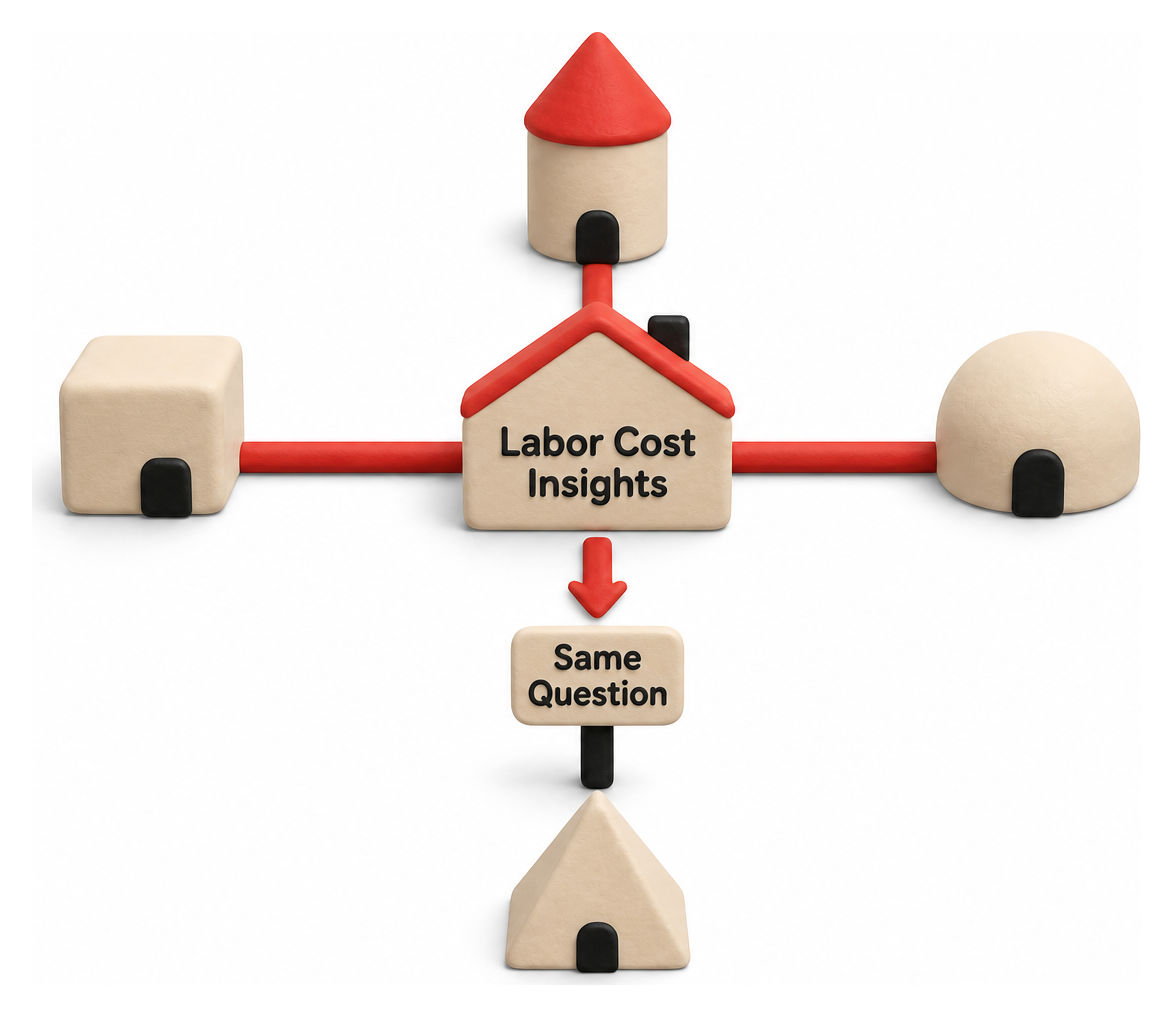
Workday Adaptive Planning markets itself around bringing "HR, finance, and operations together in one powerful platform to create workforce plans" [16], and its headcount-and-cost planning module lets teams "link workforce plans to financial models with up-to-date headcount plans and related costs, staying on budget" [16]. Workday's published customer story for Philips Electronics illustrates the model in practice: facing "geographical complexities and the limitations of legacy Excel processes" that made enterprise-wide workforce planning difficult, Philips adopted Workday Adaptive Planning in an expansion of a relationship that began with Core HCM as "the first Workday module introduced by Philips' HR team" [33], after which its Global HRIS Architect said the platform "enabled the company to overcome a multitude of local variables which is helping to drive greater consistency and much smarter ways of working" [33]. Philips' Human Resources Project Manager added that the platform lets the company "take full account of all headcount costs, from salary and wages to country-specific social security costs, annual incentives, all kinds of bonus plans and so on," which "overcomes the need for local Excels" [33]. Workday also reports that, on average, its Workforce Planning customers see 70 percent shorter planning cycle times and a 50 percent improvement in productivity.
ADP DataCloud takes a payroll-native approach, since ADP already processes payroll for a large share of the businesses it serves. Its workforce analytics module promises to "reveal evolving labor expenses and the true costs of employees so you can maximize your return on investment," answering questions like "how do actual labor costs compare to budgeted labor costs?" and "how are costs per full-time employee trending in different areas of your business?" [17]. It ships with "preconfigured key performance indicators (KPIs) based on industry standards, such as turnover, head count and labor expenses" [17]. This is functionally the same value proposition Oracle now makes for Labor Cost Insights, connect payroll cost detail to a business-performance lens, but ADP's version starts from the payroll system rather than the ERP system, which is precisely the gap NetSuite's ADP Workforce Now connector is designed to close for ADP customers who run their books on NetSuite.
SAP SuccessFactors Workforce Planning, delivered through SAP Analytics Cloud, is described by SAP's own documentation as "a scenario-based approach to predict workforce demand, supply, gap and cost and develop a five year workforce strategy," complemented by "Operational Headcount Planning," a "job classification- or position-based yearly planning of headcount for hires, terminations, transfers and cost" [18]. SAP implementation partner hr-campus.ch markets the same underlying planning solution in SAP Analytics Cloud as a way to "optimise the use of your resources, identify bottlenecks at an early stage and avoid overcapacity," with real-time data enabling "informed decisions" (Source: hr-campus.ch). SAP's approach leans more heavily on long-range scenario modeling than on the near-real-time, AI-summarized reporting NetSuite now emphasizes.
Ceridian Dayforce, a global human capital management (HCM) platform, positions itself around lowering "cost structure" and helping customers "cut down your operating costs and make more efficient labor decisions" [19]. Its published customer testimony offers the most concrete labor-cost outcome figure found in this research: Motivate's chief executive officer stated that "having real-time access to Dayforce data has enabled us to reduce our labor spend by 4%, which is equivalent to approximately $1.2 million annualized" [19]. No equivalent, independently attributed dollar-savings figure for NetSuite Labor Cost Insights exists yet, a limitation of a feature announced only weeks before this report's publication date.
Table 1 below summarizes how these five platforms compare on architecture, target audience, and their headline evidence for labor-cost impact.
| Platform | Architectural Basis | Primary Buyer | Distinguishing Claim | Quantified Evidence |
|---|---|---|---|---|
| NetSuite Labor Cost Insights | Native ERP module bundled with the ADP Workforce Now connector, built on the same system of record as the general ledger [22] | CFOs and finance leaders at NetSuite ERP customers | Connects labor cost data directly to NetSuite financial data with AI-generated summaries, no middleware required | Not yet publicly available; feature released July 15, 2026 |
| Workday Adaptive Planning | Standalone enterprise performance management (EPM) platform with an Elastic Hypercube modeling engine [16] | Enterprise finance and HR planning teams | Multidimensional scenario modeling for headcount and cost, independent of the source ERP | 70% shorter planning cycles and 50% productivity improvement, per Workday customer averages cited in the prose above |
| ADP DataCloud / Workforce Now | Payroll-native analytics layered on ADP's payroll processing engine [17] | HR and payroll leaders, mid-market and enterprise | Preconfigured KPIs benchmarked against ADP's own payroll client base | Preconfigured KPIs for turnover, head count, and labor expenses cited in the prose above |
| SAP SuccessFactors Workforce Planning | Scenario modeling inside SAP Analytics Cloud, tied to SuccessFactors Employee Central [18] | Large enterprise HR and finance planning teams | Five-year workforce demand, supply, gap, and cost forecasting | Not disclosed in public documentation reviewed |
| Ceridian Dayforce | Unified global HCM platform (pay, time, talent, analytics in one system) [19] | HR, payroll, and workforce management leaders | Real-time labor spend visibility across a single global HCM data model | 4% labor spend reduction, approximately $1.2 million annualized, per named customer Motivate, cited in the prose above |
The comparison suggests each platform's evidentiary strength mirrors its architectural starting point. Dayforce and ADP, both payroll-native, can point to concrete client dollar figures because they already process the pay transactions they analyze. Workday, an EPM specialist, publishes both a detailed customer story (Philips) and process-efficiency metrics (planning cycle time, productivity). NetSuite's potential advantage is its managed ADP Workforce Now connector, which synchronizes payroll data with the NetSuite financial system so Labor Cost Insights can relate labor costs to revenue performance. That advantage remains a design claim until independent customers publish outcome data.
A second consideration is total cost. Independent NetSuite consultancy Broken Rubik, which reviews contracts rather than relying on official list prices since "Oracle does not publish official NetSuite pricing," estimates the base ERP platform at $999 to $5,000 per month, full user licenses at $129 to $199 per user per month (up from $99 after a 2025 price increase of roughly 30 percent), and SuitePeople HR as a $10 to $30 per user per month add-on [20]. Independent HR-software reviewers confirm that pricing opacity extends to SuitePeople specifically, describing its pricing model as "quote-based" rather than published tiers (Source: hr.software). Since Labor Cost Insights ships with the ADP Workforce Now connector rather than as a discrete line item, its incremental price is not yet independently documented; organizations already licensed for SuitePeople Payroll or planning to adopt the new connector should expect to negotiate its cost as part of a broader NetSuite renewal rather than finding a published module price.
- Built as a native ERP module bundled with the ADP Workforce Now connector, on the same system of record as the general ledger
- Connects labor cost data directly to NetSuite financial data with AI-generated summaries, no middleware required
- No quantified evidence is yet publicly available since the feature only released July 15, 2026
- A unified global HCM platform combining pay, time, talent, and analytics in one system
- Offers real-time labor spend visibility across a single global HCM data model
- Already has a named customer figure: Motivate cut labor spend 4%, about $1.2 million annualized
That advantage remains a design claim until independent customers publish outcome data.
Data Analysis and Evidence
This section assembles the quantitative backdrop against which Labor Cost Insights should be judged: how large labor costs actually are relative to revenue across the industries NetSuite targets, how workforce analytics adoption is trending, and what the pricing data implies about total cost of ownership.
Labor's share of revenue varies sharply by sector, which is precisely why NetSuite frames Labor Cost Insights around five named industries. In full-service restaurants, the National Restaurant Association's 2025 Operations Abstract, based on more than 900 restaurant operators, found that salaries and wages including benefits represented a median of 36.5 percent of sales in 2024 [9]. Operators who reported a pre-tax profit had labor costs at a median of 34.2 percent of sales, versus 42.9 percent for operators who reported a loss, a gap of more than 6 percentage points that illustrates how directly labor cost discipline separates profitable from unprofitable operations in this sector [9]. Limited-service restaurants showed a similar, less dramatic pattern: labor represented a median of 31.7 percent of sales overall, 30.0 percent for profitable operators, and 34.1 percent for operators reporting a loss [9].
Healthcare offers an instructive real-world illustration of the underlying labor-productivity motivation vendors market: Fortune Business Insights notes that Apollo Hospitals, a healthcare provider in Asia, adopted Kronos Workforce Central in 2019 to lift workforce productivity and efficiency through collaborative self-scheduling [11]. This is the same category of benefit, translating workforce data into measurable productivity and cost gains, that Oracle now markets for Labor Cost Insights.
For professional services, the relevant labor metric is billable utilization rather than a direct percentage of sales, since revenue is generated hour by hour. Industry benchmarks compiled by capacity-planning vendor Runn show wide variation by discipline: information technology (IT) services firms typically target 70 to 80 percent utilization; legal services firms consider approximately 40 percent good as a firm-wide average; accounting firms target 65 to 85 percent utilization per individual, with roughly 60 percent considered in line with the firm-wide average; marketing agencies typically target 70 to 80 percent; management consulting firms average just under 70 percent firm-wide; and architectural and engineering firms target around 80 percent [34]. Within a single firm, targets also vary sharply by seniority: Runn's illustrative examples show a junior designer at a marketing agency hitting a 90 percent billable utilization rate on simple projects, while a senior consultant managing a dozen staff might carry a target of only 60 percent billable utilization because of mentoring and oversight responsibilities [34]. For a services firm, this is exactly the kind of denominator Labor Cost Insights and NetSuite's Job Costing feature are built to make visible in real time, since utilization directly determines whether tracked labor cost converts into billable revenue.
At the macro level, the underlying cost of labor itself is well documented by the BLS. Total employer compensation costs for private industry workers averaged $46.60 per hour worked in March 2026, with wages and salaries averaging $32.60 per hour (69.9 percent of the total) and benefit costs averaging $14.01 per hour (30.1 percent) [8]. Government workers face a noticeably different cost structure: total compensation for state and local government workers averaged $66.41 per hour in March 2026, with wages making up 61.5 percent of the total and benefits, largely retirement and health coverage, making up the remaining 38.5 percent [8]. At the high end of the private-sector wage distribution, total compensation reached $89.70 per hour at the 90th wage percentile in March 2026, versus $18.06 at the 10th percentile, illustrating how differently labor-cost pressure is felt across an organization's pay bands [8].
Table 2 below consolidates the labor-cost-as-percentage-of-revenue benchmarks discussed above, alongside the NetSuite licensing costs most directly relevant to deploying a labor-cost analytics stack.
| Metric | Value | Context | Source |
|---|---|---|---|
| Full-service restaurant labor cost, all operators (2024) | 36.5% of sales | Median across 900+ surveyed operators | National Restaurant Association [9] |
| Full-service restaurant labor cost, loss-making operators (2024) | 42.9% of sales | Median; over 6 points above the all-operator median | National Restaurant Association [9] |
| Manufacturing burdened labor rate premium (500+ employees) | +38% over base wages | Payroll taxes and benefits combined | BLS, via NetSuite [21] |
| Private industry compensation, total (March 2026) | $46.60/hour | 69.9% wages, 30.1% benefits | U.S. Bureau of Labor Statistics [8] |
| State and local government compensation, total (March 2026) | $66.41/hour | 61.5% wages, 38.5% benefits | U.S. Bureau of Labor Statistics [8] |
| Workforce management software market (2026) | $9.76B to $13.09B | Range across two research firms | Mordor Intelligence and Fortune Business Insights [10] [11] |
| NetSuite full user license (2026) | $129 to $199/user/month | Up roughly 30% from $99 after 2025 increase | Broken Rubik (industry estimate, not official Oracle pricing) [20] |
| Typical mid-market NetSuite annual license cost | $50,000 to $150,000/year | Excludes one-time implementation | Broken Rubik [20] |
Interpreting this table together, the return-on-investment case for a feature like Labor Cost Insights depends heavily on how labor-intensive the buyer's business is. A full-service restaurant group where a swing from 34.2 percent to 36.5 percent of sales going to labor represents the difference between profit and loss has a much larger dollar incentive to catch cost drift early than, say, a low-headcount software company where SG&A payroll is a smaller share of revenue, even though NetSuite's own Unit Economics dashboard was purpose-built for that latter group's MRR-per-employee metric. Similarly, the pricing data suggests that Labor Cost Insights' true cost of ownership is inseparable from a NetSuite subscription that, per independent consultancy estimates, already runs $50,000 to $150,000 per year in license fees alone for a typical mid-market deployment, before implementation, which Broken Rubik pegs at one to two times the annual license cost [20]. Organizations should therefore evaluate Labor Cost Insights as an incremental capability inside an existing or planned NetSuite investment, not as a discrete purchase decision with its own standalone price tag, since Oracle has not published one.
Case Studies and Real-World Examples
Because Labor Cost Insights itself launched on July 15, 2026, no independent customer case study documenting its specific use exists as of this report's publication date. The cases below document other NetSuite deployments involving labor costing, project costing, or workforce management. They provide context on those separate deployments, not evidence that Labor Cost Insights uses the same data flows or will produce comparable outcomes.
CMP Corp: Lean Manufacturing and a 25 Percent Cost Reduction
CMP Corp., described as the world's largest independent manufacturer of aftermarket compressor parts for HVAC and refrigeration, based in Oklahoma City, adopted NetSuite ERP and SuiteCommerce Advanced after outgrowing an on-premises Infor Visual Manufacturing system that was costly to maintain [13]. NetSuite's comprehensive data access and reporting tools supported CMP's broader lean-manufacturing initiative to cut waste and reduce costs [13], and according to the implementation partner's published case study, "NetSuite has been instrumental in our lean manufacturing initiative, helping us reduce cost and waste while achieving double-digit growth," in the words of Adam Harper, the company's Director of Administration [13]. The quantified result: CMP "cut crankshaft production lead time from 85 days to 10 and reduced costs by 25%, achieving double-digit growth in 95 countries" [13]. While this case predates Labor Cost Insights, it demonstrates the underlying reporting and cost-visibility infrastructure that a manufacturing customer would now feed into the new labor cost dashboards.
having real-time access to Dayforce data has enabled us to reduce our labor spend by 4%, which is equivalent to approximately \$1.2 million annualized
Myers-Holum: Scaling a Professional Services Firm from 10 to 400 Employees
Myers-Holum, Inc., a consulting firm and NetSuite Alliance Partner, faced the same fragmentation problem internally that many of its own clients faced: it ran QuickBooks for accounting, Salesforce for customer relationship management (CRM), and Mavenlink (now Kantata) for project execution, time, and expenses, none of it integrated, a setup that became untenable as the firm "rapidly grew from about 10 to more than 400 employees over the past six years" [14], prompting a 2023 consolidation onto a single NetSuite instance. Post-migration, Myers-Holum "can easily and accurately track project costs, employee time, and expenses" in one system, and the resulting single source of information across accounting, sales, and delivery teams "helps Myers-Holum make better decisions around staffing, customer invoicing, customer status, and project status" [14]. This is exactly the staffing-decision use case Oracle now describes for Labor Cost Insights.
Bridgepoint / BECI: Closing a Gross Margin Reporting Gap
Building Engineering Consultants Inc. (BECI), an engineering consulting firm, engaged implementation partner Bridgepoint Consulting to deploy NetSuite Professional Services Automation (PSA) after outgrowing its legacy ERP system. Before the project, BECI had "limited insight into project progress, profitability and gross margin reporting," "insufficient billing automation for diverse project scenarios," and "inadequate utilization metrics for evaluating team performance" [15]. After implementation, the firm cut manual process time by 40 percent, the headline figure in the case study's title [15], while also gaining "robust custom reporting packages," automated project scheduling that removed manual steps from setting up new engagements [15], and the elimination of manual invoicing that had previously slowed the billing cycle [15]. This case is a direct illustration of the "profitability analysis by employee" and "gross margin dashboard" gap that Labor Cost Insights is designed to close at the finance-leadership level, since BECI's original problem was specifically a lack of project-level margin and utilization visibility.
SoftArt Solutions: Real-Time Project Margin Visibility for an IT Consulting Firm
A fast-growing IT consulting firm client of SoftArt Solutions had relied on Excel for time tracking, expense management, and invoicing, resulting in "billing errors, approval delays, and little to no visibility into project profitability" [35]. After SoftArt implemented a tailored NetSuite solution, including "project profitability dashboards" to "track margins by client, project, and resource" and streamlined approval workflows for "timesheet submissions and invoice approvals, reducing turnaround times and administrative workload" [35], the firm achieved a "45% Increase in Billing Accuracy through automated time tracking and invoicing," gained "real-time visibility into project margins for each client and engagement," and saved "20+ hours per week" through automated invoicing and timesheet approval [35].
Snubbertech: Job Costing for Engineer-to-Order Manufacturing
Snubbertech, a Fort Worth, Texas-based engineer-to-order manufacturer of oilfield snubbing systems with more than 50 employees [36], replaced QuickBooks and Excel with a customized NetSuite implementation from partner Appficiency. Before the project, "key activities such as work-in-progress reporting, time tracking, and labor costing were performed manually, placing a heavy administrative burden on teams," and "without real-time visibility, project managers had limited ability to compare estimated and actual results" [36]. Snubbertech chose NetSuite specifically "for its robust project functionality, support for milestone billing, and multi-currency consolidation" [36], and the resulting deployment gave the company "real-time job costing, multi-currency support, and a scalable foundation for global growth" as it expanded into the United Arab Emirates [36].
Taken together, these five cases span manufacturing, professional services, and engineering, three of the five industries NetSuite names as Labor Cost Insights targets, and each independently confirms that the underlying pain point, labor and project cost data trapped outside the financial system of record, is real and recurring across NetSuite's customer base. What none of them can yet confirm is the incremental value of the new AI-generated summaries and CFO-facing reports Labor Cost Insights specifically adds on top of that existing data plumbing.
Implications and Future Directions
The launch of Labor Cost Insights alongside the broader NetSuite Next rollout signals that Oracle views labor cost as a strategic wedge for its AI investment, not an isolated feature. The same July 2026 release paired Labor Cost Insights with other AI-assisted finance tools, including a variance-explanation capability that helps accountants and controllers "explain why account balances changed between reporting periods" and an AI transaction matching assistant for bank reconciliation [3]. The pattern across all three is the same: take a financial-close or cost-analysis task that previously required a human to reconcile data across systems, and let an AI assistant draft the first-pass explanation for a human to review. For labor cost specifically, this could shorten the monthly or quarterly cycle in which a CFO discovers that margin has eroded because of unplanned overtime, headcount growth outpacing revenue, or a shift in the mix of contractor versus employee labor.
The market data reviewed in this report suggests the underlying demand is real regardless of which vendor captures it. Workforce analytics is forecast to be the fastest-growing software segment within the broader workforce management market, at a 6.81 percent CAGR through 2031 according to Mordor Intelligence [10], and healthcare, one of NetSuite's five named target industries, is projected to be the fastest-growing end-use industry as staffing shortages intensify [10]. This gives Oracle a plausible tailwind independent of how well Labor Cost Insights itself performs at launch, and it is consistent with Oracle's own reported Cloud Applications growth at the parent-company level.
At the same time, several open questions will determine whether Labor Cost Insights becomes a genuine differentiator or a marketing checkbox. First, the feature currently ships bundled with the ADP Workforce Now connector, which means customers using other payroll providers, or NetSuite's native SuitePeople Payroll, may need to wait for broader connector coverage before they can adopt it; Oracle's own material does not specify a timeline for extending Labor Cost Insights beyond the ADP integration path. Second, because NetSuite does not publish official module pricing, and because independent estimates already place a typical mid-market NetSuite deployment at $50,000 to $150,000 per year before this feature, the true incremental cost of Labor Cost Insights for existing customers is opaque until Oracle or its resale partners publish specifics. Third, competitors are not standing still: Workday, ADP, SAP, and Ceridian Dayforce all have multi-year track records and, in ADP's and Dayforce's cases, published customer dollar-savings figures that NetSuite's feature has not yet matched in public documentation.
Looking forward, the most useful evidence for buyers evaluating Labor Cost Insights will likely come from the next one to two NetSuite release cycles, when Oracle typically publishes early-adopter customer quotes and, potentially, quantified outcomes in subsequent release announcements and case studies. Until that evidence accumulates, organizations should treat Labor Cost Insights as a promising but unproven addition to an already capable, if fragmented, NetSuite labor-costing toolkit.
Frequently Asked Questions (FAQs)
What is NetSuite Labor Cost Insights? As described earlier in this report, it is a reporting and analytics capability introduced in NetSuite 2026.2 and bundled with the NetSuite Connector for ADP Workforce Now that gives CFOs AI-generated reports connecting payroll-driven labor costs to NetSuite's revenue and profitability data.
When was Labor Cost Insights released? Oracle announced it as part of NetSuite 2026.2 on July 15, 2026 [2].
Does Labor Cost Insights require ADP payroll? As released, the feature ships included with the NetSuite Connector for ADP Workforce Now, so organizations must be using or adopting that connector to access it in its initial form, as discussed in the Product and Platform Architecture section above.
How does NetSuite calculate Revenue per FTE? Its Revenue per FTE KPI divides revenue by the average number of active employees over a period. For example, $3,500,000 in revenue divided by 150 FTEs equals $23,333 per FTE [6]. This is a revenue-efficiency metric, not a profit-per-employee calculation.
What is the difference between Labor Cost Insights and Job Costing? Job Costing calculates labor costs from tracked project time and posts them to the general ledger at the project level [4], while Labor Cost Insights aggregates payroll-driven costs against overall revenue and margin trends at the company level for CFO-facing reporting, as described in the Product and Platform Architecture section.
How much does NetSuite cost? Oracle does not publish official pricing, but independent NetSuite consultancy Broken Rubik estimates a base platform fee of $999 to $5,000 per month plus $129 to $199 per full user license per month as of 2026, with a typical mid-market deployment running $50,000 to $150,000 per year in license fees [20].
Can Labor Cost Insights replace a dedicated workforce management platform like Workday or Dayforce? Not directly. It is a reporting layer inside NetSuite's ERP, whereas Workday Adaptive Planning and Ceridian Dayforce are standalone or HCM-native platforms with their own scenario-modeling and payroll-processing engines [16] [19]. Organizations already committed to one of those platforms would use Labor Cost Insights as a complementary financial-reporting lens rather than a replacement.
Which industries benefit most from Labor Cost Insights? As discussed in the Use Cases section, Oracle names professional services, manufacturing, retail, hospitality, and healthcare as the industries where workforce costs most directly affect profitability.
Conclusion
NetSuite Labor Cost Insights addresses a genuine and well-documented problem: labor is typically an organization's largest controllable cost, yet the data needed to manage it has historically been scattered across payroll, HR, and financial systems that do not talk to each other in real time. By pairing the managed NetSuite Connector for ADP Workforce Now, which synchronizes payroll data from ADP to NetSuite, with AI-generated, CFO-facing reporting, Oracle has built a plausible bridge between payroll data and the financial statements that ultimately determine whether a business is profitable. That bridge sits on top of a genuinely mature NetSuite foundation, Job Costing, Labor Expense Allocation, Workforce Analytics, SuitePeople HR and Workforce Management, Revenue per FTE, and the Unit Economics KPI scorecard, all of which already give NetSuite customers partial visibility into labor cost and per-employee revenue efficiency.
The evidence assembled in this report supports cautious optimism rather than an unqualified endorsement. On one hand, the macro case is strong: labor consistently represents 30 to 40 percent or more of revenue in the industries Oracle targets, the underlying workforce analytics software segment is growing faster than the broader workforce management market, and adjacent NetSuite customers, from a manufacturer that cut costs 25 percent to a professional services firm that scaled from 10 to 400 employees, have already demonstrated real value from the platform's labor and project costing capabilities. On the other hand, Labor Cost Insights itself is too new, having launched July 15, 2026, for any independent organization to have published a quantified outcome, its dependency on the ADP Workforce Now connector currently limits its addressable base within NetSuite's own 43,000-plus customers, and rivals including Workday, ADP, and Ceridian Dayforce already have multi-year track records and, in some cases, published dollar-value savings that NetSuite has not yet matched in public materials. Buyers evaluating the feature should obtain a quote for the connector and related NetSuite subscription scope, because Oracle has not publicly documented Labor Cost Insights’ incremental commercial cost. They should withhold judgment on its specific return on investment until independent customer results become public.
External Sources (36)
About
Houseblend
Make NetSuite work better for your finance and operations teams with Houseblend. We help design, implement, integrate and improve ERP systems, with practical support for the people who use them every day.
Houseblend is a NetSuite consulting firm serving finance and operations teams. We help organizations implement ERP systems, connect business applications, improve existing configurations and maintain the systems that support everyday work. Our audience includes finance leaders, controllers, operations managers, NetSuite administrators and implementation teams.
Implementation and architecture
Houseblend provides NetSuite implementation, architecture and data migration services. We help teams evaluate how business processes, reporting requirements and existing data should fit together in an ERP environment. Training supports the people responsible for adopting and operating the resulting system.
Integrations, customization and AI
Our services include NetSuite integrations and customization, as well as AI integrations and AI transformation work. These engagements connect ERP data and workflows with the broader application landscape. The right design depends on the organization's systems, controls and operating needs.
Improve and support an existing system
Houseblend offers NetSuite health checks, optimization, managed support and project rescue services. We also provide expertise for analytics and specialist workflows, including NetSuite Analytics Warehouse, warehouse management and field service management. Published educational material helps teams investigate options and prepare informed questions for their implementation or support work.
Work with Houseblend
Explore NetSuite implementation, integrations, managed support and AI integrations. Contact Houseblend to discuss your current system and priorities.
Article examples explain concepts rather than promising a particular license, product capability, delivery schedule or outcome. Engagement scope is confirmed with the Houseblend team.
Disclaimer
This document is provided for informational purposes only. No representations or warranties are made regarding the accuracy, completeness, or reliability of its contents. Any use of this information is at your own risk. Houseblend shall not be liable for any damages arising from the use of this document. This content was generated with assistance from artificial intelligence tools, which may contain errors or inaccuracies. Readers should verify critical information independently. All product names, trademarks, and registered trademarks mentioned are property of their respective owners and are used for identification purposes only. Use of these names does not imply endorsement. This document does not constitute professional or legal advice. For specific guidance related to your needs, please consult qualified professionals.