Houseblend Article
Oracle NetSuite Restaurant Operations: AI ERP Explained
Inside this article
Oracle NetSuite Restaurant Operations: New AI Back-Office Suite Explained for Operators
Executive Summary
The newly announced Oracle NetSuite Restaurant Operations is a purpose-built, AI-enhanced back-office platform aimed at unifying fragmented restaurant management functions (inventory, procurement, scheduling, production planning, finances, etc.) into a single cloud system [1] [2]. Oracle’s press release emphasizes that this solution integrates with the Oracle Simphony Cloud POS (and other POS systems), providing real-time visibility, actionable insights, and automated workflows to improve efficiency and margins [1]. Built on NetSuite’s cloud ERP, the suite embeds AI tools that automate repetitive tasks (e.g. data reconciliations, routine approvals) and deliver predictive analytics (e.g. inventory forecasting, demand trends) [1]. Early reports and partner case studies suggest significant benefits: integrated systems have reduced labor-intensive reconciliation, accelerated financial closes, improved forecasting accuracy, and exposed new revenue insights across multi-restaurant chains [3].
However, experts caution that successful implementation requires clear goals and robust processes – an impatience with “plug-and-play” ERP can lead to failure without proper integration planning. Indeed, competitors like Restaurant365 highlight their pre-built POS and labor-system integrations as advantages over generic ERPs [4]. The Oracle/NetSuite suite is slated for global release by early 2027, supporting 110+ countries and 27 languages [1], reflecting Oracle’s effort to capture growing demand for verticalized, AI-driven restaurant management software. Industry data underscore the opportunity: 64% of enterprise restaurant groups plan to implement unified management systems, and over 65% already use integrated POS/inventory solutions [5], while a majority (>70%) have migrated to cloud platforms. In short, Oracle’s new vertical ERP is well-timed to address longstanding “patchwork” back-office challenges with modern AI capabilities [1].
Introduction and Industry Background
The global foodservice industry is immense (over $4 trillion in 2025) and growing [6]. Facing thin profit margins (often 5–6% net) and ever-rising combined food+labor costs (typical target ≤60% of revenue), restaurant operators are under extreme pressure to optimize operations. Compounding this, consumer demand has diversified across dine-in, take-out, delivery, mobile ordering, etc. – in 2023 roughly 41% of revenues were generated via delivery platforms. This multichannel reality demands tight coordination: staffing, kitchen production, and supply chains must all flex rapidly to meet daily demand shifts. Technology adoption has surged: by 2024, over 65% of restaurants were using integrated POS and inventory systems [5], and roughly 68–70% of operations had moved to cloud-based solutions [5]. Indeed, a recent industry survey reports 64% of enterprise restaurant groups intend to implement unified, enterprise-wide management systems that centralize data and reporting.
Yet despite these trends, adoption is uneven. Many restaurants still rely on a “cobbled-together” tech stack: separate tools for POS, workforce scheduling, accounting, inventory, etc., leading to manual data entry, errors and blind spots. Oracle NetSuite EVP Brian Chess notes that “restaurants have traditionally relied on a patchwork of systems” for inventory, purchasing, finance, and more [7]. Table 1 illustrates typical back-office fragmentation versus the unified model Oracle is promoting.
| Back-Office Function | Traditional Approach | Oracle NetSuite Restaurant Operations (AI Suite) |
|---|---|---|
| Inventory Management | Separate inventory system or spreadsheets; limited real-time visibility; manual stock counts. | Centralized ingredient and stock tracking across locations; automated reordering suggestions and spoilage control via AI analytics [1]. |
| Procurement and Vendor Mgmt | Decentralized purchasing per location; manual invoice processing; frequent overstock/stockouts. | Unified purchasing module; centralized vendor billing and approvals; materials demand forecasts streamline ordering [8]. |
| Staff Scheduling (Labor) | Stand-alone shift-scheduling apps; manual labor adjustments; disconnect with sales forecasts. | Integrated labor planning synced with sales and foot-traffic data; AI-driven schedule optimization (accounting for reservations, historical demand) [9]. |
| Production/Demand Planning | Kitchen prep planned per historical recipes; poor integration with on-hand inventory. | Recipe-level demand forecasting using real-time sales and inventory data; AI predicts ingredient needs (minimizing waste) [9] [8]. |
| Financial Management & Cash | Legacy accounting software; manual consolidation of branch P&L’s; slow month-end close. | Embedded finance module with multi-entity ledger; AI automates routine journal entries and reconciliations; real-time cash/flow analytics [1]. |
| Reporting & Analytics | Disparate reports from POS, spreadsheets; delayed insights. | Cross-channel dashboards provide KPIs in real time; AI surfaces trends and anomalies; automated management reports [1]. |
Table 1: Examples of restaurant back-office functions under traditional systems versus Oracle NetSuite’s unified AI-powered solution (sources: Oracle announcements and partner case studies [1] [8]).
The fragmented approach has clear pain points. For example, a quick-service chain struggled with overstocking and $waste$ until it standardized on a unified ERP: after implementing a tailored NetSuite solution, it achieved 25% reduction in ingredient waste, centralized vendor billing, and real-time inventory insights across outlets [8]. Conversely, a family-owned multi-brand group with 25 restaurants (Hofman Hospitality) reported much faster financial closes and a single corporate view of data after moving to NetSuite [3]. These examples illustrate typical gains from consolidation.
Importantly, modern restaurants increasingly expect such integrations: a Deloitte study finds 73% of foodservice executives plan to raise their AI investment in the next year [10], yet only ~20–30% feel prepared with the necessary technology and governance [10]. Operators see value in AI for forecasting, inventory, scheduling, and customer service, but many cite lack of readiness. This gap underscores the appeal of turnkey, AI-enhanced suites that promise to “make decisions easier” without rebuilding the entire tech stack in-house [10]. Oracle’s new service is positioned to meet exactly that demand for an integrated, AI-driven back-office.
Oracle and NetSuite Background
Oracle Corporation, a major provider of cloud applications and technology, has been building specialized solutions for restaurants for decades. Its Oracle Simphony Cloud POS platform, originally from the MICROS acquisition, is widely used by thousands of restaurants worldwide for front-end operations [11]. Separately, Oracle owns NetSuite, a leading cloud ERP system. NetSuite (launched 1998) provides integrated financial, supply chain, and customer management capabilities to over 43,000 customers in 220 countries [12] and markets itself as “the #1 AI cloud ERP solution” [12]. NetSuite includes industry-tailored versions (termed SuiteSuccess) for sectors like wholesale, manufacturing, and food and beverage [13]. Even before this announcement, NetSuite had proven valuable in hospitality: an Oracle NetSuite press release (Nov 2023) profiles chains like Hofman and Lettuce Entertain You leveraging NetSuite to streamline operations [3].
With its deep footprint in both POS and ERP, Oracle’s latest move – branding “Oracle NetSuite Restaurant Operations” – essentially stitches those worlds together. The product is built on “25 years of Oracle/NetSuite hospitality and restaurant financial best practices” [1], combining Simphony’s transaction data with NetSuite’s cloud ERP capabilities. Oracle’s EVP Alex Alt emphasizes that many restaurant leaders face mounting pressure to cut costs and do “more with less”, while still delivering quality guest experiences [14]. By unifying the tech stack, Oracle claims Restaurant Operations will let operators “optimize efficiency, reduce costs, and unlock rapid innovation at scale” [14].
According to the official announcement, Restaurant Operations will feature:
- Unified Data Platform: Consolidating data from Simphony and other POS systems into NetSuite’s ERP, yielding a single source of truth and consolidated KPIs [1].
- AI-Enhanced Workflows: Embedded AI performs repetitive or time-consuming tasks (for example, auto-matching invoices to purchase orders, automating accruals, generating suggested purchase orders) [1]. Predictive analytics (such as item stock forecasting or sales planning) deliver recommendations and alert operators to trends [1] [9].
- Industry-Tuned UI and Controls: Interfaces and tools tailored to restaurant ops – e.g. material/inventory control features, menu costing, sub-location costing and rolls (for kitchens vs A/P) – designed to be intuitive for QSR or multi-restaurant chains [1] [8].
- Scalability and Localization: Cloud service offered globally (110+ countries, 190 currencies, 27 languages [1]), supporting single-unit startups to large franchises.
In effect, Oracle NetSuite Restaurant Operations extends the existing Oracle Cloud ERP and NetSuite ERP frameworks with a vertical overlay for restaurants. It joins the trend of “vertical SaaS/ERP” – specialized solutions that embed deep domain knowledge (here, restaurant finance and operations) and AI to outperform generic systems in complex workflows [9]. By leveraging its owned POS (Simphony) and the NetSuite backbone, Oracle can offer a unified suite covering both front- and back-end.
Key Features of the Restaurant Operations Suite
Unified Inventory and Procurement
A central aim of Restaurant Operations is to integrate inventory and purchasing. Traditional restaurant systems often lack real-time stock visibility, leading to excess waste or running out of ingredients. The new suite promises real-time inventory tracking across multiple locations, with materials and recipe costing tied directly to sales. Oracle’s announcement highlights that users will gain “elevated materials control and inventory tools” with AI-driven analysis for trends and predictions [14]. For example, the system can automatically update stock levels from POS data and suggest reorders when on-hand quantities fall below thresholds, or even predict spoilage rates based on past usage. By automating vendor invoicing and approvals, it reduces manual input: one case study noted that NetSuite’s AI tools “cut reporting cycles by days” once inventory and bank feeds were connected. In practice, partners report dramatic results: a quick-service chain saw a 25% reduction in ingredient wastage after centralizing inventory data with NetSuite [8].
Workforce Scheduling Integration
Labor is often the largest controllable cost in restaurants. The Restaurant Operations suite incorporates scheduling and labor data to align staffing with predicted demand. Unlike standalone scheduling apps, this integrated system can feed sales forecasts (including promotions or local events) into AI-powered roster planning. (Industry analysts note that advanced restaurant ERP will consider inputs like reservations and weather alongside sales history to optimize schedules [9].) The press release mentions scheduling explicitly as a unified function [1]. Although Oracle’s announcement does not detail the exact AI algorithms, the implication is that managers will see staff budgets and schedules on the same platform as inventory and sales, enabling automatic adjustments. This contrasts with legacy setups where the POS/budget and scheduling tools speak different languages. By aligning employee hours with real-time and forecasted sales, operators can reduce overstaffing (common cause of margin erosion) and improve service levels.
Centralized Financial Controls and Analytics
NetSuite’s strong financial engine is at the core. With all outlets feeding into one ERP, corporate finance teams gain immediate access to multi-entity P&L, unified charts of accounts, and real-time cash balances. The suite embeds AI in financial workflows: for example, it can auto-categorize expenses, reconcile bank feeds, and flag anomalies across locations. As Brian Chess of NetSuite notes, connecting operational and financial data in one system yields “real-time visibility into performance across locations” and the ability to “surface operational trends” [7]. In effect, closing the books every period becomes quicker and less error-prone. In Orchard’s words, restaurants using NetSuite “reduced the number of time-consuming and manual finance tasks, accelerated financial insights, and enabled [leaders] to quickly respond to changing trends” [3]. These gains are directly attributable to unified systems. Additionally, cash management features (integrating cash drawers, bank accounts, and POS transactions) will give operators real-time cash flow reporting, which is critical for managing tight margins.
Analytics Dashboards and KPIs
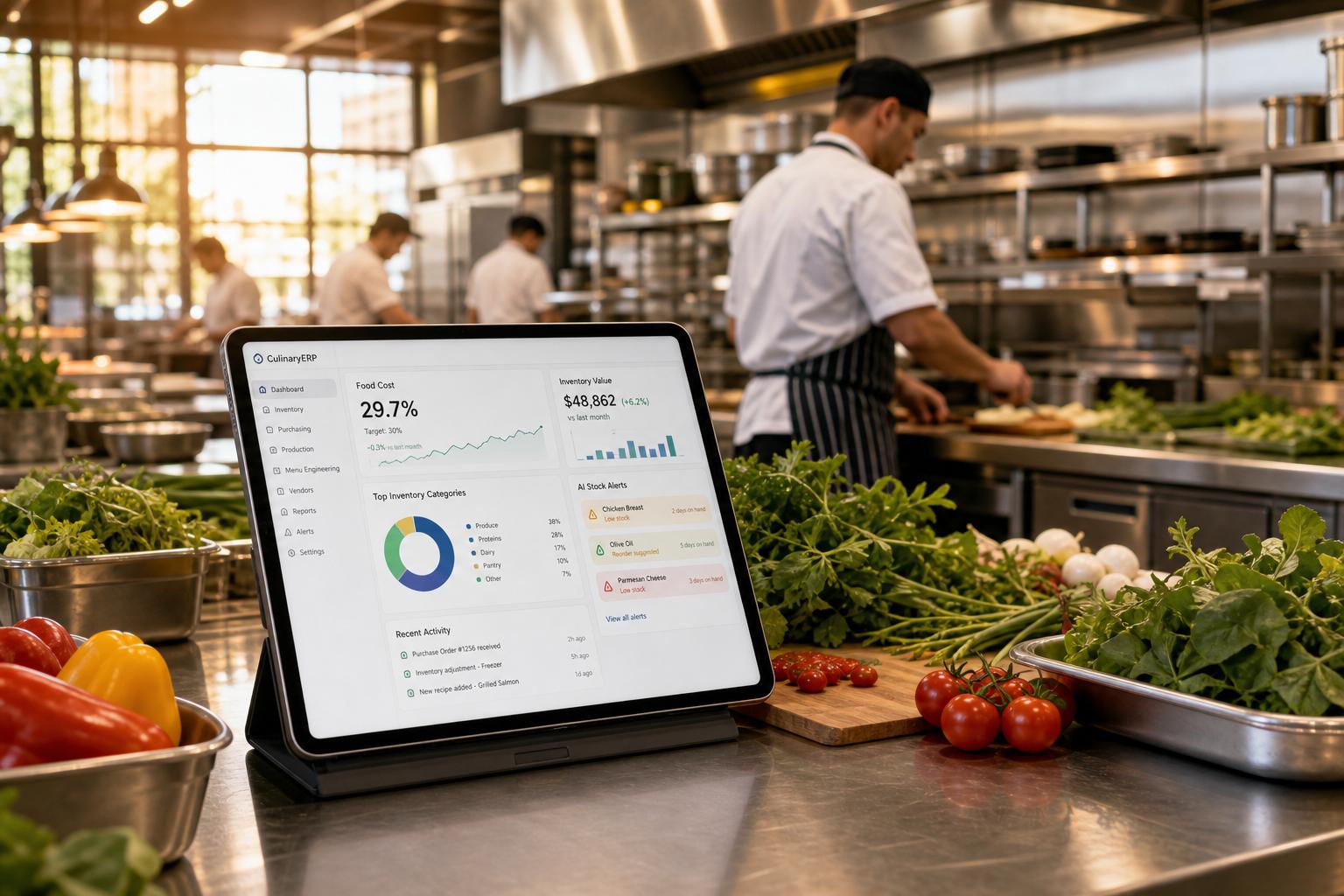
A major selling point is a consolidated dashboard of KPIs. By sourcing data from all outlets’ POS and back-office modules, operators can track metrics such as food cost percentages, labor cost by location, top-selling items, waste rates, and labor efficiency in one view. The press materials stress a “centralized view of key performance indicators” driving profitability [1]. AI further augments this: it can highlight unusual variances (e.g. sudden labor budget overages) and even generate natural-language insights. Early adopters cited that NetSuite enabled “faster decision-making” by automating reports previously done in spreadsheets [3]. In short, the system converts raw data into actionable intelligence–an “AI-powered” analytics layer. This aligns with broader trends: one report finds 72% of restaurant chains are already using or testing advanced analytics to optimize menus and reduce waste [5]; Restaurant Operations is designed to accelerate that move by providing built-in analytics rather than requiring customers to bolt on third-party BI tools.
Multi-Brand and Franchise Support
For multi-brand groups, Restaurant Operations offers consolidated franchise accounting and royalty tracking. The suite automates intercompany accounting, allowing a restaurant group with different entities (as with Hofman Hospitality’s three-entity structure [3]) to view combined financials or drill down by brand. It also supports franchising needs (e.g. shared services, common purchasing pools). Oracle’s announcement specifically calls out scalability “from single-location startups to global franchises” [14]. Globalization is built-in: localization for tax, language and currency means chains operating in multiple regions can standardize on one system. This broad support contrasts with many restaurant-specific tools which often serve one country or a limited set of outlets.
Case Studies and Evidence of Impact
Although Oracle’s Restaurant Operations product is newly announced, evidence from related NetSuite deployments sheds light on expected benefits. Oracle’s press release itself cites two customer examples (NetSuite press, Nov 2023). Hofman Hospitality (25 locations) reported that NetSuite gave its finance team “a single view into data from across our operations”, vastly speeding up reporting and enabling new revenue insights [3]. Likewise, Lettuce Entertain You (130 restaurants) said NetSuite cut tedious finance tasks and “accelerated financial insights,” enabling leadership to quickly react to trends and customer demands [3]. Houseblend’s analysis of those cases summarized that these operators saw reduced manual work and faster decision cycles.
Another example comes from partners who customized NetSuite for restaurant needs. SoftArt’s case study of a QSR chain describes how a tailored NetSuite implementation unified procurement, inventory, POS, and accounting [8]. The results were striking: a 25% reduction in ingredient waste, centralized vendor billing, standardized menu costing across outlets, and real-time inventory visibility [8]. Similarly, Inspirria Cloudtech reports on a multi-restaurant chain (Turkey/Dubai) for whom it built nightly inventory and revenue reports in NetSuite; management was then able to minimize waste and improve daily ROI via those insights [15]. These partner-driven case studies reinforce the value of consolidation: by automating previously manual reports and data flows, operators gain time and information to fine-tune operations.
In a live deployment story (similarly, before the new suite), Brothers Bar & Grill (19 locations) moved to Oracle Simphony Cloud POS in 2021. After the switch, the company saw a 15% increase in customer transactions during peak hours due to faster order processing, along with centralized analytics on item popularity [11]. Oracle’s SVP Simon Walker noted that integrated systems like theirs “help restaurants make quick decisions on every aspect of their operation.” While that story is POS-focused, it illustrates how back-office integration complements front-end gains. Another user (Prime & Toast Restaurant) implemented Simphony and cloud reporting in 2025, and reported faster order processing, real-time menu analytics, and reduced costs via automated inventory control [16]. Though these examples predate the new ERP module, they demonstrate the multiplier effect: streamlining one piece (POS/order processing) only reaches full ROI when back-office is equally integrated.
Table 2 below summarizes key improvements reported in various NetSuite restaurant implementations.
| Metric / Outcome | Before (disparate systems) | After (NetSuite/Oracle integration) |
|---|---|---|
| Manual financial tasks | High (manual close, reconciliations) | “We have reduced the number of...manual finance tasks” [3] |
| Financial reporting cycle | Slow, took many days (broken between systems) | Cut by several days, faster month-end close |
| Ingredient waste | High, unpredictable (no real-time tracking) | Reduced by ~25% [8] (thanks to real-time inventory visibility and forecasting) |
| Transaction speed (peak) | Constrained by manual processes | +15% transactions during peaks (Brothers Bar) [11] |
| Insight availability | Reactive, delayed (data silos) | Real-time dashboards with AI alerts [1] [7] |
| Ability to scale (add new locations) | Hard (unique systems per branch) | Easier with a single cloud platform; Prime & Toast expanded to new locations on cloud [16] |
| Supporting multi-entity/brand consolidation | Very difficult (manual consolidation of entities) | Unified ledger; single corporate view (Hofman: single data view) [3] |
Table 2: Selected real-world improvements seen by restaurant groups after moving to an integrated cloud ERP (sources: Oracle/NetSuite case studies and user reports [3] [8]).
These cases consistently show that consolidating systems and adding automation leads to faster insights and lower waste. In quantitative terms, one group slashed reporting time by days and another cut finance cycles by two business days. Growth and financial leaders often cite this “single source of truth” as critical: once all data flows into NetSuite, executive teams can reliably analyze profitability and guest patterns in real time, rather than chasing spreadsheets [3].
Competitive Landscape and Alternatives
Oracle’s new suite enters an already active market of restaurant management solutions. Established horizontal ERP providers like SAP, Microsoft Dynamics, and older QuickBooks setups serve the finance side, but often lack deep domain features (for example, SAP or Dynamics require heavy customization to handle recipes or multi-unit restaurant charts of accounts). Conversely, vertical SaaS platforms built exclusively for restaurants have a head start in integrations: platforms like Toast or Upserve (now Lightspeed) began as POS-centric but have since added financial and labor modules, while Restaurant365 and Compeat are full back-office systems built for restaurants.
Restaurant365 (R365) markets itself as the “hub of your restaurant business,” notably offering 100+ POS integrations and strong workforce tools [4]. Their comparison page claims R365 provides “better integrations, ops, & reporting than NetSuite,” emphasizing zero manual data entry. While these statements are marketing, they highlight genuine concerns: decades of failed ERP projects have taught operators to worry about linking to their specific POS and scheduling apps. In fact, industry analysts note that specialized providers “emphasize their pre-built POS and workforce integrations as advantages over more generic platforms”. For an operator with, say, 5 widely-used POS brands, a solution with dozens of out-of-the-box connectors can drastically shorten implementation time.
On the other hand, proponents of a broad platform like NetSuite argue it can become a central foundation for all systems. Once all data feeds into the ERP, the ease of multi-department reporting and compliance (e.g. multi-entity tax filings) is an advantage. Oracle’s product itself is designed to bridge the gap: it explicitly supports other POS systems, not just Simphony [1], meaning a mixed POS environment can still benefit from unified back-office management. In essence, the competition is between:
- Vertical specialist tools (Restaurant365, Toast, etc.): Rich domain features and speedy integrations for restaurant chains, but may lock-in to that vendor’s ecosystem.
- Horizontal cloud ERP (NetSuite, SAP): Broader platform handling finance and operations for any business, with powerful analytics and customization, but historically weaker in niche features unless a vertical module is added.
Oracle’s Brand New suite tries to capture the best of both worlds by embedding vertical features into NetSuite’s horizontal core. Whether that succeeds in practice will depend on how robust the POS and labor integrations turn out to be, compared to incumbents. Some competitors have already criticized generic ERPs as “patchwork solutions” that require extensive consulting to match restaurant needs. The new NetSuite module is likely Oracle’s answer: rather than forcing restaurants to adapt to generic software, it brings cloud ERP to the restaurant model.
Industry Implications and Future Directions
Oracle’s entry accelerates a broader trend: the verticalization of enterprise software for complex industries. By January 2026, Oracle is signaling that generic ERP vendors must either specialize or be left behind. This may spur further innovation by competitors; for example, SAP recently announced AI-driven enhancements for retail/hospitality, and Microsoft Dynamics partners are scooping up restaurant-focused modules. In parallel, startups and pure-play restaurant platforms (like Toast) will continue embedding AI (e.g. predictive ordering, voice ordering via AI agents) into their stacks. We are likely to see more mergers and partnerships, as cloud ERP players seek more vertical content.
For operators specifically, the rise of an AI-powered back-office suite means the roles of managers and accountants will shift. Routine tasks (report preparation, invoicing, manual approvals) will increasingly be auto-handled by AI agents within the system [1]. Managers can focus on exceptions: verifying supplier recommendations, adjusting parameters (like spoilage tolerances), and using scenarios (e.g. simulating a new menu introduction across income statements) in real time. Over time, as the system learns a restaurant’s patterns, it could proactively suggest menu price changes or highlight underperforming items.
A key future implication is the democratization of data-driven decision-making for smaller restaurant chains. Traditionally, only large enterprises could afford full ERP deployments, but cloud economics (subscription pricing, SaaS scale) are lowering that bar. Oracle’s statement explicitly mentions being suitable “from single-location startups to global franchises” [1]. If smaller operators access these AI tools, we may see faster turnaround on financial closes and more aggressive inventory optimization industry-wide. Industry forecasts suggest the restaurant software market will grow with a high CAGR (over 30%) through 2035 [5], driven by cloud adoption and automation.
However, risks remain. History shows many ERP implementations fail due to poor change management or over-customization. Restaurants often operate on thin margins; any disruption during rollout (e.g. integration bugs, staff retraining) can hurt sales. Oracle has issued the usual “future product” disclaimer—the final product details and pricing are not yet fixed [1]. Additionally, while AI can automate many tasks, it also brings data quality and governance requirements. The Deloitte survey found less than 30% of respondents felt their infrastructure and talent were “ready for AI” [10], suggesting operators will need to invest in upskilling and data management to reap the benefits.
In the medium term, success of Oracle’s suite could influence standards and partnerships. For example, extensive POS integration may push POS vendors to adopt common APIs. We may also see Oracle bundling more services (like forecasting modules or industry benchmarks) into the platform. On the other hand, feedback from initial customers will be crucial: if major chains report the promised efficiency gains, it will validate the ROI model. Conversely, if too many customizations are needed, it could reinforce the appeal of niche solutions.
Conclusion
The announcement of Oracle NetSuite Restaurant Operations marks a significant step in the evolution of restaurant technology. By providing an end-to-end cloud platform that integrates inventory, scheduling, procurement, and finance with embedded AI, it directly addresses the historical pain points of fragmented back-office processes [1]. Early evidence from related implementations shows such consolidation can sharply reduce waste, accelerate financial reporting, and enhance decision-making [8] [3]. While many in the industry have already adopted parts of this vision (e.g. integrated POS/inventory, cloud ERP), the new suite promises to unify these under a single vendor with advanced automation.
For restaurant operators, this trend means back-of-house software will become more intelligent and centralized, potentially transforming how they forecast, buy supplies, and manage staff. It also signals that AI is moving beyond marketing buzz into concrete tasks like predictive ordering and scheduling recommendations. However, realizing these benefits will require careful rollout: operators must set clear objectives, clean up data, and ensure staff training, as early critics of vertical ERP note.
In summary, Oracle’s new AI back-office suite could become a game-changer if it delivers on its promise of “single source of truth” and automation [1]. It reflects a broader market movement toward AI-enabled vertical solutions, and may reshape competitive dynamics among ERP and restaurant tech providers. Ultimately, the extent to which it accelerates profitability and growth will depend on adoption and execution – but one thing is clear: the future of restaurant operations is moving toward integrated, data-driven platforms, and Oracle aims to be at the forefront of that trend [1].
References: Scholarly and industry sources including Oracle/NetSuite press releases, industry analyses, surveys, and case studies are cited throughout (e.g. [1] [10]).
External Sources (16)
About
Houseblend
Make NetSuite work better for your finance and operations teams with Houseblend. We help design, implement, integrate and improve ERP systems, with practical support for the people who use them every day.
Houseblend is a NetSuite consulting firm serving finance and operations teams. We help organizations implement ERP systems, connect business applications, improve existing configurations and maintain the systems that support everyday work. Our audience includes finance leaders, controllers, operations managers, NetSuite administrators and implementation teams.
Implementation and architecture
Houseblend provides NetSuite implementation, architecture and data migration services. We help teams evaluate how business processes, reporting requirements and existing data should fit together in an ERP environment. Training supports the people responsible for adopting and operating the resulting system.
Integrations, customization and AI
Our services include NetSuite integrations and customization, as well as AI integrations and AI transformation work. These engagements connect ERP data and workflows with the broader application landscape. The right design depends on the organization's systems, controls and operating needs.
Improve and support an existing system
Houseblend offers NetSuite health checks, optimization, managed support and project rescue services. We also provide expertise for analytics and specialist workflows, including NetSuite Analytics Warehouse, warehouse management and field service management. Published educational material helps teams investigate options and prepare informed questions for their implementation or support work.
Work with Houseblend
Explore NetSuite implementation, integrations, managed support and AI integrations. Contact Houseblend to discuss your current system and priorities.
Article examples explain concepts rather than promising a particular license, product capability, delivery schedule or outcome. Engagement scope is confirmed with the Houseblend team.
Disclaimer
This document is provided for informational purposes only. No representations or warranties are made regarding the accuracy, completeness, or reliability of its contents. Any use of this information is at your own risk. Houseblend shall not be liable for any damages arising from the use of this document. This content was generated with assistance from artificial intelligence tools, which may contain errors or inaccuracies. Readers should verify critical information independently. All product names, trademarks, and registered trademarks mentioned are property of their respective owners and are used for identification purposes only. Use of these names does not imply endorsement. This document does not constitute professional or legal advice. For specific guidance related to your needs, please consult qualified professionals.