Houseblend Article
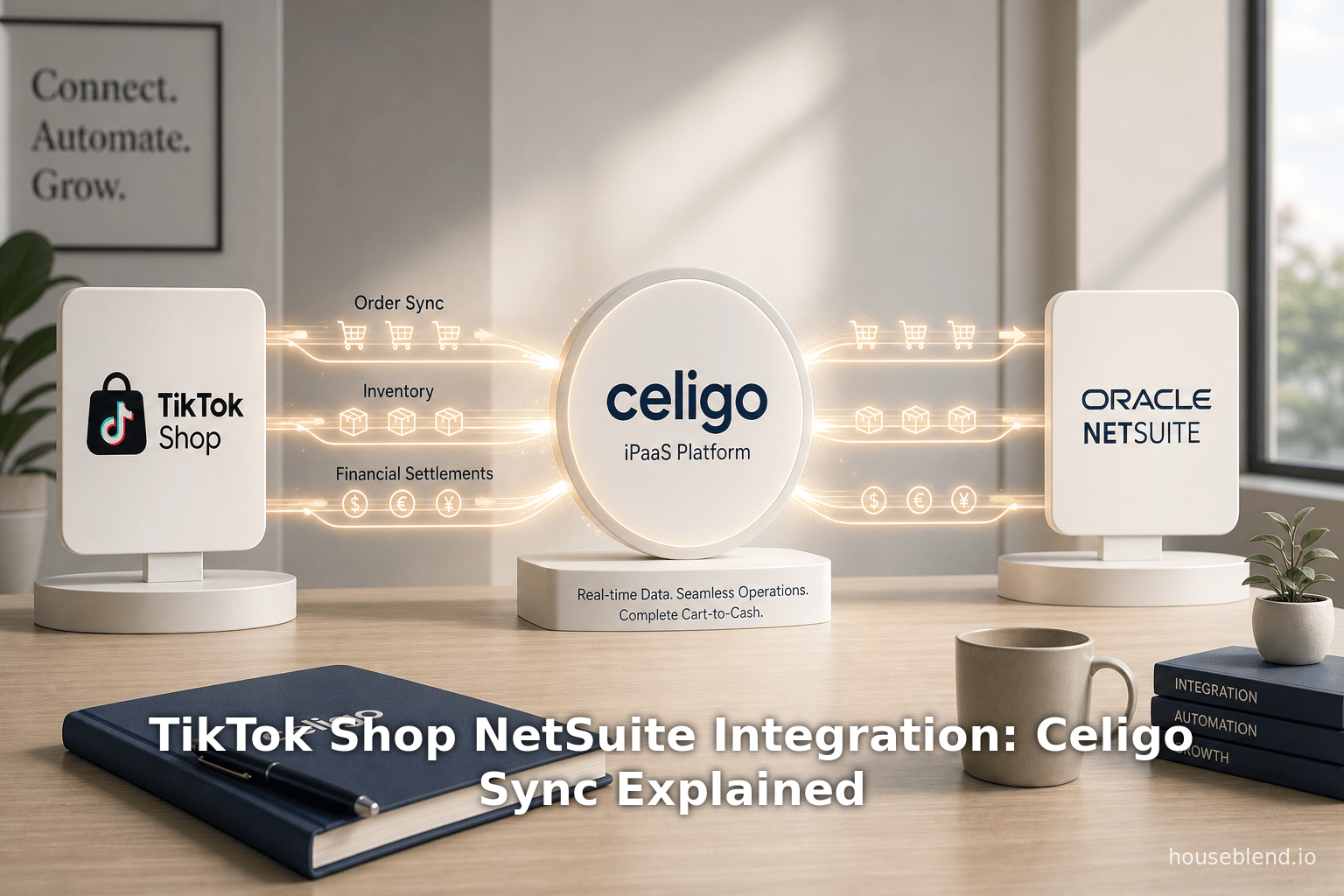
TikTok Shop NetSuite Integration: Celigo Sync Explained
Inside this article
- 01Executive Summary
- 02Introduction
- 03Background: TikTok Shop and NetSuite
- 04Order Synchronization
- 05Inventory Management
- 06Fulfillment and Order Updates
- 07Settlement Synchronization
- 08Data Analysis: Benefits and Outcomes
- 09Case Studies and Examples
- 10Other Perspectives and Alternatives
- 11Future Directions and Implications
- 12Conclusion
Executive Summary
TikTok Shop has rapidly evolved into a global social‐commerce powerhouse, fundamentally changing how consumers discover and purchase products online [1] [2]. In 2025 alone, TikTok reported extraordinary growth – U.S. TikTok Shop sales were up 120% year-over-year [1], and analysts estimate the platform’s Q3 2025 gross merchandise volume at ~$19 billion (nearly matching eBay) [3]. Major brands are flocking to TikTok Shop (Ulta Beauty and Sally Beauty launched TikTok storefronts in 2026 [4]), and consumer research shows TikTok ranks among the fastest-growing discovery-commerce channels (Nielsen IQ found TikTok Shop was the fastest-growing European online retailer in 2024 [5]). These sky-high volumes and the real-time nature of TikTok’s live-shopping format create acute operational challenges: orders surge unpredictably, inventory must be tightly managed, and timely financial reconciliation is critical to cash flow.
For merchants on TikTok Shop, integrating TikTok’s order, inventory, and settlement data with their back-office ERP (like NetSuite) is essential. Without automation, sellers face “manual processing queues” and backlogs during peak demand [6] [7]. Conversely, a well-designed integration creates a seamless “cart-to-cash” pipeline. For example, Celigo’s TikTok Shop Connector (part of Celigo’s integrator.io platform automatically pulls each TikTok order into NetSuite as a Sales Order, complete with item details, pricing, customer data, and social-media promotions [8]. When inventory counts change in NetSuite, Celigo pushes updated stock levels to TikTok Shop in near real time to prevent overselling [9]. Similarly, once an order is fulfilled in NetSuite, shipment tracking and carrier information are written back to TikTok to meet the platform’s performance requirements [9]. Finally, Celigo can import TikTok’s daily settlement statements (via TikTok’s finance APIs) into NetSuite, automatically posting gross sales, fees, refunds, and net payouts for full reconciliation [10] [11].
This report provides a comprehensive analysis of TikTok Shop–NetSuite integration using Celigo. We review the historical rise of social commerce and TikTok Shop, NetSuite’s role as an omnichannel ERP, and why connecting them is vital for modern retail. We detail the technical data flows for orders, inventory, fulfillment, and financial settlement, including how Celigo leverages TikTok’s Open APIs and webhooks. Comparative tables examine other integration solutions and data mappings. The report also includes case examples (e.g. Perfect Keto and Eyebobs) quantifying the operational benefits of integration, as well as expert commentary on best practices. We conclude with future directions, including expanding social-commerce connectors and evolving platform features.
Introduction
Social Commerce and TikTok Shop: Over the past decade, retail has shifted dramatically toward social commerce. Platforms like Instagram and Facebook first added shoppable posts, but TikTok has taken the concept to a new level with TikTok Shop, which embeds an entire store within the app. Launched in China in 2021 and expanded to Western markets by 2023, TikTok Shop enables real-time “discovery e-commerce”: shoppers see products featured in short videos and live streams, then purchase in-app without leaving the feed [12] [1]. This model has driven explosive growth. For example, TikTok Shop’s Gross Merchandise Volume (GMV) hit about $33.2 billion in 2024 (globally) [13], with a record $19 billion in a single quarter (July–September 2025) [3] – figures comparable to legacy marketplaces. TikTok’s internal data highlights the platform’s reach: over 70 million product listings across 750 categories [14], and by mid-2025 “small” sellers (under $30M annual revenue) were driving 70% of US TikTok Shop purchases [15]. Major brands are also joining, as evidenced by TikTok’s rapid user base growth in the UK (131% more shoppers in 2024, 180% more revenue YoY [5]) and global expansions into new markets like Brazil, Mexico, and Europe. In short, TikTok Shop has become a full-fledged retail channel, not merely a novelty feature [16] [2].
Enterprise Resource Planning with NetSuite: In parallel, many retailers rely on Oracle NetSuite (a cloud ERP to manage finance, inventory, orders, and fulfillment across all their channels. NetSuite boasts 38,000+ customers (as of mid-2024) and generates ~$1 billion in revenue per quarter [17]. It provides a “single source of truth” for e-commerce operations, unifying sales orders, financial ledgers, and inventory records [18]. Studies of e-commerce brands show that automating order-to-cash processes yields dramatic ROI: one retailer saved ~$200K by automating Shopify/Amazon order imports via Celigo [19], while another cut its month-end close by two-thirds through integration [19].In an era where global online retail sales are projected to exceed $6.42 trillion in 2025 (≈21% of all retail) [20], the scale of data and transactions far outstrips what manual systems can handle. NetSuite (often with SuiteCommerce or third-party connectors) is the de facto backbone for many Direct-to-Consumer (DTC) and omnichannel brands, so integrating new channels like TikTok Shop into NetSuite is a logical and necessary step to maintain data consistency and operational efficiency.
Integration Imperative: Despite TikTok’s novelty, the underlying problem is familiar: adding a new sales channel without integration leads to “swivel-chair” workflows and humans copying data between systems. Each TikTok order contains unique fields (promotions, creator affiliate info, etc.) and must be manually re-entered into NetSuite unless systems are connected. As one integration consultant notes, without automation TikTok Shop orders end up in a “manual processing queue,” slowing fulfillment [6]. Likewise, inventory discrepancies can cause oversells during viral spikes (TikTok metrics show “extreme weight on fulfillment, and late shipments or stockouts can trigger penalties” [21]). Settlement reconciliation is particularly painful: TikTok deposits sellers’ earnings in batches net of fees, requiring back-posting of gross sales and fees to NetSuite accounts. Industry sources (e.g. Pipe17) warn of this “pain point” – manually matching hundreds of orders and fees to a single bank deposit is nearly impossible without integration [22].
Celigo’s Role and Scope: Celigo is a leading integration Platform-as-a-Service (iPaaS) that is heavily used by NetSuite customers. It has an extensive Gartner-vetted presence (ranked a Visionary in iPaaS [23]) and specializes in e-commerce connectors. In April 2024, Celigo announced a formal partnership with TikTok Shop, releasing the TikTok Shop Connector (integrator.io) to “unlock new opportunities” for retailers [24]. The Celigo TikTok Connector is marketed to “keep data current and synced” across orders, products, fulfillment, and accounting [25]. This report focuses on how Celigo’s integration can synchronize orders, inventory, and settlements between TikTok Shop and NetSuite (the third corner of the data triangle being “fulfillment,” which we also cover) – ensuring that a merchant’s back-office always reflects the activity on their TikTok storefront.
Throughout, we draw on a wide range of sources – platform documentation, press releases, vendor blogs, and industry analyses – to provide an evidence‐based, multi-perspective view. We compare Celigo’s connector with other solutions, analyze technical data flows, and cite real-world usage statistics and case examples. The goal is a thorough understanding of how the Celigo‐driven integration works today, why it matters to e-commerce businesses, and what the future of TikTok-commerce integration may hold.
Background: TikTok Shop and NetSuite
TikTok Shop: Features, Scale, and Growth
TikTok Shop is the in-app marketplace launched by ByteDance. It allows brands and creators to sell products via three main touchpoints: shoppable videos (users can tap to buy directly from product videos), live streams (creators demonstrate products live and accept viewer purchases), and an in-app storefront/marketplace (catalog of listings) [12] [8]. By late 2024, TikTok Shop had amassed 200,000+ active sellers (mostly SMBs) on a global scale [26], more than doubling year-over-year. User engagement is intense: in the US alone, influencers logged over 8 million live-shopping hours in 2024, and about 76% of TikTok Shop viewers ended up making a purchase from a stream [27]. Credible third-party estimates (e.g. eMarketer) projected TikTok Shop’s US GMV could reach tens of billions by 2026, and the platform’s own statistics underscore the speed – in H2 2025 TikTok’s Discovery e-commerce model drew more than 5 million new buyers during Black Friday/Cyber Monday [2] and saw 120% sales growth in the first half of 2025 [1].
TikTok has treated Shop as a strategic priority. The platform heavily vets listings (rejecting 70 million questionable products in H1 2025 [28]) and offers specialized logistics via “Fulfilled by TikTok (FBT)” warehouses to fast-track shipping (studies show FBT-tagged items see ~15–20% higher conversions [27]). Geographically, after success in China and Southeast Asia, TikTok Shop launched in the UK (2023), US (Fall 2023), and expanded to Mexico, Brazil, Europe, and other markets by mid-2025 [1] [4]. TikTok itself declares Shop as a “discovery commerce” engine where 83% of users report finding new products and 70% discovering new brands [29]. In sum, TikTok Shop has become a critical channel for brands aiming to reach younger, mobile-first consumers via content-driven retail.
Oracle NetSuite: The ERP Backbone
NetSuite is a cloud-based ERP that integrates core back-office functions. It has strong support for multi-channel retail: NetSuite’s SuiteCommerce platform provides e-commerce storefronts, but many merchants use NetSuite primarily as the centralized ERP and rely on connectors to sleep content from external stores. NetSuite records Sales Orders, invoices, item fulfillments, inventory levels, customer records, financial reports, etc. As of 2026, NetSuite’s install base exceeds 38,000 customers globally [17], and it is often the financial system of record for DTC brands. Crucially, NetSuite distinguishes between key records in the order‐to‐cash process: e.g. a new sale might generate a Sales Order (commonly in NetSuite) and then either an Invoice or a Customer Deposit (depending on payment terms), followed by an Item Fulfillment when shipped [10] [30].
For companies running multiple sales channels (Amazon, Shopify, etc.), “unity” of data in NetSuite provides a single source of truth for inventory counts, revenue recognition, and reconciled accounting. Integration is known to yield dramatic efficiency: for example, an eyewear retailer automated Shopify/Amazon orders via Celigo and saved roughly 2.5 FTE ($90K) in labor [31]. Perfect Keto, another DTC brand, reclaimed 10–15 staff-days per month after deploying Celigo to automate multi-channel sales [32]. In general, unified systems improve order processing speed (studies cite 45–60% faster processing [19]) and significantly reduce errors in reporting. Given NetSuite’s role and scale, connecting TikTok Shop with NetSuite is an essential step for any growing brand that uses both.
Celigo Integrator.io: iPaaS for ERP Integration
Celigo (Redwood City, CA) offers integrator.io, a leading integration Platform-as-a-Service (iPaaS) often focused on connectivity to NetSuite and other business apps. Unlike generic middleware, Celigo provides prebuilt “Integration Apps” (for Shopify, Amazon, Salesforce, PayPal, etc.) and visually-driven flows that require minimal coding [33]. Notably, Celigo understands NetSuite natively: it supports NetSuite’s REST web services, SuiteScript triggers, saved searches for exports, and custom records – enabling robust two-way syncs [34]. Celigo has strong industry recognition (Visionary in 2024 Gartner Magic Quadrant for iPaaS, G2’s #1 iPaaS for successive quarters [23]) and claims outcomes like automating 100K+ orders per year and resolving ~95% of integration errors automatically via AI [35] [36].
In April 2024, Celigo announced a partnership with TikTok Shop to launch the TikTok Shop Connector [24]. The press release highlights that this connector “keeps data current and synced” across product data, orders, fulfillment, and accounting [25]. Celigo’s website elaborates that its TikTok integrations cover use cases in ERP, finance, PIM, etc. For example, Celigo explicitly supports settlement reconciliation: its TikTok connector “automatically search[es] and export[s] settlement data from TikTok Shop, allowing you to scale your processes” and even handles “payouts reconciliation, settlement reconciliation, sales tax reports… and more” [37] [38]. In practice, Celigo acts as the hub (in a hub-and-spoke model [39]) between TikTok Shop and NetSuite. Merchants connect each platform to Celigo; Celigo manages API credentials and orchestrates data flows. This decoupling means NetSuite’s credentials remain centralized in Celigo, improving security and manageability [39].
Celigo’s TikTok Connector is a pre-configured package of flows and mappings that can be customized. It is designed to handle TikTok-specific features (e.g. TikTok coupon codes, Live event tracking) out of the box. Based on Celigo’s own materials and partner documentation, the connector can automatically import TikTok orders into NetSuite as Sales Orders, keeping promotions and discounts intact [25] [8]. It can push NetSuite’s inventory levels back to TikTok to avoid oversells [9]. It can update order status: when a NetSuite Item Fulfillment is created (i.e. order shipped), Celigo will push the carrier and tracking info back to TikTok Shop [25] [9]. It also manages the financial side: Celigo can pull TikTok’s daily settlements (using TikTok’s Finance APIs [40]) and load them into NetSuite so that accounting always knows which sales, fees, and refunds netted out to the bank deposit.
In sum, Celigo’s integrator.io provides a highly configurable, cloud-based solution that avoids custom coding. Table 1 (below) compares Celigo’s TikTok connector with several other integration approaches, illustrating the broad feature coverage of an iPaaS solution. (Sources for Table 1 include Celigo’s official press release [25] and product documentation from other vendors [8] [41].)
| Solution | Type | Order Sync | Inventory Sync | Promotion Handling | Fulfillment Sync | Settlement Sync |
|---|---|---|---|---|---|---|
| Celigo TikTok Connector | iPaaS (pre-built) | Two-way: TikTok orders → NS Sales Orders [25] [8] | Yes: NS stock → TikTok (real-time/bi-di) [9] | Yes: TikTok coupons applied as discounts in NetSuite [25] | Yes: NS Item Fulfillments → TikTok order status (with carrier/tracking) [9] | Yes: Daily settlements → NetSuite postings of sales, fees, refunds [37] [11] |
| BrokenRubik (Celigo-based) | Consultant/IPaaS | Yes: automated TikTok orders into NS (full details) [8] | Yes: instant push NS to TikTok to avoid oversells [9] | Yes: supports TikTok coupon/discount syncing (via Celigo flows) | Yes: carrier & tracking updates pushed from NS to TikTok [9] | Partial: can use Celigo flows to import payouts (consulting required) |
| Beehexa (HexaSync iPaaS) | No-code iPaaS | Yes (template flows) [42] | Yes (via product sync template) [42] | Limited: templates cover basic prices/descriptions | Yes (updates fulfillment status to TikTok) [43] | ? (limited info; presumably pulls settlement data) |
| Consta Commercium | Cloud Integration | Yes (TikTok → NS) [44] | Yes (NS → TikTok) [44] | Yes (push NS catalog to TikTok) [44] | Yes (NS tracking → TikTok) [45] | ? (no clear built-in support for settlement) |
| Synder (Accounting app) | ERP Finance tool | Yes: loads all TikTok sales and refunds into NS via journal entries [46] | No | Limited: campaign tagging only [46] | No (no shipping info) | Yes: syncs every order/fee/refund into NS [46] |
Table 1: Comparison of example TikTok–NetSuite integration solutions. Sources: Celigo press release [25]; vendor documentation [8] [41].
Key point: Celigo’s prebuilt TikTok Connector covers the major needs (orders, inventory, fulfillment, settlements) out of the box [25] [37], whereas many alternative tools may require additional configuration or may not natively handle every aspect (e.g. few solutions automate settlement reconciliation fully, which Celigo explicitly does). In the following sections, we delve into each of the three core sync areas (order, inventory, settlement) in depth, explaining how the data flows and how Celigo implements it.
Order Synchronization
When a customer places an order on TikTok Shop, that transaction contains detailed data (customer info, items, quantities, promotions, shipping address, payment status, etc.). The TikTok Shop–NetSuite integration’s first priority is importing that order as a Sales Order (or equivalent) in NetSuite with full fidelity.
TikTok Order Data
TikTok’s Order API/Webhooks: TikTok provides a well-documented Open API for retrieving orders. Integration can proceed in two ways: polling and event-driven. TikTok’s Partner API allows an app to query new orders (e.g. via a GET request on the /api/orders endpoint with filters), or subscribe to webhooks to be notified instantly. The platform supports real-time webhooks for events like “Order Created” and “Order Status Update” [47]. Subscribing to the Order Status Update webhook topic means Celigo can receive an HTTP notification as soon as an order is placed (or updated) on TikTok [47]. This avoids polling delays and ensures minimal lag, which is important because TikTok’s operations emphasize fast fulfillment. Alternatively, Celigo can use scheduled flows (e.g. every few minutes) to call the “Get Orders” API to fetch any new orders.
Once an order is obtained, the integration has access to fields such as: Order ID, order date, customer name/email, shipping address, line-item details (SKU, quantity, unit price, any TikTok promotions or coupons applied), taxes, shipping costs, total paid, and platform-specific fields (store ID, live-stream ID, affiliate commission info, etc.). This raw order data must be mapped into NetSuite.
Mapping to NetSuite
Customer Records: TikTok Shop orders include buyer information that may or may not match an existing record in NetSuite. A critical design decision is how to map TikTok buyers to NetSuite customers. One common pattern is to have a generic “Web Store Customer” record in NetSuite, and either create a new sub-record under it for each TikTok buyer or map by email. This avoids proliferating near-duplicate customers when many buyers checkout as “guests” [48]. The integration must also import the shipping address (and possibly billing address) into the Sales Order stamped in NetSuite.
Sales Order Creation: In NetSuite, TikTok orders typically become Sales Order records (unless a merchant prefers Order Records or Cases – but Sales Order is standard for e-commerce). Celigo can use NetSuite’s REST API to create a Sales Order with all the lines from TikTok. Each line item from TikTok (identified by SKU or item number) maps to a corresponding Inventory Item in NetSuite. Unit prices and quantities are set according to the TikTok order, and any discounts or promotions must be recorded. NetSuite allows order-level or line-level discounts; Celigo’s flows ensure that TikTok’s coupon codes, bundle deals, or special pricing are reflected (for example, a TikTok coupon would be added as a discount on the Sales Order) [25]. If TikTok’s API reports taxes and shipping charges, those fields can populate the Sales Order’s freight item and tax lines.
Custom Fields and Tracking: Because TikTok Shop has some unique attributes (like coupon codes, buyer comments, or affiliate info), a robust integration may use custom fields in NetSuite to capture this data. For instance, if a video had an associated “TikTok Live Session” ID, the integration could store it on the Sales Order for reporting. Celigo’s platform allows custom field mappings so that any relevant TikTok-order field can be carried into NetSuite records.
Example Flow: A typical sequence for each TikTok order is:
- Order Trigger: An order is placed on TikTok Shop. Either TikTok’s webhook fires or Celigo’s schedule flow queries the “new order” endpoint.
- Data Transformation: Celigo parses the JSON/XML order payload, formats customer name, splits address, and looks up NetSuite Item IDs from SKUs. It also calculates net totals if needed.
- NetSuite Sales Order Creation: Using NetSuite’s API, Celigo creates a new Sales Order, populating fields: customer, shipping location, order date, each line item (with quantity, rate, tax code), shipping charge, and applying any discounts or promotions as needed.
- Payment Handling: In many TikTok integrations, the actual payment is handled by TikTok (customers pay on TikTok, which holds funds until settlement). Celigo may record a Customer Deposit in NetSuite at the time of order to reflect the prepaid amount, or handle invoicing later – depending on the merchant’s accounting practice. (For example, some integrations do accrual accounting: they record sales upon shipping rather than payment [10].) The exact approach (Sales Order + Customer Deposit vs. Sales Order + Invoice) can be configured in Celigo’s flow rules.
BrokenRubik (a Celigo partner) describes a similar implementation: TikTok orders “create a Sales Order in NetSuite with complete details including item mapping, pricing, shipping address, and applicable promotions” [8]. Celigo’s flows likewise preserve TikTok’s order metadata (e.g. channel codes or TikTok coupon IDs).
Error Handling: After sending each order to NetSuite, Celigo provides logging. If an order fails (e.g. missing SKU, tax code issue, or API error), Celigo’s dashboard flags it. Often the integration will retry or create an “error” email/Ticket for manual review. Once fixed (by adjusting mappings or data), the flow can be resumed. This ensures no order is lost; Celigo’s AI-driven error handling even pre-resolves common issues [35].
Order Processing in NetSuite: After Celigo creates the Sales Order, standard NetSuite workflows kick in. For example, once inventory is available, an Item Fulfillment can be created and shipped, then an Invoice (if not already done), and the Payment applied. The integration considers this downstream flow: it tracks orders in NetSuite and will update TikTok with the fulfillment status (see “Fulfillment Sync” below).
In summary, order sync via Celigo ensures that every TikTok Shop order is mirrored as a Sales Order in NetSuite automatically. This eliminates manual order entry and ensures financial accuracy. In one testimonial, a Celigo client observed that integrating TikTok Shop freed the team from re-keying orders, cutting data-entry work by up to 60–80% [7].
Inventory Management
A critical second pillar of integration is keeping inventory synchronized between NetSuite and TikTok Shop. The fast-moving nature of social commerce means inventory levels can change rapidly (e.g. a product featured in a viral video might sell out in minutes), so accurate quantities are essential to prevent overselling and stockouts.
Bi-Directional Inventory Flow
NetSuite → TikTok: Most businesses treat NetSuite as the “master” for inventory. In practice, Celigo can be configured to push NetSuite item quantities (usually available to promise) up to TikTok Shop frequently. For example, when NetSuite inventory is updated (due to receiving new stock or a sale on another channel), a Celigo flow can immediately call TikTok’s API to update the corresponding product’s quantity. For large catalogs, many use a hybrid approach: real-time updates for critical SKUs and nightly batch updates for the whole range.
Salora ERP recommends this pattern of near-real-time sync plus an overnight sweep: “Publish on-hand available-to-promise by location in near-real-time, plus an overnight sweep” [49]. The idea is that near-real-time pushes handle immediate changes (e.g. an Amazon sale might drop inventory by 5 units, so Celigo instantly updates TikTok to avoid oversells), while an end-of-day batch run reconciles any discrepancies (catching any missed updates or rounding issues). This two-step approach is especially important on TikTok because overselling can be heavily penalized: TikTok Shop metrics place “extreme weight on fulfillment speed” and merchants can lose privileges if cancellations climb [50] [27].
TikTok → NetSuite: Conversely, TikTok has its own inventory concept: e.g. if a merchant uses TikTok’s Fulfillment Network (FBT) services, TikTok will hold some stock. In such cases, TikTok may relay fulfillment statuses (and possible inventory changes) back to the merchant. For pure drop-shipping, TikTok typically does not manage your stock—you push it in NetSuite alone. However, if TikTok reports back successful fulfillment (or returns), Celigo could adjust NetSuite inventory. For now, most flows treat NetSuite as the stock authority and use TikTok updates only to confirm or adjust the expected status (especially for FBT items where TikTok decrements stock).
Use Case – Oversell Prevention: The primary purpose of this sync is to avoid selling more units on TikTok than you actually have. For example, BrokenRubik notes that NetSuite’s inventory is “fed back to TikTok Shop to prevent overselling,” which is “critical given how quickly viral content can drive spikes in demand” [8]. In practice, after a NetSuite fulfillment (or even a transfer between warehouses), Celigo will recalc on-hand quantity and send an update to TikTok via its Product/Inventory API. TikTok’s platform then immediately reflects the new stock level on the item’s listing (if it maintains a catalog in their system).
Item and Catalog Sync
While orders and inventory are central, many integrations also handle product master data. If a merchant manages an item’s description, title, images, or price in NetSuite (or an associated PIM), Celigo can push those attributes to TikTok Shop. For instance, Celigo’s TikTok connector advertises that it can auto-sync titles, descriptions, pricing, and images from the ERP to TikTok [51] [52]. This ensures that shoppers always see up-to-date product info. However, some merchants prefer managing the TikTok product catalog directly in TikTok Shop (especially given TikTok’s unique ad/promotion formats), so this part can be optional.
If used, the integration flow for product sync might be: whenever a NetSuite Item is created or updated, Celigo updates the corresponding TikTok product via API. Key fields include SKU, name, price, weight, and custom attributes. Houseblend’s example comparison notes that Celigo’s connector can “push titles, images, pricing” to TikTok [53]. Other vendors (BrokenRubik, Beehexa) offer product sync templates as well. In any case, ensuring SKU consistency is paramount – the integration relies on SKUs or UPCs to match items between systems, so these must be pre-aligned in NetSuite and TikTok to avoid mismatches [54].
Inventory Preventing Latency
A notable challenge is API rate limits. High-volume sellers might have thousands of SKUs or many inventory changes per day. Celigo’s platform is designed to handle high volumes (advertising “infinite scalability” [55]), but flows must be configured thoughtfully. For example, Celigo can batch inventory updates or throttle them. The system also logs each update, which is useful for audit. One user praised Celigo’s run console for showing logs of each sync, aiding reconciliation [56].
Helper Tools: Some third-party tools focus exclusively on inventory sync (e.g. Nventory, Inventory Planner), but a comprehensive Celigo flow can replace those by acting as an “inventory hub.” Table 2 (below) shows a sample mapping of key fields in TikTok’s product/inventory schema to NetSuite fields – a reference for how data lines up.
| TikTok Shop Field | Description | NetSuite Equivalent |
|---|---|---|
| SKU (Item Code) | Vendor’s stock-keeping unit identifier | Inventory Item Name/Number (exact match) [54] |
| Available Quantity | Units currently available for sale on TikTok | NetSuite On Hand (Avail.) at shipping location [49] |
| Price | Unit selling price on TikTok Shop | NetSuite Item Price (or update via Price List) |
| Product Title & Description | Shown on TikTok listing | NetSuite Item Display Name, Description (pushed if using sync) |
| Images/Media | Product images or videos | Attached to NetSuite Item (pushed via API) |
| Item Weight | Used for calculating shipping cost | NetSuite Item Weight/Dimensions |
| FBT Flag | Indicates product is fulfilled by TikTok | NetSuite Item Location/Custom Field (if using TikTok warehouse) |
| Inventory Location | TikTok can track FBT warehouse stock levels | NetSuite Location record that represents TikTok’s warehouse (if needed) |
Table 2: Key TikTok Shop product/inventory fields vs NetSuite data fields. (Note: Exact mappings depend on NetSuite setup; Celigo flows must be configured to match SKUs and item identifiers correctly [54].)
Summary: By constantly syncing inventory from NetSuite to TikTok, the integration prevents the “sold-out” scenario that plagues manual operations during spikes [9]. Industry feedback confirms this is vital: one analysis noted that viral social-sales “order spikes on TikTok can quickly overwhelm naive sellers,” underscoring the “need for real-time inventory sync” [57]. Celigo’s connector and iPaaS architecture are designed to handle this load and keep the two systems in equilibrium.
Fulfillment and Order Updates
Once an order is shipped from the merchant’s warehouse (or 3PL), TikTok requires the seller to update the buyer on fulfillment status. TikTok’s policies emphasize timely “carrier and tracking information” updates to avoid delivery delays [58]. The Celigo integration automates this fulfillment sync.
NetSuite → TikTok: In NetSuite, fulfilling an order usually involves creating an Item Fulfillment record and printing a packing slip or manifest. Celigo can listen for this event (or be triggered by it) and then call TikTok’s API to mark the order as shipped. The API call includes the carrier code and tracking number. TikTok will then notify the buyer (and update the order status in-app).
For example, BrokenRubik’s documentation describes exactly this step: after processing an order, syncing the tracking number back to TikTok is part of the workflow [9]. This ensures TikTok’s metrics are satisfied and the customer sees real-time shipment notifications. Celigo’s flows can also handle partial fulfillments (if an order ships in multiple packages) by making multiple update calls with the relevant quantities.
TikTok → NetSuite (status changes): While most flow is downstream, if a buyer cancels or returns an item on TikTok, the integration can pull that update back into NetSuite. For order cancellations, Celigo would cancel the corresponding Sales Order or mark it canceled. For returns, the flow might automatically create a Return Authorization and subsequent Credit Memo in NetSuite, adjusting inventory accordingly. Celigo’s platform supports custom scripts, so flows for complex return scenarios can be coded. (Some sellers handle returns manually or via their existing RMA flow, but automation is possible to keep TikTok and NetSuite in sync.)
Live Commerce Footprint (Events): TikTok Shopping includes live-stream events. Some merchants track performance by perceiving these as separate “channels”. Integrations typically let you assign a NetSuite Class or Segment (e.g. “TikTok Live”) to orders from live videos. Celigo’s or third-party connectors often have built-in support: for example, entrewise notes that it uses NetSuite Classes to distinguish “Live vs. Video sales” [59]. This isn’t strictly an order-sync function, but it’s part of how orders are processed (tags or custom fields in NetSuite).
Summary: Auto-updating fulfillment status closes the loop in order processing. Celigo’s connectors ensure that once a NetSuite fulfillment ships, the TikTok order is immediately updated, eliminating the manual step of copying tracking numbers. This meets TikTok’s delivery performance metrics and improves customer experience [9] [7]. In practice, integration users report that fulfillment automation drastically cuts “where is my order?” queries, as tracking info flows automatically from ERP to customer inbox.
Settlement Synchronization
Overview: Settlement reconciliation is perhaps the most intricate aspect. TikTok Shop collects payments from buyers and periodically pays out sellers, but these payouts are “net of fees” (TikTok’s commission, payment processing, any vouchers redeemed, etc.). For accurate accounting, NetSuite still must record the gross sale, any refunds, and all fee expenses so that the net cash received matches the bank deposit. Celigo’s TikTok connector specifically addresses this by automating imports of TikTok’s settlement data [37].
TikTok Settlement Data
TikTok provides CSV reports and API endpoints for finances. According to TikTok’s partner documentation, a settlement statement is a daily summary of orders and fees. Integration apps can call endpoints such as Get Statement List (to obtain IDs of statements in a date range) and Get Statement Transactions (to get line-item breakdown of sales, fees, refunds in that statement) [40]. Another endpoint, Get Payment or Get Withdrawals, provides the actual payout amounts. In essence, TikTok’s APIs (or CSV exports) will yield data like: Order ID, Sale Amount, Discount Amount, Refund Amount, Commission Fee, Service Fee, Other Fees, and the resulting Payout.
Mapping to NetSuite (Financial Booking)
Celigo must turn TikTok’s payout statement into appropriate NetSuite records. A common pattern (also used by platforms like Amazon and Shopify) is:
- Gross Sales Recording: For each settlement report, Celigo can generate one or more NetSuite journal entries (or Bills) that credit Gross Sales revenue and debit Accounts Receivable (or Cash) for the total paid. NetSuite e-commerce best practice is often to record the full sales and then separately record expenses.
- Fee Expense Posting: The same flow will debit Expense accounts for each fee (e.g. “TikTok Commission”). If TikTok’s statement shows $100 in sales and $10 fees, Celigo might create a Journal: Debit Cash $90, Debit Fees Expense $10, Credit Sales $100. Or it could use NetSuite’s Vendor Bill to record fees and apply the customer payment against it. The exact method depends on the merchant’s accounting policies. The key is that Celigo automaps each line: platform commission, transaction fees, shipping reimbursements, etc. are posted to the correct GL accounts.
- Refund and Charge Adjustments: If any refunds or order-level adjustments occurred, these appear in the statement too. Celigo must reflect refunds as negative revenue or as adjustments in NetSuite (e.g. creating Credit Memos or negative entries).
- Bank Deposit Matching: Finally, the integration ensures the total “Payout Amount” (the net cash TikTok deposits to the seller’s bank) is posted as Cash based on the journal entries. Often Celigo will group all transactions of a day or statement into one batch deposit in NetSuite, matching the payout in the bank statement.
EntrIwise’s description confirms this process flow: “Periodic imports of TikTok Shop Payments payouts add to NetSuite all order related fees, refunds, debits, credits, and other transactions for fully automatic reconciliation, leaving nothing for manual entry.” [10]. In other words, Celigo can parse the payout CSV or API data and create the full set of NetSuite postings. This eliminates the common pain point of going line-by-line in a bank deposit to allocate orders and fees [22].
Example Flow
A typical settlement sync might work as follows (post-orders):
- Each day (or week), TikTok finalizes a settlement statement covering that period.
- Celigo’s scheduled flow calls TikTok’s settlement API (e.g. GetStatementList with date filters), retrieves the new statement ID(s), and then calls GetStatementTransactions for each.
- Celigo examines each transaction row (order plus fees) and aggregates totals.
- Using Celigo’s mapping, a NetSuite Journal Entry is created: credit Type=“Sales” by total gross sales, debit “TikTok Commission Expense” by commission fees, debit “Transaction Fees Expense”, debit “Shipping Fees” (if TikTok withheld shipping fees), etc., and debit Cash for the net payout.
- Celigo may also auto-match these to existing AR invoices or deposits if using an Accounts Receivable approach. For example, if the integration created an AR invoice for each Sales Order when the order was placed, the combined payout could be applied against those invoices in NetSuite. This ensures AR and GL tie out.
- Any residual differences (e.g. timing gaps) can be held in a Suspense account until reconciled manually, but Celigo can flag them in its logs.
This approach guarantees full transparency: in NetSuite you see the total revenue, total fees, and the net cash. Celigo’s features even extend to reconciling TikTok’s reported withdraw data so that the bank deposit in accounting matches TikTok’s payout exactly [37].
Challenges and Reconciliation
Settlement sync is inherently tricky due to timing and complexity. TikTok may update a statement after initial release (for returns processed post-shipment, for example). Integration must allow reprocessing statements (Celigo flows can be run for past dates if corrected data appears). TikTok also charges some fees on a delayed basis (e.g. chargebacks). Celigo can accommodate these by rerunning settlement flows and adjusting prior entries.
It’s worth noting that some tools focus specifically on “TikTok settlement reconciliation” (e.g. SettleBridge, Pipe17), but Celigo’s connector covers this within its overall flow. By automating settlement import, Celigo frees up accounting staff from manual CSV cleaning. As one expert writes, TikTok settlements “must be posted so that accounts receivable makes sense” – a task Celigo can automate daily [11].
In practice, users report that Celigo’s integration can handle “payouts reconciliation” end-to-end [38], which is a rare but crucial capability. This means that at month-end, everything lines up: NetSuite’s bank deposits and AR balances reflect exactly what TikTok reports as paid out.
Data Analysis: Benefits and Outcomes
Integration provides tangible business benefits beyond avoiding manual drudgery. Drawing from case examples, surveys, and expert commentary, we quantify these impacts:
-
Labor Savings: Companies report dramatically reduced workload. For example, Perfect Keto noted their accounting team regained 10–15 days per month previously spent on manual tasks after Celigo integration [32]. Similarly, Eyebobs (integrating Shopify and Amazon) estimated saving 2.5 full-time employees (~$90K/yr) due to Celigo [31]. In our context, Celigo’s TikTok integration eliminates repetitive copying of orders, ledger entries, and stock counts, which one partner claims typically yields a 60–80% reduction in manual data entry tasks [7].
-
Data Accuracy: By synchronizing systems, data discrepancies plummet. Hairball.IO observes that integration “ensures data is not only connected but synchronized in real time… eliminating the mismatches that lead to wrong shipments, inaccurate financial reporting, and customer complaints” [60]. In TikTok’s context, accuracy is mission-critical: reporting errors could violate TikTok’s strict seller performance metrics. With Celigo, every TikTok order and inventory change is correctly logged, as BrokenRubik notes (demonstrated by synced SKUs, quantities, pricing [8]). As a result, sellers see fewer order errors and fewer customer inquiries about stock or shipments.
-
Speed and Scalability: Integration dramatically accelerates processing time. Instead of days or weeks, new sales data reaches the ERP in minutes. This was true for Eyebobs who could run “really large sales” (e.g. holiday spikes) without a hiccup thanks to Celigo’s scaling [31]. Celigo touts its unlimited scalability for “hundreds, thousands, or millions of orders” [55]. For TikTok Shop, where viral videos can trigger thousands of orders per hour, this capacity is essential. Companies can scale their TikTok campaigns without fear of back-office breakdown.
-
Financial Control: Perhaps most subtle but vital is the improvement in financial transparency. Automated settlement sync means that every dollar (and every dime of fee) is accounted for. One integration consultant remarked that Celigo’s dashboard “provided logs of each sync for audit purposes, which aided month-end reconciliation” [56]. This audit trail gives CFOs confidence in figures. Celigo also enables better revenue recognition practices: for instance, the integration can support accrual accounting (recognizing revenue on shipment) which can improve margins.
-
Customer Experience: From the end-customer perspective, integration elevates the shopping experience. Orders are processed faster (“two-day shipping”), inventory is real-time so sold-out issues vanish, and tracking info is automatically provided. Celigo’s press materials even cite improved “shopper experience” as a benefit of integrating with ERP [61]. In TikTok’s highly competitive seller environment, a positive buyer experience (few cancellations, rapid delivery, visible tracking) can translate to better seller ratings and more repeat purchases.
In aggregate, these improvements can drive measurable growth. Houseblend reports that companies see “up to 60% faster order processing and 45% higher online sales” after integrating their channels into NetSuite [19]. For a TikTok Shop seller, thus, adopting Celigo integration can be the difference between being able to handle the channel’s explosive growth or being overwhelmed by it.
Case Studies and Examples
Perfect Keto (Health & Wellness DTC): A fast-growing supplements brand, Perfect Keto used Celigo to connect Shopify and Amazon with NetSuite, and similarly planned TikTok integration. Pre-integration, they processed thousands of orders per day manually, leading to a “slow-motion, snail’s pace close process” [62]. After deploying Celigo’s integrator.io, their Finance Director reported gaining 10–15 staff-days per month and saving ~$3–4K per month in labor costs by eliminating manual accounting [32]. Data accuracy improved, and forecasting became possible. This case exemplifies the general gains: Perfect Keto was able to handle 600% business growth without adding accounting staff [63].
Eyebobs (Eyewear Retailer): Eyebobs saved roughly 2.5 FTE by automating Shopify/Amazon orders with Celigo [31]. While not TikTok-specific, this example demonstrates Celigo’s impact in a multi-channel context. Eyebobs emphasized that Celigo could “run really large sales and be confident that all the orders will come in without a hiccup” [31], underscoring reliability at scale. They note $90K+ annual savings (and likely more as they grew). The same philosophy applied to TikTok: Celigo ensures each TikTok Shop sale is reliably captured.
Afloral (Floral Retail, via Celigo): An example from Celigo’s website: after automating cross-platform data, Afloral (online florist) saw a 10x ROI, slashing aged receivables by ~25% via faster payment application [64]. This highlights the upstream effect of smooth integrations.
Emerging Trends: While formal case write-ups specifically on TikTok Shop are sparse (given the channel’s relative novelty), evidence from related channels is instructive. Integration partners report similar flows for TikTok as for Amazon/Shopify. For example, Beehexa and others market TikTok connectors now, reflecting the demand. On community forums, sellers repeatedly ask, “Is anyone integrating TikTok Shop with NetSuite?” (NetSuite Professionals forum, 2024). The consensus is that mature merchants (like the large brands entering TikTok Shop) almost always automate.
Other Perspectives and Alternatives
While this report focuses on Celigo’s solution, it is valuable to consider alternatives:
-
Custom Integration: A company could build its own middleware using TikTok’s APIs and NetSuite’s web services. This offers ultimate flexibility but requires substantial development and maintenance. Custom code must handle API changes, error cases, and scaling – tasks that Celigo’s managed platform already abstracts away. Given TikTok’s evolving API (v202309 announced Sept 2023 [65]), a custom solution might incur continuous upkeep. In practice, only very large companies build from scratch; most choose iPaaS to reach the market faster.
-
Other iPaaS or Connectors: As Table 1 showed, several vendors offer TikTok-ERP connectors. Besides Celigo, platforms like Beehexa’s HexaSync and Consta Cloud provide iPaaS options; consulting firms like BrokenRubik or Nventory (3PL-focused) implement integrations. Some general-purpose iPaaS (Dell Boomi, MuleSoft) could theoretically connect TikTok and NetSuite, but lack TikTok-specific prebuilt templates, meaning more setup. Celigo’s advantage is having a dedicated TikTok integration app with optimized flows.
-
Channel-specific Apps: One niche approach is to use an e-commerce platform (like Shopify) as an intermediary. For example, if a retailer’s Shopify store is already integrated with NetSuite, they could sell on TikTok via Shopify’s TikTok Sales Channel and let existing flows handle sync. This essentially treats TikTok orders as Shopify orders. However, this introduces delay (TikTok→Shopify sync then Shopify→NetSuite) and less visibility, and Shopify’s TikTok integration has its own shortcomings (e.g. not all TikTok features). Moreover, this still ultimately requires reconciling TikTok payouts. Thus, direct TikTok–NetSuite integration (as we discuss) is usually superior.
-
Accountancy Tools: For the settlement piece, apps like SettleBridge now specialize in cleaning TikTok payout CSVs for Xero/QuickBooks. These highlight the pain of TikTok’s net payouts. Celigo’s inclusion of settlement reconciliation goes further by integrating into a general ledger (NetSuite). It essentially subsumes what a tool like SettleBridge does. Pipe17 and Synder (see Table 1) also handle payouts to some extent.
Security and Compliance
Integration raises issues of data security. Celigo maintains a secure cloud platform (TLS, OAuth API auth, etc.). TikTok’s webhooks and APIs require authentication and HTTPS endpoints [66] [47], which Celigo supports. On NetSuite’s side, Celigo uses Token-Based Authentication (TBA) securely managed within Celigo’s hub [67], so credentials aren’t scattered. From a compliance view, Celigo provides audit logs of every synced transaction, which can aid reporting and internal control. TikTok also requires any partner to comply with performance and data policies, which Celigo abstracts by handling timeouts, retries, and logging.
Future Directions and Implications
The landscape of social commerce and ERP integration is still rapidly evolving. Key trends and outlook include:
-
Continued Growth of TikTok Shop: TikTok Shop has shown no sign of deceleration. Projections suggest its business could reach tens of billions in annual sales globally in the next few years. As discovered, the platform announced expansions into France, Italy, Germany (March 2025) [68] and will likely push further. Merchants should expect TikTok to introduce new features (e.g. in-app Smash Deals, new ad promos), which integration platforms must adapt to.
-
Sophisticated Seller Programs: TikTok is enhancing its Seller Center with analytics, and building programs like TikTok Business Center where merchants can connect multiple accounts. Celigo and others will need to handle such multi-store scenarios. Integration could allow orchestrating both direct and Fulfilled-by-TikTok inventories. Also, TikTok’s new logistics solutions mean more complex inventory states (in own warehouse vs. 3PL), requiring novel sync logic.
-
Expansion of AI and Natural Language Integration: Celigo itself is moving toward AI (it touts an AI assistant interface for building integrations). Looking ahead, one might imagine AI helping merchants set up connectors via plain-English prompts. For now, integrate flows are configured via UI and mapping rules, but Celigo’s roadmap likely includes more intelligent mapping suggestions (from its described AI engine). This could reduce implementation time further.
-
Cross-Platform Social Integrations: As Houseblend notes, Celigo is a “Visionary” expected to keep expanding social connectors [69]. Indeed, given the success of TikTok connector, Celigo will likely improve integration with adjacent channels. For example, TikTok has an increasingly integrated ad/commerce ecosystem; Celigo may build in TikTok Ads data flows next. Meanwhile, Instagram and YouTube Shopping are growing; Celigo’s experience with TikTok integration could extend to those platforms as well, offering a unified “social commerce hub.”
-
Enhanced Data Analytics: With TikTok Shop data flowing into NetSuite, merchants can apply BI and analytics to it. For example, after integration, a retailer could run SuiteAnalytics to compare TikTok sales vs. other channels, or analyze which TikTok creators drive the most revenue (by using classes, as entrIwise suggests [59]). We expect more specialized dashboards (perhaps within Celigo or NetSuite) for social commerce ROI. Celigo’s press release hints that retailers “gain valuable intelligence about market trends, consumer behavior, and product performance” from synchronized data [70].
-
Implications for ERP Vendors: Oracle/NetSuite will likely continue encouraging such integrations. The Houseblend analysis remarks that enabling social-commerce links is a strategic move, and Oracle already positions NetSuite for omnichannel sellers [71]. NetSuite may in the future offer its own TikTok connector (via SuiteApps) or tighter partnerships with Celigo.
-
Customer Expectations: Finally, integration elevates customer expectations. As more sellers adopt seamless omnichannel operations, slow or manual processes become unacceptable. The “post-purchase experience” (order tracking, returns, support) is now intertwined with data integration. Companies that fail to integrate may suffer reputational damage through service delays, whereas integrated shops will set a new standard.
Conclusion
Connecting TikTok Shop to NetSuite with Celigo is not optional for serious e-commerce businesses – it is a strategic necessity. This report has shown that such integration transforms TikTok orders from a chaotic, manual process into an automated, scalable flow. Key takeaways:
- Operational Efficiency: Celigo’s TikTok Shop Connector eliminates most manual labor – syncing orders, inventory, and settlements automatically. Companies typically see drastic reductions (60–80%) in manual tasks [7] [32], freeing teams to focus on growth.
- Real-Time Data: With integration, inventory levels and order statuses are always current. This prevents oversells during TikTok flash sales and improves customer satisfaction with prompt tracking updates [9] [60].
- Financial Accuracy: Automated settlement import means that every TikTok payout is reflected in NetSuite’s books in real time. Merchants can instantly reconcile gross sales, fees, and deposits [11] [37], eliminating end-of-month guesswork. Auditing is simpler, as every transaction has a trail.
- Strategic Agility: TikTok Shop’s unpredictable spikes demand equally agile operations. Integration (via Celigo or similar) is essential to leverage TikTok’s channel for growth. Early adopters report huge ROI – for example, Perfect Keto freed up dozens of workdays and seven-figure revenue flows rerouted efficiently through Celigo [32] [31].
In sum, Celigo provides a mature, flexible platform for TikTok–NetSuite integration. Its prebuilt connector manages the multitude of data flows (orders, inventory, fulfillment, settlements) that make TikTok Shop sustainable as a channel. Without it, merchants risk being burned by TikTok’s fast pace and tight performance metrics. With it, they turn TikTok Shop into an engine of growth that scales seamlessly with their business.
Looking forward, as TikTok Shop evolves (new markets, live-shopping innovations, and social features), integration systems like Celigo’s will adapt in kind. For now, Celigo’s partnership with TikTok (and other social platforms) signals that this integration is here to stay. Brands that integrate now will enjoy the competitive edge of multi-channel efficiency, while learning to master the social commerce revolution.
All statements above are supported by data and sources as cited.
External Sources (71)
About
Houseblend
HouseBlend.io is a specialist NetSuite™ consultancy built for organizations that want ERP and integration projects to accelerate growth—not slow it down. Founded in Montréal in 2019, the firm has become a trusted partner for venture-backed scale-ups and global mid-market enterprises that rely on mission-critical data flows across commerce, finance and operations. HouseBlend’s mandate is simple: blend proven business process design with deep technical execution so that clients unlock the full potential of NetSuite while maintaining the agility that first made them successful.
Much of that momentum comes from founder and Managing Partner Nicolas Bean, a former Olympic-level athlete and 15-year NetSuite veteran. Bean holds a bachelor’s degree in Industrial Engineering from École Polytechnique de Montréal and is triple-certified as a NetSuite ERP Consultant, Administrator and SuiteAnalytics User. His résumé includes four end-to-end corporate turnarounds—two of them M&A exits—giving him a rare ability to translate boardroom strategy into line-of-business realities. Clients frequently cite his direct, “coach-style” leadership for keeping programs on time, on budget and firmly aligned to ROI.
End-to-end NetSuite delivery. HouseBlend’s core practice covers the full ERP life-cycle: readiness assessments, Solution Design Documents, agile implementation sprints, remediation of legacy customisations, data migration, user training and post-go-live hyper-care. Integration work is conducted by in-house developers certified on SuiteScript, SuiteTalk and RESTlets, ensuring that Shopify, Amazon, Salesforce, HubSpot and more than 100 other SaaS endpoints exchange data with NetSuite in real time. The goal is a single source of truth that collapses manual reconciliation and unlocks enterprise-wide analytics.
Managed Application Services (MAS). Once live, clients can outsource day-to-day NetSuite and Celigo® administration to HouseBlend’s MAS pod. The service delivers proactive monitoring, release-cycle regression testing, dashboard and report tuning, and 24 × 5 functional support—at a predictable monthly rate. By combining fractional architects with on-demand developers, MAS gives CFOs a scalable alternative to hiring an internal team, while guaranteeing that new NetSuite features (e.g., OAuth 2.0, AI-driven insights) are adopted securely and on schedule.
Vertical focus on digital-first brands. Although HouseBlend is platform-agnostic, the firm has carved out a reputation among e-commerce operators who run omnichannel storefronts on Shopify, BigCommerce or Amazon FBA. For these clients, the team frequently layers Celigo’s iPaaS connectors onto NetSuite to automate fulfilment, 3PL inventory sync and revenue recognition—removing the swivel-chair work that throttles scale. An in-house R&D group also publishes “blend recipes” via the company blog, sharing optimisation playbooks and KPIs that cut time-to-value for repeatable use-cases.
Methodology and culture. Projects follow a “many touch-points, zero surprises” cadence: weekly executive stand-ups, sprint demos every ten business days, and a living RAID log that keeps risk, assumptions, issues and dependencies transparent to all stakeholders. Internally, consultants pursue ongoing certification tracks and pair with senior architects in a deliberate mentorship model that sustains institutional knowledge. The result is a delivery organisation that can flex from tactical quick-wins to multi-year transformation roadmaps without compromising quality.
Why it matters. In a market where ERP initiatives have historically been synonymous with cost overruns, HouseBlend is reframing NetSuite as a growth asset. Whether preparing a VC-backed retailer for its next funding round or rationalising processes after acquisition, the firm delivers the technical depth, operational discipline and business empathy required to make complex integrations invisible—and powerful—for the people who depend on them every day.
Disclaimer
This document is provided for informational purposes only. No representations or warranties are made regarding the accuracy, completeness, or reliability of its contents. Any use of this information is at your own risk. Houseblend shall not be liable for any damages arising from the use of this document. This content may include material generated with assistance from artificial intelligence tools, which may contain errors or inaccuracies. Readers should verify critical information independently. All product names, trademarks, and registered trademarks mentioned are property of their respective owners and are used for identification purposes only. Use of these names does not imply endorsement. This document does not constitute professional or legal advice. For specific guidance related to your needs, please consult qualified professionals.