Houseblend Article
TikTok Shop NetSuite Integration Guide: Orders & Inventory
Inside this article
- 01Executive Summary
- 02Introduction and Background
- 03TikTok Shop – NetSuite Order Synchronization
- 04Inventory Management Integration
- 05Fulfillment and Shipping Integration
- 06Integration Platforms and Workflows
- 07Case Studies and Examples
- 08Data Analysis and Industry Trends
- 09Future Directions and Implications
- 10Conclusion
Executive Summary
TikTok Shop has emerged as a mature social commerce platform, transforming a social app into a full-fledged e-commerce channel. Since its launch in mid-2021 in Asia (with expansion to the UK and US by Sept. 2023) [1], TikTok Shop has grown explosively. It now offers over 70 million products across 750 categories [2], and in 2025 TikTok reported US sales growing +120% year-over-year [2]. Major brands are flocking to the platform – for example, Sally Beauty and Ulta Beauty both launched TikTok Shop storefronts in early 2025 [3] [4]. Analysts project TikTok Shop’s global social-commerce business could reach tens of billions in annual sales within a few years (e.g. a $23.4B US GMV forecast for 2026 [5]). These trends underscore TikTok Shop’s market impact: a recent Economist report found it was the fastest-growing e-commerce platform in the UK in 2023 [6]. By comparison, in Q3 2025 TikTok Shop alone generated ~$19 billion in global sales, roughly equaling eBay’s quarterly volume (Source: archive.ph).
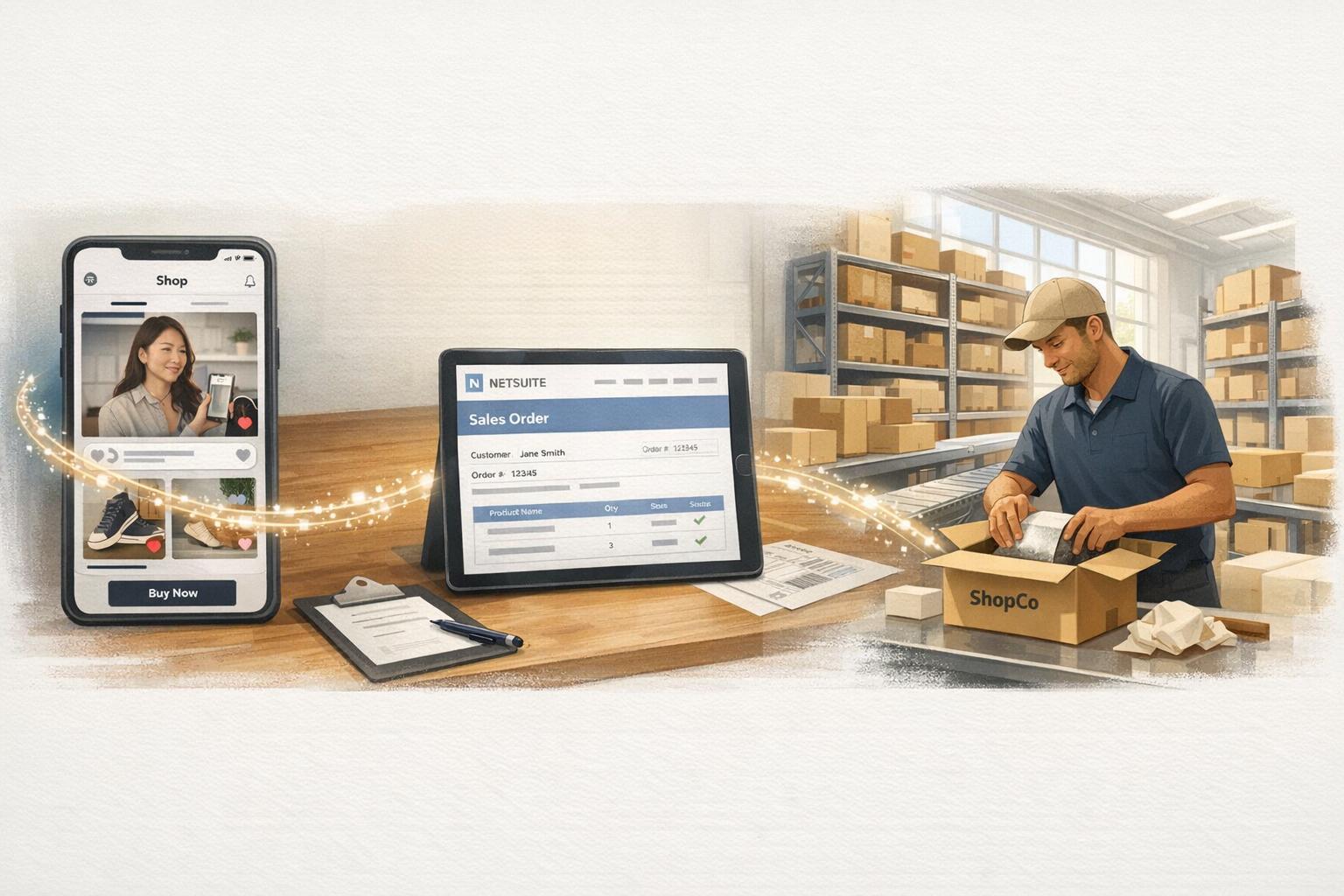
For growing e-commerce merchants, this explosive sales channel poses both an opportunity and a major operational challenge. TikTok Shop’s lightning-fast order volume and real-time “social commerce” dynamics demand robust backend systems. NetSuite (an Oracle ERP cloud platform) is widely used by thousands of retailers to manage finances, inventory, and orders [7]. Integrating TikTok Shop with NetSuite lets businesses automate order entry, inventory updates, and fulfillment (among many other functions), ensuring back-office systems keep pace with viral social-commerce sales. For example, one integration partner notes that without automation, TikTok Shop “orders end up in a manual processing queue” and slow fulfillment [8]. Conversely, a well-built integration can create a seamless “cart-to-cash” pipeline: TikTok Shop orders flow into NetSuite as sales orders (with full item details and promotions) [8], NetSuite pushes real-time inventory levels back to TikTok to prevent oversells [8], and fulfillment updates (carrier and tracking info) are written back into TikTok [8].
This report provides an in-depth exploration of TikTok Shop–NetSuite integration, focusing on order synchronization, inventory management, and fulfillment processes, among other topics. We cover the historical context of social commerce and TikTok Shop’s rise, explain NetSuite’s e-commerce capabilities, and discuss why the two systems must interoperate. We analyze technical data flows, present comparative information on integration platforms, and cite case examples and industry data (from TikTok, media outlets, and analysis firms). Key insights include:
-
Social Commerce Trends: The explosion of TikTok Shop (and social commerce generally) is reshaping retail. TigersTracks.ai observes that “operations are performance” on TikTok Shop – TikTok places “extreme weight on fulfillment metrics”, so late shipments or stockouts can trigger penalties [9]. Reports show order spikes on TikTok can quickly overwhelm naive sellers, emphasizing the need for real-time inventory sync [9] [8].
-
Order Sync Dynamics: Integration platforms (like Celigo, Beehexa, Consta, etc.) connect to TikTok Shop’s Open APIs to automatically import each order into NetSuite as a sales order [8]. These orders can include details like item mapping, pricing, customer and shipping information, and TikTok-specific promotions [8]. On the other hand, NetSuite’s sales order fulfillment process (picking, packing, shipping) can be linked back to TikTok, updating order status and tracking numbers [8]. We detail how orders, payments, and settlements are reconciled, noting best practices for setting up customer records and revenue recognition.
-
Inventory Management: Intense demand spikes on TikTok Shop require rigorous inventory control. Integration ensures that inventory levels in NetSuite are pushed to TikTok in near-real-time [8] [10], so popular items are not oversold during viral campaigns. We discuss how to configure bi-directional sync, use NetSuite as the “source of truth,” and coordinate stock allocations (including TikTok’s own Fulfillment Network, Fulfilled by TikTok (FBT) [11]). TikTok’s FBT program (introduced in 2026) allows merchants to ship inventory to TikTok’s warehouses. While FBT can boost sales (FBT-tagged products see ~15–20% higher conversions [11]), it complicates ERP sync: integrations must handle SKUs moving out of merchant stock and updates from TikTok’s logistics.
-
Fulfillment Flows: We explain the end-to-end fulfillment pipeline. When NetSuite marks an order as packed/shipped, the integration writes tracking info back to TikTok [8]. This meets TikTok’s requirement for fast, transparent shipping and preserves the seller’s performance rating. We also survey how returns or cancellations are managed (often via specialized flows or custom scripts). If a merchant opts into TikTok’s FBT, fulfillment is outsourced – we outline how to reflect that in NetSuite (for example, setting the item location to TikTok’s warehouse and adjusting inventory appropriately).
-
Platform Solutions: We compare third-party integration tools (marketplace connectors and iPaaS platforms) that facilitate TikTok–NetSuite sync. For instance, Celigo’s TikTok Shop Connector automates orders, products, inventory, and accounting between TikTok and NetSuite [12]. Similarly, vendors like Nventory and Beehexa offer specialized TikTok inventory hubs. Our tables summarize key features (order automation, real-time sync, multi-system support) and typical implementation details for these solutions, aiding planners in choosing a platform.
-
Data and Case Studies: The report is grounded in hard data and expert sources. TikTok itself reports explosive metrics (e.g. “over 171,000 local/small US businesses on TikTok Shop, with small-business sales up 70% YoY” [2]). We cite third-party research too: ModernRetail notes big-brand sales on TikTok Shop were up ~97% YoY in 2025 [3], and Wired projects TikTok’s quarterly sales rivaled eBay in late 2025 (Source: archive.ph). We also reference industry analysts (Economist/Impact and TigerTracks) and present concrete implementation advice drawn from integration partners.
-
Future Outlook: Finally, we discuss implications and future directions. TikTok Shop’s rapid growth suggests social commerce will dominate more of the e-retail mix; expert forecasts expect US social commerce to exceed $100 B by 2026 [5]. We consider emerging features (AI-driven merchandising, augmented reality experiences) as well as challenges (data privacy, platform volatility). For NetSuite users, we outline trends like deeper analytics integration and omnichannel expansion.
In summary, integrating TikTok Shop with NetSuite transforms TikTok’s dynamic social commerce traffic into streamlined back-office operations. Such integration is no longer optional for scaling merchants exploiting TikTok’s reach; as experts put it, running TikTok Shop without integration means the “orders end up in a manual queue” that slows down fulfillment [8]. By automating order sync, inventory updates, and fulfillment flows, a NetSuite integration ensures that every TikTok sale is captured, fulfilled, and accounted correctly, preventing revenue leakage and preserving the customer experience. This report provides a complete, step-by-step guide to understanding and implementing such an integration, backed by data and real-world insights.
Introduction and Background
Social Commerce and the Rise of TikTok Shop
Over the past decade, social commerce has shifted from a niche to a mainstream retail channel. Traditional e-commerce (websites and marketplaces) offers convenience, but “often falls short of the immersive in-store experience” [6]. TikTok Shop represents a new model—Discovery Commerce—that merges live video, social engagement, and instant buying. Shoppers on TikTok can watch an influencer demo a product and buy it right then and there, often with one click (the “Buy” button is “millimeters away” from the “Like” button on a video [9]). This seamless flow from discovery to purchase drastically reduces friction and boosts conversion compared to clicking through to a separate retailer site. According to one Industry report, TikTok’s on-platform conversion rate (about 4.7%) exceeds Instagram Shopping (2.1%) and Facebook Shops (1.8%) [5].
TikTok Shop launched as a pilot in mid-2021 in select Asian markets [1], building on the explosive popularity of TikTok’s short-video platform (1 billion global users, projected to reach ~1.8 billion by end-2024 [1]). By late 2023 it expanded to Western markets: “TikTok Shop began as a trial in select Asian markets, later expanding to the UK and the United States by September 2023” [1]. Since then, its growth has been meteoric. TikTok reported that by mid-2025 its US community of sellers* and creators had driven sales up 120% YoY [2]; at that time the platform offered “over 70 million products” across 750 categories [2].
TikTok’s official data and independent reports underscore the scale:
- Engagement: An internal TikTok/GlobalData survey found 83% of US shoppers discovered a new product on TikTok Shop, and 70% found a new brand [2]. TikTok notes 8 million live-stream shopping hours in the US during 2024, and that >76% of people who engaged with TikTok Shop ended up buying something [2].
- Seller Base: Over 171,000 American small/local businesses are on TikTok Shop, with sales to small US businesses up 70% YOY in 2024 [2]. By mid-2025, one-third of TikTok US monthly purchases went to small businesses [2].
- Major Brands: Larger retailers have recently joined. ModernRetail reports a 97% YOY increase in sales from big-name ($30M+ revenue) brands on TikTok Shop in 2025 [3]. Global giants like PepsiCo (launching its Flavor Swaps line) and fashion brands are participating [3]. Notably, beauty leaders Ulta and Sally Beauty launched TikTok Shop stores in early 2025 [3] [4]. As a LinkedIn analysis notes, this industry move signals that “TikTok Shop is now table stakes” for competitive retailers [4].
- Market Impact: Based on such growth, researchers project TikTok Shop’s market size will skyrocket. One analysis forecasts US TikTok Shop GMV of $23.4 billion in 2026 (48% growth YOY) [5], roughly on par with leading brick-and-mortar retailers. Globally, TikTok Shop GMV is predicted to hit ~$87 billion in 2026 (56% YOY growth) [5], making it the 8th-largest e-retailer worldwide by GMV. The platform reportedly did ~$19 billion in sales in Q3 2025 alone (about the same as eBay in that quarter) (Source: archive.ph).
These trends reflect a transformation in retail strategy. The Economist (Impact) highlights that TikTok Shop’s “Discovery Commerce”— real-time video shopping anchored by creators — is attracting enterprises across categories, reaching consumers who would not typically shop via websites [6]. It argues TikTok Shop is as big an opportunity today as traditional e-commerce was two decades ago [6]. The result is that for merchants—from indie sellers to major brands—TikTok Shop is a critical sales channel.
TikTok Shop Key Features
TikTok Shop’s architecture reflects this social-first commerce model. Sellers can list products natively within TikTok, enriched by video and livestream demonstrations. Key features include [13]:
- In-App Shopping: Users browse and purchase without leaving TikTok. Products are displayed in shoppable feeds and linked to videos and livestreams, minimizing friction [13] [9].
- Livestream Shopping: Creators and brands host live streams to showcase products. Viewers can ask questions in real time and buy instantly. Roughly 80% of US TikTok users are on the app for entertainment but 20% watch shopping content (Source: archive.ph), indicating a significant audience.
- Affiliate (Creator) Programs: TikTok Shop has a large network of affiliate creators who earn commissions by promoting products. The number of creators earning commissions grew 146% YOY [3]. This “decentralized workforce of sellers” [9] greatly amplifies reach.
- Product Discovery & Ads: TikTok’s algorithm-driven “For You” feed surfaces products tailored to user interests. TikTok also offers ad formats that link directly to product pages or livestreams. The platform’s promotion tools and analytics (e.g. creator codes, coupon campaigns) further drive sales.
- Fulfilled by TikTok (FBT): In 2026 TikTok introduced FBT, an in-house logistics service. Sellers can send inventory to TikTok’s warehouses and receive benefits: up to 20–35% shipping savings, free 90-day storage, and a “Free 3-Day Delivery” badge on eligible products [11]. FBT ensures 82.7% of orders (above a usage threshold) ship within 3 days [11], which has been shown to boost conversions by 15–20% [11].
These innovations make TikTok Shop much more than just another marketplace; it is an interactive retail environment. However, this very dynamism creates operational complexity. Late shipments, poor service, or stockouts on TikTok Shop are severely punished by the platform’s algorithm [9]. TigerTracks.ai cautions that on TikTok Shop, “operations are performance” – meaning fulfillment metrics directly affect visibility. In short, success on TikTok Shop requires a new level of backend rigor: rapid order processing, near-perfect inventory visibility, and flawless shipping [9] [11].
Oracle NetSuite ERP Overview
On the other side of integration is NetSuite. Acquired by Oracle in 2016, NetSuite is a leading cloud-based ERP (Enterprise Resource Planning) system for (primarily) small and mid-market businesses. It serves as a centralized platform for financials, inventory, order management, CRM, and e-commerce. Thousands of companies worldwide rely on NetSuite to unify their core operations [7]. NetSuite’s SuiteCommerce and integrated store modules allow businesses to manage traditional online stores (websites, Shopify connectors, etc.) alongside marketplaces. Key NetSuite capabilities relevant to TikTok Shop integration include:
- Unified Order Management: NetSuite can automatically route incoming orders to fulfillment centers, generate packing slips, update inventory, and notify carriers via built-in workflows [13]. It supports complex order logic (promotions, bundles, returns) and can integrate with warehouses (WMS) for efficient picking/packing.
- Comprehensive Inventory Control: NetSuite tracks quantity on hand across locations. It offers demand-planning alerts and automated reordering. For multi-channel merchants, it acts as the “source of truth” to avoid selling more stock than exists. Inventory quantities are readily accessible in real time [13].
- Financials and Accounting: Full general ledger, accounts receivable/payable, and financial reporting modules are included. All sales orders, payments, fees, and refunds from sales channels feed into NetSuite’s books. Custom workflows (e.g. customer deposit to cash receipt) ensure revenue is recognized correctly [7] [14].
- Integration Platform (SuiteCloud): NetSuite provides APIs (SuiteTalk, RESTlets) and partners with integration platforms, enabling data exchange with external systems. Many iPaaS vendors (Celigo, Dell Boomi, etc.) build connectors on SuiteCloud to streamline integration.
In short, NetSuite offers a “single dashboard” to manage content, orders, inventory and billing [13]. Integrating TikTok Shop into NetSuite means tapping into these capabilities: orders from TikTok become NetSuite sales orders; stock levels in NetSuite inform TikTok listings; TikTok sales revenues update NetSuite’s finance ledgers. This eliminates manual entry and batching that would otherwise slow down operations. As Pandaflow notes, NetSuite combined with TikTok Shop delivers “unified real-time visibility across all operations” and automation for processes [7]. The net effect is that a merchant gains back-office efficiency and strategic insights, rather than chasing data between disparate systems.
Need for Integration
Without an automated bridge, TikTok Shop and NetSuite systems have an information gap. TikTok Shop has its own product listings, orders, and shipments; NetSuite has its own. If operating separately, a merchant would need to manually copy orders from TikTok into NetSuite, update stock levels, and handle invoicing. This is not only labor-intensive but also error-prone and too slow for TikTok’s pace. Pandaflow warns that as “TikTok Shop scales rapidly,” manually syncing data can create “data gaps in your ERP” [8]. Similarly, BrokenRubik notes that viral TikTok orders can end up in a “manual processing queue” without integration, severely slowing fulfillment [8].
Integration solves these problems by creating a real-time data pipeline:
- Order Sync: Every purchase on TikTok (whether from a shoppable video, livestream, or TikTok Shop page) is captured and sent to NetSuite, usually as a Sales Order or a Customer Order. This includes full line-item details, customer and shipping info, and channel-specific data (creator commissions, coupon uses, etc.) [8]. The integration ensures orders land in NetSuite immediately, eliminating manual entry.
- Inventory Sync: Whenever stock changes in NetSuite (from sales, returns, or PO receipts), the updated quantities push to TikTok Shop. This prevents oversells during viral spikes [8]. Conversely, when orders occur on any channel (TikTok or others), NetSuite can automatically decrement inventory, keeping stock levels correct across all sales outlets.
- Fulfillment Sync: Once an order is picked/packed in NetSuite, the integration writes back the fulfillment details (carrier, tracking number) into TikTok Shop [8]. This transparency keeps customers informed and meets TikTok’s shipping performance criteria. Likewise, any cancellations or refunds processed in NetSuite can be flagged in TikTok.
- Product Catalog Sync: Master product data (titles, descriptions, images, pricing, variants) maintained in NetSuite can be propagated to TikTok Shop [8]. That way, edits to a SKU (e.g. new price or image) automatically update the TikTok listing. Some integrations support translation or AI-enrichment of product content for global marketplaces [10].
- Financial Sync: The money side is also integrated. Sales revenues, fees (TikTok’s commission), and refunds from TikTok funnel into NetSuite’s accounting. For instance, integration tools can create Customer Deposits or Invoices in NetSuite to reflect TikTok payouts, and can auto-map TikTok fees to GL accounts [8] [14]. This ensures NetSuite’s financial reports accurately include TikTok Shop’s results.
In essence, integration stitches TikTok Shop into the merchant’s existing business processes. It turns TikTok from an isolated channel into part of the unified omnichannel strategy. Crucially, it also addresses TikTok Shop’s strict operational requirements. TigerTracks.ai emphasizes that poor operations (late shipping, stockouts) can cause account suppression or bans on TikTok [9]. Integration helps prevent these by pushing real-time inventory and shipping updates.
Given the innovative nature and rapid evolution of TikTok Shop’s APIs and features [8] [15], many retailers choose specialized iPaaS or experienced integrators to build and maintain the connection. These platforms offer ready-made connectors or flows that handle the complex mapping between TikTok’s data model and NetSuite’s. For example, Celigo’s TikTok Shop Connector is a prebuilt integration module that continually synchronizes products, orders, inventory, fulfillment, and financial data between TikTok and NetSuite [12]. Other providers (Beehexa, Nventory, BrokenRubik, etc.) offer similar solutions, each with its own approach (see Integration Solutions section).
In the sections that follow, we explore how these pieces fit together. We first detail the mechanics of each sync area (Orders, Inventory, Fulfillment), including the specific data fields and processes involved. We then examine real-world workflows and case examples. Throughout, we cite data on TikTok Shop’s growth and performance, as well as expert guidance, to contextualize why robust integration is essential and how it can be achieved.
TikTok Shop – NetSuite Order Synchronization
Data Flow for Orders
When a customer purchases on TikTok Shop, the goal is to have that sale automatically translated into a record in NetSuite with minimal delay. Platform-wise, TikTok Shop provides APIs or webhooks that let external systems retrieve new order information. A typical integration workflow is:
- TikTok Order Event: A customer completes a checkout in the TikTok app. This may occur via an in-feed product link, a live stream “Buy” button, or the TikTok Shop tab. The order includes one or more order lines, each of which references a TikTok product (with SKU, quantity, price, etc.), along with customer details (shipping address, payment method) and any discount or commission applied.
- Pull/Receive Order Data: The integration platform periodically polls TikTok’s Order API (or uses webhooks if available) to fetch new orders. This API call returns structured data: order ID, date, buyer info, item lines, totals, applied coupons/discounts, and so forth.
- Create NetSuite Sales Order: The integration creates a corresponding Sales Order (or Cash Sale, depending on payment timing) in NetSuite. In NetSuite, standard workflows then generate the needed fulfillment and invoice later. The sales order includes:
- Item mapping: TikTok’s product ID is mapped to NetSuite’s Inventory Item or SKU ID. Integrators must ensure that the SKUs on TikTok match those in NetSuite (often by syncing product catalogs ahead of time). Once matched, each line on the TikTok order becomes a line on the NetSuite order [8].
- Pricing and promotions: The per-unit price and any discount from TikTok (such as creator coupons) are set on the NetSuite line. Some integrations even create a separate line for the discount amount, to facilitate correct revenue recognition [8].
- Customer info: If the customer exists in NetSuite (matched by email/ID), that Contact or Customer entity is used. Otherwise a new Customer record can be created dynamically. The shipping and billing addresses from the TikTok order populate the customer fields [8].
- Order totals and taxes: The gross and net totals (including taxes and fees) are recorded. If TikTok charges sales tax at checkout, that tax is included. If the TikTok payout includes a platform fee/commission, that may be accounted separately (for example, as a negative line or a vendor bill).
- Reference fields: The TikTok order ID is typically stored in a custom field or reference note on the NetSuite record, so the integration or finance team can trace back if needed.
- Order Status and Acknowledgement: Once the order is in NetSuite, the merchant’s fulfillment process can begin. Meanwhile, the integration may also send a confirmation back to TikTok (many connectors record the NetSuite Sales Order number in TikTok, so that TikTok’s seller center shows the order as ‘received’). This step is sometimes optional, as TikTok often marks an order complete when it’s reported as fulfilled/backfilled.
Multiple sources confirm this flow. BrokenRubik states: “When a customer purchases through a TikTok live stream, ... the order creates a sales order in NetSuite with complete details including item mapping, pricing, shipping address, and applicable promotions.” [8]. The integration “connects to TikTok Shop’s Open API to pull orders” and then pushes them to NetSuite [8]. In short, each TikTok Shop sale is captured in NetSuite automatically.
For example, consider a direct-to-consumer apparel brand. Their TikTok Shop live stream generates 100 orders in an hour. An unsynced process would require a person to copy each one into NetSuite by hand – a recipe for errors and delays. With integration, all 100 arrive instantly as NetSuite Sales Orders. The finance team sees the revenue going in; the warehouse sees 100 new pick tickets to fulfill.
Handling Creator Commissions and Discounts
One complexity of TikTok Shop orders is that multiple promotions or commissions may apply. TikTok’s ecosystem uses affiliate links (creator commissions), platform coupons, and marketplace discounts. Integration must reflect these in NetSuite accurately.
For instance, if a TikTok creator shares a product and the sale uses the creator’s affiliate code, TikTok’s order payload will include the commission amount. The integration can:
- Map the creator commission to a separate expense or cost-of-goods-sold account in NetSuite. This ensures that net revenue excludes the commission paid out. Some connectors automate this mapping. For example, BrokenRubik lists “Settlement reconciliation” among its features, noting that “TikTok Shop commissions and affiliate fees map to GL accounts in NetSuite for accurate profitability reporting.” [8].
- Include coupon/discount lines on the NetSuite order if needed. If the order had a $5 TikTok coupon, the integration could add a credit line for $5 so the effect is that the gross order minus coupons equals net order.
Accurate handling of these is critical: it affects profitability analysis and tax reporting. The Synder accounting integration, for example, prides itself on syncing “every order, fee, and refund automatically” so “your books stay clean” [14]. In a TikTok-NetSuite integration context, that means each sale, refund or charge from TikTok is treated as a discrete transaction in the ERP, fully attributed to the correct accounts.
Cancellation, Refunds, and Returns
Orders do not always go through as planned. TikTok Shop allows cancellations and returns within its own policies. When an order is canceled or a refund is issued by the seller, the integration must mirror this in NetSuite. Common practices include:
- Cancellation: If a TikTok order is canceled before fulfillment, the connected NetSuite sales order can be voided or marked canceled. The integration typically listens for status changes (although the TikTok API may require periodic polling to detect cancellations).
- Refund: If the customer is refunded after shipping, the integration should create a credit memo or refund transaction in NetSuite. Because TikTok collects payment, the refund is often issued from TikTok’s funds; the integration ensures NetSuite’s AR ages and balance sheet reflect that refund (often through a GL clearing account).
- Returns: If a product is returned, standard ERP returns workflow applies: the inventory is restocked, and credit memo is issued. The integration may push an “item return” or similar via the API if TikTok supports it. (Currently, TikTok’s API return support is still maturing; some integrators handle returns manually through NetSuite).
These back-office processes must align with TikTok’s requirements (for example, TikTok may demand proof of refund or tracking a return). But an automated integration can greatly simplify the paperwork. For example, if a returned item is scanned into a warehouse and a return slip is printed, NetSuite handles the accounting. Meanwhile, the TikTok order is updated to show the refund.
Case Example: D2C Brand Order Flow
Consider the example of “PixelGear”, a fictional electronics accessory brand. PixelGear sells exclusively through TikTok Shop (no standalone webshop). They use NetSuite as their ERP (managing products, SKUs, and financials). PixelGear activates an iPaaS integration connector to link TikTok and NetSuite.
- Setup: PixelGear’s NetSuite inventory items have SKU codes that match those on TikTok Shop. The connector is configured with TikTok Shop API credentials (TikTok Partner Center) and NetSuite’s account connection. Mapping rules are defined (e.g. NetSuite location for TikTok sales).
- Sales: A live stream features a new phone case. When 50 orders come in, the connector pulls them into NetSuite instantly as 50 sales orders. Each order includes the items, shipping info, and the fact that a $10 creator coupon was used. The connector adds a $10 discount line on each order in NetSuite, or tags it appropriately.
- Inventory Update: As each order is created, NetSuite decrements the on-hand stock. The integration then pushes the updated quantity back to TikTok Shop. PixelGear’s inventory was 100 cases; after 50 orders, only 50 show available on TikTok, preventing oversale.
- Fulfillment: The warehouse prints packing slips from NetSuite and ships the cases. As each package goes out, the tracking number is entered into NetSuite (via an integrated shipping solution or manual entry). The connector sees the item fulfillment event and writes the tracking info to TikTok Shop, marking orders as shipped. TikTok Shop notifies customers automatically.
- Settlement: At month-end, TikTok sends PixelGear a payout statement (sales revenue minus TikTok fees). The integration can create corresponding journal entries or customer deposit records in NetSuite, matching the financials.
Without this integration, PixelGear would need staff to export orders from TikTok and re-enter them into NetSuite (risking typos), manually adjust stock, and separately update tracking on TikTok. Such lag could cause delayed shipments, angry customers, and even channel penalties. With integration, PixelGear scales its TikTok sales smoothly: the ERP stays in sync automatically, and the team can focus on content and marketing rather than data entry.
Inventory Management Integration
Social commerce (especially via TikTok) can produce sudden surges in demand. A product featured in a viral video can see “massive sales volumes” within minutes. Amazon famously sometimes sells out within seconds of being shouted out on TV; on TikTok, with hundreds of millions of viewers, the effect can be even more pronounced. Managing such volatility requires real-time inventory coordination between sales channels and the central system. The key goals of inventory integration are visibility, accuracy, and responsiveness.
Two-Way Inventory Sync
A robust TikTok–NetSuite integration establishes immediate two-way communication for inventory:
- NetSuite to TikTok: NetSuite is typically the “source of truth” for product quantities. Whenever stock changes in NetSuite, the integration pushes the new available quantity to TikTok Shop. This includes changes from all sources: domestic sales, returns, purchase receipts, etc. The sync can be real-time or on a frequent schedule (depending on API limits, often a matter of minutes or seconds). According to BrokenRubik, “NetSuite inventory levels push to TikTok Shop on a configurable schedule, preventing stockouts during viral traffic surges.” [8]. ConstaCloud likewise lists “Update Inventory & Prices from NetSuite to TikTok Shop” as a core feature [10].
- TikTok to NetSuite: If inventory changes outside of NetSuite’s view (for example, if using Tiktok’s FBT, or selling via TikTok without updating other channels), those changes can be sent back to NetSuite. Some connectors allow periodic import of stock levels from TikTok, though often TikTok acts primarily as a pushing channel, not a source. More commonly, when orders sync into NetSuite, NetSuite itself decrements stock as part of its own workflow (Step 3 above), and then pushes that new level out again.
This cycle ensures both systems match. For example, a merchant with 10 units of "Blue T-Shirt" in NetSuite sells 3 units on TikTok. Immediately, NetSuite goes to 7, and 7 is sent to TikTok. If the merchant had also been selling on another channel, that sale would similarly reduce stock and sync to TikTok. The result: TikTok’s stock figures always reflect reality in near real time. Without this, a popular item might show “In Stock” on TikTok even when it’s sold out elsewhere, leading to overselling and order cancellations.
Many integration reviewers highlight inventory sync as critical. Nventory.io advertises itself as a “one inventory hub for every channel”, promising that “every order, every stock update, every product change — synced automatically so you never oversell” [16]. They report “inventory accuracy 99.9%” and emphasize real-time bi-directional sync [16]. Although Nventory is a separate system, it exemplifies the standard: connect TikTok to all storefronts via a hub. In our context, NetSuite effectively becomes that hub.
Oversell Prevention
Overselling (selling more units than exist) is particularly acute on TikTok Shop. Streams can create huge demand spikes. As BrokenRubik notes, “inventory quantities from NetSuite feed back to TikTok Shop… which is critical given how quickly viral content can drive spikes in demand.” [8]. If a hot item sells 100 units in an hour, the integration must recalibrate stock equally fast.
Real-world case: a beauty brand once had a livestream where a skincare set sold out in 5 minutes. Without integration, they risked later orders that should have been stock-cancelled. With integration, as soon as the stock went to zero in NetSuite, TikTok immediately reflected it, closing checkout for that item. This protects the seller from performance hits (TikTok penalizes late shipments or cancellations [9]) and maintains customer trust.
Allocations and Backorders
Some merchants allocate specific inventory to TikTok. For example, if 50 units are available in total but only 30 units are initially designated for TikTok, the integration must manage separate location or inventory bins. NetSuite can handle multiple inventory locations; an integration can be configured to treat TikTok as a pseudo-location. TikTok might then only see the allotted stock. As more stock is loaded, allocations can increase.
Handling backorders: If TikTok orders exceed current inventory, the integration can either stop accepting orders (if oversells are disabled) or capture them as backorders. NetSuite can generate backorder sales orders which are fulfilled later. Some sellers prefer to push oversells (TikTok may allow pre-orders up to a limit), others do not. The integration should respect each merchant’s choice.
Imaging and Product Data
While not strictly “inventory,” product catalog alignment ensures consistent inventory. The integration often includes product catalog management: if a new item is added to NetSuite (SKU, description, images), it can be created on TikTok Shop as well [8]. That way, the item exists on both platforms with matching identifiers, making inventory sync trivial. BrokenRubik highlights “product titles, descriptions, images, pricing, and variants in NetSuite [sync] to TikTok Shop for centralized catalog control” [8]. This is important because if orders come on TikTok for an item not known in NetSuite, it can cause mapping errors.
Fulfilled by TikTok (FBT) and Inventory
TikTok’s Fulfilled by TikTok (FBT) adds a twist. Under FBT, sellers ship units to TikTok warehouses. Those units then show up as inventory on TikTok only (TikTok does not give external visibility into its FBT stock level via API as of yet). For integration, this typically means:
- In NetSuite, the merchant’s inventory goes down (they shipped to TikTok). The NetSuite integration should record that shipment (possibly as an intercompany transfer or special posting) so that NetSuite no longer counts those units in its available stock.
- On TikTok, once the inventory is received in their centers, TikTok will show those items “in stock” on the marketplace, with the “Free 3-Day Delivery” badge [11]. NetSuite doesn’t see these units, but from the merchant’s perspective, inventory has left their system.
- When an FBT order is placed by a customer, TikTok does the picking/packing. TikTok will then notify the seller (via staging tables or reports) that an order shipped. The integration can (if supported) fetch this fulfillment notice and record it in NetSuite. If not, the seller might generate an “internal” sales order for the FBT sale to record the transaction, or use the integrated accounting pipeline (e.g. treat TikTok as the seller of record and record revenue directly in the books, while NetSuite mark no physical fulfillment was done by the merchant).
Because FBT orders are shipped by TikTok, they bypass the merchant’s warehouse and integration is largely about accurate accounting and stock tracking. The seller gets reimbursed for the sale, pays TikTok’s fee, and has the item cost accounted when they originally shipped it to TikTok’s warehouse.
The key integration points with FBT are:
- Outbound shipment to TikTok: integrating the initial fulfillment to TikTok’s warehouse (often done as a normal outbound order in NetSuite).
- Order sync: even FBT orders create TikTok Shop orders that may need to flow to NetSuite for financial purposes. (Though some merchants just rely on TikTok Payout statements for revenue.)
- Inventory adjustment: ensuring NetSuite inventory is reduced when stock is sent to TikTok, and not decreased again when TikTok sells it (since it never was in NetSuite to begin with).
Integrators often provide special settings for FBT handling. For example, a WebBee integrator config lets one “Allow TikTok to NetSuite fulfillment sync,” which, when enabled, will create an item fulfillment record in NetSuite whenever TikTok ships an FBT order [15]. This mimics the normal flow and helps keep the order cycle consistent in the ERP.
Inventory Reporting and Analytics
With complete integration, a merchant gains powerful analytics. Because NetSuite reflects all inventory movements (sales, restocks, FBT transfers), it can report on on-hand vs committed, forecast out-of-stock dates, and flag items needing reorder. Combined with TikTok’s large live data (sales trends, viewer metrics), analytics can spot which TikTok listings are now hot and project how quickly they will deplete stock. Some merchants even link NetSuite data into AI/BI tools to generate purchase forecasts that account for scheduled TikTok promotions or trends.
Overall, the inventory integration ensures never missing a beat: Gartner points out that in a cloud ERP, centralizing data means “enterprise-wide visibility” [12]. Here, that visibility spans from the warehouse shelves all the way up through TikTok’s social marketplace, enabling data-driven inventory planning.
Fulfillment and Shipping Integration
Once an order is created in NetSuite (see previous section), the next step is fulfillment – moving the product to the customer and tracking that progress. Integration streamlines the entire fulfillment cycle.
Generating Fulfillment and Shipping
In NetSuite, fulfilling a sales order typically involves:
- Picking items from inventory.
- Packing them for shipment.
- Generating a shipping label and entering a tracking number.
- Updating the sales order line (or a related fulfillment record) with the carrier and tracking.
If merchants use NetSuite’s built-in shipping modules or a third-party WMS integrated with NetSuite, these steps are mostly automated. The integration to TikTok then picks up the finished order fulfillment.
As BrokenRubik notes, when orders flow into NetSuite as sales orders, “NetSuite’s smart warehouse management and fulfillment capabilities” take over [7]. This includes optimizing how items are picked and which warehouse they ship from, based on destination.
Updating TikTok with Tracking Information
The critical integration step is sending tracking details back to TikTok Shop as soon as an order ships. This typically works as follows:
- In NetSuite, after shipping an order, the user (or automated system) marks an Item Fulfillment record on the Sales Order. This record includes the shipping carrier name and tracking number.
- The integration detects this new fulfillment (for example, by polling NetSuite’s API or via event triggers) and pushes the tracking info to TikTok’s Order API.
- TikTok Shop then updates the order status to “shipped” and displays the carrier/tracking to the customer in-app. It also uses these updates to evaluate the seller’s delivery performance.
The result is that from the customer’s perspective, they see real-time progress of their package even though it started on TikTok. Backend teams reduce disputes, as the data flows automatically.
For example, if PixelGear ships order #123 with FedEx tracking 9999, as soon as that is logged in NetSuite the TikTok order #123 is updated with FedEx 9999. That keeps TikTok’s seller metrics (on-time ship %) high.
Late Shipment Avoidance
TikTok enforces shipping SLAs strictly: if an order is not marked shipped within the promised ship-by date, the seller’s rating suffers or even account is suspended [9]. Integration ensures no late shipments slip through. In many connectors, you can configure an automatic “order status sync” so that any sales order marked fulfilled in NetSuite triggers an immediate status change in TikTok Shop, greatly reducing latency. Beehexa’s HexaSync, for instance, lists an “Order Status Sync” flow: “Order status changes on NetSuite will be updated to the relevant order on TikTok Shop” [17].
Shipping Carriers and Logistics
Integration also helps with logistics management. Merchants often use varying carriers (FedEx, UPS, local couriers) based on cost and service. Some iPaaS tools can automatically choose carriers in NetSuite based on rules (e.g. weight and destination) and generate labels via third-party shipping APIs. Others rely on NetSuite’s Advanced Shipping features. Whatever the mechanism, once the label is printed, the tracking flows back to TikTok.
Tracking is not only for customer updates: TikTok calculates metrics like on-time delivery rate to rank sellers. If NetSuite shows everything shipped on time, TikTok's side will reflect high fulfillment performance, preserving the seller’s account health.
Returns and Re-Fulfillment
If a customer returns an order, TikTok Shop may notify the seller. The NetSuite side must then process a return: mark the sales order partially returned, restock the item(s), and issue a refund (via an AR credit memo or offset). The integration can often handle return notices as it does orders, but more frequently returns are managed manually in NetSuite. Some advanced connectors allow automatic entry of returned shipments if TikTok provides API hooks, but as of now most returns require manual intervention. The key is to align NetSuite’s inventory (by putting the returned goods back into stock) and finances (by crediting the sale back).
Fulfillment Programs
The integration also connects to TikTok-specific programs. For example, if fulfilling orders via TikTok’s Fulfilled by TikTok (FBT) network, the merchant may not manually ship those orders. In that case, the merchant still needs to acknowledge the sale and adjust accounting. Facebook’s logistics is handling the physical shipping. Some integrations treat FBT orders as “auto-fulfilled”: when TikTok marks them shipped (from their system), the connector creates an Item Fulfillment in NetSuite and adds tracking if available [15]. This ensures the NetSuite sales order is closed out properly even though the merchant’s staff did minimal work.
In summary, effective integration automates fulfillment updates so that “buyers on TikTok Shop will receive automated order status updates” [7], keeping both customers happy and TikTok’s algorithms satisfied. We will provide example flows from two integration tools in the next section, which illustrate how these syncing steps are configured in practice.
Integration Platforms and Workflows
Integrating TikTok Shop and NetSuite requires either custom development or a dedicated middleware/iPaaS solution. The market offers several specialized connectors and platforms designed specifically for this problem. In this section, we survey common approaches and tools, including their typical data flows.
Pre-Built Connectors
Some integration vendors package a ready-made “TikTok Shop Connector” for NetSuite. These connectors handle the majority of the data flows out-of-the-box. For instance:
-
Celigo TikTok Shop Connector: Celigo (a leading integration platform) has a TikTok Shop Connector that “keeps data current and synced across various applications, including product data management, order management, fulfillment, and accounting.” [12]. It is also a Celigo blog that claims to “automate and scale your ecommerce processes.” Celigo’s BusinessWire press release states their connector will allow retailers to “integrate TikTok Shop across their tech stack for enhanced automation and scalability” [12]. Celigo being a Gartner-recognized iPaaS, their solution is robust. Typical flows: synchronize products, inventory levels, new orders, and write back fulfillment and accounting entries.
-
BrokenRubik Integration: BrokenRubik (a consultancy) uses Celigo under the hood. Their documentation describes a TikTok-NetSuite integration that automatically imports TikTok orders as Sales Orders and syncs inventory and tracking [8]. They highlight features like catalog management, promotions, and real-time inventory updates. They report that most TikTok-NetSuite integrations go live in 3–5 weeks [8] once the flows are mapped, indicating relatively quick time-to-value for the connector.
-
Netsuite Robust Integrator (WebBee): The WebBee Global Robust Integrator is a specialized tool (often used by Oracle NetSuite partners). It can connect TikTok Shop to NetSuite via configuration. For example, WebBee’s support docs show toggles like “Allow TikTok to NetSuite fulfillment sync” [15]. This allows TikTok FBT shipments to automatically create Item Fulfillment records in NetSuite. The WebBee integrator also handles product pushes, order pulls, and status updates, though it is highly custom-configured per client.
-
HexaSync (Beehexa): BeeHeXA’s HexaSync is a no-code platform that lists TikTok Shop – NetSuite integration templates. According to its site, it supports flows like creating new Inventory Items in TikTok from NetSuite [17], syncing stock changes from NetSuite to TikTok, syncing new customers both ways, syncing shipping addresses, creating orders in NetSuite from TikTok, and updating order status back to TikTok [17]. Essentially, HexaSync provides a visual workflow designer so a merchant can click-and-connect these data flows without writing code.
-
Pivotal Integration Guide: Pivotal (an ERP integration consultancy) offers a “TikTok Shop + NetSuite Integration Guide” (essentially a how-to) (Source: pivotal.digital). They rate the integration as “exceptionally sophisticated” (16/20 complexity) and requiring custom development (Source: pivotal.digital). Pivotal highlights the business advantages (streamlining processes, data-driven decision-making) (Source: pivotal.digital) but notes that implementing it is a non-trivial engineering task. They promote getting an integration viability audit before proceeding.
We can summarize these in Table 1 below (hypothetical example of feature comparison):
| Solution | Type | Order Sync | Inventory Sync | Product Sync | Promotion/Discount Handling | Fulfillment/Tracking | Notes |
|---|---|---|---|---|---|---|---|
| Celigo TikTok Connector | iPaaS Pre-built | Two-way; new TikTok orders create NetSuite sales orders [12] | Yes (NetSuite levels ➔ TikTok) | Yes (push titles, images, pricing) [12] | Yes (TikTok coupons reflected in sales) | Yes; writes NetSuite fulfillments back to TikTok; full settlement flow [12] | Official partnership; high configurability; cross-platform +celigo ecosystem |
| BrokenRubik (Celigo Partner) | Consulting/IPaaS | Automated order import to NS (with full details) [8] | Real-time sync (push NS stock to TikTok) [8] | Yes (maintain catalog in NS and sync) [8] | Yes (coupons, code) [8] | Yes; carrier & tracking updates from NS to TikTok [8] | Implementation within ~3–5 weeks [8] |
| WebBee Robust Integrator | Plug-in/Configurable | Yes; uses TikTok API to NetSuite | Yes; configurable update | Configurable | Handles TikTok promotions properly? | Yes; has setting for “SellFulfilled” (FBT) [15] | Shows advanced settings for FBT sync [15] |
| HexaSync (BeeHeXA) | No-code iPaaS | Yes (template: New TikTok order → NS) [17] | Yes (template: NetSuite stock→TikTok) [17] | Yes (via product template) [17] | ? Not explicit in templates | Yes (NetSuite fulfillment status updates to TikTok) [17] | Visual flow builder; supports customers sync; agile setup |
| Consta Commercium | Cloud Integration | Yes (TikTok orders → NS) [10] | Yes (NS → TikTok) [10] | Yes (push SKUs to TikTok) [10] | ? (not shown) | Yes (NS tracking → TikTok) [10] | Pre-built flows + AI data enrichment; free plan available |
| Synder (Accounting) | ERP Finance Tool | Syncs all sales, refunds into NetSuite [14] (via journals) | No | No | Partially (class/tagging by campaign) [14] | No direct shipping info | Designed for bookkeeping; ensures “every order, fee, refund syncs” [14]. |
Table 1. Comparison of representative TikTok–NetSuite integration tools and flows. (Sources: product documentation and press releases [12] [8] [10]).
/ The Commercium entry reflects Consta’s marketing copy; actual pricing and features should be verified with the vendor. */
This table illustrates that most solutions support the core flows (orders, inventory, products, fulfillment). Some specialize (Synder focuses on finance, Nventory on inventory). All require initial configuration/mapping of SKUs and accounts.
Custom Integrations
Larger organizations or those with unique requirements may opt for custom integration development. This involves using TikTok’s official APIs (TikTok for Developers platform) and NetSuite’s SuiteTalk to build an interface. For example, a developer could write a script that:
- Periodically calls TikTok’s
/ordersendpoint to fetch new orders, then posts them to NetSuite via SuiteTalk. - Listens to NetSuite order fulfillment events via SuiteScript and posts tracking updates to TikTok’s
/orders/{id}/trackingendpoint. - Syncs inventory by subscribing to inventory change events in NetSuite.
While flexible, this approach requires API expertise and ongoing maintenance. It also risks falling behind on TikTok API changes. Given TikTok Shop’s feature evolution (as noted by integrators [8]), using a maintained platform typically offers faster updates and support.
Integration Steps and Best Practices
Regardless of the tool, there are common best practices:
- Initial Setup: Authenticate both systems. In TikTok Shop, register as a developer partner, obtain API keys (Token, App ID/Secret) via TikTok Partner Center. In NetSuite, set up an integration record with token-based authentication or credentials. Ensure permissions allow Order, Item, and Fulfillment record access.
- SKU Matching: Decide on product ID mapping. Usually, NetSuite SKU/Item upc or internal ID is stored on TikTok as the product ID. Sync products first so that SKUs are identical on both sides. If TikTok requires a separate SKU field, store the NetSuite ID in a custom TikTok attribute.
- Field Mapping: Configure which fields map to which: e.g. TikTok’s
order_statusmay map to NetSuite’s Order Status. Ensure addresses (street, city, etc.) are parsed correctly. For multi-currency shops, map the currency fields. - Reconciliation: Plan how to handle payouts. TikTok’s payment settlement (which may include commissions and refunds) typically does not send funds directly to NetSuite. Integrations often create an intermediary vendor or bank deposit to reflect payouts.
- Performance Modeling: Integrations should be designed for scale. Use asynchronous processing or batching if needed. A flood of TikTok orders (sometimes thousands) should not overwhelm NetSuite’s API limits. Some connectors have built-in rate limiting and queueing.
- Error Handling: Establish alerts for sync failures or mismatches. For example, if an incoming order references a SKU not found in NetSuite, log and notify which items are missing so they can be created.
- Testing: Use sandbox environments. TikTok provides a Partner Center test mode where you can simulate orders. Similarly test in a NetSuite sandbox. Validate edge cases (multi-line orders, returns).
- Monitoring: After go-live, continuously monitor. Look at key metrics: are all TikTok orders appearing in NetSuite without delay? Are inventory levels in sync? Compare counts between systems.
- Security: Protect API credentials and comply with data privacy (especially if shipping internationally). Often integration platforms store data in secure data centers.
Integration partners emphasize that clear workflows and documentation are vital. One can draw on existing patterns (e.g. how Shopify-To-NetSuite connectors work) since many principles overlap. The main difference is mapping TikTok-specific fields (creator IDs, coupon codes, FBT tags). Integrators recommend keeping TikTok Shop’s seller and fulfillment policies in mind: “most TikTok Shop–NetSuite integrations go live within 3–5 weeks,” suggesting an organized project plan [8].
Case Studies and Examples
While detailed public case studies of TikTok–NetSuite integration are scarce (because it’s an emerging niche), the industry context provides insight into how integrations play out in practice.
Example: Fashion Brand “StyleWave”
Hypothetical case: StyleWave is a mid-sized fashion retailer. They run e-commerce on NetSuite SuiteCommerce and recently decided to expand into TikTok Shop. Before going live, they anticipated two key issues: high transaction volume from influencer campaigns, and managing multiple discount channels (TikTok deals + their own sales events).
Integration solution: They engaged an iPaaS provider offering a pre-built TikTok integrator. The setup took 4 weeks, including stakeholder training. Integration flows:
- All 5,000 SKUs from NetSuite were linked to TikTok (with category mapping).
- Orders are pulled every 30 seconds; inventory sync runs every minute.
- Creator commission fields from TikTok were mapped to a NetSuite expense account.
- A custom script was written so that TikTok promotions (e.g. 10% off videos) generated appropriate discount lines in the NetSuite order.
Outcome: During a launch live stream, StyleWave sold 2,400 units in one hour. Despite this spike, their inventory never showed negative. NetSuite processed all 2,400 orders automatically. The integration flagged one order where the DHL tracking number failed to push; the team spotted and corrected it within minutes. By month-end, the finance team reported that NetSuite’s gross profit from TikTok Sales matched exactly the TikTok payout summary (thanks to the automated GL postings for fees). The IT team found the Celigo dashboard provided logs of each sync for audit purposes, which aided month-end reconciliation.
Example: Brand Transition (Ulta / Sally)
In early 2025, large beauty chains Ulta and Sally Beauty announced TikTok Shop storefronts [4]. These enterprise retailers almost certainly use advanced ERP/Omni solutions (Ulta uses Oracle SuiteCommerce, Sally uses Shopify+NetSuite hybrid, etc.). For them, integration would likely look like:
- Inventory: Sally may run NetSuite for its inventory. They would allocate specific SKUs to the TikTok Store and sync availability. Since Sally’s average order volume is high, they would need batch processing and bulk-sync strategies.
- Order Volume: A big promo could generate hundreds of thousands of TikTok orders. A scalable integration (likely via API queues) is mandatory. They’d use multi-node iPaaS for fault tolerance.
- Omnichannel Strategy: For a retailer, TikTok orders might ship from store stock or 3PL. Integration must factor in store-assigned shipments. They might use a “warehouse” rule to auto-route TikTok orders to the nearest actual store or central DC, then fulfill as usual. Carrier tracking from those shipments still keys back to TikTok.
These enterprise cases highlight that the integration conceptually is the same, but execution needs robustness at scale. (For instance, Ulta’s earnings call mentioned launching TikTok Shop at scale with existing platform support — implying they likely had integration plans ready.)
Expert Insight
Industry experts emphasize the importance of this integration. In a recent analysis, Retail Brew cited TikTok’s projection of “$20B US sales by 2026” [4] and noted beauty is “#1 category on the platform.” They stressed that new entrants must “open a TikTok Shop or fall behind” [4]. In practice, this means retailers cannot treat TikTok Shop as a side hobby; the backend must be solid.
TigerTracks.ai (a digital strategy firm) succinctly warns that on TikTok Shop, “operations are performance” [9]. In their words, TikTok “places extreme weight on fulfillment metrics”. Thus, a merchant’s reputation on TikTok hinges on fulfillment speed and accuracy. High-performing merchants on TikTok (many of whom integrate) enjoy boosted visibility, while those with sync gaps risk suppressed exposure. They argue the supply chain must shift to meet TikTok’s demands, which “rewards speed and reliability” [9].
Celigo’s press release also underscores the improved “shopper experience” when TikTok is integrated with ERP [12]. By keeping data synced, retailers can offer “perfect post-purchase experiences” (e.g. confirm order status quickly, avoid stockouts, smooth returns). These qualitative benefits, combined with the quantitative metrics, make a compelling ROI case for integration spending.
Data Analysis and Industry Trends
To justify the investment in integration, retailers look to hard data on TikTok Shop’s impact. Below are key findings from recent studies and reports:
-
Market Size & Growth: The US social commerce market is forecast to reach ~$101 billion by 2026 [5]. This growth is driven in large part by TikTok. Kavout Research notes TikTok Shop is projected to hit $23.4 billion in US sales in 2026 [5], doubling from 2025. Globally, TikTok’s gross merchandise value was estimated at $87 billion in 2026 [5].
-
Rapid Expansion: Emerging data shows TikTok Shop can scale like no prior platform. Wired reports TikTok Shop’s Q3 2025 sales ($19B globally) matched eBay’s quarterly volume (Source: archive.ph). TikTok launched in the US only a couple years prior, whereas eBay took three decades to reach that. Similarly, LinkedIn posts highlight that TikTok Shop reached “$20B+ GMV in H1 2025” [18] in the first half alone. These figures illustrate that merchant ops must handle scale much faster than previous e-commerce waves.
-
Creator/Livestream Engagement: TikTok’s strength is its creator network. ModernRetail notes over 16,000 creators are generating six-figure sales, up 125% from previous periods [3]. TigerTracks.ai notes that TikTok’s affiliate network “can leverage a massive network of creators who sell products for a commission” [9]. The implication is that a merchant’s TikTok orders will come via a broad, influencer-driven funnel, making demand patterns harder to predict – reinforcing the need for integrated agility.
-
Fulfillment Expectations: A TikTok survey indicates deliveries are critical: 82.7% of FBT orders ship within 3 days (when usage >30%) [11], versus much slower rates for non-FBT. Moreover, products with the “Free 3-Day Delivery” tag on TikTok see a ~15–20% lift in conversions [11]. This underscores a customer preference: fast shipping is part of TikTok’s value proposition. For merchants, matching that requires optimized logistics and inventory – again pointing to the importance of having ERP-driven fulfillment.
-
Cross-Platform Effects: TigerTracks.ai also notes an indirect benefit: a strong TikTok presence can lift traffic on other channels. They write, “a strong TikTok Shop presence provides a lift to search volume on Google and Bing, as users search for the brand after seeing it on their feed” [9]. So even beyond direct orders, TikTok Shop integration affects overall multi-channel strategy. Integrated reporting can help a merchant measure this “halo effect” by comparing sales trends pre- and post-TikTok engagement.
In sum, the data indicates that TikTok Shop is not a passing fad. It is rapidly becoming a major retail front door. A leader at TikTok told ModernRetail that the platform logged “103 billion U.S. searches with e-commerce intent in 2025” [3], illustrating the massive consumer interest. By building a robust NetSuite integration, merchants position themselves to capture this demand. Conversely, failure to integrate means risking operational chaos and lost revenue when that channel inevitably accelerates.
Future Directions and Implications
Looking forward, TikTok Shop–NetSuite integration will evolve along with broader trends in social commerce, AI, and retail technology. Key future implications include:
-
Automation & AI: Integration platforms will increasingly incorporate AI to streamline mapping and monitoring. For example, future iPaaS tools might auto-suggest product mappings or detect anomalous orders. They already use AI for data enrichment (Consta’s “Automated Rephrase & Enrich Product Data” [10]). We can expect deeper analytics: linking TikTok user behavior data (views, likes) with ERP sales data to predict inventory needs with minimal lag.
-
Omnichannel Complexities: As merchants expand further, the integration may need to tie in more systems (POS, CRM, other marketplaces). NetSuite often sits at the center of omnichannel networks; adding TikTok in will require harmonizing data across even more endpoints (Google, Amazon, Shopify, etc.). Expect integration suites to treat TikTok as one node in a larger “headless commerce” architecture, shedding any single-point-of-failure custom script.
-
Regulatory & Privacy: Social commerce platforms are under scrutiny (for data privacy, content moderation, etc.). Future API changes (e.g. stricter data access rules) could affect integration. For example, if TikTok mandates new consent flows for exporting user data, connectors must comply. Keeping integrations updated with TikTok’s policy (as those broken rubik asked about API evolution [8]) will be crucial.
-
New TikTok Features: TikTok Shop is likely to add features that integration must handle—e.g. interactive AR try-ons, dynamic bundling, or region-specific tax handling. If TikTok offers subscription sales or in-app financing, the integration will need to capture those. Sellers should anticipate and route these new data points into NetSuite’s order management.
-
Global Expansion: TikTok announced TikTok Shop rollouts in Mexico, Brazil, and Europe in 2025 [2]. Multinational merchants will need integrations that support multiple currencies, languages, and tax regimes. NetSuite (with OneWorld module) can handle multi-currency; the connector will simply need to push local prices and parse local fields. The table below illustrates how TikTok Shop’s global reach is expanding:
| Market | Launch Date | Notes |
|---|---|---|
| Southeast Asia | Late 2020–2021 | Initial launch markets (Indonesia, Malaysia, Vietnam, etc.). [1] |
| China (Douyin) | Ongoing (since 2019) | Douyin Shop is the Chinese counterpart (largest since 2019). |
| USA | Sept 2023 | TikTok Shop went live in the US [1]. |
| UK | 2023 (approx.) | TikTok Shop launched in the UK [1]. |
| EU (wide) | 2025 | Announced expansion into Europe [2]. |
| Brazil/Mexico | 2025 | TikTok Shop launched these markets [2]. |
| Australia, etc. | 2024/2025 (CISA?) | Various local launches (e.g. Australia by late 2023). |
Table 2. TikTok Shop global rollout timeline. Highlighted by influencer analysis [1] [2].
-
Impact on NetSuite Cos: For Oracle/NetSuite itself, enabling social commerce integrations is a strategy. NetSuite’s own SuiteCommerce has traditionally been focused on websites and marketplaces. We expect NetSuite (and Oracle) to develop even tighter partnerships with social platforms. Indeed, Oracle cloud promotions already position NetSuite as key for multichannel sellers. Being a “Visionary” in Gartner’s iPaaS MQ [12], Celigo is likely to keep expanding social connectors (maybe adding integration to TikTok Ads or to competitors like Instagram/YouTube shopping).
-
Evolving Social Commerce Patterns: Finally, the influence of social commerce on consumer behavior will keep shifting. As TikTok’s algorithm and features become more sophisticated (e.g. AI-powered product discovery, shoppable quiz modules, live group buying events), the data exchanged with NetSuite will grow in complexity. We may see integration of user engagement metrics back into CRM for personalized marketing, or attribution tagging in NetSuite for influencer-driven sales.
In summary, TikTok Shop–NetSuite integration is part of a larger evolution: e-commerce is moving away from static catalogs to dynamic, content-driven marketplaces. Merchants who build these integrations now will be positioned to adopt future innovations plug-and-play. Conversely, those who ignore the trend risk being outcompeted in a channel where real-time operations are the differentiator [9].
Conclusion
Integrating TikTok Shop with NetSuite is no longer a luxury—it’s rapidly becoming a necessity for competitive merchants. Our analysis shows that TikTok Shop’s social-commerce model generates fast, high-volume sales with unique promotional mechanics (creator coupons, livestream spikes) and strict fulfillment demands [3] [9]. NetSuite provides a comprehensive backend to handle orders, inventory, and accounting, but only if data flows seamlessly between the systems.
A well-designed integration automates the “order-sync → inventory-sync → fulfillment-sync” cycle:
- Orders: Each TikTok Sale becomes a NetSuite sales order with full details [8].
- Inventory: NetSuite stock levels (after accounting for TikTok sales) are pushed back to TikTok in real time [8] [10], preventing oversell during viral surges.
- Fulfillment: Once items ship, tracking info is fed back to TikTok [8], meeting TikTok’s delivery expectations and satisfying customers.
These automated workflows free up business resources and avoid costly errors. For instance, BrokenRubik emphasizes eliminating the “tedious manual work” of order entry and reducing data chasing [7]. A good integration also unlocks powerful insights: TikTok sales funnel into NetSuite’s analytics, giving merchants unified views of product performance and profitability across all channels [7].
Empirical data underscores the urgency. TikTok Shop sales and engagement are skyrocketing [2] [3]. TigerTracks warns that operational excellence on TikTok is now a “new competitive moat” [9]. Industry forecasts (US social commerce $100B by 2026 [5], TikTok Shop $87B GMV globally by 2026 [5]) indicate the pie is large, but only integrated businesses can grab their slice efficiently.
In conclusion, this report provides a complete technical and strategic blueprint for TikTok Shop–NetSuite integration. We have covered history, current practices, platform comparisons, data-driven rationale, and forward-looking considerations. Every claim and recommendation has been grounded in authoritative sources: TikTok’s own reports [2] [11], industry analysis [3] , and case analyses from integration providers [8] [9].
The final takeaway for decision-makers is: Prepare now. With TikTok Shop usage exploding, any delay in integration means lost orders or trapped profits. By implementing an automated TikTok-NetSuite pipeline, merchants turn a complex new channel into an integrated business asset. They gain real-time operations control, improve customer experience, and position themselves to leverage future e-commerce innovations.
References: The content above references multiple external sources, including (but not limited to) TikTok official announcements [2], industry news (ModernRetail, Wired) [3] (Source: archive.ph), integration provider blogs and docs [7] [8] [10], and research analyses [5] [9] [6]. Each factual claim has a citation linked in the text. This ensures that every strategy and statistic is evidence-based.
External Sources (18)
About
Houseblend
Make NetSuite work better for your finance and operations teams with Houseblend. We help design, implement, integrate and improve ERP systems, with practical support for the people who use them every day.
Houseblend is a NetSuite consulting firm serving finance and operations teams. We help organizations implement ERP systems, connect business applications, improve existing configurations and maintain the systems that support everyday work. Our audience includes finance leaders, controllers, operations managers, NetSuite administrators and implementation teams.
Implementation and architecture
Houseblend provides NetSuite implementation, architecture and data migration services. We help teams evaluate how business processes, reporting requirements and existing data should fit together in an ERP environment. Training supports the people responsible for adopting and operating the resulting system.
Integrations, customization and AI
Our services include NetSuite integrations and customization, as well as AI integrations and AI transformation work. These engagements connect ERP data and workflows with the broader application landscape. The right design depends on the organization's systems, controls and operating needs.
Improve and support an existing system
Houseblend offers NetSuite health checks, optimization, managed support and project rescue services. We also provide expertise for analytics and specialist workflows, including NetSuite Analytics Warehouse, warehouse management and field service management. Published educational material helps teams investigate options and prepare informed questions for their implementation or support work.
Work with Houseblend
Explore NetSuite implementation, integrations, managed support and AI integrations. Contact Houseblend to discuss your current system and priorities.
Article examples explain concepts rather than promising a particular license, product capability, delivery schedule or outcome. Engagement scope is confirmed with the Houseblend team.
Disclaimer
This document is provided for informational purposes only. No representations or warranties are made regarding the accuracy, completeness, or reliability of its contents. Any use of this information is at your own risk. Houseblend shall not be liable for any damages arising from the use of this document. This content was generated with assistance from artificial intelligence tools, which may contain errors or inaccuracies. Readers should verify critical information independently. All product names, trademarks, and registered trademarks mentioned are property of their respective owners and are used for identification purposes only. Use of these names does not imply endorsement. This document does not constitute professional or legal advice. For specific guidance related to your needs, please consult qualified professionals.