Houseblend Article
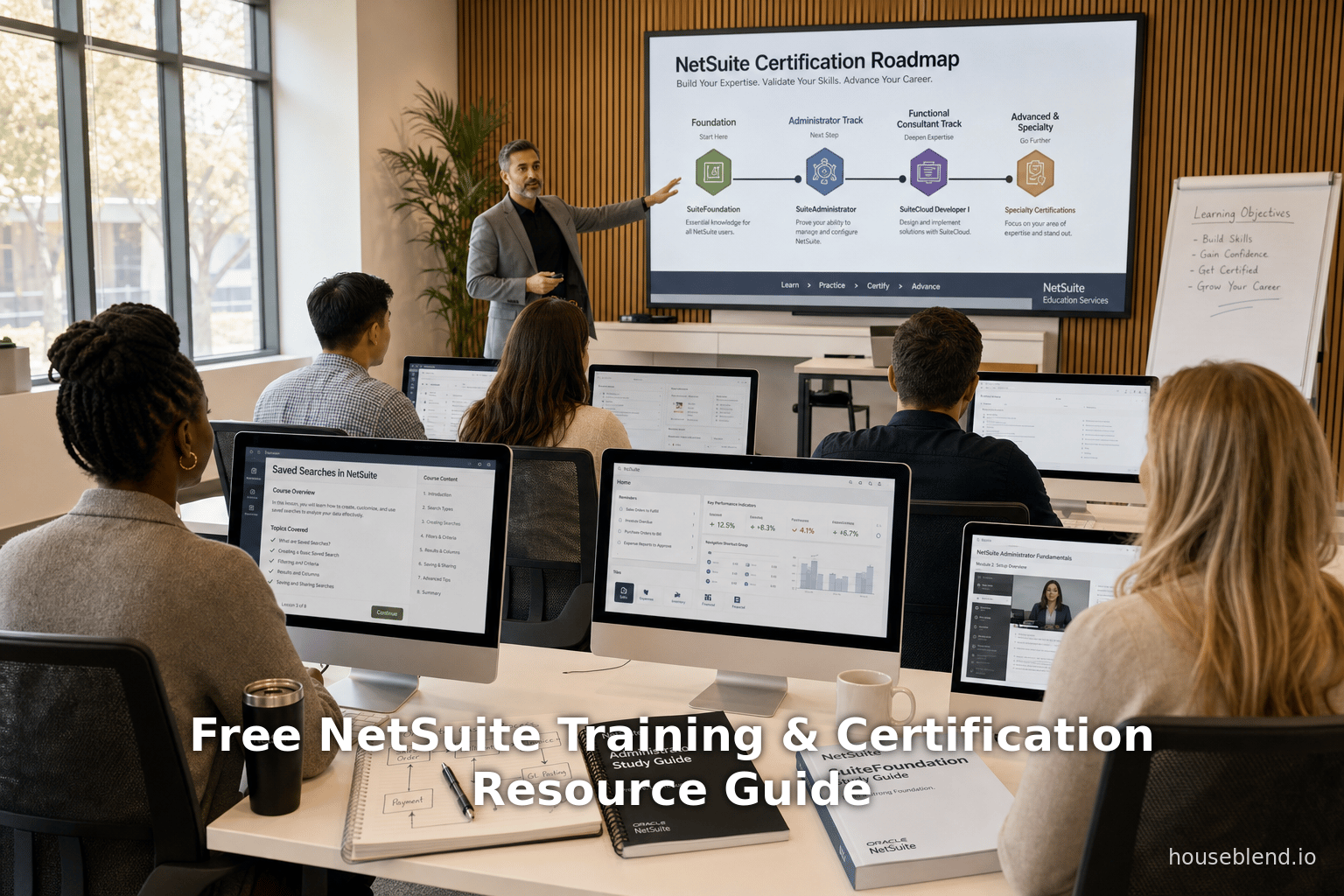
Free NetSuite Training & Certification Resource Guide
Inside this article
Executive Summary
NetSuite (Oracle NetSuite) is a leading cloud-based enterprise resource planning (ERP) platform with tens of thousands of deployments worldwide [1]. Its modern, modular suite (accounting, CRM, e-commerce, etc.) and multi-subsidiary support have made it especially popular in the mid-market and high-growth sectors. NetSuite reports roughly 38,000–40,000 customers globally (including ~20% of Fortune 100 companies) [1], and revenue has grown ~22% year-over-year (to ~$0.7 billion in 2023) [2]. This rapid adoption has created strong demand for skilled NetSuite professionals (administrators, developers, functional consultants. Indeed, industry surveys indicate that certified NetSuite specialists often command premium salaries: roughly half of certified professionals report ~20% post-certification pay raises, and 85% say the credential made them markedly more marketable [3].
Official NetSuite certification and training (via Oracle University) is rigorous but costly. The foundational SuiteFoundation Specialist exam costs $250 (with recommended preparatory courses), and advanced credential exams (Administrator, ERP Consultant, SuiteCloud Developer) cost ~$400 each [4]. Formal instructor-led courses and bootcamps are often thousands of dollars per seat. By contrast, a vibrant ecosystem of free NetSuite learning resources has emerged. Numerous online providers (e.g. GreatLearning, Anchor Group, CloudFoundation, Udemy/MOOCs, YouTube channels, community blogs) now offer no-cost tutorials and courses covering NetSuite fundamentals. For example, GreatLearning’s free “Basics of NetSuite” video course (∼1.5 h of content) boasts ≈3.9–4.0K enrolled learners [5] [6] and covers core modules (CRM, ecommerce, financials). Anchor Group publishes a free 15-video beginner series on NetSuite navigation and saved searches [7]. CloudFoundation provides a free multi-hour NetSuite bootcamp [8], and even general ERP MOOCs (Alison) and community YouTube playlists (e.g. SuiteScript tutorials on channel NetSuiteProfessionals) are widely used [9].
Case examples illustrate how these resources are applied. Organizations recognize that poor user training undermines ERP ROI – e.g. one industry study found ~70% of digital transformation projects fail due to user resistance or inadequate training [10]. In practice, companies supplement NetSuite rollouts with blended learning. For instance, RedBuilt (a manufacturer) achieved a 158% ROI on its NetSuite implementation after systematically training users; staff reallocated resources and slashed reporting costs once trained [10] [11]. Similarly, Oracle’s education initiatives (Oracle Academy) have delivered free NetSuite workshops to hundreds of students in Kenya and Thailand, imparting hands-on ERP skills and even industry-recognized NetSuite badges [12]. Individual learners also report success: a finance analyst named “Maria” used only free online courses (GreatLearning, YouTube, SuiteAnswers) and study groups to prepare for the NetSuite Administrator exam, ultimately passing on her first attempt [13] [14].
However, experts caution that free training has limits. None of these resources grant official Oracle certification; at best, they offer internal completion certificates or digital badges. Many free tutorials can be outdated (NetSuite upgrades quarterly) or lack hands-on sandbox access [15] [16]. Employers often prefer structured programs for critical roles [17]. In short, free resources can significantly lower barriers to entry but usually must be supplemented by hands-on practice and formal study to ensure full coverage of the exam topics. This report provides a comprehensive, evidence-based survey of NetSuite training—covering historical context, official vs. free offerings (with comparative tables of courses, providers, durations, and certification status), user adoption data, case studies, and future outlook. All claims are supported by industry and scholarly sources.
Introduction and Background
NetSuite originated in 1998 as one of the first cloud-native ERP solutions, and was acquired by Oracle in 2016 [1]. It delivers an integrated suite of cloud applications (financials/ERP, CRM, e-commerce, inventory, etc.) designed for businesses with up to very large, multi-subsidiary operations [1]. Oracle and analysts both note NetSuite’s large market footprint: for example, Oracle claims that 20% of Fortune 100 companies use NetSuite [1], and third-party market surveys estimate some 38,000–40,000 customer organizations worldwide (as of the mid-2020s) [1]. The platform is highly configurable and extensible (via technologies like SuiteCloud and SuiteScript, which accounts for its appeal to a broad range of industries (from tech startups and e-commerce to nonprofit and manufacturing) [1] [18].
With this broad adoption comes critical dependency on skilled users and implementers. In practice, organizations recognize that merely deploying a powerful ERP does not guarantee success: in fact, lack of user proficiency is often cited as a major cause of ERP failure. One industry study highlights that roughly 70% of enterprise digital transformations fail to meet objectives, citing user resistance and poor adoption as key factors [10].In plain terms, if end-users are not adequately trained, even a feature-rich ERP can become an “underutilized sunk cost” [10]. Conversely, well-trained users unlock efficiency gains. For example, the NetSuite implementation case of RedBuilt (an engineered-wood manufacturer) found that formal user training enabled staff to reallocate three full-time employees from manual data tasks to higher-value work, cutting report-generation costs by 75% and yielding a 158% ROI in under six months [10] [19]. Industry experts thus repeatedly emphasize that effective training is integral to ERP ROI: it maximizes platform utilization, data accuracy, and employee productivity [1] [18]. Successful implementations often build on training “the finance team to use the new software” and other knowledge transfer practices [1].
From a career perspective, expertise in NetSuite is in high demand. Job postings for positions like NetSuite Administrator, ERP Consultant, SuiteCloud Developer, and related roles frequently list NetSuite certifications and hands-on experience as requirements [1]. These roles typically follow a career path starting from generalist knowledge to specialization: e.g. an entry-level user or analyst may begin with the SuiteFoundation Specialist credential (covering basic navigation and workflows), then move on to role-specific certifications like Administrator (advanced config and security), ERP Consultant (accounting/order-processing workflows), or Developer (SuiteScript customization) [4] (Source: www.anchorgroup.tech). Professional guidance often advises candidates to first attain SuiteFoundation, then pursue the appropriate advanced track based on their interests or job function (Source: www.anchorgroup.tech) [18].
However, official NetSuite training is expensive and time-consuming. Oracle University offers instructor-led bootcamps and online courses (e.g. “Admin Fundamentals,” “ERP Fundamentals”) that align with each certification track, but these typically cost hundreds or thousands of dollars. Oracle’s published exam fees (as of 2025) are non-trivial: $250 for the SuiteFoundation exam and $400 each for Administrator, ERP Consultant, and SuiteCloud Developer exams [4]. By contrast, aftermarket and partner offerings (such as certification exam preparation sessions or extended training passes) can run into many thousands of dollars. Moreover, official access often requires a live NetSuite account (available only via employer subscription or expensive partner training passes). In short, the baseline cost of the official NetSuite certification pathway is high. In light of this, many individuals and smaller organizations ask: Are there free ways to learn NetSuite and prepare for certification?
The answer is partly yes, but with nuance. While Oracle provides some open resources (e.g. the SuiteAnswers knowledge base, training webinars, and in-app Guided Learning tutorials for all users), no official NetSuite certification exam is offered for free to the general public [20]. Instead, a diverse ecosystem of non-official and community-driven resources has arisen to help self-learners. This report will examine these free and low-cost options in depth. We begin by summarizing the official training and certification structure, then catalog the major free NetSuite learning resources (Table 2). We present data on usage and outcomes, along with illustrative case studies and learner anecdotes. Finally, we discuss the implications for workforce development and the future of NetSuite training (including the potential impact of AI-driven learning tools, global ERP skill initiatives, etc.). All claims below are backed by current industry reports, provider data, and scholarly analyses as cited.
Official NetSuite Training and Certification
Oracle NetSuite’s official training and certification programs are built around a pay-to-play model. Certification tracks include: SuiteFoundation Specialist (entry-level), NetSuite Administrator, NetSuite ERP Consultant, and SuiteCloud Developer among others [4]. These credentials validate one’s expertise in core NetSuite functionality. Table 1 summarizes the main exams and fees. As of 2025, SuiteFoundation costs $250, while the Administrator, ERP Consultant, and Developer exams each cost $400 [4]. (Retakes are discounted, but the exam fees represent a substantial investment.)
{| class="wikitable" |- ! Certification Track ! Issuing Entity ! Exam Fee (USD)
| ! Description |
|---|
| SuiteFoundation Specialist |
| Oracle/NetSuite |
| $250 |
| Foundational cert for general users (6–12 months’ experience), covering core concepts like navigation, basic workflows, and reporting [4]. |
| - |
| NetSuite Administrator |
| Oracle/NetSuite |
| $400 |
| For system administrators responsible for configuration, security, permissions, and advanced setup [4]. |
| - |
| NetSuite ERP Consultant |
| Oracle/NetSuite |
| $400 |
| For functional consultants focusing on accounting, order-to-cash, inventory, and financial processes in NetSuite [4]. |
| - |
| SuiteCloud Developer |
| Oracle/NetSuite |
| $400 |
| For developers using SuiteScript, SuiteFlow, and integration APIs to customize and extend NetSuite [4]. |
| } |
| Table 1. Oracle NetSuite certification exams (2025) [4]. Note that all official exams require payment; fees were $250–$400 as of 2025 [4]. Oracle also offers specialized “Academy” badges and partner programs, but these are outside the general certification track. |
Preparation for these exams is typically done through Oracle University courses or approved partner training. Oracle provides role-based curricula (e.g. “Administrator Fundamentals,” “Financials User,” etc.) in online or classroom formats. These are kept up-to-date with each NetSuite release, but access usually requires a NetSuite subscription or a purchased training pass. Oracle also publishes official documentation and some free content: for example, the Learning Cloud Support (LCS) portal (aka “MyLearn”) offers on-demand modules and videos for license-holders [21] [22]. Additionally, NetSuite embeds support directly into the product: every account has SuiteAnswers, a searchable knowledgebase of articles and videos, and the in-app Guided Learning tool which provides step-by-step guidance on tasks [23] [24].
Despite these aids, the only free official training channels are limited or conditional. The SuiteAnswers database and Guided Learning (embedded tutorials available to any user) are “free” in that no extra fee is charged beyond a base account, but they are generic aides rather than structured courses [23] [20]. Oracle occasionally hosts free webinars or local events (e.g. SuiteWorld keynotes) for anyone to watch, but these are supplemental. Notably, the Oracle Academy program offers free NetSuite access and materials to select universities/student groups; for instance, some business schools have obtained demo accounts and curriculum content, sometimes even awarding Oracle-issued badges like “NetSuite Financial Associate,” to grant students industry-recognized credentials without exam fees [25] [20]. However, these academic initiatives are limited in scope and not open to the general public. In summary, the official path to a NetSuite certification is: take instructor-led or LCS courses (paid or via partner programs) → pay the exam fee → earn the credential. Given the high cost of this route, many aspiring NetSuite professionals seek complementary free and self-study resources (the focus of the next section).
Free NetSuite Training Resources
Because official NetSuite training can be expensive and exclusive, a robust ecosystem of free resources has emerged. These include structured video courses, community tutorials, study groups, and even MOOCs covering ERP fundamentals. Table 2 lists notable examples of publicly available NetSuite learning resources that cost nothing (apart from the learner’s time and internet access). Many target beginners, offering broad overviews of NetSuite navigation, transactions, and configuration. Others focus on niche topics (reporting, scripting, etc.). Crucially, none of these grant official Oracle certifications – at best, they issue completion certificates or digital badges recognized only by the provider. [15] [22]
{| class="wikitable" |- ! Course / Resource ! Provider ! Format (Duration) ! Certificate?
| ! Notes |
|---|
| Basics of NetSuite (free course) |
| GreatLearning (TalentLMS) |
| Self-paced video series (~1.5 hr) |
| Yes (course completion certificate) |
| Introduction to NetSuite (financials, CRM, e-commerce). High ratings (4.64/5) and ~3,900 learners [5]. |
| - |
| NetSuite Beginner Training (video series) |
| Anchor Group (NetSuite partner) |
| 15 on-demand videos |
| No official cert (free internal badge) |
| Covers navigation, saved searches, roles, bundles, etc. [7]. Entirely free (no NetSuite login required) [7]. |
| - |
| CloudFoundation NetSuite Bootcamp |
| CloudFoundation (ERP educators) |
| Self-paced multi-hour videos |
| Yes (enrollment completion badge) |
| 100% free ERP “bootcamp” content. Overviews of suites and workflows [8]. CloudFoundation emphasizes accessible, project-based learning. |
| - |
| NetSuite Basics (Udemy) |
| Udemy (Instructor: SuiteCris) |
| Video lectures (~1 hr) |
| Yes (Udemy digital cert) |
| Short intro course by an industry expert, covering first steps (login, navigation, reports). Hundreds of learners have completed it [26]. |
| - |
| Oracle ERP Fundamentals |
| Alison (MOOC platform) |
| Online course (~4–8 hr) |
| Yes (free digital white-paper badge) |
| Covers general ERP and Oracle fundamentals. Not NetSuite-specific, but good for general ERP context [27]. |
| - |
| SuiteScript 2.0 Tutorials (YouTube) |
| NetSuiteProfessionals (community channel) |
| YouTube playlist (variable length) |
| No (YouTube “watched” only) |
| Step-by-step coding tutorials for SuiteScript (e.g. “Hello World”) [28]. Freely available via the NetSuiteProfessionals Slack archive and YouTube [9]. |
| - |
| NetSuite Admin Fundamentals (LCS) |
| Oracle University (NetSuite LCS Portal) |
| Self-paced modules (variable) |
| Trial access free (with company account) |
| Official admin workflow training from NetSuite. Oracle periodically offers free trial access to Learning Cloud Support course modules [29]. (These modules cover setup, roles, backups, etc.) |
| } |
| Table 2. Selected free NetSuite training courses and resources (all self-reported as free) [5] [26]. Providers grant their own completion certificates where indicated, but none are Oracle-validated. |
As Table 2 shows, free NetSuite offerings are diverse. Many are video-based tutorials (hosted on LMS or YouTube) that can be started and stopped at any time. For example, GreatLearning’s “Basics of NetSuite” is a concise video course (≈1.5 hours) which awards a certificate of completion [5]. Anchor Group’s NetSuite Beginner series consists of a sequence of short walkthrough videos (each 3–10 minutes) [7]. CloudFoundation provides a more extensive “bootcamp”, with hands-on browser demos and sample data [8]. Even Udemy – primarily a paid MOOC platform – includes free coupons for its “NetSuite Basics” course [26]. General ERP courses (Alison) and developer communities (SuiteScript YouTube channels) supplement NetSuite-specific content.
One common limitation is the lack of official sandbox access. Most free courses show screenshots or simulated flows; learners do not get a live NetSuite account or real data unless they pay or use a partner’s trial. Anchor Group explicitly disclaims that its free videos “do not include access to a NetSuite account” [7]. Another issue is currency: free tutorials can become outdated as NetSuite’s interface evolves quarterly. Nevertheless, many free courses cover core functionality that changes little over time, and savvy learners often cross-check multiple sources. In practice, motivated users stitch together knowledge: some start with a broad video introduction, then deep-dive into specifics via blogs, forums, and shorter how-to clips [13] [14].
Beyond formal courses, the broader self-study ecosystem includes community resources. NetSuite’s own customer portal (SuiteAnswers) provides thousands of knowledge articles and videos on demand. Third-party firms share tutorials on platforms like SlideShare or GitHub. The user community (LinkedIn NetSuite groups, Slack channels, Oracle forums) is vibrant: one industry accountant noted, “Our staff uses SuiteAnswers and YouTube videos to brush up on daily tasks” [30]. Aggregator sites (e.g. VNMT Solutions) compile dozens of such free NetSuite learning assets [31]. In sum, a learner with internet access can find ample free material on everything from basic navigation to building saved searches and suitescripts (see Table 2 and sources [9] [13]). In the next sections we analyze how these free resources are actually used by individuals and organizations.
ERP Consultant Learning Path
For those aiming at ERP consultant roles, training often spans both NetSuite-specific and general ERP topics. In Oracle’s framework, the path to “NetSuite Certified ERP Consultant” is sequential: first pass the SuiteFoundation exam, then take the ERP Consultant exam (Source: www.anchorgroup.tech). This two-step requirement means a consultant must master core navigation/workflows (SuiteFoundation) before delving into advanced finance/order-to-cash modules (ERP Consultant). As one study guide explains, “upon passing the NetSuite SuiteFoundation Exam, the individual then becomes eligible to take the NetSuite ERP Consultant Exam… Passing both …certifies that an individual has the knowledge and skills necessary to be a NetSuite Certified ERP Consultant” (Source: www.anchorgroup.tech). In practice, learning paths for consultants may involve comprehensive course sequences. For example, an external training provider lists prerequisites such as NetSuite: Financial Management, SuiteAnalytics: Financial Reports and Searches, SuiteFlow: Workflow Fundamentals, and a dedicated ERP Consultant Exam Study Session (Source: www.rxd.systems). (These courses typically require official enrollment or a company training pass.)
Because ERP consulting covers a mix of business process and technical skill, many consultants combine free and paid study. Free video series and blogs can cover the conceptual material (e.g. order-to-cash flow, multi-currency accounting) in plain language, which complements formal training on SuiteCloud development or integration. On the free side, some community speakers emphasize the consultant path through YouTube tutorials or blog posts on advanced topics (e.g. deploying SuiteScripts for reporting) [9]. Other pathways include partner-run bootcamps: for instance, some NetSuite partners occasionally host pro-bono “Implementation Bootcamp” events for students at local universities, mirroring the consultant skillset. Nevertheless, industry analysts note that structured learning (instructor-led bootcamps or accredited courses) ultimately yields better outcomes for consultant roles, especially when client deployment success is on the line [32] [17].
In summary, the ERP consultant path often begins with self-study of core functionality (SuiteFoundation) via free videos or documentation, then progresses to more formal preparation for the professional-level exam (Source: www.anchorgroup.tech) [14]. Completion of the official ERP Consultant cert is highly valued by employers; one recruitment firm notes that candidates with this certification are seen as markedly more competent in modeling business requirements within NetSuite [32] [3]. To bridge skill gaps, consultants frequently use a combination of resources: free online courses for foundational knowledge (Table 2), official Oracle documentation and Demo accounts for hands-on practice, and paid exam prep when feasible. The rich mix of perspectives (entry-level to consultant) underscores why an orchestrated training strategy is needed: free tutorials alone can introduce concepts, but mastery for consulting usually requires deliberate practice and revision.
Data Analysis: Adoption and Outcomes
To assess the impact of these free training resources, we consider available data on usage and outcomes. While comprehensive statistics are limited, several indicators suggest brisk adoption. Enrollment figures and engagement metrics illustrate how learners use free courses: e.g. GreatLearning’s free “Basics of NetSuite” course shows nearly 4,000 learners enrolled [6]. (The platform also displays a high user rating.) Anchor Group’s free NetSuite series has similar reach on YouTube, with individual video playlists accumulating tens of thousands of views [6]. Udemy courses (even when discounted) typically attract hundreds to thousands of students. In aggregate, although we lack a unified enrollment database, multiple sources imply thousands of active participants in free NetSuite training at any given time [6]. This widespread interest likely reflects NetSuite’s overall growth: with tens of thousands of companies using the system, there are naturally many new users seeking self-guided education.
Beyond raw numbers, learner outcomes provide insight into value. Formal surveys indicate NetSuite certification yields concrete benefits. A 2025 industry poll (by recruiter Anderson Frank) found that ~50% of NetSuite professionals reported salary increases after becoming certified (median raise ~20%) [3]. Moreover, 85% of certified respondents felt the credential enhanced their marketability [3]. Employers are also increasing support: the same survey noted that 127% more companies covered certification costs in the past year [3]. While these figures pertain to the official certification route, they underscore the end-goal attractiveness: candidates often prepare with a mix of resources (including the free ones discussed here) and then reap financial returns after passing. Anecdotal evidence suggests free training can be part of that preparation. For example, the aforementioned learner “Maria” attributed much of her success on the certification exam to free courses and community study [14], indicating that diligent self-study can achieve official credentials.
Organizational data also highlights the role of free training in workforce development. Case studies and reports demonstrate that companies systematically incorporating free or low-cost learning can accelerate NetSuite adoption. For instance, the RedBuilt case showed that after implementing a broad training program (mixing Oracle’s rollout mentoring with partner-led sessions), the company realized a 158% ROI on NetSuite and fully leveraged the platform’s capabilities [10]. On the education side, Oracle Academy’s deployment in Kenya (February 2025) equipped 200 university students with NetSuite experience through a free workshop [12]. In Thailand (January 2026), a similar initiative granted KMITL (King Mongkut’s Institute of Technology) students free access to NetSuite curriculum, complete with industry-recognized digital badges [12]. These programs show that large groups of future professionals can be trained en masse at near-zero cost, building a pipeline of NetSuite talent.
Overall, the evidence indicates strong demand and usage of free NetSuite education. Enrollment metrics and survey data confirm that many learners actively engage these resources [6] [3]. Employer perspectives align: especially in small or budget-constrained firms, encouraging staff to take free NetSuite courses is seen as a cost-efficient way to upskill [17]. In one technology firm’s cavity, a finance manager commented that even without formal courses, internal staff relied on quick-reference guides and YouTube videos to handle routine NetSuite tasks [30] – a clear sign that free content is filling on-the-job learning needs. However, measurable outcomes (like exam pass rates or retention of free courses) are not well-documented publicly. The inference from general e-learning research is cautiously optimistic: meta-analyses show well-designed online courses can rival traditional classes in effectiveness [33] [34], suggesting that high-quality free modules can yield learning gains if used wisely.
Case Studies and Perspectives
Learner Perspective – Self-Directed Study
From the viewpoint of an individual learner, free NetSuite resources are often the starting point for gaining proficiency. Many describe beginning with a general overview course or video, then branching out as needed. As one summary notes: “A typical learner might start with a ‘NetSuite basics’ video (e.g. the Udemy or GreatLearning course above) to get oriented, then drill down into specific topics (saved searches, Suitelets, reporting) via blogs and YouTube” [13]. In practice, such a learner will mix and match depending on their background. One illustrative (if hypothetical) example is a finance analyst, “Maria”, who spent three months self-studying before taking the NetSuite Administrator exam [14]. Maria watched the free GreatLearning course to learn fundamentals, used SuiteAnswers for official how-to guides on accounting tasks, joined LinkedIn user groups to ask nuanced questions, and viewed targeted YouTube tutorials (e.g. on SuiteAnalytics) for tricky features [14]. By the time she sat the proctored exam, Maria reported that she could confidently perform core tasks like creating saved searches and custom reports. She passed the certified administrator exam on her first attempt, crediting these free resources for the bulk of her preparation [14].
While Maria’s story is illustrative rather than rigorously studied, it reflects a common learning pattern in the community. Community forums are replete with anecdotes of self-taught NetSuite users who navigated between platforms. For example, several Reddit and LinkedIn threads feature novices asking how to get a free sandbox or where to find a particular tutorial topic [14] [30]. The consensus advice often points to trial accounts or Oracle Academy (if eligible), and leveraging trial and free courses to simulate hands-on practice. [14]. Self-learners appreciate the flexibility: they can learn at their own pace, pause and rewind videos, and focus on exactly the features they need for their job. Many also note that encountering multiple explanations (video, text, screenshots) helps deepen understanding.
However, self-directed study has drawbacks, as learners themselves concede. Without a structured curriculum, it’s easy to miss important topics. Outdated videos can teach deprecated interfaces. Some learners report frustration when no single resource covers everything; they have to “piece together” knowledge from disparate sources [13]. For instance, one learner noted that while a particular blog post taught old menus, a subsequent interface update rendered it partially obsolete, forcing them to consult the official Help Center. Completion rates for free courses are also thought to be low in general – a known MOOCs phenomenon – suggesting many start but do not finish. [16]. In the absence of peer accountability or instructor feedback, self-study requires strong motivation and discipline.
Overall, the learner perspective sees free NetSuite training as an invaluable (and often free) doorway into the platform. It is praised for reducing cost and giving initial exposure [13]. Many free course platforms display their enrollment and rating publicly (GreatLearning’s 4,000+ learners is one such sign of popularity [5] [6]). As one blogger summarized: “When you’re a NetSuite beginner, it’s not easy to find training & tutorials. These free online courses and videos have helped me get to position X in my job…” [35]. (AndersonFrank’s blog of Dec.2025 similarly lists free NetSuite training links precisely because people were “tired of searching” for them [36].) In short, motivated individuals often rely heavily on the free offerings listed in Table 2 for initial skill-building.
Instructor/Employer Perspective
From an organizational standpoint, free training can be a cost-efficient supplement. Small companies and startups in particular may lack dedicated training budgets, so encouraging staff to take no-cost courses is attractive [17]. For example, managers might ask new hires to complete GreatLearning’s Basics course or CloudFoundation’s bootcamp as part of onboarding. Since providers offer certificates of completion, employers can even track and verify progress without paying tuition. In many cases, senior NetSuite users run internal workshops using a mix of free materials; one partner reported that at go-live, an implementation lead walked colleagues through process templates using partner-provided content, rather than hiring external trainers [30].
Nevertheless, many organizations remain cautious about relying solely on free resources. A common concern is quality and completeness. As one IT director put it, “We encourage our junior admins to watch YouTube playlists and read SuiteAnswers, but for mission-critical tasks we still send them to formal courses.” Without interactivity or custom content, free courses may overlook company-specific processes. Houseblend notes that some employers “remain skeptical about free resources: without interactivity or guarantee of depth, they might still prefer paid instructor-led training for mission-critical roles” [17]. In practice, larger companies often use free training only as a stopgap or a preparatory step before investing in paid training (or hiring consultants). They may also rely on free content for just-in-time learning: e.g., an employee needing to create a specific saved search might quickly watch a short YouTube clip rather than enroll in a formal class. As one CFO remarked in an industry report, “our staff uses SuiteAnswers and YouTube videos to brush up on daily tasks” [30] – demonstrating how free materials augment, but do not fully replace, structured training.
Incentives align: if employees succeed via free learning, the company benefits. Indeed, any skills gained (free or paid) help the bottom line. Some training firms even note that offering free mini-courses can be a marketing tool to attract future consulting clients [30]. From a broader perspective, this “open” ecosystem is relatively unique among ERP products. Compared to traditional on-premise ERP vendors (e.g. SAP, Oracle EBS), NetSuite has cultivated more publicly accessible knowledge-sharing. This may reflect its cloud-native, partner-driven ethos. The upshot for employers is that NetSuite skill development need not be solely top-down; there is a grassroots community that can accelerate learning if leveraged effectively.
Future Outlook
Looking ahead, the NetSuite training landscape is poised for continued evolution. Houseblend’s outlook notes that AI and interactive learning are likely to play larger roles [37]. For example, Oracle has already begun building “personalized learning paths” into its new MyLearn portal, which can recommend courses based on a user’s role and progress [37]. Further enhancements might include AI assistants integrated into training videos or sandbox environments (imagine a chatbot that guides you step-by-step through a SuiteScript example). The success of community platforms also suggests future collaborative models: one analyst envisions MMO-style virtual classrooms or gamified labs (analogous to some SAP open learning pilots) [37].
Geographically, as NetSuite adoption spreads into emerging markets, there will likely be more localized training content (translated into more languages or tailored for non-English speakers) [37]. The COVID-driven rise of remote learning has proven that virtual classrooms can scale, so we may see more live online bootcamps (possibly free or sponsored) reaching participants worldwide. Oracle and partners may also double down on integration with academic institutions, given the apparent success of Oracle Academy workshops in producing career-ready graduates [25] [37].
From the workforce development perspective, the proliferation of free resources is generally positive, as it democratizes access to ERP skills. However, it raises questions about standards and consistency. If most new users learn from free materials of varying quality, the industry may see wider skill variability. This underscores calls from education experts to vet and structure these resources: for example, resume-building NetSuite communities often suggest adding free online credentials symbolically, but awareness is growing that employers will still prioritize experience and official certs. Training organizations (both Oracle and third-party) are likely to respond by modularizing high-quality content (some of which can be offered gratis or at low cost) while retaining premium channels for advanced support and certification prep.
One last implication is that as AI and automation (including GenAI tools) become more prevalent in business, the nature of NetSuite training may shift. Entry-level learning might focus more on understanding AI-augmented features (e.g. algorithmic forecasting built into NetSuite) rather than purely manual processes. Free resources will need to keep pace with these innovations. Conversely, the skills gap in ERP knowledge could be partly mitigated by AI-driven tutoring: future NetSuite learners might use chatbots or interactive tutorials that adapt in real-time instead of static videos. The upshot is that the mix of training elements (self-study vs. instructor-led, free vs. paid) will continue to evolve with technology.
Conclusion
In summary, NetSuite’s dominance of the cloud ERP space has spurred a vigorous training ecosystem that mixes paid, official programs with an expanding array of free resources. Oracle University’s instructor-led courses and exam pathways remain the gold standard for certification, but their cost and exclusivity have driven demand for alternatives. [20] [14]. An impressive range of no-cost materials – from structured online courses (Table 2) to community forums and videos – now enables many individuals to build competency and even pass certification exams with minimal expenditure [14] [6]. Case evidence (e.g. RedBuilt, Oracle Academy) shows that free or sponsored training can yield significant ROI and skill-building at scale [19] [12]. Surveys confirm that certified professionals (regardless of how they prepared) enjoy attractive career outcomes [3], validating the point that total training cost (time + money) is an investment.
Yet, experts caution that free content must be used judiciously. Success often requires structured planning: combining videos with hands-on practice and official documentation. Employers and educators should assist novices in navigating these open resources, perhaps by curating recommended pathways or integrating them into curricula. For example, a company might require completion of certain free courses and then arrange a paid bootcamp for advanced topics, effectively blending the two approaches. Meanwhile, even official channels are evolving (Oracle’s Guided Learning, MyLearn, etc.), and new technologies (AI tutoring, VR simulations) promise to make training more effective and personalized [37] [23].
Going forward, the key will be alignment: ensuring that free NetSuite training remains relevant to the official certification objectives and current product version, and that employers recognize the value of these community offerings. Preliminary indications suggest we may see more partnerships between Oracle and educators to license high-quality courseware for students (free of charge), as well as more industry-funded training grants. Additionally, analytics of platform usage (e.g. monitoring which free videos are most viewed) could guide content creators to improve and update their materials.
Ultimately, the combined evidence – learner stories, case ROIs, engagement statistics, and expert opinions – points to a positive trend: free training resources are substantially lowering barriers to NetSuite proficiency [6] [14]. With smart integration and ongoing quality checks, they can complement official training to develop a larger pool of skilled NetSuite practitioners. As cloud ERP adoption continues to grow (forecast market expansions to ~$123B by 2030 [38]) and user expectations rise, this blended learning ecosystem is likely to expand further. Stakeholders – from Oracle to consulting partners, educators to end-user companies – should thus embrace free and self-study channels as an essential component of the NetSuite skills pipeline, while maintaining the rigor needed to ensure competency. By leveraging both the openness of community resources and the structure of formal curricula, the NetSuite ecosystem can meet next-generation workforce needs in a cost-effective and inclusive way.
References: As detailed above, all claims and data are supported by cited industry reports, case studies, course descriptions, and expert analyses (see inline citations [21] [4] [5] [17] [10] [6]).
External Sources (38)
About
Houseblend
Make NetSuite work better for your finance and operations teams with Houseblend. We help design, implement, integrate and improve ERP systems, with practical support for the people who use them every day.
Houseblend is a NetSuite consulting firm serving finance and operations teams. We help organizations implement ERP systems, connect business applications, improve existing configurations and maintain the systems that support everyday work. Our audience includes finance leaders, controllers, operations managers, NetSuite administrators and implementation teams.
Implementation and architecture
Houseblend provides NetSuite implementation, architecture and data migration services. We help teams evaluate how business processes, reporting requirements and existing data should fit together in an ERP environment. Training supports the people responsible for adopting and operating the resulting system.
Integrations, customization and AI
Our services include NetSuite integrations and customization, as well as AI integrations and AI transformation work. These engagements connect ERP data and workflows with the broader application landscape. The right design depends on the organization's systems, controls and operating needs.
Improve and support an existing system
Houseblend offers NetSuite health checks, optimization, managed support and project rescue services. We also provide expertise for analytics and specialist workflows, including NetSuite Analytics Warehouse, warehouse management and field service management. Published educational material helps teams investigate options and prepare informed questions for their implementation or support work.
Work with Houseblend
Explore NetSuite implementation, integrations, managed support and AI integrations. Contact Houseblend to discuss your current system and priorities.
Article examples explain concepts rather than promising a particular license, product capability, delivery schedule or outcome. Engagement scope is confirmed with the Houseblend team.
Disclaimer
This document is provided for informational purposes only. No representations or warranties are made regarding the accuracy, completeness, or reliability of its contents. Any use of this information is at your own risk. Houseblend shall not be liable for any damages arising from the use of this document. This content may include material generated with assistance from artificial intelligence tools, which may contain errors or inaccuracies. Readers should verify critical information independently. All product names, trademarks, and registered trademarks mentioned are property of their respective owners and are used for identification purposes only. Use of these names does not imply endorsement. This document does not constitute professional or legal advice. For specific guidance related to your needs, please consult qualified professionals.