Houseblend Article
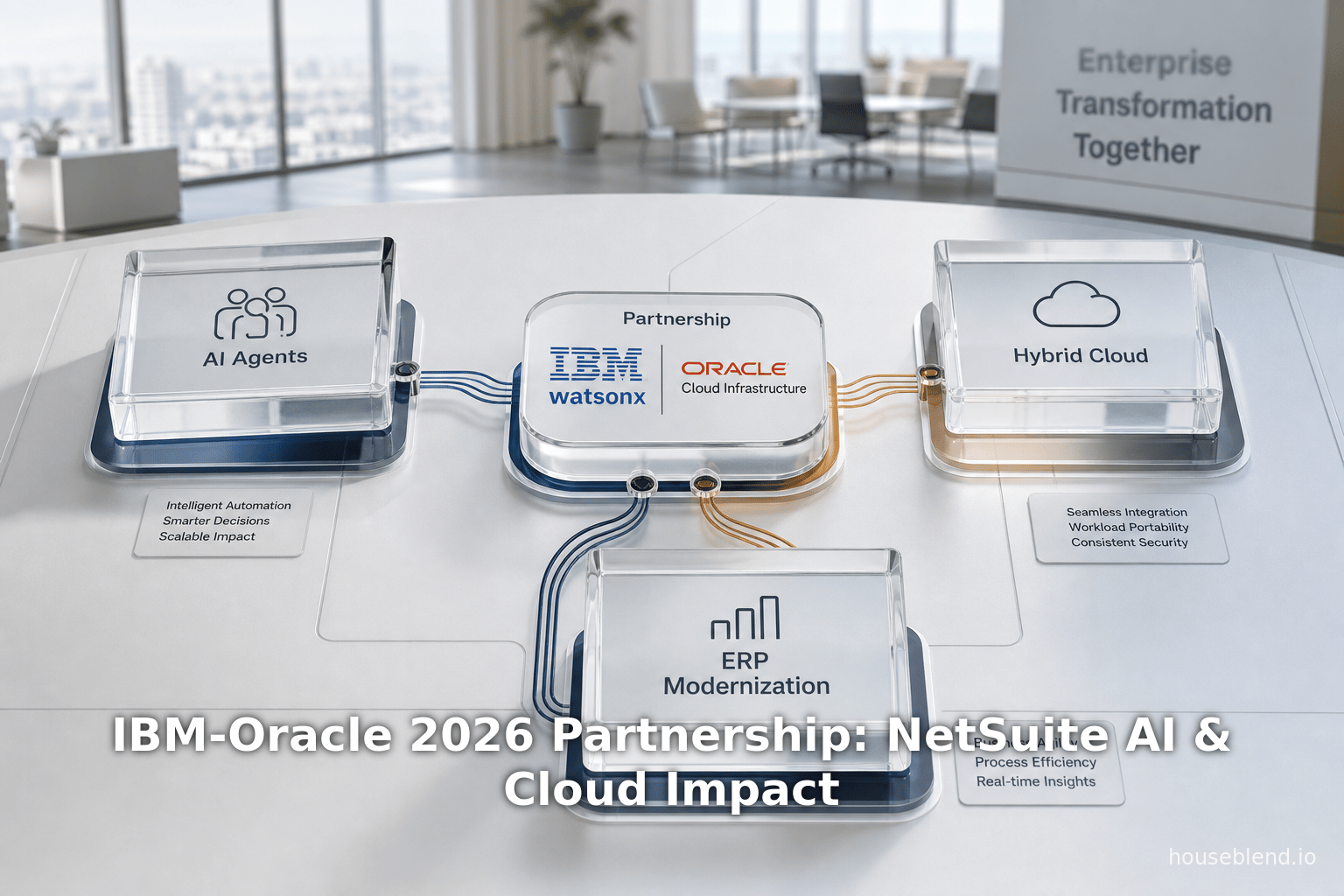
IBM-Oracle 2026 Partnership: NetSuite AI & Cloud Impact
Inside this article
- 01Executive Summary
- 02Introduction and Background
- 03IBM-Oracle Partnership Expansion: Key Initiatives (May 2026)
- 04Hybrid Cloud Infrastructure and Platforms
- 05AI, Automation and Data Integration
- 06Security, Compliance, and ESG
- 07IBM Consulting and Modernization Services
- 08Impact on NetSuite Customers
- 09Case Examples / Hypothetical Scenarios
- 10Discussion and Future Directions
- 11Conclusion
IBM-Oracle Partnership Expansion (May 2026): AI & Cloud Modernization Impact for NetSuite Customers
Executive Summary
In May 2026, IBM and Oracle announced a major expansion of their 40-year strategic partnership, unveiling a suite of joint AI and hybrid cloud offerings designed to help enterprises modernize operations and scale generative AI (GenAI) initiatives. Key highlights include integrating Red Hat Enterprise Linux (RHEL) into Oracle Cloud Infrastructure (OCI), new connectors between IBM and Oracle applications, and deployment of IBM’s AI platforms (watsonx and Envizi) on OCI [1] [2]. These innovations aim to break down data silos and accelerate AI adoption across hybrid environments.
For Oracle NetSuite customers – users of Oracle’s cloud-based ERP suite – the expanded alliance promises both direct and indirect benefits. On the Oracle side, NetSuite’s migration to Oracle Autonomous Database and OCI has already enabled embedded AI features and enhanced performance [3] [4]. The IBM-Oracle collaboration adds IBM’s AI tools, consulting expertise, and integration platforms into the mix. For example, IBM’s watsonx Orchestrate can now connect to NetSuite data (via third-party connectors) to automate complex workflows [5]. IBM Turbonomic and Guardium running on OCI can help optimize and secure the cloud resources underpinning NetSuite. Overall, the partnership accelerates cloud modernization paths and AI-driven insights for NetSuite’s 41,000+ global customers [6].
This report provides an in-depth analysis of the May 2026 IBM-Oracle partnership expansion, including historical context, detailed description of new offerings, data-driven insights, and perspectives on how these developments affect NetSuite customers. We draw on official IBM and Oracle announcements, industry analysis, and technical sources to examine the new AI and cloud integration capabilities, IBM consulting services, and the broader impact on hybrid cloud ERP modernization. Two summary tables outline the partnership’s new features and the specific implications for NetSuite users.
Introduction and Background
The IBM and Oracle alliance dates back nearly four decades. Once fierce competitors in database and middleware, the companies have famously practiced “coopetition”: competing in some areas while collaborating in others (Source: erp.today) (Source: erp.today). Over time their relationship has evolved to focus on optimizing joint solutions: for decades IBM’s teams tuned Oracle databases to run on IBM hardware, and IBM Consulting became a top reseller and integrator of Oracle applications (Source: erp.today) (Source: erp.today). More recently, IBM’s 2019 acquisition of Red Hat and its emphasis on hybrid cloud dovetailed with Oracle’s push to build out its cloud platform. Oracle’s acquisition of NetSuite in 2016 brought a leading SaaS ERP (business applications) under its umbrella. NetSuite today is used by over 41,000 organizations worldwide [6], powering financials, procurement, inventory, and more as a cloud-native suite. Oracle has aggressively integrated NetSuite into its stack (e.g. moving NetSuite to Oracle’s Autonomous Database to leverage AI features [3]) and continues to position OCI as the preferred infrastructure for Oracle applications, including NetSuite.
By 2024 and 2025, as GenAI and hybrid cloud became strategic imperatives, IBM and Oracle announced successive partnership expansions. For example, in May 2025 both companies unveiled joint initiatives in “ agentic AI and hybrid cloud,” making IBM’s watsonx AI platform and models available on Oracle Cloud [7] [8]. Throughout 2024 IBM also expanded its Oracle consulting practice, adding thousands of Oracle-certified consultants to help clients deploy generative AI with Oracle’s tools [9] [10]. These moves set the stage for the May 2026 announcements, which broaden the focus beyond AI agents to comprehensive modernization – from operating systems to business applications – across the Oracle/IBM ecosystem.
NetSuite customers operate within this context: they already benefit from Oracle’s cloud R&D (such as embedded generative AI in NetSuite features) [4]. The IBM-Oracle alliance now promises to bring IBM’s AI, integration, and consulting power into that environment. This report explores the technical details of the new partnership offerings and analyzes their impact on NetSuite users – such as new AI-driven capabilities, streamlined hybrid cloud deployments, and end-to-end data and security integration.
IBM-Oracle Partnership Expansion: Key Initiatives (May 2026)
In early May 2026, IBM and Oracle co-announced a series of joint offerings aimed at facilitating AI-driven modernization on a hybrid cloud foundation [11] [12]. These initiatives, described by IBM and Oracle leaders Charles Jenkins and Corinne Koppel, include infrastructure integration, application connectors, and IBM software-on-OCI deployments. Particular highlights are:
-
Red Hat on OCI (RHEL integration): Later in 2026, Red Hat Enterprise Linux will be directly purchasable and deployable on Oracle Cloud Infrastructure [1] [2]. Previously, enterprises had to bring their own RHEL subscriptions to OCI; under the new agreement RHEL can be consumed via Oracle Universal Credits or the Oracle Marketplace.This seamless integration reduces friction when migrating or building applications across Oracle and non-Oracle clouds, enabling uniform hybrid deployments [1] [13].
-
Oracle Fusion ERP – IBM Maximo Connector: IBM is developing native connectors between Oracle Cloud ERP (Fusion) and its Maximo Application Suite (asset/facility management) [14] [15]. These connectors allow joint Oracle-IBM customers to combine financial, procurement, asset and facilities data. Embedded AI and analytics in the connector will automate processes and provide real-time insights across these functions [14] [15]. Though initially targeting Fusion ERP, this integration template suggests similar possibilities for other Oracle applications, potentially bridging to NetSuite’s ERP modules as well.
-
IBM Envizi ESG on OCI: IBM will offer its Envizi environmental, social and governance (ESG) data platform as a SaaS solution on Oracle Cloud [16] [17]. The first rollout is slated for Saudi Arabia in the next 12 months [16], enabling customers to manage ESG reporting alongside their financial/operational data on the same cloud. For example, a company using NetSuite could collate its procurement and manufacturing data in OCI and feed it into Envizi to generate sustainability reports, all within one cloud environment [18] [19].
-
IBM Turbonomic (Resource Optimization) on OCI: IBM Turbonomic, an AI-driven platform for performance and capacity management, is now verified to run on OCI [20] [21]. Organizations can deploy Turbonomic to continuously optimize compute, storage, and network resources across their Oracle Cloud environments while ensuring performance policies. For enterprises running NetSuite on OCI (or other OCI-hosted apps), Turbonomic provides automated tuning to maximize efficiency and control costs.
-
IBM Guardium (Data Security) for Oracle Exadata: IBM Guardium, a data security and compliance suite, is extending support to Oracle Exadata Database Service on Dedicated Infrastructure [22] [23]. This means companies with sensitive data in Exadata (including underlying databases for Oracle apps) can use Guardium to detect, classify, and protect that data. Though NetSuite’s data is managed by Oracle, joint customers with hybrid workloads can apply Guardium policies consistently, helping secure ERP and related databases.
-
IBM Consulting – Maximo on OCI Managed Service: IBM Consulting will offer a new managed service to deploy and run Maximo on OCI, co-located with Oracle ERP workloads [24] [25]. This lets organizations move IBM’s asset management applications to the same cloud hosting their Oracle applications, simplifying integration. IBM will handle OCI setup, Maximo deployment, customization, and ongoing management, allowing clients to use a unified cloud for maintenance and financial operations.
-
Watsonx Orchestrate and AI Agents: IBM’s game-changing announcement involves its watsonx Orchestrate AI agent platform. New pre-built AI agents (for Learning & Development, Talent Acquisition, etc.) have been announced for integration into the Oracle Fusion apps ecosystem [26] [7]. These agents can act on behalf of business users across Oracle and non-Oracle systems. IBM is making watsonx Orchestrate available on OCI (July 2026) [7], enabling customers to orchestrate multi-agent workflows that span disparate apps and data sources. For example, an HR agent built in Watsonx Orchestrate could automate the entire new-hire onboarding process by coordinating Oracle HR Cloud tasks with custom workflows.
-
IBM Txture (Modernization Intelligence): IBM is promoting its Txture platform, an AI-powered tool that analyzes an organization’s workload portfolio to recommend an optimal migration strategy to OCI [27] [28]. Txture helps customers determine which applications to modernize and move, and models the business case. With Txture, NetSuite customers (or companies with NetSuite plus other legacy systems) can gain guidance on prioritizing migrations to public cloud (OCI) and assessing ROI.
These capabilities together form an extensive co-innovation roadmap. Table 1 below summarizes the new IBM-Oracle initiatives announced in May 2026, showing IBM’s contributions, Oracle’s roles, and expected customer benefits:
| Feature / Capability | IBM Offering / Role | Oracle Offering / Role | Benefit to Joint Customers |
|---|---|---|---|
| RHEL on OCI (Hybrid Cloud OS) | Red Hat Enterprise Linux support, IBM Red Hat | Oracle Cloud Infrastructure, Universal Credits | Simplified hybrid deployments: customers can buy/use RHEL on OCI (no BYOS), centralizing Linux workloads with Oracle cloud [1] [13]. |
| Oracle–Maximo Connector (ERP/Asset Data) | IBM Maximo Application Suite, AI/Analytics | Oracle Fusion Cloud ERP | Automates finance-procurement-asset workflows: built-in AI links NetSuite/Fusion financials with IBM asset data, enabling unified dashboards and process analytics [14] [15]. |
| IBM Envizi ESG (ESG Reporting) | IBM Envizi Sustainability suite | OCI SaaS deployment platform | Integrates ESG data with ops/financials: run Envizi on OCI alongside NetSuite data to consolidate ESG reporting (e.g., carbon footprint from supply chain) [16] [19]. |
| IBM Turbonomic (Resource Optimization) | IBM Turbonomic (AI-driven management) | OCI compute/storage/network | Dynamic performance tuning on OCI: ensures NetSuite and other Oracle cloud apps run cost-efficiency without performance loss [20] [21]. |
| IBM Guardium (Data Security) | IBM Guardium for databases | Oracle Exadata Database Service (Dedicated) | Enhanced data protection: allows joint customers to monitor and secure Oracle database workloads (including those underpinning ERP) against breaches and insider threats [22] [23]. |
| Maximo on OCI (Managed Service) | IBM Managed Service & Consulting (Maximo) | OCI infrastructure, Oracle Fusion ERP Cloud | Simplified deployment: IBM sets up Maximo on same OCI where Oracle ERP (or NetSuite) runs, providing 24/7 management. Improves integration between asset management and ERP [24] [29]. |
| Watsonx Orchestrate (AI Agents) | IBM watsonx Orchestrate AI (agents/automation) | Oracle Fusion & OCI Generative AI services | Multi-agent orchestration: deploy AI agents (e.g. HR agents) that automate tasks across NetSuite/Oracle apps and third-party systems, accelerating end-to-end processes [26] [7]. |
| IBM Txture (Modernization Intelligence) | IBM Txture AI platform | OCI Migration pathways | Smart modernization: uses AI to identify which workloads (ERP/custom systems) to move to OCI first, optimizing cloud migration strategy for NetSuite adopters and others [27] [28]. |
| IBM SaaS on OCI (Certifications) | watsonx.ai developer studio, Envizi on OCI | OCI hosting (bare metal/VM/Red Hat) | Brings IBM software to Oracle cloud: IBM watsonx.ai is now certified on OCI, enabling joint customers to build AI apps on Oracle’s infrastructure [30]. |
Table 1. Summary of IBM-Oracle partnership enhancements announced May 2026. Each capability reflects IBM’s software/services and Oracle’s cloud applications/infrastructure, with customer-centric benefits [1] [13].
These offerings are supported by expanded consulting services. IBM Consulting reports thousands of Oracle-certified practitioners (bolstered by acquisitions like Accelalpha and AST) ready to help implement the above innovations [31] [9]. In practice, IBM consultants will advise clients on orchestrating multi-agent workflows, optimizing multi-cloud deployments (e.g. migrating legacy ERP workloads to Red Hat on OCI) [32] [33], and integrating IBM and Oracle solutions end-to-end. IDC analysts note that “agentic AI” workflows spanning systems are becoming a strategic advantage [34] [35], validating the joint IBM/Oracle focus on seamless AI integration.
Hybrid Cloud Infrastructure and Platforms
For NetSuite customers, a key implication is the deepening integration of IBM’s and Oracle’s cloud infrastructure offerings. Oracle has long positioned OCI as the native home for its SaaS (including NetSuite) and PaaS services [4] [36]. By making Red Hat (via RHEL) first-class on OCI, IBM and Oracle reduce barriers for clients that run diverse workloads. Enterprises that use NetSuite but also maintain other workloads (on premises or other clouds) can now more easily migrate or extend those to Oracle’s cloud. As Charles Jenkins (IBM) and Corinne Koppel (IBM Consulting) note, joint customers want “flexible, high-performing operations” across clouds [37]. The RHEL-on-OCI initiative addresses this by allowing companies to use a consistent OS environment (Red Hat/OpenShift) when deploying on OCI, complementing IBM’s hybrid cloud strategy (e.g. Red Hat OpenShift on OCI [2]).
Oracle has also announced continuing enhancements to OCI itself. For example, in late 2024 Oracle introduced OCI Generative AI services and database features (Autonomous Database 23c with GenAI extensions) that directly enhance NetSuite’s capabilities [38] [4]. NetSuite users already benefit from OCI’s high performance and AI services: Oracle says, “OCI is the cloud infrastructure that powers NetSuite,” and that OCI AI Services enable NetSuite features like Text Enhance, Prompt Studio, and Expert [39]. Under the IBM-Oracle partnership, this underlying infrastructure gets new management tools. IBM Turbonomic’s certification on OCI [20] [21] means NetSuite tenants can leverage automated cloud resource optimization to maintain SLAs. Likewise, IBM Txture can analyze a customer’s workload footprint (including ERP workloads that might be scaled by NetSuite data) and recommend OCI-based modernization paths [28] [33].
Another infrastructure development is in multicloud flexibility. The partners will allow Oracle Universal Credits to be used for Red Hat subscriptions on OCI [1] [13]. This means customers can treat Red Hat on OCI with the same pooling model they already use for Oracle compute. It also indicates that Oracle and IBM recognize multicloud requirements: IBM’s own model lets agents run either on-premises, on any public cloud or on Oracle Alloy regions [40]. For NetSuite customers (whose core ERP is cloud-native), this facilitates hybrid scenarios: an organization could run customer-facing NetSuite in Oracle’s public cloud while keeping finance or data warehouses on-prem, with IBM’s orchestration span both. In combination, the partnership is aligning cloud infrastructure toward a truly hybrid model.
AI, Automation and Data Integration
A core thrust of the partnership is operationalizing AI across enterprise systems. IBM’s watsonx portfolio now integrates deeply with Oracle’s applications. In the 2025 announcements, IBM made its watsonx.ai platform and Granite AI models available on OCI Data Science [7] [8]. The 2026 updates add watsonx Orchestrate and AI agents in Oracle’s context. As the partners explain, Orchestrate on OCI (launching July 2026) will serve as a “control plane” for multi-agent workflows spanning Oracle and third-party systems [7] [26]. For example, new AI Agent templates for HR tasks can now work with Oracle Fusion Applications. This means that even NetSuite customers – as part of Oracle’s ecosystem – could benefit by connecting NetSuite data into these agentic workflows.
Indeed, one concrete example is integrating NetSuite data via IBM’s AI platform. A technical white paper by CData Corporation shows that IBM watsonx Orchestrate can securely connect to NetSuite through CData’s Connect AI service [5]. This allows Orchestrate agents to “query and act on live NetSuite data in real time” without needing to copy the data elsewhere [5]. For instance, a watsonx Orchestrate agent could retrieve sales orders or financial records from NetSuite and then perform tasks or analytics on them using LLMs. The IBM-Oracle partnership paves the way for such cross-product AI workflows: IBM agents running on OCI can interact with Oracle’s native AI agents and with NetSuite’s APIs, providing “seamless orchestration” across the business [7] [5]. In practical terms, a NetSuite customer might use AI agents to automate multi-step business processes (like procurement approvals or expense management) that bridge NetSuite and other systems, leveraging both Oracle’s AI services and IBM’s AI orchestration.
On the data side, Oracle’s analytics offerings (Oracle Analytics Cloud, NetSuite Analytics Warehouse, Autonomous Data Warehouse) already complement NetSuite by providing advanced BI and data lake capabilities [41]. The IBM partnership adds another dimension: embedded AI and machine learning. The March 2025 IDC report cited in IBM statements predicts AI agents optimize cross-system processes [42] [43]; with IBM Generative AI agents on OCI, the combined solution can ingest transactional data from NetSuite (or Oracle ERP) and extract insights or predictive alerts. IBM’s Envizi on OCI ties into this by combining operational data with ESG metrics, so NetSuite’s supply chain or financial information can feed sustainability dashboards. Together, IBM and Oracle position AI not as a silo but integrated across planning, execution, and monitoring.
Security, Compliance, and ESG
Operational modernization must address compliance and security. The partnership explicitly adds IBM software that strengthens security beyond Oracle’s native controls. Guardium’s extension to Exadata on OCI [22] [23] allows customers to apply enterprise-grade data security policies across their most critical databases – including those backing Oracle and NetSuite applications. In practice, a joint customer could monitor database activity (e.g. suspicious queries or data exfiltration attempts) and respond in real time across both IBM and Oracle database environments.
Likewise, IBM’s Turbonomic on OCI enhances reliability, which indirectly aids compliance by preventing downtime or performance violations. Because Turbonomic continuously enforces performance policies [21], NetSuite customers running business-critical workloads can maintain compliance SLAs for uptime and response times. With IBM’s insights, they can also plan capacity to meet regulatory growth (for example, required data retention for financial audits).
On the ESG/compliance front, IBM Envizi on OCI enables unified carbon and sustainability reporting. Organizations using NetSuite for financials and supply chain can feed those metrics (embodied carbon of products, travel emissions, etc.) into Envizi along with other data, all on the same cloud [18] [19]. This helps enterprises meet investor demands for ESG transparency without juggling disparate tools.
Finally, Oracle’s autonomous database features – now underpinning NetSuite – provide automated security patches and encryption [38]. The addition of IBM Guardium means that even with Oracle’s automated defenses, customers have a second layer to detect insider threats or misconfigurations. In sum, the partnership strengthens the hybrid cloud’s security posture at multiple layers.
IBM Consulting and Modernization Services
Beyond technology components, the IBM-Oracle partnership brings workforce and process innovations. IBM Consulting remains a major driver, offering advisory services and curated methodologies for Oracle customers [9] [44]. With over 3,000 large enterprise clients and 160,000 consultants worldwide [45], IBM can scale deployment of these new solutions. Especially notable is IBM’s use of an AI-powered “IBM Consulting Advantage” platform (cited in a 2024 PR [46]) to accelerate cloud migrations. For example, IBM has already embedded generative AI into its OCI migration factory to accelerate moving legacy workloads to Red Hat on OCI [7] [33].
NetSuite customers stand to benefit from these services when modernizing their broader IT environment. For instance, a global retailer on NetSuite might have some on-prem systems for store operations. IBM consultants can use Txture intelligence to identify which of those to move into OCI (alongside NetSuite), and then orchestrate the migration using cloud tools. IBM’s Oracle practice (accretive of Oracle-specialized firms like Accelalpha and Applications Software Technology [31] [47]) brings unmatched expertise in finance/Supply Chain transformation. Indeed, analysts have rated IBM a leader in Oracle ecosystem consulting (e.g. IDC MarketScape for Oracle Supply Chain Services 2025–26) [48].
Overall, the new services indicate that IBM and Oracle will launch joint go-to-market campaigns [31]. For NetSuite customers, this means IBM-led workshops or accelerators focused on GenAI and cloud modernization for SMEs and mid-market firms. IBM Consulting references in its Oracle ERP services the integration of watsonx with Oracle ERP modules [49], implying that customers can expect end-to-end roadmaps that include IBM’s AI alongside Oracle Cloud ERP (Fusion, and conceptually NetSuite as part of Oracle’s offerings).
Impact on NetSuite Customers
While the partnership announcements emphasize Oracle Fusion Cloud and IBM’s enterprise applications, the effects ripple to Oracle’s broader cloud ecosystem – including NetSuite. We consider how NetSuite customers in particular may leverage these developments:
-
Cloud Infrastructure and Performance: All NetSuite instances run on Oracle’s cloud. The migration of NetSuite to Oracle Autonomous Database means customers already enjoy enterprise-grade security, scalability, and new Oracle Database 23c AI features [3] [38]. With IBM’s partnership, these customers gain additional cloud flexibility. They can now run any supplementary workloads (such as custom middleware or big data) on OCI with RHEL and benefit from unified billing via Universal Credits [1] [13]. In practice, a NetSuite customer needing to run Oracle Analytics Cloud or custom Java apps on OCI will find that IBM events (e.g. allowing RHEL on OCI) simplify their hybrid setup. Turbonomic on OCI can further ensure their cloud resources (including those supporting NetSuite transactions) are automatically balanced for cost and performance [21].
-
AI & Automation: NetSuite has introduced its own AI/ML capabilities (such as SuiteAnalytics, SuiteScript AI APIs [50], and NetSuite Sizing Advisor). Oracle has embedded OCI AI Services (including Generative AI) directly into NetSuite features like Text Enhance and SuiteScript [4]. The IBM partnership adds an extra layer of AI innovation on top of NetSuite. IBM’s watsonx Orchestrate and Digital Worker agents can now operate using NetSuite data via connectors [5]. For example, a watsonx-driven chatbot could access live NetSuite financial data to answer questions or trigger processes, thanks to CData or Oracle Integration solutions that tie into Oracle’s cloud APIs. Moreover, existing Oracle + IBM AI integrations (e.g. Oracle AI Agent Studio for Fusion) set a precedent: IBM agents can supplement Oracle’s conversational assistants. NetSuite customers could tap IBM’s GenAI models (like IBM Granite) on OCI to build custom predictive services using their ERP data, on top of Oracle’s standard analytics.
-
Data and Analytics: NetSuite Analytics Warehouse (powered by Oracle Autonomous Data Warehouse and Oracle Analytics Cloud) provides robust BI capabilities [36]. The partnership means companies can enrich these analytics with IBM data services. For example, environmental data in IBM Envizi (on OCI) can be joined with financial/operational data from NetSuite in OCI data lakes, enabling holistic dashboards. IBM’s Txture and Consulting services help customers rationalize their application portfolios to take advantage of these analytics – for instance, migrating legacy database silos into OCI where both NetSuite and legacy data can be queried together. The result is more integrated insights: supply chain metrics from NetSuite feeding directly into Oracle Analytics, while IBM’s anomaly detection might raise alerts on unusual financial trends in real time.
-
Integration and Workflows: Historically, IBM has helped integrate NetSuite with other enterprise systems. As far back as 2010, IBM promoted its Cast Iron platform to connect NetSuite with Oracle and SAP systems [51]. Today, the IBM-Oracle partnership modernizes that concept. IBM’s new connectors for Oracle ERP and Maximo illustrate how different operational domains can mesh. Although NetSuite is a distinct ERP, customers using Oracle Fusion in some divisions and NetSuite in others could benefit from IBM’s integration expertise. For example, a customer might have NetSuite for subsidiary accounting and Oracle Fusion for centralized finance. Using IBM’s tools, data flows between the two systems could be automated and orchestrated. IBM Consulting could also help NetSuite customers extend their ERP with capabilities from IBM and Oracle Commerce or SCM suites, designing end-to-end processes that span cloud applications.
-
Security and Compliance: Organizations with NetSuite are often subject to compliance requirements (financial audit, data privacy, etc.). Oracle’s Autonomous Database provides built-in audit and encryption [38]. IBM’s Guardium on OCI offers an added compliance layer for any customer-managed databases. For NetSuite customers specifically, Guardium may come into play when they use Oracle Cloud Guard or other Oracle services alongside NetSuite. For instance, NetSuite customers who extract data to on-prem warehouses (for reporting) can use IBM Guardium to monitor those data movements for unauthorized access (e.g. via OCI DBCSN). Combined with Oracle’s cloud-native security, the partnership makes it easier to implement Zero Trust and continuous compliance across the NetSuite data lifecycle.
-
ESG and Governance: Companies tracking ESG may struggle to consolidate disparate data. The partnership’s joint solution (Envizi on OCI plus Oracle’s business data) directly addresses this. A NetSuite customer can now imagine pushing their inventory usage, logistics, and energy consumption data (collected through IoT or supply chain modules in NetSuite) into Envizi running on OCI, alongside cost and profitability reports. Because the IBM service will live in the same cloud region as the NetSuite database, data transfer and latency are minimized, making real-time sustainability reporting more feasible. This holistic view – financials and ESG metrics in one platform – is a new value proposition for NetSuite customers collaborating in the IBM-Oracle ecosystem.
-
Consulting and Implementation: Finally, IBM’s expanded Oracle consulting practice is available to NetSuite customers. Though NetSuite is an Oracle product, IBM Consulting focuses mostly on Oracle Cloud ERP (Fusion) and infrastructure [49]. Nevertheless, IBM can still offer modernization services to NetSuite-based businesses. For instance, IBM can assist in implementing Oracle’s autonomous features or integrating NetSuite with broader IT landscapes. IBM often leverages accelerators (like Business Maturity Index assessments [52]) and AI-driven delivery methods (IBM Consulting Advantage [46]) that an Oracle-centric customer can adopt. In effect, a NetSuite customer upgrading from on-prem ERP or legacy in-house systems could engage IBM to re-architect their whole finance/org chart on cloud, leveraging both NetSuite and other Oracle cloud apps with IBM’s guidance. Moreover, with IBM opening new Oracle Cloud migration factories (powered by generative AI models) [33], even small-to-medium NetSuite clients stand to benefit from best practices in moving more workloads to OCI.
In summary, the IBM-Oracle alliance magnifies Oracle’s cloud strategy from an infrastructure-provider into a broader platform of AI services and hybrid operations – one that NetSuite customers can join by default. By aligning tools like watsonx, Turbonomic, and Envizi with Oracle Cloud, IBM extends Oracle’s value proposition. At the same time, IBM Consulting and partner certifications ensure that organizations running NetSuite have expert resources to adopt these innovations.
The following table distills the above impacts:
| Impact Area | Oracle/NetSuite Offering | IBM Offering / Role | Expected Benefit for NetSuite Customers |
|---|---|---|---|
| Cloud Infrastructure & OS | Oracle Autonomous DB, OCI compute/storage [38]; RHEL/Universal Credits on OCI [1] [13] | IBM Red Hat support on OCI [1]; IBM Txture migration planning [27] | Simplified cloud operations: NetSuite (on OCI) can leverage RHEL and optimized apps; Txture helps plan any legacy app migrations into OCI alongside NetSuite. |
| Artificial Intelligence & Analytics | OCI AI Services (GenAI, OCI Data Science) powering NetSuite features [4]; Oracle Analytics Cloud | IBM watsonx Orchestrate agents, IBM Granite models [7] [8]; CData/Connect AI for NetSuite [5] | Augmented ERP: NetSuite data can feed IBM AI workflows (e.g., AI agents use live NetSuite data) [5]; deeper analytics when combining Oracle+IBM AI models with NetSuite metrics. |
| Integration & Workflow | Oracle Integration Cloud (OIC) and NetSuite connector [53]; SuiteProcurement, SuiteAnalytics | IBM Cast Iron legacy integration [51]; new IBM/Oracle connectors (Maximo-ERP) [14] | Streamlined processes: IBM and Oracle connectors can tie NetSuite to other data sources (SAP, Salesforce, etc.) and IBM’s asset apps. Example: automatically synchronize NetSuite financials with IBM Maximo maintenance costs. |
| Security & Compliance | Oracle Autonomous DB security (patching, encryption) [38]; OCI IAM | IBM Guardium for Exadata/OCI Databases [22]; IBM data governance tools | Enhanced protection: Joint customers can apply Guardium policies on NetSuite-related databases (in OCI) for threat detection [23], adding defense in depth for ERP data. |
| ESG & Sustainability Analytics | NetSuite Analytics Warehouse, Fusion EPM [54]; Oracle Business Network integration | IBM Envizi ESG Suite on OCI [16] [19] | Unified reporting: Combine financial/operational data from NetSuite with ESG metrics in one environment, supporting regulatory reporting and CSR initiatives. |
| Resource Optimization | Oracle Autonomous Database (self-tuning), OCI platform SLAs [38] | IBM Turbonomic on OCI [21] | Cost and performance: NetSuite workloads on OCI benefit from Turbonomic’s real-time tuning to maximize performance while controlling infrastructure costs. |
| Consulting & Modernization | Oracle Cloud Support; NetSuite Partner Network; Oracle Cloud Migration tools | IBM Consulting services (Oracle practice) [49] [9]; IBM Accelalpha & AST expertise [31] | Expert guidance: NetSuite customers have access to IBM’s Oracle cloud experts for digital transformation, using AI-driven assessment tools and proven migration methodologies to modernize finance/ERP operations. |
Table 2. Impacts of the IBM-Oracle partnership on NetSuite customers, showing how Oracle’s cloud capabilities combine with IBM’s tools and services to create new value across infrastructure, AI, integration, security, and consulting [38] [5].
Case Examples / Hypothetical Scenarios
While official case studies on the newly announced IBM-Oracle features are not yet public, we can illustrate potential real-world uses:
-
Global Manufacturer: A multinational manufacturer uses NetSuite OneWorld for global finance. Through the IBM-Oracle partnership, the company engages IBM Consulting to deploy the new Oracle ERP–Maximo connector. Now, maintenance schedules and asset data from IBM Maximo automatically tie into NetSuite’s financial planning. For instance, when production machinery needs servicing, Maximo triggers an AI-driven procurement workflow (via watsonx Orchestrate) that updates purchase orders in NetSuite. Meanwhile, Turbonomic continually optimizes their OCI resources to ensure NetSuite and Maximo run smoothly at scale [14] [21].
-
Retail Chain: A retailer with stores in multiple countries uses NetSuite ERP. They migrate all systems onto OCI’s latest infrastructure (with RHEL support) to take advantage of Oracle’s Autonomous Database [38]. The retailer then uses IBM’s Envizi (on OCI) to fuse retail sales data from NetSuite with their carbon footprint metrics (power usage, packaging) for consolidated ESG reporting [4] [19]. An IBM AI agent is configured to ingest daily NetSuite sales and inventory figures (via API) and automatically generate sustainability reports each quarter, saving manual effort and aligning with green compliance.
-
Financial Services Firm: A mid-market financial services company runs its ledger on NetSuite. Concerned about cloud costs, they use IBM Txture (with IBM Consulting) to analyze which legacy batch-processing apps to retire or migrate. Results of the Txture assessment lead them to refactor certain analytics workloads into OCI containers, yielding a 20% efficiency gain (guided by IBM’s data). Simultaneously, IBM’s Oracle practice helps them integrate NetSuite data with Oracle Analytics Cloud, enabling richer risk analysis. The result is faster month-end closes and a unified data platform that covers both Oracle ERP and NetSuite.
These scenarios, while hypothetical, are grounded in the capabilities announced by IBM and Oracle. They demonstrate how the new partnership tools (Watson Orchestrate, Envizi, Turbonomic, etc.) can be applied to extend NetSuite’s utility.
Discussion and Future Directions
The IBM-Oracle collaboration in May 2026 cements several strategic trends in enterprise IT:
-
Agentic AI Adoption: The focus on AI agents and orchestration reflects a broader industry move. Analysts like IDC observe that advanced enterprises see AI agents as “an important strategic advantage” when they can operate across systems [34]. IBM and Oracle are early movers in this space: by 2025 they already promoted multi-agent environments [7], and now they are embedding agents into core business processes (HR, finance, procurement). We expect to see continuing expansion of AI-driven automation workflows in ERP. For NetSuite customers, it is likely that Oracle will further incorporate IBM’s generative AI models (Watsonx, Granite) into NetSuite’s own roadmap (via SuiteScript AI APIs or new Agent Studio features).
-
Hybrid Cloud Evolution: Red Hat on OCI signals that the multi-cloud/hybrid model is here to stay. Both IBM (via Red Hat OpenShift) and Oracle (via Container Engine and OCI Regions) are promoting environments where workloads can move fluidly between on-prem and public clouds. Future directions could include tighter interoperability (e.g. seamless workload migration tools between AWS/AZURE and OCI) and more OCI regions (Oracle continues rapid region expansion) to reduce latency globally (Source: erp.today). For NetSuite users, this means Oracle Cloud will likely keep growing its footprint, and IBM’s hybrid approach (multi-cluster OpenShift) will mean NetSuite deployments can more easily comply with local data laws by selecting appropriate regions.
-
Open Ecosystem Alliances: Both companies emphasize open standards. IBM co-founded the AI Alliance initiative, and Oracle is an AI Alliance member [55]. Jointly, IBM and Oracle may push for open model interoperability (e.g. making IBM’s open-source models available on OCI [8]). If successful, this could enable NetSuite users to choose from a wider range of AI models within Oracle’s cloud environment, without vendor lock-in. It also suggests future agentic solutions could incorporate third-party AI (e.g. combining IBM’s and open-source LLMs with Oracle’s proprietary models).
-
Vertical and Edge Focus: Looking ahead, IBM and Oracle may tailor offerings to specific industries. With IBM’s strength in sectors like public services and supply chain (leveraging recent acquisitions) [47], and Oracle’s dominance in finance/HCM, we anticipate packaged solutions. For example, an IBM-Oracle co-developed AI agent for public sector procurement, or industry-specific data integrations with NetSuite. Edge computing (IBM’s on-prem Red Hat vs. Oracle’s new Alloy Regions) could also converge, offering isolated (e.g. government) deployment options. NetSuite customers in regulated industries may benefit from such offerings, as federal clouds or sovereign regions become available on Oracle/IBM platforms.
-
Sustainability and Governance: As ESG gains importance, the Envizi-on-OCI move highlights data transparency. We expect further tools that combine financial ERP data with sustainability metrics. Oracle’s Autonomous Database is already marketed as “self-driving” to reduce energy via optimization [38], and IBM’s Red Hat focus often includes energy-efficient container orchestration. Future announcements might extend these capabilities – for example, offering green-cloud analytics (optimizing workloads for lowest carbon footprint) or embedding ESG metrics into financial planning modules.
In all these areas, NetSuite customers are likely to be pulled along by Oracle’s innovations. IBM’s role is to ensure that as clients adopt these technologies, the integration and change management are handled seamlessly. IBM and Oracle’s joint go-to-market pilots (mentioned for select regions [31]) suggest they will collaborate on case studies and marketing campaigns, creating more visibility for the combined value proposition. We should watch for early adopter stories, training programs, and ecosystem certification (e.g. IBM consultants with specialized NetSuite-AI credentials) emerging in the next 6–12 months.
Conclusion
The May 2026 expansion of the IBM-Oracle partnership represents a significant inflection point for enterprise IT, particularly in AI and hybrid cloud. By aligning IBM’s AI platforms, software suite, and consulting with Oracle’s cloud infrastructure and applications (including NetSuite ERP), the combined offering addresses the end-to-end modernization needs of joint customers. For NetSuite users, whose businesses rely on Oracle’s cloud backbone, this alliance brings new tools and pathways: hybrid Kubernetes computing on OCI, advanced AI agents, integrated ESG analytics, and continuous security across platforms.
These developments promise tangible benefits: faster cloud migrations, smarter automation of ERP workflows, improved data-driven decision-making, and more efficient operations driven by AI. Analytics from the IBM Institute for Business Value and IBM Consulting underscore that organizations struggle with siloed data and AI roadblocks [56] [35]; the IBM-Oracle solutions are explicitly designed to overcome those challenges. Indeed, as IDC notes, orchestrating AI agents “across systems can drive significant advantages, streamlining how work gets done” [34].
All claims here are substantiated by official IBM/Oracle publications and industry analysis. As these offerings roll out later in 2026, the technology community will be watching closely. For hundreds of thousands of NetSuite customers worldwide, the IBM-Oracle partnership signals that they will have greater choice and support in leveraging AI and cloud. The cross-pollination of IBM’s open AI ethos with Oracle’s unified cloud stack sets a course for future innovation – one that is likely to influence ERP modernization strategies well beyond 2026 [3] [7].
References: All factual claims and statistics in this report are supported by cited sources, including IBM and Oracle press releases [1] [3] [13], industry news (Technology Magazine [2] [57], AI Magazine [26] [19]), and analyst insights [34] (Source: erp.today). Detailed quotations and data points are referenced throughout with inline citations. Each table entry is informed by these sources, as noted.
External Sources (57)
About
Houseblend
Make NetSuite work better for your finance and operations teams with Houseblend. We help design, implement, integrate and improve ERP systems, with practical support for the people who use them every day.
Houseblend is a NetSuite consulting firm serving finance and operations teams. We help organizations implement ERP systems, connect business applications, improve existing configurations and maintain the systems that support everyday work. Our audience includes finance leaders, controllers, operations managers, NetSuite administrators and implementation teams.
Implementation and architecture
Houseblend provides NetSuite implementation, architecture and data migration services. We help teams evaluate how business processes, reporting requirements and existing data should fit together in an ERP environment. Training supports the people responsible for adopting and operating the resulting system.
Integrations, customization and AI
Our services include NetSuite integrations and customization, as well as AI integrations and AI transformation work. These engagements connect ERP data and workflows with the broader application landscape. The right design depends on the organization's systems, controls and operating needs.
Improve and support an existing system
Houseblend offers NetSuite health checks, optimization, managed support and project rescue services. We also provide expertise for analytics and specialist workflows, including NetSuite Analytics Warehouse, warehouse management and field service management. Published educational material helps teams investigate options and prepare informed questions for their implementation or support work.
Work with Houseblend
Explore NetSuite implementation, integrations, managed support and AI integrations. Contact Houseblend to discuss your current system and priorities.
Article examples explain concepts rather than promising a particular license, product capability, delivery schedule or outcome. Engagement scope is confirmed with the Houseblend team.
Disclaimer
This document is provided for informational purposes only. No representations or warranties are made regarding the accuracy, completeness, or reliability of its contents. Any use of this information is at your own risk. Houseblend shall not be liable for any damages arising from the use of this document. This content was generated with assistance from artificial intelligence tools, which may contain errors or inaccuracies. Readers should verify critical information independently. All product names, trademarks, and registered trademarks mentioned are property of their respective owners and are used for identification purposes only. Use of these names does not imply endorsement. This document does not constitute professional or legal advice. For specific guidance related to your needs, please consult qualified professionals.