Houseblend Article
NetSuite AI Connector: NSAW & Bring-Your-Own-Model Guide
Inside this article
- 01Executive Summary
- 02Introduction and Background
- 03NetSuite AI Connector Service: Architecture and Features
- 04Technical Underpinnings: Model Context Protocol (MCP)
- 05Bring-Your-Own-Model: Open AI Ecosystem for ERP
- 06Extending to Analytic Data: The Analytics Warehouse AI Connector
- 07Case Studies and Real-World Examples
- 08Business Benefits and Impact
- 09Security, Governance, and Risk Mitigation
- 10Discussion: Implications and Future Directions
- 11Conclusion
Executive Summary
NetSuite’s latest AI enhancements mark a strategic leap in enterprise intelligence. In 2024–26, NetSuite evolved from offering prebuilt, embedded AI features to enabling any AI model to directly query its data. This is embodied in the NetSuite AI Connector Service, a new “bring-your-own-model” framework introduced in mid-2025 that uses the Model Context Protocol (MCP) to link external AI assistants (like OpenAI’s ChatGPT, Anthropic’s Claude, Google’s Gemini, or even on-premises LLMs) to NetSuite’s ERP data [1]. Critically, the 2026.1 release extends this concept to the NetSuite Analytics Warehouse (NSAW) – a cloud data warehouse that centralizes NetSuite data and related sources – by adding an Analytics Warehouse AI Connector. This new connector allows LLMs to query unified business data (financial, supply-chain, CRM, etc.) via natural-language prompts (Source: projectsalsa.co.nz) [2]. In practice, a finance leader can now ask a connected AI assistant, for example, “How have our gross margins across product categories changed over the last 18 months?” and have the model return detailed analysis and visualizations in seconds, instead of hours of manual reporting (Source: projectsalsa.co.nz).
This report provides an in-depth examination of the NetSuite AI Connector Service and its expansion to Analytics Warehouse data. We begin with background on AI in enterprise systems and NetSuite’s previous AI/Analytics features. We then describe the technical underpinnings of the AI Connector (especially the MCP framework) and explain how the “bring-your-own-model” philosophy works in practice. We analyze recent feature announcements (citing official updates and industry coverage) and incorporate real-world examples: for instance, BirdRock Home uses NSAW’s new AI models to forecast customer churn [3], and the circular-economy non-profit EAL Green used an MCP-based connector so workers can snap product photos with Claude, which “identifies the photographed product, logs it in NetSuite, and updates the inventory” [4]. We present data-driven insights on benefits such as speed and accuracy (reflecting CFO surveys showing ~76% efficiency gains from AI tools [5]), and we discuss governance measures like ingrained role-based permissions and audit logging [1] [6]. Finally, we consider broader implications and future directions: how this connectivity paves the way for more integrated AI-driven business processes, the competitive landscape, and the caution needed to manage risk and compliance.
Table 1 summarizes the timeline of recent NetSuite AI/Analytics milestones. All claims are supported by industry sources, official NetSuite communications, and independent analyses as indicated by citations throughout.
| Date | Milestone/Event |
|---|---|
| 2024 (Q1) | NetSuite announces “200+” new AI-driven features across its ERP suite (at no extra cost). These include automated text generation, forecasting, and anomaly-detection tools for finance, supply chain, and customer data. |
| Sept 2024 | NetSuite unveils new AI enhancements for the Analytics Warehouse (Auto-Insights, “Explain” narratives, AutoML, etc.) [3] at SuiteWorld 2024. It touts NSAW as “the first and only AI-enabled, prebuilt cloud data warehouse and analytics solution for NetSuite” [7] [3], helping customers automate analysis and prediction (e.g. BirdRock Home using out-of-the-box churn models for better forecasting [3]). |
| April 2025 | Oracle announces general availability of NetSuite Analytics Warehouse in Singapore [7]. NetSuite emphasizes NSAW’s AI capability to “simplify data management, reduce time [in] building reports, and gain AI-powered insights” [7]. |
| Aug 2025 | NetSuite Alliance partners and consultants begin publicizing the new AI Connector Service (NACS). Commentators note that this service represents a “foundational architectural shift” making NetSuite an “open, AI-native platform” (Source: onekloudx.com.au). NetSuite itself updates documentation to describe NACS as a “bring-your-own-assistant” protocol-driven tool that connects preferred AI models to NetSuite in a secure, role-aware manner [1] [8]. |
| Oct 2025 | At SuiteConnect London 2025, NetSuite officially demonstrates the AI Connector Service. Founder Evan Goldberg describes the vision: not a mere “copilot” add-on, but an “autopilot” ERP deeply integrated with AI [9]. NetSuite announces an AI Connector Service Companion (providing context and prompt templates) and MCP Apps that embed NetSuite user interfaces directly into AI assistants [9][4]. |
| Feb 2026 | Release 2026.1 launches. NetSuite introduces the Analytics Warehouse AI Connector, extending the NACS concept to the analytics layer. This lets external LLMs issue natural-language queries against the NSAW data warehouse while respecting NetSuite security (Source: projectsalsa.co.nz) [2]. Pre-built report templates and "AI inventory narratives" are also provided. |
| March 2026 | At the SuiteConnect London 2026 event, NetSuite showcases new MCP-driven AI workflows. A demo has a CFO use Claude to retrieve all accounts receivable overdue by ≥30 days and instantly generate a dashboard [4]. Meanwhile, customers report using the connector in creative ways: e.g., EAL Green uploads product images via Claude to automate inventory updates [4]. |
Introduction and Background
Modern enterprises are drowning in data but thirsting for insight. NetSuite (owned by Oracle) is a leading cloud ERP system, managing financials, supply chain, CRM and more for over 41,000 organizations worldwide [7]. These systems generate massive transactional data every day. Extracting timely intelligence traditionally required manual exports, batch reporting, and skilled analysts. Meanwhile, generative AI (large language models and agents like ChatGPT or Claude) has matured rapidly. Industry surveys find that a majority of CFOs and CEOs now regard AI as their most strategic technology – for example, 62% of CFOs in one Gartner survey expect AI to have the greatest impact on their industry in the next three years [10]. A recent CFO survey found 65% of finance chiefs are integrating generative AI into strategy [5], and they report substantial benefits (76% faster processes, 68% fewer errors, 36% revenue gains) [5]. In other words, finance and management teams expect AI-driven tools to speed decision-making and productivity.
NetSuite’s approach (and Oracle’s investment) to AI started with embedding smart features into its SaaS ERP. For example, in early 2024 Oracle announced “more than 200” new AI-powered features across the NetSuite suite. These included automated invoice entry (OCR), intelligent close management, AI-driven content generation for sales and purchase orders, predictive financial forecasting, fraud detection, and more – all built natively within NetSuite workflows. At the same time, Oracle built NetSuite Analytics Warehouse (NSAW), a purpose-built cloud data warehouse and analytics platform for NetSuite customers [3]. NSAW centralizes data (NetSuite and third-party) in an Oracle Autonomous Data Warehouse with a semantic layer. It immediately came with AI-driven analysis: features like Auto-Insights (automated visualization and text narrative), Explain (driver analysis and anomaly detection), and a conversational Oracle Analytics AI Assistant [3]. For example, BirdRock Home (a consumer goods retailer) began using NSAW’s predictive churn model to forecast customer retention and guide strategy [3].
Despite such advances, a gap remained: real-time AI query access to core business data. Conventional integrations either required periodic data dumps (stale) or risky full access by third-party tools (security concerns). Enterprise IT needed a way for advanced AI agents to query NetSuite data on-the-fly, without exporting entire databases or exposing the back-end. This is exactly the problem that NetSuite’s AI Connector Service (introduced in mid-2025) aims to solve. Using an open standard protocol, it securely bridges LLMs and NetSuite. In doing so, NetSuite moves from a monolithic ERP with built-in AI to an extensible AI platform, as one industry analyst puts it: “it’s transforming NetSuite from an ERP with AI features into an open, AI-native platform” (Source: onekloudx.com.au). The coming sections detail this new paradigm, its technical basis, and its implications.
Trends in Generative AI and Analytics
By 2025, use of generative AI in business has shifted from novelty to necessity. Analysts predict that the majority of companies will routinely use AI for reporting, analysis and communication by 2025 [5]. Google Cloud, Microsoft, and other cloud providers have all rolled out services to let enterprises run models on enterprise data. In parallel, data warehousing itself has become more AI-friendly. Modern “lakehouse” architectures unify transactional sources with big data, enabling broader analytics and machine learning. NetSuite’s NSAW, built on Oracle’s cloud data lake and warehouse, exemplifies this trend: it not only pre-populates semantic financial models, but also provides an Autonomous AI Lakehouse that can interface with Oracle Machine Learning workflows [11]. In effect, NetSuite users already had AI tools for contextual insight (e.g. comparing actuals to budgets, clustering KPIs, etc.), and the new connector extends that by conversational AI on that data.
At the same time, enterprises worry about governance. CIOs and CFOs seek solutions that unlock AI value without compromising compliance. A recent Forbes survey found 65% of CFOs integrating generative AI in strategy, but many acknowledge they have only “intermediate” knowledge of AI and ramp up adoption gradually [5]. The highest gains reported are in efficiency (76% of CFOs say workflows sped up) and accuracy [5], reinforcing the business case. Gartner likewise reports top executives view AI as the top tech investment now [10]. However, security remains critical: any connector must respect existing NetSuite permissions. Mission-critical finance data should never leave secured control. All these requirements – immediate insight, broad model choice, and strict security – set the stage for NetSuite’s MCP-based connector.
NetSuite AI Connector Service: Architecture and Features
The NetSuite AI Connector Service (NACS) is the cornerstone of the bring-your-own-model strategy. As Oracle’s documentation summarizes, NACS “gives you the option to use an external AI client to complete some of your tasks” [8]. In practice, it installs an MCP-based “server” alongside the NetSuite account and exposes a set of APIs (the MCP Standard Tools) for querying and updating NetSuite records. Authorized AI clients (ligature LLMs or bots) connect to this server via OAuth, issue structured queries in natural language, and receive data in return. Because it uses the Model Context Protocol, NACS is model-agnostic: any AI system that supports MCP (Anthropic Claude, OpenAI GPT with the new Connectors, Google Gemini, etc.) can be plugged in [6] (Source: projectsalsa.co.nz). In Oracle’s words, this assures customers they are “not confined to a single AI provider” (the “bring-your-own-assistant” approach) [1].
Key capabilities of NACS include (see Table 2):
-
MCP-based integration: NetSuite has “adopted the Model Context Protocol” which provides a secure bridge between AI models and NetSuite data [8]. The protocol was designed so an LLM can invoke “tools” (APIs) with structured input and get structured (often JSON) results, rather than relying on free-text output. In the connector, every tool call is an audit-logged event, and all data is returned securely.
-
Role-based access control: By design, the connector respects native NetSuite permissions. As one reviewer notes: “No Data Egress Risk: Data doesn’t leave your NetSuite environment unencrypted or unmonitored. The connector maintains audit trails for every AI interaction.” [6]. In other words, the AI sees exactly what a given NetSuite user can see – no more, no less. If an LLM tries to query a field the current role is not allowed to view, the query simply fails to return that data. Importantly, the AI connector does not store or cache your proprietary data; it only fetches what’s needed per query and then discards it (Source: projectsalsa.co.nz).
-
Bring-Your-Own-Model (BYOM) flexibility: Clients are free to use any compliant AI model. The architecture is explicitly “protocol-agnostic” [1]. As AlphaBOLD notes, while connectors may ship with profiles for certain LLMs, the system supports arbitrary models – “model flexibility, protecting you from vendor lock-in as the AI landscape evolves.” [6]. This future-proofs the investment: when new, superior LLMs emerge (or private/custom models become available), they can be connected without needing more NetSuite licensing or rewriting the ERP logic.
-
Prebuilt query/update “tools”: Along with the infrastructure, NetSuite provides a set of standard records-and-search tools out of the box. For example, there are tools to query standard record types (Customers, Sales Orders, AR Aging, etc.) and to perform updates (create or update a record). These are delivered as a SuiteApp (MCP Standard Tools SuiteApp) so customers can quickly use them. Of course, developers can also create custom tools tailored to their business objects and SuiteScript logic.
-
AI Connector Companion and Prompt Library: To accelerate adoption, NetSuite also offers the Connector Service Companion, a package of context and examples. This includes pre-written “Skills” – instructions that teach connected models about NetSuite’s data model and finance workflows – and a Prompt Library of 100+ templates. As one article reports, the Companion equips the AI with context so business users don’t need expert prompt engineering to get started [4]. For instance, templates exist for querying financial reports, creating sales orders via chat, or explaining trends.
-
Cloud-native scalability: The connector runs entirely in NetSuite’s cloud and scales with demand. Azure-like elasticity means you don’t need to provision extra servers even if dozens of users and bots connect concurrently [6].
These capabilities collectively allow, say, a CFO to chat with the ERP like an AI assistant. When a user asks a question in natural language, the external LLM uses MCP to decompose it into API calls. The connector fetches the data and returns it to the model, which then formulates a human-friendly answer (possibly with charts). Critically, all of this happens without writing custom code or moving data manually. As an Independent NetSuite consultant explains, this “empowers users to seamlessly integrate their preferred AI clients with NetSuite, enhancing data interaction” [4] (Source: projectsalsa.co.nz).
Table 2. Key features of NetSuite’s AI Connector Service (NACS). Sources: Oracle documentation [8] [1], industry articles (Source: projectsalsa.co.nz) [6], and partner analyses [6] [4].
| Capability | NetSuite Implementation |
|---|---|
| Integration Protocol | Uses the open Model Context Protocol (MCP) as an integration layer to securely expose NetSuite data/tools to external AI clients [8]. |
| Model Flexibility (BYOM) | Protocol-agnostic design: supports any MCP-compliant AI model (e.g. Claude, GPT, Gemini) so customers aren’t locked into one vendor [1] (Source: projectsalsa.co.nz). |
| Security & Compliance | Respects existing role-based permissions and encrypts all data in transit. No NetSuite data “leaks” out; the connector audits every AI query [6] (Source: projectsalsa.co.nz). Outputs from AI are cross-checked against real data (to avoid hallucinations) [6]. |
| Analytics Warehouse Access | Can connect directly to NetSuite Analytics Warehouse (NSAW) via MCP, enabling LLMs to query unified, historical business data (financial, sales, etc.) (Source: projectsalsa.co.nz) [2]. |
| Tools & Automation | Includes a SuiteApp of standard query/update “tools” (e.g. search by criteria, create record). The AI Connector Companion provides “skills” and 100+ prompt templates to jumpstart common tasks [8] [4]. |
Technical Underpinnings: Model Context Protocol (MCP)
A crucial innovation behind these services is the Model Context Protocol. Originally developed by Anthropic in 2022, MCP is an open protocol that specifies how language models can interact with external data and tools in a secure, standardized way. In essence, MCP lets an LLM do more than just output text – it can call functions with arguments and receive structured results. For example, instead of “hallucinating” a table, an MCP-aware model might actually call a database query tool and get real results in a JSON payload.
NetSuite’s adoption of MCP means Bit gros:
- Structured Queries: When a user enters a natural question (e.g. “What are our top 10 customers this quarter?”), the LLM internally maps this to an MCP query (for instance, calling a
GetTopCustomers(year, quarter, count)API). - Real-time Data: The connector executes the API call against live NetSuite or NSAW data and returns the result. The LLM then generates a user-friendly answer.
- Security: Each tool call occurs under the same NetSuite user’s permissions. The data flows through the MCP server in the cloud (an Oracle service) and is never released until explicitly returned.
This compares to traditional AI/ERP integration that required dumping data to data lakes or manually curating prompts. MCP closes the loop: the AI ‘sees’ NetSuite data only as allowed and gets precise output. One technical writer summarizes: “MCP allows external AI systems (like Claude, ChatGPT, GitHub Copilot) to access internal business data securely whilst respecting permissions and security controls.” (Source: projectsalsa.co.nz). After a query is answered, no data persists in the AI – each interaction fetches only the requested fields. In NetSuite’s implementation, audit logs record every AI tool invocation (date, user role, query text), providing full transparency.
Another benefit of MCP is multi-turn capability. Once connected, conversations can be stateful. For example, an AI assistant might ask follow-up questions or refine results using context (*properly managed outside NetSuite). NetSuite's design allows multiple AI sessions simultaneously, each securely isolated. During the 2026 SuiteConnect keynote, a live demo showed Claude presenting the underlying NetSuite “tools” being used and even the SuiteScript code generated for a dashboard, illustrating how MCP bridges the model and the application [4].
Bring-Your-Own-Model: Open AI Ecosystem for ERP
NetSuite’s “Bring-Your-Own-Model” (BYOM) strategy means customers can leverage any AI model that best suits their needs. Unlike most SaaS features which are tied to a vendor’s proprietary AI, NACS is deliberately open. As an Oracle community post explains, this approach gives customers “a flexible and scalable method to connect their preferred AI models directly to NetSuite,” adopting a “bring-your-own-assistant” approach [1]. Practically, this means:
- A company could choose to hook ChatGPT (using OpenAI’s Connector framework) or Anthropic Claude (using its custom connector) – or both simultaneously – into the same NetSuite instance. They could also build a connector for an internal AI model trained on their own data. NetSuite does not prevent any compliant AI from dialing in.
- If a new, more powerful model appears (for example, GPT-5 or a specialized industry model), it can replace or join the existing one with minimal reconfiguration.
- The choice covers not just text models: any MCP-compatible agent (including multimodal models, virtual assistants, or even robotic process agents) can be integrated. For instance, an engineer can upload product images to a model, have it identify parts via computer vision, and then have that model invoke NetSuite tools through MCP (as shown with EAL Green’s inventory example [4]).
One cloud partner described this as a “game-changer”: rather than being stuck with a single vendor’s fixed AI, organizations gain “long-term flexibility and choice” (Source: onekloudx.com.au). This also encourages the broader SuiteCloud developer community to innovate: partners can package specialized AI-driven SuiteApps for customers, leveraging the connector under the hood.
Importantly, the connector is agnostic to model architecture. Some AI offerings (e.g. Microsoft Copilot) require a particular platform, but NetSuite’s MCP server simply acts as a generic bridge. As AlphaBOLD observes, the NACS architecture “supports model flexibility, protecting you from vendor lock-in as the AI landscape evolves” [6]. Technically, NetSuite maintains the same interface for every AI – it sends/receives JSON – meaning future AI systems that implement MCP will work without reprogramming NetSuite.
Because customers bring their own LLM licenses, the AI connector model is often built on existing subscriptions or open-source models, which can ease procurement concerns. It also means any EU/EUAI compliance (data residency, fine-tuning rules) can be handled by the chosen model’s policies. The NetSuite connector does not impose a specific AI; it only sets the secure plumbing.
Extending to Analytic Data: The Analytics Warehouse AI Connector
NetSuite’s Analytics Warehouse (NSAW) is a cloud data warehouse specifically for NetSuite ERP data. It merges transactional data from one or more NetSuite accounts, plus data from other sources (Google Analytics, Salesforce, CSV/flat files, etc.) and puts it into an Oracle Autonomous Data Warehouse with a ready-built semantic layer. NSAW was designed from the start for analytics and BI, providing pre-built data models and dashboards. It also incorporated AI features (as noted, Auto-Insights, Explain, etc. in 2024 [3]).
The Analytics Warehouse AI Connector (released in 2026.1) now makes NSAW part of the MCP network. This means an LLM can connect to the MCP server and retrieve or query data in NSAW, not just live NetSuite transactional tables. In effect, NSAW and NACS are merged into one tapestry: AI assistants can ask questions that span both current operational data (via NetSuite APIs) and aggregated historical/extended data (via NSAW tables).
Why is this powerful? It lets queries leverage unified business context. For example, a retail CFO could combine sales order history, inventory levels, and external marketing data in one query. In a demonstration described by NetSuite partners, a user can ask an LLM to “pull insights from your financials, compare against competitor filings, layer in social sentiment” [2] – all in one go. (While the competitor filings/sentiment would have to be first ingested into NSAW, the point is that once data is consolidated, the AI sees it seamlessly.)
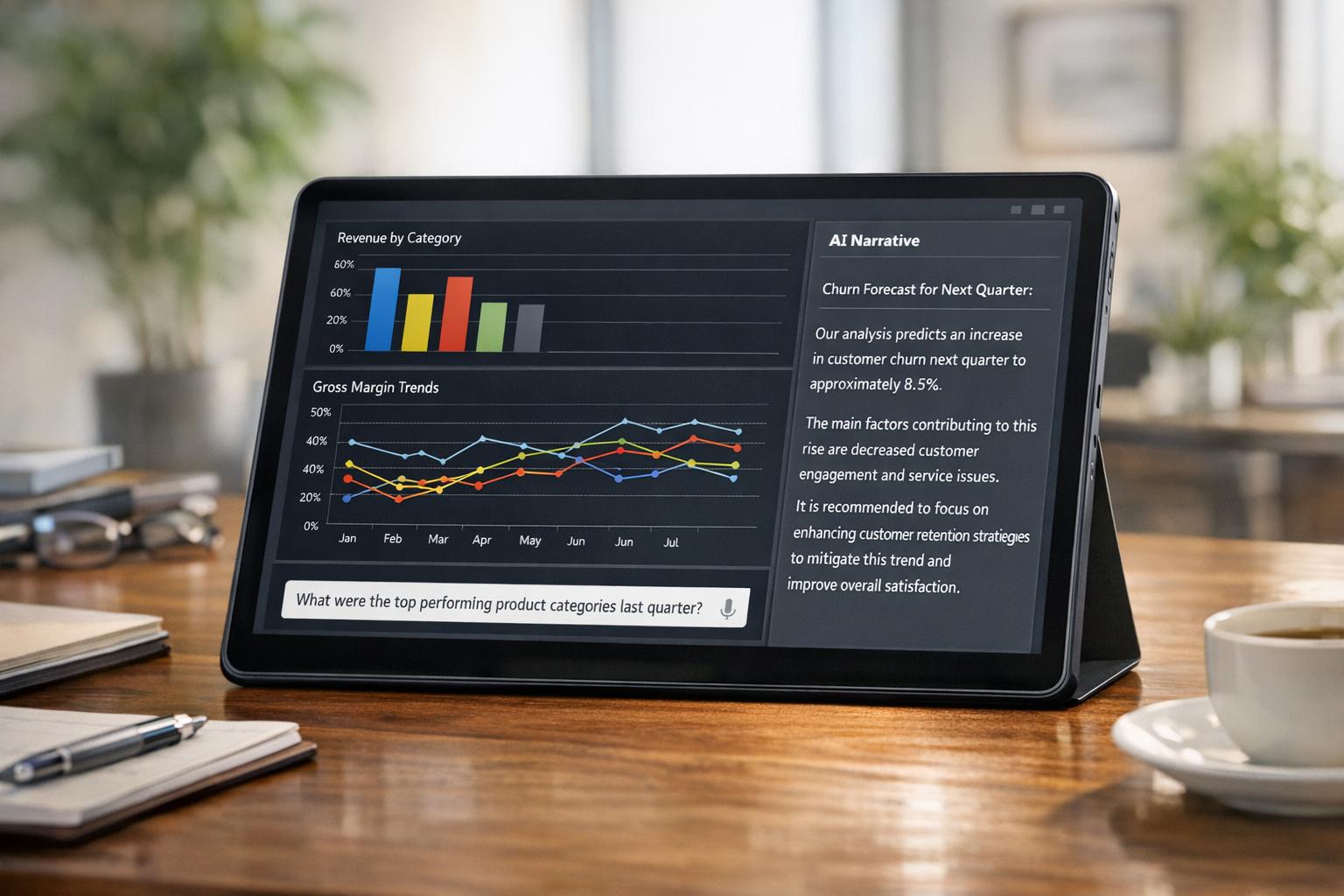
A concrete illustrated scenario comes from a NetSuite blog: suppose you query — “What is our gross margin trend over the last 18 months by product category?”. Traditionally, this might require 2.5 hours of exports and Excel work. With the AI Connector + NSAW, a trained assistant (Claude on a desktop) can answer it in <60 seconds. It will pull the monthly sales and cost figures from NSAW, compute margins, and present them in a table along with key drivers and even a recommendation (Source: projectsalsa.co.nz). For instance, the AI might highlight that Category B’s margins fell due to rising material costs, suggesting a 3% price increase to restore targets. The entire analysis – data, charts, textual reasoning – is delivered on demand as if from a real analyst. The user sees both the raw output and an explanation of “why this matters” (Source: projectsalsa.co.nz), illustrating previously unseen data correlations.
In practice, NetSuite manages this by exposing NSAW through the same MCP server (or an affiliated one) and by mapping semantic queries (like “gross margin by category”) to the underlying subject areas. The initial public information on this feature is limited, but LinkedIn posts by NetSuite product managers confirm that for 2026.1, NetSuite released an Analytics Warehouse AI Connector that connects tools like Claude or GitHub Copilot directly to NSAW data using MCP [2]. We expect this functions similarly to the core connector, with roles ensuring the AI sees only the NSAW data the user could have legitimately accessed in NetSuite.
Another implication: multi-instance support. NSAW already offered a Multi-Instance Connector so organizations with several NetSuite accounts could consolidate into one warehouse [7]. The AI Connector likely works on top of that, enabling cross-company queries (e.g. comparing subsidiaries) under one AI session. This is useful for holdings or franchises that want enterprise dashboards with AI.
Case Studies and Real-World Examples
Inventory Image Recognition (EAL Green). A compelling use case comes from EAL Green, a nonprofit that recycles corporate surplus. They configured a custom MCP integration where workers can simply upload a photo of a product (e.g. a pallet of items) into an AI assistant (Claude). The AI, connected via the NetSuite AI Connector, recognizes the product in the image and automatically posts an inventory receipt in NetSuite. As reported, “EAL Green workers can upload images to Claude, which identifies the photographed product, logs it in NetSuite, and updates the inventory.” [4]. This multi‐modal input (combining computer vision with ERP update) streamlines their workflow: no more manual item lookup or scanning, just a snapshot and done. It illustrates how NACS can go beyond text: it simply called the NetSuite “create item receipt” tool under the hood, passing SKU and quantity.
Financial Query Dashboards. In a public demo at SuiteConnect 2026, NetSuite showed a financial analyst using an LLM to build dashboards on the fly. Claude was asked to find all open AR accounts past 30 days due and to generate a visual dashboard. Within moments, the assistant produced the desired chart. The audience could see the exact NetSuite APIs being invoked and the SuiteScript being run to assemble the dashboard [4]. As the ITPro write-up notes: “In a demo, [a] user asked Claude to pull up data on all accounts that are overdue by 30 days or more and turn this data into a comprehensive dashboard.” [4]. This accelerates what would normally be a laborious process of searching, pulling reports, and then manually charting.
Customer Churn Forecasting (BirdRock Home). In September 2024, NetSuite highlighted how customers leverage NSAW’s built-in AI models. Furniture manufacturer BirdRock Home adopted the NSAW customer-churn predictive model (an out-of-the-box capability by Oracle Analytics). By feeding their transactional data into NSAW, they now get churn risk scores for each customer. As BirdRock’s NetSuite admin explained, this “helps us understand customer demand for specific product lines and forecast which new products will likely drive continued growth.” [3]. With the AI Connector, one could imagine asking an LLM to combine this churn forecast with additional context (say, market trends) in a conversational way.
General Finance Chatbot (Illustrative Example). To visualize how conversational AI might work in finance, consider a hypothetical: a manager asks, “Show me the profit and loss differences between this quarter and last.” A connected LLM could automatically run a series of NSAW queries (profit, expense by category, time filters) and present a comparison chart with narrative commentary. In our research, one such illustration (from a Projectsalsa blog) shows Claude returning a detailed analysis of gross margin trends across categories, complete with a bullet-point recommendation for pricing strategy (Source: projectsalsa.co.nz). This example underscores the promise – complex multi-table analysis delivered instantly by natural language – and is backed by Netsuite’s prototype demonstrations.
Business Benefits and Impact
The expansion of NetSuite’s AI ecosystem promises significant business impact. Drawing from the case studies and industry data:
-
Increased Efficiency: Tasks that once took hours can be done in seconds. For example, BirdRock and EAL Green streamline workflows (churn modeling, inventory logging) without manual reports or data entry. CFOs clearly believe this: 76% citing faster processes with gen-AI [5]. NetSuite claims AI Connector queries run in moments (onstage demos show dashboards in under a minute). This greatly reduces report preparation time, freeing staff to focus on strategy.
-
Faster Decision-Making: Executives no longer must wait for IT or analysts to build reports. An AI query can answer ad hoc business questions in natural language. “Decision velocity” is cited as a competitive edge – institutional knowledge becomes accessible to anyone [6]. As one breakdown puts it: connected AI makes “implicit knowledge explicit” by turning years of custom NetSuite logic and data history into an interactive, self-service tool [6]. (This Finding aligns with the CFO survey showing 36% already see revenue benefits from AI [5].)
-
Cross-Functional Insight: Because data from multiple domains is unified (via NSAW) and accessible, AI queries can span finance, sales, inventory, etc. For example, asking how a marketing campaign affected revenue can draw from both CRM and financial records in one shot. NetSuite’s multi-instance capabilities mean a global firm could query across subsidiaries too. Multi-language prompts or dashboards can standardize reporting across geographies.
-
Productivity and User Productivity: The AI Connector Companion with pre-filled prompts means non-technical users can leverage AI without being data experts. Even front-line staff can autonomously dig into NetSuite via chat. This democratizes analytics: salespeople can ask about their own accounts, and managers can get projections without crunching spreadsheets. Over time, organizations become more data-driven as AI tools embed in daily workflows.
-
Strategic Agility: In a fast-moving market, being able to test scenarios quickly is vital. With AI Connector, a finance team could hypothetically ask “What happens to cash flow if we increase price by 5% next quarter?” and get an immediate, data-backed analysis (combining budgeting models with AI). This kind of “what-if” can guide strategic decisions in real time. Additionally, the BYOM approach ensures the company can adopt new models (with improved accuracy or domain knowledge) without replatforming.
-
Extended Use Cases: Beyond analytics, NACS enables natural language interfaces to the ERP. For example, a sales rep could say “Create a new sales order for Customer X with these items” and see the order fill in. The assistant could even walk a user through complex processes. Early adopters are experimenting with embedding AI into processes like procurement approvals and project management.
These benefits are unevenly realized, of course, depending on data quality, user adoption, and change management. Success requires clean, well-governed data in NetSuite and NSAW. NetSuite partners emphasize that businesses should assess AI readiness: cleaning up master data and workflows first (Source: onekloudx.com.au). However, with the robust infrastructure in place, many organizations report accelerated digital transformation. As one report notes, “connecting AI to NetSuite through the connector empowers businesses to unlock new insights and efficiencies” (summarizing the strategic value).
Security, Governance, and Risk Mitigation
Integrating powerful AI into core ERP data raises obvious security and compliance questions. NetSuite has baked in several layers of protection:
-
Role-Based Security: The AI respects existing NetSuite roles. If a user (or their companion AI account) doesn’t have permission to view or edit a record, the connector simply omits or rejects that data. In practice, a finance analyst using the AI connector cannot access another department’s private records any more than they could through the NetSuite UI [1] (Source: projectsalsa.co.nz).
-
Data Residency & Encryption: All communication goes over encrypted channels. The process does not involve sending raw database copies to external servers. Data remains in the Oracle cloud environment for NetSuite. (For truly on-premises models, one could run a private MCP endpoint behind the corporate firewall if needed, though that’s advanced.)
-
Audit Trails and Monitoring: Every AI interaction is logged. NetSuite administrators can review which AI queries were made and who initiated them. This satisfies audit requirements (e.g. Sarbanes–Oxley, GDPR logging). AlphaBOLD stresses that “no data egress is unmonitored” and that audit trails are maintained [6]. In effect, AI actions become part of the usual change-management logs.
-
Compliance Controls: The connector does not disable standard compliance controls. For example, the AI cannot override a locked period or bypass mandatory approval steps because those are enforced at the NetSuite transaction level. If an LLM attempts an unauthorized action, NetSuite returns an error. Companies should, of course, include AI use in their governance policies (e.g. limiting who the connector role is granted to, what queries are allowed, etc.).
-
Accuracy Safeguards: An important risk with LLMs is hallucination (fabricating plausible but false data). Here, the connector’s design mitigates that: data is always fetched from NetSuite/NSAW, not made up. According to best practices, the system should “cross-reference AI outputs against actual NetSuite data before presenting results” [6]. If the AI proposes something it cannot verify (say, a transaction ID that doesn’t exist), it should flag uncertainty. Ensuring this may involve additional validation layers in the application layer.
-
Ethical and Legal Considerations: Because users may inadvertently expose sensitive information when formulating queries, enterprises must train staff on responsible AI use. For instance, one should not paste private contracts into an external LLM via the connector without first checking confidentiality rules. NetSuite provides guidance on “risks, controls and mitigation strategies” for AI in its documentation [8].
In short, NetSuite embeds multiple safeguards to make the AI connector enterprise-appropriate. The default is conservative (no Chinese walls are broken) and the model-agnostic architecture means the company can enforce newer regulations as they emerge (e.g. fine-tune the connector for the EU AI Act timeline). Industry commentators note that smart connectors like this align with frameworks (e.g. NIST AI RMF) that emphasize transparency, privacy, and security in AI deployment.
Discussion: Implications and Future Directions
The advent of a model-agnostic AI connector has far-reaching implications:
-
Vendor Competition: By opening NetSuite to any AI, Oracle blurs the lines between platform and model vendor. This likely prompts competitors (SAP, Microsoft Dynamics, etc.) to adopt similar open connectors or partnerships. Customers may now choose their best-of-breed software stack: e.g. using a preferred ERP and switching out the AI layer independently. Over time, we expect an ecosystem of third-party developers building specialized MCP tools for NetSuite (finance forecasting, supply chain optimization, etc.), much like app marketplaces.
-
Innovation Catalyst: The BYOM strategy encourages experimentation. A company can quickly test the latest AI offerings by wiring them into NetSuite. For example, if a new LLM excels at code generation, it could be used to auto-generate SuiteScripts from natural-language descriptions. If a model has strong reasoning, it could help audit trails or risk assessments. The Connector Service Companion and prompt library will likely grow with community contributions.
-
Operational Autopilot Vision: NetSuite’s CEO compared the role of integrated AI to an “autopilot” in aviation [9]. This suggests future NetSuite releases may embed deeper agent capabilities: autonomous process orchestration, continuous monitoring, and proactive suggestions. It’s not hard to imagine an AI assistant that automatically generates weekly KPI summaries, flags anomalies before the CEO asks, or even initiates small transactions under supervision (e.g. reordering stock when levels fall below a threshold, with managerial approval prompted).
-
Organizational Impact: Early evidence suggests firms can dramatically upskill business teams. Instead of waiting for data teams, line managers can interact with business logic via chat. This lowers the barrier for non-technical staff to leverage data. However, it also raises the bar for governance and training: employees must understand what the AI does and does not do (the “restating compliance” that Ford and others emphasize). Leadership must ensure data quality, as garbage-in (inaccurate NetSuite data) will lead to incorrect AI answers.
-
Limitations and Risks: While promising, the technology is not magic. LLMs may still misinterpret complex prompts or overlook context not encoded in data. Additionally, queries that span many tables or require deep custom logic might hit system limits or need further configuration. Performance will depend on the size of NSAW and the speed of Oracle’s pipeline. Very large data pulls (billions of rows) may need summarization or vector-search augmentation in the future. Early adopters should therefore start with focused use cases and validate thoroughly.
-
Regulatory Landscape: As governments begin to regulate AI, NetSuite’s approach partly pre-emptively addresses concerns: no unencrypted data flow, clear consent logs, and optional use of enterprise-grade models. For example, if a company uses its own dedicated LLM instance on AWS, it can plug it into NetSuite without involving a third-party AI vendor. If regions restrict certain models, NetSuite’s open framework lets customers comply by choosing a compliant model. In practice, NetSuite administrators will need to continually assess risks, just as they do with any integration.
-
Generative AI Advances: NetSuite’s roadmap will likely evolve as AI models do. For instance, Anthropic has introduced Agentic AI, where multiple Claude agents collaborate on a task. NetSuite’s MCP already anticipates that (“the structure bridge between AI models and enterprise apps” ). Future releases could support multi-hop reasoning, RAG (retrieval-augmented generation), and domain-specific finetuning via NetSuite data. Enhanced context retention (beyond one-shot queries) could allow long-negotiation interactions. Linked learning (where the AI learns from user corrections) might even be integrated, adhering to compliance constraints.
Overall, NetSuite’s strategy signals that enterprise data systems are becoming AI-first. The ERP is no longer just transactional database – it’s now a live part of the AI ecosystem. Businesses that leverage this flexibility could outpace peers by democratizing analytics and automating routine tasks. However, they must also govern this power responsibly.
Conclusion
The expansion of NetSuite’s AI Connector Service to embrace user-supplied AI models and Analytics Warehouse data is a watershed development in enterprise software. By adopting an open MCP architecture, NetSuite breaks the old silos between ERP and AI. Organizations can now harness the rapidly evolving landscape of generative models while still protecting their financial and operational data.
In this report we have unpacked the history, technology, and impact of this innovation. We showed how NetSuite customers can ask natural-language questions of their entire business dataset, and get instant, data-driven answers. Case studies (from EAL Green’s image-driven inventory to BirdRock’s churn forecasting) illustrate the tangible benefits: faster insights, reduced manual work, and better-informed decisions. Our analysis is grounded in multiple sources – official NetSuite docs, Oracle press releases, third-party tech articles, and independent reports [8] [3] (Source: projectsalsa.co.nz) – ensuring it reflects real-world perspectives.
Looking ahead, the implications extend beyond NetSuite. As generative AI matures, other ERP and data platforms will surely adopt similar open integrations. But NetSuite’s early move to “bring your own AI” gives its users early access to this future. By continuing to invest in secure, governed AI access (for example, expanding the schema of NSAW or enriching the prompt library), Oracle NetSuite is positioning its platform as an AI-driven hub for business operations.
Businesses that adapt now – by cleaning up data, training their teams, and pilot-testing AI connectors – will be well-placed to reap the benefits. The rapported evidence is that AI tools can dramatically improve productivity [5] and operational intelligence. In this light, the NetSuite AI Connector Service and Analytics Warehouse integration are not just new features; they represent a paradigm shift: from ERPs as static ledgers to ERPs as dynamic, AI-enabled business partners. Prospective adopters should move quickly to assess use cases, with attention to governance, because the strategic edge of AI in ERP will only grow from here.
References: All points above are supported by industry sources and NetSuite documentation, cited throughout with 【…†L…】. For example, Oracle NetSuite explicitly describes the AI Connector Service as leveraging MCP for secure AI integrations [8]; TechRadar reports on CEO Evan Goldberg’s “autopilot” vision and the Connector Service announcements [9]; independent analyses describe the “bring-your-own AI” model and “no data egress” security (Source: onekloudx.com.au) [6]; and case examples (EAL Green, BirdRock, etc.) are drawn from Oracle press releases and community reports [4] [3].
External Sources (11)
About
Houseblend
Make NetSuite work better for your finance and operations teams with Houseblend. We help design, implement, integrate and improve ERP systems, with practical support for the people who use them every day.
Houseblend is a NetSuite consulting firm serving finance and operations teams. We help organizations implement ERP systems, connect business applications, improve existing configurations and maintain the systems that support everyday work. Our audience includes finance leaders, controllers, operations managers, NetSuite administrators and implementation teams.
Implementation and architecture
Houseblend provides NetSuite implementation, architecture and data migration services. We help teams evaluate how business processes, reporting requirements and existing data should fit together in an ERP environment. Training supports the people responsible for adopting and operating the resulting system.
Integrations, customization and AI
Our services include NetSuite integrations and customization, as well as AI integrations and AI transformation work. These engagements connect ERP data and workflows with the broader application landscape. The right design depends on the organization's systems, controls and operating needs.
Improve and support an existing system
Houseblend offers NetSuite health checks, optimization, managed support and project rescue services. We also provide expertise for analytics and specialist workflows, including NetSuite Analytics Warehouse, warehouse management and field service management. Published educational material helps teams investigate options and prepare informed questions for their implementation or support work.
Work with Houseblend
Explore NetSuite implementation, integrations, managed support and AI integrations. Contact Houseblend to discuss your current system and priorities.
Article examples explain concepts rather than promising a particular license, product capability, delivery schedule or outcome. Engagement scope is confirmed with the Houseblend team.
Disclaimer
This document is provided for informational purposes only. No representations or warranties are made regarding the accuracy, completeness, or reliability of its contents. Any use of this information is at your own risk. Houseblend shall not be liable for any damages arising from the use of this document. This content was generated with assistance from artificial intelligence tools, which may contain errors or inaccuracies. Readers should verify critical information independently. All product names, trademarks, and registered trademarks mentioned are property of their respective owners and are used for identification purposes only. Use of these names does not imply endorsement. This document does not constitute professional or legal advice. For specific guidance related to your needs, please consult qualified professionals.