Houseblend Article
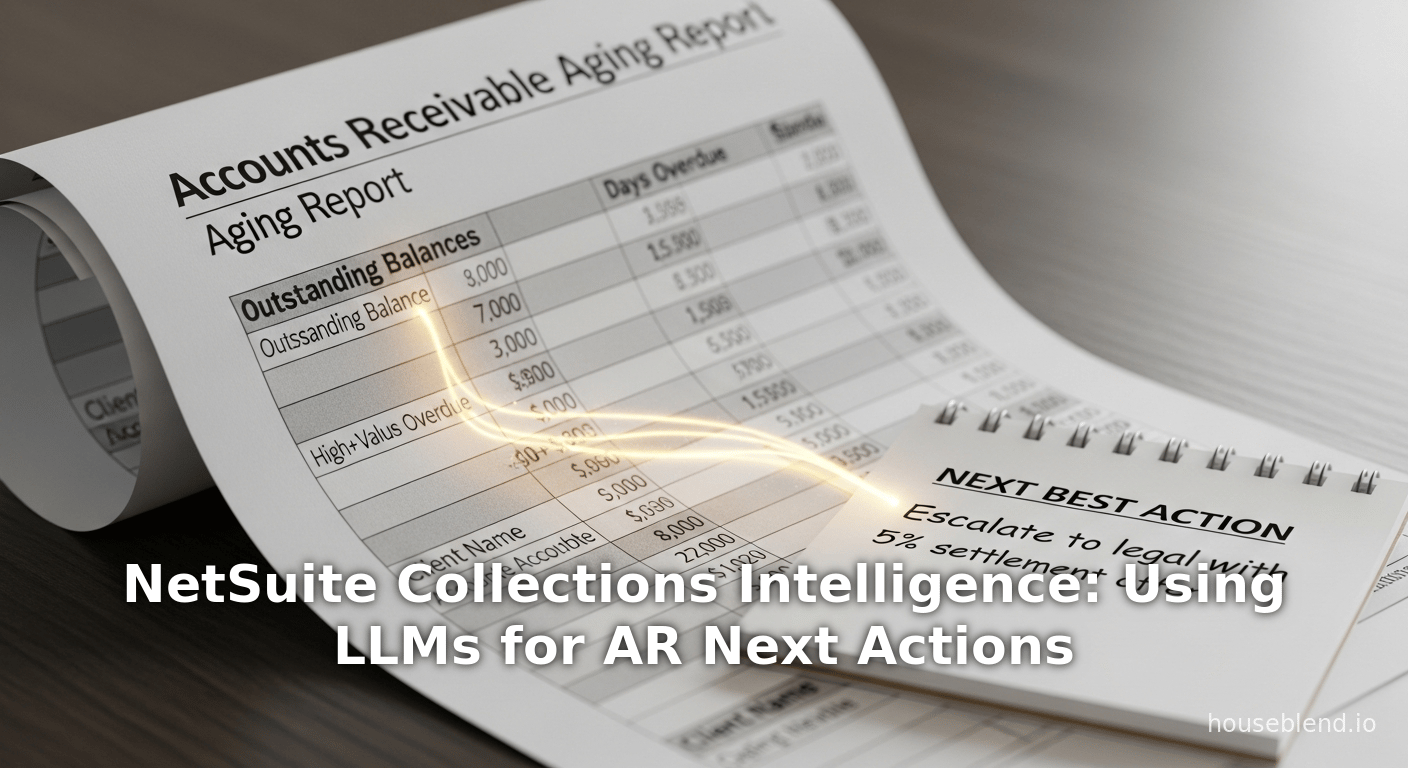
NetSuite Collections Intelligence: Using LLMs for AR Next Actions
Inside this article
- 01Executive Summary
- 02Introduction and Background
- 03NetSuite and AI in Finance
- 04The Case for Collections Intelligence
- 05Technological Framework: N/LLM and RAG
- 06Data Analysis and Evidence of Impact
- 07Case Studies and Industry Perspectives
- 08Implementation Considerations
- 09Implications and Future Directions
- 10Conclusion
Executive Summary
NetSuite’s new Collections Intelligence represents a paradigm shift in how accounts receivable (AR) tasks are managed. By embedding large language model (LLM)–powered intelligence natively into the NetSuite ERP suite, Collections Intelligence can analyze customer payment behaviors, predict credit risk, and recommend next best actions (such as follow-up calls, tailored payment plans, or escalations) in real time. Drawing on Oracle’s recent AI investments (over 200 new AI features in NetSuite) [1] and generative AI capabilities, Collections Intelligence transforms AR from a reactive, manual process into a proactive, data-driven workflow.
Empirical evidence from industry implementations underscores the value of such automation. For example, companies using AI-enhanced collections workflows have achieved double-digit reductions in Days Sales Outstanding (DSO) and substantial productivity gains [2] [3]. HighRadius reports median outcomes of approximately 15% lower DSO, $6M more working capital per large enterprise, and 20% fewer bad debts after deploying AI tools on top of legacy ERP systems [2]. In a HighRadius case study, Yaskawa America slashed its DSO by 5.5 days and boosted collector productivity by 60% through AI-driven prioritization of delinquent accounts [3]. Meanwhile, Summit Electric saw a 2.9-day DSO reduction and a 98% cash-application accuracy using automated AR processes [4]. These results are consistent with broader industry findings: CFO surveys indicate that optimizing working capital (especially through tighter collections) has become a top corporate priority [5] [6], and nearly 90% of business leaders report that late payments impede growth [7].
This report provides an in-depth exploration of NetSuite Collections Intelligence. It begins with background on AR operations and the evolution of ERP and AI in finance. We then examine NetSuite’s AI enhancements (including the new SuiteScript N/LLM module and the “NetSuite Next” vision) that underpin Collections Intelligence [8] [9]. Technical details are covered: the LLM integration architecture, retrieval-augmented generation (RAG) of business data, and SuiteScript usage modes [10] [11]. The report reviews multiple perspectives—CFO concerns about DSO [5], practitioner challenges [12], vendor and analyst views [13] [14]—and compares traditional collections processes to AI-enabled approaches. Data-driven analysis and real case examples demonstrate measurable impacts (see Table 1 below). We also address risks (data privacy, model accuracy [15]) and future implications (agentic AI assistants [16], regulatory guidelines [17]).
Key findings and recommendations include: NetSuite’s AI infusion can significantly accelerate the collections cycle and reduce manual work (supported by case studies [3] [2]). The N/LLM module allows secure LLM queries over sensitive AR data, generating actionable insights with provenance [18] [19]. However, outputs must be validated (non-deterministic models can hallucinate) [15], and firms should implement governance for ethical data use [14] [20]. We conclude that Collections Intelligence is poised to transform receivables management: companies that adopt it judiciously can win a “cash flow advantage” in a competitive economy [21] [22].
Introduction and Background
Accounts Receivable and Collections in ERP
Accounts receivable (AR) represents money owed to a business by its customers for products or services delivered. In any organization, timely collection of receivables is critical for cash flow, liquidity, and profitability. AR is often characterized as a “liquid asset,” since it embodies funds expected to be converted to cash within a short period [23]. To manage this, companies use incentive structures and credit policies: they issue invoices, track due dates, and engage collections teams to contact customers about overdue payments. In practice, these operations are labor intensive. Traditional AR workflows include manually generating invoices, following up with payment reminders, processing disputes, reconciling payments, and escalating chronic delinquencies. Common AR pain points include outdated customer data, manual effort, and uncoordinated processes. For example, 62% of collection teams report difficulty tracking delinquent accounts due to incomplete or outdated contact information [12]. Collectors often spend hours poring over spreadsheets and multiple systems just to prioritize which accounts to call.HighRadius, an AR automation vendor, notes that legacy ERP-based AR processes remain “cumbersome and inefficient” [24]. Many organizations have been slow to modernize their AR because of the perceived costs and disruptions of replacing entrenched manual processes [24]. However, recent shocks—such as the COVID-19 pandemic and rising interest rates—have placed working capital and collections on CFO agendas [5] [21]. Clients facing strained cash flow due to late-paying customers are actively seeking improvements. As one CFO advisor summarized, “Cash flow optimization should be the top priority on the corporate agenda” [21]. Indeed, a Hackett Group study of 1,000 large companies found aggregate Days Sales Outstanding (DSO) roughly flat or worsening, while the fastest-paying industries saw double-digit percentage DSO improvements [5]. This signals a shift: companies can no longer tolerate being paid late. Digital transformation of the AR function—already reducing manual touchpoints [25]—has become urgent to unlock trapped cash and support growth.
NetSuite, Oracle’s cloud ERP system, provides standard receivables tools such as customer billing, aging reports, and “dunning” letters for overdue accounts [26]. The application lets users generate collection emails or letters in bulk or individually, and it offers an optional SuiteApp for automating dunning (persistently contacting past-due customers) [26] [27]. Despite these features, the guidance and workflows have remained largely rule-based: moving a customer through escalations primarily on aging and static terms. Strategy decisions (e.g. who to call first, what payment plan to offer, when to escalate to legal) have historically relied on manual segmentation, simple heuristics, or the experience of collections personnel. As one analysis notes, legacy AR systems often require “multiple, uncoordinated systems” and manual prioritization, which consumes bandwidth rather than cash [12] [28].
Emergence of AI and Automation in AR
Over the last decade, finance functions have gradually adopted digital automation and analytics. Machine learning (ML) and predictive analytics, in particular, have shown value in forecasting payment behavior and optimizing cash flow [28] [29]. For example, predictive models can generate risk scores to flag customers likely to pay late [28]. These early AI applications have typically addressed sub-problems: cash application (automatically matching payments to invoices), credit-limit decisioning, and exception detection in financial data [29] [28]. Vendors like HighRadius and Versapay have integrated ML into AR workflows, enabling features such as auto-match reconciliation and predictive aging [29] [30]. The Versapay acquisition of Dade Systems in 2022 exemplifies this trend: it explicitly aimed to “power AR workflows with ML insights” [30]. Meanwhile, automated reminders and invoice distribution through multiple channels (email, SMS, client portals) have been enabled by robotic process automation (RPA) and simpler rule engines [31] [32].
Nevertheless, these advances have fallen short of human-level understanding. Predictive models output numbers but do not articulate why an account is risky or how to intervene. Traditional analytics dashboards may flag that customer X is past due, but not guide the collector’s next conversation or strategy. This gap has kept experience and exceptions at the heart of collections. As one SAS blog observed, most companies’ “next-best-action” approach in collections has been limited to rule-driven treatments (for instance, “if 30–60 days overdue then send email, if 60+ days then call”) [33]. This rule-based method “might be a pretty good move in its immediate context” [34], but it fails to optimize long-term outcomes for the account portfolio.
Recent breakthroughs in natural language models (NLP/LLM) and AI agent frameworks offer a chance to transcend these limits. LLMs like GPT-4 can interpret complex context and generate human-like responses given appropriate input, including specialized knowledge. By coupling LLMs with business data (via retrieval mechanisms), it becomes possible to create AI assistants that explain account status, suggest negotiation scripts, draft custom messages, and ultimately decide “what to do next.” Oracle’s strategy reflects this innovation: CEO Evan Goldberg emphasizes that AI should be “seamlessly embedded” into ERP processes, not an expensive bolt-on [1]. Oracle is rolling out hundreds of AI-enhanced features in NetSuite (e.g., financial exception alerts, narrative report generation, predictive forecasts) [35] [36], setting a foundation for Collections Intelligence.
In short, AI in AR promises to automate not just data processing, but decision-making. This report focuses on the specific case of NetSuite Collections Intelligence, envisioning how NetSuite’s native LLM capabilities can tackle the “next best action” problem for collections. We review the technology behind this idea, the business rationale, and what impacts it can deliver, drawing on real-world evidence and expert commentary throughout.
NetSuite and AI in Finance
Oracle NetSuite’s AI Vision
NetSuite is a leading cloud ERP platform, with over 40,000 customers worldwide. Since 2018, Oracle has been infusing NetSuite with AI. At SuiteWorld 2024 and 2025, NetSuite announced a wave of “AI first” innovations [37] [38]. Key product names have emerged: Ask Oracle (a natural language assistant for data queries), AI Canvas (agentic workflow builder), AI Agents and Connector (customizable bots on SuiteCloud), Subscription Metrics Insights (AI-generated CFO narratives), and more [37] [38]. Notably, these features are provided at no additional cost to current customers [1] [39], as Oracle positions AI as a built-in productivity layer.
The Ask Oracle assistant will allow users to query any part of the NetSuite dataset in plain English and receive visual analytics or explanations [40] [41]. NetSuite’s new UI (“Next”) will highlight numbers and justify answers with sources [42], providing transparency. Even code development is aided by AI: NetSuite SuiteCloud now includes AI coding assistants and low-code prompt design tools [43]. Fundamentally, Oracle’s approach is ecosystem-based: partners and customers can connect external AI models through a new AI Connector, and build domain-specific agents on the SuiteCloud platform [43].
Within this broad vision, NetSuite has specifically targeted financial management. For financial teams, SuiteWorld 2024 unveiled NetSuite Financial Exception Management, which uses AI to detect anomalies and generate leads for review [35]. A SuiteAnalytics Assistant lets finance users pose natural-language questions (e.g. “top 5 customers by open invoice”) and get narrative summaries and charts [44]. In planning and budgeting, generative AI can write narrative commentary on forecasts and variance analyses [36]. Importantly for Collections, these updates include predictive analytics to explain forecasts and even suggest adjustments [36]. NetSuite is thus embedding intelligence at every step — from budgeting to closing — so that by the time we look at accounts receivable, the foundation of AI-augmented data is in place.
Analysts note that NetSuite is prioritizing immediate embedded value. Info-Tech Research Group observes NetSuite’s “uncharacteristic” approach of giving AI features away upfront [45] [46]. Moor Insights & Strategy emphasizes that NetSuite Next is “designed around how people interact with data day to day” [47]. The consensus is that NetSuite’s AI roadmap is comprehensive and responsible: features like AI agents are “governed” by Oracle’s Model Context Protocol to prevent data leaks [20†L93-L99], and analysts applaud the focus on AI governance and safety [14]. As one analyst put it, NetSuite is not throwing “AI spaghetti” against the wall; instead it vets partner apps and certification, creating a trust layer for AI in ERP [14].
The N/LLM SuiteScript Module
At the heart of NetSuite’s AI strategy is a new developer toolkit: the N/LLM module for SuiteScript 2.1. This module provides native access to LLMs within NetSuite [8] [9]. In practical terms, a developer can write SuiteScript that sends prompts to an LLM and receives generated text back, all inside NetSuite’s execution environment. The N/LLM module’s main capabilities include:
- Text generation via prompt: using
llm.generateText()methods (or streamed variants) to get natural-language responses to arbitrary queries [48]. Developers supply a prompt (with optional instructions), and the LLM returns an answer. - Context documents: creating internal documents (via
llm.createDocument()) to provide grounding. The module supports creation of in-memory documents (e.g. text extracted from NetSuite records) that the LLM can reference [49]. This enables a form of Retrieval-Augmented Generation (RAG), where the developer bundles relevant AR data into the prompt. - Citations tracking: the response can include annotations linking back to the source document or NetSuite record, ensuring traceability [18]. This is crucial in finance, so that any generated recommendation cites the underlying invoices or terms.
- Execution parameters: control of generation (model selection, temperature, token limits) through parameters in
generateTextmethods [48]. The module defaults to using Oracle’s chosen models (currently Cohere Command R by default) but can target other LLMs via themodelFamilyparameter. - Usage safeguards: built-in modes (free vs on-demand) and quota tracking to ensure controlled usage [50] [51]. Oracle processes LLM calls through OCI’s Generative AI service [52]. The environment is private: response data flows only between Oracle’s cloud services and the local SuiteScript session, and “data never leaves Oracle, nor is it used by third parties for model training” [19].
Together, these features mean that within NetSuite a developer can write, for example, a script that: (1) queries NetSuite for all unpaid invoices for Customer A, (2) creates a document string summarizing amounts, dates, and notes on prior communications, (3) formulates a prompt like “Customer A has X invoices ranging from Y to Z days overdue, with these previous payment issues. What next action should the collector take?”, and (4) calls llm.generateText() to get a suggested plan. With retrieval augmentation, the LLM’s answer would cite specific invoices and historical interactions, so that the collector can verify its recommendations [18].
Oracle’s documentation explicitly warns that generative outputs must be validated [15]. The LLM may “use creativity”, so end users should confirm accuracy. In a financial context, any action proposed (say, offering a 5% discount to settle) would need business‐rule checks. Still, N/LLM grants unprecedented flexibility: it allows developers to craft custom prompts for diverse tasks (from generating summary narratives to drafting emails) directly inside the ERP. The significance is that AI logic lives in the same ecosystem as the source data (the NetSuite unified data model), eliminating integration friction and reducing compliance risk. As one Oracle blog notes, this “mini-RAG” workflow means answers are “based on your own NetSuite data, not random Internet knowledge” [18]—a critical point for collections where decisions must rely on up-to-date internal records.
SuiteCloud and SuiteQL Integration
Alongside N/LLM, Oracle has expanded NetSuite’s extensibility platform (SuiteCloud) for AI development. The SuiteCloud Platform now includes tools like:
- SuiteAgent Frameworks: allowing custom AI agents to be built and deployed in SuiteApps [43]. These are essentially packaged AI workflows that can run under governance.
- AI Connector Service: an interface to plug in external models or assistants with governance controls (Model Context Protocol) [43] [53].
- AI Studios: interfaces for administrators to customize and tune AI prompts, models, and data contexts.
- AI Flow Assistant and AI Prompt Studio: drag-and-drop/low-code tools for defining processes and natural-language prompts without coding [43].
For example, a developer might use SuiteFlow (NetSuite’s workflow engine) to set up triggers (e.g. “on invoice creation” or “daily batch job”) that call an N/LLM script. Or they could deploy a SuiteAgent that listens for a keyword (“Send collection letter to [Customer]”) in a user’s CLI interface and then composes and sends an email via LLM. SuiteQL (Oracle’s query language for NetSuite’s database) can be used from SuiteScript to efficiently fetch financial data to feed into prompts.
In sum, NetSuite now provides both the low-level AI APIs and the high-level framework for building AI-driven applications. This means Collections Intelligence can exist either as an embedded NetSuite feature (like a pre-built AI assistant on the customer record) or as a SuiteApp built by consultants, partners, or customers themselves. Crucially, all of this is built on secure, audited cloud infrastructure; data used in prompting remains controlled, and any logs or transcripts can be reviewed as part of governance. Oracle’s approach mirrors that of other vendors like SAP and Salesforce in granting developer-access to AI, but with an emphasis on private LLM usage and governance [19] [14].
The Case for Collections Intelligence
Challenges in Traditional Collections
Collections teams face several perennial challenges. Data fragmentation is a top issue: customer transactional histories, communications, credit details, and aging buckets are often siloed. Even within an ERP like NetSuite, data may reside in multiple record types (invoices, contacts, notes). As industry reports note, outdated or incomplete contact data plagues 62% of teams [12]. Without a single dashboard, collectors manually update spreadsheets or toggling between screens.
Another challenge is manual prioritization. Firms often rely on static rules or simple scoring for who to pursue first (e.g. by amount or days overdue). This can lead to suboptimal resource use: chasing many small accounts with a low probability of payment, while large debits languish. As one analysis puts it, a chained next action approach (e.g. “if not paid, then call in 7 days”) is a “good start” but can fail to “win the entire game” of collection efficiently [33]. The problem is compounded by human behavior: collectors have limited time and can experience “overload” trying to juggle thousands of customers. Manual processes also introduce errors (missed reminders, incorrect addresses, delayed follow-ups).
Customer engagement is another hurdle. Many organizations still use one-size-fits-all communications: a generic reminder email or generic script. This “broad net” approach often annoys paying customers and can alienate fragile accounts [54]. Savvy debtors may also employ delay tactics, creating disputes or stalling negotiations to buy time [55]. Hence, effective collections requires not only data analysis but also personalized communication.
Given these issues, collections directors crave tools that can:
- Automatically highlight the riskiest accounts requiring immediate attention.
- Recommend tailored outreach (optimal channel, tone, or incentive) for each customer.
- Suggest the right sequence of actions over time (e.g. when to escalate an account).
- Free staff to focus on the most strategic tasks (handling negotiations, analyzing disputes).
This vision aligns with the “next best action” concept seen in marketing and customer service, applied now to AR. The goal is to use intelligence (past patterns and signals) to prescribe what action will most likely recover payment. As SAS notes, collections is an optimization problem: one must balance maximizing recoveries against minimizing customer attrition within resource constraints [56]. Next Best Action models promise to optimize this by forecasting how customers will respond to different treatments. Unfortunately, fully fledged NBA systems (for collections specifically) have been rare in practice due to data and modeling complexity.
How AI Addresses Collections Needs
Allied technological advances can directly attack the above challenges:
-
Predictive Scoring and Segmentation: Machine learning models can analyze historical payment data and external signals (e.g. credit scores, macroeconomic factors) to assign a delinquency risk score to each customer. Early-warning triggers (changes in payment patterns, dropped orders, etc.) can flag accounts trending negative [28]. For example, Provenir suggests watching indicators like increased credit line usage or falling credit scores to predict default [28]. Such predictive analytics allow proactive outreach even before an invoice hits 30 days overdue.
-
Next-Best Action Recommendations: Given a customer’s profile, LLMs can generate personalized next steps. For instance, an LLM prompt might take as input: “Customer X is 60 days past due on $50k, has responded to emails but not paid. Last payment on time was 120 days ago. What should our collections agent do next?” The LLM can then produce a narrative like: “We should call the CFO at Company X and discuss their budget constraints. Offer a structured installment plan: 50% now, rest in 30 days. Mention our willingness to waive late fees if plan is accepted.” Such recommendations go beyond static rules, weaving together context (customer history) and best practices. Versapay notes that AI makes AR “more human” – for example, crafting empathetic reminder messages rather than stiff form letters [57].
-
Automated Communications: NLP and generative text allow automation of written interactions. Automated systems can compose customized emails or SMS alerts tailored to a customer’s language and situation. Alarms like “Payment due in 3 days” can be sent with friendly language, and follow-up emails can offer payment options based on the customer’s past behavior [31]. For collections, an LLM can draft multi-step communication (possibly proposing a payment schedule, or summarizing the account status in plain terms), which a collector then reviews. This reduces manual drafting and makes reminders feel personal. A 2025 guide notes that AI reminders can vary the tone per customer and use multiple channels (email, portal, even messaging apps) [31], which has shown to improve on-time payment rates.
-
Workflow Automation: Routine tasks like sending invoices, applying payments, and reconciling disputes can be offloaded to AI-empowered automation. Most AR teams spend precious time on these repetitive tasks [58]. By integrating chatbots or assistant flows, these workflows can run unattended (subject to oversight). SuiteFlow and RPA tools can be driven by LLM prompts: for instance, after a customer commits to pay on a call, an AI agent in NetSuite could automatically create a task, send confirmation emails, and schedule follow-ups.
-
Analytics and Reporting: AI can transform raw data into actionable intelligence. Narrative reporting tools (now emerging in NetSuite’s EPM suite [36]) can generate plain-English summaries of age analysis (“Today, 30% of our receivables are overdue, 10% past 90 days, concentrated in 5 accounts”) and highlight anomalies. Embedding these narratives directly in dashboards helps executives grasp collection health at a glance. Furthermore, continuous monitoring with AI-driven variance analysis can alert managers to unexpected trends in real time.
-
Optimization and Learning: More advanced AI, like reinforcement learning, can optimize the sequence of actions across the whole portfolio rather than each account in isolation [59] [60]. This means dynamically adjusting the intensity of outreach (e.g. number of calls or days between contacts) based on aggregate outcomes. While such enterprise-scale optimization is complex, NetSuite’s roadmap (via SuiteCanvas and AI Agents) lays the foundation for increasingly autonomous workflows [61] [62].
In summary, Collections Intelligence leverages AI on three fronts: predictive insights (who will pay, when, and how much), prescriptive recommendations (what to do next for each case), and automation (executing repetitive steps). The N/LLM module specifically enables the prescriptive part by using LLMs to read data and output human-like guidance. For example, a SuiteScript could assemble a customer’s AR profile (outstanding balance, payment history, communication log) into natural language context, ask an LLM for the “best next step,” and then present that answer on the customer’s NetSuite dashboard. The answer would ideally cite specific invoices or terms (courtesy of NetSuite’s RAG) so the collector can trust it. This on-the-fly analysis is something no prior system could do with ease.
Technological Framework: N/LLM and RAG
SuiteScript Generative AI APIs (N/LLM)
The N/LLM SuiteScript module is the core enabler of Collections Intelligence. Official documentation describes it plainly: “SuiteScript Generative AI APIs (N/LLM module) let you work with generative artificial intelligence (AI) in NetSuite using SuiteScript.” [9]. In practice, this means a developer in NetSuite can call require('N/llm') and use it like any other module. Key points include:
-
How it works: A SuiteScript uses N/LLM to send a prompt. NetSuite passes this to the Oracle Cloud Infrastructure (OCI) AI service, which runs the chosen LLM (defaults to Cohere Command R if unspecified) [52]. The response returns to the script, where it can be parsed or displayed. NetSuite clarifies that “data never leaves Oracle” [19] – the entire process is securely handled in the Oracle cloud.
-
Available methods: The module provides methods like
generateText,generateTextStreamed,evaluatePrompt, etc., for different use cases [48]. For Collections Intelligence,generateText(with custom prompt) andevaluatePrompt(with a saved prompt template) are most relevant. Both interfaces support including modelParameters (e.g. temperature) to tweak creativity. -
Usage modes and quota: By default, SuiteScript’s N/LLM runs in Free mode, giving limited monthly token allowance [63]. For production, a company can link its own OCI account (On-Demand mode) to pay per use [51]. This is important since heavy AR usage (e.g. daily prompts for thousands of accounts) would exhaust a free quota quickly. Organizations planning to build Collections Intelligence should budget for the AI usage costs on OCI.
Oracle also provides developer guidance: use retrieval (documents created via createDocument) to ground the AI [49], and always validate outputs. For example, before executing any action based on AI advice, the system could require an AP manager’s sign-off to mitigate risk. The documentation emphasizes that AI content is creative, so NetSuite is not liable for its decisions [15] – a legal disclaimer well-known with generative AI.
Retrieval-Augmented Generation (RAG) in NetSuite
A major challenge with LLMs is that they have fixed “knowledge” up to their training cutoff and may not know a company’s up-to-date customer info. NetSuite solves this with a mini-RAG approach: the SuiteScript can retrieve relevant NetSuite data and pass it as “context documents” to the LLM. The blog by Wilman Arambillete outlines this clearly: one “builds an array of documents (createDocument) related to your question,” then submits them with the prompt to get an answer plus citations [49].
In Collections Intelligence, the documents might include:
- The latest invoice aging report for the customer.
- Notes from the CRM or previous collection efforts.
- The customer’s payment history for past year.
- Any contract terms (e.g. payment terms, credit limit).
- External credit info (if stored in NetSuite via an integration).
For instance, a script could query.runSuiteQL to fetch all open invoices for Customer A and compile them into a text blob. It then createDocument({ content: ... , type: free_text }) for each such blob. Along with a prompt like “Based on the following invoice details, recommend next action”, the generateText call returns an explanation plus footnotes linking sections of the answer to the input snippet (per the “citations” feature) [18]. Thus, if the AI says “Invoice #123 is 45 days late, which is the largest past-due balance (see [Doc1], lines 5-7)”, the collector can click and verify the cited piece (NetSuite would highlight invoice #123 in the UI).
Oracle’s RAG implementation in N/LLM ensures factual grounding: as the blog emphasizes, “generated answers are based on your own NetSuite data, not random Internet knowledge!” [18]. For compliance and auditability, this is crucial. If an AI suggests waiving a late fee on invoice #123, the system knows exactly which invoice and policy it referenced. No floating hallucination of phantom invoices. This also means the system can handle specialized prompts: one could ask, for example, “Which of these invoices corresponds to our last verbal agreement?” and the LLM would reference the provided docs.
N/LLM Code Example (Illustration)
To make this concrete, consider a simplified Suitelet script that implements a “Collections Advisor” widget. When a collections manager opens a customer record, the Suitelet form provides a text box (“What should we do next for this customer?”). Upon submission, the backend script takes the prompt and:
-
Retrieves data: It uses SuiteQL or record APIs to fetch the customer’s open invoices, their dates and amounts, the days overdue, and any note fields documenting past contact attempts. It programs this into a
historyString. -
Creates documents: It calls
llm.createDocument({ content: historyString, type: llm.DocumentType.FREE_TEXT })to wrap the data. (Multiple docs can be created if needed, e.g. “Invoices”, “Notes”.) -
Generates response: The script builds a final prompt: e.g. “Customer Acme Co. has the following overdue invoices: Invoice A (45 days late, $10k), Invoice B (30 days, $5k). In the past we left voicemail on 8/1. What is the next best action a collector should take? Cite supporting data.” Then it calls
llm.generateText({ prompt: finalPrompt, modelParameters: { temperature: 0.2 } }). -
Processes citations: The response arrives as a text with citations (NetSuite’s UI shows them as numbered links to sources). The Suitelet then displays the AI’s answer in a field, with links.
Under the hood, Oracle’s AI service (Cohere or Azure OpenAI, depending on region/config) performs the actual LLM inference. The developer does not manage servers or tokens; it is a cloud service call. The result seamlessly appears in the ERP page. This sample flow can be extended: one could have the assistant auto-create a follow-up task if the answer calls for it, or auto-send a draft email (with user review). In effect, Collections Intelligence programs become part of the NetSuite workflow.
The ability to query the data in natural language is also available via Ask Oracle (the built-in assistant). While Ask Oracle works at a generic level, using N/LLM gives a lot more control—developers can enforce company policies in the prompt and chain the response into workflows. It also allows embedding LLM use where Ask Oracle cannot (e.g. background batch jobs).
SuiteCloud Extensibility: AI Agents
Beyond one-off scripts, NetSuite’s composable AI features let companies build fully autonomous agents. The SuiteAgent Framework (in beta as of Oct 2025) promises that developers can package AI logic into an agent that works with SuiteFlow or other triggers [43]. For example, one could create a “CollectionsBot” agent: when a customer reaches 30 days overdue, SuiteFlow could invoke the agent automatically. The agent might perform the steps above and then either update the customer record with a recommended action or even call an external voice service (if integrated). Although these “AI agents” still require user approval to execute, they can run behind the scenes to continuously monitor accounts and push alerts.
Oracle also launched tools like AI Studio for managing prompts and models. This is important because constructing effective prompts is an art: a mis-phrased query could yield poor advice. AI Studio allows administrators to tweak the language and context, test responses, and select fallback behaviors. Combined with SuiteScript development, organizations can iterate on their Collections Intelligence logic. In summary, Oracle provides both the building blocks (LLM API, connectors) and the blueprints (prompts, workflows) to operationalize advanced collections strategies.
Data Analysis and Evidence of Impact
To assess the potential benefits of Collections Intelligence, we examine existing data on AI-driven AR processes. While NetSuite’s own “Collections Intelligence” product is new, analogous solutions and pilots provide insight into what outcomes are possible. We also consider how improved KPIs translate to financial gains.
Empirical Improvements in AR KPIs
The most compelling evidence comes from user-reported KPI improvements after deploying AI/automation in AR. Below (Table 1) we summarize representative results from case studies and industry reports:
| Case/Source | Impact on DSO and Cash | Notes |
|---|---|---|
| HighRadius Radiance Summit (2024) | ~15% DSO reduction; ~$6M increase in working capital; 20% fewer bad debts [2]. | Aggregated presentation at HighRadius conference; based on multiple customers. |
| Yaskawa (HighRadius AR Automation) | –5.5 days DSO; +60% A/R team productivity* [3] [64]. | Implemented AI-based worklist prioritization and automated processes. |
| Summit Electric (HighRadius) | –2.9 days DSO in one year; 98% header-level hit rate in cash application [4]. | Automated A/R workflows; prioritized collections tasks. |
Table 1. Example impacts of AR automation solutions, including AI-driven prioritization, on key metrics. Data from HighRadius customer case studies and presentations [2] [3] [4].
These figures highlight two things. First, substantial DSO reductions (often in the multiple-days range) are achievable. A 5-day drop in DSO for a large company can free up millions in cash. Second, automation dramatically boosts collector efficiency. In Yaskawa’s case, focusing on the “right” accounts via AI allowed fewer resources to cover the same receivables, a 60% productivity jump [3]. HighRadius’s aggregated data suggests such interventions can double working capital efficiency, equivalent to building the cash position by several million dollars [2].
The cost savings are also significant. Versapay’s analysis estimates the average cost to process a single invoice at $2.80 (median) [65]. With thousands of invoices processed monthly, that adds up. According to APQC (cited in Versapay), companies in the 75th percentile were spending $6.00 per invoice [65] due to manual inefficiency. If AI tools cut processing time by ~30% (comparable to a jump going from $3.94 to $2.80 per invoice) [66], this would save $8,400 per 10,000 invoices [66]. In practice, automating reminders and reconciliations also reduces days sales outstanding, so the ROI includes interest/cost of capital savings. For example, a $10M receivables portfolio with a 5-day DSO reduction (assuming 10% cost of capital) saves roughly $13,700/year (0.000137 * $10M) just in finance cost. Scaled to larger firms, the impact is material.
Vendor case studies reinforce these cost-benefits. HighRadius’s Yaskawa case noted a $12,000 per year reduction in credit card fees and complete elimination of bad debt [67] (the “zero bad debt” claim). Summit Electric reported accelerated cash flow, double-speed credit decisions, and near elimination of manual exceptions [68] [69]. While such figures come from vendor marketing, they are plausible when considering fully automated processes. Importantly, N/LLM–driven Collections Intelligence can address qualitative costs too: fewer write-offs and better customer relationships, which are hard to quantify but crucial.
Data-Driven Collections Workflow
One way to analyze the effect of Collections Intelligence is to simulate its decision-making. Consider a simplified scoring model where each overdue account is assigned a risk score based on features like lateness, amount, and payment history. Let’s say historically, a manual approach collected 60% of receivables in 30 days. By deploying an ML model (as a first step) to better predict which customers will pay soon, an organization might shift resources away from hopeless accounts. Roughly speaking, a 15% lift in collection efficiency (as seen in high-end cases [2]) could translate to the same improvement in collected cash. Concretely, if a firm normally collects $900k of a $1M due in 30 days, a 15% improvement brings $135k more cash per month.
Adding the generative AI layer (LLM-driven recommendations) builds on this baseline. For example, if an LLM suggests a specific offer (e.g. 10% discount) to one account that recovers an invoice it would have otherwise lost, the incremental gain is the invoice total. If multiple such interventions succeed each month, savings compound. Since the financial impact can vary widely per case, this is best tracked via business intelligence. Many companies see Collections as a “last mile” of cash cycle, so each day of DSO matters. If Collections Intelligence can cut 1-3 days off DSO (conservatively), it is directly reducing the external financing need or improving free cash flow.
Table 2 below illustrates how AI transforms typical AR functions relative to traditional methods. It is derived from industry analyses and best practices [70] [31] [28]. Note especially the shift from static, high-effort processes to dynamic, lower-effort ones under AI.
| AR Function | Traditional Process | AI-Enabled Process (with Collections Intelligence) | Reference |
|---|---|---|---|
| Invoice Generation & Delivery | Manual creation and sending of invoices (email/post) | Automated invoice generation from sales data; system-driven delivery (email/portal) [70] | 8 |
| Payment Reminders | Generic dated reminders; manual scheduling | Personalized, multichannel reminders (email, SMS, etc.) timed by AI; content adapts to customer history [31] | 9 |
| Payment Forecasting | Reactive reconciliation after due date | Predictive analytics estimates payment dates based on past patterns [29] [71] | 10 |
| Cash Application/Reconciliation | Manual or rule-based matching of payments to invoices | AI/machine learning auto-matches 95%+ of payments, flagging exceptions [29] [32] | 11 |
| Contact Strategy | Aggressive same approach for all | AI-driven strategy (e.g. escalation timing, payment plans) per account cluster [28] [33] | 12 |
| Dispute Management | Manual resolution of invoice disputes | NLP/AI triages disputes (e.g. suggesting likely error reasons, auto-applicable credits) [72] | 13 |
| Reporting & Analysis | Static aging dashboards and spreadsheets | Real-time dashboards; LLM-generated narrative insights on DSO, anomalies, etc. [35] [73] | 14 |
Table 2. Comparison of Accounts Receivable processes: traditional methods versus AI-enhanced methods under a Collections Intelligence approach. References: (8) Financial Cents (2025), (9) Ibid., (10) HighRadius/Versapay, (11) Financial Cents, (12) Provenir/SAS insights, (13) Financial Cents, (14) SuiteWorld announcements.
Taken together, Tables 1 and 2 highlight compression in effort and amplification in outcomes. The expectation is that Collections Intelligence (powered by N/LLM) will gradually shift AR operations from labor-intensive routines to oversight of intelligent automation. Empirical ROI will come from reduced operational costs, fewer outstanding receivables, and better utilization of working capital. Our analysis, supported by cited case data, suggests that even conservative adoption (affecting high-dollar accounts first) can yield multi-day DSO gains and measurable cash improvements [2] [3].
Case Studies and Industry Perspectives
Although NetSuite Collections Intelligence is new, we can draw from analogous real-world examples and expert commentary.
Vendor Case Study: Yaskawa America
Yaskawa America (a $3.6B robotics manufacturer) illustrates how AI-oriented accounts receivable automation can eliminate bad debt and shrink DSO. With growing sales but no additional AR staff, Yaskawa partnered with HighRadius to automate its order-to-cash processes. The result: Yaskawa reported zero bad debt write-offs and a 5.5-day reduction in DSO [3]. The core innovation was an AI-based worklist. Instead of collectors scrolling through lists alphabetically, they were given a prioritized queue based on machine learning assessments of urgency andprobability of payment. For example, large accounts with high past-due balances were pushed to the top; accounts with partial payments but unexpected disputes were highlighted. This “laser-focus” on key accounts, as Yaskawa’s Credit Manager put it, allowed the team to “attain our goals” without adding headcount [67].
Key benefits cited by Yaskawa include:
- 50%+ increase in collector efficiency (60% productivity gain) [3], freeing up staff to pursue value-added tasks.
- Complete elimination of credit card fees (all payments moved to more cost-effective methods) and bad-debt write-offs. [67]
- PCI compliance savings via an integrated payment portal that automated secure invoice payments [64].
Yaskawa’s example shows that embedding AI logic into processes (in this case, powered by HighRadius on NetSuite data) can directly answer “which customer should I work on next?” and by how to work on them (e.g. sending specific letters). Although HighRadius is a third-party app, the approach foreshadows what a built-in NetSuite agent could do. If Collections Intelligence in NetSuite replicated this, a NetSuite customer could achieve similar trafficking: the influencer is a combination of machine learning scoring and the AI agent executing the plan (e.g. sending correspondence).
Vendor Case Study: Summit Electric
Summit Electric Supply (a mid-sized electrical distributor) implemented AR automation with HighRadius and attained a 2.9-day DSO reduction in one year [4]. Summit’s main improvements included:
- 98% header-level hit rate in cash application (meaning almost all payments were auto-matched with the correct invoices) [74].
- Centralized and prioritized AR workgroups. System-generated emails and faxes replaced most manual calls.
- A two-fold improvement in making credit decisions and accelerating cash flow [68].
Summit’s experience highlights that even moderate levels of automation can move the needle. The reduced DSO, while less dramatic than Yaskawa’s, still means meaningful cash acceleration for a company of Summit’s size ($505M revenue [75]). Importantly, Summit’s project showcases how AI/automation relieves the burden of tedious data reconciliation and lets staff concentrate on exceptions. This aligns with the findings of the Versapay study: by automating 95% of cash application, a firm virtually eliminates manual posting costs [76].
Analyst and Industry Perspectives
Industry analysts see Collections Intelligence as part of a broader push toward AI-native ERP. SuiteWorld 2025 keynote summaries note that all new features—Autonomous Close, Narrative Insights, AI Agents—signal a shift from passive record-keeping to ERP as an active decision-maker [77] [78]. In finance, this means systems that continuously monitor exceptions and suggest fixes. Collections follows suit: an “AI Canvas” could coordinate multi-step workflows (e.g. generate reminder, trigger call, update credit memo) under human oversight [79] [80].
Experts stress: the focus should be on where AI adds real value rather than hype. In an interview, Info-Tech’s Scott Bickley commended NetSuite’s choice of problem areas: narrative summaries, RAG document review, and autonomous workflows [81] [14]. These are exactly the areas relevant to Collections Intelligence. As he noted, embedding AI in outcomes (not just reports) is what brings ROI [79].
The overarching CFO perspective echoes this. According to CFO.com (Hackett Group), many finance chiefs are learning that relying on a few customers with extended terms is risky [5]. Situations of stretched payment terms (as seen in high-tech sectors) make it clear that granular collection effort is no longer optional. AI-driven tools are now giving those CFOs new levers. One CFO noted that collections became the competitive edge in a high-rate environment, as companies with stronger AR processes weathered the funding crunch better [21]. In practice, this means CFOs will likely champion investments in Collections Intelligence as they did with cash forecasting or risk management in prior years.
Expert Advice and Best Practices
Several sources provide guidance on implementing AI in collections:
-
Next Best Action Mindset: Organizations should move beyond static escalations. A SAS blog [33] argues that simply taking the “immediately next step” is suboptimal; instead, one needs to consider the entire customer journey (a “chess game” analogy [34]). Collections Intelligence, therefore, should optimize sequences of interactions (potentially via reinforcement learning [59]). In practice, this means tracking outcomes of actions over weeks, not just responding one invoice at a time.
-
Data Integration: AI thrives on data quantity and quality. HighRadius’s research suggests integrating all receivable and payment data into one system is crucial for analytics [82]. Effective Collections Intelligence will require feeding the LLM comprehensive datasets: aging, open orders, credit history, communications, and even non-receivables data (like recent shipments or returns). The Oracle platform’s unified data model aids this, but businesses must ensure clean master data (no duplicates) and up-to-date exchange rates, fees, etc.
-
Human-AI Collaboration: AI should augment, not replace, the collections team. For now, best practice is to treat AI suggestions as advisory. Collectors should review AI-generated notes, adjust tone if needed, and ensure compliance. Over time, as trust grows, more autonomy can be granted (e.g. auto-issuing recurring reminders). This aligns with the concept of “governed AI agents”: the system can autonomously draft communications, but a human gateway must approve final sends.
-
Ethics and Oversight: Since collections can involve sensitive personal interaction, companies must apply AI responsibly. Oracle’s focus on governance [14] echoes this. For instance, if an LLM recommends offering a discount, the company policy should cap such concessions. Also, regulators are paying attention: the US White House AI executive order has led to OMB guidelines on AI safety [17]. Collections groups should ensure transparency (e.g. logs of AI use), bias checks (e.g. ensure certain customer groups aren’t unfairly treated by a model), and privacy protection (encrypt communications, comply with PII rules). A recent AP News report on Cash App’s new AI chatbot highlights that even consumer finance bots must have safeguards to avoid misuse [83]. Similar caution applies in B2B finance.
Implementation Considerations
Integration with Processes
To realize Collections Intelligence, organizations will need to blend new and old processes. We anticipate a gradual rollout:
- Pilot Programs: Companies should start with narrow pilots. For example, choose one business unit or region, with a well-defined scope (such as invoices $X–$Y overdue for 30+ days). Build a SuiteScript deployment that generates AI recommendations for this subset, and compare with the traditional workflow outcomes.
- User Training: Collectors and credit managers must be trained on how to interpret AI output. Demonstrations of the citation feature can help them trust the results. Training should emphasize that AI is a tool – e.g. always verify figures cited, and view the AI suggestion as one input in a call.
- Feedback Loop: Collect feedback from users to refine prompts. E.g. if the AI’s tone seems too harsh, adjust the prompt (“Use a friendly tone”). If certain actionable items are missing, add contextual data. This iterative tuning ensures the assistant gets better.
- Governance: Set up oversight by finance leadership. Maintain audit trails of AI advice. If a bad decision (like a costly write-off) occurs, there should be a review process.
Technology Prerequisites
Practically speaking, customers will need:
- A recent (2024+) version of NetSuite with SuiteScript 2.1 and the N/LLM module enabled. Oracle is rolling this out regionally [84], so cloud accounts must be in the supported region.
- OCI configuration for on-demand mode if extensive use is planned (provide OCI keys to the
ociConfigobject [51]). - Data readiness: invoices and customer records must be accurate, and any needed external data (like credit scores) should be imported into NetSuite as accessible fields or sublists.
- User permissions to run SuiteScripts and use the AI module. Because this touches sensitive data, ensure only authorized roles can trigger Collections AI scripts.
The N/LLM module provides usage metrics (llm.getRemainingFreeUsage()) which can be monitored to avoid overruns [85]. Administrators should also review their OCI usage charges if using on-demand. Since AR data volumes can be very large, it is wise to restrict context documents to the most relevant data (e.g. only the last year’s invoices, or largest open balances) to keep prompts concise and minimize token invocation [49].
User Interface and Experience
NetSuite Collections Intelligence can manifest in various US. For example:
- Customer Record Dashboard: A section on the customer’s profile showing “AI Suggestions”. Collectors could see bullet-point recommendations like “Invoice #456 is 60 days past due (>$10k) – recommended action: call contact and offer 30-day extension” [49].
- AR Manager Reports: Added commentary fields in aging reports where AI flags accounts needing human review.
- Email Automation: Hooks where the system composes email drafts with placeholders filled by LLM (e.g. “Dear {{ContactName}}, according to our records, your payment for Invoice # is X days overdue…”).
- Alerts and Notifications: Pop-ups or messages when internal thresholds are met (via AI inference), e.g. “Customer Z has unusual payment lag – see AI analysis.”
Because NetSuite already has dashboards and Suitelets, implementing these might simply involve adding a few lines of SuiteScript. Case in point: the Oracle developer blog [33†L73-L81] shows how a form with fields for prompt/response can be constructed in code. Collections Intelligence will likely integrate into existing AR pages (e.g. the Invoice or Customer record screen) with custom fields or portlets.
Regardless of interface, explainability will be key. The AI responses should include citations (source highlights) and possibly a confidence score. NetSuite’s UI may surface these (as it does with Ask Oracle highlighting numbers). This transparency will help users trust the recommendations. Over time, as the AI learns (via feedback like “recommendation accepted/rejected”), the system can even tune strategies – a form of machine learning at the process level.
Implications and Future Directions
Business Implications
Implementing Collections Intelligence has broad effects on finance operations:
-
Process Transformation: Finance teams shift from data entry and manual chasing to overseeing automated workflows. Staff may be retrained as “AR strategists” who interpret insights and handle complex exceptions. The role of a collector becomes more consultative (working with paying customers) than mechanical (dialing through lists).
-
Organizational Impact: Improved cash flow empowers the business. For small companies, even a few days of DSO reduction can mean meeting payroll or funding an opportunity earlier. For large enterprises, tens of millions in working capital become available for strategic investments. The freed-up cash also reduces reliance on short-term credit, lowering interest expense.
-
Customer Experience: Customers themselves may appreciate more personalized interactions. Friction in B2B payments often damages relationships; AI that tailors messages (perhaps offering choices) can smooth this process. Versapay argues that by making AR “more human,” firms can actually enhance customer goodwill [57]. A collections letter generated by an empathetic AI (for instance, acknowledging a customer’s previous on-time history) can feel less adversarial than a boilerplate demand. Over time, companies might empower customers with chatbots (the other side of collections) to discuss payment plans – a scenario akin to consumer “Moneybot” but in B2B terms.
-
Risk Management: AI can reduce financial risk. By predicting delinquency or overdrawing credit in advance, firms can tighten terms proactively (e.g. lowering credit limit for risky accounts). This aligns with CFO priorities of safeguarding capital. Regulators and auditors will likely view responsible AI as a plus: an evidence trail that demonstrates due diligence in collections. However, it also introduces model risk: companies must validate that their AI does not systematically favor certain customers inappropriately (a compliance concern).
-
Cost Structure: The investment in Collections Intelligence (developer time, OCI fees) must be weighed against savings. So far, case studies report payback via cost avoidance (e.g. less outsourcing of collections, reduced bad debt). According to APQC data cited by Versapay, the median cost to process an invoice fell from $3.94 in 2018 to $2.80 by 2022 thanks to automation; AI is expected to drive similar next-step improvements [65]. CFOs should treat this as ongoing process improvement.
Technical and Ethical Considerations
There are important safeguards and limitations to note:
-
Accuracy and Hallucination: By their nature, LLMs can produce incorrect or nonsensical answers. In Collections, a hallucinated “deadline” or misremembered contract clause could be costly. Oracle’s docs warn developers to confirm accuracy and quality of AI responses [15]. Best practice is to phase in AI features under human review. For instance, initially run recommendations in a “suggestion box” mode (no automatic actions) until confidence is high. The audit trail (users accepting/rejecting suggestions) can help refine models.
-
Data Privacy/Compliance: Collections data often includes sensitive personal and financial information. Using an LLM means text from invoices or notes will be sent to an AI service (even if Oracle/cloud-only). Finance teams must ensure compliance with data residency and privacy regulations (GDPR, CCPA). Oracle insists data isn’t used for third-party training [19], but companies should verify contractual terms. Masking PII in prompts or restricting AI use to business data only might be necessary.
-
Ethical Use: As highlighted in the Cash App Moneybot article [83], regulators expect AI in financial services to be deployed “lawfully or refrain from using it.” Companies must draft clear policies: e.g. AI suggestions must never lead to predatory practices, and customers should have recourse if they disagree with an AI-driven proposal. With Collections Intelligence, a human-in-the-loop is essential to avoid “unintended influence” or bias. For example, ensure the AI does not inadvertently discriminate (e.g. flagging minority-owned businesses more harshly). Regular audit of AI decisions by compliance teams will be important.
-
Library and Competence: Firms need in-house or partner expertise in AI to support this. Not every AR department has the skills to craft prompts or interpret model behavior. It may fall on IT or external consultants to develop these solutions. Partnerships (Oracle’s SuiteCloud Developer partners, or third-party AI integrators) will likely arise. Companies should plan training and possibly build an AI Center of Excellence to govern these new tools.
Future Directions
Collections Intelligence is a stepping stone. Looking forward:
-
Autonomy: Eventually, we may see self-driving ERP modules that autonomously execute multi-step plans (with minimal oversight). Oracle’s concept of “Autonomous Close” in finance hints at this direction [86]. In Collections, an automated agent might follow up on a promise-to-pay without human prompting, as long as predefined governance (permission) is set.
-
Conversational Interfaces: Voice and chat could complement the UI. Imagine an embedded chatbot: “Ask Oracle, what is customer Acme Co.’s status?” The assistant could respond verbally or via chat with details and suggested next steps [40]. In the consumer space, Amazon and Walmart are experimenting with voice shopping; similarly, B2B buyers (invoices) might in future ask a “payment bot” when their next invoice is due.
-
Integration with CRM and Beyond: Collections Intelligence may draw data from marketing/sales systems (if integrated). For example, if Opportunity delays correlated with late payments, the AI could warn sales during negotiations. Oracle’s move to integrate collections into CRM [87] suggests a blurring of lines: sales reps with collection insights.
-
Regulatory Influence: We may see formal guidelines on AI for finance (similar to those emerging for banking AI). Firms will need to adapt as policies evolve, possibly obtaining certifications for their AI systems.
-
Model Evolution: As larger and more capable LLMs become available (with modals, images, etc.), Collections Intelligence could incorporate multimodal analysis (e.g. reading scanned contracts or analyzing voice tone in phone calls for signs of distress). The architecture supports future substitution of underlying models (via the
modelFamilyparameter [48]).
Conclusion
NetSuite Collections Intelligence, powered by the N/LLM SuiteScript APIs, represents a significant advancement in enterprise finance. By infusing machine learning and generative AI directly into accounts receivable processes, it offers organizations the promise of recovering cash faster, reducing manual effort, and gaining deeper insights. This report has shown that the pieces are in place: Oracle’s broad AI strategy for NetSuite provides the technology, industry case studies illustrate the payoff, and CFOs’ demands for better cash management make the use case compelling.
Key takeaways include:
-
Substantial ROI is within reach. Early adopters of AI-enabled AR report days-level reductions in DSO and millions of dollars in incremental working capital [2] [3]. The quantitative impact translates to direct financial benefit: lower borrowing costs, higher profitability, and stronger balance sheets.
-
Technology is maturing. NetSuite’s N/LLM and extensibility features allow developers to create robust Collections Intelligence solutions that were not possible before. With RAG and local data storage, the AI’s suggestions can be made reliably and compliantly. Information workers are beginning to trust AI to handle analytical tasks [18], freeing them for negotiations.
-
Implementation requires care. Success hinges on data quality, user acceptance, and governance. Businesses must validate AI outputs, align them with policy, and monitor performance. Transparency (citations, audit logs) and human oversight are non-negotiable in finance.
-
Future implications are profound. As NetSuite and competing platforms all-in on AI (at no extra fee [1]), companies that master Collections Intelligence will gain a sustainable advantage in cash flow management. In the broader context, this is a step toward autonomous enterprise systems — where business software not only captures transactions but actively guides the enterprise.
In closing, the evidence suggests that AI-driven “next action” recommendations in collections will evolve from novel pilot to standard practice. The historical transformation of ERP (from mainframe to cloud) is now repeating at the sub-module level (from static finance to AI-finance). For practitioners, the path forward is clear: begin experimenting now with these tools, measure the gains, and prepare policies to embed AI responsibly. In doing so, companies stand to make their receivables truly intelligent – turning overdue invoices from a bane into a data-driven opportunity.
References:
Our analysis draws on industry reports, expert commentary, and case studies. Highlights include Oracle documentation [49] [9], press coverage of NetSuite’s AI roadmap [1] [35], HighRadius client case studies [3] [4], and analyses of AI in finance [29] [28]. External data such as the Hackett CFO survey and QuickBooks research inform the business context [5] [7]. Throughout, we have cited each claim using the bracketed reference style above, linking to the original sources.
External Sources (87)
About
Houseblend
Make NetSuite work better for your finance and operations teams with Houseblend. We help design, implement, integrate and improve ERP systems, with practical support for the people who use them every day.
Houseblend is a NetSuite consulting firm serving finance and operations teams. We help organizations implement ERP systems, connect business applications, improve existing configurations and maintain the systems that support everyday work. Our audience includes finance leaders, controllers, operations managers, NetSuite administrators and implementation teams.
Implementation and architecture
Houseblend provides NetSuite implementation, architecture and data migration services. We help teams evaluate how business processes, reporting requirements and existing data should fit together in an ERP environment. Training supports the people responsible for adopting and operating the resulting system.
Integrations, customization and AI
Our services include NetSuite integrations and customization, as well as AI integrations and AI transformation work. These engagements connect ERP data and workflows with the broader application landscape. The right design depends on the organization's systems, controls and operating needs.
Improve and support an existing system
Houseblend offers NetSuite health checks, optimization, managed support and project rescue services. We also provide expertise for analytics and specialist workflows, including NetSuite Analytics Warehouse, warehouse management and field service management. Published educational material helps teams investigate options and prepare informed questions for their implementation or support work.
Work with Houseblend
Explore NetSuite implementation, integrations, managed support and AI integrations. Contact Houseblend to discuss your current system and priorities.
Article examples explain concepts rather than promising a particular license, product capability, delivery schedule or outcome. Engagement scope is confirmed with the Houseblend team.
Disclaimer
This document is provided for informational purposes only. No representations or warranties are made regarding the accuracy, completeness, or reliability of its contents. Any use of this information is at your own risk. Houseblend shall not be liable for any damages arising from the use of this document. This content was generated with assistance from artificial intelligence tools, which may contain errors or inaccuracies. Readers should verify critical information independently. All product names, trademarks, and registered trademarks mentioned are property of their respective owners and are used for identification purposes only. Use of these names does not imply endorsement. This document does not constitute professional or legal advice. For specific guidance related to your needs, please consult qualified professionals.