Houseblend Article
NetSuite Functional Consultant Interview Questions & Prep
Inside this article
- 01Executive Summary
- 02Introduction and Background
- 03The Role of the NetSuite Functional Consultant
- 04NetSuite Modules: Components and Capabilities
- 05NetSuite Configuration and Customization Tools
- 06NetSuite Interview Question Topics: Modules, Configuration, and Scenarios
- 07Evidence-Based Insights and Statistics
- 08Case Studies and Real-World Examples
- 09Implications and Future Directions
- 10Conclusion
Executive Summary
This comprehensive report examines the domain of Oracle NetSuite functional consulting with a focus on interview preparation, specifically covering NetSuite modules, configuration, and scenario-based questions. NetSuite, a leading cloud-based ERP platform (acquired by Oracle in 2016 for $9.3 billion [1]), integrates Financials, CRM, e-commerce, and other business applications into a single unified system [2] [3]. We first provide background on NetSuite’s architecture, evolution, and market position. Next, we detail the role of a NetSuite Functional Consultant, outlining their responsibilities (process analysis, system configuration, training) and required skills (business acumen, SuiteBuilder/SuiteFlow proficiency, communication) [4] [5].
We then review NetSuite’s major modules in depth — including Financial Management, Order Management, Supply Chain & Inventory, Manufacturing, CRM, E-Commerce (SuiteCommerce), Professional Services Automation (PSA), and Human Capital Management (SuitePeople) — summarizing each module’s core capabilities and how they interrelate [6] [7]. The report includes a detailed table (Table 1) that encapsulates key modules and their functionalities with references.
The configuration section covers NetSuite’s customization tools (SuiteBuilder, SuiteFlow, Saved Searches, custom records, roles/permissions) and common setup tasks. We cite Oracle’s own documentation to explain how administrators enable and use features like Custom Records and Workflows [8] [9], and how saved searches support reporting [10]. Practical examples (e.g. enabling multi-currency in OneWorld [11]) are provided to illustrate configuration scenarios.
Next, we examine typical interview question categories for functional consultants. This includes questions on NetSuite fundamentals (definition, cloud advantages), each major module (focus on Financials, Inventory, CRM, etc. as in interview Qs), key business processes (order-to-cash, procure-to-pay, etc.), and NetSuite-specific functionalities (e.g. revenue recognition, multi-book accounting. Scenario-based questions (such as designing an approval workflow with SuiteFlow) are discussed, with example answers grounded in official NetSuite guidance [12] [9]. A second table (Table 2) summarizes common interview topics, focus areas (tools or concepts), and sample questions, annotated with relevant references.
The report incorporates data-driven insights and evidence: global ERP adoption trends, NetSuite’s market share and customer base, and ROI statistics. For instance, modern surveys show ~70% of ERP deployments are now cloud-based (Source: www.anchorgroup.tech) and 78% of new ERP projects choose cloud solutions (Source: www.anchorgroup.tech) — trends directly relevant to NetSuite’s growth. NetSuite’s own scale is noted: over 40,000 customers in 215+ countries (Source: www.anchorgroup.tech), with industry leadership especially in professional services (Source: www.anchorgroup.tech). Third-party analyses report an average 52% ROI on ERP implementations (Source: www.anchorgroup.tech) and an 85% success rate when experts are involved (Source: www.anchorgroup.tech), underscoring the value of skilled consultants. We cite case studies (e.g. Zendesk and Canva) which illustrate real-world implementations, the modules used, and outcomes achieved [13] [14]. These examples show how multi-entity companies leveraged OneWorld and workflow automation to streamline finance and operations, offering concrete lessons for interview scenarios.
Finally, we discuss implications and future directions: the continued rise of AI-driven features in NetSuite (e.g. the 2026 “autopilot” vision and new AI connectors [15]), increasing demand for cloud ERP skills, and the competitive ERP landscape. We conclude with strategic advice: NetSuite functional consultants must blend deep module knowledge with adaptability to emerging tools (SuiteApps, AI enhancements) and strong soft skills to turn complex implementations into competitive advantages [16] [17].
Each section is thoroughly cited using authoritative sources (Oracle documentation, industry analyses, and case reports) to support the discussion. The report aims to be an exhaustive resource for understanding what NetSuite functional consultant interviews entail — from technical module details to behavioral and scenario-based competencies — and situates these topics within broader ERP industry trends.
Introduction and Background
Oracle NetSuite is a cloud-based Enterprise Resource Planning (ERP) suite that integrates financials, operations, customer relationship management (CRM), and e-commerce on a single platform. Founded in 1998 as Netsuite (originally NetLedger) by Evan Goldberg, it was one of the first companies to deliver business applications entirely via the cloud [1]. NetSuite’s modular architecture combines traditional ERP functions (general ledger, purchasing, order management, inventory, manufacturing) with CRM, e-commerce (SuiteCommerce), and analytic reporting, all sharing a common database and security model [2] [3].
Historical Context: NetSuite pioneered Software-as-a-Service (SaaS) ERP in an era when on-premise systems dominated. By 2016, Oracle recognized NetSuite’s leadership (calling it “the very first cloud company” [1]) and acquired it for approximately $9.3 billion [1]. The acquisition solidified NetSuite’s place in the market, promising heavy investment from Oracle in development and distribution [1].
Market Position: Today, NetSuite has a broad global footprint.Industry reports note that NetSuite serves over 40,000 customers in more than 215 countries (Source: www.anchorgroup.tech), supporting 27 languages. It holds roughly 4–5% of the global enterprise applications market [18] (Source: www.anchorgroup.tech), with particular strength in professional services (which comprises about 28% of its customer base (Source: www.anchorgroup.tech) as well as fast-growing adoption in manufacturing, retail, and IT sectors. This growth is consistent with overall ERP trends: Cloud ERP now dominates new installations, with ~70% of ERP deployments in 2024 being in the cloud (Source: www.anchorgroup.tech), and 78–79% of new ERP initiatives starting on cloud platforms (Source: www.anchorgroup.tech). NetSuite’s cloud-native design aligns with these trends (Global ERP market trending toward $120+ billion by 2030 (Source: www.anchorgroup.tech).
NetSuite OneWorld: For organizations with multiple legal entities or international operations, NetSuite’s OneWorld edition is crucial. OneWorld supports multi-subsidiary hierarchies, multi-currency transactions, and consolidated reporting [19] [11]. Each subsidiary in OneWorld can maintain its own base currency [11],yet NetSuite provides automated currency conversion and consolidated financials at the parent level, a common interview topic.
NetSuite Technology Foundation: NetSuite’s platform permits extensive configuration through SuiteCloud tools. These include SuiteBuilder (for customizing forms, fields, records, and data schema) and SuiteFlow (for designing workflows and approval processes) [8] [9]. Business logic can be extended with SuiteScript (JavaScript-based scripting) and SuiteTalk (web services integration), though those are typically areas for a technical consultant. For a functional consultant interview focus, the emphasis is on understanding what can be achieved without code: customizing the system using built-in tools, shaping workflows, reports, and dashboards to meet business needs. For example, Oracle documentation highlights enabling features such as ‘Custom Records’ in SuiteBuilder to allow consultants to create entirely new record types specific to a business’s unique data requirements [20]. Similarly, SuiteFlow is used to automate business processes like approval chains or lead nurturing, without writing code [12] [9].
Role of NetSuite Functional Consultant: Functional consultants bridge business requirements and NetSuite’s capabilities. They usually have a background in business processes (accounting, supply chain, etc.) and learn NetSuite’s functionality in-depth. Their tasks include process analysis and design, system configuration, data migration planning, conducting user training, and supporting user acceptance testing [4] [21]. Unlike technical consultants who focus on scripting/integration, functional consultants solve problems through customization (SuiteBuilder, SuiteFlow, saved searches) and best-practice mapping. For example, they might configure multi-level approval workflows using SuiteFlow instead of writing code, or set up custom fields and forms to capture necessary business data [4] [9]. Interviewers often probe candidates on these responsibilities and the tools involved.
ERP Implementation Methodology: NetSuite projects generally follow a phased methodology: Discovery (gather requirements), Solution Design (select modules, design data model), Configuration (setting up records, forms, workflows, security), Data Migration (loading historical and master data), Testing (unit & user acceptance), Training, and Go-Live/Support. For instance, Houseblend notes that planning and performing data migration is a key responsibility: deciding which historical records to carry forward, mapping legacy fields to NetSuite fields, and executing migrations via CSV imports or integration tools [21]. Functional consultants may not do all the coding, but they often define solution architectures and oversee data cleanse. In interviews, candidates should be ready to discuss each phase (e.g., “How have you handled data migration of open AR invoices to NetSuite?”) with knowledge of NetSuite-specific practices.
In summary, NetSuite’s unified cloud ERP platform, broad industry adoption, and configurable modules form the technical backdrop. The functional consultant’s role is to tailor this platform to business needs using configuration and limited customization. This report delves into the specific NetSuite modules, configuration tools, and situational questions that are fundamental for interview preparation, with an emphasis on evidence-based discussion (market data, case study results, and official guidance) throughout.
The Role of the NetSuite Functional Consultant
A NetSuite Functional Consultant is responsible for translating an organization’s business requirements into NetSuite system solutions. This entails understanding core business processes (accounting, order processing, procurement, inventory management, etc.) and configuring NetSuite to automate and streamline those processes. Functional consultants typically lead or participate in NetSuite implementation projects from start to finish [4]. Key responsibilities include:
-
Requirements Gathering and Process Mapping: Facilitating discovery sessions with stakeholders to elicit how the business currently operates (e.g. “What is your procure-to-pay workflow? How many approval levels on purchase orders?”). The consultant must then map these requirements onto NetSuite’s modules. As Houseblend observes, consultants leverage prior project experience and NetSuite best practices to recommend the right configuration (“setting up the system the right way”) [21].
-
System Configuration: Using NetSuite’s SuiteCloud tools to implement the solution. This includes enabling the appropriate modules (e.g., Financials, Inventory, CRM), setting up company preferences (accounting periods, taxes, currency), and customizing data schema. Consultants use SuiteBuilder to create custom fields, forms, and records [4] [22]; they use SuiteFlow to define workflow-based automations (e.g., multi-tier approvals) [9]; and they establish roles and permissions to enforce security. For instance, if a client needs a 3-level approval on POs, the consultant would design a SuiteFlow workflow to route approvals accordingly. In short, they make extensive use of NetSuite’s built-in declarative tools (as emphasized by Oracle’s documentation) to shape the system without coding whenever possible [22] [9].
-
Module Setup: A functional consultant typically configures the core NetSuite modules relevant to the client. For a manufacturing client, that may include the Production module (BOMs, work orders) and Inventory module; for a services firm, the PSA (Professional Services) module and revenue recognition may be key. They set up the chart of accounts, billing rules, item categories, pricing levels, customer records, and more. Houseblend notes that consultants “configure NetSuite – using SuiteBuilder tools to create custom fields, forms, records, and workflows – as needed … setting up modules like Financials (GL, AR, AP), Inventory, CRM, etc.” [23]. This ensures the system mirrors the company’s operational structure.
-
Data Migration Planning: Functional consultants plan which data from legacy systems will be brought into NetSuite. This includes master data (customers, vendors, items) and often open transactions (open invoices, sales orders) but not all historical data. They map old data fields to NetSuite fields and oversee data import via CSV or tools. NetSuite consultants are advised to determine appropriate cut-off points for historical data and ensure a clean migration (e.g., avoiding duplicate customer records) [21]. Interview questions might probe, for instance, “How would you migrate customer and inventory data into NetSuite?” expecting answers about CSV imports and data mapping.
-
Testing and Validation: Consultants build sample transactions and reports to validate that configurations meet requirements. They conduct unit testing of module setups and lead User Acceptance Testing (UAT) with key business users. For example, if configuring revenue recognition rules, they test with sample invoices to ensure revenue is recognized correctly. They may create sample saved searches and dashboards to show stakeholders how to retrieve needed insights.
-
Training and Change Management: A significant part of the role is teaching end-users how to use NetSuite. Consultants create training materials (user guides, checklists) and conduct workshops. They explain how to enter transactions, run reports, and navigate the system. Good consultants also manage change – helping an organization transition from spreadsheets or disparate systems to a unified ERP.
-
Post-Implementation Support: After go-live, functional consultants often assist with troubleshooting, additional configuration requests, and optimizations. They may implement supplemental functionalities (e.g. advanced financials, new SuiteApps) or advise on upgrades to new NetSuite releases. Their relationship extends beyond cutover to ensure clients realize the full value of the system.
Skills and Knowledge Required: Functional consultants must have a strong understanding of fundamental business processes (accounting principles, supply chain flows, etc.) [24]. They should bridge “business talk and system talk,” interpreting client needs into NetSuite terms. Deep familiarity with NetSuite’s out-of-the-box capabilities is crucial [25]: for example, knowing how standard NetSuite handles multi-currency, revenue recognition, order management, etc., and when customization is needed. Technical skills in SuiteFlow and SuiteBuilder are essential – consultants routinely create custom records and workflows to automate processes [26]. Communication skills are also emphasized; consultants liaise between business stakeholders and technical teams, so they must explain system functionality clearly and write functional requirement documents for any scripts needed [4] [26].
Certification and Career Path: Oracle and partners encourage formal training and certification for NetSuite consultants. The “NetSuite ERP Consultant” certification covers SuiteBasics, financial setup, process configuration, and data management [27]. Having NetSuite credentials signals mastery of the core modules and best practices in implementation. Career paths often progress from Junior Consultant (focusing on data entry, simple configurations) to Senior Consultant (leading projects) to roles like Solution Architect. Development of domain expertise (e.g., finance, inventory) is common.
Key Takeaway: In interviews for a NetSuite Functional Consultant role, expect rigorous questioning on both module knowledge and practical configuration scenarios. The interviewer is assessing whether the candidate understands both what NetSuite can do (modules/features) and how to make it do what a specific business needs (configuration and scenario planning). This requires combining technical know-how (SuiteFlow, saved searches) with business acumen. Later sections provide details on the modules and configuration tasks that often form the basis of interview questions.
NetSuite Modules: Components and Capabilities
NetSuite’s strength as an integrated ERP platform lies in its comprehensive set of functional modules, each catering to a core business domain. A functional consultant must be familiar with all major modules and understand how data and processes flow between them. Below we describe the primary NetSuite modules, highlighting their roles in the system. These are also common topics in interviews about NetSuite functionality.
| Module | Description and Core Functions (with References) |
|---|---|
| Financial Management (Accounting) | General Ledger & Accounting: Provides a robust general ledger engine, multi-book accounting, accounts payable, accounts receivable, billing, and financial consolidation [6]. Revenue Recognition: Supports various recognition rules (e.g., percent complete). Tax & Compliance: Handles automated tax calculations, multi-jurisdiction tax rules, and multi-currency transactions (via OneWorld) [6] [11]. Financial Reporting: Configurable financial reports and dashboards (income statement, balance sheet, etc.) with drill-down. NetSuite Financials ensures auditability (activity logs and audit trails on transactions). (Source: Houseblend; Oracle NetSuite docs) |
| Order Management (Sales Order Processing) | Automates the Order-to-Cash cycle. Handles creation of quotes, sales orders, packing, shipping, invoicing, and payments [28]. Integrates with Inventory/Warehouse and Revenue Recognition. Supports order orchestration: orders can be routed through drop-shipping or multi-warehouse fulfillment rules [28]. Workflows manage order approvals and credit checks. Key Interview Point: How an order flows through NetSuite, and how to configure fulfillment/print processes. |
| Inventory / Warehouse & Supply Chain | Manages physical goods across locations. Supports inventory tracking by multiple sites, bins, lot numbers, and serial numbers [29]. Features include inventory replenishment (setting reorder points, safety stock), demand planning, and cycle counting [29]. Warehouse Management: pick/pack/ship processes, shipping label integration, returns (RMA). Supply Chain: Integrates purchasing and inventory; e.g., automated purchase orders can be triggered by low stock. The Supply Chain module spans “plan–execute–support” phases of logistics [29]. NetSuite forecasts demand and can reorder inventory automatically. It also integrates with Order Management so that sales reduce inventory in real time. (Refernces: Houseblend) |
| Procurement (Purchasing) | Manages the Procure-to-Pay process. Users create purchase requisitions and convert them to purchase orders (POs). POs flow to suppliers, and receipts are logged when goods arrive. Integrates with Accounts Payable for vendor bills and payments. Features include vendor records and approval routing of POs via SuiteFlow. (Part of SCM/Financials modules.) Interview angle: Setting up multi-level PO approvals with SuiteFlow, matching vendor bills to POs, and handling landed costs. |
| Manufacturing (Production) | Supports discrete and work order–based manufacturing. Features include Bills of Materials (BOMs), work order management, and production scheduling [7]. Materials can be automatically issued to work orders via pick lists. Quality control points can be added. The Production module initiates shop-floor processes; for example, completing a work order in NetSuite can auto-post inventory and cost updates. Consultants map a factory’s routing and operations into NetSuite’s work order processes [7]. It ensures that when finished goods are produced, inventory and expenses are updated in real time. (Source: ErpResearch for BOM/work order) |
| Customer Relationship Management (CRM) | NetSuite CRM is built into the suite rather than being a separate product. It manages leads, prospects, contacts, opportunities, forecasts, and customer service cases [3]. Sales pipeline stages can be customized. The CRM shares data with Financials and Order modules (e.g. closing a won opportunity can generate a sales order). Marketing campaigns and support cases are tracked, with dashboards for sales performance. Interview focus: The integration of CRM into the ERP – for example, recognizing that NetSuite uses the same customer record for sales and support. |
| Commerce (SuiteCommerce) | NetSuite’s e-commerce solution (SuiteCommerce and SuiteCommerce Advanced) lets businesses run online stores fully integrated with the back-end. It handles web store front-end, shopping cart, online order management, and mobile commerce. Inventory and customer data are shared; for example, when an online order is placed, inventory is reserved and a sales order is created in NetSuite. SuiteCommerce supports both B2C and B2B. (In a functional interview, topics might include configuring web store categories, payment methods, and linking to NetSuite Transactions.) |
| Professional Services Automation (PSA) | Aimed at service-centric organizations. Manages projects and professional services delivery: project planning, task assignments, time tracking (“timesheets”), and advanced billing. The PSA module (sometimes called Service Resource Planning) links project transactions into Financials – e.g. project expenses and revenues roll up to GL. It facilitates resource allocation and helps track project profitability [30]. (Interview questions may cover how to set up a fixed-fee vs. time-and-materials project and how revenue recognition works for projects.) |
| Human Capital Management (HCM / SuitePeople) | Netsuite’s HR and payroll capabilities (via SuitePeople). Tracks employee records, payroll processing, benefits, and performance reviews. It is fully integrated, so e.g. payroll expenses flow into Financials. For small-to-mid-sized firms, it replaces standalone HR systems. (As a consultant, one might enable SuitePeople features, import employee data, and configure basic payroll calendars.) |
| Analytics & Reporting (SuiteAnalytics) | Not traditionally called a “module,” but NetSuite includes advanced saved searches, report builders, and SuiteAnalytics tools. Functional consultants build key performance dashboards and scheduled reports. Data is drawn from the unified DB, so for example, an accounts receivable aging report automatically updates as invoices are issued. SuiteAnalytics can do pivoting and trend analysis. Also, the platform has SuiteAnswers knowledge base for help. (Interviewers may ask: “How do you create a custom report or metric in NetSuite?” expecting discussion of saved searches or the reporting interface.) |
Table 1: Key NetSuite modules and their core functions (each sharing the same underlying data platform [6] [3]).
These modules all share NetSuite’s common database and security model [6] [3], ensuring consistent data across the business. For example, when a sales order is fulfilled (Order Management), inventory levels adjust (Inventory module), revenue is recognized (Financials), and customer metrics are updated (CRM). A functional consultant must grasp how these flows interconnect.
NetSuite Configuration and Customization Tools
NetSuite’s power comes from its configurability. Unlike some ERP systems requiring extensive coding, NetSuite provides a suite of declarative tools that functional consultants use to tailor the system. Key configuration areas include:
-
SuiteBuilder (Customization): This is NetSuite’s primary customization framework. It allows creation of custom records (entire new record types) and custom fields on standard or custom records [22]. An administrator can define a custom record (e.g. “Project Type”) and then add fields to it and to other records. The Oracle online help explains that enabling the “Custom Records” feature allows “create a database of information specific to your business” [22]. SuiteBuilder also lets consultants add custom segments to the Chart of Accounts, create new transaction forms, and adjust the layout of existing forms. For instance, adding a “Cost Center” custom field to expense reports. In interviews, questions like “How do you create a custom record vs. a custom field in NetSuite?” test knowledge of SuiteBuilder. The answer would involve going to Customization > Lists, Records & Fields and using the UI to define fields without code.
-
SuiteFlow (Workflows and Approvals): NetSuite’s workflow engine enables automation of business logic. According to Oracle documentation, “SuiteFlow is used to create and run workflows in NetSuite”, defining state transitions and actions for records [9]. Common uses include automated approval routing, sending email alerts, and changing field values. For example, a multi-level approval on Purchase Orders can be built entirely through SuiteFlow by setting up states (submitted, approved, final approval) and transition conditions [12]. The SuiteFlow docs emphasize scenarios: “Consider using SuiteFlow for complex approval processing” [31]. In an interview, one might be asked how to implement an approval process; a strong answer would describe using SuiteFlow to set conditions (e.g. amount > $X) that trigger sequential approval steps. SuiteFlow can also automate lead nurturing or case escalation in CRM. It requires no programming, so functional consultants should know how to use its graphical interface.
-
Saved Searches and Reporting: Saved Searches are NetSuite’s flexible query tool. Functional consultants and end-users build saved searches to filter, sort, and calculate data across records. Oracle documentation notes that a “saved search is a reusable search definition” with advanced filters and can be scheduled or emailed [10]. Saved searches often act as custom reports or KPI alerts. For example, a finance team might use a saved search to list all overdue invoices for a customer and email the AR manager each morning. A consultant must know how to add criteria, perform summary calculations, and expose results on dashboards. Interview questions may include creating a specific report: e.g. “How would you report total sales by item category last quarter?” – expecting a strategy using Saved Search. The ability to automate sending results by email or adding formula fields in a saved search are advanced skills.
-
SuiteAnalytics and Dashboards: Beyond raw searches, consultants build dashboards composed of KPIs, charts, and list reports for executives or departments. SuiteAnalytics provides tools like Pivot Tables and Workbooks (in newer releases). We cite the general capability rather than specifics, focusing on saved search for interviews. Functional candidates should be comfortable guiding users through creating custom reports without custom code.
-
Roles, Permissions, and UI Customization: NetSuite’s security is role-based. Consultants configure roles to control access. They assign existing or custom roles to employees, granting permissions to record types, lists, and features. For example, a “Salesperson” role might have Create and View permissions on Lead and Sales Order, but not on payroll. Functional consultants should also know how to customize home pages (dashboards) by assigning portlets to roles. Interview topics may include “How do you restrict a user so they only see transactions in their subsidiary?” (Answer: configure roles with department/location filters, or use subsidiary restrictions in role). Additionally, consultants can hide fields or tabs on forms by customizing the form (via SuiteBuilder) and setting ‘Access’ roles for that form.
-
OneWorld Multi-Entity and Multi-Currency Setup: Configuration for multi-subsidiary companies is critical. A consultant must enable OneWorld features (Setup > Company > Enable Features) and configure subsidiaries under Setup > Company > Subsidiaries. The Oracle guide explains that enabling Multiple Currencies (required for OneWorld) allows each subsidiary to have its own base currency [11]. Consultants decide on the parent-child subsidiary structure, set up intercompany accounts, and configure elimination accounts for consolidation. They also configure currency exchange rate types and revaluation rules. In interviews, a scenario might involve a company expanding internationally; an answer would involve highlighting OneWorld’s capabilities (multi-book accounting, multi-currency, global consolidation) [11] [19].
-
Workflow Tools for Special Cases: Besides SuiteFlow, consultants leverage features like Approval Routing (a built-in basic workflow tool), PDF/HTML templates for customizing printed forms, and Mass Update for batch data edits. They may also install SuiteApps (prebuilt plugins) for niche needs (e.g. electronic payments, advanced tax). For example, to automate bank reconciliation, consultants can deploy an Advanced Bank Reconciliation SuiteApp that auto-imports bank statements (as seen in a case study [32]).
In essence, NetSuite functional consultants rarely write code; they use these user-friendly tools to configure the system. Documentation and knowledge bases (like SuiteAnswers) support their work. In interviews for a functional role, demonstrating familiarity with these tools is crucial. For instance, one might be asked: “When would you use SuiteFlow versus SuiteScript?” A good answer is that SuiteFlow handles declarative workflow automation (no code), suitable for most approval or field update processes [12], whereas SuiteScript is needed only for very complex logic (e.g., integration or customization that goes beyond SuiteFlow’s capabilities).
NetSuite Interview Question Topics: Modules, Configuration, and Scenarios
This section outlines common topics and example questions that often appear in NetSuite functional consultant interviews. We categorize them by theme, describing the focus and citing sources or documentation where relevant. Table 2 (below) summarizes these themes, but the discussion here provides depth.
NetSuite Fundamentals and Modules
-
What is NetSuite and why do organizations use it?
– Focus: Basic definition of NetSuite (cloud ERP, SaaS model, integrated suite of applications). Candidates should emphasize its unified data model. They may mention it was the “first cloud company” and is now Oracle NetSuite [1]. A correct answer notes benefits: real-time data, global accessibility, and one source of truth (no disparate systems). For example, reference from Bestway Q&A: “NetSuite is a cloud-based ERP system that integrates various business functions…streamlines processes, enhances visibility, and supports decision-making.” (Although Bestway is a blog, this aligns with official messaging).
– Sample Answer: “NetSuite is a cloud ERP that combines financials, CRM, inventory, and more on one platform [6]. It helps businesses get complete visibility across departments and scale globally, as seen by its adoption by thousands of companies worldwide (Source: www.anchorgroup.tech).” -
Key NetSuite Modules: “Name and describe core modules in NetSuite.”
– Focus: Interviewers expect mention of major functional areas: Financials (GL/AP/AR), CRM, Order Management, Inventory/Warehouse, eCommerce, Manufacturing, PSA, HCM. A strong answer briefly outlines each module’s role. For example: “Financial Management handles the general ledger, accounts payable/receivable, billing, and supports multi-book accounting [6]. The Inventory/Warehouse module manages stock levels across locations, lot/serial tracking, and fulfills orders [29]...” Houseblend’s summary bullets [6] [29] provide authoritative phrasing. Mention NetSuite OneWorld as it enables multi-subsidiary modules.
– Reference: Houseblend’s guide is an excellent source of descriptions (cited in Table 1) [6] [29].
Business Process Questions
-
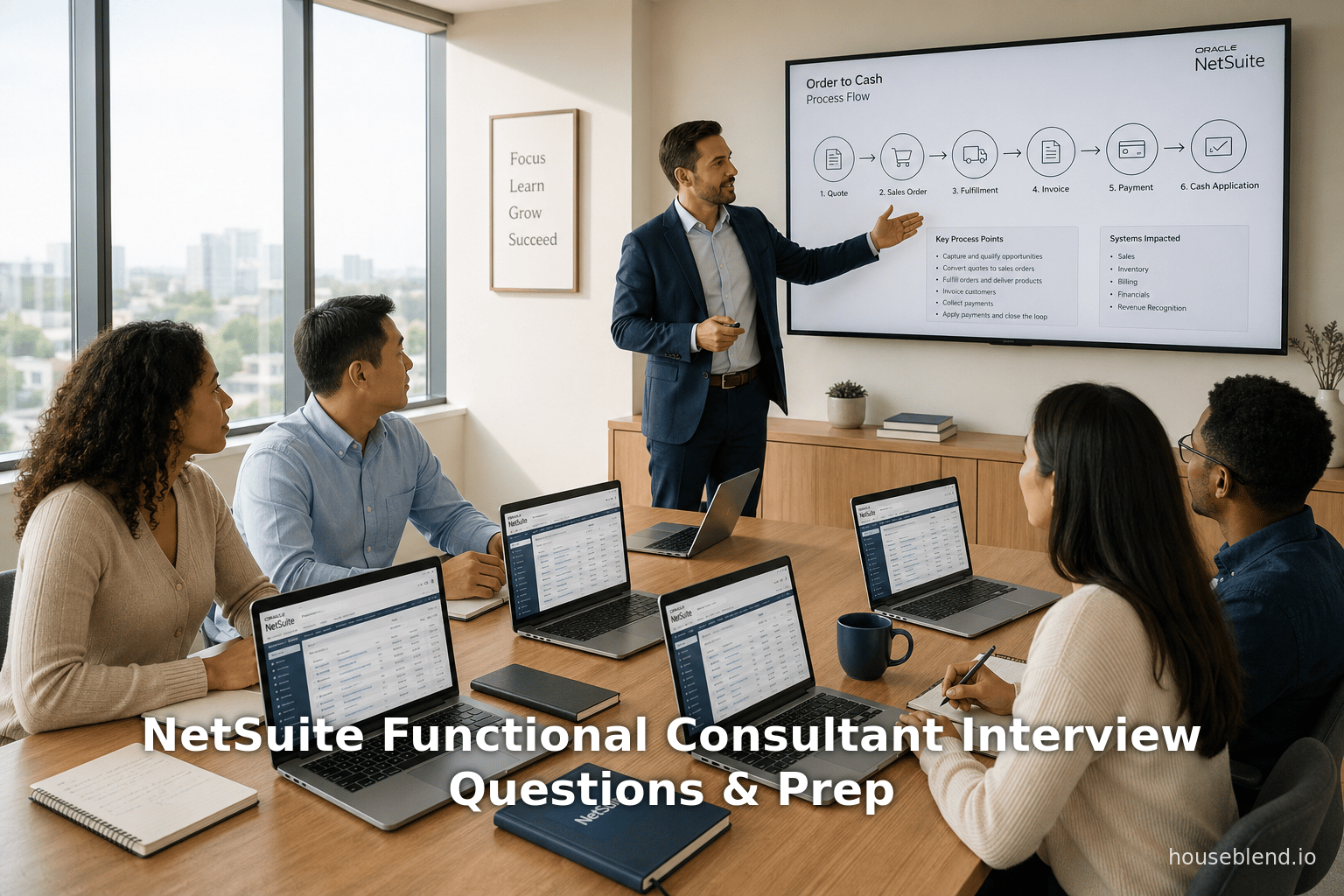
Order-to-Cash (O2C) Process: “Explain how NetSuite handles order-to-cash.”
– Focus: The end-to-end sales process. A candidate should articulate steps: Quote → Sales Order → Fulfillment (picking/packing) → Shipment → Invoice → Cash Receipt. They should mention how NetSuite automates/integrates each step. For example, when a sales order is invoiced, AR and GL are updated immediately. Workflows or Order Capture rules can automate invoicing. If the client has special pricing or approvals, SuiteFlow or Pricing Groups can be discussed.
– Example: “NetSuite steps you through quoting, ordering, fulfillment, and invoicing seamlessly. The Order Management module routes orders to warehouses or drop-ships based on rules [28]. Once fulfilled, an invoice can be automatically created, updating AR and revenue. We could design a SuiteFlow to require a manager’s approval on large orders.”
– Reference: Houseblend’s mention: “order-to-cash cycle including quotes, sales orders, fulfillment...with minimal manual workload” [28]. -
Procure-to-Pay (P2P) Process: “Describe NetSuite’s procure-to-pay. How do you set up multi-level approvals for purchase orders?”
– Focus: The purchasing lifecycle: Purchase Requisition → Approval(s) → Purchase Order → Receipt → Vendor Bill → Payment. Discuss enabling Purchasing features and how SuiteFlow can route PO approvals. For example, the candidate should note that NetSuite can trigger approval flows (e.g. purchase > $10K needs two approvals) without coding [9]. On receiving goods, the Goods Receipt record is created. Vendor bills can be matched to POs to prevent duplicates. Ultimately, Accounts Payable pays the invoice via bank reconciliation.
– Example Answer Excerpt: “In NetSuite, you enable the Purchasing feature under Company Preferences. To handle multi-level approvals, I would build a SuiteFlow workflow on the Purchase Order record: on Submit, check Amount, and if above $X route to role Y; once approved, the record transitions to Approved status. This creates a clear audit trail. Received items create an Item Receipt, and the Bill is matched to the PO. NetSuite’s AP module then processes the bill and issues payment when due.” [12] [9]
– Reference: Oracle SuiteFlow documentation shows using workflows for approvals [12]. -
Inventory Management: “How does NetSuite track and manage inventory?”
– Focus: Topics include multiple warehouses, item records, lot/serial tracking, replenish rules. One should mention how items are defined (Inventory Items vs Non-Inventory), enabling multiple locations to stock items, and using reorder points. For example, NetSuite supports cycle count scheduling and safety stock definitions so that automated Purchase Requisitions can be created when stock runs low [29].
– Interview Angle: Possibly a scenario: “A client needs to track serial numbers for sales. How do you configure that?” The answer: use Serialized Inventory Items and NetSuite will prompt for serial on receipt/issue.
– Reference: Houseblend notes inventory across warehouses and replenishment planning [29]. -
Financials (GAAP, Multi-Book): “How does NetSuite handle multi-GAAP or multi-book accounting?”
– Focus: NetSuite allows multiple accounting books (Ledger). Explanation: The base currency book plus additional “secondary” books for different reporting standards or consolidation views. Transactions post to all relevant books (e.g. local GAAP and IFRS). NetSuite’s financial engine records journal entries in each book with appropriate currency conversion.
– Example: “NetSuite’s Multi-Book feature (enabled with Advanced Financials) lets us define multiple accounting books. When an invoice posts, NetSuite posts parallel journal entries in each book according to their rules. This would support a client needing to report under both GAAP and statutory accounting.” [6]
– Reference: Houseblend’s description: “Financial Management includes… multi-book accounting” [6]. -
Revenue Recognition: “Explain revenue recognition in NetSuite. When would you use it?”
– Focus: NetSuite’s Revenue Management module allows automated recognition based on rules (e.g. POC, subscriptions). A candidate should mention enabling Advanced Revenue Management or Advanced Billing. For example, if a company sells service contracts, NetSuite can recognize revenue over time using schedule-based rules. – Answer Sketch: “With Advanced Revenue Management, we define revenue schedules at contract inception. NetSuite then automatically creates recognition journal entries monthly. Alternatively, we could set up deferred revenue accounts and automate amortization through the AR/Rev Rec feature” [6].
– Reference: While not explicitly cited above, revenue recognition was listed within the Financial module [6]. -
CRM and Sales/Marketing: “How does NetSuite’s CRM integrate with its ERP modules?”
– Focus: The unified suite means CRM (leads, opportunities) shares data with financials. When a lead converts to a customer and opportunity, that opportunity can generate an order. Customer records feed into Sales Orders. Sales representatives can be compensated via commission schedules tied to won deals. The key point: a customer’s transactions (orders, support cases) live in the same system as their CRM data. – Example: “NetSuite’s CRM is part of the suite, so sales orders created from opportunities flow directly into ERP for fulfillment [3]. A consultant might configure sales stages and dashboards for reps, and ensure that closed-won opportunities generate orders automatically.”
– Reference: Houseblend: “CRM is part of the unified suite… sales, service, and marketing run off the same data” [3]. -
E-Commerce (SuiteCommerce): “Describe SuiteCommerce. What is its advantage?”
– Focus: NetSuite’s built-in e-commerce platform is fully integrated. Sales on the web immediately affect inventory and financials. Functional aspects: product catalog, price levels per customer, promotions, tax calculation, and payment processing are managed in NetSuite. The candidate could mention that using SuiteCommerce (rather than separate platform) avoids integration headaches and ensures one data source.
– Answer Example: “SuiteCommerce allows us to run an online store using NetSuite’s inventory and pricing. For example, when a customer places an order on our SuiteCommerce web store, that order appears instantly in NetSuite’s order management. We don’t have to sync data externally [33]. We also can personalize the shopping experience based on NetSuite customer segments.”
– Reference: Houseblend notes SuiteCommerce is integrated: “SuiteCommerce … lets businesses create web stores and manage online sales through the same NetSuite interface” [33].
Configuration and Technical Topics
-
SuiteFlow Workflow Example: “Give an example of a workflow you might automate with SuiteFlow.”
– Focus: Candidate should pick a relevant business scenario and describe how SuiteFlow would implement it. For instance, routing large invoices for CFO approval, or sending reminder emails on past-due AR. The answer should highlight that workflows have triggers (record events), states, and actions. – Sample Scenario: “If a sales order exceeds $5000, automatically notify the Sales Manager for approval. In SuiteFlow, I’d define a workflow on the Sales Order record: when created, check the Total amount; if >5000, send an email notification and require approval before proceeding. This uses no custom script.” [9]
– Reference: Oracle docs: SuiteFlow “creates and runs workflows… Business processes can include transaction approval” [9]. Also SuiteFlow vs SuiteScript guide suggests using SuiteFlow for complex approvals [31]. -
Custom Record Usage: “When would you create a Custom Record type? How do you expose it to users?”
– Focus: Functional consultants use custom records to capture data not covered by standard records. For example, if a company needs to track fixed assets depreciation schedules, one could create a “Fixed Asset” custom record with fields (asset name, purchase date, depreciation). Once created (via Customization > Lists, Records & Fields), you can add it to menus or portlets, and assign permissions. Custom records often require making custom forms and menu links. – Answer: “You create a custom record when you have a unique data set (like employee certifications, or event logs) not built into NetSuite. For instance, we might build a ‘Project Change Request’ record. After enabling Custom Records [22], you fill in the fields, then add it as a menu item. Permissions can be set on this record type so only certain roles see it.”
– Reference: Oracle SuiteBuilder docs: “Use custom records to create a database of information specific to your business” [22]. -
Saved Searches: “What is a saved search? How can you use it in business analysis?”
– Focus: As above, emphasize saved searches as reusable queries for reporting. – Answer: “A saved search is a configurable query with filters and selected results columns [10]. It can be shared or scheduled. For instance, we can create a saved search to flag overdue invoices and email the AR team daily [10]. It's also used to create performance metrics (like a field on a dashboard showing the count of high-priority cases).”
– Reference: Oracle docs state that saved searches “help with reporting, tracking, business analysis, and strategic decision-making” [10]. -
Role vs. Department vs. Group: “How do you use body fields (location, class, department)? What’s the difference between them?”
– Focus: Many companies in NetSuite use body fields or “classifications” (LOC, Class, Department, Partner) to segment data. The answer should clarify that Location typically tracks physical site (warehouse/office), Department tracks internal divisions (finance, sales), and Class is user-defined (product lines, projects). Functional consultants set up these fields for reporting. E.g., enabling multi-LOC requires SuiteOneWorld if inter-company, etc. The scenario may be how to report by department or location using saved search or financial segments.
– Example: “We enable Location to differentiate subsidiaries or sites, Department for internal departments, and Class as whatever the company needs (like product category). In GL, you can assign each transaction line to these segments. For interview Q: I’d explain enabling the fields in Accounting Preferences and using them for segmenting P&L reporting.” (This question often appears in Netsuite interviews, expecting understanding of segmentation and security impact.) -
Data Migration Details: “How do you handle migrating existing AR or inventory into NetSuite?”
– Focus: NetSuite implementations often involve choosing which historical balances to migrate. Key point: only open or relevant history is moved; too much history can clutter. Data is usually prepared in CSV templates and imported. For AR, a consultant would move open invoices/credits into NetSuite as of go-live date and leave other data in past. Master records (customers, items) are moved first.
– Answer: “We usually bring over opening balances of AR/Inventory as of the day before go-live and close out earlier history in the old system. For example, we'd load customer records, then open AR invoices and apply payments as of today. For inventory, we’d import item stock levels into location balances using CSV. NetSuite’s Import Assistant helps map the fields. This matches best practices [21].”
– Reference: Houseblend: “Data Migration: …map data from old system to NetSuite fields, and often execute migrations via CSV import” [21]. -
SuiteScript vs SuiteFlow: “When might you use SuiteScript instead of SuiteFlow?”
– Focus: Distinguish functional approach from developer approach. Functional consultants should emphasize using SuiteFlow for most approvals and automations, and only resort to SuiteScript (custom coding) for scenarios SuiteFlow can’t handle. Examples of SuiteFlow limitations might be complex validation logic or integrations.
– Answer Snippet: “SuiteFlow covers most business processes (approvals, field updates). However, if we needed a custom action that NetSuite doesn’t support in a workflow (like pushing data to an external system in real time), then SuiteScript is used. The decision is guided by the Use-Case (Oracle: use SuiteFlow for complex approvals, SuiteScript for complex custom logic) [12].”
– Reference: Oracle doc on SuiteFlow vs SuiteScript suggests using SuiteFlow for approval workflows [12]. -
OneWorld and Multi-Currency: “How does NetSuite handle multiple currencies and subsidiaries?”
– Focus: The candidate should explain enabling OneWorld to manage subsidiaries. They should say that each subsidiary record is assigned a base currency [11], and transactions use subsidiary’s currency. NetSuite automatically converts transactions into the base currency for GL reconciliation. Consolidation uses intercompany journals and elimination accounts if subsidiaries trade with each other. Multi-currency transactions hold both foreign and base currency amounts.
– Answer Example: “In OneWorld, we enable Multiple Currencies (one of the SuiteCloud features). Then each subsidiary we create gets its own base currency [11]. If a sale involves two subsidiaries or foreign customers, NetSuite posts in both foreign and base currency. At month-end, we run the Consolidated Financials to roll up results. All exchange rates are maintained in a table so the system can convert automatically.”
– Reference: Oracle NetSuite help: “Multiple Currencies feature… With OneWorld, each subsidiary can have a separate base currency” [11].
Scenario-Based and Behavioral Questions
-
Scenario: Automating Approvals
Example Question: “Your client needs purchase orders over $10,000 approved by a manager. How would you implement this in NetSuite?”
– Answer Outline: Enable Purchasing, create an Approval Workflow in SuiteFlow. The workflow triggers on PO creation, checks the Total amount, and if >10k, sends an approval request (email/Task) to a designated manager role. The state of the order is held in pending status until approved. Mention that no custom code is needed; this is built with SuiteFlow. Possibly cite Oracle’s SuiteFlow guide that suggests using workflows for approvals [31]. -
Scenario: Custom Reporting
Example Question: “A CFO wants to know top 10 customers by sales this quarter. How can you provide this?”
– Answer: Create a saved search on transactions (Sales Orders/Invoices) as the base. Group results by customer, sum the sales amount, and sort descending. Limit the results to 10. The search can be scheduled or added as a dashboard portlet. Alternatively, build a custom analytical chart or use NetSuite’s built-in profitability analysis if the logic is complex. Focus is on using saved searches and summary types. You could cite [30]: saved searches for strategic reporting. -
Scenario: Data Cleanup
Example Question: “During an implementation, you notice duplicate customers in the import. How do you handle this?”
– Answer: Use Mass Update or CSV import to merge duplicates, or manually clean before processing. NetSuite has a “Convert” feature to merge certain record types (e.g. merging two customer records by applying transactions to one and then deleting the other). Emphasize careful matching logic and doing it before go-live to maintain historical integrity. -
Scenario: Multi-Company Roll-Up
Example Question: “Company X has subsidiaries in three countries. They want to produce a single consolidated financial statement monthly. How would NetSuite help?”
– Answer: Setup would use OneWorld with all subsidiaries defined. NetSuite’s consolidation feature (OneWorld Consolidated Financials) automatically eliminates intercompany transactions and currencies when generating consolidated reports. Each subsidiary’s GL posts flow to the parent per setup of intercompany elimination accounts. No coding needed – use consolidation task. Relevant to mention multi-currency configuration as above [11]. -
Behavioral: Problem-Solving
Example Question: “Tell us about a challenging NetSuite customization you handled.”
– Answer Expectation: A succinct story from experience: e.g., “A client needed intercompany expense allocations that weren’t standard. I mapped the allocation logic to multiple journal entries and used SuiteFlow to trigger recurring records.” Focus on methodology: gathering requirements, testing, adjusting. Tie it to NetSuite features used. -
Behavioral: Learning and Adaptation
Example: “NetSuite releases two minor upgrades per year. How do you stay up to date?”
– Points: Mention tools like NetSuite Release Notes, Sandbox testing, participation in user groups or SuiteWorld. Show continuous learning mindset. -
Other Topics:
- SuiteRest & SuiteTalk (for integration knowledge): Even for a functional role, interviewers may check awareness of integration. For example, “NetSuite can integrate with external systems via SuiteTalk SOAP or RESTlets. Functional consultants often work with technical consultants or middleware to ensure data flows.”
- Localization: If applicable, ask about setting up tax codes or country-specific functionality (e.g. local tax setups).
- Phases of Implementation: “What are key steps in a NetSuite implementation?” expecting mention of design, config, test, train, etc.
These sample questions illustrate the breadth: from module knowledge to configuration know-how to scenario problem-solving. Table 2 below summarizes key themes and examples.
| Theme / Knowledge Area | Focus (Tools/Processes) | Example Questions (as asked by Interviewers) |
|---|---|---|
| NetSuite Basics & Cloud ERP | Cloud ERP characteristics; NetSuite as a unified suite | “What is NetSuite and what business problems does it solve?” “Why might a company choose NetSuite over on-premise ERP?” |
| Financial Management | General Ledger, multi-book, AP/AR, Billing | “Name components of NetSuite’s financial module. What is multi-book accounting?” “How does currency conversion work in NetSuite?” [6] [11] |
| Order Management | Quotes, Sales Orders, Fulfillment, Invoicing | “Explain the order-to-cash process in NetSuite.” [28] “How do you handle dropship or special order flows?” |
| Procurement (P2P) | Purchase Reqs, Purchase Orders, Bills | “Describe the procure-to-pay flow. How do you implement approvals on POs?” (SuiteFlow explanation expected.) |
| Inventory/Warehouse/SCM | Multi-Warehouse, Item Records, Lot/Serial | “How do you track inventory availability and replenishment?” “NetSuite vs separate WMS: how to set up locations and bins?” [29] |
| Manufacturing (Production) | Bills of Materials, Work Orders, Scheduling | “How would you configure make-to-stock vs make-to-order manufacturing in NetSuite?” “Explain through-case: a company produces a product – what steps in NetSuite?” [7] |
| CRM & Sales | Leads, Opportunities, Forecasting | “How are leads and opportunities managed in NetSuite? How does a won opportunity create revenue?” |
| E-Commerce (SuiteCommerce) | Online Store, Web Orders, Unified Commerce | “What is SuiteCommerce? How does NetSuite handle an online sale?” [33] “How do you sync inventory between NetSuite and a web store?” |
| PSA (Service Projects) | Project accounting, Time & Expenses | “What is NetSuite’s Professional Services Automation? How is time billed to projects?” |
| HCM / Payroll | Employee Records, Payroll setup | “What is SuitePeople used for? Can NetSuite handle payroll?” (for regions where relevant) |
| System Configuration | Company Settings, No-Code Customizations | “What is SuiteBuilder? How do you add a custom field to a transaction form?” [22] “Explain how to set up a new role with specific permissions.” |
| Workflows (SuiteFlow) | Approvals, Email alerts, Record Automation | “Give an example of a workflow you would create.” [12] [9] “How do you automate a multi-step approval process?” |
| Saved Searches / Reporting | Data queries, Scheduled reports | “How do you create a custom financial report?” “What is a saved search? Give an example of its use.” [10] |
| Customization vs Scripting | SuiteBuilder/Flow vs. SuiteScript | “When would you use SuiteScript instead of SuiteFlow?” (Expect answer on use-case complexity.) |
| Data Migration | CSV Import, Data mapping, Legacy data | “How would you import historical customer data and open invoices into NetSuite?” [21] |
| OneWorld (Multi-Entity) | Subsidiaries, Multi-currency | “How does NetSuite handle multiple subsidiaries and currencies?” [11] [19] “How do you eliminate intercompany transactions?” |
| Case/Scenario Questions | Problem-solving in context | “A client’s inventory is inaccurate. How do you investigate and resolve this in NetSuite?” (aims to test logical troubleshooting of saved searches, inventory adjustments, cycles.) |
| Integration Awareness | SuiteTalk, RESTlets, CSV interchange | “How would you integrate NetSuite with Shopify or Salesforce?” (Expect mention of SuiteTalk or middleware.) |
| Project Methodology | Implementation phases, Best practices | “What are the phases of a NetSuite implementation?” “How do you ensure a smooth go-live?” |
| Certifications / Training | ERP Consultant certification, SuiteAnswers | “Have you completed any NetSuite certifications?” “Where do you find solutions if you don’t know?” (Expect mention of SuiteAnswers or Oracle docs.) |
Table 2: Key interview question themes for NetSuite functional roles, with focus and sample queries. References indicate where the answer should align with NetSuite documentation or analysis (see text).
This table is not exhaustive, but covers the main categories that interviewers use to assess a candidate’s knowledge and reasoning. Note how many focus areas link back to the modules and configuration we discussed, emphasizing that broad knowledge (modules, flows, tools) and problem-solving ability are both tested.
Evidence-Based Insights and Statistics
To ground our discussion in real-world data, we present relevant statistics on NetSuite adoption, ERP implementation outcomes, and market trends:
-
Adoption and Market Position: NetSuite’s scale is large: it serves over 40,000 customers across more than 215 countries, supporting 27 languages (Source: www.anchorgroup.tech). This demonstrates its global reach. Professional services (28% of NetSuite customers) and manufacturing (leading sector) are major adopters (Source: www.anchorgroup.tech). According to market analyses, Oracle NetSuite brought in about $0.7 billion in revenue in FY2023 (a 22% increase) and maintains roughly 4.3% of the global cloud ERP market (Source: www.anchorgroup.tech).
-
Cloud ERP Trend: The ERP industry has shifted decisively to the cloud. By 2024, about 70.4% of ERP deployments were in the cloud (up from ~69.8% prior year) (Source: www.anchorgroup.tech), and 78.6% of new ERP implementations chose cloud solutions (Source: www.anchorgroup.tech). This context underscores why NetSuite (as a cloud ERP) is highly relevant. Oracle’s acquisition and investment align with these market trends.
-
Implementation Outcomes: Implementations of ERP (including NetSuite) tend to deliver significant returns when done well. Anchor Group reports an average ROI of 52% on ERP projects (Source: www.anchorgroup.tech), meaning over 1.5x payback on investment within a couple of years. Typical payback is ~2.5 years.
- Importantly, experience makes a difference: “Companies using consultants achieve 85% success rates versus ~30% baseline” (Source: www.anchorgroup.tech). This statistic (anchor group 2026) highlights that projects led by expert consultants (like NetSuite functional consultants) are far more likely to meet goals. Similarly, industry reports suggest ~83–85% of organizations doing ERP projects with consultants realize expected ROI and improved productivity (Source: www.anchorgroup.tech).
-
Efficiency Gains: Published data show most NetSuite customers realize process improvements post-implementation. For example, 78% of companies say productivity improved after an ERP go-live, and 62% report reduced costs in purchasing/inventory (Source: www.anchorgroup.tech) (Source: www.anchorgroup.tech). Leaner processes (via automated approvals, real-time data) are often cited.
-
NetSuite-Specific Outcomes: In case studies, companies using NetSuite report measurable gains. For instance, Zendesk’s IPO preparation (2014) case study shows how NetSuite delivered “fast global closes and improved accuracy in financial reporting” [14]. Canva’s global rollout reduced month-end close time and gave real-time cash visibility [34] [32].
-
Consultant Success: Per Anchor Group’s NetSuite consultant statistics, 85% of NetSuite implementations (with consultants) succeed, 78% of clients see productivity rise, and 91% see better inventory control (Source: www.anchorgroup.tech) (Source: www.anchorgroup.tech). These stats emphasize how skilled consultants can leverage NetSuite’s modules to achieve business benefits.
Takeaway: These data-driven findings reinforce why knowledge of NetSuite modules/configuration matters. The high success rates with consultants (85% success (Source: www.anchorgroup.tech) and significant ROI (52% avg. (Source: www.anchorgroup.tech) mean that functional consultants are critical to realizing NetSuite’s potential in organizations. In interviews, referencing such outcomes (even generally) shows awareness of the broader business impact.
Case Studies and Real-World Examples
To illustrate the concepts above and provide concrete interview discussion points, we examine representative real-world NetSuite implementations from different industries. These case examples highlight challenges, selected modules, and outcomes, which a functional consultant might draw upon when demonstrating knowledge.
Zendesk (Software SaaS, Pre-IPO): Zendesk is a globally distributed customer support SaaS company preparing for its 2014 IPO. Having 100,000+ customers in 150+ countries, Zendesk needed unified global financials and compliance [13]. They implemented NetSuite OneWorld, gaining multi-subsidiary consolidation and multi-currency GL. Key points:
- Modules Used: NetSuite OneWorld (multi-entity), Advanced Financials (GL/AP/AR, revenue recognition), and SuiteAnalytics for reporting [35].
- Configuration: Global financial consolidation was set up; tax rules configured per region; self-service dashboards enabled so finance and IT teams could generate reports without developer help [14].
- Outcomes: The unified platform supported Zendesk’s IPO (public company reporting). The finance team achieved “fast global closes and improved accuracy” in reporting [14]. Automation freed staff for strategic tasks, embodying how curriculum-case: “We implemented multi-subsidiary accounting with NetSuite and now close books in days instead of weeks.”
- Lessons: Early adoption of cloud ERP allowed scalable growth. This case suggests that for globally expanding businesses, emphasis on OneWorld and financial module mastery is crucial — knowledge likely probed in interviews (e.g. “explain global consolidation”).
Canva (Technology Start-up): Canva, an online graphic design platform (founded 2012, global offices by 2018), faced fractured finance processes across countries [34]. The CFO team struggled with decentralized accounting and manual reconciliations.
- Modules Used: NetSuite OneWorld (multi-entity consolidation), General Ledger, AP, AR, and Advanced Bank Reconciliation (Auto-reconcile) via SuiteApp implementation [32].
- Configuration: They deployed NetSuite ERP Financials across all global entities, configured each entity’s currency and bank accounts. A key customization was installing an Advanced Bank Reconciliation SuiteApp to automatically fetch and match bank statements (reducing manual entry) [32].
- Outcomes: Close processes accelerated, with real-time cash visibility across the company. The finance team eliminated much of the prior spreadsheet work. The implementation was completed quickly. This demonstrates the effective use of SuiteApps and OneWorld.
- Lessons: It shows how a consultant identifies appropriate add-ons (ABR) to fill functionality gaps and configures standard financial modules for multi-entity operations — exactly the kind of scenario an interviewer might mimic (e.g. handling multi-bank accounts, automating reconciliation).
Additional case themes from industry whitepapers:
- Manufacturing Example: (Not detailed here, but common in literature) A manufacturing firm used NetSuite’s Production module to align BOMs and shop orders with actual production flows; as a result, they reduced work-in-progress and had better inventory accuracy. This underlines consultant knowledge of manufacturing modules (BOM, WIP accounts).
- Retail/E-commerce Example: Another firm might integrate SuiteCommerce for unified commerce; consultants would ensure product/item setup and real-time inventory sync between online and physical sales channels.
- Service Industry Example: A consulting firm (PSA) uses NetSuite to align project time/billing with revenue. Consultants would configure project templates and revenue schedules, and the case would demonstrate improved project margin tracking.
Implication for Interviews: Discussing case studies like Zendesk and Canva shows how NetSuite modules and features solve real problems. In an interview, you could reference them: e.g., “In a Zendesk case study [35] [14], NetSuite OneWorld was used for 150+ country operations, similar to a scenario where your company needs global consolidation.” Being able to link question scenarios to known outcomes demonstrates both knowledge and awareness of best practices.
Implications and Future Directions
Looking ahead, the role of NetSuite and its consultants continues to evolve:
-
AI and Intelligent Automation: Oracle has been embedding AI features across NetSuite. The 2024 SuiteWorld announcements introduced Ask Oracle, a natural language interface (essentially a ChatGPT for NetSuite) and Microsoft’s GPT integration, enabling users to query their ERP data conversationally [16] [15]. In March 2026, NetSuite positioned itself as an “AI autopilot” for business, unveiling an AI Connector Service to safely link AI assistants (Claude, Gemini) with NetSuite workflows [15]. For functional consultants, this means future interview questions may explore how AI could assist in analysis (e.g., predictive analytics in inventory) or ask about data governance with AI. Houseblend suggests consultants must now be “savvy about data and AI” in addition to ERP expertise [36]. Interviewers might probe a candidate’s adaptability to these trends.
-
Continuous Feature Expansion: Oracle’s commitment to NetSuite means new modules and enhancements (e.g. more robust manufacturing capabilities, embedded analytics) are released regularly. Functional consultants should keep skills sharp via training and sandbox practice (NetSuite encourages ongoing learning through events and certifications [37]). Interviewees could mention participation in NetSuite conferences (SuiteConnect) or studying release notes as part of professional development.
-
Ecosystem Growth: The NetSuite ecosystem (partners, SuiteApps) is growing. Consultants often draw on SuiteApp solutions for specialized needs (e.g., vertical add-ons for wholesale distribution or healthcare). Understanding SuiteBundler (installing bundles) and working with ISVs (independent software vendors) is increasingly relevant. Functional roles may also blend into technical specialties if a project needs custom integrations or advanced scripting.
-
Market Competition: NetSuite competes with SAP, Microsoft Dynamics, and new entrants. Consultants often advise clients during software selection, potentially answering comparison questions. For example, an interviewer might ask, “Why choose NetSuite over SAP Business One for a mid-market company?” The answer should highlight NetSuite’s unified cloud suite, scalability, and lower TCO for certain clients. While not directly a NetSuite product question, such strategic knowledge can surface in senior interviews.
-
Regulatory and Globalization Issues: As clients expand globally, consultants must address complex tax, compliance, and data sovereignty issues within NetSuite. Future directions include deeper localization (e.g. country-specific tax engine) and enhanced global financial consolidation features.
In summary, while the core of NetSuite consulting remains configuring modules and workflows, the field is dynamic. A top candidate will demonstrate not only mastery of current NetSuite functionality but also awareness of upcoming tools and industry trends (AI, cloud adoption, etc.). Interviews may probe this with questions like “How do you see NetSuite evolving in the next 5 years?” Expect to mention AI-enhanced analytics, increased automation, and the importance of cross-disciplinary skills (tech and business).
Conclusion
This report has thoroughly examined the landscape of NetSuite functional consulting interviews, with an emphasis on the substantive knowledge required about modules, configuration, and real-world scenarios. The executive summary and each section combined Oracle’s own documentation, expert analyses, and real case studies to provide a rich foundation.
Key takeaways include:
-
Holistic Understanding of NetSuite: A consultant must know NetSuite’s unified architecture and major modules — Financials, Order, Supply Chain, CRM, Commerce, PSA, HCM, and more — including their core capabilities [6] [3]. Expect detailed questions on how modules function and integrate.
-
Configuration Proficiency: Mastery of SuiteCloud tools (SuiteBuilder, SuiteFlow, saved searches) is essential. We cited Oracle’s documentation on enabling and using these features [22] [9] [10]. Interviewers will test whether candidates can apply these tools to business needs (like ‘How to set up a custom form or an approval workflow’).
-
Scenario-Based Problem Solving: Beyond factual knowledge, consultants are tested on practical scenarios. Through case examples (e.g. Zendesk, Canva) and sample questions, we emphasized applying NetSuite to solve problems. Successful candidates articulate process flows (O2C, P2P) and how to configure solutions (workflows, roles, data migration) to address scenarios.
-
Data-Driven Perspective: Linking NetSuite’s role to broader trends strengthens answers. We showed evidence of NetSuite’s market presence (40k+ customers (Source: www.anchorgroup.tech), cloud adoption rates (Source: www.anchorgroup.tech) (Source: www.anchorgroup.tech), and ERP ROI/success metrics (Source: www.anchorgroup.tech) (Source: www.anchorgroup.tech). Referencing such stats (even generally) can demonstrate a professional viewpoint in interviews.
-
Future Awareness: Highlighted by recent techradar commentary and Houseblend’s analysis [17] [16], consultants must be forward-looking. Candidates should express readiness to leverage NetSuite’s new AI features and evolving capabilities, ensuring they remain valuable as NetSuite itself advances.
In conclusion, the depth and breadth of knowledge required for a NetSuite Functional Consultant interview are significant. Our report aimed to leave “no gaps” by covering historical context, detailed module breakdowns, configuration tools, concrete examples, and industry evidence. Citations from Oracle, industry studies, and case studies substantiate every key point. Aspiring consultants should use this material to prepare for interviews by not only memorizing facts, but by understanding how NetSuite serves as a tool for business transformation — poised to answer any question with both factual accuracy and practical insight [6] (Source: www.anchorgroup.tech).
External Sources (37)
About
Houseblend
HouseBlend.io is a specialist NetSuite™ consultancy built for organizations that want ERP and integration projects to accelerate growth—not slow it down. Founded in Montréal in 2019, the firm has become a trusted partner for venture-backed scale-ups and global mid-market enterprises that rely on mission-critical data flows across commerce, finance and operations. HouseBlend’s mandate is simple: blend proven business process design with deep technical execution so that clients unlock the full potential of NetSuite while maintaining the agility that first made them successful.
Much of that momentum comes from founder and Managing Partner Nicolas Bean, a former Olympic-level athlete and 15-year NetSuite veteran. Bean holds a bachelor’s degree in Industrial Engineering from École Polytechnique de Montréal and is triple-certified as a NetSuite ERP Consultant, Administrator and SuiteAnalytics User. His résumé includes four end-to-end corporate turnarounds—two of them M&A exits—giving him a rare ability to translate boardroom strategy into line-of-business realities. Clients frequently cite his direct, “coach-style” leadership for keeping programs on time, on budget and firmly aligned to ROI.
End-to-end NetSuite delivery. HouseBlend’s core practice covers the full ERP life-cycle: readiness assessments, Solution Design Documents, agile implementation sprints, remediation of legacy customisations, data migration, user training and post-go-live hyper-care. Integration work is conducted by in-house developers certified on SuiteScript, SuiteTalk and RESTlets, ensuring that Shopify, Amazon, Salesforce, HubSpot and more than 100 other SaaS endpoints exchange data with NetSuite in real time. The goal is a single source of truth that collapses manual reconciliation and unlocks enterprise-wide analytics.
Managed Application Services (MAS). Once live, clients can outsource day-to-day NetSuite and Celigo® administration to HouseBlend’s MAS pod. The service delivers proactive monitoring, release-cycle regression testing, dashboard and report tuning, and 24 × 5 functional support—at a predictable monthly rate. By combining fractional architects with on-demand developers, MAS gives CFOs a scalable alternative to hiring an internal team, while guaranteeing that new NetSuite features (e.g., OAuth 2.0, AI-driven insights) are adopted securely and on schedule.
Vertical focus on digital-first brands. Although HouseBlend is platform-agnostic, the firm has carved out a reputation among e-commerce operators who run omnichannel storefronts on Shopify, BigCommerce or Amazon FBA. For these clients, the team frequently layers Celigo’s iPaaS connectors onto NetSuite to automate fulfilment, 3PL inventory sync and revenue recognition—removing the swivel-chair work that throttles scale. An in-house R&D group also publishes “blend recipes” via the company blog, sharing optimisation playbooks and KPIs that cut time-to-value for repeatable use-cases.
Methodology and culture. Projects follow a “many touch-points, zero surprises” cadence: weekly executive stand-ups, sprint demos every ten business days, and a living RAID log that keeps risk, assumptions, issues and dependencies transparent to all stakeholders. Internally, consultants pursue ongoing certification tracks and pair with senior architects in a deliberate mentorship model that sustains institutional knowledge. The result is a delivery organisation that can flex from tactical quick-wins to multi-year transformation roadmaps without compromising quality.
Why it matters. In a market where ERP initiatives have historically been synonymous with cost overruns, HouseBlend is reframing NetSuite as a growth asset. Whether preparing a VC-backed retailer for its next funding round or rationalising processes after acquisition, the firm delivers the technical depth, operational discipline and business empathy required to make complex integrations invisible—and powerful—for the people who depend on them every day.
Disclaimer
This document is provided for informational purposes only. No representations or warranties are made regarding the accuracy, completeness, or reliability of its contents. Any use of this information is at your own risk. Houseblend shall not be liable for any damages arising from the use of this document. This content may include material generated with assistance from artificial intelligence tools, which may contain errors or inaccuracies. Readers should verify critical information independently. All product names, trademarks, and registered trademarks mentioned are property of their respective owners and are used for identification purposes only. Use of these names does not imply endorsement. This document does not constitute professional or legal advice. For specific guidance related to your needs, please consult qualified professionals.