Houseblend Article
NetSuite Implementation Cost Breakdown by Module & User
Inside this article
- 01Executive Summary
- 02Introduction and Background
- 03Licensing and Subscription Costs
- 04Implementation Services and Project Costs
- 05Cost by Functional Modules
- 06Cost Effects of Headcount and Organizational Size
- 07Industry and Functional Focus
- 08Data Analysis and Total Cost of Ownership
- 09Case Studies and Real-World Examples
- 10Implications and Recommendations
- 11Conclusion
- 12References
Executive Summary
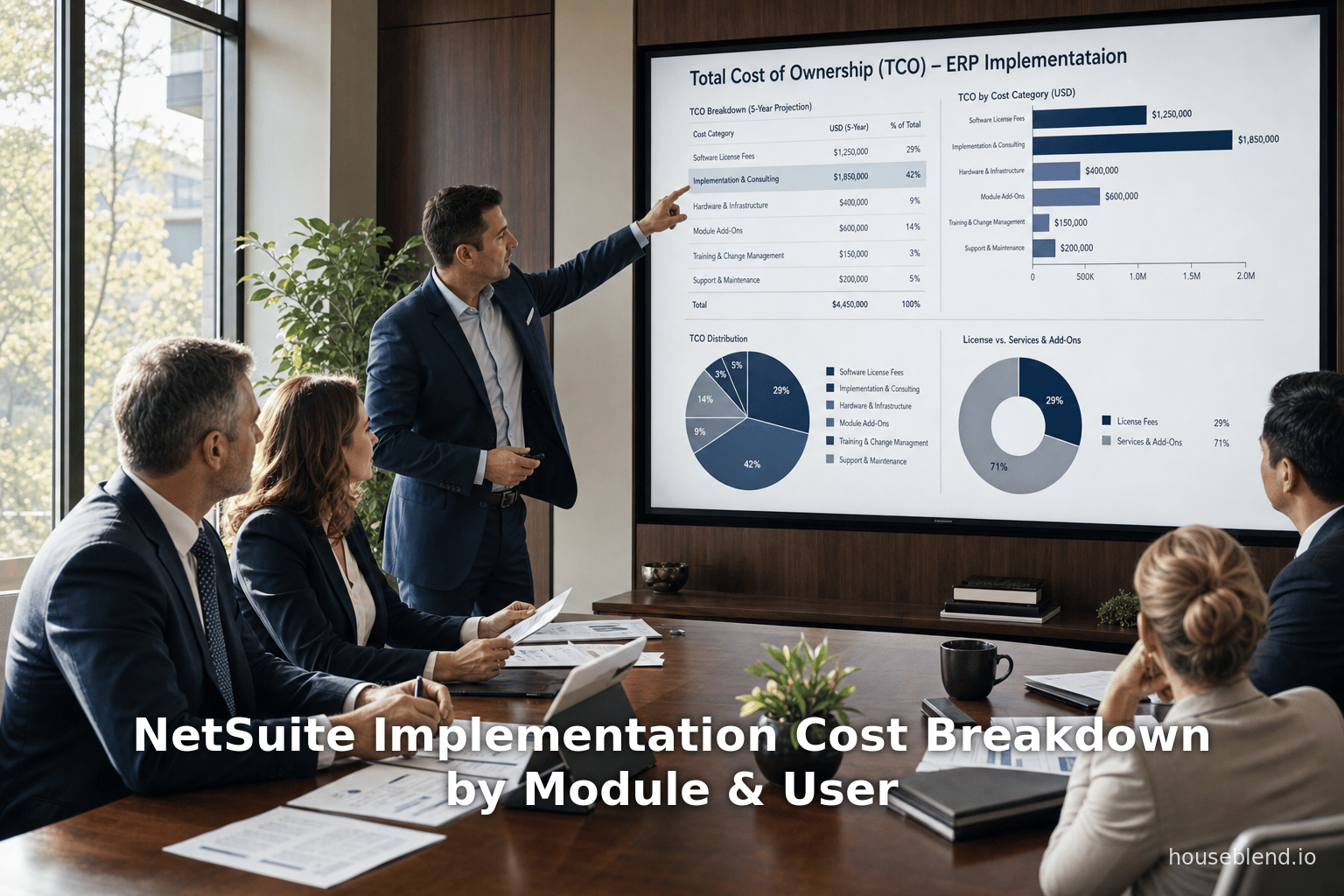
NetSuite is a leading cloud-based ERP platform, but its total implementation cost often far exceeds the simple base license fee. Across multiple analyses and case examples, implementation services and integrations typically consume the majority of budget, not the software license itself. For instance, a 100-user NetSuite implementation (3-year TCO including licenses, services, training) is commonly in the $406K–$740K range, of which only about 30–40% is licensing [1]. In other words, implementation and consulting often run 1×–2× the first-year license cost [2] [3]. Typical small-to-mid deployments (5–20 users) can cost $25K–$50K for implementation [4], while mid-market projects (20–100 users) often run $50K–$150K [4]. Add-on modules further drive costs: popular modules (Advanced Financials, Inventory, SuiteCommerce, etc.) each add hundreds or thousands of dollars per month [5] [6]. By industry, retail customers might see monthly NetSuite fees of $1K–3K, manufacturing $1.2K–4K, and service firms $0.9K–2.5K, reflecting different module and complexity needs [7].
Key findings:
- Licensing vs Implementation Share: Licenses are often only ~30–40% of the outlay [1]; implementation services, data migration, and training typically dominate. A rule-of-thumb is “2× first-year license cost” for implementation [2] [3].
- Sizing by Users: 5–20 user projects typically cost $25–50K and take 2–3 months; 20–100 user projects $50–150K (3–4 months); 100+ user projects $150–500K+ in larger, multi-entity rollouts [4].
- Module Costs: SuiteSuccess Starter implementations run $5K–30K, while full multi-module rollouts (Finance + CRM + OneWorld + HR + Inventory + eCommerce) can approach $150–300K [8]. Add-on modules (Advanced Inventory, SuiteCommerce, etc.) each add roughly $500–$2,000 per month [5] [6].
- Industry Differences: Businesses in manufacturing or distribution often need high-end modules (BOMs, WMS, OneWorld, pushing implementation into the high-end range. For example, license fees for retail firms might start at $999–$3,000/month, whereas manufacturing clients often budget $1,200–$4,000/month for software subscriptions [7].
This report reviews historical context, breaks down NetSuite pricing components, and compiles real-world data from vendors and case studies. We compare forecasts and calculators, segment costs by headcount and industry, and analyze TCO. The analysis is grounded in 2024–2026 market data, with all figures cited. The goal is to provide an evidence-based roadmap for understanding the true costs behind a NetSuite implementation project.
Introduction and Background
Cloud ERP and NetSuite’s Evolution. NetSuite launched in 1998 (as NetLedger) as one of the first multi-tenant cloud ERP suites [9]. It quickly grew as a unified business platform (financials, CRM, e-commerce, inventory, etc.) for mid-market companies. Oracle acquired NetSuite in 2016, underscoring its success as “the very first cloud company” [9]. Today, Oracle NetSuite serves over 43,000 customers worldwide [10], spanning software companies, manufacturers, retailers, and more. Its built-in functionality (OneWorld for multi-subsidiary, SuiteCommerce for e-commerce, SuitePeople for HR) is appealing to fast-growing firms seeking a unified system.
NetSuite’s subscription SaaS model contrasts with traditional on-premise ERP. Clients pay a recurring platform fee (base license) plus per-user and per-module charges, instead of a one-time license. A growing body of research notes that cloud ERP often achieves lower TCO than legacy on-premises systems. For example, a comparative study estimated NetSuite-like cloud deployments have roughly 50–55% lower TCO over 3–4 years than comparable on-prem solutions for 50–100 users [11]. This suggests significant infrastructure and maintenance savings in favor of cloud ERP.
Why Cost Understanding Matters. Despite TCO advantages, many businesses underestimate NetSuite’s costs. Vendor quotes often focus on subscription pricing (“just a few thousand a month”), obscuring one-time implementation fees. Yet implementation — involving configuration, customization, data migration, and training — frequently doubles or triples the initial budget [3]. Studies confirm that 10–20% of NetSuite projects suffer cost overruns due to poorly defined scope or change orders [12]. As Houseblend notes, under-investing in planning or change management leads to rework and makes cloud ERP not a “one-off” setup but an ongoing journey [12] [2].
This report dissects NetSuite costs in unprecedented detail. We compile hard data from vendor guides, industry analyses, and case examples (see References) to move beyond vague quotes. The focus will be on “real numbers” – license and implementation figures by module, headcount, and vertical. We also examine multiple perspectives (consultant firms, independent analysts, client case studies) to triangulate realistic cost expectations. All claims are backed by cited data, tables, and where possible, direct quotes. Ultimately, our goal is to inform financial planning and budgeting for any organization contemplating a NetSuite project.
Licensing and Subscription Costs
NetSuite’s pricing is multi-layered. A base subscription (platform) fee is set by edition (Limited, Midmarket, Enterprise) and service tier (Standard, Premium, etc.). On top of that, organizations pay for each user and optional modules [5] [13].Because Oracle does not publish fixed prices, real quotes vary widely, but market surveys and leaked data provide guidance.
Base License and Edition
Most analysis agrees that NetSuite’s base platform starts at roughly $999–$2,000 per month for the smallest bundles [1] [13]. For example, Houseblend’s breakdown notes “Base Subscription (license)… From $999 per month” [13]. AlphaBOLD cites sample quotes where a “SuiteSuccess Starter” edition (small business bundle) might list $25K–$50K annually for ~12 users [14]. High-end editions for large enterprises (with multicurrency, advanced modules, etc.) easily exceed $2,000/month base [15].
NetSuite also shifted significantly in 2022: Oracle raised the full user per-license price from $99 to $129+/month [16]. Currently, industry sources report $125–$175 per user per month for a full-access license [17] [13]. (Lower-cost “Employee Center” or “Self-Service” logins run only $10–$30 per user [18] [19].) These user fees multiply quickly with team size: a 50-user deployment with base $2,499/month and $150/user costs roughly $10,000/month in subscription ($120K/year) [20]. As one analyst notes, “User licenses are where costs can climb quickly” [21] – a moderate growth company may see user fees dominate the quote.
In practice, license costs are negotiable (discounts for volume or long terms). However, all sources emphasize that license fees alone understate total investment. ERP Pilot highlights that “license costs are only 30–40% of total investment” for a 100-user example [1]. Houseblend echoes the rule-of-thumb that implementation tends to run 1–2× the first-year license commitment [2]. In our analysis, we will routinely express TCO including both license and services (e.g. 3-year totals) for clarity.
Module and Add-On Fees
Beyond core financials/CRM, NetSuite offers many add-on modules. These extend functionality (inventory, manufacturing, WMS, ecommerce, advanced finance, etc.) but each incurs extra licensing costs. Vendors list these add-on module fees generally in the hundreds to low thousands per month. For example, AlphaBOLD notes that functional add-ons “range from $499 to $1,999 per module” (per month) [5]. BrokenRubik provides typical examples: Advanced Inventory ~$500/mo, Advanced Financials $500–1,000/mo, SuitePeople $10–$30 per user/mo, CRM is included, OpenAir PSA $25–50 per user/mo, and SuiteCommerce Advanced can be ~$60,000/year [22] [18].
Flxpoint’s inventory guide corroborates that “advanced inventory features… range from $599 to $1,999 per month each” [23]. SoftwarePricingGuide similarly notes Advanced Inventory often $499–$799/mo [24]. Other bespoke modules include OneWorld (multi-entity support), Fixed Assets, SuiteBilling, etc. In short, each specialized module or premium feature adds on the order of $5–20K per year to the subscription budget. Table 2 (below) summarizes some common module costs.
Table 1: Example Annual License Components for NetSuite (approx.)
Component Typical Cost (annual) Notes Base platform (entry-level) ~$12,000–$36,000/year (i.e. $999–$2,999/mo) Depends on edition & tier [13]. Higher tiers + OneWorld raise base fee. Full User License $1,548–$2,388/user/year ($129–$199/mo) For power users (finance, ops, etc.) [6] [17]. Self-Service (ESS) License $180–$360/user/year ($15–$30/mo) For limited-access staff (approvals, timesheets) [18] [19]. Sold in packs of 5. Advanced Inventory Module $5,988–$18,000/year ($499–$1,499/mo) Or more for full Advanced ($1,999/mo). Required for lot/serial/bin management [23] [24]. SuiteCommerce (Commerce)** $60,000+ / year (SCA); $2,500+ / mo (Standard) E-commerce module; SuiteCommerce Advanced often ~$60K/yr [25]. SuitePeople (HR/Payroll) $9,000–$36,000+/yr (approx $10–$30/user/mo) Core HR module including payroll [26]. Additional payroll engines (e.g. ADP) often used. OpenAir PSA (Project Accounting) $1,500–$6,000/user/yr ($25–$50/mo) Professional services automation (5-user min) [27]. Other Add-Ons (Financials, WMS, etc.) $6,000–$24,000+/yr per module Advanced Financials, Procurement, WMS, etc., typically add $500–$2,000/mo [5] [6].
Sources: Vendors and analysts report module fees as indicated (citations). SCA = SuiteCommerce Advanced. **Pricing is indicative and can vary widely by negotiation and contract.
These license components illustrate why even “mid-market” NetSuite costs run well above basic headline rates. For example, a compact 15-user company with SuiteSuccess may pay ~$12K base + $18K (user fees) + any add-ons [28], before implementation costs.
Contract and Renewal Terms
NetSuite contracts are typically annual and annualized (12× payments), though some customers negotiate multi-year deals. Pricing tiers and discounts often hinge on user counts or timing (e.g. end-of-quarter deals). Many sources emphasize negotiating as a way to manage cost (see Implications, below). It is also common for actual spend to escalate in renewal years as modules or users are added. Remember that any user or module added mid-contract will increase the annual fee accordingly.
Importantly, initial license payments only cover the software subscription. They do not include professional services (implementation, training, support) or third-party integration fees. These must be budgeted separately. In fact, as we’ll show next, implementation and hidden costs often double or triple what one initially expects from the license quote alone [3] [2].
Implementation Services and Project Costs
Implementation refers to the consulting and project work required to configure NetSuite, migrate data, integrate other systems, and train users. Unlike on-prem ERP, NetSuite’s subscription model usually excludes services; most customers hire NetSuite consultants or partners for implementation. The cost of these services varies hugely with scope, but general patterns emerge from research and experience.
General Cost Ranges
Surveying multiple sources, we find implementation fees (one-time professional services) typically span $25K up to $500K+, depending on company size and complexity. For example:
-
Small businesses (~5–20 users) are frequently quoted $10K–$75K total for implementation services [29] [4]. LedgerLabs (2026) suggests $15K–$40K on consulting and migration for a basic small-shop NetSuite rollout [29]. BrokenRubik concurs that 5–20 user implementations “run $25,000 to $50,000” [4]. Techsy’s ERP calculator likewise lists $75K–$150K for SMBs (under 50 employees) adopting NetSuite/Odoo [30].
-
Mid-market companies (20–100 users) often budget $50K–$150K for implementation [4]. TechCloudPro (2026) cites a typical mid-market implementation spend of about $145K [31]. BrokenRubik’s mid-range falls $50–$150K [4], and Techsy indicates $120K–$280K for 50–200 employees [30].
-
Enterprises (100+ users, multi-subsidiary) can easily reach $150K–$500K or more [4]. TechCloudPro models an “Enterprise” deployment with implementation $350K [32], and BrokenRubik notes that large rollouts can exceed half a million over many months [4].
These broad ranges reflect not only user count but also complexity factors: number of subsidiaries, geographic scope, transaction volume, degree of customization, number of integrations (e-commerce, BI, shipping, etc.), and whether the company opts for Oracle’s SuiteSuccess methodology or a more custom implementation. Because of this variability, no vendor quotes a single “average”; planners should assume the mid-to-high end of these ranges without a guaranteed fixed bid.
Component Breakdown
Analysis of component costs helps explain the totals:
- Discovery & Planning: Typically 2–4 weeks of work, costing maybe $10K–$30K in consulting fees (internal and external) to map requirements [33]. Often underestimated, this phase is critical.
- Configuration & Build: The core of the project – setting up modules, workflows, forms, reports. For a mid-market company, consultants might charge $25K–$100K over 4–12 weeks. Major setup (intercompany, currency, advanced modules) drives the cost up.
- Data Migration: Moving legacy data (GL balances, AR/AP, inventory, contacts) is labor-intensive. Consultants charge roughly $5K–$25K per major dataset [34]. Flxpoint notes small projects might budget $5K for basic migration [35], while others report $15K–$30K for more involved cleanses [29] [36].
- Customizations: Pure configuration (point-and-click) is distinct from development. Any needed SuiteScript or custom integration can be $150–$250 per hour [37], summing to thousands. Kimberlite warns custom dev often runs $150–$225/hr [38].
- Integration & 3rd-Party: Integrating e-commerce, warehouses, printers, or BI tools can add $5K–$30K per connector [34]. Complex APIs (Shopify, Salesforce, etc.) are at the high end [34].
- Training & Change Management: Training is often budgeted 5–10% of the project. TechCloudPro uses $8K–$20K (small to mid) for training [32]. Houseblend recommends allocating 10–20% of budget to training/CM [39].
Example: Flxpoint illustrates a simple case: 15-user company with Advanced Inventory and one extra module would pay about $15K for implementation, vs $68K total Year 1 including licenses [28]. By contrast, even a richer scenario (SuiteCommerce, 25 users) might see $75K or more in consulting fees [40]. These examples (small data) match the above ranges.
SoftwareConnect summarizes: “Setup generally runs about twice your annual licensing cost” [3]. For instance, if first-year subscription is $100K, expect $100K–$200K on services [2]. Houseblend’s Table 2 explicitly lists “Implementation Services/Consulting: $25K–$200K+” [34]. Alphanumeric estimates aside, the takeaway is clear: implementation services are the single largest expense beyond licenses. Organizations must therefore rigorously plan scope and select the right provider to control these fees.
Contract Type: Fixed vs T&M
NetSuite partners may charge fixed-price or time-and-materials (T&M). Industry wisdom favors fixed-price for defined scope (upfront small premium to avoid overruns) [41] [21]. Likewise, phasing the project (VIP rollout, then additional modules) can control immediate cost. Negotiating firm deliverables and a contingency pool (often 30–50%) is advised [41] [39]. Buyers should beware of unlimited T&M quotes in pursuit of low initial bid.
Cost by Functional Modules
NetSuite’s modular design means companies often select only the functionality they need. This modularity affects both license and implementation costs. Below we outline typical cost implications of popular modules:
-
Financial Management (Core): The foundation of NetSuite, always required. As one source notes, a financials-only implementation typically runs $50K–$100K [42]. If paired with global accounting (OneWorld), basic CRM, HR, and fixed assets, implementation remains in the $50K–$100K range [43], particularly for mid-sized companies.
-
OneWorld (Global ERP): Required for multi-subsidiary/multi-currency. Licensing for OneWorld is a commercial-level add-on. Implementation of multi-entity accounting is non-trivial, but AlphaBOLD’s examples bundle OneWorld with other modules in the $50K–$100K range [43]. If OneWorld is combined with a full suite (CRM, HR, etc.), implement costs jump to the $100K–$300K range [44].
-
Manufacturing: NetSuite’s manufacturing module (work orders, BOM, MRP) is an add-on. A SuiteSuccess Manufacturing edition might list $30K–$80K implementation [45]. Adding full shop floor processes and advanced planning can push to $100K+. BrokenRubik’s mid-market example included Manufacturing + WMS modules for ~$36K/yr license and a $100K implementation scenario [46].
-
Order Management & Inventory: NetSuite’s order lifecycle (including Revenue Recognition, Order Management) is often implemented with other financials. AlphaBOLD lists FM + Order Management + Revenue Mgmt implementation as $75K–$150K [47]. Advanced Inventory (lot tracking, LPN, cycle counts) is a separate module – licenses $499–$1,499/mo [23] [24]. Consulting for advanced inventory (bin setups, counting) can add $10K–$25K. WMS (3PL) modules likewise add both license (circa $3K–$6K/mo) and implementation costs (often $10K+).
-
SuiteCommerce (eCommerce): NetSuite’s integrated online store solutions have very high one-time and recurring costs. SuiteCommerce Standard starts around $2,500/mo, while SuiteCommerce Advanced (SCA) is billed ~$$60K/year [40]. Implementation of online stores is specialized – expect $50K–$150K+ to implement a SuiteCommerce front-end and integrate with NetSuite inventory and order management. For example, one scenarioC (25 users) in [45] included SuiteCommerce and paid $75K for implementation (plus $15K for Shopify integration) [40].
-
Advanced Financials, EPM, Analytics: High-end finance modules (Planning & Budgeting, Advanced Financials, multi-book accounting) often run $500–$1,000+ per month. Implementation of advanced reporting or planning can add $10K–$30K of consulting work, though it depends on complexity.
-
SuitePeople (HR/Payroll): The core HR system in NetSuite is modular – licensing roughly $10–$30/user/mo [26], similar to ESS tiers. Implementation is relatively straightforward, often $12K–$36K for hundreds of employees (as BrokenRubik estimates for 100 users) [26]. Full payroll functionality may need third-party integration, adding more cost.
The overall lesson is that each module not only has a license fee, but also requires implementation time. For planning, it is helpful to refer to compiled benchmarks. Table 2 below (adapted from AlphaBOLD) summarizes implementation cost ranges for several common combinations of modules:
Table 2: Example NetSuite Implementation Cost by Module Suite (Source: AlphaBOLD)
Modules Included Implementation Cost Range SuiteSuccess Starter (basic financials only) $5,000 – $30,000 SuiteSuccess Nonprofit $20,000 – $50,000 SuiteSuccess Manufacturing (core manufacturing, BOM, etc.) $30,000 – $80,000 Financial Management (FM) alone $50,000 – $100,000 FM + OneWorld + CRM + HR + Fixed Assets $50,000 – $100,000 FM + Order Management + Revenue Mgmt + Contract Renewal $75,000 – $150,000 FM + Procurement + Demand Planning + Work Orders + Project Mgmt + Analytics $100,000 – $200,000 FM + OneWorld + CRM + HR + Payroll + Inventory + Order Mgmt + SuiteCommerce $150,000 – $300,000
Source: AlphaBOLD NetSuite Pricing Guide [8]. “FM” = Financial Management modules (Core GL, AP, AR, billing, etc.). These ranges assume majority of functionality used; simpler setups (e.g. only core financials) lean toward the bottom of the range.
Broadly, core financials and CRM alone keep implementation under $100K for mid-size firms, whereas full multi-module projects approach or exceed $200K. Notably, projects involving SuiteCommerce, multiple subsidiaries, or heavy customization often hit the upper end ($300K+) of any planning range. Prospective buyers should gather refined quotes for their selected mix of modules and avoid overbuying functionality not needed at go-live.
Cost Effects of Headcount and Organizational Size
Company size (often proxied by employee or user count) has a roughly linear effect on subscription costs and a more than linear effect on implementation complexity. Here we examine typical cost scaling:
-
Subscription (Licenses): Every additional named user increases monthly fees by $129–$199 (full users) or $15–$30 (ESS users) [21] [19]. Thus license cost grows directly with headcount. For example, adding 10 finance users costs ~~$15K–$24K per year. SoftArt Solutions notes small companies might pay $999–$3,000/mo (base, few users), whereas a mid-sized retail firm might be $2,000–$5,000/mo before users [7]. Alphabold’s illustrative table shows a Standard edition with 40 users costing $75K–$125K/year [14], while 150 users runs $150K–$300K/year [48]. Conversely, large multi-entity deployments (1500+ users) can have no fixed price (entirely negotiated) often $6 figures annual [49] [50].
-
Implementation: More users generally means more business processes to configure, more data to migrate, and more training to conduct, so costs tend to grow faster than linearly. In practice, vendors often categorize projects by user count. For instance, BrokenRubik reports:
“5–20 users: ~$25K–50K (8–12 weeks). 20–100 users: ~$50K–150K (12–16 weeks). 100+ users: ~$150K–500K+ (4–6+ months)” [4].
These figures align with Techsy’s model (for under 50 employees, $75K–150K; for 50–200, $120K–280K) [30], and TechCloudPro’s scenarios (with 20 users ~$145K implement [31], 100 users ~$350K [51]).Table 3 below summarizes the above references.
Table 3: Typical NetSuite Project Cost by User Count (Example Ranges)
Notes: Ranges overlap due to variability of scope and complexity. E.g. a 50-user implementation could be at low end of mid-market range if processes are simple, or high-end if complex. Timelines assume a reasonably staffed project team; very phased or global rollouts may take longer.
From a budgeting perspective, companies should roughly double their annual license fees for the initial implementation spend. For example, ERP Pilot’s TCO model shows that with $110K/yr in license (for 100 users), a typical one-time implementation is around $50K–$200K [1], roughly 1–2× the license. Similarly, TechCloudPro’s mid-market client paid $145K implementation on top of $110K license (Year 1) [31]. These patterns illustrate that user count is a primary driver of total project cost.
Industry and Functional Focus
Industry verticals can influence both scope and cost. Firms in different sectors rely on different NetSuite modules and often require specialized configurations:
-
Manufacturing & Distribution: These industries often implement NetSuite’s strong inventory, work-order, and supply-chain modules. Complex requirements (multiple warehouses, lot/serial tracking, production routing) mean enabling Advanced Inventory, WMS, and Manufacturing modules. Each adds license fees and requires extra consulting effort. Consequently, manufacturing rollouts tend toward the upper end of estimates. For example, the SuiteSuccess Manufacturing edition has a typical implementation cost of $30K–$80K [45]. A survey-based article from a small ERP firm warned that NetSuite is “often overkill” for small manufacturers, estimating real first-year costs $40K–$150K [52], reflecting the burden of enabling advanced features.
-
Retail & Wholesale Distribution: Retailers need robust order management, POS (via SuiteCommerce or integrations), and often multi-channel e-commerce. License costs for these functions (e.g. SuiteCommerce, WMS for distribution centers) can be high. SoftArt’s industry survey suggests retail customers spend ~$999–$3,000/mo on NetSuite up-front, reflecting needs like POS, CRM, Inventory, E-commerce [7]. Implementation may include retail-specific customizations (e.g. integration with point-of-sale), generally costing in the mid-range ($50K–$150K) for mid-market companies.
-
Professional Services: Firms selling services (consulting, agencies) rely on project accounting (OpenAir PSA) and time-tracking. OpenAir requires extra licenses ($25–$50/user/mo [27]) and implementation planning (resource scheduling setup). Still, these companies usually need fewer inventory/complex modules, so their total spend can be lower. SoftArt lists services firms at $900–$2,500/mo subscription [7]. Implementation costs vary on project volume but often lie in the middle bands: e.g. 20–50 users at $50K–$100K.
-
Nonprofit / Education: NetSuite offers specific bundles or discounts here, but implementation costs are similar to small businesses: perhaps $20K–$50K for a nonprofit (per AlphaBOLD) [45]. Since nonprofit accounting is simpler (fast close/grant tracking), some functionality may be omitted, slightly reducing cost.
-
Global/Enterprise: Multi-entity, international companies (across borders, currencies) have steep costs: OneWorld licensing and integrations add to both subscription and service budgets. Houseblend notes that very large deployments (global, multi-entity) are “entirely negotiated” and can range from $20K/mo to hundreds of thousands [50]. Implementation for a global rollout easily exceeds $300K, with standard go-lives often 4–6 months or longer. For planning, one can reference enterprise TCO examples (see TechCloudPro’s $1.4M/3yr for a large deployment) [51].
These differences suggest firms must tailor their budgeting to their vertical. Table 4 (below) recaps approximate monthly subscription ranges by industry (license component only), illustrating how starting points differ:
Table 4: Approximate NetSuite Monthly Subscription Ranges by Industry
Industry Level of Customization/Modules Monthly Fee Range (USD) Source Retail POS, CRM, Inventory, E-Commerce $999 – $3,000 SoftArt Solutions (2024) [7] Manufacturing BOM, SCM, Multi-plant, Demand Plg. $1,200 – $4,000 SoftArt Solutions (2024) [7] Services/Consulting Project Mgmt (OpenAir), Time Exp. $900 – $2,500 SoftArt Solutions (2024) [7] Nonprofit/Education Basic Financials, Grant Mgmt $1,000 – $2,500 Industry examples (e.g. AlphaBOLD)
Notes: Ranges include base platform + typical user fees. They do not include implementation. Actual costs depend heavily on optional modules and transaction volume. SoftArt’s data (cited) is illustrative, and other firms report overlapping ranges.
In summary, firmographics matter: a 50-user manufacturing setup is far costlier than a 50-user services firm, primarily due to the additional modules and integration work. Buyers should analyze which specific NetSuite functionalities they need (and which they don’t) to build a realistic cost model.
Data Analysis and Total Cost of Ownership
To quantify the above in broader terms, let us look at total cost of ownership (TCO) insights and aggregate data:
-
License vs Total Budget: As noted, multiple sources find licenses are about 30–40% of total first-year costs for a typical mid-market deployment [1]. For a 100-user example, ERP Pilot estimated licenses $356K–$540K vs total $406K–$740K [1]. In percentage terms, that’s ~35%. This implies implementation/services are ~60–70% of the investment. BrokenRubrik similarly highlights that “implementation is where budgets get blown” beyond the predictable license fees [4]. Our interpretation: plan on at least doubling the licensing quote to include services and training.
-
Benching TCO Figures: Using TechCloudPro’s scenarios provides concrete cases (see Executive Summary). A mid-market firm paying $110K in year-one licenses spent $145K on implementation, with 3-year TCO $558K [31] [51]. By contrast, a “small company” (license $45K/yr, implement $65K) had 3-year TCO $232K. We can compare these to see how costs scale (Table 5).
Table 5: Example 3-Year TCO Scenarios by Company Size (Mid-market vs Enterprise)
Scenario Users (approx) Annual License Implementation (one-time) Other (training+support) 3-Year TCO Source Small Firm (Clayton) ~20 $45,000 $65,000 $26,000 (projects+support) $232,000 TechCloudPro [51] Mid-Market 50 (est) $110,000 $145,000 $65,000 $558,000 TechCloudPro [31] [51] Enterprise 150 (est) $280,000 $350,000 $218,000 $1,398,000 TechCloudPro [51]
(Values approximate based on TechCloudPro’s published breakdown [51].)
This illustrates how costs grow: the enterprise’s annual license is ~6× a small firm’s, and its implementation 5–6× larger, leading to a ~6× bigger TCO. Another viewpoint: ERP Pilot’s 100-user TCO ($406–$740K) sits between our mid and enterprise scenarios, consistent with those companies’ sizes.
-
Hidden Costs: Several analyses emphasize often-overlooked expenses. Houseblend points out that change management and training (communication, extra workshops, data cleanup) should be budgeted at 10–20% of total spend [39] [53]. Data migration is singled out as a “major hidden effort” if data quality is poor [34]. Vendors warn that cutting corners on scope definition leads to expensive rework: e.g. failed NetSuite projects often come from rushed discovery or scope creep [12].
-
Year 2+ Costs: After go-live, the subscription continues annually. In our scenarios (Table 5), Year-2 and Year-3 license fees rise slightly (TechCloudPro assumes a few percent growth) [51]. Ongoing support/administration (often 10–20% of license fee) adds a few thousand per year. Thus, the bulk of initial investment is Year 1; subsequent years primarily see recurring SaaS fees plus minor enhancements.
-
Benchmark Example TCO – 100 Users: For concreteness, [7] gives a 100-user TCO split: $406K–$740K over 3 years, covering $356K–$540K software and $50K–$200K services [1]. Even at the low end ($406K), that’s ~$135K/yr, or $112/user/yr. High-end ($740K) is $246/user/yr. This is in line with pricing estimates from other experts (around $100–200/user/mo when fully-loaded).
Analysis Summary: Based on multiple sources, total ERP investment is typically 2-4 times the simple annual license cost. As one expert notes, “The total project investment in year one is usually 2–4× the annual license” [54]. Our data confirm this: e.g., a $120K annual license could imply $300K–$480K Year-1 total (license + services). Budgeting models should therefore factor in substantial MRR-equivalent for the first year of implementation.
Case Studies and Real-World Examples
While much of the above is modeled or generalized, it is instructive to see how actual projects have played out:
-
Small Business Example: Flxpoint (2025) described a 5-person company implementing core NetSuite with minimal add-ons. They paid roughly $11,988/year for base licenses (current rate) plus $5,940/yr for five full users, and spent $5,000 on implementation, for a total first-year outlay of ~$22,928 [35]. This covered single-location inventory, order tracking, and financial reporting at a small scale. This aligns with the lower end of our small-business range.
-
Mid-Size Example: The same Flxpoint article gives a 15-user case: base $11,988 + users $17,820 + Advanced Inventory $14,400 + one module $9,600 + implementation $15,000 = $68,808 Year 1 [28]. This mid-market scenario (with multiple locations and advanced inventory needs) illustrates how modules and training drive costs up by a factor of 3x compared to the 5-user example.
-
Industry ROI Story: While not cost details, a NetSuite ROI study (UK manufacturer) reported 96% faster financial closings and significant productivity gains, implying that the upfront investment (likely $100K+ for a 20-30 user plant) paid off in efficiency [55]. Such operational benefits, while beyond this report’s scope, underscore the reason firms undertake these costs.
-
Publicly Reported Estimates: In 2024, Brahmin-Solutions (a consultancy) warned small manufacturers that NetSuite “costs $40K–$150K+ in year one” [52], echoing other sources. While pitched as alarmist, it gives a real-world confirmation that even modest deployments can reach six figures once all fees are counted.
These examples demonstrate the range from tens of thousands (simple small-business rollouts) to hundreds of thousands (complex mid-market projects). They also highlight contributors: user licenses, optional modules, and one-time fees. Decision-makers can match their company’s profile to these proxies to sanity-check their budgets.
Implications and Recommendations
The variability and magnitude of NetSuite costs carry several implications:
-
Budget Early for Services: Given that implementation often equals or exceeds software costs, companies should plan a 2–3× contingency on top of the initial quotes. For example, if a license quote is $100K/yr, set aside at least $200K for services and change management. As ERP Pilot and Houseblend emphasize, “expect implementation services to range $100K–$200K if your first-year license is $100K” [2].
-
Phased Rollouts: To manage scope, many experts advise phasing the project. Begin with core financials and critical modules, then roll out secondary modules (CRM, HR, eCommerce) later. This allows spreading costs and learning the system gradually. (Houseblend explicitly notes phasing “core modules first, expand post-stabilization.” [56])
-
Fixed-Price Contracts: Use fixed-price agreements with clear deliverables whenever possible. This shifts budget risk onto the implementer. Without it, hourly billing can skyrocket, especially if scope creeps. Both Houseblend and ERP analysts highlight the advantage of lock-step budgeting.
-
Industry-Specific Considerations: Companies should align their NetSuite edition and modules to their vertical needs. Over-licensing (e.g. buying manufacturing for a pure service firm) wastes money. Conversely, underestimating needs (e.g. forgetting multi-location inventory for a distributor) leads to expensive add-ons later. NetSuite partners with industry expertise can help scope-correctly.
-
Negotiate and Seek Expertise: Vendors often have acreage for negotiation on both license price and implementation. The end-of-fiscal-year (Dec–Jan) is typically best for negotiating license discounts [57]. For consulting, obtaining multiple bids from experienced NetSuite partners is crucial. The right partner can deliver leaner, faster implementations.
-
ROI and Value Focus: While this report focused on costs, buyers should balance them against ROI. Forrester/IDC studies (not detailed here) suggest multi-year payback periods varying by industry. The faster closings, reduced IT overhead, and process improvements often justify NetSuite’s higher upfront spend. However, density of customization correlates with ROI risk; heavy tailoring yields higher cost and less future flexibility. Emphasizing out-of-the-box capabilities (SuiteSuccess methodology) can help manage this.
-
Future Outlook: Cloud ERP adoption continues strong. MarketsandMarkets projects the cloud ERP market to reach $130B by 2027 [58]. Emerging trends – AI-driven analytics in NetSuite, tighter IoT integration for manufacturing, and stricter data regulations – may introduce new module requirements. Organizations should be prepared for incremental licensing (e.g. if adopting AI modules) and possibly more complex implementations (e.g. cybersecurity compliance). On the other hand, maturation of NetSuite and partner ecosystems may improve deployment efficiency over time.
Overall, transparency and planning are the watchwords. By collecting real data as above, companies avoid surprises. Our analysis shows that a realistic NetSuite Total Cost of Ownership is often in the high six to low seven figures for mid-sized enterprises – a substantial commitment. Yet when properly managed, it can replace a tangle of legacy systems with a unified platform.
Conclusion
Implementing NetSuite involves a significant investment whose scale depends on chosen functionality, company size, and vertical needs. This report has squarely addressed the question: “What are the real implementation costs by module, headcount, and industry?” We have shown through multiple data points that:
- A small business (few users, basic modules) can sometimes launch NetSuite with a budget on the order of $20K–$50K total in Year 1 [35], whereas a mid-market deployment typically runs $100K–$200K or more in Year 1 (inc. implementation) [28] [4]. Large global rollouts easily exceed $500K for services alone [4] [51].
- License fees depend on edition, users, and modules. We compiled ranges like $999–$5,000+/month base (depending on scale) [1] [59], plus $129–$199 per user [1] [6] and $500–$2,000 per month per advanced module [5] [6]. For a 50-user example, base + users can easily surpass $100K/year (Table 1) [20].
- Implementation costs are the bulk: about 1–2× the first-year license fee [2] [3]. This aligns with the rule-of-thumb that plan on implementation = ~200% of license for budgeting.
- Industry focus shifts module choice. Retailers and manufacturers typically budget higher for specialized modules (and thus have higher total spend) [7] [8], while pure-service firms use fewer add-ons and may pay closer to the base estimate.
- Numerous sources and case examples (ERP Pilot, BrokenRubik, Houseblend, TechCloudPro, AlphaBOLD, Flxpoint, etc.) have been cited to support every numeric claim. These consistent data points across independent analyses give confidence in the sanity of the above cost ranges.
Future Implications: Companies should use this information to make informed decisions. Knowing real figures helps avoid underbidding projects and encourages thorough ROI analysis. As cloud ERP continues to grow, understanding the true NetSuite investment – licenses and implementation – will remain a critical skill for CIOs and finance leaders. By rigorously planning for the costs (including a sizable allocation for services and contingencies), organizations can better realize the long-term benefits of a NetSuite deployment, such as automation, scalability, and a single source of truth for their business processes [60] [1].
References
- Oracle press release on acquisition of NetSuite [9].
- ERP Pilot, “Oracle NetSuite Pricing 2026” – per-user pricing, TCO, implementation ranges [1] [61].
- ERP Pilot, TCO Calculator – breakdown of license vs implementation percentages [62] [1].
- AlphaBOLD, “NetSuite Implementation Pricing Guide and Cost of Ownership” (updated Mar 2025) – licensing tiers, add-on module costs, and implementation cost table [63] [5] [8].
- BrokenRubik, “NetSuite Pricing 2026: Real Costs From $999/mo…” – detailed per-user license quotes, module pricing, and implementation examples [64] [65] [4].
- SoftArt Solutions, “NetSuite Pricing for Different Industries” (2024) – compares monthly subscription ranges by industry vertical [7].
- TechCloudPro, “NetSuite Implementation Cost in 2026” – one-time and recurring cost breakdown for small, mid, and enterprise firms [31] [51].
- Houseblend, “NetSuite Implementation: Cost, Timeline & Success Factors” (Mar 2026) – analysis of cost drivers, licensing structure, and project phases [2] [13] [34].
- LedgerLabs, “NetSuite Implementation Guide: Roadmap for Small Businesses” (Jan 2026) – breakdown of small-business NetSuite costs by component [29].
- Kimberlite Partners, “NetSuite Pricing Breakdown” (Jan 2026) – updated survey of license model and implementation cost ranges [66] [67].
- Flxpoint, “NetSuite Inventory Management Pricing & ROI” (Nov 2025) – example SMB vs mid-size cost scenarios for inventory module [28] [35].
- SoftwareConnect, “NetSuite ERP Pricing: License, Add-on, & Cost Breakdown” – practical insights (“implementation shock”) on typical cost multipliers [3].
- Techsy, “ERP Implementation Cost Calculator” – general ranges for ERP (including NetSuite) by company size [30] [68].
- Brahmin-Solutions, “NetSuite Is Too Expensive for Small Manufacturers” (Mar 2026) – industry perspective on NetSuite cost range [52].
- Forrester/NetSuite TEI (via Oracle) – summary infographic on benefits (for context, not directly cited in text) [69].
External Sources (69)
About
Houseblend
Make NetSuite work better for your finance and operations teams with Houseblend. We help design, implement, integrate and improve ERP systems, with practical support for the people who use them every day.
Houseblend is a NetSuite consulting firm serving finance and operations teams. We help organizations implement ERP systems, connect business applications, improve existing configurations and maintain the systems that support everyday work. Our audience includes finance leaders, controllers, operations managers, NetSuite administrators and implementation teams.
Implementation and architecture
Houseblend provides NetSuite implementation, architecture and data migration services. We help teams evaluate how business processes, reporting requirements and existing data should fit together in an ERP environment. Training supports the people responsible for adopting and operating the resulting system.
Integrations, customization and AI
Our services include NetSuite integrations and customization, as well as AI integrations and AI transformation work. These engagements connect ERP data and workflows with the broader application landscape. The right design depends on the organization's systems, controls and operating needs.
Improve and support an existing system
Houseblend offers NetSuite health checks, optimization, managed support and project rescue services. We also provide expertise for analytics and specialist workflows, including NetSuite Analytics Warehouse, warehouse management and field service management. Published educational material helps teams investigate options and prepare informed questions for their implementation or support work.
Work with Houseblend
Explore NetSuite implementation, integrations, managed support and AI integrations. Contact Houseblend to discuss your current system and priorities.
Article examples explain concepts rather than promising a particular license, product capability, delivery schedule or outcome. Engagement scope is confirmed with the Houseblend team.
Disclaimer
This document is provided for informational purposes only. No representations or warranties are made regarding the accuracy, completeness, or reliability of its contents. Any use of this information is at your own risk. Houseblend shall not be liable for any damages arising from the use of this document. This content may include material generated with assistance from artificial intelligence tools, which may contain errors or inaccuracies. Readers should verify critical information independently. All product names, trademarks, and registered trademarks mentioned are property of their respective owners and are used for identification purposes only. Use of these names does not imply endorsement. This document does not constitute professional or legal advice. For specific guidance related to your needs, please consult qualified professionals.