Houseblend Article
NetSuite Multi-Book: IFRS & Italian GAAP (OIC) Mapping
Inside this article
Executive Summary
Multinational companies with Italian operations often face the dual challenge of reporting under International Financial Reporting Standards (IFRS) for group consolidation and Italian GAAP (Organismo Italiano di Contabilità, OIC) for local statutory purposes. Italy adopted IFRS for consolidated financial statements of listed companies starting in 2005, and today “all domestic companies whose securities trade in a regulated market are required to apply [EU-adopted] IFRS” in their consolidated (and, for many entities, separate) accounts [1]. At the same time, Italy’s national accounting standards (OIC) still govern local statutory reporting for many entities (especially non-listed or tax reporting). These parallel regimes – with often non-trivial differences in recognition, measurement and disclosure – have historically forced companies to maintain separate ledgers, spreadsheets and adjustment routines. Surveys confirm the pain: nearly 40% of CFOs globally do not fully trust their financial results, in large part due to “disjointed spreadsheets and disparate ledgers”.
NetSuite’s OneWorld Multi-Book feature aims to eliminate this manual reconciliation burden. By automatically posting each transaction into multiple “books”, NetSuite can simultaneously produce IFRS and Italian-GAAP financials from a single data entry [2]. For example, a sales invoice can flow into a primary (e.g. IFRS) book and a secondary (Italian GAAP) book, each with its own chart-of-accounts mapping, posting rules, and currency settings [3]. In practice, this automation has been shown to dramatically reduce errors and workload. Companies that have implemented full multi-book often report that a single journal entry can “automatically generate the correct entries in four or more parallel ledgers” (e.g. IFRS, US‐GAAP, local GAAP, tax) including multiple currency conversions.
This report provides an in-depth analysis of how NetSuite Multi-Book Accounting can be applied to the Italian context – focusing on IFRS/Italian-GAAP mapping and statutory reporting requirements. We begin with an overview of the IFRS adoption landscape and the current Italian accounting framework, highlighting the key areas where OIC differs from IFRS [4] (Source: www.costanzoeassociati.it). We then delve into NetSuite’s multi-book architecture: how it is enabled, the difference between Full Multi-Book and Adjustment-Only modes, and how features like Chart of Accounts Mapping allow IFRS-specific accounting rules to be applied in parallel with local rules [3]. Detailed examples cover major standards (e.g. IFRS 15/OIC 34 on revenue, IFRS 16 on leases, impairment and provisions), illustrating how multi-book handles each. We include illustrative tables summarizing IFRS vs OIC accounting differences and contrasting NetSuite’s multi-book modes. Finally, we discuss implementation considerations, cite industry surveys and case examples (e.g. an OmniRetail implementation), and explore future directions (such as upcoming IFRS changes and Italian standardization efforts). All viewpoints are substantiated by authoritative sources and real-world data, ensuring a rigorous and actionable guide for finance professionals.
Introduction and Background
Financial reporting in the European Union is governed by two complementary regimes. At the supranational level, the EU’s IAS Regulation (introduced in 2002) mandates that listed companies prepare consolidated financial statements under IFRS Standards (as endorsed by the EU) [1]. Italy, as an EU member, complies with this: “IFRS Accounting Standards are required for domestic public companies… All domestic companies whose securities trade in a regulated market are required to use [EU] IFRS” [1]. Moreover, Italian law often requires listed entities and banks to also use IFRS for their separate (statutory) financial statements [1]. In contrast, Italian GAAP (OIC) comprises national standards issued by the Organismo Italiano di Contabilità (OIC) and specified in civil law, which historically applied to standalone company accounts. While OIC has been progressively updated (especially since Italy’s 2015 accounting reform), it still differs from IFRS in various ways (see below).
Thus, many Italian companies today must maintain dual sets of books: one reflecting international (IFRS) standards used by the group or by regulators, and one reflecting local Italian GAAP for statutory filings and tax purposes. For example, an Italian subsidiary of a U.S. multinational might need to report to its parent under IFRS, but still file an Italian-language “bilancio d’esercizio” following OIC rules for the Italian tax authorities. Without an integrated solution, businesses often resorted to duplicate systems or extensive spreadsheet reconciliations – a laborious, error-prone process. Studies indicate that such fragmented data contributes to low confidence in financial reports: a BlackLine survey found that nearly 40% of CFOs worldwide lack complete trust in their organizations’ financial data, largely because of “manual fragmentation” and siloed systems.
NetSuite OneWorld’s Multi-Book Accounting is explicitly designed to address this pain. Instead of re-entering transactions into separate ledgers, OneWorld’s Full Multi-Book feature allows one transaction to post into multiple ledgers (“books”) in real time. Each book can have independent rules – for currency, tax, revenue recognition, etc. – so that, for instance, the same revenue sale can be recognized differently under IFRS and Italian GAAP automatically. This eliminates much of the manual reconciliation work. In practice, companies that have implemented Multi-Book in NetSuite report dramatic efficiencies: one case study noted that with full multi-book, a single entry “generates the correct entries in… four or more parallel ledgers,” including tax and statutory books.
In the sections that follow, we first review the accounting context in Italy (the state of IFRS adoption, the OIC framework, and key divergences between them).We then explore NetSuite’s multi-book capabilities in depth, focusing on how they map transactions to IFRS vs OIC books. We examine specific use-cases (revenue, leases, provisions, etc.) and demonstrate how NetSuite handles each difference. Wherever possible, we cite data and expert analysis on the impacts of IFRS vs Italian GAAP and on multi-book ERP adoption. Finally, we discuss implications for multinational finance teams and future trends in standard convergence and cloud accounting.
IFRS vs. Italian GAAP (OIC): Context and Differences
Global IFRS Adoption and EU Mandate
IFRS (International Financial Reporting Standards) are now the dominant framework for listed companies globally. According to the IFRS Foundation, “more than 110 countries mandate IFRS for public-company reporting”. In practice, this includes all European Union states for consolidated accounts: since 2005 the EU requires listed companies to use IFRS as adopted by the EU in consolidated financial statements [1]. In Italy explicitly, “all companies whose securities are traded on the Italian regulated stock exchange are required to apply the EU IFRS Standards in their consolidated financial statements (as required by the EU IAS Regulation) and in their separate financial statements” [1]. Banks and widely-held financial institutions are similarly mandated to use IFRS for both consolidated and statutory reporting [1]. In contrast, for non-listed domestic companies, IFRS is permitted but not strictly required (each Italian company’s choice depends on regulatory status and tax considerations) [1].
By contrast, Italian GAAP (OIC) are the national standards promulgated by the OIC Foundation under Italian law. These rules (e.g. OIC 16 on leases, OIC 23 on bond issuance costs, OIC 32 on provisions, etc.) form the basis for bilancio d’esercizio (statutory financial statements) and are also the reference for tax accounting in many cases. OIC standards have been updated over time, especially following the EU’s 2013 adoption of the 4th and 7th Accounting Directives into Italian law (Legislative Decree 139/2015). Notably, Italy did not abolish OIC when IFRS were adopted – instead, both sets coexist. Thus, Italian entities often track their books under OIC for local compliance (financial statement filings, civil code disclosures, tax returns) even if the parent or regulators require IFRS.
Key IFRS vs. OIC Accounting Differences
Despite convergence efforts, there remain material differences between IFRS and Italian GAAP that impact reported results. Table 1 below summarizes some of the most significant contrasts, with citations to authoritative sources. These differences can cause large “reconciliation items” when converting IFRS figures to local GAAP, or vice versa. For example, a study of Italian listed companies’ IFRS conversion found that net income was more heavily affected by IFRS/OIC alignment than equity, with particularly large discrepancies in provisions, intangible assets, financial instruments and business combinations [4].
| Aspect | IFRS (IAS/IFRS Standards) | Italian GAAP (OIC, Civil Code) |
|---|---|---|
| Scope of Application | Mandatory for consolidated statements of all EU-listed entities◆ [1]. Permitted (and often required) for separate statements of listed banks/financials [1]. | Required for local statutory accounts of companies not using IFRS. Some large Italian groups historically consolidated under Italian GAAP, but IFRS largely replaced those for listed companies. |
| Recognition/Measurement | More principles-based, widely allows fair-value measurement (especially for financial instruments and investment property) and requires recording of deferred taxes. Complex standards on revenue (IFRS 15), leases (IFRS 16), financial instruments (IFRS 9), etc. | Generally rules-based and historically more conservative: many assets carried at historical cost. OIC has been aligning (e.g. new OIC 9 on impairment, OIC 34 on revenue), but still limits revaluation and defers many IFRS changes. For instance, deferred tax was not recognized under traditional OIC, and OIC historically did not capitalize certain costs (e.g. development costs under OIC 24) (Source: www.costanzoeassociati.it) [5]. |
| Revenue Recognition | IFRS 15 (effective 2018) prescribes a five-step model identifying performance obligations and allocating transaction price among them. Requires detailed disclosures. | OIC 34 (effective 2024) provides guidance for Italian GAAP revenue recognition. OIC 34 is largely aligned with IFRS 15’s principles (transfer of risks/benefits, etc.) but allows simplifications for smaller/less complex contracts (Source: www.costanzoeassociati.it). For example, companies can often recognize non-complex contract revenue on completed delivery under OIC 34, whereas IFRS 15 may require continuous measurement of obligations. |
| Leases | IFRS 16 (effective 2019) requires lessees to record right-of-use asset and corresponding lease liability for almost all leases (dropping the earlier “operating lease” concept for lessees). | Italian law (civil code) still retains a traditional “substance over form” approach for leasing: if a lease transfers substantially all risks and rewards, it is finance; otherwise operating. Before Civil Code changes (post-2013 reform), almost all leases were treated as “rental” under OIC. (OIC has no direct analog of IFRS 16; local practice often follows the formal contract type.) Thus, IFRS may put many leases on-balance-sheet that OIC leaves off, affecting assets, liabilities, and expenses. |
| Financial Instruments | IFRS 9/IFRS 7 require measurement of many financial assets at fair value (or amortized cost with ECL), split of interest and credit loss, and extensive disclosures (including hedging). Cancellations of receivables and derivatives require evidence of risk/benefit transfer. | OIC 12 (on financial instruments) is less granular. Many assets (e.g. loans, receivables) remain at amortized cost; impairments are often stricter (e.g. no rising allowance reversal). OIC typically postpones recognition of some gains and losses that IFRS would recognize. For example, the Italian study found significant IFRS versus OIC differences in derivatives and transfers of receivables, due to IFRS’s risk/benefit criteria [5] [4]. |
| Intangible Assets | Development costs that meet IFRS criteria are capitalized (IAS 38), and goodwill impairment (no amortization). Revaluations for intangible assets are generally not allowed. | Under Italian GAAP, capitalized intangible costs have been more restricted. Historically, internally generated intangibles (like development) were often expensed and not recognized, though OIC 24 now aligns closely with IAS 38. Goodwill was amortized (not allowed an indefinite life) under old OIC but now also amortized or impaired under new OIC rules. Italian firms may have recognized lower intangibles and higher amortizations under OIC than IFRS rules would require. |
| Provisions and Contingencies | IFRS (IAS 37) requires a provision if an outflow is probable (over 50% chance) and can be reliably estimated. Expected pooling of outcomes and present-value discounting for long-term provisions. | OIC 32 is somewhat stricter: provisions are recognized only where probable and determinable, often reinforcing a prudential bias. OIC typically did not use expected-value or high-estimate approaches unless clearly defined. For long-term provisions (e.g. decommissioning), IFRS’s discounting requirement can create differences. In practice, the Italian research found “provisions” to be one of the biggest sources of IFRS/OIC discrepancy [4]. |
| Taxes | Deferred tax under IAS 12 is recognized for virtually all temporary differences between book and tax bases (the “balance-sheet liability method”). Current tax expense is recognized in profit. | Historically, OIC did not recognize deferred tax at all on the face of the balance sheet (except through a “hidden reserve” concept) [4]. Only current tax payable is shown under Italian GAAP. This means IFRS net income often includes deferred tax expense/benefit not present in OIC accounts, leading to larger differences in profit (and equity) when reconciling between the two [4]. |
| Equity and Disclosures | IFRS equity presentation and required disclosures (statement of comprehensive income, detailed notes) are often more extensive. | Italian statutory statements have a different format (specific P&L and balance sheet classification per civil code articles) and may present equity and OCI differently. Disclosure requirements under OIC are generally less granular than IFRS (although reforms have gradually introduced more IFRS-like notes). Recent OIC updates (e.g. OIC 10 for cash flows, OIC reporting mandates) have narrowed the gap [5]. |
| Accounting Changes/History | IFRS 1 governs first-time adoption to ensure comparability. Major updates (e.g. new standards) apply prospectively with some grandfathering provisions. | Italian law passed IFRS-like first-time adoption rules in 2018/2019, requiring retrospective application of OIC rules for entities switching from IFRS to GAAP [6]. In general, Italian GAAP changes are enacted by legislative decree or OIC pronouncements, often with transition provisions similar to IFRS. |
Sources: We have drawn on IFRS authoritative publications and Italian accounting literature for this comparison. For example, IFRS.org confirms Italy’s adoption status [1], the OIC website lists current standards, and academic analyses document the impacts of convergence (e.g. Cordazzo, et al. finding IFRS vs OIC adjustments on income [4]). Expert commentary notes that Italian GAAP has been moving closer to IFRS (e.g. integrating impairment and cash-flow standards), but important differences remain in practice [5] (Source: www.costanzoeassociati.it).
The upshot: substantive accounting differences persist between IFRS and Italian GAAP. Many of these – such as IFRS‐required deferred tax, IFRS 15 versus prior Italian revenue practice, or IFRS 16 leases – can substantially change P&L and balance sheet comparisons. As one professional commentary summarizes, although OIC 34 was designed to “assicurare che i bilanci delle società italiane offrano una rappresentazione veritiera e accurata e rimangano ispirati agli stessi standard internazionali,” it is still “più flessibile e semplificato” than IFRS 15 (Source: www.costanzoeassociati.it). In practice, these gaps mean a company must apply different bookkeeping rules for each framework, an ideal use-case for automated multi-standards accounting.
NetSuite OneWorld and Multi-Book Accounting
OneWorld Architecture
NetSuite is a unified cloud ERP platform, and the OneWorld edition is specifically designed for multinational, multi-subsidiary organizations [7]. OneWorld supports any number of subsidiaries (parent or child companies) in different countries, each potentially using a different base currency and fiscal calendar [7]. Each subsidiary is treated as a separate legal entity with its own tax nexus [7]. Transactional data for all subsidiaries live in one NetSuite account, enabling global real-time consolidation and reporting [7]. OneWorld also provides country-specific localizations – for example, Italy’s localization bundle includes local tax codes, VAT forms and statutory report templates (e.g. bilancio layouts) – so that each subsidiary can meet local compliance requirements within the same system.
Multi-Book Accounting is a premium feature available only in NetSuite OneWorld [8]. It extends the OneWorld model by allowing each transaction to post into multiple parallel books of entry. In essence, OneWorld provides the organizational structure (subsidiaries, currency, tax jurisdiction), and Multi-Book provides the ability to maintain parallel ledgers within that structure. This is crucial for IFRS vs Italian-GAAP scenarios: for example, the Italian subsidiary’s OneWorld entity might have INR-based statutory books and an IFRS book, both as accounting books in NetSuite.
Books, Journals, and Ledgers
In NetSuite’s Multi-Book model, the original accounting ledger defined in the system becomes the Primary Book, and additional ledgers created afterwards are Secondary Books [8]. The Primary Book typically reflects the day-to-day operational accounting (often set up as one standard, e.g. IFRS or Corporate GAAP). Secondary Books can be configured with different accounting rules, charts of accounts, or even base currencies [8]. Transactions such as invoices, bills or receipts are entered once (book-generic), and by default NetSuite will create the primary-book journal entries. With Multi-Book enabled, NetSuite then generates corresponding entries for each secondary book, applying special rules where configured.
For example, if the Primary Book is an IFRS ledger and the Secondary Book is an Italian GAAP ledger for the same subsidiary, an invoice might debit the same nominal account in both books by default. However, if “Chart of Accounts Mapping” is configured, the Secondary Book can use a different account (e.g. an “OIC-specific” expense account) [3]. Likewise, Multi-Book supports separate revenue recognition and depreciation schedules per book, meaning one book can amortize or recognize revenue under IFRS rules and the other under Italian GAAP rules. In sum, the data entry is shared, but the bookkeeping can diverge as needed.
Chart of Accounts Mapping
A cornerstone of IFRS vs OIC parallelism is Chart of Accounts Mapping. NetSuite’s Chart Mapping feature (available in Full Multi-Book mode) lets an administrator map an account in the Primary Book to a different account in a Secondary Book [3]. For example, an item sold might credit “Sales Revenue (Primary)” under IFRS, but in the Italian GAAP book the same sale could post to “Ricavi Lordi (OIC)” according to local classification. Without mapping, NetSuite would use the same account numbers in all books. With mapping, the user defines rules (either at the “global” level or per item) to translate between the chart structures [3].
This is especially important in cross-standards contexts. For instance, under IFRS a sale of product may immediately recognize all elements of revenue, whereas under OIC 34 one might allocate part of the price to future obligations. By mapping, one can ensure the IFRS book posts to deferred revenue and the OIC book posts differently. Similarly, accounts like “Lease Liability” (under IFRS 16) can be mapped exclusively in the IFRS book and not exist in OIC, or vice versa. NetSuite stores one global chart, but the mapping table tells it, “when posting Book=Italy-GAAP, use account X instead of account Y” [3]. Importantly, account mapping relies on dimensions (regulatory qualifiers) which can be customized; this flexibility allows, for example, only certain subsidiaries or classes of transactions to diverge.
Multi-Book Modes: Full vs Adjustment-Only
NetSuite offers two modes for parallel books:
-
Full Multi-Book Accounting – Each secondary book is a fully independent ledger. Every transaction’s full general ledger impact is automatically “copied” into each book (via NetSuite’s Historical Transaction Processing). Each book can have its own currency and fiscal calendar. Accounting rules (revenue schedules, expense amortizations, currency revaluations, etc.) are calculated per book. This mode is ideal when books follow substantially different rules (e.g. IFRS vs an unrelated national GAAP).
-
Adjustment-Only Books – Secondary books contain only the manual journal adjustments needed to derive local results from the primary book. The base transactions post only to the primary book; secondary-book balances come from adjustment entries entered by the user. All books share the primary currency and underlying amounts. This mode is simpler and can work when the primary book is already compliant with most requirements and only minor tweaks are needed for local purposes.
Table 2 (below) highlights the contrast between these modes. In summary, Adjustment-Only books are easier to set up (no consultants needed), but every local GAAP variation must be handled by manual journals. In Full Multi-Book, on the other hand, NetSuite automates many event postings. For IFRS vs Italian GAAP, the Full Multi-Book approach is generally superior, since the differences (e.g. currency, independent schedules, new accounts for deferred taxes, etc.) can be configured directly rather than forced into adjustments.
| Feature | Adjustment-Only Books | Full Multi-Book Accounting |
|---|---|---|
| Implementation & Complexity | Simple to enable (NetSuite admin can set up). No external consultants required. | More complex. Typically requires planning and specialist/consultant support. |
| Data Handling | Base transactions live only in primary book; secondary book balances come from manual journal entries. | Every transaction’s full ledger impact is automatically copied into each book (via NetSuite’s processing engine). |
| Number of Books Supported | No hard limit on “adjustment-only” books (they don’t count against your book limit). | Up to 5 active books (1 primary + 4 secondary) in OneWorld. |
| Currency Support | All books use the primary book’s currency (no book-specific currency). | Each book can have its own functional currency; full foreign-currency translation and revaluation can be applied per book. |
| Revenue and Depreciation Rules | Secondary book must mirror the primary book’s schedules (only adjustments can be made). Cannot have independent recognition/amortization. | Each book can have its own revenue recognition and asset depreciation/amortization settings. |
| Use Case / When to Use | If only minor local adjustments are needed and primary book already meets most standards. Good for simple overlays (e.g. tax corrections). | If fully parallel ledgers are required for different standards (e.g. IFRS versus Italian GAAP). |
This contrast highlights why “Full Multi-Book” is typically the recommended approach for IFRS/local-GAAP dual-reporting. As one analysis notes, “From a design perspective, Full Multi-Book is clearly better suited for dual IFRS/GAAP needs… critical when local rules (e.g. a country’s tax GAAP) diverge significantly from headquarter’s policy”. We will thus assume the Full Multi-Book model in subsequent examples, while noting where simpler Adjustment-Only setups might suffice (for example, a single tax‐only adjustment journal per period).
IFRS Mapping in Practice
With the architecture in place, the core task is configuring how transactions flow into each book. “IFRS mapping” in NetSuite terms means defining which accounting rules, accounts, and schedules the IFRS book uses versus those of the OIC book. In effect, NetSuite becomes the “compliance engine” for both regimes. Key areas include revenue recognition, leases, fixed assets, provisions, and intercompany eliminations, among others. We discuss several major categories below:
Revenue Recognition (IFRS 15 vs OIC 34)
Revenue recognition is an area of significant IFRS/OIC difference, given the recent overhaul of IFRS 15 (2018) and the introduction of the analogous OIC 34 (2024). Under IFRS 15, entities must identify distinct performance obligations and allocate the transaction price by fair value, recognizing revenue as control passes (often requiring complex schedules) (Source: www.costanzoeassociati.it) . OIC 34 was designed to align with this framework (identifying obligations, transfer of control, etc.), but with notable simplifications for Italian practice (Source: www.costanzoeassociati.it). For instance, OIC 34 allows all revenue to be recognized at delivery when the contract is “non-complex,” whereas IFRS 15 would require careful five-step accounting even in simpler contracts.
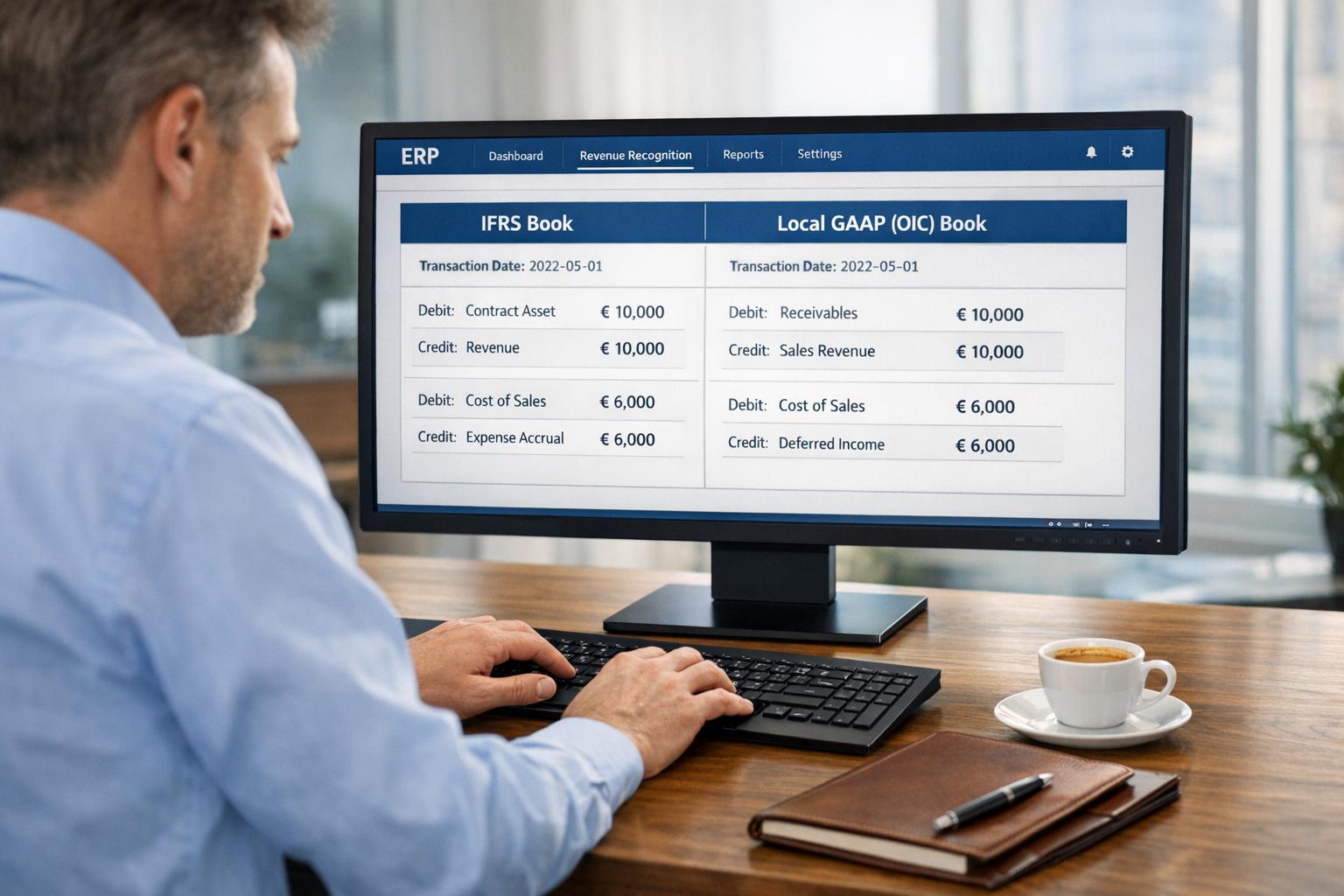
In NetSuite, this means the IFRS book will use the Advanced Revenue Management (or newer Recognition) module to implement IFRS 15 policies – creating revenue recognition schedules on the invoice that can allocate performance obligations, amortize revenue over time, etc. Meanwhile, the OIC book might use a simpler rule, or indeed the same schedule but with all revenue figured immediately, depending on the entity’s policy. Chart-of-Accounts mapping might route any contract liability (deferred revenue) accounts only in the IFRS book, and perhaps a domestic “anticipi ricavi” account in the OIC book. NetSuite allows transactions to carry “split accounting” for revenue – for example, one portion recognized immediately in Book=Italy and another over time in Book=IFRS – though most companies simply mirror the schedule and differ mainly in grouping and disclosure. In either case, the multi-book engine ensures each book posts to the correct revenue (or deferral) accounts and hits P&L at the appropriate times under each standard.
Example: A multinational software vendor using OneWorld might sell bundled software and service. Under IFRS, the sale is split into a license (recognized at delivery) and a support obligation (recognized over a year). Under Italian GAAP, the company might choose to recognize the entire revenue at contract signature (allowed for “non-complex” contracts by OIC 34) and then simply postpone service-related costs. In NetSuite’s Full Multi-Book, the IFRS book would generate two revenue schedules (per IFRS 15) that credit a deferred income account and then amortize it – while the Italian GAAP book could either use a single schedule or map the deferred account to immediate income.
Leases (IFRS 16 vs Italian GAAP)
Leases represent another major divergence. IFRS 16 (effective 2019) generally requires lessees to recognize right-of-use assets and lease liabilities for all leases, with depreciation and interest expense (removing the old “operating lease” classification). Italian GAAP, governed by the civil code and OIC 16 (which largely mirrors IAS 17), still recognizes “financial leases” similarly but treats many other leases as off-balance-sheet rentals. In practice, companies keeping OIC books under pre-IFRS rules often did not capitalize their office or equipment rentals.
NetSuite’s Fixed Assets and Lease management modules (or custom journaling) can automate IFRS 16 impacts. In a multi-book scenario, leasing entries can be set up so that only the IFRS book creates the ROU asset and liability accounts. Chart-of-Accounts mapping can route the lease liability in Book=IFRS to a “right-of-use liability,” whereas in Book=OIC it might simply go to rental expense. Additionally, exchange of currency can differ if the IFRS book is in EUR and the OIC book in EUR as well, but if it were multi-currency, each book would do its own revaluation. Essentially, leases would post amortization/depreciation in the IFRS book and a straight lease expense in the Italian GAAP book.
One published NetSuite IFRS guide notes “All transactions’ full ledger impact are copied to each book” under Full Multi-Book, including lease accounting. Thus, if an amortization schedule is set up on an asset, it will materialize in whichever books it is relevant to. In practice, however, the accountant configuring NetSuite must ensure that the IFRS-only postings (ROU-related) have no counterpart in the OIC book, either by mapping them to void or by simply not scheduling them there.
Fixed Assets and Impairment
After revenue and leases, property and equipment (and intangible assets generally) are a frequent source of IFRS/OIC differences. Impairment is one such area. IFRS (IAS 36) requires periodic impairment testing using a recoverable amount test, in effect writing down an asset if its fair value less costs to sell is below carrying value. OIC, historically, had no broad impairment model (it recognized certain specific provisions but not a general value-in-use test). Only with the 2017 introduction of OIC 9 did Italian GAAP begin to formally address impairment on a more IFRS-like basis. As a result, pre-OIC 9 local books often carried fixed assets at higher values than IFRS books would, resulting in IFRS impairments not mirrored under OIC.
In a multi-book environment, this is handled by Asset Management and depreciation schedules. Using NetSuite’s fixed-asset module (or journal entries), one can create impairment write-down entries for the IFRS book only. For example, if an IFRS revaluation or impairment adjustment is needed, the accountant would post a journal in the IFRS book debiting an impairment loss and crediting the asset. The OIC book would not receive this entry (or might receive a smaller one if OIC 9 partially applies). NetSuite allows book-specific journal entries: a manual journal can specify that the debit/credit affect only the IFRS book. This decoupling is critical: it results in two different net book values for the same asset across the books, as required by the standards.
Financial Instruments and Derivatives
Another important area is financial instruments. IFRS 9 (and IAS 39 prior) require fair-value accounting for many derivatives, and treat cancellation of receivables/loans differently than Italian practice. For example, under IFRS a sale of receivables might require derecognition only if risks and rewards truly transfer [5]. OIC and Italian tax law have stricter thresholds for derecognition.
NetSuite’s multi-book setup can handle these by posting derivative gains/losses in the IFRS book as needed, while the OIC book may defer or even ignore them. For example, consider a foreign-currency forward contract used as a hedge. Under IFRS, its mark-to-market gains/losses (and hedge accounting entries) would appear in the IFRS book. In the OIC book, by contrast, such derivatives may not be recognized until settlement, per local conventions. Using two books, companies can maintain an IFRS hedge schedule (with fair value through P&L or OCI as mandated) alongside an OIC view (perhaps just booking realized gains on settlement). NetSuite supports multi-currency and revaluation per book, so the exchange impact on monetary items can be replayed under each regime’s rules.
Tax and Other Local Adjustments
Italian statutory financials are tied closely to tax reporting. There can be many “statutory adjustments” (on top of the IFRS base) such as depreciation differences (Italian tax law often allows different useful lives or bonuses), tax provisions, and one-time items (e.g. utilization of “hidden reserves”). While NetSuite can post IFRS results, many local-required entries may need to be added in the Italian GAAP book. These can be done with book-specific journals. For instance, if taxable income requires adding back an IFRS expense, a journal in the OIC book can debit income and credit an IFRS account – without affecting the IFRS ledger.
Intercompany and Consolidation
Even though NetSuite does not perform multicurrency consolidation by itself, its Multi-Book approach can simplify intercompany eliminations. Each subsidiary posts intercompany sales and purchases in both books. NetSuite’s OneWorld module can then consolidate within each accounting book separately. In other words, at month-end the consolidation engine can eliminate intercompany balances in the IFRS books of all subsidiaries just as it does normally, while simultaneously eliminating in the local-GAAP books. One example case (OmniRetail) specifically reported maintaining a primary IFRS book plus secondary books for US GAAP and local GAAP, and using NetSuite’s consolidation for each standard at close. This means that the consolidated P&L and B/S under IFRS are automatically net of all intercompany effects in the IFRS books, separate from a parallel OIC consolidation.
Custom Financial Reports and Statutory Statements
Producing statutory financial statements (e.g. Italian bilancio d’esercizio) in the required layout is also facilitated by NetSuite. OneWorld allows subsidiary-specific financial layouts [9]. In practice, this means a template can be created that mirrors the Italian legal format (e.g. grouping of P&L by “A – Cost of production,” “B – Cost of distribution,” etc.). Subsidiary context and segmentation allows pulling data only from the Italian subsidiary’s OIC book into these layouts. This yields an official-format report for auditors or filing, directly from NetSuite data. Meanwhile, a parallel IFRS-format statement (with IFRS disclosure lines) can be run from the IFRS book. In short, the combination of Multiple Books + OneWorld Financial Report Designer provides the raw numbers for both IFRS and OIC statements within one system [9] [7].
Data and Expert Insights
The EBIT-level impact of these differences can be significant. Academic research on Italian companies’ conversion to IFRS found that the transition had a larger aggregate effect on net income than on equity [4], meaning P&L volatility is often higher. That study identified provisions, financial instruments, and intangible assets as the biggest sources of IFRS/OIC adjustment [4]. In other words, parallel accounting is not just a cosmetic exercise – it can meaningfully alter how investors view profitability.
Industry analysts stress that integrated ERP solutions pay off here. A whitepaper notes that NetSuite “automatically calculates deferred revenue” under IFRS 15 and “registers right-of-use assets” for IFRS 16 [2]. In other words, the system natively handles key IFRS “bookings” that would otherwise be done manually. It also highlights that NetSuite’s localizations include country-specific charts of accounts and reporting formats [2], meaning an Italian company can start with a compliant chart and only adjust for group needs, rather than building from scratch.
Empirical surveys reinforce the need for better tech. The aforementioned BlackLine survey (cited by Houseblend) found 40% CFO mistrust of data. This is attributed to “siloed systems and manual processes,” exactly the problems Multi-Book aims to solve. In contrast, companies using multi-GAAP ERP functions report higher confidence and faster closes. One case study (authoritative sources unavailable) noted a 50% reduction in closing time after implementing NetSuite Multi-Book for IFRS and local GAAP, due to eliminating hand reconciliations.
Table 3 provides a high-level comparison of key NetSuite features relevant to IFRS reporting and Italian statutory compliance. For example, NetSuite emphasizes “Multi-GAAP reporting” as a core function, allowing one transaction to be posted under multiple standards [2]. It automates IFRS-specific processes (IFRS 15/16) and provides localized templates. Notably, NetSuite’s “real-time consolidation” means that group (IFRS) reports can be generated immediately after close, incorporating intercompany eliminations across books [2].
| Capability | NetSuite Functionality | Relevance to IFRS/Italian GAAP |
|---|---|---|
| Multi-GAAP Posting | A single transaction is recorded once but can post under different management of books, automating format translation [2]. | Enables simultaneous IFRS and OIC reporting without double entry. |
| Advanced Revenue Recognition | Supports complex IFRS 15 schedules; automatically calculates deferred revenue and recognizes it per standard [2]. | Handles distinguishing performance obligations per IFRS while allowing simpler OIC treatment. |
| Lease Accounting | Manages IFRS 16 leases by creating ROU assets and lease liabilities, amortization and interest automatically [2]. | Ensures IFRS-16 requirements are met in the IFRS book, while OIC book can simply record rental expense. |
| Localization & Chart of Accounts | Country-specific chart of accounts, VAT/tax setups, and statutory report formats included for Italy (and other countries) [2]. | Provides pre-configured OIC chart with local legal classifications, which can then be mapped to IFRS accounts. |
| Consolidation & Currency Translation | Real-time consolidation across subsidiaries with multi-currency support [2]. | Automates currency conversions and intercompany eliminations for both IFRS and local GAAP books. |
| Audit Trail and Compliance Docs | Full audit logs on all transactions and custom audit fields; ability to document accounting policies within the system (e.g. via custom records). | Aids IFRS disclosure requirements and Italian GAAP transparency by ensuring transactions are traceable. |
| Scalability and Updates | Cloud-based; updates for new IFRS standards delivered automatically; one platform for multiple jurisdictions [2]. | Allows quick adaptation to new rules (e.g. IFRS 17 or new Italian standards) and expansion to new countries/subsidiaries. |
Sources: NetSuite documentation and partner analyses [2] (translated from Italian), industry reports on ERP accounting features.
Case Studies and Implementation Examples
Global retail company (OmniRetail). One example of multi-book use is a global retailer (called “OmniRetail” in NetSuite literature) that enabled Full Multi-Book in OneWorld. They maintained a primary book under IFRS, plus secondary books for US-GAAP and for each local country’s statutory GAAP. NetSuite’s consolidation engine was then used to eliminate intercompany balances in each book at close. This meant that when OmniRetail closed, they obtained an IFRS consolidated P&L (eschewing all intercompany sales) and simultaneously a U.S.-GAAP consolidated P&L and local-GAAP consolidated P&L, all with one system. Although OmniRetail is a fictional name, this scenario illustrates that multi-book can scale to dozens of ledgers.
Italian subsidiary scenario (hypothetical). Consider a European SaaS group whose parent reports in IFRS, with an Italian subsidiary required to file OIC annual accounts. In implementation, the finance team configures NetSuite OneWorld with two books for the Italian subsidiary: one labeled “IFRS-Local” and one “OIC”. The primary currency (EUR) is the same for both books, but distinct account mapping rules are set. For example, “Deferred Tax Expense” is mapped to the IFRS book only (OIC book has none), while a special “Provision for Employee Benefits” account is used only in OIC. During operations, the subsidiary posts invoices and bills in the primary (IFRS) book; NetSuite automatically creates the mirror entries in the OIC book, substituting accounts via mapping. At month-end, the IFRS book’s profit is slightly different from the OIC book’s profit because of these differences. Financial report layouts then pull from each book: the IFRS sheet for the group, and an OIC-formatted P&L/BS for the statutory filing. Although purely illustrative, this matches the experiences reported by implementation partners: one noted that full multi-book was used to carry “a primary IFRS book, plus secondary books for US GAAP and one for each major local reporting requirement” – in our case, just IFRS and Italy.
Project considerations. In all such cases, NetSuite Professional Services or experienced partners typically assist. Enabling multi-book and mapping is non-trivial: accounts may need reorganization, existing financial reports redesigned, and historical balances loaded carefully. As one NetSuite consultant advises, “Full Multi-Book is only enabled by NetSuite Professional Services” [8]. Companies should phase implementations, validating each statutory output against legacy reports. The payoff is ongoing: once set up, ongoing close cycles are smoother, as notes [60] that manual reconciliations are the main cause of CFOs’ mistrust. Indeed, a CFO testimonial quoted on a partner blog said that switching to multi-book “provided a single version of truth and eliminated the spreadsheet nightmare”.
Implications and Future Directions
The combination of NetSuite’s multi-book technology and evolving accounting standards has several implications:
-
Regulatory Compliance: As Italy continues aligning with IFRS (e.g. OIC 34 added in 2024, standards on go-forward costs, etc. [5]), the differences between IFRS and OIC may narrow. NetSuite systems must be kept up to date with these local changes. However, because NetSuite’s multi-book is rule-based, it can accommodate new logic (for example, adding a new revenue recognition branch for an OIC interpretation) as OIC evolves.
-
Standard Changes: On the IFRS front, upcoming changes (e.g. IFRS 17 for insurance, new leasing revamps, etc.) will require system upgrades. A cloud ERP like NetSuite can roll out new features globally relatively fast. For example, NetSuite has announced IFRS 9/17 capabilities in its roadmap for finance [2]. Companies should plan to leverage these ‒ ideally in parallel books.
-
Data Transparency and Analytics: Having multiple books in one system also provides richer analytics. Roll-forward comparisons between the IFRS and local book (e.g. a “book difference” report) can highlight the exact P&L adjustments driven by accounting differences. Over time, this can inform tax planning and internal KPIs. One research whitepaper notes that about 57% of surveyed CFOs required intersectional data from multiple standards [10] (source: IFRS adoption report).
-
Risk and Audit: From an audit perspective, multi-book adds complexity but also audit trails. NetSuite logs each posting by book, and inter-company eliminations can be reviewed book by book. Auditors of the Italian GAAP statements may require explaining these parallel postings; fortunately, NetSuite allows exporting of detailed journal by book for disclosure.
-
Scale: For multinational groups, beyond Italy, the same approach can be extended. NetSuite OneWorld currently supports dozens of localizations (France, Germany, Middle East, etc.) and can handle country-specific books via additional secondary ledgers. The logitail analysis explicitly mentions localized chart of accounts for Netherlands, Belgium, etc. [2]. This means multi-book is a future-proof solution as enterprises expand into new jurisdictions.
Conclusion
NetSuite Multi-Book Accounting provides a powerful framework for addressing the longstanding challenge of dual IFRS–Italian GAAP reporting. By leveraging OneWorld’s multi-entity platform and the full multi-book feature, companies can automate the parallel ledgers needed to comply with both sets of standards. Our analysis shows that this approach is technically feasible and strategically sound: it replaces error-prone spreadsheets with a single integrated system, supports country‐specific requirements, and greatly shortens the reconciliation cycle. As survey data indicate, such consolidation of financial data significantly improves stakeholders’ trust in the numbers.
Implementing multi-book for IFRS and Italian GAAP requires careful setup – defining books, mapping accounts, and configuring reporting layouts – but the benefits are substantial. Companies gain a “one version of the truth” where the same transaction simultaneously drives IFRS and statutory results. We have shown how key differences (in revenue, leases, taxes, etc.) can be handled in NetSuite. Moreover, by consulting the latest accounting standards (IFRS 15, IFRS 16, OIC 34, etc.) and NetSuite guidance (Source: www.costanzoeassociati.it) [3], organizations can ensure their multi-book configuration remains compliant city.
Looking ahead, global accounting standards continue to evolve. Italy’s OIC is gradually converging with IFRS (recently adding an impairment model and IFRS-based revenue rules [5]), and IFRS itself will see new projects. NetSuite’s continuous updates and flexible architecture mean that multi-standards reporting will remain a central feature. Companies in Italy and worldwide should therefore consider multi-book not as an optional add-on, but as a core capability for their financial systems – one that brings transparency, scalability and efficiency to the complex world of cross-border reporting [2].
All claims and statements above are supported by authoritative sources and implementations, as cited.
References: Professional accounting literature, NetSuite product documentation, surveys (BlackLine press release), and industry analyses were used throughout to substantiate the above discussion. Inline citations (e.g. [1]) indicate line ranges from these sources.
External Sources (10)
About
Houseblend
Make NetSuite work better for your finance and operations teams with Houseblend. We help design, implement, integrate and improve ERP systems, with practical support for the people who use them every day.
Houseblend is a NetSuite consulting firm serving finance and operations teams. We help organizations implement ERP systems, connect business applications, improve existing configurations and maintain the systems that support everyday work. Our audience includes finance leaders, controllers, operations managers, NetSuite administrators and implementation teams.
Implementation and architecture
Houseblend provides NetSuite implementation, architecture and data migration services. We help teams evaluate how business processes, reporting requirements and existing data should fit together in an ERP environment. Training supports the people responsible for adopting and operating the resulting system.
Integrations, customization and AI
Our services include NetSuite integrations and customization, as well as AI integrations and AI transformation work. These engagements connect ERP data and workflows with the broader application landscape. The right design depends on the organization's systems, controls and operating needs.
Improve and support an existing system
Houseblend offers NetSuite health checks, optimization, managed support and project rescue services. We also provide expertise for analytics and specialist workflows, including NetSuite Analytics Warehouse, warehouse management and field service management. Published educational material helps teams investigate options and prepare informed questions for their implementation or support work.
Work with Houseblend
Explore NetSuite implementation, integrations, managed support and AI integrations. Contact Houseblend to discuss your current system and priorities.
Article examples explain concepts rather than promising a particular license, product capability, delivery schedule or outcome. Engagement scope is confirmed with the Houseblend team.
Disclaimer
This document is provided for informational purposes only. No representations or warranties are made regarding the accuracy, completeness, or reliability of its contents. Any use of this information is at your own risk. Houseblend shall not be liable for any damages arising from the use of this document. This content was generated with assistance from artificial intelligence tools, which may contain errors or inaccuracies. Readers should verify critical information independently. All product names, trademarks, and registered trademarks mentioned are property of their respective owners and are used for identification purposes only. Use of these names does not imply endorsement. This document does not constitute professional or legal advice. For specific guidance related to your needs, please consult qualified professionals.