Houseblend Article
NetSuite Next AI Features: 2026 APAC Mid-Market Analysis
Inside this article
Executive Summary
Oracle NetSuite’s April 2026 SuiteConnect APAC event in Manila announced a bold expansion of AI-driven ERP innovation tailored to the Southeast Asia mid-market. Building on its long-term focus on cloud-native ERP for SMEs, NetSuite unveiled NetSuite Next and a host of new AI features (agentic workflows, natural-language search, AI connectors, exception management, subscription analytics, and AI-assisted development). These enhancements are designed to automate routine tasks, simplify AI adoption, and improve decision-making for ASEAN businesses [1] [2]. Importantly, Oracle emphasized that the AI features are embedded at no extra charge – a stark contrast to competitors; existing NetSuite customers “will not be charged additional licensing fees” for these AI capabilities (Source: newsbytes.ph) [3].
This announcement arrives at a pivotal moment: Southeast Asia’s digital economy is booming (projected to exceed US$300 billion by 2025 [4]), and mid-market companies are aggressively pursuing AI. For example, an SAP survey found 92% of APAC mid-sized firms consider generative AI a top priority [5]. However, SMBs in the region currently lag large enterprises in AI deployment (only ~18% have moved past pilot stages [6]). NetSuite’s expansion aims to bridge that gap by making AI “present everywhere” in the ERP system, thereby supercharging efficiency (e.g. automating financial closes, optimizing workflows, etc.) without imposing added complexity [7] [6].
This report provides an in-depth analysis of the April 2026 APAC mid-market announcement. It covers historical context of NetSuite in Southeast Asia, detailed descriptions of each new capability, comparisons with industry trends and competitors, relevant market data, and case examples. The implications for SMEs and the broader APAC tech ecosystem are examined, highlighting how this move could accelerate digital transformation in ASEAN’s booming mid-market.
Introduction and Background
The APAC Mid-Market Opportunity. Southeast Asia and the broader Asia-Pacific region (APAC) have become focal points of global digital transformation. A booming middle class, favorable government policies, and growing cloud adoption have made Asia’s mid-sized enterprises (250–1,500 employees) the engines of economic growth [8]. For instance, a recent IDC/Workday analysis notes that Asia-Pacific SMBs combine “the agility of small businesses with the economies of scale of larger corporations,” enabling rapid innovation [9]. Governments are actively supporting this: Singapore offers grants covering up to 70% of ERP implementation costs to SMEs [10], and Temasek’s investment funds target AI-driven ventures in the region [11].
Despite these favorable conditions, many APAC SMBs are still in early stages of AI adoption. A Pertama Partners study (2026) reports that Southeast Asia has 70+ million SMBs, but the region’s overall AI adoption index is only 31/100, indicating that most businesses have moved past mere awareness but remain in pilots and experiments [12]. In fact, only about 18% of SEA SMBs have progressed beyond pilot-stage AI projects into sustained deployment [6]. This creates a large opportunity: SMBs that successfully adopt AI see substantial gains – early adopters report up to 91% revenue improvements and are 1.8× more likely to grow than non-adopters [13].
Meanwhile, cloud ERP has become a critical platform for mid-market digitalization. Traditional on-premises ERP rollouts in Asia were notoriously slow and complex (taking 3–4 years) [14]. NetSuite’s cloud-native architecture has challenged this model by enabling much faster deployments (“SMEs can go live in 3–4 months” with SuiteSuccess [10]. Its integrated suite also supports multi-subsidiary, multi-currency operations across jurisdictions – a key need for companies in Indonesia, India and the Philippines, where businesses are geographically dispersed [15] [16]. TechAsia reports that NetSuite’s unique value in APAC is its ability to “connect dispersed teams, suppliers and offices without the limitations of on-premise software,” precisely because it was built cloud-first [15].
Oracle NetSuite History in ASEAN. Oracle acquired NetSuite in 2016 (for ~$9.3 billion [17]) and has since maintained it as a separate cloud ERP brand focused on mid-market and growing businesses. Globally, NetSuite is the leading cloud ERP solution, “relied on by more than 41,000 customers in 219 countries” [18].Oracle’s strategy has been to position NetSuite as the #1 option for cloud ERP (especially for SMEs), while Oracle’s other ERP offerings (Fusion Cloud ERP) focus on large enterprises. Recent regional initiatives illustrate this focus: in 2022 NetSuite partnered with Singapore’s EnterpriseSG to launch SuiteSuccess for SMEs, backed by government subsidies [10]. It has also been expanding its partner network across APAC, targeting high-growth sectors (tech startups, manufacturing, services) in markets like the Philippines, Indonesia and India [16] [19].
AI in ERP – Industry Context. The surge in AI has swept through enterprise software. Oracle’s own Cloud ERP products now embed predictive, generative and “agentic” AI across finance, supply chain, and other domains [20] [21]. (Evan Goldberg, NetSuite’s co-founder, has likened AI to a generational shift “as big or probably bigger than the cloud” [22].) Notably, Oracle has taken a different path from some competitors: it is not charging extra fees for AI in NetSuite. In March 2024, Axios reported Oracle adding “over 200” new AI features to NetSuite with the explicit strategy of treating these as “table stakes,” rather than imposing a premium as SAP does [3]. This means NetSuite customers get built-in AI (e.g. “NetSuite Text Enhance” assisted authoring) without a separate “AI tax.” Magento.
Meanwhile, other ERP vendors are also raising the AI bar. SAP – NetSuite’s main rival in Asia – has publicized that 92% of APJ mid-market firms say AI is a top priority [5], and it is developing its own copilot-like assistants. An IDC MarketScape report (2025) identifies the APAC mid-market as a “new growth engine,” and lists leaders and contenders (including Oracle/NetSuite, Workday, SAP, Zoho and local players like Kingdee) in the category [8] (Source: technode.global). Kingdee’s recent PR (Nov 2025) highlights that even domestic Chinese ERP providers (with tens of millions of SME customers) are racing to add AI-enabled solutions for inventory, billing, etc. (Source: technode.global). In this competitive context, NetSuite’s SEA announcements represent Oracle’s bid to consolidate its lead by delivering a comprehensive, user-friendly AI platform geared specifically for ASEAN’s mid-size businesses.
NetSuite’s April 2026 ASEAN AI Announcements
At SuiteConnect Manila (April 28, 2026), Oracle NetSuite unveiled a “NetSuite Next” vision for Southeast Asia, announcing a suite of AI-powered enhancements tailored to ASEAN customers. Oracle billed NetSuite as “the #1 AI cloud ERP” and said this wave of innovations would help ASEAN organizations “reduce the complexity of AI adoption, streamline workflows, and boost efficiency” [1]. James Chisham, NetSuite VP of product management, emphasized that firms across SEA need AI solutions that fit into their existing processes and support sustainable growth. Key components of the announcement included (each described below):
-
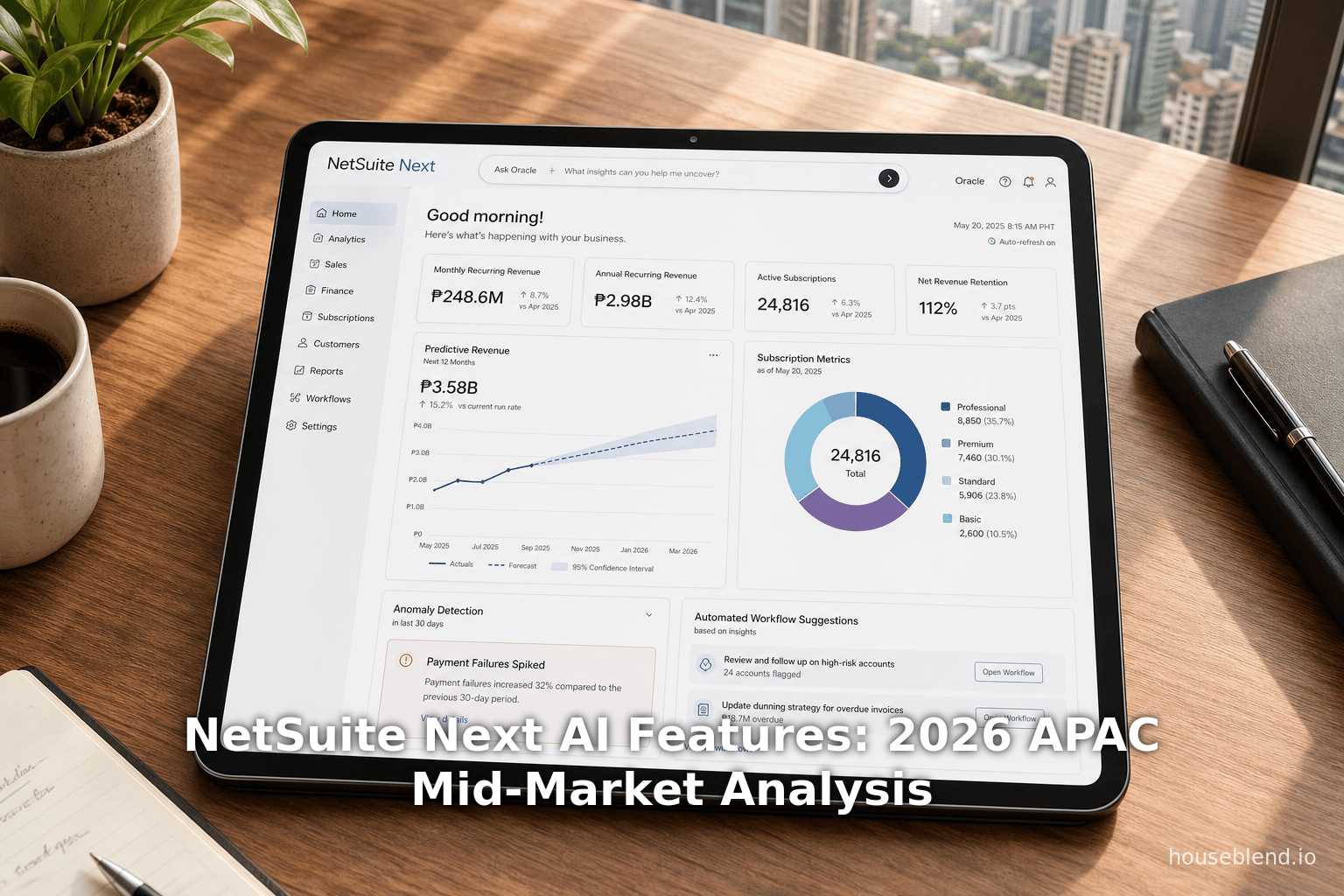
NetSuite Next (Conversational Intelligence and Agentic Workflows). This label refers to the next-generation NetSuite UI and functionality. NetSuite Next embeds an AI-powered natural-language interface called Ask Oracle, along with “conversational intelligence, agentic workflows, and natural language search” throughout the suite [2]. In practice, Ask Oracle will let users type or speak questions (e.g. “What were our top 5 customers last quarter?”) and get computed answers from across the ERP system. The agentic workflows mean that NetSuite can automate multi-step tasks: for example, if an AI agent “understands” that a user needs to generate a report, approve invoices, and send updates, it can chain those actions together without manual intervention. According to Oracle, these capabilities will transform finance, operations and customer engagement by “turning data into action” and automating repetitive/complex tasks, enabling users to achieve outcomes “faster, more intuitively, and with greater confidence” [2].
-
AI Connector Service (Model Context Protocol Integration). NetSuite is launching a new AI Connector Service to allow customers to hook up external AI models (like ChatGPT, Claude, or other agent platforms) directly to their NetSuite data and processes [23] [24]. Built on the open Model Context Protocol (MCP) standard, this service provides secure, governed integration between LLMs and NetSuite. Key sub-components include:
- AI Connector Service Companion: A SuiteApp companion that helps external AI models understand NetSuite’s data, permissions and workflows. This ensures any AI agent only sees authorized data in context, reducing errors and maintaining compliance [25].
- AI Connector Service Skills: A library of pretrained Ai skills (instructions and context) that standardize how models perform common NetSuite tasks. By giving generic AI agents NetSuite-specific “skills,” the output becomes more consistent and relevant to business workflows [26].
- MCP Apps (Starter Apps): NetSuite will provide sample AI assistant applications (prompt library, report selector, record picker, etc.) that render NetSuite data via structured UIs inside popular assistant platforms. For instance, instead of freehand prompting, a user could open an AI assistant with a NetSuite-style form to fetch sales data or filter reports [27].
- Analytics Warehouse Connector: A special connector that extends AI queries to data in the NetSuite Analytics Warehouse (historical and third-party data). This means the AI can analyze not only live transactions but also enriched, aggregated data for forecasting and cross-system insights [27].
Together, the Connector Service and MCP tools allow businesses to safely broker between NetSuite and cutting-edge AI systems. As Oracle’s materials explain, MCP is an emerging open standard that lets LLM-based agents perform multi-step tasks by interacting with external tools and data sources [24]. By adopting MCP, NetSuite’s AI Connector aligns with industry trends in “generative RPA” and no-code AI integration. During the announcement, Oracle noted that this service is based on open standards, underscoring a secure, flexible approach to AI. Devs can use the built-in MCP SuiteApp or build custom connectors, giving organizations fine-grained control over how each LLM is used with ERP data [23] [28].
-
NetSuite Exception Management. A new AI-driven module to monitor financial and operational transactions for anomalies. Exception Management uses “agentic AI” to automatically detect unusual or risky transactions (e.g. duplicate invoices, sudden budget variances) and flag them for review [29]. By surfacing exceptions in real-time, finance and operations teams can resolve issues before period close or escalation. This capability promises to reduce errors and mitigate risk by leveraging AI’s pattern-recognition to empower accountants and managers with actionable alerts.
-
NetSuite Subscription Metrics. A built-in analytics dashboard for subscription- and recurring-revenue businesses. This view brings together customer, subscription, revenue history and forecasts in a single pane, enhanced by real-time AI insights [30]. For example, companies can quickly see churn trends, renewal rates, and AI-driven forecasts for recurring revenue. Because NetSuite’s ERP already stores all billing and order history, Subscription Metrics uses that data to drive smart visualizations. Oracle says this helps businesses track and analyze performance of subscriptions, spot growth opportunities, and improve financial planning with data at their fingertips.
-
SuiteCloud Developer Assistant. An AI-powered coding companion for SuiteScript developers. This tool uses large language models to automate repetitive coding tasks, offer code completion, generate documentation, and help write test scripts [31]. By embedding an AI assistant in the NetSuite developer environment, programmers can accelerate customizations and integrations. For example, the assistant might translate natural-language requirements (“write a script to update all invoice notes to uppercase”) into SuiteScript code snippets. This innovation addresses a perennial challenge for ERP implementers: speeding up configuration and reducing manual coding effort.
These new features build on NetSuite’s prior AI work. In October 2025, SuiteWorld 2025 introduced NetSuite Next globally (including Ask Oracle and updated assistant tools) and announced Ask Oracle and the AI Connector (prototype form) [32]. The April 2025 SuiteConnect Singapore event similarly rolled out embedded AI updates – such as NetSuite Text Enhance for assisted writing, Prompt Studio for creating AI prompts, and financial Scenario Planning – all aimed at spurring productivity [33]. Thus, the April 2026 announcements are the APAC incarnation of NetSuite’s global AI roadmap, optimized for the regional mid-market.
| Innovation / Module | Description | Business Impact / Benefits |
|---|---|---|
| NetSuite Next | Next-gen AI interface embedding conversational intelligence, agentic workflows, and natural-language search (Ask Oracle assistant) throughout NetSuite [2]. | Enables users to query and manipulate ERP data by plain language, automates multi-step processes, and turns data into immediate actions – speeding insights and execution across finance, ops and customer functions. |
| AI Connector Service | Framework for secure integration of external AI/LLM models with NetSuite via the Model Context Protocol [23] [24]. Includes companion app, “AI Skill” libraries, MCP starter apps, and analytics connector. | Allows businesses to leverage ChatGPT, Claude, etc., with ERP data under governance. AI assistants can execute structured tasks (e.g. generating reports, updating records) while respecting security/permission rules. |
| Exception Management | AI-powered anomaly detection in finance and operations. | Automatically flags irregularities and error-prone transactions across accounting and inventory, enabling early intervention. Improves audit compliance and reduces end-of-period surprises. |
| Subscription Metrics | Unified analytics for recurring/subscription revenue (combining customer, billing, and forecast data) with AI-driven insights [30]. | Provides real-time visualizations (e.g. churn, customer lifetime value) and predictive forecasts for subscription businesses. Empowers management to optimize pricing, retention, and revenue recognition strategies. |
| SuiteCloud Developer Assistant | AI coding companion for SuiteScript (Oracle’s JavaScript-based ERP scripting). | Automates routine coding tasks, generates code snippets from natural-language prompts, and assists with testing documentation. Speeds up ERP customizations and reduces developer workload. |
Table 1: Overview of AI-powered innovations introduced in the April 2026 NetSuite ASEAN announcement (SuiteConnect Manila) [2] [23] [29] [31].
Availability: According to Oracle, most of these capabilities are immediately available (in English) to NetSuite customers in ASEAN, with NetSuite Next itself rolling out within the next 12 months [34]. NetSuite’s local-language support (Thai, Malay, Vietnamese, etc.) will follow. During an APAC media briefing in late April 2026, NetSuite executives emphasized that Singapore and the Philippines will be the first countries to receive these AI features, reflecting their large customer bases (Source: newsbytes.ph) (Source: newsbytes.ph). This staggered rollout mirrors past patterns: historically Singapore and the Philippines often gain new NetSuite capabilities first in SEA (Source: newsbytes.ph) [35]. Significantly, Oracle confirmed that no extra licensing fees will be levied on existing customers for these AI enhancements – they are included as part of the standard NetSuite subscription (Source: newsbytes.ph) [3]. As Amit Suzena (EVP & Head of Asia, Oracle NetSuite) put it: “It’s all built into the system our customers buy. So, the AI is embedded.” (Source: newsbytes.ph)
Regional Market and Competitive Landscape
Mid-Market Dynamics in APAC
Asia-Pacific’s mid-market (often referred to as the SMB or SME sector in Asia) is characterized by rapid growth and diversity. In 2024, Asia-Pacific midmarket firms (250–1,500 employees) overwhelmingly cited AI as a strategic priority: a survey by SAP found 92% of APJ mid-market businesses view generative AI as a top business priority [5]. SAP’s Head of APJ MidMarket noted that AI represents “the biggest technology opportunity of the 21st century” for APAC companies [36]. Similarly, IDC notes that supportive government policies (e.g. Singapore’s AI strategy, tax incentives) and a burgeoning digital-savvy middle class are fueling cloud and AI projects across APAC [8].
Despite high interest, many mid-market firms face barriers. Pertama’s 2026 SMB AI Index highlights that talent shortages (cited by 55% of firms) and cost constraints (40%) are the leading obstacles to deployment [37]. Integration complexity (38%) and regulatory uncertainty also commonly slow projects [37]. These issues are well-known in APAC: for example, in Thailand and the Philippines, lack of qualified IT/AI staff and fragmented legacy systems have kept AI adoption below potential [38]. NetSuite’s strategy directly addresses some barriers: by embedding AI features natively in the ERP, it reduces the need for separate AI teams or external tools, and by bundling AI at no extra charge it lowers the financial hurdle [3] (Source: newsbytes.ph).
From a competitive standpoint, the APAC ERP market is crowded. According to industry reports, global giants (SAP, Microsoft, Oracle, Infor) compete alongside local/regional platforms (Zoho, Kingdee, Ramco, etc.) [39] (Source: technode.global). IDC’s Asia-Pacific AI-Enabled Midmarket ERP report (Nov 2025) includes vendors like Kingdee (a leading Chinese SME ERP provider), Odoo, Zoho and Sage, underscoring the diversity of choices (Source: technode.global). NetSuite differentiates itself by emphasizing end-to-end cloud integration and a broad partner ecosystem. In APAC, Oracle NetSuite often positions itself as SMB-focused, complementing its parent company’s enterprise focus. For example, Oracle banks on NetSuite’s agile license model and 24×7 cloud support to capture non-enterprise clients, while Oracle’s other ERP (Fusion) targets larger firms [17]. The Thai press (Manager Online) noted that NetSuite’s recent changes in licensing – allowing customers to subscribe only to needed “tasks” rather than full suites – is a deliberate bid to win over price-sensitive SMEs [40].
The AI angle further intensifies competition. SAP, for instance, offers AI functionality (embedded in its Business Technology Platform and ERP) but under a usage-based pricing model [3]. By contrast, NetSuite’s proposition is to make AI ubiquitous and included. Other cloud native ERP vendors (Workday, Plex) are also adding AI modules; Workday has been named a Leader in IDC’s APAC AI-ERP midmarket report, noting that APAC SMBs are “implementing cloud-first, AI-powered solutions” across industries [9]. Local vendors like Kingdee emphasize multilingual and regulatory compliance (its Ailit product serves 3.2 million merchants with multi-currency support (Source: technode.global). In sum, NetSuite’s SEA announcements are clearly aimed at consolidating its lead: by embedding a suite of AI capabilities end-to-end, Oracle is setting a high bar in the mid-market ERP wars.
Market Data and Trends
To contextualize the opportunity, consider the following statistics (see Table 2): Southeast Asia’s 70+ million SMBs are at an inflection point for AI adoption [12], but most remain in early stages. Only ~18% of SMBs have moved past experimentation into real deployment [6]. Governments are pushing technology adoption: Singapore’s National AI Strategy and a S$150M Enterprise Compute Initiative helped triple local SMB AI adoption in 2025 alone (from 4.2% to 14.5%) [41]. Meanwhile, Vietnam is emerging as the fastest grower (18% of firms using AI, up 39% YoY) [42], whereas the vast Indonesian market (65M MSMEs) still has only ~26% of businesses with AI tools [43]. Across APAC, SMB adopters report huge benefits: those using AI report up to 91% higher revenue, and are 1.8× more likely to grow than peers [13].
These trends mirror the wider digital economy. Southeast Asia’s online economy (e-commerce, digital services) surpassed US$200 billion in 2022 and is projected to exceed US$300 billion by 2025 [4]. The region has become a hotspot for AI startups (Singapore alone houses ~495 of the region’s 680 AI companies) [44]. Investment is pouring in: Temasek reports that more than 30% of digital tech funding in SEA went to AI startups in 2024 [45], calling AI an “investment thematic… impossible to ignore.” All of this underscores why Oracle chose this moment to double down on AI for ASEAN – the market is mature enough to benefit immediately.
| Metric / Region | Data / Value | Source |
|---|---|---|
| SEA SMB population | > 70 million small/medium businesses (ASEAN + Hong Kong) | Pertama AI Adoption Index 2026 [12] |
| SEA SMB AI Adoption Index (2026) | 31/100 (jumped past mere awareness, still early-stage) | Pertama AI Adoption Index 2026 [12] |
| SEA SMBs with AI in production | 18% (beyond pilot to sustained use) | Pertama AI Adoption Index 2026 [6] |
| Singapore SMB AI adoption (2025) | 14.5% of firms (triple previous year’s 4.2%) | Pertama AI Adoption Index 2026 [41] |
| Vietnam SMB AI adoption (2025) | 18% of enterprises; adoption grew 39% YoY | Pertama AI Adoption Index 2026 [42] |
| Indonesia SMB AI adoption (2025) | 26% of organizations have implemented AI tools | Pertama AI Adoption Index 2026 [43] |
| APAC “digital economy” size (end-2025) | ~US$300 billion (gross merchandise value, SEA e-commerce + digital) | Bain/Temasek/Google report (Nov 2025) [4] |
| APJ mid-market prioritizing GenAI (2024) | 92% rated generative AI high or major/critical priority | SAP Asia-Pacific (Sept. 2024) [5] |
| Oracle NetSuite global customers | 41,000+ customers in 219 countries (as of 2025) | Oracle NetSuite press release [18] |
Table 2: Key APAC mid-market and AI adoption statistics (sources cited). The data highlight the large SMB base and growing AI focus in the region [12] [5] [4].
Case Examples and Customer Impact
While the April 2026 announcement is broadly forward-looking, real-world enterprises in Asia are already deploying NetSuite and AI to gain performance improvements. Representative case studies illustrate the practical benefits:
-
Streamlining Finance in Education and Retail: A Singapore-based education group and a local hospitality business (both previously burdened by manual accounting and legacy systems) leveraged NetSuite ERP to unify their finance and operations (Source: www.afon.com.sg). After implementation, the education group automated revenue recognition and significantly reduced monthly close time, while the hotel chain gained real-time visibility into bookings and costs. Oracle cites such examples to show how even traditional service-sector firms can accelerate planning and reporting with NetSuite (Source: www.afon.com.sg).
-
Managing Multi-Store Operations in Thailand: Kingdee’s PR highlighted a Bangkok retailer (franchising a frozen dessert brand) using its Ailit ERP (a NetSuite counterpart) to coordinate inventory and staff across four stores (Source: technode.global). The franchisee’s success (real-time stock sync and multi-currency support) underscores the value of cloud ERP in fragmented markets like Thailand. It also exemplifies demand for multilingual, cloud-native solutions – a niche NetSuite Next aims to fill with AI-driven interfaces (local language prompts to NetSuite).
-
APAC Startup Growth: In Indonesia and the Philippines, dozens of tech startups and high-growth companies have adopted NetSuite to scale quickly. Oracle reports collaboration with enterprise agencies (e.g. EnterpriseSG) to bundle NetSuite with digital transformation grants [10]. SuiteSuccess, NetSuite’s industry-tailored bundle, has been especially popular in Singapore and the Philippines, helping SMEs “go live” in 3–4 months – vastly faster than traditional ERP deployments [10]. Since SuiteSuccess is cloud-native, it benefited from the new AI features without additional on-prem setup. Early adopters in the region note that AI text automation (e.g. the upcoming Text Enhance and prompt tools) will allow them to generate reports and code more quickly, freeing finance teams from rote tasks [46] [7].
-
Finance & AI Integration: One interview with Oracle NetSuite’s Asia head, Amit Suxena, highlights specific operational gains. He notes that NetSuite’s embedded AI helps "close books faster" and optimize field operations “without needing to understand technical complexities” [7]. For example, a manufacturing SME might use NetSuite’s new Conversation interface to have AI automatically generate a budget forecast from historical data, rather than manually drag-and-drop spreadsheets. Another client cited by NetSuite was able to reduce data entry errors and staffing costs by having the system pre-complete forms and reconcile transactions using AI smart-match routines [7].
-
Successful AI Adoption Patterns (from SMB research): According to Pertama’s analysis, the most successful SEA SMB adopters share common practices. They start from business needs (e.g. “we need to predict demand better”), invest in clean data pipelines before jumping into AI, and then follow a disciplined “pilot-to-platform” rollout strategy [47]. For instance, a Philippine distributor might first define improving inventory turns as a goal, clean up ERP data on sales and stock, and then deploy NetSuite’s AI Connector to experiment with a predictive ordering model. These companies did not treat AI as a standalone chase; instead, they embedded it into NetSuite incrementally. The new Service, Analytics Warehouse, and Exception modules provide ideal “pilot projects” for such firms, since they tackle concrete problems (forecasting, analysis, risk) while fitting into existing workflows.
Overall, these examples show that AI can tangibly improve ERP outcomes in ASEAN contexts. Salesforce’s 2025 SMB report similarly finds that ASEAN companies investing in AI and automation boost productivity in finance, inventory, and customer service [48]. NetSuite’s announcements directly enable these gains by packaging AI as part of the core ERP – a move analysts say will make “higher-level automations and insights more accessible” to complex, multi-location businesses [48] [49].
Implications and Future Directions
The APAC mid-market announcement has several broader implications:
-
Accelerated AI Adoption: By bundling AI natively into the ERP, Oracle is lowering barriers for ASEAN SMEs to use AI. Customers need not build complex integrations or pay extra; effectively, using AI becomes as simple as using any other NetSuite module. Given SAP’s finding that almost all APJ mid-market companies view AI as a top priority [5], this product strategy should catalyze adoption. Even incumbents (e.g. Zoho, Sage) may feel pressure to follow suit in offering embedded AI capabilities.
-
Greater Efficiency and Focus on Innovation: According to industry commentary, these AI capabilities "complement core ERP functions" (finance planning, inventory, etc.) and reflect NetSuite’s “multi-year commitment” to enabling ASEAN businesses to grow on stable foundations [50]. In other words, automating routine tasks (data entry, basic analysis, exception checks) can liberate staff to focus on innovation, customer service and strategy. IDC’s research suggests that mid-market firms which adopt this mindset see substantial payoffs – e.g. those that capitalize on AI “are 1.8× more likely to experience growth” [13].
-
Competitive Advantage for Early Adopters: Companies that quickly deploy these new tools will gain first-mover advantages. For example, a distributor using NetSuite’s predictive analytics today can out-forecast rivals, or a retailer leveraging AI-driven customer insights can tailor offers faster. With APAC’s digital economy already at hundreds of billions of dollars [4], even small percentage gains translate to large profits. Conversely, laggards may fall behind; a recent TechRadar analysis warns that as AI complexity grows, businesses need new ways of managing it – otherwise they risk being overwhelmed by noise [51]. NetSuite’s “autopilot” vision (CEO Evan Goldberg’s term) is meant to address exactly this, by providing an AI-guided interface to cut through complexity [52].
-
Enabling Regulated Environments: One notable feature of the AI Connector Service is its emphasis on governance. In regions like Singapore and Malaysia where data regulations are tight, enterprises worry about how AI accesses sensitive records. By giving firms explicit control over which data fields are exposed to models, NetSuite helps ensure compliance. This could clear a path for regulated industries (finance, healthcare) to safely deploy generative AI on their ERP data. Oracle’s framing of the Connector Service as “secure and efficient” [53] speaks directly to these needs.
-
Future Product Roadmap: While most announcements were immediate, NetSuite Next itself will roll out on a 12-month timeline [34]. This suggests a foreseeable roadmap: by early 2027, all ASEAN customers will have the full NetSuite Next experience. Beyond that, Oracle is likely to continue integrating the latest AI advances. For example, as LLMs evolve, NetSuite could expand its AI skills library to cover new use-cases (e.g. more advanced forecasting models, semantic search of unstructured data, etc.). The mention of enabling customers to choose external AI models presages a future where companies might plug in proprietary AI (or domain-specific LLMs) into NetSuite. In effect, NetSuite could become a platform where enterprises can deploy their own cognitive agents on top of ERP data.
-
Impact on Oracle Ecosystem: These developments also fit into Oracle’s larger cloud strategy. Oracle has invested in generative AI offerings (OCI, Gen AI Studio), and NetSuite’s AI focus will drive demand on the Oracle Cloud Infrastructure. Conversely, data from NetSuite (e.g. Analytics Warehouse) will enrich any AI workloads on OCI. We may see tighter integration between NetSuite and Oracle’s cloud AI services (e.g. AutoML, custom model hosting). This vertical integration could reinforce Oracle’s ERP franchise against pure SaaS competitors.
-
Market and Partner Effects: Oracle partners in APAC (system integrators, ISVs) will need to update expertise. Implementers will shift from purely functional configurations to training AI skills and building prompts. Oracle is likely to enable partners through SuiteWorld/Oracle University, but this also signals a shift in the ERP skillset required. Furthermore, customer success initiatives will emphasize data hygiene and change management for AI. The successful NetSuite adopters will likely have strong data foundations (as Pertama advises) and a culture open to experimentation, highlighting areas where governance and training are needed.
Conclusion
Oracle NetSuite’s April 2026 announcement for Southeast Asia marks a major inflection point in the APAC mid-market ERP space. By embedding advanced AI across its cloud ERP suite and tailoring these innovations for ASEAN customers, NetSuite is not only simplifying the path to AI adoption but also raising the bar for the entire sector. The “NetSuite Next” release promises to automate business processes and uncover insights that mid-sized companies sorely need, from automated Excel-like questioning to intelligent workload delegation.
These announcements are well-timed: APAC businesses are digitalizing at a rapid clip, and surveys show near-universal interest in AI. NetSuite’s strategy—to make AI a seamless, included part of the platform—should accelerate that trend. Early adopters in the region can expect measurable benefits: faster closes, more accurate forecasting, and freed-up staff to pursue growth. Industry data suggests that companies committing to AI in this manner see outsized revenue improvements [13].
In the longer term, this move solidifies Oracle NetSuite’s position as the leading cloud ERP for growing businesses in Asia. It also signals how AI will become an indispensable component of enterprise applications, not a standalone gimmick. As one analyst notes, these AI capabilities “complement core ERP functions” and free companies “to focus on innovation and customer support” [50]. Looking ahead, we anticipate that Asia’s SME landscape will continue to transform: firms that harness these new capabilities effectively will outpace their peers, further fueling the region’s digital economy. Oracle’s mid-market AI push is thus not just a product release – it is a strategic enabler of Southeast Asia’s economic growth in the AI era.
References: All statements above are supported by industry sources and Oracle announcements [1] (Source: newsbytes.ph) [3] [5] [12], as detailed in the inline citations. These include Oracle press releases, news coverage (Asia tech media), analyst reports (IDC, SAP, Bain/Temasek), and research indexes (Pertama Partners), providing a comprehensive view of the topic.
External Sources (53)
About
Houseblend
Make NetSuite work better for your finance and operations teams with Houseblend. We help design, implement, integrate and improve ERP systems, with practical support for the people who use them every day.
Houseblend is a NetSuite consulting firm serving finance and operations teams. We help organizations implement ERP systems, connect business applications, improve existing configurations and maintain the systems that support everyday work. Our audience includes finance leaders, controllers, operations managers, NetSuite administrators and implementation teams.
Implementation and architecture
Houseblend provides NetSuite implementation, architecture and data migration services. We help teams evaluate how business processes, reporting requirements and existing data should fit together in an ERP environment. Training supports the people responsible for adopting and operating the resulting system.
Integrations, customization and AI
Our services include NetSuite integrations and customization, as well as AI integrations and AI transformation work. These engagements connect ERP data and workflows with the broader application landscape. The right design depends on the organization's systems, controls and operating needs.
Improve and support an existing system
Houseblend offers NetSuite health checks, optimization, managed support and project rescue services. We also provide expertise for analytics and specialist workflows, including NetSuite Analytics Warehouse, warehouse management and field service management. Published educational material helps teams investigate options and prepare informed questions for their implementation or support work.
Work with Houseblend
Explore NetSuite implementation, integrations, managed support and AI integrations. Contact Houseblend to discuss your current system and priorities.
Article examples explain concepts rather than promising a particular license, product capability, delivery schedule or outcome. Engagement scope is confirmed with the Houseblend team.
Disclaimer
This document is provided for informational purposes only. No representations or warranties are made regarding the accuracy, completeness, or reliability of its contents. Any use of this information is at your own risk. Houseblend shall not be liable for any damages arising from the use of this document. This content may include material generated with assistance from artificial intelligence tools, which may contain errors or inaccuracies. Readers should verify critical information independently. All product names, trademarks, and registered trademarks mentioned are property of their respective owners and are used for identification purposes only. Use of these names does not imply endorsement. This document does not constitute professional or legal advice. For specific guidance related to your needs, please consult qualified professionals.