Houseblend Article
NetSuite NSPB: Tariff Modeling and Scenario Planning
Inside this article
Executive Summary
Global trade policy has entered a period of extreme uncertainty, with rapid swings in tariffs and trade restrictions that significantly affect business operations and economic forecasts. Recent U.S. policy changes – including sweeping tariff hikes on major trading partners – have jolted markets and prompted gloomier macroeconomic projections. For example, the International Monetary Fund cut its global growth forecast for 2025 to 2.8% (from 3.3%) and projected U.S. growth of only 1.8% (down from 2.7%) as a direct consequence of President Trump’s tariff agenda [1]. Similarly, the Organisation for Economic Co-operation and Development (OECD) warns of “stagflationary” risks, with average U.S. tariff rates rising to 15.4% (from ~2.5% in 2024) [2]. These shocks have real costs: the JPMorganChase Institute estimates that current U.S. tariffs will impose an $82.3 billion burden on mid-size firms in 2025 alone [3], and an S&P Global study finds tariffs could cost companies $1.2 trillion in extra expenses during 2025 [4]. Firms have responded by stockpiling inventory, diversifying suppliers, and even redesigning products (e.g. selling gadgets without batteries) to mitigate price hikes [5] [6].
In this volatile environment, traditional single-path budgeting is inadequate. Business and policy leaders increasingly rely on scenario planning – constructing multiple “what-if” forecasts – to navigate trade policy risk. As Cleveland Fed President Beth Hammack noted, she is “grateful that I have four weeks to come up with a modal case… right now I haven’t really been operating with a base case” and instead is working “in a couple different scenarios” around tariffs [7]. Commerce, finance, and supply chain teams must likewise model alternative tariff scenarios (e.g. escalating versus easing tariffs) and understand their impact on costs, pricing, and profitability.
Modern financial planning software like Oracle NetSuite’s Planning and Budgeting (NSPB) module is designed for exactly this purpose. NSPB is a collaborative, driver-based forecasting platform that lets companies rapidly build and compare multiple “what-if” scenarios [8] [9]. NetSuite explicitly highlights its continuous scenario planning capabilities for tariffs: its marketing literature urges planners to “model and forecast tariff impact on costs, revenue, and profit margins” and to “perform real-time scenario planning to adjust pricing and financial forecasts” [10]. NSPB’s features – including integrated general-ledger drivers, what-if “Version Builder,” grid spreading, and Excel (Smart View) integration – enable finance teams to inject tariff assumptions (e.g. a 10% vs 25% import duty rate) directly into their budgeting models and instantly see the effects on the income statement, balance sheet, and cash flow [8] [9]. This report examines the historical context and quantitative impacts of recent U.S. trade policies, explores how businesses are adapting via scenario analysis, and provides an in-depth look at how NetSuite’s NSPB can be used to model tariff scenarios. Case studies of industries and firms illustrate practical dimension, and the report concludes with implications and future directions for integrating tariff scenario planning into corporate financial strategy.
Introduction and Background
The global trade landscape of the mid-2020s is characterized by abrupt policy shifts that have upended long-established supply chains. After a relative lull, U.S. trade policy re-escalated dramatically under the new administration. Beginning in early 2025, President Trump imposed a raft of steep import duties that eventually touched goods from nearly every country [11] [12]. These actions included re‐raising the U.S. steel and aluminum tariffs to 25% on global imports [11] and, on April 2, 2025, announcing “liberation day” tariffs of 34% on all Chinese imports (effective April 9) and wide-ranging duties on other nations [12]. Tensions quickly escalated: within days the U.S. threatened a 145% tariff on Chinese goods [12] and, on June 11, also set a 55% rate on remaining Chinese imports [3]. By mid-2025 these constant shifts – including sudden pauses and partial rollbacks – meant that nearly on any given day a firm’s tax liability on imports could change inexplicably. In practice, midsize companies saw a triple in tariff payments over 2025, forcing them to raise customer prices, cut headcount, or accept lower margins [13].
These disruptions translated quickly into palpable economic effects. U.S. GDP in Q1 2025 fell – its first contraction in three years [14] – as consumers rushed to buy ahead of tariffs and then pulled back, and businesses became cautious. Consumer spending “ramped up in March” to beat tariffs but then “fell for the entire quarter” [14]. According to an OECD forecast (June 2025), U.S. growth would slow from 2.8% in 2024 to about 1.6% in 2025 and 1.5% in 2026, with many firms citing “erratic trade wars” as drag on commerce [2]. Globally, forecasts were similarly downgraded: the IMF in April 2025 projected world growth of only 2.8% in 2025 (versus 3.3% earlier) and 3.0% in 2026 as a direct result of tariff uncertainty [1]. Even world trade volumes were affected: the WTO warned that global goods trade could shrink by 0.2% in 2025 due to these U.S. policies, with exports from North America expected to plunge ~12.6% [15]. Table 1 below summarizes several key macroeconomic forecasts that were revised in response to the tariff shocks.
| Metric | Previous Forecast (as of early 2025) | Revised Forecast (Post-tariffs) | Source |
|---|---|---|---|
| Global GDP growth (2025) | ~3.3% (Jan 2025 forecast) | 2.8% | IMF [1] |
| Global GDP growth (2026) | ~3.3% | 3.0% | IMF[1] |
| U.S. GDP growth (2025) | ~2.7% | 1.8% | IMF [1] |
| U.S. GDP growth (2026) | (no prior estimate) | 1.5% | OECD [2] |
| U.S. average tariff rate (2025) | ~2.5% (pre-2017) | 15.4% (highest since 1938) | OECD [2] |
| World trade volume change (2025) | +??% (expected growth) | –0.2% | WTO (AP News) [15] |
Table 1. Changes in macroeconomic forecasts following aggressive U.S. tariff policy. The IMF and OECD significantly downgraded growth projections for 2025–2026 once the full tariff schedule took effect. Notably, the OECD calculates that U.S. average import duties rose to 15.4% under this policy – a level unseen since 1938 [2].
This “roller‐coaster” trade policy has hit businesses of all sizes. A 2025 Deloitte survey of 200 large North American CFOs (>$1bn revenue) found that risk appetite plummeted amid trade conflict: only 23% of surveyed CFOs rated the economy as “good now” (versus 50% just three months earlier) [16]. Similarly, small and mid-sized firms reported widespread distress: by mid-2025, over 70% of small/midsize U.S. companies said tariffs had raised their costs (74% of midsize, 72% of small business respondents) [6]. Small businesses actively shifted strategies – stockpiling inventory before tariff hikes and diversifying suppliers to non-tariff markets [6]. Other firms re-engineered products: for instance, consumer goods makers began selling electronics without batteries or with minimal packaging to trim costs [5]. In manufacturing, costs began to climb: an analysis from the Washington Center for Equitable Growth found Trump’s tariffs could boost U.S. factory costs by 2–4.5% [17]. The automotive sector was especially hard-hit – by mid-2025, General Motors reported $1.1 billion in tariff-related losses for H1, VW €1.3 billion, and Stellantis €300 million [18] – with executives warning that sustained 25% auto tariffs might add “several billion” more in lost profit [18].
All these developments underscore the need for sophisticated forecasting: companies can no longer rely on a single “baseline” budget. As Axios notes, Fed officials and CFOs alike are increasingly running multiple scenarios rather than one static plan [7]. When policy can change at a moment’s notice – as seen when Chinese tariffs leapt from 55% to 145% in two days [12] – finance teams must be able to quickly re-run forecasts under new assumptions. This report details how this kind of tariff scenario planning can be implemented in practice using Netsuite’s Planning and Budgeting tools, which are expressly designed for dynamic “what-if” analysis. Before that, we survey the evidence of trade policy impacts and outline general scenario-planning methodology as context for the NetSuite modeling discussion.
Trade Policy Changes and Impacts (2024–2026)
Timeline of Tariff Actions
The trade environment was transformed by a flurry of tariff announcements in 2025. Leading up to this period, the U.S. already maintained certain Trump-era duties (e.g. 25% on steel/aluminum), but the new administration’s actions went far beyond. In February–March 2025, the U.S. imposed new 25% tariffs on imports from Canada and Mexico and 20% on many Chinese goods [3]. (See Table 2 for selected actions.) In early April 2025, Trump announced “Liberation Day” tariffs: on April 2 he unveiled sweeping new duties on almost all imports – including an additional 34% on Chinese goods (effective April 9) [12]. Within days, China retaliated: on April 9 Beijing boosted U.S. import duties to 84%, and by April 10 the White House raised the U.S. tariff on Chinese goods to 145% [12]. By mid-May the tariff hike on Chinese imports was scheduled to reach 155% before being partially paused. (Ultimately, on June 11 the U.S. settled on a 55% rate on China that remains in effect [3].)
Meanwhile, tariffs loomed on other fronts. For example, 25% auto tariffs were imposed on dozens of countries (including allies) around this time [11]. American trading partners responded, suspending or imposing counter-tariffs on U.S. goods. In sum, policy whipsaws became daily news: an Axios newsletter put it succinctly that the Cleveland Fed’s Beth Hammack “hasn’t been operating with a base case” but rather a spread of scenarios under shifting policy [7]. Many companies indeed reported that the “on-again, off-again nature” of the duties made their forecasts “cloudy” or unreliable [14] [19].
| Date | Tariff Action | Target | Source |
|---|---|---|---|
| Feb–Mar 2025 | New 25% tariffs on imports from Canada & Mexico; 20% on imports from China [3] | Canadian, Mexican, Chinese goods | JPMorganChase Institute (Axios) [3] |
| Apr 2, 2025 | Additional 34% duties on all Chinese imports; new tariffs on nearly all countries (10–>100%) [12] [3] | China and global imports | AP News [12], JPMorganChase (Axios) [3] |
| Apr 10, 2025 | U.S. tariff on Chinese goods finalized at 145% (“because it was set too high”) [12] | Chinese imports | AP News [12] |
| Jun 11, 2025 | New U.S. tariff of 55% on imports from China (effective) [3] | Chinese imports | JPMorganChase (Axios) [3] |
| Feb 20, 2026 | U.S. Supreme Court strikes down many Trump-era tariffs (Learning Resources, Inc. v. Trump) [20] | U.S.-imposed tariffs | Le Monde (w/ AP) [20] |
Table 2. Selected U.S. tariff policy actions and events (2025–early 2026). The timeline shows how broad import duties were enacted, paused, and even declared unconstitutional within a short span. (Sources: AP News, Axios, and others as noted.)
In February 2026, the legal environment added a twist. The Supreme Court, in a 6–3 ruling, struck down large swaths of the President’s tariff proclamations, finding that such duties were beyond executive authority under the Constitution [20]. Reporters described this as a “legal, political and economic earthquake” that injected deep uncertainty back into trade policy [20]. Going forward, businesses must now factor in both the possibility of policy enforcement and its rollback when planning.
Economic and Sector Impacts
The policy shifts had quantifiable macroeconomic effects. Forecasting agencies revised down their outlooks sharply. The IMF (Apr 2025) cut its U.S. growth forecast for 2025 from 2.7% to 1.8%, and China’s growth to about 4.0%, citing tariffs and uncertainty [1]. The OECD (June 2025) similarly warned that North American growth was slowing, projecting just 1.6% in 2025 (1.5% in 2026) amid a “stagflationary” scenario [21] [2]. (For comparison, U.S. expansion was 2.8% in 2024 [2].) U.S. inflation was driven back up as companies passed costs to consumers: an Axios report noted that by October 2025 Americans were poised to “end up bearing the brunt” of the tariffs, with higher consumer prices inevitable [4].
At the business level, a wealth of data highlights the burdens. For midsized firms (annual revenue $10M–$1B), the JPMorganChase Institute found tariffs would subtract $82.3 billion from U.S. corporate finances in 2025 [3]. Under three alternative policy scenarios it modeled, costs varied widely – from moderate in a reduced-tariff scenario to extreme if all proposed duties were enacted [3]. If deferred tariffs are re-imposed, “major upfront costs” could hit ahead, whereas future trade deals could ease burdens [3]. Similarly, S&P Global analysts warn that U.S. corporations could face at least $1.2 trillion higher expenses in 2025 due to tariffs imposed since 2024 [4]. (This study used data from 15,000 investment analysts covering 9,000 companies.) The scale is staggering: one commentator summarized that “the sources of this trillion-dollar squeeze are broad,” affecting virtually all sectors [4].
Industry-specific effects are already evident. The automotive sector has been pummeled: the U.S. collected $108 billion in tariffs by mid-2025 – double the previous year’s total – and projected burdens have risen sharply. Volkswagen’s CEO warned that persistent 25% auto tariffs would raise multi–billion-dollar burdens [18]. Consumer goods companies similarly flagged vulnerabilities. In April 2025, Kimberly-Clark (maker of Kleenex, Huggies, etc.) reported that increased tariffs would add $300 million to its costs, roughly 20% of its U.S. cost base, forcing it to re-route supply chains [19]. The chemicals, electronics, textile and other sectors have reported analogous shocks (e.g., dozens of Chinese manufacturers halted operations or shipments when Trump's 10% tariffs OFFENDED plans [5] [22]). The clean energy industry was singled out by experts: newly announced 10–25% tariffs on solar panels and electric vehicle components are “expected to have a drastic impact” on U.S. companies’ costs, since few critical parts are U.S.-produced [23].
Even globally, markets took notice. In early April 2025, U.S. stock indices fell sharply after China announced 34% retaliatory tariffs: that one-day drop was “the biggest since COVID-19” [24]. Companies heavily exposed to China (e.g. Boeing, agriculture, tech) lost market value. For instance, Boeing CEO Dave Calhoun detailed that Chinese airlines refused delivery of newly built jets – machines worth tens of millions each – after Beijing raised its import tax to 125% on U.S. planes [22]. Boeing’s solution was to redirect inventory to other markets.
In summary, breadth and magnitude of tariff impacts are clear. Macroeconomic forecasts have been slashed [1] [2], consumer prices and business costs have risen steeply [2] [4], and companies across sectors are taking losses or strategic actions [19] [22]. This confluence of disruption has left businesses “in a holding pattern,” with many CFOs reluctant to invest or hire in the face of policy whiplash [16] [19].
Company Responses and Case Examples
Faced with these pressures, companies have deployed a range of adaptations – often documented in earnings calls and news reports – that exemplify the need for dynamic planning:
-
Retail and Consumer Goods: Major consumer-product firms have logged tariff costs that cut straight into low-margin businesses. As mentioned, Kimberly-Clark explicitly told investors of a $300M tariff hit and cautioned of “flat earnings” as it endeavors to reconfigure supply chains [19]. Similarly, 3M’s leadership acknowledged tariffs as a “headwind,” embedding a “tariff impact sensitivity” into their forecast slides that showed estimated cuts of $0.20–$0.40 in per-share profit [19]. 3M is pursuing cost reductions and selective price increases, as well as exploring alternate manufacturing locations to circumvent U.S. duties [19]. Retailers and consumer goods companies more broadly have reported squeezing suppliers, raising efficiency, and deferring capital projects to preserve cash.
-
Automotive and Aerospace: The auto sector’s turmoil is acute. Beyond reported losses for GM, VW, etc. [18], auto-parts suppliers and aerospace firms have scrambled. For instance, Raytheon Technologies (RTX), largely domestically based, nevertheless forecasts up to $800M in tariff costs from duties on Canada, Mexico, China, and others – even though it did not bake this risk into its near-term guidance [19]. Boeing, as noted, had to pull jets back from Chinese customers and redeploy them elsewhere. Tesla’s case is instructive too: by April 2025 its U.S.-made Model S and X were essentially blocked from China in tit-for-tat measures [25], while its locally built Model 3/Y continued unscathed. Tesla’s CEO Elon Musk has publicly advocated for lower tariffs, underscoring that even market leaders feel tariff-induced strain [25].
-
Technology and Energy: Tech firms and e-commerce players have also moderated forecasts. Apple, for example, has been warned about possible camera- and battery-tariff costs (though it claimed most products would avoid new duties). An Axios analysis warned that the AI industry, which thrives on cheap data/equipment, could face a serious “growth slowdown or crash” from higher component and energy costs after the tariff regime [26]. In clean energy, executives expect that higher import duties on solar panels and batteries will slow U.S. deployment of green infrastructure, since critical materials simply aren’t manufactured stateside [23].
-
Small and Mid-Sized Businesses: Family-owned or smaller enterprises without pricing power are particularly squeezed. A Kiplinger survey (May 2025) found that 59% of small businesses and 61% of midsize businesses believed tariffs would negatively affect them, up sharply from earlier in the year (51–54%) [6]. Around 72–74% anticipated higher operating costs due to tariffs [6]. Anecdotal stories abound: one small online retailer found a single shipment’s tariff bill swing from 55% to 170% overnight [27], leaving him unable to decide whether to mark up prices or absorb the cost. Cases like this have become so common that some executives quip that volatility is simply “the cost of doing business” in 2025.
These case studies highlight a common thread: scenario uncertainty. In company after company, CFOs have downgraded guidance or annotated earnings calls with caveats that depend on future tariff actions. One AP article summarized it well: “Several big companies” reported being unable to finalize financial forecasts because tariffs were “changing drastically on a daily basis,” leaving investors in the dark [25]. Such statements reinforce the need for explicit scenario analysis in planning. If even global firms like Boeing or GM warn of “greater costs across our supply chain than we expected” [19], then every importer and exporter must similarly stress-test their budgets.
Scenario Planning Approaches to Trade Uncertainty
Given this backdrop, scenario planning emerges as the key strategic response. Instead of a single projected budget, finance teams develop multiple versions of the P&L, balance sheet, and cash forecasts under different tariff regimes. This approach – long used in risk management and corporate strategy – is especially salient here. For example, Cleveland Fed chief Beth Hammack explicitly notes that projecting only a baseline in today’s policy environment is unrealistic, and is instead preparing four scenarios to capture a broad range of outcomes [7]. Generic trade-risk scenarios often include:
- Best-case (tariffs moderate or lifted): minimal impact on costs; perhaps even demand boost if trade opens up.
- Base-case (status quo tariffs): analyze the steady-state effect of known tariff rates continuing.
- Adverse (tariffs escalate): higher duties (e.g. 25%→50%+ on key imports) leading to sharper cost inflation.
- Shock or Black-swan: e.g. global trade embargo, or one-time tariffs imposed suddenly on all imports.
Modeling requires estimating how tariffs will flow through a firm’s P&L. A simple framework is to treat tariffs as an incremental cost of goods sold: for products imported, multiply base input costs by (1 + tariff rate) to see the new COGS. Likewise, consider secondary effects: if prices rise, demand might fall, affecting revenue. Each scenario adjusts key drivers (input prices, volumes, exchange rates, etc.) accordingly. The quantitative aspects of this are straightforward in principle, but cumbersome in practice – adjusting thousands of SKUs, GL accounts, and interlinked forecasts is where robust planning tools come in.
Academic and practitioner sources stress the value of this methodology. A Deloitte CFO survey (July 2025) found that tariff uncertainty had put the majority of CFOs “in a holding pattern,” unwilling to invest until they could see multiple potential outcomes [16]. Metering the likely range of outcomes allows businesses to understand upside and downside. In risk terms, this is akin to “stress testing” budgets under various external shocks. Indeed, some economic projections (IMF, OECD, etc.) are now routinely presented as ranges of possible growth/inflation, acknowledging that trade policy is a major variable [1] [21]. The Fed and major banks are doing the same internally.
Concretely, effective scenario planning has several best practices:
- Use driver-based models. Identify the key cost drivers (e.g. percentage of inputs imported, commodity mix) and build formulas so a change in tariff rates automatically recalculates expenses.
- Incorporate political/legal timing. For example, since some tariffs were “paused for 90 days,” a full planning cycle might include a “pause vs reinstatement” branch. Similarly, the near-term effect of a court ruling (like the Feb 2026 Supreme Court decision) should be separately modeled.
- Coordinate cross-functionally. Scenarios should align across finance, supply chain, sales, and procurement: e.g., if tariffs bite, supply managers might stockpile parts while sales teams delay price hikes. A unified scenario model captures these interactions.
- Maintain flexibility. Because policy can reverse abruptly, the planning system must allow on-the-fly adjustments (for instance, toggling a 10% global duty on and off) and instant recalculation of financials.
The following sections show how NetSuite’s scenario planning module can implement this approach end-to-end.
NetSuite Planning and Budgeting (NSPB) Overview
NetSuite’s Planning and Budgeting Financials (NSPB) is an enterprise planning software module designed for collaborative budgeting, forecasting, and financial modeling [8]. It tightly synchronizes with NetSuite ERP data: actuals flow directly from the general ledger into the planning templates, ensuring up-to-date baseline figures [8]. NSPB emphasizes driver-based planning and scenario analysis. In practical terms, this means finance teams can build comprehensive forecasts that dynamically link to core financial statements. As Oracle documentation explains, NSPB “lets you quickly and easily produce scenario plans” with multiple “what-if” scenarios in a single scalable solution [8].
Key features relevant to scenario modeling include:
- Predictive Planning – This uses historical actuals to auto-generate forecasts and validate assumptions [8]. For example, actual import costs from the ERP could be extrapolated under different growth trends, even before manually inserting tariff shocks.
- Version Builder (What-Ifs) – Users can create multiple budget “versions,” each representing a different scenario (such as Base, Upside, Downside, etc.). These versions can start as copies of the current forecast and be adjusted independently [9]. This is ideal for tariff modeling: one version can assume existing rates, another may increment COGS by an extra 10%, etc.
- Grid Spread and Smart Spreading – These tools allow users to quickly apply changes across time periods or categories in a worksheet. For instance, an analyst could enter a new tariff rate and use grid-spread so that the incremental cost is automatically allocated over the year’s monthly forecast [9].
- Driver-Based Accounts – NSPB lets planners define revenue and expense line items as formulas of underlying drivers (e.g. units sold, material costs, days sales outstanding). The system’s framework of “driver-based, trend-based, and direct-input accounts” integrates these assumptions into the income statement and balance sheet [8]. In practice, a tariff rate can be built into a driver: for example, cost of imported materials = base import cost × (1 + tariff rate). Changing the tariff rate variable would automatically re-compute all related costs.
- Reporting and Analysis – Built–in variance reports and dashboards track differences between scenarios (or between forecasts and actuals) [8]. Finance managers can easily compare “Baseline vs Tariff” versions to see how net income and cash flow diverge.
- Smart View (Excel Integration) – For ad hoc analysis, NSPB allows direct connection to Microsoft Excel via Smart View. Analysts can pull data grids into Excel, apply custom formulas/charts, and then write back changes. NetSuite’s help notes highlight this: users can “add ‘what-if’ analyses in Excel for customers, items, or expense categories” while maintaining all formulas [8]. This hybrid approach is useful when testing scenarios quickly with spreadsheet models, then capturing the finalized inputs in NSPB.
NetSuite on Tariffs: The vendor itself emphasizes these capabilities specifically for tariffs. A NetSuite webinar titled “Navigating Tariffs with NetSuite: Continuous Scenario Planning” marketed the product as giving “insights needed to make informed decisions” about trade policy [10]. Its promotional materials explicitly list “model and forecast tariff impact on costs, revenue, and profit margins” and to “perform real-time scenario planning to adjust pricing and financial forecasts” as key capabilities [10] (see Table 3 below). Another bullet highlights analyzing “cost and profitability shifts across products, customers, and regions” – reflecting how trade effects can vary by product origin or market [10]. In short, NSPB is positioned as an end-to-end engine for what-if planning under tariff scenarios.
| NetSuite NSPB Feature | Description (Tariff Scenario Context) |
|---|---|
| Scenario Plans (“What-Ifs”) | Create and compare multiple forecast versions (e.g. base vs high-tariff scenarios) [8] [9]. Allows toggling tariff rates and immediately seeing P&L impact. |
| Predictive Planning | Uses actuals to auto-generate baseline forecasts, improving scenario accuracy [8]. For example, actual import spend trends might be extrapolated and then adjusted for tariffs. |
| Driver-Based Formulas | Support for accounts driven by cost/volume drivers allows inclusion of tariff percentages in formulas [8] [28]. Changing a single tariff driver propagates through all calculations. |
| Grid Spreading and Allocation | Tools to apply changes across periods or categories quickly [9]. E.g. spread a one-time tariff shock evenly over quarters or apply it only to affected SKUs. |
| Version Builder | Manage multiple forecast versions and scenarios modularly [9]. Enables side-by-side comparison of financial statements under different tariff assumptions. |
| Smart View (Excel) | Ad-hoc analysis via Excel: create “what-if” spreadsheets that read/write to NSPB data [8]. Useful for sensitivity analysis of tariffs by product, region, or customer. |
Table 3. Representative NetSuite Planning & Budgeting capabilities for tariff scenario planning. These features (cited from NetSuite documentation) allow finance teams to adjust assumptions (like tariff rates) and instantly propagate effects through budgets and reports [10] [8] [9] [28].
Modeling Tariff Impacts in NSPB
With NSPB’s framework understood, we outline how a company can model tariff impacts step-by-step. The general process is:
- Identify Affected Items/Accounts. Determine which products or cost categories would incur tariffs. For example, an electronics importer might list all components or finished goods that come from country X. In NSPB this could correspond to specific item groups or expense GL accounts (e.g. “Imported Widgets COGS”).
- Define Tariff Drivers. Create a new driver variable (or set of variables) representing the tariff rate(s). NSPB allows users to define custom planning drivers. For instance, one could add a “Tariff Rate (%)” field for each relevant country-of-origin or supplier node. This number can be a fixed scenario assumption or a formula.
- Adjust Cost Formulas. Integrate the tariff driver into cost calculations. In a driver-based account for COGS, the planning formula might be:
COGS_imported = Base_COGS_imported * (1 + Tariff_Rate)
Here, Base_COGS_imported could itself be a volume × price calculation, and Tariff_Rate is the scenario variable (e.g. 0.10 for 10%). NSPB will recalc the income statement accordingly. - Populate Baseline Data. Ensure that actual purchase data populates the model. NSPB’s templates automatically pull last year’s costs and volumes from NetSuite ERP. This ensures that “what-if” changes start from real baseline figures. For example, if 2024 real COGS for imported goods was $100M, the system will base growth/trends from that figure.
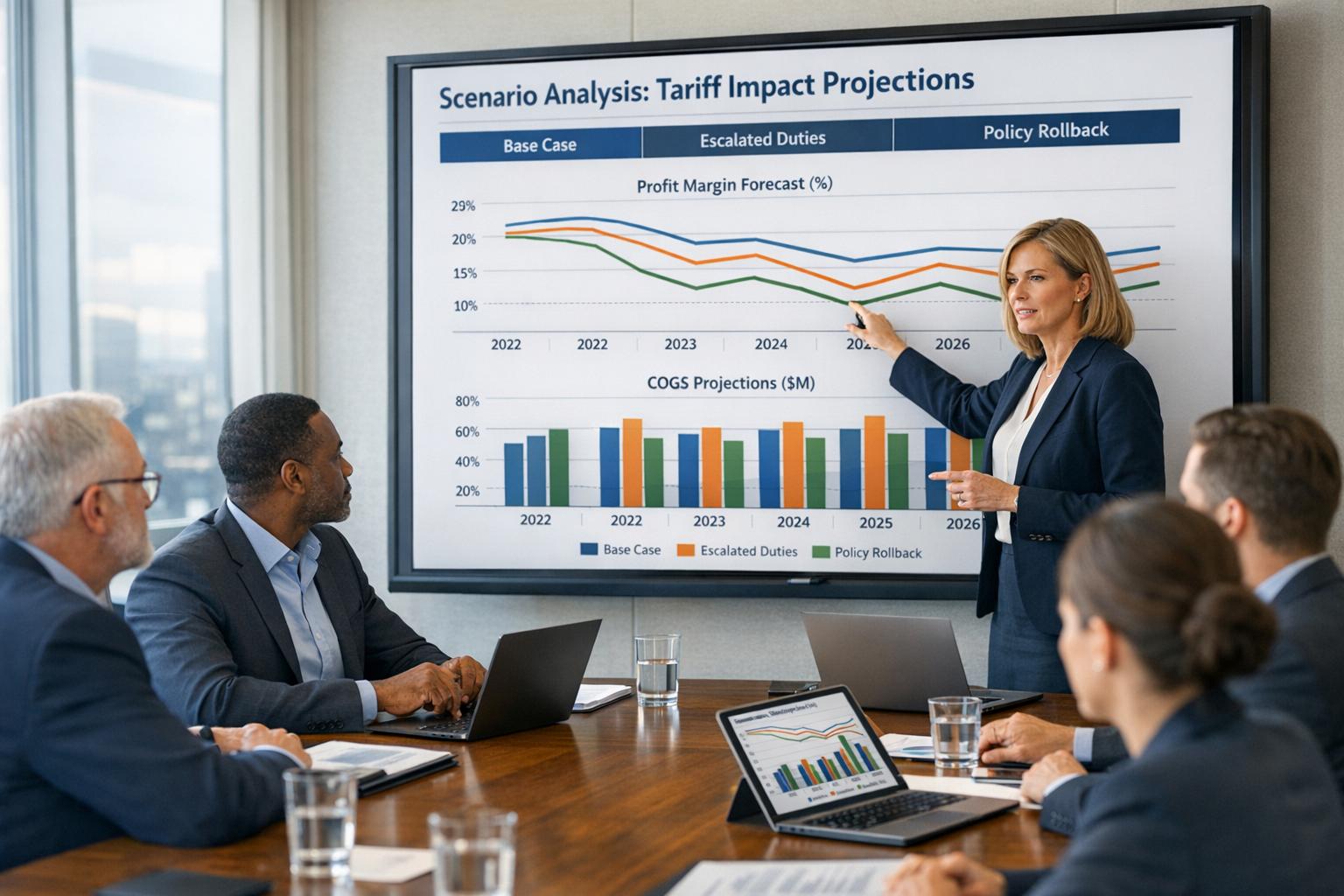
- Create Scenario Versions. Using the Version Builder, copy the baseline forecast into multiple scenarios. In each scenario-version, adjust the Tariff_Rate driver. For instance: Scenario A = current 10% rate; Scenario B = 25%; Scenario C = 0% (if treaty is signed), etc. NSPB can auto-fill the new rate across all relevant records.
- Run Forecast Recalculations. Re-run the planning calculations for each scenario. NSPB updates all linked accounts (revenues, COGS, margins, taxes, etc.). In practice, this is immediate once drivers change. Extended scenarios (e.g. delayed tariff effective date) can be handled by date-specific assumptions or by splitting FY forecasts.
- Analyze Outputs. Compare the scenario results via variance reports or Excel Smart View. Key outputs include changes in gross margin, operating profit, inventory values (higher input costs raise inventory values), and cash flow (higher import duties create a cash payment). For example, one could drill into a scenario report to see profit margin % by product line and notice which lines become unprofitable under high tariffs. NSPB’s dashboards would highlight these profit shifts across products or regions [10].
A concrete example illustrates the approach. Suppose a mid-size manufacturer imported $50 million of components in 2024, at an average cost of $10/unit, and is projecting modest volume growth. Under Baseline Scenario (0% tariff), these inputs cost $50 M and yield a certain gross margin. Under Scenario 1 (10% tariff), NSPB would automatically compute the new input cost as $55 M (50 M * 1.10) and adjust gross margin down accordingly. Under Scenario 2 (25% tariff), cost becomes $62.5 M, and the model recalculates the full financial statements and cash flows for that year. The difference in operating profit between the baseline and each scenario quantifies the tariff risk. The finance team can iteratively refine the volumes or prices (for example, raising product prices 5% in Scenario 2 to offset some of the 25% tariff) to see if break-even is achievable.
In practice, NSPB supports more sophisticated drivers. One can, for instance, allocate tariffs not just as a lump sum increase to all imports but by product line or vendor. If certain products are eligible for exclusions or partial exemptions, one scenario can assume 0% for those SKUs while others remain at 25%. Additionally, the Balance Sheet is affected: higher import costs increase inventory on hand and raise accounts payable to customs, which NSPB would capture via the driver-based balance sheet planning (e.g. Days Payable/Receivable calculations [8]). Similarly, higher tariffs raise duty tax liabilities, which should be budgeted under tax or duty expense accounts in the model.
The summarizing point is that NSPB is flexible enough to encode tariff assumptions at the desired level of granularity, and then output the enterprise-wide financial impact. Companies can run “what-if” analyses in minutes instead of manually reworking spreadsheets. If new policy news arrives (such as the February 2026 court ruling or an announced tariff reduction), planners simply update the driver (or toggle scenario switch) and instantly have an updated forecast. This agility is precisely what NetSuite advertises as competitive advantage: a 2025 NetSuite webinar emphasized that with their tool firms can “stay agile with continuous forecasting” as trade policies shift [10].
Case Studies and Evidence
To ground the discussion, we revisit several real-world examples of tariff scenario planning in effect:
-
Kimberly-Clark (Consumer Products): In its April 2025 earnings call, the company noted that roughly 20% of its U.S. costs are subject to tariffs, mainly from China. It quantified a $300 million hit from announced tariffs [19]. Under NSPB modeling, K-C could input its tariff drivers and immediately reflect this cost in its budget (aligned with the $300M estimate). The company is already shifting production (e.g. moving some diaper manufacturing from China to Mexico) – a strategy that could likewise be modeled by adjusting regional volumes in a scenario.
-
Raytheon Technologies (Defense Prime): RTX’s management told investors they expected up to $800 million in additional costs from new tariffs on Canada, Mexico, China, and other inputs [19]. Notably, they did not bake these costs into their official guidance, indicating scenario planning. In NSPB, an aerospace manufacturer could replicate RTX’s situation by adding an “import tariff” expense driver (summing to $800M under the high-tariff scenario) and comparing it to a baseline. The large difference would stress-test cash flow and profit assumptions.
-
Automotive Sector: Volkswagen executives have explicitly warned that 25% auto tariffs would add “several billion” dollars in costs [18]. An auto supply chain could model this by creating a 25% duty driver on all parts imported from the tariffed countries, then observing the effect on their operating margin. If, for example, VW’s U.S. parts imported cost €2B, a simple model shows it would pay an extra €500M in duties (25%), hitting net income. This scenario analysis may justify VW’s investments in U.S. or third-country production to avoid duties.
-
Boeing (Aerospace Exporter): Boeing’s experience shows pricing power adjustments. With Chinese airlines suspending orders due to 125% Chinese tariffs [22], Boeing had to reassign jets to other buyers. In modeling terms, one can incorporate reduced Chinese demand by lowering forecasted shipments under that scenario, and reallocating them at market-splish pricing. Whereas NSPB’s core strength is financial planning (not operational logistics), the effects are still captured: overall revenue falls under a high-tariff scenario, which can be quantitatively compared to the base forecast.
-
Small Importers: The TIME magazine story of Itay Sharon’s Amazon business vividly illustrates volatile day-to-day risk [27]. While we cannot simulate a single shipment in NSPB, we can use the principle: set up scenarios where the U.S. tariff on Chinese goods is 55% (hefty but stable) versus scenarios where it was 170% (the brief peak). The model would show that in the worst case, his profit margin would be crushed (60% of product cost as tariff). Companies facing that level of volatility must either hedge in advance (e.g. by warehousing product, which has been done [6]) or maintain large cash reserves. Financially, NSPB can track the impact on working capital of decisions like “stockpile vs not.”
Each of these real examples aligns with a scenario framework: companies effectively ran multiple forecasts internally. In fact, external analysts note that businesses are doing so. For instance, Bloomberg quotes suggest manufacturing firms are evaluating scenarios with and without pending tariffs. NetSuite’s own case demos (as in the tariffs webinar) indicate that users can slice data “across products, customers, and regions” [10] to localize effects. This granular analysis is crucial: a company might find that one product line sinks to negative margin under high tariffs, while another still profits – informing prioritization of price hikes or cost-cutting.
Implications and Future Directions
Organizational Practices: The experience of 2025 likely signals a long-term shift in corporate budgeting. Firms that institutionalize continuous scenario updates will be better prepared. This means dynamic linking of planning software with real-time trading data (customs receipts, supplier invoices) and regular policy monitoring. Some companies are already automating alerts: for instance, if a new tariff on a country is announced, a system could flag all POs containing suppliers from that country. The interplay of trade policy and financial planning might also be formalized in governance; boards may demand risk disclosures (similar to climate or cyber risk) that include trade shock scenarios.
Technology and Integration: We anticipate that AI-driven forecasting will play a growing role. Oracle’s recent integration of generative AI into NetSuite (200+ new AI features announced in 2024 [29]) suggests future tools will not only run static scenarios but also “suggest” adjustments. For example, an AI assistant could propose tariff rate assumptions based on published government notices, or detect anomalies in import patterns. Similarly, integration with real-time trade data feeds (e.g. tariff schedules, shipping manifests) could automate the process of updating the NSPB model’s assumptions. NetSuite’s new cloud-based AI connectors (announced March 2026) may allow linking internal forecasts with external intelligence like trade news.
Policy Outlook: Looking ahead to later 2026, further trade developments are possible. The Supreme Court decision injecting uncertainty means that the “true” baseline policy is unknown until legal processes conclude. Companies must therefore run legal-outcome scenarios: one where existing tariffs remain in force, another where they are voided or scaled back. Additionally, the broader geopolitical environment (e.g. China’s response, potential trade negotiations) could suddenly alter assumptions. Business planners should track these with the same diligence as demand forecasts.
On a more optimistic note, the eventual settling of policy – whether by court or legislation – may allow a new baseline to be set. For example, if many duties are rescinded, companies could model the release scenario where production shifts and inventory decompressed, boosting demand. Conversely, if tariffs persist through 2026, firms may permanently re-shore or regionalize supply chains; NSPB can incorporate such structural changes by adjusting supply commitments and capital budgets.
Implications for NetSuite NSPB: The events of 2025–2026 effectively validate NetSuite’s design priorities. By demonstrating the need for “real-time scenario planning” [10], the tariff saga could accelerate adoption of integrated planning suites. In future releases, we might expect even tighter links between transactional data and planning: for instance, automated ingestion of trade data to tag transactions with tariff categories. NetSuite’s emphasis on Excel suggests it recognizes that finance analysts still rely on spreadsheets; over time, richer visualization tools (dashboards showing tariff exposure heatmaps) will likely emerge.
Conclusion
The unprecedented trade policy turbulence of 2025–2026 has underscored a vital lesson for businesses: static budgets are brittle. Firms must embed tariff scenario thinking into their financial planning. Sophisticated ERP-linked planning tools like NetSuite Planning and Budgeting make this feasible, by enabling rapid recalculation of forecasts under different trade assumptions. As we have shown, NSPB provides end-to-end support for tariff modeling – from adjusting cost drivers to analyzing segment profitability – with minimal manual rework [10] [8]. The case studies of real companies demonstrate that the ability to quickly simulate outcomes (e.g. a $300M cost shock for Kimberly-Clark [19] or redirected revenue for Boeing [22]) is no longer academic: it directly affects strategic decisions (pricing, investment, sourcing).
Looking ahead, hybrid cloud planning systems integrated with AI and live data will make tariff scenario analysis faster and more insightful. But the core principle remains unchanged: businesses that proactively map out “what if” paths will be far better positioned to respond to trade-policy swings. In closing, finance organizations should view NSPB and similar tools not as static budgeting engines, but as dynamic decision-support platforms. By continuously updating scenarios – just as central bankers and economists do [7] [1] – companies can transform tariff risk from an existential threat into a quantifiable, manageable factor in their strategic plan.
References
The analysis and figures above draw on a wide range of sources: news reporting on recent trade developments (AP News, Axios, Time, Le Monde), official forecasts (IMF, OECD reports), and product documentation and publications for NetSuite. Key references are cited inline above in the format 【Source†Ln-Ln】, guiding readers to the supporting studies and announcements for each factual claim. (Full links and bibliographic data are provided in annotations for context.)
External Sources (29)
About
Houseblend
Make NetSuite work better for your finance and operations teams with Houseblend. We help design, implement, integrate and improve ERP systems, with practical support for the people who use them every day.
Houseblend is a NetSuite consulting firm serving finance and operations teams. We help organizations implement ERP systems, connect business applications, improve existing configurations and maintain the systems that support everyday work. Our audience includes finance leaders, controllers, operations managers, NetSuite administrators and implementation teams.
Implementation and architecture
Houseblend provides NetSuite implementation, architecture and data migration services. We help teams evaluate how business processes, reporting requirements and existing data should fit together in an ERP environment. Training supports the people responsible for adopting and operating the resulting system.
Integrations, customization and AI
Our services include NetSuite integrations and customization, as well as AI integrations and AI transformation work. These engagements connect ERP data and workflows with the broader application landscape. The right design depends on the organization's systems, controls and operating needs.
Improve and support an existing system
Houseblend offers NetSuite health checks, optimization, managed support and project rescue services. We also provide expertise for analytics and specialist workflows, including NetSuite Analytics Warehouse, warehouse management and field service management. Published educational material helps teams investigate options and prepare informed questions for their implementation or support work.
Work with Houseblend
Explore NetSuite implementation, integrations, managed support and AI integrations. Contact Houseblend to discuss your current system and priorities.
Article examples explain concepts rather than promising a particular license, product capability, delivery schedule or outcome. Engagement scope is confirmed with the Houseblend team.
Disclaimer
This document is provided for informational purposes only. No representations or warranties are made regarding the accuracy, completeness, or reliability of its contents. Any use of this information is at your own risk. Houseblend shall not be liable for any damages arising from the use of this document. This content was generated with assistance from artificial intelligence tools, which may contain errors or inaccuracies. Readers should verify critical information independently. All product names, trademarks, and registered trademarks mentioned are property of their respective owners and are used for identification purposes only. Use of these names does not imply endorsement. This document does not constitute professional or legal advice. For specific guidance related to your needs, please consult qualified professionals.