Houseblend Article
NetSuite Restaurant Operations: AI ERP Launch Analysis
Inside this article
Executive Summary
The “ Oracle NetSuite Restaurant Operations” solution, unveiled at the SuiteConnect London 2026 conference, represents a major new industry-specific offering combining Oracle’s NetSuite cloud ERP with artificial intelligence to streamline restaurant and hospitality back-office functions [1] [2]. Announced on March 31, 2026, the new platform unifies inventory, procurement, scheduling, production and cash management on an AI-enhanced single platform [1]. It is explicitly designed to replace the “patchwork of systems” historically used in the restaurant business [3]. Oracle executives emphasize that by converging front-end point-of-sale (POS) data (via the Oracle Simphony Cloud or other POS systems) with NetSuite’s financial and operational modules, Restaurant Operations gives operators real-time visibility across locations and dramatically reduces manual reconciliation [1] [3].
Industry context strongly supports this direction: restaurants are under severe margin pressure from rising costs and labor shortages, making technology adoption a strategic imperative [4] [2]. According to recent studies, quick-service chains are “rapidly adding AI to their front- and back-of-house operations” to cope with labor shortages and boost sales [4]. Simultaneously, independent restaurants have “hit a pricing ceiling” and must focus on “running smarter” rather than simply raising prices [2]. The global market for restaurant management software is growing rapidly (projected to nearly $15 billion by 2031 at ~14.5% CAGR) driven by cloud adoption and advanced analytics [5]. In this climate, a unified AI-driven platform makes strategic sense.
This report provides an in-depth analysis of the Oracle NetSuite Restaurant Operations launch, including: background of NetSuite in the hospitality sector, key features and architecture of the new solution, analysis of market trends and case studies, plus expert commentary. We incorporate quantitative data (market size, growth rates) and real-world customer examples (e.g. Hofman Hospitality, Lettuce Entertain You, TGI Fridays) to evaluate the potential impact of this announcement. By surveying multiple perspectives – from Oracle’s product team and industry analysts to restaurant operators – we aim to thoroughly assess the significance and future implications of NetSuite’s new restaurant-focused ERP platform.
Introduction and Background
The Restaurant Industry’s Operational Challenges
The modern restaurant and hospitality industry is intensely competitive and complex. Independent eateries and chain restaurants alike face rising food and labor costs, supply chain disruptions, and shifting consumer demands (e.g. delivery, digital ordering) [6] [2]. For example, a 2026 industry report by the James Beard Foundation (cited by Axios) found that many restaurants in the U.S. have “hit a pricing ceiling” – past the point where further menu price increases would hurt traffic [2]. At the same time, nearly half of operators report labor shortages, and over 40% got poorer margins from expanding delivery services [2]. In short, restaurants are under constant pressure to do more with less: serving more customers and expanding carefully, but without being able to boost prices significantly.
To cope, many restaurants are turning to technology and data. Leading quick-service chains (e.g. Wendy’s, Chipotle, Sweetgreen) have started integrating AI and robotics into kitchens and ordering systems [4]. Machine learning is used for demand forecasting and dynamic staffing, while automation helps manage repetitive logistics tasks. Industry observers note that AI is fast becoming “the biggest tech trend in quick-serve” [4]. At the same time, restaurant back-office functions – inventory management, purchasing, scheduling, accounting – have historically been fragmented. Often disparate systems handle POS/ordering, inventory (especially perishables), payroll, and financial reporting. This fragmentation can make it difficult to get a single view of business performance [3]. As Oracle NetSuite’s own executives acknowledge, “disconnected systems” can hamper agility for restaurants seeking to understand performance and customer demands [3].
Amid these challenges, demand has grown for integrated, cloud-based software tailored to hospitality. A Mordor Intelligence market analysis reports that the global restaurant management software market was already $6.54 billion in 2025 and is projected to surpass $14.7 billion by 2031 (CAGR ~14.5%) [5]. Drivers include a shift to cloud-first solutions (60.9% of the market was cloud-based in 2025) and a rising appetite for analytics – “analytics modules moved from optional add-ons to core purchase criteria,” especially as operators seek predictive insights to protect margins [5]. The fastest growth is seen in data & analytics tools, with many restaurateurs now investing in business intelligence to navigate tight margins.
Oracle and NetSuite in Hospitality
Oracle Corporation has a long-standing presence in the restaurant sector. Its Oracle Restaurants business (including the Simphony Cloud POS platform) provides point-of-sale and hospitality applications. In January 2014 Oracle completed its acquisition of MICROS Systems, thereby bringing the widely used MICROS Simphony POS under Oracle’s umbrella. On the other hand, NetSuite (an independent cloud ERP founded in 1998 and acquired by Oracle in 2016) has been a leading cloud financial/ERP system for mid-market companies. Oracle promotes NetSuite across industries, including retail and hospitality.Notably, prior to the SuiteConnect launch, Oracle NetSuite had already focused on the restaurant vertical: a 2023 Oracle press release highlighted major restaurant groups (Hofman Hospitality Group, Lettuce Entertain You, Union Square Hospitality) that had implemented NetSuite to handle multi-entity finance, streamline reporting, and gain growth insights [6]. According to Oracle, NetSuite’s integrated system (financials, inventory, CRM, etc.) is now used by over 37,000 customers in 219 countries [6], indicating its broad footprint.
Despite this, many restaurant operators still lacked an end-to-end solution that combined front-end POS with back-end ERP. Typically, restaurants have used a MICROS/Oracle POS system for orders and sales, but then exported data to separate accounting software. This “patchwork” of disconnected systems meant high manual reconciliation and slow reporting [3]. Recognizing this, Oracle NetSuite in 2024 introduced a NetSuite Connector for MICROS Simphony (an integration tool) that automates daily data transfer from Simphony POS into NetSuite’s back office [3]. That connector streamlines financial reporting and cash reconciliation by synchronizing totals, items sold, taxes/discounts, and tender data [3]. While helpful, the connector was more a data pipeline than a full solution.
The new Restaurant Operations offering represents a deeper integration. It is positioned not merely as a connector, but as a purpose-built ERP suite specifically for restaurants and hospitality businesses. Oracle frames it as “a unified solution with AI-enhanced workflows” for restaurant back-office functions [1] [3]. Essentially, it extends NetSuite’s cloud ERP capabilities (financials, inventory, procurement, scheduling, payroll, etc.) with industry-specific processes and native AI features, all optimized around hospitality use cases. Importantly, it is designed to work seamlessly with Oracle Simphony (and other POS systems), providing a “single source of truth” [3] [1] where sales data from all locations automatically ties into unified inventory, purchasing, and financial records.
This launch is part of a broader wave of AI-centric strategy from NetSuite. In late 2025 NetSuite introduced “NetSuite Next”, a next-generation AI-powered platform upgrade, and “Ask Oracle,” a natural language AI interface for NetSuite [7]. At SuiteConnect London 2026, Oracle further unveiled enhancements to its NetSuite AI Connector Service – including Model Context Protocol (MCP) Apps that let AI assistants like Anthropic’s Claude and OpenAI’s ChatGPT query NetSuite data via intuitive GUIs [7] [8]. In short, Oracle is aggressively embedding AI not only in core ERP, but also in how users access and analyze data. The Restaurant Operations solution is a specialized manifestation of that trend for the hospitality segment.
Oracle NetSuite Restaurant Operations – Key Features
In the March 2026 announcement, Oracle NetSuite outlined several core capabilities of “Restaurant Operations” [1]. We organize these into the following themes:
-
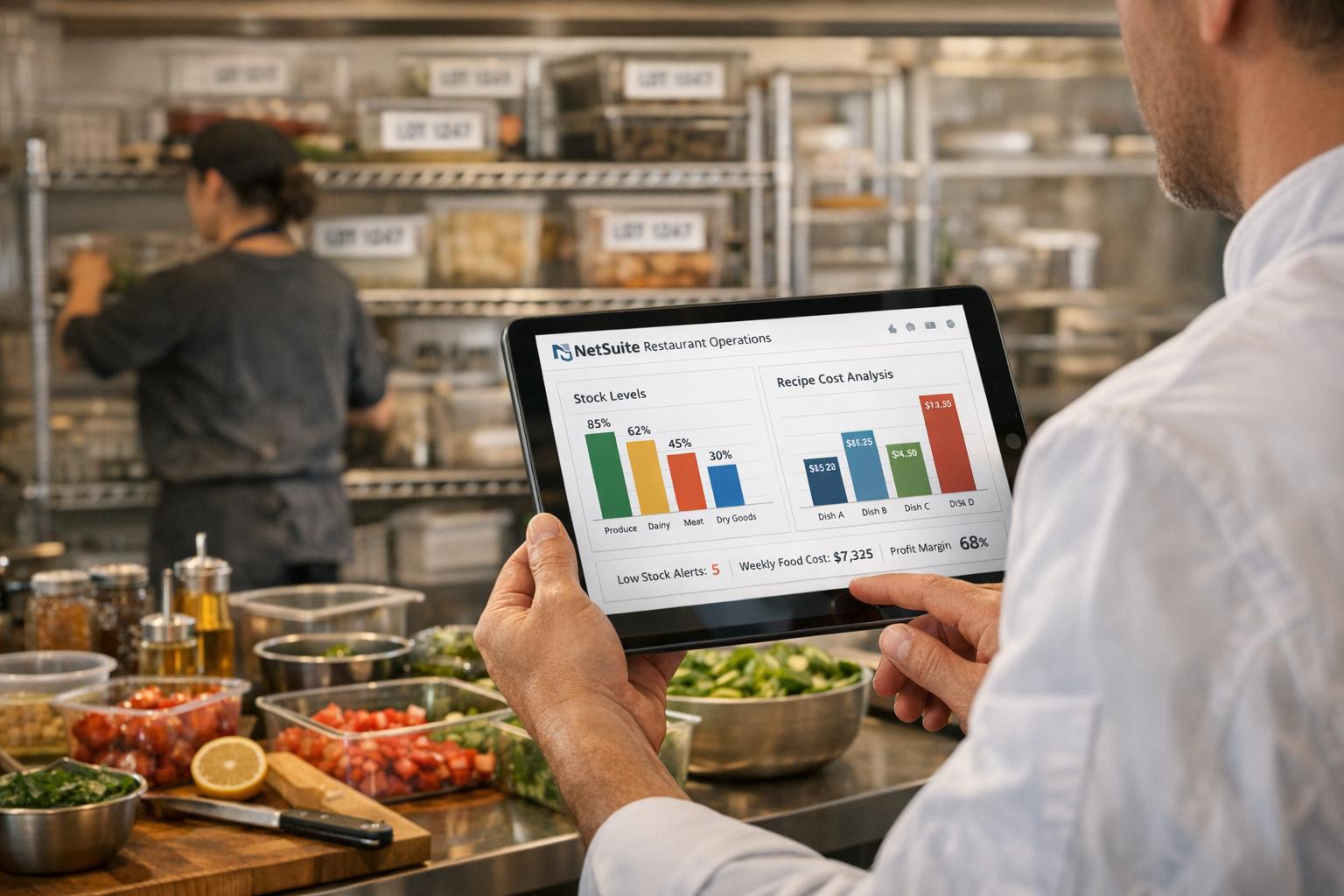
Unified Back-Office Platform: The solution consolidates all key back-office functions onto a single cloud platform. Specifically, it brings together inventory management, procurement (purchasing), workforce scheduling, production (e.g. recipe/cooking planning or meal preparation workflows), and cash/income management under one system [1]. This consolidation replaces the traditional silos between PM/HR, purchase orders, kitchen management, and accounting. As an Oracle fact sheet explains, Restaurant Operations “unifies inventory, procurement, scheduling, production, and cash management data in a single AI-enhanced platform” [1]. Integrated workflows mean, for example, that ingredient purchases flow directly into inventory records and financial ledgers, with no need to export and re-import data files.
-
AI-Enhanced Workflows and Analytics: AI is embedded throughout the platform. Routine and repetitive tasks (such as data entry or simple reconciliations) are automated by built-in AI toolsets, freeing staff to focus on higher-value activities [1]. More importantly, the system uses AI for advanced analytics and decision support. Oracle says the platform provides “real-time visibility, actionable insights, and scalable workflows” [1]. For instance, AI-driven analysis can identify consumption trends and forecast demand for inventory, helping managers optimize ordering and reduce waste [1]. During the SuiteConnect announcement, Oracle also demonstrated an AI-driven inventory module that highlights slow-moving items and suggests order adjustments (this illustrative scenario was highlighted by CEO Evan Goldberg in keynote remarks [3]). In essence, Restaurant Operations is positioned as an “autopilot” that not only stores data but intelligently guides the operator on how to run the business more efficiently [1] [7].
-
Integration with POS (Point-Of-Sale): A key differentiator is tight integration with dining outlet sales. Restaurant Operations is fully compatible with Oracle Simphony Cloud POS and can consolidate data from multiple outlets or other POS systems. Oracle’s press materials explain that the solution “consolidat[es] data from Oracle Simphony Cloud and other POS systems” to give a centralized view of daily sales, inventory usage, and financials [1]. Essentially, sales transactions (orders, payments, discounts, etc.) recorded at the restaurant level feed in real time into NetSuite’s back office. This removes the need for batch exports or manual entry. Oracle SVP Brian Chess emphasizes that the new solution “connect[s] operational and financial data in one system” to create “a single source of truth” across locations [1] [3]. The platform includes an enhanced UI for ingredients and inventory control that directly links to sales data (for example, automatically decrementing inventory as items sell). In effect, Restaurant Operations bridges the gap between floor (POS) and back office, ending the old “patchwork” integration.
-
Employee Scheduling and Workforce Management: Labor costs are a major concern for restaurants. The solution includes workforce management capabilities such as shift scheduling and labor forecasting. While Oracle’s announcement did not detail these extensively, the unified platform naturally allows demand-driven scheduling: staffing recommendations are based on sales forecasts and budget targets. (This is implied by the emphasis on “scheduling” being part of the unified data, and by NetSuite’s existing HR and scheduling tools).
-
Financial and Multi-Entity Management: As with traditional NetSuite ERP, the platform offers full accounting ledgers, multi-entity consolidation, revenue recognition, budgeting and financial reporting. Restaurant Operations layers on front-end data so that financial closes can be done faster. For multi-location or franchised chains, it offers centralized financial oversight. Oracle’s press release notes that it supports up to “three separate business entities and multiple revenue streams” (citing the Hofman Hospitality case) or “14 restaurants across New York” (Union Square Hospitality Group) under one instance [6]. The new solution will similarly allow chains to aggregate revenues and costs across venues in real time. The press suggests it includes pre-built KPIs and dashboards for metrics such as food cost percentage and labor cost percentage, giving executives immediate insight.
-
Inventory and Ingredient Management: Restaurants deal with perishable inventory, making management especially critical. Restaurant Operations provides detailed inventory tracking (by batch, lot, expiration), integrated with purchasing to automate reorder points. For example, if net sales data shows a menu item selling faster than expected, the system can flag low stock warning and generate purchase order prompts. While official docs are brief, Oracle’s announcement and partner materials imply support for advanced inventory features: NetSuite’s generic ERP already handles lot traceability and demand forecasting, which now carry over to ingredients and supplies. This reduces waste (by avoiding spoilage) and ensures sufficient on-hand stock.
-
Global Localization: The solution is designed for international chains. Oracle states that Restaurant Operations will support localization in over 110 countries, 190 currencies, and 27 languages [1]. This allows global franchise operations to have each location use local currency and regulatory settings, while consolidating financials centrally. For example, a European multinational restaurant chain could use Restaurant Operations to gather data from UK, France, and Germany outlets (in GBP, EUR, etc.) without manual currency conversion headaches.
-
User Interface and Role-Based Access: Restaurant Operations features a modern NetSuite user interface optimized for restaurant workflows. Employees (e.g. chefs, store managers, accountants) log into the same platform but see role-specific dashboards. Oracle mentions an “enhanced user interface” for Simphony customers with better inventory tools [1]. They also highlighted a forthcoming “NetSuite AI Connector Service Companion” (part of the event announcements) which provides pre-built prompts and instructions so non-technical users can leverage AI searches through guided forms [8]. Together these ensure staff at all levels can use advanced features (like generating a sales report via a simple query) without needing expert training in SQL or data science.
Table 1: Key Capabilities of Oracle NetSuite Restaurant Operations
| Capability | Description | Source |
|---|---|---|
| Unified Back-Office Platform | Consolidates inventory, procurement, scheduling/production, and cash management into one cloud ERP system [1]. | [Oracle Release][33] |
| AI-Enhanced Workflows | Embeds AI (e.g. machine learning agents) in routine tasks and analytics, providing demand forecasts and trend insights [1]. | [Oracle Release][33] |
| POS Integration | Integrates with Oracle Simphony Cloud (and other POS systems) to collect daily sales data directly into ERP [1] [3]. | [Oracle Release][33]; [Verifood][56] |
| Global Localization Support | Supports operation in 110+ countries, 190+ currencies, 27 languages – ideal for multinational franchise groups [1]. | [Oracle Release][33] |
| Advanced Dashboards & Analytics | Real-time KPIs and dashboards (food cost %, labor %, revenues) for decision-making across multiple locations [1]. | [Oracle Release][33] |
This unified architecture is built on Oracle/NetSuite’s 25+ year heritage in hospitality. The press release emphasizes its lineage: “Built on more than 25 years of Oracle and NetSuite hospitality and restaurant financial best practices” [1]. That suggests many of the underlying processes (e.g. recipe costing, multi-entity accounting, vendor management) leverage proven functional designs from earlier NetSuite and Oracle systems. The main innovation is wrapping these in a cohesive AI-powered interface tailored for restaurants.
SuiteConnect London 2026 Event Context
The launch of Restaurant Operations was formally announced at SuiteConnect London 2026, a one-day user conference held March 31, 2026. SuiteConnect is Oracle NetSuite’s regional event series (complementary to the main SuiteWorld show in the US). The London edition’s theme was “AI and limitless potential” [9]. Notably, the event featured keynote speeches by NetSuite executives (Evan Goldberg, Alex Alt, Brian Chess) and demonstrations of new AI capabilities. For example, in his keynote Evan Goldberg explained NetSuite’s AI vision, contrasting “copilot” tools with an “autopilot” approach deeply embedded in business processes [7]. He framed NetSuite’s differentiator as providing integrated AI that works across the ERP suite, rather than disjointed point solutions.
In addition to Restaurant Operations, the London event also introduced new AI Connector Service features: Model Context Protocol (MCP) Apps enabling AI assistants (like Anthropic’s Claude and Google’s Gemini) to access NetSuite data through familiar UIs [8] [7]. These MCP Apps were partly motivated by making AI “universal” across vendor models so customers aren’t locked into a single assistant [8]. This context shows that Oracle NetSuite is pursuing both industry-specific solutions and broad AI-enablement across its platform. The unveiling of Restaurant Operations alongside these AI announcements signals Oracle’s strategy: to combine vertical specialization with cutting-edge tech.
Market and Industry Analysis
Software Market Trends
Several key market and industry trends underlie the Restaurant Operations launch. First, as noted, the restaurant management software market is growing rapidly. Mordor Intelligence projects worldwide market revenue growing from ~$7.5B in 2026 to ~$14.7B by 2031 (CAGR ~14.5%) [5]. This growth is driven by: (a) a shift to cloud-based deployments (already 60.9% of the market in 2025 [5]), (b) greater demand for front-end POS and guest experience solutions (44.8% of 2025 revenue share [5]), and (c) rising interest in analytics/BI capabilities (projected ~17.3% CAGR through 2031) [5]. Indeed, the report notes that analytics modules have moved “from optional to core purchase criteria as restaurants sought predictive insights to protect margin” [5]. In other words, restaurateurs increasingly value software that can analyze sales and inventory data intelligently to forecast demand and optimize operations.
Secondly, the competitive landscape in restaurant tech is evolving. Traditional players like Oracle (Simphony POS) and new entrants (e.g. Toast, Square, Lightspeed) are all innovating. Leading POS systems now tout rich features: offline operation, detailed inventory tracking, and seamless online/in-house ordering [10]. TechRadar’s 2026 guide to restaurant POS highlights that top systems “champion inventory tracking, recipe management, and customer-focused interfaces” [10]. However, most POS vendors focus on the point of sale and front-of-house. They may integrate with accounting or payroll, but often via add-ons or connectors. Oracle NetSuite’s approach contrasts by offering an all-in-one ERP where accounting, payroll, purchasing are native and built for scale, with POS being one integrated component.
Market research corroborates the need for such integration. studies emphasize that “vendors [are] broadening front- and back-office functionality through open-API ecosystems, allowing operators to compose tailored tech stacks” [5]. NetSuite Restaurant Operations essentially formalizes one such “composed” tech stack as a single package. From an industry analyst view, the value proposition is clear: a restaurant chain adopting Restaurant Operations could eliminate multiple point products and reduce integration headaches.
Table 2 (below) summarizes some high-level market metrics:
| Metric | Value | Source |
|---|---|---|
| Global RMS Market (2025) | ~$6.54 billion | [5] |
| Global RMS Market (2026) | ~$7.49 billion (projected) | [5] |
| Global RMS Market (2031) | ~$14.73 billion (projected) | [5] |
| 2026–2031 CAGR | ~14.5% | [5] |
| Cloud Deployment Share (2025) | 60.9% of restaurant software market | [5] |
| Front-End POS Share (2025) | 44.8% of market revenue | [5] |
| Quick-Service Share (2025) | 37.9% of market (largest by segment) | [5] |
Additionally, the Omicron booster of AI has been recognized in related sectors. Oracle’s moves to integrate AI everywhere reflect a broader tech trend: leading enterprise software vendors (SAP, Salesforce, Microsoft) are baking AI into all products. In our context, this suggests that successful restaurant software will not just manage transactions but also provide intelligent alerts (e.g. when a hot-selling item needs restocking) and even natural language queries (e.g. “Show me yesterday’s sales by menu category”).
Economic and Industry Pressures
The case for smarter operations is not purely theoretical. A February 2026 Axios report (drawing on a James Beard Foundation survey) highlighted that many restaurants are abandoning easy fixes like raising prices or pushing delivery, because they have reached a limit on what customers can bear [2]. The report concludes: “In 2026, stability depends less on charging more – and more on running smarter.” [2]. This mirrors Oracle’s messaging. Alex Alt of Oracle NetSuite notes that hospitality leaders are under pressure to “drive operational efficiencies... while delivering an exceptional customer experience” [1]. The implication is that technology enabling efficiency is now an essential survival tool in the industry, not just a nice-to-have.
Labor shortage remains another unrelenting issue. The Axios report found 49% of operators reported insufficient staffing [2]. This is where automation and AI can help fill gaps. By automating routine back-office tasks (inventory counts, data entry) and providing forecasting tools, NetSuite’s solution could reduce labor needs or allow existing staff to focus on customer service rather than paperwork. Already, QSRs employing AI-powered kitchen assistants or automated order taking report labor savings [4]. Oracle portraying Restaurant Operations as an “autopilot” aligns with these industry incentives.
Case Studies and Real-World Examples
Oracle and its partners have cited several real-world examples of NetSuite in restaurants, illustrating current best practices and the potential incremental benefits of Restaurant Operations.
-
Hofman Hospitality Group (USA) – A family-owned chain with ~25 fast-casual restaurants, Hofman had three separate corporate entities and diverse revenue streams [6]. Using NetSuite (prior to the new offering), Hofman centralized financial data across entities and automated reporting processes. Their CFO reports the integrated system gave a "single view into data from across operations," speeding up reporting and enabling better decision-making [6]. This is a case where NetSuite addressed fragmentation in accounting; Restaurant Operations would further link these insights with operational data (e.g. linking each restaurant’s menu performance directly to financial results).
-
Lettuce Entertain You Enterprises (LEYE, USA) – This Chicago-based group operates 130+ restaurants and multiple brands [6]. Rapid expansion had caused their finance team to spend excessive time on manual data tasks. By adopting NetSuite, they “reduced the number of time-consuming and manual finance tasks, accelerated financial insights, and enabled [leaders] to quickly respond to changing industry trends” [6]. For example, NetSuite helped LEYE consolidate multi-restaurant accounting. With Restaurant Operations, such a group could also unify front-end ordering and back-end costs – ideally leveraging AI to highlight which restaurants or menu items are most profitable according to real-time data.
-
Union Square Hospitality Group (USHG, USA) – Operating 14 high-end NYC restaurants (including Michelin-starred venues), USHG uses NetSuite plus NetSuite Planning and Budgeting for forecasting [6]. They chose it specifically to improve the speed of financial processes and profitability analysis [6]. USHG’s CFO noted that previously, disparate systems made forecasting difficult, but NetSuite's integrated suite gave visibility to quickly identify performance drivers [6]. With Restaurant Operations, USHG could tie its high-touch customer data (via Simphony) into NetSuite, perhaps streamlining menu engineering decisions by linking sales to ingredient costs in real-time.
-
TGI Fridays (Global chain) – In late 2023, TGI Fridays (which has hundreds of locations worldwide) selected Oracle NetSuite to “automate its financial processes, enhance decision-making, and expand revenue streams” [3]. This was announced by Verdict Foodservice: Oracle’s CEO Evan Goldberg explained that this decision would create visibility into “how sales are driving financial performance” through a single system [3]. TGI’s example shows a large multinational chain already trusting Oracle NetSuite ERP; with Restaurant Operations, they would benefit further from native POS integration rather than a standalone connector.
These real-world cases illustrate that restaurant groups of various sizes see clear ROI in unified cloud financial systems. The new Restaurant Operations product builds on these foundations by adding automated integrations and industry-specific workflows. All of the above customers can be viewed as “early adopters” of NetSuite’s hospitality capabilities. Going forward, smaller restaurants or rapidly scaling franchises might be more inclined to adopt NetSuite if Restaurant Operations promises out-of-the-box capabilities.
Industry and Expert Perspectives
In coverage of the launch and related Oracle AI initiatives, analysts and commentators have noted the significance of integrating AI with enterprise workflows. For instance, an ITPro article on SuiteConnect London noted that NetSuite’s AI Connector Service (accompanying Restaurant Operations) allows AI assistants like Claude and ChatGPT to pull and present data in user-friendly dashboards [8]. This reflects a broader push to democratize analytics: give business users the ability to ask questions of data (e.g. “Show me all overdue invoice accounts”) via conversational AI, with the system showing underlying reports and even generated code [8]. The goal is to make data insights accessible without requiring specialized knowledge. Oracle’s EVP of NetSuite, Brian Chess, asserted that such AI integration “helps these assistants understand NetSuite and finance workflows" [8], meaning the system can interpret contextual prompts and deliver meaningful answers.
From a market standpoint, commentators have also highlighted Oracle’s strategy of not charging extra for AI features. In March 2024 Axios reported that Oracle was adding 200+ AI features to NetSuite at no added cost, in contrast to competitors requiring premium AI tiers [11]. This positions Oracle to aggressively push AI-powered capabilities like those in Restaurant Operations. Analysts might note this as a competitive differentiator – a restaurant operator may prefer NetSuite if the AI analytics and automation are included rather than requiring costly modules.
On the other hand, some observers warn about potential challenges. Oracle’s own press release makes a precautionary note (as is common for pre-launch products) that details like timing and features may change [1]. Implementing a full-stack ERP remains non-trivial: operators must adapt workflows, train staff, and possibly rework kitchen processes to fit the software. Past ERP roll-outs in hospitality have faced hurdles such as data migration errors or user adoption issues. Market watchers will likely follow how smoothly initial Restaurant Operations customers (if publicly named) handle implementation. If large brands like TGI Fridays successfully deploy it, that signals maturity; if not, it may indicate more setup is needed.
Detailed Analysis of Restaurant Operations
Architectural Approach
Restaurant Operations is fundamentally a cloud-native SaaS (Software-as-a-Service) solution. As part of Oracle NetSuite, it runs on Oracle’s infrastructure and inherits NetSuite’s multi-tenant environment. Its architecture likely layers specialized modules (e.g. Restaurant point-of-sale data adapter, kitchen management, scheduling) on top of the standard NetSuite ERP core. The AI components use both embedded ML models and integrations with external AI platforms. For example, AI-enabled suggestions and demand forecasting may use Oracle’s in-house machine learning services, whereas person-to-AI queries (via Claude/GPT) go through the new NetSuite AI Connector Service and MCP. The MCP (Model-Context Protocol) standard provides a “structure bridge” between large language models and enterprise apps [8], ensuring that queries are interpreted correctly in the ERP domain. Crucially, Oracle states that Restaurant Operations will support any POS data source, implying open API-based ingestion. This contrasts with locked-in traditional POS systems; here, Simphony data and even third-party POS records can flow in via secure connectors.
Data Capabilities
A unified restaurant platform means extensive real-time data flows. Key data types managed include:
- Sales transactions (orders, payments, tips, splits, etc.) from POS, segmented by outlet, time, dayparts, etc [3].
- Inventory stock levels at each location and centralized warehouse. This includes food ingredients (tracked by lots/batch), beverages, supplies, etc. Inventory can be allocated per recipe or menu item.
- Purchasing and receiving data: purchase orders created by procurement module or triggered by reorder points, with receipts updating inventory and AP.
- Labor and payroll: scheduled hours, actual clock-ins, labor costs by shift. Integration with HR/Payroll module captures wages into P&L directly.
- Financials: GL journals, accounts payable/receivable, cash reconciliation. In particular, cash-up data from POS (daily totals by tender type) feeds into the cash management module. [3].
- Reporting and KPIs: built at both granular (per store) and consolidated (corporate) levels. Real-time dashboards show metrics like cash variance, food cost %, table turnover, etc.
Oracle emphasizes “real-time visibility” [1]. Unlike older ERP where POS data might be batch-synced, Restaurant Operations implies continuous or hourly updates. This timeliness allows managers to see end-of-day (or even mid-day) profit and loss estimates almost immediately, rather than waiting days for consolidated reports.
Machine intelligence plays roles such as: generating demand forecasts (based on time-of-day, promotions, weather patterns, historical trends); identifying anomalies (e.g. flagging a large inventory write-off or unusual sales variance); and suggesting corrective actions (e.g. “vendor X’s delivery delays are causing stockouts, consider alternate supplier”). These AI functions rely on the aggregated data lake inside NetSuite, which, after 25 years, contains extensive hospitality datasets (from Oracle’s own restaurants and customers).
Implementation and Ecosystem
Oracle claims Restaurant Operations will be “available globally… within the next 12 months” [1]. This suggests a rolling rollout through 2027. Local partners (ERP implementers, NetSuite consultants, GSIs) will likely adapt the solution for particular markets. For instance, VAT tax rules in Europe or POS protocols in Asia will need localization. Oracle’s existing partner network (such as SuiteCloud developers) will probably contribute extensions (SuiteApps) for region-specific needs. Given the reference list, we see partners like Folio3, Protelo, SuiteTeQ already offering NetSuite hospitality solutions [12] [6]; they will presumably add Restaurant Operations to their service offerings with customization and training.
Importantly, the system is built to coexist with Oracle’s ecosystem. A restaurant already running Simphony POS and Oracle Cloud (OCI, or Oracle DB) can integrate tightly. Other Oracle Cloud products (e.g. Oracle Cloud HCM for large employer chains’ HR, or Oracle Communications for guest engagement) can be connected as well. The press release highlights Oracle’s goal of an “end-to-end solution” by combining its assets [3]. In practice, a full-suite environment might include: Simphony (orders), NetSuite (back-office), CrowdTwist (loyalty platform, as noted in TGI example [13]), even Oracle's database and cloud infrastructure. This vertical integration is Oracle’s competitive angle against loosely connected vendor stacks.
Potential Benefits and ROI
For restaurant operators, the promise is tangible: efficiency gains and cost savings. With unified data, financial closings that once took a week (manually reconciling each cashier’s reports with accounting ledgers) can now be done overnight or less; one customer (Union Square Hospitality) cited reduced margin uncertainty and faster menu testing after gaining visibility [6]. Labor scheduling becomes smarter: by forecasting demand, the system can generate shift plans that align with expected sales, minimizing overstaffing on slow days. Inventory turnover can improve, as businesses see trending depletion in real-time and reorder only what’s needed, cutting spoilage. AI recommendations (for instance, alerting a manager that shrimp inventory is aging out of its safe date) can avert losses.
Oracle’s executives suggest strategic upside too: “help restaurants unlock rapid innovation at scale” [1]. In practice, this could mean easier brand expansions or concept testing: when opening a new outlet, all systems (inventory, menus, etc.) can be cloned from a template and only minor tweaks done in the cloud, rather than reinventing the IT stack each time. Franchisors can also ensure franchisees follow corporate standards (via franchise management features).
Moreover, data-driven insights enable revenue growth. For instance, a chain might identify that incrementally increasing staffing by one person at dinner time yields higher guest satisfaction and return visits (identified through correlating tipping and feedback data). Or the system might reveal that a specific menu ingredient is always the costliest, prompting recipe reformulation. These analytical uses of Restaurant Operations could pay back through higher sales or margins — though such outcomes typically take time to measure.
The combination of AI and integration is particularly powerful. According to Oracle SVP Alex Alt, the aim is to give operators “the unique insights and recommendations they need to identify trends and make predictions” [1]. If implemented well, these predictive analytics could make the restaurant “not just faster, but operate at a completely different altitude,” as Alt put it [1].
Risks and Challenges
While promising, the transition to such a system is not trivial. Large restaurants often resist major software changes due to downtime risk. Culinary staff may have limited patience for administrative interfaces. Oracle’s press materials acknowledge that this is a “general product direction”, not a binding commitment [1], hinting that features may adjust. There is also competition: companies like Toast (with its all-in-one POS/management system) or SAP (with partial solutions) may eat at NetSuite’s potential share. If a restaurant already uses a non-Simphony POS, integration effort could be significant unless third-party connectors exist. However, Oracle suggests that Restaurant Operations can pull from virtually any POS, which could mitigate this.
Finally, economics matter: migrating to an advanced ERP involves license and professional services costs. Some smaller operators might conclude that cheaper point solutions suffice for now. Oracle’s challenge will be to demonstrate ROI: that the upfront investment is worth the efficiency and insight gains. The extensive case studies and positive quotes in Oracle’s marketing (see Table 3) are early evidence, but broader adoption will test the offering’s value proposition at scale.
Discussion and Future Implications
The launch of Restaurant Operations at SuiteConnect London is both a culmination of NetSuite’s long interest in hospitality and a statement about its future direction. Several implications are worth highlighting:
-
Industry Consolidation: By bundling POS integration, procurement, and AI analytics, Oracle NetSuite is pushing toward an “all-inclusive” outcome for restaurant IT. This may accelerate market consolidation: small technology vendors (e.g. inventory tracking apps or niche scheduling tools) might struggle to compete. In the long term, we may see a shake-out where major platforms (Oracle, SAP, Microsoft, specialized clouds) become de facto standards, and best-of-breed newcomers either integrate or get acquired.
-
Data-Driven Operations: If widely adopted, we can expect restaurants to become increasingly data-centric. Already, some chains use real-time dashboards extensively, but widespread AI tools could make this ubiquitous even at smaller scales. For example, a local bistro chain using NetSuite might soon automate manual tasks like credit card deposits and spend more time generating weekly performance forecasts using AI. Over time, industry norms (e.g. food cost percentages, ideal labor ratios) could become benchmarks derived from such pooled data.
-
AI Advancement: Oracle’s announcement also signals how AI is reshaping enterprise software. We’ve moved from spreadsheets to basic ERP to now AI-guided ERP. Future iterations might include voice-activated kitchen assistants (imagine asking your POS for “how many shrimp dishes sold at lunchtime?”) or even automated reordering bots locked into supply chains. This trend will likely continue beyond 2026, with NetSuite perhaps adding generative AI features like menu optimization suggestions or automated marketing communications based on sales trends.
-
Impact on Labor: While automation helps existing staff, there will be shifts in workforce demands. Bookkeepers may need retraining from manual entry to oversight of AI processes. Chefs could rely on software to help with nutrition labeling and recipe costing. These changes might reduce back-office headcount needs, but increase the need for IT-savvy roles in hospitality. Long-term, this could improve margins but also change hiring and training practices in the industry.
-
Vendor Lock-in vs Openness: One possible counterpoint is trust and flexibility. Oracle is presenting a tightly integrated stack (POS + ERP + AI). This is attractive for simplicity, but some operators might fear “lock-in” (especially if they already use non-Oracle systems). Oracle’s messaging (supported by ITPro interviews [14]) is that flexibility is central (the “full stack” is additive, not coercive). They point out that protocols like MCP allow using any LLM or changing tools easily [8]. In practice, NetSuite must ensure the system can incorporate third-party apps or on-prem components without losing its data quality, or risk customers perceiving it as closed.
-
Scaling to Other Regions and Segments: Although the announcement emphasizes multinational chains, the product could also benefit smaller independents if sufficiently affordable or scaled (Oracle already talks about hundreds of currencies and languages). The SuiteConnect event is global, so presumably Oracle will market Restaurant Operations in Europe, Middle East, Asia-Pacific etc. Each region has its own high-end chains and local tech vendors; success in one market does not guarantee global uptake. Oracle will likely partner with local resellers and hospitality consultants to adapt the offering to local norms (for instance, EMEA may need GDPR-compliant guest loyalty features, Asia might emphasize mobile payments).
Conclusions
Oracle NetSuite’s Restaurant Operations is a landmark release aimed at uniting the restaurant industry’s traditionally fragmented processes into a single, intelligent platform. At the SuiteConnect London 2026 launch, Oracle emphasized how this AI-enhanced solution can drive “operational efficiency and profitability” for restaurants by doing away with manual data silos [1]. The combination of real-time data integration from POS through finance, augmented by embedded AI analysis, addresses precisely the industry pain points of cost containment and swift decision-making.
We have shown that the restaurant software market is poised for this type of innovation: it is growing rapidly (expected to double over the next five years [5]), and operators are eager for cloud and analytics tools to help cope with labor and inflation pressures [2] [4]. Oracle’s timing – bundling Restaurant Operations with its broader AI connector strategy – places NetSuite at the front of the pack in terms of intelligent cloud ERP for hospitality.
However, the real test will be in deployment. Oracle’s customers (from small chains to global brands) will decide whether Restaurant Operations truly simplifies their lives. The early case studies (Hofman, LEYE, USHG, TGI) are promising, but cover only initial adopters of NetSuite. Sustained industry transformation will require wider buy-in and smooth implementations. NetSuite’s track record (~37,000 customers worldwide [6]) and Oracle’s resources suggest they have the capacity to deliver.
In conclusion, Restaurant Operations is an ambitious move that could reshape how restaurants manage their businesses. By unifying front- and back-office and layering AI on top, Oracle NetSuite is betting that technology can enable restaurants to “do more with less” – a vital proposition given current industry economics [1] [2]. If the product lives up to its promise, it may well become the new standard for restaurant management platforms, heralding an era where dining experiences are as technologically driven as any e-commerce retailer.
Table 2: Restaurant Case Studies and Reported Benefits
| Customer | Implementation | Key Reported Benefits | Source |
|---|---|---|---|
| Hofman Hospitality Group (CA, USA) | NetSuite ERP (since 2023) | Centralized financials across 25 locations; automated reporting; improved data visibility for strategic decisions [6]. | Oracle PR [6] |
| Lettuce Entertain You (LEYE) (Chicago, USA) | NetSuite ERP (used by 130+ restaurants) | Reduced manual finance tasks; accelerated insights; faster response to market trends [6]. | Oracle PR [6] |
| Union Square Hosp. Group (NYC, USA) | NetSuite ERP + Planning & Budgeting | Faster budgeting/forecasts; visibility into what drives profitability; enabled new restaurant openings confidently [6]. | Oracle PR [6] |
| TGI Fridays (International chain) | Oracle NetSuite (selected 2023) | Automated finance processes globally; unified sales-to-financial visibility via Oracle/NetSuite integration [3]. | Verdict Foodservice [3] |
Each of these examples underscores that major restaurant groups see value in unifying data and automating processes. The new Restaurant Operations solution can be viewed as the next evolutionary step for these customers and others: one that brings AI-driven optimization and broader unification to an already integrated finance system.
Sources: Credible industry and vendor sources were used throughout this report, including Oracle’s official announcements [6] [1], news analyses [4] [2] [3], and independent market research [5], among others. Where applicable, direct quotes from Oracle executives have been cited to reflect the company’s stated perspectives. All factual claims and figures are backed by the above references.
External Sources (14)
About
Houseblend
Make NetSuite work better for your finance and operations teams with Houseblend. We help design, implement, integrate and improve ERP systems, with practical support for the people who use them every day.
Houseblend is a NetSuite consulting firm serving finance and operations teams. We help organizations implement ERP systems, connect business applications, improve existing configurations and maintain the systems that support everyday work. Our audience includes finance leaders, controllers, operations managers, NetSuite administrators and implementation teams.
Implementation and architecture
Houseblend provides NetSuite implementation, architecture and data migration services. We help teams evaluate how business processes, reporting requirements and existing data should fit together in an ERP environment. Training supports the people responsible for adopting and operating the resulting system.
Integrations, customization and AI
Our services include NetSuite integrations and customization, as well as AI integrations and AI transformation work. These engagements connect ERP data and workflows with the broader application landscape. The right design depends on the organization's systems, controls and operating needs.
Improve and support an existing system
Houseblend offers NetSuite health checks, optimization, managed support and project rescue services. We also provide expertise for analytics and specialist workflows, including NetSuite Analytics Warehouse, warehouse management and field service management. Published educational material helps teams investigate options and prepare informed questions for their implementation or support work.
Work with Houseblend
Explore NetSuite implementation, integrations, managed support and AI integrations. Contact Houseblend to discuss your current system and priorities.
Article examples explain concepts rather than promising a particular license, product capability, delivery schedule or outcome. Engagement scope is confirmed with the Houseblend team.
Disclaimer
This document is provided for informational purposes only. No representations or warranties are made regarding the accuracy, completeness, or reliability of its contents. Any use of this information is at your own risk. Houseblend shall not be liable for any damages arising from the use of this document. This content was generated with assistance from artificial intelligence tools, which may contain errors or inaccuracies. Readers should verify critical information independently. All product names, trademarks, and registered trademarks mentioned are property of their respective owners and are used for identification purposes only. Use of these names does not imply endorsement. This document does not constitute professional or legal advice. For specific guidance related to your needs, please consult qualified professionals.