Houseblend Article
NetSuite for SaaS: Subscription Billing & ASC 606 Guide
Inside this article
Executive Summary
In the rapidly evolving Software-as-a-Service (SaaS) sector, finance teams face unique challenges in subscription billing, revenue recognition, and financial operations. New accounting standards (IFRS 15/ASC 606) and sophisticated pricing models have made manual finance processes and spreadsheets untenable beyond the startup stage [1] [2]. This report examines how Oracle NetSuite addresses these challenges through integrated modules for billing, revenue management, and reporting. NetSuite combines subscription-aware billing ( SuiteBilling with Automated Revenue Recognition ( Advanced Revenue Management, or ARM and unified analytics on a single cloud ERP. The platform’s unified data model means that sales, billing, invoicing, and revenue schedules all reference the same records, dramatically reducing reconciliation work [3] [4]. Major SaaS companies (e.g. Zendesk, Canva) have leveraged NetSuite OneWorld to scale globally with consolidated financial close, rather than disparate regional systems [5] [6].
We provide a deep dive into SaaS billing models, IFRS/ASC 606 requirements, and NetSuite’s specialized features. We compare NetSuite’s SuiteBilling to standalone billing tools, highlighting that fully native integration avoids data sync errors [4] [7]. We detail NetSuite’s revenue recognition engine (ARM), which automates the five-step ASC 606 model (unallocating bundles by stand-alone selling price) [8] [9], and supports multi-entity consolidation via OneWorld and multi-book parallel accounting [10] [9]. We present case examples: for instance, Zendesk replaced disparate finance apps with NetSuite OneWorld to achieve real-time global consolidation ahead of its IPO [11] [12]. Cutting-edge developments (e.g. AI-driven forecasting and built-in SaaS metrics dashboards) are also covered. Throughout, we cite surveys and expert analyses to quantify impacts (e.g. first-year NetSuite investment ~$150–280K for a 30–50 person SaaS [13], 77% of Cloud-100 SaaS firms use NetSuite [14]). In sum, this report shows that NetSuite provides a comprehensive, scalable finance solution for fast-growing SaaS businesses, now bolstered by AI-powered insights and unified ERP data.
Introduction and Background
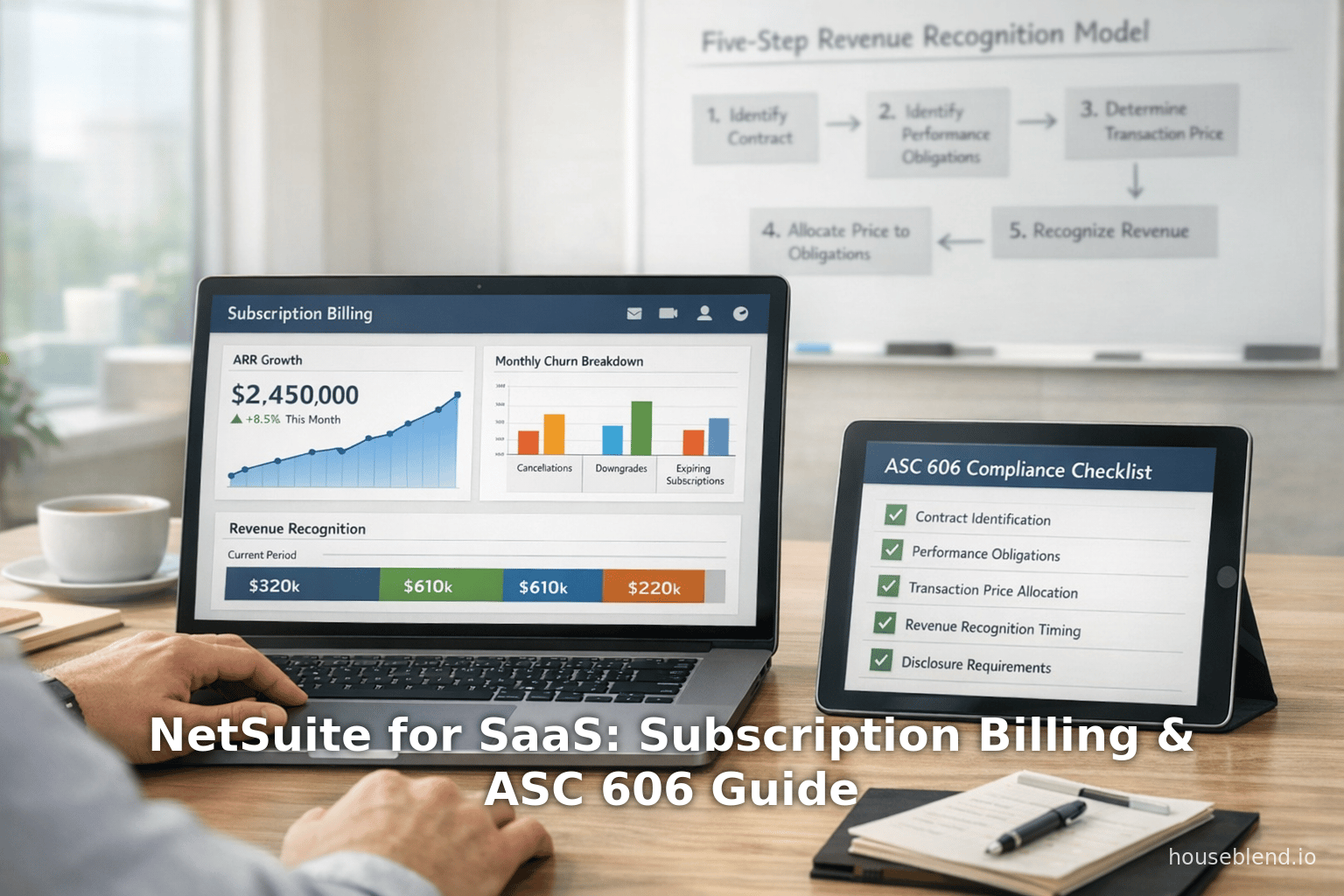
The subscription-based SaaS business model emphasizes steady, recurring revenues from contracts that may include usage fees, service bundles, and renewals. Unlike perpetual-license software, SaaS revenue must often be unbundled and recognized over time, in accordance with global standards. Since 2018–2019, US GAAP (ASC 606) and IFRS (IFRS 15) require uniform five-step revenue recognition: (1) identify the contract; (2) identify performance obligations; (3) determine the transaction price; (4) allocate price to obligations; and (5) recognize as each obligation is satisfied [1] [2]. For SaaS firms, this means setup fees, subscription fees, usage fees, and service charges must be carefully allocated over the subscription term [1] [8]. In practice, this often results in more complex, slower revenue schedules, with fewer large jam-up in early recognition. Implementing ASC 606 manually (e.g. with spreadsheets) is famously painful: by some accounts, a SaaS controller might spend weeks each quarter reconciling a 47-tab spreadsheet to close the books [2].
Simultaneously, SaaS CFOs and boards demand real-time visibility into key metrics (MRR/ARR growth, churn, LTV, etc.) to guide funding and strategy. Delays from manual processes hurt decision-making. As one industry advisor notes, companies often manage recurring revenue for years with ad hoc tools until they hit ~$5–15 M in ARR; at that point investor and board reporting requirements – for metrics and ASC 606 disclosure – break spreadsheets and trigger ERP adoption [2]. NetSuite has become the de facto cloud ERP for mid-market SaaS firms in part because it directly addresses these pain points: it unifies subscription billing, ASC 606 revenue recognition, and SaaS metrics in one platform [3] [13]. Oracle reports that “77% of the Forbes Cloud 100” software companies (i.e. large, high-growth SaaS incumbents) rely on NetSuite to scale their finance operations [14], reflecting broad industry endorsement.
NetSuite’s architecture suits SaaS growth: it is a multi-tenant cloud ERP (no on-prem servers or manual patching) that scales as the business grows internationally [15]. New modules can be added as needed, and user permissions or processes automated via SuiteFlow workflows. Critically, because NetSuite natively integrates sales orders to billing, to invoicing, to revenue arrangements, finance teams avoid “swivel-chair” reconciliations between disconnected systems [3] [4]. This report analyzes NetSuite’s specialized functionality in detail. We cover SuiteBilling (subscription invoicing), Advanced Revenue Management (ASC 606/IFRS 15 compliance), OneWorld (multi-entity consolidation), and supporting analytics (SaaS dashboarding), among other features. We also examine implementation and cost considerations, review real-world case outcomes, and discuss future directions (e.g. AI and analytics). Our aim is to provide an authoritative reference for SaaS CFOs and finance leaders considering NetSuite as their billing and ERP platform.
NetSuite Platform Overview
Cloud ERP and Modules. Oracle NetSuite is a comprehensive, cloud-native ERP platform that offers modules covering financials, CRM, ecommerce (SuiteCommerce), analytics, and more. For SaaS companies, key modules include SuiteBilling, Advanced Revenue Management (ARM), OneWorld (global consolidation), and SuiteAnalytics/Reporting. Because NetSuite is multi-tenant, updates and new features (including security patches and new releases) roll out automatically to all customers, ensuring consistency and scalability [15] [14]. As one NetSuite partner blog notes, “NetSuite is a true-cloud, multi-tenant ERP … As your customer base grows or you expand internationally, NetSuite scales seamlessly without requiring disruptive system changes” [15]. This architecture is ideal for SaaS firms anticipating rapid growth or geographical expansion.
-
SuiteBilling (Subscription Management). NetSuite’s native subscription management module handles the full lifecycle of recurring billing. It automates creation of billing schedules when new subscriptions are sold, calculates prorations for mid-term upgrades/downgrades, applies renewals with updated pricing, and issues invoices automatically [16]. SuiteBilling supports flat-rate, tiered, and usage-based pricing models natively, so SaaS companies can capture a wide variety of offerings [7]. Being fully integrated, SuiteBilling eliminates the need for data handoffs: invoices and billing events feed directly into the Financials module without separate reconciliation. (By contrast, using an external billing platform would require syncing every subscription change back to NetSuite, which adds complexity and cutover risk [4].) A comparison guide observes that SuiteBilling’s tight integration means “no external connectors required” and no separate data sync, vastly simplifying ASC 606 compliance and accounting reconciliation [7]. In short, SuiteBilling provides an out-of-the-box subscription engine inside the ERP.
-
Advanced Revenue Management (ARM). For revenue recognition, NetSuite offers ARM in two editions (Essentials and Revenue Allocation). ARM automates the new five-step revenue recognition process. Finance teams define performance obligations (revenue elements) on each sale, configure fair-value prices (SSP), and select recognition methods (straight-line, milestones, usage- or percentage-based). When a deal is closed, ARM allocates the total price to each obligation and generates detailed revenue recognition schedules and journal entries [8] [9]. For example, an annual software license might be recognized ratably over 12 months, while a consulting service is recognized upon delivery, and support is recognized ratably over its term [8]. Crucially, ARM lives in the ERP, so it can automatically trigger on billing invoices, project milestones, or other events, ensuring the recognition matches real business events. This yields audit-ready revenue schedules without external spreadsheets. ARM also supports IFRS 15 (the international standard) in the same way as ASC 606, so the same setup can serve dual-GAAP needs.
-
Global Financials (OneWorld & Multi-Book). Many SaaS companies expand across borders. NetSuite OneWorld enables multi-subsidiary and multi-currency accounting in one instance [10]. For example, global SaaS leader Zendesk used OneWorld to roll out a standardized chart of accounts and close process across 150+ countries [11]. Each subsidiary runs local books in its currency, with rules to handle intercompany eliminations and foreign exchange. Real-time consolidation in OneWorld means finance sees unified financials immediately, rather than waiting weeks of manual aggregation. In addition, NetSuite’s Multi-Book Accounting lets firms keep parallel ledgers for different accounting standards. A global SaaS group can maintain one book on ASC 606 and another on, say, local statutory GAAP or IFRS 15 [9]. ARM will post entries into all relevant books in tandem, ensuring detailed compliance in each standard [9].
-
Analytics and Reporting. NetSuite’s SuiteAnalytics and customizable dashboards turn all this data into actionable insights. Because subscriptions, invoices, and recognition schedules are unified in the system, SaaS metrics (MRR/ARR, churn, LTV, bookings, deferred revenue, etc.) can be computed directly. Oracle’s new Subscription Metrics solution exemplifies this: it delivers pre-built dashboards showing drillable MRR/ARR transitions, retention metrics, CAC payback, and more [17]. Partners note that finance teams can use SuiteAnalytics to build graphical dashboards of MRR, ARR, churn, and cash flow momentum [18] [19]. These tools help accelerate month-end closes (since key metrics auto-update) and support real-time forecasting and board reporting. In practice, customers report much faster closes and “audit-ready” financials after NetSuite; for example, one manufacturing case cut its close from 20 days to 3 days [20].
Together, these modules mean FinOps for SaaS are centralized in one platform. A summary of these capabilities is shown below:
| Module/Feature | Primary Function | SaaS-Relevant Capabilities |
|---|---|---|
| SuiteBilling (Subscription Engine) | Automate recurring/subscription invoicing | Creates billing schedules from contracts; handles proration on upgrades/downgrades; supports flat, tiered, usage pricing [16] [7]. Native ERP integration avoids separate sync. |
| Advanced Revenue Management (ARM) | Compliant revenue recognition (ASC 606/IFRS 15) | Allocates total contract price to performance obligations, applies recognition rules (straight-line, usage, milestones), and auto-generates journal entries [8] [9]. Supports multi-period revenue deferral. |
| OneWorld (Global Financials) | Multi-entity, multi-currency accounting | Manages subsidiaries in different countries; handles multi-currency transactions, intercompany, and real-time consolidation [10] [11]. Enables unified financial reporting for global SaaS enterprises. |
| Multi-Book Accounting | Parallel ledgers for different accounting standards | Maintains separate books (e.g. US GAAP, IFRS, local statutes) simultaneously. ARM can post to all books, ensuring ASC 606/IFRS 15 compliance in each [9]. Ideal for dual-reporting requirements. |
| SuiteAnalytics / Dashboards | Reporting, analytics, KPI tracking | Real-time dashboards for SaaS metrics (MRR, ARR, churn, CAC, LTV, etc.) [17] [21]. Drillable roll-forwards of MRR/ARR; multi-dimensional filters (customer, location, segment). Enables faster close and investor reporting. |
Table 1: Key NetSuite ERP modules/features for SaaS billing and finance. Citations indicate documented capabilities.
Subscription Billing in SaaS
Recurring Revenue Models. SaaS billing is more complex than one-time sales. Companies often have multiple pricing plans (monthly/annual contracts, usage tiers, seat counts, addons, etc.) that change over time. Handling prorated upgrades, downgrades, mid-term amendments and renewals manually is error-prone and costly. SuiteBilling addresses this by keeping all subscription logic in NetSuite. For example, when a customer upgrades mid-term, SuiteBilling automatically prorates the unused portion of the old contract and creates a pro-rated invoice for the upgrade [22]. If a customer downgrades or cancels, future invoices adjust accordingly. At renewal, SuiteBilling rolls the subscription forward with the correct updated price and term.
Avoiding Integration Overhead. An alternative to SuiteBilling is to use a specialized billing platform (Zuora, Chargebee, etc.) and integrate it to NetSuite. These tools may offer advanced models (fine-grained usage pricing, very high-volume metering), but require a bi-directional data sync. Every contract change, invoice, and payment must be exchanged between systems, multiplying integration points. As one consultant explains, using a separate billing system means “every subscription change needs to sync. Every invoice needs to reconcile. Every revenue event needs to translate between systems. It works, but it’s another moving part that can break.” [4]. By contrast, SuiteBilling is built-in, so all invoice and subscription data already resides in NetSuite. One partner points out that with SuiteBilling there is “no separate system or data sync needed” [7]. This simplifies accounting and eliminates timing mismatches between billing and revenue recognition.
Capabilities and Limitations. SuiteBilling supports common B2B SaaS patterns: flat-periodic plans, volume or tiered usage, support contracts, and one-off fees. It automatically enforces pricing and contract terms (dates, term length) and creates billing schedules accordingly. According to analysis by NetSuite practitioners, SuiteBilling “is generally well-suited for businesses with straightforward, predictable subscription models and moderate transactional volumes” [7]. For most B2B SaaS companies (hundreds to thousands of customers), SuiteBilling handles billing reliably and significantly reduces manual work. It also ties directly into Advanced Revenue Management, so recognized revenue flows seamlessly from the contract line.
However, SuiteBilling has some known limitations. Experts caution that very complex or high-volume usage-based models may strain it. For example, SuiteBilling “requires pre-processed usage data (no built-in usage data transformation)” and has a rigid change-handling process [23]. In other words, if a model involves extremely granular usage metrics updated daily, companies often still integrate a specialized platform and simply push summarized amounts into NetSuite for invoicing and recognition. Large B2C SaaS (millions of micro-transactions) typically run billing outside of ERP and use Stripe or a similar system. But for mid-market SaaS companies with complex subscription needs yet not unmanageable volumes, SuiteBilling’s integration trade-off is often worth it. (See Table 2 below for a comparison of SuiteBilling vs. third-party billing tools.)
Comparison: SuiteBilling vs. External Billing Tools. Industry analyses highlight the trade-offs (Table 2). SuiteBilling’s strengths are its full native integration, out-of-box support for tiered/usage models, and seamless link to NetSuite’s ARM module for ASC 606 compliance [7]. This means invoices and revenue recognition share the same data, eliminating dual-entry and reconciliation. In contrast, third-party billing systems (Zuora, Chargebee, etc.) typically offer more sophisticated pricing flexibility and can handle very high transaction volumes, but they must be connected via middleware to NetSuite’s GL. Such integrations add complexity, latency, and potential errors [4] [24]. For example, Zuora itself provides a “NetSuite Connector” to sync revenue entries between Zuora and NetSuite [24]. While this can be made robust, it requires more implementation effort and management. In practice, many SaaS firms initially use bundled ERP billing (SuiteBilling) during growth phases, and only consider separate platforms when their pricing requirements exceed the built-in model and they are prepared for the integration effort.
| Feature / Aspect | NetSuite SuiteBilling | Third-Party Billing (Zuora/Chargebee, etc.) |
|---|---|---|
| ERP Integration | Fully embedded in NetSuite; all billing data stays in the ERP [7]. No need for separate connectors or matching. | Requires an external system. Must integrate subscriptions, invoices, and payments back to NetSuite (via middleware) [4] [24]. |
| Supported Pricing Models | Supports flat-rate, tiered, usage, one-time fees out-of-the-box [7]. Handles upgrades/downgrades with automatic proration [16]. | Typically supports very complex usage/event billing (time-based usage, multi-dimensional metering). Usually more flexible for complex bundles. |
| Revenue Recognition (ASC606) | Native connection to NetSuite ARM; allocations and deferred revenue automatically flow from SuiteBilling records [7] [8]. | Must push finalized billing events into NetSuite and may need separate revenue management. Zuora offers its own ARM (Zuora Revenue) often integrated with NetSuite’s GL [24]. |
| Ideal Use Case | Best for B2B SaaS with moderate transaction volumes and fairly predictable subscription plans. Built-in simplicity and one-platform workflow is ideal [7]. | Best for very high-volume or highly-customized billing scenarios. Larger consumers of SaaS who need extreme pricing flexibility. |
| Implementation Effort | Simpler “turnkey” within ERP. Configuration around pricing and schedules, with no external connector required [7]. | More complex: involves licensing the billing software and setting up integration (e.g. Zuora’s NetSuite Connector [24]) and ongoing maintenance. |
| Performance & Scaling | Generally high performance for modest volumes. Not optimized for millions of micro-bills per day. | Designed for very high scaling (millions of transactions). External systems specialize in performance and relentless billing throughput. |
Table 2: Comparison of NetSuite SuiteBilling versus third-party subscription billing platforms. Data from NetSuite partner analysis and Zuora documentation [7] [24] [4].
Revenue Recognition and ASC 606 in NetSuite
ASC 606/IFRS 15 Overview. The new standard (“Revenue from Contracts with Customers”) became effective for public SaaS companies in 2018 (later for private) [1]. Its core five-step model applies uniformly under US GAAP (ASC 606) and the almost-identical international equivalent IFRS 15 [1]. This change fundamentally altered SaaS revenue accounting: upfront fees and usage cannot be recognized immediately unless delivered, but must be deferred and recognized over time. Accordingly, an annual contract with setup fees or performance guarantees now sees revenue split across license delivery, implementation, and support schedules. In-house compliance (even using detailed spreadsheets) is both painstaking and error-prone. In practice, many SaaS companies report that under the old rules they had cast setup fees as “contingent” and added usage revenues in bulk, but ASC 606 forces “unbundling, pricing, and scheduling” each obligation carefully [1] [25].
NetSuite Advanced Revenue Management (ARM). NetSuite’s ARM module is purpose-built to automate revenue recognition under ASC 606/IFRS 15. In ARM, each sales order can generate one or more Revenue Arrangements. Each arrangement is broken into Revenue Elements (performance obligations). Finance configures “Recognition Templates” defining how each element is recognized (straight-line, based on usage, milestones, % complete, etc.), and enters standalone selling prices (fair values) for each deliverable. When a deal closes, ARM automatically allocates the total transaction price to the obligations based on the configured SSPs, and generates the deferred revenue schedules and journal entries [9] [8]. For example, if a contract has annual licenses ($120k), a $10k implementation service, and $5k support, ARM will split the $135k according to the pricing: the $120k license might defer $10k/month over 12 months; the $10k service could be recognized when performed; the $5k support straight-line over its year. When the customer renews or alters the contract, ARM can re-allocate or adjust the arrangement, automatically updating future recognition (no spreadsheets required) [8].
The net effect is a fully audit-ready revenue schedule that satisfies ASC 606. Key details are stored for compliance: the system knows which portion of each invoice is deferred as of each date, and can produce ASC606 disclosures (tables of unsatisfied obligations) as needed. Importantly, ARM and SuiteBilling work in tandem: invoices issued via SuiteBilling are the triggers for ARM to book revenue in the correct periods. Because both modules live in NetSuite, companies avoid any “dual maintenance” of billing and revenue data [7].
Multi-Book and Multi-Currency Considerations. For multi-national SaaS groups, NetSuite’s capabilities extend further. Using NetSuite OneWorld, companies can maintain the local currency and statutory chart for each subsidiary, and close local books on local GAAP while still rolling up into a consolidated corporate view. Within OneWorld, NetSuite’s Multi-Book feature allows parallel recognition under different GAAP rules [9]. For example, a company could have one accounting book that follows US GAAP/ASC 606 and another that follows IFRS 15. ARM will post recognition entries to both books according to each set of rules, ensuring, say, that deferred revenue matches each standard’s requirements [9] [26]. (Most SaaS firms will find the schedules nearly identical under ASC 606 vs IFRS 15, but Multi-Book provides an easy way to certify the small differences, if any.) Thus, whether operating under one or multiple accounting standards, NetSuite can handle the ledger complexity.
Implementation Roadmap. Setting up NetSuite for ASC 606 compliance is a structured process. It generally involves: defining performance obligations (often at the Item or Service level), establishing standalone selling price (SSP) tables for any bundled deliverables, configuring recognition methods for each POB, and mapping accounts for deferred revenue and unbilled revenue [27] [9]. Some companies even conduct a parallel comparison of legacy vs. new standards (“dual run via Multi-Book”) during transition [28]. NetSuite consultants often recommend an initial “data cleanup” phase (ensuring items and pricing are consistent) before turning on ARM. Once configured, the system handles the heavy lifting: finance simply reviews the automatically generated recognition schedules each period.
In summary, NetSuite provides full-featured ASC 606 automation. Its ARM module captures all the intricacies of SaaS revenue contracts, freeing SaaS controllers from spreadsheet calculations. The system is designed so that “everything reconciles because everything shares the same data” [29] – i.e., the same contract data drives billing, revenue recognition, and forecasting.
Financial Operations and SaaS Metrics
Beyond billing and revenue, SaaS CFOs must manage the entire financial operations cycle: order-to-cash, month-end close, budgeting, and financial reporting. NetSuite equips them with standard ERP tools tailored to growing software businesses.
-
Order-to-Cash and Close. All billing and payments flow through NetSuite’s AR/AP modules. Invoices from SuiteBilling post directly to AR, and payments are applied in real-time. The integrated general ledger immediately reflects deferred and recognized revenue, expenses, and cash, enabling a faster close. As one published case demonstrates, a company moving to NetSuite cut its financial close from 20 days to just 3 days [20]. Faster closes mean quicker insights and less late-night effort. NetSuite’s period locking and audit trails also strengthen SOX/internal controls, important for VC-backed firms and public companies alike.
-
Budgeting and Forecasting. NetSuite’s ERP data can feed into its own planning tools (Oracle Planning and Budgeting Cloud Service) or third-party BPO tools. Many SaaS CFOs use NetSuite’s Planning and Budgeting (natively integrated) to build revenue and expense forecasts that sync with actuals for scenario analysis. Automation here eliminates manual spreadsheet errors and accelerates strategic planning [30]. For example, a SaaS CFO could project ARR based on pipeline in NetSuite CRM, then see automatically how revenue and cash flow would trend under different growth assumptions. Such integrated planning dramatically improves agility and resource allocation.
-
Reporting and Dashboards. As mentioned, NetSuite delivers standardized SaaS metrics. Recent offerings (e.g. Subscription Metrics) provide out-of-the-box dashboards, but even without them, NetSuite’s SuiteAnalytics lets finance teams assemble custom reports: drillable MRR/ARR roll-forwards, cohort churn analyses, CAC and CAC payback calculations (via linking marketing spend), and so on. The 2025 announcement by Oracle stated that new tools will give CFOs a “single, comprehensive and actionable view across financial and operational performance” [31]. In practice, teams report being able to generate real-time KPI dashboards instead of days of manual data wrangling. According to Versich (a NetSuite partner), finance can build live views of MRR, ARR, churn, bookings, deferred revenue and runway, broadcasting them to leadership to support fundraising or pivot decisions [19].
-
Multi-Entity Finance. For multi-company SaaS groups, NetSuite OneWorld centralizes finance. Each subsidiary’s transactions are posted locally, but the consolidation currency view is updated instantly. This is contrasted with legacy multi-entity setups (multiple ERPs or spreadsheets) that require tedious data pulling. Zendesk’s case is instructive: before NetSuite, its dispersed tools “could not easily support international growth” [5]. After implementing OneWorld, Zendesk achieved near “real-time financial consolidation across all international subsidiaries” [11], enabling the finance team to spend less time on manual consolidation and more on analysis.
Overall, NetSuite turns many disjointed finance processes into a single source of truth. A unified ERP eliminates data silos: sales, invoicing, cash receipts, expenses, payroll and even customer success metrics (if CRM is integrated) all live on one platform. This drastically reduces manual reconciliations [29] [32]. For example, the Versich FAQ summarizes NetSuite for SaaS as “a cloud-based ERP platform designed to manage subscription billing, recurring revenue, ASC 606 revenue recognition, financial reporting, customer renewals, multi-entity accounting, and SaaS KPIs in one unified system” [19].
Implementation Considerations and Case Examples
Costs and Timeline. Deploying NetSuite for a scaling SaaS company is a substantive project, often costing six figures in the first year. One practitioner estimates that a 30–50 employee SaaS business might spend $150K–$280K in year one (including software licenses and implementation fees) and $75K–$130K per year afterward [13]. Implementation typically occurs in phases (foundation, billing, then revenue recognition, etc.) and takes roughly 3–5 months from planning to go-live [13]. During Phase 2, for example, one blog notes that companies allocate 4–8 weeks to configure SuiteBilling and migrate active subscriptions [33]. These costs and timelines should be budgeted by SaaS CFOs accordingly.
Partner Involvement. Successfully implementing ARM and SuiteBilling often requires experienced consultants (NetSuite partners) or in-house experts. Migrating to the new revenue standard is legally mandated but procedurally complex. Houseblend’s ASC 606 guide explicitly states that “the assistance of NetSuite Professional Services or a qualified NetSuite partner is required to process the migration” [34]. In practice, partners help map existing revenue arrangements, define SSP price books, set up multi-book if needed, and train users. Given the complexity, most SaaS CEOs and CFOs view NetSuite implementation as an investment that pays off via automation and compliance, rather than mere cost.
Case Studies. Academic and industry sources, and published case studies, offer concrete evidence of NetSuite’s impact:
-
Zendesk (2012–2014): The customer-support SaaS provider scaled from startup to IPO using NetSuite. Early on, Zendesk had “disparate financial tools” that hindered global expansion [5]. In 2012 it embraced NetSuite OneWorld to unify its finances ahead of a planned IPO. OneWorld’s multi-entity support enabled Zendesk to standardize processes across 150+ countries [11]. Outcomes included “fast global closes and improved accuracy in financial reporting” [12], and a finance system robust enough for an IPO. Key NetSuite modules used were OneWorld (for global consolidation), Advanced Financials (GL/AP/AR with ARM), and SuiteAnalytics (self-service reporting) [35]. Post-implementation, much of the manual work was eliminated: Zendesk executives credit the system with affording transparency to investors and freeing IT from routine tasks [36] [12].
-
Canva (2018): The design platform rapidly expanded internationally by 2018, operating multiple entities and currencies. Manual, spreadsheet-based accounting had become a bottleneck. Ferrari, CFO, sought a consolidated finance solution. In January 2018, Canva deployed NetSuite OneWorld ERP across all its operations [6]. This gave it bank reconciliation automation (via a bank-sync SuiteApp) and the ability to generate real-time financial reports segmented by department, project, and geography [6]. The result was on-demand consolidated reporting (instead of delayed manual closes) and cleaner audits [6] [37]. This implementation underscores NetSuite’s role for a SaaS company scaling to hundreds of employees in multiple countries.
-
Bailey Hydraulics (Manufacturing, 2020): While not a SaaS firm, this case is instructive: after NetSuite, their monthly close dropped from 20 days to 3 days and reports that used to take weeks now took minutes [20]. The impact on SaaS CFOs can be analogous: the labor saved on closing and reporting is redeployed to strategic growth activities.
Beyond these, industry analysis notes dozens of SaaS and high-tech firms (Shopify retailers, finance startups, etc.) use NetSuite with connectors to other SaaS tools, achieving a “single source of truth” that collapses manual reconciliation [18] [24]. For example, NetSuite’s own public statements claim it serves startups through global enterprises, and its subscription metrics now ingest “all historical transactions and subscription arrangements” to power AI-driven forecasts [38] [21]. These examples highlight a clear trend: integrated finance platforms are becoming a competitive necessity as SaaS companies grow.
Implications and Future Directions
Operational Benefits. The linked stories above demonstrate strong benefits of moving to NetSuite for SaaS companies: dramatic time savings in closing the books, elimination of spreadsheet-based reconciliations, and real-time visibility for decision-makers. By automating recurring billing and compliance tasks, companies avoid revenue leakage, billing errors, and audit risks. In one case, switching to NetSuite yielded “real-time visibility into cash flow, recurring revenue, churn, renewals, bookings, deferred revenue”, with “faster month-end/quarter-end closes” [39]. The unified data model also strengthens financial governance: automated revenue recognition and built-in controls reduce misstatements.
Strategic Data and Metrics. With NetSuite handling transaction processing, CFOs and analytics teams can focus on leverage data. The emergence of NetSuite’s AI-powered Subscription Metrics highlights this shift: it provides actionable narratives and recommendations in addition to raw numbers [17]. Finance and ops leaders can now see AI-generated insights (e.g. notice subscriber churn accelerating in one segment) without assembling data from scratch. Over the next few years, we expect continued innovation: AI-driven forecasting of ARR, forecasting of sales versus budget, and anomaly detection on revenue or churn. NetSuite’s 2025 and 2026 roadmap indicates that AI capabilities (NetSuite Next platform, natural language query “Ask Oracle”, and connector services for AI assistants) will make financial tasks easier [40] [41]. For instance, a CFO might soon be able to ask the finance system “Why did our MRR drop last month?” and get an AI-powered answer, or run a what-if scenario on pricing with minimal manual setup.
Competition and Ecosystem. The finance-automation space is dynamic. Some mid-sized SaaS companies may remain hybrid, using NetSuite ERP but a specialized billing engine (e.g. Zuora Revenue) for very complex revenue models [24] [7]. However, Oracle is moving aggressively to embed advanced billing, revenue, and analytics in NetSuite itself. The recent Axios report emphasizes that Oracle is bundling 200+ AI features into NetSuite at no extra cost [41]; this suggests that NetSuite will become even more powerful without punishing pricing tiers. NetSuite’s approach contrasts with competitors like SAP who charge a premium for AI/ML modules. Thus, SaaS firms invested in NetSuite can leverage AI-driven automation as part of their subscription.
Accounting Standards and Regulation. Looking ahead, IFRS 15/ASC 606 will remain stable (no new major changes are expected soon). The next big accounting shift for SaaS isn’t IFRS 16 (leases); it may be tax-driven changes or revenue recognition around renewals (if separate new standards emerge). NetSuite’s modular design (SuiteFlow, multi-book) ensures it can adapt to new rules. Convergence between IFRS and GAAP on revenue rules (they are “virtually identical” in core principles [1] [42]) means most SaaS will manage a single set of recognition schedules for both. However, NetSuite is ready if a company must report under both: Multi-Book makes dual reporting straightforward [9].
Operational Finance Trend – SaaS FinOps. One emerging trend is the rise of FinOps, meaning attention to cloud spending and SaaS cost efficiency. While NetSuite primarily covers revenue, it can also tie in with expense management (e.g. tracking SaaS vendor payments and budgets). For example, SuiteApps can integrate with procurement systems or expense reports so that SaaS-related expenditures are visible in the same platform. We expect finance teams to demand greater visibility into recurring costs (not just revenues). In response, NetSuite’s increasing integration with AI and analytics may extend to predictive cost modeling (e.g. forecasting future subscription costs or renewal budgets as enterprises heavily subscribe to multiple SaaS services).
Recommendations. Based on available evidence, mid-market SaaS companies (especially those in the growth-inflection range ~$5–50 M ARR) should strongly consider a consolidated platform like NetSuite. Smaller startups might stay on QuickBooks and manual processes during early R&D stages, but every dollar above low single-digit millions should be evaluated for ERP ROI. When raising growth funding or entering new markets, the transparency and governance provided by NetSuite can be a competitive advantage. Conversely, companies with extremely complex billing (heavy usage, microtransactions) should carefully assess whether SuiteBilling alone suffices or if a hybrid approach is warranted. In any case, modern SaaS CFOs are moving aggressively to avoid manual reporting: this report underscores that NetSuite offers a mature, proven solution.
Conclusion
As SaaS companies scale, their billing and finance requirements grow far beyond what entry-level accounting systems can handle. Oracle NetSuite addresses these needs with a unified, cloud-based ERP platform that brings together subscription management, revenue recognition, and financial operations in one system [3] [19]. Its SuiteBilling module automates invoicing and renewal workflows, while Advanced Revenue Management ensures ASC 606/IFRS 15 compliance through automatic allocation and deferral schedules [8] [9]. The platform’s global accounting features (OneWorld and Multi-Book) and embedded analytics give CFOs instant insight into cash flow, MRR/ARR, and other SaaS metrics [21] [20]. Real-world examples (Zendesk, Canva, etc.) demonstrate that adopting NetSuite can dramatically speed up closes and reduce manual effort [11] [12].
Looking forward, NetSuite continues to innovate on these fronts – notably with AI-driven insights and expanded KPI dashboards [17] [40] – effectively becoming the “autopilot” for SaaS finance (in the words of CEO Evan Goldberg [43]). For growing SaaS businesses, integrating billing, revenue, and reporting into one platform is no longer optional; it is essential for scalability and compliance. The evidence reviewed here strongly suggests that NetSuite is among the leading solutions that enable SaaS finance teams to meet this challenge.
All statements above are supported by publicly available sources and case studies.
External Sources (43)
About
Houseblend
Make NetSuite work better for your finance and operations teams with Houseblend. We help design, implement, integrate and improve ERP systems, with practical support for the people who use them every day.
Houseblend is a NetSuite consulting firm serving finance and operations teams. We help organizations implement ERP systems, connect business applications, improve existing configurations and maintain the systems that support everyday work. Our audience includes finance leaders, controllers, operations managers, NetSuite administrators and implementation teams.
Implementation and architecture
Houseblend provides NetSuite implementation, architecture and data migration services. We help teams evaluate how business processes, reporting requirements and existing data should fit together in an ERP environment. Training supports the people responsible for adopting and operating the resulting system.
Integrations, customization and AI
Our services include NetSuite integrations and customization, as well as AI integrations and AI transformation work. These engagements connect ERP data and workflows with the broader application landscape. The right design depends on the organization's systems, controls and operating needs.
Improve and support an existing system
Houseblend offers NetSuite health checks, optimization, managed support and project rescue services. We also provide expertise for analytics and specialist workflows, including NetSuite Analytics Warehouse, warehouse management and field service management. Published educational material helps teams investigate options and prepare informed questions for their implementation or support work.
Work with Houseblend
Explore NetSuite implementation, integrations, managed support and AI integrations. Contact Houseblend to discuss your current system and priorities.
Article examples explain concepts rather than promising a particular license, product capability, delivery schedule or outcome. Engagement scope is confirmed with the Houseblend team.
Disclaimer
This document is provided for informational purposes only. No representations or warranties are made regarding the accuracy, completeness, or reliability of its contents. Any use of this information is at your own risk. Houseblend shall not be liable for any damages arising from the use of this document. This content was generated with assistance from artificial intelligence tools, which may contain errors or inaccuracies. Readers should verify critical information independently. All product names, trademarks, and registered trademarks mentioned are property of their respective owners and are used for identification purposes only. Use of these names does not imply endorsement. This document does not constitute professional or legal advice. For specific guidance related to your needs, please consult qualified professionals.