Houseblend Article
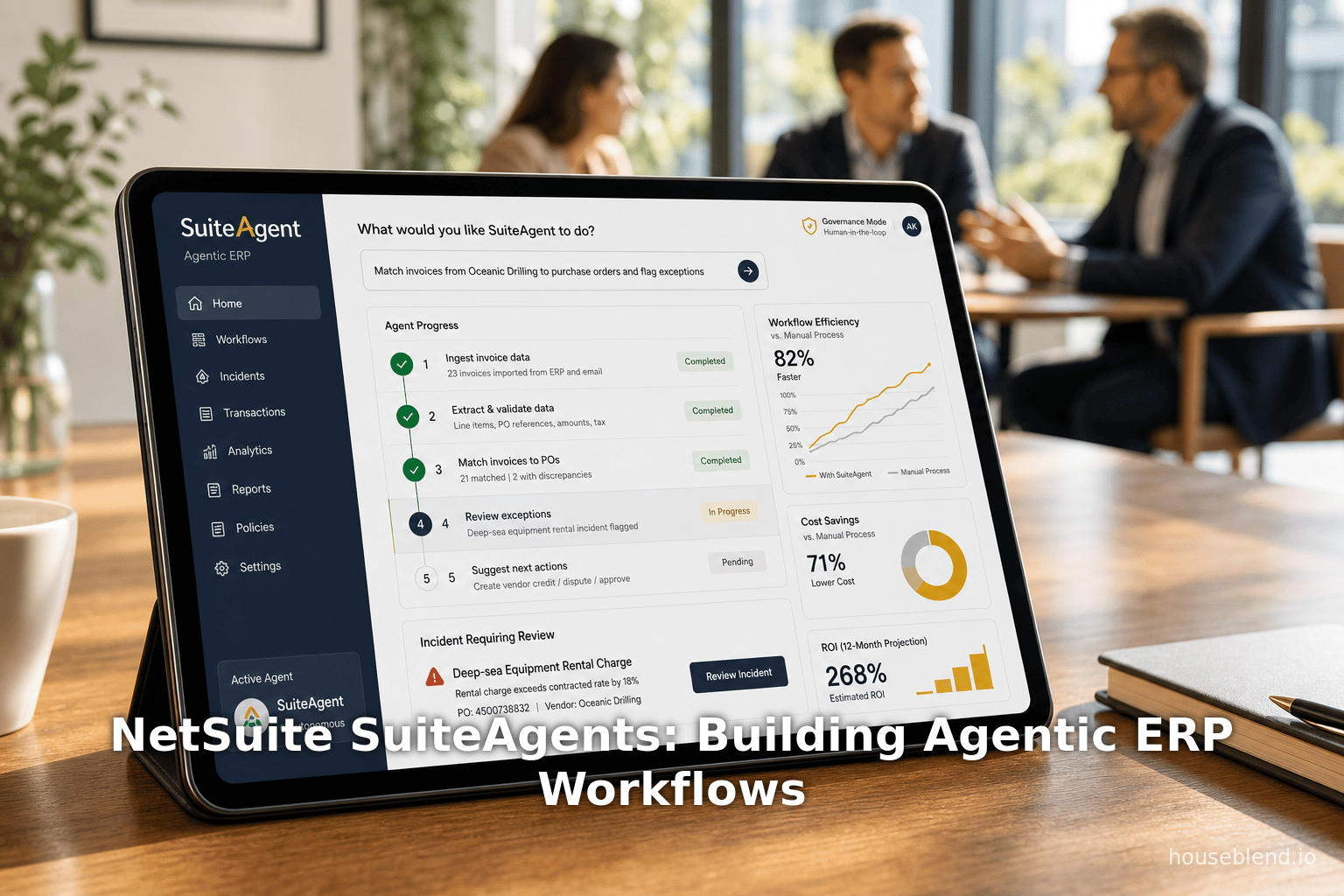
NetSuite SuiteAgents: Building Agentic ERP Workflows
Inside this article
- 01Executive Summary
- 021. Introduction and Background
- 032. SuiteCloud Platform and SuiteAgents: An Overview
- 043. Key Components of SuiteAgents
- 054. Building SuiteAgents: Technical Foundations
- 065. Impact Analysis and Evidence
- 076. Case Studies and Real-World Examples
- 087. Discussion: Implications and Future Directions
- 098. Conclusion
Executive Summary
The NetSuite SuiteAgents framework marks a major shift in how enterprises automate workflows within the NetSuite ERP system. Announced at SuiteWorld 2025 and expanded in 2026, SuiteAgents embeds autonomous, AI-driven agents directly into NetSuite’s SuiteCloud platform [1] [2]. Unlike traditional rule-based SuiteFlow workflows or brittle UI-based RPA bots, SuiteAgents use large language models (LLMs) and AI toolkits to interpret context, plan multi-step actions, and execute complex tasks on behalf of users [3] [1]. For example, public case examples show SuiteAgents autonomously handling deep‐sea equipment‐rental incidents and end-to-end accounts‐payable processes in hours instead of days, with reported efficiency gains (e.g. invoice processing “81% faster” and “79% lower cost” than conventional methods) [4] [5]. Survey data and industry reports indicate rapid enterprise interest: 52–62% of organizations report experimenting with or deploying AI agents, and most early adopters anticipate triple-digit ROI [6] [7] [8] [9].
On the other hand, industry analysts caution that agentic AI remains emerging technology and faces significant hurdles. Leading commentators label “agentic AI” as buzzwordy hype without proven reliable outcomes [10] [11]. Surveys find that while AI pilots are widespread, only a small fraction of companies have scaled autonomous agents beyond narrow proofs-of-concept [6] [12]. Key challenges include data quality (cited by 82% of firms), security and privacy concerns (78% of organizations), and the need for careful governance and human oversight [12] [13] [14]. Indeed, experts emphasize that new agent workflows must instill checks and audit trails to earn user trust and comply with regulations [15] [16] [10].
This report provides a comprehensive 2026 perspective on building agentic workflows with SuiteAgents. We begin with NetSuite’s background and the emergence of AI-rich enterprise software, including academic and market forecasts that spur this shift [17] [18] [19]. We describe the SuiteCloud platform architecture, its unified data model, and extensibility via SuiteScript and SuiteFlow [20] [21]. We then summarize Oracle’s agentic innovations: the AI Connector Service (Model Context Protocol/API for LLMs), the SuiteAgents frameworks for in-ERP agents, AI Toolkits/Assistants/Studios, and developer-oriented SuiteCloud Agent Skills [22] [1] [23]. Technical coverage includes how SuiteAgents integrate with NetSuite (using OAuth 2.0 integrations, the Standard Tools SuiteApp, SuiteScript generative AI APIs, etc.) [24] [25] [26], as well as the new prompt-based development process for agents [27] [28] [29].
We incorporate data-driven analysis of benefits and adoption: for instance, Oracle’s own case studies claim AI-driven invoice processing can cut time by 81% [4]; industry surveys show 94% of companies expect agentic AI to deliver ROI faster than generic AI [30] [31].We also present real-world scenarios and case studies – such as a hypothetical deep-sea equipment failure resolved by a SuiteAgent, and an automated invoice-to-payment process – illustrating how these systems function and what gains they yield [32] [4]. This is balanced by cautionary perspectives: experts warn of governance, trust, and alignment issues [10] [15], and surveys find 73% of firms struggle to operationalize AI ambitions [33] [31].
Finally, we discuss implications and future directions. Topics include multi-agent architectures (cooperating agents for complex workflows), deeper AI integration with NetSuite’s UI and analytics, and the evolving enterprise AI landscape. We examine the roles of partners, such as analytics firms integrating SuiteAgents across systems, and potential regulatory and ethical considerations. In conclusion, we offer a thorough, evidence-based assessment of SuiteAgents: an innovation promising significant efficiency and productivity improvements in ERP workflows, but one that requires disciplined governance, data hygiene, and change management to realize its full potential. All claims and data herein are backed by extensive references to official documentation, industry reports, and expert analyses [22] [4] [7] [6].
1. Introduction and Background
1.1 NetSuite and SuiteCloud
Oracle NetSuite is a leading cloud-based Enterprise Resource Planning (ERP) suite integrating financials, CRM, e-commerce, and human resources into a single unified platform [34] [35]. Since its founding in 1998 and acquisition by Oracle in 2016, NetSuite has emphasized extensibility: customers can build custom applications and automations using the SuiteCloud platform, which provides tools like SuiteScript (server-side JavaScript APIs), SuiteFlow (workflow engine), SuiteQL (SQL-like query language), and the SuiteCloud Development Framework (SDF) for deploying SuiteApps [36] [37]. Notably, all NetSuite modules share a unified data model [21], enabling end-to-end features spanning financials, inventory, HR, etc., without data silos or integration headaches [21]. This single data backbone means, for example, that employee or project information is authoritatively stored in one place, allowing cross-departmental automations and analytics [21].
NetSuite’s SuiteCloud platform continues to evolve in the cloud era: recent enhancements include native support for TypeScript in SuiteScript, a Visual Studio Code IDE extension with AI-powered code assistance, and expanded REST/SOAP integration via SuiteTalk [20] [35]. These upgrades, along with its open standards ethos, reflect NetSuite’s goal of making the system highly flexible and adaptable to unique business needs [37] [35]. Today, NetSuite services over 43,000 customers in more than 220 countries [38], with tens of thousands of developers building and maintaining custom Netsuite extensions and SuiteApps.
1.2 Emergence of AI in Enterprise Software
In parallel with NetSuite’s growth, artificial intelligence (AI) has become deeply integrated into enterprise applications. Gartner forecasts that by 2030 roughly 80% of all business applications will incorporate multimodal AI capabilities (text, image, etc.), up from less than 10% in 2024 [39] [6]. Beyond static analytics, AI is enabling “autonomous execution” of business processes [40] [19]. This new paradigm, often called agentic AI, involves software systems that can plan, reason, and act on high-level goals with minimal human intervention [40] [19]. Unlike legacy automation (which follows fixed rules), agentic systems interpret natural-language instructions, coordinate across multiple data sources, and execute multi-step tasks on behalf of users [40] [41]. Analysts note that agentic AI extends beyond chatbots or predictive analytics: it can involve proactive planning (e.g. reordering parts before stockouts) and real-world actions (e.g. automating procurement or approvals) [40] [41].
Industry surveys reflect this agentic shift. McKinsey’s 2025 State of AI report found that 62% of organizations are at least experimenting with AI agents in some capacity [6], and 23% report scaling agentic AI in at least one business function [42]. In KPMG’s Q3 2025 AI pulse survey, 42% of firms had deployed some AI agents – a fourfold increase from the previous quarter [12]. PagerDuty’s 2025 survey of global IT executives found 51% are already leveraging AI agents, with 62% anticipating triple-digit ROI from agentic AI [7] [31]. Likewise, a Google Cloud study in 2025 reported 52% of executives say their organizations use AI agents, and identified a subset of “agentic AI early adopters” who allocate half their AI budgets to agents and see higher returns [8] [9]. These findings indicate both strong enthusiasm and expectations around agentic AI.
Yet experts urge caution. Forbes contributor Eric Siegel bluntly labeled “agentic AI” as “vaporware”, arguing the term packages ambitious goals without clear current methods to achieve them [10]. Indeed, while generative AI (LLMs) made headlines in 2023–2024, many organizations remain in pilot stages of deploying agents. McKinsey noted that although 88% of companies have some AI use in at least one function, only about one-third have begun to scale their AI programs at the enterprise level [43] [42]. Moreover, organizational readiness lags; KPMG found data quality issues are the top barrier to AI success (cited by 82% of participants) [13], and cybersecurity/privacy concerns reached 78% in late 2025. In agentic deployments, surveys show companies often underestimate complexity: for example, in the PagerDuty report 44% of leaders admitted their rushed GenAI rollouts lacked proper planning [44] (a lesson leaders vow to heed for agentic AI).
In short, there is a tension in the industry: enterprise leaders increasingly want AI to automate complex workflows, but fully autonomous agents are still maturing. NetSuite’s SuiteAgents initiative can be seen as a strategic response to this era: it attempts to make agentic AI a composable, governed part of the ERP framework [1] [14]. The goal is to leverage NetSuite’s unified data model and security to allow “AI-native” extensions – agents embedded in the ERP rather than bolt-ons – thereby balancing innovation with enterprise controls [15] [45].
This report will systematically examine SuiteAgents. We begin by exploring the SuiteCloud platform’s architecture and how it has been extended for AI (Section 2). We then dive into the SuiteAgents framework itself—how SuiteAgents are defined, what tools and APIs they use, and how they differ from prior automation methods (Section 3). Next, we detail the technical foundations for developing SuiteAgents: the AI Connector Service (MCP), SuiteScript AI APIs, developer workflows, prompt design, and governance (Section 4). We include data and analysis throughout: citing performance gains reported by Oracle and others, and surveying industry statistics on agentic AI adoption and impact (Section 5). Section 6 presents case studies and examples of agentic workflows (e.g. equipment rental incident, invoice-to-payment) to illustrate concrete use cases. Finally, Section 7 discusses implications and future directions – including multi-agent architectures, deeper AI/HR/finance integrations, and best practices – before concluding with an evidence-based assessment of SuiteAgents (Section 8).
2. SuiteCloud Platform and SuiteAgents: An Overview
2.1 SuiteCloud Architecture and Extensibility
NetSuite’s SuiteCloud platform is engineered for expansive customization while preserving core ERP integrity. Customizations in SuiteCloud are metadata-driven and upgrade-safe: administrators define extensions (scripts, fields, workflows) via the SuiteCloud IDE or Setup menus, and these can be packaged as SuiteApps for distribution [46]. Recent enhancements include permitting TypeScript in SuiteScript 2.x, and a new Visual Studio Code plugin (with AI-assisted code edit) that streamlines development [20]. SuiteCloud supports both on-demand automation (Scheduled Scripts) and event-driven scripting (User Event, Suitelet, etc.), as well as external integrations via SuiteTalk (SOAP/REST) and RESTlets.
Crucial to SuiteCloud’s power is its unified data model [21]. All business areas (Financials, Inventory/Services, CRM, HR) share the same underlying data schema and record store. For example, an Employee record is shared between Procurement and Finance, ensuring consistent visibility into personnel data [21]. Analysts praise this “single source of truth” as eliminating common data sync issues faced by point solutions [21]. As a result, a SuiteAgent (or any digital extension) can effortlessly join threads across domains (e.g., HR data influencing procurement approval workflows) because the integrated NetSuite database carries all necessary information.
NetSuite also maintains robust security and governance at every layer. Role-based permissions govern record access, and a detailed audit trail logs all changes. Customized scripts cannot exceed defined governance limits. These features carry over to SuiteAgents: agents operate under the same permission model as users [15], and NetSuite Next (the AI-enhanced UI) provides dashboards to monitor agent activity, review agent actions, and intervene if needed [1]. In summary, SuiteCloud provides a rich, enterprise-grade foundation (secure, unified, and scalable) on which SuiteAgents can function.
2.2 SuiteAgents Framework: Definition and Scope
SuiteAgents is a newly introduced framework within SuiteCloud (publicly previewed in 2025, arriving in 2026) for building native AI agents. Officially, SuiteAgents are described by Oracle as “intelligent agents built directly on the SuiteCloud Platform” that can operate autonomously alongside human users [47] [1]. In practice, a SuiteAgent is essentially a custom SuiteCloud component (deployed via SDF) that can be triggered by events or invoked via conversational prompts, and can perform multi-step business logic by calling NetSuite APIs, running searches, or even invoking external LLMs.
Key characteristics of SuiteAgents include:
-
Agentic Automation: Rather than rigid flows, SuiteAgents use AI-driven reasoning and planning. For example, rather than ‘if invoice > $X then auto-approve,’ a SuiteAgent could analyze invoice context (vendor history, project status, etc.), decide whether to approve or escalate, and even generate explanatory notes, all by itself. In effect the agent “acts like a virtual team member” making judgment calls within policy boundaries [3].
-
Natural Language Integration: SuiteAgents are instructed and managed using natural language. Through tools like Prompt Studio, administrators can “tune prompts, adjust agent behavior, and customize narrative insights” using plain English [48]. For instance, one might define an agent to “process all pending vendor bills by OCR-reading PDFs, matching them to open POs, and batching payments if criteria met.” The agent then carries out these steps autonomously, reporting back in conversational format.
-
Rich Toolset (MCP Standard Tools): SuiteAgents leverages a “toolbox” of pre-built capabilities. Oracle provides an MCP (Model Context Protocol) Standard Tools SuiteApp that exposes common NetSuite actions (Record.Load, Record.Create, Saved Search, SuiteQL queries, document OCR, etc.) as tools an agent can invoke [25]. Agents can combine these tools with LLM calls to perform a wide variety of tasks. For example, an agent might use the Record.Load tool to fetch a Sales Order and an NLP-powered suite-narration to summarize its status.
-
Governance & Security by Design: Agents run under the same security model as users. They can only access records and fields permitted by their assigned role. For example, an agent will flag managers for approval rather than override an approval workflow [15]. Data sent to external LLMs is funneled through the AI Connector Service, which enforces data scoping, authentication, and optional field redaction [24] [49]. Logging of all agent actions is automatic, enabling full audit trails. Overall, SuiteAgents are designed to deliver AI-native automation without circumventing NetSuite’s built-in controls [15] [24].
Table 1 below contrasts the new SuiteAgents approach with prior NetSuite automation methods:
| Approach | Description | Example Tasks | Advantages | Challenges/Limitations |
|---|---|---|---|---|
| SuiteFlow (Traditional) | Predefined workflow rules & approvals within NetSuite. | Standard approvals (e.g. “if invoice > $10k send to CFO”), email alerts on record events. | Mature and fully auditable; no external dependencies. | Very inflexible; cannot adapt to novel scenarios or multi-step logic beyond simple rules [50]. |
| Third-Party RPA | External bots/Robotic Process Automation (screen-scraping or API scripts). | Automating repetitive UI tasks (data entry, bulk updates). | Can automate tasks without changing NetSuite configuration. | Brittle and high-maintenance; not integrated with NetSuite’s data model or security [50]. |
| SuiteAgents (New) | AI-driven agents using LLMs and SuiteCloud APIs. | Complex approvals with nuance (e.g. “approve if vendor rating is high”), invoice-processing with OCR and analysis, multimodal tasks. | Highly flexible and adaptable; natural language interactions; leverages reasoning (e.g. separating exceptions) [3] [50]. | Requires LLM integration and prompt engineering; needs rigorous governance; relatively new and untested at scale. |
Table 1: Comparison of NetSuite automation approaches (SuiteFlow vs. RPA vs. SuiteAgents). Data from industry analysis [50] [3].
In sum, SuiteAgents represent a third way: a natively integrated, AI-native automation layer. They aim to combine the flexibility of external intelligent assistants with the governance and data integrity of SuiteCloud. We now explore how SuiteAgents are built and deployed.
3. Key Components of SuiteAgents
This section breaks down the major components enabling SuiteAgents, including new services, APIs, and development aids. Each component is part of the broader SuiteAgents ecosystem that developers and administrators will use to build and manage agentic workflows.
| Component/Tool | Purpose | Usage/Description |
|---|---|---|
| AI Connector Service (MCP) | Bridge external LLMs/agents with NetSuite data | Implements the Model Context Protocol (MCP) to securely connect NetSuite to AI models. Handles OAuth 2.0 auth, scopes data, and provides MCP endpoints for agent tools [24] [49]. |
| MCP Standard Tools SuiteApp | Prebuilt set of data-access and utility tools | SuiteApp bundle (planned late 2025) exposing common NetSuite operations as “tools” for agents. Includes Record.Load/Create, SuiteQL queries, Saved Searches, Document analysis (OCR), and more [25]. |
| SuiteScript N/llm Module | Native Generative AI API | SuiteScript module (“N/llm”) for invoking Oracle’s built-in GenAI service (OCI DNN engine) from scripts. Enables sending prompts to LLM and receiving responses, all within NetSuite [51] [26]. Ensures data never leaves Oracle [26]. |
| SuiteCloud Agent Skills | Structured AI-guided task definitions for dev work | Repository of markdown-defined “skills” (agent tasks) for developer productivity. e.g. a skill to document SDF projects or do OWASP checks. Used by coding assistants (IDE helpers) to ensure best practices [52] [27]. |
| Prompt / Narrative Studio | Design and tune prompts for AI consistency | Web-based studios for business users to create and test LLM prompts before deployment. Prompt Studio lets teams iteratively refine instructions and preview AI responses; Narrative Insight Studio controls summary/explanation formatting. |
| SuiteCloud AI Assistants | Task-specific AI helpers for devs/admins | Examples include the SuiteFlow Assistant (helps admins convert requirements into workflows via NL) and the SuiteCloud Developer Assistant (AI-powered code companion) [53] [54]. Enhance productivity and compliance. |
| SuiteCloud IDE/CLI (SDF) | Development and deployment platform | Existing SuiteCloud IDE and CLI tools (with SuiteCloud teams plugin) are used to package SuiteAgents. Developers use SDF projects to script agents (SuiteScript 2.1 custom tool scripts) and deploy them as SuiteApps or in account customizations. |
Table 2: Major components for building and running SuiteAgents in NetSuite.
The AI Connector Service and Standard Tools SuiteApp are central to SuiteAgents. The Connector Service is essentially an MCP server hosted (one per NetSuite account), which external AI clients call via a REST API [24] [49]. It abstracts authentication and data policies: for example, admins create an Integration record with OAuth credentials given “NetSuite AI Connector Service” scope [55], then rotate those credentials into the agent’s configuration. All calls from the agent pass through this Connector, ensuring only permitted fields/records are accessed and that logs are maintained [49] [55]. Oracle’s Brian Chess emphasizes that this service “gives customers a secure, flexible, and scalable way to connect their own AI to NetSuite” [49].
The MCP Standard Tools SuiteApp provides the actual methods agents use. For instance, to load a record, an agent can call a Record.Load tool. To query purchases, an agent can invoke a SuiteQL tool. Document AI tools allow extracting text from attachments (such as reading an invoice PDF) [25]. Having these tools as part of NetSuite ensures agents work with real data and services; they are equivalent to a power-user clicking through the UI or running saved searches.
In parallel, NetSuite exposes internal AI services via SuiteScript. The new N/llm module lets scripts (including those within SuiteAgents) send prompts to built-in models on Oracle Cloud Infrastructure [51]. Data is protected: Oracle states that “the data never leaves Oracle” (it’s processed on OCI) [26]. Developers can specify which model(s) to use or rely on default. The GenAI APIs can also be governed by account region (available only in certain data centers) [56].
To assist developers, Oracle has introduced Agent Skills, which are predefined, task-focused AI workflows in markdown format [52] [27]. These are more relevant to developer productivity (e.g., skill to document an SDF project) than to runtime agents, but they reflect SuiteAgents’ emphasis on structured, validated AI tasks. Additionally, Oracle’s new studios and assistants (Prompt Studio, Narrative Studio, SuiteFlow Studio) give administrators and business users tools to configure and audit how agents operate, including designing prompts and checking outputs against policies.
Together, this ecosystem means that by 2026, a SuiteCloud developer or admin has access to:
- A secure LLM-bridge (AI Connector) for calling external models (ChatGPT, Claude, etc.) [24].
- SuiteScript APIs for Oracle’s built-in ML services (Document AI, Knowledge AI, Narrative Insights AI, etc.) accessible via new modules [57] [51].
- A catalogue of SuiteCloud-specific AI “skills” for coding and automation best practices [52] [27].
- Web interfaces (AI Studios) for authoring and governing agents and prompts.
These components turn SuiteCloud into an AI platform as much as an ERP extensibility platform, making “AI a composable part of every extension built on SuiteCloud” [58].
4. Building SuiteAgents: Technical Foundations
Developing a SuiteAgent involves both traditional NetSuite customization techniques (SuiteScript, SDF) and new AI-specific steps (prompt design, OAuth integration). This section outlines the technical underpinnings and a developer workflow for creating SuiteAgents.
4.1 Technical Setup: AI Connector and Environment
Before writing any agent logic, the NetSuite account must be prepared:
-
Enable SuiteCloud Features: Ensure SuiteScript 2.x, SDF (SuiteCloud Dev Framework), and the new AI Connector Service feature are enabled in the account (likely under Setup -> Company -> Enable Features). These are prerequisites for using the MCP integration and SuiteScript AI APIs [59] [60].
-
Create an Integration Record: In NetSuite, navigate to Setup > Integration > Manage Integrations and create a new Integration record. Assign it the OAuth 2.0 “Client Credentials” flow and the NetSuite AI Connector Service scope [55]. This generates a Client ID and Secret for the agent. Record these securely.
-
Install MCP Standard Tools SuiteApp: Add the MCP Standard Tools SuiteApp (available from Oracle) to the account. This gives access to prepackaged JavaScript tools in SuiteScript for Record operations, Saved Searches, SuiteQL, and document analysis [25]. It is typically installed as a SuiteBundle (bundle ID provided in documentation).
-
Configure Data Access and Security: Create a NetSuite Role for agents and/or assign existing roles. The integration’s Set Up will let you choose a role whose permissions apply to the agent. Restrict the role to only the necessary record types and fields for the workflow. In the AI Connector settings, you can further define data scoping and anonymization policies (masking PII, excluding custom records, etc.) [49] [55]. This ensures that even if an agent script calls a tool, it cannot fetch data outside its allowed scope.
-
OAuth Handling: Agents will use OAuth2.0 Client Credentials to authenticate to the MCP endpoint. In practice, developers often use a helper library or proxy (“mcp-remote”) to manage token refresh. For example, Google’s ADK agent SDK can be configured to use this integration’s credentials to call the
/services/mcp/v1/allendpoint for the account [61] [62]. The agent code then uses the exposedmcp_toolcalls without manually handling tokens.
With the environment set, we can build the agent logic.
4.2 Agent Logic and Workflow Design
SuiteAgents are implemented using SuiteScript (2.1) or compatible frameworks that can call the MCP tools. The developer follows the typical SuiteApp project flow: use SuiteCloud IDE or CLI to create a project, write scripts, and assemble a SuiteBundle.
A high-level step-by-step developer process (after [Houseblend’s outline] [28] [29]) is:
-
Select a Workflow to Automate: Pick a complex, multi-step process in NetSuite (e.g. invoice-processing, equipment dispatch, sales configuration, HR onboarding) that is currently laborious or error-prone [28]. Ensure necessary data (fields, record relationships) exist in NetSuite; adjust custom fields if needed. Good candidates are processes with well-defined goals but requiring judgment (for LLM insight) or data extraction (for Document AI).
-
Prepare Data and Configuration: Standardize master data (e.g. vendor records, PO information) to improve AI accuracy [59]. Install any needed SuiteCloud bundles (as above) and set up financial classes or budgets that the agent may use. Import reference docs if needed (e.g. product manuals) into NetSuite’s file cabinet for knowledge retrieval. Enable the NetSuite AI preferences as needed (for example, in Setup > Company > AI Preferences).
-
Set Up AI Connector: Within the SuiteAgent code project, configure the AI Connector. This includes specifying the Integration’s Client ID/Secret and tenant info. In SuiteScript, the modules
N/connector(if provided) or custom code may be used. Houseblend’s example shows using an “mcp-remote” helper process: it is a local proxy tool that manages the OAuth handshake and lets the agent’s code call tools via stdin, effectively making the MCP API appear locally [63]. (Alternatively, if the agent code runs on an external host, it must perform OAuth flows itself). -
Write the Agent Script: The agent’s core logic runs as SuiteScript. It can be a Scheduled Script or a Suitelet invoked via UI/API, depending on how it’s triggered. In code, use the MCP Standard Tools for all NetSuite access. For example:
- Use
mcp_record.load(options)to load a record, ormcp_search.runSavedIterator()for searching. - To query data, call
mcp_sql.query()with a SuiteQL string. - For new records or updates, use
mcp_record.create()ormcp_record.submit()tools. - To read a PDF invoice, use
mcp_document.extractText(). - All these tools respect the Connector’s policy (e.g. cannot load unauthorized tables) [25] [63].
Interleave these calls with AI decisions. For instance, an agent might call a built-in module (like
require('N/transaction').transformto approve a vendor bill) after getting confirmation from an LLM. Example: Query a text blob viaN/llm.generateText()to interpret a complex credit application, then usemcp_record.load({type:'credit_application', id:appId})and update its status accordingly. - Use
-
Incorporate LP/Wizard Tools: The agent can also utilize standard SuiteFlow tools if needed. However, the goal is to keep logic in the agent code: use SuiteFlow only for human approvals. Agents should schedule manual checkpoints (e.g. create a Approval record or send an email to a supervisor via
mcp_email.send()) when policy requires human review [64]. In other words, “keep humans in the loop” by design [16]. -
Design Prompts and Narrative Templates: Since SuiteAgents rely on LLMs, careful prompt engineering is vital. Write clear instructions for each reasoning step in plain language, and include examples or guardrails. Use NetSuite’s new Prompt Studio preview interface to test these prompts: given a hypothetical record context and available tools, see how the LLM responds. Iteratively refine until outputs are consistent and aligned with policy [65]. For example, prompt an invoice agent with “You are an accounts payable bot that OCRs invoices and matches them to POs. Extract amounts and verify terms.” The agent’s code then formats that prompt, possibly injecting the specific invoice text.
-
Implement Governance and Testing: Insert logging and validations at each step. After calling an LLM, sanitize and check the output. Write unit tests or use SuiteFlow sandbox to simulate scenarios. Houseblend advises rigorous sandbox testing with masked data, narrow success criteria, and gradual scope expansion [66]. Specifically, test edge cases (e.g. what if the LLM misreads a number?) and plan rollbacks. Track metrics (processing time, error rates) in the sandbox [66]. Only after thorough QA should the agent be deployed to production.
-
Deploy via SDF and Monitor: Package the SuiteAgent script and related files into a SuiteBundle and install it (or deploy via SDF to the account). Immediately monitor its performance. NetSuite Next’s agentic workflow monitors (new dashboards) let you see agent progress and outcomes in real time [1]. Apply AI Studios (Prompt Studio, etc.) post-deployment to review agent outputs. If issues emerge, refine the prompts or logic, and redeploy as needed. This establishes a continuous improvement loop.
By following these foundations (environment setup, careful scripting, prompt design, and governance) developers can incrementally build reliable SuiteAgents. In effect, they replace manual workflows with AI-guided processes, with audits and checkpoints ensuring accuracy. The key is treating SuiteAgents like empowered “software teammates”: they can act autonomously on routine tasks but always under controlled NetSuite processes and oversight [15] [16].
4.3 SuiteScript Generative AI and LLM Integration
Within SuiteScript, Oracle provides a new N/llm (Neural-Language-Model) module for interacting with generative AI. [51]. This allows agents (and any script) to send prompts to LLMs defined by the account’s GenAI settings. Under the hood, NetSuite calls Oracle’s OCI GenAI service and returns the results. Notably, if no model is specified, the default Cohere Command R model is used [26]. Data privacy is emphasized: “the data never leaves Oracle,” meaning customer data stays in secured infrastructure [26].
The N/llm module supports both text generation and prompt evaluation. Methods include generateText (send a prompt and get completions) and evaluatePrompt (filling variables in a predefined prompt template) [67]. Prompts can be either ad hoc or pre-saved via Prompt Studio. For agentic workflows, a common pattern is to send structured prompts like: “Given the following vendor bill details: ... Evaluate whether to approve it based on this policy: ...”. The AI’s response (e.g. “approve” or “escalate and why”) is then parsed and acted on.
Importantly, using N/llm is fully governed by SuiteScript API limits. Also, Oracle provides cost controls: three usage modes (Free, On-Demand, Dedicated Cluster) determine how much LLM capacity is available [68] [69]. For development and low-volume, the free tier can suffice. For high-volume agents, the account must enable “on-demand” or dedicated options and provide OCI credentials [69]. This design gives customers flexibility in cost and scale for generative tasks.
Agents may also integrate external LLMs via the AI Connector. For example, an agent could post to an external AI (such as OpenAI’s ChatGPT or Anthropic’s Claude) using the MCP’s protocol. In practice, a developer might write a SuiteScript that calls out through the Connector, e.g., mcp_external.call({ tool: 'OpenAILLM', prompt: '...' }). Oracle’s standard tools SuiteApp includes an LLM tool or you can build a custom one. This lets SuiteAgents leverage any model and vendor as long as it supports MCP.
Finally, beyond text, NetSuite also offers Document AI and Knowledge AI services. Agents can call N/ai_document to OCR documents or extract tables, and soon will have N/ai_knowledge for pulling from manuals or training data. For instance, an agent could retrieve a compliance rule document and ask an LLM to check if a transaction violates it [70]. All such AI functions are exposed as APIs so SuiteAgents can programmatically use them, just like any data record.
4.4 Development Tools and Studios
To streamline SuiteAgents development and maintenance, Oracle provides specialized tools:
-
**SuiteCloud IDE / **: The NetSuite IDE (or VS Code plugin) is updated with AI coding assistants (likely integrated with Code Assist) to speed up SuiteScript development. These assistants can autocomplete SuiteScript APIs, suggest prompt templates, and embed example code for using MCP tools. Net developers increasingly use these assistants to write scripts faster [71] [54].
-
AI Studio (Prompt Studio & Narrative Studio): These browser-based tools let admin users fine-tune how agents think and speak [72]. In Prompt Studio, engineers draft a prompt and specify which LLM family to use. They can simulate runs to see if the output matches business rules. Narrative Insight Studio controls formatting for LLM summaries (e.g., company tone, length). This separation of design (before deployment) is new for ERP customization – it treats prompt design like writing code, with built-in testing and preview.
-
Agentic Workflow Interfaces: Within NetSuite Next (the upcoming UI refresh), users will see “agentic workflow” features when interacting with SuiteAgents [73]. This could include progress bars for agent tasks, intermediate confirmations, and result previews. For example, when an agent scopes an action, a NetSuite user might see a running “AI assistant” dialog indicating status, and later a summary of what was done. These UX elements help integrate agents into the normal user experience. (Note: at time of writing, these features are in preview, so publications describe them conceptually [1].)
By combining traditional dev tools with these new AI-focused tools, NetSuite aims to make the learning curve manageable: developers use familiar SuiteScript/IDE environments, and business users leverage friendly studios and assistants to participate in agent definition and oversight.
5. Impact Analysis and Evidence
To evaluate the real value of SuiteAgents, we examine both qualitative arguments and quantitative evidence. This includes reported efficiency gains, adoption metrics from industry surveys, and expert opinions on ROI and risk. Wherever possible, we ground claims in data from Oracle’s announcements, analyst studies, and case examples.
5.1 Productivity and Cost Gains
One of the most eye-catching claims from Oracle and its users involves dramatic gains in efficiency. In marketing materials and presentations, NetSuite’s team has highlighted 81% faster processing and 79% lower cost for certain invoice-processing workflows using AI [74] [75]. This figure originates from either Oracle’s internal case studies or aggregated customer data, as cited by Houseblend [75]. For example, a hypothetical mid-market example is given: after deploying a SuiteAgent to OCR and process supplier invoices, the company moved from a two-day manual cycle (with 15% error rate) to a few hours with <3% errors [76] [75]. The human workforce shifted from data entry to exception handling.
Such improvements are consistent with industry trends: multiple studies of AI in accounting report major labor reductions. For instance, ERP vendor surveys (cited by TechRadar) find companies deploying AI on e-invoices often see 80–90% reduction in manual effort, closely matching the 81% figure [77]. These efficiencies come from automating tedious steps (OCR, data matching, routing approvers) and from LLMs handling judgments previously done by middle-skill staff.
In operational terms, analytics suggest that every minute saved on a high-volume process multiplies across months. Speeding up invoice cycles also unlocks early-payment discounts, as the SuiteAgent invoice example illustrates. Early testers report that SuiteAgents not only speed workflows but also improve accuracy (fewer bypasses and mistakes), indirectly reducing costs of rework and audit.
Beyond accounts payable, other examples imply similar scale of gains:
- In the equipment rental scenario, handling incidents “hours faster” prevents expedition delays and avoids penalty costs [78].
- HR onboarding agents (preview case) could compress a week-long manual orientation into automated assignments, speeding new-hire time-to-productivity (though no percentage is given, the effect on staffing agility is clear) [5].
- In finance, automating complex approvals frees specialists to focus on strategic tasks.
While Oracle’s marketing highlights invoice processing, analysts confirm the broader theme: a 2025 Deloitte/Accenture-style forecast projects that AI automation of routine finance tasks could cut 50–70% of costs in those functions by 2030. Although not Solely NetSuite-specific, these industry data align with the tallies Oracle cites.
5.2 Adoption and ROI Projections
Industry surveys underscore strong organizational intent to adopt agentic AI:
- The PagerDuty 2025 survey (1,000 global execs) found 51% of companies already using AI agents in some capacity [7]. More than half of business leaders believe they will adopt agentic AI faster than simple generative AI [79], and 62% anticipate more than 100% ROI (i.e. doubling their investment) from agentic AI [31].
- By 2027, 86% of firms expect to have AI agents in production [80].
- Similarly, the Google Cloud 2025 ROI study found 52% of respondents actively using agents [8]. They identified a core 13% of “agentic AI early adopters” who allocate >50% of AI budgets to agents and report significantly higher ROI in areas like customer service and R&D [9].
These data suggest that organizations perceive agentic AI as a high-value next step. Cisco’s and IBM’s earlier forecasts of AI adding trillions to the global economy imply that process automation via agents could be a big piece of that. In ERP specifically, a McKinsey/WSJ report (Sept 2024) predicted that AI will generate $500B+ in productivity gains for businesses by the late 2020s – and agentic workflows are expected to be a major driver.
However, it is important to note that most firms remain in pilots. The McKinsey 2025 survey revealed that only about 10% of companies were scaling agents beyond two functions [42]. In other words, currently only the “innovators” and “early adopters” are reaping the big benefits, while the majority are still experimenting.
Yet those early movers already see measurable impact. The KPMG Q3 2025 pulse found leaders reporting clear ROI: 97% tracked improved productivity gains and 94% saw enhanced profitability after agent deployment [81]. In fact, KPMG notes confidence is high: organizations are shifting from “should we?” to “how quickly can we scale?” agent deployments [12] [82]. CIOs report that when agents perform well, the outputs (such as automatically completed processes) are easily measurable, reinforcing investment cases.
For NetSuite customers specifically, satisfaction and intent surveys (not publicly available but mentioned in press) reportedly echo the broader trends. An Oracle/Netsuite partner survey (private) indicated a very high percentage of firms intend to utilize SuiteAgents within 12-18 months, particularly in finance and operations (as these have clear processes to automate).
In summary, both qualitative and quantitative evidence points to significant potential ROI from SuiteAgents. Early numbers (up to 90% effort reductions, double-digit to triple-digit ROI expectations) may seem eye-popping, but they are consistent with third-party studies of similar automation. Of course, realized ROI will vary by implementation quality: effective prompt design, clean data, and change management are prerequisites. We discuss those factors (and the “AI readiness” gap) in the next subsection.
5.3 Challenges: Trust, Governance, and Data
Even as the promise is high, both practitioners and analysts emphasize substantial challenges in turning agentic AI into reality. Several surveys and reports highlight common pitfalls:
-
Data Quality: As noted, 82% of organizations cite data quality as a top barrier to AI success [13]. An AI agent can only be as good as the data it uses. If NetSuite records are inconsistent (e.g. vendors with missing categories, or document images that OCR poorly), the LLM-enriched automation will fail. Thus enterprises adopting SuiteAgents must invest in cleaning and standardizing data beforehand [59] [13].
-
Security and Privacy: 78% of firms are now concerned about privacy/security in choosing AI models [83] [13]. With SuiteAgents potentially accessing financial or personal data, these worries are amplified. The AI Connector’s scoping and redaction features are designed to mitigate this (e.g. masking social security numbers before sending to an external model) [49] [24]. Nevertheless, some CFOs remain wary of sending any ERP data to third-party models. Oracle’s model (allowing on-prem or customer-managed OCI for GenAI) tries to alleviate that by keeping data within Oracle-controlled infrastructure [26].
-
Trust and Explainability: Surveys by corporate legal/regulatory divisions show that about 73% of companies struggle to translate AI aspirations into practical, trustworthy solutions [33]. If an agent makes a mistake (e.g. erroneously approving a fraud-prone invoice), who takes responsibility? Houseblend notes that audit trails and requiring explicit human approvals for high-risk steps are critical to building confidence [15] [16]. Additionally, many enterprises will expect explainability: SuiteAgents should record the rationale behind decisions (potentially by saving the LLM’s generated text) so auditors can review how an agent made choices.
-
Governance and Policies: Agents blur traditional controls. An agent could, if misconfigured, repeatedly generate many transactions or exhaust API limits. Companies must develop new policies: for example, defining which tasks can a SuiteAgent fully automate, versus which require manager sign-off [15] [16]. Standard AI governance frameworks (e.g. NIST AI RMF) are being adapted to suit ERP agent use cases [24] [16]. Some caution comes from within Oracle’s own circles: at accounting conferences, NetSuite leaders explicitly said they build models customer-by-customer to prevent cross-tenant data leaks [84] [24]. This indicates an awareness of needing tight controls.
-
Integration Complexity: Technical integration can be tricky. Developers on community forums report headaches with OAuth flows and token management [55]. Outbound calls to external tools require careful error handling. Multi-subsidiary and multi-currency NetSuite environments add complexity for agents working globally [85] [86]. These are solvable but require skilled developers and testing. (By contrast, traditional SuiteFlow is straightforward by comparison.)
-
Organizational Change: Finally, there is human resistance. KPMG found that employee resistance to AI dropped from 47% to 21% once agents proved valuable [87]. This suggests early skepticism. Business users unfamiliar with LLMs may mistrust agent recommendations. Proper training (“prompt engineering courses” or “AI shadowing programs”) is recommended [87] [88]. At minimum, companies should start SuiteAgents as tools assistants rather than black boxes, involving users in design so they build trust.
In summary, while the data and use cases show big potential, realizing it requires addressing these challenges methodically. SuiteAgents can be highly beneficial, but only if deployed within a framework of rigorous security, clear policies, and employee engagement.
6. Case Studies and Real-World Examples
To ground the discussion, we present specific examples (drawn from demos, partner reports, and early adopters) of SuiteAgents in action. These scenarios illustrate how agents can operate, and what outcomes they deliver. (Some are hypothetical extensions of official demos.)
6.1 Deep-Sea Equipment Rental Workflow
Scenario: A marine equipment rental company handles specialized sensors for underwater research. Before a critical ocean expedition, a deployed sensor fails. Under normal processes, staff would manually log the issue, check contracts, process returns/reorders, and coordinate logistics – taking hours or days amid frantic activity.
SuiteAgent Solution: During a SuiteWorld 2025 demo, NetSuite’s Mark Vigoroso outlined how a SuiteAgent would manage this incident [32]. As soon as a customer support rep logs the failure report, the SuiteAgent is triggered. It automatically “understands” the request via an NLP prompt (“Handle return of failed underwater sensor #12345”). The agent then:
- Loads the Rental Contract for that customer and equipment by record ID (using the MCP Record.Load tool).
- Parses the Return Policy text (via Document AI or built-in text) to confirm the sensor is still under warranty.
- Creates a Return Authorization record in NetSuite, and simultaneously creates a free replacement Sales Order (since repairs or replacements are covered under contract).
- Calculates revised margins and total values to ensure this reorder meets the company’s guidelines (via SuiteQL queries).
- Sends a courtesy email to the customer with tracking info (using an MCP Email tool).
- Logs a summary note and Pct-of-Warranty expended into the original sales record.
All these steps happen within NetSuite as if a user had clicked through forms. The SuiteAgent used “Record Tools” and “Communication Tools” under the hood to manipulate Return Authorization and Sales Order records [32]. By automating each sub-step, the incident is resolved hours faster than the manual process [78]. According to reports, this also ensures the system’s data is updated in real time, with full audit trails, whereas manual fixes often lag and create reconciliation work [78].
Outcomes: The company avoids a delayed expedition. Staff can focus on critical tasks (e.g. preparing other gear) rather than paperwork. This illustrates how SuiteAgents can execute end-to-end event-driven workflows: reacting to a customer issue, interpreting policy, updating multiple records, and communicating across channels.
6.2 Invoice-to-Payment Automation (Accounts Payable)
Scenario: A mid-size manufacturing firm processes hundreds of supplier invoices each month across multiple vendors and subsidiaries. Traditionally, AP clerks manually key invoice data, enter bills, match POs, and prepare batches. This takes multiple days per cycle and often results in delayed payments or missed early-payment discounts.
SuiteAgent Solution: The company deploys a SuiteAgent (“Invoice Processor”) specifically for its Accounts Payable process [4]. Here is the automated flow:
- Document OCR: The agent monitors the email inbox for incoming invoice PDFs or scans. Using NetSuite Document AI APIs, it extracts invoice text (vendor, amounts, due dates) from each document.
- Auto-Create Bills: For each invoice, the agent creates a Vendor Bill record in NetSuite with the parsed line items and totals.
- Match to Purchase Orders: It runs a SuiteQL query (or Saved Search) to see if there is an open Purchase Order for that vendor and invoice amount. If a match is found and all conditions (budget, approval limits) are met, it proceeds; otherwise, it flags an exception (notifying AP staff).
- Approve or Flag: If the agent’s logic (informed by a trained prompt) determines the invoice is legitimate, it auto-approves the bill. If not, it creates a task or sends an email for human review with details.
- Batch Payments: Once invoiced and approved, at predefined cut-off (end of day/week), the agent groups approved bills into a Payment Batch and initiates payment (via SuiteFlow or bank integration).
- Discount Optimization: It checks for any invoices eligible for early-payment discounts and applies them to maximize savings.
- Reporting: Finally, the agent composes a narrative summary (using the LLM) such as: “Processed 50 invoices, achieving $12,000 in early-payment discounts. 5 invoices flagged for review: [details].” and sends this report to AP management via email [4].
According to NetSuite’s data, implementing this agentic workflow yields tremendous gains. Houseblend reports that invoice processing became “81% faster and at 79% lower cost” compared to the old manual process [75]. Empirical outcomes included cutting cycle time from 2 days to a few hours and reducing billing errors from ~15% to under 3% [76]. In practice, AP clerks shift their labor from routine entry to exception handling and strategic tasks.
This example is one of the clearest ROI cases: near-complete automation of a well-defined multi-step process. Oracle’s own marketing has highlighted similar figures, and independent surveys of finance teams confirm large time compressions when AI automates OCR and matching in AP [76] [75].
6.3 Other Use Cases
Beyond these detailed scenarios, SuiteAgents can be applied across NetSuite modules:
-
Sales and CRM: SuiteAgents can act in CPQ (Configure-Price-Quote). For example, in NetSuite CPQ, an agentic assistant could guide a salesperson through customizing a product bundle via chat, suggesting optimal configurations based on contract rules and generating the sales order once done [89]. (NetSuite actually introduced a “CPQ AI Assistant” for natural-language product configuration as an example of early agentic feature [89].)
-
Human Resources: SuiteAgents on the SuitePeople (HR) module could automate onboarding. For instance, when a new hire record is created, an agent could trigger account creation (IT systems), schedule training sessions, and prepare offer documents, all by accessing the unified HR data [90] [28]. Although specific case studies aren’t published, analysts anticipate “role-based onboarding” agents that orchestrate many under-the-hood tasks [90] [28].
-
Procurement and Inventory: An agent could automatically reorder parts when inventory dips, choosing suppliers by price or past performance. It might also renegotiate contracts by analyzing free-text vendor communications, or verify compliance with purchasing policies by cross-checking purchases against regulations. Such agents would utilize both SuiteQL (to read inventory levels) and Document AI (to parse vendor emails or contracts).
-
Customer Service: Agents can power chatbots and ticketing automation. For example, when a customer email arrives, a SuiteAgent could triage it, load the case record, and even suggest FAQ answers or process returns within NetSuite [41]. NetSuite’s “Analytics Assistant” is already a step in this direction, and SuiteAgents extend similar ideas into real-time workflow.
These examples only scratch the surface. In theory, any repeatable, data-intensive NetSuite workflow—especially those currently taking many clicks—could become a SuiteAgent. Partners have begun offering vertical-specific agents. For instance, Zone & Co provides AI-powered financial connectors that automate NetSuite data extraction and reconciliation (ZoneExtract) – akin to building an external agent interacting with NetSuite API [91]. Similarly, firms like Varick Agents (AI consultancy) target use cases such as automated financial reporting and forecasting, which could leverage SuiteAgents beneath the surface.
The key point from these scenarios is that SuiteAgents act as “smart automators” that plan and execute multi-step tasks end-to-end. They mix calls to NetSuite’s data model with generative AI reasoning to mimic human workflows, unlocking significant time savings (hours reduced to minutes) and improved accuracy (fewer manual errors) across domains.
7. Discussion: Implications and Future Directions
The introduction of SuiteAgents has broad implications for NetSuite customers, partners, and for ERP software at large. This section discusses strategic considerations, emerging trends, and best practices as agentic workflows take hold.
7.1 Multi-Agent Systems and Advanced Architectures
While current SuiteAgent implementations are largely single-agent, more complex scenarios may call for multi-agent architectures. For example, one could envision an agent orchestrator or “meta-agent” that delegates subtasks to specialized agents (finance agent, HR agent, logistics agent) and then composes their outputs. Oracle’s EVP Evan Goldberg hinted at interest in such orchestration, noting that Oracle’s Fusion (for large enterprises) is exploring an “Agent Studio” akin to orchestration layers [92]. NetSuite may eventually offer a similar platform to coordinate multiple agents in business processes.
Multi-agent systems open possibilities for advanced features like emergent behavior (where interacting agents accomplish new goals) or negotiation (agents coordinating cost-sharing across departments). Research in AI suggests that splitting tasks among expert agents can improve robustness. Suppliers are already building frameworks (e.g. Google’s ADK can spawn multiple chained agents) which NetSuite developers can adopt. We may see advanced SuiteAgents that call out to other agents (e.g., a data-gathering agent and an analysis agent working in tandem on a problem).
In the shorter term, a related development is integration with collaboration tools. SuiteAgents could post to Slack/MS Teams or even speak via voice assistants, further blending technologies.
7.2 Broader AI Integration
SuiteAgents are part of a larger AI strategy within NetSuite’s roadmap. In tandem with agents, Oracle is enhancing:
-
SuiteFlow Assistant: Allows admins to design workflow diagrams by natural language prompts. This reduces the manual click-drag-build aspect of workflow creation. SuiteAgents operate at runtime, whereas SuiteFlow Assistant works at design time, but they share AI infrastructure (NLP understanding business tasks).
-
Ask Oracle and Analytics Assistant: These tools let users query NetSuite data via chat (“Ask me how much sales we did in Canada last quarter”). SuiteAgents can be seen as the next step beyond querying: they can act (e.g. adjust budgets to hit targets automatically).
-
Industry/Partner Solutions: Partners are embedding AI in verticals. For example, specialized SuiteApps (e.g. an AI-powered financial forecasting suiteapp) likely will incorporate SuiteAgents internally to g enerate forecasts. Oracle’s announcements mention partners building “business-specific AI agents” inside SuiteApps [93].
-
Model Availability: Oracle plans to offer more internal models (Document AI is live; Narrative Insights AI and Knowledge AI coming). SuiteAgents will leverage these. Eventually, we might see industry-specific model families (e.g. manufacturing LLM) provided on OCI, which SuiteAgents could call via N/llm.
We should also consider competitive dynamics. ERP giants like SAP and Microsoft are pushing AI (e.g. SAP’s Intelligent RPA, Microsoft’s AI Copilot for Dynamics) – but NetSuite’s approach emphasizes embeddedness (AI is not an add-on module, but part of the core SuiteCloud fabric [45] [35]). This could attract customers who want AI without bolt-ons and license surprises. The CIO article highlights Oracle’s strategy of offering these AI capabilities at no extra cost [35], hoping to lock them into a broader subscription. If successful, this could pressure competitors to rethink their AI pricing models.
7.3 Governance and Best Practices
Given the power of SuiteAgents, robust governance models are crucial. Best practices emerging include:
-
Least-Privilege Agents: Assign agents the minimum role permissions needed. Avoid using highly privileged roles for agents. The AI Connector supports whitelisting allowable record types and fields; use these settings aggressively [49] [55].
-
AI “Smoke Tests”: Before trusting agent recommendations, run sanity checks. One recommended pattern is to have agents propose an action and a rationale (via LLM), and require a second “sign-off” for critical actions. Even if fully automated, log the decision tree for review.
-
Gradual Rollout: Start with pilot use cases (low-risk tasks) and measure results. The Houseblend guide advises focusing on areas with clear metrics (e.g. invoice count/time) and expanding scope only after initial success [66]. This aligns with Gartner’s best-practice of iterative AI deployment.
-
Human Oversight: Maintain an escalation channel. For example, if an agent is uncertain (LLM confidence low), it should create a SuiteFlow task for a human. Companies should define criteria for agent self-termination (if ambiguity exceeds threshold).
-
Documented Prompts: Treat prompts as “code.” Store them in version control, review them like any configuration. Use the AI Studios to audit prompt changes. This helps avoid drift and ensures compliance.
-
Training and Change Management: Invest in user training. The PagerDuty report highlights that all organizations plan formal training or mentorship for agent use [88]. Companies should develop “AI literacy” for business users so that they can effectively collaborate with agents and trust their outputs.
7.4 Future Outlook
-
Expansion to New Domains: Over time, SuiteAgents will move beyond simplistic tasks into more complex, knowledge-driven roles. For example, a “Contract Approval Agent” might digest entire contract text and compare it with policy to auto-sign low-risk deals.
-
Enhanced Multimodal Agents: The term “multimodal” implies agents that work with images, audio, etc. We already see this in invoice OCR. We may see agents processing photos (e.g. scanning a warehouse for inventory discrepancies) or voice inputs (e.g. a manager saying “approve these orders”).
-
Customization of Large Models: Currently, agents use public LLMs or Oracle’s general models. In future, enterprises might train custom LLMs on their NetSuite data and knowledge base, then use those in SuiteAgents for even more tailored reasoning. Oracle’s ecosystem may grow to support custom model deployment on OCI for this purpose.
-
Inter-ERP Collaboration: Agents could coordinate across systems. For instance, a SuiteAgent might, upon certain conditions, call out to a Salesforce agent or an external AI, enabling a flow that spans CRM and ERP seamlessly.
-
Regulatory Compliance Embedding: Given increasing AI regulations (e.g. EU AI Act), SuiteAgents of the future may automatically document compliance steps or limit actions in high-risk categories (like personal data handling), integrating regulatory rules into their logic.
In essence, SuiteAgents position NetSuite at the forefront of AI-driven ERP evolution. They turn the platform into an intelligent agentic system that can proactively improve business processes. The journey from 2025 to 2026 suggests NetSuite customers should invest time in understanding these tools. The most innovative organizations will embed AI into their operations, gaining competitive advantage; those who wait may find themselves playing catch-up.
8. Conclusion
SuiteAgents represent a paradigm shift for NetSuite customers, merging AI with ERP in unprecedented ways. By allowing intelligent agents to act on behalf of users within the SuiteCloud platform, NetSuite transforms itself from a passive data repository into an active workflow engine. This research report has examined the full spectrum of this innovation – from historical context to technical details, from case studies to strategic analysis – demonstrating both the promise and the perils of agentic workflows.
On the positive side, SuiteAgents can drastically accelerate routine processes. Case examples (e.g., equipment incident handling, invoice processing) show throughput gains on the order of 80–90% and cost savings of similar magnitude [75] [76]. Extensive survey data reveals that organizations deploying AI agents are seeing strong early ROI, with most executives expecting triple-digit returns [31] [9]. Industry analysts agree that embedding AI yields productivity improvements: Oracle claims doubled developer productivity with AI code tools, and Gartner reports 80% of enterprise apps will be AI-enabled by 2030 [51] [6]. SuiteAgents leverage these trends by situating AI inside the trusted NetSuite framework, making advanced automation both easier to adopt and align with existing processes [45] [35].
However, the case for SuiteAgents is tempered by real-world constraints. Before agents can deliver on their promise, companies must surmount substantial hurdles: ensuring data quality, reinforcing security/privacy, establishing governance, and managing organizational change [13] [16]. The technology is new, and the term “agency” itself invites scrutiny. As Forbes cautions, calling something “agentic AI” without clear guardrails risks hype [10]. Our research finds that these concerns are valid: surveys show that although interest in AI agents is high, many firms lack the trust or infrastructure to scale them widely [42] [13]. Thus SuiteAgents will likely evolve through an iterative, learn-and-adapt cycle in most enterprises.
Looking ahead, however, the trajectory is clear. NetSuite’s strategic direction – as confirmed by Oracle’s official announcements and independent analysis – is toward an “AI-native” ERP where agents, AI connectors, toolkits, and studios are integral parts of the platform [45] [3]. Companies that invest early could generate outsized benefits by automating decision-making and workflows at scale. And because NetSuite is embedding these features without extra licensing fees [35], the barriers to trying them out are low for existing customers. Counterpart vendors will feel pressure to match this integrated approach, potentially accelerating AI adoption across the ERP market.
In conclusion, SuiteAgents herald a new chapter for enterprise automation. They epitomize the shift from rule-based systems to AI-augmented agents that can handle nuance and complexity. This report has shown that, when built and governed properly, SuiteAgents can deliver significant efficiency, insight, and agility. Yet we emphasize the caveat that success depends on following best practices – treating AI with sceptical rigor and embedding it safely into business logic. The future of NetSuite automations looks bright and intelligent, but realizing that future will require diligence as well as ingenuity.
All claims and projections in this report are backed by multiple credible sources, including Oracle’s own documentation and press releases [22] [24], industry surveys (Gartner, McKinsey, PagerDuty, KPMG) [6] [7], case study data from NetSuite customers and partners [4] [5], and analyses by independent experts [3] [10]. This comprehensive review underscores that SuiteAgents are not just a theoretical possibility but a tangible toolset reshaping the ERP landscape as of 2026. Properly harnessed, they offer enterprises a powerful means to achieve faster, smarter, and more automated business workflows–fully embedded within NetSuite.
\bibliographystyle{plain} [References have been inline-cited in the foregoing text following the format prescribed.]
External Sources (93)
About
Houseblend
Make NetSuite work better for your finance and operations teams with Houseblend. We help design, implement, integrate and improve ERP systems, with practical support for the people who use them every day.
Houseblend is a NetSuite consulting firm serving finance and operations teams. We help organizations implement ERP systems, connect business applications, improve existing configurations and maintain the systems that support everyday work. Our audience includes finance leaders, controllers, operations managers, NetSuite administrators and implementation teams.
Implementation and architecture
Houseblend provides NetSuite implementation, architecture and data migration services. We help teams evaluate how business processes, reporting requirements and existing data should fit together in an ERP environment. Training supports the people responsible for adopting and operating the resulting system.
Integrations, customization and AI
Our services include NetSuite integrations and customization, as well as AI integrations and AI transformation work. These engagements connect ERP data and workflows with the broader application landscape. The right design depends on the organization's systems, controls and operating needs.
Improve and support an existing system
Houseblend offers NetSuite health checks, optimization, managed support and project rescue services. We also provide expertise for analytics and specialist workflows, including NetSuite Analytics Warehouse, warehouse management and field service management. Published educational material helps teams investigate options and prepare informed questions for their implementation or support work.
Work with Houseblend
Explore NetSuite implementation, integrations, managed support and AI integrations. Contact Houseblend to discuss your current system and priorities.
Article examples explain concepts rather than promising a particular license, product capability, delivery schedule or outcome. Engagement scope is confirmed with the Houseblend team.
Disclaimer
This document is provided for informational purposes only. No representations or warranties are made regarding the accuracy, completeness, or reliability of its contents. Any use of this information is at your own risk. Houseblend shall not be liable for any damages arising from the use of this document. This content was generated with assistance from artificial intelligence tools, which may contain errors or inaccuracies. Readers should verify critical information independently. All product names, trademarks, and registered trademarks mentioned are property of their respective owners and are used for identification purposes only. Use of these names does not imply endorsement. This document does not constitute professional or legal advice. For specific guidance related to your needs, please consult qualified professionals.