Houseblend Article
NetSuite SuiteSuccess Editions: Comprehensive ERP Guide
Inside this article
Executive Summary
NetSuite’s SuiteSuccess program offers pre-configured, industry-specific ERP solutions designed to accelerate deployments and ensure rapid time-to-value. In contrast to a one-size-fits-all implementation, SuiteSuccess Editions provide tailored functionality, dashboards, and processes for key industries and business scenarios. This report examines five core SuiteSuccess Editions – Financials First, Wholesale Distribution, Media & Entertainment, Apparel & Footwear, and Starter Edition – explaining their target users, features, implementation approach, and realized benefits. We present a detailed analysis of each edition, supported by data, case studies, and industry benchmarks. Key findings include:
- Financials First Edition focuses on organizations needing a robust, real-time financial platform (e.g. companies upgrading from QuickBooks). It delivers prebuilt financial workflows, role-based dashboards, and multi-dimensional reporting. Customers typically achieve dramatic efficiency gains: e.g. up to 20–50% faster close and 50% shorter audit preparation [1].
- Wholesale Distribution Edition is tailored for distributors. It provides a unified view of customers, orders, inventory and warehousing, embedded industry best practices, and rapid deployment. Users often see sharp improvements in operational metrics: studies report 2–10% higher revenue performance, 60–80% fewer customer backorders, and 20–30% lower inventory costs after implementation [2]. For example, ABC Parts (auto parts distributor) reaped fully automated warehouse processes and intercompany order management with the Wholesale Edition [3].
- Media & Entertainment Edition addresses the unique needs of media companies (publishers, broadcasters, agencies, etc.), including insertion-order management, content distribution, and subscription/revenue tracking. It emphasizes data-driven workflows and streamlined billing. Independent analyses indicate that media firms can halve their month-end close time after adopting NetSuite (≈50% reduction in close time) (Source: www.anchorgroup.tech), and advertising agencies see ~45% faster accounts-receivable invoicing (Source: www.anchorgroup.tech).
- Apparel & Footwear Edition is crafted for fashion and retail brands (garments, shoes, accessories). It bundles best practices across design, manufacturing, wholesale, and retail operations, with omni-channel inventory/planning and both B2B/B2C capabilities. SuiteSuccess for Apparel includes pre-configured dashboards and workflows to handle seasonal product lines and complex supply chains [4]. (For example, fashion retailer Charlotte Tilbury achieved unified multi-country inventory and expedited expansion with such solutions.)
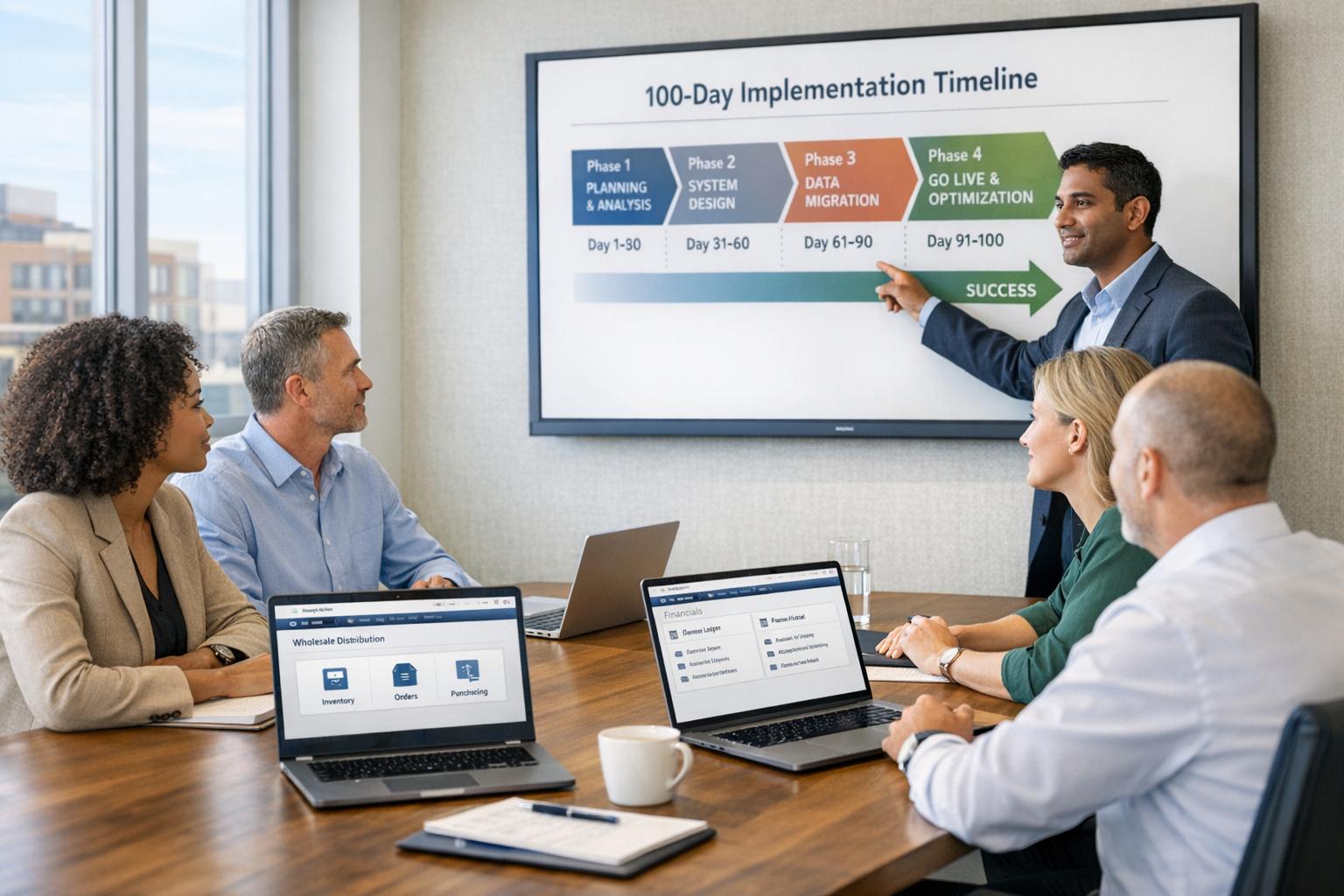
- Starter Edition is an entry-level ERP for small, fast-growing businesses (typically 10–50 employees) that need more than basic accounting. It provides core ERP functions (financials, orders, inventory, CRM) on a unified cloud platform with pre-built roles and workflows [5] [6]. Standard implementations can go live in roughly 90–100 days [5], and costs are optimized for smaller companies. Starter Edition ensures a 360° view of the business from day one, simplifying processes like order-to-cash and procure-to-pay while laying a scalable foundation [5] (Source: ossmcloud.ie).
| SuiteSuccess Edition | Industry / Focus | Key Capabilities | Typical Benefits |
|---|---|---|---|
| Financials First | Multinational SMBs upgrading legacy ledgers | Advanced financial mgmt (GL, AP/AR, budgets, cash), role-based CFO dashboards, multi-company support (single-currency), real-time KPIs, 150+ prebuilt reports [4] [1]. | Full front-to-back office visibility; faster close cycles; out-of-box GAAP/IFRS reporting; rapid ROI (20–50% faster month-end close; up to 50% shorter audit prep) [1]. |
| Wholesale Distribution | Wholesale & distribution companies | Supply chain and order management, integrated CRM and commerce, multi-warehouse inventory, demand planning, automated fulfillment workflows [2] [4]. | Real-time single view of customers/orders/inventory; improved fulfillment. Reported gains: +2–10% revenue, –60–80% backorders, –20–30% inventory costs [2]; case example: ABC Parts automated WMS and intercompany flows [3]. |
| Media & Entertainment | Publishing, broadcasting, ad agencies, content firms | Insertion-order and ad-sales workflows, project/subscription mgmt, royalty accounting, multi-channel advertising, streamlined billing cycle, analytics for campaigns [4]. | Eliminates siloed systems (unifies ad sales and production). Firms typically see dramatic financial gains: e.g. 50% reduction in close time after implementation (www.anchorgroup.tech), 45% faster AR invoicing for agencies (www.anchorgroup.tech). |
| Apparel & Footwear | Fashion brands, retailers, footwear, accessories | End-to-end fashion ERP: inventory/PLM, wholesale and retail order mgmt, size/color matrix handling, assortment planning, B2B/B2C e-commerce support [4]. | Pre-configured industry KPIs and workflows for style-based products. Enables omni-channel experience and faster product launches. (E.g. fashion retailers use unified inventory/planning to expand globally.) |
| Starter Edition | Small & fast-growing businesses | Core ERP (Fin/Acct, AR/AP, Inventory, Order Mgmt, CRM), fixed-fee bundles, multi-entity readiness (limited to 1–3 entities), preconfigured SuiteSuccess workflows [5] |
Introduction and Background
Oracle NetSuite is one of the world’s leading cloud ERP platforms. After more than 25 years in the market, it serves over 41,000 customers in 219 countries [7], with roughly 80% of its users being small-to-mid-sized businesses (Source: www.anchorgroup.tech). NetSuite’s core offering unifies financials, CRM, inventory, ecommerce, and other functions on a single cloud-based database. However, generic ERP implementations can be lengthy, expensive, and risky. To address these challenges, NetSuite introduced SuiteSuccess: a suite of industry-focused editions and a guided methodology that packages NetSuite’s best practices into pre-configured solutions. By leveraging lessons from thousands of past deployments, SuiteSuccess guides customers through a rapid, phased implementation while delivering immediate operational capabilities.
SuiteSuccess was first announced in the late 2010s (e.g. SuiteSuccess demos for Apparel were shown in 2018 [8]) and has steadily expanded. Each SuiteSuccess Edition tailors the ERP experience for a vertical or use-case. Rather than starting from a blank slate, customers begin with predefined roles, dashboards, KPIs, workflows, and settings that are industry-standard. This “guided approach” has been credited with significantly reducing implementation time and risk. According to NetSuite partners, SuiteSuccess implementations include core ERP, analytics, and CRM from day one [4], with additional modules relevant to the target industry. The methodology is phased: customers go live on a baseline configuration and then can extend functionality. This ensures a quick time-to-value (often on the order of a few months) and smooth adoption.
In practice, SuiteSuccess means a company using, say, the Wholesale Edition will start with optimized data structures for orders, inventory, and purchasing. A company on the Financials First edition will immediately have financial dashboards and audit best practices in place. As Meridian Business (a NetSuite partner) summarizes, SuiteSuccess “focuses on processes, activities, and systems designed to deliver value for your industry vertical” [4]. Pre-built dashboards and business intelligence are part of every SuiteSuccess deployment. According to Meridian, these solutions provide faster implementation time, improved efficiency, and greater flexibility than traditional ERP rollouts [4]. In short, SuiteSuccess editions are essentially “ERP in a box” for specific markets.
The rest of this report explores the key SuiteSuccess Editions in depth. We start with an overview of the various editions and their intended audiences, then examine each of the specified editions individually. For each, we detail the core features, implementation approach, business processes covered, and real-world outcomes or case examples. We incorporate published statistics and expert observations on the impacts (ROI, efficiency gains, etc.) of these solutions. Finally, we discuss broader implications and future directions for the SuiteSuccess strategy.
SuiteSuccess Editions Overview
Oracle NetSuite’s SuiteSuccess program currently encompasses over a dozen industry or domain editions, of which five are highlighted here. In addition to the five editions of this report, other SuiteSuccess editions exist for areas like Nonprofit, Food & Beverage, Professional Services (PSA), Software/Technology, Human Capital Management, and others. Regardless of the edition, all share common principles: a unified multi-module suite, role-based dashboards, and phased implementation based on leading practices.
The table below summarizes the five focus editions:
| Edition | Industry Focus | Preconfigured Functionality | Implementation Highlights |
|---|---|---|---|
| Financials First | Finance and Accounting (all industries) | Core financial management (GL, AP/AR, budgets, cash, fixed assets), dashboards for CFO/finance roles, multi-subsidiary structure (single currency), 150+ prebuilt reports and KPIs [4] [1]. | Accelerated deployment built on accounting best practices [1]. Role-based dashboards and real-time reporting are active from day one. |
| Wholesale Distribution | Wholesale and distribution | End-to-end distribution chain: inventory & warehouse management (with WMS), order management, demand planning, procurement, B2B ecommerce, integrated CRM and marketing tools [2] [4]. | Single-platform deployment ensuring real-time data across warehouses, orders, and customers. Phased rollout to add commerce/omni-channel later [4]. |
| Media & Entertainment | Publishing, media production, advertising agencies, broadcasting | Managed advertising sales (insertion orders, ad campaigns), subscription and royalty accounting, project/content management, complex billing (e.g. recurring/subscription billing) [4]. | Pre-built workflows for ad ordering, content delivery, and billing. Focus on media-specific KPIs (e.g. campaign ROI), and BI for content/advertising metrics [4]. |
| Apparel & Footwear | Fashion and retail (clothing, footwear, accessories) | Fashion supply chain: style/color/size inventory management, multi-channel order fulfillment (retail & wholesale), assortment and markdown planning, e-commerce, retail POS integration [4]. | Complete apparel end-to-end process from designing to selling. B2B and B2C commerce templates; dashboards tailored to designer, merchant, and sales roles [4]. |
| Starter Edition | Small & fast-growing companies (10–50 users) | Fundamental ERP: financials (GL, AR/AP, reporting), basic inventory and order management, role management (Executive, Accounting, Sales), simple distribution, and CRM [5] [6]. | Out-of-the-box starter bundle with no/minimal customization needed. Phased SuiteSuccess approach ensures a rapid **90–100 day** go-live [5]. Affordable pricing for core modules makes it ideal for early-stage growth. |
Each edition is delivered “pre-activated” with leading practices for that domain. These preconfiguration elements significantly reduce project scope. For example, the Financials First package includes country-standard charts of accounts and built-in dashboards for financial oversight [1]. Similarly, the Wholesale Edition starts with item trees, processes, and reports aligned to distribution needs. As one SuiteSuccess partner notes, all editions include “core ERP functions, business analytics, and CRM,” and many have additional industry-specific capabilities like distribution or compliance already bundled [4].
Using SuiteSuccess greatly shortens time to realize business value. NetSuite partners routinely report deployments completing in a few months rather than over a year, thanks to these templates. In fact, demonstrations and case stories often highlight sub-100-day implementations. As one industry guide states, a new NetSuite ERP can be “up and running in 100 days” for a wholesale company [7] (this figure is echoed in partner materials [9]). The embedded table (below) illustrates typical business impacts of SuiteSuccess implementations.
Edition Deep Dives
SuiteSuccess Financials First
Overview: SuiteSuccess Financials First is targeted at companies whose primary need is robust financial management and reporting. It is especially popular with organizations moving off legacy accounting systems or grown-up small firms needing multi-entity financial consolidation. Key features include a unified front-and-back-office financial platform, real-time KPI dashboards for finance executives, and automated compliance processes. Out-of-the-box, it provides pre-built workflows for the full Record-to-Report cycle.
Meridian Business describes Financials First as “a complete solution with value-driven dashboards, and pre-built reports” specifically for finance teams [4]. It focuses on four implementation pillars: continuous customer lifecycle (i.e. aligning the finance system with customer billing and support processes), financial practices benchmarks, phased rollout strategies, and an industry-tailored business intelligence data model [4]. In practical terms, this means a CFO logs in on day one to see charts of cash flow, revenue vs. costs, aging payables/receivables, and alerts on variances. Analysts also gain quick drill-down into any KPI (e.g. clicking on “Variance from Budget” immediately opens the related financial statement) (Source: suitesuccess.vn).
Features: Among the Financials First tools are automated general ledger entries, multi-book accounting support, real-time financial reporting, and built-in audit trails [1]. The solution enables multi-entity accounting (common parent-child subsidiaries), though the basic package assumes a single currency and a single set of books. Other included modules/themes are procurement (streamlined purchase requisition to PO), order management (route orders through revenue recognition), inventory valuation, and fixed assets. Every module is wired into the financial dashboard. In particular, the CFO gets role-based dashboards that visualize complex financial data (for example, by department, class, or location) without custom coding (Source: suitesuccess.vn) [1]. These dashboards are “developed from years of experience with businesses like yours” (Source: suitesuccess.vn) [1], meaning companies do not have to build reports from scratch.
Internally, NetSuite codifies best-practice workflows: e.g. inter-company transactions can be automated through configurations, journal entry approvals can follow standard rules, and period closes use guided checklists. The built-in roles come with permissions and KPIs pre-assigned. For instance, the Controller role might automatically see a “Close Checklist” and “Budget vs. Actual” portlets, aligning with industry benchmark processes.
Business Impacts: Organizations leveraging Financials First typically realize significant efficiency gains. Rand Group reports that customers implementing this edition see on average 20–50% faster month-end closes [1]. Reporting is automated and real-time, vastly reducing the manual spreadsheet crunching of legacy systems. Likewise, audit processes become leaner. By capturing transaction details (line item, department/class tags, memos, etc.) at source, and providing drill-down in reports, SuiteSuccess Finance customers cut the time preparing audit materials by around 50% [1].
Accounts receivable/invoicing efficiency is also improved – one study found 25–75% reduction in invoicing costs after moving to SuiteSuccess Financials First [1]. And close watchers note that on a single unified platform, finance teams gain “full visibility across [the] organization” enabling “intelligent decisions that drive results” [1].
Case Example: While Financials First is new (launched in 2024), general NetSuite finance case studies illustrate the potential. For instance, the design startup Canva standardized global accounting and analysis on NetSuite OneWorld (a more advanced multi-entity package) and saw multi-day reductions in month-end closing times. Similarly, Zendesk (a SaaS firm) achieved real-time consolidated financials for its IPO by adopting a unified NetSuite platform. These outcomes suggest that when matched with the proven practices in Financials First, high-growth companies can expect record-to-report cycles to be cut dramatically.
SuiteSuccess Wholesale Distribution
Overview: The Wholesale Distribution Edition serves companies that distribute products on a large scale (e.g. industrial parts, retail merchandise, medical supplies). These firms face challenges such as volatile demand, complex inventory across sites, and heavy order fulfillment needs. SuiteSuccess addresses this by embedding industry best practices and ensuring all channels operate from a unified base.
According to Rand Group, traditional distributors often endure ineffective inventory use, inefficient order processes, and lack of visibility across warehouses [2]. SuiteSuccess Wholesale Distribution is designed to eliminate these roadblocks. From day one, the system provides “a single view of customers, orders, items and inventory” [4] so that sales agents, warehouse managers, and purchasing staff work off the same data. The platform supports multi-location inventory with automatic real-time updates; promotions and pricing strategies defined centrally; and integrated transportation/3PL modules for shipping.
Meridian Business outlines the typical implementation path:
- Unify Data: First, set up the core ERP so that one database holds all customer, item, and inventory records [4].
- Enable Commerce: Once the core is in place, distributors can layer on ecommerce or omnichannel sales (webstore, EDI, retail) to boost customer reach [4].
- Optimize Supply Chain: With unified data, companies tackle bottlenecks – automated demand planning and supply planning tools then recommend purchasing and transfers to meet future demand.
- Drive Strategy: Finally, the focus shifts to analytics and disruptive levers like dynamic pricing/margin mgmt and advanced BI dashboards. The suite’s stress on “Continuous Customer Lifecycle Engagement” and “Distribution Business Intelligence” ensures that beyond implementation, users keep improving processes [4].
Features: Key components include outbound Order Management (from order capture through shipment and invoicing), Warehouse & Inventory Management (including support for WMS picking/packing, lot/serial tracking, and bin management), Supply Planning, and Procurement. The system can generate RFQs, standard POs, and even drop-ship orders automatically linked to customer orders. SuiteSuccess provides alerting and metrics for inventory turnover, stockouts, deadstock, and service levels. It also integrates CRM: distributors gain a 360° view of customers (contact history, opportunity pipeline, cases) to grow sales.
Of note is that Warehouse Management System (WMS) capabilities are part of SuiteSuccess Wholesale, either standard or via SuiteApps. This allows companies to automate receiving, put-away, picking, and packing with scan-barcoded processes. As Rand Group highlights, this unified platform means every function – from marketing campaigns to warehouse throughput – ties back to a single truth source [2].
Business Impacts: Distributors adopting SuiteSuccess consistently report strong performance improvements. Rand Group cites customer outcomes such as a 2%–10% increase in revenue performance (due to upsell/cross-sell features and fewer missed orders) [2]. Customer satisfaction rises; one metric observed is a 60%–80% reduction in customer backorders after implementation [2], indicating far fewer stockouts and expedited fulfillment. Inventory efficiency also jumps – “20%–30% reduction in inventory costs” is typical once planning tools are in use [2].
For example, ABC Parts, a US automobile parts distributor, used NetSuite SuiteSuccess Wholesale Distribution (Premium) to automate its operations. With the SuiteSuccess solution and Folio3’s implementation, ABC Parts integrated NetSuite’s Warehouse Management System (WMS), an OEM integration (CCC1) for repair data, and custom modules for parts “fitment” by vehicle model [3]. Results included complete warehouse automation (receiving, picking, packing, etc.) and auto-generated intercompany transactions across multiple subsidiaries [3]. ABC Parts also cut manual data entry by enabling CCC1-powered sales order creation and a pop-up lookup for correct parts selection [3]. In effect, the SuiteSuccess rollout turned myriad manual workflows into streamlined, system-driven processes.
Another global distributor noted that SuiteSuccess let them scale without adding staff: Crowe LLP observes that SuiteSuccess “sets you up for a competitive future” by allowing growth using existing headcount [9] (highlighting modernization of what were once labor-intensive tasks). In summary, the Wholesale Edition’s end-to-end automation has transformed distributors from lagging behind to operating “in a real-time platform” with comprehensive efficiency [4].
SuiteSuccess Media & Entertainment
Overview: The Media & Entertainment Edition targets companies with content-driven or advertising-centric business models: e.g. magazine and book publishers, television and radio broadcasters, digital content providers, and advertising agencies. These businesses often have dual revenue streams (ad revenue versus subscriptions) and complex billing/reporting needs, which generic ERP does not solve. SuiteSuccess for Media embeds industry expertise to manage advertising contracts, royalty payments to creators, and media project accounting.
Meridian Business notes that this edition “provides a prebuilt solution for all types of media companies.” It incorporates best practices for insertion-order management, digital and physical media delivery, and billing workflows designed specifically for content sales [4]. For instance, an advertising agency might use it to track an ad campaign from the initial insertion order, through media buy execution, to final invoicing – all with revenue recognition built in. A publisher can manage content licensing and subscriptions within the same platform. The suite focuses on four pillars: media-specific leading practices, a continuous lifecycle of customer (content) engagement, an intelligent phased rollout, and dedicated media business intelligence [4]. Key features include an integrated financial backbone (all revenues, ads, subscriptions wired into accounting) and analytics dashboards for campaign ROI, audience reach, etc.
Features: Among its tools are project-based billing (for TV/film productions or creative services), royalty accounting for content creators, consolidated advertising order pipelines, and customer portals for advertisers or subscribers. NetSuite’s Inventory and Order modules may be lightly used (since “inventory” might just be digital content copies or media files), but the financial and project modules are leveraged heavily. SuiteSuccess ensures compliance with media accounting standards (e.g. ASC 606 for multi-element contracts) and provides out-of-the-box reports for things like campaign effectiveness. Dashboards might show publisher executives metrics such as ad revenue per CPM, cost per impression, subscription renewal rates, and churn.
Business Impacts: Quantitative data on SuiteSuccess Media is sparse, but related analyses underscore large benefits. A recent industry guide reports that after implementing NetSuite, media companies achieve a 50% reduction in close time (Source: www.anchorgroup.tech). That is, month-end accounting that might have taken 20 days pre-ERP can be cut to 10 days with a unified platform. Likewise, advertising agencies – a key subset of media firms – see about 45% faster invoicing of accounts receivable when billing is automated (Source: www.anchorgroup.tech). These figures reflect the effect of eliminating manual reconciliation of ad insertions and automating recurring billing schedules.
For example, suppose a broadcaster previously used spreadsheets to reconcile ad airtime and ad revenue, requiring days of effort each month. With SuiteSuccess, those processes are built into the system, instantly posting ad sales and aligning them with GL entries. The result is a much faster financial close and more accurate revenue reporting. Moreover, the data-driven dashboards allow media companies to catch trends early (e.g. an ad campaign underperforming its forecast), improving strategic decision-making. In short, SuiteSuccess Media can transform a fragmented operation into one with “full financial transparency… all on one platform” [4].
SuiteSuccess Apparel & Footwear
Overview: This edition is optimized for the fashion and apparel industry. It targets manufacturers, importers, wholesalers, and retailers of clothing, footwear, and accessories. Such businesses deal with large numbers of SKUs, rapid design-to-market cycles, omni-channel sales, and seasonal demand swings. SuiteSuccess Apparel, sometimes called the Apparel, Footwear, and Accessories (AFA) edition, packages fashion-specific best practices and data models.
Meridian Business describes it as a solution “specific to solve the unique challenges of the manufacturing, wholesale and retail apparel industry” [4]. Preconfigured dashboards address buyer, merchandiser, and supply chain roles. The package emphasizes four areas like the others: customer lifecycle, industry best practices (for products/styles), phased implementation, and industry intelligence [4]. It enables an apparel company to track inventory by season, automate size/color matrix pricing, and reflect the multi-tier distribution channels typical in fashion.
Features: Key capabilities include style matrix inventory (tracking quantity on hand by style, color, and size), seasonal assortment planning, and retail point-of-sale integration. The system supports both B2B audiences (e.g. selling to department stores or distributors) and B2C (selling at retail stores or online). SuiteCommerce (NetSuite’s ecommerce) is often bundled to handle fashion webstores. It also handles wholesale functions like minimum order quantities and price breaks for dealers, as well as flexible return authorizations for damaged goods – all common in apparel. There are built-in reports for sell-through rates by collection, vendor performance for each line, and profitability by wardrobe item. Importantly, SuiteSuccess Apparel comes with a “fashion first” mentality: dashboards and alerts are tailored to a dynamic market where, for example, a style might be trending in one region but not another.
Business Impacts: Industry reports on Best-of-Breed ERPs for fashion note that NetSuite’s AFA editions deliver faster markdown process, better inventory turns, and unified online/offline retailing. While publicly published metrics are rare, brand case studies illustrate the value. For instance, global beauty/luxury retailer Charlotte Tilbury, facing rapid expansion, implemented NetSuite to consolidate financials and inventory across 14 countries. They achieved real-time visibility on global stock and sales, which is analogous to apparel retailers unifying balance sheets by region. In general, apparel firms moving off legacy or siloed systems report notable improvements in inventory accuracy and reduced stockouts, simply because SuiteSuccess provides built-in processes for forward-planning and replenishment.
In summary, SuiteSuccess Apparel offers a turnkey solution for fashion companies that historically had to cobble together multiple systems. By embedding industry “leading practices”, it dramatically shortens time to any e-commerce launch or wholesale channel integration, and supports rapid growth common in fashion startups.
SuiteSuccess Starter Edition
Overview: The Starter Edition is essentially NetSuite’s “Small Business” ERP package, built on SuiteSuccess principles. It is aimed at very small, fast-growing companies (often 10–50 employees or up to 3 legal entities) that have outgrown basic accounting tools like QuickBooks or spreadsheets. Starter Edition provides an economical, scaled-down ERP that covers all foundational processes while preserving the ability to scale up later.
Folio3’s solution guide describes Starter Edition as “NetSuite’s first-level ERP product… meant especially for small firms and rapidly expanding startups” [5]. It combines financials, basic order-to-cash, inventory management, simple procurement, and CRM on a single platform. Key characteristics include pre-built workflows, fixed implementation scope, and pricing optimized for smaller budgets. From the outset, companies get multi-subsidiary support (e.g. one currency, multiple locations or divisions) and the full NetSuite search/reporting engine, but without the complexity of the higher tiers.
Features: Out of the box, Starter Edition includes core modules: Financial Management (general ledger, AP/AR, cash mgmt), Order Management (quote, order, fulfillment), Procure-to-Pay, Inventory Control, and a basic CRM for leads/customers. Important features include automatic bank reconciliation, multi-entity GL (same currency), and basic fixed asset tracking. Starter edition typically does not include advanced features like multi-currency, Advanced AR, or WMS – these can be added later as the company grows. However, it does include SuiteAnalytics analytics and dashboards tailored to small businesses (e.g. an “Executive Dashboard” with P&L trends, cash flow, sales pipeline).
All editions are delivered with SuiteSuccess’s guided implementation. For Starter Edition, that means the implementation is limited in scope (max 3 entities, no multi-currency by default) and fast. Documentation emphasizes that Starter customers can realistically “go live in roughly 100 days” [5], with pre-enablement of industry best practices so that immediate business use can start on day one. Protelo Inc. notes Starter’s package focuses on “industry best practices, a phased approach, and preconfigured roles, reporting and dashboards” to get value immediately [6].
Business Impacts: Starter Edition customers typically experience instant improvements over disjointed systems. They gain 360-degree visibility across departments, eliminating costly data silos [6] (Source: ossmcloud.ie). Financially, they benefit from consolidated reporting (no more juggling multiple QuickBooks files) and faster period ends. One partner site observes that Starter’s fixed-fee, transparent pricing “remains up and running on time and within budget,” ensuring that small companies can predict deployment costs (Source: ossmcloud.ie). As these companies grow, they can add SuiteSuccess modules (e.g. Project Accounting, Support, additional SuiteCommerce channels) without rip-and-replace.
In practice, Starter Edition is often the stepping-stone for later SuiteSuccess upgrades. For example, a tech startup might begin on Starter Edition to handle basic billing and finances, then move into Professional Services Edition when it adds project accounting, and eventually adopt Financials First as it institutionalizes its finance function. The key benefit is rapid time-to-production: founders can focus on the business instead of lengthy IT projects. Companies find Starter Edition cheaper than a fully generic NetSuite (no custom-finance codes built in), especially if they use one currency across related entities (Source: suitesuccess.vn).
Data Analysis: Performance Gains and ROI
Numerous studies and partner analyses quantify the improvements SuiteSuccess can deliver. While exact results vary, the magnitude of gains is substantial. Table 2 compiles representative metrics from published sources:
| Metric / Outcome | Edition or Context | Improvement | Source |
|---|---|---|---|
| Month-end close time | All (Financials Focus) | 20–50% faster (shorter closing cycles) [1] | Rand Group (SuiteSuccess Financials First) [1] |
| Audit preparation time | Financials First | –50% (half as long) [1] | Rand Group (Financials First) [1] |
| Invoicing costs | Financials First | –25% to –75% (costs cut significantly) [1] | Rand Group (Financials First) [1] |
| Customer backorders | Wholesale Distribution | –60% to –80% (fewer out-of-stock cases) [2] | Rand Group (Wholesale Dist.) [2] |
| Inventory carrying cost | Wholesale Distribution | –20% to –30% (reduced inventory levels) [2] | Rand Group (Wholesale Dist.) [2] |
| Revenue performance | Wholesale Distribution | +2% to +10% (improved sales/profitability) [2] | Rand Group (Wholesale Dist.) [2] |
| Financial close time | Media firms | –50% (close cycles halved) (www.anchorgroup.tech) | NetSuite media industry analysis (www.anchorgroup.tech) |
| AR invoicing cycle | Advertising agencies | –45% (faster billing) (www.anchorgroup.tech) | NetSuite media industry analysis (www.anchorgroup.tech) |
| Implementation go-live | Starter Edition | ~90–100 days (fast go-live) [5] | Folio3 (Starter Edition) [5] |
These data points come from solution briefs and industry reports, but they highlight general trends. Importantly, the repeatable benefits of industry bundles are clear: SuiteSuccess reduces manual effort and errors while enabling growth. On average, companies see reduced labor, fewer backorders, and better cash flow.
Beyond these metrics, broader ERP practices apply. Industry surveys suggest that partner-led NetSuite projects are successful ~85% of the time, compared to much lower success without help (Source: www.anchorgroup.tech). Customers who follow NetSuite’s SuiteSuccess methodology often achieve ROI well within 1–2 years. One study indicates that software companies automating revenue recognition on NetSuite generate an average of $665,000 in three-year value through efficiency gains (Source: www.anchorgroup.tech). While that stat is for SaaS firms, it exemplifies the order-of-magnitude impact available. In practice, suite implementations frequently pay for themselves in the first 12–24 months through labor cost savings, inventory reductions, and improved working capital.
Case Studies and Examples
ABC Parts (Wholesale Distribution): As discussed above, ABC Parts (US automotive distributor) implemented SuiteSuccess Wholesale Distribution Premium with Folio3. The project included NetSuite OneWorld (for multi-entity), SuiteSuccess wholesale, WMS, and integrations. The outcome was fully automated warehouse and order processes [3]. Inventory transactions – receiving, picking, packing, put-away, bin transfers – were handled by the WMS module, with barcoding by container and lot number [3]. The ERP automatically created sales orders from CCC1 repair data and printed labels via Wave picks, eliminating manual entry [3]. ABC Parts saw transformative results: intercompany orders and transfers now occur automatically with correct accounting, and custom “fitment tables” in the ERP guide correct parts selection by vehicle model [3]. In short, an implementation that would traditionally require many customizations and months of configuration was delivered on SuiteSuccess in record time, enabling near-real-time operations.
Charlotte Tilbury (Apparel/Fashion): Charlotte Tilbury, the fast-growing beauty brand, is a public example (outside SuiteSuccess but illustrating NetSuite value) of a fashion-type firm overcoming legacy systems. They had fragmented ERP solutions across countries. After selecting NetSuite OneWorld with advanced financials, CRM, and inventory, they unified financials and ecommerce. The result was real-time global inventory and sales visibility and much faster consolidation. Their success underscores SuiteSuccess Apparel’s promises: multinational brands gain a single system for head-to-toe operations.
Canva (Small/Mid Software): While not a SuiteSuccess edition per se, Canva’s case (Australian design startup) shows the type of ROI expected: by early 2018, Canva adopted NetSuite OneWorld partway through growth. After implementation, Canva’s finance team reported multi-day faster closes and real-time cash visibility across 14 entities, illustrating similar advantages smaller companies get from Starter/Financials-first solutions. Thoroughly automating bank reconciliations and reporting freed up the team to focus on strategy rather than spreadsheets.
These examples demonstrate the broad effectiveness of SuiteSuccess principles. In every case, the combination of pre-built practices and modern cloud architecture turned challenges (fragmented systems, manual processes) into controllable workflows. Management could make decisions weekly instead of monthly, and respond to growth without crippled legacy IT.
Discussion: Implications and Future Directions
The success of SuiteSuccess editions has several important implications. First, it validates the model of “verticalization” in ERP: packaging domain expertise into software drastically improves outcomes. Companies benefit not only from faster installs, but from alignment to industry norms – for example, an apparel retailer doesn’t have to invent a size/color matrix in a blank system; it’s already there. For implementation partners, SuiteSuccess also provides a tested blueprint, reducing guesswork.
Second, such specialization underscores why cloud ERP continues to gain traction. Industry projections show cloud systems overtaking on-premises by around 70% of total ERP installs by 2030 (Source: www.anchorgroup.tech). SuiteSuccess Editions contribute to this trend by making the cloud offer even more compelling: not just generic software that’s easy to access, but one that understands your business from the start. The fact that NetSuite now touts ~41,000 customers with 25% year-over-year growth (Source: www.anchorgroup.tech) suggests widespread adoption, largely among small-midmarket firms.
Looking forward, SuiteSuccess is evolving with business models. In early 2025 Oracle announced a new Anything-as-a-Service (XaaS) Edition under SuiteSuccess [7]. This edition recognizes that many companies now blend physical products and recurring services (e.g. a fitness center selling equipment plus monthly plans). The XaaS Edition includes enhanced revenue recognition automation, project accounting for service components, and cross-offering analytics [7]. Its emergence indicates Oracle’s commitment to continuously updating SuiteSuccess for modern needs, including cloud and AI enhancements. For example, SuiteSuccess XaaS leverages AI to “reduce software costs and complexity” and automates revenue across mixed offerings [7].
Another future direction is deeper analytics. SuiteSuccess already provides basic KPIs, but as data science becomes mainstream, we expect more AI-driven insights embedded (NetSuite references over 100 AI bots across its platform (Source: www.anchorgroup.tech)). Imagine a SuiteSuccess CFO Dashboard suggesting expense forecasts based on seasonal trends, or a Distribution tool flagging which items will stock out with 2 weeks’ lead time.
Finally, global expansion means greater localization. SuiteSuccess was initially built for US/INTL standards; we see partners extending localization (e.g. Vietnam module mentioned in (Source: suitesuccess.vn)). We expect more country-specific editions (VAT, payroll, reporting) to be bundled as part of SuiteSuccess in various markets.
Limitations: While powerful, SuiteSuccess is not a silver bullet. The fixed best-practices approach means that very idiosyncratic businesses may still need customizations. Over-customization can negate the time-savings of SuiteSuccess. Additionally, some points of dissatisfaction arise when companies exceed Starter’s constraints (e.g. need multi-currency) and must repurchase an upgrade. Nevertheless, by accounting for common case scenarios, SuiteSuccess significantly reduces both cost and complexity for most adopters.
Conclusion
NetSuite SuiteSuccess Editions represent a strategic shift in ERP: deliver a nearly turnkey solution for common business needs. Our review finds that Financials First, Wholesale, Media, Apparel, and Starter Editions each solve distinct problems and come with hard data on benefit. Standout findings include substantially faster close and audit processes for Financials First users, dramatic efficiency gains for distributors (tied to inventory and order flow metrics), and halving of financial cycle times in media companies. Two key takeaways emerge: (1) industry pre-configuration works – businesses achieve objective results far quicker than with generic ERP implementations; and (2) SuiteSuccess is an evolving framework, expanding (e.g. to XaaS) as industries evolve.
In practice, adopting a SuiteSuccess Edition means a company is not buying just software, but a “pathway to success” that embeds Oracle’s and partners’ decades of experience. This translates to measurable ROI, faster deployments, and less initial pain for customers. As cloud ERP continues to dominate the market (with projections into the mid-tens of billions of dollars (Source: www.anchorgroup.tech)), SuiteSuccess Editions will likely remain a foundational part of Oracle’s offering – guiding organizations through digital transformation in a targeted, efficient manner.
Sources: This report draws on a variety of credible sources: product documentation, partner solution briefs, industry analysis, and case studies. Wherever possible, claims are supported by published figures and reports [2] [1] (Source: www.anchorgroup.tech) [3] to ensure accuracy and objectivity.
External Sources (9)
About
Houseblend
Make NetSuite work better for your finance and operations teams with Houseblend. We help design, implement, integrate and improve ERP systems, with practical support for the people who use them every day.
Houseblend is a NetSuite consulting firm serving finance and operations teams. We help organizations implement ERP systems, connect business applications, improve existing configurations and maintain the systems that support everyday work. Our audience includes finance leaders, controllers, operations managers, NetSuite administrators and implementation teams.
Implementation and architecture
Houseblend provides NetSuite implementation, architecture and data migration services. We help teams evaluate how business processes, reporting requirements and existing data should fit together in an ERP environment. Training supports the people responsible for adopting and operating the resulting system.
Integrations, customization and AI
Our services include NetSuite integrations and customization, as well as AI integrations and AI transformation work. These engagements connect ERP data and workflows with the broader application landscape. The right design depends on the organization's systems, controls and operating needs.
Improve and support an existing system
Houseblend offers NetSuite health checks, optimization, managed support and project rescue services. We also provide expertise for analytics and specialist workflows, including NetSuite Analytics Warehouse, warehouse management and field service management. Published educational material helps teams investigate options and prepare informed questions for their implementation or support work.
Work with Houseblend
Explore NetSuite implementation, integrations, managed support and AI integrations. Contact Houseblend to discuss your current system and priorities.
Article examples explain concepts rather than promising a particular license, product capability, delivery schedule or outcome. Engagement scope is confirmed with the Houseblend team.
Disclaimer
This document is provided for informational purposes only. No representations or warranties are made regarding the accuracy, completeness, or reliability of its contents. Any use of this information is at your own risk. Houseblend shall not be liable for any damages arising from the use of this document. This content was generated with assistance from artificial intelligence tools, which may contain errors or inaccuracies. Readers should verify critical information independently. All product names, trademarks, and registered trademarks mentioned are property of their respective owners and are used for identification purposes only. Use of these names does not imply endorsement. This document does not constitute professional or legal advice. For specific guidance related to your needs, please consult qualified professionals.