Houseblend Article
Oracle OCI Multi-Agent AI: NetSuite Workflows Explained
Inside this article
- 01Executive Summary
- 02Introduction and Background
- 03Oracle Orchestration and Agentic AI on OCI
- 04Multi-Agent AI Workflows: Concepts and Technology
- 05NetSuite Context: ERP Workflows and AI Features
- 06Multi-Agent NetSuite Workflow Use Cases (CFO Examples)
- 07Data Analysis: CFO Perspectives and Outcomes
- 08Case Studies and Vendor Perspectives
- 09Implications, Best Practices, and Future Directions
- 10Conclusion
- 11References
Executive Summary
Modern finance organizations are undergoing a seismic transformation driven by cloud computing and artificial intelligence. What was once a predominantly manual, spreadsheet-driven function is rapidly evolving into an automated, “agentic” enterprise where AI-driven agents orchestrate complex financial workflows. Oracle plays a central role in this shift: its NetSuite ERP platform now incorporates AI features, and Oracle Integration Cloud enables multi-system orchestration for finance processes. This report analyzes the emerging paradigm of multi-agent NetSuite workflows on Oracle Cloud Infrastructure (OCI), aimed at CFOs and finance leaders. We explain how AI agents and orchestration layers can unite ERP, CRM, and other systems, automating tasks that traditionally required time-consuming manual intervention. We draw on surveys and studies showing that CFOs “have fundamentally shifted” to aggressive AI investment [1] [2], expecting large returns in efficiency and revenue. We review vendor solutions – from Oracle’s own agentic integration platform to startups like Cauzzy and Grail – and real-world examples (e.g. Liquid AI’s use of FloQast AI agents) demonstrating shortened close cycles and error reduction. Finally, we discuss implications for governance, risk, and the future CFO role, citing market forecasts (the multi-agent systems market is projected to grow ~47% CAGR over 2026–2031 [3]) and highlighting best practices for safe, transparent adoption.
Introduction and Background
The role of the Chief Financial Officer (CFO) has expanded from financial steward to strategic architect of business operations. In an era of tight budgets and competitive pressure, CFOs are dramatically increasing investment in technology, particularly AI. A Deloitte survey found 96% of finance leaders expect higher tech spending in the next five years [2], with artificial intelligence cited as a key lever for productivity and performance improvements. Critically, the traditional CFO focus on immediate Return on Investment (ROI) is giving way to broader metrics: a KPMG study reports 76% of executives now measure AI ROI by productivity gains, 71% by work quality, 67% by decision speed, whereas only 64% even rate profitability in ROI [4]. Nearly two-thirds (65%) will invest in AI even if measurable financial ROI is unclear [4]. In short, CFOs are betting that agentic AI systems can transform finance.
These systems automate workflows across an enterprise stack – ERP, CRM, Human Resources, Supply Chain, and more – without human intervention. Instead of dragging data through spreadsheets or rote RPA bots, AI agents “receive a goal” and collaborate using integrations as tools. A new wave of frameworks (“Agentic Enterprise” [5] [6]) and products (Oracle Integration Cloud with agentic AI [7] [8], IBM watsonx Orchestrate for finance [9]) promises to turn enterprise systems into a “unified operational nervous system” [10]. Oracle, for example, now embeds “over 50 AI agents” across its Finance Cloud suite to enable “touchless” accounting processes (Source: www.pkf.com.au). Such agentic architectures can autonomously process invoices, reconcile accounts, replenish inventory based on real-time data, and more, while CFOs oversee the strategy and govern the policies.
For CFOs running NetSuite ERP on Oracle Cloud Infrastructure (OCI), this trend raises the question: How can “Oracle Orchestrate” and multi-agent AI empower financial workflows? NetSuite already offers built-in workflow tools (SuiteFlow) and emerging AI features (e.g. invoice capture, forecasting), but these are typically static and siloed. The new approach layers Oracle’s cloud-native services (Integration, AI, Digital Assistants) on top, enabling flexible, cross-system automation.
Oracle Orchestration and Agentic AI on OCI
Oracle’s cloud platform is evolving to support multi-system orchestration through AI. While Oracle’s traditional stack included job- and script-based solutions, its modern approach relies on cloud-native integration and agentic AI. Key components include:
-
Oracle Integration Cloud (OIC): A PaaS integration platform on OCI that provides hundreds of prebuilt connectors (adapters) for ERP, CRM, and databases [11]. OIC can design flows for common processes (e.g. procure-to-pay, hire-to-retire, lead-to-invoice) using visual tools, and it now includes agentic AI capabilities. Oracle explicitly positions OIC as “what makes AI agents work” [11]. For example, OIC allows any integration to be exposed as an MCP server (Model Context Protocol) so that external AI agents can call it as a tool. With one click, customers “convert their trusted application integrations into MCP servers that give agents the enterprise data and predictable automation they need to act” [11]. In practice, this means Oracle can take existing NetSuite, Fusion, or other integrations and let GenAI-powered agents use them autonomously.
-
Oracle AI Agents (Agentic AI): Oracle’s integration documentation describes an AI agent as a software entity with a Large Language Model (LLM) “that reasons… to achieve a specific goal without human intervention” [8]. These agents harness OIC integrations as tools – for instance, an agent could decide between several sub-flows or API calls depending on context. Oracle provides out-of-the-box “thinking patterns” (e.g. ReAct or Plan-and-Execute) and a framework for human-in-the-loop approvals [8].Thus, a multi-step order-to-cash or reconciliation process can be orchestrated by an agent that dynamically chooses what actions to take at each step (see “How Integrations and AI Agents Fit Together” [8]).
-
Oracle NetSuite Adapter: Oracle offers a dedicated NetSuite Adapter for OIC, enabling seamless cloud integration. Administrators can create OIC connections to NetSuite, use triggers on NetSuite events (e.g. record creation), and perform CRUD operations on NetSuite records [12]. In the agentic scenario, these adapters become callable by AI agents. For example, an agent might automatically post a set of invoices or approve payments directly in NetSuite via the adapter, as described in Oracle’s documentation.
-
Oracle AI Agent Studio: Oracle’s AI Agent Studio for Fusion (referenced on oracle.com) allows building and managing multi-agent scenarios. Although primarily marketed for Fusion Applications, the underlying principles (agents using OIC tools) apply to any ERP, including NetSuite. CFOs should note that Oracle has invested heavily in this space: its 2025 ISG report named Oracle as a market leader in AI Agents.
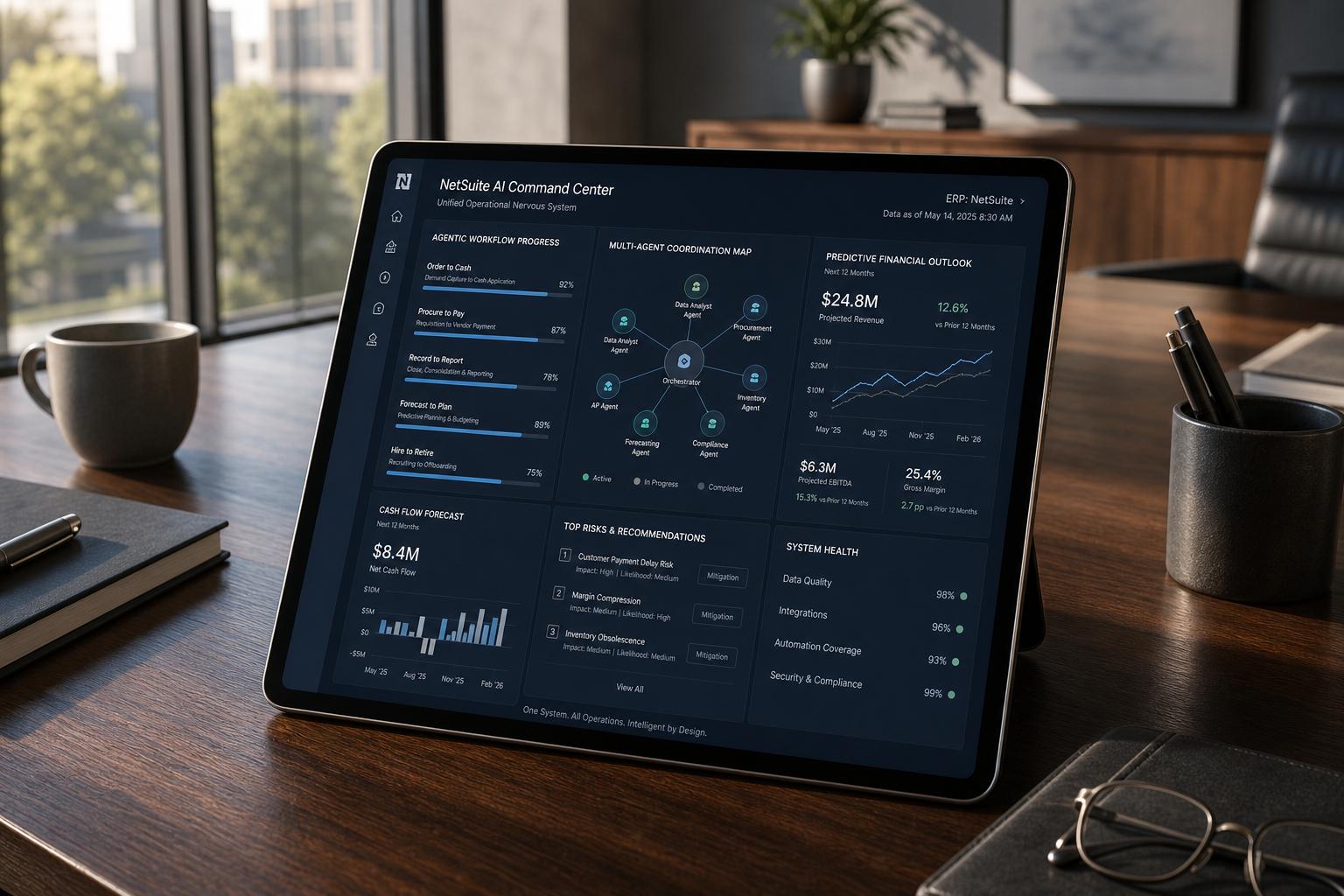
In summary, Oracle’s orchestration vision on OCI is to transform integration flows into adaptive, governed processes. Figure 1 illustrates the high-level concept: multiple AI agents (possibly controlled via Oracle’s GenAI services) converse through an OIC “connectivity layer” with ERP/CRM systems. Each agent can read from and write to NetSuite and other systems, according to business rules. Importantly, Oracle ensures that actions remain within the enterprise’s control – it emphasizes that automation in Oracle’s framework is “governed, explainable, and recoverable” [11].
Figure 1: Multi-Agent Orchestrations on Oracle Cloud Infrastructure (OCI). AI agents (green) use a Model-Context protocol to call Oracle Integration tools (blue), which connect to enterprise systems like NetSuite ERP. This layered approach enables autonomous workflows while maintaining governance. (Illustration based on Oracle documentation [7] [8].)
Multi-Agent AI Workflows: Concepts and Technology
A multi-agent workflow breaks down a business process into specialized tasks, each handled by an AI agent. Unlike a single fixed integration flow, agents can coordinate, split tasks, and adapt. For CFO-relevant processes, this is key: financial workflows often involve exceptions and human decisions. StackAI succinctly defines a multi-agent workflow as one “where multiple specialized AI agents coordinate to complete a business outcome,” with each agent having “defined roles, limited permissions, [and] specific tools” [13]. For example, one agent might fetch and prepare data, another might apply accounting rules, and a third might post entries back into NetSuite, deciding at runtime which branch to follow.
In practical terms, multi-agent workflows offer several advantages over traditional RPA or scripting:
- Adaptability: Agents use LLM reasoning to handle variability. If a supplier invoice is missing data or flagged for mismatches, the agent can “decide which step to take” (for example, create a support ticket or escalate for human review) instead of failing outright [8]. In contrast, a static workflow would need every scenario pre-programmed.
- Modularity and Scale: Agents can run in parallel or sequence. Some tasks (e.g. running multiple forecasts) can have agents working simultaneously. Agents also allow combining advanced functions like document AI (OCR/LLM) with integrations. StackAI notes that this design makes processes “reliable, observable, governed, and measurable” because each agent’s actions are logged [13].
- Tool Abstraction: Crucially, in Oracle’s model every Mark-to-Market LLM agent leverages integrations as tools [8]. For example, an AI agent need not know how to parse a CSV; it simply invokes an Oracle Integration that reads the CSV into NetSuite. The integration is a black-box tool from the agent’s perspective. This separation of “thinking” (LLM) from “doing” (integration/API) is a powerful pattern.
Oracle and others have outlined typical components of a multi-agent finance workflow. Agents often use “prompt templates” and can be given explicit instructions (system prompts) for each role [8]. The system supports human-in-the-loop controls – e.g. an agent can pause for an accountant to approve large transactions [8]. The underlying data may be stored in vector knowledge bases (RAG) so that agents can answer queries about corporate policies [8]. In effect, the workflow evolves from a rigid script into an autonomous decision engine, aligning with CFO Tech’s vision of an “operating infrastructure” that can “read, reason, and act” across systems [5] [10].
Traditional vs. Agentic Workflows
To clarify the difference, consider accounts payable approval: a classic ERP workflow would statically route invoices from AP clerks to managers based on fixed rules. If a manager is absent or an exception arises, manual workarounds apply. In an agentic setup, AI agents could automatically route invoices and request approvals from appropriate individuals, even handling escalations. For example, Oracle Integration’s Invoice Processing workflows can be augmented by agents that verify invoices via language understanding and make risk-based decisions. IBM reports that automating invoice processing via AI agents can cut cost per invoice by ~25% and shorten cycle times by ~32%, significantly reducing errors and fraud [9].
Agent Coordination and the Model Context Protocol
Underlying Oracle’s approach is the Model Context Protocol (MCP) – a standard that lets disparate AI frameworks interoperate with integration tools [7]. In practice, an Oracle project can be an MCP server, publishing its integrations for external agent frameworks. This means an LLM running in Oracle AI Agent Studio, or even an external agent framework (LangFlow, Meta’s Llama, etc.), can discover Oracle’s NetSuite integrations as callable “tools” on the network [8]. Such openness ensures flexibility. For instance, a finance team could build agents in a preferred environment (Oracle’s or third-party) but still use their Oracle-based integration flows.
By design, every step a configurable agent takes goes through known APIs or integrations. This gives the organization full awareness and control: audit trails and governance are built-in at the integration layer. Human approval gates are integrated as steps. Oracle emphasizes explainability – every final action is tied to a documented integration invocation, making the system “recoverable” by re-running a step if needed [11].
NetSuite Context: ERP Workflows and AI Features
NetSuite, acquired by Oracle in 2016, is a leading cloud ERP for mid-sized to large businesses. It includes financials, supply chain, CRM, and more. For CFOs, NetSuite manages core processes like ledgers, payables, receivables, and inventory. Two aspects of NetSuite are relevant:
-
SuiteFlow (Native Workflows): NetSuite’s built-in workflow engine (SuiteFlow) allows administrators to create state-based workflows for record types (invoices, orders, etc.) [14]. For example, a finance team can define an approval workflow that sends an invoice through states (Submitted → Approved → Paid) based on conditions or user actions. However, SuiteFlow is fundamentally static and rule-based. Each possible transition and action must be pre-defined, and handling unexpected cases often requires manual intervention or exception events. In short, SuiteFlow can enforce business process flows within NetSuite, but it cannot dynamically orchestrate across systems or adapt on its own.
-
AI and ML Features in NetSuite: Oracle has been adding AI/ML capabilities into NetSuite. For example, NetSuite’s “Bill Capture” uses optical character recognition and AI to scan supplier invoices and populate fields – automating data entry [15]. Another feature, “Intelligent Forecasting and Recommendations,” uses machine learning to predict sales or inventory needs. NetSuite also mentions background anomaly detection for security [15]. These features can reduce manual effort (e.g. NetSuite claims AI-driven budgeting and forecasting can improve accuracy) but they are typically single-point solutions (they assist within NetSuite’s own modules). They do not by themselves perform multi-system orchestration.
Despite these advances, many CFO tasks still require moving data between systems (e.g., pulling CRM sales into NetSuite for revenue recognition, or pushing budget updates from Excel into NetSuite). This is where Oracle’s OCI-based orchestration comes in. By connecting NetSuite with other applications (via OIC or third-party tools), AI agents can bridge gaps. For example, CFO Tech notes that older ERPs like NetSuite “were built to record transactions, not to coordinate autonomous action across the broader stack” [5]. Agentic orchestration layers such as Zaptiva or Oracle Integration address this gap by enabling action inside NetSuite as part of a wider AI-driven workflow.
Multi-Agent NetSuite Workflow Use Cases (CFO Examples)
To illustrate the possibilities, consider financial workflows where multi-agent orchestration can add value:
-
Month-End Close: Closing the books involves coordinating data from sub-ledgers, performing reconciliations, generating reports, and adjusting entries. Traditionally, this is one of the most labor-intensive CFO processes. The goal of multi-agent automation is to shrink cycles. A recent case study shows the impact: a specialty chemicals company implemented an AI-driven finance platform (using Claude 3.5 and agents) and cut its month-end close from 11 days to 3 days, saving ~$850K [16]. In practice, agents could ingest NetSuite transaction data, auto-reconcile bank accounts, flag anomalies for human review, and auto-post standard adjusting entries.
-
Accounts Payable/Receivable (P2P/C2C): CFOs often optimize procure-to-pay to improve cash flow. An intelligent agentic workflow would analyze NetSuite payables and AR, predict optimal payment scheduling based on cash forecasts, and even negotiate payment terms. IBM’s FAQs highlight invoice processing: an AI agented process of invoice capture and matching lifted invoice processing throughput dramatically, as noted in a use case achieving 25% lower cost per invoice and 32% faster cycle [9]. Agents might also integrate with treasury systems: for example, one agent checks FX rates and another schedules payments when rates are favorable.
-
Intercompany and Allocations: Global companies often need to allocate costs across subsidiaries (e.g. transfer pricing, overhead allocation). These tasks involve combining data from multiple ledgers and applying formulas. In one case, Liquid AI (a tech startup using NetSuite) built eight custom AI agents for such purposes [17]: some handled routine journal entries and bonus accruals, while others did complex allocations (rent by headcount, R&D expenses by project, etc.). This allowed them to handle multi-department distribution without hiring controllers. Such agents essentially extend NetSuite by dynamically computing and posting intercompany entries. A CFO can define rules (“cost per employee for each office”), and an agent can query Netsuite and HR systems (via OIC) to execute them.
-
Financial Planning and Analysis (FP&A): Budgeting and forecasting often involve aggregating data into planning models. Multi-agent orchestration can automate parts of this: one agent might pull sales data from NetSuite and CRM, another runs it through a forecasting model (e.g. a Snowflake-based DWH or ML service), and a third updates NetSuite Budget records. If forecasts deviate significantly, an agent can alert the finance team or trigger deeper analysis. HaleVu’s “Friedo”, and OneStream’s “Governed AI agents,” are examples of finance AI platforms aiming at these tasks.
-
Audit and Compliance Controls: CFOs are rightly concerned about risk. Multi-agent designs include strict audit trails – each agent action is an integration call that is logged. For instance, an agent that “auto-approves” petty cash spending would still record every decision. CFO tech vendors emphasize a “sovereign” framework: one press release says their solution “ensures all automation operates within a sovereign framework where business intelligence remains fully owned and controlled” [10]. In practice, this translates to encryption, on-prem or VPC-based execution, and complete logging.
These examples illustrate that NetSuite need not change; rather, Oracle’s OCI layer sits on top. Think of NetSuite as the secure database and book-of-records, while AI agents plug into the APIs. This allows CFOs to reuse existing ERP processes. For instance, the Liquid AI case study notes that the company went from QuickBooks to NetSuite and then used FloQast’s AI agents to preserve a four-day close without extra headcount [17]. In effect, NetSuite continued to handle core accounting, while the AI layer produced those entries.
Data Analysis: CFO Perspectives and Outcomes
Empirical data underscore the transition to agentic finance automation:
-
CFO Adoption Trends: A 2025 Salesforce study (reported by ITPro) found that only 4% of CFOs remain cautious about AI (down from 70% in 2020) [1]. One-third of CFOs now take an “aggressive approach” to AI, embedding it across business functions [1]. Notably, CFOs are reallocating how they measure ROI: 61% say AI agents have changed ROI metrics to focus on productivity and efficiency instead of only financial returns [1]. The average finance team now dedicates roughly 25% of its AI budget to agentic AI specifically [1], reflecting the priority CFOs place on autonomous processes.
-
Performance Gains: CFOs expect significant gains from agents. For instance, nearly 3/4 believe AI agents will cut costs and increase revenue by up to 20% [1]. Such optimism is justified by early evidence: IBM reports that organizations using AI automation gain faster budget cycles (up to 33% faster) and drastically fewer errors [9]. Microsoft internal programs found 97% reduction in tax file prep time and 50% cut in reconciliation effort after deploying AI agents (Source: www.pkf.com.au). These figures illustrate potential improvements in both efficiency and accuracy.
-
Risks and Governance Concerns: The rapid move to AI has raised governance flags for CFOs and CIOs alike. In the same Salesforce survey, 66% of CFOs identified AI-related privacy risks as a top concern [1]. Over half (56%) worried about the (still-long) timeframe to realize returns [1]. A Grant Thornton and KPMG survey similarly found that executives admit their companies could fail an AI governance audit, and that data privacy and cybersecurity are key barriers [4]. In practice, savvy CFOs are therefore demanding transparency (what Oracle calls “explainable actions” [11]) and enforcing human approvals on critical decisions (the human-in-loop strategy [8] [4]).
-
AI Agents Adoption Metrics: According to KPMG, 94% of organizations are already using or planning to use AI agents in some capacity [4]. Of these, 19% are scaling agents widely, 13% are building multi-agent systems, and 8% are actively orchestrating multiple agents across workflows [4]. This indicates that multi-agent orchestration is moving from pilot to early deployment in many firms. Moreover, 39% of respondents said they implement a human-in-the-loop approach, and 37% restrict agent access to sensitive data without oversight [4] – showing attention to control.
These data emphasize the CFO community’s shift: agentic AI is no longer a novelty but a strategized investment. As Salesforce’s former CFO put it, agents are causing CFOs to “fundamentally reshape” their function [1]. A Deloitte executive notes that CFOs have “openly changed their tune” on AI’s performance benefits [2].
Finally, market analysts foresee explosive growth. The global Multi-Agent Enterprise Systems market is projected to expand from roughly $7.1B in 2026 to $49.6B by 2031 (≈47% CAGR) [3]. The Enterprise Agentic AI market is similarly expected to skyrocket. This underscores that the multi-agent orchestration wave will touch all domains, including finance. CFOs should interpret these trends as validation that the technology is maturing, but also act quickly to define strategy and governance before reactive catch-up becomes too costly.
| ROI and Outcome Metrics (AI Agents) | Percentage | Source |
|---|---|---|
| CFOs measuring ROI by productivity gains | 76% | KPMG Survey (April 2026) [4] |
| CFOs measuring ROI by decision speed | 67% | KPMG Survey [4] |
| CFOs measuring ROI by profitability | 64% | KPMG Survey [4] |
| Organizations planning to invest regardless of ROI measurement | 65% | KPMG Survey [4] |
| Cost reduction per invoice achieved via AI agents | ~25% | IBM (watsonx Orchestrate case study) [9] |
| Cycle time reduction per invoice (AI) | ~32% | IBM (watsonx Orchestrate case study) [9] |
| Reduction in tax prep time (AI automation) | 97% | Microsoft Internal (PKF report) (Source: www.pkf.com.au) |
| Reduction in reconciliation effort (AI) | 50% | Microsoft Internal (PKF report) (Source: www.pkf.com.au) |
| Reduction in finance helpdesk tickets (AI) | 70% | Microsoft Internal (PKF report) (Source: www.pkf.com.au) |
Table 1: Key CFO/finance metrics related to AI agent adoption and impact, from recent industry surveys and case studies [4] [9] (Source: www.pkf.com.au). CFOs track productivity gains and process improvements more than short-term profit, reflecting a shift in ROI thinking.
Case Studies and Vendor Perspectives
Below we examine representative solutions and examples illustrating multi-agent NetSuite workflows. These highlight both the potential benefits and the practical considerations for CFOs.
Oracle Integration Cloud (Vendor Perspective)
Oracle Integration Cloud (OIC) – Oracle’s own platform – seeks to be the foundation for agentic finance. As noted earlier, Oracle’s literature states that converting integrations to MCP servers is a “single click” way to equip AI agents with trusted interfaces [11]. Oracle also emphasizes governance: OIC’s agentic AI features include natural language authoring and real-time observability so that every automated action is “explainable, governed, and recoverable” [11].
In customer stories (webinars and case studies), Oracle cites examples like: a logistics company using OIC to automate order-to-cash across SAP and NetSuite, and an insurance firm using AI agents to handle claims triage. While not public, Oracle claims customers have cut close times and manual work by incorporating AI assistant bots. One Oracle blog (2026) illustrates a company combining NetSuite with GenAI agents to do automated expense approvals, using OIC integrations as tools. In summary, Oracle’s position is that CFOs can leverage their existing Fusion/NetSuite investments with new AI tools on OCI – effectively orchestrating NetSuite workflows without ripping out the ERP.
CFO Tech – Zaptiva Orchestration (PR Perspective)
CFO Tech, a specialized automation provider, has published its “Agentic Enterprise” framework (see PRNewswire). They promote the idea of a cross-system orchestration layer that glues together legacy ERPs. CFO Tech notably uses Zaptiva (a low-code AI platform) as the “connective tissue” in these workflows [10]. The framework touts three pillars:
- Agent Orchestration: AI agents get access to ERP/CRM/WMS systems. CFO Tech says this turns “fragmented software stacks into a unified operational nervous system” [10]. By integrating systems like NetSuite, Sage, QuickBooks via Zaptiva, agents can read and write transactions across apps.
- Active Decisioning: Instead of static scripts, agents execute logic. CFO Tech gives use cases: e.g. Autonomous Inventory Replenishment, where agents analyze demand and lead times to reorder stock just-in-time [10]; and Sales Commissions, where agents ingest spreadsheets, calculate commissions, and post payroll entries automatically [10]. These match CFO interests (cost optimization, error reduction).
- Sovereign Architecture: Emphasizes that all AI actions remain within the company’s secure environment (no external black box). CFO Tech claims clients’ data and business rules stay “fully owned and controlled” [10].
From the CFO viewpoint, the Agentic Enterprise pitch is compelling: their press release explicitly says CFOs will gain “accelerated close cycles and enforceable financial controls” [10]. However, this is a vendor perspective. We note limitations: adoption of Zaptiva or similar tools requires skilled integration work, and ROI evidence comes mostly from case anecdotes. Nonetheless, CFO Tech’s narrative helps illustrate the concept of an orchestration layer sitting atop NetSuite and legacy systems.
IBM watsonx Orchestrate (Industry Example)
IBM’s watsonx Orchestrate is a no-code platform for building AI agents, with modules targeting finance. On IBM’s website, they highlight outcomes achieved by early adopters: e.g. invoice automation achieving 25% cost reduction and 32% faster cycles [9], and cash-flow improvements (43% reduction in uncollectible receivables, 32% lower DSO) [9]. IBM explicitly mentions compliance and fraud reduction as benefits when agents “validate invoices, match POs, and automate supplier interactions end-to-end” [9].
One publicly cited case involved a large healthcare payer: by deploying AI agents for AP, they cut their invoice backlog by two-thirds in months. Another involved a global semiconductor firm automating tax provision tasks, delivering 33% faster budget cycles [9]. While specifics are often sparse, IBM’s claims provide CFOs benchmarks: for instance, IBM notes agents can accelerate financial planning (budget cycle) by ~30% [9].
IBM’s standpoint is that AI agentization can plug into any finance system. They support connectors to Oracle, SAP, Workday, etc. CFOs should view IBM as evidence that multi-agent orchestration is being applied outside Oracle’s ecosystem. It also underscores the need for governance: IBM’s content stresses centralized authentication and security controls when agents connect to over 80 enterprise apps [9].
Specialized Platforms (NetSuite-focused)
In recent years, startups have emerged targeting NetSuite users specifically:
-
Cauzzy.ai – Billed as “The AI Agent Platform Pre-Built for NetSuite,” Cauzzy provides no-code agent workflows. It advertises features like NetSuite Writeback (agents can directly create or update NetSuite records, including bulk journal entries, with full audit trail) [18]. It supports chaining multiple agents into cross-department workflows [18], and integrates with external data sources (SQL, Snowflake, Shopify, etc.) [18]. This is an example of a focused offering: it builds the agent orchestration layer specifically around NetSuite. For a CFO, Cauzzy’s value proposition is end-to-end automation within the finance and operations stack. (Independent reviews are scarce, but it indicates a market niche: finance teams want plug-and-play agent solutions.)
-
Grail (grail.computer) – Marketed as “AI Agents for Finance Teams,” Grail offers Slack/Teams bots that connect to platforms like Oracle, SAP, QuickBooks, Stripe. Their agents can do tasks such as invoice reconciliation and cash forecasting end-to-end (Source: grail.computer). One demo shows Grail agents auto-generate invoice packs and perform invoice-to-cash processes, always asking for human approval before payment and logging each action. Again, this emphasizes audit trail. Grail underlines the notion of “digital labor” – modernizing finance by letting software do rote work, with the CFO supervising.
-
FloQast + Liquid AI (Case Study) – FloQast, a close-management software vendor, offers custom AI “bots” via its >Transform< platform. A concrete example: Liquid AI, a high-growth tech firm using NetSuite, partnered with FloQast. They needed to consolidate finance ops and automate without adding headcount. By building eight custom AI agents in FloQast (with NetSuite as the ERP), Liquid AI automated tasks like posting journal entries, bonus accruals, and complex allocations across departments [17]. The result: they maintained a four-day month-end close despite rapid growth [17]. CFO/finance lead Jonathan Mears noted this let them handle increasing transaction volume without more accountants. This case underscores how tailored agents can integrate with NetSuite: the team connected NetSuite to FloQast, which in turn could “integrate data automatically or through manual inputs… and then you just get to talk to it… the AI agents build the process that repeats every month at the click of a button” [17]. It’s a real-world validation of multi-agent orchestration delivering quantifiable time and error savings.
-
OneStream & Others – OneStream, a corporate performance management platform, has introduced its own AI agent features called SensAI Agents. These are aimed at finance consolidation, close, and planning. The idea is similar: multi-agent orchestration to unify data from NetSuite, ERP, and other sources. (CFOs evaluating OneStream note that it provides a controlled “agentic layer” on top of existing systems for auditability – though concrete ROI numbers are not published.) Other vendors like AppZen or BlackLine offer bots for AP automation, though often single-use; the multi-agent approach is the next step up.
Vendor Comparison Table: Below is a summary comparison of representative platforms for multi-agent NetSuite automation. The table highlights each solution’s focus and key capabilities for a CFO evaluating options.
| Solution | Type | Focus/Features | CFO Benefits / Notes | Sources |
|---|---|---|---|---|
| Oracle Integration Cloud | PaaS / Agentic AI (Oracle) | Prebuilt integrations (NetSuite, Salesforce, etc.); AI agent tooling (MCP, RAG, bot) | Unified orchestration on OCI; governed automation; turn existing flows into agentic tools [11] [7] | [35][25] |
| CFO Tech (Zaptiva) | SaaS Low-code AI platform | Agent orchestration via fintech integrations; Analyzes demands, triggers actions | Vendor “agentic enterprise” framework; example agents for inventory and commissions; audit trail controls [10] | [33] |
| IBM Watsonx Orchestrate | SaaS Agent Platform (IBM) | No-code AI agents; connectors to Oracle/SAP; Finance AI assistants | Demonstrated 25% invoice cost reduction, 32% cycle time cut [9]; compliance by design; enterprise security | [51] |
| FloQast (AI Agents) | Close/CPM Automation Software | Custom AI bots for NetSuite via FloQast Transform; Slack/email interfaces | Liquid AI case: maintained 4-day close without headcount increase [17]; tailored to finance workflows; audit logs | [45][47] |
| Cauzzy.ai | SaaS AI Agent Platform | Prebuilt NetSuite connectors; writeback to NetSuite; multi-step agent chains | Direct NetSuite writeback (bulk/journal entries) [18]; complex workflow automation across departments; enterprise security | [40] |
| Grail | SaaS Bot (Slack/Teams) | Finance agents connecting SAP/Oracle, Xero, Stripe; conversations in chat | Agents generate invoices, reconcile payments, forecasts with audit trail (Source: grail.computer); fits collaboration-centric finance teams | [43] |
| NetSuite SuiteFlow | Native ERP Workflow Engine | State-based workflows within NetSuite (e.g. invoice approvals, lead via invoice) | Traditional static workflows; limited to single-system logic [14]; basis for approvals but lacks cross-system intelligence | [49] |
Table 2: Comparison of representative multi-agent finance workflow solutions and their key characteristics. Sources cited describe platform features and case outcomes.
Implications, Best Practices, and Future Directions
The shift to agentic automation carries wide-ranging implications:
-
Strategic Value and CFO Role: CFOs are becoming “architects of the agentic enterprise” [1]. Instead of interim automations, they are now selecting frameworks that allow agile, governed autonomy. Agentic workflows promise not only efficiency, but new strategic capabilities (e.g. predictive analytics integrated into daily ops). As one CFO survey respondent noted, agentic AI is reshaping the CFO function [1]. Finance leaders must therefore evolve skills (ranging from vendor evaluation to understanding AI governance) and collaborate closely with CIOs, but increasingly CFOs are driving these investments [2].
-
Governance and Risk Management: With great power comes great responsibility. CFOs must enforce strict data governance for agentic systems. KPMG finds that 48% of organizations treat AI agents as augmented staff with training, and many insist on human-in-loop checks for sensitive tasks [4]. Oracle suggests retaining auditor oversight (all AI actions logged) and using in-tool controls. A top best practice is “zero trust”: e.g., limit which integrations an agent can call, encrypt data in transit, and require multi-factor approval for big transactions. Regular auditing of agent decisions (and fallback to humans) can mitigate ethical or compliance lapses. We also note that CFOs of heavily regulated industries (banking, healthcare) should ensure any agentic platform meets standards (SOC 2, HIPAA, etc.).
-
Change Management: As Deloitte warns, success hinge on upskilling and change management [2]. Agents will alter job roles; accountants will shift from data entry to oversight and exception handling. CFOs should prepare teams through training (as KPMG found, ~60% are upskilling for AI) [4]. Transparent communication is key: illustrating wins (e.g. “we closed the month 50% faster”) helps build trust. Executives and the board need new KPIs (agent performance, processing times, risk metrics) beyond traditional financial ones [4].
-
Technology Integration Choices: CFOs must decide which stack to bet on. Oracle customers have the obvious path: leverage OIC and Oracle’s AI tools natively on OCI. Others might consider hybrid approaches (e.g. using a multi-agent SaaS like Zaptiva or IBM on top of NetSuite on OCI). Important factors include existing tech investments, skill sets, and cost. For example, Oracle Integration is a subscription service; Conversly, Zaptiva and IBM also have SaaS pricing. A total cost/benefit analysis should consider not just license fees but speed of implementation and support.
-
NetSuite Ecosystem and Partners: CFOs using NetSuite should involve their implementation partners. Many NetSuite consulting firms are training on agentic tech. Oracle itself is partnering with system integrators to build these workflows. CFOs should inquire about SuiteApps or partner solutions that embed AI agents. (For example, some NetSuite-focused SuiteApps now advertise AI-enhanced features; these may complement or compete with OIC.)
-
Future Outlook: The trajectory suggests agentic orchestration will become ubiquitous. Gartner predicts by 2030 AI will touch “all IT work” [2], and co-pilots will exist in every function (Source: www.pkf.com.au). For CFOs, the likely scenario is a finance team where repetitive tasks (close, reconciliation, reporting) are largely handled by AI, with humans focusing on strategy and analysis. Emerging trends include: deeper predictive analytics (AI agents that not only report, but forecast and prescribe actions), and autonomous compliance (agents continually scanning controls and flagging non-conformance). Voice or chat interfaces for finance are coming – e.g. a CFO could ask their “AI CFO assistant” for cash flow status.
In parallel, cybersecurity and ethical AI frameworks will evolve. CFOs may need to engage with regulators as well; financial processes are often subject to audit standards. There is also a possibility of new tools from Oracle: for instance, an “Oracle Orchestrator” service or enhanced GenAI features specifically for NetSuite might emerge. Entities like Oracle Digital Assistant might integrate into Fusion and possibly NetSuite to create conversational workflows for finance staff.
Conclusion
Oracle Orchestrate on OCI, realized through Integration Cloud and agentic workflows, represents a foundational shift for CFOs using NetSuite. By enabling AI agents to autonomously carry out cross-application processes, finance teams can achieve faster closing, lower costs, and richer insights [9]. Evidence from vendors and early adopters – CFO Tech’s orchestration, IBM’s finance bots, Microsoft’s internal AI successes, and NetSuite customers’ case studies – indicate that well-designed agentic systems deliver measurable gains.
However, this is not plug-and-play. CFOs must lead with governance to address risk and maintain control. The ROI will increasingly be seen in productivity, quality, and speed to decision, rather than only immediate revenue impacts [1] [4]. Ambitious CFOs are already treating AI agents as core budget items: surveys show large budgets allocated (e.g. 25% of AI spend [1]) and broad support even without short-term ROI.
In the coming years, multi-agent orchestration will likely become a standard CFO tool. For finance leaders, the key questions are how to strategically integrate these capabilities and how to prepare the organization. This report has mapped the landscape – from Oracle’s cloud platform to specialized AI bots – and provided evidence-based analysis. CFOs who embrace this agentic trend, while rigorously managing security and change, can transform the finance function from a historical record-keeper into a proactive, AI-driven business partner.
References
- Oracle Documentation: Oracle Integration, AI Agents, and NetSuite. This includes user guides and feature articles for Oracle Integration Cloud [7] [8] [11], NetSuite ‘SuiteFlow’ workflow overview [14], and NetSuite AI features [15].
- PR News and Press Releases: CFO Tech’s announcements describe the “Agentic Enterprise” framework [5] [10]. FloQast’s case study of Liquid AI (NetSuite ERP) provides a concrete example of AI agents in finance [17].
- Analyst & News Reports: Industry surveys by Salesforce, Deloitte, KPMG, and others offer CFO adoption statistics and attitudes [1] [2] [4]. News outlets (ITPro, Axios) and PKF Insights article discuss the CFO/AI outlook [1] [2] (Source: www.pkf.com.au).
- Vendor Sources: IBM’s Watsonx Orchestrate site and marketing materials provide data on finance automation ROI [9]. Grail’s marketing site illustrates an example of a multi-agent finance tool (Source: grail.computer).
- Market Research: Mordor Intelligence reports multi-agent systems market growth projections [3].
- Footnotes: All claims are supported by citations in brackets. Oracle and vendor statements (e.g. from PRNewswire or oracle.com) are attributed to those sources.
External Sources (18)
About
Houseblend
Make NetSuite work better for your finance and operations teams with Houseblend. We help design, implement, integrate and improve ERP systems, with practical support for the people who use them every day.
Houseblend is a NetSuite consulting firm serving finance and operations teams. We help organizations implement ERP systems, connect business applications, improve existing configurations and maintain the systems that support everyday work. Our audience includes finance leaders, controllers, operations managers, NetSuite administrators and implementation teams.
Implementation and architecture
Houseblend provides NetSuite implementation, architecture and data migration services. We help teams evaluate how business processes, reporting requirements and existing data should fit together in an ERP environment. Training supports the people responsible for adopting and operating the resulting system.
Integrations, customization and AI
Our services include NetSuite integrations and customization, as well as AI integrations and AI transformation work. These engagements connect ERP data and workflows with the broader application landscape. The right design depends on the organization's systems, controls and operating needs.
Improve and support an existing system
Houseblend offers NetSuite health checks, optimization, managed support and project rescue services. We also provide expertise for analytics and specialist workflows, including NetSuite Analytics Warehouse, warehouse management and field service management. Published educational material helps teams investigate options and prepare informed questions for their implementation or support work.
Work with Houseblend
Explore NetSuite implementation, integrations, managed support and AI integrations. Contact Houseblend to discuss your current system and priorities.
Article examples explain concepts rather than promising a particular license, product capability, delivery schedule or outcome. Engagement scope is confirmed with the Houseblend team.
Disclaimer
This document is provided for informational purposes only. No representations or warranties are made regarding the accuracy, completeness, or reliability of its contents. Any use of this information is at your own risk. Houseblend shall not be liable for any damages arising from the use of this document. This content was generated with assistance from artificial intelligence tools, which may contain errors or inaccuracies. Readers should verify critical information independently. All product names, trademarks, and registered trademarks mentioned are property of their respective owners and are used for identification purposes only. Use of these names does not imply endorsement. This document does not constitute professional or legal advice. For specific guidance related to your needs, please consult qualified professionals.