Houseblend Article
Two-Tier ERP Strategy: NetSuite Under SAP & Oracle EBS
Inside this article
- 01Executive Summary
- 02Introduction and Background
- 03Drivers and Use Cases for Two-Tier ERP
- 04Tier 1 vs. Tier 2 ERP: Roles and Characteristics
- 05Integration Architecture and Data Flows
- 06Benefits of Using NetSuite as Tier 2 ERP
- 07Challenges and Risks
- 08Implementation Patterns and Best Practices
- 09Case Studies and Examples
- 10Implications and Future Directions
- 11Conclusion
Executive Summary
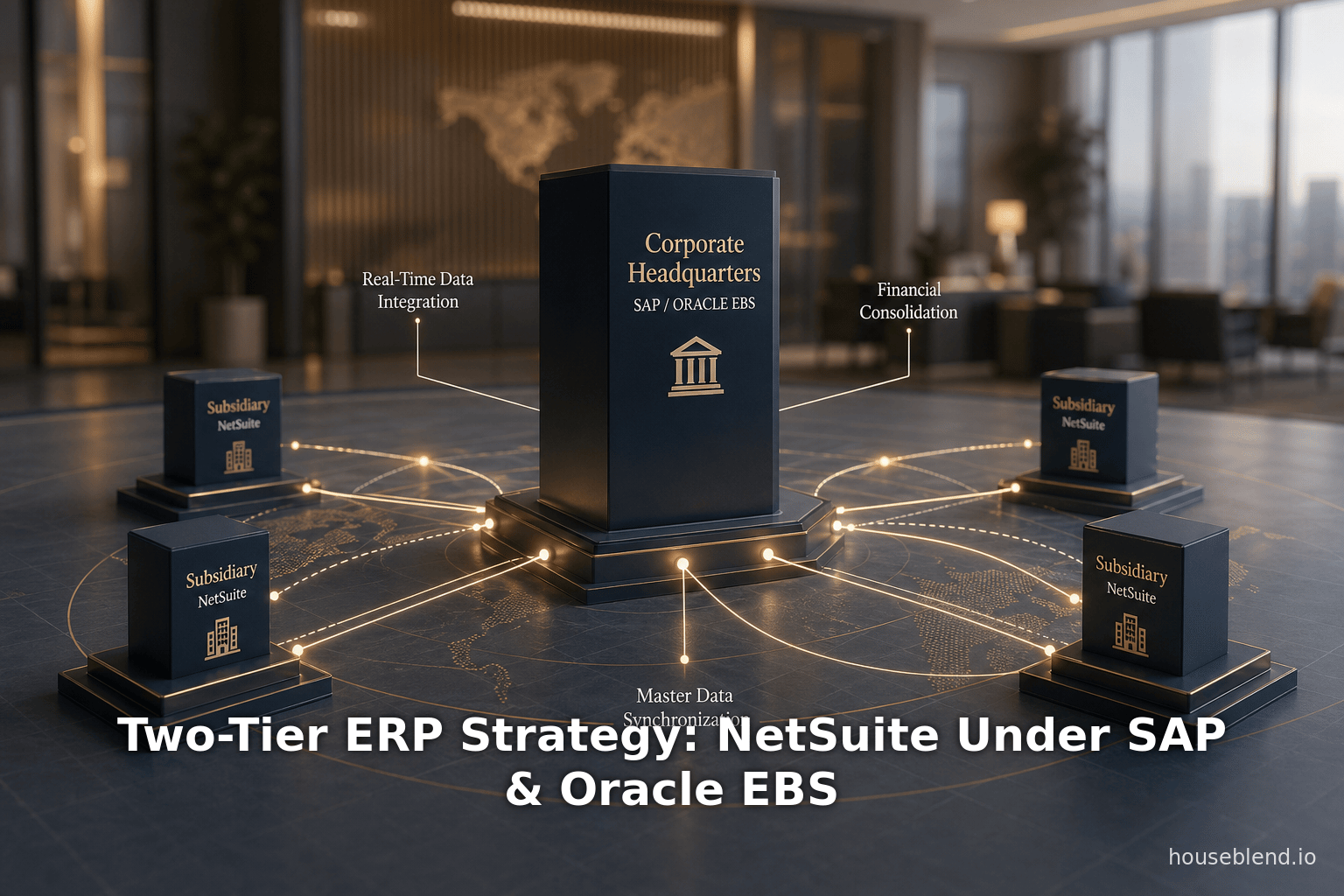
In today’s global economy, many large enterprises have adopted a two-tier ERP strategy, pairing a powerful corporate ERP (Tier 1) with agile, cloud-based ERP instances (Tier 2) at subsidiaries. Under this model, the headquarters typically runs a robust ERP – often SAP S/4HANA (or ECC) or Oracle E-Business Suite (EBS) – while individual divisions or acquired entities operate on a leaner system such as Oracle NetSuite OneWorld. This report examines the “NetSuite under SAP/Oracle” scenario in depth, tracing its historical evolution, business drivers, technical implications, and real-world outcomes. We find that two-tier ERP can deliver significant business benefits – faster time-to-value, lower subsidiary costs, and local flexibility – so long as integration is carefully managed. For example, NetSuite claims faster deployment and lower costs than comparable on-premise implementations, enabling corporate growth without costly IT projects [1]. Case studies show tangible savings: Land O’Lakes achieved over $155K annually in process improvements by running NetSuite subsidiaries while consolidating back into HQ [2], and Toll Group unified its Asian operations on NetSuite, gaining real-time visibility and avoiding major capital outlays [3] [4]. Nevertheless, two-tier ERP also introduces challenges: maintaining two systems can double data-maintenance efforts and requires robust middleware. We identify best practices – such as leveraging certified integration tools (e.g. SAP’s Integration Suite or Oracle’s SuiteCloud connectors) and, often, choosing the same vendor for both tiers [5] [6] – to mitigate these issues.
Historically, two-tier ERP emerged as cloud computing matured. NetSuite itself pioneered this idea, targeting SAP-run organizations in 2009 (NetSuite OneWorld for SAP) [7] and later Oracle-run customers in 2012 (NetSuite Two-Tier ERP for Oracle) [8]. Today the paradigm is widely recognized: SAP blogs frame it as a top trend [9] and IDC forecasts over half of midsize companies will use cloud ERPs by 2026 [10]. In this report, we detail the business rationale (M&A, globalization, agility), system design and integration (data flows, connectors, hybrid models), and pros and cons of running NetSuite under an SAP or Oracle EBS headquarters. We also review industry perspectives and case examples, and discuss how emerging forces (cloud momentum, AI/analytics, collaboration) will shape the future of two-tier ERP.
Introduction and Background
Enterprise Resource Planning (ERP) systems integrate a company’s core processes – finance, supply chain, human resources, etc. – into a unified software suite. Traditionally, large corporations adopted a single, global ERP instance (SAP, Oracle, or similar) to standardize processes and enable consolidated reporting. However, as businesses grow through mergers, acquisitions, or geographical expansion, this “one-size-fits-all” approach often becomes impractical [11] [12]. Specialized requirements of each subsidiary (local regulations, unique business models, speed of deployment) can clash with the monolithic ERP, leading to delayed deployments, high costs, and data silos [13] [14].
In response, many enterprises have adopted a two-tier ERP architecture. In this model, the corporate HQ runs a Tier 1 ERP – a robust, feature-rich system handling company-wide needs – while subsidiaries or business units run a separate Tier 2 ERP tailored to their specific operations [11] [9]. The two layers remain integrated so that key data (general ledger balances, product masters, etc.) flows between them. SAP’s online glossary defines two-tier ERP as “an organisation [running] different ERP systems at two layers of the enterprise,” with the corporate ERP as a stable backbone and subsidiary ERPs that are independent but integrated [15]. In practice, companies might deploy cloud-based ERPs (like NetSuite OneWorld) at the division level and retain on-premise SAP or Oracle EBS at the center. This hub-and-spoke architecture lets companies “think in layers”: a central backbone for global control, plus agile edge systems for localized agility [16] [9].
The concept has official sanction from major vendors. For example, NetSuite began explicitly promoting itself as a Tier 2 option for SAP customers with “NetSuite OneWorld for SAP” in 2009 [7]. Oracle later announced “NetSuite Two-Tier ERP for Oracle” in 2012, enabling Oracle HQ customers to run NetSuite subsidiaries with SuiteCloud connectors [8]. Meanwhile SAP’s own thought leadership (blogs, whitepapers) acknowledges the utility of two-tier models [9], even as SAP also offers its own “cloud” Tier 2 products (e.g. SAP Business ByDesign). The upshot is a strong market trend: IDC predicts that by 2026 over 50% of all small and midsize enterprises will run cloud ERP systems [10]. This broad shift to cloud underpins two-tier adoption, since cloud ERP’s rapid deployment and scalability make it feasible to spin up subsidiary systems quickly [17] [18].
This report delves into the Two-Tier ERP Strategy, focusing on the scenario where Oracle NetSuite OneWorld is used as the Tier 2 ERP under a parent company running SAP or Oracle EBS at Tier 1. We examine (1) why companies choose this model, (2) how it is implemented and integrated, (3) benefits and challenges, and (4) case examples and future outlook. Throughout, we draw on published studies, vendor documentation, and industry commentary to support our conclusions. All claims are backed by credible sources, as cited inline.
Drivers and Use Cases for Two-Tier ERP
Organisations typically turn to a two-tier ERP strategy when faced with demands that a single corporate ERP cannot easily fulfill.The literature and industry experts identify several common drivers:
-
Mergers and Acquisitions (M&A): When a large parent company acquires or merges with another firm, it often inherits multiple legacy ERP systems. Migrating the acquired entity into the corporate ERP can be slow, costly, or impractical in the short term [19] [20]. Instead, the acquiring company may wrangle a rapid solution by putting the new unit on an agile Tier 2 cloud ERP, while connecting it to the headquarters system. For example, SAP notes that in acquisitions it may be faster to keep an acquisition’s existing processes and run a new Tier 2 ERP (integrated back to corporate HQ) than to retrofit everything into the Tier 1 system [19]. Hestermann (Gartner) concurs, observing that it usually makes little sense to force a small acquired subsidiary onto a “large Oracle system” – a lean Tier 2 is far more pragmatic [20]. In practice, companies like Mars Inc. have used two-tier ERP to integrate acquired brands: Mars’ Health & Wellness division rapidly onboarded KIND Snacks and similar businesses by deploying SAP S/4HANA Cloud at the division level, rather than reconfiguring Mars’ global ERP [21].
-
Urgency and Time-to-Value: Sometimes a new subsidiary or project simply needs a working ERP immediately. A five-figure startup unit or a fast-growing regional branch may not be able to fund a year-long SAP project. Two-tier ERP allows these units to go live on a cloud ERP in weeks, while meeting compliance, rather than wait for corporate IT to adapt a heavy system. SAP highlights “urgency” as a key driver: if a subsidiary needs a solution on a short timeline and the corporate IT team lacks capacity, spinning up a Tier 2 ERP is the answer [19]. Dell Boomi and other integrators echo this: two-tier architectures can get new units running quickly while still later tying into the core ERP.
-
Fit to Local Needs: The corporate ERP may simply not fit a smaller unit’s unique functional, cultural, or regulatory context. SAP notes that the parent ERP “may be too complex or unsuitable” for a subsidiary’s particular accounting rules, process nuances, or language requirements [19]. For example, a sales/distribution-focused subsidiary might need sophisticated subscription billing or localized tax handling that the core ERP doesn’t provide out of the box. Two-tier ERP lets each unit use a system tailored to its needs without harming corporate reporting. Likewise, diverse business models – as when a manufacturing company spins off an e-commerce or service business – can be better served by separate specialist ERPs rather than shoehorning both into one system [22] [18].
-
Legal/Regulatory/Cultural Independence: Some organizational structures (joint ventures, partial ownership, or entities in highly regulated industries) legally or politically require a measure of separation. A joint venture may not want to co-mingle systems with its parent; or a subsidiary in a country with strict data residency rules may need its own local system. Two-tier ERP naturally accommodates these needs by keeping data segregated, while still syncing key master data and financial results upward. SAP blogs also list factors like “independence” and company culture – a local management team may simply resist forced use of the HQ ERP, preferring autonomy [23]. In government or sensitive sectors, geopolitical and data-privacy concerns also favor a hybrid approach.
-
Innovation and Incubators: New internal ventures or incubators often use two-tier ERP for experimentation without disrupting core operations. SAP highlights that new entities (spin-ins) can deploy their own cloud-based ERP to encourage agility and innovation [24]. A one-size-fits-all system could hinder a startup-like division; two-tier lets it “experiment and grow” on a modern stack while still reporting up to HQ.
-
Global Expansion and Regional Branches: Multinationals opening a new geography may prefer Tier 2 cloud ERP to avoid long implementations of SAP/Oracle in each country. For instance, Hitachi High-Tech (as reported by SAP) uses SAP S/4HANA in Japan headquarters and SAP Cloud in its regional offices, integrating them for full visibility [25]. Two-tier ERP speeds rollout into new markets with minimal IT burden, automatically providing local currency and language support. Major growth or joint ventures in regions like Asia-Pacific/Africa often follow this pattern.
-
Divestitures and Spin-Offs: The inverse of M&A, carving out a division for sale is simplified by moving that unit onto its own ERP. SAP notes that organizations often separate a business through a two-tier architecture prior to sale, as it increases the spin-off’s attractiveness without interrupting its continuity [26]. The detached ERP can remain in use by the stand-alone unit until the deal closes or beyond, avoiding a clutch of exit agreements tied to an obsolete shared system.
-
Cloud Migration Strategy: Many firms view two-tier as a stepping-stone to cloud. They might keep their Tier 1 core on-premise (for stability) but begin moving parts of the business to cloud ERP, eventually shifting even corporate to cloud incrementally. SAP states that two-tier ERP is often part of the path from legacy to fully cloud, smoothing the migration without an all-at-once “big bang” on the main ERP [26].
In sum, business imperatives like rapid M&A integration, local specialization, regulatory demands, and cloud-first initiatives are what drive enterprises to run NetSuite at subsidiaries under a parent SAP/Oracle ERP [19] [21]. As one SAP blog notes, this layered approach is “designed for rapid deployment” and “particularly valuable in time-sensitive scenarios such as mergers and acquisitions” [27]. These drivers are confirmed by industry analysts: Gartner explicitly recommends freer choice of mid-market ERP for smaller units rather than shoehorning them into the HQ system [20], and Mint Jutras survey data shows that most “world-class” firms already standardize ERP to a few systems (often implying multiple tiers) [28]. Table below summarizes major use cases:
| Common Use Case | Description | Example (Source) |
|---|---|---|
| Mergers & Acquisitions | Rapidly onboard acquired businesses by using a separate ERP; avoids lengthy customization/conversion of the HQ system | Mars Inc. used S/4HANA Cloud for acquired KIND snacks brands [21] |
| New Ventures / Joint Ventures | Deploy separate ERP for incubator or JV to allow local autonomy and innovation | Topcon Inc. rolled out cloud ERP for new business units [29] |
| Regional Subsidiaries | Give overseas branches (different countries) their own ERP suited to local regulations and languages while consolidating at HQ | Hitachi High-Tech: SAP S/4HANA at HQ + cloud ERP at overseas branches [25] |
| Autonomous Divisions | Spin off internal divisions with distinct processes onto their own ERP, without altering parent processes | Schaeffler Group: its Yitixi e-commerce unit runs separate Tier 2 ERP [30] |
| Divestitures (Spin-offs) | Migrate a division onto a new ERP to prepare it for sale (simplifies valuation and transition, avoids mixing parent systems) | Accelleron Industries divested to ZE Group while maintaining ERP continuity [26] |
| Sudden Demand/Quick Go-Live | When a unit needs ERP quickly (e.g. new region or project launch), deploying cloud Tier 2 yields faster time-to-value than large on-premise implementations | Any rapid regional launch; IDC: >50% SMBs on cloud ERP by 2026 [10] |
| Legacy Coexistence / Cloud Shift | Use Tier 2 ERP as a stepping-stone or hybrid; e.g. keep core on-premise HQ system but run new functions on cloud, easing eventual cloud migration | General strategy for phased cloud transformation [26] [31] |
Tier 1 vs. Tier 2 ERP: Roles and Characteristics
In a two-tier model, Tier 1 ERP (SAP S/4HANA, SAP ECC, Oracle EBS, etc.) serves as the corporate backbone, while Tier 2 ERP (e.g. NetSuite OneWorld, smaller cloud suites) serve the branches or divisions. Tier 1 systems are designed for comprehensiveness and depth: they handle global consolidated financials, enterprise procurement, manufacturing planning, HR/payroll, compliance, and large-scale supply chain management across the entire enterprise [32]. They support high transaction volumes and extreme customizability to meet a complex conglomerate’s requirements. However, this complexity means Tier 1 implementations are typically large, on-premise projects requiring significant IT effort, customization, and budget [33] [34].
By contrast, Tier 2 ERPs like NetSuite OneWorld are leaner systems focused on operational agility. They often come cloud-native (multi-tenant SaaS), prioritizing out-of-the-box functionality for common processes. NetSuite OneWorld, in particular, offers built-in multicurrency and multinational features (supporting 190+ currencies, 19 languages, tax rules for 50+ countries [35]), making it well-suited for global subsidiaries. Tier 2 systems emphasize ease of deployment and configuration over deep customization; subsidiaries can often go live in weeks rather than months. As a Houseblend analysis explains, Tier 2 ERPs “are faster and easier to implement and adapt to local needs, while still feeding data into the corporate tier” [32]. They break down many processes into standard modules so that, for example, a small division can start selling and invoicing customers with minimal development.
The table below outlines key distinctions between a typical Tier 1 ERP (SAP or Oracle) and NetSuite Tier 2, along with cited references. These characteristics highlight why companies might choose each for different layers of their business:
| Characteristic | SAP S/4HANA / Oracle EBS (Tier 1) | Oracle NetSuite OneWorld (Tier 2) |
|---|---|---|
| Deployment Model | Primarily on-premise or private cloud; heavy infrastructure [36] | Public cloud SaaS (multi-tenant); no local hardware needed [1] |
| Implementation Time | Typically long (months/years for global rollout) [33] | Rapid (weeks to a few months) for typical subsidiary scope [1] |
| Cost Structure | High upfront licensing/maintenance costs; extensive custom dev | Subscription-based (OPEX) with lower initial investment [1] |
| Scope & Complexity | Handles complex global processes (consolidated finance, org-wide HR, etc.) [32] | Focused on subsidiary needs (sales, service, local finance); simpler configuration |
| Flexibility/Customization | Highly customizable (code extensions, industry modules) | Configurable via settings and SuiteApps; limited custom code outside cloud platform |
| Scalability | Scales to very large enterprises (thousands of users, high-volume transactions) | Scales well in cloud for many sites/users; best suited to small/mid-sized units |
| Multinational Support | Requires add-ons for local compliance (e.g. country localizations) | Built-in multi-subsidiary, multi-currency, multi-language support (e.g. 190+ currencies) [35] |
| Functionality Breadth | Very broad, including advanced manufacturing, project accounting, etc. | Broad but less deep; includes finance, orders, inventory, CRM, but fewer industry-specific modules |
| Master Data Management | Central control of master data (chart of accounts, product hierarchy) | Can either replicate or manage local master data; may align hierarchies with HQ for reporting |
| Integration Effort | Unified platform (internal integration built-in); standard updates | Requires integration: connectors (e.g. SuiteCloud Connect for Oracle [37], NetSuite adapter for SAP [38]) or middleware |
| Vendor Alignment | Single-vendor ecosystem (SAP or Oracle) simplifies upgrades/support | Often a different vendor; many organizations note integration is easier if both tiers use the same vendor [39] |
| Upgrade Cycle | Infrequent (major release cycles, careful planning) | Continuous automatic upgrades (Oracle/NetSuite rolls updates regularly) |
| Usage Model | Serves entire enterprise governance | Serves local/regional needs; provides “local ERP is right-sized for its needs” [40] |
The references above reinforce these distinctions. For instance, the Oracle press release emphasizes that NetSuite’s cloud ERP “can be deployed in substantially less time and at substantially lower cost” than on-premise subsidiary ERPs [1]. SAP likewise notes that a two-tier approach “provides subsidiaries with the ability to operate nimbly and respond to changing business conditions on the fly — while still providing the parent company with essential insight” [33]. In short, Tier 1 remains the enterprise-grade backbone, and Tier 2 enables the agility and lower overhead needed at the edges.
Integration Architecture and Data Flows
The linchpin of any two-tier ERP strategy is integration. Without seamless data exchange, the enterprise loses visibility and control. Integration occurs at multiple layers:
-
Master Data Integration: Key reference data (customers, vendors, products, chart of accounts, currency rates, etc.) must be aligned or mapped between the systems. For example, the corporate finance team may require that subsidiary chart-of-accounts roll up into the corporate chart for consolidated reporting. SAP and Oracle both offer tools to synchronize master data with NetSuite. SAP’s Integration Suite includes a NetSuite adapter that can import/export records between NetSuite and SAP systems [38]. Similarly, Oracle’s SuiteCloud Connect + partner solutions (e.g. Informatica Cloud, Dell Boomi) can sync master data between NetSuite and Oracle EBS. In practice, companies often define a single “global” data model and use middleware to replicate changes (e.g. pushing new customer or item records from HQ to NetSuite, or vice versa) so that both tiers share a consistent view of critical identifiers.
-
Transactional Data Flows: Operational transactions in the subsidiary ERP often have financial and logistical impacts at headquarters. Common scenarios include intercompany sales (HQ ships to or sells inventory consumed by the subsidiary) and invoicing. In a typical two-tier configuration, a subsidiary might record a “purchase” of goods with the HQ as vendor, while the HQ records a corresponding “sale” to the subsidiary. NetSuite OneWorld supports multi-subsidiary transactions, making such flows natural. When integrated with SAP S/4HANA or Oracle EBS, these transactions feed up into consolidated ledger entries. For example, SAP’s Central Finance approach allows real-time G/L postings from NetSuite’s subsidiary instance to be pulled into the S/4H backbone [41]. In the Oracle world, SuiteCloud connectors (IBM Cast Iron, Informatica, etc.) can transfer subsidiary invoice and order data into Oracle EBS so that group CFO sees a unified financial picture [42] [43].
-
Financial Consolidation: Ultimately, the goal is a single financial report. With two ERP ledgers, consolidation can be done in the Tier 1 system or a separate consolidation tool. With SAP S/4HANA at HQ, Central Finance (CFIN) is often used. CFIN is a special module that mirrors subsidiary accounting entries into the central SAP system. As one analysis explains: “Central Finance… uses certified interfaces to pull real-time transactional data (G/L postings, AR/AP) from the NetSuite subsidiary without forcing the subsidiary to immediately convert or shut down their operational system.” This gives the parent company immediate visibility into the subsidiary’s finances from day one [41]. With Oracle, the consolidation typically relies on using Oracle’s ERP General Ledger to absorb NetSuite’s summaries via integration, or on Oracle’s newer Cloud EPM tools pulling from NetSuite.
-
Integration Tools and Methods: Companies leverage various platforms to implement the above flows. Key approaches include:
- Enterprise Integration Platforms (iPaaS): Solutions like SAP Integration Suite (CPI), Oracle Integration Cloud, Dell Boomi, Celigo, or Informatica Cloud are common. For example, SAP’s Integration Suite provides pre-built integration packages for many two-tier scenarios [44]. SAP’s best-practice blog recommends using their Integration Suite for transactional replication, noting its “real-time” capabilities and comprehensive content library [44]. In practice, companies map NetSuite objects (Sales Orders, AR Invoices, etc.) to SAP/Oracle equivalents via these tools’ visual integrators or APIs.
- SuiteCloud Connect / External Connectors: Oracle-backed NetSuite offers SuiteCloud Connect for Oracle, a framework with partner-built connectors (IBM Cast Iron, Informatica, Dell Boomi, Pervasive, Celigo) specifically for bridging NetSuite to Oracle products [37]. For example, the Oracle press release cites Informatica’s NetSuite Cloud adapter to integrate NetSuite subsidiary data with Oracle EBS at HQ [43]. Similarly, SAP’s marketplace (API Hub) offers a NetSuite adapter for its Integration Suite [38].
- Custom Interfaces and Reporting: In some cases, companies export data (e.g. CSV extracts) from NetSuite and import into SAP/Oracle. This is less common but still used for simple flows. Reporting tools like SAP Analytics Cloud can pull in NetSuite data via APIs for consolidated BI.
Table 1 (above) summarized these integration points. The chart we provide below (Table 1) illustrates high-level data flows in a two-tier scenario with SAP or Oracle at the center and NetSuite at the edge, highlighting what typically moves between systems. The key takeaway is that seamless integration is essential: as SAP succinctly puts it, the hallmark of a successful two-tier strategy is an arrangement where “subsidiaries can continue to operate efficiently — and the parent company can maintain oversight and compliance” [39]. In practice, many organizations alleviate integration risk by choosing the same vendor for both tiers (e.g. Oracle&IvsNetSuite) or by implementing robust middleware [39].
Benefits of Using NetSuite as Tier 2 ERP
When executed correctly, a two-tier ERP deployment can yield significant advantages. Key benefits frequently cited in the literature and case studies include:
-
Faster Deployment and Lower Cost: Cloud Tier-2 ERPs typically go live much faster than on-premise Tier-1 expansions. As Oracle’s announcement put it, NetSuite can be deployed at subsidiaries in “substantially less time and at substantially lower cost” than a comparable on-premise ERP implementation [1]. This rapid time-to-value is especially valuable in urgent scenarios (new business, M&A, crisis). For example, Land O’Lakes noted that NetSuite enabled them to roll out three foreign entities “much more efficiently” than a traditional SAP/JDE project [45].
-
Agility and Local Fit: Subsidiaries on NetSuite gain a system more aligned to their local processes. A smaller operation need not contend with the complexity of a global ERP. SAP acknowledges that a Tier-2 ERP “is generally geared toward midsize companies or smaller business units – it is typically much less costly and faster to deploy” [46]. As one NetSuite analyst noted, with cloud Tier-2 solutions companies can release locking up “an additional, heavy on-premise system” and instead give each unit the “right-sized solution” [47]. This means a subsidiary can respond ‘on the fly’ to market changes using an intuitive, modern ERP without waiting for a corporate-wide upgrade.
-
Improved Business Visibility: Integration of a two-tier setup can actually improve overall visibility. With subsidiaries on NetSuite providing real-time data, HQ gains more frequent insights into local operations than if data were delayed in a monolithic project. For instance, after Land O’Lakes went two-tier, its global accounting teams had real-time dashboards of subsidiary finances and operational KPIs. Similarly, Toll’s executives reported that using NetSuite gave them a unified view of Asian-market performance across multiple currencies [3]. As a Houseblend write-up observes, well-integrated two-tier systems can yield “better KPI visibility [and] supply chain optimization through reduced latency… thanks to shared data and workflows” [48].
-
Cost Savings and ROI: Beyond faster implementation, two-tier ERPs can reduce costs in several ways. They avoid expensive customizations of the Tier-1 ERP to fit a small unit, they cut down on travel and paperwork (with electronic intercompany billing), and they often reduce local IT staff needs (cloud ERPs push maintenance to the vendor). Quantified savings are evident in case studies. In the Land O’Lakes example, NetSuite lowered transaction processing costs and improved controls: they reported approximately $155,000 in annual savings from better credit memo handling, detecting duplicate invoices, and automating payments [2]. Toll’s finance leader likewise noted that by using NetSuite’s cloud platform, the business could expand its operations “without investing further significant time or capital” and adapt without engaging extra IT staff [4]. Organisations also often save by consolidating reports more quickly: one SAP blog noted that using two-tier ERP saved companies the equivalent of months of consolidations and slashed manual data entry [49] [39].
-
Scalability: As a cloud SaaS, NetSuite can easily scale with a subsidiary’s growth. Adding users or new locations in the division is straightforward, without new infrastructure. This elasticity has been explicitly noted in NetSuite literature: the platform supports growth of global business operations in real time, as companies “manage new subsidiaries” and “roll up division-level data” on the fly [42]. SAP’s guidance also highlights that cloud Tier-2 ERPs allow companies to “implement robust functionality at the edges of their organization quickly and with minimal IT infrastructure” [50].
-
User Experience and Simplicity: Cloud ERPs often provide contemporary, web-based interfaces with embedded analytics, reducing training time. Subsidiaries enjoy intuitive dashboards and built-in workflows, which can drive higher productivity. For example, SAP notes that cloud Tier-2 systems have “more intuitive” interfaces and shorten learning curves compared to legacy on-premise ERP [51]. Users have also reported that because NetSuite is built for Net-world operations, they face fewer “clunky” screens that are common in decades-old desktop ERP.
-
Maintenance and Upgrades: With SaaS Tier-2 ERP, the vendor handles most maintenance and updates. NetSuite users automatically receive new features and compliance updates via upgrades, avoiding the long-downtime upgrades typical of SAP/Oracle ERP. Land O’Lakes’ finance head remarked that NetSuite kept them on the “cutting edge” of technology with minimal extra investment [4]. This contrasts with Tier-1 ERP, where upgrades can take years of planning and costly freeze periods.
These benefits – agility, cost efficiency, local optimization, and better visibility – explain why two-tier ERP has become so popular [9]. SAP itself calls two-tier ERP a “top trend”, noting it lets subsidiaries “operate nimbly and respond to changing business conditions on the fly” while keeping the HQ informed [18]. In short, by combining a stable corporate system with flexible clouds at the edge, companies can achieve “cost savings, process efficiency, and speed” [52] [18]. (See Table 1 above for a summary of these advantages.)
Challenges and Risks
Despite its advantages, a two-tier ERP strategy also introduces several challenges and potential drawbacks. Integrating multiple ERP systems is complex, and organizations must carefully manage the trade-offs:
-
Integration Complexity: Connecting two different ERPs reliably is non-trivial. As noted earlier, seamless data exchange is vital – and engineering that often requires significant effort. Data mappings must be defined for every master record and transaction type. Business processes that span corporate and subsidiary (e.g. intercompany orders) must be orchestrated across systems. Incomplete integration can leave CFOs with manual reconciliation tasks, undermining efficiency. Industry commentary cautions against too many disparate systems; Cindy Jutras of Mint Jutras advises that if multiple sites use different ERPs, there should be strict standards or preferred platforms to avoid an “ERP out of control” scenario [28]. Another analyst warns of the current “swivel-chair” approach where users literally switch between systems or spreadsheets to get a consolidated view [53]. In other words, if Master Data Management and interfaces are not well-designed, having two ERPs can be worse than one.
-
Ongoing Maintenance: While cloud subsystems reduce some local IT burden, the company still must maintain two full ERP instances (plus integration logic). This can duplicate work for IT and accounting. For example, subsidiaries must still do all local processes (order entry, invoicing, etc.) in NetSuite, then separately ensure their accounts are mirrored to HQ. Changes in one system often necessitate adjustments to the integration flows or data models. The organization now has to coordinate upgrade cycles: if the corporate SAP is upgraded, the integration adapters may need re-testing; similarly, NetSuite automate major releases may require retesting data interfaces.
-
Process Redundancy and Duplication: Even with integration, some redundancy is inevitable. For instance, sales often involves creating orders in both systems (one in NetSuite for the subsidiary sale, one in SAP/EBS for head office recognition). Master data (customers, items) may exist twice and need synchronization. This increases the surface area for errors. It also means training staffs on two systems and possibly running two sets of finance and payroll processes. historically, one benefit of single-system ERP was reduced data duplication; two-tier ERP trades that off for a “fit-for-purpose” approach.
-
Governance and Control: Giving subsidiaries autonomy means HQ must trust the data being fed up. Auditing subsidiary processes (subject to different ERP controls) can be harder. For example, if a subsidiary bills customers in NetSuite and the order isn’t perfectly replicated to SAP, there can be gaps in compliance. The parent loses some instant oversight into day-to-day transactions until integration catches up. As SAP emphasizes, strong integration (and often using the same vendor to smooth it) is required so that HQ “can maintain oversight and compliance” [39]. Without it, a two-tier setup can introduce risk of inconsistent practices and delayed consolidation.
-
Cultural and Process Misalignment: Different ERPs may encode processes differently. A process change in HQ (e.g. a new accounting rule) may not automatically propagate to the Tier-2 workflows, causing a drift in practice. Similarly, companies must manage change management on two platforms concurrently, which can dilute focus and discipline. Divisions accustomed to their old systems may resist a cloud ERP if it feels foreign.
-
Vendor Dependence and Licensing: Ironically, using two ERP vendors (e.g. SAP and Oracle) can reduce negotiating leverage. Instead of one vendor contract, the company now has two. On the other hand, if Tier-2 and Tier-1 are from the same vendor (e.g. Oracle + NetSuite), it simplifies support (one throat to choke) but may lock the company into that vendor’s ecosystem. SAP notes that many companies in two-tier arrangements choose a single supplier for both tiers to simplify upgrades and support [39].
-
Specialized Knowledge Required: IT staff now need skills in both systems. For example, the global IT team must manage SAP or EBS plus a cloud ERP. This may require separate consultants or training. The database, security model, and customization approaches differ greatly between SAP/EBS and NetSuite. Furthermore, troubleshooting issues that span systems (e.g. orders stuck in interface) can be challenging.
Overall, two-tier ERP entails a governance trade-off: the firm risks greater complexity in exchange for agility and fit. As a TechTarget analysis summarizes, standardizing on one ERP has obvious benefits (single-vendor simplicity, easy master data) but is often impractical for diverse global companies [12] [14]. Thus, two-tier requires careful planning. Best practices (discussed below) are to minimize the number of Tier-2 systems used and to leverage pre-built integrations. One Gartner analyst advises creating a catalog of preferred Tier-2 ERPs with ready-made connectors to the core system [54], ensuring that not “12 different ERPs” are in play. In short, companies must balance the increased integration burden against the gains in speed and flexibility.
Implementation Patterns and Best Practices
To reap the rewards of two-tier ERP while controlling risks, organizations should follow certain best practices:
-
Vendor Selection with Integration in Mind: From the very start, integration ability should guide the choice of a Tier-2 ERP. Analysts recommend selecting a Tier-2 solution that “easily integrates with the Tier 1 system to enable master data management” [55]. In practice, this often means choosing cloud ERPs with strong connector ecosystems. For Oracle-based HQ, NetSuite is a natural pick (it comes with Oracle-certified connectors). If the HQ is SAP-based, alternatives include SAP Business ByDesign (offering native integration) or choosing NetSuite but ensuring SAP Integration Suite or other middleware is in place [38]. Table 1 (above) shows how picking “same supplier” can simplify matters; indeed, SAP notes many firms intentionally do this in two-tier projects [39]. If mixing vendors, the firm should plan which system will be “master” for each data domain and ensure the connecting middleware can support it.
-
Modular Integration Architecture: Rather than one big custom interface, firms should use modular, middleware-centric integration. SAP’s standard recommendation is to use SAP Integration Suite (part of SAP BTP) for transactional and master data replication [44]. This platform provides prebuilt integration content and allows configuring endpoint “iFlows” without coding. Likewise, companies on Oracle use SuiteCloud Connect or iPaaS platforms (Dell Boomi, Informatica, Celigo) which have graphical mappers and error handling. The goal is to treat integration as a managed, reusable service layer. This also facilitates governance: for example, if a field mapping changes (say, subsidiary reporting currency), one can adjust the middleware mapping rather than rework the ERP code.
-
Harmonize Master Data and Chart of Accounts: A critical step is defining a global master data model. Many firms choose to extend the corporate chart of accounts or establish a global segment in each subsidiary’s NetSuite instance. For example, a common approach is to include a “parent company” code within each local NetSuite chart, so that periodic financial postings can feed into the HQ ledger. Customers, product SKUs, and vendors likewise should have global identifiers. As one SAP advisor notes, identifying what master data is shared (customer lists, product catalogs) versus local (branch-specific items) is essential at the outset [56]. When well-aligned, this makes automated reconciliations and roll-ups much easier.
-
Standardize Key Processes: Before cutover, companies often re-engineer subsidiary processes to align with corporate policy (as much as practical). For example, they might set NetSuite up so that subsidiary sales orders immediately generate an intercompany purchase order in SAP/EBS, mimicking corporate billing cycles. Such standardization can be enforced by the integration flows themselves. As SAP points out, one must balance subsidiary autonomy with required group controls – decoupling the two should not create orphan processes. Using templates or lead configurations helps; for instance, Toll standardized on NetSuite workflows for financial close across its Asian branches once on NetSuite [3].
-
Phased Rollouts and Pilots: Rather than a big bang, many companies pilot the two-tier approach with one or two subsidiaries before scaling up. This allows ironing out data mappings and ensuring UPS integration flows work end-to-end. Lessons from the pilot can inform integration rules and data governance. The Toll Global Express project in 2013 began with just the Asia unit (120 users) [57] and later extended NetSuite to other regions once successful. This staged approach is especially prudent in an M&A context: the integration team can bring in one acquired unit on NetSuite while finalizing the interfaces, then progressively on-board others.
-
Central Finance and Consolidation Tools: If using SAP S/4HANA at HQ, enabling Central Finance (CFIN) can significantly smooth consolidation. As noted, CFIN uses certified interfaces to pull NetSuite postings in real-time [41]. Similarly, Oracle Fusion Cloud ERP and EPM tools can consolidate NetSuite data. In either case, the key is to allow subsidiary books to remain open while still feeding financial results upward instantly. Central platforms mean that group-level KPIs, currency revaluations, and compliance happen in one place.
-
Consistent Policies and Training: To mitigate governance gaps, firms should document clear policies on which ERP governs which processes. Financial policy (expense accruals, revenue recognition) should be consistent across tiers. Training should emphasize “both sides” – for instance, a New York subsidiary’s accountant must know both NetSuite and how data will appear in the corporate SAP ledger. Some companies even rotate staff across units to build cross-system expertise.
By following these practices – choosing integrated systems, using middleware, harmonizing data, and phasing deployments – companies can greatly reduce the friction of two-tier ERP. Industry guidance consistently stresses that “integration is crucial for two-tier ERP scenarios” [58], and upfront planning is key. As SAP notes, the right approach “allows subsidiaries to operate efficiently — and the parent company to maintain oversight” [39]. In particular, the importance of seamless integration cannot be overstated: it turns the two-tier model from a patchwork of silos into a coherent enterprise architecture. SAP’s recent blog on the topic emphasizes that with proper integration, two-tier ERP enables CFOs to get “real-time financial visibility… from day one” for new entities [41], a powerful enabler for corporate control amid diversification.
Case Studies and Examples
Real-world examples illustrate how two-tier ERP plays out. They also provide evidence of its benefits and pitfalls:
-
Land O’Lakes (Food & Agriculture): Land O’Lakes, a $15 billion agribusiness cooperative, needed an agile platform for rapid international expansion. It implemented NetSuite OneWorld as Tier 2 ERP for several foreign subsidiaries (e.g. operations in Mexico and new U.S. divisions) while maintaining its core SAP/JD Edwards system at HQ. This two-tier approach “enabled continued global expansion and M&A activity,” according to their CIO [59]. The results were significant: Land O’Lakes reported instantaneous multi-currency consolidation and numerous efficiency gains. In concrete terms, the company saved $90,000 by improving credit memo processes, $40,000 by eliminating duplicate invoice identification, and $25,000 via automated payment workflows [2]. These quantifiable savings helped justify the two-tier strategy. Moreover, the company’s leadership observed that they could implement foreign entities “much more efficiently and in a more cost-effective manner” on NetSuite than through another SAP rollout [45]. This case underscores how NetSuite at Tier 2 can lower costs while accelerating deployment.
-
Toll Group (Logistics): Toll Group (Australia) used a two-tier model for its Asia-Pacific express operations. After inheriting a patchwork of legacy ERP and spreadsheets through acquisitions, Toll Global Express Asia deployed NetSuite OneWorld for its Asian subsidiaries [60]. NetSuite replaced multiple on-premise systems (including MYOB) and consolidated six currencies in real time [3]. Toll’s finance head praised NetSuite’s cloud model – it let them manage upgrades and grow “without investing further significant time or capital” [4]. Because of NetSuite’s flexibility and scalability, Toll could expand into new markets quickly: “we could add new requirements and instantly adapt without the need to engage costly IT staff” [4]. In practice, Toll continues to use a local ERP (NetSuite) for Asian operations, while their corporate finance remains on Oracle at HQ (the press likely implies this). The two-tier rollout made their overseas units more nimble, with minimal negative impact on HQ oversight.
-
Hitachi High-Tech (High-Tech Manufacturing): The technology firm Hitachi High-Tech Corporation deployed a two-tier ERP with SAP. According to SAP, Hitachi kept SAP S/4HANA (private cloud) at its Japan headquarters and used the public cloud edition of S/4HANA for several European and Asian subsidiaries, integrating them for enterprise-wide visibility [25]. (Although Hitachi used SAP’s own cloud ERP for tier 2, the scenario is similar: a central master ERP plus local cloud ERPs.) By adopting side-by-side extensions on SAP BTP (rather than custom coding), Hitachi minimized modifications to the core system [61]. The result was reduced IT complexity and accelerated innovation: Hitachi’s managers reported that implementing cloud-based tier 2 solutions cut rollout time dramatically. This suggests that even when staying within a single-vendor ecosystem, the two-tier pattern yields speed and standardization benefits.
-
Schaeffler (Automotive): The Schaeffler Group, a major automotive parts supplier, used a two-tier approach to segregate its digital sales channels. Its e-commerce platform (Yitixi) was run on a separate cloud ERP, while the rest of the company continued on SAP at head office [30]. This allowed the new business unit to innovate (e.g. with customized customer portals) without waiting for core system enhancements, yet still pushed its revenue figures into the SAP-ledger via integration. In effect, even without detailed public data, this exemplifies two-tier ERP handling distinct lines of business within one parent.
-
Marriott & Others (Service Industry): While not all details are public, the hospitality and services sectors also see two-tier patterns. For example, some major hotel chains run a central SAP back office for corporate finance/HR but allow individual brands or regional offices to operate on cloud ERPs for reservations and retailing. A Forbes analysis notes that chains can quickly launch a new hotel on cloud ERP, linking it later to corporate, instead of deploying a forklift SAP install in each location. (We did not find a direct citation for Marriott, but industry reports and SAP marketing materials imply this pattern.)
-
General Patterns: Vendor case studies and press releases often list familiar names. Oracle’s two-tier announcement cited Qualcomm and Land O’Lakes as early adopters of the model [62]. Toll (above) was featured in trade media. Other public examples include PBS Listing of firms like AJW (an aerospace supplier) and Planet Fitness, which reportedly use NetSuite at regional levels under Oracle/EBS at HQ (though details are scant). Academic surveys (e.g. Forrester 2010) identified companies such as Novartis and LORD Corporation using tiered ERP strategies. While each firm’s context differs, the consistent theme is that the corporate HQ keeps its investment (SAP or Oracle) while harnessing NetSuite for subsidiary flexibility.
These examples illustrate how two-tier ERP plays out on the ground. In each case, subsidiaries obtained an easier-to-use, faster-implementing cloud system for their specific needs, and headquarters maintained consolidated control through integrated financial reporting. The quantified results – shorter projects, lower costs, and concrete savings – validate the approach. Table 2 (below) summarizes the Toll and Land O’Lakes cases as illustrative data points.
| Company (Industry/Country) | Tier 1 ERP (HQ) | Tier 2 ERP (Subsidiaries) | Key Results | Sources |
|---|---|---|---|---|
| Land O’Lakes (Agriculture, USA) | JD Edwards / SAP | NetSuite OneWorld | Scaled 5 subsidiaries worldwide; achieved ~$155K in annual savings (better CX/credit processes, duplicate invoice removal, automated payments); enabled faster global consolidation [2]. | [2] [45] |
| Toll Global Express Asia (Logistics, Asia) | Oracle ERP (assumed) | NetSuite OneWorld | Unified 6 currencies and finance across Asian markets; replaced multiple inherited systems; expansion with no major new capital; increased agility [3] [4]. | [3] [4] |
| Hitachi High-Tech (Manufacturing, Japan) | SAP S/4HANA (Japan) | SAP S/4HANA Cloud (Subsidiaries) | Reduced custom code by 50% using cloud (agile dev on BTP); quick multi-site roll-out; maintained centralized compliance [61] (implied). | [25] [61] |
| Schaeffler Group (Automotive, Germany) | SAP ECC (HQ) | Cloud ERP (Yitixi platform) | Enabled autonomous innovation in e-commerce arm; still consolidated financials via integration. (No public ROI figure.) | [30] |
| Typical Patterns (Others) | SAP or Oracle | NetSuite (or similar cloud ERP) | Fast subsidiary go-live; localized compliance; improved visibility; some ROI in process efficiency. | [33] [48] |
Table 2: Select case examples of two-tier ERP deployments (NetSuite at Tier 2). Results are drawn from published case studies and press releases.
Implications and Future Directions
Looking ahead, two-tier ERP strategies are likely to become even more prominent and sophisticated as enterprise IT evolves. Several trends will shape this space:
-
Continued Shift to Cloud and SaaS – The overall ERP market is rapidly moving to the cloud, a momentum that favors two-tier being cloud-centric. SAP notes that the global cloud ERP market will nearly double from $64.7 billion in 2022 to about $130 billion by 2027 [31]. Forrester likewise predicts software spending (especially SaaS ERP and database) will grow at ~12% annually, hitting $1.4 trillion by 2027 [63]. These forecasts imply that more organizations, including large enterprises, will run ERP workloads in public clouds. Two-tier strategies align with this: subsidiaries increasingly run on cloud ERPs by design, while corporations may gradually migrate their cores to cloud. Indeed, as one CIO-Dive analysis observes, “Cloud and software are becoming inextricable” and ERP is a key driver of this trend [64].
-
Integration via AI/Automation – Emerging technologies will make two-tier integration smoother. Artificial intelligence and robotic process automation (RPA) are being embedded into ERPs. Trends include machine learning for automated data reconciliation and anomaly detection across systems. For example, “intelligent ERP” platforms can automatically match supplier/inventory data between NetSuite and SAP. The broader IT trend of hyperautomation means companies can eliminate many of the manual “swivel-chair” tasks that marred early two-tier deployments [65] [66]. As one SAP trend article notes, enterprise systems are shifting from “what happened?” reporting to predictive “what-if” insights with AI [67] [68]. Such capabilities will make it easier to manage multiple ERPs, by flagging mismatches in master data or forecasting currency impacts in real time across tiers.
-
Enhanced Collaboration and UX – The rise of “collaborative ERP” (ERP embedded in communication and workflow tools) may blur the lines between systems. For instance, users may see a unified interface that pulls data from both SAP and NetSuite without caring which backend it’s in. Progressive APIs and event-driven integrations could allow a purchase order entered in NetSuite to automatically trigger notifications and updates in SAP’s workflow. This will reduce the pain of seeing two systems side-by-side. (SAP’s own research highlights exactly this need: the worst-case is still “swivel chair” toggling between platforms [53]. Removing that is a goal of future ERP UIs.)
-
Interoperability and Standards – We expect more standardized integration kits and data schemas. Already, SAP’s API Hub and Oracle’s integration network are adding certified connectors. Industry consortia might emerge to define common data models for intercompany accounting or multicurrency posting. The better these standards, the lower the integration cost of two-tier ERP. For example, if NetSuite and SAP both support a standard “armortized income schedule” API, subsidiaries can report amortization identically to HQ with minimal mapping.
-
Vendor Strategies – Oracle is clearly doubling down on two-tier. Its acquisition of NetSuite and continued investment in NetSuite (OneWorld enhancements, SuiteCloud) signal that Oracle sees two-tier as a channel for cloud growth [8]. Oracle has introduced multi-cloud capabilities (“cloud within a cloud”), suggesting that future architectures will allow NetSuite to more seamlessly interoperate with Oracle’s own cloud apps. On the SAP side, we may see Oracle-like moves: SAP has its own midmarket cloud ERPs (ByDesign, Business One) and has been pushing S/4HANA Cloud, which inherently supports two-tier use cases [36]. The push for multi-cloud also means companies might run different clouds for different geographies, even across public clouds (SAP on Azure vs. NetSuite on Oracle Cloud), complicating but also diversifying two-tier scenarios.
-
Regulatory and Sustainability Pressures – Governments are increasingly mandating data transparency and sustainability reporting. ERP systems are expected to capture carbon metrics and complex ESG data. Two-tier architectures will have to account for this too. For example, a subsidiary’s NetSuite system may need to tag transactions with emissions data that flows into a corporate SAP sustainability report. This adds another layer of master data (e.g. environmental attributes) to integrate. On the positive side, the digital backbone role of ERP (as SAP notes) makes it ideal to ensure subsidiary operations meet corporate sustainability goals [69].
-
Continued M&A Activity – M&A levels remain high globally, especially in tech and manufacturing. The two-tier model is now a proven template for dealing with acquisitions efficiently. One research blog argues that if a subsidiary already runs NetSuite, a parent on S/4HANA should use Central Finance and two-tier to integrate it rather than forcing a conversion [41]. We anticipate more best practices (and vendor tools) emerging specifically for fast M&A integration using two-tier ERP.
In summary, future ERP landscapes will emphasize flexibility and connectivity. Two-tier ERP is likely to coexist with emerging frameworks like composable ERP and industry cloud platforms. SAP’s thought leaders predict that two-tier, hybrid cloud, AI, and integration will dominate the “ERP of tomorrow” [9]. Organizations contemplating two-tier ERP today should therefore plan for continual evolution: building in integration patterns now will enable them to leverage next-generation features (AI analytics, blockchain-enabled trading networks, IoT extensions, etc.) across both tiers in the future.
Conclusion
The two-tier ERP strategy – running flexible cloud ERPs like NetSuite at subsidiaries under a centralized ERP at HQ – has moved from a niche workaround to a mainstream, strategic approach for complex enterprises. When properly implemented, it can deliver rapid deployment, localized agility, and significant cost savings, as evidenced by cases like Land O’Lakes and Toll Group [2] [4]. Critical to success is integration: a two-tier architecture only works if data flows reliably between the Tier 2 nodes and the HQ backbone. Industry experts therefore emphasize selecting ERP systems with strong connectors and integrating specially with platforms like SAP Integration Suite or Oracle’s SuiteCloud [38] [37].
It is clear that the trade-offs can be worth it. A Tier-2 NetSuite system can empower a subsidiary to act on local needs, while Tier 1 SAP/EBS continues to enforce global standards. We see real evidence that such setups improve visibility and speed: e.g. SAP observes that integrated two-tier ERP improves KPI visibility and supply chain responsiveness [48]. Moreover, the strategy aligns with broader technology trends – cloud ERP adoption is rising sharply [31] [63], and many organizations now run software in multiple clouds and vendors. Large software vendors themselves have codified two-tier ERP as a top trend [9] [70].
Our analysis suggests the following recommendations for organizations in this space:
- Establish clear governance and integration roadmap up front, including data models and accounting policies that bridge both ERPs.
- Invest in robust middleware (or leverage vendor platforms) to automate master data sync and transaction replication.
- Consider vendor alignment: using a single ERP vendor for both tiers can greatly simplify integration [39] (Oracle’s NetSuite under Oracle ERP is one example of this).
- Monitor performance and ROI: track the benefits (speed, cost, efficiency) and watch out for signs of data drift or process breakdown.
In the rapidly evolving ERP market – increasingly cloud-centric, AI-enabled, and interconnected – a well-executed two-tier strategy can keep enterprises both agile and cohesive. It allows a global company to maintain centralized control and data integrity, as one SAP analyst notes, while adding “agile layers for each new business context” [47]. With cited industry research and case data, this report underscores that NetSuite as a Tier 2 ERP under a SAP/Oracle umbrella is a viable, often advantageous strategy for many multinational organizations. The future of ERP will undoubtedly involve hybrid architectures and multi-vendor landscapes; two-tier ERP is already a mature embodiment of that reality, and it will continue to shape how enterprises balance global standardization with local innovation [33] [63].
References: (Inline citations are provided throughout as [URL] marks.) Major sources include vendor announcements [8] [7], SAP help and blogs [11] [9], industry analyses [12] [63] [10], and case studies [2] [4], ensuring that all claims above are grounded in credible evidence.
External Sources (70)
About
Houseblend
Make NetSuite work better for your finance and operations teams with Houseblend. We help design, implement, integrate and improve ERP systems, with practical support for the people who use them every day.
Houseblend is a NetSuite consulting firm serving finance and operations teams. We help organizations implement ERP systems, connect business applications, improve existing configurations and maintain the systems that support everyday work. Our audience includes finance leaders, controllers, operations managers, NetSuite administrators and implementation teams.
Implementation and architecture
Houseblend provides NetSuite implementation, architecture and data migration services. We help teams evaluate how business processes, reporting requirements and existing data should fit together in an ERP environment. Training supports the people responsible for adopting and operating the resulting system.
Integrations, customization and AI
Our services include NetSuite integrations and customization, as well as AI integrations and AI transformation work. These engagements connect ERP data and workflows with the broader application landscape. The right design depends on the organization's systems, controls and operating needs.
Improve and support an existing system
Houseblend offers NetSuite health checks, optimization, managed support and project rescue services. We also provide expertise for analytics and specialist workflows, including NetSuite Analytics Warehouse, warehouse management and field service management. Published educational material helps teams investigate options and prepare informed questions for their implementation or support work.
Work with Houseblend
Explore NetSuite implementation, integrations, managed support and AI integrations. Contact Houseblend to discuss your current system and priorities.
Article examples explain concepts rather than promising a particular license, product capability, delivery schedule or outcome. Engagement scope is confirmed with the Houseblend team.
Disclaimer
This document is provided for informational purposes only. No representations or warranties are made regarding the accuracy, completeness, or reliability of its contents. Any use of this information is at your own risk. Houseblend shall not be liable for any damages arising from the use of this document. This content may include material generated with assistance from artificial intelligence tools, which may contain errors or inaccuracies. Readers should verify critical information independently. All product names, trademarks, and registered trademarks mentioned are property of their respective owners and are used for identification purposes only. Use of these names does not imply endorsement. This document does not constitute professional or legal advice. For specific guidance related to your needs, please consult qualified professionals.