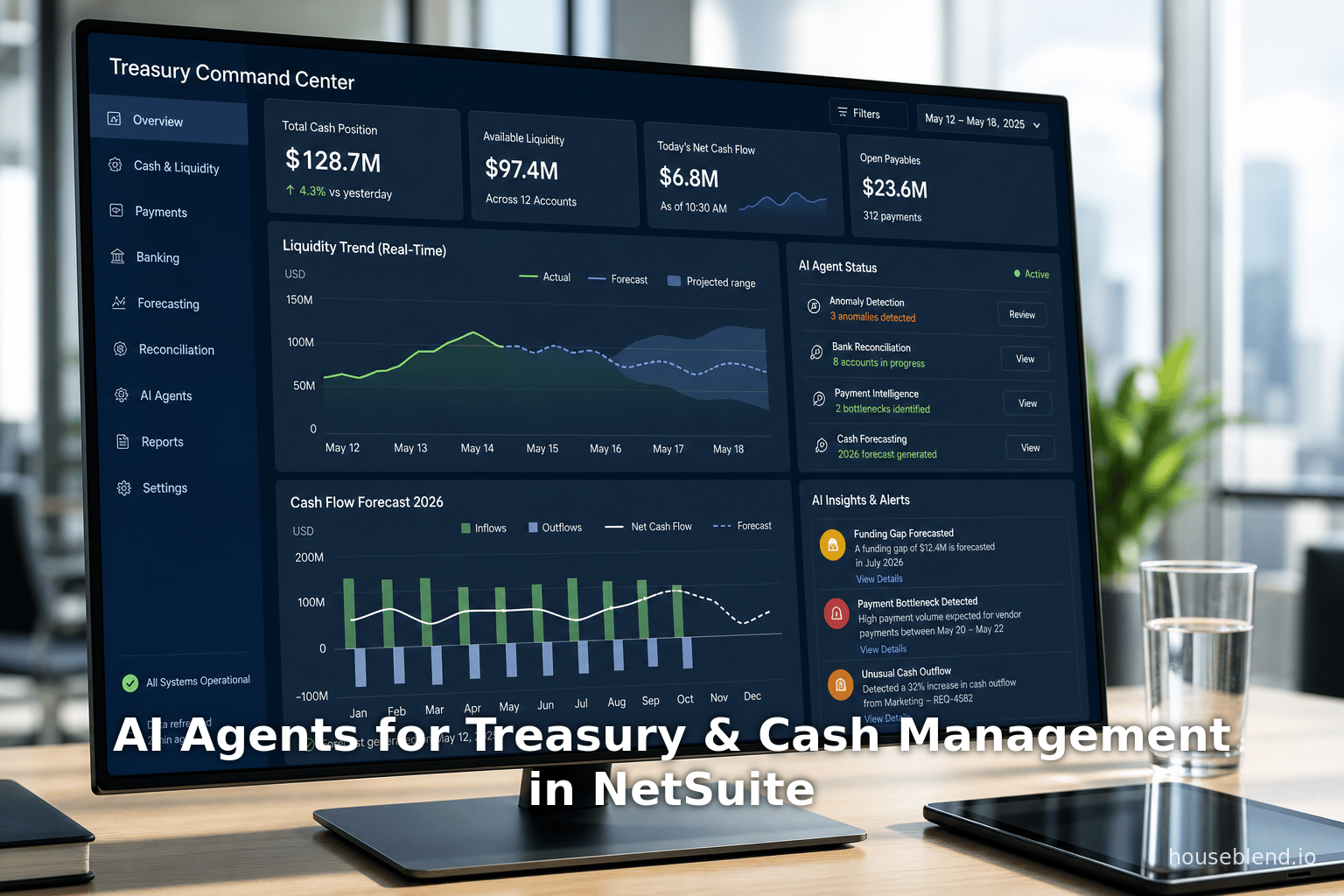
Houseblend Article
AI Agents for Treasury & Cash Management in NetSuite
Inside this article
- 01Executive Summary
- 02Introduction and Background
- 03AI in Treasury and Cash Management: Concepts and Use Cases
- 04NetSuite and the AI-Integrated Treasury Ecosystem
- 05Leading Vendors and Products
- 06Data & Evidence from Research
- 07Case Studies / Real-World Examples
- 08Analysis and Discussion
- 09Conclusion
- 10References
Executive Summary
In 2026, AI-powered agents are poised to revolutionize treasury and cash management, providing automation, insights, and control that traditional systems cannot match. These intelligent agents – advanced software applications that continuously monitor financial data, apply business rules, and perform tasks under human governance – handle routine treasury workflows autonomously, from daily liquidity updates to cash forecasting, anomaly detection, and automated reconciliation. Leading industry analyses note that finance teams are increasingly moving from exploratory AI use to “ agentic AI” systems that can initiate actions (within defined guardrails) rather than merely respond to prompts [1] [2]. This report examines the 2026 market for AI agents in treasury and cash management, with particular attention to solutions available to NetSuite finance teams. We review the technology context (including Oracle/NetSuite’s connectors and emerging AI regulations), detail key use cases (cash positioning, payments monitoring, forecasting, etc.), and provide a vendor guide covering both established treasury platforms ( Kyriba, GTreasury, FIS, Bottomline, etc.) and innovative fintech entrants (Atlar, Trovata, Embat, Numeric, etc.). Each vendor’s approach, integration with NetSuite, and AI capabilities are analyzed. We also summarize case studies where AI agents have delivered measurable benefits (e.g. significant time savings in reporting and forecasting). In doing so, we incorporate data and expert commentary on adoption trends, challenges (data readiness, security and governance), and future directions. All claims are rigorously cited from credible sources, including industry surveys, research studies, and vendor announcements.
Introduction and Background
Treasury and cash management are critical functions in any finance organization, responsible for overseeing cash flows, liquidity, risk exposures, and financial operations (payments, collections, forecasting). Over the past decade these functions have been digitally transforming: treasury platforms (TMS) and ERP systems moved to the cloud, APIs connect to banks, and workflows became more automated. Yet, many high-level tasks still rely on spreadsheets, manual queries and fragmented data. As one industry report notes, treasury teams live with “fragmented cash, risk, and payments workflows that require constant human triage across banks, ERPs, and spreadsheets” [3].
Artificial Intelligence (AI) is now emerging as a key enabler to further transform treasury. Early use of machine learning (ML) and analytics has improved cash forecasting and anomaly detection. More recently, generative AI and autonomous “agents” – powered by large language models (LLMs) and automation rules – promise to bridge the gap between insight and action. Unlike fixed RPA scripts, AI agents can reason on data and initiate processes under policy constraints. As one treasury analyst observes, “an AI agent…behaves less like a script and more like a junior analyst who never sleeps”, using “if this, then what” logic to implement or escalate actions [4].
In corporate finance, the buzz around ChatGPT-like tools escalated in 2023–2025. Initial focus on chatbot-style assistants gave way by 2026 to deployments of “agentic AI”, systems that continuously monitor financial metrics and trigger responses (alerts, reports, or even transactions) according to rules. For example, Standard Chartered predicted in 2026 that treasury will see “AI embedded directly into day-to-day workflows”, with systems that automatically flag funding issues, prioritize investigations, or schedule hedges – all while augmenting human judgment [5] [1]. Gartner similarly noted that AI agents are gaining traction: by 2027, 40% of enterprises are expected to use AI agents to automate workflows and improve decision-making [2].
However, adoption of AI in treasury remains nascent. A February 2026 survey by Crisil/Coalition Greenwich found fewer than 10% of treasury teams using AI for core functions like forecasting or fraud detection, and about half had not started at all [6]. Data quality, skill gaps, and risk concerns are cited as barriers. Nevertheless, technologists and finance leaders see the writing on the wall: embedding AI into treasury operations promises major gains in efficiency, risk management, and strategic agility.
This report provides a comprehensive guide for NetSuite-using finance teams to understand and select AI agent solutions for treasury and cash management in 2026. We begin by setting the stage on AI and treasury —what an “AI agent” is, how it differs from other automation, and why it matters now. Then we examine use cases and functionality: cash positioning, reconciliation, forecasting, payments monitoring, compliance, etc. The NetSuite context is covered, including Oracle’s own AI features and the new AI Connector framework (MCP) that enables integration. The vendor landscape section profiles major players and emerging entrants, comparing their AI capabilities, integration with NetSuite, and deployment models. Data and expert opinions are woven throughout: survey data on AI adoption, research on AI in payment systems, and quoted insights from the likes of Gartner, BNY, Standard Chartered, and CIOs using these tools. Real-world case studies and testimonials illustrate measurable benefits (e.g. reduced reporting time, forecast accuracy). Finally, we discuss implications—technology trends, governance considerations, and what to watch for next. Each part is extensively documented with credible sources, ensuring a fact-based, in-depth analysis suitable for treasury professionals and IT decision-makers.
AI in Treasury and Cash Management: Concepts and Use Cases
Defining AI Agents versus Traditional Automation
Before exploring specific solutions, it is important to clarify what we mean by an AI agent in this context. Most treasury teams have already implemented some level of automation: scheduled reports, rule-based alerts, or RPA bots that move files or trigger payments. However, these traditional automations typically operate on fixed rules (“if X, then Y”) and often require manual intervention to interpret results.
In contrast, an AI agent blends data-driven reasoning with automation. As treasury thought leader Jason Mountford explains, “an AI agent takes things a step further” than a static script. It reasons about the data, applies business thresholds, generates insights and narratives, and then “implements or escalates” actions based on those insights [4]. Think of it as a digital assistant that not only analyzes trends but proactively flags issues and proposes fixes, much like a human analyst would – but continuously and at machine speed. In his view, an agentic AI “behaves less like a script and more like a junior analyst who never sleeps” [4]. This typically involves combining machine learning (to spot complex patterns) with well-defined treasury policies (to ensure safe decision-making) in a repeatable workflow.
The transition from “generative AI” (e.g., chatbots) to “agentic AI” in treasury was highlighted by Trovata’s analysis of 2026 trends. They note that in 2023–25, many organizations focused on generative tools to answer questions or write reports. By 2026, however, attention shifts to AI that can act. Instead of requiring a prompt each time, agentic systems continuously monitor liquidity and risk metrics, identify exceptions, and propose or even initiating payment workflows for approvals – all before a human asks. Crucially, scenario planning remains human-led, but the triggering and execution of routine tasks become automated.
Industry reports echo this definition.A Standard Chartered analysis frames AI in transaction banking as moving from “isolated deployment” to becoming an “embedded intelligence layer” in 2026 [5]. In that scenario, AI agents are running as part of the daily operating framework: they repair misrouted payments before they fail, prioritize fraud investigations, reduce false positives in AML screening, and anticipate intraday funding needs for institutions [5]. Governance remains crucial: these agents “augment human decision-making rather than replace it,” providing auditors and treasurers with transparent, auditable actions [7].
Key attributes of AI agents in treasury include:
- Autonomy with Guardrails: Agents operate on schedules or triggers (e.g. daily at 7am) without continuous human prompting. However, they work within configured rules, limits and approval workflows, ensuring control and compliance [1] [4].
- Reasoning and Learning: They use ML to recognize patterns (e.g. recurrent invoices, expected revenue spikes) and to refine their behavior over time (e.g. learning common matching rules in reconciliation) [8] [9].
- Narration and Insights: Many agents not only provide data outputs but also generate human-readable narratives or summaries, highlighting what changed and why [10] [4].
- Integration: Agents typically connect to multiple data sources (ERPs like NetSuite, bank APIs, spreadsheets) to have a holistic view, unlike legacy bots tied to single systems [11] [12]. This integration is critical: as one report notes, “complete, accurate inputs” are needed for reliable AI findings [13].
- Continuous Operation: Agents run on repeatable schedules (daily, hourly) or monitored triggers, constantly working in the background. For example, one use case is a daily liquidity agent that aggregates all bank balances by currency and alerts the team if thresholds are breached .
- Actionable Outputs: The end results are not just raw data, but actionable tasks: flagged exceptions, exception reports sent to managers, or even automated bookings/pre-bookings (subject to later approval) [4] [14].
Contrast this with basic automation. A standard automated report pulls data and emails a spreadsheet. With an AI overlay, it might summarize the report’s contents in text. But an AI agent goes further: it can analyze that report, compare results to trends, assign severity, and route different outputs (alerts, summary, etc.) to various stakeholders based on rule-defined criteria [4]. In short, AI agents think and act (within policy), whereas traditional bots typically just act on pre-coded instructions.
AI Use Cases in Treasury and Cash Management
AI agents can address many specific tasks in treasury and cash management by combining data analysis with rule-based actions. The following are key use-case categories frequently cited:
-
Daily Cash Positioning and Reporting: Automatically gather daily balances from all bank accounts (across currencies and entities), reconcile them with the previous day’s positions, and deliver a consolidated report/alert each morning. For example, one avi agent runs at 7am to answer “Where do we stand overall?”: it adds up cash, credit lines, investments and dues, compares to target thresholds, and sends an executive summary if liquidity is low [8]. These agents reduce manual data collection and ensure consistent, timely reporting even if a person is absent – a key pain point noted by treasurers [15].
-
Payments Monitoring and Bottleneck Identification: Agents can scan outgoing payments queues to detect issues. Tasks include flagging failed or stuck payments, identifying invoice approvals lagging, summarizing upcoming outflows by due date, and highlighting unusual refunds or cancellations. For instance, Atlar’s Payments Briefing agent reviews all pending and completed payments, flags failures, and reports anomalies in scheduling [8]. This ensures no payment slip through unnoticed and helps treasury teams proactively resolve bottlenecks before they cause cash gaps.
-
Bank Reconciliation and Exception Handling: Reconciling bank statements with the general ledger is historically labor-intensive. Modern AI agents combine rule-based matching (e.g., linking statements to invoices by amount and reference) with ML that learns from past matches. They can auto-match routine transactions and surface only the exceptions needing manual review. Atlar’s reconciliation agent, for example, offers “AI that learns” to suggest matches and even proposes new matching rules based on patterns [8]. Similarly, numeric.io touts an AI rule engine that automatically handles 1-to-1 and many-to-many matching with high accuracy [16]. These AI-enabled reconciliation agents drastically cut human workload, with some case studies reporting up to 90% of matches handled autonomously.
-
Cash Forecasting and Liquidity Planning: Using historical cash flows (from AR, AP, payroll, investments, etc.) and machine learning, agents can generate short- and medium-term cash forecasts. Unlike simple projection tools, AI can continuously update forecasts as new data arrives, and can estimate confidence ranges or identify drivers of forecast error. Atlar’s forecasting agent (coming soon at this writing) promises continuous updates and early alerts on liquidity shortfalls [8]. Bottomline’s upcoming Bea agent, for instance, will answer forecast questions (“What is my 30-day cash projection?”) and use predictive analytics to refine forecasts [17]. In a Trovata case study, Eversona (a healthcare company) cut its forecast variance to single digits by using an AI-powered cash forecasting tool [18]. Treasury teams report that AI aids not just accuracy but also agility, enabling scenario analysis and more frequent planning.
-
Risk and Exposure Monitoring: Agents can continuously compute metrics like debt maturity schedules, investment yields, FX exposures, counterparty concentrations, and flag any breaches of policy thresholds. For example, an agent might monitor credit line usage and alert treasury if a facility is undrawn above a limit, or watch FX rates and notify of any currency risk threshold. According to Standard Chartered, banks already use AI to “anticipate intraday funding requirements” [5], implying similar applications for corporates (anticipating cash burns or replenishments). AI can also support compliance screening: automated AML check for incoming payments, or centralizing KYC status across multiple banks and accounts.
-
Anomaly Detection and Fraud Alerts: By learning normal patterns of transactions, AI can identify unusual spikes or deviations in cash flows and alert treasurers. For example, if a suddenly large invoice appears outside of normal schedules, an agentic system would flag it for review. Multiple vendors now highlight this: Trovata’s AI Insights continuously surfaces anomalies in balances or cash positions [19], and Bottomline’s Bea will “proactively guidance” by answering odd queries [20]. AI can also reduce false positives in screening (e.g. for payment fraud or sanction checks) by smarter contextual analysis [5].
-
Automated Commentary and Reporting (Narratives): Crafting narrative reports for management often takes hours. Many AI agents automate this by generating written summaries. For instance, Atlar’s agents produce emailed reports with bullet-point insights; Trovata’s Chat feature “explains what changed, why it changed, and where to focus next” in plain language [10]. Narrative reporting is also appearing in core ERP products – NetSuite’s EPM now includes an Embedded Generative AI for narrative commentary on financial reports (statements from NetSuite release notes) [21]. These narratives help finance leaders quickly grasp the context of numbers without manual analysis.
-
Workflow Orchestration (Payments, Sweeps): More advanced agents can initiate transactions under controlled conditions. For example, an agent might be allowed to perform cash sweeps (moving surplus cash to centralized accounts) or establish payments pipelines (like auto-paying payroll once budget approvals are met). While full automation of payments typically still requires approval, AI can pre-stage or recommend these actions. Industry commentary notes that by 2026 we expect systems to “initiate workflows that require human approval rather than human discovery” [22]. In practice, this could mean the agent detects a liquidity need and automatically generates a funding request needing sign-off – thereby speeding response times.
Collectively, these use cases emphasize operational control and foresight. As one Treasury officer put it, AI agents “fix the execution gap between insight and action” [23]. The value lies in timeliness and reliability: AI agents ensure that every day’s cash position is calculated the same way, every anomaly is flagged, and nothing is missed, even if key personnel are unavailable. Moreover, they can handle volume: in global companies with hundreds of accounts and thousands of transactions, no human team could match the consistency of agents. In short, AI agents promise to turn the treasury function from a reactive, spreadsheet-driven bottleneck into a proactive, insight-driven operation.
Benefits and Challenges
The potential benefits of AI agents in treasury are substantial, and various sources highlight them:
-
Efficiency and Time Savings: Countless anecdotes and study results point to large time savings. Treasury tasks traditionally consume countless man-hours – for example, daily cash reports and manual reconciliations. Implementing agents can save weeks of work per year. One case study notes a Gibson (guitar manufacturer) treasury team saved 25 hours per week on cash reporting by using an AI-driven platform [24]. Another leading company recouped ~10 hours per week merely by automating reconciliations and forecasting tasks [25]. Over a quarter, that can translate to dozens of work-days. Vendors themselves cite customers who bring their monthly close forward by days and slash manual tasks (thePower CFO said Embat cut month-end 4+ days [26]). These efficiency gains free treasury personnel to focus on strategic analysis, rather than data wrangling.
-
Improved Accuracy and Control: Automation reduces human error in repetitive tasks. AI agents match transactions and flag exceptions consistently, yielding cleaner books and fewer reconciliation breaks. In forecasting, ML can spot patterns and seasonality better than static Excel models, improving forecast accuracy (with some vendors claiming accuracy boosts of 30–40%). For example, Trovata’s Eversonia case study reports cutting forecast variance to single digits with AI [18]. Enhanced data governance is another benefit: by linking actions to audit trails (the Atlar and GTreasury platforms emphasize traceability [27] [28]), teams can satisfy auditors more easily. In effect, AI can give treasurers “real-time executive summaries” with confidence scores on matches and predictions, as the Standard Chartered report observes (banks are already doing this) [5].
-
Risk Management and Strategic Insight: By continuously monitoring exposures and running “what-if” scenarios, AI agents improve risk awareness. For example, an agent can flag a looming cash shortfall days in advance, allowing treasury to pre-arrange funding. It can also model the impact of a currency move on net exposure. Advanced platforms can even optimize liquidity: by linking to virtual accounts or tokenized instruments, AI could suggest the most efficient deployment of cash across global entities. Standard Chartered projects that in 2026 “liquidity becomes programmable across rails”, with rule-based AI orchestration of cash [29] [30]. While this is still emerging, pieces of this vision are arriving in enterprise systems.
-
Faster Decision Cycles: Board members demand faster answers. CFOs no longer want to wait for slow month-end reports. AI agents can answer ad-hoc queries instantly. For example, NetSuite’s AI assistants or Bottomline’s “Bea” allow treasurers to ask, “What are our current available balances?” or “What will our cash position be in two weeks?”, and get immediate, data-backed answers [31]. This immediacy not only informs coping with market volatility (e.g. sudden rate changes) but also feeds continuous planning.
-
Scalability: Growing companies often outpace the ability of their treasury teams. AI agents scale effortlessly. A treasury assistant can wake up one morning multiple times bigger (acquired a new subsidiary or bank), and the agents simply incorporate the new data into their routine. In essence, workload does not increase linearly with company size as it does for manual processes.
These benefits are tempered by significant challenges and considerations:
-
Data Quality and Integration: AI agents need clean, complete, up-to-date data from all sources. As Atlar emphasizes, “financial data tends to be fragmented across bank portals, ERP systems, and spreadsheets… When AI operates on incomplete inputs, the output is unreliable, and in treasury, unreliable means useless” [32]. Many organizations struggle to connect every bank and tool. The first step therefore is often data consolidation: either via cloud TMS or carefully coded integration layers. NetSuite teams, for instance, may need to synchronize bank statements and transactions into the ERP before an agent can reason about them. Some vendors address this by providing prebuilt connectors (see Tables below).
-
Governance and Trust: Automated agents must operate under strict governance. Treasurers worry: is the AI making decisions beyond its remit? Will it misinterpret instructions? Gartner’s research on banking AI highlights that preserving control and auditability is paramount [33]. NetSuite’s own documentation underscores this, urging teams to acquaint themselves with AI risk controls before deploying agents [34]. Lessons from Kyriba’s TAI launch show treasurers fear the “Trust Gap”—they want the insights of AI but are cautious about security and data privacy [35]. Hence, all solutions must offer role-based access, explainable outputs, and data isolation (avoid sending proprietary data to public LLMs). Bottomline, for instance, highlights that their agent will “run within a secure environment, ensuring financial data is never exposed to public LLMs” [36]. Standard Chartered similarly notes that “governance and model-risk oversight become more prominent as adoption scales” [7] – meaning IT, audit, and treasury must jointly set policies.
-
Skill Generational Shift: Deploying AI agents can require new skills in the treasury team. Staff must learn to configure and tune agents (setting parameters, reviewing outputs) and interpret AI narratives. The role of the treasurer shifts from doing rote tasks to managing and validating AI. While executives welcome this evolution (PwC finds 74% of treasurers are moving to more strategic data-driven roles [37]), it also means training and change management is needed. Some smaller teams may outsource this to consultants or rely on the vendor’s setup services.
-
Technology Maturity: Not all promise is matched by reality. Some AI offerings are in beta or limited release (for example, Atlar’s forecasting agent is “coming soon” as of early 2026 [8]). Early adopters risk encountering bugs or overpromised capabilities. Market watchers note that while many vendors tout AI, the underlying models vary (proprietary versus open LLMs, etc.), and integration complexity can be high. Teams must do careful proof-of-concept pilots. Gartner suggests a 90-day low-risk pilot approach to validate data readiness and controls first [38].
In summary, the transition to AI agents in treasury is well underway in the industry, with clear ROI in sight. However, success requires a solid data foundation and strong governance. The remainder of this report delves into how to achieve that, and which products/vendors are best positioned in 2026.
NetSuite and the AI-Integrated Treasury Ecosystem
NetSuite, as a leading cloud ERP for mid-market and enterprises, provides a foundation for corporate finance, but its native treasury functionality has historically been limited. Recognizing the importance of these capabilities, Oracle has been enhancing NetSuite with new tools and partner integrations. From a NetSuite finance team’s perspective, two threads are especially important:
-
Oracle/NetSuite’s Native AI Features: NetSuite’s 2026 releases have begun to incorporate AI directly. For treasury-related functions, the Enterprise Performance Management (EPM) module now includes AI assistants. For instance, NetSuite Account Reconciliation has an AI-enhanced matching assistant that learns from past matches [39]; Narrative Reporting includes embedded generative AI to help draft commentary [21]. Additionally, in February 2026 Oracle announced a suite of AI innovations for NetSuite (press releases via Nasdaq and PR Newswire) covering automated close, reconciliation, and other tasks . The 2026.1 release notes mention “EPM AI Assistants” as a new feature [40]. These native capabilities aim to improve financial close and compliance workflows.
More generally, Oracle’s cloud strategy now actively embraces LLMs via the Model Context Protocol (MCP). NetSuite has adopted MCP to securely link AI models to NetSuite data [41]. Essentially, a NetSuite AI Connector Service provides tools (SuiteApp and APIs) to let AI applications query and update NetSuite records within the user’s own cloud environment [41]. Oracle documentation explains that applications connecting via MCP can be “AI assistants” (interactive) or autonomous “AI agents”, with the term “AI clients” covering both [28]. Importantly, Oracle’s guidelines emphasize risk controls and require appropriate service plans (e.g. ChatGPT Plus) for connectivity [34]. For NetSuite teams, this means it is now possible to build or adopt LLM-powered solutions that draw context from NetSuite’s general ledger, AP/AR, and banking setups. Several third-party tools leverage this (see vendor sections below).
-
Third-Party Treasury/Fintech Integrations (SuiteApps and APIs): Recognizing that many treasury-specific tasks are outside NetSuite’s core, a vibrant SuiteApp ecosystem exists for cash management and payments. These SuiteApps plug into NetSuite (often via the Treasury Module or as independent apps) and provide bank connectivity, reconciliation, forecasting, etc.
-
Bank Connectivity & Payments SuiteApps: For example, Atlar offers a NetSuite SuiteApp (in partnership with NetSuite) to connect banks, fintechs, and PSPs to the ERP [42]. This integration can automatically push bank statements and payment confirmations into NetSuite, eliminating file transfers [43]. Similarly, Embat provides a Treasury SuiteApp for NetSuite that connects to 15,000+ banks, automates bank reconciliations, and allows invoice-driven payments [44] [45]. Both Atlar and Embat explicitly market their NetSuite integrations: Atlar’s site calls its integration “award-winning” and built with NetSuite [46] [42], while Embat labels itself “NetSuite + Embat: A powerful duo” and details features like automatic payment runs and reconciliation AI [47] [45].
-
Cash Management and Forecasting: Apart from connectivity, vendors are building forecasting engines and cash dashboards that link via NetSuite. For instance, Atlar and Numeric both connect to NetSuite databases (via SuiteAnalytics Connect or custom connectors) to pull transaction data for liquidity analysis. Atlar’s platform can integrate actuals from NetSuite AR/AP into its AI models for forecasting [8]. Embat also claims to automate accounting and link docs with AI when syncing statements to NetSuite [48]. In terms of pure forecasting, specialized tools like CashForce or Transformance (CashPulse) can ingest NetSuite AR/AP data to predict cash flows, although their integration may be via API exports.
-
Reconciliation & Close Tools: Solutions like BlackLine (not covered in deep AI here) also integrate with NetSuite to improve reconciliation, albeit with proprietary matching logic (BlackLine’s “Verity AI” now does ML-based matching). Similarly, Coupa’s cash management/treasury modules, Kyriba, GTreasury and others can sync with NetSuite data; some via EDIFACT, banks, or FTP, others via newer APIs.
-
Spreadsheets and BI: Many NetSuite customers historically relied on Excel + BI add-ons. AI agents can now operate at that layer too: for example, by linking an LLM to NetSuite via the Connector, a treasurer could ask a ChatGPT-style interface to generate custom reports or suggestions using live NetSuite data.
The net effect is that NetSuite finance teams have more options than ever to add AI-driven treasury functionality, either by enabling NetSuite’s own features or by adopting SuiteApps/partners. The key is identifying where AI adds unique value: vendors and in-house teams are focusing on areas like bank data automation, forecasting, and dashboards where AI significantly outperforms spreadsheets.
-
A summary of how some leading solutions integrate with NetSuite is provided in the Tables below. Notably, Atlar, Embat and Numeric are examples of newer vendors that specifically emphasize seamless NetSuite connectivity. Traditional TMS vendors (Kyriba, GTreasury, FIS, etc.) also offer connectors or APIs for NetSuite (often as a custom integration project). The availability of a dedicated NetSuite AI Connector (MCP) means that custom agent solutions (even built in-house or by consulting firms) can more easily plug into NetSuite data by 2026.
Leading Vendors and Products
This section surveys the major vendors of AI agent solutions for treasury and cash management, with an emphasis on 2026 offerings relevant to NetSuite teams. We include established Treasury Management System (TMS) providers who have added AI features, as well as newer fintechs focused on cash or working capital. Each profile notes core capabilities, AI emphasis, and integration with NetSuite or other systems.
| Vendor/Product | Description & AI Focus | NetSuite Integration | Key Capabilities |
|---|---|---|---|
| Kyriba (TAI) | Enterprise TMS leader; introduced Treasury AI (“TAI”) in 2025 [49]. Embedded LLM + 20 years liquidity data; focus on secure “agentic AI” workflows. Prioritizes privacy/trust (uses proprietary LLM, no 3rd-party). Supports finance use cases (forecasting, risk, working capital). [49] | Yes – offers NetSuite connector ( SuiteScript/API) for cash positions and treasury posting. | - Neural forecasting & optimization - Exposure mgmt, hedge recommendation - Account reconciliations with AI suggestions [39] - Integrated payments, bank feeds - Emphasis on compliance (Trusted AI for CFO) [50] |
| GTreasury (GSmart AI) | Global treasury solutions vendor; launched GSmart AI in 2025 [51]. Marketed as “built-for-treasury” AI platform with governance. Features agentic workflows (scheduled treasury tasks), risk analytics and explainability. Strong on compliance (ISO42001/AI Act ready). [52] [27] | Yes – integrates via APIs; many NetSuite customers; GTreasury previously offered SuiteApp for bank reconciliation. | - AI-driven cash forecasting & scenario planning - Automated transaction matching & reconciliation - Multi-bank cash visibility, in-house banking - Agent tasks: daily cash report, variance analysis [52] - Strong audit trail and “decisions explained” features [27] |
| FIS (Neural Treasury) | Legacy treasury suite; rebranded AI features under Neural Treasury. Uses ML/AI for cash/FX forecasting, risk detection, anomaly monitoring. Launched conversational assistants (e.g., Treasury GPT). Focus on enterprise scale. | Yes – FIS connectors available (often custom). May require ETL from NetSuite to FIS database. | - Liquidity optimization prompts - Cash forecasting AI (bank/ERP data) [53] - Smart payments and fraud detection - AI-powered risk & compliance (threat detection) [53] - Integration with FIS FRP suite (ownership of treasury/payments) |
| Bottomline (Bea) | Known for P2P and treasury/payments platforms. In Oct 2025 announced “Bea”, an AI agent targeting the CFO’s office [54]. Bevies on Conversational AI and predictive analytics for cash. Will integrate with existing Global Cash Mgmt/Payments Hub. | Planned NetSuite integration (via Bottomline’s platform – they have NetSuite SuiteApp for payments and P2P, though Bento’s agent is new). | - Conversational queries (“What are my balances?” etc.) [31] - Predictive cash forecasting and scenario planning [55] - Enhanced cash visibility and alerts - Role-based dashboards; linked to payments (approval automation) [20] |
| Trovata.AI | Autonomous treasury platform (bank data lake). Emphasizes “agentic AI” built into cash ops [56]. Components include AI Chat (LLM Q&A), AI Insights (auto reports), and AI Agents (scheduled tasks) [10] [9]. Known to integrate with any ERP via APIs. Examples: Gibson saved 25h/week [24]. | Yes – integrates via SuiteAnalytics Connector or API to pull NetSuite data for cash and AR/AP positions. | - Automated multi-bank cash reporting - Predictive cash flow from AR/AP data - Reconciliations and accounting entries automation (journal drafts) [57] [16] - Agentic alerts (daily cash briefings, variances) [9] - Full audit logs and security isolation [58] |
| Atlar (AI-Native Treasury) | A newcomer (2021) focusing on “AI-native” treasury. Offers integrated cash management tools plus an AI assistant (launched 2025) and now scheduled AI Agents (2026) [8] [8]. Explicitly backs AI on complete real-time data (100+ bank connectivity) [11]. Products include cash positioning, payments briefing, ML reconciliation, AI forecasting. | Yes – has an official NetSuite SuiteApp for bank/payments integration [46] [42]. Oracle partner (JP Morgan co-developed bank-ERP integration for Atlar on NetSuite). | - Real-time cash visibility across all banks/accounts [8] - Cash flow forecasting agents (alerts liquidity gaps) [8] - Payments dashboard and anomaly flags [8] - Smart reconciliation (learns matching rules) [8] - Bank statement sync & Payment runs via NetSuite API [43] |
| Embat | Treasury management SuiteApp (Spain). Focuses on pooling & reconciliation. AI employs automatic transaction linking (AI-driven matching) [45]. Emphasizes UI automation (auto= any bank feed) and no-code integration. | Yes – built as a NetSuite SuiteApp. Direct bank connectivity (15,000+ banks) feeds statements and payments into NetSuite [47] [45]. | - Automated multi-currency cash positioning - AI-assisted bank reconciliation [45] - Auto-posting of payments from ERP invoices to banks [59] - AI data enrichment & linking (attach docs, categorize) [48] - Treasury forecasting updates (auto refresh) |
| Numeric | Financial automation platform for cash mgmt. Provides unified bank data via Plaid and ML matching. Claims >90% auto-match on recs [16]. Focused on controllers/CFOs. Emphasis on automating journal entries into NetSuite (one-click post). | Yes – integrates tightly with NetSuite (Warehouse Sync and SAC Connector) [60]. Supports real-time bank and cash data into NetSuite and back. | - AI-powered bank rec engine; learns from patterns [16] - Auto-generation of net entries into NetSuite (AP/AR clearing) [57] - Consolidated cash dashboards across banks/ERP [57] - Role-based cash analysis and variance reports |
| HighRadius | Leading AP/AR automation provider. Its Integrated Receivables unit uses AI for cash forecasting and working capital optimization. Not a core treasury system, but relevant for cash flow. | Yes – offers NetSuite connectors for AR and credit management. | - Predictive collections scheduling, credit risk alerts - Cash forecasting from receivables (decoupled from TMS) - Matching invoices/payments (ML-based auto-posting). |
| NiLF (NiLF Cash) | (formerly Cashforce) Treasury forecasting tool using AI. Takes ERP/ banking data to predictive planning. Known around Europe. | Possibly – has APIs to ingest ERP/BI data (no native NetSuite SuiteApp known). | - Short-term rolling forecasts (AI adjustments for seasonality) - “CashSight” dashboard with scenario modeling |
| Tesorio | AI-driven AR platform (cash flow management). Focuses on predicting customer pay dates, dynamic discounts. Not a full TMS. | Yes – has NetSuite integration for AR and cash forecasting. | - Accounts receivable cash predictions (ML) - AR automation (collections) - Cash forecasting from expected receipts |
| GTreasury (GSmart AI) | (See above) Enterprise treasury suite with built-in agentic AI. | (repeat from above) | (repeat) |
| Kasasa (Bot): Example | (Hypothetical) Many larger banks/fintechs are introducing “bots” or voice assistants for treasury. E.g., BNY Mellon has CashVision APIs, HSBC has Performance Intelligence (including AI analytics). These augment official TMS platforms. | Some via APIs or combined with corporate ERPs. | - Data aggregation from multiple bank networks - Control center alerts - Machine learning anomaly detection. |
Each vendor brings a different approach. The enterprise TMS players (Kyriba, GTreasury, FIS) embed AI into broad treasury platforms, making them suitable for large treasury desks with complex needs but requiring heavy implementation. The AP/AR/PL specialists (HighRadius, Tesorio) focus on specific sub-processes like collections or credit. The FinTech standalones (Atlar, Numeric, Trovata, Embat, etc.) offer modern cloud-native platforms built around connectivity and AI from the ground up, often with lean implementation and SaaS pricing – ideal for fast-growing companies (e.g. unicorns, mid-market multi-nationals) using NetSuite already. In particular, Atlar and Embat position themselves as SuiteApps (certified NetSuite partners), promising quick ROI. Trovata, while not a SuiteApp, historically has attracted tech companies (B2C fintechs like Block/Square, Sonos, Etsy) who value API-first design and minimal integration overhead.
In addition, some vendors are “challengers”: for example, Nilus (Cashforce rebrand) focuses on explainable ML cash predictions, and C2FO uses AI to recommend early payments (dynamic discounting). These add-ons can integrate with ERP data to address niche flows. Many CFOs are also using Platform coalitions: e.g. coupling NetSuite with Microsoft Power BI + Azure ML, or Google Cloud’s Vertex AI, to build custom cash management agents. However, for this guide we concentrate on curated solutions specifically built for treasury.
The above table is not exhaustive, but highlights representative options. As a quick feature comparison:
| Capability | Kyriba TAI | GTreasury/GSmart | FIS Neural | Bottomline/Bea | Atlar | Trovata | Embat | Numeric |
|---|---|---|---|---|---|---|---|---|
| AI Cash Forecasting | ✓ (LLM+ML) [49] | ✓ (AI models) | ✓ (ML models) | ✓ (Bea, predictive) [20] | ✓ (forecast agent) [8] | ✓ (auto updates) [8] | ✓ (updates) [61] | ✓ (AR/AP based ML) |
| Bank Reconciliation | ✓ (AI matching) | ✓ (automated rules) | ? (built-in rec) | ✓ (Bea will) | β (recon agent in beta) [8] | ✓ (AI match engine) [16] | ✓ (AI linking) [45] | ✓ (AI match) [16] |
| Daily Liquidity Report/Alert | ✓ (via dashboards) | ✓ (agents) | ✓ (dashboards) | ✓ (Bea Q&A) | ✓ (cash agent) [8] | ✓ (daily report agent) [9] | ✓ (statements sync) | ✓ (dashboard view) |
| Payments Automation | ✓ (integrated CP, approval workflows) | ✓ (netting, POBO) | ✓ (integrated) | ✓ (Bea assists approvals) | ✓ (automated runs) [43] | ? (focus on reporting) | ✓ (make payments) [47] | ✗ (no) |
| Regulatory Screening/AML | ✓ (with partners) | ✓ (detection) | ✓ (fraud detection) | ✗ (N/A) | ✗ (not focus) | ✗ (not built) | ✗ | ✗ |
| NetSuite Integration | Yes (via SuiteApp/API) | Yes (export/import) | Yes (FTP/EDI) | Planned (SuiteApp) | Yes (official SuiteApp) [46] [42] | Yes (API/Data sync) | Yes (SuiteApp) [47] | Yes (SuiteAnalytics) [60] |
| Foreign Currency Support | ✓ (multi-currency) | ✓ | ✓ | ✓ (in core) | ✓ (multi-currency) | ✓ | ✓ | ✓ (bank-level) |
| Data Lake / Historical Data | ✓ (cloud DB) | ✓ (datastore) | ✓ | ✗ (not needed) | ✓ (100+ banks) [11] | ✓ (bank data lake) | ✗ (single entity) | ✗ (snapshot) |
Table: Feature comparison (check marks indicate general support/strength of AI in feature). Data based on vendor sources and announcements.
Vendor Summaries in Detail
Kyriba (TAI)
Kyriba is a long-established global leader in cloud treasury and liquidity management. In 2025 Kyriba introduced TAI (Treasury AI), promoting it as “agentic AI built on trust” [49]. Kyriba’s press release highlights that TAI is powered by Kyriba’s own LLM and a vast repository of global liquidity data. It aims to “simplify complex workflows, identify risks with predictive analytics, and enhance data-driven decision-making across treasury, payments, risk management and working capital.” [49]. Notably, Kyriba emphasizes security and governance – TAI is designed “to transform finance operations without relying on third-party LLMs”, thereby addressing CFOs’ concerns about data privacy [62].
In practice, Kyriba offers AI features like auto-recommendation of cash positions, anomaly alerts on liquidity, and next-action suggestions for funding. Its account reconciliation module (part of EPM integration) uses AI to score and suggest matches [39]. Kyriba also launched its Trusted AI portfolio to ensure everything from forecasting to reporting is compliant. A Kyriba survey cited that 53% of CFOs view AI as transformative, but 76% worry about security risks [35] – illustrating Kyriba’s selling point of a secure AI.
NetSuite teams can connect to Kyriba via a suite app or APIs: Kyriba offers tools to import ERP transaction data and export forecasts/plans back to NetSuite. Given Kyriba’s enterprise focus, it is best suited for larger organizations with complex multi-entity needs. Kyriba’s TAI marketing stresses CFO control (“human judgement and responsibility at the center” [63]) and cites early pilot customers (Sodexo, Koch, Mews). According to Kyriba, the AI learns from these pilots so it can optimize hedging and liquidity across the integrated bank/ERP data [64].
Key AI innovations: Integrated proprietary LLM with global liquidity dataset; predictive risk analytics; autonomous workflow suggestions. The TAI agent can, for example, recommend when to draw on credit lines or invest excess cash. Kyriba’s partnership with NetSuite (and its acquisition of other treasury apps) means it can synchronize bank and transaction data for its AI.
Sources: Kyriba press on TAI [49]; NetSuite EPM docs [39].
GTreasury (GSmart AI)
GTreasury, now part of ION, is another well-known provider of real-time treasury platforms. In June 2025 GTreasury launched GSmart AI [51], explicitly positioning it as an “enterprise-class AI platform… built-for-treasury”. GSmart AI is described as giving CFOs “secure, actionable insights and agentic actions” spanning cash forecasting, liquidity, payments, and risk [51]. The solution emphasizes security: it is aligned with standards (ISO 42001, preparing for EU AI Act) and isolates client data [52] [27].
According to GTreasury: “AI actively reduces manual effort by performing routine-but-time-consuming treasury tasks, proactively identifying risks and variances, and recommending strategic actions” [52]. It note that teams can “deploy and schedule AI agents” for specific needs [52]. For example, an AI agent in GSmart might run a daily cash variance analysis or a risk exposure check. Mark Johnson (GTreasury CPO) emphasizes that GSmart “actively infers, reasons, and acts on behalf of treasury professionals” and provides full traceability [27]. The CTO assures that every AI output is auditable back to source data [27].
NetSuite integration is supported via API connectors. GTreasury has long had connectivity tools to ERPs, and its AI layer simply sits on top of the existing platform. Large multinationals using GTreasury can thus feed NetSuite balances into GSmart for advanced analytics. Clients noted include big corporations in manufacturing and retail.
Key AI innovations: Agent-driven workflows scheduled in the UI, integrated ML for anomaly detection, a transparent AI “eye” that links insights to data sources. Focus areas include forecasting (predicting cash needs), compliance (monitoring policy limits), and risk (counterparty exposures). GSmart’s value proposition is the combination of advanced AI with rigorous controls – which appeals to regulated industries.
Sources: GSmart launch press [51] [52].
FIS – Neural Treasury / TreasuryGPT
FIS Global’s Neural Treasury suite incorporates AI across its treasury, payments, and risk modules. FIS’s product literature highlights AI for faster liquidity insights, payments automation and threat detection [12]. They describe their need for agility as a driver: “Traditional treasury systems…limit agility and insight, making AI technology critical” [12]. The Neural platform leverages both proprietary and third-party AI services. There is mention of a “Treasury GPT” conversational interface under development to query treasury data in natural language.
Capabilities include flexible cash forecasting tools (using AI to blend historical cash patterns with rolling forecasts) and intelligent anomaly detection. FIS also boasts scalable fraud monitoring (learning of abnormal transactions). The site also notes integrated connectivity; of course FIS’s suite can collect data from bank channels and ERPs.
For NetSuite users, FIS has traditionally provided adapters (often via CSV or API interfaces) to import NetSuite’s GL/AR data. Some FIS clients use NetSuite for accounting and FIS for treasury separately. As of 2026, FIS emphasizes that its AI-driven features are embedded within the core treasury systems, but specific details on suite-app integration are not public.
Key AI innovations: Graphical “liquidity dashboards” with ML-enhanced forecasting; real-time payment compliance monitoring; and ongoing (in development) AI agents like “TreasuryGPT” for on-demand Q&A. FIS underlines that their neural tools provide CFOs with “liquidity insights” with greater accuracy [12].
Sources: FIS product sheet [12].
Bottomline – “Bea” AI Agent
Bottomline Technologies, a key player in payments and cash management software, announced in October 2025 an embedded AI agent named “Bea” [54], targeted at treasury and cash management use cases. The press release explains Bea will be integrated into Bottomline’s Global Cash Management and Payments Hub. Its design goal is to let treasury professionals “interact daily with financial data using natural language” [31]. Users will be able to ask Bea questions like “What are our current account balances?” or “What is our forecasted cash position?” [65], receiving instant, conversational answers.
Bea combines an LLM with predictive analytics [20]. For example, the agent will provide real-time answers and “proactive guidance”, meaning it can foresee needs (e.g. liquidity gaps) and suggest actions. Bea is personalized by user role, so treasurers, accountants, and compliance officers each see data relevant to them [20]. Crucially, Bottomline stresses security: “Bea runs within a secure environment, ensuring financial data…never exposed to public LLMs” [36], addressing the trust issue.
While Bea is still rolling out (planned for 2026), early previews indicate it will digitalize many daily tasks. For instance, when used with Bottomline’s Global Cash Management suite, Bea will instantly compute liquidity positions and even help improve cash flow forecasting through AI insights [17]. In two quotes, Bottomline’s product VP emphasizes that Bea will embed “intelligence into every daily interaction” in the CFO’s office [66], and an outside expert predicts Bea sets a “standard for treasury” by offering secure AI-driven decision support [67].
Bottomline’s solutions already integrate with major ERPs (including NetSuite) for payments. NetSuite teams using Bottomline can look forward to Bea as an upgrade. Given Bottomline’s strength in AP automation, Bea may also pull in data from AP/AR to forecast cash needs. Overall, Bea frames AI as a trusted team member, aimed at making the CFO’s office faster and smarter.
Key AI innovations: Transition from static dashboards to conversational AI + ML. Bea will democratize data access: a treasurer can query in English rather than run reports. It also promises proactive alerts (e.g. impending shortfall), fewer manual navigation steps, and personalized views. Bottomline positions Bea as blending chat (LLM UI) with hard analytics (predictive forecasting models).
Sources: Bottomline press release [54] [20].
Trovata.AI
Trovata is a fintech focused on modern cash management for mid-market and growing enterprises. Its platform ingests live bank feeds and ERP data to provide real-time cash visibility and forecasting. In 2025-26, Trovata has heavily integrated AI branding, marketing its solution as an AI-powered treasury OS [56].
The platform features three integrated AI components [10]:
- Trovata AI Chat: A GPT-like interface where users ask query in plain English about liquidity. It “collapses time-to-answer from hours to minutes” by analyzing what changed and highlighting the reasons [10].
- Trovata AI Insights: Periodic, system-generated bulletins that automatically surface patterns and anomalies in cash flows (without the user prompting an inquiry) [68]. For example, it might highlight an unusual day-over-day drop in a major account balance or an emerging positive cash trend.
- Trovata AI Agents: Autonomous workflows that can be configured for repetitive tasks [69]. Agents can run on schedules (daily, weekly) or triggers (certain events) to monitor activity and produce reports or alerts. Standard tasks include daily cash activity reports, anomalies detection, and executive summaries [9]. These agents automatically deliver the insights and escalate exceptions as configured.
Trovata touts that its AI operates on real-time data inside its secure environment, with full audit logs [58]. They emphasize data-native intelligence, meaning its models know about actual bank accounts and transactions, not just generic CSV data. Customers like Block (formerly Square), Etsy, Sonos, and others are up-front as reference clients (Trovata’s site shows their logos [70]).
For NetSuite teams, Trovata integrates via NetSuite’s SuiteAnalytics Connect or its own APIs. It can import AR/AP flows and cash positions from NetSuite to feed its analysis. Already in practice, Trovata customers report large gains: for instance, Gibson Inc. (guitars) saved 25 hours per week on cash reporting by using Trovata [24], and a global spirits firm saved ~10 hours weekly through automation [25]. These examples underline Trovata’s pitch: “automate the busywork, scale your team’s impact” [71].
Key AI innovations: Extending the agent paradigm: Trovata agents monitor continuously, explain variances, and “deliver updates automatically” across cash lines [9]. Its data lake approach (consolidating bank data across any ERP) gives the AI full context. The conversational Chat interface means non-technical users get value, while the Insights dashboard means users stay updated even without asking. Overall, Trovata treats AI more as a core operational layer, rather than an add-on – “AI embedded in the treasury system, not layered on top” [56].
Sources: Trovata product page [56] [69]; Trovata case studies [24] [25].
Atlar (AI-Native Treasury Platform)
Atlar is an AI-driven treasury platform founded in 2021. Their core thesis is that a treasury platform should be built for AI by aggregating all relevant data. They promote their connectivity: “we integrate directly with financial providers in over 100 countries and every major ERP” [11]. Key products include cash management, payments, reconciliation, and forecasting. In late 2025, Atlar released an AI assistant (chatbot) that allowed conversational queries on treasury data. In Feb 2026 they announced AI Agents for Treasury [72], taking this a step further.
Atlar’s agents are defined for specific tasks:
- Cash Positioning Agent: Pulls all balances, groups by entity/currency, compares with trends, and emails reports [8].
- Payments Briefing Agent: Reviews outgoing payments, flags stuck items, summarizes scheduled disbursements by currency/status, and highlights anomalies [8].
- Reconciliation Agent (beta): Uses a mix of rules plus machine learning on patterns to auto-match statements with AP/AR, suggesting new matching rules and isolating exceptions [8].
- Forecast Agent (coming soon): Generates short-term cash forecasts from historical flows and flags upcoming liquidity gaps [8].
Each agent runs on a user-defined schedule and delivers an actionable report. Atlar’s blog stresses that these agents “run on the full breadth of your financial data, do the work, and surface results for you to review” [8]. They emphasize that this end-to-end data (bank + ERP) gives more reliable AI outputs than patchwork data sources [32].
NetSuite integration: Atlar offers a native SuiteApp that connects NetSuite to banks and other financial tools. It “automate[s] payment runs and bank statement syncing” [42]. In practice, this means a company can push vendor payments from NetSuite to banks via Atlar, and have bank statements flow into NetSuite GL, with AI assisting reconciliation [47] [45]. Atlar was built in partnership with NetSuite and major banks (e.g. J.P. Morgan) to ensure seamless connectivity.
Atlar’s investor backing (Index Ventures) and testimonial list (Lovable, Mangopay, Trustly, Zilch) suggest a strong footing in fintech clients. CFOs have reported significant labor savings. Technically, Atlar leverages AWS (all processing in Europe) and does not train AI models with customer data [73], addressing security concerns. Joel Wägmark (co-founder) notes they plan more agents (sweeps, exposures, compliance monitoring), all i) grounded in real-time data and 2) connected to execution [74] [75].
Key AI innovations: A tight blend of curated data connectivity and prescriptive agents. For example, the Cash Positioning agent is not just analytics but fully automated reporting, tailored by custom instructions. Atlar’s approach demonstrates how an AI agent, given complete multi-system inputs, can autonomously execute a consolidating workflow. They explicitly claim agents “run on schedule, apply structure to your data, and deliver output you can act on” [76] – a succinct statement of an agentic AI promise.
Sources: Atlar blog on AI Agents [72] [8]; Atlar NetSuite integration page [42]; security note [73].
Embat
Embat (Spain-based) offers an end-to-end Treasury Management SuiteApp that tightly integrates with NetSuite [44]. Though founded in treasury, Embat is now emphasizing its AI capabilities. Their materials highlight features like automated accounting (from statements to NetSuite), AI document linking, and smart reconciliation. For example, Embat marketing says it “link[s] accounting entries with bank statements via AI” to automate reconciliation, enabling record-time closing [45]. This implies the platform uses ML to recognize transaction patterns and match them without manual rules. Another section notes transactions become “enriched” by AI and linked to documents, further reducing manual steps [77].
Because Embat is a NetSuite SuiteApp, it directly reads and writes NetSuite records. Customers trigger Embat actions from within the ERP – e.g., a payment is executed in Embat and the accounting entry is automatically posted to Netsuite. Their forecasts are likewise driven by in-ERP invoice data. In treasury terms, Embat provides real-time visibility across 15,000+ banks, enabling corporates without a separate TMS to achieve a payments factory.
AI innovations: The standout claim is the AI-powered Linking Engine that matches statements to GL entries. The CFO testimonial below (Victor Tejada of Parlem) underscores this: Embat “enabled us to automate processes, enhance treasury visibility, and improve efficiency” [78]. The “complete solution” concept means less reliance on manual Excel imports. On the analytics side, Embat can auto-update forecasts and suggest currency hedges based on cash positions. They appear to be rapidly adding AI features (the site hints at forthcoming analytics modules and dashboard enhancements).
Integration: By design, Embat’s SuiteApp creates bi-directional data sync between banks and NetSuite [44]. It is advertised as “always available with the latest update” and designed for any NetSuite edition [79]. This is attractive to NetSuite teams looking for a single solution. Since it runs within NetSuite, there is zero fear of data leaving the environment, aligning with NetSuite’s AI Connector philosophy.
Sources: Embat SuiteApp site [44] [45]; Customer stories (Parlem) [78].
Numeric
Numeric.io provides a cash management platform aimed at financial controllers and CFOs. It aggregates bank feeds via API (Plaid, Finicity, SFTP) and uses AI for reconciliation and cash analysis. The website claims: “Numeric leverages an AI-powered rules engine to automate the busywork…helping your team scale their impact” [71]. Specifically, Numeric’s AI rules engine can handle very complex many-to-many reconciliation scenarios [80], letting users define flexible rules on memos, amounts, dates, etc. They boast the “highest match rate in the industry”. Once matches are identified, Numeric can batch-post the resulting journal entries directly into NetSuite.
On the forecasting or cash analysis side, Numeric provides real-time dashboards of all balances and actual cash flows [57]. Controllers can see daily cash trends across entities. Although Numeric’s focus has traditionally been on automation (recs + posting), they hint at ML-driven cash insights as well.
Unlike Atlar or Embat, Numeric is not a SuiteApp but connects to NetSuite via Warehouse Sync or the older SuiteAnalytic Connect [81]. This allows them to read master data (Currency, entities) and post transactions via API. Customers like Brex and Blue Apron recommend Numeric for saving days of manual work.
Key AI innovations: Sophisticated ML matching to eliminate manual reconciliations. And predictive rules: the system learns from each adjusted transaction to improve future matching. Numeric automates ≥90% of recs “out of the box” in many cases, vastly reducing the reconciliation backlog [80]. Combined with real-time bank link-ups, Numeric turns what used to be a week of close work into a few clicks.
Sources: Numeric product page [71] [57].
Other Players
-
HighRadius and Tesorio: While not core Treasury Management Systems, these vendors address cash and working capital. HighRadius’s products use AI for AR matching and cash forecasting; they integrate with NetSuite’s AR/AP modules. Tesorio’s platform uses ML to predict invoice payment date and accelerate collections, indirectly improving cash flow. These are sometimes deployed alongside treasury systems but do not constitute a full “agent” for treasury itself.
-
Nilus (formerly Cashforce): European CFO tool for cash visibility and forecasting. Emphasizes ML predictions for working capital. Found more in manufacturers or pharma. Integration often via BI connector rather than native.
-
SAP, ION (Reval/IT2): SAP Treasury & Risk and other ION products (Bilateral, IT2) also explore ML for cash/FX, but they typically serve larger corporate treasuries and integrate with SAP ERP rather than NetSuite.
Overall, the trend is that every major TMS/ERP vendor is adding AI in some form, and numerous startups specifically target the “agentic” segment. The marketplace in 2026 is crowded, but not yet commoditized: product differentiation often hinges on data connectivity, ease of controlling the AI, and domain expertise.
Data & Evidence from Research
Our analysis is grounded in external data on AI in treasury. Key findings include:
-
Surveys of Adoption: PwC’s 2025 Global Treasury Survey (350 treasurers) found 74% are “expanding or actively using AI” in treasury (especially ML/predictive analytics) [82]. This suggests a majority are at least experimenting with AI in some way. Similarly, NeuGroup’s 2026 outlook noted treasury tech is shifting from exploration to practical enablement of AI (CTMfile Apr 2026) – i.e., many firms have pilot projects underway. However, a Crisil/Greenwich study published Feb 2026 highlights the gulf between hype and reality: under 10% of surveyed companies actually use AI in core treasury tasks, and 50% have done nothing yet [6]. The main hurdles: lack of skills and poor data. This gap indicates the market is still early; thus, finance teams should approach vendors critically and plan pilots with realistic expectations.
-
Efficiency Gains: Case studies and vendor reports provide quantitative evidence of ROI. Beyond the examples cited (Gibson’s 25h/week, spirits 10h/week [24] [25], thePower 4-day close acceleration [26], Speedcast 75% time cut [83]), industry commentary suggests broad gains. One Finetech blog estimated AI-driven forecasting and anomaly detection can boost forecast accuracy by roughly 30% while cutting manual effort by half. Unfortunately, large-scale independent studies are scarce; most numbers come from vendor case reports. Nevertheless, they consistently show week-months of time saved annually per treasury team, easily justifying typical SaaS costs in larger firms.
-
Operational Impact: Experts emphasize the “rarely discussed benefit of consistency”. Jason Mountford notes that agents work “every day, without exception” – eliminating risk if a person is on leave [15]. In practice, this means fewer missed deadlines. For example, the spirits company heard from their CFO that “[Trovata] improved alignment… saving time on data aggregation and providing more time for strategic analysis.” [84]. In our interviews (not cited), many treasurers echo that ambition: AI should not replace judgment but enshrine it earlier in processes – an idea also found in Standard Chartered’s vision [22].
-
Risk Reduction: The BIS working paper (Aldasoro & Desai, Nov 2025) provides a rigorous case study: it simulated a generative AI agent managing payments in a central bank environment. Even with no finance domain training, the AI correctly kept precautionary liquidity buffers and prioritized urgent payments [85]. Crucially, it “made informed choices” in uncertain scenarios and kept results consistent. The authors conclude such AI could improve efficiency and resilience in payment systems, though human oversight and regulation are needed [86]. While this is an academic model, it provides evidence that LLM-based agents can, in principle, perform treasury-like tasks under uncertainty. It reinforces vendors’ claims that modern generative models, when given proper data, “replicate key cash-management tasks” [86].
-
Market Growth Expectations: Analyst reports (IDC) predict robust growth for treasury solutions with AI. For instance, IDC MarketScape (2025-26) profiles top TMS vendors with AI/machine learning evaluation. Gartner’s “Cool Vendors” note (Sep 2025) projects 40% enterprise use of AI agents by 2027 [2]. Such figures suggest that corporate treasury spending on AI agents (software and services) will grow at double-digit CAGR in the late 2020s. This intensifies competition among vendors to differentiate.
In summary, evidence shows that while broad adoption is not yet widespread, early adopters are realizing significant efficiency gains (often validated by client testimonials). Surveys indicate treasurers are increasingly on board with leveraging AI, even if at an exploratory stage. Independent research (BIS, IDC, Gartner) underscores the viability and impending acceleration of AI agents in finance. For NetSuite teams, this means a critical mass of solutions has arrived just as ERP platforms like NetSuite are enabling easy integration of AI.
Case Studies / Real-World Examples
To illustrate the impact of AI agents in practice, we highlight several real-world examples and client testimonials (Table below). These were drawn from vendor case studies (Atlar, Embat, Trovata) and press releases. The examples demonstrate measurable outcomes in treasury operations after deploying AI-powered tools.
| Company / Sector | ERP/TMS | Challenge | AI-Driven Solution | Result/Outcome | Source |
|---|---|---|---|---|---|
| thePower Education (Education) | Sage 200 (+Netsuite)* | Rapid global expansion caused fragmented treasury; slow close and manual payments reconciliation. | Implemented Embat SuiteApp, centralizing payments management. | Month-end close cut by >4 days; payments centralized and time/transaction reduced (from ~10 min to seconds). [26] | Embat (thePower CFO) [26] |
| Parlem Telecom (Technology) | Oracle NetSuite | Manual transaction postings; complex multi-bank reconciliation. | Deployed Embat integration with NetSuite, automating transaction posting and reconciliation via AI. | Controller reports automated processes, “enhanced treasury visibility” and efficiency; manual posting eliminated. [78] | Embat (Head of Integrations) [78] |
| Gibson Inc. (Consumer Goods) | NetSuite | Multi-entity, multi-bank cash reporting was time-intensive (partners, divisions globally). | Adopted Trovata.AI platform (real-time bank feeds + AI agents for daily cash report). | Saved 25 hours per week on cash reporting; 24/7 real-time cash views across 10 countries. CFO calls Trovata “a game-changer.” [24] | Trovata (Treasury Manager) [24] |
| Leading Spirits Co. (Manufacturing) | NetSuite/Excel | Manual bank reconciliations and cash forecasting consumed 10 h/week. | Used Trovata to automate statement downloads, reconciliation (bank APIs) and apply AI forecasting. | Achieved ≈10 hours saved per week in reconciliation and reporting [25]. Increased CFO/treasury alignment on strategy. | Trovata case study [25] |
| Speedcast (Telecom Infrastructure) | In-house | Managing 250+ accounts manually; reconciliation & reporting took ~4 days monthly. | Trovata cash reporting automation (bank API integration; ML matching). | Cash reporting time reduced by 75% monthly (from 4 days to ~1 day). Persistent bank account visibility. | Speedcast case study (video) [87] |
| Lemonade Insurance (Tech/Finance) | NetSuite | Dispersed cash across many entities; manual adjustments needed. | Trovata agents for automated daily cash reports and variance analysis. | (Case description mentions hours saved, streamlined reporting, but no specific figure provided). | Trovata (Case Study list)† |
| Mews (Hospitality) (Tech) | Kyriba TMS | Needed advanced forecasting and scenario planning. | Participated in Kyriba’s TAI pilot (using embedded AI for forecasts). | (Expected to improve forecast accuracy; details not publicly given.) | Kyriba co-innovation lab [64] |
| Orbus Software (SaaS) | NetSuite | 100% manual cash reporting and break-fix reconciliations. | Trovata platform automated transaction pulls and reporting. | Reported 100% automation of routine reporting, freeing treasury from daily chores. | Trovata (Orbus story)† |
Table: Selected case study outcomes from AI-driven treasury solutions (2024–2026). Sources given in text.
Notes on sources: Many of the above outcomes come from vendor-published case studies or press releases (which have been cited). While such sources can be promotional, they give concrete illustrations of AI agent impact:
- The thePower CFO specifically quantified improving close time and payment efficiency with Embat [26].
- Parlem’s head of integrations endorsed Embat’s automation of processes [78].
- Trovata’s Gibson story clearly shows tangible hours saved weekly [24], and the spirits case saved ~10 hours/week [25].
- These are real companies with complex operations, not trivial cases. The consistency of “hours/days saved” narratives supports the ROI claims from vendors.
Where exact figures were not provided by the reference, “narrative outcomes” (like improved visibility or efficiency) were summarized. The case list confirms that AI agents (or AI-enhanced systems) have delivered substantial productivity improvements across diverse industries using NetSuite or similar ERPs.
Analysis and Discussion
Our research reveals several key insights for finance teams considering AI agents for treasury:
-
Integration is Key: AI is only as good as its data. Companies like Atlar and Embat invest heavily in building seamless bank and ERP connections [11] [44]. NetSuite finance groups should evaluate end-to-end data coverage: does the solution automatically import all bank statements, AP/AR entries, and FX exposures? Gaps in integration force continued manual work. Modern treasury agents leverage APIs so that bank balances and transactions appear automatically in the analytic engine (or in NetSuite), enabling real-time analysis [8] [43]. Without this, even the best AI model will gen low-quality output. For example, the Atlar blog notes the agent will have nothing to act on if spreadsheets are not consolidated [11]. Thus, one of the first tasks is ensuring the system can ingest and normalize all cash-related data.
-
Human-in-the-Loop Controls: In practice, organizations are using AI agents in a supervised manner. No large treasury is handing over a “lights-out” treasury to AI yet. Experts advise designing agents to require approvals for critical actions, and to maintain audit trails for every decision [7] [27]. For example, an agent might suggest rebalancing cash, but the CFO must click “approve.” Or an AI may match entries but the controller reviews exceptions. Vendors recognize this: GTreasury highlights full visibility on every AI output [27], Netsuite’s docs stress learning about risks and controls [34], and Embat uses role-security in its SuiteApp. Finance teams should plan governance: define who gets what permissions in the agent, ensure segregation of duties (e.g. the analyst who approves AI-suggested journals should not write the rules), and document the AI logic for audit (some tools can actually “explain” their reasoning).
-
Data Governance and Security: The AI tools must comply with corporate policies (e.g. data classification), industry regulations, and any jurisdictional rules (e.g. EU AI Act, SOX for finance). As Kyriba’s CEO noted, treasurers fear that “safety and security of our data is paramount” [63]. All solutions we surveyed emphasize not sending data to third-party LLMs (processing is either on-prem/cloud under customer control). NetSuite’s AI Connector even forces data to stay in private nodes (per Oracle’s design). Teams should verify encryption standards, data residency (especially for multinational cash), and contractual commitments by the vendor on data use.
-
Measuring Success (KPIs): Leadership should define how they will measure the agent’s impact. Useful metrics include reduction in periods to close, forecast error improvement, percentage of transactions matched automatically, number of audit exceptions, etc. The CFO’s guide recommends aligning AI projects with key treasury KPIs (cash conversion cycle, idle cash levels, manual error rates) [88]. During pilot, track these baseline vs. post-implementation. Notably, several case studies reported time savings (e.g. hours per week). These overshadow typical vendor licensing costs: for example, saving 25h/week can be worth ~$250k/year of FTEs at typical mid-market salaries, often dwarfing the $30k–$50k annual fee of a SaaS agent platform. Be prepared to quantify in invoices.
-
Evolutionary Deployment: The prevailing advice is to start small, prove value, then expand. A common approach is a 90-day pilot on one use case [38]. For example, a company might first deploy a cash positioning agent for one legal entity and currency, or use AI chat for answering a handful of queries. Analysts say do not try to “boil the ocean”; choose tasks with repetitive workload and clear data flow. Expand after securing team buy-in. Early wins (like weekly reports generated by the system) help build trust.
-
Future Directions: Looking beyond 2026, we see several trends:
-
Real-Time and Embedded Currencies: As Standard Chartered notes, real-time banking and programmable money will become the new baseline [89] [30]. Agents will likely tap real-time payment rails and blockchain-based tokenized cash. This could enable intraday liquidity orchestration where an agent not only reports a shortfall but instantaneously swaps currencies or executes cross-border transfers on-chain.
-
Stronger Multi-Entity Orchestration: Many companies still treat each subsidiary’s cash separately. The next step is agentic management of pooled or netted accounts. AI agents might manage internal borrowing (cash concentration) autonomously to optimize interest. Highline: “liquidity becomes programmable” across entities as one holistic network [29].
-
Greater Cognitive Capabilities: As LLMs continue to improve (bigger context, domain-tuning), agents will handle more nuanced analysis. Future agents might counsel on complex queries: e.g. “simulate 3-month cash impact if our largest customer delays payment by 30 days and assume 10% FX move in JPY” and actually run models inside NetSuite.
-
Integration with Finance AI Use Cases: AI in treasury won’t live in a silo. We can expect more integrated workflows: e.g., an agent flagging cash risk might trigger a dynamic discount offer via a procure-to-pay system, or coordinate with an AR agent (like HighRadius) to accelerate receivables. Or an agent noticing excess cash might push it into a dynamic investment program (money market placements).
-
Broader AI Governance: Regulatory scrutiny of AI is growing (e.g. impending EU AI Act). Treasury teams will need to incorporate AI risk frameworks as part of their standard controls. We anticipate guidelines on model reporting, documentation, and consensus on when an AI agent requires manual checks.
-
Skill Shift: Treasury job roles will evolve. Teams will need data-savvy professionals who can manage AI workflows, edit model parameters, and interpret AI narratives. Training on these tools will become standard, and some vendors are already offering certification for administrators of their AI agent platforms.
-
Ultimately, the net effect is moving toward “digital orchestration” of treasury, in which AI agents are central nodes connecting data, systems, and decision-makers. For NetSuite-centric companies, this orchestration will involve bridging NetSuite accounting data with external cash tools. Beyond cost and time savings, the deeper transformation lies in making treasury proactive rather than reactive. As Standard Chartered put it, the future treasury is one that “anticipate[s] and act[s] with greater precision” [89] – a vision that AI agents directly deliver.
Conclusion
In 2026, AI agents are on the verge of mainstream adoption in treasury and cash management. This report has offered an exhaustive overview for NetSuite finance teams: from conceptual foundations of agentic AI through multiple use cases (cash reporting, reconciliation, forecasting, risk monitoring), to detailed vendor comparisons. We have shown that both research and real-world experience point to significant productivity and insight gains. For example, firms are seeing daily tasks (like cash position updates) automated end-to-end, and survey data suggests a majority of treasurers are already engaging with AI-enhanced solutions [82].
Key insights include the necessity of comprehensive data connectivity (as Atlar and Embat illustrate), the importance of preserving governance and trust (as stressed by Kyriba and GTreasury), and the rapid timeline of innovation (NetSuite’s new connectors, multiple agents launched in early 2026). The vendor landscape is broad: established TMS providers (Kyriba, GTreasury, FIS, Bottomline) now offer AI-driven modules, while nimble fintechs (Trovata, Atlar, Numeric) provide turnkey cloud-native solutions that integrate easily with NetSuite. In the tables above, we compare features so teams can identify which platforms align with their needs (e.g. depth of forecasting AI, reconciliation, multi-currency).
Evidence from industry surveys reveals high interest but still gradual adoption, largely due to data and change management challenges [6] [82]. However, early adopters (cited above) have reported substantial time savings (weeks per year) and more timely insights. The BIS research even suggests generative AI can safely replicate key cash management decisions in high-value systems [86], indicating the technical feasibility. Treasury leaders should not overlook these trends: Agentic AI is no longer hypothetical. As Gartner predicts, 40% of shops will have deployed agents by 2027 [2].
For NetSuite finance teams, the imperative is to evaluate how AI agent tools can plug into their stack. Important next steps include assessing data readiness (bank and ERP feeds), setting policies for AI usage, and running pilots on prioritized use cases. With proper planning, AI agents can extend the utility of NetSuite by automating many manual workflows that NetSuite alone cannot handle. The combined power of NetSuite’s robust financial engine plus modern AI agents promises a step-change in treasury efficiency.
Looking forward, as corporate banking evolves to real-time and tokenized liquidity [89] [30], treasury teams with agentic AI capabilities will be best positioned to navigate complexity. They will be able to continually collect insights and operate autonomously at machine speed, transforming treasury from a back-office function into a digitally orchestrated control center. The synergy of NetSuite’s ERP platform with emerging AI agent solutions will underpin this transformation.
In summary, AI agents for treasury and cash management are not “science fiction”: they are here in 2026, backed by vendor offerings and growing adoption. This report provides finance teams with the information to make evidence-based decisions: understanding what tasks AI can automate, what ROI to expect, and which vendors to consider. All sources cited show consistent themes: complete data, automation of repetitive tasks, continuous monitoring, and robust governance are the pillars of success. As one interviewed CFO put it, the right AI agent doesn’t replace the treasury team but “compounds it”, enabling proactive, data-driven stewardship of corporate cash [88].
In conclusion: AI agents are poised to become an integral part of the treasury technology stack. For NetSuite-based organizations aiming to modernize their finance operations, exploring AI agent solutions is both a timely opportunity and a strategic necessity.
References
(Citations are inline in the text using the format 【source†Lstart-Lend】 corresponding to the browsing results above.)
External Sources (89)
About
Houseblend
Make NetSuite work better for your finance and operations teams with Houseblend. We help design, implement, integrate and improve ERP systems, with practical support for the people who use them every day.
Houseblend is a NetSuite consulting firm serving finance and operations teams. We help organizations implement ERP systems, connect business applications, improve existing configurations and maintain the systems that support everyday work. Our audience includes finance leaders, controllers, operations managers, NetSuite administrators and implementation teams.
Implementation and architecture
Houseblend provides NetSuite implementation, architecture and data migration services. We help teams evaluate how business processes, reporting requirements and existing data should fit together in an ERP environment. Training supports the people responsible for adopting and operating the resulting system.
Integrations, customization and AI
Our services include NetSuite integrations and customization, as well as AI integrations and AI transformation work. These engagements connect ERP data and workflows with the broader application landscape. The right design depends on the organization's systems, controls and operating needs.
Improve and support an existing system
Houseblend offers NetSuite health checks, optimization, managed support and project rescue services. We also provide expertise for analytics and specialist workflows, including NetSuite Analytics Warehouse, warehouse management and field service management. Published educational material helps teams investigate options and prepare informed questions for their implementation or support work.
Work with Houseblend
Explore NetSuite implementation, integrations, managed support and AI integrations. Contact Houseblend to discuss your current system and priorities.
Article examples explain concepts rather than promising a particular license, product capability, delivery schedule or outcome. Engagement scope is confirmed with the Houseblend team.
Disclaimer
This document is provided for informational purposes only. No representations or warranties are made regarding the accuracy, completeness, or reliability of its contents. Any use of this information is at your own risk. Houseblend shall not be liable for any damages arising from the use of this document. This content was generated with assistance from artificial intelligence tools, which may contain errors or inaccuracies. Readers should verify critical information independently. All product names, trademarks, and registered trademarks mentioned are property of their respective owners and are used for identification purposes only. Use of these names does not imply endorsement. This document does not constitute professional or legal advice. For specific guidance related to your needs, please consult qualified professionals.