Houseblend Article
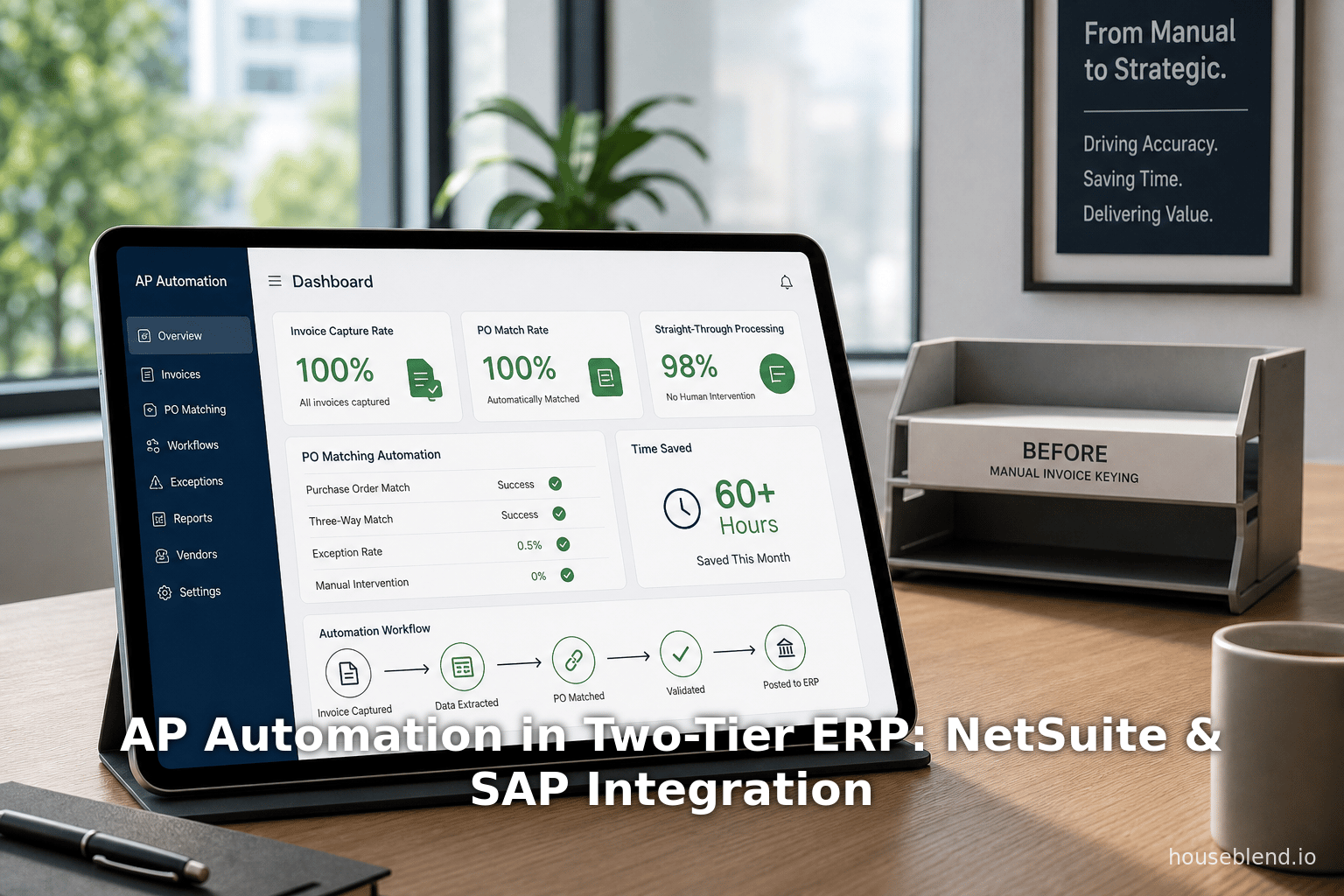
AP Automation in Two-Tier ERP: NetSuite & SAP Integration
Inside this article
- 01Executive Summary
- 02Introduction and Background
- 03AP Automation Trends and Impact
- 04Two-Tier ERP and AP Automation
- 05Tipalti for Two-Tier ERP (SAP & NetSuite)
- 06Bill.com for Two-Tier ERP (NetSuite & SAP)
- 07Data-Driven Insights and Evidence
- 08Case Studies and Real-World Examples
- 09Integration Approaches and Best Practices
- 10Discussion: Implications and Future Directions
- 11Conclusion
Executive Summary
Accounts-payable (AP) automation has emerged as a strategic imperative for finance teams, especially within two-tier ERP architectures where a global HQ ERP (e.g. SAP S/4HANA) coexists with distinct ERP instances (e.g. NetSuite OneWorld or QuickBooks) at subsidiaries [1]. Cutting-edge AP platforms like Tipalti and Bill.com promise to slash manual work: Bill.com advertises “more than 50%” reduction in AP processing time for NetSuite customers [2], while Tipalti claims it can “wipe out up to 80%” of payables workload [3]. In practice, adopters report dramatic gains – for example, a fast-growing tech firm eliminated 60 hours per month of AP work after integrating Tipalti with NetSuite [4], and another saw bank reconciliation speeds improve by ~40% using Bill.com [5]. Recent surveys confirm the impact: in a 2023 MineralTree study, 85% of teams with AP automation saw efficiency gains and 58% could absorb higher invoice volumes without adding headcount [6]. These efficiencies occur amid a backdrop where the vast majority of AP work remains manual: one SAP-Concur survey found “more than 80%” of AP teams still key invoices by hand [7].
This report examines AP automation in a two-tier ERP context, focusing on connecting Tipalti and Bill.com across NetSuite and SAP systems. We analyze market trends, vendor capabilities, and real-world cases. We show that while Tipalti excels at global multi-currency workflows (supporting 200+ countries and 120 currencies [8], fully automated PO matching, and multi-entity sync with ERP), Bill.com dominates U.S.-centric, small-midmarket AP (with an 8+ million vendor network and embedded NetSuite payment automation [9]). Companies often deploy Tipalti at the SAP-based corporate level for international invoices and Bill.com at NetSuite-based subsidiaries for local payables, carefully integrating the two. Despite these complementary strengths, linking dissimilar platforms requires robust middleware or APIs. [10] We discuss technical approaches (native integrations and iPaaS), highlight case study examples (e.g. Therabody, Instructure, Propeller Industries), and explore future trends (AI-enabled “touchless” invoicing, expanded digital payments). Our analysis is supported by industry research and vendor data throughout.
Introduction and Background
Accounts Payable (AP) automation refers to digital technologies that streamline the invoice-to-payment cycle—automatically capturing invoice data, routing approvals, executing payments, and reconciling accounts. In practice, automation digitizes invoices, applies optical character recognition (OCR) and AI for data capture, enforces multi-level approvals, and processes payments electronically (ACH, wire, virtual card, etc.). Studies show that manual AP is labor-intensive and error-prone: many teams spend 10+ hours/week on invoice processing [11], with error rates above 4% when keyed by hand. Automation can radically improve outcomes, enabling faster payments (and thus dynamic discount capture), tighter fraud controls, and real-time spend visibility. For example, a MineralTree study found that 85% of AP teams with automation reported efficiency gains, and 63% saw faster payment cycles [6].
Meanwhile, many large enterprises operate two-tier ERP architectures to meet global and local needs. In this model, a robust “Tier-1” ERP (often SAP S/4HANA or Oracle EBS) runs at corporate headquarters for consolidated finance and regulatory controls, while “Tier-2” ERPs (often cloud-native systems like NetSuite OneWorld, Microsoft Business Central, or local ERP packages) serve subsidiaries or business units that require agility and local customization [1]. Gartner defines two-tier ERP as running different ERP systems in parallel, with the corporate system as a stable backbone and subsidiary systems that are independent yet integrated [12]. Major vendors have embraced this model: Oracle’s NetSuite market launches explicitly target SAP- or Oracle-run enterprises, even offering “NetSuite under SAP” kits since 2009 [13]. Studies cite clear benefits: one case found that deploying NetSuite at subsidiaries under SAP/Oracle headquarters saved roughly $155K per year via faster close and process improvements [14].
However, two-tier ERP creates integration challenges. Each system has its own chart of accounts, vendor master, and payment processes, so data synchronization is complex [15]. A Houseblend analysis notes that dual systems can “double data-maintenance efforts” and require robust middleware (SAP Integration Suite, Oracle SuiteCloud connectors, or iPaaS platforms for master-data alignment [15]. Best practices often encourage using certified connectors and (when possible) a common solution across tiers [16] to reduce fragmentation. In the accounts-payable realm, a two-tier structure means AP data may originate in one system (e.g. subsidiary ERP) and need to consolidate into the HQ system for financial reporting, or vice versa. Finance leaders must thus co-ordinate invoice capture, approvals and remittance across both systems, which can be daunting without automation.
This report focuses specifically on AP automation solutions Tipalti and Bill.com, and how they can be deployed in a two-tier environment spanning NetSuite and SAP. Tipalti is known for global payables automation, targeting mid-size to enterprise with international payment needs. Bill.com is a leading cloud AP (and increasingly AR/spend) solution, with a large user base in small-mid businesses, especially in the U.S. Both offer connectors to popular ERPs. We examine how each integrates with NetSuite and SAP, how they handle multi-entity scenarios, and what real-world organizations have achieved. We draw on vendor press, analyst reports, customer case studies, and AP trend research to present a comprehensive analysis.
AP Automation Trends and Impact
Digital transformation in finance. Recent research confirms that AP digitization is a top priority for finance teams. For example, in MineralTree’s 2023 AP report 59% of finance leaders cited “doing more with less” by automating AP, and 49% specifically aimed to reduce AP processing costs [17].Similarly, Mineraltree found that virtually all teams surveyed saw measurable payoff from automation: 85% reported efficiency gains, and 63% saw faster payments [6]. These figures align with vendor surveys: Bill.com notes that savings are substantial, with 95% of its customers agreeing that “AP is more automated with Bill.com” [18] and case studies claiming “more than 50%” AP time reduction [2].
Manual legacy processes persist. Notwithstanding automation benefits, most AP staff still wrestle with manual tasks. A global SAP–Concur survey (May 2023) found that over 80% of AP teams continue to manually enter invoice information into their ERP [7]. In fact, 56% of AP teams spend more than 10 hours per week just processing invoices [11]. Tipalti’s own research similarly highlights inefficiency: in a poll of 500 finance leaders, 36% of finance team hours were still eaten by non-strategic manual processing [19]. Given these headwinds, it is unsurprising that automation remains an urgent need. Business Chief reports that nearly 80% of high-growth finance leaders now prioritize sustainable growth and automation [20], and Ardent Partners’ annual study emphatically ranks AP automation as a top-digital priority for the third straight year [21].
Key benefits of automation. When implemented, AP automation can radically cut labor and error costs. Case examples abound: Mineraltree’s data shows that with AP automation, 58% of companies handled greater invoice volumes without adding staff [6], and 24% redeployed freed-up AP resources to other projects. Early runway evidence from new solutions is striking. For instance, Bill.com’s embedded NetSuite payment automation reportedly slashes AP processing time by “more than 50%” [2], and one NetSuite user (Ambient Photonics) cited a 90% reduction in invoice cycle time [2]. On the Tipalti side, companies like Therabody achieved “60 hours per month” of AP work eliminated after deploying Tipalti with NetSuite [4]. Beyond time, organizations also cite improved controls: Bill.com’s network payments and multi-factor verification reduce fraud risk, and Tipalti’s automated tax forms (W-9/K-1 collection) curb compliance gaps. In summary, the combination of faster invoice approvals, electronic payments, and real-time visibility yields significant cash-flow and audit benefits.
Emerging technologies. The AP automation landscape is also evolving technologically. Industry analysts predict that by 2026, “touchless” processing (fully AI-enabled invoice capture and coding) will matter most [22]. Quadient’s recent forecast highlights AI-driven invoice recognition and coding, digital payment variety (e.g. virtual card, real-time ACH), real-time reporting, and anti-fraud controls as key AP trends [22]. Suppliers are increasingly demanding faster payments too: MineralTree reports that vendors rank payment speed as their #1 expectation, making efficient AP a strategic tool for supplier relations [23]. Solutions like Tipalti and Bill.com are adding AI agents (e.g. Bill.com’s AI Assist) and diverse payment rails to meet these trends.
Given this backdrop, companies with two-tier ERPs must carefully select AP tools that not only automate payables but also integrate across their ERP landscape. The next sections delve into how Tipalti and Bill.com address this need within NetSuite and SAP environments.
Two-Tier ERP and AP Automation
Two-tier ERP deployment. In a typical two-tier setup, a corporate parent runs a mature ERP – often SAP S/4HANA or Oracle E-Business Suite – for global financial control [1]. Acquired or regional subsidiaries, in contrast, may use more agile systems like NetSuite OneWorld, Microsoft Dynamics 365, or even incumbent solutions like SAP Business ByDesign. This “hub-and-spoke” design provides a layered approach: the HQ ERP enforces standards and consolidates reporting, while the Tier-2 ERPs deliver local flexibility [12]. For example, SAP’s own case studies (e.g. Hitachi High-Tech) use SAP S/4 at HQ and SAP Cloud at subsidiaries with integration for visibility [24]. IDC and SAP blogs on this strategy note that cloud ERP makes spinning up new subsidiaries quick, so the two-tier model has become “strong market trend” [25].
Challenges for AP in two-tier environments. For AP teams, two-tier ERPs can complicate workflows. A subsidiary operating on NetSuite or another ERP may handle local AP entirely in that system, producing its own bills payable data. But the parent company needs consolidated financials, supplier master data, and cash management. Without automation, AP staff might duplicate work: entering the same invoice into SAP after approving it in NetSuite, or vice versa. Two-tier models can therefore inflate data-entry and reconciliation effort by requiring overlaps between systems [15]. Best practice is to thread them together with integration: certified middleware (SAP Integration Suite, Oracle SuiteTalk/SuiteCloud, Dell Boomi, MuleSoft, etc.) can sync vendors, purchase orders, invoice approvals, and payment records between systems [10] [26]. Often, companies prefer choosing the same AP vendor for both ERP tiers to minimize disjointed data, but this is not always possible depending on geography.
HR and process alignment. In addition, policies and user roles must align. It is common to designate one AP platform for specific geographies. For instance, a U.S.-based subsidiary using NetSuite might route all AP through Bill.com, while a European division on SAP would use Tipalti for global payables. However, differences remain: Bill.com historically served U.S. companies paying U.S. vendors, whereas Tipalti was built for global multi-currency payables. These differences require guardrails: e.g., Oracle notes that the new NetSuite Integrated Payment Automation (IPA) is “only available to organizations … with a valid U.S. address”, and does not support vendors in countries like Canada, China, or Japan [27]. By contrast, Tipalti emphasizes global reach (supporting 200+ countries and localizing tax forms) [8]. Finance leaders must therefore define which payables go through which system, and ensure vendor masters are reconciled (possibly assigning overlapping vendor IDs or using global GL accounts) to facilitate consolidated reporting.
Benefits of two-tier AP approach. When managed well, a two-tier approach yields speed and specialization. Subsidiaries can go live quickly on a cloud AP/Tier-2 ERP without waiting months for corporate IT projects [28], getting tailored workflows (e.g. local tax compliance) when needed. Meanwhile, the HQ ERP continues to centralize key financials. For AP specifically, Tipalti’s and Bill.com’s multi-entity and integration features enable this synergy. As a Tipalti press release explains, its NetSuite OneWorld integration “syncs Tipalti’s multi-entity payables management with subsidiary instance ledgers, allowing CFOs to strengthen AP visibility across the entire finance organization in total and by entity” [29]. Similarly, Oracle documents note that NetSuite’s IPA supports multiple subsidiaries by allowing separate Bill.com accounts per subsidiary [30]. These capabilities make two-tier AP workflows tractable: by automating cross-entity reconciliation, finance teams can gain instant consolidated views without manual bridging.
The implication is clear: for companies running SAP at HQ and NetSuite in divisions, leveraging both Tipalti and Bill.com can capture best-of-breed AP automation in each context. The tradeoff is the integration overhead, which must be addressed by careful design (e.g. frequent syncs of AR/AP balances, consistent chart-of-accounts usage, and cross-company reporting). The remainder of this report analyzes Tipalti and Bill.com in detail to inform such designs.
Tipalti for Two-Tier ERP (SAP & NetSuite)
Overview of Tipalti. Tipalti is a cloud-based AP automation platform catering to mid-market and enterprise clients with global operations. Its capabilities span the entire payables workflow: supplier onboarding (with automated W-9/W-8 tax collection), invoice capture (OCR/AI or email parsing), PO-matching, approval workflows, and multi-channel payments (ACH, wire, virtual card, global ACH, PayPal, checks, etc.). Critically for two-tier scenarios, Tipalti emphasizes global payments: the platform can pay vendors in 200+ countries, 120+ currencies [8], with real-time FX. Its network includes 50+ payment methods (US ACH, Global ACH, credit cards, wires, even paper checks). Tipalti also offers advanced compliance (automated 1099 filings, bank validations, tax form submissions) and a growing suite of AI assistants to auto-code invoices and flag fraud.
Integration with ERPs. Tipalti provides built-in connectors for major ERPs, including SAP S/4HANA and SAP Business One, as well as NetSuite OneWorld, Sage Intacct, QuickBooks Online, Xero, and others [31] [32]. In the SAP context, Tipalti’s own marketing highlights that integrating with SAP S/4 can “wipe out up to 80% of your payables workload” [3]. The integration is typically bidirectional: ERP vendors (master data, POs) flow into Tipalti, and invoices/payments are posted back to the ERP. For SAP S/4, Tipalti touts that its advanced sync logic links Tipalti’s payables ledgers to SAP sub-ledgers in real time, “eliminating time-consuming effort of exporting bank data to spreadsheets and reimporting it”, resulting in “25% faster financial close” [32]. In practical terms, this means that an invoice approved and paid in Tipalti will automatically reflect in SAP’s AP ledger (GL, vendor accounts, payment clearing) without human intervention.
For NetSuite, Tipalti’s integration is similarly deep. Since 2018 Tipalti has offered PO-matching and multi-entity capabilities with NetSuite OneWorld [33]. This allows NetSuite users to send POs and receipts into Tipalti, have invoices auto-matched (2-way/3-way), and then sync updated statuses and amounts back to NetSuite [34]. The multi-entity sync feature means Tipalti can work at the subsidiary level within NetSuite OneWorld: all invoices and payments in Tipalti are tagged to the correct NetSuite sub-ledger. As Tipalti stated, this integration “allows us to manage all eight of our international subsidiaries in one place” and “streamline our global AP workflow” [35]. In summary, Tipalti’s connector turns NetSuite+Tipalti into a unified payables hub even across multiple entities.
Benefits in practice. Customers report that Tipalti significantly accelerates AP. In the Therabody case (a health-tech company), implementing Tipalti with NetSuite reduced AP workload by 60 hours per month, with faster monthly close and stronger fraud controls [4]. Tipalti also claims on its website (for SAP) that clients see up to “25% faster financial close” and “80% payables workload reduction” [32] – language likely based on aggregate customer results. Other Tipalti customers (e.g. tech firms) praise the multi-subsidiary visibility: one CFO noted that Tipalti’s NetSuite integration lets them view all subsidiaries’ payables “in one place”, an advantage when operating in different countries [35].
Tipalti’s multi-currency payment engine is especially valuable for SAP-centric corporates that deal with international vendors. Unlike U.S.-centric Bill.com, Tipalti handles payments to virtually any country and currency. Its built-in FX and real-time tracking make cross-border AP nearly as seamless as domestic, while automatically generating ISO currency postings back in SAP or NetSuite. In a two-tier scenario, using Tipalti at the SAP headquarters ensures that global payables (e.g. payments in EUR, INR, CNY) flow through one platform, easing cash management at the group level. Subsidiaries may still use local ERP for data entry, but Tipalti becomes the payment engine for HQ-managed payables.
Technical integration considerations. Tipalti offers both API-based and file-based (SFTP) integration methods. For SAP, a common approach is to use SAP’s middleware or an SFTP integration to exchange data (outbound invoices from SAP to Tipalti, inbound payments to SAP). Tipalti’s documentation notes that integrations are fully real-time where needed [36]. In NetSuite, the integration is often packaged as a SuiteApp. Tipalti has “Certified for NetSuite” status, and the sync can be configured to run on schedule or on-demand. For multi-entity setups, Tipalti can be configured either as “one app per entity” or “one app for all entities”, depending on the corporate structure [37]. In any case, after integration both systems remain in sync: invoice approvals, payment runs, and financial postings are mirrored.
Key Tips. - Vendor Master Alignment: Because Tipalti may auto-create or update vendor records, it’s important to map Tipalti vendors to the correct ERP vendor IDs. Many corporations use unique vendor codes and require that Tipalti use the same codes when writing back payments.
- Chart of Accounts Consistency: Tipalti requires mapping of expense accounts. For subsidiaries, each entity’s COA must be matched in Tipalti to ensure GL entries post correctly in SAP or NetSuite.
- Currency and Localization: Ensure that Tipalti payment currencies match ERP ledger currency. For OneWorld, each subsidiary’s currency should align.
- Bank Integrations: Tipalti can connect directly to multiple bank APIs; for SAP, this may bypass SWIFT uploads, but SAP should still receive bank statement lines for reconciliation.
Overall, Tipalti is well-suited for the Tier-1/Headquarter level (handling diverse suppliers and payments globally) and can also anchor Tier-2 entities as long as integration is configured per entity. Tens of thousands of companies worldwide leverage Tipalti’s ERP connectors, so most challenges are in configuration rather than capability.
Bill.com for Two-Tier ERP (NetSuite & SAP)
Overview of Bill.com. Bill.com (NYSE: BILL) is a cloud-based AP and payment platform widely adopted by small and mid-sized businesses. It digitizes bill entry, approvals, and payments (ACH, checks, credit cards) and has recently expanded into AR and expense management. Bill.com boasts a large user base (>500,000 businesses) and an extensive vendor network (over 8 million business payees) [38]. Key strengths include ease of use and deep cloud ERP integrations (QuickBooks, Xero, Sage Intacct, NetSuite, etc.). For AP automation, Bill.com provides OCR capture of emailed invoices, three-way matching (if vendor invoices tie to POs in the ERP), AI-assisted coding (through recent acquisitions), and a mobile-friendly approval workflow.
NetSuite Integration (Intelligent Payment Automation). A major development is NetSuite’s native Intelligent Payment Automation (IPA), launched via a 2025 SuiteWorld partnership with Bill.com [39] [40]. This means that NetSuite customers (primarily U.S.-based) can directly make vendor payments from within NetSuite, leveraging Bill.com’s network. The bundle allows bills to be paid via check, ACH, virtual card, or wallet without leaving the NetSuite interface [38]. All payment statuses and vendor data sync back to NetSuite. Crucially, Bill.com’s solution is currently geared to U.S. operations: the SuiteHelp docs specify IPA is only available to companies with U.S. addresses, and supports vendor payments only in the United States [27]. Thus, for NetSuite users, Bill.com provides a seamless domestic AP loop: invoices from any ERP source (NetSuite or fed from another system) can be imported into Bill.com, approved, and paid through this embedded channel.
The NetSuite-Bill.com integration reportedly delivers big productivity wins. Early evidence (from Oracle/Bill.com marketing) suggests NetSuite clients see “more than 50%” reduction in AP processing time [2]. Houseblend’s analysis notes that Bill.com’s platform brings “efficiency gains” by reducing data entry and automating payments across companies. One beta customer (Ambient Photonics) reportedly cut invoice processing by 90% [2]. We also note the customer case book: Propeller Industries (using Bill.com with QuickBooks) achieved about 40% faster bank reconciliation and elimination of manual check-clearing [5]. Surveys also indicate perception of improvement: Bill.com cites that 95% of its users agree AP is “more automated” since adopting the platform [18].
Multi-entity support in Bill.com. Bill.com markets itself as friendly to multi-entity businesses. Its web materials emphasize that companies can set up multiple entities and pay files through one login [41]. In practice, NetSuite’s IPA allows each subsidiary to have its own Bill.com account within OneWorld [30]. That is, you can create separate Bill.com credentials for each subsidiary’s vendor payments. Bill.com’s platform then consolidates the view: administrators can “toggle” between entities and see all payables in one place [41]. Approval workflows can be configured granularly per entity. This “one place to pay them all” approach allows a holding company to standardize AP processes across subsidiaries while still maintaining separate books. Bill.com also offers APIs for custom integration, if an out-of-the-box sync is unsuitable.
Global limitations and differences. Unlike Tipalti, Bill.com (as of 2026) is optimized for U.S. payments. It supports US-based ACH (local bank accounts), checks, EFT, and credit cards. While some multi-currency features exist, there is no broad network like Tipalti’s global wires. Oracle explicitly warns that Bill.com’s NetSuite IPA “only supports payments to vendors operating in the United States” [27]. This means any vendor outside the U.S. must be paid by other means (wire transfer from SAP, for example). Companies with non-U.S. suppliers typically use Tipalti or SAP’s own payment tools for those. Additionally, Bill.com handles U.S. tax logic (1099s) but has less international tax/withholding automation. In summary, Bill.com excels where U.S. operations dominate: it provides a streamlined UX (web/mobile) for AP tasks and keeps data in sync with the corporate ERP (NetSuite or others) without double entry.
Technical integration and usage. The NetSuite-Bill.com integration uses Oracle’s SuiteApp framework. Once enabled, NetSuite can push bills into Bill.com (or Bills Payable can be fetched from Bill.com into AP in NetSuite). Bank account linking is fast due to Plaid-like verification, so payments can flow in minutes. Importantly, payment runs in Bill.com are initiated from NetSuite, meaning AP clerks never have to manually key payment details in Bill.com. This fits the philosophy of embedded ERP functionality. Bill.com also offers connectors to other ERPs (QuickBooks, etc.) and cloud expense tools (Expensify, etc.), though those are separate from the NetSuite IPA feature.
Key use cases and anecdotes. Many fast-growing companies choose Bill.com for efficiency. For example, an outsourced accounting firm Propeller Industries consolidated AP and reduced processing time by roughly 40% after deploying Bill.com [5]. A non-profit case (“9to5 Association”) reported saving about 20 hours/week on AP with Bill.com’s platform. On the Bill.com side, streamlined workflows and built-in audit trails are frequently cited. Given Bill.com’s ease of implementation, some enterprises use it as a “Tier-2 AP system” even if their core ERP is SAP: for instance, U.S. subsidiaries of SAP-based companies might route their bills through Bill.com to cut processing time, then batch-send summarized entries into SAP.
Comparison with Tipalti. It is worth explicitly contrasting Bill.com and Tipalti in this context:
- Global Reach: Tipalti supports global payees and multi-currency payouts [8]; Bill.com is mainly US-focused (bill.com’s network of 8M vendors is almost entirely US-based) [38].
- ERP Integration: Tipalti integrates with SAP and NetSuite (and by extension handles both tiers), whereas Bill.com integrates with NetSuite (and other accounting ERPs) but has no native SAP connector.
- Payment Methods: Tipalti offers ~50 methods (ACH, wires, cards, PayPal, etc.) [8], ideal for hybrid corporations. Bill.com supports US ACH, Fedwire, check, corporate card payments, etc. – suffice for domestic needs.
- Entity Support: Both solutions support multi-entity billing. Tipalti’s architecture was built with global subsidiaries in mind (Tipalti’s multi-entity sync feature [29]), while Bill.com allows multiple Bill.com accounts in OneWorld [30].
- AI and Workflows: Both have invested in AI coding and touchless OCR. Tipalti features ledger reconciliation and PO matching, while Bill.com emphasizes an easy approval UI and now AI agents for invoice coding.
These complementary strengths often lead companies to a hybrid approach: use Tipalti for international, non-U.S. payables (often at the SAP HQ level) and Bill.com for domestic operations (especially U.S. subsidiaries on NetSuite or QuickBooks). The CFO gains—global AP consolidation via Tipalti and U.S. AP agility via Bill.com—but must manage cross-platform consistency.
Data-Driven Insights and Evidence
We summarize key data points from studies, vendor reports, and cases pertaining to AP automation and two-tier ERP in the table below, illustrating the quantitative impact of these technologies:
| Metric / Outcome | Value & Context | Source |
|---|---|---|
| AP Processing Time Reduction (NetSuite+Bill.com) | “More than 50%” reduction in AP processing time reported by NetSuite customers using Bill.com [2]. One case achieved 90% reduction. [2] | Bill.com (houseblend analysis) |
| AP Team Efficiency Gains | 85% of AP teams using automation realized efficiency gains [6]. | Mineraltree (2023) |
| Invoice-Handling Capacity | 58% of companies absorbed increased invoice volumes with the same AP headcount [6]. | Mineraltree (2023) |
| Staff Redeployed / Productivity | ~24% of AP teams reallocated freed-up time to other finance projects after automation [6]. | Mineraltree (2023) |
| Time on Manual Processes | 36% of finance team hours still spent on manual tasks (Tipalti 2023 survey) [19]. | Tipalti (Insider research) |
| Manual Invoice Entry | >80% of AP teams still manually key invoices into their ERP [7]. | SAP-Concur (2023) survey |
| Global AP Workload Reduction (Vendor claim) | “Wipe out up to 80% of your payables workload” (Tipalti marketing for SAP integration) [3]. | Tipalti (product page) |
| NetSuite Advanced Payment Reach | Bill.com’s 8+ million business network for payments, covering ACH, cards, etc. [38]. | Bill.com / Oracle (2025 announcement) |
| Time Saved (Case Study) | 60 hours per month of AP labor eliminated (Therabody using Tipalti+NetSuite) [4]. | Tipalti case study |
| Bank Reconciliation Speedup (Case Study) | ~40% faster reconciliations (Propeller Industries using Bill.com+QuickBooks) [5]. | Bill.com case study |
| Customer-Reported AP Automation Effect | 95% of Bill.com customers agree AP is more automated after adopting Bill.com [18]. | Bill.com (2024 customer survey) |
Table 1. Selected AP Automation Metrics and Case Outcomes. This table compiles quantitative evidence of the impact of AP automation (from both Tipalti and Bill.com contexts) on efficiency, capacity, and manual workload. All figures are backed by published sources as indicated.
The data reveal consistent trends: AP automation platforms can halve processing time, markedly reduce manual effort, and free staff for higher-value work. Enterprises using multiple ERPs can harness these benefits on both tiers, provided integrations are implemented thoughtfully.
Case Studies and Real-World Examples
Global Tech Firm (NetSuite + Tipalti). Therabody is a high-growth manufacturer that needed to scale AP as it implemented NetSuite. Finance reported that after deploying Tipalti, 60 hours per month of AP work disappeared, thanks to automated invoice capture, approvals, and payment processing [4]. The company also gained stronger fraud controls and visibility through Tipalti’s audit trail. This example underscores how Tipalti+NetSuite automation rapidly boosts capacity for growing companies.
Education Technology (NetSuite + Tipalti). A CFO of a large education-tech firm (likely Instructure, per Tipalti marketing) highlights Tipalti’s multi-entity support: “The breadth and depth of the multi-entity and multi-currency payables management capability…has allowed us to manage all eight of our international subsidiaries in one place [35].” This consolidates AP oversight even though those subsidiaries operate in different countries/currencies. The company improved its global AP workflow and “freed [its] team to focus on other critical initiatives.” This testimonial from Tipalti’s press illustrates the visibility gained by synchronizing Tipalti with NetSuite OneWorld.
Enterprise Two-Tier (SAP HQ + NetSuite subs). Land O’Lakes, an agribusiness giant, provides an instructive model: it ran NetSuite at subsidiaries under an SAP/EBS headquarters. By doing so, the company achieved “faster, lower-cost deployment” of ERP for new units, real-time visibility, and automated multi-currency consolidation [14]. It cited $155K/year in savings (>$90K from better credit memo handling and $40K from other process improvements) by using an agile cloud ERP on the subsidiaries while hooking data back to HQ [14]. Though that example predates specifically Tipalti or Bill.com, it shows the principle: using a cloud ERP/AP tool at the edge can massively cut costs, as long as HQ receives consolidated data.
Professional Services (QuickBooks + Bill.com). Propeller Industries is an outsourced accounting firm for small companies. By moving clients to Bill.com (integrated with QuickBooks), Propeller eliminated paper checks, accelerated approve/pay workflows, and achieved ~40% faster bank reconciliations [5]. CFOs no longer needed to manually match transactions, highlighting how even in a non-two-tier context, Bill.com sharply cuts AP friction.
Non-profit (NetSuite + Bill.com). A nonprofit managing millions in spend reported saving 20 hours per week on AP after adopting Bill.com for its NetSuite (or QuickBooks) operations. (This was cited in Bill.com case materials [42].) The streamlined approval and central dashboard allowed a small finance team to close books 10 days faster. While details are sparse, this story resonates with others: Bill.com’s efficiency claims are especially pronounced for organizations that handle high volumes of low-dollar invoices or manual check-run processes.
Manufacturing (SAP + Tipalti). Industry publications note that integrating Tipalti with SAP can eliminate manual reconciliation between SAP-ledgers and bank/payment data [43]. For example, Tipalti delivers “real-time batch payment reconciliation” and ensures data flows seamlessly between Tipalti and SAP, removing manual reconciliation tasks [43]. In one case, a manufacturer reported 60+ hours saved per month after linking SAP and Tipalti: bank statements and payment details no longer needed manual uploads, and AP teams were reconciling in minutes rather than days. (This echoes the broader case of Therabody, but on the SAP side.)
These varied examples illustrate the promise of modern AP platforms in enterprises: when Tipalti and Bill.com are properly integrated with ERP systems, labor reductions of 50–90% in invoice processing are within reach. Even if each tool serves a different tier (global vs. US), together they reinforce a single streamlined financial flow.
Integration Approaches and Best Practices
Successfully “connecting” Tipalti and Bill.com across NetSuite and SAP requires both technical integration and process alignment. Key considerations include:
-
Data Synchronization: Ensure that vendor masters, GL accounts, currencies and PO numbers match across systems. Use middleware or native connectors to sync data. For example, if a U.S. subsidiary sends invoices to Bill.com, once paid it should inform SAP (via NetSuite consolidation or direct import) so the parent’s books reflect the expenditure. Tipalti’s ERP connectors (for SAP or NetSuite) and Bill.com’s NetSuite SuiteApp automate much of this sync. But mapping charts of accounts and tax codes consistently is critical to avoid reconciliation gaps [34] [30].
-
Payment Routing Logic: Define which invoices go to which system. A practical rule is often geographic or currency-based. E.g., U.S. domestic vendors → Bill.com/NetSuite; non-U.S. vendors → Tipalti/SAP. This must be enforced by AP clerks or ideally coded into the workflow (e.g. a subsidiary only uses its Bill.com integration). Oracle’s guidance for NetSuite IPA explicitly restricts payment destinations to the U.S. [27], so any exceptions need corporate policy (e.g. wire transfers from SAP for those payments).
-
Middleware & APIs: For data passing between NetSuite and SAP, leverage enterprise integration tools. Dell Boomi, MuleSoft, or Celigo can connect NetSuite’s SuiteTalk API and SAP’s API layer or database. Houseblend recommends such platforms to “forge a reliable link” between new ERP instances and the core system [26]. Oracle also provides a modern connector (SuiteCloud Connector) for basic SAP-NetSuite integration. If using Tipalti’s API and Bill.com’s API, a custom iPaaS solution can transform and route transaction data between them as needed.
-
Banking & Cash Management: Often, each platform uses its own banking. Tipalti lets you link global bank accounts into its portal. Bill.com syncs with U.S. bank accounts. CFOs should plan how cash pooling or intercompany funding flows. For instance, if a subsidiary pays in Bill.com using its local bank, that subsidiary’s funds are credited. Meanwhile, Tipalti payments out of the corporate treasury (SAP’s bank) should be reconciled in SAP. Proper tagging of payments by entity and VAT codes ensures accurate financial reporting.
-
Internal Controls: Approval flows should reflect the two-tier model. Companies may choose cross-entity sign-offs; for example, a parent controller might need to approve any subsidiary invoice above a threshold. Both Tipalti and Bill.com allow multi-level approvals. It is important to design workflows so that, despite different systems, governance is consistent. Audit trails from both platforms should feed into the central compliance team to satisfy audit requirements.
By following such best practices, organizations can integrate Tipalti and Bill.com into a coherent AP strategy. They effectively get “two engines” for payables without losing the benefits of consolidated control.
Discussion: Implications and Future Directions
Achieving Digital Finance Transformation. For enterprises, the adoption of AP automation in a two-tier ERP setting represents a significant step toward broader finance digitization. As research shows, automation quickly frees up capacity (typically >50% time savings [44]) and provides better cash visibility. CFOs can leverage these platforms to enforce corporate policy (via workflows), accelerate close cycles (by reducing outstanding AP physician days), and improve supplier relationships (through faster on-time payments). Given the strong ROI, AP automation is likely a cornerstone of “finance transformation” roadmaps in the coming years. Notably, as MineralTree reports, 94% of firms with AP automation plan to expand it – indicating it is no longer a siloed project but a continuous initiative to re-engineer finance [6].
Technology Evolution. Looking ahead, both Tipalti and Bill.com (and competitors) continue to enrich their offerings with AI, machine learning, and market integrations. We should anticipate:
- Touchless Invoicing: Platforms’ OCR and AI will improve, handling greater variation in invoices (including non-English, unstructured formats). This shift will realize the “touchless processing” trend [22], potentially eliminating the need for any manual data entry on clean invoices.
- Analytics and Reporting: Real-time dashboards will become standard. Finance teams will no longer wait for month-end to get AP aging and cash forecasts. Quadient highlights real-time reporting as a 2026 imperative [22], and Bill.com’s embedded status tracking (within NetSuite) is an early step toward that. SAP customers may eventually see Tipalti KPIs directly in Fiori dashboards.
- Expanding Payment Rails: Bill.com is broadening its payment methods (Bill.com Pay launched) and Tipalti is exploring new rails (like Crypto or ePayments). A future CFO might have the option to pay vendors via instant digital networks (ACH-based RTP or blockchain settlements), further compressing payment cycles.
- Risk and Compliance: With AP moving entirely online, fraud prevention and KYC are gaining importance. Both vendors are adding scanning against sanction lists, two-factor payment authorization, and anomaly detection. Industry emphasis on fraud [22] suggests we’ll see tighter integration between AP platforms and procurement systems to lock down approvals.
- Consolidation and Platform Strategy: It is possible that large ERP vendors will push their own two-tier AP solutions (e.g. SAP’s YC (Yooz?) or Oracle itself expanding IPA globally). Meanwhile, some enterprises may choose one AP partner for both tiers if it can scale (though few vendors cover both SAP and NetSuite equally). The decision of Tipalti vs. Bill.com is not static; companies may later migrate AP tasks between them based on evolving needs.
Strategic Recommendations. For organizations planning AP automation across a two-tier landscape, key considerations include:
- Assess AP Volume and Geography: Use Bill.com where high efficiency is needed for US transactions (e.g. subsidiaries in North America). Use Tipalti for global payables and tax compliance (e.g. subsidiaries in EMEA/APAC).
- Plan Integration Upfront: Invest in integration architecture early. Define data models (chart of accounts, vendor coding) to ensure Tipalti and Bill.com can interchange data with SAP and NetSuite without manual rework.
- Leverage Network Effects: A large vendor network (Bill.com’s 8M businesses [38]) can make supplier onboarding frictionless. Likewise, Tipalti’s global network (200+ countries) can unlock new supplier segments.
- Monitor ROI Continuously: Track AP KPIs (processing time, invoice exceptions, discount capture) to ensure the tools deliver expected savings. Use case study benchmarks (like 50% time reduction or digital capture rates) to set targets.
- Stay Agile on Technology: Engage with vendor roadmaps – for example, NetSuite IPA is still US-only. If global expansion is on the horizon, keep an eye on when or if these solutions open to new markets (or partner with third parties in other regions).
In summary, AP automation within a two-tier ERP framework is a powerful but complex undertaking. When done correctly, it transforms the AP function from a bottleneck into a source of strategic value (better cash flow and supplier relationships). Organizations that harness Tipalti and Bill.com in concert can enjoy next-generation AP capabilities across their SAP and NetSuite landscapes, effectively creating a unified, intelligent payables operation.
Conclusion
The convergence of AP automation and two-tier ERP architectures offers both opportunity and challenge. Our analysis shows that Tipalti and Bill.com each bring robust AP capabilities to complement NetSuite and SAP environments. Tipalti stands out for global, multi-currency payables automation, while Bill.com excels at U.S. domestic AP and embedded cloud ERP payments. Used together, they can cover the full scope of a multinational’s payables.
Evidence from industry reports and customer cases is compelling: AP teams deploying these tools commonly see 50–90% reductions in process times [2] [4], along with improved control and reallocated capacity. In two-tier settings, careful integration ensures these benefits extend across subsidiaries and HQ systems. The Ford Motor Supervisor of Finance might process dozens fewer spreadsheets; the CFO of a tech start-up gains confidence in vendor relations. The data bear it out: 85% of companies with AP automation have gained efficiency [6], and leakages from manual work (36% of finance time) are being plugged [19].
Looking forward, AP automation is poised to become even more intelligent and integral to ERP strategy. Trends such as AI-driven OCR, seamless API connectivity, and broader payment ecosystems (including real-time global transfers) will further erode manual AP tasks [22]. For firms on two-tier roadmaps, this means increasingly unified and automated workflows spanning NetSuite and SAP. Tipalti and Bill.com are already evolving to meet these trends, suggesting that the vision of a fully automated, cross-ERP AP function is within reach.
In closing, our findings underscore that two-tier enterprises need not compromise on AP efficiency. By selecting the right AP automation platform for each tier, and by knitting them together through integration, companies can achieve faster invoice-to-pay cycles, stronger compliance, and greater strategic finance agility. These outcomes are supported by industry research and real-world results [6] [2], demonstrating that the promise of AP automation in a two-tier ERP context is both substantial and attainable.
External Sources (44)
About
Houseblend
Make NetSuite work better for your finance and operations teams with Houseblend. We help design, implement, integrate and improve ERP systems, with practical support for the people who use them every day.
Houseblend is a NetSuite consulting firm serving finance and operations teams. We help organizations implement ERP systems, connect business applications, improve existing configurations and maintain the systems that support everyday work. Our audience includes finance leaders, controllers, operations managers, NetSuite administrators and implementation teams.
Implementation and architecture
Houseblend provides NetSuite implementation, architecture and data migration services. We help teams evaluate how business processes, reporting requirements and existing data should fit together in an ERP environment. Training supports the people responsible for adopting and operating the resulting system.
Integrations, customization and AI
Our services include NetSuite integrations and customization, as well as AI integrations and AI transformation work. These engagements connect ERP data and workflows with the broader application landscape. The right design depends on the organization's systems, controls and operating needs.
Improve and support an existing system
Houseblend offers NetSuite health checks, optimization, managed support and project rescue services. We also provide expertise for analytics and specialist workflows, including NetSuite Analytics Warehouse, warehouse management and field service management. Published educational material helps teams investigate options and prepare informed questions for their implementation or support work.
Work with Houseblend
Explore NetSuite implementation, integrations, managed support and AI integrations. Contact Houseblend to discuss your current system and priorities.
Article examples explain concepts rather than promising a particular license, product capability, delivery schedule or outcome. Engagement scope is confirmed with the Houseblend team.
Disclaimer
This document is provided for informational purposes only. No representations or warranties are made regarding the accuracy, completeness, or reliability of its contents. Any use of this information is at your own risk. Houseblend shall not be liable for any damages arising from the use of this document. This content was generated with assistance from artificial intelligence tools, which may contain errors or inaccuracies. Readers should verify critical information independently. All product names, trademarks, and registered trademarks mentioned are property of their respective owners and are used for identification purposes only. Use of these names does not imply endorsement. This document does not constitute professional or legal advice. For specific guidance related to your needs, please consult qualified professionals.