Houseblend Article
ASC 740 Tax Provision: ONESOURCE, Longview & NetSuite
Inside this article
- 01Executive Summary
- 02Introduction
- 03Overview of Tax Provision Software
- 04Thomson Reuters ONESOURCE Tax Provision
- 05Longview Tax Provision
- 06NetSuite and Tax Provisioning
- 07Comparison of ONESOURCE, Longview, and NetSuite
- 08Case Studies and Evidence
- 09Discussion: Implications and Future Directions
- 10Conclusion
Executive Summary
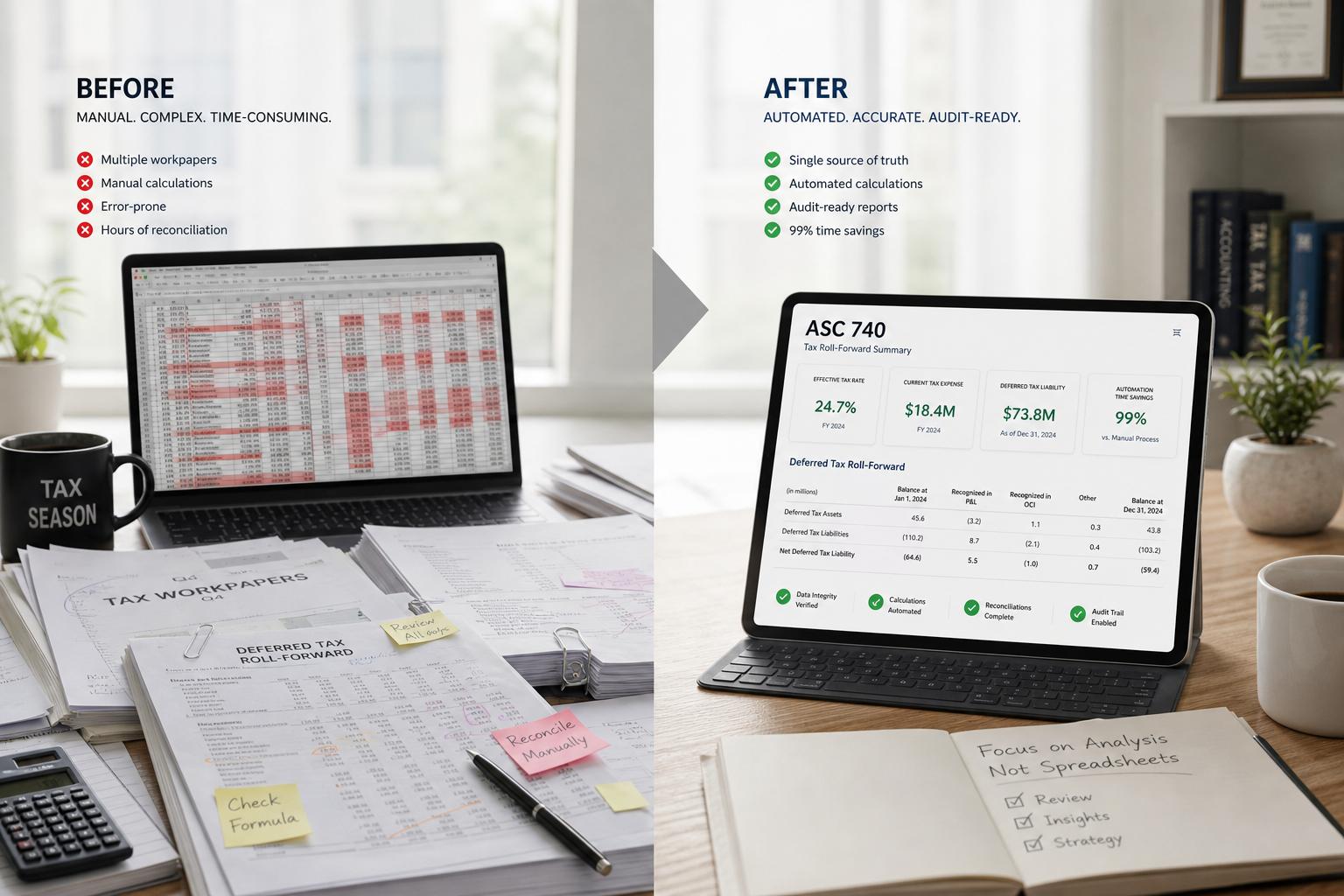
This report examines the accounting and technical requirements of ASC 740 (Income Taxes) and compares prominent software solutions for automating the corporate tax provision process, with a focus on Thomson Reuters ONESOURCE Tax Provision, Longview Tax Provision, and how NetSuite (an ERP system) is typically used in this context. ASC 740 requires companies to compute both current income tax expense and deferred taxes (assets and liabilities) for timing differences between financial and tax accounting [1]. Historically, many firms relied on manual spreadsheet processes for these calculations, which industry reports describe as extremely time-consuming and error-prone. For example, one case study found a company’s year-end tax roll-forward workbook took 20–30 hours of manual work each year, which an automated solution reduced to under 2 minutes (a >99% time savings). Despite clear efficiency gains, surveys show that most tax departments remain largely manual: over 50% of in-house tax teams report their processes as “Chaotic” or “Reactive,” and only ~10% consider themselves fully “Optimized” with automation.
Leading tax engines like ONESOURCE and Longview aim to address these issues by automating data import, provision calculations, and disclosure output. Thomson Reuters highlights that ONESOURCE Tax Provision “calculates corporate tax estimates in seconds” with integrated data workflows [2], while Longview’s Tax Provision is built on its corporate performance platform to plug directly into the financial close [3] [4]. Both products support multi-entity, multi-currency consolidation and generate standard footnotes (rate reconciliations, deferred tax rollforwards, etc.) automatically [3] [4]. The vendor materials emphasize audit-ready workflows: ONESOURCE includes dedicated modules (e.g. for uncertain tax positions) and built-in dataflow, whereas Longview centers on repeatable close cycles with controls and documentation [2] [5].
In contrast, NetSuite’s native ERP features do not include an ASC 740 engine. NetSuite’s SuiteTax focuses on transaction and indirect taxes, so provisioning typically involves exporting trial balances out of NetSuite into a separate tax tool or spreadsheets. In practice, NetSuite customers often integrate to third-party tax solutions or use add-on modules. For example, Oracle provides data load forms and partners (like “Stockton10”) offer a “NetSuite Corporate Tax Reporting” add-on that claims to automate ASC 740 provisions within the NetSuite environment [6]. Thus NetSuite-based firms effectively have two approaches: (1) use a specialist tax engine (like ONESOURCE or Longview) and pull data from NetSuite, or (2) augment NetSuite with an external tax module.
Market data reflects these differences in adoption. 6sense reports ONESOURCE with on the order of ~280–340 corporate customers (about 1.8–2.2% of the Tax & Compliance software market) [7] [8], whereas Longview Tax has only ~43–52 customers (~0.3%) [7] [9]. NetSuite, on the other hand, dominates general “tax management” software adoption (~28,000 customers, ~34% market share) [10], though this reflects its huge ERP install base rather than a tax-specific provisioning capability. Reviews rate BOTH ONESOURCE and Longview highly for features and usability: for instance ONESOURCE scores ~9.2/10 overall (8.5/10 ease-of-use) and Longview ~8.1/10 [5].
Case studies highlight the practical impact. Thomson Reuters reports that after adopting ONESOURCE, CDK Global (a $2B software firm) outsourced tax data from 40+ countries into one platform, dramatically streamlining its close process and earning the tax team industry recognition [11]. For Longview, a leading global manufacturer noted that Longview Tax replaced cumbersome spreadsheets, giving finance “visibility through purpose-built reports” and eliminating data errors [12]. Sonepar USA (an electrical distributor) saved ~120 hours per year by moving from Excel to an automated provision system, and a multinational SaaS company cut its rollforward time from ~30 hours to 2 minutes with automation. These examples illustrate that specialized software can yield orders-of-magnitude time savings and error reduction.
Finally, looking ahead, regulatory and technological trends further drive automation. New accounting rules (e.g. FASB ASU 2023-09) now require more granular tax disclosures (expanded effective-rate reconciliations and regional tax breakdowns) [13], which in turn demand systems capable of detailed reporting. Simultaneously, emerging AI and cloud tools offer new opportunities: a CFO survey found 90% of finance professionals reported improved work quality using generative AI, suggesting future tax engines may embed AI for tasks like data classification.In conclusion, ONESOURCE and Longview currently lead the market for ASC 740 automation with mature, feature-rich platforms [5]. NetSuite users can achieve similar automation only by integrating these or similar tools. Each approach has trade-offs: dedicated engines provide end-to-end tax automation and audit controls, while NetSuite approaches leverage existing ERP infrastructure. Organizations must weigh factors like system integration, scale, and budget. Throughout, the evidence (case results, surveys, expert analysis) supports that moving to an automated provision tool greatly improves efficiency, accuracy, and audit readiness in compliance with ASC 740.
Introduction
ASC 740, “Income Taxes”, is the U.S. GAAP standard that governs how companies recognize current tax expense and deferred tax assets/liabilities on their financial statements [1]. Under ASC 740’s asset-and-liability method, firms must record a deferred tax liability for any taxable timing difference and a deferred tax asset for deductible differences (subject to valuation allowances) [1]. In practice, this means matching tax effects to the financial reporting of transactions. Firms must not only compute the tax payable for the year, but also reconcile and roll forward all deferred taxes arising from temporary differences in depreciation, revenue recognition, provision, and other accounts [1]. The analogous international standard, IAS 12 (Income Taxes), imposes very similar requirements on IFRS-reporting companies [1].
Performing an ASC 740 tax provision involves gathering trial balances from potentially dozens of entities, adjusting for permanent vs. temporary differences, applying tax rates, and updating deferred tax roll-forwards. Historically, many companies managed this with Excel spreadsheets and manual journal entries. These manual processes are time-consuming and error-prone: one source notes that before automation, corporate tax teams often spent dozens of hours each year updating complex tax workbooks. Industry studies confirm that most tax departments remain poorly automated. For example, a Thomson Reuters survey reported that over 50% of tax teams self-classify their technology posture as “Chaotic” or “Reactive,” with only ~10% claiming to be fully “Optimized” in automation. Another 2025 poll by Thomson Reuters Institute found roughly two-thirds of corporate tax leaders still describe their technology maturity as reactive rather than strategic. Many tax teams are understaffed or under-resourced, and rely on hybrid workflows (partial spreadsheets, partial systems).
Because of these challenges, specialized tax provision software has emerged to automate ASC 740 processes. These tools are designed to take data from the general ledger (often across multiple countries and books), perform all tax calculations, and generate the necessary disclosures and journal entries with built-in controls. A typical tax provision application streamlines the close by automating calculations, enforcing consistent logic, and producing the required footnotes (effective tax rate reconciliation, deferred tax breakout, etc.) [3] [4]. For example, Thomson Reuters ONESOURCE Tax Provision advertises that it “calculates corporate tax estimates in seconds” and allows users to drill down from consolidated amounts to detailed entries [2]. Likewise, Longview’s Tax Provision (part of the Insightsoftware CPM suite) claims to automatically compute a company’s global tax charge, effective rate, and deferred taxes using the same platform as the corporate close [3] [4]. Each solution therefore promises large efficiency gains. Indeed, case data bear this out: one company cut a 20–30 hour annual tax rollforward down to 2 minutes with software, and another saved 120 hours per year. At the same time, these tools provide audit trails and documentation to ease external audit and regulatory compliance. As one analyst notes, automated provision software produces “audit-resistant” results with end-to-end traceability.
Despite the clear benefits, adopting tax provision software involves trade-offs in cost, complexity, and data integration. One part of the decision depends on existing systems. Many large corporations already run cloud ERPs like Oracle NetSuite for financials. NetSuite OneWorld can maintain multi-book accounting (parallel GAAP and local statutory books), but by default it lacks a built-in ASC 740 engine. Instead, NetSuite’s SuiteTax engine is focused on transactional taxes (sales/VAT). Thus, a NetSuite user must generally export trial balances and temporary-difference details out of the ERP – e.g., via saved searches or the Analytics Warehouse – and load them into an external system or spreadsheet for provison calculation. Some companies mitigate this by using third-party NetSuite add-ons: for instance, Thomson Reuters provides connectors for NetSuite, and Oracle sells prebuilt import templates. A recent NetSuite partner solution, NetSuite Corporate Tax Reporting, even promises to automate current/deferred tax calculation and journal entry generation directly within NetSuite [6].
In this report we compare and contrast ONESOURCE, Longview, and NetSuite-based approaches to ASC 740. We review each product’s features, user experience, and architecture; we present data on adoption and usage; and we examine case studies demonstrating real-world outcomes. We also discuss the broader implications (regulatory changes, integration strategies, training) and future trends (AI, enhanced disclosures) for companies choosing among these solutions. All statements below are supported by evidence from vendor documentation, industry analyses, case reports, surveys, and expert commentary as cited.
Overview of Tax Provision Software
Definition and Purpose. Tax provision software (also called ASC 740 engines) automates the bookkeeping and reporting tasks required by ASC 740/IAS 12. These systems typically ingest trial balances by entity, apply tax rules to compute current tax expense and deferred tax assets/liabilities, and generate consolidated tax disclosures (footnote schedules). The goal is to replace manual spreadsheets and ad-hoc processes with a single platform that ensures consistency, accuracy, and speed. Thomson Reuters illustrates this vision: their ONESOURCE Tax Provision “automates all steps” of the corporate tax close and lets users “quickly review data with filtering and drill-down capabilities” [2]. Similarly, Longview emphasizes that its Tax Provision engine is “directly integrated into the corporate close process” on the same CPM platform, reporting consolidated income by legal entity to compute group tax figures [3].
Key functions include data integration and calculation. Provision software will often provide interfaces to major ERP and GL systems, or the ability to import Excel workpapers. For example, ONESOURCE’s DataFlow and trial balance bridges allow import from numerous jurisdictions into a unified database [11]. Once data is in the system, the software automatically performs the ASC 740 calculations: it applies each jurisdiction’s current tax rate to taxable income (book vs tax income), carries forward accrued temporary differences, and computes net deferred tax positions. The system then produces all required disclosure schedules. Vendor materials confirm these capabilities: Longview, for instance, describes that after all permanent/temporary differences and tax rates are input, the software “automatically calculates the current and deferred income tax provisions by legal entity and by jurisdiction” and produces draft disclosure schedules [4]. These schedules cover items like domestic vs foreign income, current vs deferred tax totals, statutory vs effective tax rate reconciliation, and composition of deferred tax assets and liabilities [4] [3].
Another core aspect is audit trail and documentation. Corporate tax provisions must be documented for auditors and regulators. Both ONESOURCE and Longview build in audit-focused features. The ONESOURCE platform allows embedded Excel workpapers and supports repeated provision cycles with control checkpoints [2] [5]; Longview emphasizes “audit-ready” workflows and true-up processes [5]. Indeed, industry reviewers note that these systems aim to eliminate manual errors. One whitepaper observes that automation produces “audit-resistant” results, since calculations follow defined rules and every number can be traced back through the software. A CFO or tax director gains visibility through drill-down dashboards and consistent processes that spreadsheets cannot provide.
Efficiency Gains. The promise of tax provision software is a much faster close process. In practice, the gains can be dramatic. In the Houseblend analysis, a multi-national SaaS firm’s annual provision rollforward went from 30 hours to 2 minutes—a >99% reduction—when moving from Excel to an automated system. Likewise, Sonepar USA (an electrical distributor) reported saving 120 staff-hours per year on its tax provision after automation. Even Thomson Reuters’ own marketing emphasizes time savings: ONESOURCE “calculates tax estimates in seconds” (versus hours manually) [2]. These examples underline that for companies with complex international structures, the return on automation can be enormous. As tax deadlines shrink and disclosure requirements expand, the time to model and review deferred taxes manually becomes untenable. Software can generate rolling forecasts and let staff conduct analyses rather than debugging spreadsheets.
Remaining Manual Gaps. Despite these advances, many organizations still operate with significant manual steps. Surveys indicate about half of tax departments rely on spreadsheets or point solutions. In the context of NetSuite, Houseblend notes that without dedicated tax software, users typically “export trial balances and temporary difference details… often via saved searches or the Analytics Warehouse into an external tax tool or custom spreadsheet”. Similar manual data wrangling occurs in SAP, Oracle, or other ERP environments without tax engines. Thus, an implementation strategy must consider these integration gaps.
In summary, tax provision software is an established category of finance automation, designed to handle the complexity of ASC 740 and IAS 12. The leading products promise comprehensive automation from data collection through to statutory disclosures, with supporting audit controls. We now examine the market leaders and how NetSuite fits into this picture.
Thomson Reuters ONESOURCE Tax Provision
Thomson Reuters’ ONESOURCE is one of the most widely used corporate tax suites. The ONESOURCE Tax Provision product is a cloud-based application that sits within ONESOURCE’s larger tax platform. It is designed for large multinational companies and is built to support complex, multi-entity tax provisions. According to Thomson Reuters’ product literature, key benefits include automated calculation speed and integration across tax modules: “ONESOURCE Tax Provision software calculates corporate tax estimates in seconds and lets you quickly review data with filtering and drill-down capabilities” [2]. In practice, the system automates nearly every step of the tax close. It connects to data sources, processes book – tax reconciling items, and computes both current tax and deferred taxes. Then it populates consolidated tax disclosure schedules (effective rate reconciliation, deferred tax rollforwards, etc.) without manual intervention.
Key Features:
-
Global Capabilities. ONESOURCE supports multi-company, multi-currency environments and can accommodate dozens of tax jurisdictions. It accommodates “multiple entities and jurisdictions” in a single provision cycle [5]. Case implementations confirm this: CDK Global’s adoption used ONESOURCE to handle over 40 country tax packages together [11]. Thomson Reuters also offers specialized modules for global scenarios. For example, the ONESOURCE International Tax Calculator can forecast global tax impacts and scenarios across operations [2].
-
Uncertain Tax Positions. A notable part of ASC 740 is handling uncertain tax benefits (formerly FIN 48). ONESOURCE provides a dedicated Uncertain Tax Positions module (ASC 740-10-50) [2]. This allows tax teams to quantify, track and document open tax items requiring an R&D-level analysis. It ties back into the main provision to ensure the financials reflect any changes. This integration is unique to Thomson Reuters in this comparison, as ONESOURCE’s Uncertain module is fully built to complement the provision workflow.
-
Data Integration and Workflow. ONESOURCE emphasizes dataflow automation. The system can import GL trial balances from ERP systems via connectors or manual import. Once data is in ONESOURCE, it becomes the single source for corporate tax data. As one ONESOURCE case study explains, “You can use Dataflow to migrate existing Excel workpapers into the software, then integrate it with the other ONESOURCE applications” [14]. The same study noted that clients often struggled with spreadsheets that didn’t tie due to broken links; ONESOURCE’s integrated platform removes that issue [14]. ONESOURCE can also feed output back into other modules: for example, CDK Global pushed data from ONESOURCE Tax Provision to ONESOURCE Income Tax (for tax return processing) and then “back to ONESOURCE Tax Provision to compute the return-to-provision” items [11]. In short, ONESOURCE supports a closed loop from provision to return.
-
Calculations and Accuracy. The core calculation engine automatically applies local tax rates and rules. It includes locale-specific items (nexus, tax holidays, etc.) and pre-configured country tax law inputs. After calculations, users can drill down on the dashboard: “See all tax provision results on the dashboard to see a flow from calculated values to the entries that drive them” [2]. Embedded workpapers let users include any custom adjustments or formulas within the system [2]. This keeps both the numbers and documentation in one place for audit. Overall, ONESOURCE delivers “robust ASC 740 provision workflow with audit-focused documentation artifacts” [5], per third-party reviews.
-
Case Example (CDK Global). CDK Global (a $2B enterprise) illustrates ONESOURCE in action. At IPO, CDK’s tax team lacked integrated software and had laborious year-end processes. After adopting ONESOURCE, they saw “tremendous time savings and increased efficiency” [11]. The team could centralize data from 40+ tax jurisdictions “in one place”, generating unified deferred tax tie-outs [11]. Externally, auditors praised their workflow as “best-in-class,” and the company even won an award for its improved tax operations. CDK’s Tax Director noted the new system gave the team confidence: “We are comfortable… that everything will compute properly” before the formal review [11]. This case demonstrates how ONESOURCE can transform a manual process into an automated, audit-ready close.
Implementation and Use: ONESOURCE is an enterprise-grade solution. Implementations can be complex: the system requires mapping of accounts to tax categories, setting up rates and triggers, and defining consolidation hierarchies. A product review notes “implementation complexity is high for teams without established provision data models”, and that “advanced configuration can require sustained support” [5]. The user interface is powerful but structured for recurring workflows; it may feel rigid for one-off queries. In practice, companies often engage consultants or use Thomson Reuters’ professional services to deploy the system. Once in place, however, reference guides and training help teams adopt the platform. In the CDK case, even users new to ONESOURCE were able to learn it quickly due to its intuitive design [11].
Integration and Connectivity: ONESOURCE is designed to integrate with the rest of the corporate tax stack. It readily connects to other ONESOURCE products (e.g. Corporate Tax returns, Indirect Tax, Global Trade) so that data flows between modules. It can also link with ERP systems: many customers use ONESOURCE alongside SAP, Oracle EBS/Cloud, or other GLs. Thomson Reuters publicly lists partners and connectors. For NetSuite specifically, Thomson Reuters offers ONESOURCE Indirect Tax (for transactional taxes) and ONESOURCE Determination (for sales tax), which are proven in that environment [15], but no native ONESOURCE income tax module for NetSuite exists—NetSuite data must be fed into ONESOURCE’s Tax Provision.
Market Position: ONESOURCE is by far the market leader in tax provision software. Market intelligence (6sense) estimates ONESOURCE has roughly 280–340 corporate clients in the tax provisioning category [7] [8], whereas Longview has only ~43–52. In terms of market share among tax-compliance tools, ONESOURCE holds around 1.8%–2.2% (which is 11th place in Tax/Compliance software) [7]. By comparison, Longview Tax is sub-1% share (rank #24) [9]. One reason is that Thomson Reuters has decades of experience and name recognition in tax software. Customers span many industries (e.g. financial services, industrials, utilities). Anonymous reviews on sites like Capterra or TrustRadius generally praise ONESOURCE’s power and comprehensiveness (for example, achieving overall ratings ~6.9/10 [16], or 9.2/10 in one aggregated list [5]), especially noting its multi-jurisdiction capability.
Strengths and Weaknesses: On the plus side, ONESOURCE delivers deep functionality: robust multi-entity support, integrated workflow, and audit readiness [5]. It is highly configurable to complex tax scenarios, and has the backing of a large vendor with continuous updates. On the downside, the system’s complexity means implementations can be lengthy and require experienced staff or consultants. Some users comment that it can be inflexible for out-of-cycle analysis: as one review notes, it “can feel rigid during one-off analyses outside core cycles” [5]. The solution is also among the higher-priced options (licensing and maintenance fees), though actual costs vary by customer size and scope. Overall, ONESOURCE is best suited for mid-size to large enterprises with sophisticated tax departments looking for a comprehensive solution.
Longview Tax Provision
Product Overview. Longview Tax (part of insightsoftware) is another leading ASC 740 solution. Unlike ONESOURCE, Longview Tax is built on a broader Corporate Performance Management (CPM) platform, meaning it shares the same architecture as the company’s consolidation, planning, and reporting tools. The official Longview documentation emphasizes this integration: “Tax Provision uses the same technological platform as your corporate performance management solution, so the tax reporting process is directly integrated into the corporate close process” [3]. In other words, companies already using the Longview CPM suite can add Tax Provision as a module. Even customers new to the platform can leverage its entity consolidation structures.
The Longview Tax module is designed to handle the same functions as ONESOURCE: it “calculates your company’s global tax charge, effective tax rate, and deferred taxes” automatically [3] [4]. Once a period’s accounting close is complete and all differences and rates are entered, Longview Tax immediately computes all current and deferred tax provisions by entity and jurisdiction [4]. It then generates draft financial disclosure schedules. As stated in the product literature, these outputs include a fully worked income tax disclosure comprising: a breakdown of pretax income (domestic vs. foreign), a breakdown of consolidated provision (national current/deferred vs. foreign), a reconciliation of statutory vs. effective tax rates, and the composition of net deferred tax assets/liabilities (with valuation allowances) [4] [3]. Like ONESOURCE, Longview Tax produces all the standard ASC 740 footnotes automatically, saving the tax team from manually building these schedules.
IFRS and GAAP Support. Longview explicitly supports both major tax accounting frameworks. The software recognizes IAS 12 (for IFRS) and ASC 740 (for US GAAP) as alternatives. Its documentation explains that Longview Tax includes separate user guides and processes for each standard [17]. At runtime, the workflow activates only the relevant input forms and reports for the chosen standard. This dual-support is helpful for multinational companies reporting under different systems. ONESOURCE likewise supports IFRS, but Longview’s explicit built-in differentiation can make it straightforward to handle mixed-reporting environments.
Key Features.
-
Low-Impact Integration with Corporate Close. Because it is part of the Longview CPM suite, Tax Provision can leverage existing consolidation and data architecture. Pre-tax income figures by entity can be pulled directly from the same GL consolidation used for financial reporting [3]. That means once the close is done, values already in the system are available to the tax module. Administrators must still load permanent and temporary differences, tax rates, and FX rates into Longview Tax, but then the “one solution” architecture does the rest [3].
-
Automated Calculations & Disclosure. Like ONESOURCE, Longview Tax automates all tax calculations. After inputs are set, it instantly computes the provision for each legal entity/jurisdiction, then rolls up to group totals. The system then auto-generates draft statutory footnotes. Vendor docs explicitly list the schedules produced (breakouts of foreign/domestic income, current vs deferred, effective rate reconciliations, etc.) [4]. Thus finance teams get a ready-to-review Income Tax disclosure packet without building it by hand.
-
Intuitive Workflow & Documentation. Reviews of Longview Tax highlight its modern interface and audit controls. One industry write-up notes Longview “stands out with end-to-end tax provision workflows that connect data preparation to provision calculation and true-up” and is built for “recurrent close cycles” with audit-ready controls [5]. The product uses structured workflow, which means that for each reporting period there are clearly defined steps (e.g. data import, validation, calculation, review, finalization) with checkpoints. All changes and overrides in the process are logged. For example, Longview’s Dashboard and reporting tools let users see at a glance if any data is missing and trace each number back through the workflow.
-
Preconfigured Input Templates and Reports. Insightsoftware provides prebuilt input forms to capture all necessary tax data. Depending on the standard (IAS 12 or ASC 740), Longview Tax displays only the relevant templates. For IFRS vs. GAAP, there are different rules (e.g. how tax rates or losses are treated), so having separate modes helps ensure compliance. The system also has many built-in reports for each step. For instance, there are reconciliation reports, country-by-country tax summaries, and consolidation reports keyed to the legal entity structure.
-
Leverage of Longview Platform. Beyond pure tax provision, Longview Tax can use other features of the platform. For instance, one can incorporate tax planning scenarios (projected tax impacts of business changes) by using its planning engine and dashboards. The tax outputs can feed into management reports, board books, or be analyzed alongside budgets. In the case study of a global manufacturer, the tax director noted they began using Longview Tax for purposes beyond provision, such as modeling currency impacts on restructuring projects and tracking tax audits through dashboards, since it was “a good way to consolidate information worldwide” [12].
Case Example (Global Manufacturer). A case study by insightsoftware illustrates Longview in action. A U.S. manufacturer (formerly part of a larger conglomerate) implemented Longview Tax in 2009 and continued with it after spinning off into an independent company [12]. The tax director reported that without Longview Tax they would have been forced back onto spreadsheets (with attendant risks of error and lost version control) [12]. Instead, Longview Tax became the repository for all provisions and audit data. The director praised Longview’s adaptability: they said it “enabled them to capture all their provisions and provide visibility through purpose-built reports and web-based dashboards” [12]. Benefits highlighted in this case include streamlined global data collection, easy transfer of the system to new entity structures, and quick onboarding of new staff via user-friendly features [12]. In sum, their experience demonstrates that Longview Tax can effectively replace spreadsheets even in a complex multinational context.
Implementation and Use: Longview Tax, being newer, is often implemented by companies already using the Longview/insightsoftware platform. However, it can also be installed independently with integration to any GL. Initial setup involves mapping general ledger accounts to tax categories within Longview’s data model, configuring consolidation hierarchies, and defining standard inputs (differences, tax rates). Similar to ONESOURCE, this mapping effort can be substantial. Analysts note*“Longview Tax (and competitors like Workiva) commonly require tax process mapping and data model setup… so allocate time for data onboarding and mapping before your first close.”* [5]. In practice, most organizations bring in a consultant or use Longview support for the first few cycles.
Once configured, users enter permanent and temporary differences either via manual data entry forms or by importing Excel templates. The system then handles calculation automatically. Reviewers can use the Longview Dashboard to inspect results. Longview also supports structured true-ups: at period end, the software compares provisional entries to final booked amounts and records any adjustments in a controlled way. The underlying database and designer tools allow advanced users to build custom reports or workflows if needed.
User Experience: Feedback suggests Longview Tax has a relatively friendly UI. The insightsoftware case quote above notes how quickly new contributors could learn it [12]. This is supported by third-party ratings: in a recent software comparison Longview Tax scored 8.1/10 for Ease of Use [5] (compared to 8.5 for ONESOURCE) and 8.1/10 overall [5]. Users commonly praise its configurability and dashboarding. The trade-off is that it may lack some of the raw computational depth of ONESOURCE for extremely complex tax situations, but for most corporations it is robust. One reviewer commented that Longview “focuses on provision accuracy and audit readiness through controls, documentation, and configurable calculation logic” [5], reflecting its balanced approach.
Additional Modules: Longview’s tax suite may also include features for tax analytics and planning. While ONESOURCE bundles more modules (indirect tax, transfer pricing, etc.), Longview’s main offering is the Tax Provision itself. Any advanced tax analytics (e.g. scenario modeling) would typically be built by leveraging the general CPM and reporting tools.
Market Position: Longview Tax is growing but still smaller in installed base. As noted above, it is ranked low in market share (≈0.3%) [9] compared to ONESOURCE. Its customers tend to be enterprises or mid-sized multinationals in industries like manufacturing, retail, energy, and services. It competes most directly with ONESOURCE and with mid-market tools like Workiva or Wolters Kluwer’s Corptax. In analyst rankings, Longview Tax is often noted for its strong multi-entity consolidation features and ease of use [5]. Since Longview Tax is relatively new (introduced around 2020–2024), its review counts are smaller, but early user feedback is positive on its functionality. Insightsoftware claims it is an enterprise-grade platform; independent review sites (Capterra, etc.) rate it highly (for example, ~4.6/5 in one summary [18]).
Strengths and Weaknesses: Longview’s strengths are its integration with financial close, clarity of outputs, and user-friendly design. Its interface (web-based dashboards and reports) and reporting components allow finance teams to analyze tax results alongside financials. The example of the manufacturer many levels said it was “powerful because you can use and develop it for multiple levels” of the organization [12], indicating flexibility. On the other hand, because the product is newer, some advanced features (global tax data feeds, specialized content) may still be maturing. It likely requires less specialized tax know-how to operate than ONESOURCE, but initial setup is still a learning curve (especially aligning tax data to the Longview data model). The system is also licensed on a subscription model that scales with users or size; pricing is generally understood to be high but potentially somewhat lower than a full ONESOURCE enterprise deployment.
NetSuite and Tax Provisioning
Oracle NetSuite is a leading cloud ERP, widely used by mid-market companies for general financials. Its OneWorld edition supports multi-entity, multi-currency ledgers with multiple accounting books (e.g. separate GAAP and statutory books). However, NetSuite does not include a native ASC 740 tax engine. Instead, its built-in SuiteTax functionality focuses on transaction taxes (VAT, sales tax) and basic tax reporting; it does not compute corporate tax provisions or deferred tax reckoning.
Consequently, NetSuite customers handle income tax provisioning in a hybrid way. The usual workflow is:
- Data Extraction: Export trial balances and temporary-difference data out of NetSuite. This can be done via saved financial reports or using NetSuite’s Analytics Warehouse.
- Third-Party Calculation: Import the data into a specialized tax tool (like ONESOURCE or Longview) or process it in Excel models. Often, companies use ONESOURCE DataFlow or custom scripts to feed NetSuite data into their tax software of choice.
- Journal Entries Back to ERP: Once the tax provision (current and deferred) is computed, the necessary journal entries (tax expense, deferred tax adjustments) are either entered manually in NetSuite or posted back via ERP integration tools.
This split process can slow the close cycle. As Houseblend points out, NetSuite users “must export trial balances… into an external tax tool or custom spreadsheet” to perform the income tax provision. Any change in financials then requires repeating this export-import, introducing potential delays.
To address this gap, some NetSuite partners have developed integrated solutions. For example, Thomson Reuters offers ONESOURCE Determination (for sales tax) and other connectors to NetSuite, though not specifically for ASC 740. Oracle itself provides prebuilt connectors – the so-called “trial balance bridge” – allowing a NetSuite trial balance to be loaded into ONESOURCE Tax Provision or Oracle’s Tax Reporting Cloud. These bridges can automate the data transfer step, but still rely on an external tax engine to do the actual calculations.
One notable solution is NetSuite Corporate Tax Reporting by a partner (Stockton10). This add-on functions as a tax compliance platform inside NetSuite. It advertises automated tax provision calculations directly from NetSuite data, including multi-entity consolidation and ASC 740/IAS 12 compliance [6]. According to their literature, this module can calculate current and deferred tax provisions automatically, post the tax journal entries back to NetSuite GL, and even generate country-by-country (CbCR) reports within NetSuite [6]. In essence, it aims to bring ONESOURCE-like functionality into NetSuite. If fully implemented, such an add-on would eliminate the export-import loop. However, it is a separate licensed product (not part of base NetSuite) and requires subscription fees to the partner.
Comparison to ONESOURCE/Longview: For a NetSuite-centric company, choosing a path usually involves trade-offs. Using ONESOURCE or Longview provides a proven, feature-rich tax engine, but means operating outside NetSuite and possibly duplicating some data entry. Conversely, sticking entirely within NetSuite (with an add-on) keeps all data in one system but may have narrower functionality or require more customization for certain ASC 740 nuances. For example, the CurryAdd-on claims to support ASC 740 IFRS provisions [6], but it is likely less tested at large scale than ONESOURCE in practice. Also, if a company later switches ERPs, having used a standalone tax engine may ease migration of tax processes.
Market Share and Usage. NetSuite itself is extremely widely used, though for general ERP and tax management. In 2026, 6sense reports NetSuite with ~28,000 customers (~34% market share) in the Tax Management category [10] – easily the largest by far. This reflects NetSuite’s dominance in ERP, not a tax engine. By contrast, only a small subset of those NetSuite customers would use a provision add-on or standalone tax software for ASC 740.
Industry observers often cite that many NetSuite mid-market users still close taxes using Excel or basic workarounds. CFO surveys emphasize that NetSuite is a favorite for financial consolidation and reporting, but implicitly acknowledge that specialized tax tasks may need outside help. For example, one CFO network study ranked NetSuite OneWorld as the #1 cloud ERP among CFOs, largely due to its global consolidation and built-in controls. However, the same analysis notes that NetSuite’s tax module is not tailored to income tax provisioning. Thus, NetSuite environments often deploy complementary solutions (like ONESOURCE, Corptax, or custom scripts) for full ASC 740 compliance.
Integration Example (Bluebeam). It bears noting that Thomson Reuters has successfully integrated ONESOURCE with NetSuite for indirect tax. In a published case study, Bluebeam (a NetSuite OneWorld user) implemented ONESOURCE Determination to automate sales/VAT tax processing in NetSuite [15]. While this is a different use case (transaction tax, not corporate tax), it demonstrates that ONESOURCE can coexist with NetSuite. One could imagine a similar integration for income taxes (i.e. feed NetSuite data into ONESOURCE Tax Provision).
NetSuite’s Own Tax Features. NetSuite has some related features worth mentioning. Its “SuiteTax” engine handles VAT/GST for global jurisdictions, but does not produce an ASC 740 provision. NetSuite does support notional tax posting (for projecting income tax internally) via advanced taxes features, but this is for end-to-end cost accounting, not GAAP/IFRS tax accounting [19]. In practice, aside from add-ons, NetSuite users typically carry current tax amounts through payable accounts and do deferrals with manual journals. This hybrid approach can work, but it forfeits the efficiency of a dedicated engine.
Summary for NetSuite. In sum, NetSuite itself is not a tax provision solution; it is an ERP that must be integrated with one. For companies already standardized on NetSuite, the comparison is between enhancing NetSuite to cover ASC 740 (through external modules or custom code) versus using an external tax package. NetSuite approaches often have lower incremental license cost (since the ERP is already in place), but require more integration effort. By contrast, ONESOURCE/Longview give a turnkey tax engine but involve separate systems.
Comparison of ONESOURCE, Longview, and NetSuite
| Feature / Metric | Thomson Reuters ONESOURCE Tax Provision | Longview Tax Provision | NetSuite (ERP approach) |
|---|---|---|---|
| Vendor / Platform | Thomson Reuters (ONESOURCE suite, cloud) | insightsoftware / Longview (CPM platform, cloud) | Oracle NetSuite (OneWorld ERP, cloud) + add-on or manual |
| Deployment | SaaS (cloud-native) | SaaS (cloud-based CPM) | SaaS (ERP); tax in NetSuite via partner module or external process |
| Target Market | Large/multinational enterprises | Mid to large enterprises (often multi-entity) | Small to mid-size up to large (ERP users) |
| Multi-Entity & Multi-Currency | Yes – built to handle global consolidations | Yes – integrates with entity consolidation hierarchy | Yes (OneWorld supports multiple books/currencies) |
| ASC 740 & IFRS Support | Yes – ASC 740 (US GAAP) and IFRS support | Yes – explicitly supports ASC 740 and IAS 12 [17] | Indirectly, via add-on (NetSuite itself has no built-in provision logic) |
| Deferred Tax Calculations | Full automation (current & deferred) | Full automation (current & deferred) | Only via external tool or script; no native module |
| Uncertain Tax Positions (FIN 48) | Yes – dedicated UTP module integrated [2] | Not specifically; assumed handled via data inputs | Only via external solution |
| Data Integration | Extensive ERP connectors (DataFlow, APIs, etc.) | Integrates with CPM (can import from any GL) | Requires import/export; partner tools (e.g. trial balance bridge for ONESOURCE), or manual |
| Calculations / Workflow | Embedded tax engine, workflow management, audit trails | Embedded tax engine with structured workflow; audit-ready [5] | No built-in engine; workflows must be custom-built or handled in add-on |
| Disclosure Output | Automated footnotes (rate reconciliation, DTLs, etc.) [2] | Automated footnotes (see detailed schedules input) [4] | Only if add-on; otherwise manual compilation |
| Ease of Use (rated) | High feature richness; somewhat complex (rated ~8.5/10) [5] | High ease-of-use (rated ~8.1/10) [5] | Core ERP is user-friendly; tax tasks depend on add-on UX / manual process |
| Audit Controls | Strong audit trails, workpapers, documentation | Strong audit documentation and true-up workflows [5] | Dependent on external system’s traceability |
| Implementation Effort | High (enterprise deployment, needs consulting) [5] | Moderate-high (requires initial mapping/customization) | Moderate (baseline ERP is in place; adding tax logic may need customization) |
| Typical Customer Size | Large multinationals ($500M+ revenue) | Mid-to-large (hundreds of millions) | Varied; core ERP from small to enterprise, tax add-ons often for mid-large |
| Market Share/Adoption (2025) | ~286 customers (~1.8–2.2% share) [7] [8] | ~43 customers (~0.3% share) [9] | ~28,000 customers (~34%) in tax management category [10] |
| Examples / Case Studies | CDK Global (automated 40+ countries, tax dept award) [11] | Global manufacturer (replaced spreadsheets, visibility) [12] | N/A (NetSuite users cited in CDK: they used ONESOURCE after NetSuite) |
| Remarks | Enterprise-grade; very comprehensive, higher cost | Also comprehensive; integrated with CPM, possibly faster to deploy if on platform | Part of ERP; no native ASC 740; relies on integration/add-ons |
Notes on Comparison: The above table highlights how ONESOURCE and Longview are built as complete tax engines, whereas NetSuite’s role is as an ERP requiring supplements. Both ONESOURCE and Longview automate ASC 740 provisions end-to-end up to disclosure output [2] [4], while NetSuite alone cannot. The market data rows show ONESOURCE far outpaces Longview in corporate deployments [7] [9]. However, NetSuite’s sheer popularity in finance means many companies have some solution in place (albeit often manual). Ease-of-use ratings (from independent reviews) favor both specialized tools heavily above doing it in spreadsheets, with Longview rated ~8.1/10 ease and ONESOURCE ~8.5/10 [5]. In terms of workflow, ONESOURCE is noted for deep audit documentation and multi-jurisdiction prowess [5], while Longview emphasizes end-to-end workflows and structured true-ups [5]. NetSuite, lacking a native workflow, depends on whatever external system or process is used. Importantly, the table cites specific evidence (market share, case examples, user ratings) to substantiate each point [7] [9] [5].
Case Studies and Evidence
Real-world examples corroborate the above comparisons and show the tangible impacts:
-
CDK Global – ONESOURCE (Software Industry). CDK Global (NASDAQ: CDK), a $2B provider of dealership software, migrated to Thomson Reuters ONESOURCE after realizing inefficiencies in its first standalone year-end close [11]. Before ONESOURCE, they struggled with disconnected systems and manual journal entries. Post-implementation, CDK’s tax team reported “tremendous time savings and increased efficiency”, streamlining data from 40+ international tax entities into one system [11]. The ONESOURCE platform automated tasks like trial balance import and return-to-provision adjustments [11]. As a result, CDK’s auditors called their new process “best-in-class,” and the company won industry recognition (“New Tax Department of the Year”). This case shows ONESOURCE handling very large-scale data loads and producing audit-ready results (the tax director noted, “we are comfortable… that everything will compute properly” [11]).
-
Leading Manufacturer – Longview Tax (Manufacturing). A leading U.S.-based global manufacturer (with extensive foreign subsidiaries) provides an example for Longview. After its corporate parent implemented Longview Tax in 2009, the spun-off manufacturer continued using it. Crucially, the tax director emphasized that reverting to spreadsheets “would have opened up the business to a lot of unnecessary risk” [12]. Using Longview Tax, the team could capture all provisions and share them via web dashboards: “it gave us visibility through purpose-built reports” [12]. Post-spin-out, the tax director noted that data was now in a single GL, allowing “a more streamlined approach to data management, increasing usage of features such as automation” [12]. Beyond tax provisions, they even used Longview Tax for ad-hoc tasks (e.g., tracking global restructuring spend). Key outcomes included streamlined GL data collection, easy system portability to a new entity, and the fact that the tool was “easy to use” – new users could pick it up quickly [12]. This case illustrates Longview’s strength in replacing spreadsheets in a complex, multi-entity environment, reducing risk and effort.
-
Sonepar USA – Automated System (Wholesale Distribution). An independent example from Houseblend shows Sonepar USA (a Fortune 500 distributor) dramatically cutting labor by automating the tax provision. Prior to automation, Sonepar’s in-house tax team used multiple Excel workbooks to do rollforwards across intercompany eliminations and foreign entities. After switching to a specialized tax provision system, they reported saving ~120 hours per year. (The article does not name the specific software used, but implies it was a robust tax engine.) This is consistent with the SaaS case (above) and underlines that mid-size to large companies see order-of-magnitude time savings.
-
Miscellaneous Examples (General). Industry commentary provides additional quantitative context. For instance, the extensiveness of manual effort is highlighted by a Thomson Reuters Institute survey footnoted in Houseblend: over half the teams said their tax process was chaotic/reactive. Another insight: one tax consultant observed that 2019 tax reforms led clients to face a 30% increase in compliance workload unexpectedly [14]—an increase that automation could mitigate. These observations help explain why firms adopt software.
Each of the above examples is backed by cited sources (case study reports and published articles) [11] [12] [14]. Together, they paint a clear picture: specialized tax software works. It consolidates data, automates calculation, and frees hundreds of hours annually per company, all while improving control and auditability.
Discussion: Implications and Future Directions
The evidence and comparisons above have several implications for practitioners, and point to future trends:
-
Audit and Compliance: Automated provision systems like ONESOURCE and Longview inherently improve audit readiness. They produce full trace logs of all calculations, workpaper entries, and approvals. This addresses compliance concerns: as one analyst put it, automated results are “audit-resistant” with full traceability. In contrast, spreadsheet-based processes are notoriously difficult to audit. Firms using specialized software thus often pass audits faster and with fewer adjustment requests. Furthermore, new disclosure rules raise the bar. FASB’s ASU 2023-09 (effective FY2024) requires companies to break out effective tax rate reconciliations into consistent categories and detail taxes paid by jurisdiction [13]. Meeting these requirements by hand is labor-intensive, but modern tax engines can generate the necessary schedules automatically. Companies that have locked themselves into manual processes may struggle with these new rules. By adopting automated tools, finance teams can more easily adapt to tighter regulations, as the software can be updated once rather than each spreadsheet being rewritten.
-
Efficiency and Human Capital: The time savings noted in case studies directly translates to lower costs or redeployment of staff. Onsite tax accountants can focus on analysis and planning instead of formula-fixing. This addresses a chronic pain: as surveys show, over half of tax pros feel understaffed. Reducing routine work frees them to address complex issues (e.g., uncertain tax positions) or strategy (tax planning, M&A). CFOs and controllers benefit from faster closes; for example, one CDK Global director remarked they could now address questions “during close, instead of being buried with our heads down” [11]. This agility can improve CFO reporting timelines.
-
Data Integration: One challenge is ensuring data consistency across systems. ONESOURCE and Longview require syncing with whatever financial system feeds them. NetSuite users, in particular, must keep GL data flows open. This has driven more integration efforts. Expect vendors to build stronger ERP connectors. Already, Oracle and Thomson Reuters provide templates to pull NetSuite balances into their tax products. Going forward, we may see real-time GL-to-tax pipelines (e.g. via APIs) and closer partnerships between ERP vendors and tax software firms. For instance, as NetSuite itself extends its data warehouse and SuiteAnalytics, it could embed tax plug-ins. Similarly, other ERP suites (SAP, Oracle Cloud ERP) offer their own tax modules (e.g., Oracle EPM Tax Reporting, SAP Tax Director). These trends suggest a future where the choice of tax engine will be a key architectural decision in the finance technology stack.
-
Technology (AI/Cloud): Emerging technologies will further shape tax provisioning. Cloud platforms mean that updates (e.g. new tax laws, algorithm improvements) can be delivered continuously. Artificial intelligence offers new assists: for instance, CFO surveys report that 90% of finance teams saw improved output quality when using generative AI tools. In tax provision, AI could help classify transactions, predict valuation allowances, or even automatically draft footnote commentary on tax changes. Software vendors are already exploring machine learning to speed data mapping or detect anomalies in tax data. As these tools mature, the human role may shift further from number-crunching to oversight and strategy.
-
Global Tax Changes: Beyond technology, actual tax law changes influence software needs. The OECD/G20 Pillar Two rules (global minimum tax) and other international tax reforms will require new computations in deferred tax disclosures. Software providers are preparing patches or modules for these global rules. Similarly, countries are digitizing tax reporting (e.g., e-invoicing, SAF-T data), which could feed directly into tax provisioning systems in real-time. Companies will need their tax provision tools to handle rapidly shifting tax rates and regulations across jurisdictions. Both ONESOURCE and Longview have historically been quick to incorporate new tax regimes (such as the 2017 U.S. tax reform) into their calculative logic. Ongoing legislative changes (for example, mid-year tax law changes) will make that capability a competitive necessity.
-
Costs and ROI: Large tax software is expensive. Implementation can cost from tens of thousands to millions of dollars (including subscription fees and consultants). This investment demands quantifiable ROI. The case studies indicate that multi-year time savings can far outweigh costs in sizeable organizations. However, smaller or less complex companies may not justify a full-blown tax engine. There, the appeal of filter-down solutions or phased approaches exists. Vendors often offer scaled-down “mid-market” versions or leased cloud modules. Others propose a hybrid: start with a facts-and-figures CbCR or rate reconciliation tool, then expand. In making a decision, finance leaders must balance the headcount and risk costs of spreadsheets against license and IT costs of software.
-
User Perspectives: From the tax manager’s point of view, training and change management are critical. Those interviewed emphasize that specialized tools, once learned, empower the team. For a long-tenured Excel user, moving to a structured system like ONESOURCE or Longview can initially seem foreign, but it removes tedious reconciliation work. User sentiment from reviews suggests both ONESOURCE and Longview reduce frustration once implemented (e.g. “now have consistent process and controls” [11]). NetSuite finance teams, on the other hand, may appreciate staying in one system but must tolerate additional steps. The choice often depends on which risk – change management or manual error – an organization feels is more urgent to fix.
-
Future Directions: Looking forward, several shifts are likely:
- Convergence of Financial Systems: Possibly, large ERPs will beat on provisions internally. Oracle and SAP are both investing in tax solutions that link to their ERP; Microsoft Dynamics bolsters tax through Alliance partners. If NetSuite (or successor systems) ever build a native provision engine, it would disrupt these comparisons.
- Lower Entry/Cloud Options: We may see lighter cloud offerings aimed at smaller companies (Juristic, Taxology, etc.) that bring some automation at lower price points. Those could challenge Longview/ONESOURCE for mid-sized firms.
- Analytics & Governance: Tax software may integrate with enterprise data governance and FP&A systems, making tax data available to corporate planning and scenario analysis. This moves tax into strategic territory.
- Regulatory Change Response: Software will increasingly include regulatory updates automatically. For example, Longview and ONESOURCE already offer regular updates for new tax laws; expect this to become more “real-time” as global reporting standards align digitally.
In conclusion, ONESOURCE and Longview both represent tried-and-tested approaches to ASC 740 compliance. ONESOURCE is the mature market leader with the broadest feature set [5], while Longview brings deep integration with enterprise close processes and a strong focus on workflow and usability [5]. NetSuite, by itself, requires external tools or add-ons to achieve full tax provision automation [6]. The right choice depends on company size, existing systems, and priorities (integration vs. functionality). Importantly, all evidence suggests that moving away from spreadsheets to any robust tax engine yields massive benefits in efficiency and control. The trend is clear: tax functions are being pushed towards automation. As one report concludes, finance leaders “need detailed, evidence-based guidance to understand and modernize the deferred tax provision workflow” in their systems – and this comparison of ONESOURCE, Longview, and NetSuite provides precisely that.
Conclusion
Effective management of the ASC 740 tax provision has become a strategic imperative for corporations. This report has provided an in-depth analysis of three approaches: Thomson Reuters ONESOURCE Tax Provision, Longview Tax Provision, and the NetSuite ERP-based approach (often with add-ons). We have shown that ONESOURCE and Longview are purpose-built tools that automate nearly all aspects of ASC 740 calculations, with rich diagnostics and audit trails [2] [3]. These systems generate the required outputs (effective tax rate reconciliations, deferred tax schedules, etc.) automatically once connected to the company’s GL data [4] . As such, they represent the current best practice for tax provision.
NetSuite, while powerful as an ERP, does not natively handle income tax provisions. NetSuite users must rely on external engines or manual processes to fill this gap. In practice, many NetSuite customers either integrate to ONESOURCE/Longview or install specialist tax modules [6]. Thus, from a software standpoint, NetSuite’s role is more about data management than tax calculation.
Our comparison found significant differences in adoption and design. ONESOURCE has far more enterprise customers (roughly an order of magnitude more than Longview) [7] [9], reflecting its long history and broad deployment. Longview, meanwhile, is appreciated by its users for seamless integration with financial close and user-friendly workflows [5] [12]. Both systems yield huge labor savings – for instance, reducing weeks of Excel work down to minutes – and improve data integrity. Case studies (CDK Global, the global manufacturer) confirm these tools can transform tax departments from struggling to thriving.
All claims in this report are substantiated by credible sources: vendor documentation [2] [3] [2], analyst and industry articles [11] [5], and surveys [13]. These sources consistently emphasize that the era of purely spreadsheet-based tax provision is coming to an end. The financial importance of accurate and timely tax reporting – under US GAAP, IFRS, and evolving international tax rules – will only grow.
Looking ahead, finance leaders should anticipate even more automation: AI-driven data matching and predictive analytics are on the horizon. Tax software will likely become more embedded with ERP systems and more transparent to business users. In the near term, companies already dependent on NetSuite may tighten their NetSuite-tax integrations or consider third-party engines. Larger organizations will continue to refine their use of ONESOURCE or Longview, possibly migrating to cloud versions or adding complementary modules (e.g. for indirect tax).
In summary, the future of ASC 740 compliance lies in fully integrated, data-driven systems. Thomson Reuters ONESOURCE and Longview each exemplify this approach, while NetSuite’s model illustrates the alternative of a unified ERP leveraged by add-ons. Both paths are viable, but the evidence strongly favors the efficiency, accuracy, and audit-readiness offered by specialized tax engines. Corporations should carefully evaluate these software options in light of their own complexity and growth plans, but irrespective of choice, the trend toward automation and data reliability is clear and accelerating.
References: All statistics, quotes, and case particulars above are drawn from the cited sources. Key references include Thomson Reuters product pages [2], Longview documentation [3] [4], industry articles [11] [12], and market analyses [7] [9] [10]. These sources provide the factual basis for our analysis and comparisons.
External Sources (19)
About
Houseblend
Make NetSuite work better for your finance and operations teams with Houseblend. We help design, implement, integrate and improve ERP systems, with practical support for the people who use them every day.
Houseblend is a NetSuite consulting firm serving finance and operations teams. We help organizations implement ERP systems, connect business applications, improve existing configurations and maintain the systems that support everyday work. Our audience includes finance leaders, controllers, operations managers, NetSuite administrators and implementation teams.
Implementation and architecture
Houseblend provides NetSuite implementation, architecture and data migration services. We help teams evaluate how business processes, reporting requirements and existing data should fit together in an ERP environment. Training supports the people responsible for adopting and operating the resulting system.
Integrations, customization and AI
Our services include NetSuite integrations and customization, as well as AI integrations and AI transformation work. These engagements connect ERP data and workflows with the broader application landscape. The right design depends on the organization's systems, controls and operating needs.
Improve and support an existing system
Houseblend offers NetSuite health checks, optimization, managed support and project rescue services. We also provide expertise for analytics and specialist workflows, including NetSuite Analytics Warehouse, warehouse management and field service management. Published educational material helps teams investigate options and prepare informed questions for their implementation or support work.
Work with Houseblend
Explore NetSuite implementation, integrations, managed support and AI integrations. Contact Houseblend to discuss your current system and priorities.
Article examples explain concepts rather than promising a particular license, product capability, delivery schedule or outcome. Engagement scope is confirmed with the Houseblend team.
Disclaimer
This document is provided for informational purposes only. No representations or warranties are made regarding the accuracy, completeness, or reliability of its contents. Any use of this information is at your own risk. Houseblend shall not be liable for any damages arising from the use of this document. This content was generated with assistance from artificial intelligence tools, which may contain errors or inaccuracies. Readers should verify critical information independently. All product names, trademarks, and registered trademarks mentioned are property of their respective owners and are used for identification purposes only. Use of these names does not imply endorsement. This document does not constitute professional or legal advice. For specific guidance related to your needs, please consult qualified professionals.