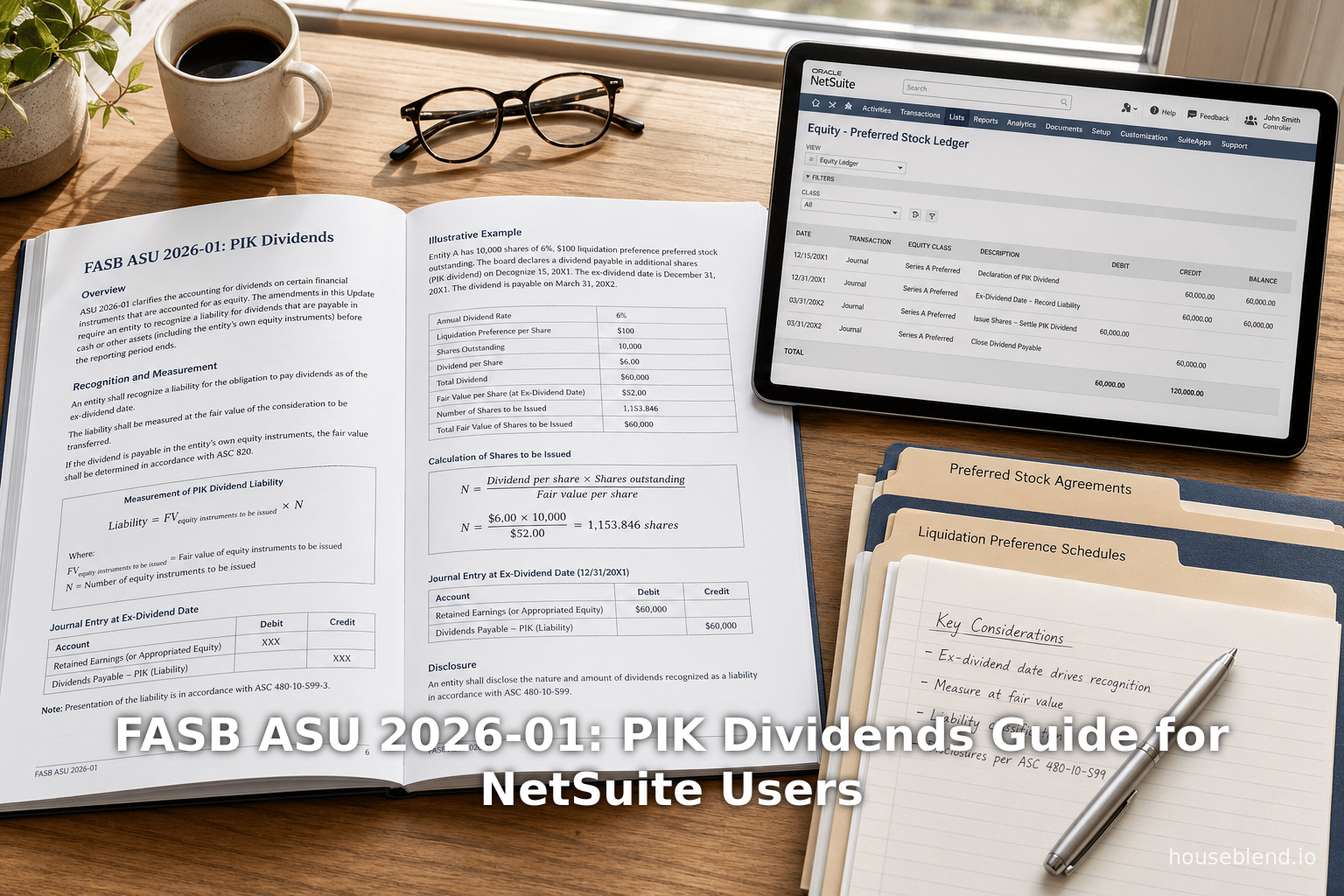
Houseblend Article
FASB ASU 2026-01: PIK Dividends Guide for NetSuite Users
Inside this article
- 01FASB ASU 2026-01: Paid-in-Kind Dividends Accounting Guide for NetSuite Users
- 02Introduction and Background
- 03Scope and Provisions of ASU 2026-01
- 04Illustrative Calculations
- 05Reporting and Disclosure Implications
- 06Implementation in NetSuite (Practical Guide)
- 07Case Studies and Examples
- 08Multiple Perspectives
- 09Implications and Future Directions
- 10Conclusion
FASB ASU 2026-01: Paid-in-Kind Dividends Accounting Guide for NetSuite Users
Executive Summary: FASB Accounting Standards Update (ASU) 2026-01, “Equity (Topic 505): Initial Measurement of Paid-in-Kind Dividends on Equity-Classified Preferred Stock,” codifies how U.S. GAAP entities must measure paid-in-kind (PIK) dividends on equity-classified preferred stock [1]. The ASU, issued April 23, 2026 and effective for fiscal years after Dec. 15, 2026, requires PIK dividends to be measured by multiplying the stated dividend rate by the shares’ liquidation preference [1] [2]. This definitive guidance addresses previously divergent practices that affected balance-sheet presentation and earnings-per-share calculations [3] [2]. Recognizing the new rule has broad implications – from financial statement comparability to ERP implementation – this report reviews the historical context, the ASU’s provisions, practical implementation (with emphasis on NetSuite ERP), and future impacts. Numerous perspectives (practitioner, auditor, investor) and examples illustrate how to apply the guidance and what changes preparers and users should expect. All assertions herein are supported by authoritative literature, comment letters, and illustrative cases.
Introduction and Background
Dividends “paid in kind” (PIK) are those satisfied not with cash but with additional securities (typically shares) or equivalent increases in share value. In practice, a corporation may owe preferred-stock dividends and, instead of paying cash, issue more stock or increase the liquidation value of existing shares [4] [5]. PIK dividends can arise in venture financings, convertible preferred issuances, or mandatory convertible stock, often offering liquidity relief or deferred cash yield. The key accounting issue is how to initially measure these dividends under U.S. GAAP when the preferred stock is classified as equity.
Historically, U.S. GAAP lacked explicit guidance for measuring PIK dividends on equity-classified preferred stock. As a result, companies used various approaches. In some cases, issuers treated PIK as a declared, accumulated equity dividend, while others treated it akin to interest or debt-like accruals [3]. Michael Cohn of Accounting Today noted that this diversity in practice “reduces the comparability of financial reporting information” on both the balance sheet and earnings-per-share metrics [3]. In light of this ambiguity, FASB’s Emerging Issues Task Force (EITF) initiated work on the issue. At a March 25, 2025 meeting, the EITF recommended adding a project to FASB’s agenda [6] [7]. The Board added the project in April 2025 and issued an Exposure Draft (ED) in September 2025 (comments due Oct. 27, 2025) [8] [7]. The ED and stakeholders’ feedback led to the final ASU issued in April 2026 [9].
Before ASU 2026-01, no authoritative ASC topic directly addressed PIK dividends’ measurement. For preferred stock deemed equity (including temporary equity per SEC staff guidance ASC 480-10-S99-3A [10]), preparers lacked a standard. A typical scenario featured convertible preferred stock with dividend clauses allowing issuer to pay partly or wholly in shares. Investor firms (e.g. biotech startups, banks) would specify dividend rates (e.g. 6%, 8%) on a per-share liquidation amount. Some companies (pre-ASU) used the liquidation preference as a basis, while others used the original issue price or carrying value, leading to inconsistency. FASB identified these divergent methods as problematic for comparability [3].
Fundamental definitions: A PIK dividend is formally an equity distribution, so it reduces shareholders’ equity (retained earnings) while issuing new equity (common or preferred stock) [10]. FASB’s target was initial measurement – i.e. how to quantify the dividend obligation. Recognition (when it’s “incurred” as a liability or equity transaction) remains governed by prevailing principles for dividends and equity vs liability classification in ASC 505 and ASC 480 [11] [12].
From a user’s viewpoint, the new ASU settles how to populate NetSuite (or any accounting system) fields for PIK accruals or declarations. For example, in NetSuite’s Chart of Accounts, the creation of additional equity shares for PIK should use equity accounts consistent with the defined treatment of preferred stock – something to configure carefully as discussed later. This report therefore integrates the GAAP guidance with practical recording in a NetSuite environment, using general ledger principles and NetSuite configuration insights.
Scope and Provisions of ASU 2026-01
ASU 2026-01 amends ASC Topic 505 (Equity) with specific guidance on PIK dividends. Scope: The guidance applies to dividends on preferred stock classified as equity, including “temporary equity” (mandatorily redeemable instruments per ASC 480) [13] [14]. It covers mandatory and optional PIK payments, whether issued as additional stock or by increasing face value. The ASU clarifies two satisfaction methods: (1) delivering additional like shares, or (2) increasing the original shares’ liquidation value [4]. It explicitly excludes arrangements where dividends guarantee a fixed monetary value by varying shares issued (e.g., a promise of “$1,000 in stock per share”, which is a fixed obligation and thus not PIK measureable under this guidance) [15]. It also does not apply to deemed dividends (such as certain reacquisitions) [15].
Definition: The ASU defines PIK dividends as those satisfied by additional stock or increased share value [10]. The amendment inserts this definition into ASC 505-10-15, aligning it with existing “stock dividend” concepts – essentially treating PIK as a type of stock dividend payable. Notably, this is after one determines the dividend is indeed equity (ASC 505 vs liability analysis) – the ASU explicitly does not change when a dividend is recognized, only how it is measured once recognized [11] [12].
Measurement (Key Rule): The core requirement is to measure PIK dividends “on the basis of their rate stated in the preferred stock agreement” [16]. In practice, nearly all PIK agreements list a percentage of the liquidation preference (or par value) per period. So the ASU directs: multiply the PIK rate by the liquidation (or stated) preference, for each share outstanding [16] [2]. This yields the monetary amount of the dividend. If paid in shares, divide that amount by the liquidation preference per share to get the number of additional shares to issue. (If liquidation preference equals par, this division is straightforward. If the stock was issued below liquidation value, the carrying value of stock is irrelevant – always use the contractual liquidation amount [17] [16].)
In formula form:
$$\text{PIK Dividend Amount} = \text{Liquidation Preference} \times \text{PIK Rate}.$$
Number of Shares Issued = PIK Dividend Amount \div \text{[Liquidation preference per share] }.
The ASU thus ties PIK to economic terms in the contract, not to prior carrying amounts. Deloitte summarizes: “entities are required to measure such dividends by multiplying the stated PIK dividend rate by the liquidation preference of the shares” [1]. Example 1 in the ASU illustrates a 1.5% quarterly rate on $10 liquidation preference: $10M×1.5% = $150,000, which ÷$10/share implies 15,000 new shares [18].
Discretionary vs Non-Discretionary: Before ASU, some analysts distinguished between “mandatory” PIK (non-discretionary) and optional. The ASU removes any such distinction: all equity-classified PIK dividends, whether issuer can choose cash or must issue stock, use the same measurement rule [19]. (The FATF example 3 shows different rates only if structured differently, but all dividend accrual uses the stated rate applicable to whichever form.) This simplifies practice: preparers no longer decide PIK vs cash differential for measurement.
Recognition: The ASU is explicit that it does not alter the recognition triggers [20]. Recognition of a dividend (and whether classified as liability or equity) remains per existing ASC 505 guidance on redeemable vs permanent equity, EITF D-98 (ASC 480) for temporary equity, and the definition of a “dividend declaration.” In other words, companies still apply ASC 505-10 “liabilities vs equity” tests – PIK’s measurement is applied after concluding the dividend is recognized to equity-classified preferred stock [11] [12]. Deloitte’s Roadmap on liabilities vs equity (distinguishing concepts) helps in making that determination [11].
Effective Date & Transition: The ASU is effective for all entities for annual periods beginning after Dec. 15, 2026, including interims within those years [21]. Early adoption is permitted. Entities may adopt (1) prospectively or (2) modified retrospectively (with a cumulative adjustment for open instruments) for instruments outstanding at initial application [21]. The ED comment period suggested private companies get an extra year, but final ASU did not provide such an extension (Grant Thornton had requested one [22]). Thus, as of 2027 reporting season, preparers must apply ASU 2026-01.
Illustrative Examples: The ASU (and commentaries) include examples to demonstrate application. Key scenarios:
- Issuance Discount: Example 2 in Deloitte’s summary shows issuance discount (preferred not recorded at full proceeds) has no effect on PIK measure [23].
- Different PIK vs Cash Rates: Example 3 has PIK at 8% vs cash at 6%. The company simply uses 8% on the full liquidation pref for PIK accrual [24], reaffirming use of the stated PIK rate.
A condensed comparison of “before vs after” ASU 2026-01 may be summarized in Table 1 below.
| Aspect | Pre-ASU (Current U.S. GAAP) | ASU 2026-01 (Post) | IFRS (Illustrative) |
|---|---|---|---|
| Guidance Existed? | None explicit. Diversity in practice (some use issue price, par, carrying value, or cash regimes). [3] | Clear rule: measure by contractual PIK rate × liquidation preference [1] [2] | IFRS does not explicitly address PIK; often treated by analogy to stock dividends or SPPI test (see below). |
| Definition of PIK Dividends | No codified definition; concept varied. | Added definition: PIK indicated by additional shares or increased share value per prefer. terms [10] | IFRS focuses on instrument classification; PIK terms may make instrument compound (equity + liability) [25]. |
| Scope | N/A | Applies to equity-classified preferred (even temporary equity) [13] [14]. Fixed-value “dividends” with variable shares excluded [15]. | IFRS classifies instrument (liability vs equity) via IAS 32. Contractual PIK likely implies liability component [25]. |
| Measurement Basis | Varied (some used carrying value; some used full liquidation; others debated especially if issuance discount). [26] | Always use the stated PIK rate and liquidation preference as basis [1] [16]. Issuance discounts irrelevant [23]. | IFRS IFRIC view: If PIK dividends are contractual, they're akin to a liability to deliver more shares [25], which under IFRS, a liability might be measured at fair value (a complex topic). |
| Discretionary vs Mandatory | Entities sometimes varied measurement depending on whether PIK was required or optional. | No distinction: both discretionary and non-discretionary PIK dividends measured by same rate formula [19]. | IFRS: If equity-classified, distributable at fair value like a stock dividend; if liability-classified, measured at PV of obligation. |
| Recognition Guidance Provided? | None new. Recognition still follows ASC 505 liability vs equity tests. | ASU explicitly does not address when to recognize (dividend must be recognized first) [11]. | IAS 32 and 33: stock dividends increase equity (no P&L effect), but contingent obligations (like required share issuance) may create a liability. |
| Typical Journal Entry (Payment) | Variable by practice; often Dr RE, Cr APIC (if shares issued). | Same mechanics: Dr Dividends or RE, Cr common stock/APIC for share issuance equal to amount determined [16]. | IFRS: If equity, Dr Ret. Earn, Cr Share Capital/APIC (at fair value); if liability, Dr P&L, Cr Liability. |
| Example | See below. Model outcomes may differ (e.g. using issue carry vs face value). | See below: $10M pref at 6% yields $150K PIK ($150K ÷ $10 = 15K shares) [18]. | Under IFRS viewpoint, would likely account similarly to stock dividend (increase equity) or if a debt component, present IFRS 9 rules (AC/FV). |
Table 1: Comparison of PIK dividend accounting (pre-ASU vs ASU 2026-01, with illustrative IFRS viewpoint).
Illustrative Calculations
Consider two common scenarios to demonstrate ASU 2026-01’s effect:
| Scenario | Liquidation Preference | Stated PIK Rate (Annual) | Accrual Period | PIK Dividend $$ | New Shares Issued | Notes |
|---|---|---|---|---|---|---|
| A | $10 per share | 6% | Quarterly (1.5%/qtr) | $10M×1.5% = $150K | $150K ÷ $10 = 15,000 | 1M shares outstanding. No issuance discount. [18] |
| B | $10 per share (carried at $9 due to warrant) | 6% | Quarterly (1.5%) | $150K | 15,000 | Issuance discount doesn’t change PIK calc. The carrying value is $9M, but PIK uses $10 liquidation [23]. |
| C | $10 per share | 8% (PIK) / 6% (cash) | Quarterly (2% PIK) | $10M×2% = $200K | $200K ÷ $10 = 20,000 | If no cash declared, use 8% rate. (If cash declared, use 6% for cash dividend part). [24] |
| D (IFRS) | £0.20 per share (20p) | 10% (assumed SONIA+5%) | Annual | £20M×10% = £2M | £2M ÷ £0.20 = 10M | Hypothetical IFRS case: IFRS commentary suggests under IFRS, these PIK obligations likely constitute a financial liability requiring FV measurement [25]. |
Table 2: Example PIK dividend calculations. Scenarios A–C illustrate ASU 2026-01 outcomes (data from Deloitte example and hypothetical). Scenario D shows an IFRS-perspective example from industry discussion [25].
In #A, a straightforward case shows $150K per quarter, delivering 15K shares. In #B, despite a $1M issue discount (carrying value $9/share), the PIK calculation still uses $10, yielding the same 15K shares [23]. In #C, a higher PIK rate (8%) applies if cash isn’t paid, giving 20K shares [24]. These examples underline the simplicity and consistency of ASU 2026-01’s rule.
Reporting and Disclosure Implications
Balance Sheet: Pre-ASU, equity-classified preferred stock’s carrying amount could inadvertently embed different dividend assumptions. Post-ASU, the equity account for preferred stock remains unchanged by measurement; instead, PIK dividends increase equity via retained earnings (or a dividends payable) and APIC. Companies must update equity rollforwards: disclose increased share counts and equity value when PIK is issued. The ASU itself does not change how equity accounts (common stock, APIC, RE) behave, but NetSuite users must ensure those accounts correctly reflect new shares issued. In a multisubsidiary consolidation, mark equity accounts “Never revalue” in multi-currency elimination settings [27] so the PIK entries aren’t disturbed by currency rules.
Income Statement/EPS: Because PIK dividends reduce net income attributable to common stock (by allocating earnings to preferred holders), EPS can be impacted. Companies reporting EPS must include PIK dividends in “less: preferred dividends” in EPS calculation. Since ASU clarifies measurement, EPS comparatives will now uniformly exclude the measured PIK dividends amount from numerator. First under the new guidance, companies should recalc prior EPS (if retroactive) to remove previous inconsistent treatments. Analysts should note comparability improvements: formerly, two companies with similar terms might have shown different “income available” to common; after ASU, EPS is more consistent.
Disclosure: FASB did not explicitly add new disclosure requirements. However, companies should describe the new measurement policy (even though set by GAAP, specification in footnotes aids understanding). It may also be prudent to disclose the effect of adopting the amendments (amount of adjustment in RE if retrospective, number of shares issued, etc.). Some registrants already voluntarily disclose PIK terms (like Biolase’s S-1 noted above) [5] [28]. Expect references to ASU 2026-01 in MD&A if PIK is material, discussing role in dividend policy and EPS effects.
Implementation in NetSuite (Practical Guide)
For companies using NetSuite ERP, applying ASU 2026-01 involves configuring accounts and processes to capture PIK transactions correctly. While NetSuite is not industry-specific to equity instruments, general ledger and record-keeping principles apply.
Account Configuration: In NetSuite’s Chart of Accounts, preferred stock and APIC (Additional Paid-In Capital) accounts should be set as Equity type. As NetSuite documentation notes, equity-type accounts do not revalue for currency and are treated historically [29]. This ensures that issuing shares via PIK dividends doesn’t create foreign-exchange noise. For example, if a multinational has preferred stock denominated in USD but consolidates in other currency, the “Eliminate Intercompany Transactions” and “Revalue” flags for equity accounts should be set appropriately (Equity accounts: Reverse Elimination – No; Revalue – Never [30]).
Journal Entries: When a PIK dividend is declared or inferred at period-end, NetSuite users can enter a Journal Entry (JE) to record it. The typical entry (assuming PIK dividends on X shares paying Y additional shares) is:
- Debit: Retained Earnings (or Dividends Declared) – $Pik_Dividend_Amount.
- Credit: Common Stock/APIC (or Preferred Stock/APIC, as applicable) – $Pik_Dividend_Amount.
Since NetSuite does not inherently auto-calculate PIK, one may use a custom formula or spreadsheet outside NetSuite to compute required values (PIK amount and share count) and then input into JE. If PIK issuance is recurring or patterned, a Scheduled Script ( SuiteScript could automate computing the rate×liquidation formula each period, then create the JE programmatically. Alternatively, a Saved Search combined with a SuiteFlow could prompt reminders.
Equity Issuance Tracking: NetSuite’s base functionality does not track individual share counts or par values. Users may need to maintain a supplemental registry (outside of NetSuite, or via partner bundle) to track shares outstanding. However, the ERP will record the dollar value entries to equity. Any round-lot issuance (like whole shares) can be reflected by appropriately adjusting APIC accounts (e.g. credit Common Stock par value + APIC for remainder). For example, if par is $1 and liquidation is $10, credit Common Stock by par value of new shares, and APIC by any excess credit needed to total the $Pik_Dividend_Amount. Consistency in how par and share premium are accounted should match company charter and prior issues.
Multi-Book/Auditing: NetSuite’s Multi-Book Accounting (if used) should have the PIK entries posted to all books to preserve GAAP consistency. For tax/ statutory books, tags as temporary equity may vary. Ensure to update tax book equity accordingly (though PIK dividends are not tax-deductible, so the pathway is equity-only).
Period Closing: Upon quarter/year-end when PIK dividends are recognized, NetSuite users must ensure the JE is posted to close the period. Many PIK obligations accrue even if final issuance occurs later; this may require an accrual JE with offset to a dividend payable or directly to equity. If the company accrues PIK regularly, using NetSuite’s accrual schedules or recurring transactions can schedule this (e.g. recognize 25% of annual PIK each quarter).
Example Workflow: Suppose a CFO knows preferred dividends accrue quarterly at 8% on a $1M liq pref stock. At quarter-end, an accountant uses NetSuite to create a custom transaction: an “Equity Journal” type with Debit Retained Earnings $20,000, Credit APIC $20,000 (this $20k is 2% of $1M). If above 100,000 shares outstanding (liq $10M ironically – adjust scale), she might split into par vs APIC credits. She also updates a non-NetSuite registry: issuance of 2,000 new shares (if $10/liquidation) or the equivalent. The entry ties to ASU’s rule by using that $20k calculation. Documentation of this JE should cite ASU 2026-01 compliance.
Internal Controls: Given new GAAP, companies should update control documentation. For example, in NetSuite Control catalogs, modify Dividends and Equity controls to reflect PIK measurement. Key control: “ensure PIK dividends are measured per contractual rate” – this could be a review step comparing contract terms to JE amounts.
Case Studies and Examples
1. Biolase, Inc. (August 2023)
Biolase’s S-1 Registration Statement (Aug. 2023) illustrates real-world PIK terms. It issued two series of permanent preferred: Series H and Series J. Series H dividends were a one-time PIK of 20% on a $50 stated value (1.0x year) [28]. Series J entailed quarterly PIK at 20% per annum on $100 par (5% per quarter) [5] [31]. Biolase provided the calculation in detail: each quarter the holder received additional shares equal to (Quarterly Rate * 100) ÷ $60 (their issue price) of the Series J [32].
Excerpt: “Dividends on the Series J Convertible Preferred Stock shall be paid in-kind (‘PIK dividends’) in additional shares… at an assumed dividend rate of 20.0%… at the quarterly dividend rate of 5.0%… PIK dividends on each share… in a number equal to the quotient obtained by dividing (A) [Quarterly Rate × $100] by (B) [$60 per Unit]” [5]. This precisely matches ASU 2026-01’s logic: 5% of $100 is $5, divided by the per-unit price of $60 = 0.0833 shares per share (or 8.33%). If 20,000 shares were sold, that implies issuing 1,666 new shares each quarter ($1000 PIK total) — exactly the ASU rule in effect.
A NetSuite user reading Biolase’s terms would calculate the PIK just as above and record the equivalent value in equity accounts. Biolase, in disclosure, implicitly applied what ASU 2026-01 standardizes (it cites nothing but context). Their S-1 predated the ASU but used a straightforward multiplication. Post-ASU, their measurement would be exactly the same as their stated formula.
2. Hypothetical Venture Startup X
Imagine a tech startup issues 1,000,000 shares of Series A preferred at $10 par for $10 million. Dividends accrue at 6% of liquidation value (paid in kind) [18]. Prior to ASU 2026-01, one group had treated it as $9M carrying value × 6% = $540K/yr (if issuance discount), while another used $10M. Under ASU 2026-01, X must use $10M × 6% = $600K per year, or $150K per quarter [18]. At 6% per annum, assumption of quarter is 1.5%. Each quarter X’s accountants have to issue shares worth $150K (15,000 shares of $10 liq each). They would debit R/E $150K and credit APIC/Common Stock $150K. Without the ASU, X’s prior calculations might have varied (some might have done $135K using $9M basis). The ASU forces X and its auditors to align on $150K, which raises the company’s reported preferred stock equity over time relative to using only $9M.
3. Public Bank Preferred Stock (Comparative Analysis)
Banks sometimes issue non-cumulative convertible preferred with PIK options. For instance, a bank may have $500 million of such stock at $25,000 liquidation, 6% cash or 7% PIK. Under ASU 2026-01, each quarter’s PIK accrual is straightforward: (7%/4) × $500M. An exercise of diffusion: assume 6.0% is cash and 1.0% excess PIK; thus quarterly PIK=1.75% of $500M = $8.75M (350 new 25k shares). If the bank had split this differently before, now all use 7% of $500M. The bottom line: $8.75M quarter. This cash impact (common vs preferred EPS) is crystal clear under ASU, aiding analysts’ predictions.
4. Software Company Without PIK (Contrast)
Though not directly involving PIK, it’s instructive. A public software firm might have preferred stock paying cash only. No ASU issues – but had it included an option to issue stock if cash isn’t paid, that option would trigger ASU 2026-01 measurement upon election of stock payment. For NetSuite users, if such an option existed but company always paid cash, installation of ASU has no effect (no PIK to measure). It’s only when stock issuance option is exercised that one would make a new type of JE.
Multiple Perspectives
Preparers (CFOs/Controllers): For companies issuing PIK, this ASU finalizes practice. Those auditors previously scoping measurement methods will now expect the stated-rate approach. Preparers must update accounting manuals and train staff: e.g., accounting policy will cite ASU 2026-01 for PIK measurement instead of “as practice.” Check that contractual rates are tracked accurately. They will appreciate clarity – as Grant Thornton commented, the guidance is “much-needed” to reduce diversity [33]. Those who had previously measured on face or fair value can stop debating and lock in one method.
Auditors and Accountants: Audit procedures will add a step: verify that PIK dividend measurement matches the ASU formula (the simple rate×liquidation calc). They should review stock agreements for PIK terms and recalc archive. Audit plans should note no change in recognition criteria but emphasize measurement consistency. For reissue discounts on IPOs or warrants (inasmuch as those affect carrying value but not PIK basis [23]), auditors will stop overlooking this detail – it’s now explicitly addressed. Firms will update checklists (e.g., PwC’s hands-on “equity analyses” likely have an item now).
Investors and Analysts: Once rare, PIK-preferred can meaningfully dilute equity. After ASU, analysts know precisely how much dilution per period: it’s simply contractually driven, not subject to manipulable assumptions. Comparison across firms becomes easier. Some equity analysts will want footnote disclosure of the formula to verify reported amounts. Equity investors should note that PIK is a form of dividend that is definitely not cash, and ASU assures it’s reflected as such on the statement of equity (reducing RE in effect). For example, equity analysts valuing a private company with PIK clauses can apply the same formula retrospectively. Ashland (just hypothetical) – an analyst commentary in Accountants Today might say “ASU 2026-01 levels the playing field; we now know Earnings available to commons share exclude exactly Rate×liq pref.” Some may worry: is the forward-looking EPS lower when PIK is higher? Affirmative. But more importantly, they note comparability.
Valuation Specialists: In mergers or buyouts, PIK terms must be unraveled. The ASU’s clarity helps acquirers project commitments accurately. If Company A is buying Company B with convertible preferred with PIK, the buyer can compute exactly how much stock issuance will occur. Goodwill or acquisition pricing considers PIK as equity distribution. Equity influencers: PIK dividends rise with increased liquidation value (e.g. if preferred converts to a higher stock price), so the ASU’s retrospective clarity prevents “pop-up surprises” in modeling.
IFRS/International: IFRS does not have an identical rule. Some practitioners note that mandatory PIK resembles a liability in IFRS (IAS 32). In an IFRS context, a share plan with an obligatory additional share delivery may be viewed as a compound instrument (equity component + settlement liability) [25]. For example, IFRS experts have stated: “PIK dividends seem to be a financial liability because the issuer has a contractual obligation to deliver another financial asset… The initial preferred shares themselves appear equity since no cash obligation exists” [25]. Under IAS 32, the liability (the PIK) would be measured at fair value (likely via present value of future shares). This contrasts US GAAP’s simplicity: using fixed contract rate. In essence, IFRS might route PIK into liability, while FASB keeps it in equity domain. The ASU thus also highlights a convergence gap: U.S. GAAP treats PIK as an equity distribution measure, whereas IFRS might sometimes treat it as a debt instrument component (depending on obligations and control definitions). Those considering subsidiaries or investors with IFRS-based books should be aware this divergence may need bridging.
Implications and Future Directions
The immediate implication of ASU 2026-01 is uniformity of measurement. Companies can no longer choose an alternate base. While some preparers resisted the loss of flexibility, most acknowledged comparability benefits [33]. Analyst transparency improves: for instance, when comparing two biotech firms with similar convertible preferred, EPS can be compared after ASU knowing measurement is lockstep.
The ASU does not address recognition or classification under ASC 480. Some now question whether guidance on recognition of mandatory dividends should follow. For example, if a contract says “if dividends aren’t declared in cash by date, additional shares automatically accrue,” one might ask if recognition should be annual or at conversion. Currently, ASC 505-10 and EITF D-98 govern these tests, but companies might still debate present conditions. Future Board or EITF work might extend to “when is the obligation to pay PIK recognized” (though FASB’s focus here was only measurement).
Another future angle is disclosure enrichment. Possibly, improved guidance will lead to calls for disclosure of PIK dividend terms and amounts in 10-K/annual notes. It wouldn’t be surprising if 2027-era filings highlight how ASU 2026-01 changed (or didn’t change) their reported figures.
From a software/ERP perspective, NetSuite may in future issue guidance or even features (bundled solutions) to automate PIK calculations, especially if requested by customers. Given the clarity of formula, some NetSuite partners might design a small add-on. The policy note might also prompt NetSuite Implementation guides to mention equity adjustments for PIK. Intuition Labs (and peers) may produce whitepapers or training content (as the prompt suggests) to help users interpret new GAAP in NetSuite workflows.
In a broader accounting evolution context, this ASU is a narrow-scope “targeted improvements” update, not a sweeping overhaul like revenue recognition projects. It demonstrates FASB’s willingness to fix niche but practical issues. Whether ASU 2026-01 spurs other fixes (e.g., guidance on other in-kind distributions) is uncertain. However, it may encourage scrutiny of any remaining gaps around convertible/equity instruments (EITF D-97 on convertible debt, for instance, was another project, but that dealt with assumed conversions).
Future Research: Empirical study could investigate how prevalent PIK arrangements are and measure their impact on equity. After adoption, financial statement footnotes may reveal trends (e.g., average PIK rates, industries where PIK is common). Also, it would be useful to survey CFOs for netSuite integration approaches post-ASU: e.g., any scripts or SuiteFlows adopted. While too early now, a follow-up industry survey or case literature might emerge in late 2026 or 2027.
Tables Recap
- Table 1 compared the ASU’s requirements to prior practice and an IFRS viewpoint. It demonstrates the pre-ASU variability and post-ASU rule, highlighting that IFRS might still classify PIK differently [19] [25].
- Table 2 walked through numeric examples (similar to the ASU’s examples and industry comments [18] [25]) to show how to compute PIK share issuances.
Conclusion
FASB ASU 2026-01 closes a long-noted gap by explicitly prescribing that paid-in-kind dividends on equity-classified preferred stock be measured at contractual rate × liquidation preference [1] [2]. This resolution eliminates prior practice diversity and enhances comparability of equity instruments and EPS calculations. NetSuite users and accounting teams must now adjust closing routines: configure equity accounts properly [29], calculate PIK amounts by formula (potentially via custom scripting), and enter the corresponding journal entries in retained earnings and paid-in capital accounts. The shift requires careful transition (e.g. identifying existing instruments for retrospective application) but is conceptually straightforward.
The consequences are significant for issuers of equity-with-PIK structures. Enhanced clarity reduces audit risk and facilitates investor analysis. As one practitioner put it, the ASU provides “much-needed guidance” that will improve comparability [33]. Although IFRS does not have an identical rule (and in fact may treat PIK obligations as liabilities [25]), U.S. GAAP entities now have certainty.
In summary, ASU 2026-01 standardizes the once-questioned practice of measuring stock-based dividends. For NetSuite users, it translates into predictable accounting entries and system setups, ensuring that PIK dividends are honored at the implicitly stipulated economic value. The result: financial statements where equity and earnings properly reflect these non-cash dividends, all backed by consistent, cited guidance.
Sources and Further Reading: The above analysis is grounded in the ASU content and interpretations from authoritative publications and filings [8] [34] [9] [33] [35]. Practitioners should review the full ASU text and consider detailed examples in Deloitte’s and other firms’ publications to fully apply these principles.
External Sources (35)
About
Houseblend
HouseBlend.io is a specialist NetSuite™ consultancy built for organizations that want ERP and integration projects to accelerate growth—not slow it down. Founded in Montréal in 2019, the firm has become a trusted partner for venture-backed scale-ups and global mid-market enterprises that rely on mission-critical data flows across commerce, finance and operations. HouseBlend’s mandate is simple: blend proven business process design with deep technical execution so that clients unlock the full potential of NetSuite while maintaining the agility that first made them successful.
Much of that momentum comes from founder and Managing Partner Nicolas Bean, a former Olympic-level athlete and 15-year NetSuite veteran. Bean holds a bachelor’s degree in Industrial Engineering from École Polytechnique de Montréal and is triple-certified as a NetSuite ERP Consultant, Administrator and SuiteAnalytics User. His résumé includes four end-to-end corporate turnarounds—two of them M&A exits—giving him a rare ability to translate boardroom strategy into line-of-business realities. Clients frequently cite his direct, “coach-style” leadership for keeping programs on time, on budget and firmly aligned to ROI.
End-to-end NetSuite delivery. HouseBlend’s core practice covers the full ERP life-cycle: readiness assessments, Solution Design Documents, agile implementation sprints, remediation of legacy customisations, data migration, user training and post-go-live hyper-care. Integration work is conducted by in-house developers certified on SuiteScript, SuiteTalk and RESTlets, ensuring that Shopify, Amazon, Salesforce, HubSpot and more than 100 other SaaS endpoints exchange data with NetSuite in real time. The goal is a single source of truth that collapses manual reconciliation and unlocks enterprise-wide analytics.
Managed Application Services (MAS). Once live, clients can outsource day-to-day NetSuite and Celigo® administration to HouseBlend’s MAS pod. The service delivers proactive monitoring, release-cycle regression testing, dashboard and report tuning, and 24 × 5 functional support—at a predictable monthly rate. By combining fractional architects with on-demand developers, MAS gives CFOs a scalable alternative to hiring an internal team, while guaranteeing that new NetSuite features (e.g., OAuth 2.0, AI-driven insights) are adopted securely and on schedule.
Vertical focus on digital-first brands. Although HouseBlend is platform-agnostic, the firm has carved out a reputation among e-commerce operators who run omnichannel storefronts on Shopify, BigCommerce or Amazon FBA. For these clients, the team frequently layers Celigo’s iPaaS connectors onto NetSuite to automate fulfilment, 3PL inventory sync and revenue recognition—removing the swivel-chair work that throttles scale. An in-house R&D group also publishes “blend recipes” via the company blog, sharing optimisation playbooks and KPIs that cut time-to-value for repeatable use-cases.
Methodology and culture. Projects follow a “many touch-points, zero surprises” cadence: weekly executive stand-ups, sprint demos every ten business days, and a living RAID log that keeps risk, assumptions, issues and dependencies transparent to all stakeholders. Internally, consultants pursue ongoing certification tracks and pair with senior architects in a deliberate mentorship model that sustains institutional knowledge. The result is a delivery organisation that can flex from tactical quick-wins to multi-year transformation roadmaps without compromising quality.
Why it matters. In a market where ERP initiatives have historically been synonymous with cost overruns, HouseBlend is reframing NetSuite as a growth asset. Whether preparing a VC-backed retailer for its next funding round or rationalising processes after acquisition, the firm delivers the technical depth, operational discipline and business empathy required to make complex integrations invisible—and powerful—for the people who depend on them every day.
Disclaimer
This document is provided for informational purposes only. No representations or warranties are made regarding the accuracy, completeness, or reliability of its contents. Any use of this information is at your own risk. Houseblend shall not be liable for any damages arising from the use of this document. This content may include material generated with assistance from artificial intelligence tools, which may contain errors or inaccuracies. Readers should verify critical information independently. All product names, trademarks, and registered trademarks mentioned are property of their respective owners and are used for identification purposes only. Use of these names does not imply endorsement. This document does not constitute professional or legal advice. For specific guidance related to your needs, please consult qualified professionals.