Houseblend Article
How to Set Up Ask Oracle in NetSuite 2026.2 for Finance Teams
Inside this article
- 01Executive Summary
- 02Introduction and Background
- 03What Is Ask Oracle in NetSuite
- 04Ask Oracle Versus Related NetSuite AI Capabilities
- 05Step-by-Step: Enabling and Setting Up Ask Oracle
- 061. Confirm the Account Is Updated to 2026.2 and Located in an Eligible Region
- 072. Watch for the In-Product Administrator Banner
- 083. Grant Access By Role, Not By Individual User
- 094. Because Ask Oracle Inherits Permissions, Audit Roles Before Wide Rollout
- 105. Use a Preview or Sandbox Account to Test Before Production
- 116. Verify Regional and Feature-Level Availability Constraints
- 12Understanding NetSuite AI Units and What Ask Oracle Costs to Run
- 13How AI Units Are Allocated
- 14What a Typical Ask Oracle Query Costs
- 15Monitoring and Managing AI Unit Usage
- 16Permissions, Governance, and the AI Connector Service
- 17Why the AI Connector Service Cannot Use the Administrator Role
- 18Why the Role Itself Still Matters
- 19AI Client and Technical Requirements for the Connector Service
- 20Third-Party Governance Tooling for AI-Enabled Accounts
- 21Ask Oracle Use Cases for Finance Teams
- 22Data Analysis and Evidence
- 23Case Studies and Real-World Examples
- 24Oracle NetSuite's Own Rollout Communication (July 2026)
- 25A Small Business Trends-Documented Adoption Path (Hypothetical Example)
- 26An Overly Permissioned Role Scenario Documented by Netwrix (Hypothetical Example)
- 27A Community-Reported Delayed Rollout (r/Netsuite, 2026)
- 28A Consultancy's Pre-Launch Readiness Checklist (Tvarana, July 2026)
- 29Implications and Future Directions
- 30Frequently Asked Questions (FAQs)
- 31Conclusion
How to Set Up Ask Oracle in NetSuite 2026.2 for Finance Teams
Executive Summary
Oracle NetSuite introduced Ask Oracle as a generally available capability inside standard NetSuite accounts with the NetSuite 2026.2 release, published July 15, 2026 [1] (Source: erp.today). Ask Oracle is the conversational artificial intelligence (AI) assistant originally built for NetSuite Next, Oracle's redesigned ERP (enterprise resource planning) experience unveiled at SuiteWorld on October 7, 2025 [2], and 2026.2 marks the point at which that assistant became available "alongside the experience you use today" for existing NetSuite customers, without requiring a full migration (Source: cfotech.news). As of July 2026, the feature is available only to customers in the United States and Canada, with Oracle stating that "additional countries" are "coming soon" [1].
Setting up Ask Oracle is administratively lightweight because it does not require a new module purchase; instead, a NetSuite administrator sees an in-product banner after the 2026.2 update and enables access role by role [1]. Because Ask Oracle "operates within your existing NetSuite roles, permissions, and workflows," finance teams do not configure a separate permission set for the assistant itself; rather, whatever a user's role can already see and do defines what Ask Oracle can retrieve or execute on that user's behalf [3]. Every query, however, consumes metered NetSuite AI Units, a consumption framework in which eligible licenses include 1,000 AI Units per month of term, provisioned upfront into a shared account pool [4]. Oracle's own documentation estimates that a simple Ask Oracle question consumes roughly 10 AI Units, while a research-style question can consume between 50 and 200 AI Units [5].
This report walks finance and NetSuite administration teams through what Ask Oracle is, how it differs from the separate NetSuite AI Connector Service (an MCP, or Model Context Protocol, integration that lets third-party AI clients such as Claude or ChatGPT query NetSuite under a dedicated non-administrator role), how to enable and govern it, what it costs to run at scale, and how it fits into the broader wave of AI-driven finance automation shipped in 2026.2, including a new AI transaction matching assistant and NetSuite Intelligent Flux Analysis for variance explanations (Source: erp.today).
The evidence assembled here draws on Oracle's own product, documentation, and press pages, independent trade press coverage of the July 2026 rollout from outlets including ERP Today, CFOTech, and Small Business Trends, a NetSuite governance vendor's technical analysis of the AI Connector Service's permission model, two implementation partners' guidance on rollout readiness, industry research on enterprise AI adoption economics, and unfiltered practitioner commentary from the r/Netsuite community, which as of the 2026.1 release reported that Ask Oracle access was gated to NetSuite Next accounts and rolling out gradually rather than universally [6]. The overall picture is one of a capability that is free at the point of a standard license, governed entirely by NetSuite's pre-existing role-and-permission system rather than a bespoke access model, metered by usage rather than by seat, and still in a phased, North America-first rollout as of publication. Organizations preparing to adopt it should audit their existing roles and permissions before enabling Ask Oracle broadly, because the assistant inherits, rather than restricts, whatever access a role already has, a point independent analysis of NetSuite's AI Connector Service and finance-focused commentary from implementation partners both make explicit [7] [8].
Introduction and Background
NetSuite is Oracle's cloud enterprise resource planning (ERP) platform, relied on by "more than 43,000 customers in 219 countries and dependent territories" to run finance, order management, inventory, and related back-office operations from a single system of record [2]. Since NetSuite's founding in 1998 and its acquisition by Oracle in 2016, the platform's SuiteCloud extensibility layer has let customers customize workflows without disrupting the core ERP, according to independent analyst research on the platform's history. At its October 2025 SuiteWorld conference, Oracle unveiled NetSuite Next, describing it as "designed to be collaborative, insightful, adaptive, and trustworthy," embedding "conversational intelligence, agentic workflows, and natural language search capabilities" across the suite [2]. Founder and Executive Vice President Evan Goldberg framed the design intent directly at launch: "Every insight and action is rooted in data and governed by the existing roles, permissions, and policies our customers depend on" [2]. At that time, Oracle committed that "NetSuite Next will be available initially for customers in North America within the next 12 months" [2], a target the 2026.2 release beat by roughly three months.
For roughly nine months, Ask Oracle existed only inside NetSuite Next preview and early-access accounts. That changed with the NetSuite 2026.2 release, published July 15, 2026, which Oracle frames as making "the conversational AI assistant from NetSuite Next available within your current NetSuite experience" for customers who have not yet switched to the redesigned interface [1]. Brian Chess, Oracle NetSuite's Senior Vice President of AI, Product, and Technology, called the broader NetSuite Next rollout "the biggest update to NetSuite since we first launched in 1998" (Source: cfotech.news), a characterization ERP Today's independent coverage repeated verbatim: "NetSuite describes Next as the biggest update to the suite since its original 1998 launch" (Source: erp.today). Chess also confirmed that Ask Oracle in classic NetSuite is meant as a bridge that lets customers "familiarize themselves with Ask Oracle within their existing NetSuite environment" before eventually adopting NetSuite Next in full [9].
Trade press covering the July 2026 announcement echoed Oracle's framing that this is a phased, low-disruption rollout rather than a forced upgrade. Small Business Trends reported that "NetSuite is positioning the transition as an extension of customers' current systems rather than a new ERP implementation," noting that administrators "can request a preview account containing a copy of the company's existing data, roles, workflows, and customizations" before turning anything on in production [10]. CFOTech, a technology news outlet for financial decision-makers, reported the same message from Chess directly: "We understand each business is different, and we want to give our customers the ability to adopt AI at their own pace" (Source: cfotech.news). NetSuite implementation partner Tvarana, writing shortly before the release, similarly summarized the deal for prospective adopters: "Ask Oracle and AI Canvas are rolling out through 2026, with North America first, and all features are included in existing licences at no extra cost" [11].
Practically, "setting up Ask Oracle in NetSuite" breaks into three distinct but related tasks that this report addresses in turn: (1) confirming the feature is enabled and rolled out to an account and granting per-role access to it, which is an administrative toggle rather than a module purchase; (2) understanding and managing the AI Units consumption that every Ask Oracle query draws down, since this is a metered resource that finance and IT need to budget and monitor; and (3) deciding, separately, whether to also enable the NetSuite AI Connector Service, a related but distinct MCP-based integration that lets external AI clients query NetSuite data under a dedicated custom role rather than through the native Ask Oracle chat interface [12]. Because both capabilities touch the same underlying data and rely on NetSuite's existing role-based permission model rather than introducing a parallel one, the report treats roles and permissions as a first-class topic, not an afterthought.
What Is Ask Oracle in NetSuite
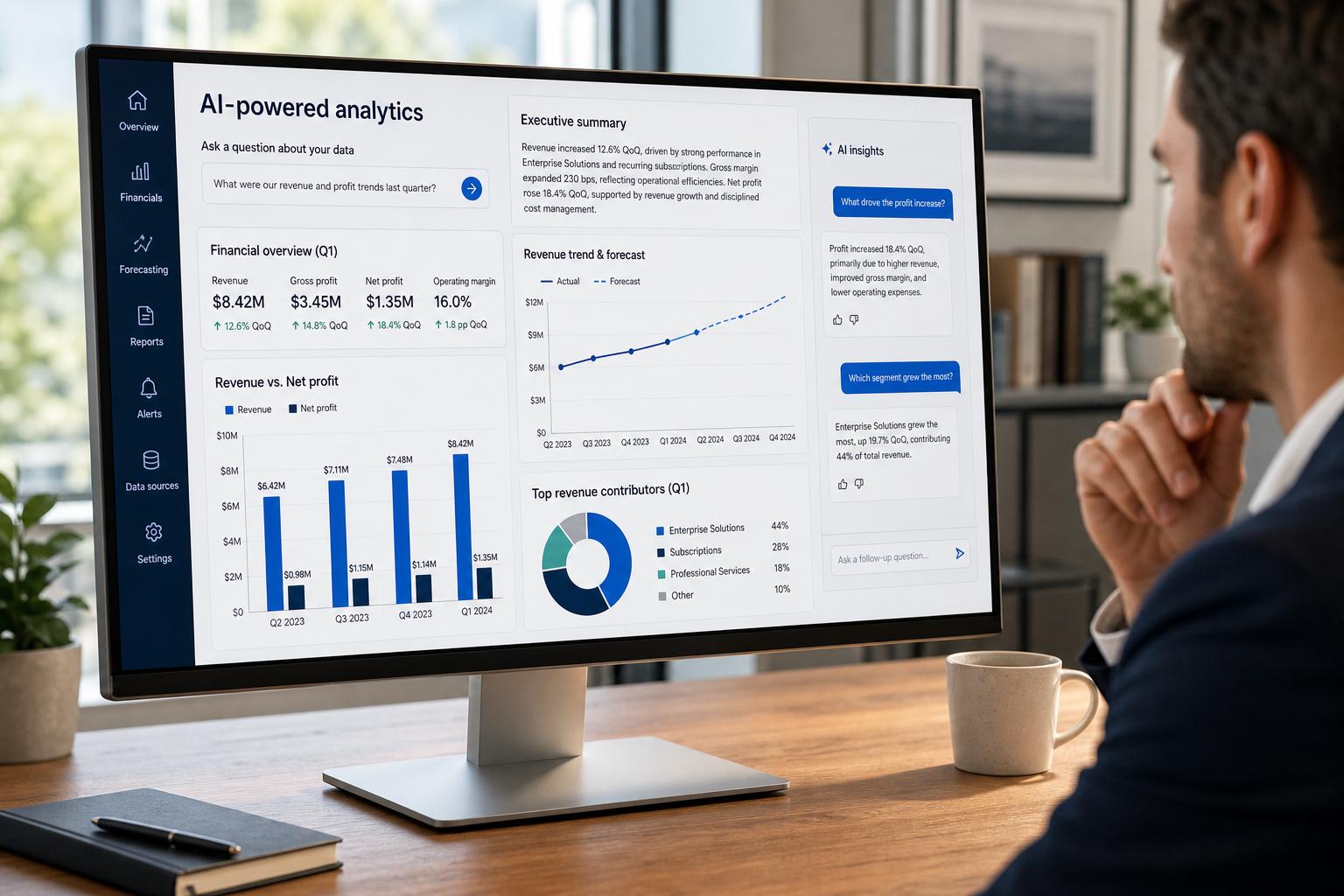
Ask Oracle is Oracle's name for the conversational AI assistant embedded across NetSuite, described on the product's own marketing page as delivering "context-aware answers, visualizations, and recommendations grounded in your business," working "alongside you" while understanding "your data, workflows, roles, and permissions" [3]. Tvarana's own summary for prospective implementers reinforces this positioning: users should "think of Ask Oracle as a smart colleague who understands your NetSuite data, knows how your business works, can answer questions, show insights, and even help you take action" [11]. Functionally, it supports three overlapping use cases:
- Answers and insights. Users can ask both basic "how do I" questions about NetSuite mechanics and more complex analytical questions, and Ask Oracle can help "produce narratives and charts based on that analysis" [1].
- Search and navigation. Instead of guessing which saved search, report, or record type holds a piece of information, a user can type a name, ID, email address, phone number, keyword string, or a natural-language request like "show me the top customers with overdue invoices," and Ask Oracle surfaces the relevant records, pages, reports, or dashboards directly [1].
- Canvas-based analysis. From a chat conversation, users can move into a "canvas," an ad hoc workspace for building dashboards, KPI (key performance indicator) scorecards, charts, and text summaries that can then be printed or exported as PDF documents [1].
Two design principles distinguish Ask Oracle from a generic chatbot bolted onto the ERP. First, explainability: every response includes a "Show Explanation" control that lets a user trace how the answer was generated, alongside thumbs-up and thumbs-down feedback controls [1]. Oracle's original launch materials frame the same capability at the platform level, describing Ask Oracle as delivering "reasoning that explains the 'how' and 'why' behind every response and enables users to more easily collaborate with NetSuite" [2]. Second, permission inheritance: Ask Oracle "operates within your existing roles and permissions" and "can't access or act on anything beyond what each user is authorized to see or do," which Oracle positions as the mechanism that keeps AI-generated answers trustworthy rather than a generic model hallucinating across the entire dataset [3].
Ask Oracle is also explicitly closed to the open internet: Oracle's own FAQ states plainly that "Ask Oracle communicates only with NetSuite. It does not currently connect to external LLMs or access the public internet," directing customers who want to connect NetSuite data to third-party large language models (LLMs) toward the separate AI Connector Service instead [3]. A third-party analyst report from Houseblend, an independent research firm covering enterprise software, corroborates this architecture, noting that customer "data never leaves the customer's secure NetSuite environment" and that queries combine "live data retrieval (for accuracy) with LLM inference (for natural language), all running on OCI's servers," referring to Oracle Cloud Infrastructure.
Ask Oracle Versus Related NetSuite AI Capabilities
Because Oracle has shipped several AI-branded features into NetSuite over 2025 and 2026, it is worth taxonomizing what falls inside "Ask Oracle" and what is a distinct, adjacent capability that a search for "how to set up Ask Oracle" often surfaces alongside it. ERP Today frames Ask Oracle's role in this landscape succinctly, calling it "the foundational AI capability in NetSuite Next," through which users "ask questions in natural language, analyze business data, surface insights, get guidance, and take action in the context of their work" (Source: erp.today).
- Ask Oracle (native conversational assistant). Embedded directly in NetSuite's interface; consumes NetSuite AI Units; does not connect to external LLMs; governed entirely by the user's existing NetSuite role [3].
- NetSuite AI Connector Service (MCP integration). A separate, protocol-based service, first announced August 12, 2025, that lets an external AI client (Claude, ChatGPT, or another Model Context Protocol-compatible tool) authenticate into NetSuite and call a constrained set of tools defined by the MCP Standard Tools SuiteApp or by custom SuiteScript-based tools [13]. Unlike Ask Oracle, the Connector Service explicitly does not consume AI Units: "the NetSuite AI Connector (MCP) still supports the use of third-party AI providers. The NetSuite AI Connector will not consume AI Units" [4], though it does require a distinct, non-administrator custom role: independent technical analysis confirms "a role (which cannot be Administrator and cannot be a role with full permissions across NetSuite) must be granted two specific permissions: MCP Server Connection and Log in using OAuth 2.0 Access Tokens" [7].
- SuiteAgents (agentic workflows). Autonomous, multi-step AI-driven workflows layered on top of the SuiteCloud platform, announced alongside NetSuite Next at SuiteWorld 2025, that can plan and execute tasks such as invoice matching or approval routing with human-in-the-loop checkpoints, rather than answering a single question. Oracle's own October 2025 launch materials describe agentic workflows as able to "help automate complex tasks such as payment proposals, vendor selection, reconciliations, and supply chain operations," while giving "users the choice to approve key decisions or allow agents to act autonomously" [2].
- Feature-specific generative AI tools. Narrower generative AI features such as Text Enhance, Prompt Studio, Narrative Insights, Case Summary, and the Transaction Matching Assistant, which are separately toggled on the AI Preferences page and, per Oracle's documentation, also draw from the same AI Unit pool that Ask Oracle uses [4].
The distinction matters operationally: an organization can enable Ask Oracle without ever touching the AI Connector Service, and vice versa. NetSuite implementation blog BrokenRubik summarizes Ask Oracle to its client base as the assistant that "lets non-technical users query NetSuite data without building saved searches," giving the example prompt "show me overdue invoices over $10K from customers in California," while treating the AI Connector Service as a separate, developer-facing capability covered in its own guide [14]. Tvarana frames the same distinction from an implementation-partner perspective, describing Ask Oracle as a tool that lets users "type things like" plain-language operational questions and receive answers that "explain why something is happening, not just what is happening" [11].
Step-by-Step: Enabling and Setting Up Ask Oracle
Because Ask Oracle ships as a feature of the platform rather than a separately purchased SuiteApp, "setup" is closer to a rollout and permissioning exercise than a traditional installation. Based on Oracle's own documentation and release communications, the process breaks down as follows.
1. Confirm the Account Is Updated to 2026.2 and Located in an Eligible Region
Ask Oracle in classic NetSuite requires an account to be on the 2026.2 release and located in the United States or Canada; Oracle has stated other countries will follow but has not published a firm date [1]. Even within eligible accounts, rollout has been observed as gradual rather than instantaneous: practitioner reports on the r/Netsuite subreddit around the prior 2026.1 release described Ask Oracle as available only "in the Next accounts right now," with one administrator noting "I'm guessing it's a gradual and not a general rollout" after enabling the Redwood interface preference without seeing the feature appear [6]. Administrators should therefore treat the appearance of Ask Oracle as staged by tenant rather than guaranteed the moment an account shows the 2026.2 version number.
2. Watch for the In-Product Administrator Banner
Oracle's own guidance states plainly: "When your NetSuite account is updated to 2026.2, your NetSuite administrator will see a banner in NetSuite with information about enabling Ask Oracle for your account" [1]. This banner-driven activation, rather than a checkbox buried in Enable Features, is the primary entry point Oracle designed for the rollout, and the release note explicitly instructs administrators to "connect with your administrator to set up a plan," implying the enablement decision should be a deliberate, planned step rather than an automatic default [1].
3. Grant Access By Role, Not By Individual User
Because "access can be enabled by role," Ask Oracle setup is fundamentally a role-management exercise built on NetSuite's existing security model rather than a new access-control system. This is consistent with NetSuite's general permissioning architecture, where users with the Administrator role manage permissions from Setup > Users/Roles > User Management > Manage Roles, editing the Permissions subtab to add or adjust access levels for Transactions, Reports, Lists, Setup, and Custom Record permission types [15]. Brokenrubik's release-notes guidance to its NetSuite client base flags this as one of the cross-cutting 2026 themes, noting "refined role-based permissions, and audit log enhancements that simplify SOX compliance" alongside the AI rollout [14].
4. Because Ask Oracle Inherits Permissions, Audit Roles Before Wide Rollout
Because AI in NetSuite operates within existing roles and permissions [3], any pre-existing role hygiene problem becomes an AI exposure problem the moment Ask Oracle is switched on for that role. Small Business Trends' coverage of the rollout makes this explicit for finance teams: "Because the assistant works within existing access controls, outdated roles or overly broad permissions could give employees access to more financial, payroll, customer, or employee information than their jobs require" [10]. NetSuite implementation firm Novutech gives the same recommendation from the advisory side, telling finance and operations leaders that "before adopting more AI-assisted workflows, companies should review master data, subsidiaries, roles, permissions, saved searches, reports, workflows and integrations," warning that "if the underlying data is inconsistent, AI-generated answers will be harder to trust" [8].
5. Use a Preview or Sandbox Account to Test Before Production
Administrators can request a preview account, described by Oracle as "a copy of your current environment with your data, roles, workflows, and customizations," specifically so they can explore the full NetSuite Next experience before making the switch [16]. Sandbox and Development environments carry their own separate AI Unit pools, distinct from production, which lets teams test Ask Oracle and other AI features "without affecting production usage," according to industry guidance from NetSuite consultancy Protelo [17], a claim consistent with Oracle's own statement that each sandbox "includes a separate pool equal to the number of AI Units licensed in the connected customer Production account" [4]. Novutech reinforces the same starting-point discipline for any AI rollout: "The best starting point is not 'Where can we use AI?' but 'Which workflow creates the most friction today?'" [8]. Small Business Trends echoes the same testing discipline from the customer side, recommending administrators "identify a few measurable use cases" and run "a limited pilot" that compares "time saved, error rates, employee adoption, and the quality of the system's recommendations" before expanding access [10].
6. Verify Regional and Feature-Level Availability Constraints
Even after enablement, some AI features Ask Oracle draws on are gated by region, language, or account type. For example, Oracle's Generative AI Feature Availability documentation notes that Narrative Insights, an adjacent AI feature, "can't be activated for healthcare customers with a signed Business Associate Agreement (BAA)" because it has not yet been assessed for compliance with the US Health Insurance Portability and Accountability Act (HIPAA) [18]. Healthcare organizations evaluating Ask Oracle should confirm HIPAA-related constraints directly with their Oracle NetSuite representative before rollout, since the underlying compliance posture of the AI Preferences features can vary by module even within the same account.
Understanding NetSuite AI Units and What Ask Oracle Costs to Run
Ask Oracle itself carries no separate license fee, but every interaction with it draws down a metered resource Oracle calls AI Units. Protelo's July 2026 explainer for NetSuite customers frames the change plainly: "As of July 2026, Oracle NetSuite has introduced NetSuite AI Units, a new global framework for measuring and managing AI usage across eligible AI capabilities," included "at no additional cost" for most customers [17]. Understanding this consumption model is a core part of "setting up" Ask Oracle responsibly, because it determines ongoing operating cost and requires monitoring analogous to a cloud compute budget.
How AI Units Are Allocated
AI Units are provisioned automatically with eligible NetSuite licenses. The standard NetSuite General Access Cloud Service User license (Item #6023) includes 1,000 AI Units per month of term, "provisioned upfront into customer AI Unit Pool" [4]. Critically, these Units are pooled at the account level, not siloed by individual user; Protelo's analysis of the framework describes this design as allowing "organizations to use AI capabilities where they provide the most value without managing separate allocations for each user" [17].
AI Units do not carry over between terms; Oracle states explicitly, "No. AI Units are part of a term allowance, meaning they expire when your NetSuite term expires" [4]. When a pool is exhausted, customers "are expected to purchase more or pause any further usage of AI features" [4]. Protelo's guidance frames the purchasing decision for customers plainly: "Most customers will not need additional AI Units immediately," but "additional AI Units are available for organizations that expand their use of AI capabilities beyond the allocation included with eligible licenses" [17].
What a Typical Ask Oracle Query Costs
Oracle publishes indicative AI Unit estimates for Ask Oracle specifically, though it cautions these are estimates only, and "the actual values for the AI Units used may vary from the estimated values" depending on request complexity [5]. Table 1 below summarizes the published tiers.
Table 1. Estimated AI Unit consumption by Ask Oracle query type
| Query Type | Example Prompt | Estimated AI Units | Source |
|---|---|---|---|
| Simple question | "How do I create a vendor credit in NetSuite?" | Approximately 10 AI Units | [5] |
| Analysis question | "What is the remaining balance of invoice INV-1008?" | 10 to 50 AI Units | [5] |
| Research question | "Show me the top five customers by overdue A/R balance this quarter" | 50 to 200 AI Units | [5] |
| Case Summary (adjacent feature) | Summarizing a support case | 5 to 75 AI Units | [5] |
| Narrative Insights (adjacent feature) | Generating an insight on a customer record | 5 to 200 AI Units | [5] |
Because the pool is shared across the organization rather than assigned per user, the impact of research-tier questions depends on the organization's eligible-license count, contract-term allocation, and remaining balance. A small group of heavy users can meaningfully draw down the units available to other users, so administrators should monitor consumption rather than treat the included allocation as unlimited [19].
Monitoring and Managing AI Unit Usage
Administrators can view AI Unit consumption at Setup > Company > View Billing Information; NetSuite consultancy Protelo confirms to its client base that "customer administrators can view AI Unit information through: Setup > Company > View Billing Information" [17]. Protelo's guidance frames this centralized visibility as giving businesses "greater visibility into AI adoption" and "a consistent way to manage usage as more AI-powered features become available within the NetSuite platform" [17]. For organizations that anticipate very high AI usage, NetSuite also offers a separate, non-metered path: a company can connect its own Oracle Cloud Infrastructure (OCI) account under Setup > Company > AI > AI Preferences, at which point, "your company pays for the OCI services it uses" directly rather than drawing from the pooled AI Unit allowance, effectively converting metered usage into a pay-as-you-go OCI Generative AI bill [20].
Permissions, Governance, and the AI Connector Service
Setting up Ask Oracle correctly requires distinguishing it from, and often governing it alongside, the separate NetSuite AI Connector Service, since both raise similar permission questions and organizations frequently evaluate them together.

Why the AI Connector Service Cannot Use the Administrator Role
Unlike Ask Oracle, which any permitted role can use, the AI Connector Service is explicitly blocked from running under NetSuite's Administrator role. Oracle's FAQ states: "For better access control and security, the NetSuite AI Connector service does not support Administrator roles," instructing customers instead to "create a custom role or use an existing non-administrator role" and assign it the MCP Server Connection and OAuth 2.0 Access Tokens permissions [12]. This is a deliberate blast-radius control: an AI agent connecting through MCP can never inherit full administrative rights, regardless of how the connecting role is configured. Novutech's own setup guide for the connector describes the underlying design principle the same way from an implementation-partner perspective: "The AI Connector respects NetSuite's existing role-based permission structure, ensuring that AI interactions maintain the same security boundaries your team already operates within" [21].
Oracle layers four hard platform-level constraints on top of the role restriction, all independently confirmed in NetSuite's own FAQ: MCP tools "can't run as administrators, can't call external APIs and can't run elevated scripts," and they "run with user role permissions only" [12]. Independent technical analysis from Netwrix, a governance vendor, corroborates this list, describing four platform-level guardrails: "MCP tools can't run as Administrator or with elevated privileges. Tools can't invoke Suitelets. Tools can't perform HTTP requests to external destinations. And 'Run as role' is disabled for all tools" [7].
Why the Role Itself Still Matters
The same Netwrix analysis makes the point most relevant to finance teams evaluating either Ask Oracle or the AI Connector Service: platform-level guardrails constrain what categories of actions are impossible, but they do not narrow what a connected role can already do. "If the role can read vendor bank account fields through any saved search, the AI can read them. If the role has Edit access on customer records, the AI can modify them" [7]. Netwrix further observes that the practical effect of AI adoption is to remove human friction from actions a role was already technically permitted to take: "When an AI agent holds the same role, the friction collapses. The agent can be prompted (or prompt-injected) to make the same change in a single tool call, executed in milliseconds" [7]. Oracle's own AI Connector documentation names the two failure modes this concern addresses directly: "prompt injection" and "hallucination," both of which, per the same technical analysis of Oracle's documented risk framework, "produce the same downstream outcomes: unintended actions, data corruption, and sensitive information disclosure" [7]. Netwrix summarizes the underlying account-hygiene risk bluntly: "The typical NetSuite environment in 2026 contains roles that were created years ago for specific projects, modified incrementally by multiple administrators, never formally reviewed, and granted to users whose responsibilities have shifted" [7].
Oracle's own connector FAQ recommends a set of practical mitigations that apply equally well to Ask Oracle governance: "Use trusted AI clients," "Limit the permissions to only those really needed," "Avoid using any high-privilege roles," "Restrict the tool access," "Train the users," and "Monitor the usage regularly" [12].
AI Client and Technical Requirements for the Connector Service
For organizations that also want to enable the AI Connector Service, independent technical analysis of Oracle's documented requirements confirms that "the AI client must support remote MCP, streamable HTTP, OAuth 2.0 Authorization Code Grant with PKCE, and protocol version 2025-06-18" [7], where PKCE stands for Proof Key for Code Exchange. On the NetSuite side, the same analysis confirms "the NetSuite account must have Server SuiteScript and OAuth 2.0 enabled at the feature level" [7]. Both Claude Pro and ChatGPT are named by Oracle as currently supported clients, though Oracle notes "some ChatGPT plans require Developer Mode to use MCP connectors" [12]. Notably, Oracle states the AI Connector Service itself "is not a paid feature and the MCP Standard Tools is a free SuiteApp," though a paid subscription to the AI client (such as Claude Pro) may still be required [12].
Usage is logged for audit purposes in the integration record's Execution Log, with a retention policy of "21 days for production" and "7 days for Sandbox" [12]. Netwrix's analysis flags a limitation in this log worth noting for compliance teams: "The integration record's execution log captures the API call. It does not capture the prompt that triggered it, the LLM's reasoning, or the content the LLM was processing when it decided to make the call" [7].
Third-Party Governance Tooling for AI-Enabled Accounts
Beyond Oracle's own platform constraints, specialized governance tooling has emerged to manage the expanded risk surface that AI access creates inside NetSuite. Netwrix's own governance product for NetSuite "installs into NetSuite and operates entirely inside the account," structured around "three engines that map directly to the gap the NetSuite AI Connector creates: documentation, change tracking, and access governance" [7]. The documentation engine, which Netwrix calls "the Spider," is described as "a set of scheduled scripts that crawl the NetSuite account and build Customization Records for every custom object," with the "initial Spider run" taking "four to five days during which the account is scanned and Customization Records are populated" [7].
Independent of dedicated governance software, NetSuite implementation partner Novutech offers more incremental advice for teams starting from scratch, recommending organizations "pick one repetitive task your team does weekly, like generating customer reports or updating inventory, and try the conversational approach" before expanding scope [21]. Novutech also flags a data-access limitation worth weighing alongside any permissions review: "the AI Connector doesn't provide NetSuite report data to MCP clients like Claude," meaning "standard NetSuite reports (Income Statements, Balance Sheets, etc.) aren't directly accessible without additional configuration" [21]. ERP Today frames the underlying stakes for IT and finance leaders in similar terms, arguing that "the next usability benchmark will be whether users can get from business question to governed action without navigating through layers of screens and reports" (Source: erp.today).
Ask Oracle Use Cases for Finance Teams
Beyond general navigation and Q&A, Ask Oracle and the broader 2026.2 AI feature set target specific finance workflows. Table 2 below maps the primary categories of finance-relevant capability shipped alongside Ask Oracle in the 2026.2 release, with the workflow each addresses and its source.
Table 2. Finance-focused AI capabilities shipped with NetSuite 2026.2
| Capability | What It Does | Workflow Addressed |
|---|---|---|
| AI transaction matching assistant | Recommends a single likely general ledger match when multiple bank-reconciliation suggestions remain, with a stated rationale, while keeping final submission under human control (Source: erp.today) | Bank reconciliation |
| Suggestions workspace | Replaces the former Review tab; surfaces ambiguous matches previously discarded and lets teams compare up to five likely options [22] | Reconciliation review |
| NetSuite Intelligent Flux Analysis | Drafts AI-generated explanations for account balance variances between reporting periods, available from the Comparative Income Statement (Source: erp.today) | Close variance narratives |
| AI-Powered Labor Cost Insights | Gives CFOs AI-generated reports and summaries connecting workforce costs to revenue and profitability (Source: erp.today) | Margin and workforce analysis |
| Reconciliation assignment assistance | Predicts and assigns reconciliation attributes based on historical actions, with confidence scores for prediction accuracy [22] | NetSuite EPM account reconciliation |
| Intelligent Close Manager portlet | Uses transaction data and AI-driven exception detection to give a centralized view of close tasks, KPIs, and exceptions across A/R, A/P, and accounting [23] | Close task prioritization |
Small Business Trends synthesized the finance impact for a non-technical audience, noting that Flux Analysis "could reduce the time spent comparing statements, tracing variance drivers, and writing management commentary," while cautioning that reconciliation and labor-cost tools remain decision-support aids: the health-score and matching tools "may help businesses evaluate AI results, but they do not remove the need for human review, particularly when an output affects payments, financial statements, inventory decisions, pricing, or customer commitments" [10]. ERP Today's own read of the finance capabilities was similarly specific, describing the AI Transaction Matching and Suggestions Workspace as designed to help finance teams "resolve ambiguous matches during reconciliation," with "AI-powered recommendations" that "surface likely matches and rationale" (Source: erp.today).
Novutech, an implementation partner writing specifically for CFOs, Finance Directors, and Operations leaders, illustrates the kinds of natural-language questions Ask Oracle is designed to answer in finance contexts: "Why did gross margin decrease this month?", "Which transactions need attention before period close?", "What is affecting cash visibility this quarter?", and "Which customer accounts show unusual payment behaviour?" [8]. The firm frames the core value proposition as reducing "the time between data, explanation and decision," rather than replacing financial judgment [8]. Tvarana lists a parallel set of example prompts oriented toward operations rather than pure finance, including "Why did inventory costs increase this month," "Show me overdue receivables by customer," and "What's blocking order fulfillment," illustrating that Ask Oracle's natural-language interface spans finance and operations questions rather than finance alone [11]. Brokenrubik's own release breakdown for finance teams frames the underlying 2026.1 groundwork the 2026.2 finance features built on top of, describing "AI-powered close management, smarter bank reconciliation, and long-overdue workflow fixes" as the immediate predecessor capabilities that made the 2026.2 finance AI additions possible [14].
Data Analysis and Evidence
Several quantitative threads are useful for finance teams weighing how aggressively to roll out Ask Oracle, both about the specific rollout and about generative AI adoption in enterprise software generally.
Adoption scale and timing. NetSuite's installed base of "more than 43,000 customers in 219 countries and dependent territories" [2] means that a July 2026 rollout gated to two countries still touches a substantial share of the platform's global footprint, since the United States and Canada represent NetSuite's largest markets. The gap between the October 2025 SuiteWorld announcement of NetSuite Next and the July 2026 general availability of Ask Oracle in classic NetSuite, roughly nine months, comfortably beat Oracle's own initial guidance that the feature "will be available initially for customers in North America within the next 12 months" [2], illustrating a deliberate, staged approach that nonetheless outran its own conservative public timeline. Not every account received it at the same moment: implementation partner Tvarana, writing on July 9, 2026, just days before the 2026.2 launch, told prospective adopters that availability "in other regions" was "expected to follow through 2026-2027" [11], a notably vaguer window than Oracle's own "additional countries coming soon" framing, underscoring that even close implementation partners were working from imprecise rollout signals just before general availability.
AI Unit consumption at scale. Applying Oracle's published per-query estimates (10 to 200 AI Units depending on complexity) [5] against the standard 1,000-Unit monthly allocation per General Access user [4] implies that an organization with, for example, 10 full-access finance users could support somewhere between roughly 50 heavy "research question" sessions and several hundred simple navigational questions per month before exhausting the pooled allowance, underscoring why Oracle designed the pool to be shared at the account level rather than allocated rigidly per seat.
Broader enterprise AI ROI context. Independent of NetSuite specifically, a widely cited 2025 report from MIT's NANDA initiative, titled The GenAI Divide: State of AI in Business 2025 and based on "150 interviews with leaders, a survey of 350 employees, and an analysis of 300 public AI deployments," found that "about 5% of AI pilot programs achieve rapid revenue acceleration; the vast majority stall, delivering little to no measurable impact on P&L" [24]. The report's lead author, Aditya Challapally, was quoted by Fortune stating that "the 95% failure rate for enterprise AI solutions represents the clearest manifestation of the GenAI Divide" and attributed it not to model quality but to a "learning gap" in enterprise integration [24]. The same report found that "purchasing AI tools from specialized vendors and building partnerships succeed about 67% of the time, while internal builds succeed only one-third as often" [24], which is directly relevant context for organizations deciding between adopting Oracle's pre-built Ask Oracle versus building custom AI tooling against NetSuite through the AI Connector Service. The report also identified that "more than half of generative AI budgets are devoted to sales and marketing tools, yet MIT found the biggest ROI in back-office automation," including "eliminating business process outsourcing, cutting external agency costs, and streamlining operations" [24], a finding that broadly supports Oracle's own framing of Ask Oracle's finance and back-office use cases as high-value targets, though it should be read as general enterprise AI research rather than NetSuite-specific validation. Separately, the same report found that workforce disruption from AI adoption "is already underway, especially in customer support and administrative roles," with companies "increasingly not backfilling positions as they become vacant" rather than pursuing mass layoffs outright [24], a pattern consistent with Ask Oracle's own design toward reducing manual navigation and search work rather than replacing financial judgment.
Adoption reality on the ground. Practitioner sentiment gathered from the r/Netsuite community around the 2026.1 release, several months before the 2026.2 general availability discussed above, illustrates a gap between announced capability and lived customer experience: multiple users in one widely upvoted thread reported that Ask Oracle "is not available yet" in their accounts despite enabling the "Redwood Experience" preference, with one commenter noting that release notes describing "AI Everywhere" in practice meant "six different rollout calendars" for different features such as Bill Capture, Narrative Reporting, and the CRM AI assistant, each on separate access paths [6]. This corroborates Oracle's own framing that access is being enabled by role and by tenant in phases, rather than turned on universally the moment an account reaches 2026.2, and it echoes ERP Today's assessment that "trust will determine how quickly AI assistants move into daily ERP work," since "adoption will depend on whether AI feels traceable enough to support real decisions, not just faster information retrieval" (Source: erp.today).
How Ask Oracle fits within overall NetSuite cost. Because NetSuite is licensed on a modular, named-user basis rather than through a single published price, Ask Oracle's inclusion at no incremental subscription cost is best understood against that backdrop. NetSuite consultancy Protelo's 2026 pricing guide explains that "NetSuite pricing in 2026 is determined by four main levers: the scope of products you license, the number and type of users, the modules you add, and the implementation effort required to reach go-live," meaning Ask Oracle's AI Unit allocation rides along with whatever base user licenses an organization already carries rather than adding a new pricing dimension of its own [25].
Case Studies and Real-World Examples
Oracle NetSuite's Own Rollout Communication (July 2026)
Oracle's July 15, 2026 announcement of the NetSuite Next and Ask Oracle general availability serves as the primary real-world case of how the vendor itself expects customers to sequence adoption. Brian Chess, writing as Senior Vice President of AI, Product, and Technology, framed the two-track approach directly: existing customers "can familiarize themselves with Ask Oracle within their existing NetSuite environment, then extend that experience with NetSuite Next, where Ask Oracle becomes more capable because it is deeply embedded throughout the user experience" [9]. This staged design itself functions as a template other organizations can follow: pilot the assistant inside the familiar interface first, then evaluate a full NetSuite Next migration once user comfort is established.
A Small Business Trends-Documented Adoption Path (Hypothetical Example)
Small Business Trends' coverage constructs a composite, illustrative adoption sequence for a small or mid-sized NetSuite customer rather than naming a specific company: "A company could start with its finance team, a department manager, or a small group of experienced users before expanding access across the organization" [10]. This is a (Hypothetical Example) rather than a named customer deployment, but it reflects the phased-rollout logic Oracle itself designed into the release.
An Overly Permissioned Role Scenario Documented by Netwrix (Hypothetical Example)
Netwrix's technical governance analysis walks through a (Hypothetical Example) illustrating why role review matters before enabling AI access, describing a NetSuite environment where "custom records added by SuiteApps inherit access patterns no one has audited" and "global permissions get assigned during troubleshooting and never removed" [7]. The firm's recommended deployment sequence for the related AI Connector Service, which applies equally as a template for Ask Oracle governance, includes running a full inventory of customizations, building a segregation-of-duties rule library, designing a dedicated least-privilege role, and scheduling "the first UAR (User Access Review) cycle for the AI-enabled role within 90 days of go-live" [7].
A Community-Reported Delayed Rollout (r/Netsuite, 2026)
A concrete, named-platform example of adoption friction comes from the r/Netsuite community itself, where a user posting under the handle WubbaLubbaHongKong asked, "Has anyone received the Ask Oracle feature? I enabled the Redwood Experience in my preferences but nothing showing up like what they demo'd," to which another commenter replied, "Ask Oracle only shows up in the Next accounts right now. Might change in the future, but that's the plan at the moment so far as I can tell" [6]. This exchange, dated to the 2026.1 cycle, is a real, documented case of the gap between Oracle's marketing description of features and the staged reality individual customers experienced, and it directly informed this report's guidance to verify feature availability by account before planning a rollout timeline.
A Consultancy's Pre-Launch Readiness Checklist (Tvarana, July 2026)
Tvarana's own guide for prospective NetSuite Next adopters, published July 9, 2026, functions as a real, publicly documented case of how a NetSuite implementation partner advised clients to prepare in the weeks immediately before Ask Oracle's general availability. The firm told clients that NetSuite Next "will not be a forced migration" and that "existing customers will be able to upgrade to NetSuite Next while retaining their current data, configurations, and customizations," with the transition "designed to be gradual, allowing organizations to adopt NetSuite Next at their own pace" [11]. This advice, delivered before Oracle's own general-availability announcement six days later, aligned closely with what Oracle ultimately shipped, suggesting the phased design had been well-telegraphed to the implementation partner ecosystem in advance.
Implications and Future Directions
The near-term trajectory for Ask Oracle is a widening geographic and functional footprint. Oracle has committed to extending access beyond the United States and Canada "shortly after" the initial North America rollout, though without a published date (Source: cfotech.news). NetSuite implementation blog BrokenRubik's roadmap analysis, based on signals from SuiteWorld 2025 and the mid-cycle SuiteConnect 2026 event, anticipates "expanded Ask Oracle coverage" and "more agentic AI workflows reaching GA (general availability) from preview status" in subsequent releases [14]. It is worth noting that this same source, writing in March 2026 before the actual 2026.2 launch, projected the release for "September 2026," a forecast that the confirmed July 15, 2026 general availability date subsequently superseded, illustrating how quickly even well-sourced implementation-partner roadmaps can be overtaken by Oracle's actual release cadence [14].
Structurally, Ask Oracle sits inside a broader Oracle strategy of embedding AI as a standard, largely included capability rather than a premium upsell, consistent with Evan Goldberg's stated design intent at the NetSuite Next launch that every insight and action should be "rooted in data and governed by the existing roles, permissions, and policies our customers depend on" [2]. Independent industry analyst commentary aggregated by Houseblend supports this framing, noting Oracle's characterization of NetSuite Next as turning the ERP into a "system of insight, action, and collaboration". The same analysis situates this shift within a broader industry trend, noting that analysts "predict that by 2030 roughly 80% of enterprise applications will support multimodal AI capabilities, up from under 10% in 2024", a trajectory Ask Oracle is positioned to ride rather than lead. The AI Units model, included with eligible licenses rather than charged per query, is consistent with that positioning. The shared, finite term allowance means heavy usage can still create an incremental cost once the pool is exhausted. Customers may purchase additional AI Units; accounts that already have an OCI configuration saved in NetSuite can also configure supported AI features to use paid OCI services [4] [20].
For governance and internal audit functions, the most durable implication is that AI adoption inside NetSuite does not introduce a new access-control problem so much as it operationalizes and accelerates whatever access-control problems already existed. As Netwrix summarizes: "NetSuite logs what happened. Oracle's connector enforces what categories of actions are impossible. Neither system tells you whether the role that authorized the action should have had that permission in the first place" [7]. Organizations that treat Ask Oracle setup purely as "flip the banner switch" without a preceding roles-and-permissions audit are, in effect, deferring a governance decision they will eventually have to make anyway, only with less visibility once AI-mediated actions are already in production. Given that the broader MIT NANDA research found purchased, vendor-integrated AI tools succeed roughly twice as often as internally built alternatives [24], Ask Oracle's pre-integrated, vendor-maintained design plausibly places it in a more favorable adoption category than a bespoke internal AI build against NetSuite's data, though no NetSuite-specific, independently measured success-rate data was found during this research to confirm that inference for Ask Oracle specifically. ERP Today's own forward-looking assessment lands on a similar note of conditional optimism, arguing that "AI value will come from specific workflows, not broad interface changes" and pointing to "variance explanations, transaction matching, bank reconciliation, labor cost analysis, usage billing, renewals, and healthcare dashboards" as the concrete proof points that will determine whether the broader AI-interface bet pays off (Source: erp.today).
Frequently Asked Questions (FAQs)
What is Ask Oracle in NetSuite? Ask Oracle is Oracle NetSuite's embedded conversational AI assistant that lets users search, navigate, analyze data, and complete tasks using natural language, operating within each user's existing NetSuite roles and permissions [3].
Is Ask Oracle available in my NetSuite account right now? It depends on region and release version. As of July 2026, Ask Oracle is available only to customers in the United States and Canada on the 2026.2 release, and even within eligible accounts, rollout has been staged by tenant and role rather than switched on universally [1].
Does setting up Ask Oracle require purchasing a new module? No. Ask Oracle is a platform capability enabled through an administrator banner and role-level access grants rather than a separately licensed SuiteApp [1].
What permissions does Ask Oracle need? Ask Oracle does not use a separate permission model; it inherits whatever access a user's existing NetSuite role already grants for records, reports, and transactions [3]. Administrators should audit and, if necessary, tighten role permissions before enabling Ask Oracle broadly, since any existing over-permissioning becomes AI-accessible the moment a role is granted access [10].
Does Ask Oracle cost extra money to use? There is no separate subscription fee, but every query consumes metered NetSuite AI Units, of which eligible licenses include 1,000 per month by default; heavy usage beyond that pooled allowance requires purchasing additional AI Unit packs or connecting a company's own Oracle Cloud Infrastructure account [20].
Is Ask Oracle the same thing as the NetSuite AI Connector Service? No. Ask Oracle is NetSuite's native, closed-loop conversational assistant, while the AI Connector Service is a separate MCP-based integration that lets external AI clients like Claude or ChatGPT query NetSuite through a dedicated, non-administrator role [3] [12].
Can Ask Oracle access data outside NetSuite or connect to the public internet? No. Oracle states Ask Oracle "communicates only with NetSuite" and "does not currently connect to external LLMs or access the public internet" [3].
What HIPAA limitation is documented for Narrative Insights? Oracle states that Narrative Insights cannot be activated for healthcare customers with a signed Business Associate Agreement (BAA) because the feature has not been assessed for compliance with the US Health Insurance Portability and Accountability Act (HIPAA). This documentation addresses Narrative Insights, not Ask Oracle [18].
Will Ask Oracle be available outside the United States and Canada? Eventually, though Oracle has not committed to a firm date; the company has said only that access will expand to "additional countries" after the North America rollout [1], while implementation partner Tvarana told clients ahead of the launch that other regions were "expected to follow through 2026-2027" [11].
Conclusion
Setting up Ask Oracle in NetSuite is, in practice, a governance and change-management exercise layered on top of a straightforward administrative toggle. Enablement itself is simple: once an account reaches the 2026.2 release in an eligible region, an administrator sees a banner, grants access by role, and Ask Oracle becomes available to those roles within the existing NetSuite interface. The harder, more consequential work sits on either side of that toggle: auditing existing role permissions before enablement, since Ask Oracle inherits rather than restricts whatever access a role already has, and monitoring AI Unit consumption afterward, since the assistant draws from a pooled, metered allowance rather than operating at unlimited scale by default.
Organizations evaluating Ask Oracle alongside the separate AI Connector Service should keep the two capabilities conceptually distinct: Ask Oracle is a closed, NetSuite-only conversational interface with no external connectivity and no additional subscription cost beyond AI Unit consumption, while the Connector Service is an open, MCP-based integration point for third-party AI clients that requires a dedicated non-administrator role and its own permission grants. Both, however, converge on the same underlying lesson repeated across Oracle's own documentation, independent governance analysis, and trade press coverage of the July 2026 rollout: NetSuite's AI features are only as safe, and only as useful, as the role-based permission structure they inherit. A finance team that treats the pre-rollout permissions audit as seriously as the rollout itself will get materially more value, and materially less risk, from Ask Oracle than one that simply flips the administrator banner on and moves forward.
As of publication in July 2026, Ask Oracle is available in the United States and Canada. Oracle states that, once an account is updated to 2026.2, its administrator sees an enablement banner and can enable access by role; Oracle has not published a firm date for additional countries. Finance and IT teams outside North America can use the intervening time to complete the roles-and-permissions review this report recommends [1].
External Sources (25)
About
Houseblend
Make NetSuite work better for your finance and operations teams with Houseblend. We help design, implement, integrate and improve ERP systems, with practical support for the people who use them every day.
Houseblend is a NetSuite consulting firm serving finance and operations teams. We help organizations implement ERP systems, connect business applications, improve existing configurations and maintain the systems that support everyday work. Our audience includes finance leaders, controllers, operations managers, NetSuite administrators and implementation teams.
Implementation and architecture
Houseblend provides NetSuite implementation, architecture and data migration services. We help teams evaluate how business processes, reporting requirements and existing data should fit together in an ERP environment. Training supports the people responsible for adopting and operating the resulting system.
Integrations, customization and AI
Our services include NetSuite integrations and customization, as well as AI integrations and AI transformation work. These engagements connect ERP data and workflows with the broader application landscape. The right design depends on the organization's systems, controls and operating needs.
Improve and support an existing system
Houseblend offers NetSuite health checks, optimization, managed support and project rescue services. We also provide expertise for analytics and specialist workflows, including NetSuite Analytics Warehouse, warehouse management and field service management. Published educational material helps teams investigate options and prepare informed questions for their implementation or support work.
Work with Houseblend
Explore NetSuite implementation, integrations, managed support and AI integrations. Contact Houseblend to discuss your current system and priorities.
Article examples explain concepts rather than promising a particular license, product capability, delivery schedule or outcome. Engagement scope is confirmed with the Houseblend team.
Disclaimer
This document is provided for informational purposes only. No representations or warranties are made regarding the accuracy, completeness, or reliability of its contents. Any use of this information is at your own risk. Houseblend shall not be liable for any damages arising from the use of this document. This content was generated with assistance from artificial intelligence tools, which may contain errors or inaccuracies. Readers should verify critical information independently. All product names, trademarks, and registered trademarks mentioned are property of their respective owners and are used for identification purposes only. Use of these names does not imply endorsement. This document does not constitute professional or legal advice. For specific guidance related to your needs, please consult qualified professionals.