Houseblend Article
Deterministic-First Document Capture for NetSuite AI
Summary
- 01A deterministic-first pipeline defines what must be true before a document can create or update a NetSuite transaction, rather than letting an unreviewed model output become an accounting decision.
- 02AI-assisted extraction should remain a suggestion checked against supplier records, purchase orders, item receipts, and configured tolerances before it affects a transaction.
- 03NetSuite states that Bill Capture does not replace functionality such as 3-way match, approval workflows, or SuiteApprovals, so existing posting and payment controls stay in place.
- 04Separating extraction from validation makes it easier to identify whether an issue arose in document interpretation, record matching, policy validation, or approval.
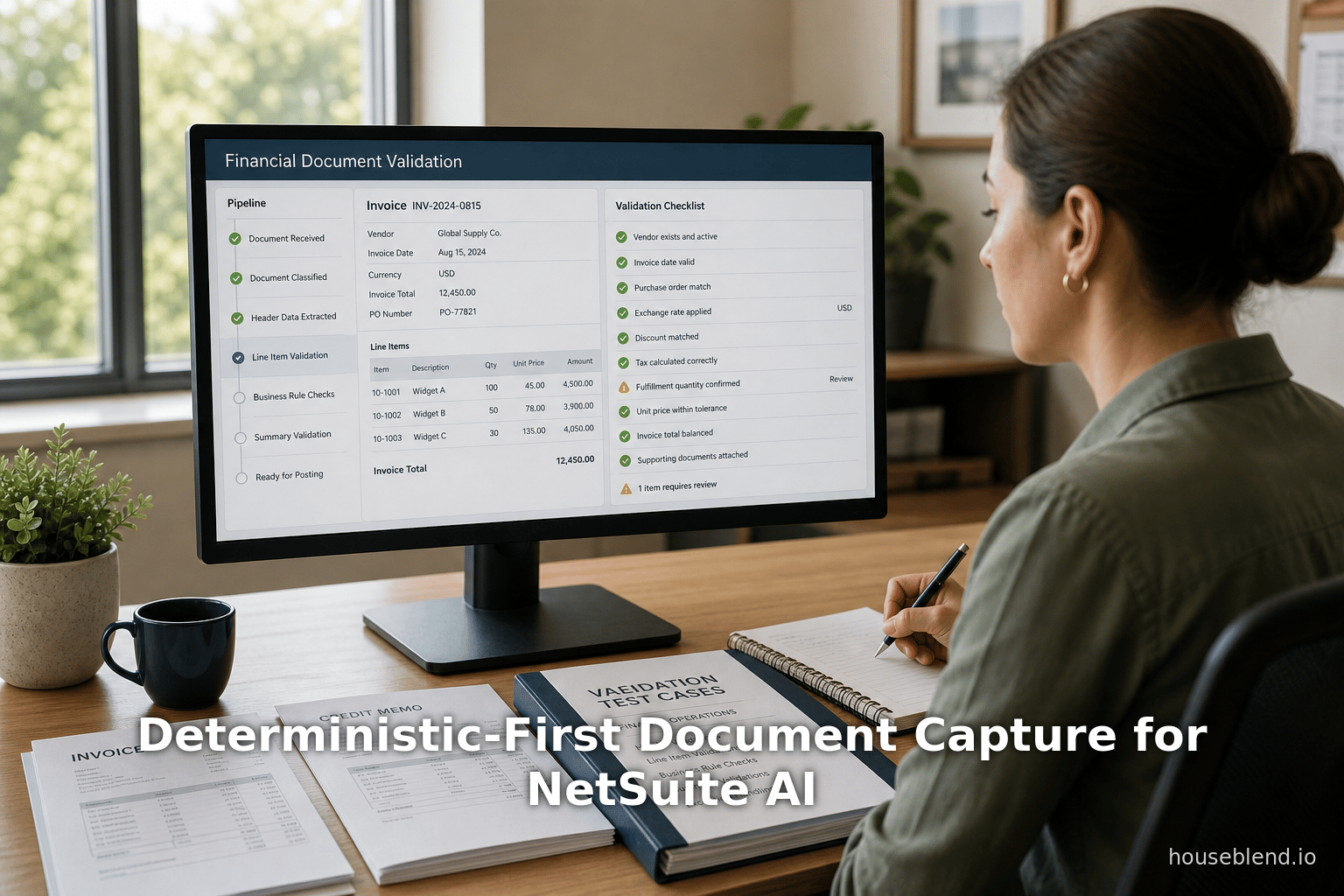
- 05The practical operating model treats the process as four distinct stages: ingest, extract candidate data, validate against deterministic rules and NetSuite records, and approve or reject.
Inside this article
<current_article_content># Deterministic-First Document Capture for NetSuite AI
Document capture can reduce manual entry, but it should not turn an unreviewed model output into an accounting decision. For NetSuite workflows, a safer design starts with deterministic controls and uses AI only where it adds bounded, reviewable assistance.
NetSuite's Bill Capture illustrates the distinction. It can receive vendor-bill files by email or upload and uses Oracle Cloud Infrastructure Document Understanding to extract key values. The resulting bill is reviewed before it is created, and the account's existing approval and matching controls continue to apply. Oracle's Bill Capture documentation also notes that suggestions rely on matches to NetSuite records such as vendors, items, and purchase orders.
Start with deterministic controls
A deterministic-first pipeline defines what must be true before a document can create or update a transaction. Typical controls include:
- Validate the sender, file type, and document-routing rules.
- Identify the vendor and match the document to known vendor, purchase-order, and item records.
- Apply explicit rules for required fields, duplicate-document detection, currency handling, and tolerance thresholds.
- Route exceptions to a reviewer instead of guessing a value or account.
- Preserve the source document, extracted values, rule results, and approval history for investigation.
These rules should be designed around the organization's configured accounting policies and tested against representative documents, including credits, discounts, foreign-currency invoices, partial receipts, and unusual line-item structures. The purpose of testing is to establish the limits of the workflow and define when human review is required—not to claim that automation eliminates risk.
Document capture can reduce manual entry, but it should not turn an unreviewed model output into an accounting decision.
Use AI as a constrained enhancement
AI can be useful for tasks that are difficult to express as simple rules, such as interpreting varied invoice layouts, proposing a description, or extracting a candidate value from unstructured text. Its output should remain a suggestion with a defined downstream check.
For example, an AI-assisted extraction can propose a vendor, date, amount, or line-item description. Deterministic validation can then compare that proposal with the supplier record, purchase order, item receipt, and configured tolerances. If the validation fails or the confidence is insufficient for the organization's policy, the document should enter an exception queue.
This separation makes it easier to identify whether an issue arose in document interpretation, record matching, policy validation, or approval. It also lets teams improve an extraction component without changing the accounting controls that govern posting.
- Validate the sender, file type, and document-routing rules.
- Identify the vendor and match the document to known vendor, purchase-order, and item records.
- Route exceptions to a reviewer instead of guessing a value or account.
- AI can be useful for tasks difficult to express as simple rules, such as interpreting varied invoice layouts or extracting a candidate value from unstructured text.
- Its output should remain a suggestion with a defined downstream check.
- If validation fails or confidence is insufficient for the organization's policy, the document enters an exception queue.
A deterministic-first approach does not guarantee correct results, but it makes AI output reviewable and contained.
Keep posting and payment controls in place
A captured vendor bill is still a vendor bill subject to NetSuite's configured processes. NetSuite states that Bill Capture does not replace functionality such as 3-way match, approval workflows, or SuiteApprovals. Vendor bill approvals can require review before payment; a bill in Pending Approval has no accounting impact until it is approved. The prebuilt Vendor Bill Approval Workflow can also flag purchase-order quantity and amount discrepancies for review. Oracle documents those workflow exceptions here.
The appropriate control design depends on the transaction type, company policy, and NetSuite configuration. A deterministic-first approach does not guarantee correct results. It provides a practical way to make automated document capture reviewable, to contain the effect of uncertain AI output, and to preserve explicit approval gates for financial transactions.
A deterministic-first approach does not guarantee correct results.
A practical operating model
- 01Ingest
The document enters the pipeline as the first of the four stages.
- 02Extract
Candidate data is extracted from the document for review.
- 03Validate
Candidate data is checked against deterministic rules and NetSuite records.
- 04Approve or reject
The resulting transaction is either approved or rejected.
Exceptions, rule failures, and reviewer corrections are monitored over time to guide targeted improvements.
Treat the process as four distinct stages: ingest the document, extract candidate data, validate it against deterministic rules and NetSuite records, then approve or reject the resulting transaction. Monitor exceptions, rule failures, and reviewer corrections over time. Those records can guide targeted improvements to extraction and rules without relaxing the controls that protect the accounting process.</current_article_content>
About
Houseblend
Make NetSuite work better for your finance and operations teams with Houseblend. We help design, implement, integrate and improve ERP systems, with practical support for the people who use them every day.
Houseblend is a NetSuite consulting firm serving finance and operations teams. We help organizations implement ERP systems, connect business applications, improve existing configurations and maintain the systems that support everyday work. Our audience includes finance leaders, controllers, operations managers, NetSuite administrators and implementation teams.
Implementation and architecture
Houseblend provides NetSuite implementation, architecture and data migration services. We help teams evaluate how business processes, reporting requirements and existing data should fit together in an ERP environment. Training supports the people responsible for adopting and operating the resulting system.
Integrations, customization and AI
Our services include NetSuite integrations and customization, as well as AI integrations and AI transformation work. These engagements connect ERP data and workflows with the broader application landscape. The right design depends on the organization's systems, controls and operating needs.
Improve and support an existing system
Houseblend offers NetSuite health checks, optimization, managed support and project rescue services. We also provide expertise for analytics and specialist workflows, including NetSuite Analytics Warehouse, warehouse management and field service management. Published educational material helps teams investigate options and prepare informed questions for their implementation or support work.
Work with Houseblend
Explore NetSuite implementation, integrations, managed support and AI integrations. Contact Houseblend to discuss your current system and priorities.
Article examples explain concepts rather than promising a particular license, product capability, delivery schedule or outcome. Engagement scope is confirmed with the Houseblend team.
Disclaimer
This document is provided for informational purposes only. No representations or warranties are made regarding the accuracy, completeness, or reliability of its contents. Any use of this information is at your own risk. Houseblend shall not be liable for any damages arising from the use of this document. This content may include material generated with assistance from artificial intelligence tools, which may contain errors or inaccuracies. Readers should verify critical information independently. All product names, trademarks, and registered trademarks mentioned are property of their respective owners and are used for identification purposes only. Use of these names does not imply endorsement. This document does not constitute professional or legal advice. For specific guidance related to your needs, please consult qualified professionals.