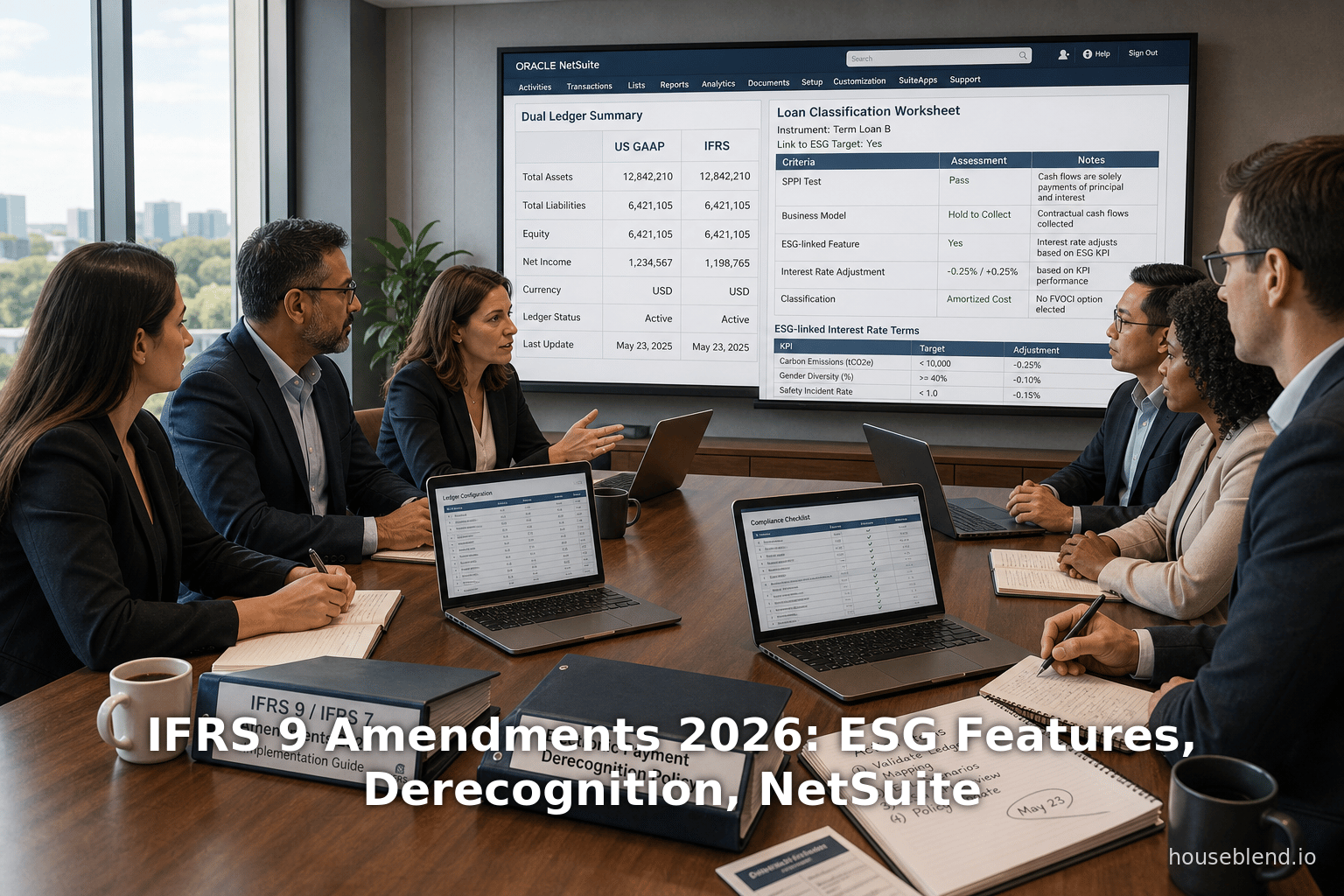
Houseblend Article
IFRS 9 Amendments 2026: ESG Features, Derecognition, NetSuite
Summary
- 01The IFRS 9/IFRS 7 amendments take effect for annual periods beginning on or after 1 January 2026, with early application allowed for the full package or just the classification changes.
- 02A new accounting policy choice lets entities derecognize a financial liability settled via electronic payment before the settlement date, but only if three cumulative conditions are met.
- 03A new SPPI test requires ESG-linked or other contingent loan features to produce cash flows consistent with basic lending and not significantly different from an identical instrument without the feature.
- 04NetSuite's Multi-Book Accounting supports parallel IFRS/GAAP ledgers but does not natively perform SPPI testing or ECL calculation; that instrument-level work sits in Oracle's separate Financial Services IFRS 9 Solution Cloud Service.
- 05Entities must apply the amendments retrospectively but are not required to restate prior periods, and may only restate if possible without hindsight.
- 06Global syndicated sustainable and ESG loan volumes fell 30% year-on-year to $327 billion in 1H 2025, yet sustainability-linked loans alone still totaled roughly $80 billion per quarter, showing the SPPI classification question remains commercially material.
Inside this article
- 01Executive Summary
- 02Introduction and Background
- 03Key Changes
- 04Implementation Considerations and Process Changes
- 05Enterprise Resource Planning Systems and NetSuite IFRS 9 Compliance Support
- 06Data Analysis and Evidence
- 07Implications and Future Directions
- 08Frequently Asked Questions (FAQs)
- 09Conclusion
IFRS 9 Amendments 2026: ESG Features, Derecognition, NetSuite
Executive Summary
The International Accounting Standards Board (IASB) finalized targeted amendments to IFRS 9 Financial Instruments and IFRS 7 Financial Instruments: Disclosures on 30 May 2024, under the title Amendments to the Classification and Measurement of Financial Instruments [1]. The amendments are effective for annual reporting periods beginning on or after 1 January 2026, with early application permitted, either for the full package or for the classification-of-financial-assets amendments alone [2] [3]. This report examines the amendments’ three overarching areas: recognition and derecognition, classification of financial assets with ESG-linked (environmental, social and governance) or other contingent cash-flow features, and expanded IFRS 7 disclosures. Within recognition and derecognition, the amendments clarify the relevant dates for financial assets and financial liabilities and introduce a separate accounting policy choice to derecognize certain financial liabilities settled through electronic payment systems before the settlement date.
The derecognition amendment lets an entity treat a liability as discharged early only if three cumulative conditions hold: no practical ability to withdraw, stop, or cancel the payment instruction; no practical ability to access the cash used for settlement; and settlement risk that is insignificant [4]. The classification amendment responds directly to what IASB Chair Andreas Barckow described as loans with ESG-linked features "becoming more prevalent" [5]; it introduces an additional SPPI (solely payments of principal and interest) test requiring that a contingent feature's cash flows remain consistent with a basic lending arrangement and not be significantly different from an otherwise identical instrument lacking the feature [6].
Market data underscore why the classification question matters: LSEG (London Stock Exchange Group) data show global syndicated sustainable and ESG loan volumes fell to $327 billion in the first half of 2025, a 30% year-on-year decline, even as sustainability-linked loans (SLLs) alone still totaled roughly $80 billion per quarter in the first two quarters of 2025 [7] [8]. An Irish regulatory review found that credit institutions accounted for 92.32% of the sustainability-linked debt examined in its sample; this concentration is specific to that sample and does not establish the amendments' primary constituency (Source: iaasa.ie).
On the enterprise-software side, this report finds that Oracle NetSuite's core capability relevant to IFRS compliance is Multi-Book Accounting, which lets one transaction stream flow into parallel ledgers configured for different standards, such as US GAAP and IFRS, simultaneously [9]. Instrument-level IFRS 9 functionality, such as SPPI testing and expected credit loss (ECL) calculation, is not native to core NetSuite; it resides in a separate, bank-focused Oracle product, the Oracle Financial Services IFRS 9 Solution Cloud Service [10]. Big Four accounting firms, PwC, KPMG, EY, and Deloitte, converge on the same practical message: entities must review electronic payment system terms, reassess prior SPPI conclusions for contingent-feature instruments, and prepare for retrospective transition without mandatory restatement of prior periods [11].
Introduction and Background
IFRS 9 Financial Instruments is the accounting standard issued by the IASB governing how entities classify, measure, and account for financial instruments. The IASB issued the completed standard on 24 July 2014, replacing the older IAS 39 Financial Instruments: Recognition and Measurement, and it became effective for annual periods beginning on or after 1 January 2018 [12] [13]. The standard consists of three components: classification and measurement of financial instruments, impairment (expected credit losses), and hedge accounting [14].
In 2022, the IASB completed a post-implementation review (PIR) of IFRS 9's classification and measurement requirements. The review concluded that preparers could generally apply the requirements consistently, but it identified specific matters requiring amendment [15]. Following the PIR, the IASB published an exposure draft of proposed amendments in March 2023, with a comment period ending 19 July 2023 [16]. The final amendments, issued 30 May 2024, "finalise the proposals in the March 2023 exposure draft" [17].
The amendments address diversity in accounting practice "by making the requirements more understandable and consistent," according to PwC's technical guidance [18]. Three areas of substantive change anchor the package: (1) an accounting policy choice for the early derecognition of financial liabilities settled via electronic payment systems, (2) new application guidance for classifying financial assets whose contractual cash flows are contingent on events such as ESG targets, and (3) enhanced disclosures under IFRS 7 for both categories, plus for equity instruments designated at fair value through other comprehensive income (FVOCI) [19]. Notably, one IASB Board member dissented from issuance, disagreeing specifically with the effective date attached to the recognition and derecognition amendments [20], citing concern that entities may not have "sufficient time to apply the amendments" given the potential for "widespread reporting system changes" [21].
IASB issued the completed standard on 24 July 2014, replacing the older IAS 39.
The original standard became effective for annual periods beginning on or after 1 January 2018.
IASB completed a post-implementation review of IFRS 9's classification and measurement requirements, identifying matters needing amendment.
IASB published an exposure draft of proposed amendments with a comment period ending 19 July 2023.
IASB finalized targeted amendments to IFRS 9 and IFRS 7 under the Classification and Measurement of Financial Instruments title.
The amendments apply to annual reporting periods beginning on or after 1 January 2026, with early application permitted.
Key Changes
Recognition Date and Settlement-Date Derecognition
The amendments add application guidance on the dates of initial recognition and derecognition. Except where other IFRS 9 requirements apply, an entity recognizes a financial asset or financial liability when it becomes party to the instrument’s contractual provisions. A financial asset is derecognized when its contractual rights to cash flows expire or the asset is transferred; a financial liability is derecognized on the settlement date, when the obligation is extinguished, unless the entity elects the separate electronic-payment policy option described below [22].
Derecognition of Financial Liabilities Settled via Electronic Payment Systems
Stakeholders had told the IASB that the existing IFRS 9 derecognition requirements were difficult to apply to settlements made through modern electronic cash-transfer systems, since a payment instruction and the actual delivery of cash to a creditor rarely occur at the exact same moment [23]. In response, the amendments introduce a new accounting policy choice: an entity is permitted, but not required, to derecognize a financial liability (or part of it) settled in cash via an electronic payment system before the settlement date, if a payment instruction has been initiated that satisfies three cumulative conditions [24].
The three conditions, confirmed independently by both Deloitte's IAS Plus and KPMG's technical guidance, are: (1) the entity has no practical ability to withdraw, stop, or cancel the payment instruction; (2) the entity has no practical ability to access the cash to be used for settlement as a result of the payment instruction; and (3) the settlement risk associated with the electronic payment system is insignificant [4] [25]. "Settlement risk" is defined as the risk that a transaction will not be completed, such that a debtor fails to deliver cash to the creditor on the settlement date [26]. It is deemed insignificant when the payment instruction follows a standard administrative process and the time between the first two criteria being met and the actual delivery of cash is short [27].
Critically, an entity that elects this policy must apply it consistently to all settlements made through the same electronic payment system, effectively making it a system-by-system accounting policy choice rather than a transaction-by-transaction judgment call. The IASB deliberately did not extend an equivalent early-derecognition alternative to financial assets: in the Board's view, a recipient of cash does not have the same practical inability to withdraw, stop, or cancel a transaction, and does not gain practical access to the cash until it is actually delivered [28].
KPMG's global insights note that, from a practical standpoint, the amendment "may help companies to maintain their current practice" where systems already function this way [29], but it also cautions that reviewing every electronic payment system an entity uses against the three-part test "may require significant time and effort" [30]. PwC similarly frames this change as an "optional exception," describing it as permitting an entity "to derecognise a financial liability at an earlier date if the cash transfer takes place through an electronic payment system" [31], and observes that this particular strand of the amendments "is most relevant to financial institutions" [32].
Classification of Financial Assets with ESG-Linked and Contingent Features
The second, and for lending markets the most consequential, change addresses how to classify financial assets whose contractual cash flows change based on a contingent event, most prominently loans whose interest rate steps up or down depending on whether a borrower meets specified ESG targets, commonly called sustainability-linked loans (SLLs). Before the amendment, it was "unclear whether the contractual cash flows of some financial assets with ESG-linked features represented" SPPI (solely payments of principal and interest), a required condition for amortized-cost measurement; this uncertainty "could have resulted in financial assets with ESG-linked features being measured at fair value through profit or loss" (FVTPL) rather than amortized cost, introducing income-statement volatility that many lenders considered a poor economic representation of ordinary lending activity [33].
IASB Chair Andreas Barckow explained the rationale directly: "Loans with ESG-linked features are becoming more prevalent. The IASB responded to requests to clarify the measurement of such instruments in a timely manner" [5]. The amendments introduce an additional SPPI test specifically for contingent features that are not directly related to a change in basic lending risks or costs, such as an ESG target written into a loan contract [34]. Under the new guidance, an entity must consider the effect of any contingent event specified in the contract "however likely or unlikely the event is to occur," unless the contractual term is not genuine [35].
To pass the new test, the contingent feature must produce contractual cash flows that are "consistent with a basic lending arrangement both before and after the change" and that are "not significantly different from the cash flows for an identical financial asset without such a contingent feature" [36]. EY's technical publication reproduces an IASB illustrative example that clarifies the boundary: a loan whose interest rate is "reduced by a fixed number of basis points if the debtor achieves a contractually specified reduction in its carbon emissions in the previous period" passes SPPI, because the adjustment is capped and consistent with basic lending economics [37]. By contrast, a loan whose interest rate is instead adjusted by movements in a carbon price index fails the test, because "the cash flows are indexed to a variable that is not a basic lending risk or cost and is therefore inconsistent with a basic lending arrangement" [38].
KPMG's global IFRS financial instruments leadership "welcome[d] the IASB tackling emerging issues promptly" [39], while cautioning that "judgement will be required in determining whether the new test is met" [40], and that although the amendments are "more permissive, they apply to all contingent features, not just ESG-linked features," so lenders cannot treat the new test as an ESG-only carve-out [41]. PwC's summary situates this change alongside two related, narrower clarifications issued in the same package: guidance on non-recourse features and on contractually linked instruments (CLIs), both of which affect how cash-flow characteristics are assessed for structured or asset-backed lending [42].
Disclosure Amendments to IFRS 7
Alongside the classification and derecognition changes, the IASB added new disclosure requirements "to enhance transparency for investors regarding investments in equity instruments designated at fair value through other comprehensive income and financial instruments with contingent features, for example features tied to ESG-linked targets" [43]. For FVOCI-designated equity instruments, an entity must now disclose the fair value gain or loss presented in other comprehensive income during the period, shown separately for investments derecognized during the period and those still held at period end [44].
For financial instruments carrying contingent contractual terms, such as ESG-linked interest rate features, the new IFRS 7 disclosures require a qualitative description of the nature of the contingent event, quantitative information about the possible changes to contractual cash flows (for example, the range of possible changes), and the gross carrying amount of financial assets, or amortized cost of financial liabilities, subject to those contractual terms, by class [45]. Separately, BDO's technical summary confirms the disclosure scope covers "contractual terms that could change the amount of contractual cash flows based on the occurrence or non-occurrence of a contingent event that does not relate directly to changes in basic lending risks and costs" (Source: www.bdo.com.au), directly mirroring the scope of the new SPPI test itself.
At the date of initial application, entities must also disclose, for each class of financial asset that changed measurement category as a result of applying the amendments, the measurement category and carrying amount both immediately before and immediately after the change [46]. Table 1 below summarizes the principal amendments, who they primarily affect, and their treatment under the 1 January 2026 effective date.
| Area of Amendment | What Changes | Primarily Affects | Effective Date / Adoption |
|---|---|---|---|
| Derecognition of financial liabilities | New accounting policy choice to derecognize a liability settled via electronic payment before the settlement date, if three cumulative conditions are met [31] | Financial institutions and other frequent payers using electronic payment systems [32] | Periods beginning on/after 1 Jan 2026; may be excluded from early adoption of the classification amendments [3] |
| Classification of ESG-linked / contingent-feature assets (SPPI) | New test requiring contingent cash flows to be consistent with a basic lending arrangement and not significantly different from an identical instrument without the feature [36] | All entities holding loans or debt instruments with ESG-linked or other contingent pricing features [47] | Periods beginning on/after 1 Jan 2026; eligible for standalone early adoption [48] |
| IFRS 7 disclosures | New qualitative/quantitative disclosures for contingent-feature instruments and FVOCI equity instruments, plus transition disclosures [45] | All entities affected by the classification or FVOCI-equity provisions [44] | Applied alongside whichever substantive amendment they support [43] |
As Table 1 illustrates, the derecognition and classification amendments have different natural audiences, banks and other frequent electronic-payment originators for the former, essentially any IFRS reporter that extends ESG-linked or contingent-feature financing for the latter, while the disclosure amendments ride alongside both. This bifurcation matters for implementation planning, since it lets entities that only originate contingent-feature loans, without needing the electronic-payment provision, adopt a narrower scope of change if they choose early application.
Loans with ESG-linked features are becoming more prevalent. The IASB responded to requests to clarify the measurement of such instruments in a timely manner
Implementation Considerations and Process Changes
Transition follows IAS 8 Accounting Policies, Changes in Accounting Estimates and Errors: entities are required to apply the amendments retrospectively, but are not required to restate prior periods, and may only do so if restatement is possible without the use of hindsight [11]. Where prior periods are not restated, an entity must instead recognize the cumulative effect of initial application as an adjustment to the opening balance of financial assets and financial liabilities, and, where applicable, to the opening balance of retained earnings or another component of equity at the date of initial application [49].
Big Four guidance converges on a small number of practical themes. EY frames the amendments as introducing "an accounting policy choice (if specific conditions are met) to derecognise financial liabilities settled using an electronic payment system before the settlement date" and separately clarifying "classification of financial assets with environmental, social and corporate governance (ESG) and similar features" [50] [51], and warns that the new classification criteria "may result in different outcomes for the classification of such instruments than under the current guidance," meaning "entities should reassess their previous conclusions when transitioning to the new requirements" [52]. KPMG's implementation guidance similarly recommends that entities "review the terms and conditions of electronic payment systems" they use to assess eligibility for the derecognition policy choice [53], and, in a mid-2026 outlook article, KPMG US described the now-effective package as amendments that "clarify settlement-date derecognition rules, introduce an exception for electronic payments, provide guidance for assessing ESG-linked" cash flows, and add related disclosures [54].
PwC's segmentation of the package is instructive for planning purposes: it groups the amendments into (a) classification amendments for contingent-event, non-recourse, and contractually linked instruments; (b) the electronic-payment derecognition policy choice; (c) FVOCI equity-instrument disclosures; and (d) contingent-feature disclosures, then notes plainly that "the amendments in (b) are most relevant to financial institutions, but the amendments in (a), (c) and (d) are relevant to all entities" [55]. This distinction is a useful scoping tool for corporates that originate or hold ESG-linked debt but do not themselves settle high volumes of liabilities through electronic payment rails; for them, the classification and disclosure work, not the derecognition provision, is the priority.
The dissenting IASB Board member's concern about system readiness has practical resonance. Applying the electronic-payment derecognition test at scale, KPMG notes, "may require significant time and effort" because it requires system-by-system review of payment-rail terms and conditions [30], which is consistent with the dissenting member's original warning that the changes "could necessitate widespread reporting system changes" [56]. Entities that intend to early adopt should note the split election structure: an entity may "apply all the amendments at the same time and disclose that fact" or "apply only the amendments to the classification of financial assets for that earlier period and disclose that fact," but cannot mix and match beyond those two options [57].
Enterprise Resource Planning Systems and NetSuite IFRS 9 Compliance Support
Meeting the 2026 amendments in practice depends heavily on the accounting systems entities use to classify instruments, maintain parallel books, and produce the newly required disclosures. Oracle NetSuite, a widely used cloud enterprise resource planning (ERP) platform, addresses IFRS compliance primarily through a feature called Multi-Book Accounting, which "provides the ability to maintain multiple sets of accounting records based on a single set of real-time financial transactions" [58]. NetSuite's own educational materials describe this capability as enabling "financial reporting that complies with both US Generally Accepted Accounting Principles (GAAP) and International Financial Reporting Standards (IFRS)" from the same underlying transactions [9], and a NetSuite product datasheet states that Multi-Book "also helps you avoid errors related to differences in ASC and IFRS standards for revenue recognition, lease accounting, insurance, and other rules" [59]. NetSuite's UK product page for finance and accounting states the software helps organizations "comply with multiple regulatory financial compliance requirements, including IFRS15, ASC 606, GAAP, SOX and more" [60].

Two related NetSuite modules extend this: Financial Consolidation lets multinational groups "create multiple sets of books to accommodate accounting rules, tax codes or other requirements that may differ at parent and subsidiary levels" [61], and the Financial Reporting module's "Multiple Reporting Standards" feature relies on the same underlying multi-book architecture "to comply with various accounting standards, tax codes and reporting requirements" [62].
An important scope distinction should be noted for readers evaluating NetSuite specifically against the 2026 amendments: none of NetSuite's own public product documentation describes purpose-built SPPI testing or expected credit loss (ECL) calculation engines within the core ERP. That instrument-level functionality is delivered by a separate, distinctly branded Oracle product built for banks and financial institutions, the Oracle Financial Services IFRS 9 Solution Cloud Service (part of Oracle Financial Services Analytical Applications), which "helps financial services institutions to address the IFRS 9 requirements i.e., Classification and Measurement, Impairment, and Hedge Accounting" [10]. That product's documentation confirms it supports "out-of-box Expected Credit Loss methods" [63], ECL calculation "for multiple economic scenarios" [64], and a formal account-classification process in which "financial assets must undergo the Business Model test (BM) and Cash Flow Characteristics test (SPPI)" to sort instruments into amortized cost, FVOCI, or FVTPL categories [65]. For comparative context, SAP's Treasury and Risk Management "Reserve for Bad Debts" tool computes impairments using both an individual expected-cash-flow approach and a parameter-based ECL approach, and it supports "parallel processing of two accounting principles (e.g. IFRS9 and a local GAAP)" [66].
Table 2 summarizes how these three system offerings map onto IFRS 9-relevant functionality.
| System | Vendor | Core IFRS-Relevant Capability | Typical User |
|---|---|---|---|
| Multi-Book Accounting | Oracle NetSuite | Parallel ledgers from one transaction stream for GAAP/IFRS and other standards [9] | General mid-market and enterprise corporates, not instrument-level classification |
| Oracle Financial Services IFRS 9 Solution Cloud Service | Oracle (OFSAA) | SPPI/Business Model classification, ECL calculation across scenarios [65] | Banks and financial institutions |
| Treasury and Risk Management (Reserve for Bad Debts) | SAP | Individual and parameter-based ECL, parallel accounting-principle processing [66] | Corporate treasury functions with financial instrument exposure |
As the table indicates, an organization's choice of system depends heavily on whether it is a OneWorld corporate reporter needing parallel-standard bookkeeping, for which Full Multi-Book Accounting may be relevant when implemented with NetSuite Professional Services or an authorized partner ( Oracle documentation, or a bank or lender seeking the SPPI-testing and ECL-modeling capabilities Oracle documents for its OFSAA-based IFRS 9 Solution Cloud Service. Finance teams evaluating NetSuite specifically for the 2026 amendments should confirm the functionality, configuration, and any integrations needed for their instrument classification and ECL processes with Oracle or their implementation partner.
- Maintains multiple sets of accounting records from one stream of real-time transactions.
- Enables financial reporting that complies with both US GAAP and IFRS from the same transactions.
- Does not natively include purpose-built SPPI testing or ECL calculation engines.
- Addresses IFRS 9 classification and measurement, impairment, and hedge accounting requirements.
- Supports out-of-box Expected Credit Loss methods.
- Runs a formal Business Model and Cash Flow Characteristics (SPPI) classification process.
PwC frames this split directly: the electronic-payment derecognition provision is most relevant to financial institutions, while classification and disclosure changes are relevant to all entities.
Data Analysis and Evidence
The scale of IFRS adoption globally frames why these amendments matter beyond any single jurisdiction: the IFRS Foundation maintains "complete profiles for 170 jurisdictions" tracking the use of IFRS Accounting Standards worldwide [67].
Sustainability-linked and broader ESG lending, the market segment most directly affected by the classification amendment, has been volatile but remains substantial. The Institute of International Finance's Sustainable Debt Monitor described the sustainability-linked loan market as "the fastest growing segment in the ESG debt universe," within a total ESG debt universe that had grown to nearly $4.5 trillion by the third quarter of 2022 [68]. More recent data show a market correction: LSEG (London Stock Exchange Group) reported that global sustainable finance volumes across loans and bonds combined reached $774.7 billion in the first half of 2025, a 14% year-on-year decline [69], while global syndicated sustainable and ESG loan volumes specifically fell to $327 billion in the same period, a steeper 30% year-on-year decline [70]. Within that total, EMEA (Europe, the Middle East, and Africa) ESG and sustainable loan volumes dropped from $228.34 billion across 309 deals in the first half of 2024 to $156.08 billion across 181 transactions in the first half of 2025, a 32% decline [71].
Environmental Finance Data corroborates the broader slowdown while highlighting that the SLL segment specifically has held up better than the labelled sustainable-loan market overall: more than $390 billion was raised through sustainable loans in the first six months of 2025, down roughly 18% versus each half of 2024 [72]. Labelled loan volumes overall fell 52% between the first half of 2024 and the first half of 2025, yet SLLs alone still totaled roughly $80 billion per quarter in each of the first two quarters of 2025 [73], evidence that ESG-linked lending remains a meaningful, if contracting, part of global credit markets precisely as the IFRS 9 classification amendments take effect. In Europe, AFME (using Dealogic data) reported that ESG bond and loan issuance, including sustainability-linked and green loans, totaled €679.4 billion for full-year 2025, a 2.3% decline from €695.3 billion in 2024 (Source: www.afme.eu), with fourth-quarter 2025 issuance of €127 billion marking "the lowest quarterly amount since Q3 2023 and the lowest Q4 since 2019" (Source: www.afme.eu).
A thematic review by Ireland's IAASA (Irish Auditing and Accounting Supervisory Authority) of sustainability-linked debt disclosures across a sample of 17 equity issuers listed on Euronext Dublin's main market (Source: iaasa.ie) found that credit institutions accounted for 92.32% of the sustainability-linked debt examined in that sample (Source: iaasa.ie). The finding describes that small, Ireland-specific sample; it cannot establish which entities globally have the most at stake in applying the new SPPI test. Table 3 below consolidates these market figures.
| Metric | Period | Value | Source |
|---|---|---|---|
| Global sustainable finance volume (loans + bonds) | 1H 2025 | $774.7 billion (-14% YoY) | LSEG, via LMA Horizons [69] |
| Global syndicated sustainable/ESG loan volume | 1H 2025 | $327 billion (-30% YoY) | LSEG, via LMA Horizons [70] |
| EMEA ESG/sustainable loan volume | 1H 2024 vs 1H 2025 | $228.34bn to $156.08bn (-32%) | LSEG, via LMA Horizons [71] |
| Sustainable loan issuance | H1 2025 | >$390 billion (-18% vs 2024 halves) | Environmental Finance Data [72] |
| Sustainability-linked loan issuance | Q1-Q2 2025 (each quarter) | ~$80 billion/quarter | Environmental Finance Data [8] |
| European ESG bond and loan issuance | FY2025 | €679.4 billion (-2.3% YoY) | AFME/Dealogic (Source: www.afme.eu) |
| ESG debt universe total | Q3 2022 | ~$4.5 trillion | Institute of International Finance [68] |
| Credit institution share of sampled SLD | 2025 | 92.32% | IAASA thematic review (Source: iaasa.ie) |
For entities that also report under US GAAP, PwC's IFRS-US GAAP comparison guide notes that the impairment scope under ASC 326 (the US Current Expected Credit Loss, or CECL, standard) is broadly similar to IFRS 9: "both apply to financial assets measured at amortized cost, as well as to off-balance sheet exposures, such as loan commitments and guarantees" [74]. The measurement mechanics diverge, however: IFRS 9's "dual-measurement approach requires an entity to measure the loss allowance for an asset accounted for at amortized cost or FVTOCI ... at an amount equal to either (1) the 12-month expected credit losses or (2) lifetime expected credit losses," in contrast to the single lifetime-loss model under CECL [75]. On hedge accounting, KPMG's comparison highlights that "IFRS 9 has moved away from bright lines and focuses on an objective-based test that requires an economic relationship of critical terms," whereas under US GAAP's ASC 815, a hedging relationship must be "highly effective," generally interpreted as falling within an 80% to 125% range [76]. These persistent GAAP/IFRS differences reinforce why dual-reporting infrastructure, such as NetSuite's Multi-Book Accounting or SAP's parallel accounting-principle processing, remains operationally important for multinational filers.
the amendments in (b) are most relevant to financial institutions, but the amendments in (a), (c) and (d) are relevant to all entities
Implications and Future Directions
The combination of a declining but still substantial sustainability-linked loan market, roughly $80 billion originated per quarter in early 2025 even amid a 52% year-on-year drop in the broader labelled loan segment [77], and a new accounting test that clarifies rather than restricts amortized-cost eligibility for ESG-linked loans, suggests the amendments could remove one source of accounting friction that had made lenders cautious about structuring sustainability-linked pricing. By giving preparers a defined, IASB-endorsed pathway to keep well-structured ESG-linked loans off fair-value accounting, the amendments may support continued or renewed growth in the SLL segment once broader macroeconomic conditions affecting loan volumes stabilize.
IAASA found that credit institutions represented 92.32% of the sustainability-linked debt examined in its sample (Source: iaasa.ie), but that sample does not establish the global distribution of implementation effort. The work required will depend on each entity's holdings of contingent-feature instruments and use of electronic payment systems, including the SPPI reassessment work EY recommends [52] and the electronic-payment-system reviews KPMG describes [53]. This concentration of impact is likely to accelerate demand for specialized instrument-classification and ECL tooling of the kind found in Oracle's Financial Services IFRS 9 Solution Cloud Service [10] and SAP's treasury and risk management platform [66], even as general-purpose ERP platforms such as NetSuite continue to serve the parallel-book reporting layer above that instrument-level analysis [9].
Persistent divergence from US GAAP, in impairment measurement mechanics and hedge-effectiveness testing alike [75] [76], means multinational groups filing under both frameworks will continue to need dual-book infrastructure regardless of how the 2026 amendments settle in practice. Given that IFRS Accounting Standards have complete adoption profiles across 170 jurisdictions [67], the classification clarity introduced here is likely to become a reference point other standard-setters and lenders structuring cross-border ESG-linked facilities will watch closely in the years following the 1 January 2026 effective date.
Frequently Asked Questions (FAQs)
When do the IFRS 9 amendments take effect? The amendments apply to annual reporting periods beginning on or after 1 January 2026, with early application permitted [2].
What is the SPPI test and why does it matter for ESG-linked loans? SPPI stands for "solely payments of principal and interest," the cash-flow test a financial asset must pass to qualify for amortized-cost or FVOCI measurement rather than FVTPL; the amendments add a specific test for contingent features such as ESG targets, requiring the resulting cash flows to be consistent with a basic lending arrangement and not significantly different from an identical instrument without the feature [36].
How does the derecognition amendment change liability accounting? It allows an entity, as an accounting policy choice, to treat a financial liability settled via an electronic payment system as discharged before the settlement date if it has no practical ability to withdraw the payment instruction, no practical access to the settlement cash, and insignificant settlement risk [25].
Can companies early adopt only part of the amendments? Yes. An entity may adopt all the amendments together or adopt only the classification-of-financial-assets amendments (and related disclosures) separately from the derecognition amendments, disclosing which choice it made [48].
Does NetSuite support IFRS 9 compliance? NetSuite's Multi-Book Accounting supports parallel IFRS and GAAP reporting from one transaction stream [58], but instrument-level SPPI testing and ECL calculation are provided by the separate Oracle Financial Services IFRS 9 Solution Cloud Service aimed at banks [10].
How will the amendments affect financial statements? Entities may see instruments reclassified between amortized cost, FVOCI, and FVTPL categories, and must disclose the before-and-after measurement category and carrying amount for each class of financial asset that changed category as a result of applying the amendments [46].
Conclusion
The IASB's May 2024 amendments to IFRS 9 and IFRS 7 reach their effective date for annual periods beginning on or after 1 January 2026, closing out a process that began with the 2022 post-implementation review of IFRS 9's classification and measurement requirements and moved through a March 2023 exposure draft to final issuance. The package resolves two distinct sources of practical uncertainty that had accumulated since IFRS 9 first took effect in 2018: how to derecognize liabilities settled through modern electronic payment rails, and how to classify financial assets, most visibly sustainability-linked loans, whose cash flows depend on contingent, often ESG-related, events. Both changes are accompanied by expanded IFRS 7 disclosures designed to give investors more visibility into the affected instruments and the measurement judgments applied to them.
For preparers, the practical work ahead splits along the lines Big Four firms have already mapped: banks and other frequent electronic-payment originators face a system-by-system review of payment rails against the three-part derecognition test, while entities holding financial assets with contingent events that do not directly relate to changes in basic lending risks and costs must reassess their SPPI conclusions under the new criteria ( IFRS Foundation staff paper. For NetSuite OneWorld customers, Full Multi-Book Accounting can support parallel-standard reporting when implemented with NetSuite Professional Services or an authorized Multi-Book partner ( Oracle documentation; organizations should assess whether their configured system and any integrations support their required instrument-classification and ECL processes. With sustainability-linked lending still running at tens of billions of dollars per quarter despite a broader market slowdown, the amendments arrive at a moment when getting this classification question right carries real financial-statement consequences across a substantial share of the credit market.
External Sources (77)
About
Houseblend
Make NetSuite work better for your finance and operations teams with Houseblend. We help design, implement, integrate and improve ERP systems, with practical support for the people who use them every day.
Houseblend is a NetSuite consulting firm serving finance and operations teams. We help organizations implement ERP systems, connect business applications, improve existing configurations and maintain the systems that support everyday work. Our audience includes finance leaders, controllers, operations managers, NetSuite administrators and implementation teams.
Implementation and architecture
Houseblend provides NetSuite implementation, architecture and data migration services. We help teams evaluate how business processes, reporting requirements and existing data should fit together in an ERP environment. Training supports the people responsible for adopting and operating the resulting system.
Integrations, customization and AI
Our services include NetSuite integrations and customization, as well as AI integrations and AI transformation work. These engagements connect ERP data and workflows with the broader application landscape. The right design depends on the organization's systems, controls and operating needs.
Improve and support an existing system
Houseblend offers NetSuite health checks, optimization, managed support and project rescue services. We also provide expertise for analytics and specialist workflows, including NetSuite Analytics Warehouse, warehouse management and field service management. Published educational material helps teams investigate options and prepare informed questions for their implementation or support work.
Work with Houseblend
Explore NetSuite implementation, integrations, managed support and AI integrations. Contact Houseblend to discuss your current system and priorities.
Article examples explain concepts rather than promising a particular license, product capability, delivery schedule or outcome. Engagement scope is confirmed with the Houseblend team.
Disclaimer
This document is provided for informational purposes only. No representations or warranties are made regarding the accuracy, completeness, or reliability of its contents. Any use of this information is at your own risk. Houseblend shall not be liable for any damages arising from the use of this document. This content may include material generated with assistance from artificial intelligence tools, which may contain errors or inaccuracies. Readers should verify critical information independently. All product names, trademarks, and registered trademarks mentioned are property of their respective owners and are used for identification purposes only. Use of these names does not imply endorsement. This document does not constitute professional or legal advice. For specific guidance related to your needs, please consult qualified professionals.