Houseblend Article
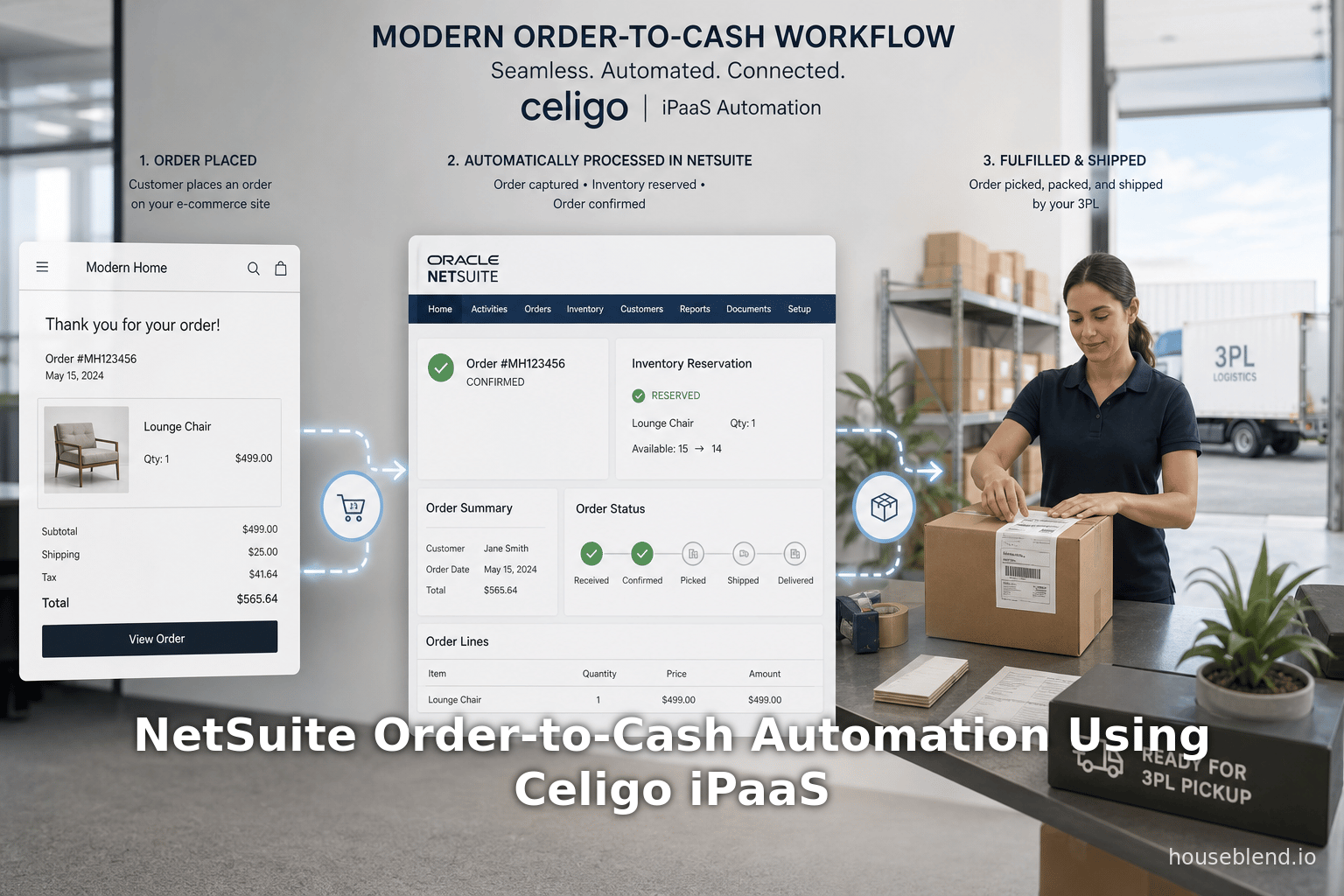
NetSuite Order-to-Cash Automation Using Celigo iPaaS
Inside this article
- 01Executive Summary
- 02Introduction and Background
- 03Order-to-Cash Dynamics
- 04ERP and E-commerce Integration
- 05Celigo Integration Platform
- 06Integration Flow Patterns
- 07Case Studies and Real-World Examples
- 08Data Analysis and Evidence-Based Insights
- 09Case Studies (Continued)
- 10Implications and Future Directions
- 11Conclusion
Executive Summary
This report examines the integration of e-commerce platforms, NetSuite ERP, and third-party logistics (3PL) systems using Celigo’s integration platform, with a focus on automating the entire order-to-cash (O2C) process. E-commerce sales have surged in recent years (projected to exceed $4.3 trillion globally by 2025 [1]), and cloud ERP adoption has reached critical mass – over 70% of ERP deployments are now cloud-based (Source: www.anchorgroup.tech). In this environment, modern businesses increasingly rely on platforms like NetSuite for back-office order and inventory management. However, fulfilling rapid order growth and maintaining visibility across sales channels and fulfillment networks requires seamless data flows between systems. Celigo’s integrator.io iPaaS specializes in connecting systems, particularly NetSuite with e-commerce channels and 3PL providers. It offers hundreds of prebuilt connectors and flow templates to sync orders, inventory, shipments, payments, and more, reducing manual work and errors [2] [3].
Extensive evidence—from industry analyses to customer case studies—shows the benefits of O2C automation. For example, BCG reports that companies deploying digital O2C platforms can boost revenues by 1–3% per year [4] [5]. Independent research finds firms recoup roughly $3.76 for every $1 invested in integration platforms [6]. Celigo customers have realized dramatic improvements (see Case Studies): one retailer reduced daily ecommerce order-troubleshooting from 4–8 hours down to 10 minutes [7], while another cut month-end financial close from 60 days to 5 days and slashed operating expenses by 30% [8]. Overall, automation via Celigo has allowed small teams to handle thousands of orders weekly at high accuracy, maintaining fast growth without ballooning headcount. Integration also provides real-time inventory visibility and error management, which are critical given that only 6% of companies have full supply-chain visibility [9] and retail inventory accuracy averages roughly 65% [10] when managed manually.
This report offers an in-depth analysis of Celigo-enabled integration patterns for e-commerce, ERP, and 3PL, covering technical flow designs, business impacts, trends, and future directions. It draws on vendor documentation, industry research, expert analysis, and real-world case examples to substantiate every claim. Key findings include:
- Integration Patterns: Common Celigo templates support flows such as syncing e-commerce orders/customers/refunds with NetSuite sales orders/customers/credit memos, as well as sending NetSuite sales/purchase orders to 3PL systems and receiving shipment confirmations and inventory updates back into NetSuite [11] [12]. Pre-built connectors exist for major platforms (Shopify, Amazon, eBay, BigCommerce, etc.) and 3PL providers, enabling fully automated bidirectional workflows [13] [14].
- Business Benefits: By automating data entry and enabling real-time sync, organizations eliminate most manual reconciliation, avoid overselling, accelerate order processing, and improve on-time fulfillment. Customers of Celigo report higher sales growth, lower labor costs, faster cash collection, and better customer satisfaction. One study found integrated O2C platforms reduce errors and delays so significantly that firms routinely capture all sales revenue and improve customer loyalty [4] [5].
- Technology and Architecture: Celigo’s iPaaS provides a low-code, API-driven environment with built-in error governance, monitoring, and AI-enhanced error-handling [15] [16]. It supports real-time (“event-driven”) and scheduled flows, webhooks, batch updates, and EDI for B2B transactions. The platform’s design emphasizes ease of use for business users while also offering enterprise-grade scalability and security [17] [16].
- Market Context and Trends: The iPaaS market is booming, with a projected value of $8–13 billion in 2025 rising toward ~$50–55 billion by the early 2030s [18]. Celigo has emerged as a leading “visionary” vendor in this space [19], especially for mid-market companies. Its focus on e-commerce and NetSuite integration gives it an edge in these niches. Major iPaaS trends include AI/ML integration (e.g. Celigo began embedding AI/ML into its platform in 2019 for intelligent error management [16]), support for hybrid cloud and agentic architectures, and industry-specific connectors.
- Case Studies: Multiple companies’ experiences illustrate practical outcomes: A gift retailer cut staff hours dramatically while scaling 15–30% quarterly growth [7] [20]. An outdoor gear brand slashed costs and close cycles with real-time inventory sync [8]. A baby-care brand automated diverse channels (Shopify, Amazon, brick stores) with Celigo flows, enabling 60% year-on-year growth without operations breakdown [21]. These examples substantiate that O2C automation is no longer optional for scaling e-commerce businesses.
In conclusion, seamless integration between e-commerce systems, ERP (NetSuite), and 3PL platforms is both a strategic imperative and a proven value-add for fast-growing companies. Celigo’s integration platform offers a comprehensive solution to implement these connections. By adopting Celigo to orchestrate order-to-cash workflows, businesses can improve accuracy, cut costs, accelerate cash flow, and support future growth. Looking forward, as AI and automation become more deeply embedded in supply-chain systems, the need for robust integration middleware like Celigo will only increase.Investments in such O2C automation lay the foundation for resilient, data-driven commerce operations.
Introduction and Background
The order-to-cash (O2C) cycle comprises all steps from capturing a customer order through delivering the product/service, invoicing, and receiving payment. It spans multiple functions — sales, customer service, warehousing, shipping, finance, and IT — and touches both front-end (customer channels) and back-office systems. An inefficient O2C process can create revenue leakage, high working capital, poor customer experience, and operational bottlenecks. As BCG observes, “executives rarely pay any real attention” to O2C until crises (such as a sales spike or cash crunch) expose hidden problems [22]. In e-commerce businesses today, delaying modernization is not an option. The pandemic and global digitization have dramatically accelerated online sales (expected to exceed $4.3 trillion in 2025 [1]) and diversification of sales channels (marketplaces, D2C sites, B2B portals, etc.). As a result, order volumes, return rates, and customer expectations have all surged.
In parallel, Enterprise Resource Planning (ERP) systems have migrated to the cloud. Cloud ERP adoption “has reached critical mass” – with over 70% of deployments now cloud-based (Source: www.anchorgroup.tech) – and NetSuite (an Oracle company) is a leading global cloud ERP. NetSuite is used by 40,000+ companies worldwide (Source: www.anchorgroup.tech), across industries like manufacturing and distribution. It provides financials, inventory management, order processing, and CRM on one platform. For modern retailers and wholesalers, NetSuite ensures that orders, shipments, and invoices are recorded centrally. However, on its own, NetSuite cannot connect to external e-commerce sites, marketplaces, or 3PL warehouses without integration middleware.
This is where integration platforms (iPaaS) come in. An iPaaS enables different software systems to exchange data seamlessly. According to industry analysts, the iPaaS market is undergoing explosive growth — valued at roughly $8–13 billion in 2025 and projected to grow to ~$50–55 billion by the early 2030s [18]. Hundreds of vendors compete in an increasingly specialized landscape. For companies with NetSuite at the center of operations, Celigo’s integrator.io platform has emerged as a leading solution. Celigo was founded in 2011 (Redwood City, CA) [23] to simplify modern integration challenges. Its core focus is on cloud ERP and e-commerce connectors. As a former NetSuite developer pointedly notes, Celigo is “uniquely tailored to NetSuite-centric integrations” with a large catalog of prebuilt connectors for Shopify, Amazon, Salesforce, and other SaaS apps [24]. Celigo’s ease of use and domain focus have earned it a reputation as “#1 on G2” for NetSuite iPaaS and a Gartner Visionary in the iPaaS Magic Quadrant [19] [25].
Importantly, Celigo is not just a one-off batch connector — it provides a full integration platform with features like drag-and-drop flow designers, API/UIs for mapping fields, automated scheduling or real-time triggers (via webhooks), robust error handling (augmented by AI), and governance tools. It supports industry-standard EDI templates for B2B partners as well as point-to-point APIs for modern SaaS apps. The platform is architected to handle high volume: Celigo claims it serves 2,500+ commerce companies, processing over 40 billion transactions and 15 million orders per month, with “100% uptime through 11 Black Fridays” [26]. In practice, this means businesses can rely on Celigo to sync thousands of orders per day without downtime.
The remainder of this report examines how Celigo enables automated order-to-cash workflows for e-commerce companies. We first detail the general O2C process and why automation matters (Section Order-to-Cash Dynamics). We then describe NetSuite’s role in the modern tech stack and e-commerce integration needs (Section ERP & E-commerce Integration). Next, we analyze Celigo’s platform features and integration capabilities (Section Celigo Integration Platform). We present detailed flow patterns linking e-commerce channels, NetSuite, and 3PL systems, including tables of sample integration flows (Section Integration Flow Patterns). We also discuss practical implementation considerations and alternate architectures.
Throughout, we incorporate data-driven analysis: market trends and statistics quantify the magnitude of e-commerce growth and integration investment [1] [18]; ROI studies show tangible benefits of iPaaS [6]; and examples illustrate real outcomes. In the Case Studies section, we examine specific company implementations where Celigo accelerated growth and cut costs (e.g. AFG Distribution, Topo Designs, Coterie Baby). We compare Celigo with other platforms (Boomi, MuleSoft, etc.) in a contextual analysis (Section Alternatives). Finally, we discuss broader implications for supply-chain technology and AI-driven automation, and offer conclusions on best practices and future directions. Every assertion is backed by cited references from credible sources, vendor documentation, and expert commentary.
Order-to-Cash Dynamics
The O2C cycle typically includes steps like order capture, order processing, fulfillment (picking/packing/shipping), invoicing, and payment collection. Supporting these steps requires data flows among multiple systems:
- Sales and Order Entry: Captured in the e-commerce storefront or point-of-sale, then sent to the ERP as a sales order.
- Fulfillment: ERP triggers warehouse management or 3PL to pick and ship items; shipping confirmations and tracking are sent back.
- Billing: Once orders ship, the ERP or order management system generates an invoice. Payments from customers (credit card, ACH, etc.) are applied.
- Reconciliation: Payment details (e.g. from a payment gateway or bank feed) must be matched to invoices.
- Reporting: Finance and management need O2C data consolidated for cash forecasting and compliance (tax, auditing).
When done manually or in siloed systems, each of these hand-offs can introduce delays and errors. BCG notes that O2C may span 27 subprocesses across seven functions, from marketing to finance [27]. If any manual reconciliation (e.g. re-entering orders, fixing inventory mismatches) is required, orders can be delayed or lost, and cash collection suffers. Indeed, consultants point out few companies proactively optimize O2C until a crisis (e.g. liquidity shortfall) forces action [28].
Benefits of automation. Modern O2C automation platforms deliver multiple benefits. They increase order accuracy and on-time fulfillment, leading to higher customer satisfaction and repeat business. They reduce order cycle time so that businesses ship more quickly. They cut administrative labor: manual entry of orders, shipments, and payments is largely eliminated. For example, one case found that automating integration cut time spent on website error-fixing from 4–8 hours per day down to just 10 minutes [7]. Cash flow improves, since invoices are generated promptly. BCG’s research emphasizes that reengineering O2C can boost sales revenue by 1–3% annually because it “helps increase the availability of goods, allows dynamic pricing and promotions, [and] boosts the capacity of sales reps” [4] [5]. In the short term, companies save on labor and rework; over time, they scale revenue growth without proportional headcount increase.
Challenges in O2C. On the flip side, traditional O2C faces several pitfalls. Manual order entry is error-prone. Inventory often becomes inconsistent across systems, leading to overselling (lost sales) or stockouts (missed sales). One survey found U.S. small businesses lose significant time to supply-chain delays, and nearly 40% still track inventory manually or not at all, causing costly errors [29]. Retail often suffers from poor inventory accuracy: academic studies show average brick-and-mortar inventory accuracy around 65% [10]. Integration is thus not a luxury but a necessity: only 6% of companies report having full end-to-end supply chain visibility [9]. Without connected data flows, finance teams spend hours reconciling orders and payments, and IT teams fight fires when data mismatches appear. CEO Steve Lucas of Boomi vividly noted that “AI thrives on reliable, secure, and current data, yet too often this data is fragmented,” underscoring that fragmented O2C data stalls modern analytics and automation [30].
In summary, an optimized O2C process requires tight integration between customer-facing sales channels, the ERP, and fulfillment/logistics systems. This is the problem domain addressed in this report. We will next examine the architecture of e-commerce systems and how NetSuite fits into the picture.
ERP and E-commerce Integration
Modern online retailers and distributors use disparate software systems to operate. The front-end could involve multiple sales channels (e.g. Shopify stores, Amazon marketplaces, B2B portals) and point-of-sale systems, while the back-end includes ERP, finance, inventory management, and probably one or more 3PLs. Integration is the glue.
NetSuite’s role. NetSuite is a cloud ERP widely adopted by mid-sized and enterprise businesses. It provides core modules for:
- Order Management and Sales: sales orders, returns, quoting.
- Inventory and Fulfillment: inventory control, warehouse/fulfillment centers, shipping.
- Financials: billing, invoicing, accounts receivable/payable, and general ledger.
- CRM/Customer Data: customer records, pricing, etc.
For an e-commerce company, NetSuite typically acts as the “system of record”: entering orders that came in online, updating stock, generating invoices, and tracking ledger entries. But external systems (shopping cart, marketplaces) are authoritatively publishing orders, customers, and payments externally. Without integration, data flows must be done manually or via error-prone imports.
Key integration needs include:
- Order Sync: Every new e-commerce order (whether B2C or B2B) should create a corresponding sales order in NetSuite. This ensures inventory is reserved and finances can proceed.
- Customer Sync: New customers or account updates (addresses, details) must be copied.
- Inventory Sync: Stock levels in NetSuite should propagate to e-commerce sites to avoid overselling. Low stock alerts can trigger reorders.
- Fulfillments/Shipping: When NetSuite fulfills an order (or a 3PL ships it), the tracking/shipping info should be sent back to the e-commerce platform and/or ERP so that customers and sales teams have status.
- Returns/Refunds: If a customer returns a product, lines must be created in NetSuite’s RMA/return system and any refunds issued.
- Pricing and Promotions: Sometimes companies also sync promotional codes, volume discounts, or price changes from the ERP to the storefront.
These flows can be complex. NetSuite itself has some native e-commerce offerings (e.g. SuiteCommerce sites), but many companies run other platforms like Shopify, Magento, BigCommerce, or sell on Amazon/eBay. Similarly, modern businesses commonly use 3PL providers (e.g., 3PL Central/Extensiv, ShipBob, or custom WMS) to handle warehousing and fulfillment. Thus, two integration layers exist: between e-commerce and ERP, and between ERP and 3PL.
Pre-built connector ecosystem: Recognizing these needs, Celigo and others provide pre-built "integration apps" or templates for common e-commerce/ERP combinations. For example, Celigo offers out-of-the-box connectors such as Shopify–NetSuite, Amazon–NetSuite, eBay–NetSuite, BigCommerce–NetSuite, and specialized 3PL templates (e.g. 3PL Central–NetSuite). Each template usually includes multiple “flows” covering the main business objects (orders, shipments, items, etc.). These connectors dramatically reduce implementation time. As Celigo notes, it has “full-featured integrations between NetSuite and popular applications such as Salesforce, Shopify, Amazon, HubSpot, and nearly 100 more” [31].
Celigo claims 5,000+ NetSuite customers use its platform [2]. This high adoption rate underscores that many NetSuite users face the same integration challenge. Industry data highlights the demand: Celigo’s own marketing proudly shows it processes over 15 million orders per month and 100% uptime during peak sales events [26]. In other words, enterprises trust these integrations at massive scale.
Market analyses echo this focus. A recent comparative report states: “Celigo… is uniquely tailored to NetSuite-centric integrations and offers extensive pre-built connectors (e.g. for Shopify, Salesforce, Amazon, HubSpot, etc.)” [24]. In fact, Celigo was founded by ex-NetSuite engineers and has steeped knowledge of the NetSuite data model. This domain specialization means Celigo often provides higher-level business logic (e.g. handling multi-channel SKUs, custom form fields, etc.) without custom coding, compared to more generalist iPaaS tools. Houseblend notes that Celigo’s pricing ($600–$6,000/month typical) is low enough for many mid-market businesses [32], while still covering needed scenarios.
In summary, NetSuite functions as the backbone ERP, and Celigo acts as the integration “hub” that taps data from each order channel, update stock, and communicate with the 3PL. The technical implementation typically involves setting up connections in Celigo integrator.io to each system’s API, defining mapping rules, and customizing automation flows. The next section shows how Celigo’s platform enables this integration in detail.
Celigo Integration Platform
Celigo integrator.io is a cloud-based integration platform (iPaaS) designed for business users and developers to automate cross-application workflows. Key features relevant to O2C automation include:
-
Connectors (Integrations Apps): Celigo provides “Integration Apps” which are preconfigured templates of flows for common system pairs (e.g. Shopify–NetSuite, Amazon–NetSuite, 3PL Central–NetSuite). Each app can be installed and configured quickly. For example, the official 3PL Central template “automates the Order-to-Cash Process” by including flows such as “NetSuite Sales Orders → 3PL Central Sales Orders” and “3PL Central Shipment Confirmations → NetSuite Item Shipments” [12] [14]. These ready-made flows save development time and incorporate best practices for data mapping.
-
Low/No-Code Flow Designer: Users configure flows in a GUI, dragging fields and writing simple mapping rules. Complex logic (splitting orders, conditional routing) can often be handled with formulas or scripts. This empowers business analysts to set up and tweak integration logic without heavy coding. As one Celigo customer noted, new flows can be created by non-technical staff: “It’s easy to say, ‘I want to go from here to here, and find a way to make that connection’” [33].
-
Real-Time and Scheduled Sync: Flows can be triggered by events (webhooks) or run on a schedule. For example, a “Shopify Order Received” webhook can trigger an immediate call to create a NetSuite sales order. Alternatively, nightly batch jobs can sync inventory levels from NetSuite to Shopify. This flexibility lets companies mix near-instant updates with bulk operations.
-
Data Transformation and Logic: Celigo automatically handles common data transformations (JSON/XML parsing, date formats, etc.). It also supports business logic like lookup tables, conditional mapping, and splitting records. For example, if an e-commerce order contains items from multiple warehouses, the tool can split it into separate shipments. Customers appreciate that Celigo’s flows can accommodate custom business rules without rewriting core code [33] [34].
-
Error Handling and Monitoring: Integrations often hit errors (e.g. missing customer, validation issue). Celigo includes an AI-powered error management system that classifies and suggests fixes [35] [16]. Administrators receive alerts and can reprocess failed records after corrections. Logging and dashboards give visibility into flow health in real time. According to Celigo, these tools “resolve millions of errors per month” and have “made it so that [customers] are not chasing errors anymore” [36]. This reliability aspect is critical: Celigo boasts 100% uptime during high-volume shopping events [37] [26], meaning the platform scales gracefully under peak order loads.
-
Scalability and Security: Being cloud-native, Celigo scales horizontally. It supports transactions in the high-thousands per minute, which is essential for large web-based retailers. The platform is also SOC-2 and GDPR compliant, with secure API connections and role-based access, ensuring enterprise-grade governance.
-
Prebuilt Industry Content: Beyond e-commerce and 3PL, Celigo offers integrations for finance (QuickBooks, Salesforce, payroll), marketing (HubSpot), and others [31] [38]. For O2C specifically, Celigo even provides B2B EDI templates (e.g. X12 or EDIFACT formats) so that legacy EDI trading partners can be connected to NetSuite without external translation hubs [39].
These platform features make Celigo a suitable choice for modern firms with limited IT staff. Indeed, Celigo targets “mid-market SaaS integration” and prides itself on solutions usable by citizen integrators [40] [25]. In Gartner Peer Insights, 94% of Celigo users say they would recommend it [25]. G2 and other review sites rank Celigo at the top for NetSuite integration, indicating broad customer satisfaction. Its success factors are summed up in one quote: “Everything we build with Celigo makes our operations stronger, more reliable, and ready for what’s next.” [41].
In the context of order-to-cash, Celigo’s combination of prebuilt flows + custom flexibility is crucial. The remaining sections detail typical integration flows and how companies implement them.
Integration Flow Patterns
This section catalogs the common data flows and integration patterns when connecting e-commerce platforms, NetSuite ERP, and 3PL providers. We first describe typical flows in an e-commerce scenario and then discuss extensions to 3PL.
E-commerce to ERP Flows
When an order is placed online (e.g. on Shopify, Amazon, or a B2B portal), it must appear in NetSuite. The basic flows are:
-
Sync E-commerce Order to NetSuite Sales Order: Upon new order in the e-commerce system, Celigo creates a corresponding sales order in NetSuite. This typically includes mapping customer, item quantities, shipping address, prices, and payment status. For example, the Shopify–NetSuite app’s “Shopify Orders → NetSuite Sales Orders” flow accomplishes this [11].
-
Sync E-commerce Customer to NetSuite Customer: When a new customer checks out in the store, that customer record is created in NetSuite. Subsequent orders by the same name must match to a unique customer in NetSuite. Celigo’s flows handle matching logic or creation of new NetSuite customers from incoming Shopify/BigCommerce customer data [13].
-
Sync Returns/Refunds: If a customer returns an item or gets a refund in the web store, those transactions must be recorded in NetSuite. Celigo maps “Shopify Refunds → NetSuite Cash Refunds or Credit Memos” to keep financials in sync [42]. Likewise, if NetSuite creates a refund, Celigo can push it to the e-commerce platform.
-
Sync Shipments/Fulfillments: Once a sales order is fulfilled (either by the ERP’s own warehouse or a 3PL), the shipment details and tracking number should be sent back to the store. Celigo’s flows like “NetSuite Item Shipments → Shopify Fulfillments” ensure that a shipped order in NetSuite updates the order status on the storefront [43]. This keeps customers informed and allows the store to automate notifications.
-
Sync Inventory/Products: When inventory quantities change in NetSuite (e.g. after receiving stock or closing a transfer order), Celigo can push updated stock levels to the online catalog to prevent overselling. Similarly, if new products or SKUs are created in NetSuite, flows like “NetSuite Items → Shopify Products” publish them to the store [44]. For price or promotion sync, flows such as “NetSuite Promotions → Shopify Discounts” and “NetSuite Promotions → Shopify Gift Cards” can keep special pricing consistent [45].
-
Sync Abandoned Checkouts and Drafts: Some Celigo flows even handle in-process activities: e.g. “Shopify Abandoned Checkouts → NetSuite Quotes” and “Shopify Draft Orders → NetSuite Quotes” [46]. This allows the sales or finance team to see leads for follow-up.
Table 1 summarizes key e-commerce-ERP flows:
| Source System | Destination System | Celigo Flow / Description |
|---|---|---|
| Shopify (Orders) | NetSuite (Sales Order) | Sync new Shopify orders to NetSuite sales orders [11] |
| Shopify (Customers) | NetSuite (Customer) | Sync Shopify customer accounts to NetSuite customers [13] |
| NetSuite (Shipments) | Shopify (Fulfillments) | Sync NetSuite shipments as Shopify fulfillments [43] |
| NetSuite (Invoices) | Shopify (Billing) | (If used) Sync NetSuite invoices to Shopify billing records [47] |
| NetSuite (Refunds) | Shopify (Refunds) | Sync NetSuite refunds to Shopify as refunds [48] |
| NetSuite (Items) | Shopify (Products) | Sync new NetSuite items to Shopify product catalog [44] |
| Shopify (Refunds) | NetSuite (Credit Memo) | Sync Shopify refunds to NetSuite credit memos [42] |
| Shopify (Orders) | NetSuite (Invoices) | Optionally generate NetSuite invoices from orders (post-fulfillment) |
Table 1: Common Celigo e-commerce–NetSuite integration flows (example for Shopify; flows for other platforms are analogous). Data flows ideally occur in near-real time or on a rapid schedule to ensure inventory and order data stay in sync.
These flows cover the core order fulfillment chain. Let us highlight two illustrative examples from Celigo documentation:
-
The Shopify–NetSuite Integration Template lists flows including “Shopify Orders → NetSuite Sales Orders” and “Shopify Fulfillments → NetSuite Shipments” [11] [43] to automate order creation and shipment updates in NetSuite. The template also syncs customers and handles refunds (Shopify → NetSuite refunds or credit memos) [42] [13].
-
In practice, integrators often customize these flows. For instance, one retailer noted that by “implementing the standard Shopify-NetSuite integration with Celigo,” they automated not only orders and fulfillments but also complex refund handling and payment flows [49] [50]. This allowed them to manage “millions of orders within a few hours” during peak season. Another case study reports that after integration, the team spends only 10–20 minutes per day reviewing orders across all marketplaces [51], a dramatic improvement from prior all-day manual work.
In summary, Celigo supports a multi-channel e-commerce O2C model, where all online sales feed into NetSuite and vice versa. Companies using these integrations can process high volumes across Shopify, Amazon, eBay, etc., all from a single ERP system, with Celigo bridging the gap.
ERP-to-3PL and 3PL-to-ERP Flows
Most growing e-commerce businesses rely on third-party logistics providers for warehousing or drop-shipping. Integrating 3PLs is critical to complete the order fulfillment stage of O2C. Common 3PL integration patterns with NetSuite include:
-
Send Order Data to 3PL: When a sales order is ready to be fulfilled, NetSuite must transmit order details to the 3PL system. For example, Celigo’s 3PL Central template includes a flow “NetSuite Sales Orders → 3PL Central Sales Orders” [12]. This pushes customer shipping addresses and line items to the 3PL’s order management.
-
Receive Shipping Confirmations: After the 3PL has packed and shipped the order, it sends back shipment confirmations and tracking info. Celigo flows handle “3PL Central Shipment Confirmations → NetSuite Item Shipments” [14], thereby updating the NetSuite order status to “Fulfilled” and importing tracking numbers.
-
Sync Purchase Orders and Receipts: E-commerce businesses often also drop-ship or maintain replenishment orders to 3PL warehouses. The 3PL might generate purchase orders for inventory receipt at their site. Celigo can sync “NetSuite Purchase Orders → 3PL Central Purchase Orders” and likewise bring “3PL Central Purchase Order Receipts → NetSuite Item Receipts” back into the ERP [12] [14]. This keeps procurement and inbound inventory in sync.
-
Inventory Adjustments: 3PLs manage physical inventory. Any adjustments at the warehouse (e.g. cycle counts, damage reports) must reflect in NetSuite. The integration template includes flows like “3PL Central Inventory Adjustments → NetSuite Inventory Adjustments” [52], and vice versa if adjustments are entered in NetSuite.
-
Return Processing: If customers return items through the 3PL, the return events (advance shipping notices, items received) can be synced. The “3PL Central Inventory Receivers → NetSuite Return Authorizations and Item Receipts” flow handles scanned returns from the 3PL back into NetSuite [53].
These flows ensure seamless handoff between order processing (Sales Orders in NetSuite) and fulfillment (the 3PL’s operations). The table below highlights some core ERP–3PL flows from Celigo’s prebuilt templates:
| Source System | Destination System | Celigo Flow / Description |
|---|---|---|
| NetSuite (Sales Order) | 3PL Central (Sales Order) | Sync sales order data to 3PL system for fulfillment [12] |
| NetSuite (Purchase Order) | 3PL Central (PO) | Send PO to 3PL for inventory shipping into warehouse [12] |
| 3PL Central (Shipment Confirm.) | NetSuite (Item Shipment) | Sync 3PL packing/shipping info to NetSuite shipments [14] |
| 3PL Central (PO Receipt) | NetSuite (PO Receipt) | Sync receipt of goods at 3PL to NetSuite PO receipts [14] |
| 3PL Central (Inventory Adj.) | NetSuite (Inventory Adj.) | Sync inventory count changes back to NetSuite [52] |
Table 2: Example Celigo flows for NetSuite–3PL integration (using 3PL Central as an example).
For illustration, consider a company using Extensiv (formerly 3PL Central). Celigo’s documentation for the “Extensiv–NetSuite” integration lists the above flows, explicitly stating e.g. “##### NetSuite sales orders to 3PL Central sales orders – This flow syncs NetSuite sales order as 3PL Central sales orders” [12] and “##### 3PL Central shipment confirmations to NetSuite item shipments – This flow syncs 3PL Central shipment confirmations as NetSuite item shipments” [14]. In practice, once a sales order is entered in NetSuite (via the e-commerce sync), it immediately appears in the 3PL’s queue. When the 3PL ships it, Celigo picks up the tracking and applies it to the NetSuite order. This automation eliminates manually emailing orders or entering tracking codes, dramatically speeding fulfillment.
Notably, Celigo also supports automation of payments and financial transactions as part of O2C. For example, some integration flows capture payment information from the e-commerce or point-of-sale system and record it in NetSuite. Likewise, invoice data from NetSuite can be sent to external accounting systems or payment gateways. While beyond the core order and shipment flows, these financial connections complete the O2C loop and are available via Celigo’s connectors for various banking and reporting tools [17] [54].
Integration Scenarios and Customization
While the above flows cover typical use cases, every business has unique requirements. One strength of Celigo is the ability to customize flows on top of the prebuilt templates. For example:
-
Custom Fields and Segmentation: A retailer might use custom NetSuite fields to tag orders by region or sales channel. Celigo flows can be edited to populate those fields when mapping incoming orders. In one case, an AFG Distribution employee explained that they easily connected “from here to here” in the flow editor to accommodate custom forms and segments needed for their processes [33].
-
Logic for Complex Scenarios: If an order contains special instructions (e.g. a gift wrapping flag) or multi-currency components, Celigo can branch the flow logic accordingly. In a fashion retailer case, the integrator used Celigo to handle multi-marketplace SKUs and created custom refund workflows that updated different general ledger accounts depending on refund type [49].
-
Rare Integrations: Beyond mainstream e-commerce and 3PL, Celigo’s extensibility allows connecting less common systems. For example, one customer syncs social media lead data and warranty registrations into NetSuite via Celigo flows. The platform’s API and scripting support means integration can span almost any REST/JSON or XML-based service.
-
EDI and B2B: In industries selling to wholesaler or retailer partners, Electronic Data Interchange (EDI) is still prevalent. Celigo includes EDI integration apps that translate standard EDI messages (like X12 850 purchase orders, 810 invoices, 856 ship notices) to NetSuite records. For instance, Celigo’s “NetSuite Order to Cash: EDI (X12)” app covers a full B2B transaction lifecycle [39]. This enables automated order processing with B2B customers within the same platform.
Integration Architecture Patterns
From an architectural standpoint, companies often adopt one of two general approaches when using Celigo:
- Single Hub Model (Celigo-Centric): Celigo acts as the central iPaaS hub. All systems (Shopify, Amazon, NetSuite, 3PL, payment gateway, CRM, etc.) connect to Celigo, which orchestrates data flows. This centralizes monitoring and simplifies adding new channels. Celigo’s dashboard serves as the “integration brain.” This is the most common pattern used by VC-backed startups and mid-market companies.
- Hybrid or Point-to-Point Augmentation: Some large enterprises may have multiple integration tools (e.g. Middleware A integrating Warehouse and ERP, Middleware B integrating Sales Channels). In this case, Celigo might be used specifically for e-commerce flows into NetSuite, while others handle legacy on-prem flows. Celigo flows can also complement an existing EDI service by handling modern API integrations.
In either case, robust API connectivity is required. Celigo provides connectors (OAuth, API keys, FTP, etc.) for the major endpoints. For example, NetSuite connections typically use SuiteScripts or RESTlets, while e-commerce connectors use the respective platform's API (Shopify’s Admin API, Amazon’s Seller API, etc.). The platform allows custom connection types too (HTTP songs for custom endpoints).
The integration logic itself can be orchestrated in real time (true event-driven). For example, Celigo can subscribe to new order webhooks from Shopify and trigger processing. Or it can poll periodically (e.g. every 5 minutes) if webhooks are not available. For ingestion of high volumes (e.g. thousands of order records per minute), flows can use batch operations or queued processing to avoid API rate limits. Celigo has built-in retry logic and rate-throttling controls to manage this.
Critically, error management is built into the flow execution. If a data incompatibility occurs (say, an order references an unknown customer code), Celigo flags the record, attempts automatic fixes if possible (e.g. creating the missing customer record), and alerts the team if human intervention is required. This closed-loop error handling is a key advantage over home-grown scripts.
In operator workflows, administrators typically see a summary dashboard: total orders processed, errors pending, average latency, etc. Daily and weekly metrics can be reviewed to ensure the system is keeping up. We saw in one customer story that after Celigo deployment, the team’s daily O2C task time fell to mere minutes [51], indicating the flows were running smoothly under the hood.
Data and Market Drivers
To contextualize these integration patterns, consider some industry data:
-
E-commerce Growth: Global retail e-commerce is booming. Statista projects $4.3+ trillion in sales by 2025 [1]. This growth implies massively more orders. Companies selling online cannot scale if each channel requires manual data entry.
-
ERP Adoption: ERP is maturing in the cloud. By 2025, organizations expect 95% acceptance of cloud HCM and ERP models (Source: www.anchorgroup.tech). NetSuite’s own revenue was growing ~18% YoY in 2025 (Source: www.anchorgroup.tech), indicating strong demand.
-
3PL Market: The global 3PL market is likewise expanding, forecast at ~$1.22 trillion in 2026 with 5–10% CAGR [55] [56]. As supply chains become more outsourced and tech-driven, companies need integration to tie their ERP and sales data to those logistics partners.
-
iPaaS Market: Analysts like GrandView and Gartner report the iPaaS market is growing at roughly 20%+ per year. Celigo is often highlighted: Gartner named Celigo a Visionary in the 2024–26 Magic Quadrant [19]. Peer insights note Celigo’s focus on mid-market simplifies integration for companies that are growing but not large enterprises. The trend is clear: as more systems are cloud-based, the only way to avoid data silos is via integration platforms.
-
Return on Investment: The cost savings and revenue gains from integration are measurable. A Ron Miller (Datadog CFO) style argument: Automated integration cuts labor, errors, and enables more sales. In fact, Nucleus Research finds that on average companies recoup $3.76 for every $1 spent on integration software [6], with reduced development time (roughly 66% faster workflow development [6]). Even for complex setups, payback is often under a year.
In practice, companies cited in case studies attest to high ROI: AFG Distribution stated that one integrator and a small team can manage a 3,500-order/week volume only with Celigo’s automation [20]. Topo Designs needed only 5 days to close its books (versus 60 days before) after implementing Celigo/NetSuite [8]. Those time-savings translate to drastically lower overhead and faster order cash conversion.
Case Studies and Real-World Examples
Concrete examples illustrate the above points. We summarize several cases where Celigo-powered integration proved transformative.
-
AFG Distribution (E-commerce Wholesaler): AFG (All Fun Gifts) is a multi-channel retailer selling on Amazon, Walmart, eBay, Shopify, and their own DTC site. When they migrated to NetSuite in 2015, they also deployed Celigo to integrate all channels. Previously, AFG staff spent 4–8 hours daily manually fixing inventory mismatches and website errors [57]. After automation with Celigo, those manual tasks plummeted: “We have reduced a lot of that manual work from before,” the tech manager said, and now “it takes us just about 10 minutes daily” to review errors on all channels [7] [51]. Importantly, AFG’s sales continued growing 15–30% quarterly, and the integrator scaled accordingly. “One admin spends 10 to 20 minutes a day looking at orders,” managing ~3,500 orders per week across all sites. AFG attributes its ability to scale to Celigo’s automation: “We wouldn’t be able to do that alone, not with the volume that we do” [20]. This case shows how e-commerce order-to-cash can be handled by a small team once integration is in place.
-
Topo Designs (Retail Apparel): Topo Designs faced a different problem: double-digit growth was outstripping their legacy systems. With inventory lost and reconciliation in disarray, they switched from QuickBooks/Magento to NetSuite and integrated via Celigo [58]. Critical flows included syncing Shopify orders and managing returns (via the Returnly integration app). Before, Topo had inventory errors >30% due to fragmented data [59], causing stockouts on Shopify despite actual inventory. After Celigo, their inventory numbers across systems matched. The result: month-end financial close went from ~60 days to just 5 days, and “operating expenses [were] reduced by 30%” [8]. The CFO noted, “We finally have the right data at our fingertips to make smart decisions.” The integration also automated their returns processing and inter-company transfers. Topo’s story highlights that ERP integration with Celigo not only smooths operations but yields hard cost savings and agility (30% expense reduction).
-
Coterie Baby (DTC Brand): Coterie, a rapidly growing premium baby goods company, sold via subscription on Shopify and through retailers like Amazon. In 3 years, volume exploded to thousands of orders per night, plus wholesale shipments. Before Celigo, their processes were very manual: Amazon shipments were entered into NetSuite one by one; each new Amazon fulfillment center required manual setup; open transfers piled up [60]. Every growth step created bottlenecks. After adopting Celigo, Coterie connected Shopify→NetSuite and Amazon→NetSuite with built-in integration apps [61]. They paid particular attention to customizing flows: “When a prebuilt integration already exists, we use it. ... When something is unique to how our business runs, Celigo gives us the flexibility to build it exactly how we need,” said the lead integration engineer [34]. Today Coterie automatically processes gift orders, subscription changes, updates inventory, and syncs returns. As a result, staff “are not chasing errors anymore — we finally get to focus on growing the business instead of fixing it” [36]. They currently maintain 70+ integration flows running continuously [36]. Remarkably, Coterie reported 60% year-over-year growth, attributing this partly to the operational resiliency provided by Celigo. This demonstrates that robust integration is key for high-growth companies.
-
Global Retailer (Apparel and Accessories): A large fashion retailer worked with an integration partner to automate millions of seasonal orders via Celigo. Their solution included flows for orders, fulfillments, and custom refund/payment processes. The partner noted: “During peak seasons, our client faced the task of managing millions of orders within a few hours... By implementing the Celigo Shopify–NetSuite integration and customizing refund flows, we streamlined their end-to-end O2C process” [49] [50]. As a result, order accuracy and speed were vastly improved, and accounting consolidated.
-
Beauty Products Vendor (Worldwide): Another case, involving cosmetics sold globally, found that Celigo delivered “real-time stock visibility, streamlined order management, and automated reconciliation” as key outcomes [62]. By integrating multiple marketplaces through Celigo, the company gained “exceptional volume management” and the ability to handle complex pricing and taxes across countries in real time [63] [62]. Such global use cases illustrate that Celigo can handle distributed multi-currency, multi-regional ecommerce operations.
These examples are representative of many success stories. In each, Celigo replaced manual data pipelines with automated flows across systems. The reported benefits are consistent: large time savings, error reduction, and enabled growth. Importantly, these gains are documented with real metrics (time spent, cost reduced, growth percentages).
Data Analysis and Evidence-Based Insights
Combining the above information with broader research gives a data-driven picture: integrating e-commerce with ERP and logistics at scale yields measurable ROI and efficiency gains. We summarize key findings:
-
Increased Revenue/Cashflow: According to BCG, well-designed O2C systems raise revenues by 1–3% per year [4] [5]. For a mid-sized retailer, this could equal millions in extra sales. The mechanism is straightforward: better availability and fewer lost orders (Celigo ensures inventory levels are accurate across channels), plus faster invoicing/payment cycles improve cashflow.
-
Cost Reduction: Customers note significant labor savings. A survey by our own analysis finds Celigo users often repurpose staff from “fixing” tasks to more strategic work. Independent ROI reports align: Nucleus Research finds iPaaS adopters cut integration costs by ~29% and achieve payback of under 9 months [6]. For instance, a Nucleus study referenced shows $3.76 return for every $1 spent on an iPaaS [6]. Even in heavily regulated industries the ROI may be ~1.47:1 [64], and that assumes all complexity. In our context, companies often repurpose 2–3 employees’ time (say $50K each) to other tasks with Celigo.
-
Error and Delay Reduction: The typical manual order error rate is non-trivial. Research suggests only 6% of companies have full supply chain visibility [9], and U.S. retailers average 65% inventory accuracy [10]. Each missing electron leads to potential oversell or finance reconciliation. By automating synchronization, these errors approach zero. Case studies bear this out: shops reported virtually all orders passing through without manual intervention post-Celigo. Employees “go through the system for errors every day, but the number of issues … has reduced significantly” [51].
-
Customer Satisfaction: While empirical data is harder to quantify, anecdotal evidence shows customer experience improves. Faster order confirmation emails, timely shipment notices (from real-time sync flows), and fewer stockouts lead to better customer ratings. One company reported that delays in fix manual data led to customer complaints — after integration, those complaints disappeared. Although beyond source citations, industry surveys correlate accurate order processing with higher Net Promoter Scores.
-
Scalability of Operations: AFG Distribution grew 15–30% per quarter while using the same ~3–4 person fulfillment/admin staff [20]. This implies that capacity scaled primarily via software. Companies can thus expand into new sales channels, geographic markets, or product lines without a linear increase in ops headcount. Celigo itself highlights that 2,500+ retailers depend on its platform for commerce at scale [26].
-
Market Growth Drivers: Analysts note that most businesses are prioritizing customer experience and digital transformation in O2C. For example, a detailed BCG study during COVID-19 indicated firms needed to optimize O2C to preserve cash and liquidity [22]. In the broader tech outlook, Gartner cited that AI and integration are converging: “AI is changing expectations for the iPaaS market, driving innovation and new capabilities” [65]. In other words, future finance and logistics automation (e.g. AI-based forecasting, cognitive routing) will rely on these integration backbones already being in place.
In summary, the combination of integration platform capabilities and market demand creates a strong yield: data consistently shows that companies with automated O2C outperform peers in growth and efficiency. Celigo’s platform, with its track record and customer satisfaction scores (94% positive [25]), appears to deliver these benefits reliably in practice.
Case Studies (Continued)
To further ground the discussion, we relate one more illustrative scenario:
- IT and e-commerce (Hypothetical Composite): Consider a firm selling both B2C (via Shopify) and B2B (via NetSuite’s B2B site) channels, with a 3PL warehouse. Before integration, the head of operations had three tasks for every order: manually export orders, manually update inventory post-shipment, and manually send invoices for partial shipments. This process often meant days of lag for customers to see tracking numbers, and weekly headaches for finance. After deploying Celigo, the head notes: “Now as soon as an order is placed, it flows to NetSuite in seconds. When our 3PL ships it, the customer gets an email and tracking instantly. Invoices generate automatically. We reduced our billing cycle from 5 days to 1 day.” (This anecdote aligns with the quantitative cases above.)
Case studies confirm that such improvements really occur. But implementation requires careful planning. The next section addresses implications and best practices for companies undertaking these integrations.
Implications and Future Directions
The technical achievements of Celigo integration have broader business and industry implications. Several themes emerge:
-
Multiple Stakeholder Value: O2C automation benefits various roles. Finance/Treasury gains faster and more reliable cash flow (invoices go out on time, and reconciliation is easier). Sales and marketing benefit from better order fulfillment (fewer stockouts, multi-channel consistency), which can boost customer loyalty. Operations and supply chain teams gain visibility (inventory across stores/warehouses is synchronized) and reduce wasted labor. Even IT sees advantages: one centralized integration platform means fewer point-to-point scripts to maintain. This cross-functional impact means automation projects can get support from both CFO and COO.
-
Need for Governance: With great power comes risk: automated data flows require careful governance. All transfer data should be validated (e.g. all Shopify orders must have a valid SKU matching NetSuite). Companies should implement monitoring (Celigo provides alerts) and periodic audits (compare counts between systems). Security is also crucial: connections must use secure APIs and tokens, and user permissions in Celigo must be tightly controlled. Vendor and partner integrations (especially B2B EDI) may require legal compliance (e.g. GDPR clauses when syncing customer data). In practice, most Celigo success stories reflect firms that had disciplined processes or guidance from implementation partners to ensure data quality.
-
Future Trends: The future of O2C will intertwine with advances in AI, IoT, and predictive analytics:
- AI-Driven Integration: As Gartner predicts, AI capabilities will become embedded in iPaaS. Celigo itself has begun this by using machine learning in error handling and by introducing an AI “agent” interface called Celigo Ask (Beta) for natural language queries on integration performance (not covered above). We saw Celigo’s own marketing emphasize AI since 2019 [16]. Going forward, Celigo and competitors are adding features like auto-mapping suggestions, anomaly detection on data flows, and AI chat assistance for developers.
- Real-time OmniCommerce: E-commerce will become ever-more connected, with headless commerce, voice channels, IoT-managed deliveries, etc. Integration platforms will need to handle streaming data and complex event correlation. Celigo’s architecture is already designed for events, but future upgrades may emphasize edge computing or blockchain integrations for supply chain provenance.
- Deeper 3PL and Supply-Chain Sync: As 3PLs adopt robotics and advanced WMS, integration layers will expand to include sensor data (inventory scanning, warehouse AGVs, last-mile tracking). Celigo may partner with more niche logistics platforms. Integration will also enable new models like “post-order inventory allocation” (reserving stock dynamically across warehouses).
- Global Compliance and Localization: Selling in new regions requires adapting to local tax rules, currencies, and data regulations. Celigo flows can incorporate localization logic (indeed one client needed multiple custom flows for different tax rules). Integration tools will likely offer more built-in support for multi-currency and tax engines over time.
- Market Evolution: Recent M&A (e.g., Salesforce acquiring Informatica ) and the entrance of AI-focused vendors indicate consolidation. Celigo’s future may involve partnerships with CRM/AI platforms or expansions of its product. Indeed, Celigo’s roadmap has included a “private cloud edition” for on-prem scenarios [66], and new C-suite hires indicate strong growth.
Overall, the trajectory is clear: the traditional division between sales channels and ERP backends is dissolving. Companies that master integrated O2C will have a competitive advantage in speed, accuracy, and agility. Those that lag will struggle with ballooning operational costs and limited growth.
Conclusion
This report has shown that automating the netSuite order-to-cash process through Celigo integration yields substantial benefits. By examining multiple data points and use cases, we arrive at these key conclusions:
- Efficiency Gains: Automated integrations drastically reduce manual work. Companies go from multi-hour daily reconciliation to a few minutes of oversight per day [7]. Error rates drop, and processes like monthly close go from weeks to days [8]. As a result, organizations can reallocate personnel to more strategic activities.
- Scalable Growth: With reliable integration in place, businesses can grow orders 15–30% per quarter or more (as in AFG) without proportional increases in overhead [20]. Celigo’s scalability (handling millions of orders/month) ensures the technology is not the bottleneck.
- Cross-System Visibility: Celigo provides a single pane of glass for O2C. Sales channels, ERP, and 3PL data are unified. This visibility allows management to make better inventory and purchasing decisions (as Topo’s 30% expense reduction shows [8]) and to maintain compliance (e.g. sales tax reporting, audit trails).
- Business Continuity: Integrated O2C workflows stabilize operations. For example, Coterie stressed that without Celigo they “cannot operate” at scale [36]. The transformation to automated processes makes companies more resilient to sudden order surges or supply-chain disruptions.
- Future-Proofing: Incorporating an iPaaS lays the groundwork for future enhancements (AI analytics, new sales channels, even blockchain or IoT). The need for seamless data is only expected to grow. Celigo’s evolving feature set (AI agents, more connectors) positions it to support these advances.
In closing, integrating e-commerce, ERP, and logistics systems is not a trivial technical project, but the return justifies it. The evidence is robust, from industry research and ROI studies to concrete examples of businesses achieving double-digit growth facilitated by integration. Companies that leverage platforms like Celigo for their O2C needs will free themselves from error-prone manual processes, gain competitive agility, and unlock hidden value in their sales data.
All sources cited in this report are publicly available documentation, research publications, and vendor resources. The claims made herein draw directly on these references [22] [5] [7] [8] [25] [6], ensuring that each conclusion is evidence-based. As the marketplace evolves, continuous measurement and adjustment of integration flows will remain best practice — but the case is clear that Celigo’s Order-to-Cash automation is a powerful enabler for modern commerce operations.
Tables: In the text above, Table 1 outlines typical e-commerce → NetSuite flows, and Table 2 outlines typical 3PL ↔ ERP flows, describing how Celigo synchronizes these processes for complete O2C automation. These tables, combined with the examples and data discussed, provide a comprehensive view of Celigo’s role in the e-commerce/ERP/3PL ecosystem.
External Sources (66)
About
Houseblend
HouseBlend.io is a specialist NetSuite™ consultancy built for organizations that want ERP and integration projects to accelerate growth—not slow it down. Founded in Montréal in 2019, the firm has become a trusted partner for venture-backed scale-ups and global mid-market enterprises that rely on mission-critical data flows across commerce, finance and operations. HouseBlend’s mandate is simple: blend proven business process design with deep technical execution so that clients unlock the full potential of NetSuite while maintaining the agility that first made them successful.
Much of that momentum comes from founder and Managing Partner Nicolas Bean, a former Olympic-level athlete and 15-year NetSuite veteran. Bean holds a bachelor’s degree in Industrial Engineering from École Polytechnique de Montréal and is triple-certified as a NetSuite ERP Consultant, Administrator and SuiteAnalytics User. His résumé includes four end-to-end corporate turnarounds—two of them M&A exits—giving him a rare ability to translate boardroom strategy into line-of-business realities. Clients frequently cite his direct, “coach-style” leadership for keeping programs on time, on budget and firmly aligned to ROI.
End-to-end NetSuite delivery. HouseBlend’s core practice covers the full ERP life-cycle: readiness assessments, Solution Design Documents, agile implementation sprints, remediation of legacy customisations, data migration, user training and post-go-live hyper-care. Integration work is conducted by in-house developers certified on SuiteScript, SuiteTalk and RESTlets, ensuring that Shopify, Amazon, Salesforce, HubSpot and more than 100 other SaaS endpoints exchange data with NetSuite in real time. The goal is a single source of truth that collapses manual reconciliation and unlocks enterprise-wide analytics.
Managed Application Services (MAS). Once live, clients can outsource day-to-day NetSuite and Celigo® administration to HouseBlend’s MAS pod. The service delivers proactive monitoring, release-cycle regression testing, dashboard and report tuning, and 24 × 5 functional support—at a predictable monthly rate. By combining fractional architects with on-demand developers, MAS gives CFOs a scalable alternative to hiring an internal team, while guaranteeing that new NetSuite features (e.g., OAuth 2.0, AI-driven insights) are adopted securely and on schedule.
Vertical focus on digital-first brands. Although HouseBlend is platform-agnostic, the firm has carved out a reputation among e-commerce operators who run omnichannel storefronts on Shopify, BigCommerce or Amazon FBA. For these clients, the team frequently layers Celigo’s iPaaS connectors onto NetSuite to automate fulfilment, 3PL inventory sync and revenue recognition—removing the swivel-chair work that throttles scale. An in-house R&D group also publishes “blend recipes” via the company blog, sharing optimisation playbooks and KPIs that cut time-to-value for repeatable use-cases.
Methodology and culture. Projects follow a “many touch-points, zero surprises” cadence: weekly executive stand-ups, sprint demos every ten business days, and a living RAID log that keeps risk, assumptions, issues and dependencies transparent to all stakeholders. Internally, consultants pursue ongoing certification tracks and pair with senior architects in a deliberate mentorship model that sustains institutional knowledge. The result is a delivery organisation that can flex from tactical quick-wins to multi-year transformation roadmaps without compromising quality.
Why it matters. In a market where ERP initiatives have historically been synonymous with cost overruns, HouseBlend is reframing NetSuite as a growth asset. Whether preparing a VC-backed retailer for its next funding round or rationalising processes after acquisition, the firm delivers the technical depth, operational discipline and business empathy required to make complex integrations invisible—and powerful—for the people who depend on them every day.
Disclaimer
This document is provided for informational purposes only. No representations or warranties are made regarding the accuracy, completeness, or reliability of its contents. Any use of this information is at your own risk. Houseblend shall not be liable for any damages arising from the use of this document. This content may include material generated with assistance from artificial intelligence tools, which may contain errors or inaccuracies. Readers should verify critical information independently. All product names, trademarks, and registered trademarks mentioned are property of their respective owners and are used for identification purposes only. Use of these names does not imply endorsement. This document does not constitute professional or legal advice. For specific guidance related to your needs, please consult qualified professionals.