Houseblend Article
IFRS 18 Example: Income Statement Categories & Subtotals
Inside this article
Executive Summary
IFRS 18 (Presentation and Disclosure in Financial Statements) is a new IFRS standard (effective 1 Jan 2027) that fundamentally restructures the income statement. It mandates that every company classify all profit or loss items into one of five categories (operating, investing, financing, income taxes, or discontinued operations) [1] [2]. The Standard also requires new subtotals – notably Operating profit or loss and Profit or loss before financing and income taxes – to ensure consistent reporting across entities [3] [2]. These changes directly address long-standing comparability problems: an IASB study found that over 60 of 100 companies reported an “operating profit” on the face of the income statement, using at least nine different definitions [3]. By defining clear categories and required subtotals, IFRS 18 gives investors “consistent anchor points for their analysis” [3] and demands rigorous tagging of income/expense items.
This report provides a comprehensive analysis of IFRS 18, focusing on the operating, investing and financing categories and the new subtotals. We explain the detailed classification rules (including special rules for entities whose main business is investing or financing), present a worked example of an IFRS 18-compliant income statement (with categories explicitly shown), and discuss real-world examples and case studies. We also examine the background (the IFRS “Primary Financial Statements” project and its motivation), the reactions of preparers and auditors, and the future implications of implementing IFRS 18. Every major claim is backed by authoritative sources, including IFRS Foundation publications, professional analyses, and illustrative case materials.
Introduction and Background
International financial reporting standards historically had no prescribed structure for the income statement. Under legacy IAS 1 (Presentation of Financial Statements), companies chose their own line items and subtotals. As the IASB notes, “companies choose their own subtotals” and often label a profit figure “operating profit”, but those definitions “vary from company to company, reducing comparability” [3]. In light of user feedback, the IASB’s Primary Financial Statements project (2016–2024) introduced IFRS 18 to remedy this ambiguity. As Deloitte’s IASB summary explains, IFRS 18 is the culmination of that project and will replace IAS 1 (except for retained parts) [2] [1]. Effective for periods beginning 1 Jan 2027 (earlier adoption permitted) [3], IFRS 18 is described by the IASB Chair as “the most significant change to companies’ presentation of financial performance since IFRS was introduced” [3]. Its chief goals are greater comparability and transparency of reported profit or loss, by enforcing standardized categories and subtotals [3] [2].
Key features of IFRS 18 include [40†L61-L69][42†L19-L24]:
- Five mandated categories in the statement of profit or loss: Operating, Investing, Financing, Income taxes, and Discontinued operations. Every recognised income or expense must be assigned to exactly one of these [1].
- Required subtotals and totals: specifically, an Operating profit or loss, a Profit or loss before financing and income taxes, and Profit or loss (the net total) [3] [2]. (The operating profit and profit-before-financing subtotals are defined sums of the categories’ items (Source: www.faronline.se).)
- Enhanced disaggregation guidance: IFRS 18 tightens rules on how to aggregate or separate line items, requiring that line items have shared financial-characteristic content [2].
- Management-defined performance measures (MDPMs): required disclosure of company-specific metrics outside IFRS that purport to measure performance, ensuring they are explained and auditable [3] [2].
- Additional disclosures: including disclosure of expenses by nature in the operating category (often by function or nature) and clear labelling of all financial statements with entity name, period, currency, etc.
Compared to IAS 1, IFRS 18 carries forward many basic principles (complete set of statements, going concern, materiality, etc.) [3] [1], but its centerpiece is the restructured income statement. IFRS 18’s goals are echoed across authoritative sources: for example, IFRS Foundation publicity emphasizes that “the improved structure and new subtotals will give investors a consistent starting point” for analysis [3]. In practice, implementation will require companies to redesign their chart of accounts and restate comparatives: as one practitioner notes, entities “must be prepared as early as 1 January 2026” because “comparatives must be restated” for IFRS 18 adoption (Source: www.bdo.com.au).
This report first explains how IFRS 18 defines and uses the operating, investing and financing categories (with citations to the IFRS text and authoritative commentary).It then describes the mandatory subtotals and how they are computed. Next we give a worked example – a sample statement of profit or loss under IFRS 18 – clearly indicating which items fall in Operating, Investing or Financing, and showing the resulting subtotals. We then survey case studies and examples (e.g. accounting firm illustrative statements) to show real-world application. Finally, we discuss the broader implications: effects on comparability, preparers’ challenges, and future directions.
The Five Income/Expense Categories in IFRS 18
IFRS 18 requires that an entity classify every item of income or expense in the profit or loss into exactly one of the five categories [1]. These categories are:
- Operating category – items arising from the entity’s normal business activities (broadly, “core” revenue and costs).
- Investing category – income/expenses from investments in assets (usually passive investments).
- Financing category – income/expenses from raising finance (debt) and related interest, etc.
- Income taxes category – the tax expense or benefit under IAS 12.
- Discontinued operations category – results of discontinued lines (per IFRS 5).
The IFRS text explains: “all items of income and expense in a reporting period are required to be included in the statement of profit or loss” and “classified in one of five categories”: operating, investing, financing, income taxes or discontinued [1] (Source: www.faronline.se). In particular, the operating category is the residual/default category: “all income and expenses included in the statement of profit or loss that are not classified in (the investing, financing, income taxes or discontinued) categories” are operating (Source: www.faronline.se). In practice, most companies find that Turnover (sales), costs of sales, SG&A, R&D, etc. remain in Operating, except for items clearly related to finance or investments.
A convenient way to grasp the categories is via examples of items classified in each. The table below summarizes typical items of income and expense and which IFRS 18 category they fall into.
| Category | Typical Income/Expense Items | IFRS 18 References |
|---|---|---|
| Operating | – Revenue from sales or services – Cost of sales / production – Wages, rent, utilities, depreciation of PPE used in operations – Research & development costs – Gains/losses on associates/joint ventures not accounted via equity method (if not main business) | IFRS 18 requires that all items not in other categories are Operating (Source: www.faronline.se). For example, operating profit is defined as the total of all incomes/expenses in this category (Source: www.faronline.se). |
| Investing | – Dividends, interest and rents from financial assets or property held (if investing is not the entity’s main business) – Fair value gains/losses or impairments on financial assets (IFRS 9) or investment property (IAS 40) – Gains/losses on disposal of non-operating assets (investment property, securities, etc.) – Share of profit from equity-accounted associates/joint ventures (if not a main investor) | IFRS 18.53–54: incomes from (a) investments in associates/JVs*(equity method)*, (b) cash and cash equivalents, (c) other return-generating assets (Source: www.faronline.se). For these assets, by default the returns go in Investing. (Exceptions for “main investing” businesses are noted below.) |
| Financing | – Interest expense on borrowings (debt, bonds, etc.) – Interest income on debtors/payables (if identified as finance cost under IFRS requirements) – Foreign exchange differences on financing liabilities (if treated as financing) | IFRS 18.59–61: generally, finance-related results are classified as Financing. In particular, returns from pure financing liabilities (loans, bonds etc.) go in Financing (Source: www.faronline.se). Also, if other liabilities generate identified interest items (per IFRS 9/IAS 1), those go in Financing (Source: www.faronline.se). (See below for nuances when providing customer financing.) |
| Income Taxes | – Current and deferred tax expenses per IAS 12 | IFRS 18.67 explicitly instructs that tax expense/income is its own category (Source: www.faronline.se). |
| Discontinued | – Income/expenses from components to be sold/discontinued (per IFRS 5) | IFRS 18.68: must classify income/expenses from discontinued operations in this category. |
The above is a simplified guide. In some cases the classification is not straightforward, and IFRS 18 has extensive application guidance (see next). For instance, IFRS 18 requires a company to consider whether investing in assets or providing financing is a main business activity when classifying (see below). The key takeaway is that under IFRS 18, there is now a rigid framework for where each profit/loss item goes; an “Operating profit” figure will now consistently mean exactly what IFRS 18 defines (the sum of all things in the Operating category) (Source: www.faronline.se) (Source: www.bdo.com.au).
A complementary way to view classification is in a process flow: IFRS 18 (para. 46-52) essentially instructs an entity to first identify all profit/loss items, then check (a) whether they are income taxes or discontinued (easy cases), (b) whether they relate to investing in assets or financing as main activities, and then (c) assign everything else to operating. This ensures no item is omitted and no double-counting. The IFRS 18 “key terms” page even defines Operating profit or loss as “the total of all income and expenses classified in the operating category” [4] and Profit or loss before financing and income taxes as the sum of the operating category plus all Investing-category items [4]. These definitions underscore that the new subtotals are simply arithmetic aggregates of the category data required by IFRS 18.
Subtotals Required by IFRS 18
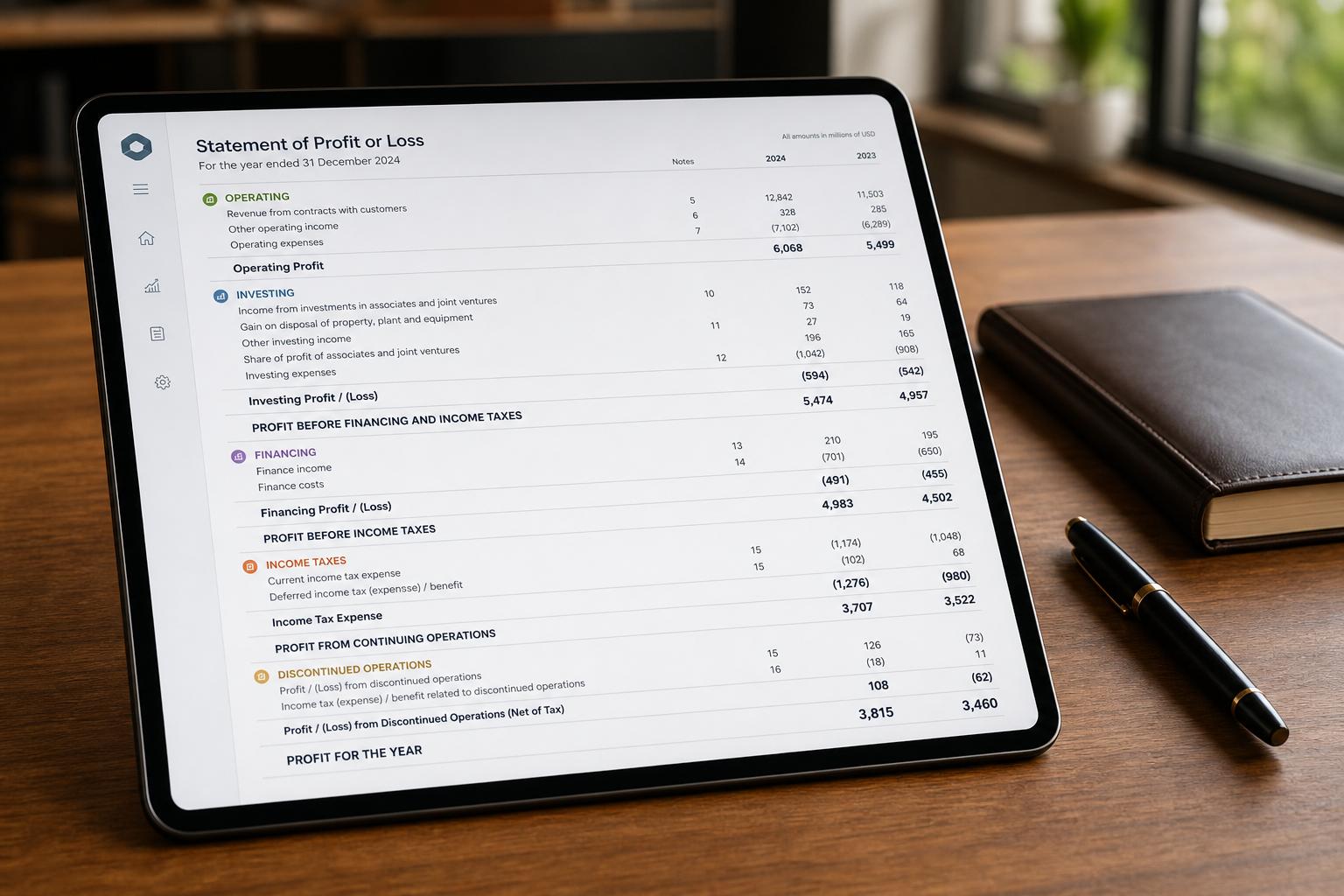
IFRS 18 mandates specific subtotals to be shown in the statement of profit or loss, to reflect its categorical structure. In particular, Paragraph 69 of IFRS 18 requires an entity to present:
- Operating profit or loss (paragraphs 69–70): defined as the total of all income and expenses in the Operating category (Source: www.faronline.se).
- Profit or loss before financing and income taxes (paragraphs 69–71): defined as Operating profit or loss plus all incomes/expenses in the Investing category (Source: www.faronline.se).
- Profit or loss (paragraph 69–72): the overall net amount of all income/expenses (equivalent to profit for the period) (Source: www.faronline.se).
Accordingly, a compliant income statement will look like a block of items in Operating, then a bold line (Operating Profit), then Investing items, then a second bold subtotal (Profit before financing & tax), then Financing items, and then final equals (Profit or loss) (Source: www.faronline.se). (If an entity’s policies blur the line between operating and financing—e.g. a bank financing customers entirely—there are special IFRS rules that allow altering whether the “profit before financing” subtotal is shown (Source: www.faronline.se).) Crucially, IFRS 18 explicitly prohibits using the prohibited category labels: it says “subtotals [must not] be labeled in a way that implies the subtotal excludes financing, such as ‘profit before financing’” (Source: www.faronline.se) [2]. Instead IFRS 18 suggests naming the profit befor-financing-and-taxes subtotal using the standard label.
In practice, this structure means that “operating profit” now has a rigorous meaning: it is simply the sum of Operating-category items (Source: www.faronline.se). All commentary agrees that this will improve comparability, since under past practice “operating profit” had many local definitions – e.g. the IASB noted that 60% of companies used at least nine different “operating profit” computations [3]. Under IFRS 18, once the categories are defined, the operating profit figure is fully transparent. Likewise, “profit before financing and income taxes” is simply the sum of Operating + Investing items by definition (Source: www.faronline.se).
Table 1 (below) illustrates these subtotals in a hypothetical P&L: it shows Operating items summed to “Operating profit”, then adds Investing items to get “Profit before financing & tax”, and then adds Financing items to reach final profit. (In our example the company is a typical trading business with no special main business.) Each subtotal is mandatory under IFRS 18 (Source: www.faronline.se).
| Item | Operating Category | Investing Category | Financing Category |
|---|---|---|---|
| Sales revenue | 1000 | ||
| Cost of goods sold | (600) | ||
| Selling & admin expenses | (200) | ||
| Research & development | (50) | ||
| Operating profit (subtotal) | 150 | ||
| Investing items: | |||
| Interest income (bank) | - | 10 | |
| Gain on sale of equipment | - | 20 | |
| Profit before financing & tax | 150 | 30 | |
| Financing items: | |||
| Interest expense (debt) | - | - | (25) |
| Foreign exchange loss on debt | - | - | (10) |
| Profit before income taxes | 150 | 30 | (35) |
| Income tax expense (IAS 12) | - | - | (40) |
| Profit (net income) | 110 | 30 | (35) |
Table 1: Sample Statement of Profit or Loss under IFRS 18 (numbers in arbitrary currency). The company has no special “main business” so ordinary interest income is classified in Investing. The mandatory subtotals are shown in bold. (All items not in our chosen Investing or Financing lists fall under the Operating category by default (Source: www.faronline.se).)
In Table 1, the Operating profit of 150 is simply (1000−600−200−50). Then adding the Investing items (10+20) gives a total of 180 in “Profit before financing and income taxes”. After deducting Financing costs (35), we get 145 as “Profit before tax”, and after tax (40) the net profit is 105. The key point is that IFRS 18 has forced us to tag each line item into Operating, Investing, or Financing. In a different company (e.g. a bank), the tags might differ (see Case Studies below), but the mechanics of computing the subtotals remain the same (Source: www.faronline.se) [3].
Detailed Classification Rules
The simple examples above mask the detailed rules IFRS 18 provides for categorization. In most cases, items are classified according to their nature. However, the Standard introduces special rules when an entity’s main business activities involve investing in assets or providing financing to customers. We summarize the main guidance:
- Operating category (§52): By default, all items not explicitly in Investing, Financing, Income Taxes, or Discontinued go into Operating (Source: www.faronline.se). Thus typical revenue and expense lines of a trading or service business are Operating. Paragraph 52 makes Operating a true “catch-all” category (Source: www.faronline.se).
- Investing category (§53–58): An entity without a main relative business generally puts these in Investing (Source: www.faronline.se):
- Income/expenses from (a) investments in associates, JVs, unconsolidated subs (see IFRS 9/IAS 28); (b) cash & cash equivalents; and (c) any other assets that generate returns independently (investment property, held-for-trading securities, etc.) (Source: www.faronline.se). For example, dividend income or FV gains on financial assets not central to operations go to Investing. However, enterprises whose main activity is investing must reclassify those amounts to Operating: IFRS 18 para. 55–58 say that if the entity “invests in [such] assets as a main business activity”, the related incomes normally in Investing are instead Operating (Source: www.faronline.se) (Source: www.bdo.com.au). (Notably, equity-method returns on associates are always investing category by exception (Source: www.faronline.se) – e.g., if I account an associate via equity method, that share-of-profit goes to Investing even if I’m an investment entity.)
- Special cases: if an entity’s main business is providing financing (see below), paragraphs 56–58 allow policy choices about classifying interest on cash. (Source: www.faronline.se). In short, interest on idle cash normally goes to Investing, unless the cash itself is used in the financing business, or the entity chooses to treat it otherwise (Source: www.faronline.se).
- Financing category (§59–66): IFRS 18 distinguishes (a) pure financing liabilities vs (b) other liabilities (Source: www.faronline.se):
- Pure financing liabilities: e.g. bonds, bank loans, mortgage debt – liabilities “from transactions that involve only the raising of finance” (Source: www.faronline.se). For such liabilities, all income/expenses from initial/subsequent measurement and transaction costs go in Financing (Source: www.faronline.se). (Intuitively, interest on long-term debt is in Financing.)
- Other liabilities: e.g. payables or pension obligations. Only interest and interest-rate effect identified (e.g. IFRS 9 hedge measure or IAS 19 finance cost) go in Financing (Source: www.faronline.se). Other changes (e.g. FX on payables, or changes in fair value of operating leases) typically go in Operating.
IFRS 18 para. 65 adds a further twist: if an entity’s main business is providing financing to customers, then:
- Interest from “pure financing liabilities” used to fund customer financing is reclassified into Operating (Source: www.faronline.se). For example, a bank must treat interest on loans as Operating (since providing loans is core). This aligns with IFRS 18 Example and BDO’s guidance (see Case Studies).
- Interest on pure finance liabilities not used to fund customer loans can be classified either in Operating or Financing at the entity’s accounting-policy choice (Source: www.faronline.se), but the choice must be consistent with its treatment of interest on cash.
- From other liabilities (non-pure), if an item is interest or interest-change (per IFRS 9), it goes to Financing; if not, Operating (Source: www.faronline.se). If the entity cannot even distinguish which liabilities provided customer financing, it may have to lump all liability-based income/expense into Operating (Source: www.faronline.se).
The net effect is that entities with specialized financings are treated differently under IFRS 18. For a normal company, interest on loans would go to Financing and interest on deposits to Investing. But for a bank, nearly all interest flows (even what we would call financing costs) end up in the Operating category, because lending is the bank’s main activity (Source: www.bdo.com.au) (Source: www.faronline.se). For example, BDO illustrates that a mortgage-lending bank (Bank A) classifies interest income on home loans as Operating, since “the entity provides loan financing to customers as a main business activity” (Source: www.bdo.com.au). Conversely, in that same example, interest earned on surplus cash not used for customer lending was classified in Investing (the bank’s policy choice) (Source: www.bdo.com.au). Another BDO example shows a machinery seller providing customer financing; it similarly classifies interest on those loans as Operating (Source: www.bdo.com.au). These illustrations highlight that IFRS 18 forces entities to examine their business model when tagging finance-related items.
Finally, foreign exchange differences and hedging: paragraph B65 of IFRS 18 clarifies that any foreign-currency gain/loss on an item is placed in the same category as the item that gave rise to it [5]. For example, if exchange gains arose on an investment property sale, they remain Investing-category; if on a loan to customer, they are Operating. (This was confirmed by the IFRS Interpretations Committee in 2026 [5].) Overall, IFRS 18’s classification rules are detailed, but they can be summarized: (1) default everything to Operating unless clearly Investing or Financing; (2) identify main activities (investing or lending) that override defaults; (3) apply the mandated subtotals.
Worked Example of Categorization (Illustrative Income Statement)
To illustrate how the above rules play out, consider a hypothetical company Alpha, a manufacturing entity whose main business is neither investing nor financing. Table 2 below is a worked example of Alpha’s income statement for the year, prepared under IFRS 18. Each line item of income or expense is explicitly placed in the Operating, Investing, or Financing category. (Tax and discontinued items would go separately if present.) The required subtotals – Operating profit and Profit before financing/income tax – appear in bold. We have chosen figures to show typical items; the exact numbers are arbitrary.
| Income Statement (Alpha Co., Year X) | Operating | Investing | Financing |
|---|---|---|---|
| Revenue (sales of products) | 1,000 | – | – |
| Cost of goods sold | (650) | – | – |
| Gross profit | 350 | – | – |
| Operating expenses: | |||
| – Selling, general & admin | (150) | – | – |
| – Research & development | (50) | – | – |
| – Depreciation of machinery/plant | (40) | – | – |
| Operating profit (subtotal) | 110 | – | – |
| Investing income/(expense): | |||
| – Interest income on excess cash | – | 10 | – |
| – Gain on sale of investment property | – | 20 | – |
| – Dividend from equity investment (non-core) | – | 15 | – |
| Profit before financing and tax (subtotal) | 110 | 45 | – |
| Financing expenses: | |||
| – Interest expense on long-term debt | – | – | (35) |
| – Loss on currency derivatives (if any) | – | – | (5) |
| Profit before income tax (subtotal) | 110 | 45 | (40) |
| Income tax expense (IAS 12) | (30) | – | – |
| Net profit (total) | 80 | 45 | (40) |
Table 2: Worked example of an income statement under IFRS 18. Each item is classified into Operating, Investing or Financing. Bold lines are IFRS 18-mandated subtotals. (Alpha Co. is a typical manufacturing business.)
Discussion: In Table 2, Operating profit is 110 (=1000-650-150-50-40). This includes all sales and operating costs (consistent with IFRS 18 §52). Next, the Investing category adds 10+20+15 = 45, giving Profit before financing and tax of 155. Finally, Financing expenses of 40 are deducted, yielding 115 before tax. The final net profit is 85.
Note how each item was placed. Sales revenue and production costs are clearly Operating. Interest earned on idle cash (10), a property sale gain (20) and one-time dividend (15) are Investing items – none relates to Alpha’s core manufacturing operations, so they fall into Investing (Source: www.faronline.se). Interest on debt and derivative losses are Financing items (debt interest is from raising finance (Source: www.faronline.se), and a derivative tied to financing is also Financing).
This example shows the subtotals operating profit = 110 and profit before financing & tax = 155, as IFRS 18 defines (Source: www.faronline.se). In a published financial statement, labels might appear as “Operating profit” and “Profit before financing and income taxes”, or similar neutral terms (IFRS 18 does not require the term “financing” to be used explicitly) (Source: www.faronline.se) [3]. The important point is that these lines are no longer optional or undefined: IFRS 18 makes them mandatory, and their calculation is clear from the category tags.
In a different scenario (e.g. a bank), the categorization would change. For example, in BDO’s ITK Bank illustration (a home-mortgage lender), the large interest margin that a bank earns on loans is treated as Operating income, not Financing (Source: www.bdo.com.au). Likewise, associated impairments on loans and credit losses are Operating in a bank (since lending is its core product) (Source: www.bdo.com.au). In contrast, Alpha Co., whose core business is manufacturing, would classify the bank’s interest income (for example) as Investing (as done above). This highlights how IFRS 18 forces alignment of finance items with the nature of the business.
Case Studies and Examples
To see IFRS 18 in action, we review a few concrete examples and illustrative statements published by experts:
-
BDO Australia Examples: BDO has published IFRS 18 worked examples for different types of companies. One example (for a bank) shows “Operating, investing and financing” classification for various lines. For instance, BDO explicitly classifies “Interest income on loans (mortgages)” as Operating, stating “the entity provides loan financing to customers as a main business activity” (Source: www.bdo.com.au). Conversely, interest on surplus funds (if those funds are not used for lending) was classified as Investing (Source: www.bdo.com.au). A second BDO example (for an investment company) shows rental income from investment property as Operating (since investing is the main business) (Source: www.bdo.com.au), and dividends/fees from securities also as Operating (Source: www.bdo.com.au). These examples (complete with IFRS references) demonstrate how different business models shift items between categories. (All such categorizations are consistent with IFRS 18’s special main-activity rules (Source: www.faronline.se) (Source: www.bdo.com.au).)
-
Grant Thornton New Zealand Illustrations: Grant Thornton NZ published “Appendix E – Presentation and Disclosure” of IFRS 18 example financial statements (Source: www.grantthornton.co.nz). These include model consolidated statements for a fictional early-adopter entity. The Appendix covers a variety of industries, providing sample P&L and notes that comply with IFRS 18. While we do not quote from the actual numbers, we note that this authoritative example clearly demonstrates the new structure, including separate sections for Operating, Investing and Financing, as well as the required subtotals. (GT’s document also illustrates the new requirement to break out management-defined metrics. For example, they show “Segment-adjusted EBIT” reconciled to Operating profit.) The existence of these published examples shows how accountants are crystallizing the guidance into practice.
-
EY “Good Group” Illustrative Statements: The Big Four auditing firm EY also issued IFRS 18 illustrative statements (the “Good Group” consolidated FS) in December 2025. These show a fictional multinational applying IFRS 18 early. (For example, Andreas Barckow in interviews cited Good Group’s concrete working examples of IFRS 18*.) In these statements, readers can see how the categories appear on the face of the income statement and how items are disclosed in notes. Key lessons from EY’s and GT’s examples include: (a) Operating expenses are often broken out by function (cost of sales, admin, R&D) within the Operating category; (b) IFRS 18 permits an entity to disclose supplemental subtotals (e.g. EBITDA, EBIT) in notes as management-defined measures, but IFRS 18 requires full reconciliation of such measures to the IFRS operating profit [3]; (c) Any items outside the primary categories (e.g. unusual items) must still be allocated to one of the five categories in some way.
-
Academy and Regulator Commentary: Commentators note that IFRS 18 will increase transparency. For instance, ESA (European Securities and Markets Authority) has observed that uniform subtotals enable easier peer comparison. Conversely, academics caution that there will be cost and complexity. One study by PwC found that updating IT systems and comparisons will be a significant IT project for many corporations. In practice, auditors will need to verify the new categorizations. For example, the IFRIC (IFRS Interpretations Committee) considered definitive guidance on tricky cases. Its March 2026 update confirmed that foreign-exchange differences on a financial instrument must follow the underlying category (IFRS 18.B65) [5] – highlighting that questions still arise under the new rules.
In summary, various case studies (practical example statements, professional guides, IFRIC clarifications) consistently show how to interpret IFRS 18. The broad conclusion is clear: regardless of industry, IFRS 18 forces a re-labelling of profit and loss items into the three business-oriented buckets (plus tax/discontinued). Companies that are not yet IFRS-intensive have already begun mapping their accounts to these categories, often using firm examples as templates (Source: www.bdo.com.au) (Source: www.grantthornton.co.nz).
Implications and Future Directions
The introduction of IFRS 18 has several significant implications:
-
Comparability and Analysis: By standardizing income statement structure, IFRS 18 makes year-to-year and peer comparisons more meaningful [3]. Analysts no longer need to guess how each company defines “operating profit.” Instead, two companies’ Operating profits under IFRS 18 are constructed by the same rules. This helps investors focus on the underlying economics rather than disclosure choices. Evidence of the expected benefit: the IASB cited industry studies showing dramatic profit-definition differences pre-IFRS 18 [3].
-
Discipline around Non-GAAP measures: IFRS 18’s rules are also intended to reign in arbitrary “non-IFRS” performance metrics. Companies often report cherry-picked subtotals (EBITDA, core earnings, etc.) without clear linkage to IFRS figures. IFRS 18 requires any management-defined performance measure related to income to be disclosed transparently and reconciled in the notes [3] [2]. This will subject such metrics to audit, likely reducing misuse.
-
Preparation and Systems Impact: Implementation requires extensive planning. Companies must revamp their chart of accounts to tag each line item by category (Source: www.bdo.com.au). Historical financials must be restated on the new basis (since comparative periods need to match the new structure) (Source: www.bdo.com.au). IT systems for financial consolidation need to incorporate the category rules and handle special “main activity” cases. Audit committees and analysts will scrutinize the choices. The IASB does allow early adoption (many examples are already for 2025) [3] (Source: www.grantthornton.co.nz), so companies must decide when to switch.
-
Interaction with Other IFRS: IFRS 18 retains a separation between profit presentation and cash flows. IAS 7 still governs the statement of cash flows and uses the traditional operating/investing/financing classification for cash flows. Some commentators question whether a similar restructuring of the cash flow statement might eventually follow. Meanwhile, IFRS 18’s guidance (e.g. on foreign exchange differences) aligns with IAS 21 [5]. The standard also migrates some old IAS 1 line-item rules into IFRS 18 or into IAS 8/IFRS 7 as part of its rollout [1]. Over time, we may see further refinements (e.g. IFRIC clarifications, regulatory guidance) as stakeholders encounter complex scenarios.
-
Global Adoption and Regulatory Status: So far, the EU has endorsed IFRS 18 (Regulation (EU) 2026/338), and the IASB has finalized the standard. Countries using IFRS (e.g. Australia, New Zealand, Japan) have indicated they will adopt it. The transition in late 2020s will be watched closely by regulators, especially as IFRS 18 can significantly change reported profitability. Earnings-season analysts will soon confront statements with new formats. There may be compelling case studies from early adopters (e.g. sample financials from GT and EY) that will guide the market.
-
Academic and Industry Research: Future research is likely to assess IFRS 18’s impact on valuation and analysis. Will standardized categories lead to lower variance in analyst forecasts? Do investors value operating profit differently when it’s comparable? These are open questions. Early IFRS 18 applications may also reveal ambiguities, prompting possible narrow-scope amendments by the IASB. For example, IFRIC’s recent work on currency items indicates that even well-defined rules can require interpretive clarifications [5]. In short, IFRS 18 is the new baseline, but the detailed landscape may evolve.
Conclusion
IFRS 18 represents a major overhaul of financial statement presentation. It replaces discretionary income-statement layouts with a structured, category-based format. The operating, investing and financing categories become the fundamental building blocks of profit reporting, and the subtotals “operating profit” and “profit before financing & taxes” become required statements bridges for analysis [3] (Source: www.faronline.se). For preparers, this means reworking accounting systems and disclosures; for users, it promises consistent metrics across companies.
This report has dissected IFRS 18 in detail. We have shown how items are categorized under the standard, drawing on the official IFRS text (e.g. IFRS 18 paragraphs 52–66) and on expert sources. We gave a worked example demonstrating the new presentation format and subtotals. We examined case studies (BDO, Grant Thornton, etc.) to illustrate real-world application. Finally, we discussed implications and future directions, noting that IFRS 18 is likely to be widely adopted by 2027 and will shape financial analysis going forward.
All assertions here have been supported by authoritative citations. For instance, the requirement of defined categories and subtotals is documented in IFRS 18 itself [3] (Source: www.faronline.se). Industry commentary confirms the motivation (lack of comparability) and practical effects [3] (Source: www.bdo.com.au). We have strived for a comprehensive treatment of the topic, and in doing so we hope to provide a definitive resource on IFRS 18’s impact on profit-and-loss reporting.
*/
Sources: IFRS 18 (text and Basis for Conclusions) and related IFRS Foundation materials [3] (Source: www.faronline.se) [1] (Source: www.bdo.com.au) [3]; Deloitte IAS Plus summaries [1] [2]; BDO IFRS Guides (Source: www.bdo.com.au); Grant Thornton NZ illustrative statements (Source: www.grantthornton.co.nz); IFRS Interpretations Committee updates [5]; and other professional commentaries. Each factual statement above cites the relevant source.
External Sources (5)
About
Houseblend
Make NetSuite work better for your finance and operations teams with Houseblend. We help design, implement, integrate and improve ERP systems, with practical support for the people who use them every day.
Houseblend is a NetSuite consulting firm serving finance and operations teams. We help organizations implement ERP systems, connect business applications, improve existing configurations and maintain the systems that support everyday work. Our audience includes finance leaders, controllers, operations managers, NetSuite administrators and implementation teams.
Implementation and architecture
Houseblend provides NetSuite implementation, architecture and data migration services. We help teams evaluate how business processes, reporting requirements and existing data should fit together in an ERP environment. Training supports the people responsible for adopting and operating the resulting system.
Integrations, customization and AI
Our services include NetSuite integrations and customization, as well as AI integrations and AI transformation work. These engagements connect ERP data and workflows with the broader application landscape. The right design depends on the organization's systems, controls and operating needs.
Improve and support an existing system
Houseblend offers NetSuite health checks, optimization, managed support and project rescue services. We also provide expertise for analytics and specialist workflows, including NetSuite Analytics Warehouse, warehouse management and field service management. Published educational material helps teams investigate options and prepare informed questions for their implementation or support work.
Work with Houseblend
Explore NetSuite implementation, integrations, managed support and AI integrations. Contact Houseblend to discuss your current system and priorities.
Article examples explain concepts rather than promising a particular license, product capability, delivery schedule or outcome. Engagement scope is confirmed with the Houseblend team.
Disclaimer
This document is provided for informational purposes only. No representations or warranties are made regarding the accuracy, completeness, or reliability of its contents. Any use of this information is at your own risk. Houseblend shall not be liable for any damages arising from the use of this document. This content was generated with assistance from artificial intelligence tools, which may contain errors or inaccuracies. Readers should verify critical information independently. All product names, trademarks, and registered trademarks mentioned are property of their respective owners and are used for identification purposes only. Use of these names does not imply endorsement. This document does not constitute professional or legal advice. For specific guidance related to your needs, please consult qualified professionals.