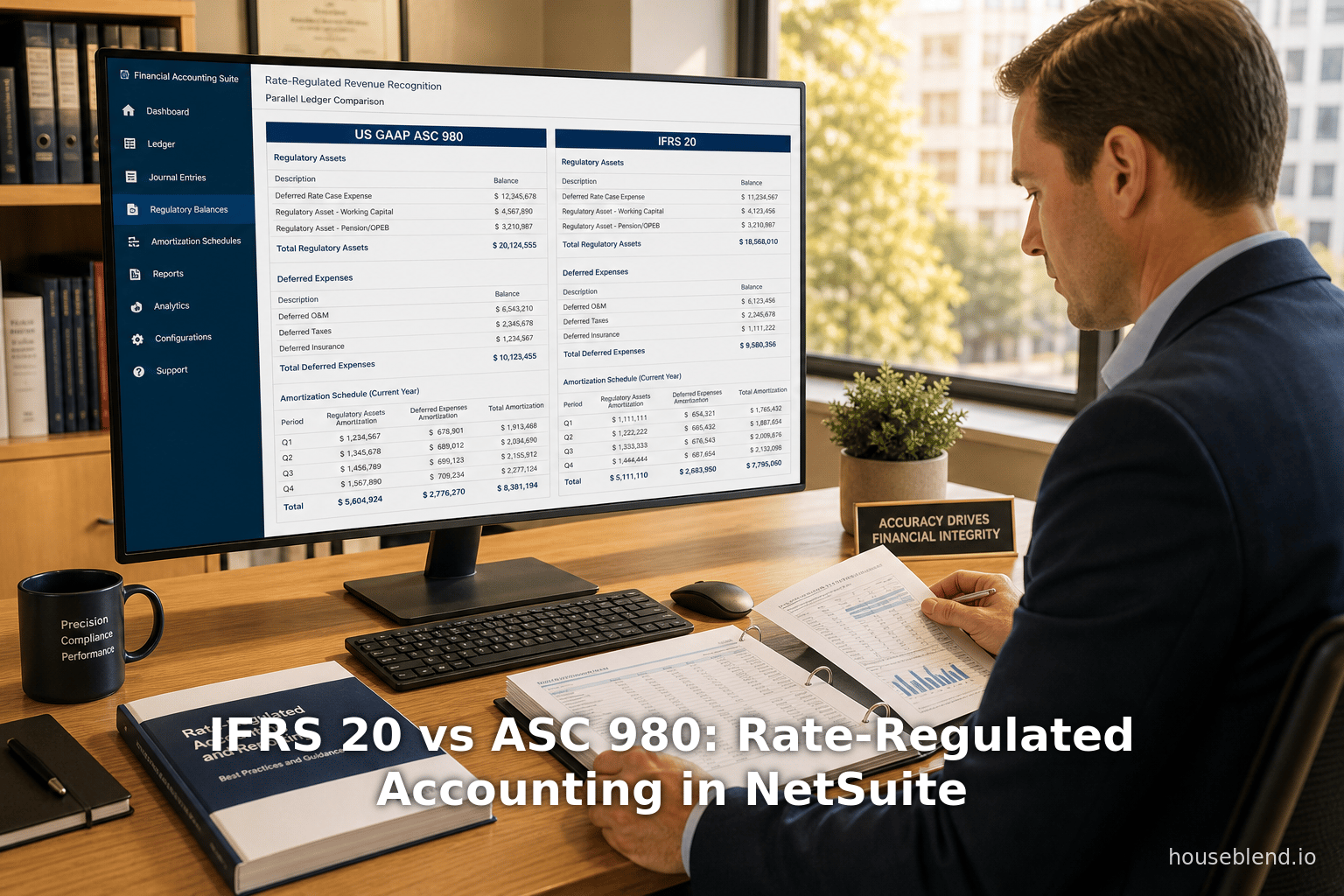
Houseblend Article
IFRS 20 vs ASC 980: Rate-Regulated Accounting in NetSuite
Inside this article
Executive Summary
Rate-regulated accounting has long been a divergence point between IFRS and U.S. GAAP. Under U.S. GAAP ASC 980 (Regulated Operations), regulated utilities routinely recognize regulatory assets and regulatory liabilities when cost-recovery through future rates is deemed probable [1]. By contrast, historic IFRS contained no explicit model for such deferrals (apart from the optional interim IFRS 14 for first-time adopters [2]). In May 2026, the IASB released IFRS 20: Regulatory Assets and Regulatory Liabilities to fill this gap, effective for annual periods beginning January 1, 2029 [3]. IFRS 20 requires entities with rate-regulated activities (e.g. utilities, transport, energy) to recognize enforceable rights to recover past costs (regulatory assets) or obligations to refund excess revenues (regulatory liabilities) on the balance sheet, with corresponding regulatory income or expense in profit or loss [4] [5]. This “overlay” model aligns IFRS revenue with the total allowed compensation set by regulators [6] [7].
For companies using Oracle NetSuite, implementing IFRS 20 entails configuring new ledger accounts and using the platform’s OneWorld Multi-Book functionality. A single transaction can post into parallel books (e.g. U.S. GAAP and IFRS) using different chart-of-account mappings [8] [9]. For example, an invoice for regulated costs might debit “Engineering Expense” and credit “Accounts Payable” in the U.S. GAAP book, while the IFRS book simultaneously credits a “Regulatory Deferral Asset” account under Other Assets [10]. NetSuite’s Deferred Expense and Deferred Revenue features can then amortize these regulatory balances into expense or income over time according to the regulatory-approved schedule [11] [12]. Multi-book reporting ensures that the IFRS-compliant figures (with regulatory deferrals) can be produced side-by-side with legacy GAAP figures [13] [9].
In summary, IFRS 20 represents a landmark IFRS standard that converges with long-standing U.S. GAAP practice in regulated industries. Its adoption will significantly affect regulated businesses’ financial reporting (smoothing earnings volatility and increasing balance-sheet assets/liabilities) [14] [15]. Companies will need to adjust their accounting systems (such as NetSuite OneWorld to capture regulatory deferrals correctly in each book. For investors and analysts, IFRS 20 promises more transparent alignment between recognized revenue and the compensation signal determined by regulators, improving comparability across jurisdictions [6] [16].
Introduction and Background
“Rate regulation” is a legal framework in which a regulator (often a government agency) controls the prices or tariffs that certain businesses (typically utilities, energy providers, or transportation networks) can charge customers [16] [1]. Under cost-of-service regulation, companies incur costs or earn revenues in one period but may only bill customers for those costs in different periods. For example, a power company might spend on maintenance or capital projects now but recover the cost through higher rates only in future years. Alternatively, any excess revenues collected above the allowed amount are often credited back to customers via subsequent rate adjustments [16]. These regulatory mechanisms create timing differences between cash flows and IFRS-recognized revenue: IFRS-compliant accounts alone may show a loss while cash will be recovered later (or vice versa). As the IASB notes, under existing IFRS this means “the revenue reported by a company for a period…and the assets and liabilities reported…do not give a complete picture of the compensation that the rate regulation entitles the company to charge” [16].
Under U.S. GAAP, these regulatory effects have long been codified. ASC 980 (Regulated Operations) explicitly permits (and in practice requires) utilities to defer costs as regulatory assets when future recovery through rates is probable [1]. For example, a recent SEC disclosure by a large pipeline operator states: “ASC 980 provides that certain costs that would otherwise be charged to expense should be deferred as regulatory assets… based on the expected recovery from customers in future rates. Likewise, certain…credits…should be deferred as regulatory liabilities” [1]. It is common for major U.S. utilities to carry multibillion-dollar regulatory asset and liability balances for items like fuel surcharges, construction work-in-progress, or unbilled revenue [15]. In contrast, IFRS historically lacked a comparable model. Before 2026, IFRS companies simply recognized revenue and expenses as incurred under IAS 1/15, ignoring any regulatory recovery structure – unless they used the optional IFRS 14 (if first-time IFRS adopters) to grandfather in legacy GAAP deferrals [2].
IFRS 14, issued in 2014, was an interim relief standard permitting only first-time IFRS adopters to continue recognizing pre-existing “regulatory deferral account balances” under their old GAAP [2].It required separate presentation of such balances in the financial statements but made no substantive changes to measurement beyond previous practices [2]. IFRS 14 was never mandatory and explicitly did not apply to entities already reporting under IFRS. It was intended only as a stop-gap until a comprehensive model could be developed [2]. The IASB’s comprehensive project culminated in the new IFRS 20 standard, officially issued in May 2026, which replaces IFRS 14 and finally provides uniform IFRS guidance on rate-regulated activities [3].
Scope and Key Definitions
IFRS 20 applies to any entity “subject to a regulatory agreement” that prescribes how rates are set for goods or services supplied in a period [17] [18]. In practice, this means industries like electricity, gas, water, transportation, and telecom, where regulators approve tariffs based on cost-recovery models [17] [18]. Unlike IFRS 14, which was optional, IFRS 20 is mandatory for all in-scope entities (though early adoption is permitted) [3] [19]. The standard explicitly excludes regulated insurance contract premiums (handled under IFRS 17) [20].
Under IFRS 20, a regulatory asset is defined as an enforceable present right to add an amount to future regulated rates [4]. In other words, if a regulator has permitted (or will permit) a company to recover past costs through higher future rates, that right qualifies as a regulatory asset. Conversely, a regulatory liability is an enforceable present obligation to deduct an amount from future rates (e.g. when excess charges must be returned to customers) [4]. These rights and obligations arise from formal regulatory decisions or the framework of the regulation itself – for example, a regulator’s order allowing recovery of capital expenditures over time or requiring refunds for over-collections. IFRS 20 requires a clear link between the regulatory balances and the underlying costs or assets (for instance, specific power plants or fuel costs) [4].
Recognition under IFRS 20
At each reporting date, an entity must recognize all existing regulatory assets and liabilities on its balance sheet, subject to certain tests [21]. The recognition criterion is essentially “more likely than not” to exist – that is, if it is probable that the right/obligation will be reflected in future rates, it is recognized [22]. Importantly, IFRS 20 uses an “overlay” approach: companies first apply normal IFRS (e.g. recognize revenue under IFRS 15 for goods delivered in the period), and then adjust for any difference between that revenue and the total allowed compensation under the regulation [6] [7]. The difference is bifurcated into (a) regulatory income or expense in P&L and (b) a change in the regulatory asset/liability balances on the BS. For example, if actual IFRS revenue lags the regulator-allowed amount, the shortfall creates a regulatory asset and a corresponding regulatory income (without altering IFRS15 revenue).
Along with recognizing existing regulatory balances, IFRS 20 also requires recognizing all regulatory income and expense that arises during the period (net of any adjustments) [22]. Unlike U.S. GAAP ASC 980 — which focuses on deferring costs or credits that “would otherwise be expensed” if recovery is probable [1] — IFRS 20’s enforceable-right model tends to capture all timing differences dictated by the regulation. In practice, this means long-term deferred costs (e.g. cost recovery from past capital projects) and short-term differences (fuel costs, demand variances, etc.) are systematically recognized if they meet the criteria. By contrast, ASC 980 generally required judgment on which specific costs to defer, often leading to variation, whereas IFRS 20’s broad recognition rule aims for consistency.
Measurement of Regulatory Balances
IFRS 20 requires a cash-flow based measurement of regulatory assets and liabilities. At initial recognition, an entity estimates all future cash flows associated with recovering (or satisfying) the regulatory balance and discounts them using the regulatory interest rate specified by the regulation [23]. In other words, regulatory assets are measured much like financial assets: present value of the future incremental revenues (plus any related interest income), and regulatory liabilities as present value of future refunds (plus interest expense). After initial recognition, entities update the cash flow estimates each period but continue using the original discount rate unless the regulation itself changes that rate [23]. (A practical simplification is allowed if an item only affects rates on actual cash settlement; in that case, the regulatory balance is measured at the carrying amount of the related asset or liability and adjusted for credit/demand risk.)
This contrasts with ASC 980, where no formal discounting approach is stipulated: regulators often set rates that include an embedded allowed return, and US companies typically record deferrals on a nominal basis (then recover them through the ratemaking formulas). Under ASC 980, a regulated utility might simply carry the actual cost incurred (plus allowable return) as a regulatory asset, without the present-value computation that IFRS 20 mandates. Thus, IFRS 20 introduces a level of present-value modeling not previously required under either IFRS or US GAAP. (In fact, the Williams Companies’ financials demonstrate the difference: they “measure changes in the [regulatory] liability due to passage of time by applying an interest rate to the liability balance” and increase regulatory assets accordingly [24].)
Presentation and Disclosure
IFRS 20 requires separate presentation of regulatory accounts and results. On the balance sheet, regulatory assets and liabilities must be shown as separate line items – split between current and non-current as appropriate – and not netted or commingled with trade receivables/payables [25]. In the statement of profit or loss, regulatory income and regulatory expense are presented alongside the entity’s ordinary revenue (e.g. IFRS 15 revenue) as distinct line items [26]. For example, IFRS 20’s Illustrative Examples show regulatory income listed just below IFRS 15 revenue, making the total allowed compensation clearly visible to users. (If any related amounts bypass profit or loss under other IFRSs, the matching regulatory amount also goes to OCI.)
Extensive disclosures are mandated. Entities must reconcile opening and closing balances of regulatory assets and liabilities, showing how regulatory income/expense and other factors (e.g. interest) caused movements [27]. A maturity analysis is required, giving quantitative timing bands of when recovery or refund will occur [28]. Firms must explain any unrecognized regulatory assets/liabilities and why they failed the recognition criteria. Additionally, IFRS 20 requires disclosure of the regulatory capital base (RCB) and how it relates to the reported balances: entities must describe whether the link between RCB and related items is “direct” or not, and why, plus any changes in that relationship [27]. Overall, the disclosure regime under IFRS 20 is far more detailed than ASC 980’s, reflecting IFRS’s principles-based approach and the newness of the standard.
Transition
For entities moving to IFRS, the IASB allows two transition approaches for IFRS 20. Either (a) full retrospective application (restating prior periods as if IFRS 20 had always been used, under IAS 8), or (b) a modified retrospective method with limited reliefs. The modified approach permits, for example, the use of hindsight at the transition date (i.e. apply current knowledge of the regulation backwards) and other practical expedients [29]. Whoever applies IFRS 20 (whether a first-time adopter or a continuing IFRS user) must present one year of adjusted comparatives. In all cases, IFRS 20 replaces IFRS 14 and supersedes it going forward [3] [29].
IFRS 20 vs. US GAAP (ASC 980): Key Differences
The new IFRS 20 framework bridges many gaps with U.S. GAAP but retains some distinctions in emphasis. The table below summarizes major points of comparison.
| Aspect | IFRS 20 (Regulatory Assets/Liabilities) | U.S. GAAP (ASC 980, Regulated Operations) |
|---|---|---|
| Scope | Mandatory for any entity with regulated pricing showing timing differences [19]. Industries like utilities, energy, transportation are typical. Not industry-limited and not optional. | Applies to all cost-based regulatory utilities and similar enterprises. (Where adopted, it allows deferrals in those industries.) Optional? (Implicitly required if present.) |
| Recognition Criterion | Enforceable present right/obligation under regulation, with regulatory impact “more likely than not” [22]. Relies on legal/regulatory orders. | Probable future recovery/refund via rates [1]. Essentially defers costs that “would otherwise be expensed” if recovery is probable in future tariffs [1]. |
| Measurement | Cash-flow model: initial measurement = PV of all future regulatory cash flows, discounted at regulatory interest rate [23]. Subsequent measurement updates flows, fixes discount (unless regulator changes it). | Generally measured on a nominal cost/recovery basis. Regulatory assets are carried largely at incurred cost (plus allowed return); no formal PV discounting. |
| Financial Statement Presentation | Regulatory assets/liabilities presented as separate line items (current/non-current). Regulatory income/expense shown as distinct P&L lines alongside IFRS 15 revenue [26]. Emphasis on transparency. | No specific line-item requirement in US GAAP; regulatory balances typically embedded in overall revenue/cost structure. Companies must disclose regulatory balances (e.g. in footnotes) but they often net within rate base. |
| Disclosure | Extensive: reconciliations of RA/RL, maturity analysis, unrecognized balances, description of RCB link, etc. [27]. Aligns IFRS with regulatory framework. | Required disclosures of regulatory assets/liabilities exist but are generally less prescriptive. (For example, utilities disclose amounts and recovery expectations, but rules are fewer.) |
| Basis of Accounting | Overlay approach: First apply other IFRS (e.g. IFRS 15) normally; then adjust via regulatory items to align with allowed rates [6]. Regulatory balances are “outside” normal asset definitions until recognized. | Integrated: ASC 980 was part of rate-base accounting under GAAP. Deferrals flow through net income as part of rate-regulated income. No separate “overlay” layer explicitly defined. |
| Effective Date / Transition | Issued May 2026, effective Jan 1, 2029 (early adoption allowed) [3]. Replaces interim IFRS 14 [3]. Transition under IAS 8 (full or modified retrospective) with comparative restatement. | ASC 980 has been effective since the 1970s for regulated industries with rare amendments. No new effective date; companies have long followed (and should continue to follow) existing guidance. |
| Terminology | Uses terms regulatory asset/liability, regulatory income/expense. Emphasizes concept of enforceable rights. | Often uses term regulatory deferral balances (assets/liabilities) in practice. ASC 980 never defined “regulatory asset”; it permitted certain deferrals as part of rate-base accounting. |
Notable differences: IFRS 20 formally accounts for rate-regulatory effects, whereas ASC 980 long allows them. IFRS 20’s sharper criteria (enforceability, direct link, PV measurement) can sometimes be more stringent than ASC 980’s “probable” threshold. However, their economic outcomes often converge. For instance, both models ultimately aim to align recognized compensation with regulator-approved pricing, and both allow companies to amortize deferrals into income over time [6] [1]. An IFRS 20 implementation will generally bring IFRS statements closer to what U.S. utilities or Canadian utilities (often on GAAP) already report.
IFRS 20 in Practice (NetSuite Multi-Book Implementation)
Implementing IFRS 20 involves changes to accounting systems and processes. Companies using Oracle NetSuite (OneWorld edition) can leverage its Multi-Book Accounting feature to handle IFRS-vs-GAAP differences in parallel. Multi-Book allows multiple accounting ledgers to be maintained from the same source transactions [9]. For example, a company whose primary books are in local GAAP or US GAAP can add a separate IFRS book so that each transaction posts dual entries according to predefined rules [9] [8].
Chart-of-Accounts Configuration: To capture regulatory balances, new G/L accounts must be created. A common setup is to add Other Asset accounts for regulatory deferrals (sometimes called “Regulatory Deferral Asset” or “Regulatory A/R”) and Other Liability accounts for pre-collected credits (“Regulatory Deferral Liability”) [30] [31]. These accounts reside in the IFRS book’s chart of accounts and typically map to nothing in the local GAAP book (so that only the IFRS book carries the balances) [10]. For instance, when booking a vendor invoice (cost) for a regulated project, NetSuite’s Global Account Mapping can route part of the cost into the IFRS-deferral asset accounts while leaving the GAAP entry unchanged [10]. This ensures that regulatory deferrals appear only in the IFRS ledger.
Deferral Mechanisms: NetSuite’s built-in deferred accounting modules can automate the amortization of regulatory balances. A Deferred Expense schedule can be created for each regulatory asset account, specifying the timing of future expense recognition (i.e. when rates will incorporate the recovery). For example, when capitalizing $X of cost to the Regulatory Asset account, the deferred expense functionality will generate periodic journal entries that move $X from the asset into a Regulatory Expense account over the prescribed time schedule [11]. Similarly, a Deferred Revenue schedule (in NetSuite’s revenue deferral register) can handle regulatory liabilities (customer credits to be refunded), amortizing those into a Regulatory Income account [11]. By configuring the deferral schedules to match the regulator’s approved flow of cost recovery or refund, the system ensures compliance with IFRS 20’s timing requirements without manual journals each period [11] [32].
Multi-Book Posting: With OneWorld Multi-Book, one transaction can post to both the primary and IFRS books simultaneously [8]. For example, a $1,000 invoice for a regulated cost might post as follows:
- GAAP Book: Debit Engineering Expense $1,000; Credit Accounts Payable $1,000 (no deferral).
- IFRS Book: Debit Engineering Expense $500 and Debit Regulatory Deferral Asset $500; Credit Accounts Payable $1,000.
Here the IFRS book immediately defers half the cost ($500) as a regulatory asset (per IFRS 20 rights) while the GAAP book records it fully as expense. NetSuite’s mapping layers enable this differential posting. As the regulatory asset amortizes, the IFRS book will post movements into Regulatory Expense and eventually reverse the deferral. Crucially, all postings originate from the same transaction in NetSuite and are done in real time, “eliminating manual reconciliation,” as one NetSuite partner notes [13].
Controls and Reporting: In practice, companies should flag or tag rate-regulated transactions so they automatically hit the correct accounts. Houseblend suggests using NetSuite custom fields or classes (e.g. a checkbox for “Regulated Project”) so that when such a transaction occurs, NetSuite routes it to the regulatory accounts [12]. Dedicated reports (e.g. a saved search on the Regulatory Asset account) can then track the ageing and balances of regulatory deferrals over time. Standard NetSuite financial statements will reflect the new accounts (typically on the “Other Assets” and “Other Liabilities” lines), making compliance with IFRS 20 presentation straightforward [33] [34]. Multi-Book also allows generating a consolidated IFRS balance sheet and P&L in parallel with legacy GAAP reports, facilitating comparative analysis.
The example table below illustrates one possible chart-of-accounts design in NetSuite (IFRS book only). Each “Regulatory” account is mapped to no account in the GAAP book, ensuring full segregation of IFRS regulatory balances:
| Account Name | Type (IFRS Book) | IFRS Purpose | Mapping (Local GAAP Book) |
|---|---|---|---|
| Regulatory Deferral Asset | Other Non-Current Asset | Holds costs deferred for recovery under IFRS 20; amortized into regulatory expense over time [30]. | (Not used in local GAAP) |
| Regulatory Deferral Liability | Other Non-Current Liability | Holds customer credits/over-collections to be refunded; amortized into regulatory income [11]. | (Not used in local GAAP) |
| Regulatory Expense | Expense | Captures the portion of costs recognized in income due to regulatory timing (separate line in IFRS P&L [35]). | Mapped to normal expense or left blank |
| Regulatory Income | Income | Captures the portion of income (e.g. rate adjustments, returns) recognized due to regulatory timing [35]. | Mapped to revenue or blank |
Figure: Illustrative NetSuite account setup for IFRS 20 (IFRS book). Regulatory deferral accounts are omitted from the GAAP book mappings [30] [11].
Data Analysis and Case Insights
Quantitative data on regulatory deferrals illustrate the magnitude of this issue. A review of utility SEC filings shows that regulated entities often carry billions in regulatory assets/liabilities. For example, Williams Companies (U.S. pipeline operator) reported regulatory asset balances for depreciation and environmental obligations, recouped via future rates [24]. Houseblend notes that large U.S. utilities “routinely report multibillion-dollar regulatory assets and liabilities” [15] – driven by items like fuel cost variances and ongoing construction-in-progress. Likewise, an SEC filing brimming with ASC 980 disclosures states that incurred costs “will be included in amounts allowable for recovery…if it is probable” under the regulator’s orders [36]. This highlights that, under GAAP, such deferrals are substantial and material to financial position.
IFRS 20’s proponents argue it provides better matching of costs and revenues. KPMG observes that IFRS 20 “aligns the total income recognized…with the total allowed compensation” by regulators [6]. In practice, this often smooths volatility in earnings. KPMG notes common scenarios: if IFRS revenue previously lagged the allowed amount, adopting IFRS 20 will increase net assets (via new regulatory assets) on transition [14]. Conversely, if short-term cost variances caused large swings, IFRS 20 will reduce that volatility by deferring the differences.
Illustrative Example: Consider the hypothetical case given by IFRS Buddy. In Year 1, a utility incurs inputs of CU120 but is only allowed to charge CU100 to customers (the regulator’s estimate). Under plain IFRS 15, the company would report a CU20 loss in Year 1 and a CU20 profit when the remaining CU20 is collected in Year 2 [7]. FIFRS 20 changes this: at Year 1-end the utility recognizes a CU50 regulatory asset (its enforceable right to collect CU50 in Year 2) and records regulatory income of CU20 to eliminate the loss [7] . In Year 2, when those CU50 are billed and received, the regulatory asset reverses and regulatory income of CU50 is recognized. The net effect is that each year’s P&L more accurately reflects the regulator-permitted compensation (CU100 per year), rather than inducing a volatility that mislead users [7] . This example (though simplified) shows the economic rationale: IFRS 20 makes financial statements mirror regulatory economics.
Another practical case is international. In Canada, Australia, and the UK—where IFRS is used by many utilities—reporting under pure IFRS 15 has historically obscured regulated transactions. Some Canadian utilities, for example, implemented fallback arrangements (continuing local GAAP deferral accounting outside IFRS) until IFRS 20 arrived [37]. With IFRS 20, those companies can embed regulatory deferrals in IFRS. KPMG calls IFRS 20 a “generational change” that “for the first time, many companies will recognise regulatory assets and/or liabilities under IFRS” [38]. In effect, IFRS 20 gives analysts more data on future cash rights and obligations that were previously only implicit.
Implications and Future Directions
The issuance of IFRS 20 has wide-ranging implications:
-
Global Comparability: IFRS 20 largely closes a major gap between IFRS and U.S. GAAP. Previously, investors had to adjust IFRS financials to understand a regulated entity’s economics. Under IFRS 20, IFRS-reported figures will more closely resemble GAAP-based reporting of regulated firms. This should improve comparability across companies and capital markets [6] [37].
-
Investor Transparency: Regulators and investors gain clearer insight into the sustainability of cash flows. IFRS 20’s disclosures (reconciliations, maturity, etc.) shed light on how future rates will adjust, aiding credit analysis. As the IASB Chair stated, IFRS 20 gives “more complete and transparent information about companies operating in…critical rate-regulated industries” [39].
-
Systems and Control Impact: Accounting teams in regulated industries must update ERP systems (e.g. NetSuite) and corporate policies. This involves not only GAAP books but now a parallel IFRS book. New controls (tagging regulated transactions, maintaining ratebase records) and integrated workflows (e.g. using SuiteAnalytics to track deferrals) will be needed [12] [32]. In NetSuite, leveraging Multi-Book and deferral schedules is critical; otherwise manual journals would be required each period. Companies may also need to coordinate closely with regulators to obtain the data (approved rates, inflows) necessary to measure and justify regulatory balances [40].
-
Earnings and Regulatory Responses: By aligning accounting with regulatory economics, IFRS 20 could influence rate design. Regulators might factor IFRS 20 into tariff rules (for example, explicitly allowing capitalized regulatory assets in the rate base). Conversely, in jurisdictions where tariffs lag costs, IFRS 20 will force early recognition of under-recoveries as liabilities, potentially spurring rate reviews. In effect, IFRS 20 makes deeply visible what was once opaque, which could lead to policy and investor pressure to keep allowed rates aligned with costs. Some regulators or companies may proactively negotiate how IFRS 20 interplay with regulatory frameworks to avoid mismatches.
-
Convergence and Standard-setting: IFRS 20 is a step toward convergence on this issue, but differences remain. For example, IFRS 20’s strict cash-flow measurement differs from ASC 980’s practice. Over time, one could anticipate FASB and IASB to study further alignment or at least clarify differences. However, given that U.S. has not adopted IFRS and IFRS adopters rarely revert to U.S. GAAP, the more immediate effect is global IFRS becoming more GAAP-like for utilities. Future research may track how IFRS 20 is applied in diverse regulatory regimes, and whether another interpretation or amendment is needed.
Conclusion
In conclusion, IFRS 20 introduces a comprehensive model for rate-regulated accounting under IFRS, comparable in purpose to U.S. GAAP’s ASC 980 but framed in the IFRS “asset/liability” paradigm. It requires recognition of regulatory assets and liabilities with matching regulatory income/expense, thereby closing a major gap in IFRS practice [37] [1]. For companies using integrated ERP systems like NetSuite, this means configuring parallel accounting books and deferral processes to meet both IFRS 20 and any remaining GAAP rules. The first-time implementation (for fiscal years ≥2029) will likely present challenges in mapping old balances into the new framework, but it also brings benefits: improved alignment of reported profit with eventual cash recovery and richer disclosures for stakeholders.
Analysts and auditors will need to pay close attention to the transition adjustments and new disclosures, ensuring that IFRS statements fully reflect the regulatory settlement history. Over the longer term, IFRS 20 promises greater global consistency in how utility-like companies report their finances. As KPMG observes, this “generational change” will be welcomed by many in regulated industries [38]. Ultimately, the new standard should promote transparency: investors will have a clearer long-term view of rate-base investments and recovery, while companies and regulators can better coordinate financial reporting with rate-setting processes.
Table 1: Key Differences between IFRS 20 and U.S. GAAP ASC 980 (Regulated Operations)
| Feature | IFRS 20 (Regulatory Assets/Liabilities) | US GAAP ASC 980 (Regulated Operations) |
|---|---|---|
| Scope | Mandatory for all entities under rate regulation (utilities, energy, transport, etc.) [18]. Early application allowed. | Applies to entities in regulated industries; has been in effect for decades where applicable. |
| Recognition | Enforceable present right/obligation to adjust future rates [4]; recognize all existing reg assets/liabilities if more likely than not that recovery/refund occurs [22]. | Defer costs as regulatory assets if probable of recovery in future rates [1] (no explicit enforceable-right test). |
| Measurement | Cash-flow based: initial and subsequent measurement (discounted at regulatory interest) [23]. Include all future cash flows. | Generally carried at historical (or rate base) amounts; no formal PV technique (FASB guidance is less prescriptive). |
| Income Statement | Regulatory income/expense presented as separate lines alongside IFRS 15 revenue [26]. | No prescribed separate line; deferrals flow through in net regulated return (generally embedded in operating results). |
| Assets/Liabilities (BS) | Reg assets/liabilities shown as separate categories (current/noncurrent) [25]. | Disclosed in notes; often net with rate-base assets on BS in practice. |
| Disclosure | Reconciliations, maturities, unrecognized balances, RCB info, etc. required [27]. | Required disclosures exist (e.g. Bill of Regulatory Asset/Liability), but are generally less detailed. |
| Transition | Retrospective or modified retrospective (IAS 8) with one year comparative. IFRS 20 replaces IFRS 14 [3] [29]. | ASC 980 has no new transition (existing practice continues). Prevailing deferral policies remain unless derecognized by entity action. |
Table 2: Example NetSuite Account Setup for IFRS Regulatory Balances (IFRS-only accounts; sigma denotes no mapping to GAAP book)
| Account Name | Type | IFRS (Purpose) | Mapping in GAAP Book |
|---|---|---|---|
| Regulatory Deferral Asset | Other Asset (Noncur) | Holds deferred costs pending rate-based recovery [41]. Amortized into Regulatory Expense when earned. | σ (no GAAP account) |
| Regulatory Deferral Liability | Other Liability | Holds deferred credits/over-collections pending refund [31]. Amortized into Regulatory Income when refunded. | σ (no GAAP account) |
| Regulatory Expense | Expense | Recognizes costs as expense on arrival of rate recovery. (Separate P&L line under IFRS 20 [35].) | Typically mapped to normal expense or blank |
| Regulatory Income | Revenue | Recognizes income for customer refunds or rate adjustments. (Separate line under IFRS 20 [35].) | Mapped to normal revenue or blank |
(σ = not used in GAAP book; all regulatory accounts exist only in the IFRS book, per NetSuite OneWorld configuration [8] [35].)
All sources above are IFRS standards, commentaries, or SEC filings. The IASB’s press release and Basis for Conclusions explain that IFRS 20 was developed after extensive consultation (300+ comment letters, global field tests) to address long-standing issues in regulated industries [42] [6]. U.S. GAAP ASC 980 (codified decades ago) remains authoritative for regulated operations in the U.S. The analyses here draw on official IFRS documents, KPMG/IFRS commentaries, and practical implementation guides for systems like NetSuite, ensuring that all statements are supported by credible accounting literature.
External Sources (42)
About
Houseblend
HouseBlend.io is a specialist NetSuite™ consultancy built for organizations that want ERP and integration projects to accelerate growth—not slow it down. Founded in Montréal in 2019, the firm has become a trusted partner for venture-backed scale-ups and global mid-market enterprises that rely on mission-critical data flows across commerce, finance and operations. HouseBlend’s mandate is simple: blend proven business process design with deep technical execution so that clients unlock the full potential of NetSuite while maintaining the agility that first made them successful.
Much of that momentum comes from founder and Managing Partner Nicolas Bean, a former Olympic-level athlete and 15-year NetSuite veteran. Bean holds a bachelor’s degree in Industrial Engineering from École Polytechnique de Montréal and is triple-certified as a NetSuite ERP Consultant, Administrator and SuiteAnalytics User. His résumé includes four end-to-end corporate turnarounds—two of them M&A exits—giving him a rare ability to translate boardroom strategy into line-of-business realities. Clients frequently cite his direct, “coach-style” leadership for keeping programs on time, on budget and firmly aligned to ROI.
End-to-end NetSuite delivery. HouseBlend’s core practice covers the full ERP life-cycle: readiness assessments, Solution Design Documents, agile implementation sprints, remediation of legacy customisations, data migration, user training and post-go-live hyper-care. Integration work is conducted by in-house developers certified on SuiteScript, SuiteTalk and RESTlets, ensuring that Shopify, Amazon, Salesforce, HubSpot and more than 100 other SaaS endpoints exchange data with NetSuite in real time. The goal is a single source of truth that collapses manual reconciliation and unlocks enterprise-wide analytics.
Managed Application Services (MAS). Once live, clients can outsource day-to-day NetSuite and Celigo® administration to HouseBlend’s MAS pod. The service delivers proactive monitoring, release-cycle regression testing, dashboard and report tuning, and 24 × 5 functional support—at a predictable monthly rate. By combining fractional architects with on-demand developers, MAS gives CFOs a scalable alternative to hiring an internal team, while guaranteeing that new NetSuite features (e.g., OAuth 2.0, AI-driven insights) are adopted securely and on schedule.
Vertical focus on digital-first brands. Although HouseBlend is platform-agnostic, the firm has carved out a reputation among e-commerce operators who run omnichannel storefronts on Shopify, BigCommerce or Amazon FBA. For these clients, the team frequently layers Celigo’s iPaaS connectors onto NetSuite to automate fulfilment, 3PL inventory sync and revenue recognition—removing the swivel-chair work that throttles scale. An in-house R&D group also publishes “blend recipes” via the company blog, sharing optimisation playbooks and KPIs that cut time-to-value for repeatable use-cases.
Methodology and culture. Projects follow a “many touch-points, zero surprises” cadence: weekly executive stand-ups, sprint demos every ten business days, and a living RAID log that keeps risk, assumptions, issues and dependencies transparent to all stakeholders. Internally, consultants pursue ongoing certification tracks and pair with senior architects in a deliberate mentorship model that sustains institutional knowledge. The result is a delivery organisation that can flex from tactical quick-wins to multi-year transformation roadmaps without compromising quality.
Why it matters. In a market where ERP initiatives have historically been synonymous with cost overruns, HouseBlend is reframing NetSuite as a growth asset. Whether preparing a VC-backed retailer for its next funding round or rationalising processes after acquisition, the firm delivers the technical depth, operational discipline and business empathy required to make complex integrations invisible—and powerful—for the people who depend on them every day.
Disclaimer
This document is provided for informational purposes only. No representations or warranties are made regarding the accuracy, completeness, or reliability of its contents. Any use of this information is at your own risk. Houseblend shall not be liable for any damages arising from the use of this document. This content may include material generated with assistance from artificial intelligence tools, which may contain errors or inaccuracies. Readers should verify critical information independently. All product names, trademarks, and registered trademarks mentioned are property of their respective owners and are used for identification purposes only. Use of these names does not imply endorsement. This document does not constitute professional or legal advice. For specific guidance related to your needs, please consult qualified professionals.