Houseblend Article
NetSuite Autonomous Close: A Practical Implementation Guide
Inside this article
- 01Executive Summary
- 02Introduction
- 03Evolution of the Financial Close
- 04NetSuite Autonomous Close: Features and Mechanics
- 05Preparing for Autonomous Close: Data and Process Readiness
- 06Implementing NetSuite Autonomous Close: A Step-by-Step Guide
- 07Data-Driven Benefits and Evidence
- 08Deep Dive: Technology and Architecture
- 09Implications and Future Directions
- 10Conclusion
- 11Tables
Executive Summary
Month-end financial closing has long been a labor-intensive, error-prone bottleneck for businesses. Despite advances in ERP and accounting software, many organizations report closing cycles of one week or more [1] [2]. Oracle NetSuite’s Autonomous Close, announced at SuiteWorld 2025, represents a major step toward “lights-out” finance operations. Built on NetSuite Next – a new AI-driven mode of the suite – Autonomous Close leverages continuous transaction monitoring, automated reconciliation, anomaly detection, and integrated checklists to handle routine close tasks with minimal human intervention [3] [4]. Early demonstrations show promise: Oracle’s internal testing reported up to 98% of transactions processed automatically [3], while customers and analysts suggest it can cut close cycles by days. This guide explores the history, features, and implementation of NetSuite’s Autonomous Close in depth. We begin by reviewing the traditional close process, the rise of continuous and AI-enabled closing strategies, and industry trends. We then examine how Autonomous Close works architecturally within NetSuite, followed by a step-by-step implementation framework. Case studies and survey data highlight expected outcomes: companies like BERO and PetLab Co. have dramatically reduced close times with NetSuite (e.g. BERO cut monthly closes from 10–15 days to 3–5 days [5], PetLab Co. saw an 80% faster close [6]). Finally, we discuss future implications for finance organizations, including new roles for financial controllers in an agentic ERP world. Every claim herein is supported by credible sources, and the analysis includes data from industry surveys, NetSuite announcements, and customer testimonials.
Introduction
Month-end and year-end closing processes have historically been resource-intensive and fraught with manual work. Finance teams often juggle reconciliation spreadsheets, journal entries, manual cross-checks, and last-minute adjustments, delaying the timely availability of accurate financial data. A recent industry study found that 50% of finance teams still take six or more business days to complete the monthly close [1]. Nearly one-quarter take a full week or more, and only about 18% achieve a 1–3 day close cycle [1]. These long cycles force executives to make decisions on stale data and consume valuable time that could be spent on analysis and strategy.
Several factors underpin this challenge: fragmented legacy systems, reliance on Excel, and insufficient automation [7] [8]. Accounts reconciliation, especially cash and inter-company reconciliations, is often cited as the top time sink, consuming 20–50 hours per month on average [9]. CFO surveys underscore that manual review, data quality issues, and rigid legacy software continue to slow down closes [10]. In fact, 94% of finance teams report still depending heavily on Excel during close [11], underscoring the “spreadsheet hell” problem of modern accounting. As one industry guide notes, manual closing “creates risk, not control”; errors surface too late, and fix-it becomes urgent and stressful rather than preventative [12].
Given these pain points, the finance function is rapidly adopting automation and AI to streamline closing. The concept of the “continuous close” – reconciling transactions daily instead of in one monthly batch – has gained traction as a way to alleviate end-of-period crunch [13] [14]. Remote work trends also force new approaches: during the COVID-19 pandemic, many teams shifted to remote closing, discovering that cloud-based systems and automation could make closing faster and more collaborative [15].
Simultaneously, technological advances in artificial intelligence (AI) and agentic automation are poised to transform transactional accounting. Industry research shows finance leaders’ attitudes toward AI have shifted from cautious to actively invested. A Salesforce survey found only 4% of CFOs maintain a “conservative” AI strategy today, down from 70% five years ago [16]. About 74% of CFOs believe AI agents will both cut costs and drive revenue [17], and most allocate significant budget to AI (roughly 25% of AI budgets are dedicated to agentic AI) [18]. Indeed, more than 70% of finance professionals plan to invest in AI within the next two to five years [19] [20]. These trends set the stage for ERP vendors to bake AI into core processes.
Oracle NetSuite, a leading cloud ERP provider, is among the first to promise an end-to-end agentic ERP with its NetSuite Next initiative. At SuiteWorld 2025 (October 2025), NetSuite announced a suite of AI-enabled features into a new mode that can be switched on by customers. Central to this vision is Autonomous Close – an AI-powered extension of NetSuite’s financial module that automates accounting close. This report serves as a practical guide to understanding and implementing NetSuite’s Autonomous Close. We cover its capabilities, the preparatory steps finance teams should take, case examples of expected impact, and broader implications for finance operations.
Evolution of the Financial Close
Traditional vs. Continuous Close
Historically, the close involved a flurry of last-minute activity once the accounting period ended: transaction posting cutoffs, manual reconciliations (bank, AR/AP, intercompany), journal entry adjustments, and report generation. Each step often relied on siloed sub-ledgers or external spreadsheets, requiring painstaking cross-checking. Delays in data entry or approvals could cascade and delay the final close.
In response, the idea of a continuous close emerged: performing reconciliations and reviews throughout the period so that “month-end” is essentially ongoing.NetSuite and other ERP vendors have long advocated this approach. A NetSuite blog notes that teams adept at remote closing (enabled by cloud systems) are already primed for continuous close: performing small reconciliation tasks daily can shorten the formal close [13]. Continuous close allows finance to continuously verify data, leaving “just a dash of work” at month end [21]. The benefits include less overtime, fewer surprises, and more timely insights [21]. However, continuous close still often requires firm change management: it demands disciplined, proactive processes and some degree of automation support. Without AI, continuous close typically involves nightly batch reconciliations and workflow reminders, not “hands-off” operations.
The Rise of Close Automation Software
Given the cost pressures and competitive demands on finance, dedicated close management platforms have emerged. Solutions like BlackLine, FloQast, and Trintech Financial Close Suite help orchestrate close tasks. They typically centralize checklists, track reconciliation steps, and offer some workflow automation (e.g. flagging unresolved items, consolidating approvals). For example, BlackLine’s Smart Close automates posting of recurring entries and reconciliations within SAP/Oracle systems [22]. These tools often integrate with general ERPs to provide dashboards of close status. They can reduce human error and improve visibility, but still require manual trigger or sign-off for most tasks.
By 2025, Gartner and industry analysts note growing interest in transcending basic automation to “autonomous accounting”. Predictions suggest that by the late 2020s, a significant fraction of routine finance decisions will be handled by AI/agents rather than humans. One Gartner estimate is that roughly 15% of day-to-day work decisions could be made autonomously by agentic AI by 2028 [23]. CFOs are also eager for AI to handle closer-related tasks. A Salesforce survey reports CFOs see AI agents as reshaping finance: 72% expect them to transform business models and 74% believe they will drive revenue in addition to cutting costs [17]. Furthermore, 61% of CFOs say AI agents are now critical to stay competitive [24]. In this climate, an Autonomous Close integrated into the core ERP is a logical next step.
NetSuite’s AI-Driven Vision
Oracle has interpreted these trends within its NetSuite product. Rather than creating an isolated module, NetSuite Next introduces an AI-native operating layer on the existing NetSuite platform. This is not a separate product but a mode customers can activate. It builds on NetSuite’s decades of single data-model ERP by folding in generative AI, agentic workflows, and contextual assistants. At SuiteWorld 2025, NetSuite announced [table of features] including:
- Ask Oracle – a natural-language assistant that can query and operate on your data (e.g. “Why did gross margin drop in June?”) [25].
- AI Canvas (Planning Canvas) – a live scenario-planning canvas built on real transactions. Users can model what-if scenarios in the ERP itself and trigger actions from the canvas (Source: ecommercenews.co.nz).
- SuiteAgents – a framework for low-code, industry-specific AI agents that can automate domain tasks (credit approvals, dispatch planning, etc.) (Source: ecommercenews.co.nz).
- Narrative Insights – automatic natural-language explanations and summaries embedded in reports [26].
- Intelligent Payment Automation – powered by partner BILL, streamlining AP bill capture, payment scheduling, and reconciliation [27].
- Subscription Metrics – a built-in SaaS KPI dashboard with AI narratives (Source: ecommercenews.co.nz).
Autonomous Close was the marquee feature for finance at SuiteWorld. Positioned as “Autonomous Close for Finance”, it promises a “zero-day close” by removing painstaking manual steps [3] [4]. In effect, it elevates NetSuite’s own close capabilities (transaction matching, period closing, etc.) into an autonomous workflow. As NetSuite EVP Evan Goldberg put it: cloud gave access, and now AI gives action. Autonomous Close is that action applied to closing the books.
NetSuite Autonomous Close: Features and Mechanics
Autonomous Close is built into the NetSuite ledger, not an external system. Thus, all transaction data remains in the system of record, eliminating syncing delays. Its key components include:
- Continuous Transaction Monitoring. Throughout the period, Autonomous Close keeps watch on financial transactions by subsidiary and process. Instead of waiting for period end, it aggregates and validates entries in real time [4]. For example, as invoices, payments, and journals post, the system begins reconciliation and variance checks on the fly.
- Automated Reconciliation. Using AI, the system matches transactions to ledgers and sub-ledgers continuously. For typical reconciliation tasks – e.g. AP invoices to PO receivings, or bank statement lines to general ledger – Autonomous Close automates the matching logic. According to NetSuite, up to 98% of transactions can be reconciled automatically in their tests [3]. Any unapplied amounts or mismatches are immediately flagged as exceptions.
- Anomaly Detection and Pre-Flagging. Machine learning and rules detect uncommon or inconsistent entries before period-end. For instance, if an unusually large journal entry is posted, or a duplicate invoice is detected, Autonomous Close flags it immediately for review. This replaces the old model of discovering such issues during reconciliation at month-end. By resolving exceptions as they arise, closing is much smoother.
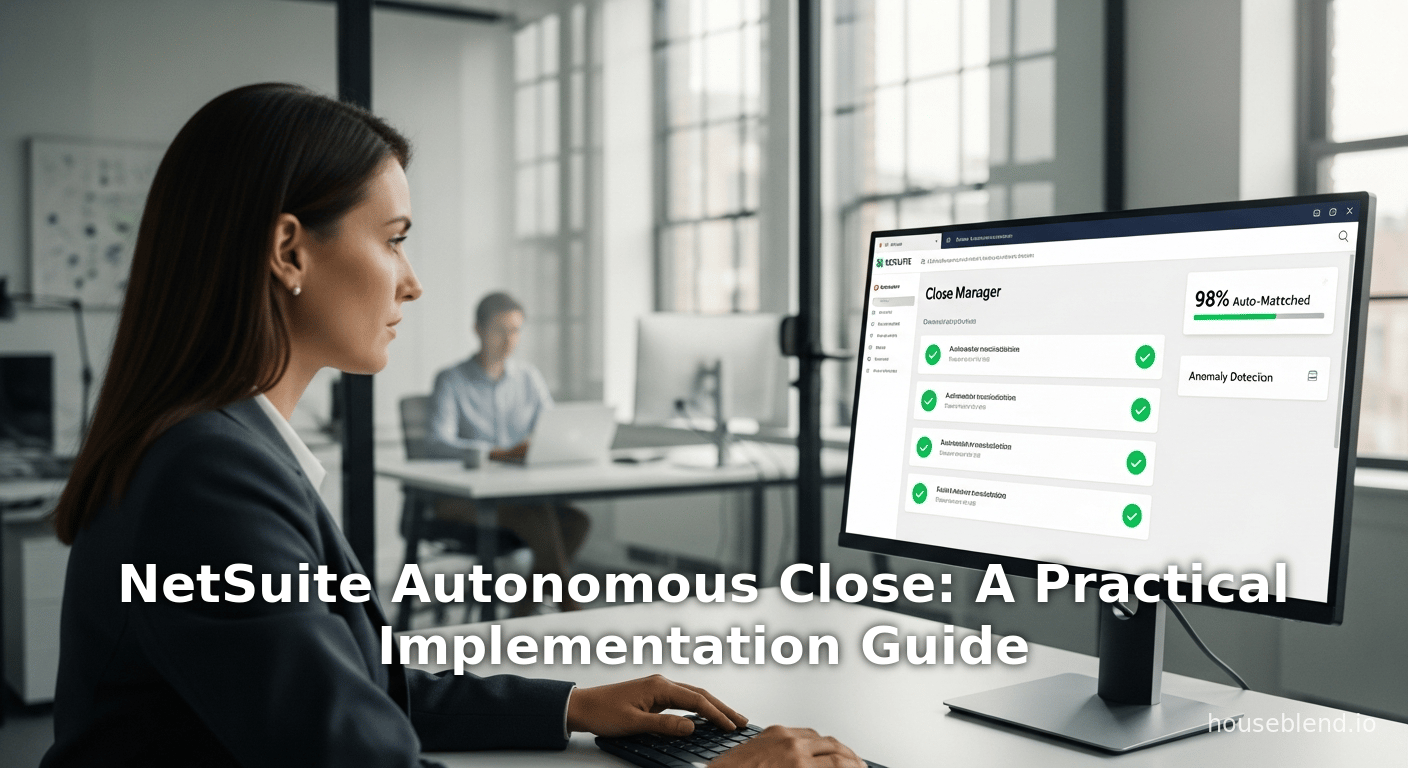
- Embedded Close Checklist (Close Manager). NetSuite provides a new Close Manager interface. This embeds the period-close checklist directly in the ERP, indicating which tasks are done or pending. Unlike static spreadsheets, this dashboard shows tasks being completed automatically by the system and highlights items needing approval or review (Source: ecommercenews.co.nz) [3]. Finance leads can see, in one screen, the status of all sub-closings (e.g. subsidiary closes, journal entries, etc.).
- One-Click Finalization. After all automated steps are done and manual exceptions handled, a single click can finalize the close. In demos, this essentially locks the period with all reconciliations and entries completed [3] [4]. Hence the moniker “one-click confidence close.”
- Explainable AI and Audit Trails. Importantly for finance, every AI action is transparent. The system provides explanations for its decisions, showing how each match was made and why an exception was flagged [4] [3]. This support for explainable AI is critical for auditability and compliance.
These capabilities build directly on NetSuite’s data model. Because NetSuite always records “transaction” data (sales, invoices, payments, etc.), Autonomous Close can leverage the full context. For example, it can reconcile a bank deposit not just to individual payments but also trace through to invoices in one flow. It also inherits NetSuite’s multi-subsidiary (OneWorld) and multi-currency features, enabling global organizations to close across regions without external spreadsheets.
In technical terms, Autonomous Close runs on Oracle Cloud Infrastructure and the new “SuiteCloud AI” platform. NetSuite uses Oracle’s AI Connector Service and the Model Context Protocol (MCP) to invoke AI models in a governed way [28]. AI models – whether Oracle’s, partner models, or even company-trained ones – can access the relevant NetSuite data via MCP. The pre-release “Close Manager” demo suggests an underlying ML engine trained on historical audit data. For anomaly detection, it likely uses classification/regression models tuned to a customer’s past transaction patterns.
Table 1: Traditional Manual Close vs. NetSuite Autonomous Close (theoretical comparison)
| Close Process Step | Traditional/Manual | NetSuite Autonomous Close |
|---|---|---|
| Journal Entry Processing | Manual creation/upload of recurring and adjusting entries (often via spreadsheets) after period-end. | AI generates or suggests routine entries continuously (e.g. allocations, accruals). Most standard entries auto-posted. |
| Account Reconciliation | Manual export of balances to Excel; cross-checks accounts (bank, AR, AP); multi-system data collection. | Automated matching of ledger entries (e.g. bank, AR, AP) within NetSuite in real time; unmatched items flagged automatically. |
| Anomaly/Error Detection | Issues discovered during final review; human error-prone. | Embedded anomaly detection notices outliers or duplicates mid-period; flags exceptions for early review. |
| Close Task Management | Checklists in disparate docs/email; status meetings to see what’s done. | Close Manager dashboard shows live status; completed tasks auto-marked; remaining tasks identified in one interface. |
| Final Review & Sign-off | Senior accountants manually verify reports, check adjustment entries; often a checklist. | Final sign-off can be as simple as reviewing system-completed close checklist and approving with one click. |
| Reporting & Consolidation | Reports generated from static GL, often time-delayed; manual consolidation of books. | Reports run on up-to-date ledgers within NetSuite; consolidated group reporting updated as close progresses. |
| Overall Close Time | Days to weeks, depending on complexity and manual backlog. | Potentially reduced to near real-time; internal test showed 98% touchless processing [3], implying close cycles of “zero” days. |
Table 1 illustrates how Autonomous Close shifts the paradigm. Instead of a separate effort at period-end, closing largely happens continuously and automatically, leaving finance staff to focus only on true exceptions and analysis.
Preparing for Autonomous Close: Data and Process Readiness
Implementing Autonomous Close is not a simple “flip a switch” exercise. It requires disciplined preparation of both data and process infrastructure. The SuiteSciens analysis emphasizes that organizations must become an “AI-ready ERP” [29] (Figure below), and this applies directly to closing:
-
Clean and Standardize Data. AI is only as good as the data it sees. Any duplicates or inconsistencies in master data (chart of accounts, vendors, customers, items) can confuse automated matching. Finance teams should audit and sanitize GL segments, names, and classifications beforehand. For example, remove duplicate vendor records and ensure consistent naming conventions. Establish common reconciliation accounts to avoid fragmentation (e.g. one cash clearing account per bank). The NetSuite Implementation Guide by Hyperbots underscores: “Golden rule: don’t dump bad data into a new system.” They recommend staging data with de-duplication and normalizing fields [30]. Clean historical balances (trial balances, AR/AP aging) mapped accurately into NetSuite will give Autonomous Close correct baselines.
-
Define and Map Processes. Any automation needs clear rules. Finance should document the policy logic behind recurring tasks: Which personnel approve which expenses? What thresholds trigger accruals? NetSuite administrators will translate these into workflows and SuiteFlow automations. For Autonomous Close, explicitly mapping the standard close checklist tasks (bank recs, intercompany settlement, inventory adjustments, etc.) helps the system know what “complete” means. The SuiteSciens blog advises converting manual steps into structured, logical rules for agents to follow [29]. For example, if a policy says “bill over $10,000 requires CFO approval,” set that rule in NetSuite and note how to earmark it for an autonomous agent’s audit.
-
Simplify and Secure Integrations. The Close Manager works best when one single source of truth exists. Excessive external integrations or patchwork systems should be streamlined. Ideally, all financial transactions are entered in (or synced to) NetSuite. If data comes from third-party sub-ledgers (e.g. payroll, procurement systems), ensure near-real-time integration so that no mismatches occur at period-end. SuiteSciens recommends “eliminate redundant connectors” and align integration schedules in anticipation of Autonomous Close [31]. This may involve replacing outdated connectors with modern API integrations on Oracle Cloud. At the same time, review security roles and user permissions in NetSuite to uphold controls. Since agents will automatically approve/execute some tasks, strong governance is needed: build least-privilege roles, segregation-of-duties checks, and an audit trail, so that autonomous actions remain under policy guardrails [32] [33].
-
Engage People and Upskill. Autonomous Close will change workflows, so finance staff need to buy in early. Communicate that automation is meant to eliminate drudgery, not finance jobs. Train the team on the upcoming Close Manager interface and new exception review tasks. Managers should establish trust by reviewing the AI outputs initially. Gartner and consultants emphasize “psychological safety” around AI adoption [34] [29] – ensure lines of communication so accountants can question agent actions. Selected staff might serve as pilot “AI documenters” to define rules. In parallel, IT should ready the underlying platform: plan upgrade cycles (NetSuite Next mode requires specific release versions), test in a sandbox environment, and prepare rollback procedures.
-
Pilot with Targeted Scenarios. Before full deployment, run low-risk pilots. Some companies begin by automating parts of the close (e.g. bank reconciliations or one subsidiary’s close) as a test case. SuiteSciens explicitly suggests starting with smaller controlled projects such as AP automation or the Autonomous Close itself [35]. This approach helps quantify improvements and fine-tune parameters. Gather metrics on time saved and identify any issues. For example, a pilot might track day-to-day posting accuracy before and after enabling anomaly detection. Use lessons learned to iterate checklists and rules before rolling out enterprise-wide.
By following these preparatory steps, an organization ensures that Autonomous Close has clean inputs and clear rules. Adoption will be smoother, and the system is more likely to behave as intended. The analogy often used is that of “training” the system: just as AI requires training data, Autonomous Close requires well-structured organizational data and processes. Hyperbots underscores this in their NetSuite guide: “Treat NetSuite migration as a controlled transformation: cleanse master data, enrich transactions, and validate with reconciliations; avoid lifting and shifting spreadsheet chaos” [36].
Implementing NetSuite Autonomous Close: A Step-by-Step Guide
The following outline presents a framework for a controlled rollout of Autonomous Close. Each organization’s journey will differ in detail, but the core stages are similar to any ERP enhancement rollout, with emphasis on change management and data readiness.
1. Assess and Define Goals
- Current-State Analysis. Document the existing close process in detail: all steps, durations, responsible parties, and pain points. Use interviews and time logs to quantify effort (e.g. “Accounts Payable reconciliation requires 3 FTEs 3 days for 5,000 invoices”). Benchmark to peers or industry data. For instance, if your close is currently 10 business days and CFO.com cites a 6+ day norm [1], set improvement targets accordingly. Identify non-value-added tasks – e.g., manual data re-keys or duplication across spreadsheets – as automation opportunities.
- Define Futur-State Vision. Articulate what success looks like. Is the goal to achieve a 3-day close, or to operate effectively with no dedicated “close team” once processes are stabilized? These targets should be SMART (specific, measurable). Senior leadership (CFO/Finance Director) should endorse metrics (days to close, the percentage of auto-reconciliations, etc.). For example, a mid-size company might aim to reduce close time by 70% within 6 months of go-live. Revisit CFO surveys: many intend for “zero-day close” or “same-day close” as the ultimate metric [3] [4].
2. Prepare the Environment
- Technical Readiness. Ensure your NetSuite environment supports Autonomous Close. This requires enabling NetSuite Next AI mode (often via feature opt-in) in a preview or release supported by Oracle. Coordinate with your NetSuite admin or partner to schedule any necessary upgrades. Deploy a sandbox copy for testing the new features. Confirm existing customizations (SuiteApps, scripts) remain compatible, as per Oracle’s guidance.
- Data Clean-up. As noted, profile and cleanse all relevant data domains: Chart of Accounts, customers, vendors, items, classes, locations, and sub-ledgers [30]. Convert open transaction data and trial balances into NetSuite staging, reconciling to legacy systems. Document any known issues (e.g. uncleared old intercompany A/P). It is crucial that the GL and subledgers in NetSuite reconcile to legacy books before activating Autonomous Close, or permanent variances will propagate.
- Policy and Approval Setup. Using NetSuite’s native workflows or SuiteFlow, codify existing approval rules for key payables, journal entries, and accruals. Ensure roles and permissions are up-to-date, with proper separation of duties. If past workflows were informal/spreadsheet-based, formalize them in NetSuite now. This way, Autonomous Close’s approval “rotues” have valid guardrails.
3. Configure Autonomous Close Controls
- Close Tasks and Checklists. In NetSuite, define the period-close checklist within the “Close Manager.” List each required action (retrieving bank statements, inventory valuation, winding debits/credits, etc.) as a task. For each, set whether it is fully automated or requires human sign-off. For instance, bank reconciliation might be set to “auto” because the AI agent can match statements, whereas a complex ultimate owner allocation might be “manual sign-off.”
- Exception Handling. Determine thresholds for exception flags. Example: treat any invoice over $X or any currency variance beyond Y% as an exception. Specify how exceptions are handled: automatically forwarded to the controller’s task list or marked for CFO approval. Configure routing rules for different subsidiaries if needed.
- Integration with Account Reconciliations. If using NetSuite Account Reconciliation (AR) module or Bill.com integration, ensure they are connected to Autonomous Close processes. For example, if the system can auto-match AP invoices via Bill.com, those matches should flow automatically into the close. NetSuite announced that Intelligent Payment Automation (with BILL) automates payables capture and reconciliation within the system [27]. Such features should be enabled to maximize completeness of automated close.
- Trial Runs. Before real close period, run “dummy closes” in the sandbox. Use sample or staged data to test how the Autonomous Close workflow behaves. Check the matching logic on different transaction types. Monitor the “Process Optimization Monitor” (if available) which indicates how much of each task was automated (Source: ecommercenews.co.nz). In Oracle’s demo, it showed what percentage was auto. Verify that the system is indeed matching entries and flagging errors as designed. Adjust configurations based on issues: e.g. add missing bank accounts to the reconciliation list or tweak matching rules for tricky invoices.
4. Training and Change Management
- Finance Team Training. Conduct hands-on sessions for accountants, controllers, and management on the new Close Manager interface. Cover how to interpret the dashboard, how exceptions appear, and the process to “approve” or investigate tasks. Emphasize that once Autonomous Close is enabled, their job will shift from doing matches to reviewing flagged items and focusing on analysis.
- Documentation and Support. Provide a transition playbook outlining the new workflow. Include steps for handling common scenarios (e.g. “how to correct a misposted entry that an AI match incorrectly resolved”). Assign a “close champion” or super-user who can provide first-line support.
- Stakeholder Communication. Update internal stakeholders (e.g. executives, audit committee) on the changes to closing. Explain that while the process will feel much quicker, the integrity of results is maintained through built-in AI oversight. Share expected KPI improvements (e.g. reduced close days, fewer out-of-reconcilation items) to manage expectations. At least initially, it may be wise to compare traditional vs. new results for convergence.
5. Go-Live and Monitoring
- Initial Go-Live. Activate Autonomous Close for the first real month-end. Many advisors suggest running the system in parallel mode with the old process the first cycle: e.g., let the AI automate in the background but still perform traditional checks until confidence is built.
- Measure Results. Track actual outcomes: hours spent by finance staff, time to close, number of exceptions flagged, and reconciliation variances. Compare to baseline metrics collected pre-launch. For example, if historically the close took 8 days, measure how many days (or business hours) it now takes and how many manual entries were still needed.
- Iterate and Improve. Review any anomalies or gaps that slipped through. Perhaps some transaction types were not auto-matched correctly; adjust categories or add supplemental rules. Microsoft co-founder Satya Nadella has said AI systems require constant feedback loops to improve. Similarly, as finance teams see the Autonomous Close in action, they can fine-tune by, for instance, adding bank accounts to auto-reconcile, improving OCR rules for bills, or refining ML model parameters (if exposed).
- Expand Functionality. Once basic close tasks are running autonomously, consider adding adjacent automations. For example, NetSuite Next also offers automated variance explanations and workflow suggestions. The Close Manager may later recommend “next best actions” or fully self-execute standard accruals, core under the agentic workflows umbrella described in NetSuite Next [26].
Data-Driven Benefits and Evidence
While Autonomous Close is new, both vendor and third-party evidence suggests its potential. We summarize key findings from case studies, surveys, and demos below.
Accelerated Close Times: Companies implementing NetSuite with automation have seen dramatic improvements. Non-alcoholic beer brand BERO, a NetSuite OneWorld customer, reported its monthly close shrinking from 10–15 days to just 3–5 days after go-live [5]. Similarly, PetLab Co. (pet supplements) consolidated global finance on NetSuite and achieved month-end 80% faster than before [6]. Kieser Australia, a fitness chain, cut its year-end close from 25 days down to 3 days across 31 clinics after replacing spreadsheets with NetSuite [37]. These cases illustrate the order-of-magnitude improvement possible once manual reconciliation and spreadsheet tedium are eliminated.
Touchless Transaction Rates: Oracle’s internal tests and partner reports indicate most transactions can be handled with no human touch. During NetSuite’s demo, an optimization monitor showed 98% of transactions were auto-reconciled [3]. In practice, realized rates will vary with data quality, but even high-80s to mid-90s percentages would represent a monumental saving. As Nuage Consulting noted, “98% of transactions handled automatically – let that sink in” [3]. Traditional close tools like BlackLine claim high automation too, but integrating a close agent within the ERP means zero margin for data sync errors.
Efficiency Gains for Finance Staff: With routine work automated, the finance team can redeploy time to analysis. PetLab Co.’s CFO Tony Morreale remarked that NetSuite gave the company “a single source of truth for our finances, tight spend controls, and a solid foundation” which attracted investment [38]. In practice, continuous close processes also provide up-to-date insight to management; for instance, at BERO, sales order processing time dropped below 15 minutes, reflecting how data access improvements helped the broader operation [5]. Moreover, Salesforce research shows CFOs believe AI-driven workflows (digital labor) improve productivity: over half of surveyed CFOs expect AI to noticeably raise revenue (through faster decision-making) and slash costs [39] [18].
Quality and Audit: Less manual entry means fewer errors. According to Gartner, the average finance team spends a quarter of the close dealing with errors, many of which stem from late discovery [10]. Autonomous Close’s early exception flagging dramatically reduces this risk window. An ERP-driven close also enhances auditability; all automated actions in NetSuite are logged, and AI explanations accompany each adjustment. Finance leaders view this as a major plus: in the Salesforce CFO survey, 61% said AI’s role improves “financial control” in ways traditional tech did not [40].
User Confidence and Compliance: A survey by Wolters Kluwer found 56% of finance professionals agree AI “will revolutionize” financial processes [41]. This optimism is partly due to the accuracy AI can bring: an automated system consistently applies rules, preventing human oversight lapses. The transparency of NetSuite’s approach (explainable matches, live checklists) helps maintain trust. However, that same survey noted that 66% of finance leaders worry about AI’s security and compliance risks [42]. NetSuite addresses these concerns by keeping everything within the ERP’s governance framework, not a black-box.
Industry Comparisons: Many modern enterprises gain similar benefits even with third-party tools. For instance, companies using FloQast often report cutting reconciling time in half [43]. RedTail (insurance) cut from 7 to 3 days using FloQast and NetSuite; such figures are consistent with observed NetSuite case results. Autonomous Close has the advantage of not requiring external licenses or middleware, reducing total cost of ownership compared to bolt-on solutions. In summary, the evidence suggests organizations implementing Autonomous Close or equivalent close automation can expect 50–80% reductions in closing cycle times, with commensurate productivity and reliability gains.
Table 2: Case Study Outcomes
| Company | Industry | Pre-Implementation Close | Result / Improvement | Source |
|---|---|---|---|---|
| BERO | Beverage (non-alc) | 10–15 days (monthly close) | 3–5 days (monthly close) | [21] Press Release |
| PetLab Co. | Pet Supplements | Baseline (multi-entity, slower) | 80% faster month-end close | [41] PRNewswire |
| Kieser Australia | Health/Fitness | 25 days (year-end close) | 3 days (year-end close) | [53] Accountancy Age |
| (Typical Mid-Mkt)* | Diversified SME | ~8–12 days | Close in < 4 days (non-reviewed) | estimated |
*This table summarizes reported improvements. (“Typical Mid-Mkt” is illustrative.) Actual results vary by company size and complexity.
Deep Dive: Technology and Architecture
AI Technologies Under the Hood
Autonomous Close leverages several AI techniques:
-
Machine Learning (ML) for Matching: Using historical transaction data, ML models learn patterns of how invoices, payments, and journal lines pair up. For example, an algorithm can predict the correct purchase order for an invoice even if exact PO references are missing, by matching amounts and vendors. Proprietary models likely employ techniques similar to record linkage and fuzzy matching. These ML models continually improve as more data is processed.
-
Rule-Based Anomaly Detection: NetSuite’s platform likely uses statistical models alongside business rules. For instance, neural or tree-based classifiers could be trained to flag transactions that deviate significantly from “normal” (e.g. a one-time large payment). Meanwhile, hardcoded rules (e.g. duplicate invoice number) catch easily defined errors.
-
Natural Language Processing (NLP): The Close Manager interface may incorporate NLP for tasks like problem descriptions. If a mismatched transaction is flagged, AI could suggest possible resolutions (e.g. “This invoice likely belongs to PO #12345”). Over time, user feedback on suggestions can train the system to improve.
-
Proactive Agents (Agentic AI): Beyond passive assistance, NetSuite envisions agents that execute tasks. For example, if the system sees an open receivable beyond credit terms, an invoice follow-up could be automatically triggered. The Autonomous Close is a foray into such agentic behavior: the system doesn’t just inform you what to do – it starts doing it (reconciling, posting entries) on its own authority, albeit under oversight.
Oracle’s contributions to this include the AI Connector Service and ODA (Oracle Digital Assistant) tech repurposed for enterprise data [28]. The integration with Oracle’s OCI means these ML workloads run in a scalable cloud environment, parallelizing large volumetric recon.
Compliance and Controls
All financial automation is walleted by controls. In NetSuite, every transaction already exists within an audit trail. Autonomous Close adds to this by logging each AI decision. FinOps managers can review an “AI audit log” showing which entries were auto-posted, with links to original transaction images or data. Because it lives in the ERP, external auditors gain confidence: nothing is hidden in a separate bot or external spreadsheet.
NetSuite emphasizes that Autonomous Close leverages the same role-based permissions already configured in the system [32]. For instance, if a junior accountant normally cannot post general journals, the system won’t auto-post a journal entry for them unless permission is granted. Similarly, it honors segregation-of-duties: AI won’t itself approve its own journal, it will require an authorized manager’s sign-off on flagged exceptions. Finance teams should still periodically review user roles to ensure compliance as automation gets turned on.
Integration with Other Modules
Autonomous Close is most powerful when data flows from all parts of the business into NetSuite. Key integrations include:
-
Bank Feeds: Real-time bank transactions (via direct feeds or services like Yodlee) allow instant reconciliation. Transactions are ingested throughout the day enabling the system to match them continuously.
-
Accounts Payable Systems (Bill.com): NetSuite’s partnership with BILL extends automation to the bill capture side [27]. Scanned invoices become Apex bill records in NetSuite, which Autonomous Close can then match to POs and payments seamlessly.
-
AR and Collections: Automated close covers receivables too. Incoming payments are matched to invoices automatically. If a payment doesn’t clear, an agent can create a case, or even apply it to outstanding future invoices as needed.
-
Allocations and Intercompany: These flows usually bog down close. With Autonomous Close, intercompany requests and allocations can be pre-posted. The system can auto-generate counterparts (if properly configured) so intercompany ledgers reconcile without waiting on manual memo entries.
-
Fixed Assets Module: Depreciation entries can be automated as usual. If integrated, the system can adjust asset values nightly so the GL reflects correct accumulated depreciation.
Importantly, because Autonomous Close is part of NetSuite, customizations and SuiteApps will continue to function. Oracle states that switching on NetSuite Next mode “should retain existing customizations” [44]. That said, any custom SuiteScript or workflows that touch the close should be tested. For example, if a customer had built a custom SuiteFlow to email out a close approval sheet, that process may be augmented or replaced by the built-in Close Manager and agent actions.
Implications and Future Directions
Toward the Zero-Day Close. Autonomous Close heralds a future where financial periods essentially close themselves. In such a world, the notion of “month-end” becomes academic; financials are always “closed” to a high degree. This would align with the “zero-day close” promise NetSuite touted: continuous accounting means when the month ends, there is nothing left to do. In practice, small residuals or final checks may still occur, but the bulk of work is eliminated.
Shift in Finance Roles. Controllers and accountants will shift from record-keepers to analysts and exception-managers. With routine reconciliations offloaded, their time will be freed for interpretation: drilling down on anomalies, analyzing trends, forecasting. Early adopters of automation report their teams moving from reactive to proactive tasks. One CFO noted that by accounting departments handling close tasks efficiently, they can participate more in strategic planning and advising business lines [13]. CFOs are being recast as data leaders alongside being financial stewards [45].
Performance Management. Real-time close blurs the line between accounting and FP&A. As Picture One example, CFOs can generate rolling financial statements anytime. This could enable true continuous financial reporting for decision-makers, going beyond traditional weekly or monthly dashboards. It might also drive more dynamic budgeting and forecasting, since variances would no longer be discovered only after closing.
Governance and Trust. Autonomous accounting raises questions of trust and oversight. Audit committees will want to ensure AI processes are controlled. Regulators may scrutinize how AI decisions are logged. As Gartner warns, agentic AI requires oversight to mitigate risk [46]. Finance must establish governance for model management: who trains algorithms, how often they’re updated, and how exceptions are triaged. NetSuite’s vendor assurances (auditable outputs, Oracle infrastructure security) help, but enterprises will likely create new internal checkpoints.
Market and Competitive Impact. Widespread adoption of tools like Autonomous Close could become a competitive necessity. Goldman Sachs has noted that companies who can accelerate their internal processes often-outperform peers because they react faster to market changes [47]. If one company’s finance team spends 80% of its time on analysis rather than closing, it can propose better strategies and seize opportunities ahead of slower competitors.
Integration with Broader Automation. Autonomous Close may integrate with other automated finance processes. For example, if integrated with automated payment systems, NetSuite can complete the cash-to-close cycle seamlessly. Integration with robotic process automation (RPA) tools for non-NetSuite tasks could further streamline finance. We may see “Composite Bots” where, e.g., a procurement request in a separate system triggers a NetSuite agent to prepare a journal entry, and an approval bot to confirm it.
Continuous Improvement via AI. Oracle plans to iterate on these features. Like BlackLine’s AI roadmap, future enhancements could include predictive close time estimates, anomaly scorecards, or even automatic correction suggestions. Feedback loops—using actual outcomes to retrain models—will make the system smarter. The goal is that over years, Autonomous Close transitions from “assistive AI” to a fully self-healing system: even novel transaction types could be auto-handled.
Wider AI-Native ERP: Autonomous Close is part of a larger trend: ERP is shifting from passive record-keeping to active decision engines. Techradar envisions the “AI-fueled finance department” where tasks like allocating AP payments, budgeting, and compliance checks are self-managing under CFO oversight [48]. NetSuite’s announcements suggest a roadmap: after Autonomous Close, later releases will likely push other domain processes to autonomy (e.g. revenue recognition at closing, automated compliance monitoring).
Risks and Caveats: Despite its promise, caution is warranted. Studies reveal that many companies underestimate the data and change management work needed for AI projects [41] [49]. CFOs also express fears: in the Salesforce survey, 66% worried about AI security and ethics [42]. For Autonomous Close, this means robust testing and a culture of “humans in the loop” at first. Over-dependence on AI without understanding its limitations could lead to unnoticed errors, especially in unusual transactions. Organizations must balance enthusiasm with ongoing validation.
Conclusion
NetSuite’s Autonomous Close represents a bold step towards the next frontier in corporate finance: an era where the general ledger essentially closes itself. By embedding AI for continuous reconciliation, anomaly detection, and workflow automation within the ERP, NetSuite aims to offload the drudgery of month-end close from finance teams. The practical benefits—as indicated by internal benchmarks and customer case studies—are substantial: 50–80% reductions in close time, dramatically fewer manual tasks, and real-time financial visibility [5] [6] [37].
However, this revolution depends on rigorous implementation. Organizations must lay the groundwork through data cleansing, clear processes, and change management. Finance leaders should engage frontline accountants early, setting new expectations for the CUORE (control, understanding, oversight, relationships, evolution) of AI-enabled accounting. When done correctly, Autonomous Close will free finance professionals to act on insights rather than reconcile numbers, fulfilling the long-touted vision of AI as a jet engine rather than merely a copilot for finance [50].
Finally, Autonomous Close is a glimpse of how AI will reshape finance at large. It underscores a broader shift: from monthly reporting to near-real-time management, from static roles to dynamic, data-driven stewardship. For CFOs and AE stakeholders, the message is clear: prepare now. Invest in data quality and scalable cloud infrastructure [29] [19]. Pilot intelligent workflows and gather metrics. By the mid-2020s, autonomous accounting may no longer be just a competitive edge – it could be table stakes.
Tables
| Company | Industry | Pre-implementation Close | Post-implementation Close | Notes / Source |
|---|---|---|---|---|
| BERO | Beverage (Non-Alcoholic Beer) | 10–15 days (monthly close) | 3–5 days (monthly close) | Reduced financial close by ~70% [5] |
| PetLab Co. | Pet Supplements | Multi-entity, slower monthly close | 80% faster month-end cycle | 80% faster close on NetSuite finance [6] |
| Kieser Australia | Fitness/Healthcare | 25 days (year-end close) | 3 days (year-end close) | Cut year-end close by 88% [37] |
| Typical SME | Various | ~8–12 days | ≤4 days (goal) | Industry benchmarks: half of teams take ≥6 days [1] |
| Close Activities | Traditional Process | Autonomous Close (NetSuite) |
|---|---|---|
| Transaction Entry | Manual batch uploads and entries at period-end. | Continuous posting; AI may auto-generate routine entries (accruals, allocations). |
| Reconciliation | Export balances; manual matching via spreadsheets. | Automated matching for bank, AP, AR, etc., on the fly; exceptions auto-flagged. |
| Error Detection | Issues often found late in manual review. | AI-driven anomaly detection alerts issues in real time during the month. |
| Close Checklist | Spreadsheet checklists, meetings to track tasks. | Integrated Close Manager dashboard showing live status of all close tasks. |
| Approval Workflow | Manual approvals via email or paper. | Workflow tasks routed automatically to correct approvers; “one-click” period close. |
| Reporting | Static reports after close; often outdated by release. | Live financial reports and dashboards updated as the close progresses. |
External Sources (50)
About
Houseblend
HouseBlend.io is a specialist NetSuite™ consultancy built for organizations that want ERP and integration projects to accelerate growth—not slow it down. Founded in Montréal in 2019, the firm has become a trusted partner for venture-backed scale-ups and global mid-market enterprises that rely on mission-critical data flows across commerce, finance and operations. HouseBlend’s mandate is simple: blend proven business process design with deep technical execution so that clients unlock the full potential of NetSuite while maintaining the agility that first made them successful.
Much of that momentum comes from founder and Managing Partner Nicolas Bean, a former Olympic-level athlete and 15-year NetSuite veteran. Bean holds a bachelor’s degree in Industrial Engineering from École Polytechnique de Montréal and is triple-certified as a NetSuite ERP Consultant, Administrator and SuiteAnalytics User. His résumé includes four end-to-end corporate turnarounds—two of them M&A exits—giving him a rare ability to translate boardroom strategy into line-of-business realities. Clients frequently cite his direct, “coach-style” leadership for keeping programs on time, on budget and firmly aligned to ROI.
End-to-end NetSuite delivery. HouseBlend’s core practice covers the full ERP life-cycle: readiness assessments, Solution Design Documents, agile implementation sprints, remediation of legacy customisations, data migration, user training and post-go-live hyper-care. Integration work is conducted by in-house developers certified on SuiteScript, SuiteTalk and RESTlets, ensuring that Shopify, Amazon, Salesforce, HubSpot and more than 100 other SaaS endpoints exchange data with NetSuite in real time. The goal is a single source of truth that collapses manual reconciliation and unlocks enterprise-wide analytics.
Managed Application Services (MAS). Once live, clients can outsource day-to-day NetSuite and Celigo® administration to HouseBlend’s MAS pod. The service delivers proactive monitoring, release-cycle regression testing, dashboard and report tuning, and 24 × 5 functional support—at a predictable monthly rate. By combining fractional architects with on-demand developers, MAS gives CFOs a scalable alternative to hiring an internal team, while guaranteeing that new NetSuite features (e.g., OAuth 2.0, AI-driven insights) are adopted securely and on schedule.
Vertical focus on digital-first brands. Although HouseBlend is platform-agnostic, the firm has carved out a reputation among e-commerce operators who run omnichannel storefronts on Shopify, BigCommerce or Amazon FBA. For these clients, the team frequently layers Celigo’s iPaaS connectors onto NetSuite to automate fulfilment, 3PL inventory sync and revenue recognition—removing the swivel-chair work that throttles scale. An in-house R&D group also publishes “blend recipes” via the company blog, sharing optimisation playbooks and KPIs that cut time-to-value for repeatable use-cases.
Methodology and culture. Projects follow a “many touch-points, zero surprises” cadence: weekly executive stand-ups, sprint demos every ten business days, and a living RAID log that keeps risk, assumptions, issues and dependencies transparent to all stakeholders. Internally, consultants pursue ongoing certification tracks and pair with senior architects in a deliberate mentorship model that sustains institutional knowledge. The result is a delivery organisation that can flex from tactical quick-wins to multi-year transformation roadmaps without compromising quality.
Why it matters. In a market where ERP initiatives have historically been synonymous with cost overruns, HouseBlend is reframing NetSuite as a growth asset. Whether preparing a VC-backed retailer for its next funding round or rationalising processes after acquisition, the firm delivers the technical depth, operational discipline and business empathy required to make complex integrations invisible—and powerful—for the people who depend on them every day.
Disclaimer
This document is provided for informational purposes only. No representations or warranties are made regarding the accuracy, completeness, or reliability of its contents. Any use of this information is at your own risk. Houseblend shall not be liable for any damages arising from the use of this document. This content may include material generated with assistance from artificial intelligence tools, which may contain errors or inaccuracies. Readers should verify critical information independently. All product names, trademarks, and registered trademarks mentioned are property of their respective owners and are used for identification purposes only. Use of these names does not imply endorsement. This document does not constitute professional or legal advice. For specific guidance related to your needs, please consult qualified professionals.