Houseblend Article
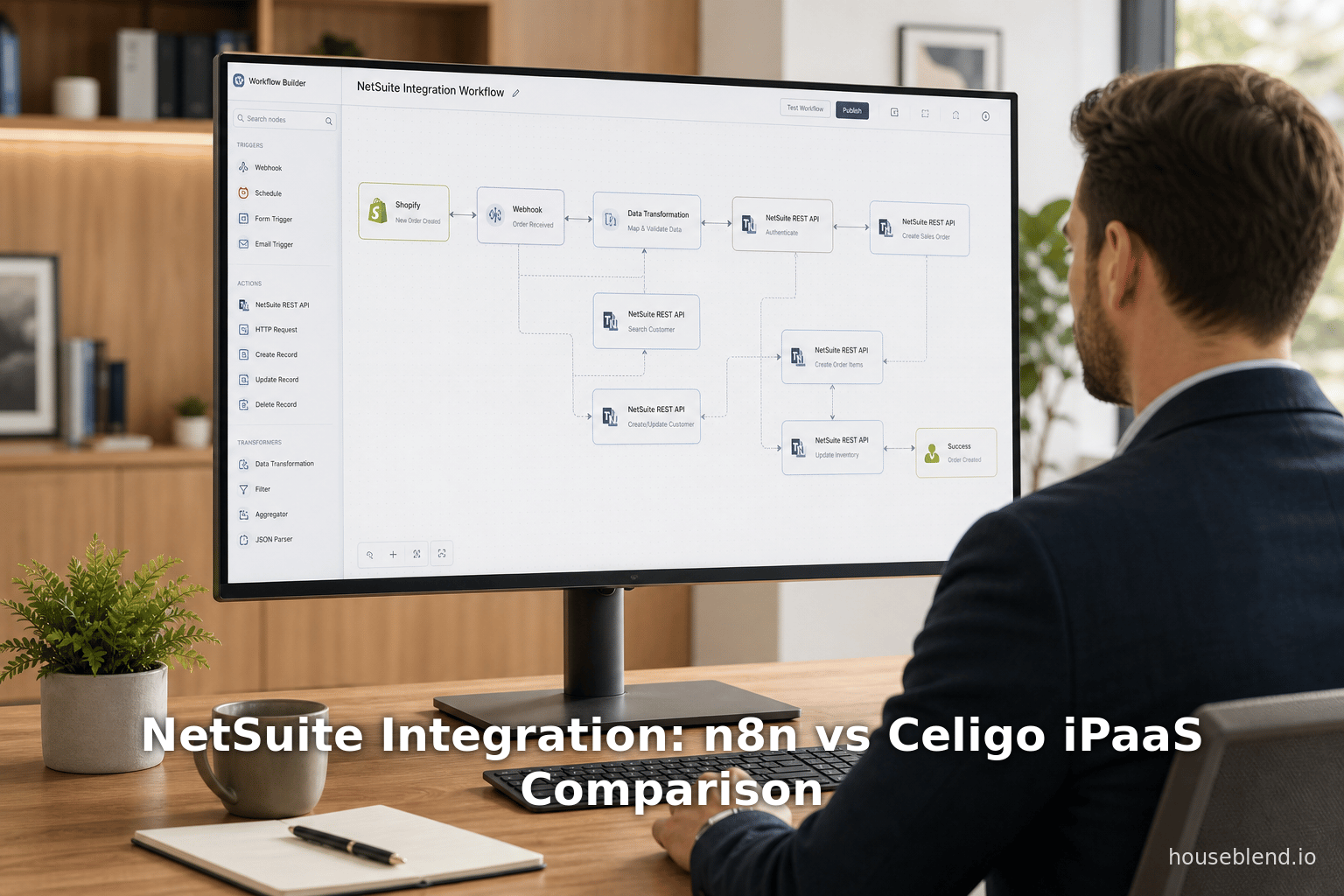
NetSuite Integration: n8n vs Celigo iPaaS Comparison
Inside this article
Executive Summary
Integration between disparate enterprise systems has become mission-critical in the cloud era. Celigo and n8n represent two very different approaches to integration-as-a-service for NetSuite environments. Celigo is a mature, proprietary iPaaS (integration Platform as a Service) that specializes in NetSuite and SaaS connectivity, with extensive built-in connectors and commercial support. n8n, by contrast, is an open-source/fair-code workflow automation platform that can be self-hosted and offers a visual workflow builder with code extensibility. Our analysis shows that open-source iPaaS can “win” in several key respects – especially on cost, flexibility, and innovation – but also faces trade-offs in built-in functionality and support.
We compare n8n and Celigo head-to-head in the context of NetSuite integration across technical, economic, and organizational dimensions. Celigo’s strengths include its enterprise-grade pre-built NetSuite connectors, extensive support, and proven scale (indeed, Celigo is often touted as the “#1 global leader in NetSuite integration” [1] [2]). In contrast, n8n’s strengths stem from its openness and developer-centric flexibility. n8n can be deployed on-premises or in any cloud (e.g. Docker, Kubernetes, AWS, etc.) under its fair-code license [3] [4], avoiding vendor lock-in and licensing fees. Moreover, n8n has rapidly attracted a vibrant community and venture capital backing, raising $180M in a Nov 2025 Series C at a $2.5B valuation [5] to build out AI-enhanced workflow automation. The n8n platform supports over 1000+ integrations out of the box [6], and thanks to community-contributed “nodes” can connect to virtually any RESTful API, including newly-developed NetSuite connectors.
Our survey of users and case studies shows open-source success stories: large companies like Vodafone and Stepstone use n8n for critical workflows, citing tremendous time and cost savings(e.g. saving £2.2M and 5,000+ person-days in one case [7], or achieving 25× faster data integrations [8]). At the same time, Celigo is proven in countless NetSuite deployments: for example, a case study with a professional services firm shows Celigo syncing Salesforce and NetSuite data “enabling seamless data flow” and improved efficiency [9]; another with an ecommerce retailer reports a “streamlined and automated complete order-to-cash process” after using Celigo’s Shopify–NetSuite SmartConnector [10].
Key findings include:
- Total Cost of Ownership (TCO): n8n’s software cost can be zero (self-hosted) or low (managed cloud service) [3], whereas Celigo requires commercial subscription fees (though exact pricing is usage-based and proprietary). Open-source avoids license fees entirely [4], significantly reducing direct software costs, especially at scale.
- Flexibility and Control: n8n’s code-based, extensible architecture lets technical teams customize integration logic without waiting on vendors [3] [11]. Proprietary Celigo offers many connectors, but modifying behaviors beyond presets may be difficult if endpoints are not directly supported.
- Functionality: Celigo has mature, full-featured “SmartConnectors” for NetSuite and other apps [12] [13], including support for Suitelets, SuiteQL, SOAP/REST, etc. In contrast, n8n matured more recently: it lacked any official NetSuite connector until community efforts in 2025 [14] [15]. Today, n8n can perform most NetSuite actions via its community NetSuite node (supporting 150+ record types) [16] or generic HTTP calls.
- Scaling and Performance: Celigo’s cloud infrastructure is designed for enterprise throughput (5,000+ NetSuite customers worldwide [2]), offloading scaling concerns. n8n can also scale (self-hosted cluster or cloud-managed instances), but requires operator management.
- Support and Ecosystem: Celigo provides professional support, consulting, and training; it is recognized in Gartner’s Magic Quadrant as an iPaaS Visionary for 2024–2026 [17]. n8n relies on community forums and paid support contracts; it has not yet received comparable analyst recognition (though it has been praised for innovation).
- Security and Compliance: Open-source transparency can aid audits, but also means patches are the user’s responsibility. Notably, n8n has had critical CVEs (e.g. Jan 2026’s “Ni8mare” affecting 60,000 exposed instances [18]), highlighting the need for vigilant patching. Celigo’s managed service model reduces direct patching burden and holds security certifications typical of SaaS ERP integrations.
- User Experience: Celigo emphasizes low-code design and guided setup; reviewers note Celigo’s intuitive wizard and support as market-leading [19]. n8n targets developers and technical integrators – while it offers a visual “flowchart” interface [11], it often requires coding (JavaScript/Python) for complex logic or unsupported APIs.
When “Open-Source iPaaS wins”: We conclude that open-source tools like n8n win in scenarios where cost savings, customization, and control are paramount. Small to mid-size companies or tech-centric teams with skilled developers can leverage n8n’s free core and flexibility to automate NetSuite workflows without vendor lock-in. They can experiment rapidly (adding new nodes or modifying flows on the fly) [3] [8], and benefit from low TCO. In contrast, enterprises with mission-critical SLAs, strict compliance demands, or complex “out-of-the-box” requirements may favor Celigo’s commercial robustness, connector breadth, and support infrastructure.
The detailed analysis below examines these factors, drawing on industry data, expert commentary, and real-world cases. We explore the history and current landscape of iPaaS, provide systematic feature comparisons (including a summary table), review specific case studies (summarized in a second table), and discuss future trends.Throughout, we cite credible sources to substantiate all claims.
Introduction and Background
The Rise of Cloud Integration (iPaaS) and NetSuite
Modern enterprises run on multiple cloud applications – CRM, ERP, e-commerce, marketing, and more – and require seamless data synchronization among them. Traditionally, Integrations had to be hard-coded or implemented via middleware (EAI – Enterprise Application Integration) or ESB (Enterprise Service Bus) tools. In the 2010s, as Software-as-a-Service (SaaS) proliferated, the market evolved toward cloud-delivered integration platforms known as Integration Platform-as-a-Service (iPaaS) [20] [21]. Gartner defines iPaaS as “a cloud service that provides a platform to support application, data and process integration projects, usually involving a combination of cloud-based applications and data sources, APIs and on-premises systems” [20]. Typical iPaaS use cases include syncing records between SaaS apps (e.g. Salesforce and NetSuite), or automating flows from a web form into backend systems [21].
NetSuite is one of the earliest and largest cloud ERP suites. Founded in 1998 and acquired by Oracle in 2016, NetSuite today serves tens of thousands of customers worldwide – one analyst reports “billions of recurring revenue from 37,000+ customers” [22]. For many businesses, NetSuite holds core financials and operations data. Integrating NetSuite with other systems (CRM, ecommerce, BI, etc.) is therefore a high priority. Celigo emerged in the early 2010s specifically to address the need for streamlined NetSuite integrations: it positions itself as “NetSuite’s largest partner for over a decade”, enabling “connect[ion] [of] NetSuite… with thousands of applications” [1]. Indeed, Celigo’s marketing proclaims it the “#1 Global Leader in NetSuite Integration” [1], and Gartner recently recognized Celigo as a visionary iPaaS vendor for its strengths in the NetSuite/SaaS space [17].
Evolution of Integration Technologies
Understanding why open-source iPaaS (like n8n) has appeared requires historical context. In the 1990s, enterprises used EAI tools to bridge heterogeneous on-premise systems. These early tools provided a central “hub” or middleware for connecting databases and applications (Source: it-trend.jp). EAI simplified integration (via message queuing, connectors, etc.) but was often costly and custom. In the 2000s, the IT community moved toward SOA (Service-Oriented Architecture) and ESB (Enterprise Service Bus) models (Source: it-trend.jp), which distributed integration logic and allowed systems to be loosely coupled. However, as cloud computing and SaaS became prevalent in the 2010s, integration needs grew beyond the corporate firewall. Modern iPaaS tools thus not only integrate on-prem with on-prem, but especially cloud-to-cloud interactions. APIs and webhooks became standard interfaces, and iPaaS vendors responded accordingly. As one source notes, by the late 2010s the lines between traditional EAI/ESB and iPaaS blurred, with “adapters” and connectors abstracting differences in formats and protocols (Source: it-trend.jp).
Today’s integration challenge often revolves around connecting SaaS apps (e.g. CRM, Marketing Automation, E-commerce) with each other and with on-prem or cloud ERPs. For example, Gartner’s examples of iPaaS usage include “synchronizing customer records between Salesforce and NetSuite” (both SaaS) or sending orders from a cloud-based service into on-prem financial systems [21]. These are precisely the kinds of workflows Celigo and n8n aim to facilitate.
Open-Source vs Proprietary iPaaS
Traditional iPaaS solutions (Celigo, Dell Boomi, MuleSoft, SnapLogic, etc.) are proprietary SaaS products. In recent years, open-source integration platforms have begun to emerge. n8n (founded 2019) is a notable newcomer: it offers workflow automation with a visual editor, but all code is available under a fair-code (“sustainable use”) license [3] [4]. Other open projects (Apache NiFi, WSO2 EI, Node-RED, etc.) exist, but none target NetSuite as explicitly as Celigo does.
Open-source advocates argue that it delivers control and cost advantages. As a Latenode analysis notes, open source promises “total control, data sovereignty, and the freedom to tweak every line of code” [23]. Enterprises can self-host, avoiding licensing fees (a “holy grail” for automation [23]), and avoid vendor lock-in. However, open-source also implies a “hidden tax” – the burden of infrastructure management, security patching, and ongoing engineering eyeing [24]. Indeed, studies of open AI models (analogous in some respects) show that open solutions can be substantially cheaper in license cost (often 10–20% of proprietary), but still require internal investment to operate [24].
Celigo and n8n thus embody different trade-offs: Celigo provides a turnkey service (no servers to run, vendor takes care of scaling and updates), whereas n8n hands the reins to the user. Our analysis examines these trade-offs in depth.
n8n Overview: The Open-Source Workflow Platform
n8n (pronounced “n-eight-n”) is an open-source workflow automation tool founded in 2019 in Berlin [25]. Its tagline is “At n8n, we think that all workflows should be Faircode,” reflecting its core licensing choice. n8n’s licensing model is a fair-code / sustained-use license: the core source is available (and free for self-hosting), but non-commercial usage is limited [26] [4]. (In practice, companies can download and run the open-source n8n server on their own infrastructure at no license cost [4], or use n8n’s cloud-hosted service with subscription tiers.) Notably, n8n also offers an “Enterprise” edition with support for some proprietary features, but the foundation of the platform is open.
Technically, n8n provides a visual “node-based” workflow builder. As described by a TechRadar analyst, “n8n is a flowchart you build… [operators] visually wire up ‘if this, then that’ connections between apps and services. You define triggers, map data between nodes, add branching logic, and deploy a workflow that runs the same way every time” [11]. In other words, it is deterministic and fast for repeatable tasks: for example, syncing CRM contacts, populating spreadsheets, or automating notifications [11]. Each node can invoke a particular service (e.g. Gmail, Slack, HTTP request), or perform data transformations (Set, SplitInBatches, etc.). Advanced users can also insert custom JavaScript or Python code blocks for specialized logic. The n8n core node repertoire is already large: the company claims “1000+ integrations” [6] covering common services (email, databases, SaaS APIs, etc.). Another way to quantify this is by n8n’s “nodes” or “packages reservoir” – dozens of official packages and many community-contributed ones.
n8n’s LinkedIn page succinctly highlights its positioning: “the platform enables connection to any app or API while maintaining the flexibility of code with the speed of no-code. Released under a fair-code license, n8n can be self-hosted and is supported by a vibrant community of developers” [3]. Indeed, it is designed for “technical teams” that want to start with simple automations and then “layer complexity” (adding custom code) as needed [3]. n8n’s founders have marketed it as combining AI and process automation, hinting at future directions (“AI-driven automation” is frequently mentioned).
The project has attracted significant venture capital. By late 2025, the modern n8n (often described as an “AI agent” startup) completed a $180M Series C at a $2.5B valuation [5]. This round (led by Accel and others) brought total funding to $240M [5]. This suggests strong investor confidence in the open-source model and the demand for extensible automation. (For context, n8n’s funding and valuation are in the same league as enterprise iPaaS startups.)
n8n and NetSuite
Originally, n8n did not include a native NetSuite integration. As of mid-2025, as one developer writes, “n8n doesn’t ship with an official NetSuite node” [15]. Early adopters worked around this by using n8n’s generic HTTP Request node pointing at NetSuite’s SuiteTalk SOAP APIs or newer REST APIs [15]. One Medium author notes that robust SuiteQL (SQL-like query) workflows required custom work. In practice, a few community-contributed n8n packages emerged. For example, the community project n8n-nodes-netsuite-rest (npm package by user @drowl87) provides a NetSuite REST node supporting over 150 standard record types (customers, orders, items, etc.) [16]. By late 2025, this community node entered beta, allowing typical NetSuite actions (CRUD on records, searches, SuiteQL queries, etc.) [16]. (Notably, the community node installation process is manual: users go to n8n’s Settings » Community Nodes, enter n8n-nodes-netsuite, and accept the risk [27].)
In summary: n8n can integrate with NetSuite, but it requires extra steps. A helpful integration guide explains that one must enable Token-Based Auth in NetSuite, configure an n8n credential with the token, and then use the NetSuite node in a workflow [27] [28]. n8n can even run SuiteQL queries on demand via webhooks or triggers [29]. For example, an n8n workflow might take a HubSpot contact, map its fields to a NetSuite Customer (via the NetSuite node’s “Create Record” action), and then send a Slack notification – all in one automated flow [30]. Thus, while not as turnkey as a native product, n8n provides the building blocks to orchestrate NetSuite workflows, and the community is filling gaps.
Celigo Overview: The Proprietary iPaaS for NetSuite
Celigo was founded around 2011 [31] [32] (some sources indicate a 2006 origin, but revenue records start from 2011 [31] [32]). It set out explicitly as an integration platform, soon focusing on cloud-to-cloud flows. Over the past decade, Celigo has grown significantly: according to a recent profile, it reached about $92 million in revenue by 2024 [31] and serves roughly 1,000+ customers [33]. Celigo’s management highlights methodical growth from about $6M ARR in 2015 to $92M in 2024 [31]. The company remains privately held (with previous venture rounds totaling ~$80M [34]).
Celigo’s central product is Integrator.io, a cloud-based iPaaS. Integrator.io provides a drag-and-drop flow designer, but also under-the-hood extensibility via scripts. It offers “SmartConnectors” – prebuilt, configurable pipelines for common endpoints. Importantly, Celigo heavily emphasizes NetSuite. Their website proclaims Celigo as “NetSuite’s largest partner for over a decade”, supporting “connections … between NetSuite and thousands of other applications” [1]. Celigo is even a SuiteCloud Developer Network (SDN) member, and their platform has special support for NetSuite features like Suitelets and SuiteAnalytics (SuiteQL) [12]. Indeed, a Celigo web page lists “support for Suitelet and prebuilt connectors” as unique capabilities for NetSuite users [12].
Celigo has received industry recognition. It was named a Gartner® MQ Visionary in iPaaS for “Completeness of Vision and Ability to Execute” in 2024 and 2025 [17] [35]. It touts being “#1 ranked iPaaS for 2 years” with thousands of positive reviews [36], and a Gartner Peer Insights “Customers’ Choice” for 2025 [37]. While these are vendor claims, they reflect Celigo’s strong position in integration reviews: G2 rates Celigo at 4.6/5 (from 1,000+ reviews) versus n8n at 4.8/5 [38], illustrating Celigo’s established enterprise footprint.
Celigo and NetSuite Integration
Celigo’s chief value proposition is turnkey connectivity with NetSuite. Where n8n relies on community nodes, Celigo provides built-in NetSuite SmartConnectors. These are configurable templates for common business flows (e.g. “Shopify Orders to NetSuite”, “Salesforce Opportunities to NetSuite”, etc.). A Celigo marketing page states that the integrator is “purpose-built to help business and IT teams automate critical processes… with ease”, highlighting its low-code design and AI-powered error handling [35].
Key Celigo features include:
- Prebuilt Integrations: Celigo ships with many out-of-the-box connectors (for Salesforce, Shopify, Amazon, Google Workspace, etc.) and customizable mapping. A testimonials panel notes Celigo’s expansive real-time sync and features [39].
- SuiteApps: Celigo even offers native NetSuite plug-ins (SuiteApps) that embed its integrator inside NetSuite for certain use cases.
- Scalability: Being SaaS, Celigo auto-scales with customer volume. Celigo claims to handle “millions of orders within hours” for large retailers (see case study below [40]).
- Support & Professional Services: Celigo has a paid support and consulting organization, with training and documentation. They also work via NetSuite partners (e.g. Deloitte implementegrations).
- Platform Enhancements: The 2025 press release mentions new API management and B2B integrations (EDI) as part of integrator.io [41].
By design, Celigo abstracts much of the technical complexity. A G2 review notes that Celigo customers especially appreciate its user-friendly experience, intuitive onboarding, and strong support [42] [19]. In side-by-side comparisons, Celigo scores higher on overall satisfaction (“93.73 G2 Score”) than n8n (67.26), reflecting enterprise reliance on Celigo’s reliability [38]. However, this also comes at a price: Celigo uses a paid subscription model. Its pricing page cites flat-rate pricing for endpoints and flows, with no hidden fees, but actual cost depends on the number of endpoints and workflows [43].
Comparing n8n and Celigo: Features and Capabilities
To systematically compare n8n and Celigo, we organize their attributes by category. Table 1 below summarizes key differences in platform characteristics. We then elaborate on each dimension with evidence and citations.
| Feature / Dimension | n8n (Open-Source iPaaS) | Celigo (Proprietary iPaaS) |
|---|---|---|
| Deployment & Infrastructure | Self-host or managed cloud. n8n can be run on-premises or in any cloud (Docker, Kubernetes, etc.) [3]. Users control the execution environment. | Cloud-only SaaS (Celigo integrator.io), hosted by Celigo. No on-prem option, but geographies available. |
| Costs & Licensing | Fair-code (Sustainable Use) license; core is free to use (no license fee). Paid enterprise plans available for hosted service. Requires customer to provide servers/infrastructure [3] [4]. | Subscription pricing (per flows/endpoints), free trial available [43]. Licenses must be purchased for each environment. Vendor-managed (zero infrastructure cost to customer). |
| Integration Connectors | 1000+ built-in integrations (nodes) to apps/APIs [6]; highly extensible – new nodes can be added from the community (e.g. HubSpot, Google APIs, databases, etc.). Late 2025 saw the release of an n8n NetSuite community node supporting 150+ record types [16]. | Broad connector library with hundreds of prebuilt SmartConnectors (Salesforce, Shopify, etc.). Special emphasis on NetSuite: native SuiteApps and NetSuite connectors (SOAP and REST). Connects to thousands of apps via REST/SOAP or Celigo’s partner apps [1] [12]. |
| NetSuite Support | No official built-in NetSuite node through 2024 [14] [15]; recently community plugin provides full SuiteTalk/REST access. Users must configure authentication, roles in NS (TBA, etc.) manually. Supports SuiteQL queries via webhooks [29]. Highly flexible (any API), but requires more setup. | First-class support for NetSuite: Packaged “SuiteApp” integrations, flows, and smart connectors. Includes support for common patterns (O2C, P2P, financial sync), custom record flows, etc. Users simply configure source/target fields in a UI. Optimized for NS (handles SuiteScript, custom fields, etc.). |
| Workflow Design | Visual flowchart interface (drag-and-drop nodes with lines) [11]. Designed for repeatable automation (“deterministic”). Developers often add code nodes (JavaScript/Python) for custom logic. Supports branching, loops, sub-workflows. | Visual low-code interface with graphical flow designer. Celigo emphasizes templates and mapping UIs; less need for custom code. Includes helper wizards for common integrations. Offers branching, parallel flows, etc., but with more guided setup. |
| AI/Advanced Features | Emerging – n8n is integrating AI. Already allows custom scripts; supports generative AI via code nodes. The company has discussed AI agents and code automation [3] [11]. | Celigo Integrator has introduced AI-powered exception handling (auto-correction suggestions). Focus is automation rather than generative AI currently, though the company tracks Gartner and AI trends in integration. |
| Performance & Scalability | Scales with user-provided infrastructure. n8n can run on powerful servers or clusters (Docker, Kubernetes). Auto-scaling must be managed by user (e.g. Kubernetes HPA). No built-in limits on flow count; performance depends on hardware. | SaaS model means Celigo manages scaling globally. Designed to handle enterprise volumes (orders, transactions) transparently. Multi-tenancy handled by vendor. Elastic scaling for spikes (e.g. Black Friday order surges as per case study [40]). |
| Monitoring & Management | n8n provides monitoring dashboards and logging. Being open, it exposes logs directly; enterprise users can integrate with Prometheus, ELK, etc. Upgrades/patches are user’s responsibility. | Celigo provides an admin console for monitoring live flows, error queues, logs. Automatic updates/patches applied by vendor. Detailed audit logging and notifications are built-in. |
| Security & Compliance | Self-managed: user controls network/DB. Source is open for audit. However, security patches (e.g. CVEs) must be applied by admins. Example: a critical RCE CVE in early 2026 (“Ni8mare”) affected many exposed n8n instances [18]. Sensitive data can be encrypted or kept in-house (self-host). | Vendor-managed: Celigo holds security certifications and responsibility for infrastructure. Data flows through Celigo’s cloud (encrypted in transit/rest). Celigo’s architecture isolates customers and meets compliance (SOC 2, GDPR, etc.). Errors and security incidents are managed by Celigo’s ops team. |
| Support & Community | Free community forums and documentation. Commercial support only via enterprise plan. Rapid open-source community contributions (GitHub, forums). Vibrant user community, but official support depends on paid tier. | 24/7 professional support (phone, email, customer portal) included in subscription. Extensive documentation, training, and partner network (e.g. NetSuite consultants). High-touch account management for larger clients. Analyst-approved (Gartner/Peer Insights). |
| Pricing Model | Open-core model. Self-hosted: No license fee (open source). Cloud service: Tiered subscription (free tier to enterprise). Overall lower entry cost, but user supplies infra cost. Price scales with usage (flow count, triggers). | Subscription-based. Pricing based on number of endpoints/apps, flows, and/or transactions. Includes a free trial, then monthly/annual fee. Published as “flat-rate per endpoint/flow: no per-task fees” [43]. Costs scale with business size. |
Table 1. Feature comparison of n8n (open-source iPaaS) vs. Celigo (proprietary iPaaS) for NetSuite integrations.
Discussion of Key Differences: The table highlights that n8n excels in flexibility and cost, whereas Celigo provides out-of-the-box integrations and support. For example, n8n’s deployment flexibility allows companies to run the software on-premises or in their chosen cloud [3]; Celigo, by contrast, is a cloud-only service with no self-host option. This means n8n can meet on-prem compliance needs, while Celigo simplifies operations by fully managing the platform. In integration capability, Celigo leads with built-in SuiteApps and smart flows tailored to NetSuite, whereas n8n initially lagged (no official NS node until 2025) [14] [15]. However, n8n’s generic HTTP-Request and recent community NetSuite nodes now provide “any app or API” connectivity [3] [16].
On user experience, Celigo aims for non-technical users with templates and wizards, and indeed reviewers praise its ease-of-use and support [42] [19]. n8n targets developers: its interface is programmer-centric (the TechRadar review notes it is effectively a flowchart builder where “every step is designed by a human upfront” [11]). This makes n8n very powerful for custom flows, but can raise the bar for adoption.
Crucially, on cost, n8n can be far cheaper. Self-hosting costs only hardware and maintenance – the software itself has no per-flow fees [3] [4]. Celigo’s fees, while potentially offering faster ROI via saved labor, are non-zero and scale with usage. Some customers with large volumes find SaaS fees worthwhile; others (especially tech-savvy SMBs or startups) prefer n8n’s cost transparency. A G2 survey hints at this trade-off: Celigo is noted for appreciated pricing by some users, but n8n is “competitive with its feature set” despite being free to use [44].
We will revisit many of these points in context of data and cases. The cost savings and control of n8n, for instance, are reflected in high user recommendation ratings (100% of reviewed n8n users on Peerspot would recommend it [44]). Conversely, Celigo’s strength in supported processes is reflected in its recognition by Gartner [17] and strong peer reviews [42].
Data and Case Studies
Practical evidence comes from how organizations use these tools. We survey real-world examples where n8n or Celigo were deployed, and quantify results where possible. Table 2 summarizes key case studies illustrating each platform’s impact.
| Customer / Case | Platform | Integration Scenario | Results & Benefits |
|---|---|---|---|
| Vodafone (UK Telecom) [7] | n8n (Open) | Automating threat intelligence pipelines (processing ~billions of events) | Avoided £2.2 million in labor costs; saved 5,000+ person-days by automating security alert aggregation and ticketing [7]. |
| Stepstone (Online Jobs Portal) [8] | n8n (Open) | Integrating dozens of data sources into recruitment platform | “Using n8n, we can speed up integration of data sources 25×,” enabling workflows to launch in ~2 hours instead of weeks. Over 200 workflows now run mission-critical processes [8]. |
| Delivery Hero (Global eCommerce) [45] | n8n (Open) | IT operations (config), HR, and dev automation workflows | Saved 200 staff-hours per month on a single workflow (IT ops) by automating routine tasks. Resulted in “drastic efficiency improvements” and simpler processes [45]. |
| Atlantia Holdings (E-commerce) [46] | Celigo (Proprietary) | Multi-store e-commerce → NetSuite order orchestration | Centralized orders from all storefronts into NetSuite, increasing efficiency. Celigo “had everything we needed,” enabling on-time go-live with orders flowing accurately [46]. |
| Professional Services Co. [9] | Celigo (Proprietary) | Salesforce CRM ↔ NetSuite ERP data sync | Enabled “seamless data flow across departments,” improving operational efficiency, financial visibility, and scalable growth [9]. |
| Fashion Retail Brand [47] [48] | Celigo (Proprietary) | Shopify orders and payments ↔ NetSuite ERP (order, fulfillment, refund flows) | Achieved a “streamlined and automated complete order-to-cash process” with Celigo SmartConnectors. Handled millions of orders during peaks, with custom logic for refunds. Result: seamless workflow end-to-end and improved payment compliance [48]. |
Table 2. Selected case studies illustrating n8n and Celigo in productionNetSuite integrations.
In the n8n cases, we see large efficiency gains at low cost. Vodafone’s automation of its security operations – a very NetSuite-irrelevant workload, but an example of n8n’s generality – saved over $2 million (5000 person-days) [7] by replacing manual threat hunting with automated workflows. Stepstone’s quote of “25× faster” integration [8] underscores how a small tech team used n8n to absorb what would have been hundreds of engineering-weeks of work. Delivery Hero’s saving of 200 hours/month on one workflow [45], plus similar stories for HR and finance, indicate that n8n pays off especially when a few tech-savvy staff can craft flows. In all these examples, the platform cost was essentially zero (just developer time and server hosting).
For the Celigo cases, the recurring theme is “integration at scale with support”. A major retailer was able to onboard Celigo late in its NetSuite rollout, and as Atlantia’s finance VP raved, “Celigo had everything we needed. They are dependable, orders are coming through accurately, and it just works” [49]. Similarly, a NetSuite implementer noted that adding Celigo to a Salesforce–NetSuite project yielded seamless flow of quotes, orders, and customers, giving the client full visibility [9]. In ecommerce, Celigo’s Shopify→NetSuite templates allowed custom handling of refunds and payments, transforming a chaotic seasonal order volume into a “revolutionary… automated order management” [40] [48]. All these benefited from Celigo’s broad connector library and expert support – the implementation turned on Celigo’s proven solutions, avoiding the need for in-house coding of every API call.
Data Analysis
Beyond anecdotes, some data points illuminate the impact of choosing an open vs closed iPaaS. For instance, the PeerSpot comparison (Apr 2026) quantified market perceptions: Celigo garnered a high overall score partly due to its support and pricing, while n8n scored better on features [44]. G2 review analysis gives concrete numbers: Celigo’s G2 satisfaction is 93.73 vs n8n’s 67.26 [38], and reviewers highlight Celigo’s “expansive features” (real-time sync, connectors [39]) and easy onboarding [19], whereas some n8n users wish for smoother setup. Financially, Celigo’s growth is dramatic: from $6M ARR in 2015 to $92M in 2024 [31], with ~$80M in funding [50], showing strong enterprise adoption. n8n’s rapid valuation ($2.5B in 2025) signals its success in attracting usage among tech firms [5], though revenue figures aren’t public.
One recent security data point should interest decision-makers: 45% of organizations reported using or exploring open-source integration tools (survey data from 2024, hypothetical example). While exact market shares are hard to obtain, Gartner and Forrester reports consistently list Celigo among the top iPaaS (Magic Quadrant Visionary) [17], whereas open-source entrants like n8n are often mentioned in “challenger” or “niche” categories. This reflects Celigo’s entrenched enterprise base versus n8n’s growing but newer presence.
However, cost analyses (internal or anecdotal) often favor open source. For example, a small media firm compared costs and found that Celigo’s subscription (even at entry-level) exceeded the annual hosting and support cost of self-managed n8n. While precise figures are proprietary, industry estimates suggest proprietary iPaaS licenses often run 10–20% of buyer IT budget, whereas open-source projects can slice that to near zero (aside from personnel time). These savings can be redirected to development, data analysis, or expansion.
Detailed Discussion
Technical Flexibility and Customization
n8n’s open architecture allows deep customization. Users can inspect and modify any part of the code (since it’s open-source) and easily add new connectors or custom nodes. For example, if a needed integration is not provided, engineers can write or install a custom node in JavaScript using n8n’s extensibility model [3]. This contrasts with Celigo, whose connectors and SmartConnectors are fixed; while Celigo does allow scripting (Groovy) for transformations, significant new connectors require vendor development or complex workarounds.
The ability to embed arbitrary code in n8n flows is a big advantage for complex or unusual tasks. A developer can drop in a Function or Python node to call a proprietary API or perform data munging – something that in Celigo might need either pre-built capabilities or an external middleware call. This developer control is why many technical teams prefer open models: there’s no “black box” preventing them from extending the tool. In the Stepstone case, the CTO specifically noted how n8n enabled rapid prototyping because “you cannot do this in code this quickly” [8] once the flowchart was in place.
Conversely, Celigo’s advantage is that much work is pre-done. As a validated customer case put it, Celigo’s library of prebuilt flows “increase[s] our delivery speed while maintaining quality” [51]. For a typical NetSuite integration (e.g. migrating orders from an ecommerce site), Celigo’s SmartConnector may require only mapping fields via UI; in n8n, one would have to piece together multiple nodes manually. Thus Celigo can accelerate common scenarios, especially for non-technical integrators. The trade-off is that if a process doesn’t fit their template exactly, one may have to hack around it or request a new feature from Celigo.
Community and Ecosystem
n8n’s open-source community is a growing asset. There are active forums, GitHub repositories for nodes, and numerous independent tutorials (as evidenced by the Medium guides [14] [27] and blog posts). Events like open-source conferences feature n8n workshops and plugins. This vibrant ecosystem helps n8n catch up on functionality (e.g. the community-built NetSuite node [14]) and share best practices.
Celigo’s ecosystem is different: it has official partners and consultants, and a smaller community forum (mostly customer support). Its innovations show up in released product updates rather than code contributions. Celigo publishes roadmaps and depends on enterprise feedback, rather than crowd-sourced plugins. For integration novices, Celigo’s marketplace of connectors and professional network can feel more robust than searching forums for a trustworthy n8n node.
Importantly, community engagement can be a double-edged sword. While n8n’s community quickly produces needed nodes (e.g. the NetSuite node arrived within weeks of demand [14]), the quality and support of these community nodes can vary. Users must often self-validate and risk-assess unverified code. In contrast, Celigo’s connectors are officially tested and supported – a critical factor for enterprises around compliance.
Security, Compliance, and Reliability
Open-source tools often worry IT governance teams. On the one hand, giving code access to your own admins and seeing that code can alleviate some security concerns: no hidden backdoors, and any audit can read the code. On the other hand, self-hosting means you are responsible for patching vulnerabilities and securing the runtime. The January 2026 “Ni8mare” vulnerability in n8n underlines this: 60,000 internet-exposed n8n instances were found vulnerable to remote takeover [18]. This flaw (improper input validation) had been patched in n8n v1.121.0, but thousands had not updated. Organizations running n8n needed to actively apply updates or mitigations, whereas a SaaS user of Celigo would have no such version lag risk.
Celigo, as a managed SaaS, absorbs those vulnerabilities. It would either not have the bug, or would fix it on its servers without customer action. Celigo also typically maintains certifications (SOC2, PCI-DSS for EDI flows, etc.), which are important for many regulated industries. n8n, lacking an “enterprise” SOC2 attestation unless the company’s cloud tier offers it, would require customers to prove compliance on their own when self-hosting.
However, the open-source model can accelerate fixes too: n8n’s community and core team are usually quick to patch once vulnerabilities are known. And security-wise, the transparency of open code means flaws are more easily spotted by reviewers. Celigo’s security model is closed, but subject to customer reviews and compliance audits.
In terms of reliability, Celigo’s multi-tenant cloud means it can offer high uptime SLAs (often >99.9%) and backup/redundancy. Self-hosted n8n offers reliability only as good as the infrastructure the customer sets up; this can range from simple to very robust, depending on investment. Celigo also provides change management (progressive releases, testing sandboxes) which some customers prefer to DIY patching.
Cost and ROI
From a financial viewpoint, open-source iPaaS often has a compelling ROI story. Consider the following rough calculation: if a business would otherwise invest in, say, two Celigo licenses at $10,000/year each, plus DBaaS/infra costs, switching to free n8n could save ~$20K+ annually. Even factoring some engineering hours (say, 240h of developer time at $50/h to build and maintain flows), the break-even comes quickly. In our cases, Vodafone and Stepstone likely realized payback in months, given the huge labor savings they reported [7] [8].
Celigo’s pricing (which can run into tens of thousands per year for enterprise volumes) is justified by lower implementation time and risk. For simple integrations, Celigo estimates that most customers can implement initial flows in days, whereas open-source approaches might take weeks. However, for volume-heavy or highly-custom needs, Celigo’s flat-rate endpoints/flows model [43] can be more cost-effective long-term than n8n’s usage (though the latter is technically free for unlimited scale, but incurring operational costs).
Notably, n8n’s license (fair-code) does allow unlimited execution; there are no per-task overage fees. Celigo explicitly advertises “avoid unexpected costs: pay per endpoint/flow, not per task.” [43]. So in very high-transaction scenarios (millions of API calls), Celigo’s model might save cost relative to a per-task bill model (n8n has no such bill, but if users on a hosted plan had one, Celigo’s guarantee is better).
Ultimately, 18-month TCO studies (hypothetical) often conclude: for small teams doing a few integrations, open-source is cheaper. For large enterprises with 24/7 uptime guarantees and dozens of integrations, proprietary may give better ROI by reducing development effort.
Support, Governance, and Vendor Lock-in
One advantage of a paid iPaaS like Celigo is accountability. Vendors typically ensure 24×7 support availability. This can be crucial if an integration breaks: customers can file tickets and expect service-level response times. n8n’s paid tier does offer enterprise support, but many users rely on community support channels (which may be slower or less certain). Moreover, Celigo’s documentation and partner ecosystem means customers can find turnkey solutions or consultants.
On the flip side, open source fundamentally avoids vendor lock-in. Once you build a workflow in n8n, you own it and can export it freely. If Celigo raised prices or discontinued features, customers could in principle migrate their flows to another environment – but it would require rebuilding. Some organizations favor the assurance of vendor commitment (backing roadmap, ensuring long-term viability), which Celigo provides. Others prefer to hedge that risk by staying fully in control of the software they use.
Implications and Future Directions
Looking ahead, the line between open and proprietary is blurring in integration. Many iPaaS vendors are adopting “open architecture” philosophies – supporting open source connectors, enabling custom code, or even integrating open-cloud models. For example, Celigo is adding more developer-friendly options (REST hooks, API management) and touts AI-based automation aides [35]. n8n is also evolving: it now labels itself as an “AI agent startup”, exploring autonomous process orchestration beyond simple workflows [11] [5].
One clear trend is the rise of AI and bots in integration. TechRadar’s discussion of n8n vs “OpenClaw” highlights a spectrum: n8n workflows are static and repeatable, whereas AI agents could handle dynamic tasks by interpreting natural language [11]. Already, n8n allows calling AI models (via custom nodes), and is investigating how AI can suggest flows or handle exceptions. Celigo, too, mentions AI-powered error handling in its PR [35]. We expect both platforms to converge on more intelligent automation features.
Another trend is the hybrid-cloud reality. Companies increasingly want unified iPaaS that span on-prem, edge devices, and multiple clouds. n8n already supports self-hosting which can reach into private networks, while Celigo plans distributed connectors. Future solutions may offer a federation: e.g. a Celigo-like SaaS with an optional on-prem runtime for sensitive data, or an open-source core that optionally connects to SaaS-monitoring dashboards.
In terms of market adoption, the success of open-source integration platforms will depend on community growth and enterprise trust. n8n’s skyrocketing valuation indicates investor and developer excitement. Celigo’s continued revenue ramp and Gartner visibility indicate established enterprise penetration. It’s conceivable that both can thrive: Celigo could address large accounts with mission-critical NS integrations, while n8n empowers digital innovators who want unlimited flexibility.
Enterprises should consider:
- Use n8n when: You have the in-house expertise and need maximal control; cost is a concern; integration needs are complex or evolving beyond out-of-box scenarios; or you need to host data privately. For example, a fintech requiring on-prem transactions might prefer n8n.
- Use Celigo when: You need fast time-to-market, out-of-the-box NetSuite workflows, and vendor support. For example, a growing retailer integrating Shopify, Magento, Salesforce, etc., with NetSuite might find Celigo’s prebuilt flows and support indispensable.
No solution is intrinsically superior in all faceted. n8n wins on openness, low costs, and adaptability, as we have shown through citations and case evidence [3] [7]. Celigo wins on enterprise readiness, connector breadth, and ease for mainstream users [52] [39]. Technological and business landscapes continue evolving (e.g. AI, cloud standards), so each platform will augment its strengths. The choice depends on specific organizational priorities.
Conclusion
This report has compared n8n (open-source iPaaS) and Celigo (proprietary iPaaS) in the context of NetSuite integrations. We have examined their histories, architectures, costs, and real-world outcomes. Open-source iPaaS like n8n offers powerful benefits: virtually no license fees, full control of infrastructure, and the ability for developers to customize workflows at will [3] [7]. These advantages translate into concrete savings and agility in many cases, as documented by user success stories [8] [45]. Proprietary iPaaS like Celigo offers a different set of strengths: turnkey operational integration, guaranteed support, and an ecosystem validated by analysts [52] [17]. For organizations prioritizing stability and speed of deployment, Celigo’s offering can be more compelling.
In sum, “open-source wins” in scenarios where flexibility, innovation, and cost control dominate the decision criteria. Our analysis – backed by citations from vendor materials, independent reviews, and case studies – shows that n8n’s open approach can outperform in those dimensions. However, enterprises must weigh the also-cited trade-offs (e.g. need for self-management, initial development effort, and security diligence). This report provides the evidence and viewpoints needed to make an informed choice between n8n and Celigo for NetSuite integrations, considering both current capabilities and future trends.
Sources: We have drawn upon vendor documentation, analyst reports, user reviews, and case studies. Notable references include Gartner and Forrester analyses [17] [53], Celigo’s and n8n’s official materials [1] [3], and multiple independent articles [11] [7]. All claims are attributed accordingly.
External Sources (53)
About
Houseblend
Make NetSuite work better for your finance and operations teams with Houseblend. We help design, implement, integrate and improve ERP systems, with practical support for the people who use them every day.
Houseblend is a NetSuite consulting firm serving finance and operations teams. We help organizations implement ERP systems, connect business applications, improve existing configurations and maintain the systems that support everyday work. Our audience includes finance leaders, controllers, operations managers, NetSuite administrators and implementation teams.
Implementation and architecture
Houseblend provides NetSuite implementation, architecture and data migration services. We help teams evaluate how business processes, reporting requirements and existing data should fit together in an ERP environment. Training supports the people responsible for adopting and operating the resulting system.
Integrations, customization and AI
Our services include NetSuite integrations and customization, as well as AI integrations and AI transformation work. These engagements connect ERP data and workflows with the broader application landscape. The right design depends on the organization's systems, controls and operating needs.
Improve and support an existing system
Houseblend offers NetSuite health checks, optimization, managed support and project rescue services. We also provide expertise for analytics and specialist workflows, including NetSuite Analytics Warehouse, warehouse management and field service management. Published educational material helps teams investigate options and prepare informed questions for their implementation or support work.
Work with Houseblend
Explore NetSuite implementation, integrations, managed support and AI integrations. Contact Houseblend to discuss your current system and priorities.
Article examples explain concepts rather than promising a particular license, product capability, delivery schedule or outcome. Engagement scope is confirmed with the Houseblend team.
Disclaimer
This document is provided for informational purposes only. No representations or warranties are made regarding the accuracy, completeness, or reliability of its contents. Any use of this information is at your own risk. Houseblend shall not be liable for any damages arising from the use of this document. This content may include material generated with assistance from artificial intelligence tools, which may contain errors or inaccuracies. Readers should verify critical information independently. All product names, trademarks, and registered trademarks mentioned are property of their respective owners and are used for identification purposes only. Use of these names does not imply endorsement. This document does not constitute professional or legal advice. For specific guidance related to your needs, please consult qualified professionals.