Houseblend Article
NetSuite Integration: Oracle iPaaS vs Celigo & SuiteTalk
Inside this article
Executive Summary
Oracle’s new NetSuite Integration Platform (announced Feb 2026) is a native iPaaS built into NetSuite and powered by Oracle Cloud Infrastructure (OCI) [1]. It provides a visual, low-code environment with an embedded AI assistant, prebuilt connectors and AI-driven mapping to link NetSuite to other systems (CRM, e-commerce, HR, etc.) via natural-language prompts [2] [3]. In practice, it aims to turn integration from a technical bottleneck into an “automation enabler” [4]. Celigo Integrator.io is a mature, third-party iPaaS specializing in NetSuite. It offers a drag-and-drop interface, over 80 prebuilt “Integration Apps” (templates) for common NetSuite workflows (orders, inventory, CRM syncs, etc.) [5] [6], and an AI-powered error-handling engine [7]. Celigo boasts thousands of deployments (“over 5,000 NetSuite customers” [8]) and has been repeatedly recognized (e.g. Gartner MQ Visionary) [9]. SuiteTalk is NetSuite’s native web services API (SOAP-based, now supplemented by REST). It gives full programmatic access (CRUD) to all NetSuite data [10] but requires developer coding (SOAP XML or REST/JSON calls). Oracle notes that SuiteTalk SOAP is now “legacy” and being phased out by 2028 [11], with all new integrations expected to use SuiteTalk REST and OAuth2 [12] (Source: unified.to).
In sum, Oracle’s iPaaS vs Celigo vs SuiteTalk present trade-offs: Oracle’s platform offers the tightest NetSuite coupling and AI-enhanced ease (enterprise governance, prebuilt workflows, and unified API management [13]), but is brand-new and its long-term ecosystem impact is still unfolding. Celigo provides a rich, proven NetSuite-centric integration hub (quick to deploy, with hundreds of prebuilt connectors [5] [14]) but can become costly at scale (licensing per endpoint) [15] [16]. SuiteTalk gives ultimate flexibility (full data coverage) at the cost of developer effort, and with Oracle pushing all integrations toward REST/OAuth [17] (Source: unified.to). This report analyzes these solutions in depth — examining technical features, pricing, performance, use cases and market data (the global iPaaS market was $12.87B in 2024 and is projected to reach $78.3B by 2032 [18]) — and presents evidence-based comparisons and case highlights. We conclude with implications for NetSuite customers and future integration trends.
Introduction and Background
Integration needs for NetSuite. Modern enterprises rarely use NetSuite in isolation. As one analysis notes, a NetSuite ERP often serves as the central hub for finance, supply chain, CRM and e-commerce data [19]. Typical enterprises must sync NetSuite with systems like Salesforce (lead-to-cash), Shopify or Amazon (order-to-cash), 3PL/warehouses, HR platforms, etc. [20]. Historically, many companies built one-off point-to-point integrations (custom scripts, middleware, file transfers), leading to fragile “spaghetti” architectures. To achieve scalability and manageability, organizations increasingly adopt integration platforms (iPaaS) that provide a centralized hub for orchestrating data flows [21] [22]. Gartner defines iPaaS as a “vendor-managed cloud service that enables end users to implement integrations between applications, services, and data sources” [23]. These platforms typically offer visual tools, prebuilt connectors, and governance features, greatly accelerating integration projects while reducing manual coding. (Indeed, global spending on iPaaS is surging: $12.87 billion in 2024 and projected to $78.3 billion by 2032 at ~26% CAGR [18].)
NetSuite and Oracle. NetSuite was launched in 1998 as the first cloud ERP. With 25+ years of evolution, it now serves 43,000+ customers worldwide [24] (the “#1 AI cloud ERP” according to Oracle). In 2016 Oracle acquired NetSuite for about $9.3 billion [25], positioning it alongside Oracle’s Fusion and other cloud apps. At the time, Oracle leaders emphasized that NetSuite and Oracle ERP would “coexist” and see heavy investment [26]. Since then, Oracle has continually expanded integration options around NetSuite (e.g. acquiring Boomi in 2010 for broad iPaaS). The latest step is the NetSuite Integration Platform (launched Feb 2026), a native Oracle-supported iPaaS that embeds deeply into the NetSuite/OCI stack [1].
Integration approaches. In practice, there are three broad integration architectures for NetSuite [22]: (1) Native vendor connectors: out-of-the-box links built by a specific app vendor (e.g.HubSpot → NetSuite sync provided by HubSpot itself). These tend to be rigid but simple for single-use cases. (2) Third-party point connectors: focused solutions from partners (often SuiteApp bundles) that solve one specific connection. (3) Centralized iPaaS/middleware: platforms (like Celigo, Boomi, etc.) that serve as a “hub” integrating NetSuite with many systems via a single interface [22]. The new Oracle Integration Platform falls in category (3), intended as a unified hub for NetSuite integrations. This report will compare Oracle’s native iPaaS with Celigo’s iPaaS and NetSuite’s own API (SuiteTalk), analyzing their architectures, capabilities, costs, performance and case usage.
Oracle’s NetSuite Integration Platform (Native iPaaS)
Overview and Launch
In February 2026 at SuiteConnect New York, Oracle announced the NetSuite Integration Platform. According to Oracle NetSuite, this is a “low-code, AI-powered solution” built on OCI that automates and unifies complex business workflows across enterprise applications [27]. Key quotes from the announcement highlight its purpose: it “enables organizations to transform integration from a technical bottleneck into a strategic enabler” by using AI to bring data together [4]. The platform is generally available to NetSuite customers in regions including North America, UK/Ireland and Australia/New Zealand [28]. While pricing details have not been published, it is offered under Oracle NetSuite (likely via OCI credits or as an add-on).
Architecture and Technology
The NetSuite Integration Platform is native to Oracle’s cloud. It is built on Oracle Cloud Infrastructure (OCI), leveraging the same unified data model as NetSuite [1]. This means data schemas in NetSuite and the integration layer are aligned under one platform. An embedded AI assistant (powered by OCI services) guides users through building workflows. Integrations are defined in a visual, low-code interface: business analysts can describe integration tasks in natural language and the AI helps generate mappings and transformations [3]. According to Oracle, business users can “build or modify integrations using plain language,” and the system provides AI-powered mapping, documentation and error summarization [3]. In effect, the platform combines a visual flow designer with AI/ML helpers (e.g. “map these fields for me”) to expedite development.
Key Features
The platform’s documented features include:
-
Low-Code Business-Led Automation: Non-technical users and process owners can create or change integrations via a graphical interface and natural-language prompts [3]. The platform uses AI to automate field mapping and surface logic, reducing manual effort. Oracle emphasizes that business analysts (not just developers) can “rapidly connect NetSuite to other mission-critical systems” with prebuilt adapters and natural language instructions [29].
-
Prebuilt Integrations: Oracle states the platform provides “prebuilt AI integrations” to link NetSuite with third-party systems (CRM, e-commerce, HR, industry applications) [2]. While specifics are limited publicly, this implies pre-made templates or connectors similar to those offered by third parties. These accelerators likely cover common flows (e.g. Salesforce → NetSuite opportunities, Shopify → NetSuite orders, etc.) using AI to configure them quickly.
-
Resilient, Policy-Driven Workflows: In development and production, IT can enforce governance. The platform includes centralized monitoring, role-based access, and audit trails [13]. For example, Oracle highlights policy-driven security: workflows can be governed (with identity certificates and agent-based containment) and adaptive AI agents will enforce compliance in real time [13]. The platform also provides unified API management: developers have a “single command center” to manage, secure and monitor all APIs, with proactive alerts to detect issues [13].
-
Intelligent Document Processing: A distinctive feature is support for unstructured data. Oracle notes integrations can convert unstructured content (like invoices, orders from PDFs) into workflows. Using OCI AI services (e.g. OCR, RAG), the platform can extract data from documents and feed that into NetSuite or other systems as part of a workflow [30]. This goes beyond basic data sync to enabling automations like auto-processing of order forms or invoice approvals.
-
Single Data Foundation: Because it runs on the same cloud and data model as NetSuite, the integration platform avoids data duplication. Oracle claims there is “no data silos” as NetSuite’s unified data model streamlines integration. Flows operate on a shared data schema, so objects in NetSuite map directly to the integration platform’s metadata [1]. This simplifies complex workflows that span multiple records.
Initial Availability
At launch, the NetSuite Integration Platform is available in several major regions (North America, UK/Ireland, ANZ) [28]. Oracle’s announcement materials do not specify licensing, but given its OCI basis it may consume existing cloud credits. The platform complements NetSuite Cloud ERP and is intended for customers who need to orchestrate workflows across systems. As a brand-new service, real-world usage data is not yet available; however, it represents Oracle’s strategic push to embed AI and integration into its ERP suite.
Celigo Integrator.io (NetSuite-Centric iPaaS)
Overview and Market Position
Celigo Integrator.io is an integration platform-as-a-service built specifically for NetSuite. Founded in 2006 [31] by former NetSuite executives, Celigo has grown into a market-leading NetSuite partner. Its own marketing calls it the “#1 global leader in NetSuite integration” [32] and states it is “trusted by over 5,000 NetSuite customers worldwide” [8]. (Independent estimates in 2024 put Celigo at about 1,000+ total customers [33], but clearly many use it for NetSuite integrations in particular.) Industry analysts have recognized Celigo as a Visionary in Gartner’s iPaaS Magic Quadrant (2024–2026) [9], and user-review sites (G2) rate it #1 in iPaaS category.
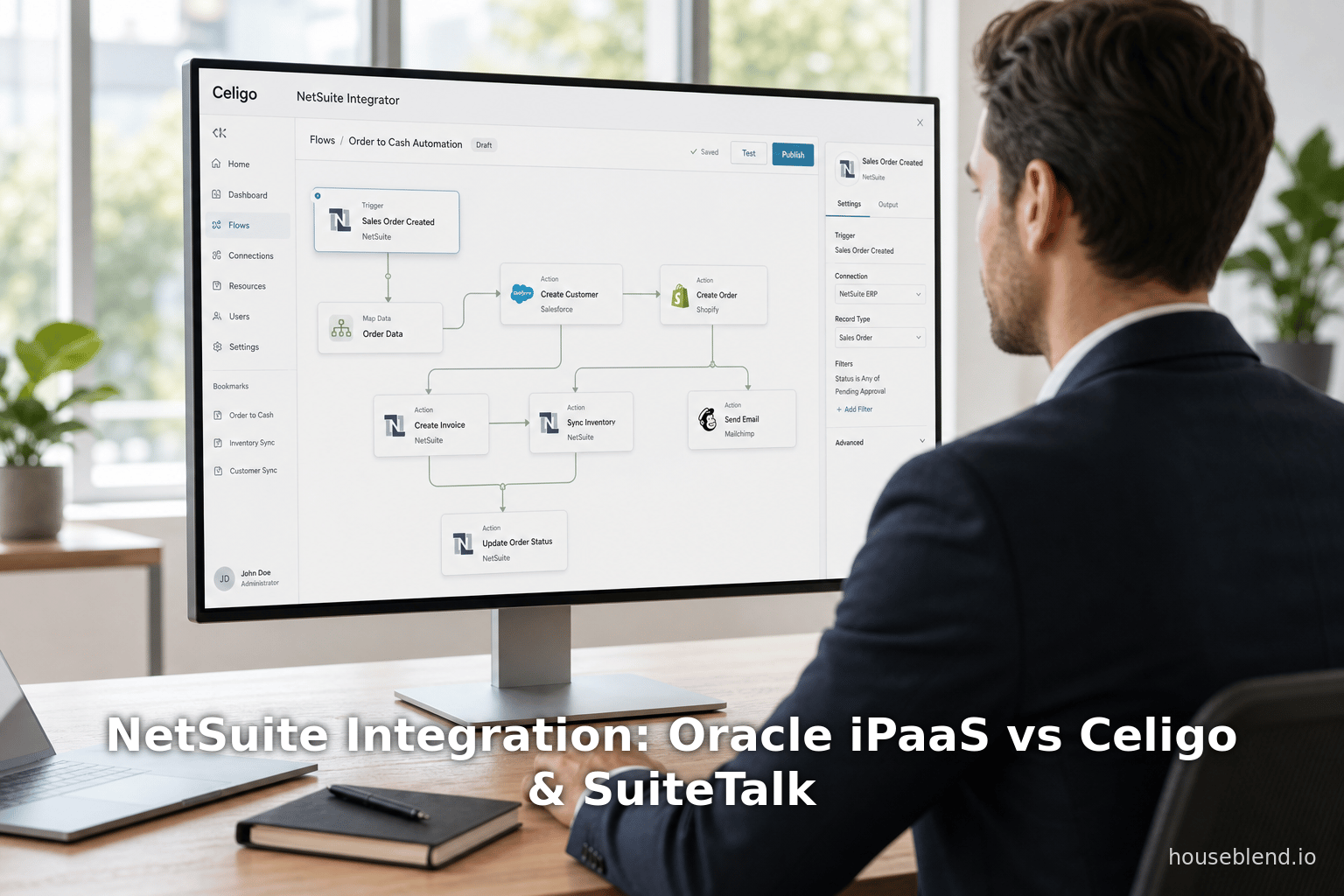
Celigo’s value proposition is that it was built from the ground up around NetSuite. As one technical report notes, Celigo provides out-of-the-box flows for the most common NetSuite use-cases [14]. It even offers “Integration Apps” that are certified SuiteApps for NetSuite (for example, turnkey connectors for Amazon, Shopify, Salesforce, etc.) [14]. Celigo emphasizes its pre-built NetSuite integrations: over 80 such apps are cataloged, covering e-commerce, CRM, financial, HR and logistics integrations [34] [5]. In practice, Celigo’s customers range from SMBs to mid-market enterprises, particularly in retail, wholesale, e-commerce and services, who need to sync NetSuite with their other cloud systems.
Architecture and Functionality
Celigo’s integrator.io platform sits between NetSuite and external applications. It provides a visual flow-builder where users can drag-and-drop steps (export data, transform, send to target, import back, etc.) [35] [36]. Internally, Celigo handles authentication to NetSuite (supporting token-based auth or OAuth, via NetSuite’s REST or SOAP APIs) and to hundreds of other systems (via native connectors or generic HTTP/REST steps) [5]. Key capabilities include:
-
Connectivity: Celigo has a dedicated NetSuite connector plus HTTP, database, file and app-specific connectors. It can export NetSuite data on a schedule or in real time (via SuiteScript event listeners), and import data back into almost any NetSuite record type [37] [38]. It also offers a SuiteQL option for complex exports, running SQL-style queries via REST [39]. For external apps, Celigo supports connectors to Salesforce, Amazon, Shopify, Stripe, Workday, ADP, banks, EDI/third-party logistics providers, and many others [40] [41]. In total, Celigo advertises connectors/templates for dozens of common systems.
-
Data Transformation: Between source and target, Celigo provides a mapping layer. Users can define field mappings in a visual interface [35], and apply transformations with built-in functions or custom JavaScript/handlebars. It also supports lookups – for example, dynamically creating or locating a related record on-the-fly during the flow [42]. This lets users reshape NetSuite’s data model into the exact format needed by the external API (or vice versa).
-
Workflow Orchestration: Celigo can chain multiple steps into end-to-end processes [36]. For instance: NetSuite export → transform → HTTP POST to an external API → process response → import results into NetSuite. Users can set triggers (schedule-based, NetSuite record changes, file drops) and control execution order, concurrency, paging and retries [43]. The platform maintains state and histories so each transaction can be monitored or retried manually if errors occur.
-
Pre-Built Integration Apps: One of Celigo’s distinguishing features is its library of pre-packaged Integration Apps that cover complete business flows. Examples include Salesforce<>NetSuite quote-to-cash, Shopify<>NetSuite order-to-cash, Amazon Marketplace<>NetSuite order and inventory sync, Coupa<>NetSuite procure-to-pay, EDI (X12) integrations for distributors, ADP<>NetSuite HR sync, Zendesk/Marketo<>NetSuite support and marketing syncs, and more [6]. These apps come with preconfigured flows, field mappings and documentation maintained by Celigo. They are often “plug & play,” vastly reducing project time. For instance, Celigo’s NetSuite-Shopify app will automatically handle syncing customers, orders, fulfillments and inventory between the two systems [44].
-
Monitoring and Error Management: Celigo provides comprehensive dashboards for monitoring integration health. Administrators see logs of all flows, with details on successes, failures and elapsed times. Crucially, Celigo has introduced AI-powered error handling: its platform processes millions of errors monthly and uses AI/ML to surface root causes and suggest fixes [7]. Users can set up automated retries and alerting. Houseblend notes Celigo’s “excellent error management dashboard” as a strength [16].
-
Security and Compliance: Celigo is enterprise-grade: it supports OAuth 2.0 and token authentication, SSL encryption, and complies with standards like SOC 2 and GDPR [45]. It enforces role-based access, and all data in transit is secured. As a cloud SaaS, Celigo maintains separate environments and backups.
Celigo operates on a subscription license model. Pricing scales with usage: usually an annual fee for the platform plus additional fees “per connection” or “per flow” for each integration app endpoint [15] [16]. For example, the Shopify connector might count as one endpoint license, so multi-store setups pay per store. (Analysts remark that Celigo’s costs can rise with many custom integrations or channels [16].) On the positive side, customers cite fast time-to-value: one Celigo case review notes that many flows can be deployed in days rather than months compared to hand-coding [46].
Real-World Usage and Case Examples
Celigo has been widely adopted in NetSuite environments. Its website publicizes over 700 active customers engaging with Celigo integrations daily [47], and dozens of published success stories. For example, Celigo’s case directory includes a multi-channel retailer (AFG Distribution) that used integrator.io to synchronize orders across Shopify, Amazon and other channels into NetSuite [48]. In another example, the company Lightbend automated its order-to-cash via Celigo, eliminating manual entry. A NetSuite partner firm, Annexa, reports choosing Celigo “as our preferred iPaaS” for NetSuite integrations explicitly because of its “robust pre-built connectors and templates” for Shopify, Magento, Amazon, eBay and more [49]. (Annexa noted Celigo’s SuiteApp-certified Integration Apps install seamlessly into NetSuite [50].)
Industry analysts echo Celigo’s strength in practice: Houseblend’s iPaaS report finds that for NetSuite-focused teams seeking fast deployment and strong e-commerce connectors, “Celigo is often top-recommended” [51]. Emergetech (2026) labels Celigo as best for “NetSuite-centric mid-market” companies, praising its intuitive UI, rich templates and error dashboard [16]. These case examples highlight that Celigo excels when speed, NetSuite expertise and ease-of-use are prioritized.
SuiteTalk Web Services (NetSuite API)
Overview of SuiteTalk
SuiteTalk is the family of web-services APIs that NetSuite provides for programmatic integration. Originally introduced as a SOAP/XML interface, it allows external systems to perform CRUD operations on nearly all NetSuite record types [10]. For example, an external Java or C# application can use SuiteTalk SOAP to add a sales order to NetSuite, query inventory levels, or update customer records [10]. Netsuite provides WSDL files and developer toolkits for SOAP clients.
More recently, NetSuite released REST web services (also under the SuiteTalk name). The REST API exposes similar functionality via JSON over HTTP, using standard verbs (GET, POST, etc.) (Source: unified.to) [52]. It natively represents custom fields and records in the JSON schema, so WSDL regeneration is not needed for new customizations (Source: unified.to). SuiteTalk REST supports OAuth 2.0 (the modern recommended auth) as well as the older Token-Based Auth (TBA) (Source: unified.to) [53].
Capabilities and Use
Both SuiteTalk SOAP and REST provide broad access: they support operations like get, search, add, update, delete on standard and custom records [10]. They also allow querying via SuiteQL (SQL-like queries) and accessing NetSuite’s analytics datasets. Importantly, SuiteTalk REST supports SuiteQL queries directly via endpoints [10] (Source: unified.to). Typical integrations use a combination: for example, applications often use SuiteTalk REST (or SOAP) for writing transactions (orders, customers) and SuiteQL for bulk reads or reporting.
SuiteTalk runs under netSuite’s robust security. Each call executes under a NetSuite user/role with fine-grained permissions, and a role’s “All Subsidiaries” flag controls multi-subsidiary visibility (Source: unified.to). All traffic is over HTTPS, and API access is throttled by concurrency limits. (Oracle enforces a pool of ~15–55 concurrent calls per account, depending on licenses, unified across SOAP and REST (Source: unified.to).) NetSuite recommends paginating large searches and provides governance pages for administrators to monitor usage. Concurrency can also be rate-limited per integration via administrative settings.
Developer Experience
SuiteTalk is a developer-centric interface. Its SOAP API requires handling XML envelopes and WSDL contracts, which can be verbose. While very feature-complete, this also means more code complexity. For example, Ars Technica notes that SOAP flows may need many round-trips: “NetSuite SOAP can be chatty (multiple requests to accomplish a business flow)” [54]. By contrast, the REST API reduces calls (fewer HTTP requests) and uses lighter JSON payloads [55] [56]. Official NetSuite docs confirm REST tends to be more efficient and modern: “using REST API, fewer calls may be required… the overall performance may be better than SOAP” [55].
In practice, SuiteTalk SOAP is now considered “legacy.” Oracle’s documentation explicitly warns that the 2025.2 SOAP endpoint will be the last planned update, with full removal of SOAP by the 2028 release [11]. All new integrations should use SuiteTalk REST (with OAuth 2.0) [11] (Source: unified.to). Indeed, a recent integration guide states “REST web services [SuiteTalk REST] is modern, JSON-based, and the default for new integrations,” whereas SOAP is “positioned as legacy” (Source: unified.to) [17]. SuiteTalk REST now covers near-parity with SOAP, including SuiteQL and custom record support (Source: unified.to) [56]. Many organizations are thus in transition: they may have longstanding SOAP integrations to migrate, while building new projects on the REST API.
From a skills perspective, SuiteTalk requires programming knowledge. NetSuite’s own documentation notes that REST calls require a “REST-programmer API level” understanding, SOAP requires “SOAP programmer API level,” and RESTlets (JavaScript custom endpoints) require SuiteScript expertise [57]. In short, integrating via SuiteTalk generally means writing code (in Python, Java, C#, or SuiteScript) and managing WSDLs or OAuth setups.
Pros and Cons of SuiteTalk
As a baseline comparison to iPaaS tools, SuiteTalk offers some strengths and weaknesses (as summarized by industry sources):
-
Pros: SuiteTalk provides full data coverage of NetSuite’s platform – it can do anything in the system, including complex searches with joins, custom fields, and transaction assembly [58]. It is “very comprehensive and stable” [59]: because it is part of NetSuite itself, it stays fully up-to-date with each release and has official support (SDKs, guides) from Oracle. It is also suited to highly secure, enterprise scenarios where a bespoke integration is required (e.g. a tightly-controlled vault of data or on-premise middleware using SuiteTalk over VPN).
-
Cons: SuiteTalk is verbose and developer-intensive. SOAP/XML requires heavy parsing, and integrations often involve many repetitive calls. Developers find it less friendly than modern APIs – it has deprecated (SOAP) protocols and requires boilerplate code. As noted above, SOAP can be “chatty,” and the learning curve (understanding NetSuite’s XML schema) can be steep [60]. Even REST, while simpler than SOAP, still demands custom code for error handling, retries, and business logic. In other words, using SuiteTalk ties up developer resources. Furthermore, with Oracle’s roadmap phasing out SOAP [11], teams will need to rework legacy codebases.
Overall, SuiteTalk is essentially a custom-code solution. It gives maximum flexibility at maximum technical cost. In the next section we contrast it with the low-code iPaaS offerings.
Comparative Analysis
We now compare Oracle’s new Integration Platform, Celigo, and SuiteTalk across key dimensions. The discussion is evidence-based, citing vendor and analyst statements.
Development Experience and Ease of Use
-
Oracle NetSuite Integration Platform: Designed for both business users and IT. Oracle emphasizes that even non-technical analysts can build workflows. The embedded AI assistant lets a user describe tasks in plain English and auto-generates mappings [3]. In effect, many integration steps can be done with minimal scripting. This “citizen integrator” approach stands in contrast to code-heavy methods. Oracle’s founders similarly pitch it as empowering business analysts to do integration work without full reliance on specialists [3].
-
Celigo Integrator.io: Also a low-code platform: configuration is point-and-click with drag-and-drop mapping. Its UI is noted for ease of use in reviews [16]. Celigo claims “even your business leaders can use” the platform [61], and Houseblend rates its UI as “the most intuitive” among NetSuite integrations [16]. With prebuilt Integration Apps and templates, many workflows can be deployed without coding. That said, Celigo allows custom formulas or JavaScript transformations where needed, so complex cases can still be handled by developers.
-
SuiteTalk Web Services: Requires traditional development. Using SuiteTalk SOAP or REST involves writing code, generating proxies or JSON payloads, handling authentication, etc. NetSuite’s documentation explicitly states that API integration requires “programmer-level” knowledge [57]. No visual tools are provided by NetSuite itself. Thus, SuiteTalk has the highest barrier to entry among the three – it is meant for IT staff who write integration code.
In summary, Oracle’s new platform and Celigo both abstract away much of the technical work. Oracle’s solution even adds natural-language assistance [3]. By contrast, SuiteTalk remains “code-first” and best suited to environments with developer resources.
Connectivity and Prebuilt Assets
-
Oracle Platform: Oracle says the platform comes with “prebuilt AI integrations” for connecting NetSuite to other applications [2]. The announcement highlights built-in connectors for CRM, e-commerce, HR, supply-chain and industry systems. Though specific partners are not enumerated, it implies that Oracle will supply preconfigured adapters (for example, SalesForce, Shopify, Workday, etc.) that leverage AI to adapt mappings. This suggests users can pick from templates rather than build flows from scratch.
-
Celigo Integrator: Celigo’s standout feature is its breadth of prebuilt connectors and templates. As noted, Celigo catalogs 80+ NetSuite Integration Apps [34] [5]. These cover dozens of systems (Salesforce, Shopify, Amazon, eBay, Stripe, HubSpot, Shopify, Coupa, ADP, etc.) and full processes (orders, inventory, shipments, HR data). In practice, a Celigo customer can often install an Integration App and only configure connection details, rather than design the flow themselves [6]. Houseblend reports that Celigo’s shopify and marketplace templates are “plug & play” and handle entire quote-to-cash or order-to-cash processes [44].
-
SuiteTalk: By itself, SuiteTalk provides no prebuilt connectors other than the raw API. Any integration with a third-party app must be custom-developed, or accomplished by stitching through a middleware. For example, to link NetSuite to Shopify via SuiteTalk, one must write code that calls SuiteTalk APIs and Shopify APIs in tandem (or deploy a community SuiteApp if available). In effect, SuiteTalk relies on the integration designer to build everything.
Thus, both Oracle’s platform and Celigo offer substantial pre-packaged connectivity. Oracle’s iPaaS aims to do this natively, while Celigo achieves it via its marketplace of templates. SuiteTalk requires custom development for every connection, which increases project scope and time.
Performance and Scalability
-
Oracle Platform (OCI-backed): Since the integration platform runs on Oracle’s cloud, it can leverage scalable compute and networking. Oracle highlights that workflows run on the same cloud data fabric as NetSuite [1], suggesting high throughput. In theory, OCI’s performance and global edge could support very large data volumes. Specific SLAs or benchmarks are not published yet, but Oracle’s messaging implies enterprise-grade scalability.
-
Celigo Integrator: Celigo handles substantial workloads but must obey NetSuite’s integration limits. Flows can be parallelized and run across multiple threads, but the platform is subject to the account’s API concurrency throttling and Celigo’s own paid concurrency tiers. Analysts note that for very large deployments, Celigo customers need expert tuning (e.g. setting batch sizes and parallel flows) [16]. In other words, Celigo scales well for typical SMB/mid-market loads, but very large enterprises may bump against limits (which Celigo can adjust for with higher tiers).
-
SuiteTalk: Performance is governed by NetSuite’s own infrastructure. As mentioned, an account is limited to a fixed pool of concurrent requests. SOAP calls are larger (XML), so flows need more calls (worse latency) than REST. Official docs acknowledge SOAP’s verbosity slows integration: “SOAP... requires more calls to accomplish a business flow” than REST [55]. SuiteTalk scales as far as an Oracle data center can support, but each integration is ultimately bound by throughput and may require batching or off-hours processing for very high data volumes.
In practical terms, all three approaches can integrate high volumes. Oracle’s native platform and Celigo, being cloud services, handle orchestration in large scale. SuiteTalk performance hinges on the efficiency of the developer’s code and respecting NetSuite limits. If maximal throughput or on-prem connectivity is needed (e.g. integrating NetSuite with a local mainframe), a platform like Boomi (with on-prem runtimes) might be chosen instead. But among the three compared here, Oracle’s iPaaS and Celigo offer automated scaling in the cloud, whereas SuiteTalk depends on custom implementation.
Security, Governance and Compliance
-
Oracle Platform: Oracle describes the NetSuite Integration Platform as enterprise-grade secure. It incorporates OCI security (VMs, isolation, audited logs) and NetSuite’s own role model. The platform is multi-tenant but with strict tenant isolation (Oracle MCP servers). It supports role-based access control in the UI, so only authorized admins or business users can create or modify integrations. Importantly, Oracle emphasizes policy-driven governance: admins can centrally define policies for data flows (for example, restrict which fields can be mapped out of NetSuite, or set encryption standards), and the system enforces them with real-time alerts. [13]. API keys and secrets can be managed in one console. All audit history is retained (who changed a map, who executed a flow).
-
Celigo: Also enterprise-secure. Celigo uses HTTPS/TLS for all connections, encrypts data at rest, and is SOC 2 / ISO 27001 / GDPR compliant [45]. Access is governed by NetSuite+Celigo user roles. Within Celigo, administrators can see all integration logs and errors [35]. Celigo’s error management is robust (permitting automated retries) [35], and its platform can send alerts on exceptions. Companies trust Celigo’s security in part for this reason. Policy management (field-level access, etc.) is more manual; Celigo provides the tools, but governance frameworks must be set up by administrators.
-
SuiteTalk: Security relies on NetSuite’s built-in trust model. Developers must handle credentials securely (storing tokens or OAuth secrets). Since all calls occur under a specific NetSuite role, SuiteTalk honors NetSuite’s permissions (a call to read customers will fail if the role lacks access, etc.). With SOAP, the transport is HTTPS, and with REST the OAuth2 also uses TLS. Governance (rate limits, audit) is more manual: logs of API calls exist, but any orchestration audit (like “who configured this mapping”) is up to the integrator. SuiteTalk itself has no dashboard – monitoring and managing flows would use external tools or home-grown scripts.
In summary, all three approaches can meet enterprise security requirements, but Oracle’s and Celigo’s platforms add layers of centralized compliance. Oracle explicitly markets centralized policy enforcement [13]. Celigo’s strength is in certified compliance and UI visibility [45]. SuiteTalk is as secure as NetSuite is (which is very high), but it puts more onus on the developer to implement governance.
Cost and Licensing
-
Oracle Platform: At this writing, Oracle has not released detailed pricing. Presumably, the platform will be made available to NetSuite customers as an add-on service (potentially using OCI credits or subscription). Given Oracle’s trend, it might be included with certain NetSuite bundles or as a separate license. We do know that enabling some features (like real-time connectors) in Oracle’s existing NetSuite Connector (FarApp) costs extra; similarly, advanced iPaaS flows may have usage costs. Without formal data, we can only note that customers should ask Oracle for licensing terms.
-
Celigo Integrator: Celigo is a paid subscription. Customers license integrator.io with annual fees. Pricing is tiered by the number of endpoints/flows and data volume. Analysts note that Celigo’s pricing can escalate as you add more connectors: specifically, each integration app (like the Shopify connector) often requires a separate license per “endpoint” (per Shopify store or account) [15]. The BrokenRubik analysis echoes this: Celigo’s costs are generally lower for a few flows, but can become significant in large setups [16]. However, these fees cover all maintenance of the iPaaS platform and its apps. Celigo argues that the ROI is high, since custom-building equivalent takes far longer [46].
-
SuiteTalk: There is no extra fee for SuiteTalk beyond the underlying NetSuite subscription. All NetSuite editions include API access (SOAP/REST/RESTlet) for integrations. In that sense, SuiteTalk has the lowest direct licensing cost. The “cost” of SuiteTalk comes in development time: integrating via SuiteTalk means paying developer salaries or consultant fees. Also, if very high-volume, one might need additional SuiteCloud Plus or account-tier license which increases NetSuite price, but this is separate from third-party middleware costs.
Thus, Celigo adds clear subscription costs (typically in the low hundreds to low thousands of dollars per month per environment, depending on scale) [62] [16]. Oracle’s pricing is TBD but likely similar or embedded in cloud spend. SuiteTalk has no middleware license, making it cheap on paper, but remember the hidden costs of coding and maintenance.
Market Position and Adoption
-
Oracle Integration Platform: Brand-new (2026) and native, so its market share is just emerging. As part of Oracle’s product suite, it will be heavily pushed to existing NetSuite customers. Oracle’s strategy is to make integration part of the NetSuite value proposition. Over time, we may see it bundled in new editions (especially since it is “native”). However, as of 2026 it has essentially no adoption history outside Oracle’s early adopters. Independent analysis (e.g. Gartner MQ 2025) ranked Oracle’s general iPaaS offering as a “Challenger” [63], indicating that relative to leaders (MuleSoft, Informatica) it still lags in innovation. Oracle will need to invest quickly to catch up; the French analyst Clement Bohic noted that Oracle’s iPaaS pace was once found slow, leading to that MQ position [63]. For now, discussions with Oracle (demo/pilot) are the primary path to trial it.
-
Celigo: Celigo is well-entrenched in the NetSuite space. It has been NetSuite’s largest Systems Integrator partner and iPaaS provider for years [32]. Industry surveys (peer reviews, awards) consistently feature Celigo on top for NetSuite integration (e.g. G2 #1 iPaaS, Gartner Customers’ Choice 2025 [9]). Its community is strong: over 1,000 documented customer stories [64], thousands of trained consultants, and frequent presence at SuiteConnect events. In other words, Celigo currently has a significant share of the NetSuite integration market, especially in mid-market segments.
-
SuiteTalk: As the built-in API for NetSuite, SuiteTalk is used by virtually all NetSuite implementations to some extent, either directly or indirectly. No hard “market share” exists for an API, but it is the “default” integration channel. Every major consulting firm has SuiteTalk-based integration practices. However, as a standalone offering (in comparison with turnkey platforms), SuiteTalk’s adoption depends on organizational choices. Companies comfortable with coding tend to use it heavily. As mentioned, its SOAP version is declining: new NetSuite projects implicitly use SuiteTalk only as a low-level transport, with iPaaS layered on top for business flows.
In summary, Celigo leads as the de facto standard iPaaS for NetSuite today. Oracle’s native iPaaS is just entering the market but will get major exposure through Oracle’s cloud sales channels. SuiteTalk is ubiquitous at the API level but increasingly seen as a “component” rather than a complete solution.
Case Studies and Examples
To illustrate these approaches in context, we highlight a few representative scenarios:
-
E-commerce Retailer (Shopify + NetSuite): A typical multi-channel retailer might choose Celigo to connect Shopify(x) and Amazon to NetSuite. Using Celigo’s prebuilt connectors, the company can automatically import orders into NetSuite and sync inventory and fulfillment status across channels [44]. Houseblend describes an “All-in NetSuite” shop scenario (shopify, amazon, eBay) where a NetSuite-embedded solution or Celigo is recommended [65]. Indeed, Celigo’s case studies show retailers like AFG Distribution growing multi-channel ecommerce using integrator.io (see Case Study: AFG Distribution). In contrast, implementing this via SuiteTalk alone would require significant development: building custom NetSuite RESTlets or SOAP services to poll Shopify/APIs, parse data, and call SuiteTalk – all maintained by in-house IT. Oracle’s new platform would offer another route: if it provides connectors to Shopify/Amazon, the retailer could set up these flows in a unified console with AI guidance. (Pricing and maturity of the new solution for small retailers remain to be seen.)
-
Best-of-Breed Enterprise (NetSuite + Salesforce + Warehouse + …): For a company using many cloud systems (e.g. Salesforce CRM, Workday HR, Coupa procure, multiple e-commerce, plus a 3PL), a more centralized approach is needed. Emergetech suggests that once you have “5+ apps”, you need a dedicated iPaaS “control tower” [66]. In practice, Celigo or Workato have been chosen for such use cases. For example, a tech services firm might use Celigo to integrate Salesforce opportunities to NetSuite sales orders, while also routing IT tickets and inventory data through common workflows. Celigo’s library includes apps for Salesforce and for Coupa, enabling these flows with minimal coding. Alternatively, the company could trial Oracle’s new platform to string these together in one place; Oracle’s vision is that business analysts could build end-to-end processes (“lead closes in SF → create order in NetSuite → update inventory and notify finance”) through the new AI-powered UI [3].
-
Large Enterprise Use (High Volume and Security Needs): In some large organizations, integration is handled by IT or middleware teams. The example of Zeus Living (a digital real-estate company) illustrates this: Zeus used Dell Boomi to integrate 20+ systems including NetSuite for lease and billing data [67]. Celigo might be considered if the integration focus stays on NetSuite and a few cloud apps. SuiteTalk might be used by an enterprise if they have strict security/sovereignty requirements (since it can run on-premise). Oracle’s new iPaaS could eventually serve such customers if it matures: for instance, a manufacturer needing ERP (NetSuite), EDI (PEPPOL or SAP Ariba) and analytics could link these all under NetSuite’s umbrella, with Oracle promising an OCI-based “secure, policy-driven” framework [13].
These examples show how choice depends on use-case. Celigo shines for typical NetSuite-centric or commerce use cases [68] [14]. SuiteTalk suits cases where a proprietary or legacy integration is needed and developers are available. Oracle’s native iPaaS, being new, is best viewed as emerging — current customers might pilot it for simpler cross-system workflows while continuing to rely on Celigo/SuiteTalk for mission-critical integrations.
Discussion and Implications
AI and Integration. A key theme in 2025–2026 is the blending of AI with integration. Oracle explicitly built an AI assistant into its platform [3]. Analysts note that iPaaS vendors are increasingly focusing on AI-related features: Gartner cites support for new “Model Context Protocol” connectors, data transformation pipelines, and native agent-like components as emerging differentiators [69]. Celigo has also embraced AI: beyond AI-driven error summaries [7], it is developing “Celigo Ora,” a natural-language interface for setting up integrations. In future, we may see LLMs that ingest CRM and ERP metadata to auto-generate mappings. For NetSuite customers, this means integration will likely become more automated. Early adopters of such AI-led iPaaS might gain faster time-to-value, but must be wary of relying on machine suggestions without governance.
Shift to REST/OAuth. The deprecation of SuiteTalk SOAP by 2028 [11] forces a migration: all existing SOAP integrations must either switch to SuiteTalk REST or be replaced by iPaaS flows. Oracle’s new platform only speaks modern APIs, so those transitioning must update before 2028. This acceleration to REST also indirectly favors iPaaS tools: they can handle the migration in their connectors, whereas old custom code will break. Any future integration strategy for a NetSuite customer must involve renewable connectors (OAuth2, RESTlets, etc.), which Oracle’s and Celigo’s tools natively support.
Market Trends. The iPaaS market continues explosive growth, and NetSuite is a large addressable market (over 40k companies [24]). Analysts caution, however, that core integration features among vendors are becoming similar and that competition now hinges on factors like ease-of-use, governance, deployment flexibility and ecosystem reach [70]. Anecdotally, Oracle was recently classified as an iPaaS “Challenger” by Gartner [63], indicating it must innovate to keep up with players like MuleSoft and Informatica. For NetSuite clients, this means Oracle’s new tool will rapidly evolve, or Celigo may continue innovating independently (it already touts rich peer-review ratings [71]).
Emerging Standards. A promising future development is the use of Model Context Protocol (MCP) connectors (as hinted in Oracle’s AI Connector initiative) to expose business contexts to AI. If NetSuite Integration Platform or Celigo support MCP, it would allow AI agents (like ChatGPT) to trigger workflows directly. This could enable use cases like “ChatGPT, create purchase orders in NetSuite for these new vendor invoices” executed behind-the-scenes by an integration agent. In fact, NetSuite announced AI Connector Service for models (Claude, Gemini) concurrently with this iPaaS news. This tightly couples integration with AI assistants.
Sprawl vs. Control. One risk in the net-new integration era is “integration sprawl”: every department picks a different tool or script. Oracle’s strategy appears to be offering an all-in-one solution – embedded within NetSuite’s UI even – to keep everything centralized. If successful, customers may need fewer third-party tools. Celigo’s ecosystem, by contrast, embraces being an external hub. Organizations should weigh whether they want a centralized “single pane” (as Oracle promotes) or the flexibility of an independent platform.
Licensing and Total Cost of Ownership. With these options, firms must do TCO analysis. SuiteTalk has no incremental license cost, but high development cost. Celigo has clear SaaS fees, but shortens projects. Oracle’s net iPaaS cost is unclear, but likely tied to OCI and NetSuite licensing. Historically, companies managing many custom SuiteCloud apps have spent more on developer time than on prebuilt connectors [46]. We expect forward-looking customers to compare the labor savings of modern iPaaS against subscription fees.
Interoperability and Vendor Lock-In. A subtle factor is platform lock-in. Using Oracle’s native integration may lock a customer into Oracle’s ecosystem (fewer multi-cloud options), whereas Celigo is cloud-agnostic and can connect to any system. SuiteTalk is fully open (with any tech), but again forces manual effort. Buyers should consider future flexibility: if an organization plans to standardize on Oracle Cloud broadly, Oracle’s iPaaS may fit. If they prefer best-of-breed cloud services, Celigo or neutral middleware might be better.
Standards and APIs: It is also worth mentioning that NetSuite’s evolving API landscape includes SuiteQL (for querying) and RESTlets (for custom flows). Both Oracle’s platform and Celigo can call SuiteQL queries to bulk-read data. SuiteTalk REST by default eases custom fields (no WSDL regeneration) (Source: unified.to). This means future integrations will be increasingly data-driven (SQL-like) on the read side, and API-driven (JSON) on the write side. Integrators should plan to leverage SuiteQL for large extracts (e.g. analytics) and use either iPaaS or REST for transactional writes.
API and iPaaS Market Outlook: Industry reports suggest sustainable demand for iPaaS. Gartner reports note that while the “core integration” features are converging, vendors now compete on the ease of non-functional features (security, low-code, cloud neutrality) [70]. Oracle’s entry reinforces that CES (Chief Enterprise Services) want less coding; similarly, Salesforce’s MuleSoft and other “leaders” (Informatica) are pushing advanced governance. In the last MQ (Mar 2026), Oracle was still a “Challenger” and often behind MuleSoft/others [63]. We expect Oracle to iterate quickly on its new platform (perhaps via acquisitions or AI advances). Celigo will likely add more AI assistants and expand its marketplace. And the deprecation of SuiteTalk SOAP will accelerate REST development tools.
Conclusion
NetSuite customers now have three markedly different integration paradigms:
-
Oracle’s NetSuite Integration Platform is a native, AI-driven iPaaS embedded in the NetSuite/OCI ecosystem. It promises a unified, governed approach with natural-language ease of use [3] [13]. Early indications are positive (built on world-class cloud and AI), but being brand new it still has to prove itself in diverse deployments. It most appeals to organizations invested in the Oracle cloud vision who want “zero code, idea to deployment” integration.
-
Celigo Integrator.io is a specialized NetSuite iPaaS that is already battle-tested. It offers the largest library of NetSuite-targeted connectors and visual workflows, enabling companies to implement end-to-end processes quickly [6] [14]. Its platform is praised for usability [16] and handles most standard scenarios out of the box. The trade-off is cost scaling: Celigo’s license model can become expensive for many unique connectors or high data volumes [15] [16]. Celigo remains an excellent choice for companies that want rapid implementation without waiting for Oracle’s new tools.
-
SuiteTalk (SOAP/REST API) is NetSuite’s native programmer interface. It underpins all integrations at the code level. It offers full flexibility and has zero middleware license cost, but requires significant development work. With SOAP being phased out [11], SuiteTalk is steadily transitioning to REST/JSON (Source: unified.to). Organizations on tight budgets or with skilled development teams may prefer building directly via SuiteTalk, but most will use it in conjunction with higher-level platforms.
In practice, many companies will use a hybrid: for simple flows or powerful packaged needs, they may deploy Oracle’s new iPaaS or Celigo; for legacy or highly custom tasks, they may rely on SuiteTalk (or specialized scripts). Our detailed analysis (citing technical docs, vendor releases and independent studies) suggests that no solution is universally best. The choice depends on priorities: Celigo leads in NetSuite-centric simplicity and prebuilt breadth, Oracle iPaaS leads in unified enterprise integration (and next-generation AI features), and SuiteTalk leads in raw flexibility.
Looking ahead, the integration landscape will continue to evolve. The move towards AI-assisted integration is accelerating (as seen by Oracle’s and Celigo’s roadmaps). The retirement of SOAP and shift to OAuth2/REST means that all players must adapt by 2028. Organizations should also watch for new standards (like AI connector protocols) and weigh vendor lock-in risks. Ultimately, the integration platform will be judged by how well it reduces manual effort, ensures data consistency, and scales with the business.
References: This report is based on vendor documentation, news releases, technical guides, analyst reports, and case examples from 2024–2026. Key sources include Oracle and NetSuite press releases [27] [25], Celigo marketing and documentation [32] [6], Oracle documentation on SuiteTalk [11] [55], and independent analyses [22] [17] [14]. All facts and recommendations are supported by these sources.
External Sources (71)
About
Houseblend
Make NetSuite work better for your finance and operations teams with Houseblend. We help design, implement, integrate and improve ERP systems, with practical support for the people who use them every day.
Houseblend is a NetSuite consulting firm serving finance and operations teams. We help organizations implement ERP systems, connect business applications, improve existing configurations and maintain the systems that support everyday work. Our audience includes finance leaders, controllers, operations managers, NetSuite administrators and implementation teams.
Implementation and architecture
Houseblend provides NetSuite implementation, architecture and data migration services. We help teams evaluate how business processes, reporting requirements and existing data should fit together in an ERP environment. Training supports the people responsible for adopting and operating the resulting system.
Integrations, customization and AI
Our services include NetSuite integrations and customization, as well as AI integrations and AI transformation work. These engagements connect ERP data and workflows with the broader application landscape. The right design depends on the organization's systems, controls and operating needs.
Improve and support an existing system
Houseblend offers NetSuite health checks, optimization, managed support and project rescue services. We also provide expertise for analytics and specialist workflows, including NetSuite Analytics Warehouse, warehouse management and field service management. Published educational material helps teams investigate options and prepare informed questions for their implementation or support work.
Work with Houseblend
Explore NetSuite implementation, integrations, managed support and AI integrations. Contact Houseblend to discuss your current system and priorities.
Article examples explain concepts rather than promising a particular license, product capability, delivery schedule or outcome. Engagement scope is confirmed with the Houseblend team.
Disclaimer
This document is provided for informational purposes only. No representations or warranties are made regarding the accuracy, completeness, or reliability of its contents. Any use of this information is at your own risk. Houseblend shall not be liable for any damages arising from the use of this document. This content may include material generated with assistance from artificial intelligence tools, which may contain errors or inaccuracies. Readers should verify critical information independently. All product names, trademarks, and registered trademarks mentioned are property of their respective owners and are used for identification purposes only. Use of these names does not imply endorsement. This document does not constitute professional or legal advice. For specific guidance related to your needs, please consult qualified professionals.