Houseblend Article
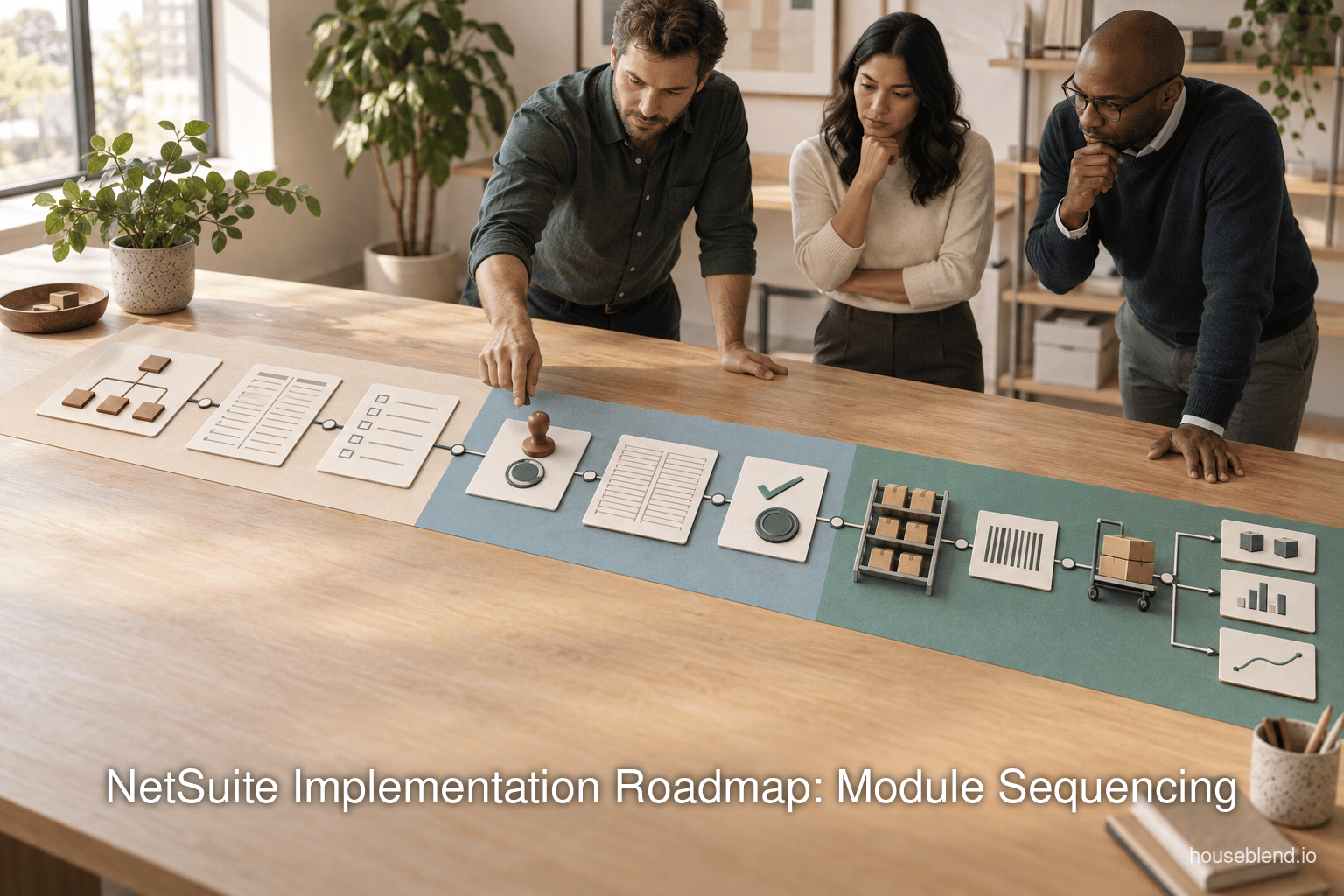
NetSuite Implementation Roadmap: Module Sequencing
Summary
- 01Sequence implementation by dependencies: establish foundations, launch the transactional core, then add capabilities that consume reliable upstream outputs.
- 02Use phase gates rather than calendar dates: launch requires proof across data, transactions, controls, operations, and people.
- 03Choose launch patterns by in-scope process and readiness, and defer capabilities tied to unsettled inputs or operating controls.
- 04Readiness scoring is a planning indicator, not a probability, and critical stop conditions still require separate judgment.
Inside this article
- 01Executive Summary
- 02Introduction and Background
- 03Key Changes
- 04NetSuite Module Dependency Matrix
- 05Rollout Patterns and Decision Rules
- 06Implementation Considerations and Process Changes
- 07Data Analysis and Evidence
- 08Case Studies and Real-World Examples
- 09Implications and Future Directions
- 10Frequently Asked Questions (FAQs)
- 11Conclusion
Executive Summary
A defensible NetSuite implementation roadmap starts with dependencies, not a catalog of modules. The minimum viable launch is the smallest scope that can post, reconcile, secure, and report the transactions the business must run on day one. Everything else should enter a later wave only when its upstream data, configuration, transactions, integrations, owners, and controls are demonstrably ready. NetSuite itself recognizes staged rollouts in which high-priority modules or processes precede later additions [1].
This report uses three dependency classes. A hard product prerequisite is enforced or explicitly required by NetSuite. An implementation prerequisite is not necessarily enforced, but proceeding without it creates unusable outputs or rework. A recommended operational predecessor makes the next capability safer and more useful. The distinction matters. For example, cycle counting before WMS is an operational recommendation: ASCM describes cycle counting as a way to identify items in error [2], while a peer-reviewed study found 65% of 370,000 inventory records across 37 stores were inaccurate [3].
The recommended sequence is foundation, transactional core, then dependent capabilities. Foundation work establishes the chart of accounts, legal entities, currencies, tax design, customers, vendors, items, locations, roles, integrations, and reporting ownership. Finance-first companies can then stabilize general ledger, accounts payable, accounts receivable, and cash management, which NetSuite describes as foundational capabilities [4]. Distribution-first companies add controlled order, receipt, commitment, fulfillment, and inventory flows before WMS or planning. Services-first companies stabilize projects, time, expense, billing, and revenue rules before automation. Multi-entity companies must design subsidiaries, currencies, tax nexuses, eliminations, and consolidation before attempting a OneWorld close.
No universal readiness percentage exists. ISO guidance says thresholds should be pertinent to the business and each object [5]. The practical score in this report is therefore completed required gates divided by applicable required gates, used as a planning indicator, not a probability of success. Go-live requires evidence behind the score: reconciliations, signed test exits, volume and integration tests, approved access, trained users demonstrating proficiency, and named data and report owners. Microsoft’s implementation guidance calls for completed test cycles with exit criteria and business sign-off [6].
Introduction and Background
The question “which NetSuite modules should be implemented first?” is easy to answer badly. A features list treats every capability as independent. A licensing list confuses commercial entitlement with deployment readiness. A big-bang plan assumes that enabling a feature, migrating data, training users, and proving the close can all become ready at the same instant.
The more useful question is: what must already be true before a capability is safe and useful? Oracle’s implementation planning guidance calls for governance, redesigned-process maps, and data-migration plans [7]. NetSuite’s implementation lifecycle moves through discovery and planning, design, development, testing, deployment, and support [8]. A module roadmap overlays capability dependencies on that lifecycle.
In that distinction, NetSuite implementation phases describe the delivery lifecycle, while NetSuite module implementation order describes dependency. The matrix answers which NetSuite modules to implement first by converting a NetSuite modules list into a NetSuite phased implementation strategy. Its gates turn the resulting NetSuite implementation sequence into a controlled NetSuite rollout roadmap, with NetSuite implementation best practices expressed as evidence rather than slogans.
This analysis is vendor-neutral about sequencing judgment while remaining product-specific about documented NetSuite prerequisites. It does not infer that a public module name is included in a customer’s subscription. NetSuite says modules must be licensed before their functionality can be enabled [9]. Product names, SuiteSuccess packaging, country availability, editions, and contractual entitlements must be checked against the current Oracle order form.
Houseblend is a direct provider of NetSuite implementation, rescue, architecture, integration, and managed support, rather than a competing module vendor. Its site describes implementation, rescue, and optimization services [10] and experience with advanced NetSuite modules such as WMS [11]. That makes solution architecture and sequencing relevant first-party perspectives, but the matrix below remains a scoping aid, not licensing advice.
Key Changes
Change One: Replace the module list with dependency classes
Every proposed capability should receive one of three labels:
-
Hard product prerequisite: A documented feature, record, status, or entitlement must exist first. WMS feature flags and ARM Accounting Periods are examples.
-
Implementation prerequisite: The platform may allow configuration, but trustworthy use depends on defined data, process, ownership, controls, or integration behavior.
-
Recommended operational predecessor: The earlier capability is not technically mandatory, but it reduces ambiguity, manual work, or control risk.
This prevents teams from presenting preferences as product rules. Advanced Revenue Management Essentials, for example, explicitly requires Accounting Periods [12]. Stable transaction and approval design is a separate implementation prerequisite that should be proved with representative scenarios.
Change Two: Treat phase zero as production design
Phase zero is not preliminary administration. It defines the production vocabulary and control model. Treasury’s Standard General Ledger combines a uniform account structure with technical guidance [13]. The implication is not that a private company should copy a government chart. It is that account purpose, hierarchy, ownership, and posting rules belong in one governed design.
Phase zero also names owners for customer, vendor, item, location, employee, project, account, and reporting definitions. UK readiness guidance expects data owners and stewards to be in place [14]. GS1’s data model aims to simplify and harmonize master-data exchange [15]. Those principles support common identifiers and definitions before applications exchange records.
Change Three: Gate waves with evidence, not dates
A calendar milestone says when the team hopes to launch. A phase gate says what must be proven. Acceptance criteria should be testable, measurable, and complete [16]. UK service-readiness guidance asks for test plans, results, and analysis against acceptance criteria [17].
Useful evidence includes:
-
Data: Record counts, control totals, duplicates, valid codes, exceptions, and owner approvals.
-
Transactions: Complete, approved scenarios from source event through accounting and reporting.
-
Controls: Segregated roles, least privilege, approvals, audit evidence, and monitored exceptions.
-
Operations: Volume tests, cutover rehearsal, support ownership, and rollback decisions.
-
People: Role-based training, demonstrated proficiency, adoption measures, and manager support.
NetSuite Module Dependency Matrix
Table 1 is a copyable, source-noted sequencing asset. “Never” means not justified for the stated use case, not permanently prohibited. “Owner” is the accountable business role, not necessarily the system administrator.
| Capability or module | Business decision | Upstream master data | Required configuration | Dependent transactions | Integrations | Owner | Dependency label | Suggested wave | Phase-gate evidence | Edition or region caveat | Source, verified 2026-09-21 |
|---|---|---|---|---|---|---|---|---|---|---|---|
| Core financials | What books, dimensions, periods, approvals, and reports define the control model? | Accounts, entities, customers, vendors, tax codes | Periods, posting rules, roles, approvals | Journals, bills, invoices, receipts, payments | Banks, expenses, payroll as applicable | Controller | Implementation prerequisite for all later finance | Phase 1 | Reconciled opening trial balance; bill-to-pay and invoice-to-cash tests; signed reports | Confirm localized tax and statutory needs | Foundational capabilities include GL, AP, AR, and cash management [4] |
| OneWorld and consolidation | Which legal entities are in scope, and where are eliminations performed? | Subsidiaries, currencies, tax nexuses, accounting dimensions | Hierarchy, base currencies, elimination subsidiaries, rates | Intercompany, revaluation, consolidation, close | Tax, payroll, banking, local systems | Group controller | Hard and implementation prerequisites | Phase 0 to 1 | Approved entity tree; currency and nexus map; dry-run consolidated close | Address country determines edition and tax nexus [18] | IFRS consolidation scope follows control [19] |
| Advanced Revenue Management | Which contracts and modifications require allocation and recognition? | Customers, items, prices, fair values, contracts | Accounting periods, rules, approvals, mappings | Approved sales orders, invoices, returns, credits | CPQ, CRM, billing | Revenue controller | Hard product plus implementation prerequisite | Phase 2 | Scenario set produces expected arrangements, plans, postings, and disclosures | Revenue Allocation requires ARM Essentials | Oracle documents the feature dependency [20] |
| Fixed Assets Management | Which asset classes, books, methods, and capitalization rules apply? | Asset register, classes, locations, employees | Required SuiteCloud features, accounts, depreciation rules | Purchases, proposals, transfers, depreciation, disposal | Procurement, tax, maintenance | Fixed-assets accountant | Hard product plus operational predecessor | Phase 2 | Register reconciles to GL; sample assets calculate as approved | Confirm SuiteApp availability and local tax treatment | Required account features must be enabled [21]; placed-in-service facts matter [22] |
| Procurement and three-way match | Which spend needs purchase orders, receipts, and tolerance review? | Vendors, items, units, locations, terms | Approval routing, receiving, matching rules | Purchase order, item receipt, vendor bill | Procurement, expense, banking | Procurement lead and AP manager | Recommended operational predecessor | Phase 1 or 2 | Matched and exception scenarios post correctly; owners clear queues | Confirm features and permissions in account | The workflow compares bill, order, and receipt [23] |
| Advanced inventory | Which stocking dimensions and controls are operationally necessary? | Items, units, lots, serials, locations, bins, statuses | Costing, replenishment, commitment, counts | Receipts, transfers, adjustments, fulfillment | Ecommerce, 3PL, WMS, planning | Inventory controller | Implementation prerequisite for WMS and planning | Phase 1 | Physical-to-system reconciliation; negative and exception review; cycle-count process | Capability naming does not prove entitlement | ASCM defines reconciliation as matching records with physical product [24] |
| WMS | Which facilities need directed mobile receiving, picking, staging, and waves? | Clean items, locations, bins, statuses, units, barcodes | WMS SuiteApps, prerequisite features, strategies, mobile roles | Approved, committed orders; receipts; waves; pick tasks; fulfillments | Carriers, automation, 3PL, devices | Warehouse operations lead | Hard product plus operational predecessor | Phase 2 | End-to-end volume test from receipt through fulfillment; inventory reconciles | Feature may require provisioning | Approved orders are required [25] |
| Demand and supply planning | What demand signals, policies, horizons, and exceptions drive action? | Item-location combinations, lead times, calendars, bills, sources | MRP, planning preferences, supply types, demand inputs | Sales, work, purchase, transfer, forecast transactions | Commerce, suppliers, forecasting tools | Planning lead | Hard product plus implementation prerequisite | Phase 2 | Back-test and exception review; planned orders trace to approved inputs | Confirm planning feature entitlement | Input data must be free of errors, missing values, and inconsistencies [26] |
| Manufacturing | Which products require work orders, routings, WIP, costing, and quality? | Assemblies, bills of material, work centers, calendars, cost templates | Work orders, WIP, routing, costing, completion rules | Builds, issues, completions, scrap, variances | MES, PLM, shop-floor devices | Manufacturing controller and operations lead | Hard product and implementation prerequisites | Phase 2 | Representative build closes with expected quantities, costs, and variances | Confirm module combination and localized needs | Routing imports require predecessor records [27] |
| Quality Management | Which inspections, specifications, sampling, and disposition rules are required? | Items, vendors, locations, specifications | Inspection contexts, queues, roles, workflows | Receipts, builds, fulfillments, nonconformance | Supplier quality, lab or MES where applicable | Quality owner | Implementation prerequisite | Phase 2 or never | Triggered inspections route, record, and report correctly | Confirm SuiteApp and process fit | Process is defined by inspections and specifications [28] |
| SuiteProjects | Which project structures drive time, expense, billing, revenue, margin, and staffing? | Customers, projects, resources, skills, rates, tasks | Time and expense, billing rules, approvals, accounting | Time, expense, charges, invoices, project journals | PSA, CRM, payroll | Services operations and controller | Implementation prerequisite | Phase 1 for services-first, otherwise Phase 2 | Quote-to-cash project scenarios reconcile to project and GL reports | Confirm entitlement and naming | SuiteProjects connects project activities with project accounting [29] |
| SuiteCommerce | Which catalog, pricing, customer, tax, order, and fulfillment model is authoritative? | Items, categories, customers, prices, inventory availability | Site, domains, tax, payments, order and fulfillment rules | Cart, order, payment, fulfillment, return | Payment, tax, search, carriers | Commerce owner | Recommended operational predecessor | Phase 2 or never | Representative customer journeys reconcile to orders, cash, tax, and inventory | Confirm product, countries, payments, and contract | Ecommerce is unified with NetSuite order processing [30] |
| SuitePeople or HR capabilities | Which employee records and workflows belong in NetSuite? | Employees, organizations, jobs, compensation, time policies | Confidential access, workflows, approvals, retention | Hire, change, time, leave, payroll interfaces | Payroll, benefits, identity | HR owner | Implementation prerequisite | Phase 2 or never | Confidential-access tests and employee scenarios approved | Country and payroll coverage require verification | Administrators can be restricted from confidential data [31] |
| SuiteAnalytics Connect and reporting | Which decisions require governed datasets, extracts, and reports? | All governed masters and dimensions | Roles, datasets, driver, extracts, refresh, report catalog | Posted and operational records | BI warehouse and planning tools | Reporting owner | Hard technical plus implementation prerequisite | Phase 1 for statutory reports, Phase 2 for broad analytics | Reports tie to source and GL; refresh and access tests pass | Driver and connector licensing must be confirmed | A Connect driver must be installed [32] |
| SuiteTalk, REST, SuiteScript, Celigo, or other integrations | Which system owns each field, event, retry, and exception? | Stable identifiers and ownership across systems | Authentication, permissions, concurrency, monitoring, replay | API records and business events | Every named endpoint | Integration owner | Hard account features plus implementation prerequisite | Phase 0 to 2, aligned to dependent process | Volume, failure, replay, duplicate, reconciliation, and security tests pass | API limits, features, and third-party contracts vary | Web services require relevant features [33] |
The matrix shows why “modules list” and “implementation order” are different artifacts. Some rows, such as WMS and ARM, contain documented platform prerequisites. Others, such as commerce and project automation, mainly depend on business design and stable upstream transactions. “Phase 2” is not lower value. It means the capability consumes outputs that Phase 1 must first make reliable.
The corresponding dependency graph is deliberately simple:
Governance + owners + licensed scope
                |
Legal entities + chart + roles + master data + integrations
                |
Core finance + required operational transactions
        |               |                 |
       ARM       inventory and orders   projects and time
                        |                 |
                 WMS + planning      services automation
                        |
              manufacturing + quality
A calendar milestone says when the team hopes to launch. A phase gate says what must be proven.
Rollout Patterns and Decision Rules
Table 2 compares four common launch patterns and one implementation-support option. The patterns are design choices, not Oracle-prescribed packages, and the support row is not a software product.
| Pattern | Launch now | Defer | Avoid for this use case | Disqualifying condition for go-live |
|---|---|---|---|---|
| Finance-first | Core GL, AP, AR, cash, tax, necessary banking and reporting | ARM, fixed assets, advanced close automation, procurement extensions | WMS, manufacturing, commerce, or HR without an in-scope process | Opening balances do not reconcile; posting, payment, collection, tax, or close scenarios fail |
| Distribution-first | Core finance plus items, locations, purchasing, receipts, orders, commitments, fulfillment, inventory control | WMS until location and bin discipline is proven; planning until item-location inputs are trusted | Manufacturing where no work-order process exists | Physical stock does not reconcile; order and receipt statuses cannot support downstream transactions |
| Services-first | Core finance plus customers, projects, resources, time, expense, billing, and required revenue treatment | Resource optimization, advanced analytics, or HR expansion until base project flows stabilize | Inventory-heavy capabilities without stocked operations | Project billing, time approval, revenue, and GL results do not reconcile |
| Multi-entity/global | OneWorld foundation, subsidiaries, currencies, tax nexuses, intercompany, eliminations, close and consolidation | Local extensions and optional operational modules until the group close works | A single-entity design that must later be restructured for known subsidiaries | Entity tree, base currencies, local requirements, eliminations, or consolidation scope remain unsigned |
| Houseblend-supported delivery | Apply the selected pattern with scoped NetSuite planning, architecture, implementation, integration, or rescue support [34] | Defer capabilities under the same dependency and evidence rules | Treating consulting support as a module, entitlement, or substitute for Oracle product terms | The customer and delivery team have not assigned decision rights, evidence owners, and acceptance authority |
The finance-first pattern works when the immediate objective is a controlled book of record. The distribution-first pattern broadens that core because inventory balances are created by purchasing, receipt, transfer, commitment, fulfillment, return, and adjustment transactions. The services-first pattern substitutes project, resource, time, expense, billing, and revenue dependencies for physical inventory. The multi-entity pattern pulls OneWorld design into phase zero because entity, currency, tax, elimination, and consolidation choices shape the group close.
Use three decision rules for each candidate capability:
-
Launch now when it is required to execute or account for an in-scope day-one process, every required predecessor is ready, and evidence passes.
-
Defer when the capability has value but depends on unsettled data, transactions, ownership, integrations, controls, or user behaviors.
-
Avoid for this use case when no accountable owner, recurring decision, required transaction, or measurable acceptance outcome exists.
Deferral is not merely scope reduction. It can preserve design integrity. High-quality inputs are essential for meaningful forecasts [35]. Launching planning before item-location policies and demand inputs are governed produces activity, not necessarily useful supply recommendations.
- Launch core GL, AP, AR, cash, tax, necessary banking and reporting.
- Do not go live if opening balances or core accounting scenarios fail.
- Launch core finance with items, locations, purchasing, orders, fulfillment, and inventory control.
- Do not go live if physical stock or downstream transaction statuses do not reconcile.
Implementation Considerations and Process Changes
Data and migration
Migration should be managed as a controlled conversion, not a file upload. The UK Government Data Quality Framework separates completeness, uniqueness, consistency, timeliness, validity, and accuracy [36]. A field can be complete and still be wrong. That distinction is essential for accounts, tax codes, units, locations, payment terms, and integration identifiers.
Required migration evidence should include:
-
Population control: Source and target counts by object and status.
-
Financial control totals: Opening balances and subledger totals tied to approved sources.
-
Field quality: Validity, uniqueness, consistency, timeliness, completeness, and accuracy measures with object-specific thresholds.
-
Lineage: Source, transformation, target, owner, and exception disposition.
-
Rehearsal: Multiple timed conversions using the production method and representative volumes.
GSA guidance calls for validation and reconciliation reports to be designed and unit tested during mock conversion [37]. Western Australia’s data-pipeline architecture compares record counts, control totals, quality results, lineage, latency, and consumer queries (Source: adr.dtt.digital.wa.gov.au). NSW guidance makes sampling proportional to business risk (Source: nsw.gov.au). Together, these support full-population control totals plus risk-based record inspection.
Roles, controls, and integrations
Security design must follow business duties. NIST defines least privilege as restricting access to the minimum necessary for assigned tasks [38]. Separation of duties addresses the potential abuse of authorized privileges [39]. A roadmap should therefore require named role owners, task justification for privileged access, approval and posting separation where applicable, and negative tests showing prohibited actions are blocked.
Integrations need the same discipline. For every interface, record the system of record, keys, transformations, timing, authentication, retry behavior, duplicate prevention, reconciliation, monitoring, and support owner. NetSuite applies an account governance limit to the combined total of web-services and RESTlet requests [40]. That makes aggregate concurrency testing more meaningful than testing each interface alone.
Testing, training, and cutover
Each test cycle should be a small rehearsal of the scoped operation, combining code, configuration, master data, and migrated data [41]. Test with real data and integrations where security permits [42]. Required scenarios should cover happy paths, approvals, reversals, corrections, period boundaries, failures, duplicate events, permissions, volume, reconciliation, reports, and support handoffs.
Training is not attendance. NetSuite recommends developing training materials in parallel with software development [43]. A peer-reviewed study surveyed 170 ERP users [44] and found that supervisor support and transfer motivation positively influenced training transfer [45]. Accordingly, the gate should ask users to complete representative work, resolve exceptions, and explain escalation routes. PMI also identifies impact assessments, stakeholder engagement, training programs, and change-management methods as core strategies [46].
Data Analysis and Evidence
The roadmap uses a deliberately transparent metric:
Readiness score = completed required gates / applicable required gates
If a wave has 20 applicable required gates and 17 are complete, its readiness score is 17 / 20 = 85%. This is an original worked calculation, not an industry benchmark. It does not mean the wave has an 85% probability of success. A single incomplete hard prerequisite can still block launch, so the score must be accompanied by a stoplight for each critical gate.
Table 3 is the scoring worksheet. Teams should expand each row into named tests and retain the evidence link.
| Gate family | Required evidence | Completed | Applicable | Stop condition |
|---|---|---|---|---|
| Product and contract | Ordered capability, provisioned feature, prerequisite flags, country and edition check | 2 | 2 | Any required entitlement or hard product prerequisite absent |
| Master data | Named owners, approved values, duplicates resolved, object thresholds met | 3 | 4 | Critical account, entity, item, location, currency, tax, or identifier unresolved |
| Configuration | Signed design and configuration traceability | 2 | 2 | Configuration cannot be traced to an approved decision |
| Transactions and accounting | End-to-end scenarios, reversals, exceptions, period boundaries, reconciliation | 3 | 4 | Material scenario fails or does not reconcile |
| Integrations and volume | Authentication, mapping, retry, duplicate, aggregate load, monitoring | 2 | 3 | Dependent interface or recovery test fails |
| Controls and access | Role owner, least privilege, segregation, approval, audit evidence | 2 | 2 | Unauthorized action succeeds or required duty cannot be performed |
| People and support | Proficiency demonstration, support rota, runbooks, escalation | 3 | 3 | No accountable production owner or critical role cannot execute |
| Total | Original illustrative worksheet | 17 | 20 | 85% is informative, not sufficient if a stop condition remains |
The worksheet’s denominators must be local. ISO makes data-quality thresholds business-specific and object-specific [5]. A government example calculates 98% completeness from 294 present values among 300 expected values, while explicitly separating completeness from correctness [47]. A NetSuite team might therefore set different thresholds for active vendors, historical addresses, serialized inventory, and optional marketing attributes.
External evidence also illustrates why gates should measure behavior rather than documents. The inventory study cited earlier found 65% inaccuracy in a large retail record population [48]. A later simulation study found cycle counting reduced inventory record inaccuracy across all modeled warehouse types (Source: prod.org.br). Neither result supplies a universal NetSuite threshold. Both support reconciling inventory and proving a repeatable correction process before WMS or planning relies on the data.
Change evidence needs similar caution. Prosci’s provider-sponsored 2023 benchmark covered more than 10,800 respondents in 101 countries and reported a correlation between change-management effectiveness and objective attainment [49]. It should not be converted into a causal probability for a NetSuite project. The safer application is to measure proficiency, active use, process compliance, manager reinforcement, and unresolved support demand.
Deferral is not merely scope reduction. It can preserve design integrity.
Case Studies and Real-World Examples
Distributor adding WMS and planning (Hypothetical Example)
Consider a mid-market distributor with two warehouses, ecommerce orders, purchase receipts, serialized items, and a current inventory ledger that requires frequent manual corrections. It wants core NetSuite, WMS, and planning in one program.
Phase zero defines accounts, tax, customers, vendors, items, units, locations, serial rules, inventory statuses, roles, source-system ownership, integrations, and reporting. Global Location Numbers may be encoded in barcodes or RFID tags for automatic location identification [50], but the example does not require that standard unless trading partners or process design justify it.
Phase one launches finance and controlled distribution transactions: purchase orders, receipts, vendor bills, sales orders, commitment, picking or fulfillment, returns, transfers, adjustments, payments, and reporting. Inventory is physically reconciled by location. Cycle counts and exception ownership are operating. Interfaces prove retry and duplicate behavior. The phase does not yet rely on WMS-directed work or planning recommendations.
Phase two A introduces WMS after the hard prerequisites in Table 1 are confirmed. Orders must be approved, have eligible statuses, and contain committed quantities before wave release. Acceptance evidence includes representative receipts, putaway, replenishment, waves, pick tasks, staging, fulfillment, reversals, mobile permissions, label scans, peak volume, and inventory reconciliation.
Phase two B introduces planning after item-location policies, supply types, lead times, calendars, bills, demand inputs, and exception ownership are stable. The team back-tests recommendations against known periods, reviews outliers, and traces planned orders to approved inputs.
This sequence does not claim that WMS must always precede planning. It says both consume item-location and transaction data, while WMS additionally depends on warehouse execution and product prerequisites. The business can reverse the two subwaves if planning has clean inputs and a stronger near-term decision need.
Defines accounts, tax, customers, vendors, items, locations, roles, integrations, and reporting.
Launches finance and controlled distribution transactions while inventory is physically reconciled by location.
Introduces WMS after hard prerequisites are confirmed and orders meet release conditions.
Introduces planning after item-location policies, demand inputs, and exception ownership are stable.
Implications and Future Directions
The central governance implication is that module sequencing is a portfolio of evidence-backed decisions. The steering committee should not approve “WMS” or “ARM” as a label. It should approve a capability, its prerequisites, owner, dependent transactions, integrations, acceptance evidence, unresolved caveats, and operational support model.
Four practices make the roadmap durable:
-
Maintain the dependency register: Revisit classifications when Oracle documentation, account provisioning, or process design changes.
-
Separate contract truth from public taxonomy: Public pages help identify capability families, but the order form governs entitlement.
-
Version acceptance evidence: Store test runs, reconciliations, decisions, approvals, and exception dispositions with the release.
-
Review after every NetSuite release and quarterly: Reconfirm product names, prerequisites, country support, integration behavior, and deferred-wave assumptions.
Governance should continue after go-live. The 2025 GAO Green Book organizes internal control into five components and 17 principles [51]. A NetSuite owner can adapt that structure into a recurring review of role design, transaction controls, reconciliations, monitoring, and change approval without treating the framework as NetSuite-specific implementation instructions.
Forecasting and automation will make input governance more important, not less. AWS guidance says high-quality data is essential for meaningful predictions and forecasts [35]. Teams should therefore resist adding planning, artificial intelligence, or broad analytics merely because the functionality is available. The roadmap should connect every capability to a recurring decision, known data lineage, accountable owner, and measurable output.
Frequently Asked Questions (FAQs)
What are the main NetSuite implementation phases?
A practical lifecycle is discovery and planning, design, development, testing, deployment, and support, matching NetSuite’s published framing [52]. Capability waves sit inside that lifecycle. Phase zero creates shared foundations, Phase one launches the minimum viable transactional core, and Phase two adds capabilities whose prerequisites are proven.
Which NetSuite modules should be implemented first?
Implement the capabilities required to operate and control day-one transactions first. For most organizations that includes core financials, master data, roles, required integrations, and reporting. Add inventory and order processes for distributors, project and time processes for services firms, and entity, currency, tax, elimination, and consolidation design for multi-entity groups. The exact sequence follows dependencies, not a universal ranking.
Is a phased NetSuite implementation better than a big-bang rollout?
Neither is universally superior. Microsoft defines phased rollout as releasing application features to production over time [53]. Phasing is useful when a later capability consumes data or transactions that the earlier wave must stabilize. A coordinated launch can be appropriate when end-to-end processes cannot be split safely and every dependency passes.
Can WMS launch with core NetSuite?
Yes, if the prerequisites and operational evidence are ready. Product prerequisites include Bin Management and Advanced Bin/Numbered Inventory Management. Operationally, item, location, bin, status, unit, commitment, order approval, mobile, and fulfillment behavior must be proven. If those conditions are not ready, deferring WMS avoids forcing warehouse complexity into the core launch.
When should Advanced Revenue Management launch?
Launch ARM when accounting periods, transaction approval, source contract data, items, prices, fair-value logic, mappings, and revenue scenarios are stable. ARM Essentials requires Accounting Periods, and Revenue Allocation depends on ARM Essentials. A company with simple day-one revenue may defer it. A company whose required financial reporting depends on it may need it in the core wave.
How should readiness be scored?
Use completed required gates divided by applicable required gates, disclose the denominator, and show each critical stop condition separately. Do not interpret the result as a probability. Thresholds should be set for the business and each measured object, consistent with ISO’s object-specific approach [54].
What should be taken into an Oracle or partner scoping session?
Bring the current order form, entity and process scope, volume profile, integrations, data-quality results, close and reporting requirements, control model, owners, target waves, and the matrix’s unresolved caveats. Ask:
-
Which named products and SuiteApps are licensed and provisioned in this account?
-
Which prerequisites are enforced by the platform, and which are implementation conventions?
-
Which countries, editions, taxes, payments, payrolls, or localizations constrain the design?
-
Which transaction statuses and records feed each dependent capability?
-
Which migration, performance, security, reconciliation, and user tests prove acceptance?
-
Who owns each master, report, integration, exception queue, and production decision?
Conclusion
The strongest NetSuite implementation roadmap is a dependency map with evidence gates. It begins with ownership, licensed scope, legal entities, chart of accounts, master data, roles, integrations, and reporting. It then launches the minimum set of financial and operational transactions needed to run the business. ARM, WMS, planning, manufacturing, quality, projects, commerce, HR, and broader analytics enter only when their hard product, implementation, and operational predecessors are ready.
The four launch patterns provide a starting point, not a prescription. Finance-first prioritizes a controlled book of record. Distribution-first adds inventory and order execution. Services-first centers projects, people, time, billing, and revenue. Multi-entity/global moves OneWorld, currencies, tax, intercompany, eliminations, and consolidation into the foundation.
Finally, readiness is not a date and not a single percentage. It is a body of evidence: reconciled data, traceable configuration, complete transactions, tested integrations, controlled access, demonstrated user proficiency, named ownership, and support readiness. The scoring worksheet helps expose incomplete work, while critical stop conditions preserve judgment. Because packaging and functionality change, teams should verify the matrix against current Oracle documentation, the specific customer order form, and a functional consultant before each wave. The matrix is a scoping aid, not Oracle licensing advice.
External Sources (54)
About
Houseblend
Make NetSuite work better for your finance and operations teams with Houseblend. We help design, implement, integrate and improve ERP systems, with practical support for the people who use them every day.
Houseblend is a NetSuite consulting firm serving finance and operations teams. We help organizations implement ERP systems, connect business applications, improve existing configurations and maintain the systems that support everyday work. Our audience includes finance leaders, controllers, operations managers, NetSuite administrators and implementation teams.
Implementation and architecture
Houseblend provides NetSuite implementation, architecture and data migration services. We help teams evaluate how business processes, reporting requirements and existing data should fit together in an ERP environment. Training supports the people responsible for adopting and operating the resulting system.
Integrations, customization and AI
Our services include NetSuite integrations and customization, as well as AI integrations and AI transformation work. These engagements connect ERP data and workflows with the broader application landscape. The right design depends on the organization's systems, controls and operating needs.
Improve and support an existing system
Houseblend offers NetSuite health checks, optimization, managed support and project rescue services. We also provide expertise for analytics and specialist workflows, including NetSuite Analytics Warehouse, warehouse management and field service management. Published educational material helps teams investigate options and prepare informed questions for their implementation or support work.
Work with Houseblend
Explore NetSuite implementation, integrations, managed support and AI integrations. Contact Houseblend to discuss your current system and priorities.
Article examples explain concepts rather than promising a particular license, product capability, delivery schedule or outcome. Engagement scope is confirmed with the Houseblend team.
Disclaimer
This document is provided for informational purposes only. No representations or warranties are made regarding the accuracy, completeness, or reliability of its contents. Any use of this information is at your own risk. Houseblend shall not be liable for any damages arising from the use of this document. This content may include material generated with assistance from artificial intelligence tools, which may contain errors or inaccuracies. Readers should verify critical information independently. All product names, trademarks, and registered trademarks mentioned are property of their respective owners and are used for identification purposes only. Use of these names does not imply endorsement. This document does not constitute professional or legal advice. For specific guidance related to your needs, please consult qualified professionals.