Houseblend Article
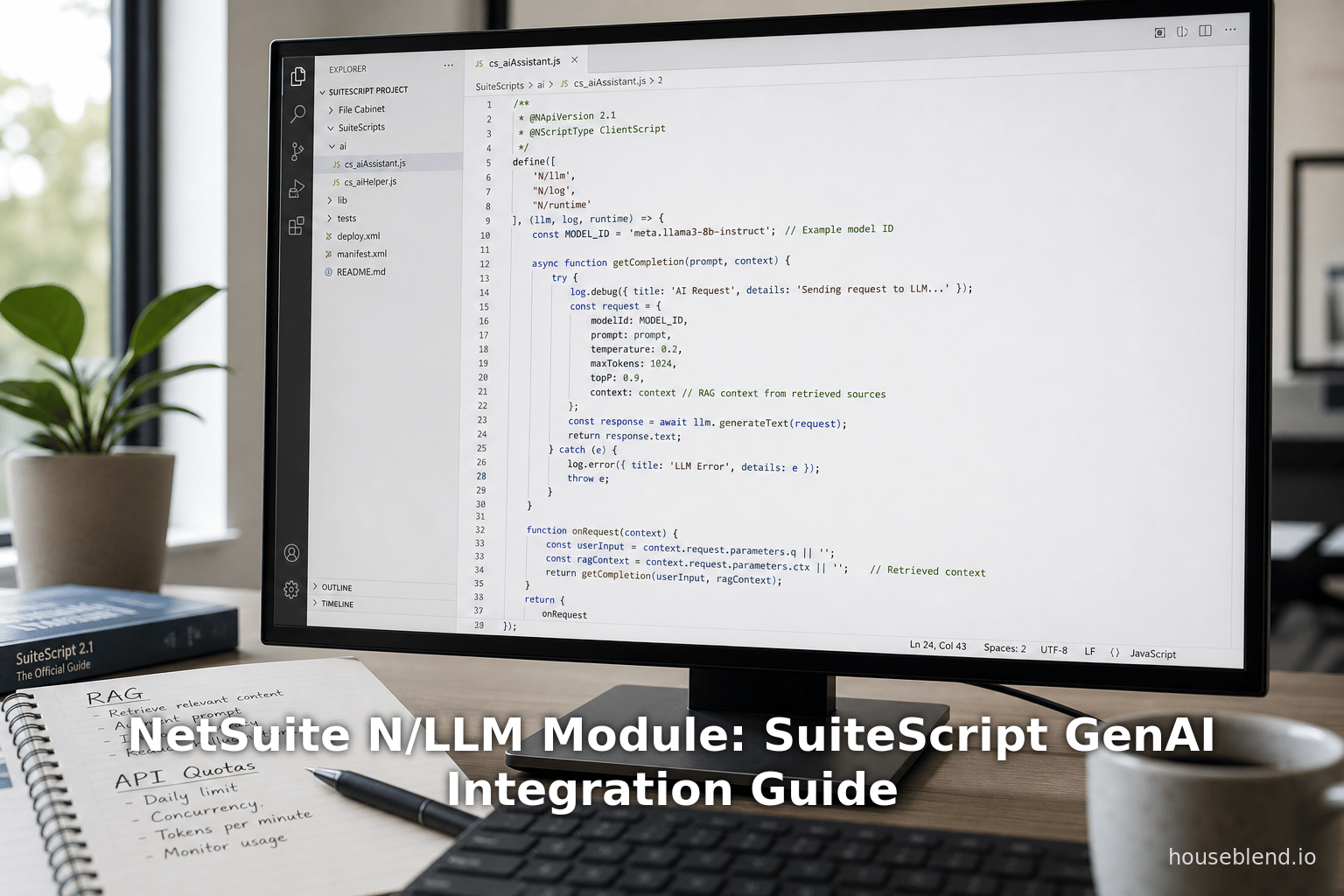
NetSuite N/LLM Module: SuiteScript GenAI Integration Guide
Inside this article
- 01Executive Summary
- 02Introduction and Background
- 03NetSuite N/LLM Module: Technical Overview
- 04Usage Limits and Governance
- 05Example Use Cases and Benefits
- 06Data Privacy, Security, and Best Practices
- 07Data Analysis and Performance Considerations
- 08Discussion, Implications, and Future Directions
- 09Conclusion
- 10References
Executive Summary
Oracle NetSuite’s new N/LLM SuiteScript module (introduced in 2024) brings large-language-model (LLM) and generative AI (GenAI) capabilities natively into the NetSuite ERP platform. It allows SuiteScript developers to call Oracle Cloud Infrastructure’s generative AI services directly from NetSuite scripts, enabling on-demand text generation, chatbots, summarization, intelligent search, and more, all grounded in a customer’s own data. Key features include content generation (llm.generateText), prompt evaluation (llm.evaluatePrompt), vector embeddings (llm.embed), and retrieval-augmented generation (RAG) by supplying NetSuite documents to the LLM. The module supports streamed responses (llm.generateTextStreamed), integration with Prompt Studio (shared prompt templates), and usage governance (monthly free quotas and concurrency limits. By default, NetSuite provides each account a free monthly pool of LLM tokens (separate quotas for generation vs. embeddings) [1]. Developers can monitor this via APIs (llm.getRemainingFreeUsage(), llm.getRemainingFreeEmbedUsage()) or the AI Preferences page [1] [2], and can also configure their own OCI credentials for unlimited usage (billed to the customer) [3] [1].
This report provides a comprehensive integration guide to the N/LLM SuiteScript module. We review NetSuite’s AI strategy and the context for embedding generative models in ERP systems; detail the technical architecture and API (methods, parameters, limits, and example code); explore sample use cases (chatbots, report summarization, semantic search, intelligent field completion, etc.) including case studies of NetSuite customers; and discuss governance, data privacy, and future directions. We cite official documentation, third-party analyses, industry statistics, and real-world examples. In particular, we show how N/LLM enables “mini-RAG” within NetSuite – scripts can query transaction data (via SuiteQL or searches), build “source documents” from that data, and pass them with prompts so the LLM’s responses are grounded in the customer’s own records [4] [5]. This grounded approach mitigates hallucination and boosts relevance [4] [6].
Key findings:
- Capabilities: The N/LLM module introduces a rich SuiteScript API (Table 2) including methods like
llm.generateText(options)for free-text generation,llm.chat(options)alias for conversational prompts,llm.evaluatePrompt(options)for executing stored Prompt Studio templates,llm.embed(options)for obtaining vector embeddings, and utilities such asllm.createDocument()(to construct RAG context) andllm.getRemainingFreeUsage()(to check quotas) [7] [8]. Streaming variants (generateTextStreamed,chatStreamed,evaluatePromptStreamed) allow processing tokens as they arrive, reducing latency [9]. The API also includes chat-specific objects (llm.ChatMessage,llm.ChatRole) for building conversation sessions [10] [8]. - Governance: Oracle enforces strict usage controls. Each account (and separate SuiteApp) gets a monthly free pool of LLM calls for text generation and a separate pool for embedding calls [1] [2]. By default, calls draw from these free quotas (which reset monthly), but customers can link an external OCI Generative AI credential to shift calls to that account’s quota (and billing) for unlimited usage [1] [3]. A technical limit of 5 concurrent calls applies per script for generation methods and 5 for embedding methods [3] [1]. Exceeding quotas or concurrency produces errors that scripts must handle. Administrators can track usage on NetSuite’s AI Preferences page, which shows monthly breakdowns by type (Generate vs. Embed) [3] [2].
- Integration & Best Practices: The module is designed for privacy and security. Importantly, the LLM has no direct access to an account’s data unless it is explicitly provided via script [11] [12]. Oracle’s security design keeps generative AI calls on OCI under role-based access, and no customer data is shared with model providers or other tenants [12]. Best practices (as documented by Oracle and consultants) include passing only vetted, non-sensitive data to the LLM and always validating outputs for accuracy [11] [13]. N/LLM compliments other NetSuite AI modules (e.g. N/documentCapture or N/machineTranslation, see Table 1) and tools like Prompt Studio, which lets admins define reusable prompts and actions that can be invoked via
llm.evaluatePrompt[14] [8].
Case studies and industry analyses reinforce the potential of N/LLM. For example, Houseblend magazine notes that NetSuite customers such as BirdRock Home (a high-volume retailer) and Overture Promotions have already used AI/ML on their NetSuite data to gain “actionable strategy improvements” [15].BirdRock’s CEO reports processing “thousands of orders daily” in NetSuite, an ideal setting for AI-driven forecasting and insights [16] [17]. More broadly, survey data show explosive GenAI adoption: Gartner found that by late 2023 roughly 29% of organizations had live GenAI deployments (up from <5% in 2022), with an expected >80% of enterprises using GenAI APIs or applications by 2026 [18] [19]. McKinsey projects that generative AI could add $2.6–4.4 trillion annually to the global economy, doubling the impact of prior AI generations [20] [21]. However, experts caution that without careful integration and strong data governance, most generative AI pilots fail to deliver measurable ROI [22] [23]. In NetSuite’s case, harnessing N/LLM effectively requires planning (e.g. structuring data into prompts, controlling supply of sensitive fields, testing outputs) and aligning with corporate AI strategy and compliance standards [22] [24].
In summary, NetSuite’s N/LLM module represents a powerful new frontier in ERP customization. It embeds cutting-edge LLM technology directly into the SuiteCloud ecosystem, enabling new automation and intelligence while keeping data governance intact. This report delves deeply into its features, illustrates practical examples, and considers the broader implications for businesses using NetSuite ERP.
Introduction and Background
NetSuite and the Rise of Generative AI
Oracle NetSuite is a leading multi-tenant cloud ERP platform that centralizes an enterprise’s data across financials, CRM, inventory, commerce, and more [25] [26]. Its unified data architecture — often called “Suiteness” — means, as Oracle’s SVP of Development notes, that “all business data and workflows in one system” provides an ideal foundation for AI-driven insights [27] [28]. Over 40,000 organizations use NetSuite worldwide, processing high transaction volumes and rich master data (customers, items, transactions, etc.) that are ripe for machine intelligence [27] [28].
Meanwhile, generative AI has rapidly transformed IT and enterprise software. The public breakthrough of LLMs like ChatGPT (2022) and competitive offerings (Anthropic Claude, Google Gemini, etc.) has demonstrated that AI can perform many cognitive tasks — drafting text, answering questions, summarizing documents — with human-level fluency [20] [19]. Analysts project dramatic impacts: McKinsey (2023) estimates GenAI could contribute roughly $2.6–4.4 trillion per year globally, roughly doubling prior AI’s value [20] [21]. In just 2023–2025, both software vendors and business users have embraced GenAI at an unprecedented pace. Gartner reported that by late 2023 nearly 30% of surveyed organizations had already deployed GenAI solutions, up from <5% in 2022 [20]. Further studies forecast that over 80% of enterprises will use GenAI applications or APIs by 2026 [20]. However, many companies also report that simply “using AI tools” has not yet translated into bottom-line gains [21] [19], likely because effective integration and execution remain challenging.
Enterprises have responded by embedding intelligence throughout business applications. Major ERP and CRM platforms have announced AI-powered features: predictive analytics, automated document processing, and conversational agents. Oracle NetSuite has aggressively “AI-enriched” the suite: executives emphasize AI as “table stakes” and stress that NetSuite’s centralized data unlocks distinctive opportunities. For instance, at SuiteWorld 2023, Oracle announced NetSuite Text∗Enhance, a generative feature that uses company data to auto-populate or improve free-form fields across finance, HR, supply chain, and more [29] [30]. At SuiteWorld 2024, dozens of new AI-powered capabilities were introduced (SuiteAnalytics Assistant, narrative reporting, anomaly detection, etc.) with an emphasis that these are embedded at no additional license cost [31] [30]. Evan Goldberg (Oracle NetSuite EVP) stated: “We’ve embedded AI at the core of the suite… and are now adding more generative AI capabilities… at no additional cost” [30] [32]. By February 2025, NetSuite’s roadmap included advanced agents (in CPQ, SuiteAnswers), a Prompt Management API, and wide use of generative models to streamline workflows [33] [34].
Within this broader AI initiative, the N/LLM SuiteScript module is the centerpiece. Announced in 2024 and rolled out in 2025, N/LLM gives developers programmatic access to LLM services right inside their JavaScript code. In effect, it lets any SuiteScript (User Event, Suitelet, RESTlet, etc.) “talk to a large language model” as part of normal business logic. Oracle documentation describes it as a SuiteScript 2.1 module that “brings generative AI power into your NetSuite SuiteScript environment” [35]. The module is built on Oracle’s OCI Generative AI platform (currently leveraging Cohere models) and integrates tightly with NetSuite’s data and governance features [1] [1].
The timing and motivation are clear: as enterprises rapidly adopt GenAI across functions, enabling native LLM calls in ERP scripts lets companies leverage enterprise data in intelligent workflows. Unlike third-party tools, this approach “locks in” the LLM within NetSuite’s secure environment. Data never leaves NetSuite except via explicit prompts, alleviating data governance concerns. As Oracle notes, no customer data is shared with external model providers; each company’s queries run on OCI’s multi-tenant infrastructure under strict access controls [12]. In short, N/LLM embeds cutting-edge AI where it has the most context — with the company’s own records — while maintaining enterprise-grade security.
This report will examine the N/LLM module in detail. We begin by reviewing NetSuite’s AI strategy and the role of generative AI in ERP (Section 2). We then describe the technical architecture of N/LLM (Section 3) and outline its SuiteScript API methods, parameters, and limits (Section 4). We provide code examples illustrating how to call the LLM, use embeddings, and perform RAG. Next, we analyze real-world use cases and case studies (Section 5), showing how organizations can apply N/LLM for tasks like natural-language querying of data, automated reporting, intelligent chatbots, and more. Section 6 discusses practical considerations—usage quotas, data privacy, compliance, and best practices. Finally, we assess future directions (Section 7) and conclude with recommendations. Throughout, we cite official NetSuite documentation, industry analyses, and examples to substantiate all claims.
NetSuite N/LLM Module: Technical Overview
AI Modules in NetSuite
NetSuite provides several built-in SuiteScript modules for AI and automation tasks, as summarized in Table 1. The new N/LLM module is specifically for generative AI:
| SuiteScript AI Module | OCI Service Used | Description |
|---|---|---|
| N/llm | OCI Generative AI | Accesses large language models for on-demand text generation, Q&A, summarization, and other tasks. Supports sending prompts (with optional context documents) to LLMs and returns AI-generated responses that can be written back into NetSuite records [8] [36]. |
| N/documentCapture | OCI Document Understanding | Performs OCR and structured data extraction from documents (PDFs, images, receipts) [36]. Useful for automating data entry (e.g. reading invoice fields) and feeding results into NetSuite records. |
| N/machineTranslation | OCI Language Translator Service | Provides text translation between supported languages [36]. Allows scripts to localize content or build multilingual features (e.g. auto-translating customer notes, reports). |
Table 1: NetSuite SuiteScript AI modules and their underlying OCI services (source: Oracle documentation [36]). The N/LLM module is new in SuiteScript 2.1 (since 2024.1) and distinguishes itself by interfacing directly with LLMs (currently Cohere models on OCI).
Each of these modules runs on NetSuite’s cloud backend and is subject to the platform’s security and governance. In particular, calls through N/LLM transmit data via Oracle’s OCI generative AI service; they never directly invoke external HTTP endpoints that bypass NetSuite. This ensures that API usage is tracked, and that role-based NetSuite permissions apply to any data passed (the LLM cannot see any record fields unless a script explicitly reads them and includes them in the prompt [11] [12]). Importantly, Oracle provides a limited free usage pool for AI calls (both generative and embedding) each month [1] [2], renewing on a regular schedule. If an account needs higher limits, an administrator can configure an OCI account credential in Setup > Company > AI Preferences. Once linked, N/LLM calls will draw from that OCI account’s quota (with billing according to OCI rates) instead of the free pool [3] [37].
Supported LLM Models and RAG
N/LLM is currently built on OCI’s generative AI platform, which in NetSuite use-cases is powered by Cohere’s models. The default “Command-A 03-2025” model (a Cohere text generation model) is used if no alternate model is specified [38] [39]. In SuiteScript, one can specify options.modelFamily in llm.generateText to choose models; supported values are given in Oracle’s docs [39]. For example, llm.ModelFamily.COHERE_COMMAND corresponds to the Command-A model (with RAG and preamble support), while llm.ModelFamily.GPT_OSS refers to a large open-source GPT model (with preamble support but no RAG) [39]. JavaScript clients see these as plain string enums. NetSuite’s UI always defaults to the latest approved model if none is set.
A cornerstone capability is Retrieval-Augmented Generation (RAG). N/LLM allows the script to supply “source documents” to ground the LLM’s answer. These are created with llm.createDocument({ text: "...", title: "..." }) and passed via the options.documents array. When provided, the LLM uses the text of those documents as additional context for generation, and returns citations in the response that point back to the original documents [5] [4]. In practice, a SuiteScript might query NetSuite records (e.g. using SuiteQL or N/query) to retrieve relevant data, format each record or note into a short text string, and add it to a documents array. Then the call llm.generateText({ prompt: userQuestion, documents: myDocuments, ... }) ensures the answer is “based on your own NetSuite data, not random internet knowledge” [4]. This “mini-RAG” approach — retrieving relevant company data first and then generating answers — significantly improves factual accuracy and domain relevance [5] [40]. (Without RAG, the LLM would rely only on its training corpus, which may not reflect the company’s specifics.)
Oracle fully supports RAG: by passing an array of llm.Document objects, the response comes with an .citations array of llm.Citation objects that identify which documents were used as sources [5] [4]. This allows the script to link answers back to specific records or knowledge base articles. Early examples from Oracle illustrate using RAG for tasks like answering questions over a company’s sales data or documentation [5] [40].
SuiteScript Integration
The N/LLM module is available in SuiteScript 2.1. In practice, developers include it with the require or define call. For example, in a script or Suitelet one might write:
define(['N/llm'], function(llm) {
    // Use llm.generateText, llm.embed, etc.
    const result = llm.generateText({ prompt: "Hello World!" });
    log.debug('AI response', result.text);
});
(Oracle’s sample script “Send a Prompt to the LLM” illustrates this, sending the prompt "Hello World!" to the default LLM and reading response.text [38].) In the SuiteScript 2.x debugger, the code uses require (as in example), but in deployed scripts one uses define [41]. Aside from syntax, the N/LLM module functions like any other NetSuite module: it returns objects and values to the script, and can be called from User Event scripts, Suitelets, RESTlets, or Scheduled Scripts. Its methods throw NetSuite-specific errors (SuiteScript exceptions) on failure (e.g. exceeding quotas).
Since generative calls involve external compute, they are subject to NetSuite’s governance limits. The official limits documentation notes that each method type has a concurrency limit (5 calls) [3] and that each SuiteScript invocation of the module incurs token usage against the free pool. Oracle’s governance limit for llm.generateText is effectively 100 units (this is indicated under “Governance” in the API reference [42], though in practice usage is measured by tokens). Developers should plan for potential delays (calls can take a few hundred milliseconds or more) and include error handling for quota/concurrency exceptions.
Key methods and objects (see Table 2): The N/LLM module exposes both methods (functions) and object types. Table 2 summarizes the most important ones:
| Method / Object | Description |
|---|---|
| llm.generateText(options) | Sends a text prompt to the LLM and returns an llm.Response object containing the generated text (.text), any citations (.citations), and usage stats. Alias: llm.chat(options). Supports options.prompt (string), optional options.documents (llm.Document[]) for RAG, and advanced parameters (model, maxTokens, temperature, penalties) [8] [7]. |
| llm.generateTextStreamed(options) | Same as generateText but returns a llm.StreamedResponse that allows iterating tokens as they arrive. Useful for building live chat UIs. Alias: llm.chatStreamed(options). |
| llm.evaluatePrompt(options) | Executes a Prompt Studio prompt by ID in a script. Options include id of the saved prompt and a map of promptValues for its template variables. Returns an llm.Response. Alias: llm.executePrompt(options) [7]. |
| llm.evaluatePromptStreamed(options) | Streamed version of evaluatePrompt (alias llm.executePromptStreamed). Processes tokens in real time. |
| llm.embed(options) | Converts input text into a vector embedding using the Cohere embed model. Expects options.input (string or array of strings). Returns an llm.EmbedResponse with .embeddings (number arrays) and usage. Embedding calls use a separate quota from text generation [2] [43]. |
| llm.createDocument(options) | Creates an llm.Document object with properties like .text and .reference (a title or source link). These can be collected into an array and passed as options.documents for RAG. (E.g., after querying records, you might do docs.push(llm.createDocument({ text: recordSummary, reference: recordId });.) |
| llm.getRemainingFreeUsage() | Returns the number of free generative tokens left in the monthly pool for the account. Useful for monitoring consumption. Works synchronously. (Also async .promise() version.) |
| llm.getRemainingFreeEmbedUsage() | Returns remaining free tokens for embedding calls. |
| llm.ChatMessage | Constructor for chat messages. Use to build conversation arrays for chatHistory. Example: llm.createChatMessage({ role: llm.ChatRole.USER, content: "..." }). |
| llm.ChatRole | Enum for chat roles (USER, ASSISTANT). Used when creating ChatMessage. |
| llm.Citation | Represents a citation in a genAI response linking back to a document. Contains .content (text of the snippet) and .sourceIndex (index into your documents list). |
| llm.Response / llm.StreamedResponse | Returned by generation or prompt calls. .Response has .text (string) and .citations (array of llm.Citation). .StreamedResponse is iterable and yields tokens or partial responses. |
Table 2: Selected N/LLM module methods and objects. See Oracle’s documentation for full details [44] [45].
This API surface gives developers a powerful toolbox. For typical use, one might call llm.generateText({ prompt: "Summary of sales in Q1", modelParameters: {...} }) and then use response.text in a record field or email. For conversational helpers, one can accumulate llm.ChatMessage objects and use the chatHistory option to keep context. For RAG, one builds documents via llm.createDocument(), then passes them in. In all cases, the returned object also provides usage details (tokens consumed), which can be logged or stored.
Behind the scenes, NetSuite handles authentication with OCI; the script need only reference the module name N/llm. By default, Oracle handles credentials (multitenant model on OCI). Advanced users can switch to “unlimited” mode by populating the AI Preferences with their own OCI tenant and key, at which point calls accept OCI config parameters [44] [3].
Code Example: Sending a Prompt (Hello World)
The simplest use of N/LLM is demonstrated by NetSuite’s official example [46]. In a SuiteScript 2.1 script, after requiring 'N/llm', one might write:
define(['N/llm'], function(llm) {
    // Send a "Hello World!" prompt to the default LLM model.
    const response = llm.generateText({
        prompt: "Hello World!",
        modelParameters: {
            maxTokens: 100,
            temperature: 0.5,
            topK: 40
        }
    });
    // Extract the response text and log it.
    const reply = response.text;
    log.debug('LLM replied', reply);
    // Check remaining free tokens.
    const remaining = llm.getRemainingFreeUsage();
    log.debug('Tokens left', remaining);
});
This sample sends a fixed prompt and retrieves response.text [46]. It also calls llm.getRemainingFreeUsage() to query the remaining free token quota for text generation. In console, a developer would see the LLM’s reply (e.g. “Hello World to you too!”) and the updated usage. This illustrates the basic synchronous workflow. (Note: in a live script deployed to NetSuite, use define as above; in the SuiteScript Debugger one can use require in the snippet editor as shown in the docs [46].)
The example shows other parameters: temperature, topK, etc., which control creativity. By default (if omitted), NetSuite uses Cohere’s Command-A model at temperature = 0.2. Changing these affects output variety (higher temp/randomness).
In an actual application, fields like prompt would likely be dynamic (based on record data or user input) rather than a hardcoded string. But this sample clarifies the call structure. It also highlights that by default, all generative calls count against a per-account usage pool. In our example, each generateText invocation consumes tokens; the account’s free balance can be checked programmatically (e.g. to warn the admin or switch to paid mode if low).
Other Methods: Prompt Evaluation and Embeddings
Beyond raw text generation, N/LLM provides higher-level facilities. NetSuite’s Prompt Studio allows administrators to define reusable prompts (with placeholders) and group them with Text Enhance actions. The SuiteScript method llm.evaluatePrompt(options) lets the script invoke a stored prompt by ID, passing in dynamic values. For example, one could define a prompt “Dear {{customer}}, your credit balance is {{balance}}.” in Prompt Studio, then in SuiteScript call llm.evaluatePrompt({ id: 123, promptValues: {customer: "Acme Corp", balance: "$500"} }). The LLM fills in the template with the given values, using preset model settings saved with the prompt. Oracle’s API docs call this “Prompt Evaluation” [14]. The alias llm.executePrompt is equivalent. Unlike a freehand prompt, evaluatePrompt reuses trained prompt templates and ensures consistency across uses.
Example (Prompt Studio integration):
const response = llm.evaluatePrompt({
    id: 456,
    promptValues: { "reportPeriod": "Q1 2026", "totalRevenue": "$1,200,000" }
});
log.debug('Generated report summary:', response.text);
This would run the prompt template with ID 456, substituting the values into it.
For embeddings, the method is llm.embed(options). This converts text into a numerical vector. NetSuite currently uses Cohere’s embed_v4.0 model for this. Embeddings enable semantic search and similarity comparisons. The scripts in the documentation show, for instance, computing cosine similarity between embeddings of item descriptions [47]. The important point is that embedding usage has its own quota. Oracle and partner blogs note that embeddings consume tokens from a separate free monthly pool [2] [43]. Developers retrieve embeddings like so:
const embedResp = llm.embed({ input: ["Item A description", "Item B description"] });
const vectors = embedResp.embeddings; // Array of number arrays
One can then compute similarity (e.g. dot product, cosine) to rank related records. This approach (“semantic Search”) can find similar records or cluster data.
Streaming methods (generateTextStreamed, evaluatePromptStreamed) are identical in usage except they return a special StreamedResponse object you can loop over. For example, in a Suitelet you might offload partial tokens to the client browser as they arrive for a more responsive chat interface [9]. The methods accept the same options but allow real-time reading of response.token values.
Example: Retrieval-Augmented Q&A Suitelet
To illustrate a more complete use case, consider a Suitelet that answers free-text questions about NetSuite data (sales, inventory, etc.). A recent Oracle developer blog walks through building such a “Sales Insights” Suitelet [48] [49]. Key steps are:
-
UI Form: Create a form with a textarea for the user’s question and an output field for the AI’s answer. Include a section for “Advanced Details” to show supporting info (documents, citations, and remaining tokens) [48].
-
Query Data: When the user submits, use
N/queryor SuiteQL to fetch relevant records. In the example, sales order lines from 2016–2017 are queried (with item, quantity, revenue, location breakdown) [50] [49]. -
Create Documents: For each row/result, format a short text snippet (e.g.
"Item: Phone X, Quantity Sold: 250, Revenue: $50,000") and callllm.createDocument({ text: snippet, reference: recordId }). Collect these into an arraydocuments[]. This provides structured context to the LLM [49]. -
Generate Response: Call
llm.generateText({ prompt: userQuestion, documents: documents, modelParameters: { maxTokens: 200, temperature: 0.3 } }). Becausedocumentsis provided, the LLM uses them as a factual basis. The method returns anllm.Responsewith.text(the answer) and.citations(pointing to which inserted documents contributed to the answer) [4]. -
Parse and Display: Show
response.textin the answer field. In the advanced section, list the original documents and highlights fromresponse.citations. Also displayllm.getRemainingFreeUsage().
By following this pattern, the Suitelet ensures that answers to questions like “What was the highest-selling product in Q1 2017?” are grounded in the actual NetSuite data. The LLM does not “hallucinate” random facts; instead, it references the provided documents. This example demonstrates how N/LLM enables natural-language querying of ERP data with minimal coding.
Usage Limits and Governance
NetSuite strictly governs N/LLM usage to balance utility and cost. As noted, each account has a limited free usage pool for AI calls, reset monthly [1]. Specifically, the pools are tracked separately for text generation vs. embeddings [1] [2]. For example, if you run one generateText call with a 100-token prompt and LLM response, it consumes 100 tokens from the text generation pool. If you then call embed on some strings, those tokens come from the embed pool. The exact number of free tokens is not publicly documented (it likely varies by account or edition) [1], but administrators can monitor consumption in Setup > Company > AI Preferences. The SuiteScript API also provides methods llm.getRemainingFreeUsage() and llm.getRemainingFreeEmbedUsage() to check the remaining balance for the current month [51] [52].
Each method call is rated in NetSuite governance units, but those match the token usage. If a script tries to exceed the free quota, it will receive an error. To continue usage, one must either wait for the next monthly reset or configure OCI billing. By adding an external OCI Generative AI credential in the AI Settings (pointing to the customer’s OCI tenancy), all N/LLM calls will draw from that external account’s quota (subject to OCI limits) [3] [37]. This shift unlocks unlimited usage (beyond NetSuite’s free cap) but incurs standard OCI charges (per model and per million tokens, etc.).
Besides token quotas, Oracle enforces a concurrency limit of 5 simultaneous calls. This means a script or multiple scripts in parallel can have at most five active generateText (or evaluatePrompt) calls at once, and similarly five embed calls. The docs state “up to five concurrent LLM calls are allowed for generation methods and up to five for embedding” [3]. Attempting a 6th concurrent call will immediately error. In practice, server scripts are usually sequential, but this limit is relevant if, say, a Scheduled Script starts multiple parallel threads or a Suitelet spawns multiple background requests.
NetSuite provides transparency: the AI Preferences page (“SuiteScript AI Preferences”) shows a table of usage by month and by type [2] [1]. Initially the table will say “No records to show” until the first successful AI call is made [53]. Once populated, administrators can see, for each month, the total tokens consumed for “Generate” and “Embed” and how much free quota was used vs. remaining. This helps in budgeting and troubleshooting (e.g. identifying a sudden spike in usage or an expired OCI credential).
The built-in governance encourages efficiency. For example, the streaming APIs (generateTextStreamed) are useful for reducing perceived latency on large responses [54], but each token still counts the same against usage. Also, scripts should avoid unnecessary repeated calls. Caching or reusing responses (when appropriate) can conserve quota.
Example Use Cases and Benefits
The N/LLM module enables a wide range of AI-driven capabilities within NetSuite. Some illustrative examples:
-
Interactive Chatbots: Provide context-sensitive help or assistant chat inside NetSuite. For instance, a help desk Suitelet can use N/LLM to answer “How do I assign a saved search to a dashboard?” or “What’s the correct sales tax code for a vendor?” by calling an LLM with the user’s question [55] [7]. Because NetSuite’s support documentation is encompassed in the LLM training (via Oracle partnerships) and/or provided as prompts, the answers can be highly accurate. Techfino (a NetSuite partner) notes that the safest use is to ask general procedural questions that don’t involve live data, e.g. ‘How do I enable global search filters?’ [55]. This reduces help-desk ticket volume and guides users in-app [56] [55].
-
Data Querying (Natural Language Search): As illustrated in the Suitelet example, users can ask questions over transactional data. Instead of writing SuiteQL, an analyst might type “What became our top-selling product last quarter?” and receive a summary, while seeing the supporting records listed. This “talk to my data” scenario was even highlighted by Oracle: their blog title “Now You Can Talk to NetSuite” refers to using N/LLM plus RAG to unlock custom queries [57] [4]. Houseblend and Oracle highlight that customers with rich data (e.g. retail orders, inventory histories) stand to benefit from this directly [16] [58]. For example, BirdRock Home (a home-goods retailer with “thousands of products” and high order volume) can use N/LLM to ask supply-chain questions or generate trend reports from its NetSuite data [16] [15].
-
Automated Content Generation: Tasks like filling out free-form fields, generating summaries, or creating text documents can be automated. Oracle’s Text Enhance feature (announced Feb 2025) uses N/LLM under the hood. For example, a finance user creating a journal entry could receive AI-generated suggestions for the memo field or a customer communications email by using
llm.generateTexton a prompt “compose a note for invoice #1234 based on these details…”. The LLM can incorporate relevant ERP data (invoice amount, vendor terms, etc.) to craft accurate text. Similarly, copying product descriptions, translating policy documents, or drafting proposals can be accelerated. -
Semantic Search and Recommendation: By embedding text (item names, vendor notes, transaction memos) into vector space, NetSuite scripts can implement semantic search. For instance, the “Find Similar Items” Suitelet sample uses
llm.embedto compute embeddings for item descriptions and then computes cosine similarity [47]. The result is a dynamic related-items feature: click on an item and see a ranked list of “similar” items by meaning (not just by keywords). This can aid merchandising or fraud detection (e.g. find duplicate descriptions, related products, etc.). Embeddings can also underpin recommendation engines (cross-sell suggestions) or clustering of records. -
Enhanced Reporting and Insights: Beyond ad-hoc Q&A, N/LLM can generate narrative reports. A Suitelet or Scheduled Script could run nightly, summarizing key metrics in prose. For example: “Gross profit for Q4 was $X (up 5% YoY). Top-selling region was West Coast with $Y. Inventory turns improved by 10%. Key actions: reorder 100 units of part Z.” Such narrative can be directly written into dashboards or emailed to managers. This kind of natural-language analytics was a highlight in SuiteWorld announcements. Predefined prompts (via Prompt Studio) can standardize such reports, and scripts can fill them with current data values.
-
ChatOps & Agents: Oracle is already introducing AI “agents” in various modules (CPQ, SuiteAnswers). In practice, a NetSuite developer could build custom AI-driven workflows. For instance, a chatbot in a Service Suitelet might not only answer FAQs but also create records on command (e.g. “create a service request for customer X”), combining N/LLM with SuiteScript actions. This follows the emerging “Agentic AI” trend where generative models trigger actions [59]. Although current N/LLM scripts are primarily “generate-or-evaluate” actions, the underlying SuiteScript control means one could parse LLM responses and perform further automation.
These use cases underscore transformational potential: Mundane tasks (like writing emails, summarizing data, answering routine questions) can be offloaded to AI, freeing users for higher-value work. NetSuite’s built-in integration means developers don’t have to cobble together separate tools; the AI logic runs where the data lives, preserving security and reducing integration overhead. For example, Techfino notes that N/LLM is “privacy-by-design” – nothing sensitive leaks out unless purposely included [11].
Case Studies and Industry Perspectives
Real-world evidence of AI’s impact in NetSuite is emerging. Publicly, Oracle has highlighted customers leveraging AI (even if not always generative). Houseblend reports that BirdRock Home uses NetSuite’s Analytics Warehouse and AI for forecasting and decision support [17]. BirdRock’s profile states it processes “thousands of orders daily” within NetSuite [16], implying rich data for AI. In February 2023, market research showed BirdRock selected Oracle NetSuite Generative AI platforms for analytics and BI [60]. This suggests BirdRock is actively using NetSuite’s GenAI capabilities for analytics. Similarly, Overture Promotions (a marketing services firm) is cited using NetSuite’s analytics to improve supply-chain decisions [61]. Houseblend summarizes: these customers applied AI/ML on ERP data (BirdRock for churn prediction, Overture for supply-chain forecasting) and achieved “actionable strategy improvements.” [15]. While BirdRock and Overture case studies primarily describe analytics/forecasting, they exemplify the type of data-enrichment AI that the N/LLM module can leverage.
Industry analysts reinforce the trend. CSPs like Gartner and TechTarget note that AI is now a built-in feature of modern ERP. For example, itpro.com reports that SuiteWorld 2023 announcements centered on AI built into NetSuite (Owen Pettifor, TechTarget) [62] [29]. Axios reports echo Oracle’s stance that embedding AI at no extra cost is a deliberate strategy [31], contrasting with competitors who often sell AI add-ons. A TechRadar analysis warns that many GenAI pilots have failed due to lack of integration: “over 95% of unstructured AI pilots fail without focused integration” [22]. This underscores that while N/LLM is powerful, success hinges on disciplined implementation. As one expert quipped, N/LLM’s deployment “hinges on structured implementation aligned with enterprise data governance” [24].
In sum, both customer anecdotes and industry studies indicate that enterprises with high-volume NetSuite data and clear use cases stand to gain from generative AI. BirdRock and Overture are examples of data-rich businesses. The global momentum (McKinsey, Gartner) shows a rapidly growing AI adoption curve [20] [19], and NetSuite’s integration choice puts it in a strong position to deliver those benefits.
Data Privacy, Security, and Best Practices
While generative AI opens new capabilities, it also raises concerns around data privacy, security, and compliance. NetSuite’s design attempts to address these intrinsically. By default, no NetSuite record or customer data is sent to the LLM unless a script explicitly reads it and includes it in the prompt [11]. This “privacy by design” is key: as Techfino notes, the LLM “does not have access to your NetSuite records unless you explicitly pass that data via script.” [11]. In other words, generative calls occur over NiS within NetSuite’s cloud, and only the prompt and document text (provided by the script) are sent to OCI. Oracle explicitly assures customers that “no customer data is shared with LLM providers or seen by other customers or third parties” [12]. Moreover, if a company trains a custom model on its data, only that company can use it. All AI actions respect NetSuite’s role-based security: a script running under a given user’s permissions can only read fields that user is authorized to see, and the output cannot expose hidden data.
Nonetheless, administrators and architects must be cautious. Best practices (echoed by Oracle and partners) include:
-
Limit sensitive data in prompts: Only pass data that is safe and necessary. Personal Identifiable Information (PII) or credit-card data, for example, should never be fed into an external model. Techfino explicitly advises to “pass only vetted data you’re comfortable sharing” [11]. For instance, if querying customer balances, the script might include totals and account status but omit customer contact details.
-
Validate all AI outputs: Because LLMs produce “creative” text, NetSuite warns that responses “must be checked for accuracy” [24]. A recommended pattern is to treat LLM outputs as drafts or suggestions. For example, if generating a customer email, the script should require human review or approval before sending. Houseblend emphasizes that ~95% of unfocused AI pilots fail due to lack of review [24]. Automated processes should include sanity checks. Some options: have the script verify certain facts (e.g. amounts match amounts in the data); use confidence scoring where available; or route outputs through a human-in-the-loop.
-
Rate limit and monitor usage: Keep an eye on quotas, and implement checks so that a runaway bug or malicious input doesn’t exhaust tokens. The API methods
getRemainingFreeUsage()andgetRemainingFreeEmbedUsage()can be used in scripts to warn or halt operations if usage is low [1]. Similarly, handle the errors thrown on quota exhaustion gracefully. -
Use aliases and async methods where helpful: Many methods have promise-based asynchronous versions (e.g.
llm.generateText.promise()) and streaming variants. Using promises can avoid blocking behavior in Node.js-style code. Aliases likellm.chat()(for generateText) orllm.executePrompt()(for evaluatePrompt) can make code more intuitive. GURUS Solutions recommends leveraging these conveniences [63]. -
Design data pipelines: For RAG scenarios, the retrieval step is critical. NetSuite data should be prepared thoughtfully. This might involve scheduled scripts to pre-build and refresh “document” corpora. For example, daily-running Scheduled Scripts could export key summaries into a custom record or JSON store, ensuring the LLM always sees up-to-date info. Houseblend notes that ERP data often needs “careful planning” to encode as prompts [64]. Employing SuiteQL and saved searches cleverly can ensure relevant data is surfaced (e.g. the Sales Insights example uses SuiteQL to efficiently retrieve summary metrics [50]).
-
Stay Region-Aware: Generative AI features are rolled out region by region. Check that the desired OCI GenAI tenancy is available in your NetSuite region. Oracle’s documentation (e.g. “Generative AI Feature Availability”) should be consulted. If a script is deployed in a region without GenAI support, calls will fail.
By following these guidelines, organizations can harness N/LLM’s power while minimizing risks. Critically, enterprises should integrate N/LLM into a broader AI governance framework — aligning data usage policies and compliance rules just as they would for any other sensitive integration [24].
Data Analysis and Performance Considerations
While N/LLM is primarily an API integration, there are some performance and analytical aspects developers should consider:
-
Prompt and Response Size: Generative models have token limits (Oracle’s Cohere Command-A might handle a certain maximum context size). The
modelParameters.maxTokenssetting caps the length of the response. Requests that exceed model limits will error. As a rule of thumb, keep prompts concise and consider summarizing or truncating source documents. Very long documents (e.g. full HTML pages) should be pre-processed into shorter bullet points or abstracts before passing them in. -
Token Accounting: Each word or symbol counts toward usage. A good practice is to measure token consumption to plan cost. The API’s
.usageor separate methods (getRemainingFreeUsage) facilitate this. For example, if an average prompt+answer consumes ~500 tokens, a company’s 50k-token free pool allows roughly 100 such calls per month. Actual free pool sizes are not public, but monitoring can empirically determine them. Knowing your token usage can also inform when to provision OCI billing or throttle usage. -
Latency: Generative calls require round-trips to OCI. In practice, scripts should assume a latency of a few hundred milliseconds to a couple of seconds per call, depending on the model’s load and the prompt size. Synchronous script execution will pause until the result returns. Therefore, event scripts that run on user forms (Client/script triggers) should be used carefully. Suitelets (server-side) or asynchronous processing are more typical use cases. Use the streamed methods or a loading indicator in UIs to improve user experience.
-
Batching and Parallelism: If a script needs multiple pieces of data generated, consider batching them in one call (if semantically meaningful) rather than separate calls. However, the concurrency limit (5) does allow some parallel requests if done right. For example, a RESTlet receiving multiple prompts could issue up to 5
generateTextcalls in parallel using promise variants, then await them together. But beyond that, calls will queue or fail. -
Analytics on Usage: Organizations should track usage patterns. For instance, one could build a saved search or custom record to log each lLM call’s context and outcome (user, date, type of call, tokens used). Over time, analytics on this data could reveal heavy-use users, successful vs. failed prompts, or opportunities to optimize prompts. It can also feed CMDB or chargeback models for AI usage internally.
Discussion, Implications, and Future Directions
NetSuite’s integration of generative AI via the N/LLM module is both a limiting factor and a huge enabler for data-driven automation. The implications include:
-
Democratization of AI in ERP: By embedding AI at the platform level, NetSuite makes advanced analytics and language capabilities accessible to customers who might lack deep in-house AI expertise. Users no longer have to set up external AI services or write complex integrations. This lowers the barrier for small and midmarket businesses to use AI. The fact that Oracle included this functionality as part of the core product (no premium AI license) suggests an industry shift: AI is moving from experimental to expected [30] [31].
-
Business Productivity Gains: If used well, N/LLM can streamline workflows. Oracle’s VP Evan Goldberg sums it up: these AI features “advise and assist our customers and help them boost productivity, increase profits, and optimize their business” [30]. For example, sales teams can automate proposal generation; support agents can get instant knowledge-base answers; finance can produce draft analyses in seconds. These translate into real time-savings and potential cost reduction. McKinsey and Gartner surveys suggest large economic impact is possible if companies fully exploit these tools [20] [19].
-
New Development Paradigms: SuiteScript developers now think in terms of LLM outputs. Traditional data triggers (e.g. “on record load, do X”) can be augmented with “on demand, ask the AI…”. We may see growth of SuiteApps focused on AI (e.g. chat assistants, intelligent search connectors). The Prompt Management API (announced in 2025) and Prompt Studio tightly couple with N/LLM: it’s likely that SuiteScript developers will integrate prompt templates into code (e.g. invoking standard company prompts for consistency) and share AI solutions more widely. The ecosystem may evolve similar to how BI tools standardized SQL reporting; soon we may have “standard prompts” for finance summaries, legal drafts, etc.
-
Data Governance and Quality Emphasis: As many analysts warn, the success of AI features depends on data quality and governance. The high failure rate of unfocused AI pilots [24] suggests enterprises will invest in cleaning and structuring their ERP data to feed these tools. For example, ensuring customer records have rich descriptions allows the LLM to generate better customer profiles. Organizations will likely define policies on what data can be processed (HIPAA, GDPR, etc.). Implementing N/LLM in production will often require a business-change management effort: training users, setting up review processes, and measuring ROI.
-
Competitive Dynamics: NetSuite’s strategy contrasts with some rivals. Houseblend and news reports note that NetSuite is including AI in its base platform, whereas competitors (e.g. SAP with “Joule”, Microsoft with Copilot) often bundle AI as a premium add-on or require separate licensing [31] [65]. This could be a competitive advantage for NetSuite, attracting customers who want AI without hefty fees. However, as more vendors roll out AI, customers will demand continuous innovation. NetSuite will likely need to keep expanding N/LLM (new models, vision, etc.) to stay ahead.
-
Future Features: Looking ahead, we expect N/LLM to gain capabilities. Possible directions include support for additional model families (e.g. integration with models from OpenAI or Google, once approved for OCI), and multi-turn dialog management (session tracking across multiple calls). Oracle’s commitment to OCI (with GPU “Supercluster” infrastructure [66]) suggests they will add more powerful or specialized models over time. The formal mention of chat roles and messages in the API hints at conversational workflows. We may also see deeper agents — e.g., an LLM response that automatically schedules tasks or updates records via SuiteScript hooks (an idea known as agentic AI [19]). Integration with analytics and planning tools (like further linking N/LLM with the Analytics Warehouse for large-scale RAG) is likely.
-
Ethical and Compliance Considerations: More AI means more scrutiny. Regulators in Europe and other regions are beginning to address AI usage. Enterprises using N/LLM may need to ensure compliance (e.g. data retention logs, explainability for AI-generated decisions). NetSuite (Oracle) will need to provide transparency features, and customers will demand auditing (who asked which question, what basis the model had, etc.). The built-in citation feature helps trace answers back to source data, which is a positive.
-
Broader Ecosystem Impact: Finally, the availability of N/LLM could spark innovations beyond NetSuite. For example, independent developers might build AI-driven SuiteApps (marketplace), or integrate NetSuite AI with IoT/data streams. The SDN (SuiteCloud Dev Network) and partnerships will accelerate AI integration services. Training materials and community examples (like this guide) will proliferate, helping developers craft best practices.
In summary, N/LLM’s integration in NetSuite signals that enterprise GenAI has arrived. Its thoughtful design (OCI-backed, secured, with governance) addresses many concerns that doomed earlier AI pilots. The combination of NetSuite’s rich data and Oracle’s generative AI platform offers a powerful enabler. However, delivering actual business value will require disciplined adoption: focusing on clear use cases, monitoring outcomes, and embedding outputs into workflows. Companies that do so can expect productivity gains and better data-driven strategies; those that neglect governance may find themselves in the 95% of failed pilots [24].
Conclusion
NetSuite’s N/LLM SuiteScript module is a groundbreaking addition to the ERP landscape, effectively turning the platform into an AI-native environment. By providing a seamless interface to LLMs within the familiar SuiteScript framework, it opens myriad possibilities: from writing product descriptions, drafting financial summaries, and answering user queries, to enabling sophisticated RAG-driven analytics and chatbots. This guide has explored the historical context, technical details, and practical examples of N/LLM usage. Key takeaways include: the module’s rich API (see Table 2), its reliance on OCI’s generative AI service, the importance of supplying company data to ground responses, and the governance mechanisms (quotas, concurrency, usage monitoring) that NetSuite implements.
Our analysis indicates strong potential value. Industry data shows rapid GenAI adoption and enthusiasm [20] [19], and NetSuite customers like BirdRock and Overture are already leveraging AI for insight [15] [17]. Because NetSuite embeds generative AI at no extra license cost [30] [31], customers have a low barrier to experiment. However, expertise is needed: enterprises must treat N/LLM as a strategic capability, not a gimmick. Best practices (passing only safe data, reviewing outputs, aligning with data governance) are essential to avoid pitfalls. Case studies and expert reports warn that untargeted AI projects commonly fail [22] [24]. In contrast, an implementation that sources high-quality data, designs thoughtful prompts, and integrates checks can unlock powerful automation and insights.
Looking ahead, we anticipate the N/LLM module and its ecosystem will evolve rapidly. Future Oracle enhancements (new agents, more AI features across Suite, support for diverse models, etc.) will expand what SuiteScript developers can do. Organizations that invest in understanding and leveraging N/LLM now will be well-positioned to reap early benefits. Specifically, we recommend that readers:
- Experiment with the module in sandbox environments to learn the API and measure usage patterns.
- Start with low-risk applications, such as help-desk chatbots using non-sensitive script-generated prompts [55] [11] or automated document summarization, to build familiarity.
- Involve data governance stakeholders early, ensuring data passed to the model complies with policies.
- Monitor and iterate: track token usage, error logs, and user feedback to refine prompts and use cases.
- Stay informed: watch for Oracle updates (e.g. Prompt Management API, additional models) and industry news (OCI GenAI feature releases) to continuously enhance solutions.
In conclusion, N/LLM is a powerful new capability that, if harnessed correctly, can transform NetSuite from a passive data repository into an intelligent, interactive system. It embodies the trend of “operational GenAI” in enterprise software. The evidence suggests that broad adoption of generative AI in ERP is coming [20] [19], and NetSuite’s approach has set a high bar. This report has aimed to thoroughly document how N/LLM works and how it can be applied; businesses should now consider how to incorporate these insights for strategic advantage.
References
- Oracle NetSuite SuiteScript Help – N/llm Module Script Samples (code examples) [67] [46].
- Oracle NetSuite SuiteScript Help – llm.generateText(options) (API reference) [8] [46].
- Oracle NetSuite SuiteScript Help – AI Usage Limit and Usage [2] [51].
- Oracle Blogs: “Now You Can Talk to NetSuite: Unlock Your Data with N/LLM and Intelligent Querying” by Wilman Arambillete (Apr 29, 2025) [40] [4].
- Oracle News Release: “NetSuite Extends AI Capabilities … no additional cost” (SuiteConnect 2025) [30] [68].
- Oracle News Release: “NetSuite Embeds Generative AI … SuiteWorld 2023” (Oct 17, 2023) [29] [32].
- NetSuite Partner Blog (GURUS Solutions): “NetSuite N/llm Module” (features overview) [35] [69].
- Techfino blog (Oracle partner): “NetSuite Chatbot Assistant: Using the N/llm Module” (Jul 2025) [70] [56].
- Houseblend: “NetSuite N/LLM Module: Methods, Limits & RAG” (Feb 2026) [1] [24].
- Houseblend: “Enriching NetSuite Data: A Guide to the N/LLM Module” (Nov 2025) [16] [5].
- Houseblend: “Building AI/ML Models on NetSuite” (Nov 2025) [17] [61].
- Gartner (via Houseblend) – AI adoption forecasts (2023) [18].
- McKinsey Analysis (2023) – economic impact of GenAI [20].
- TechRadar / Tom’s Hardware – articles on enterprise AI trends (2025) [19] [24].
- Oracle NetSuite Documentation (N/llm Module, Prompt Studio, etc.) via docs.oracle.com [46] [39].
External Sources (70)
About
Houseblend
Make NetSuite work better for your finance and operations teams with Houseblend. We help design, implement, integrate and improve ERP systems, with practical support for the people who use them every day.
Houseblend is a NetSuite consulting firm serving finance and operations teams. We help organizations implement ERP systems, connect business applications, improve existing configurations and maintain the systems that support everyday work. Our audience includes finance leaders, controllers, operations managers, NetSuite administrators and implementation teams.
Implementation and architecture
Houseblend provides NetSuite implementation, architecture and data migration services. We help teams evaluate how business processes, reporting requirements and existing data should fit together in an ERP environment. Training supports the people responsible for adopting and operating the resulting system.
Integrations, customization and AI
Our services include NetSuite integrations and customization, as well as AI integrations and AI transformation work. These engagements connect ERP data and workflows with the broader application landscape. The right design depends on the organization's systems, controls and operating needs.
Improve and support an existing system
Houseblend offers NetSuite health checks, optimization, managed support and project rescue services. We also provide expertise for analytics and specialist workflows, including NetSuite Analytics Warehouse, warehouse management and field service management. Published educational material helps teams investigate options and prepare informed questions for their implementation or support work.
Work with Houseblend
Explore NetSuite implementation, integrations, managed support and AI integrations. Contact Houseblend to discuss your current system and priorities.
Article examples explain concepts rather than promising a particular license, product capability, delivery schedule or outcome. Engagement scope is confirmed with the Houseblend team.
Disclaimer
This document is provided for informational purposes only. No representations or warranties are made regarding the accuracy, completeness, or reliability of its contents. Any use of this information is at your own risk. Houseblend shall not be liable for any damages arising from the use of this document. This content was generated with assistance from artificial intelligence tools, which may contain errors or inaccuracies. Readers should verify critical information independently. All product names, trademarks, and registered trademarks mentioned are property of their respective owners and are used for identification purposes only. Use of these names does not imply endorsement. This document does not constitute professional or legal advice. For specific guidance related to your needs, please consult qualified professionals.