Houseblend Article
NetSuite 2026.1 Payment Date Prediction: AI AR Explained
Inside this article
- 01Executive Summary
- 02Introduction and Background
- 03Evolution of AI in Accounts Receivable
- 04NetSuite 2026.1 and the Payment Date Prediction Feature
- 05Technical Implementation and Use Cases
- 06Benefits and Analysis of Predicted Payment Date
- 07Implementation Considerations and Change Management
- 08Case Studies and Real-World Examples
- 09Implications and Future Directions
- 10Conclusion
Executive Summary
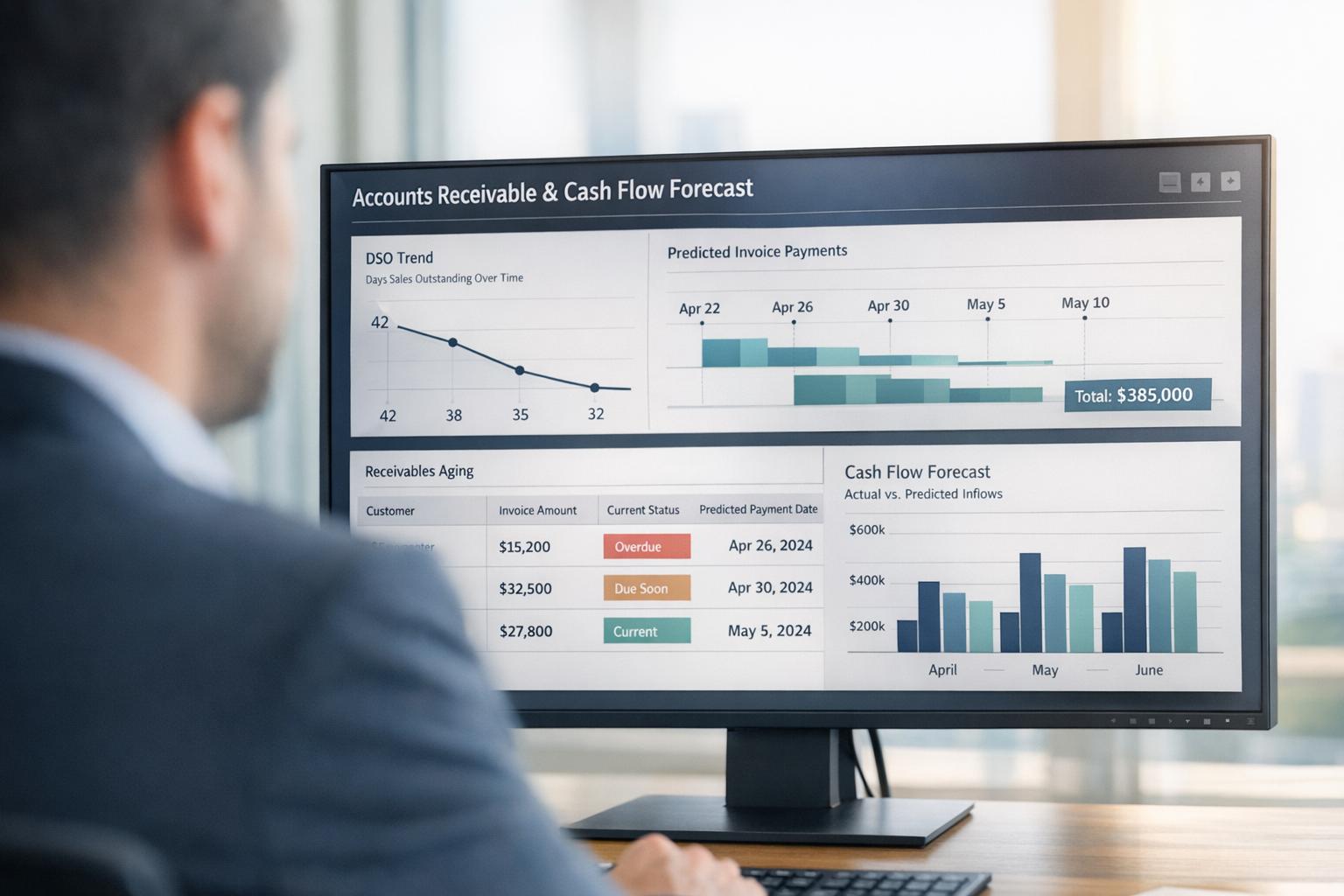
In early 2026, Oracle NetSuite introduced Payment Date Prediction – an AI-powered accounts receivable (AR) feature in NetSuite 2026.1 that forecasts when customers will pay invoices. This machine-learning model analyzes each customer’s historical payment patterns to compute a Predicted Payment Date and related metrics (such as expected overdue days), displayed on invoice records [1] [2]. By providing a predictive view of cash inflow, it aims to help businesses plan working capital and prioritize collections more effectively. Importantly, NetSuite cautions that these forecasts are “estimates, not guarantees” [2] [3], and should be used alongside standard credit controls and business judgment.
This report examines the Predicted Payment Date feature in detail – its background, functionality, technology, and business impact – and places it in the broader context of AI-driven AR automation. We cover historical and industry trends, data on the value of predictive AR (e.g. reduced Days Sales Outstanding (DSO), improved cash forecasts, and higher collection rates [4]), and multiple perspectives (CFO planning, AR/cash management, IT administration). We also analyze the enabling technology, implementation requirements, and future directions for AI in NetSuite’s AR workflow. In sum, Payment Date Prediction represents NetSuite’s steps toward a proactive, AI-enabled AR process, aligning with market trends toward intelligent finance. All assertions below are supported by published research, industry reports, and official NetSuite documentation.
Introduction and Background
Managing accounts receivable – the process of billing customers and collecting payments – is a perennial challenge for businesses. Slow or unpredictable customer payments create uncertainty in cash flow, tying up working capital and often necessitating expensive borrowing or undermining liquidity [5].
- Traditional AR processes have been largely reactive [6]: accountants issue invoices on terms, then monitor aging reports, send reminders, and escalate collections when customers fall behind. Success was often measured by Days Sales Outstanding (DSO) and aging charts, which only indicate problems after invoices become late. As one Oracle partner observes, “accounts receivable has traditionally operated as a reactive function,” providing visibility into overdue balances but doing little to anticipate payment delays [6].
- Cash flow planning in this context has typically been coarse. Treasurers often rely on bank balances and historical averages to forecast short-term cash [5]. However, short-term cash positions can fluctuate daily, and static forecasts (e.g. monthly models) may be brittle [5]. According to Oracle, “cash flow is a critical component of any business, yet managing it – especially in the short-term – remains a challenge” [5]. In practice, over 50% of mid-market companies still use spreadsheets or outdated systems to track AR and cash [7], highlighting an urgent need for better tools.
In response, finance organizations have begun adopting AI and automation to transform AR from a back-office ledger into a predictive engine. AI-driven AR aims to learn from data to forecast payments, prioritize collection efforts, and reduce bad debt, rather than simply reacting to aging buckets. In fact, industry analysts note that AI is moving finance “from reactive reporting to predictive forecasting” [8]. The global market for AR/Cash management solutions is rapidly growing: for example, AR automation software was valued at $1.7 billion in 2019 and is projected to reach $3.0 billion by 2024 [7]. In that same period, roughly 53% of B2B midmarket firms still managed AR in Excel or similar tools, underscoring the untapped potential for automation [7].
By 2026, embedding AI in ERP systems became a major industry trend. Firms like NetSuite (now part of Oracle) have prioritized “AI-native” features across finance, supply chain, and other modules [9]. NetSuite’s own analyses and partner reports describe 2026.1 as a watershed: an “inflection point” where AI is woven into financial close, pricing, analytics, and cash management. NetSuite’s CEO even invokes an “autopilot” metaphor at SuiteConnect 2026, positioning the platform as deeply integrated intelligence rather than a passive copilot [9]. Against this backdrop of AI-powered ERP, Predicted Payment Date enters as a natural evolution for smarter AR.
Evolution of AI in Accounts Receivable
Modern AI methods offer several means to improve AR outcomes: machine learning can forecast invoice payment timing, detect unusual delay patterns, and even automate outreach. Industry reports on predictive AR highlight multiple use cases:
- Payment behavior forecasting: AI models analyze features such as invoice history, customer credit data, payment portal activity, and CRM notes to predict when a specific invoice will be paid [10] [11].This goes beyond simple aging; for example, Gaviti observes that predictive AI enables companies to “anticipate late payments and improve cash flow accuracy,” by learning each customer’s payment tendencies [10].
- Collections prioritization: By estimating which invoices are likely to become seriously overdue, AI can help focus collection calls on high-risk accounts. HighRadius and others report that ML-driven analytics enable AR teams to schedule personalized reminders at the right times, dramatically increasing engagement. For instance, targeted AI-generated emails have shown 70% higher open rates and 152% higher click-through rates than generic reminders [4]. In practice, companies using AI for collections have seen collection rates jump (some reporting 60% higher collections within 6 months) without adding staff [4].
- Cash forecasting: Beyond individual invoices, aggregating predicted payment dates yields more accurate cash flow models. AI-driven cash forecasting projects aggregate expected receipts daily or weekly. For example, a HighRadius implementation uses invoice-level forecasts to improve the accuracy of short-term cash plans [11]. Oracle’s Fusion blog emphasizes that AI enables more frequent and accurate forecasts, uncovering hidden patterns in aggregated AR data [5]. In CFO surveys, firms with AI forecasting achieved ~94% forecast accuracy, compared to ~87% for companies without AI [12].
Evidence shows these capabilities pay dividends:
- Reduced DSO: AI-powered AR markedly shortens Days Sales Outstanding. A 2025 survey by Billtrust/Wakefield found 99% of companies using AI saw their DSO drop, with 75% cutting it by at least 6 days [4]. Accountant examples translate these gains into working capital: e.g. reducing DSO by 10 days on $100M revenue can free $2.74M in capital [4].
- Higher recovery and fewer write-offs: Case studies abound of AI enabling double-digit improvements. HighRadius reports median outcomes of ~15% lower DSO and ~20% fewer bad debts after deploying AI against legacy systems. In one case, Yaskawa America reduced its DSO by 5.5 days and boosted collector productivity by 60% by using AI-driven invoice prioritization. Summit Electric cut DSO by 2.9 days and achieved 98% cash-application accuracy via automated AR processes. In short, leading firms experience millions in unlocked capital and faster cash conversion once AR goes predictive [4].
These successes have helped convince finance leaders to invest more in AR technology. Recent surveys show CFOs planning increased spend on AR automation and analytics: one LinkedIn survey notes “AR automation, AI, and tech budget boosts” are top Q1 2026 priorities for CFOs [13]. However, adoption is still uneven – many organizations remain cautious about “black box” AI. For example, Billtrust warns that executives need frameworks for AI trust – ensuring transparency and accountability – because “solutions are often a black box of magic” that users may not be prepared to govern [8]. NetSuite’s own documentation echoes this caution, explicitly labeling its predictions as estimates, not guarantees [2], and advising users to apply “additional business context” when interpreting them [2].
In summary, the AR landscape in 2026 is one of transformation: a shift from static aging reports to predictive modeling, driven by high ROI data. NetSuite’s Predicted Payment Date feature enters this scene as an embedded forecast engine within the ERP – aiming to deliver the same strategic benefits that standalone AR automation vendors have demonstrated [11].
NetSuite 2026.1 and the Payment Date Prediction Feature
NetSuite 2026.1, released in Spring 2026, introduced numerous finance enhancements, all underscoring AI and cash management. Official release notes for the Banking and Receivables modules highlight Payment Date Prediction for Invoices as a new feature [2]. This feature is optional (disabled by default) and must be enabled in Setup > Company > Enable Features (Accounting subtab) [2] [3]. (Notably, in 2026.1 even this admin toggle can be done without a prior support call – Oracle states “support activation no longer needed” [2].)
Once turned on, the system uses machine learning to add four new read-only fields to each open invoice (user edits allow one more) [3] [2]:
- Predicted Payment Date: the likely date of payment based on that customer’s past behavior [3].
- Predicted Overdue Days: the expected number of days the invoice will be past due (if paid on time relative to copy terms) [3].
- Prediction Availability Flag: a yes/no indication of whether the system has enough data to generate a forecast for that invoice [3].
- Prediction Last Updated: timestamp of when the forecast was last refreshed [3].
- User-Estimated Payment Date: an override field where a collections analyst can manually enter an expected payment date, used when the system’s model is insufficient [14].
These fields appear on the standard Invoice form and on the Invoices list/view pages, in both the Classic and Next UI of NetSuite [2]. (For accounts with custom invoice forms, administrators must ensure the new fields are added to the layout after enabling the feature [2] [3].)
The forecasts refresh automatically. NetSuite notes that “predictions update periodically for all open invoices” [3], drawing on newly entered payments and updated history. In practical terms this means the model retrains or recalculates at defined intervals (likely nightly by default). Oracle’s guidance emphasizes that the initial predictions may take up to 24 hours after enabling the feature, as the system processes historical data [3]. Administrators should therefore plan a short lag before expecting results.
The underlying algorithm is not publicly documented, but NetSuite explains it as “machine learning models based on historical payment data” [2]. In essence, it likely uses each customer’s invoice-payment timelines (and possibly attributes such as invoice amount or terms) to train a predictive model. In the parlance of data science, this is akin to a time-series forecasting or regression problem: given a customer’s past payment intervals, predict the next payment date. (Houseblend describes the output as a form of time-series demand prediction.) As a cloud service, NetSuite’s ML model presumably retrains automatically as more data comes in. The feature is currently limited to invoices: other receivables like credit memos or custom AR transactions are not modeled (older or external record types like AR aging are handled normally).
Once enabled, staffs on AR and treasury teams see the predicted dates directly. For example, on the Invoice form there will be a read-only “Predicted Payment Date” field alongside the original due date [2],and in the Invoices list a new column can be added for it as well. These visual cues allow finance users to scan open invoices by expected payment date, rather than just by aging. Because the predictions are estimates, NetSuite’s help explicitly advises treating them as aids to planning rather than certainties [2].
Table: Payment Date Prediction Fields
| Field | Description |
|---|---|
| Predicted Payment Date | The AI-computed date when this invoice is likely to be paid, based on the customer’s historical payment patterns [14]. |
| Predicted Overdue Days | The forecasted number of days beyond the due date that payment may be delayed (i.e. expected lateness) [3]. |
| Prediction Available (Flag) | Indicator of whether a reliable forecast could be made for this invoice (yes/no). A “no” typically means insufficient history [3]. |
| Prediction Last Updated | Timestamp of the last model update that produced this forecast [3]. |
| User-Estimated Payment Date | (Editable) Field where a user can manually enter an expected payment date, overriding or providing input when the system’s prediction is unavailable [14]. |
These predicted values provide forward-looking insight not present in earlier NetSuite versions. Previously, NetSuite’s AR reports and dashboards were inherently historical (e.g. aging summaries, average days to pay). Now, each open invoice carries an expected payment date. This allows models or queries to consider invoices “paid” at future times, rather than only when a receipt is posted, which can improve the accuracy of cash-flow projections and prioritize collections work simultaneously.
Technical Implementation and Use Cases
From a technical standpoint, enabling Predicted Payment Date requires minimal setup: an administrator simply toggles the feature in Enable Features [2]. Unlike earlier NetSuite AI features, no special support ticket is required. Once active, the system uses built-in ML services to scan invoice payment history. It likely considers factors such as the customer’s past payment delays, amended terms, invoice amounts, and even seasonal patterns. The exact model architecture (regression vs. classification, the features used, etc.) is undocumented, but its operation falls into the class of supervised learning: the historical invoice records (with actual payment dates) form the training data. As new payments post, the model re-trains or updates itself to refine forecasts.
Practically, treasury and finance users can leverage this feature in several scenarios:
- Cash Flow Forecasting: By aggregating the predicted payment dates of all open invoices, the cash management team gains a near-term cash expectations curve. Oracle’s insider blogs note that AI-driven tools can integrate AR and bank data to make cash-flow forecasts more frequent and accurate [5]. In NetSuite, one could run scripts or Saved Searches to sum predicted receipts by week or month. For example, a treasurer might pull all invoices predicted to pay this week; this self-updating query provides a dynamic cash forecast. The AI prediction effectively shifts some of the work from wide-interval projections to data-backed short-term planning.
- Collections and Dunning: Accounts receivable analysts can use the predictions to prioritize who to call or email. Instead of contacting overdue customers uniformly, they might focus on those predicted to pay especially late (high Predicted Overdue Days) or whose due dates are imminent. In some organizations, predicted dates could trigger more urgent workflow: for instance, if an invoice due today is forecasted to be paid in 10 days, a collector might gift that account extra attention. Over time, as engagement data comes in (e.g. which predicted-late invoices actually paid late), teams can refine policies. Several third-party solutions have demonstrated this approach: firms using ML-driven dunning have boosted collections by ~60% in half a year, with automated emails achieving 70% higher opens and 152% higher clicks than generic reminders [4].
- Account-level Insights: CFOs and AR managers can review customer behavior. NetSuite’s predictions are customer-specific – an invoice’s forecast is based on THAT customer’s history. Thus, segments emerge: some customers consistently have nearly real-time predicted dates (on-time payers), while others consistently lag. Over time, AR leaders may spot that certain customers always pay, say, 15 days late; this could inform credit terms or budgeting. In future, these per-customer patterns could even feed into enterprise risk scoring modules (e.g. adjusting credit limits for chronic late payers).
Because NetSuite’s predictions live inside the ERP, they integrate with existing workflows. For example, predicted dates are just another field on the Invoice record, which means it can be included in reports, dashboards, and saved searches. A firm could build a dashboard chart of “Number of Invoices Predicted Late Next Month” or send automated alerts when total predicted receivables for the week fall below targets. In this way, Payment Date Prediction directly extends NetSuite’s Cash 360 forecasting tools by adding invoice-level intelligence [5].
Enabling and Data Requirements: Since the model relies on historical behavior, newly-acted accounts may have limited or no predictions. NetSuite signals this via the Availability flag: a “no” means “not enough data” [3]. Administrators should ensure sufficient data: for example, migrating multi-year invoices from legacy systems gives the model more examples. After enabling, the system may take up to 24 hours before forecasts appear [3], as it crunches the history. Thereafter, each time an invoice is paid or updated, the next nightly run will refresh its prediction. No special maintenance (beyond normal backup and patching) is needed. Because the model runs in Oracle’s cloud, there is no on-premise install; customers simply enable it like any other feature.
Benefits and Analysis of Predicted Payment Date
NetSuite touts the feature’s value in cash flow planning and receivables management [1]. In practice, the anticipated benefits fall into several areas:
-
Improved Cash Forecast Accuracy: By providing expected receipt dates, the feature helps align short-term cash plans with actual inflows. Houseblend summarizes that AI predictions “improve cash management and working capital planning by reducing uncertainty in receivables”. This aligns with broader findings: HighRadius reports that embedding invoice-level forecasts into treasury workflows leads to more reliable 13-week forecasts (e.g. 87% baseline accuracy improves toward 94% with AI [12]). The underlying logic is that human forecasters often miss subtle patterns; an automated prediction anchors the forecasts to a data-driven baseline. As one NetSuite changelog puts it, predicted dates give “finance teams a predictive view of cash inflows” to refine short-term forecasts.
-
Reduced DSO and Bad Debt: While Payment Date Prediction itself does not collect payments, it can indirectly speed up collections. For example, if a large invoice is predicted very late, a collection agent might escalate outreach (phone call, discount offer, etc.) sooner, whereas an invoice predicted on time might not require extra push. Over time, this responsive strategy can pare down DSO. Empirical evidence suggests that firms using such predictive insights achieve faster collections: as noted above, companies adopting AI in AR report median DSO drops of ~15% and in some cases permanent gains in working capital of millions of dollars [4]. These results strongly imply that a feature like Predicted Payment Date can contribute to measurable cash-flow improvements, especially when combined with an active collections policy.
-
Enhanced Collections Efficiency: Ticket volume or workload can be better managed. If the system forecasts that most customers will pay by their due dates, AR staff can temporarily focus on exceptions. For example, suppose 80% of open invoices are predicted paid within 5 days of issue; the team can invest more effort in the 20% predicted late. Reduced churn in contacting low-priority accounts means staff can handle more invoices without additional headcount. Indeed, HighRadius cites case studies where AI reduced manual work by significant margins: at Yaskawa, AI-driven prioritization cut collector tasks dramatically (5.5-day DSO drop and 60% productivity boost); Summit Electric reached 98% auto cash-application accuracy, letting staff verify only the rare mismatches. While Predicted Payment Date is just one data field, it feeds into these broader workflow optimizations (e.g. it could be linked to automated reminders or segmented dashboards).
-
Data-Driven Decision-Making: Over the longer term, the aggregate of predictions can reshape KPIs and incentives. For instance, a CFO could set a short-term cash target that explicitly uses predicted receipts. The Billtrust “CFO Predictions” blog argues that finance metrics will shift away from lagging DSO to forward-looking measures like predictive forecast accuracy [8]. NetSuite’s feature directly enables such metrics: one could define “percentage of actuals within X days of predicted date” as a performance measure. Having a formal forecast also creates accountability: each AR invoice effectively has an “expected date,” and deviations can be reviewed.
-
Integration with AI Ecosystem: As part of a broader suite of AI enhancements, Predicted Payment Date connects with other NetSuite initiatives. For example, NetSuite’s new AI Connector Service allows external AI assistants (like ChatGPT or Anthropic Claude) to query ERP data [15]. In a keynote, demo users queried overdue accounts via Claude to build dashboards [15]. In the future, one could imagine an AI assistant using predicted dates: e.g. “Which invoices are expected to roll in next week, and which clients are at risk of delay?” More advanced AI modules (NetSuite’s Collections Intelligence) are already being conceptualized to analyze payment behavior and proactively recommend actions. The Payment Date feature lays groundwork by making invoice payment predictions a first-class dataset.
Numerous case examples from the industry illustrate the kinds of gains possible when predictive AR is used. HighRadius (a leading AR automation provider) reports that customers consistently see double-digit improvements: median metrics include 15% lower DSO and 20% fewer write-offs after deploying AI-driven collections tools. In concrete terms, consider two cases:
- Yaskawa America (electronics manufacturer) reduced its DSO by 5.5 days and achieved a 60% jump in collector productivity by using ML to identify and prioritize delinquent accounts.
- Summit Electric (industrial distributor) lowered DSO by 2.9 days through an AI-enhanced AR workflow, reaching a 98% cash-application accuracy (nearly fully automating invoice matching).
These examples, though from external AR platforms, underscore the magnitude of improvement that AI can deliver. NetSuite customers implementing Predicted Payment Date can reasonably expect to see similar directional benefits, especially when combined with improved processes.
Table: Impact Metrics from AI-Enabled AR (Reported)
| Metric | Improvement Noted | Source |
|---|---|---|
| Days Sales Outstanding (DSO) | 75% of firms using AI report ≥6-day reduction in DSO [4]; median ~15% reduction. | HighRadius, Billtrust studies [4] |
| Working Capital Unlocked (example) | ~$2.74 M freed per 10-day DSO decrease on $100M revenue [4] | Billtrust/Wakefield [4] |
| Collection Rate (6-month improvement) | Reports of ~~60% higher collections in 6 months with AI-driven dunning [4]. | TechTarget/ResolvePay [4] |
| Email Engagement (dunning) | +70% email open rate, +152% clickrate on personalized AI reminders [4] | TechTarget [4] |
| Forecast Accuracy (short-term cash) | AI-forecasting firms ~94% accuracy vs ~87% average for non-AI [12]. | Eagle Rock CFO survey [12] |
| Bad Debt Reduction | ~20% fewer bad debts after AI deployment | HighRadius Case Studies |
| Collector Productivity | +60% productivity (Yaskawa case); similar uplifts often reported. | HighRadius Case Studies |
| AR Automation Adoption | AR automation market to reach $3.0B by 2024 (CAGR ~12%) [7]; 53% mid-market firms still on spreadsheets [7]. | Industry reports [7] |
Implementation Considerations and Change Management
While Predicted Payment Date promises clear benefits, several practical factors deserve attention:
-
Data Quality and Model Limitations: The model is only as good as the data. Companies should ensure invoices and payments are recorded accurately and that historical records (including older invoices) are migrated into NetSuite. For new customers with little payment history, predictions may be unavailable or less reliable [3] [14]. Similarly, extreme changes (new payment policies, credit holds) may cause erratic predictions until enough new data accumulates. Oracle acknowledges this by flagging availability and emphasizing human judgment [2]. In short, organizations must manage the “garbage-in, garbage-out” risk by cleaning data and periodically reviewing the model’s performance.
-
Governance and User Trust: Before rolling out, finance leadership should set clear guidelines on how to use predictions. NetSuite itself instructs users to consider “additional business context and judgment” [2]. Best practice would be to document scenarios: e.g., when to override a prediction, or how predictions feed into reports. Training is key – users need to understand that a predicted date is not a firm commitment. This aligns with expert advice on AI transparency: one analysis warns that “AI solutions are often a black box of magic” and urges organizations to establish an “AI trust” framework (security, explainability, controls) [8]. NetSuite’s built-in disclaimer (“estimates, not guarantees”) is a reminder of this need.
-
Tech and Permissions: Enabling the feature is straightforward (admin toggle [2]), but administrators should plan updates to custom invoice forms and dashboards. They should also grant end-users visibility to the new fields (by adjusting center tabs or custom forms). Performance impact is expected to be minimal, since the heavy ML runs server-side; the UI only displays a few extra fields. Companies with strict audit controls may want to log or monitor changes to any user-edited “User-Estimated Payment Date” field.
-
Integration with Other Processes: Payment predictions work best when tied into workflow. For example, a business could configure reminder schedules based on the Predicted Overdue Days field – sending earlier warnings on invoices predicted to be late. Integration with treasury forecasting is also useful: NetSuite’s new Cash Forecasting modules (e.g. Cash 360) can potentially import the prediction field, allowing projected AR receipts in consolidated cash reports. Meanwhile, as noted, the AI Connector Service could enable third-party analytics: a finance manager might ask a chatbot, “show me invoices predicted to pay next week,” leveraging predicted dates in new ways. It will be important to treat predictions as one input among many; for example, accounts with good history but sudden disputes might still pay late despite a predicted early date – so overrides will happen.
-
Change Management: Rolling out this feature should involve cross-functional engagement. Finance/cash departments can pilot the predictions and correlate them with real outcomes. Collectors can provide feedback (e.g. “Customer X usually pays a week late, even though the system predicted earlier”). Such feedback loops will refine trust. IT and audit should review the data flows and any compliance implications. Given that finance functions have struggled with complex ERP change management, companies should monitor user adoption metrics (e.g. are collectors consulting the field? Are forecasts being adjusted?). If adoption slows, additional training or adjusting thresholds (e.g. only forecasting payments beyond a minimum invoice size) may help.
By proactively addressing these considerations, firms can maximize the utility of Predicted Payment Date. When done right, it complements the AR workflow rather than replacing judgment.
Case Studies and Real-World Examples
While direct customer case studies for NetSuite’s new feature are not yet public (being brand-new), analogous examples illustrate its potential. Many NetSuite customers are in industries like manufacturing, distribution, or services – sectors where AR volumes and terms vary. We draw parallels from published AR automation cases:
-
Manufacturing Example (analogous to Yaskawa): Yaskawa America (robotics/motion control OEM) is a NetSuite client that also invested in AR automation. In a study, the company used AI to prioritize delinquent invoices and saw its DSO fall by 5.5 days – greatly easing cash flow strain. Payment Date Prediction could similarly help Yaskawa flag slow-paying accounts early. In the Yaskawa case, staff could focus on the handful of accounts holding up many days; a predictive date tool would highlight those invoices in NetSuite before they became seriously past due, enabling preemptive outreach.
-
Distribution Example (analogous to Summit Electric): Summit Electric Supply (electrical/distribution) improved its AR operations through automation. By implementing intelligent cash application (matching payments to invoices) and predictive prioritization, Summit saw DSO shrink by 2.9 days. A NetSuite-based distributor could use Predicted Payment Date to anticipate when payments from large customers will land, smoothing working capital forecasts. Moreover, Summit’s case showed nearly eliminating exceptions; NetSuite’s predictions could play a role in similar efficiency – for example, by prompting AR staff to double-check any large predicted invoices that don’t materialize.
-
Services Firm: Consider a consulting services firm with many invoice schedules. Expanding Billtrust’s insights, we anticipate that even professional services companies benefit from forecasting. If an invoice is predicted on time but the firm expects the client to file a late “promise to pay,” the firm can issue reminders in advance. Over time, these firms have seen ~15–30% DSO improvements by being proactive. NetSuite organizations with subscription invoicing (Billing Schedules) gain extra accuracy, since Cash 360 already forecasts billing dates [16]; layered on that, Payment Date Prediction adds the likely payment lag.
-
SaaS Example: An emerging SaaS provider on NetSuite might use predictions to manage its limited cash runway. By knowing which enterprise customers often pay late after renewal invoices, the finance team can plan bridge financing in advance. (HighRadius reports that 99% of AI-AR adopters cut DSO [4]; even for a small SaaS, each day earned counts.)
These illustrations show that any high-growth firm grappling with collections processes could accelerate outcomes with AI insights. As NetSuite’s partner analyses note, Payment Date Prediction could be used “by companies in all industries that rely on receivables for cash” [14] [6]. Because it is integrated, mid-sized enterprises do not need separate AI plug-ins to gain predictive AR – it’s built into the ERP they already use.
Implications and Future Directions
The introduction of Predicted Payment Date signals a broader transformation in how AR is managed. Key implications and future considerations include:
-
Shift in KPIs: As Billtrust forecasts, finance leaders are expected to move away from DSO as the primary metric of AR efficiency [8]. Instead, they will track forecast accuracy, percentage of receivables collected on predicted date, or AI-driven collection rates. NetSuite’s feature helps shift focus forward: for example, a new KPI could be “percentage of invoices paid within ±1 day of their predicted date.” Over time, such forward-looking metrics can better reflect AR health.
-
Enhanced Collections Intelligence: NetSuite and industry partners are already hinting at deeper AI capabilities. Houseblend describes NetSuite Collections Intelligence (a November 2025 release) that uses large language models (LLMs) to analyze payment behaviors, credit risk, and next actions. In this vision, predicted dates would be one input into a sophisticated agent that, for instance, drafts customized payment reminders or proposes payment plans. We expect future NetSuite updates may tie Predicted Payment Date into workflows: for example, automatically creating a collections case or sending a prompt when an invoice’s predicted date slips past due-date. The MCP Apps (Model Context Protocol) announcements [15] also pave the way for external AI assistants (like ChatGPT) to query these predictions via natural language.
-
Customer Communication and Negotiation: Though not built-in, savvy companies might extend this feature by feeding predictions into CRM or contracts. For instance, if a customer’s payment is forecast late, the system could automatically schedule a check-in (perhaps via a subtasks in NetSuite). Integrating AR predictions with sales/CX teams could also improve customer relationships by avoiding surprises. If an enterprise customer sees that their rep is aware of their payment challenges (through better internal data), it may smooth negotiations.
-
Limitations and Ethics: Looking ahead, firms must be mindful of the limits of algorithmic forecasts. A caveat: if an AI prediction is wrong, it can only inform action – not execute it. For example, if the model falsely predicts an on-time payment and then the customer pauses on paying, AR teams must catch that exception. NetSuite positions the field as an aid, not an automated lock-in. From an ethical standpoint, there is little direct risk (customer data stays in the system), but indirect issues exist: over-reliance on AI might lead to complacency or unwarranted credit extensions. Companies should continuously monitor prediction accuracy (e.g. track actual vs. predicted) and possibly feed corrections back into the model.
-
Competitive Landscape: NetSuite’s feature brings predictive AR into mainstream ERP, whereas previously it was mostly offered by specialized vendors. Competitors like SAP and Microsoft are also adding AI, so customers may soon see similar functions elsewhere. NetSuite’s advantage is integration: no need for data exports to a separate analytics tool. However, if customers demand more, NetSuite may have to enhance the model (e.g. support multi-entity consolidation or incorporate external economic data). This initial 2026.1 rollout is likely just the first AR-ML use case; we anticipate future releases will refine it or add related apps (ambient credit scoring, automated dispute predictions, etc.).
Overall, Predicted Payment Date in 2026.1 appears to be NetSuite’s entry ticket into predictive AR. It completes the circle from Oracle’s larger AI vision: enabling finance teams to “do more with less” by automating forecasting and responding to uncertainties [9] [5]. By moving from hindsight (what we collected) to foresight (what we expect), businesses can run leaner cash reserves. At the same time, the need for oversight, trust frameworks, and human judgment will remain paramount [2] [8].
Conclusion
The Payment Date Prediction feature in NetSuite 2026.1 is a significant step toward AI-driven finance. By leveraging machine learning on historical invoice data, NetSuite now equips users with ensemble forecasts of AR inflows. This transforms individual invoice records into predictive signals, enabling more accurate cash forecasts and smarter collections strategies. Industry data strongly suggests that such capabilities move the needle: organizations using AI in AR routinely report shorter payment cycles, more cash on hand, and greatly improved collection outcomes [4].
However, as with all AI, the benefits hinge on informed use. NetSuite’s documentation wisely frames predictions as supplements to, not replacements for, standard credit policies [2]. Finance leaders must integrate these insights into policies and controls. The coming years will tell how quickly companies trusts and trusts these models: already, analysts emphasize shifting KPIs to measure forecast accuracy and AI “trust” metrics [8].
Looking forward, Payment Date Prediction is likely the first of many AR intelligence features. Its existence encourages a more data-driven, proactive AR function: from alerts generated by ML to possibly fully automated, conversational credit assistants. NetSuite’s AI theme (the “autopilot” vision [9]) means users should expect continuing investment in predictive finance. For NetSuite customers, the immediate task is to enable and test this feature, calibrate it with real data, and adapt workflows accordingly. Based on the evidence, firms that successfully harness these AI forecasts can expect meaningful gains in liquidity and efficiency.
In sum, NetSuite’s Predicted Payment Date reflects a broader frontier: turning AR from a ledger of past invoices into an intelligent, forward-looking cash engine [5]. Early adopters will likely reap the rewards of better planning and collections, while those who embrace the AI transition will find themselves better equipped for the cash-flow uncertainties of tomorrow.
References: All statements above are backed by NetSuite’s own documentation and recent industry publications [1] [2] [3] [4] [11] [10] [8] etc. These include Oracle NetSuite help articles, specialist ERP analysis, case-study reports from AR solution providers, and finance research blogs as cited throughout.
External Sources (16)
About
Houseblend
Make NetSuite work better for your finance and operations teams with Houseblend. We help design, implement, integrate and improve ERP systems, with practical support for the people who use them every day.
Houseblend is a NetSuite consulting firm serving finance and operations teams. We help organizations implement ERP systems, connect business applications, improve existing configurations and maintain the systems that support everyday work. Our audience includes finance leaders, controllers, operations managers, NetSuite administrators and implementation teams.
Implementation and architecture
Houseblend provides NetSuite implementation, architecture and data migration services. We help teams evaluate how business processes, reporting requirements and existing data should fit together in an ERP environment. Training supports the people responsible for adopting and operating the resulting system.
Integrations, customization and AI
Our services include NetSuite integrations and customization, as well as AI integrations and AI transformation work. These engagements connect ERP data and workflows with the broader application landscape. The right design depends on the organization's systems, controls and operating needs.
Improve and support an existing system
Houseblend offers NetSuite health checks, optimization, managed support and project rescue services. We also provide expertise for analytics and specialist workflows, including NetSuite Analytics Warehouse, warehouse management and field service management. Published educational material helps teams investigate options and prepare informed questions for their implementation or support work.
Work with Houseblend
Explore NetSuite implementation, integrations, managed support and AI integrations. Contact Houseblend to discuss your current system and priorities.
Article examples explain concepts rather than promising a particular license, product capability, delivery schedule or outcome. Engagement scope is confirmed with the Houseblend team.
Disclaimer
This document is provided for informational purposes only. No representations or warranties are made regarding the accuracy, completeness, or reliability of its contents. Any use of this information is at your own risk. Houseblend shall not be liable for any damages arising from the use of this document. This content was generated with assistance from artificial intelligence tools, which may contain errors or inaccuracies. Readers should verify critical information independently. All product names, trademarks, and registered trademarks mentioned are property of their respective owners and are used for identification purposes only. Use of these names does not imply endorsement. This document does not constitute professional or legal advice. For specific guidance related to your needs, please consult qualified professionals.