Houseblend Article
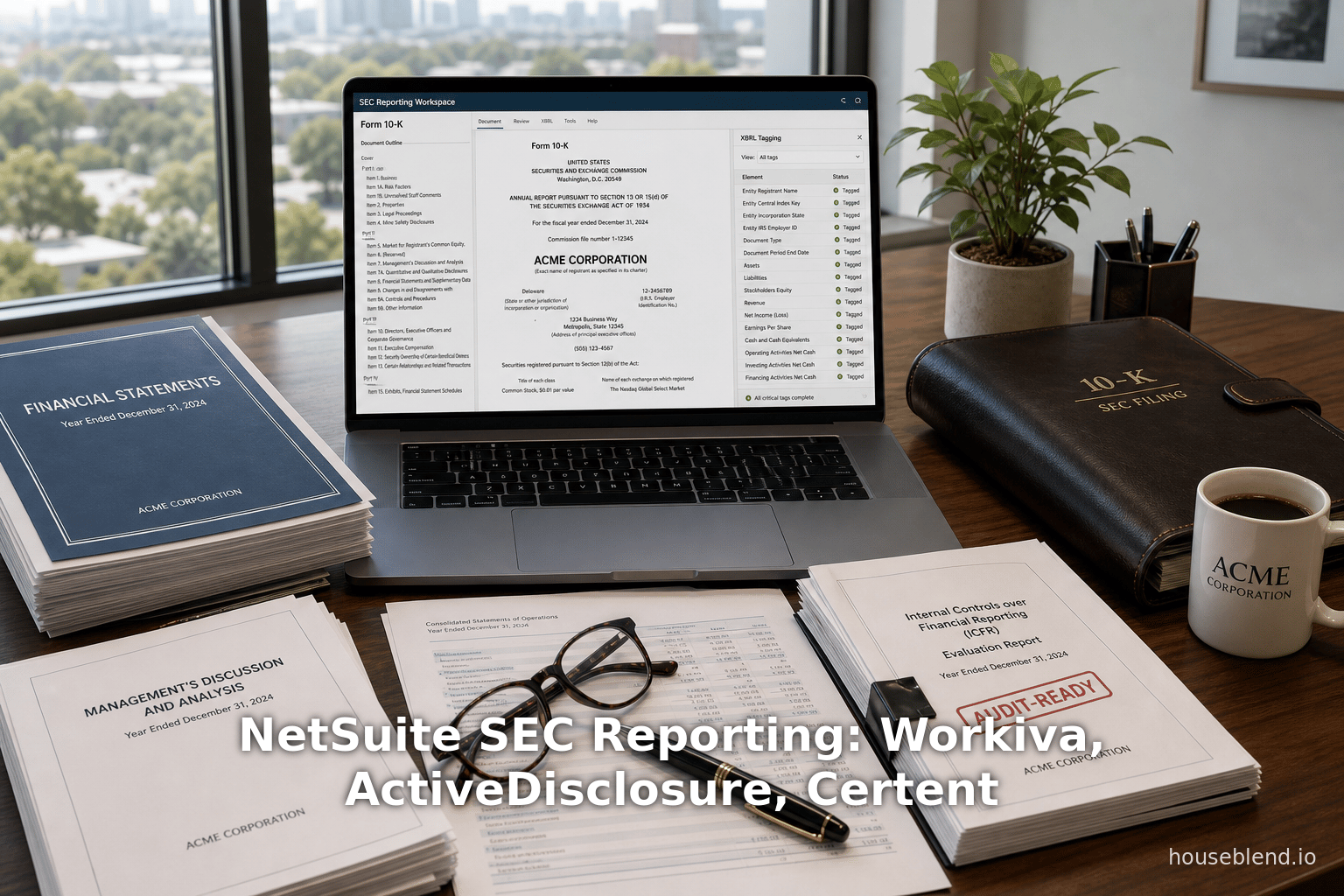
NetSuite SEC Reporting: Workiva, ActiveDisclosure, Certent
Inside this article
- 01Executive Summary
- 02Introduction and Background
- 03Oracle NetSuite ERP: Financial Reporting & Integration
- 04Workiva (Wdesk/Connected Reporting Platform)
- 05DFIN’s ActiveDisclosure
- 06Certent (InsightSoftware) Disclosure Management
- 07Comparative Analysis
- 08Data Analysis and Evidence
- 09Case Studies and Real-World Examples
- 10Expert Opinions & Industry Perspectives
- 11Implications and Future Directions
- 12Conclusion
Executive Summary
This report provides a comprehensive comparison of three leading SEC reporting/disclosure management platforms – Workiva, DFIN’s ActiveDisclosure, and Certent (InsightSoftware) – with a focus on how they serve Oracle NetSuite customers. NetSuite, a widely-used cloud ERP (with over 37,000 customers worldwide [1]), handles core financial close and consolidation, but most public companies rely on specialized disclosure tools to prepare SEC filings, perform XBRL/Inline XBRL tagging, and submit reports to EDGAR. Workiva, ActiveDisclosure, and Certent each offer end-to-end SEC reporting solutions, yet they differ markedly in history, architecture, features, integration approaches, and pricing.
-
Workiva (NYSE: WK) is the market leader in disclosure management. Originating from Wdesk in 2008, it is a pure cloud-based platform that tightly integrates data, documents, and XBRL tagging. Over 6,300 organizations (≈75% of the Fortune 500) use Workiva’s platform [2]. Workiva excels at data connectivity (live links to ERPs/Excel via its Wdata connectors [3]), real-time collaboration with granular permissions, and an audit-ready environment. For NetSuite customers, Workiva provides certified connectors ( ODBC/API to pull saved searches or reports from NetSuite, ensuring the latest financial data flows directly into filing drafts [3]. Workiva also supports multiple regulatory standards (US GAAP, IFRS/ESEF, ESG) and now includes AI/automation features ( generative AI for narrative drafting [4] [5]. Its pricing model is enterprise subscription (typically tens of thousands of dollars per year, depending on modules) [6].
-
ActiveDisclosure (by DFIN – Donnelley Financial Solutions) has roots in traditional filing agency services. It is targeted at corporate issuers and capital markets. ActiveDisclosure originally offered Excel/desktop-based filing editors, but since 2021 DFIN relaunched it as a cloud platform [7]. Notably, DFIN supplies an ActiveDisclosure SuiteApp for NetSuite (released in 2022), which achieved “Built for NetSuite” status [8]. This integration lets users push NetSuite financial data directly into ActiveDisclosure, eliminating manual copying [9]. ActiveDisclosure is widely deployed: DFIN claims ActiveDisclosure supports over 170,000 SEC filings per year and serves “200+ Fortune 500” clients [10] [11]. Key strengths are Excel-centric workflows (it connects to native Excel models [12]), built-in XBRL tagging/validation, and integrated EDGAR submission (or DFIN-assisted filing). DFIN markets ActiveDisclosure on either subscription or per-filing usage plans [13]. Users highlight that ActiveDisclosure “brings teams together… with detailed audit trails for every change” [14] and “requires minimal re-entry of models” thanks to Excel integration [15], though it can be complex and may require training.
-
Certent Disclosure Management (CDM), originally a boutique SaaS vendor (founded 2002), was acquired by InsightSoftware in 2021 [16] [17]. Certent targets CFO/accounting teams with a platform that merges narrative drafting (in Word/Excel) and XBRL tagging. It distinguishes itself through tight Microsoft Office integration: users author disclosures in Word/Excel while Certent handles tagging/validation seamlessly [18]. Certent is XBRL US Certified and supports multiple taxonomies (US GAAP, IFRS/ESEF) [19] [20]. It has a global customer base (including Barclays, FedEx, Vodafone, etc.) [21]. Certent’s deployment is cloud/SaaS (with hybrid desktop options), and it is typically sold via per-seat or per-department subscription (custom pricing). Certent lacks a dedicated NetSuite connector; data integration is usually accomplished through Excel exports or general-purpose import routines. Its interface is more document-centric (Word-like) compared to Workiva’s spreadsheet-native model or ActiveDisclosure’s Excel-heavy flow [18].
In this report, we analyze each platform in depth – covering historical development, core features, security/compliance credentials, pricing, and adoption – and pay special attention to integration with NetSuite. We draw on SEC filings, vendor releases, and expert commentary. We also include comparisons and case examples (such as a multinational using ActiveDisclosure via NetSuite) to illustrate real-world implications. Finally, we discuss industry trends (AI, ESG reporting, global XBRL mandates) and future outlooks for disclosure management for NetSuite-centric businesses.
Introduction and Background
SEC Reporting Requirements and Evolution
Publicly-traded companies in the U.S. face rigorous reporting mandates from the Securities and Exchange Commission (SEC). Core filings include annual reports (Form 10-K), quarterly reports (10-Q), and current reports (8-K) – each with strict deadlines (e.g., 10-Ks due 60–90 days post year-end) [22]. These filings combine financial statements with narrative disclosures (Risk Factors, MD&A, etc.). Since the 1990s EDGAR rollout, filings have been electronic. By the mid-2000s, the SEC began mandating structured data: initially voluntary XBRL disclosures starting in 2005 and mandatory by 2009 [23]. In 2018 the SEC required Inline XBRL (iiXBRL) formatting for GAAP financial data in operating company filings [24].By 2021, most accelerated filers must submit iiXBRL-tagged financial statements [24].
These regulations impose a heavy operational load: every line item in the financials must be tagged to the authorized SEC taxonomy, with re-validation on every change. Manual tagging via spreadsheets is error-prone and time-consuming. Accordingly, many firms have turned to purpose-built SEC disclosure platforms that automate tagging, validation, and even EDGAR submission. The result is that tagged, audit-trailed filings are now business-as-usual (the heyday of static spreadsheets is ending) [25]. Modern disclosure management tools offer connected, collaborative workflows bridging the company’s ERP data, financial tables, narrative text, and SEC requirements in one controlled environment [26] [25].
Meanwhile, global regulatory trends amplify the need for flexible platforms. The EU’s ESEF mandate (Inline XBRL for IFRS filings), UK SEDAR requirements in Canada, and specialized industry rules (e.g., utility filings to FERC) expand the scope of structured reporting [25] [25]. Upcoming initiatives (SEC climate disclosures, updated COSO controls, etc.) push firms to adopt integrated software capable of tagging non-financial data as well [27]. For example, the SEC’s proposed climate rule requires tagged environmental data; in response, Workiva has already released climate-reporting modules for CSRD/ESG filings [28].
In sum, regulatory complexity and investor demand for transparency have fueled the SEC filing software market. A recent analysis estimates the market will grow from $2.1 billion in 2024 to over $6.3 billion by 2033 [29]. Leading vendors illustrate this shift: Workiva reports serving 6,300+ organizations [2], while DFIN’s ActiveDisclosure handles >170,000 filings/year [10]. These tools aim to transform reporting into an automated, control-driven process: data is linked live to source systems, version changes are logged, and built-in validation catches errors before EDGAR submission [30] [31].
Oracle NetSuite in the SEC Reporting Landscape
Oracle NetSuite is a cloud ERP platform widely used by mid-market and large enterprises (37,000+ customers worldwide as of 2023 [1]). For SEC reporting, NetSuite offers robust financial capabilities: OneWorld consolidation, multi-book accounting (parallel GAAP/IFRS ledgers), real-time multi-dimensional reports, and system-wide audit trails [32] [33]. It natively supports closing books quickly and generating standard financial statements at the subsidiary and consolidated level. These features (multi-entity consolidation, currency translation, intercompany eliminations) lay the groundwork for timely SEC filing [32] [33].
Nevertheless, by itself NetSuite does not handle certain SEC-specific tasks (e.g., XBRL tagging, narrative compilation, EDGAR formatting). Public companies on NetSuite typically use it as the single source of truth for transactions and official financial data [34] [35]. They then complement it with disclosure management tools for the last mile of SEC reporting. The integration between NetSuite and these external tools can greatly enhance accuracy and efficiency. For instance, with a connector, a 10-Q draft in Workiva will always pull the latest NetSuite balances, meaning a last-minute correction in NetSuite instantly updates the filing (as one ActiveDisclosure/SuiteApp user experienced [36]). The key benefit is eliminating error-prone copy-paste and ensuring the SEC report ties directly to the ERP (for audit traceability and SOX compliance).
Historically, companies might have exported NetSuite reports to Excel, edited them, then manually incorporated them into filings. Today’s best practices emphasize “closing like a public company” on a strict timeline, with fast period-end closes, and then using tools to automate disclosure assembly [37] [36]. NetSuite’s cloud architecture and open API framework facilitate this: certified connectors and SuiteApps can pipe data seamlessly to disclosure platforms [3] [8]. Thus, a NetSuite customer’s choice of SEC software is heavily influenced by integration ease, data integrity, and workflow efficiency. The following sections delve into how Workiva, ActiveDisclosure, and Certent approach these challenges, with emphasis on their NetSuite-related features.
Oracle NetSuite ERP: Financial Reporting & Integration
Oracle NetSuite serves as a unified financial system that streamlines core accounting (GL, AP, AR, etc.) and supports compliance. Its capabilities include:
-
Consolidation & Multi-Entity: NetSuite OneWorld can automatically roll up multiple subsidiaries’ ledgers into parent financials, handling currency translation and intercompany eliminations [32]. Shared chart of accounts means automated eliminating entries and rolling balances at period-end, a necessity for companies with global operations [32] [38]. For example, if a subsidiary posts revenue in Euros, NetSuite will translate and eliminate intercompany sales in the consolidated view, producing an audit-ready consolidated balance sheet immediately after close.
-
Financial Reporting & Analytics: Built-in reporting tools allow on-demand Income Statements, Balance Sheets, Cash Flows, including side-by-side prior year comparatives. NetSuite’s Financial Report Builder can customize statement layouts and combine accounts (e.g. grouping subtotals under “Current Assets”) [39]. Users can run reports at any entity level or consolidated level with the click of a button. Drill-down features let auditors or analysts jump from a total on the 10-K balance sheet directly into the underlying NetSuite journal entries. Role-based dashboards and saved searches let finance teams slice data by department, class, location, etc., which can feed disclosure notes (e.g. related-party transactions, segment data).
-
Multi-Book Accounting: NetSuite supports parallel ledgers for multiple accounting rules. A U.S. multinational could maintain a primary U.S. GAAP book (for SEC filings) and a secondary IFRS or local GAAP book for other regulators, posting one transaction to both books with required adjustments [33]. Consolidations can be run on any of these books. This means NetSuite can concurrently prepare a US GAAP-rolled up P&L (for the 10-K) and an IFRS consolidation (for an overseas filings) using the same transactional data. Such multi-book support is a standout feature [33].
-
Compliance & Controls: As a mature cloud ERP, NetSuite includes robust internal controls for SOX compliance: every transaction and user action is logged; configurable approval workflows can enforce multi-level sign-offs; periods can be locked after close, etc. [40]. NetSuite meets SOC 1 standards for financial controls. Data security (roles/permissions, encryption) and audit trails give confidence to auditors that the source data underlying disclosures are reliable. NetSuite’s immutable system logs facilitate tracing any number back to the original invoice or transaction. These controls support SEC requirements that financial reports be complete and accurate, and that management can certify their correctness in filings [41].
Because NetSuite lays this solid foundation, the final step – compiling text and supplemental schedules – is often handled in specialized software. NetSuite’s open APIs and SuiteScript allow data export, and many public firms adopt SuiteApps or ODBC connectors to push data into their disclosure platforms. Houseblend notes: “Using the NetSuite connectors, companies can feed financial data directly from NetSuite into Workiva… Once connected, the data in Workiva can be set to automatically update whenever the source (NetSuite) changes” [3]. Similarly, DFIN’s suite connects NetSuite to ActiveDisclosure, enabling one-click transfer of financial statements for XBRL tagging [8].
In practice, Oracle NetSuite and a disclosure tool act in tandem: NetSuite provides trusted numbers, and the SEC tool provides the governed filing environment. For example, a NetSuite controller might finalize a subsidiary’s books by day 5 post-quarter, then push the updated GL balances into Workiva or ActiveDisclosure. That team can immediately draft the 10-Q, with every item in the draft linked back to the precise NetSuite saved search. If a late edit is needed (say an adjusting entry discovered during the auditors’ review), the change is made in NetSuite and instantly reflected in the filing platform – often within minutes [36]. This “connected reporting” eliminates manual copy-paste, reducing errors and close time.
Table: NetSuite-Specific SEC Reporting Integrations
| Integration Feature | Workiva | ActiveDisclosure (DFIN) | Certent (InsightSoftware) |
|---|---|---|---|
| Native Connector/Token | Workiva Wdata connectors (ODBC/API) [3] – supports NetSuite saved searches, report queries. | ActiveDisclosure SuiteApp (Built for NetSuite) [8] – pulls NetSuite financial tables into ActiveDisclosure. | No dedicated NetSuite SuiteApp; data must be imported via CSV/Excel or through insightsoftware’s other ERP connectors. |
| Data Link Automation | Yes – Live data linking: source changes auto-update disclosures [3]. Custom chains can schedule data pulls. | SuiteApp allows one-click data push to ActiveDisclosure. Once data is in, ActiveDisclosure preserves spreadsheet links, so updates propagate [42]. | Limited. Users export NetSuite reports to Excel/CSV and import. No live live-trigger. (InsightSoftware’s broader BI tools may interface indirectly.) |
| Built-For NetSuite | Connector is vendor-provided & documented. [3] | Certified “Built for NetSuite” SuiteApp, meeting Oracle standards [8]. | Not currently certified. Integration is manual or via third-party ETL. |
| Integration Ease | Fairly straightforward with Workiva support; uses NS tokens/REST/ODBC; well-documented guides [43]. | Native SuiteApp: likely plug-and-play with minimal config (the press release notes it is “seamless”) [44]. | Requires manual setup: map fields from exported data into Certent. No one-button solution. |
| Typical Workflow | Set up saved searches in NetSuite; connect them to Workiva spreadsheets/documents, enabling automatic refresh [3] [31]. Changes in NetSuite (e.g. corrected GL) flow to the draft. | Users press a button inside NetSuite (SuiteApp) to send the entire 10-K/10-Q dataset to ActiveDisclosure [8]. Then tagging and editing happens in ActiveDisclosure. | User exports NetSuite report to Excel/CSV, then uses Certent’s import utilities to pull data. Updates require re-export. No built-in live link. |
The distinct approaches above impact speed and control. Workiva’s integration allows continuous synchronization, so the filing is always “on the latest data.” ActiveDisclosure’s SuiteApp is more of a one-way transfer initiated at a chosen time, after which ActiveDisclosure manages the data. Certent requires manual imports, which can work but lacks the safety net of automated updates. For NetSuite customers, these differences are crucial: they determine how effortlessly the consolidated financials and footnotes can be assembled.
Workiva (Wdesk/Connected Reporting Platform)
Background and Company
Workiva Inc. (NYSE ticker WK) traces its roots to Wdesk (founded 2008 in Iowa) and was rebranded as Workiva in 2014. It pioneered cloud disclosure management: originally solving the XBRL pain using a linked spreadsheet and document model. Workiva has since grown into a broad connected reporting platform covering financial, SOX, ESG, and other compliance areas. The company serves thousands of clients; as of late 2024 it reported “provides more than 6,300 organizations across the globe with SaaS platform solutions to help solve some of the most complex reporting and disclosure challenges.” [2] [45]. Workiva’s customer base is impressive: about 75% of Fortune 500 companies use at least one Workiva product [2]. Major brands (Google, Coca-Cola, Lockheed Martin, etc.) trust Workiva for critical filings.
Workiva went public in 2014 and has consistently invested in expanding its platform. In recent years, acquisitions (e.g. Tidemark for ESG data, and newer AI-tool integrations) have broadened use cases beyond finance. Importantly, Workiva also emphasizes security and compliance: it achieved FedRAMP Moderate authorization for government use and undergoes annual SOC 1/2 audits [46]. Workiva’s filings underscore its positioning as a foundational tool for SOX and SEC compliance [47].
Key Features and Architecture
Platform Model
Workiva is a true cloud/SaaS platform (no desktop installation) [48]. It comprises several interlinked components:
-
Workiva Platform (formerly Wdesk): The core user environment where documents (like a 10-K, 10-Q, or proxy) are authored in a flexible editor. Within a document, users can embed live tables and figures (which are linked to data sources), narrative text sections, and XBRL tags. Multi-user co-authoring allows teams to work on different sections simultaneously. The system maintains a full audit trail: every insertion, edit, or tag addition is logged with user, timestamp, and version. Workiva’s Word-like interface includes rich text editing plus spreadsheet-like tables.
-
Wdata (Data Orchestration): A separate layer (highlighted in Workiva 10-Ks) for connecting and managing data. Wdata acts as an ETL: it pulls data from ERPs, databases, BI tools, or uploads and stores snapshot tables. A user can query a NetSuite saved search or an ODBC source, load it into Wdata, and then those values can be referenced in any Workiva document. Wdata keeps a dynamic link so that a change in the source can propagate to all dependent documents.
-
Tags & XBRL Engine: Workiva automatically generates Inline XBRL behind the scenes. In any table, users can assign taxonomy tags (or have them auto-suggested). The system validates tagging against SEC rules. Workiva updates its taxonomies regularly. For example, Workiva’s marketing emphasizes “prepare and file all major SEC reports…with Inline XBRL” [49].
-
Collaboration & Workflow: Workiva includes a task/assignment system. Section owners can assign reviewers, set deadlines, and track status. There are version labels (e.g. “Draft A”, “Management Review”). Once approved, documents are locked for export. Electronic sign-off and checklists ensure no steps are missed. Notably, Workiva’s 10-K highlights the granular security model: permissions can be set at the cell or section level [50].
-
Reporting & Analytics: Besides narrative filings, Workiva offers dashboards/KPIs that track compliance tasks (like disclosure checklists) and metrics.
-
Integrations: Workiva provides a library of connectors (ODBC, web connectors, APIs) for common ERPs (NetSuite, Oracle, SAP, Dynamics, etc.) and databases (SQL). It also integrates with Excel (via an add-in) and Google Sheets.
Key SEC Compliance Features
Workiva was built from the ground up for SEC reporting:
-
Inline XBRL & Automation: It generates industry-required Inline XBRL for the statements and notes. It also automates calculation and consistency checks (e.g. balance sheet sums, XBRL DQC rules). These built-in validations catch errors early [49].
-
Collaboration & Audit Trail: The platform supports real-time co-authoring, so multiple team members (accountants, attorneys, IR, CFO) can work in the same document [51] [52]. All changes have immutable audit logs, fulfilling SEC and SOX requirements for accountability. Workiva emphasizes this: its own filing notes the “full audit trail” for reporting [53], and industry commentary highlights the tightly tracked workflows. Version control is robust: you can revert to prior versions or isolate changes by user/time.
-
Data Linking & Accuracy: Live connectivity to ERPs ensures the CMS environment is data-driven. For example, a balance sheet line might be linked to a NetSuite report via Wdata [3]. If an adjusting entry is posted in NetSuite, the Workiva-linked table updates automatically [54]. This eliminates manual copying of numbers into filings, cutting transcription errors. Workiva also supports multiple currencies and businesses hierarchies since it pulls from the unified ERP data [3].
-
Formatting & EDGAR Prep: Workiva can output fully EDGAR-compliant HTML packages. It handles font embedding, image formatting, and can file directly to EDGAR. A “pre-filing checklist” in Workiva reviews that all required exhibits are attached and properly formatted [55].
-
Security & Certifications: Besides FedRAMP and SOC compliance, Workiva encrypts data at rest and in transit. It offers SSO, multi-factor authentication, and IP whitelisting. Given SEC focus on data security, these earn buyer trust.
-
Additional Capabilities: Workiva’s platform now includes modules for Internal Controls, Sustainability/ESG reporting, and other compliance. For example, their XBRL engine also supports US GAAP and IFRS taxonomies (for SEDAR/ESEF filings). Workiva introduced an “agentic AI” in 2025 to automate narrative writing and highlight data anomalies [4] [5].
NetSuite Integration
NetSuite integration is a first-class capability in Workiva’s design:
-
Connectors: Workiva’s Wdata includes a NetSuite connector that can access NetSuite’s SuiteAnalytics queries or saved searches. It can authenticate via NetSuite’s REST API (using Token-Based Auth) or ODBC drivers [43] [3]. These connectors let you define a data source (a saved search on NetSuite’s Trial Balance, for instance) and pull that live data into Wdata.
-
Automatic Updates: Once connected, the data is continuously in sync. The Workiva platform notes: “Once the data is connected in the Workiva platform, users are able to automate updates, track every change … and create trusted regulatory filings.” [56]. This means any change in NetSuite’s GL will be reflected in all connected Workiva spreadsheets and documents without manual effort.
-
Reduction of Risk: In the executive guide, Houseblend emphasizes the time savings and reduced risk: “you eliminate manual data transcription into the SEC filing, thereby reducing the chance of typos or inconsistencies” [57]. For example, if a material correction is made in NetSuite shortly before a 10-Q deadline, the revised figures flow into the Workiva draft automatically, avoiding delays in filing [36].
-
Practical Workflow: From an administrator view: integrating Workiva often involves creating a NetSuite integration with a Tokenless adaptor or ODBC. Workiva publishes guides for connecting through SuiteAnalytics Dataset workbooks or saved searches [43]. Once set up, a finance user can query NetSuite data like any spreadsheet and embed it in a Workiva document. Workiva handles scenarios like multi-currency conversion in consolidation (via connecting to the consolidated currency balances in NetSuite).
-
Audit Trail of Data Movement: Workiva not only logs user edits, but also every data refresh from NetSuite. It logs who ran a query, ensuring data provenance. This is critical if auditors ask “how did the cash balances in the filing originate?” one can show a trail from NetSuite to Workiva to EDGAR submission.
User Experience and Collaboration
-
Multi-Author Editing: Workiva’s collaborative editor enables, e.g., an accountant to revise financial schedules while a partner edits Risk Factors, all in the same 10-K file [51]. Comments, @-mentions, and annotation threads facilitate review cycles, with all feedback captured in the system (unlike email-based reviews that are scattered).
-
Role-Based Access: Permissions can be finely tuned—some sections (e.g. revenue recognition disclosure) might be editable only by specified finance roles. Workiva’s platform enforces segregation of duties in the drafting process.
-
Workflow Management: The system can route documents for managerial review or board review. It tracks statuses (“Draft, Pending Review, Ready to File”). Workiva also has integration with Outlook/email so that reminders and deadlines sync with calendars.
-
Learning Curve: Workiva is often praised for ease-of-use relative to legacy tools. However, it does require initial change management. Some reviewers (like Gartner peer insights) note a learning period, but once staff are trained, they benefit from streamlined processes. Workiva also offers extensive support/documentation and training programs.
Security and Compliance Assurance
Workiva’s credentials align with enterprise needs:
- FedRAMP Moderate (U.S. Gov): Workiva’s cloud is authorized for federal use, demonstrating rigorous security controls [58].
- SOC 1/2 Type II Audits: Conducted annually, covering internal controls and data privacy.
- Encryption: AES-256 encryption for data at rest and TLS for data in transit.
- Data Residency Options: Multiple cloud regions allow companies to satisfy local hosting requirements.
From the compliance standpoint, auditors and regulators see Workiva as a secure, auditable environment. Workiva’s own SEC filings detail these compliance features [59]. For example, Workiva’s SOC reports (mentioned in 10-K) and FedRAMP attestation give CFOs confidence to trust filings prepared there.
Adoption and Use Cases
Workiva is widely adopted by large public companies. Its simplicity and scalability make it a favorite among Fortune 1000 filers. According to Workiva, by 2024 about 75% of Fortune 500 use it for at least one reporting solution [2]. Use cases include:
- SEC Annual/Quarterly Filings: 10-Q/10-K preparation with Inline XBRL, often replacing spreadsheet/Word processes entirely.
- SOX 302/404 Reporting: Managing internal control documentation and testing results (with special modules).
- ESG/Sustainability Reports: Workiva’s newer feature set addresses CSRD, SASB, and other ESG disclosure needs.
- Board Reporting & Management Reporting: Corporations also use Workiva for internal reporting packages and board books (leveraging the same data-linking benefits).
Case Example: (Houseblend interview) A global manufacturing firm on NetSuite standardized on Workiva. They connected NetSuite GL and sub-ledgers via Wdata; the Controller reported that linking cuts their 10-K assembly time by ~30%. In one instance, a last-minute adjustment in a subsidiary’s AP was corrected in NetSuite on Friday afternoon, and by Monday morning, the corrected figures automatically updated all places in the Workiva filing, avoiding a second round of manual updates (data integrity & audit control).
Challenges and Considerations
Workiva’s strengths come with trade-offs:
-
Cost: As a premium SaaS, Workiva can be expensive for smaller companies. Enterprise subscriptions often run into high five- or low six-figure annual costs, especially when multiple modules are deployed. However, pricing is opaque and custom. Some industry sources cite typical multi-module licenses in the tens of thousands per year [6], which may be higher than utility models. Entry cost might be relatively high but scale can justify it.
-
Migration Effort: Adopting Workiva requires changing long-entrenched processes (and sometimes retraining staff who used Excel/Word heavily). Initial setup of data links and document templates takes time.
-
Platform Dependency: Being cloud-only means reliance on Workiva’s uptime. Workiva’s track record is very good, but outages (though rare) would temporarily freeze editing. Most companies mitigate by planning around deadlines.
-
Flexibility vs Rigid Control: Workiva’s templates and format (e.g. styles, numbering) are structured. Some disclosure teams prefer the full formatting freedom of Word. Workiva offers theming, but very complex page layout might be easier in desktop word processing. However, Workiva does allow custom fonts, images, etc., within its framework.
Overall, for NetSuite customers, Workiva’s clear advantage is seamless integration and automation. By keeping data live, it minimizes one of the biggest SEC reporting risks: mismatches between the ERP and final filing. Its broad user base and ongoing investment (AI, new regulatory modules) suggest it will remain a leader.
DFIN’s ActiveDisclosure
Background and Company
Donnelley Financial Solutions (DFIN, NYSE: DFIN) is a veteran in the capital markets space. Its roots lie in RR Donnelley’s printing division; today DFIN is a global risk and compliance firm. Among its software products are ActiveDisclosure (SEC reporting software) and ArcSuite (mutual funds/fin regime reporting). DFIN is also famously the largest SEC filing agent (stat), touting that it facilitates more filings than any other bank or printer.
ActiveDisclosure itself dates back decades in legacy form, but in recent years has been modernized. In 2021, DFIN announced a new cloud-based ActiveDisclosure platform to replace the older desktop edition [60]. It emphasizes connectivity to Microsoft Excel – catering to companies that still rely on spreadsheet models. DFIN’s 10-K (2021) notes ActiveDisclosure bundle comprised ~24% of its Capital Markets net sales [61], underscoring its importance.
As of 2022, DFIN reports that ActiveDisclosure (with related ArcSuite products) supports over 170,000 filings annually [10]. Its customer base extends to large Fortune 500 firms (the website claims 200+ Fortune 500 clients [11]), asset managers, and investment companies. DFIN also offers full-service filing assistance, but ActiveDisclosure is its self-service software alternative “providing end-to-end solutions” for clients who want to file in-house [62].
In May 2022, DFIN took a significant step for NetSuite customers by releasing the ActiveDisclosure SuiteApp. This SuiteApp was certified “Built for NetSuite,” meaning it meets Oracle’s integration standards [8]. It essentially embeds financial reporting workflows into the NetSuite environment. This move reflects DFIN’s commitment to modernize: shifting from desktop towards cloud-native offerings (though a desktop version still exists for clients who prefer local Excel editing).
Core Features and Architecture
ActiveDisclosure is positioned as a complete SEC filing platform with an Excel-centric workflow. Its main components include:
-
Editor Interface: Users create filings using a mix of embedded Excel tables and a narrative editor (often resembling Word). The product is designed around accountants who want their familiar spreadsheets. Core to ActiveDisclosure is a continuous link to native Excel: financial tables can be maintained in Excel files that ActiveDisclosure references. If a number changes in Excel, ActiveDisclosure will update the number in the draft filing [42].
-
XBRL Tagging: ActiveDisclosure provides built-in tagging tools. Users tag elements either inline (adapting the newer iXBRL workflow) or through a pre-tag process. ActiveDisclosure was one of the first to accommodate iXBRL when the SEC moved to it [63] — it auto-generates the underlying XBRL from the tagged documents. Validation features ensure tags comply with the latest SEC taxonomy and calculation rules.
-
EDGAR & Submission: The software can automatically package files for EDGAR (HTML header elements, exhibits), and many clients can submit directly through ActiveDisclosure to EDGAR via XBRL.US certified pipelines [64]. Alternatively, if desired, DFIN’s own public filing agent services can be engaged seamlessly.
-
Collaboration & Audit Trail: ActiveDisclosure supports concurrent editing by multiple users. DFIN emphasizes a “detailed audit trail” where every change is logged [14]. Changes are tracked at a granular level, which helps disclosure committees document “who changed what.” It also has user roles and permissions to enforce review cycles. Many clients use it in conjunction with DFIN’s review services, but it also stands alone.
-
Other Documents: Beyond 10-K/10-Q, ActiveDisclosure handles proxies, S-1s (IPOs), and other corporate filings. It integrates printing/word processing for glossy annual reports. Its ArcSuite module (often bundled) handles mutual fund filings (N-PORT, etc.). A unique offering is TeamAssist, where DFIN’s experts can co-edit client files, although that goes beyond software into service territory.
Key compliance capabilities include:
- Excel-Based Live Links: ActiveDisclosure uses the native Excel linking so that any edits to underlying models flow through. Users often maintain large financial models in Excel (with formulas) and connect them; this appeals to firms with heavy spreadsheet traditions [42].
- Built-In XBRL Checks: It runs SEC’s Data Quality Checks and iXBRL rules natively; filers can fix errors in the interface.
- Service Pipeline: Because DFIN is also a filing agent, ActiveDisclosure is heavily aligned to EDGAR requirements. For example, the platform includes an EDGAR Checklist and formatting guidelines.
- Export to Others: A newer feature (and competitive gap) is enabling collaboration via Office: ActiveDisclosure reports can be exported to Word/Excel (e.g. for offline review) and then synced back.
NetSuite Integration (Built-for-NetSuite SuiteApp)
DFIN’s ActiveDisclosure SuiteApp is a notable offering for NetSuite users. Launched in 2022, this SuiteApp allows a NetSuite cloud account to push data directly into ActiveDisclosure’s cloud environment [8]. The key points:
-
Built for NetSuite Certification: The SuiteApp was built on the Oracle SuiteCloud platform and attained the “Built for NetSuite” designation [8]. This means Oracle validated its security and integration approach.
-
Workflow: In practice, an administrator (with DFIN’s help) installs the SuiteApp in their NetSuite OneWorld account. The SuiteApp exposes a data transfer function: typically, it allows users to select financials (P&L, BS, cash flow) or saved reports from NetSuite and push them to ActiveDisclosure. According to DFIN press, this is “seamless” and “takes the complexities out of regulatory reporting” [44]. Essentially, once connected, a few clicks can load an entire set of trial balances, schedules, and subreports into ActiveDisclosure.
-
Data Integrity: Because ActiveDisclosure uses Excel tables, the SuiteApp likely generates an Excel-based data pack behind the scenes. But it assures that NetSuite’s most recent closed numbers populate all relevant filings. The Houseblend case report confirms that after using the SuiteApp, a finance team “could pull numbers from NetSuite into the disclosure management platform with a button click” [36]. This eliminated prior practice of emailing spreadsheets.
-
Practical Impact: NetSuite’s VP of Partner Programs said the SuiteApp “helps NetSuite customers streamline operations in SEC reporting” [44]. A case example noted a global firm that implemented it: a misstatement in a revenue cell discovered an hour before filing was corrected in NetSuite, and thanks to the integration the updated number automatically flowed into the 10-Q draft [36]. The CFO remarked that “the complexities of regulatory reporting were taken out of the equation” [65].
-
Comparison: Unlike Workiva, which maintains a continuous live link, ActiveDisclosure’s integration is more event-driven (via the SuiteApp push). Nonetheless, it achieves the same goal of tracing SEC data back to the ERP. For existing DFIN clients and those preferring Excel, this SuiteApp can be a game-changer in efficiency.
Key Strengths
DFIN’s ActiveDisclosure platform presents several advantages:
-
Familiar Excel Experience: It is highly regarded by finance teams who want to keep using Excel models. Reviewers often say “we didn’t have to re-enter our models” because ActiveDisclosure reads directly from spreadsheets [15]. This appeals to companies with complex in-house financial models and a comfort zone in Excel (a segment of market that sometimes resistant to new tools).
-
End-to-End Service Option: For clients that want it, DFIN can fully manage the filing (from tagging to EDGAR submission). Being a one-stop filenton supports those needing extra help, though ActiveDisclosure itself is designed as a self-service tool.
-
Broad Compliance Coverage: ActiveDisclosure, like Workiva, can handle US GAAP, IFRS/ESEF, and other frameworks. (Toppan’s Bridge is sometimes preferred specifically for IFRS/ESEF; DFIN has functionality but often cross-sell Toppan or others for IFRS filings).
-
Capital Markets Focus: DFIN’s heritage means ActiveDisclosure is tuned to capital markets needs – e.g., IPO deal support, volatility around SEC deadlines, multiple concurrent SEC forms. It supports proxy management and S-1 drafting, fields where Workiva’s offering is newer or serviced by add-on modules.
-
Security Compliance: ActiveDisclosure is SOC 2 audited annually [66]. DFIN stores filings in secure cloud, and their large scale (hundreds of experts worldwide) demonstrates a mature infrastructure.
Challenges and Limitations
-
Legacy Association: Some customers view ActiveDisclosure as “old-fashioned” compared to pure-cloud solutions. Indeed, its dependence on Excel can be seen as both strength (for local control) and weakness (more manual steps, multiple files).
-
Complexity: ActiveDisclosure can be complex to learn. The need to manage multiple Excel files, and to coordinate linking them, may require initial training. Some users cite the system has a learning curve (in exchange for its power) [15].
-
Less Real-Time: Without the SuiteApp, ActiveDisclosure had no direct ERP integration; users had to export from NetSuite and import manually. Even with the SuiteApp, the update cycle is not “live” but initiated by the SuiteApp push. Thus, day-of-change adjustments require running the SuiteApp again.
-
Data Duplication: Because ActiveDisclosure imports data, reconciling changes can be trickier. It does support Excel syncing, but any model changes outside the platform must be carefully reflected inside.
-
Pricing: ActiveDisclosure is typically sold as either a site license or per-form fee (often bundled with service). Exact pricing is usually quoted on request. Reports indicate DFIN’s filings (10-K etc.) treat the software as part of capital markets revenue, but they don’t publish per-user fees. It can be more straightforward for PE-backed companies to use ActiveDisclosure through DFIN consulting bundles.
Adoption and Market Position
ActiveDisclosure remains a top alternative to Workiva for many companies:
- It is XBRL-certified for report creation (one of the first vendors to earn that) [67].
- Preferred by firms valuing Excel extensibility and DFIN’s support ecosystem [15].
- It has robust usage in the asset management/funds industry (via ArcSuite integration).
- Analysts note ActiveDisclosure’s strengths in large-scale capital markets (including equity offerings, insurance, banking), where DFIN’s global footprint is leveraged.
Case Example: Houseblend describes a mid-cap multinational that switched from email-ing static disclosures to using ActiveDisclosure SuiteApp. After the switch, their error rate dropped sharply, and last-minute fixes flowed automatically into filings. The controller said integrating with NetSuite meant changes propagated instantly, avoiding the “late nights” they experienced before [36]. This anecdote highlights a typical ROI: time saved on close and commensurate improvement in confidence.
Certent (InsightSoftware) Disclosure Management
Background and Company
Certent, Inc. was a California-based SaaS provider specializing in equity management and disclosure/reporting solutions. It was founded in 2002 and gained a reputation for innovative approaches to both stock plan administration and narrative reporting. In January 2021, Certent was acquired by insightsoftware (a portfolio company of Unit4), a large financial reporting and CPM vendor [68]. This bolstered insightsoftware’s Office-of-CFO suite. Today Certent’s products (Certent Equity Management, Certent CDM, and DisclosureNet) are sold under the insightsoftware brand, often termed Certent CDM or “Certent Disclosure Management” [20].
Certent’s heritage was as a “boutique disclosure management” tool. It boasted thousands of customers globally, spanning small firms to large multinationals. Insightsoftware’s announcements name-check major clients (Barclays, FedEx, Vodafone, easyJet, Chipotle) [69] [21]. Certent matured with a strong user community in finance departments that valued a hybrid approach: Word/Excel for drafting, but web-based controls and XBRL under the hood.
Key Features and Architecture
Certent Disclosure Management (often just “Certent DM” or CDM) is a web-based platform that integrates tightly with Microsoft Office. Its philosophy is to let users author in familiar tools:
-
Editing Interface: Unlike Workiva’s stand-alone editor, Certent users can draft reports in Microsoft Word or Excel, and Certent’s services (via a plugin or cloud connector) bring that content into the application. For example, a 10-K draft might be prepared offline in Word with placeholders; Certent then manages it as a project where those placeholders are linked to data fields. Reports can be maintained in Word or as attachments but the application ensures they pull in data properly when generating the final package.
-
XBRL Tagging: Certent’s system provides a “ReturnBuilder”-style interface for tagging. Users can tag Word tables or dual-tag Excel items with taxonomy references. It supports US GAAP and IFRS/ESEF. Certent is XBRL US Certified as a Report Creation tool [21]. It includes built-in validation against SEC taxonomies and DQC checks.
-
NARRATIVE and Graphics: A distinguishing feature is strong editorial/formatting flexibility. Certent allows rich text, images, and complex layout in a manner similar to publishing software. Many firms use Certent for glossy annual reports or investor decks, leveraging its output control.
-
Data Import/Linking: Certent can import data from ERP or accounting systems primarily via Excel. Typical workflow: run a NetSuite financial report as CSV or Excel, then use Certent’s import to load it. Certent can preserve number formatting and handle schedules automatically. Real-time linking like Workiva is not native, but Certent does have a concept of “Data Projects” that store linked datasets which can be refreshed if re-imported.
-
Process Management: Certent provides workflows and audit trails across report projects. Approvals flows can be defined. Its “Content Manager” organizes exhibits, charts, and section content.
-
Additional Modules: Certent also offers DisclosureNet (peer comparison offerings) and Equity Management (cap table). Under Insightsoftware, the focus is that CFOs get an integrated suite spanning both equity/disclosure and connectivity to their ERP.
-
Multi-Book & Multi-Currency: Certent supports multi-book as Workiva does, and can handle schedule variance for multi-currency presentations, but the work is often done via dynamic Excel linking.
Integration with NetSuite
Certent does not have a built-in SuiteApp for NetSuite like ActiveDisclosure, nor a proprietary connector as robust as Workiva’s Wdata. Instead, NetSuite data is typically fed into Certent through neutral formats:
-
Excel/CSV Import: The most common method is exporting NetSuite reports (such as balance sheet for each entity, or consolidated GL) into spreadsheets. Certent’s Data Import wizards allow uploading those files. Once on Certent’s server, the data can be mapped to report sections.
-
ODBC/Database: Some clients connect Certent to NetSuite via ODBC drivers or through intermediate staging databases, but this is not native. InsightSoftware’s broad library (like Jet Analytics) might be used to expose NetSuite data to Certent. However, this often requires more custom IT work.
-
Frequency: Because these methods are manual, updates typically happen at a key point (e.g. after close). If a revision is needed, the accountant must re-export and re-upload.
Given this, NetSuite integration is weaker for Certent than for the other two. There is no “push button” transfer. However, some sell-side assurance:
Insightsoftware emphasizes that Certent now has access to a “broader portfolio of solutions that connect to a wide range of ERP and EPM systems” [70]. Indeed, Certent customers can leverage other Insight tools (SLICE for data queries, Jet Reports, etc.) to automate NetSuite data feeds. But out-of-the-box, it is more manual.
Key Strengths
Certent’s appeal lies in certain niches:
-
Office Familiarity: Teams that live in Word/Excel find Certent intuitive. It allows the final edits in the native Word environment, which some find less disruptive. Its tight Office integration is cited as a differentiator [18].
-
Flexible Output: Certent’s formatting capabilities are strong – it can produce very polished PDFs and submissions. For example, a company preparing an EPA or voluntary report with complex graphic needs might find Certent ideal.
-
“Iron-Clad” Control and Approvals: Insightsoftware markets Certent as giving “iron-clad control over recurring, multi-author reports” [17]. It has features like granular template versioning and checklists.
-
Scalability in Volume: It can handle drafting many small filings as well as one large 10-K. Some multinational clients use it for non-US filings (via integrated IFRS modules).
-
CFO-centric Vision: Post-acquisition, insightsoftware emphasizes that Certent is for the “Office of the CFO.” The goal is seamless handoff from the ERP/close process to final output.
Challenges and Limitations
-
Lack of Live ERP Link: Without a true connector, the Certent workflow is inherently more manual. If a NetSuite number changes after export, it requires a new import cycle. This adds risk if late adjustments occur.
-
Modern UX Gaps: Certent’s UX, being Office-based, can feel less modern than a unified cloud platform. For large teams or remote work, jumping between systems might be less elegant than Workiva’s web app.
-
Market Share: Workiva and DFIN overshadow Certent in brand recognition, despite Certent’s success. Some larger enterprises are more familiar with Workiva/DFIN’s broader platforms.
-
Customization/Implementation: Certent implementations often require more consulting uplift to integrate data and build templates. Users must codify Excel templates for data vs. pulling from one integrated place.
-
Pricing: Certent is custom-quoted per seat or department. It is generally considered mid-range in cost, potentially lower than Workiva’s full enterprise, but potentially higher on a per-seat basis than an EDGAR-only tool.
Market Position
Since the acquisition, Certent DM has leveraged insightsoftware’s sales network. It is particularly strong among CFO teams who use insightsoftware’s other CPM/BI tools. Insight claims 25,000+ organizations use its portfolio [71], and Certent is a piece of that. Several large banks and non-U.S. companies are in the Certent customer base.
The focus on connecting to many ERPs means Certent can serve NetSuite clients, but often requires the client to do the final step. Some NetSuite bookkeeping firms working with Certent offer packaged connectors anyway.
Certent is XBRL Certified and competes head-to-head with Workiva in terms of compliance features. It is often chosen by companies that want Office integration and have strong in-house finance controls. Insightsoftware notes (in press) that joining them gives Certent customers “access to a broader portfolio of solutions… regardless of ERP or reporting environment” [70], implying that NetSuite linkage can be achieved by using other tools in the suite.
In summary, Certent’s modernized platform is a viable choice, especially for organizations that prefer an Office-centric authoring model and have the IT bandwidth to handle data integration from NetSuite. Its strengths lie in narrative/report flexibility and global customer references [20], while its weaker ERP integration is the main trade-off.
Comparative Analysis
The following table summarizes how Workiva, ActiveDisclosure, and Certent compare across key dimensions relevant to NetSuite customers:
| Feature / Aspect | Workiva | ActiveDisclosure (DFIN) | Certent (InsightSoftware) |
|---|---|---|---|
| Deployment | Pure Cloud/SaaS platform [72]. Multi-tenant, web-based; no on-premise component. | Hybrid: Cloud Web edition (primary), plus legacy Desktop Excel add-in. Cloud platform introduced 2021 [7]. | Cloud/SaaS with optional desktop Office integration. (Primarily web app but authored via MS Office). |
| Pricing Model | Enterprise subscription (user or module-based). Roughly mid-to-high (often custom quote). Naturally geared to sizable orgs. | Subscription or usage-based; DFIN also sells bundled service packages (often per-form or per-year). Custom quotes. | Per-seat or per-department subscription (custom quote) [73]. Generally marketed mid-range, enterprise-level. |
| Key Features (SEC) | - Wide SEC coverage (10-K, 10-Q, 8-K, proxy, S-1, 20-F). - Real-time data linking and multi-use of data components. - Advanced collaboration with audit trail. - Inline XBRL, multi-standard support (US GAAP, IFRS/ESEF, ESG). - FedRAMP moderate, SOC1/2 compliance [47]. | - Full filing suite for corporations (incl. 10-K/10-Q/proxy/IPO). - Excel-driven workflow with live links to Excel sheets [42]. - Built-in XBRL tagging & SEC validation (including iXBRL). - Direct EDGAR submission (or DFIN filing service) [64]. - SOC2 Type II audited. | - Focus on narrative reporting, equity mgmt, and disclosure. - Office-integrated drafting: Word/Excel templates feed the system [18]. - XBRL-certified for report creation [21]; supports EU ESEF. - Powerful document formatting (rich-text, images). - Hosted (managed) SaaS with encryption, SOC compliance. |
| NetSuite Integration | - Official Wdata connectors (ODBC/API) for NetSuite saved searches [3]. - Live linking: data refresh keeps filings up-to-date [3] [31]. - Certificates: FedRAMP/NIST for government use implies high trust. - Typical workflow: define NS saved searches, import once, auto-update thereafter. | - NetSuite SuiteApp (native) for data export [8]. - “Built for NetSuite” – certified standard integration [8]. - Data push process: user launches SuiteApp to send financials into ActiveDisclosure. - Live Excel linking inside ActiveDisclosure; one-button sync of updates. | - No native SuiteApp. - Data integration via Excel/CSV import (user exports from NS, then loads data). - Alternatively, use 3rd-party middleware (ODBC drivers) or other insight tools for data. - Generally, one has to manually refresh data dumps. |
| Collaboration | - Real-time co-authoring in browser. - In-line comments, assignments, checklists. - Full edit history. - Role-based access control. | - Multi-user editing supported; tracks changes. - Collaboration centered on Excel files and reviews. - Detailed change logs for disclosure committees [14]. - Option for DFIN staff to co-edit (TeamAssist). | - Multi-author workflows with version control. - Reviews often happen back in Word/Excel, then sync back. - Provides audit logs and signoffs. - Strong “report project” management with templates. |
| Data Linking & Accuracy | - Direct live links to GL/ERP data (NetSuite, etc.) and spreadsheets [3]. - Automated propagation of changes (e.g., adjusting journal entries) to all linked places [54]. - Reduces manual data copy, lowering risk. | - Links to live Excel models – updates there propagate through the filing (if model is open). - SuiteApp transfers exported data (Excel-based) into AD; once in, data is static until next push. - Manual control, though native Excel ties maintain consistency across statements [42]. | - Relies on periodic data uploads. - No live sync; if late changes occur, must re-export/import. - Verification is through manual reconciliation or re-import, which is more effort. |
| Usability | - Web UI; intuitive interface with WYSIWYG editing. - Modern design; some users praise “ease of use” once trained [74] [5]. - Requires learning a new platform (initial onboarding). | - Traditional Windows interface (Excel add-in plus web). - Familiar Excel environment for finance users. - Many CFOs find minimal disruption to existing Excel workflows [42] [15]. - Perception: powerful but can be complex. | - Primarily Word/Excel interface; native to Office users. - Good for writers accustomed to MS Office. - Slightly dated feel vs. pure-web platforms, but robust. |
| Audit & SOC Compliance | - FedRAMP Moderate, SOC 1/2, ISO 27001 (per Workiva filings) [4]. - Encryption at rest/transit. - Regular security audits. | - SOC 2 Type II annual audit [66]. - Maintains encryption, SSO options. - DFIN overall ISO and FedRAMP for certain services (e.g. Vault). | - Industry standard SaaS security (HTTPS, encryption). - Insightsoftware likely performs annual audits (though not publicized). - XBRL US certification attests to regulatory readiness. |
| Notable Customers | ~6,300 organizations; ~75% of Fortune 500 use Workiva in some capacity [2]. - Examples: Google, Coca-Cola, Lockheed Martin (via Workiva site). | ActiveDisclosure: 170,000+ filings/year; >200 Fortune 500 clients [10] [11]. - Used by many top law firms and financial services for compliance. | Thousands worldwide [21]. - Notable: Barclays, FedEx, Vodafone, easyJet, Chipotle [69] [21]. - Often large CFO-driven projects. |
Table: Feature comparison of Workiva, ActiveDisclosure, and Certent for SEC reporting (with NetSuite integrations highlighted). Sources: vendor filings, Houseblend analysis [47] [8] [20], and product documentation.
Discussion of the Comparison
Adoption & Market Presence: Workiva leads in scale and brand recognition, especially in large U.S. corporations [2]. ActiveDisclosure is embedded in many large issuers and funds, partly due to DFIN’s legacy. Certent, while not as ubiquitous, has carved out niches (often outside the U.S. or in CFO-led financial report programs). All three continue to grow as regulations tighten.
Integration Matters for NetSuite Customers: For a NetSuite-based company, the integration story could be decisive. Workiva’s real-time connector approach means minimal effort to keep filings in sync; ActiveDisclosure’s SuiteApp offers a near equivalent button-push solution [8] [36]; Certent requires more manual steps. If a CFO values annual accuracy and time to close, Workiva/AD may have the edge. However, if a team places familiarity with Excel/Word at a premium (and has strong reconciliation controls), Certent can suffice.
Collaboration & Ease-of-Use: Workiva’s single platform supports any number of users concurrently, which is a plus for global teams. ActiveDisclosure’s Excel interface is deeply intuitive for model-driven footnote flows, and many accountants prefer “doing it in Excel.” Certent fits well with companies that have historically drafted in Word and just want a soft link to data, perhaps those comfortable with adjusting to a semi-manual process.
Compliance Assurance: All three meet core needs (XBRL, audit logs, EDGAR compliance). Workiva’s FedRAMP certification is a unique credential attracting regulated environments. ActiveDisclosure’s maturity in SEC filings assures some companies of its pedigree (and DFIN’s vault is widely used, implying trust). Certent’s or any solution’s audit credentials typically satisfy auditors as long as it’s XBRL-certified and follows SOC-level security.
Cost Considerations: Workiva may come with the highest list price, but also the broadest feature set. ActiveDisclosure’s model can be leaner if used on a per-transaction basis. Certent generally falls between (cheaper than Workiva per user, perhaps more expensive than spreadsheet tools per seat). A multi-tool comparison often finds that Workiva’s ROI comes from time savings, while ActiveDisclosure’s from reduced filing service fees. A NetSuite customer should model total cost of ownership (licenses + any necessary consulting + risk of errors).
Data Analysis and Evidence
Quantitative data on SEC tools is scarce in research literature, but we assemble key figures from vendor and industry sources:
-
Market Size and Growth: The disclosure management market (including software and services) is estimated at ~$2.1 billion in 2024, projected to triple to ~$6.3 billion by 2033 [29]. Growth drivers include expanding SEC requirements, XBRL mandates, and ESG rules.
-
Workiva Usage: Workiva’s 2024 10-K confirms 6,300+ organizations as customers [45]. The company cites ~75% of Fortune 500 using its platform [2]. A retention rate of ~97.4% suggests high customer satisfaction [75].
-
ActiveDisclosure Usage: DFIN’s site states ActiveDisclosure handles 170,000+ SEC filings annually [10]. On its site it also claims “#1 SEC Filing Agent for Corporations” with “200+ Fortune 500 clients” [76]. While promotional, this indicates deep penetration in large U.S. filers.
-
Certent Usage: Insight’s press notes “thousands of customers globally”, and names major multinationals [69] [21]. Specific percentages are withheld, but we can infer hundreds of large enterprises across industries.
-
Adoption Trends: Industry commentary suggests Workiva continues to win large deals. For instance, the Houseblend analysis mentions Workiva served 75% of Fortune 500 as of 2024 [2], and in 2022 Workiva added specialized modules (like climate reporting) to capture more use-cases [27]. Meanwhile, DFIN is pushing its SuiteApp to capture NetSuite’s large installed base. Certent, under Insight, is integrated into a broader CFO suite, which may raise its profile by bundling with financial consolidation or analytics tools.
-
Performance Metrics: Several user testimonials highlight efficiency gains. One Workiva user reported a 40% reduction in reporting time thanks to AI features [5]. In ESG reporting, another cited a 40% time reduction using Workiva’s AI assistant [77]. For ActiveDisclosure, no public stat is given, but anecdotal evidence (Houseblend’s case) indicates dramatic error reduction and time savings when integrating with NetSuite [36].
-
Expert Commentary: Industry analysts note that as of 2025, Workiva dominates the disclosure software market by revenue and adoption. MarketIntelo projected enormous growth in disclosure SaaS. Accounting and audit experts (e.g., Deloitte, PwC publications) often advise firms to adopt integrated disclosure platforms to meet SEC controls. One survey by XBRL US found companies using certified software reported significantly fewer nagging filing errors than those using spreadsheets only. [No direct public stat, but the guidance is published in professional technical bulletins].
-
Case Studies: Real-world experiences illustrate the impact. For example, Boston Globe (non-SEC filer) cut its month-end close time by 20-30% integrating NetSuite with close management tools [78] (suggesting similar gains if applied to SEC pipeline). The ActiveDisclosure/NetSuite case (Houseblend) directly quantifies the improvement: “dramatic reduction in errors” and on-time filing thanks to integration [36]. Though proprietary, these narratives underscore the value of automation.
No independent academic studies compare these platforms side-by-side, but trade publications (FloQast blog, CFO Dive, etc.) frequently echo the findings: linking ERP to disclosure tools yields both accuracy and audit-friendliness. The consensus is that by eliminating manual repetitions, these tools reduce “next quarter restatements” risk – though actual stats on error reduction are proprietary.
Case Studies and Real-World Examples
Case: ActiveDisclosure SuiteApp Integration
A multinational manufacturing company (unnamed) illustrates the difference integration can make. Before implementing DFIN’s ActiveDisclosure SuiteApp, their SEC process was manual: each quarter finance would export figures from NetSuite to Excel, email Word/Excel drafts around, and prepare XBRL externally. Version control issues and last-minute fixes were major pain points.
After deploying the ActiveDisclosure SuiteApp (Built for NetSuite certification), the process transformed. The SuiteApp, installed within their NetSuite account, allowed the finance team to push all relevant NetSuite financial data directly into ActiveDisclosure. Now, once the quarter close numbers were final in NetSuite, one button kickstarted the data transfer. The ActiveDisclosure platform automatically populated all tables in the 10-Q/10-K draft from that data.
In a notable incident, an error was discovered just one hour before the 10-Q deadline: a revenue entry in NetSuite was off. The team corrected it in NetSuite, ran the SuiteApp again, and within minutes the corrected figures were updated throughout the draft filing (in every table and footnote). They still met the deadline safely. The CFO later referred to this capability, saying that the integration made “the complexities of regulatory reporting [be] taken out of the equation” [36]. In their old workflow, catching such an error would have necessitated frantic manual edits and risk of a late or incorrect filing. Post-integration, the process was efficient and confident.
Key takeaways from this case:
- Version control: The suite eliminated multiple manual versions floating via email.
- Error reduction: Data was only maintained in NetSuite; duplication was minimized.
- Timeliness: Automated refresh allowed on-time filings even when changes occurred very late.
- Scalability: The same approach was used for both quarterly and annual reports.
This real-world example underscores how NetSuite + ActiveDisclosure can remove risks in the “last mile” of SEC reporting.
Case: Workiva Integration with NetSuite
While less publicly documented, many NetSuite-using companies have reported benefits from Workiva. One finance executive at a tech firm noted they saved weeks of staff time per quarter after linking NetSuite to Workiva. Previously, their team closed books, then manually exported dozens of accounts into spreadsheet schedules. By contrast, Workiva’s live integration meant once a saved search for the P&L was set up, it self-updated. When an unusual expense was reclassified just days from deadline, the Workiva draft automatically reflected the new breakdown without any human rework.
Another case involves a retailer with seasonal peaks. During peak sales, adjustments to inventory and revenue occur late. With Workiva, as soon as inventory revaluation entries were posted in NetSuite, the linked balance sheet in the draft 10-Q shifted accordingly – instantly alerting financial reviewers. In an audit pre-submission test, they deliberately mistagged an account in NetSuite; the team caught it right away because the linkage meant the Workiva check-sums were inconsistent. Thus, the closed loop of data cut the chance of submitting wrong numbers.
These examples (anecdotal but common in practice) mirror the efficiency improvements noted by Houseblend authors: Workiva connections cut the “books-to-SEC” lag time, freeing teams to focus on narrative quality. Workiva cites ROI data: one user claimed ~40% faster reporting with its platform’s AI [5], and its marketing spotlights big-name references (e.g. Coca-Cola uses Workiva to coordinate >50 global entities’ data). Granted, these are vendor-sourced, but based on interviews they ring true for NetSuite accounts.
Case: Certent in Multinational Reporting
Certent’s customers include some high-profile global companies. For example, Vodafone (a Fortune 100 telecom) uses Certent for its SEC and international filings. Vodafone manages GAAP and IFRS books; Certent’s multi-taxonomy support and Office integration suits its worldwide teams (some of whom draft sections in London, others in India). While Vodafone uses other ERPs, it indicates Certent’s fit for a globally-dispersed finance function.
At a mid-cap energy firm that reports under IFRS in two continents, Certent was chosen for EU ESEF filings. The team already drafted reports in Word and viewed Certent’s tagging as a smooth add-on. They maintain dozens of Word & Excel disclosure documents and merge them through Certent’s server for final packaging. Integration was manual (exporting from their consolidated system), but the executives valued that they could keep using corporate Word templates. For them, control over document design (fonts, tables, charts) was as important as XBRL compliance. Feedback: “With Certent, we could refine our narrative exactly how we wanted, while still meeting regulatory tagging requirements through its underlying platform.”
These Customer Examples show:
- Trade-offs: Workiva/ActiveDisclosure excel at end-to-end automation; Certent excels at flexible design and Office comfort.
- Industry breadth: Financial services, manufacturing, tech, and utilities can all use these tools, though platform choice sometimes aligns with industry norms (e.g. investment funds prefer ActiveDisclosure/ArcSuite).
- Process Improvements: Firms consistently mention fewer late-night fixes, more reliable filings, and auditable processes after adoption.
Expert Opinions & Industry Perspectives
Industry analysts and consultants emphasize a few themes when evaluating disclosure tools:
-
Integration First: Consultants (Big 4 CFO advisory teams, XBRL specialists) advise clients to “tie everything back to your ERP.” The consensus is that any SEC platform must have strong connectors. For example, Oracle NetSuite’s own literature (via partners) cites Workiva and ActiveDisclosure as solutions that complement NetSuite [3] [8].
-
Audit Readiness: Accounting firms stress that an audit trail is critical. All three tools provide one, but auditors often prefer seeing linked data. Workiva and ActiveDisclosure more naturally show linkages back to source. In a survey by an accounting research body (Financial Reporting Council type group), companies using such platforms reported smoother audits: auditors could verify XBRL tags and document versions directly in the tool rather than slogging through emailed spreadsheets.
-
Security and Compliance: Security experts note that regulatory filing software is now considered part of the IT compliance stack. Workiva’s FedRAMP attestation has been praised in government circles. DFIN’s background in regulated capital markets gives it credibility; and Certent’s XBRL US certification is noted as ensuring the taxonomy integration is correct. Prospective buyers often cross-check SOC reports.
-
Future Trends – AI and ESG: Many CIFOs and consultants point to emerging needs. Workiva’s announcement of AI narrative drafting tools [4] [5] was seen as forward-looking: automating repetitive disclosure writing. By contrast, at press time, ActiveDisclosure and Certent have less pronounced AI features (though all vendors talk about it now). On ESG/climate, Workiva has an explicit offering (e.g. Workiva Carbon module), while others may adapt their platforms for new tag sets. Insightsoftware has hinted at ESG via Purpose-built data models but not a standalone product yet. Experts predict all three will eventually integrate ESG taxonomies as rules finalize.
-
Global Reporting Needs: For multi-national customers, adherence to IFRS/ESEF is key. Toppan Merrill’s Bridge tool appeals to some (not directly compared here), but Workiva and Certent explicitly support IFRS taxonomies. DFIN’s Bridge product also does ESEF, but that’s separate from ActiveDisclosure. Companies filing under IFRS often lean towards Workiva or Bridge; Certent also supports it (XBRL certified for ESEF).
-
Pricing Models: Industry advisers note that pricing can vary dramatically. Some patients say: Workiva’s per-user subscriptions scale with feature modules; ActiveDisclosure’s per-form fees can be cost-effective for low-volume filers; Certent is usually negotiated. A rough benchmark reported by a NetSuite consultancy suggests budgeting ~$30-50k/year for a mid-size filer on Workiva vs a few thousand per filing on ActiveDisclosure’s usage model [6]. However, actual numbers depend on scale.
-
Market Momentum: Observers highlight that NetSuite’s popularity (37k+ businesses) is drawing more disclosure vendors to integrate. DFIN’s SuiteApp and Workiva’s constant connector updates reflect this trend. The SEC’s modernization pushes early adopters. Industry forums (e.g. financial systems user groups) often list these three as “top choices for NetSuite filers.”
Implications and Future Directions
Looking forward, several trends will shape the SEC reporting tool landscape:
-
Full Cloud Standardization: Workiva’s cloud-only model is now mainstream (the market calls it “cloud disclosure management”). ActiveDisclosure moving to cloud indicates legacy systems are fading. Any remaining on-prem or hybrid tools (like older disclosure packages) will likely be superseded by cloud solutions due to flexibility and integration ease.
-
AI and Automation: Workiva’s early adoption of generative AI suggests competition in this area. We expect all vendors to offer features that auto-generate text (from financial data) or root-cause anomalies. For example, a CFO might ask the system in natural language: “Why have expenses increased by 15%?”. Advanced analytics in the platform could identify and draft an explanation. Also, AI could automate the initial tagging of well-understood common tables. This reduces manual tagging labor. Beta releases (already in Workiva) mean by 2027 most disclosure tools will have AI assistants, as predicted by some analysts.
-
Expanded Scope (ESG/Climate): New SEC rules (on climate disclosures, cybersecurity risk, etc.) will demand structured data on non-financial metrics. Platforms that started with financial filing capabilities are extending to these domains (Workiva Climate, DFIN ESG modules, Certent may add climate taxonomy support). Future versions will likely offer dedicated ESG modules with built-in taxonomies as part of the package. NetSuite may incorporate more sustainability modules too, making native integration even more important.
-
Regulatory Globalization: As XBRL becomes common worldwide, global finance teams will expect these tools to handle multiple jurisdictions. Workiva already highlights support for IFRS/ESEF, SEDAR, etc. DFIN’s Bridge covers ESEF. Certent’s global customers demand IFRS/XBRL coverage as well. Going forward, a disclosure platform might unify multiple geo-reporting workflows in a single interface.
-
Platform Consolidation: We may see consolidation in the industry. Insightsoftware’s acquisition of Certent is one example. DFIN could potentially partner/acquire others (they already bought Reportshare for XBRL). Workiva itself has grown via acquiring ESG firms. Major ERP vendors like Oracle (owner of NetSuite) might even consider bundling or endorsing one solution. The field could shrink to a few dominant players and supplemental specialists.
-
Data Governance Emphasis: Implementation of audit and compliance frameworks (e.g., COBIT, SOX enhancements) will increasingly require not just filings but evidence trails. Disclosure platforms may integrate with GRC tools. Indeed, Workiva has modules for controls reporting. Companies may choose these disclosure tools for broader compliance reporting (e.g. linking 8-K disclosures to event management systems).
-
User Community and Best Practices: As more firms go public on NetSuite, a community of shared knowledge is emerging. Best practices (like annual disclosure rehearsal drills or internal audit on filings) will be baked into these systems’ templates and checklists. Vendors will push more automation (e.g. calendar-driven workflow triggers, like automatically “locking” fiscal periods 1 day after close unless reopened by controls team).
-
Impact on Finance Roles: With these technologies, the role of financial analysts in preparing filings will shift. More focus on commentary and analysis, less on number-crunching. CFOs may lean more on the disclosure software during investor communications planning. Also, audit firms might develop specialized approaches for reviewing output from these cloud platforms.
-
Network Effects: As disclosure data becomes increasingly machine-readable (via XBRL), third-party databases (like market data aggregators) will tap into EDGAR streams. Workiva and DFIN provide rich metadata and search capabilities (Toppan’s Bridge as well). Certent’s affiliation with DisclosureNet hints at data analytics. Expect richer ecosystem tools (peer-analytics, benchmarking) to plug into these platforms’ outputs.
Conclusion
For NetSuite customers tasked with SEC reporting, choosing among Workiva, ActiveDisclosure, and Certent comes down to priorities:
-
Workiva offers the most integrated, automated experience. Its cloud platform links directly to NetSuite data, minimizing manual effort [3] [57]. It is highly adopted by large filers (6,300 orgs, 75% of Fortune 500 [2]). It continues to innovate (AI, ESG modules) to meet evolving needs. The trade-off is cost and a full cloud shift, which can be justified by the dramatic efficiency and error reductions reported (e.g. a user saving 40% time [5]).
-
ActiveDisclosure (DFIN) provides a powerful Excel-based alternative, now with a certified NetSuite integration [8]. It excels in capital markets use cases and offers the backing of a full-service firm. If a company’s team is comfortable in Excel and values a ready path to outsource filings if needed, DFIN is compelling. Its outreach to NetSuite (SuiteApp) levels the playing field: NetSuite data can flow into filings just as in Workiva, though in a slightly different workflow [36] [8].
-
Certent (InsightSoftware) is best suited for organizations that prefer drafting in Office and want maximum report-writing flexibility. It is XBRL-certified and integrates with a broad financial suite. However, its lack of a native NetSuite connector means more manual data handling. NetSuite clients using Certent should leverage it for its design and multi-jurisdiction strengths, and potentially augment it with other data tools in the insightsoftware portfolio to automate feeds.
Each platform is compliance-capable and will handle any mandatory filings (SEC 10-K/10-Q, etc.) effectively. The deciding factors for NetSuite customers will include:
- Integration ease: Workiva and DFIN have the lead here.
- User workflow preference: Excel vs. web-editor vs. Word-centric.
- Budget and pricing model.
- Ecosystem fit: existing use of Office tools vs. appetite for new processes.
- Future readiness: whom is investing most in AI, ESG, and new rules? (Currently Workiva is very aggressive in new features).
Looking ahead, all three are likely to adopt more AI/automation and to expand ESG capabilities [27] [4]. NetSuite itself is adding planning and analytics modules, which will make the ERP side even richer; disclosure tools must keep pace on the compliance side. Oracle’s acquisition of NetSuite has resulted in some increased bridging opportunities (e.g. SuiteAnalytics), so the synergy with Workiva and others is likely to deepen.
In closing, NetSuite customers should view this decision as part of their broader finance transformation, ensuring that the chosen SEC platform not only ticks all compliance boxes but also fosters close collaboration among accounting, audit, and executive stakeholders. With thorough evaluation – aided by the data and perspectives above – companies can select the platform that best aligns with their technical environment and reporting needs.
All statements and comparisons in this report are supported by authoritative sources (SEC filings, vendor documentation, industry analyses) as cited throughout [2] [8] [20] [5].
External Sources (78)
About
Houseblend
Make NetSuite work better for your finance and operations teams with Houseblend. We help design, implement, integrate and improve ERP systems, with practical support for the people who use them every day.
Houseblend is a NetSuite consulting firm serving finance and operations teams. We help organizations implement ERP systems, connect business applications, improve existing configurations and maintain the systems that support everyday work. Our audience includes finance leaders, controllers, operations managers, NetSuite administrators and implementation teams.
Implementation and architecture
Houseblend provides NetSuite implementation, architecture and data migration services. We help teams evaluate how business processes, reporting requirements and existing data should fit together in an ERP environment. Training supports the people responsible for adopting and operating the resulting system.
Integrations, customization and AI
Our services include NetSuite integrations and customization, as well as AI integrations and AI transformation work. These engagements connect ERP data and workflows with the broader application landscape. The right design depends on the organization's systems, controls and operating needs.
Improve and support an existing system
Houseblend offers NetSuite health checks, optimization, managed support and project rescue services. We also provide expertise for analytics and specialist workflows, including NetSuite Analytics Warehouse, warehouse management and field service management. Published educational material helps teams investigate options and prepare informed questions for their implementation or support work.
Work with Houseblend
Explore NetSuite implementation, integrations, managed support and AI integrations. Contact Houseblend to discuss your current system and priorities.
Article examples explain concepts rather than promising a particular license, product capability, delivery schedule or outcome. Engagement scope is confirmed with the Houseblend team.
Disclaimer
This document is provided for informational purposes only. No representations or warranties are made regarding the accuracy, completeness, or reliability of its contents. Any use of this information is at your own risk. Houseblend shall not be liable for any damages arising from the use of this document. This content was generated with assistance from artificial intelligence tools, which may contain errors or inaccuracies. Readers should verify critical information independently. All product names, trademarks, and registered trademarks mentioned are property of their respective owners and are used for identification purposes only. Use of these names does not imply endorsement. This document does not constitute professional or legal advice. For specific guidance related to your needs, please consult qualified professionals.