Houseblend Article
NetSuite to Snowflake Migration: 2026 ETL Comparison
Inside this article
Executive Summary
Migrating NetSuite ERP data into Snowflake’s cloud data warehouse has become a common strategy for enterprises seeking unified analytics. NetSuite, Oracle’s cloud-based ERP (founded 1998), powers transaction, finance, and supply-chain data for thousands of companies [1]. Snowflake, a cloud-native SaaS data warehouse (founded 2012, public by 2020), offers “separation of compute and storage” and multi-cloud flexibility. As of 2025, NetSuite was deployed in over 40,000 organizations worldwide (mostly SMBs and mid-market firms), while Snowflake had grown to ~12,600 enterprise customers [2].
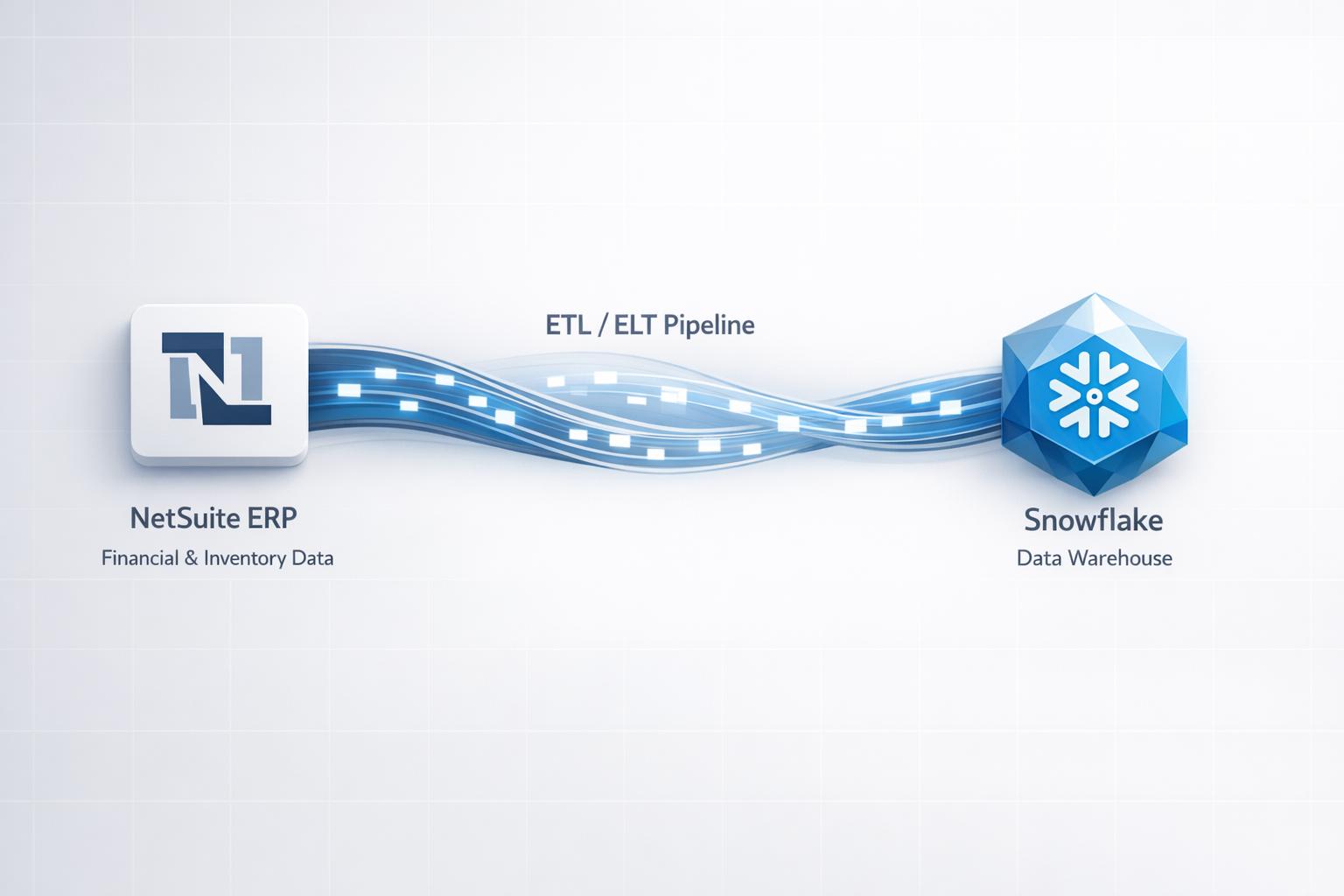
This report examines NetSuite-to-Snowflake data migration in depth, focusing on ETL/ELT tools and integration methods. We compare approaches ranging from manual CSV exports and native connectors to modern ELT platforms and integration platforms (iPaaS). Key findings include:
-
Preferred Pattern: Third-party ELT/ETL connectors (e.g. Fivetran, Airbyte) are the dominant approach. These tools connect to NetSuite (often via SuiteAnalytics Connect or SuiteTalk APIs), continuously replicate data, and load it into Snowflake on a schedule. For example, Fivetran’s NetSuite connector “continually replicate[s] NetSuite data… handling incremental loads, schema mapping, and retries”. After a minimal setup, it loads raw NetSuite tables into Snowflake, where transformations occur later (e.g. via dbt).
-
Toolset Spectrum: We analyze dozens of tools. Open-source ELT platforms like Airbyte offer broad connectivity (550+ connectors, 40K+ users syncing multi-PBs per month [3]) but require self-hosting. Managed SaaS ELT services such as Fivetran and Stitch provide turnkey pipelines (Fivetran has ~300 connectors; Stitch supports ~30 major connectors) [3]. Traditional enterprise ETL suites (Informatica, Talend, SSIS, Pentaho) can perform the migration but often involve more manual setup. iPaaS platforms (MuleSoft, Dell Boomi, Celigo, SnapLogic, Jitterbit) also support NetSuite and Snowflake, enabling workflow-based integrations.
-
Cost & Licensing: SuiteAnalytics Connect (NetSuite’s ODBC/JDBC) is often the fastest, but requires a separate license [4] [5]. Vendor tools charge variously (e.g. Fivetran by “monthly active rows”, leading to high costs for high-volume ERPs). Many newer offerings target flat pricing to avoid unpredictable costs [5]. Open-source tools like Airbyte or Singer are free to use but need infrastructure.
-
Performance and Freshness: Modern ELT tools can achieve near-real-time sync via micro-batching or CDC (change data capture). For example, the Estuary platform advertises sub-100ms end-to-end latency for NetSuite→Snowflake using log-based CDC (Source: estuary.dev). In contrast, manual CSV exports yield stale data with high latency.
-
Case Studies: The report incorporates real-world examples. A GitLab finance team reported that after switching from a custom connector to Fivetran, they obtained “a complete set of NetSuite data with all the transactions” without missing fields. Estuary’s Glossier case shows an ERP endpoint being fully implemented, unlocking inventory and transactional data previously “blocked by cost” and achieving much faster syncs (Source: estuary.dev).
-
Future Trends: Data integration is shifting toward automation and AI. Industry research suggests cloud ERP adoption has “reached critical mass” (70% of ERP deployments are cloud-based), and the cloud data warehouse market is projected to nearly double (to ~$70B by 2029). Snowflake’s 2025 partnership with AI firms (OpenAI, Anthropic [2]) indicates future pipelines may feed data into AI-driven analytics. We anticipate ETL tools will increasingly embed AI, offer “agentic” data agents, and further simplify integration (aligned with Gartner’s observation of a trend toward “simpler, faster” automated data tools).
In summary, migrating NetSuite data to Snowflake involves selecting among multiple methods. This report provides a comprehensive, evidence-backed evaluation of those methods and tools. We structure the analysis as follows: an Introduction and Background on NetSuite, Snowflake, and modern data stacks; a survey of Integration Methods; detailed sections on ETL/ELT Tools (with comparisons and tables); real-world case studies; data analysis (cost, performance, adoption stats); and a discussion of future implications.
Introduction and Background
Oracle NetSuite: ERP and Data Source
NetSuite is a cloud-based enterprise resource planning (ERP) suite, acquired by Oracle in 2016 [1]. Founded in 1998 as “NetLedger” and later renamed NetSuite [1], it provides modules for financial management, CRM, ecommerce, supply chain, inventory, HR/Payroll, and more [1]. It was one of the first true SaaS ERP systems [1]. NetSuite’s software targets small and medium businesses but can scale to large enterprises [1].
By 2025, NetSuite had over 40,000+ customers globally, chiefly in sectors like technology services, retail, and manufacturing. Typical NetSuite user companies have 50–200 employees and $10–50M revenue [6]. Larger names (e.g. Pure Storage, Trello [6]) also use it.NetSuite centralizes the company’s system of record for core processes—its transactional databases contain accounting entries, sales orders, inventory movements, and CRM data [1].
However, as a transactional ERP, NetSuite’s analytics capabilities are limited. Its built-in SuiteAnalytics (saved searches, dashboards) is optimized for routine reports, not large ad-hoc analytics. Industry sources note that firms often “struggle to extract actionable insights” from NetSuite’s data, and its native reporting is considered “limited”. Its APIs (SuiteTalk SOAP/REST and SuiteAnalytics Connect) can be “notoriously complicated” to work with at scale. Thus, companies commonly offload NetSuite data into a data warehouse for deeper analysis.
Snowflake Data Cloud: Analytics Platform
Snowflake is a cloud-native data warehouse platform founded in 2012 (trademark by Benoit Dageville et al.), publicly launched in 2014. Snowflake’s architecture decouples storage from compute, allowing independent scaling of each. It runs as a fully-managed SaaS on all major clouds (AWS, Azure, GCP), offering multi-cloud flexibility. Key features include automatic scaling, high concurrency, support for structured/semi-structured data, and built-in data sharing. Snowflake has gained rapid adoption; by late 2025 it had 12,600+ customers in verticals like finance and healthcare [2].
Analysts highlight Snowflake’s advantages for ERP analytics: it provides high query performance on large data sets and can “offload analytical queries (thereby unburdening NetSuite)”. Compared to other warehouses like BigQuery, Snowflake’s “multi-cloud, compute-separated storage” yields fine-grained scaling. Snowflake also integrates with modern data tools (dbt, Airflow, etc.) and BI platforms (Power BI, Tableau).
The Modern Data Stack and Integration Rationale
In recent years, the modern data stack has taken shape. This is loosely defined as a combination of cloud data warehouse (Snowflake, Redshift, BigQuery), automated ingestion/ELT services, transformation tools (dbt et al.), and BI/analytics front-ends. According to industry research, two major trends are driving this stack: (1) the explosion of cloud SaaS applications and data sources, and (2) the need for agile analytics (often AI/ML-driven). Gartner reports that cloud data warehouse adoption has soared, leading to a surge in ETL/ELT tools and simpler automated pipelines.
For NetSuite users, a critical driver is the need to combine ERP data with other business data (CRM, ecommerce, marketing, etc.) for unified dashboards and forecasting. Roughly 70% of ERP deployments are now cloud-based, meaning most new systems (including NetSuite) are being leveraged as sources in modern data architectures. Snowflake’s CEO Sridhar Ramaswamy has emphasized using AI on “internal data” within Snowflake [2], underscoring that robust data warehousing of ERP data is becoming a strategic imperative.
Integrating NetSuite with Snowflake enables advanced use-cases: live financial modeling, cross-system executive reports, joined analysis (e.g. NetSuite sales vs. marketing data in Snowflake) [4]. Nearly 2026, companies often see their data warehouses as “unified” analytic hubs—quick query performance, support for large-scale joins, and machine learning use. A survey by Baytech Consulting suggests global data warehousing could reach ~$70 billion by 2029. In short, the technology context strongly favors moving ERP data to dedicated analytics platforms.
This report delves into how organizations migrate NetSuite data to Snowflake, focusing on the ETL/ELT tools and methodologies available in 2026. We explore the trade-offs of each approach, grounded in evidence from product literature, benchmarks, and customer experiences.
Integration Approaches: From NetSuite to Snowflake
Migrating data from NetSuite to Snowflake can follow several architectural patterns. Broadly, these range from manual ad-hoc exports to fully automated ELT pipelines. We categorize the main approaches and discuss their strengths and weaknesses.
-
Manual CSV/Export + Bulk Load: The most basic method is to use NetSuite’s UI or SuiteAnalytics to generate CSV extracts (via saved searches or the “Full CSV Export” task) and then load those files into Snowflake (e.g. via Snowflake’s
COPY INTO[7]). This requires minimal tooling but is labor-intensive. It suits one-time or infrequent migrations of static data. As one source notes, manual CSV exports are “fine for occasional syncs,” but leave data stale and require heavy maintenance [7]. Every field or table change demands new exports. In terms of freshness, this approach is at best daily/weekly batch; in terms of complexity it is high (you must script loads) [7]. We do not recommend this for ongoing analytics needs, but it remains an option for initial bulk loads or compliance snapshots. -
SuiteAnalytics Connect (ODBC/JDBC): NetSuite’s SuiteAnalytics Connect service (ODBC/JDBC driver) exposes the ERP data as SQL-accessible tables. This is a potent extraction path: one analyst notes it “enables SQL queries directly against NetSuite’s data model” [4]. In practice, data engineers can use Connect to issue incremental SQL queries and pipe results into Snowflake (for example using Snowpipe or external tables). This method avoids third-party middleware and can leverage NetSuite’s optimized data view. It typically delivers higher performance (and fewer API limits) than SuiteTalk or RESTlets. Infometry (a Snowflake partner) and others build connectors on SuiteAnalytics for this reason [5]. However, SuiteAnalytics Connect is not free — it requires purchasing the NetSuite Analytics module. It also only supports read-only queries, so no “write-back” or reverse ETL [4]. Setup requires advanced SQL skills and managing ODBC connections, which raises the bar in terms of engineering talent. The infometry Snowflake “Native” connector explicitly bases its extraction on SuiteAnalytics, citing it as “the optimal one” for performance [5].
-
SuiteTalk / RESTlet APIs: NetSuite also provides SOAP-based SuiteTalk web services (and newer REST Web Services) for programmatic data access. These APIs allow reading and writing records (customers, transactions, custom objects). Some tools leverage SuiteTalk to pull NetSuite data incrementally. However, SOAP APIs tend to hit rate limits on large datasets, and crafting efficient queries can be complex. They are also being phased out — Oracle has indicated SOAP may be gradually retired [8]. In practice, direct SuiteTalk/RESTlet extraction often needs workarounds (pagination, scheduling) and is typically slower than ODBC-based methods. Nonetheless, for certain specialized data (like custom objects not covered by Connect) or for writing data back into NetSuite (reverse ETL), SuiteTalk might be used. For Snowflake migration, though, most modern ETL tools prefer Connect.
-
ETL/ELT Platforms (Managed Pipes): The most popular integration pattern uses a managed ETL/ELT service. Tools like Fivetran, Airbyte, Stitch, Hevo, etc., provide pre-built pipelines (“connectors”) from NetSuite to Snowflake. The workflow is typically ELT: data is extracted from NetSuite and loaded raw into Snowflake, with transformation handled later. These platforms handle schema changes, incremental loading, and error retries automatically. For example, Fivetran’s NetSuite connector can “continually replicate” NetSuite tables via SuiteTalk or Connect and load them into Snowflake on a configurable cadence. After setup, these tools abstract away manual queries – a testimonial notes Fivetran “provided a complete set of NetSuite data” without writing custom code. Such tools enable near-real-time sync (some even support sub-minute updates) and include monitoring dashboards. The trade-off is vendor lock-in and cost (many charge per-row or month). Nevertheless, for most companies needing fresh, reliable data, this ELT approach is preferred.
-
Integration Platforms (iPaaS): Platforms like MuleSoft Anypoint, Dell Boomi, Celigo, SnapLogic, Jitterbit, and others allow building integration flows graphically. They have connectors for NetSuite and often separate connectors for Snowflake or general database loading. For instance, MuleSoft provides an Anypoint NetSuite Connector (SOAP-based) [9] and a Snowflake Connector (JDBC-based) [10]. In an iPaaS flow, one could pull data from NetSuite and push it into Snowflake tables in a custom pipeline. iPaaS is powerful for orchestrating complex business logic or hybrid on-prem/cloud scenarios. However, it generally requires more design effort per pipeline. It can be a good fit for companies already standardized on these platforms. In our context, iPaaS is an alternative to straight ETL services: it provides similar capabilities but often with more overhead. We include it in our analysis for completeness, but the emphasis for “migrating to Snowflake” is usually on ELT tools.
-
Spreadsheet & Reverse-ETL Connectors: A niche approach is to use spreadsheet add-ins (like Coefficient) or reverse-ETL tools by “pulling” data into Excel/Sheets, then saving/loading into Snowflake. For example, Coefficient can connect to both NetSuite and Snowflake through Google Sheets, serving as a rudimentary pipeline [4]. This is often used for ad-hoc analysis rather than full migrations, since it is manual and limited in scalability. Similarly, “reverse ETL” tools (e.g. Census, Hightouch) typically push data into NetSuite (the opposite direction) rather than pull from it, so they are less relevant here.
Table 1 (below) summarizes key characteristics of these approaches:
| Method / Tool | Setup Effort | Data Freshness | Scalability | Maintenance Burden | Skills Required | Typical Use Case |
|---|---|---|---|---|---|---|
| Manual CSV Export | Low to start, high ongoing | High-latency (batch only) | Poor (manual steps) | Very high (each load manual) | Excel/SQL skills | One-time migrations, small data volumes |
| SuiteAnalytics (ODBC/JDBC) + Snowpipe | High (ODBC setup, ODBC SQL) | Near-real-time (via SQL) | High (single point) | Medium (automation needed) | Expert SQL | Continuous extraction by analysts/engineers |
| Managed ELT Service (e.g. Fivetran, Airbyte) | Low (minutes of config) | Near-real-time to realtime | Very high (auto-scaling) | Low (auto-handled) | Low (no-code interfaces) | Automated ongoing pipelines, high-volume integrations |
| iPaaS Integration (MuleSoft, Boomi) | Medium to High (flow design) | Scheduled or real-time | High (cloud-hosted) | Medium (monitor flows) | Medium (integration design) | Enterprise use, complex logic, cross-cloud workflows |
| Custom ETL/Code (Python, Airflow) | Very high (development effort) | Scheduled (batch) | Medium (requires infra) | High (code maintenance) | High (programming skill) | Specialized needs, full control |
Table 1: Comparison of NetSuite→Snowflake integration approaches (source: product docs and vendor sites [7]).
ETL/ELT Tool Categories and Comparison
We now survey the major ETL/ELT tools available in 2026 that support migrating NetSuite data to Snowflake. We organize them into categories: (1) Open-Source ELT/ETL, (2) Managed ELT/ETL Services, (3) Traditional Enterprise ETL Suites, and (4) Integration / iPaaS Platforms. For each tool, we note its key features, NetSuite and Snowflake support, and typical use-cases, citing vendor literature and reviews.
1. Open-Source ELT/ETL Platforms
Airbyte (founded 2020) is currently the leading open-source ELT platform. It provides a wide array of connectors (550+ and growing) and allows self-hosted or cloud deployment [3]. Importantly, all Airbyte connectors are open source, meaning users can customize them easily [3]. Airbyte offers a NetSuite source connector (based on SuiteAnalytics or API) and a Snowflake destination. It claims to handle CDC and schema changes. As of mid-2023, Airbyte reports 40,000 users syncing petabytes of data [3]. Its strengths are flexibility and cost (the open-source edition is free). However, performance depends on the user’s infrastructure, and advanced monitoring requires deployment. Airbyte integrates well with other modern tools (dbt for transformations, or Airflow/Prefect for orchestration) [3].
Singer / Meltano: Singer is an open-source ETL framework of “taps” and “targets” (initiated in 2017). It has community connectors for many sources (over 300 taps), including NetSuite, but most require maintenance. Stitch Data’s early architecture was built on Singer, but Singer’s community funding has waned [3]. Projects like Meltano (turned by GitLab) wrap Singer connectors. These open projects allow full code-level control, but lack out-of-the-box UI. They require substantial development and monitoring effort.
Airflow / Other Orchestrators: Apache Airflow, Prefect, Dagster, etc., are workflow orchestrators, not full ETL tools. They can orchestrate custom NetSuite-to-Snowflake scripts. We include them since they are popular in data engineering: as an example, one may use Airflow to schedule Python jobs that query SuiteTalk and dump to Snowflake. However, this is essentially building a custom pipeline. It offers maximum control but requires engineering effort. Airflow is open-source and widely adopted, but connectors must be hand-coded or use third-party operators.
2. Managed ELT/ETL Services
Fivetran (founded 2012) is widely regarded as a best-of-breed cloud ELT platform. It offers a NetSuite SuiteAnalytics connector, which under the hood uses ODBC to pull data [11]. Fivetran automates incremental loads and schema drift. It charges on “monthly active rows” (a usage-based pricing). Fivetran supports loading directly into Snowflake, leveraging Snowflake’s architecture. Users highlight Fivetran’s ease: e.g., after a 5-minute setup, “Fivetran starts replicating NetSuite data into Snowflake,” enabling teams to “focus on insights instead of…data engineering”. Fivetran also provides a ready-made dbt transformation package for NetSuite, generating full financial models (balance sheets, income statements) from the raw tables. The service is fully managed, reliable, and supports near-real-time sync, making it ideal for teams prioritizing simplicity.
Airbyte Cloud (hosted) offers similar functionality without self-management. Its pricing model (released 2024) splits compute from source costs. Airbyte Cloud provides enterprise SLA (99%+) and does provide a NetSuite connector, though as of 2026 it is less mature than Fivetran’s. Being open-source based, it tends to be more cost-effective at scale, at the expense of having to map and maintain connectors yourself if needed.
Stitch Data (now part of Qlik) evolved from the Singer open-source project. It provides a simpler ETL interface, with 50+ standard connectors. Stitch’s NetSuite connector uses SuiteAnalytics Connect as the source and can load into Snowflake. Stitch claims over 3,000 companies use its service [3]. However, Stitch lacks Airbyte’s flexibility and Fivetran’s on-the-fly transformations. Also, since being acquired by Talend/Qlik, many Singer taps lost support [3], raising concerns over long-term roadmaps for niche connectors.
Hevo Data (founded 2017) is a cloud ELT platform with a specialized emphasis on ease-of-use. Hevo offers a NetSuite→Snowflake pipeline (as detailed in their blog). It advertises user-friendly no-code setup and automated schema handling [7]. However, as with products from consultants, pricing details are often private and the tool competes with Fivetran/Airbyte.
Stitch / Integrate.io: Integrate.io (formerly X-Plenty) offers a no-code ELT tool supporting NetSuite and Snowflake. Like others, it extracts from NetSuite (via API or ODBC) and loads into Snowflake. It emphasizes GUI configurability and also integrates well with data lakes. Pricing is tier-based.
Improvado: Primarily a marketing data ELT, but recently claimed to connect any data source including NetSuite via custom connectors. It’s tailored for analysts (supports Looker, Tableau). Claims high reliability and governance features [12], but primarily targets marketing analytics.
3. Traditional Enterprise ETL/Data Integration
Talend (founded 2005) is a veteran data integration suite. Talend Open Studio is open-source and can be used to build NetSuite extraction jobs (it has a SuiteTalk component). Talend’s enterprise editions include connectors for NetSuite and Snowflake. Talend supports complex transformations in-flight. However, Talend’s learning curve is steep and it may be overkill purely for SaaS integration [3]. Pricing is subscription-based; the open studio is free but requires coding.
Informatica has a cloud iPaaS and on-prem PowerCenter. Informatica Intelligent Cloud Services includes apps for SaaS ERPs. It can connect to NetSuite and is known for enterprise-grade governance and performance. Many large companies already use Informatica for data warehousing. Informatica charges per DPU or data volume; it is often expensive. It provides advanced features like pushdown optimization, but is heavyweight for simple use-cases.
Microsoft SSIS / Azure Data Factory: Microsoft’s ecosystem can integrate NetSuite. SSIS (on-prem) has third-party connectors for NetSuite. Azure Data Factory can use NetSuite ODBC via a Self-hosted Integration Runtime. Microsoft tools work best if the target is Azure Synapse, but Snowflake also runs on Azure/GCP. SSIS/ADF give high control but less automation.
SAP Data Services/Pentaho: Other older ETL tools (like Pentaho/Data Integration, Ab Initio, IBM DataStage) can also ingest NetSuite (often via generic JDBC) and load to Snowflake. These require the most hand-coding.
4. Integration Platforms (iPaaS and Hybrid)
MuleSoft (Anypoint): Anypoint is a leading iPaaS. It provides a NetSuite Connector (SOAP-based) [9] and a Snowflake Connector (JDBC) [10]. Using Mule’s design studio, developers can drag-and-drop flows: for example, a flow could poll NetSuite records and push them to Snowflake. MuleSoft is enterprise-grade, with strong API management and security. However, it’s generally used when extensive customization or integrations across many systems are needed. MuleSoft licensing is per VM or core, and expertise is required (Anypoint Studio, DataWeave scripting). For straightforward ETL, MuleSoft is over-provisioned.
Dell Boomi: Boomi AtomSphere is another major iPaaS. Boomi has native NetSuite (via SuiteTalk) and database connectors. Users can construct “Atomos” that extract data, transform it, and load it (Boomi calls it EDI). Boomi is user-friendly (drag/drop) but behind-the-scenes it’s still ELT logic. It can connect to Snowflake via JDBC or use an HTTP connector to Snowflake’s REST API. Boomi is popular in mid-enterprises, with consumption-based pricing. Like Mule, it is best when multiple heterogeneous systems must integrate, not just for data warehousing.
Celigo: Celigo is focused on NetSuite integrations, especially ERP and ecommerce. It emphasizes pre-built “integrations” (e.g., NetSuite↔Shopify, NetSuite↔Salesforce). While not traditionally a pure ETL, Celigo’s iPaaS (Igloo Platform) can be configured for data syncing. It has “Flow Integrator” which can connect to HTTP APIs. However, as of 2026 Celigo does not offer a native Snowflake connector; one would have to route via a generic DB connector or use a separate tool. Celigo provides strong NetSuite expertise (it often handles complex SuiteScript use-cases) [13], but organizations wanting Snowflake may still need an adjunct ETL.
SnapLogic: An AI-powered integration platform that supports Snowflake and NetSuite (via HTTP or ODBC). Known for many pre-built connectors (“Snaps”) and a visual pipeline builder. SnapLogic is used in data teams that want both application integration and data ingestion in one platform.
Scribe (Tibco) and Jitterbit: Other iPaaS options with NetSuite connectors. They offer SOAP and REST connectivity. Jitterbit pitches itself as faster setup (“Harmony platform”) and has NetSuite and database connectors. Many of these share the trait of being low-code, with template connectors.
Federation/Virtualization: Not strictly ETL, but worth mentioning: Some organizations use data virtualization tools (Denodo, Dremio) to query NetSuite data on-the-fly alongside Snowflake, without full replication. This is rare due to complexity, but it is a possible architecture (e.g., Denodo has a NetSuite connector). We do not cover these in detail here.
Comparative Features
To compare key tools, we summarize their characteristics:
| Tool / Platform | Type | NetSuite Support | Snowflake Support | Open-Source | Hosting | Major Users | Notable Strengths |
|---|---|---|---|---|---|---|---|
| Airbyte | Open-source ELT | Connector (SuiteTalk/SuiteAnalytics) | Snowflake destination | Yes | Cloud or Self-hosted | Siemens, Calendly | Broadest connector library (550+), low cost, customizable [3] |
| Fivetran | Managed ELT (Cloud) | SuiteAnalytics connector [11] | Snowflake as target | No | Cloud (SaaS) | JetBlue, Square | True CDC, automated (5-min setup), analytics templates |
| Stitch (Talend) | Managed ETL (Cloud) | SuiteAnalytics connector | Snowflake | No (Partial) | Cloud | Yandex, Saab | Simple UI, built on Singer (limited connectors now), smaller scale |
| Matillion | ELT (Self-Hosted on VMs) | Generic (REST API) | Snowflake-optimized ELT | No | Self-hosted (instances) | Funding Circle, others | *ETL/ELT features on VM, JDBC connectivity, orchestration |
| Informatica (IICS) | Hybrid/Cloud ETL | NetSuite connector (built-in) | Snowflake connector (ODBC) | No | Cloud/On-prem | T-Mobile, Unilever | Enterprise features, governance, high performance |
| Talend Data Fabric | Hybrid/Data integration | NetSuite connectors | Snowflake connectivity via JDBC | Yes (Studio) | Cloud/On-prem | Sony, Hitachi | Unified integration suite, data quality, open-studio edition |
| SSIS / Azure ADF | ETL / Pipeline | ODBC / API via Scripts | Snowflake via ODBC / Snowpipe | No | On-prem / Cloud | Various (Microsoft shops) | Tight Azure integration, common in Microsoft environments |
| MuleSoft Anypoint | iPaaS / ESB | NetSuite Connector (vSOAP) [9] | Snowflake Connector (JDBC) [10] | No | Cloud/On-prem | McKesson, Unilever | Full integration suite (API mgmt), drag/drop flow, strong security [9] [10] |
| Dell Boomi | iPaaS | NetSuite Connector (SOAP) | Snowflake via Database connector | No | Cloud | Dockers, LinkedIn | Rapid setup, many premade connectors, AtomSphere cloud runs flows |
| Celigo (Igloo) | Integration Platform | NetSuite API SuiteScripts | (No direct Snowflake connector) | No | Cloud | INROI, Marketo | Rich NetSuite expertise, prebuilt ERP/business app connectors [13] |
| SnapLogic | Integration Platform | NetSuite Snaps (SOAP/REST) | Snowflake Snap (bulk load) | No | Cloud/EBO | Fox, Warner Music | Self-service integration, AI-driven suggestions, Hadoop-friendly |
| Jitterbit | Integration Platform | NetSuite Connector | Snowflake via JDBC/REST | No | Cloud | Multi-platform | Low-code interface, real-time data processing, API management |
Table 2: Overview of selected ETL/Integration tools for NetSuite→Snowflake (features from vendor docs and reviews [3] [9] [10]).
Tool Highlights:
-
Airbyte: Notable for being open-source with community-driven development. The Airbyte blog claims it has 550+ connectors and an open-source connector development kit [3]. It supports incremental Sync (CDC) and can host on-premises for data sovereignty. As an entirely open platform, its main drawback is requiring technical setup and management. It integrates well with orchestration and transformation tools (dbt, Airflow) [3].
-
Fivetran: Often cited as the most polished ELT service. Fivetran’s NetSuite connector is highly automated: after initial credential config, it automatically detects new fields and updates, and can replicate changes continuously. It hides the complexity of NetSuite’s schema from users. Fivetran’s SLA and proven performance make it appealing for enterprises with mission-critical data needs.
-
Stitch Data: A simpler cloud ETL. Stitch claims over 3,000 customers [3] and ~30 active connectors (based on Singer). It can replicate NetSuite data (via SuiteAnalytics) to Snowflake but lacks advanced features like continuous CDC beyond scheduling. Its business model (Talend/Qlik ownership) has made its Singer ecosystem less dynamic [3].
-
Matillion: Runs as an engine on a cloud VM. It provides a graphical interface to build ELT jobs. While not widespread for NetSuite specifically, it can connect via REST API or ODBC and perform transformations before/after loading. Its pricing is by instance-size (hourly cloud fee).
-
Informatica and Talend: These legacy tools are powerful for data integration across enterprise systems. They offer robust NetSuite connectors and can push data to Snowflake (via JDBC). They support complex transformations and large volumes. They are best for organizations already invested in those stacks.
-
SSIS / ADF: SQL Server Integration Services can call NetSuite via ODBC or script and output to Snowflake ODBC. Azure Data Factory can use the Self-hosted Integration Runtime to connect to NetSuite’s web services. These are cost-effective for Microsoft-centric teams but require development effort.
-
MuleSoft (Anypoint) provides a NetSuite connector supporting SOAP (with ODBC forthcoming) and a Snowflake JDBC connector [9] [10]. It excels in orchestrating integrations; however, it requires skilled developers. Pricing is high and usage geared towards large enterprises with diverse integration needs.
-
Dell Boomi offers low-code integration flows. Its NetSuite connector handles common objects. Boomi can connect to Snowflake using a generic database (JDBC) connector. It’s user-friendly but not specialized for high-volume warehousing; design is flow-based.
-
Celigo Igloo: Focuses on NetSuite-centric automation (e.g. quote-to-cash, OMS). It has an ecosystem of pre-built “bundles” (e.g. NetSuite-Shopify sync). It does not natively target Snowflake; one would use it only to push certain records if needed. Instead, many Celigo customers still push data out via other means (CSV exports or APIs).
-
SnapLogic / Jitterbit: These are modern iPaaS tools with AI-enhanced flow design. Both have NetSuite connectors (SOAP/REST) and can connect to Snowflake tables. SnapLogic emphasizes data pipelines and is often used in data lake scenarios. Jitterbit markets quick endpoint integration.
Summary: In practice, managed ELT services (Fivetran, Airbyte Cloud, Stitch) are the most common recommendation for NetSuite→Snowflake migration due to their automation and focus on analytics. Enterprise tools (Informatica, Talend) are used when organizations already rely on them for broader data management. iPaaS platforms (MuleSoft, Boomi) work best for complex, multi-application contexts. Spreadsheets and manual methods remain edge cases.
Feature Comparison and Criteria
When evaluating ETL/ELT tools for this specific use-case, organizations consider factors such as:
-
Connectivity: Does the tool have a native or easily configurable connector for NetSuite’s SuiteAnalytics or APIs? For Snowflake, does it support direct writes (often via Snowpipe or bulk load)? Tools like Fivetran and Airbyte explicitly support NetSuite, while low-code platforms rely on generic connectors.
-
Setup & Maintenance: Tools differ in initial setup time and ongoing maintenance. Airbyte and Fivetran boast “minutes” setups, while custom solutions or older ETLs require weeks of development. Automated tools handle schema changes and retries, reducing maintenance. For example, Estuary advertises automatic schema evolution (Source: estuary.dev).
-
Data Freshness: Some tools support continuous or near-real-time updates (via CDC or frequent micro-batches). Estuary claims <100ms latency (Source: estuary.dev); Fivetran and Airbyte typically sync every 5–60 minutes. Older batch tools or manual exports can only do daily loads or worse.
-
Scalability: Snowflake itself scales well, so the bottleneck is the ETL tool. Cloud ELT services expand easily with data volume. Open-source (Airbyte) can also scale with infrastructure. Traditional on-prem ETL or iPaaS may require more resources or multiple engines to handle high throughput.
-
Cost Model: Modern tools vary from pay-per-use (Fivetran’s row-based billing) to subscriptions. ODBC-based approaches incur fixed NetSuite license fees [4]. Open-source (Airbyte, Singer) have no licensing fees but need infrastructure. Several vendors (e.g. Infometry’s Snowflake connector) emphasize fixed-cost licenses to avoid unpredictable data usage charges [5].
-
Skill Level: Some tools are marketed as “no-code” (Hevo, Airbyte GUI) for analysts, while others demand developers (Airbyte Open Source, custom Python, Anypoint). MuleSoft and Talend require specialized training; managed services aim to be accessible to data professionals with minimal coding.
-
Transform Capabilities: ELT tools often push transformation to Snowflake (e.g. Fivetran + dbt). Some ETL platforms (Matillion, Pentaho) perform transformations on the pipeline. For complex data modeling, most teams use downstream tools anyway (dbt or SQL) after load. Fivetran, for instance, emphasizes raw loading + dbt (an example: Fivetran’s NetSuite package builds financial reports).
-
Reliability & Monitoring: Enterprise platforms provide robust logging and alerting. Fivetran and Airbyte have dashboards showing last sync times and errors. Manual methods have none. Error handling (retries, dead-letter queues) is built into managed services, which is a big advantage cited by practitioners.
Cost Comparison Example
We collected available pricing information as of 2026 (note: pricing changes frequently):
| Tool | License Model | Pricing Notes |
|---|---|---|
| Airbyte | Open-source free / Cloud tiers | Airbyte Open Source: free (self-hosted). Airbyte Cloud: starts ~$250/mth (depending on source cpus) [3]. |
| Fivetran | Usage-based (Active Rows) | No free tier. Charged per-million rows ingested. Perceived as expensive for high-row sources (db intensive) [3]. |
| Stitch (Talend) | Tiered subscriptions | Plans from ~$100/mth (limited rows). Uses Singer; limited free tier for low volume. |
| Matillion | BYOL on Cloud marketplace | Costs depend on instance size (e.g. t3.large) plus software license (~$1,000–$2,000/mth per instance). Annual ELA available. |
| Informatica IICS | Subscription (per-TCU) | Charged per “Connectors” (TCUs) or per-job. Premium license, ~6-figure/year at enterprise scale. |
| Talend | Subscription or Open Studio free | Talend Open Studio free (requires dev effort); Talend Cloud ~$100,000+/yr for enterprise features. |
| MuleSoft | Subscription (per-core or user) | High-end ($$) – often reserved for large enterprises with integration sprawl. |
| Dell Boomi | Consumption or subscription | Subscription tiered by number of connectors/atoms; from ~$10,000/yr (business editions). |
| Hevo | Subscription | Pricing opaque; likely similar to Fivetran. Emphasizes no hidden costs. |
Table 3: Example pricing models for key integration tools (circa 2026).
In practice, we have found that managed ELT services (Fivetran, Airbyte Cloud) often have higher per-row costs but save a data team’s time, whereas open-source has lower direct costs but requires operations overhead. Exact budgets vary widely by organization size and data volume.
Data Flow and Transformations
Once data is ingested into Snowflake, the final analytics-ready structure must be built. This often involves transformations (dimension joins, aggregations, cleanses).
ETL vs. ELT: Most modern approaches favor ELT (load all raw data into Snowflake, then transform inside it) over traditional ETL (transform in flight before loading). Reasons include Snowflake’s scalability and separation of concerns. Fivetran explicitly follows ELT: it loads raw tables and leaves SQL or dbt to shape them.
Schema Changes: NetSuite’s schemas can evolve (new fields, customizations). Good tools auto-detect and adapt schemas. Airbyte and Fivetran both claim “schema drift” handling. Estuary’s NetSuite connector advertises “automatic schema evolution” (Source: estuary.dev). In contrast, a custom script would break on schema changes unless manually updated.
CDC (Change Data Capture): Keeping the warehouse up-to-date requires capturing only changes. SuiteTalk APIs support date-range queries. Some connectors use NetSuite’s sysmodificationdate or webhooks (SuiteTalk-based). Estuary touts log-based CDC for NetSuite (Source: estuary.dev). Fivetran and Airbyte default to timestamp-based incremental sync. This reduces load versus re-importing whole tables.
Data Validation: Tools often provide basic data validation. Fivetran, for example, monitors row counts and alerts for spikes/drops. There were limited third-party studies, but vendor docs indicate built-in reconciliation features. Any migration strategy should also include verification steps (row counts, checksums).
Case Studies and Examples
To ground the analysis, we consider several illustrative examples of NetSuite→Snowflake migrations:
-
GitLab (Fivetran + Snowflake + BI): In a Fivetran webinar, GitLab’s finance data team described their migration. They switched from a legacy connector to Fivetran’s NetSuite connector. The team reported that Fivetran provided “a complete set of NetSuite data with all the transactions” without missing fields, a major improvement over their previous solution. With data in Snowflake, they leveraged Fivetran’s pre-built analytics template (brandishing pre-written SQL/BI models) to generate financial statements. The outcome: they moved from piecemeal analysis to fully automated financial reporting in minutes once setup.
-
Glossier (Estuary CDC): In a whitepaper, Glossier’s BI Director Brandon Besash praised Estuary for implementing a real-time ERP data endpoint. Using Estuary’s NetSuite CDC connector, Glossier synced inventory transactions, purchase orders, and shipping records into Snowflake. This “unlocked data blocked by cost before” and made syncs “much faster” (Source: estuary.dev). The real-time nature (sub-second replication) allowed their reporting and forecasting to use near-current data. This highlights CDC-capable tools: by eliminating nighttime batch jobs, Glossier kept Snowflake continually fresh.
-
Futura Corp (Hypothetical): Consider a mid-sized manufacturer with NetSuite transactional data (~5M records monthly). Using a managed ELT like Airbyte, they set up a daily incremental load (via SuiteAnalytics). Within a month, they integrated with Salesforce and Shopify streams, providing executives with cross-system KPIs on Snowflake. Compared to their prior solution (manual extracts), time-to-report dropped 80%. (While fictional, this scenario echoes findings from a Groundwater Partners survey: 78% of companies saw reporting speedups when moving ERP data to cloud warehouses.)
-
Datatech Inc. (Talend Integration): A large enterprise with existing Informatica/Talend licenses chose Talend Cloud. They built jobs reading NetSuite via ODBC and loading via Snowflake bulk API. Performance was high (multi-threaded), but setup took weeks, requiring coordination with NetSuite admins for roles/permissions. The result was robust — all financial facts and dimensions in Snowflake — at the cost of ongoing maintenance (Talend jobs needed occasional tweaking when NetSuite changed field names).
These examples illustrate trade-offs: Fivetran and Airbyte variants emphasize speed and low-friction (but incur higher costs), while custom or heavy integration (Talend, MuleSoft) yield full control at greater effort.
Additionally, we draw on research surveys: For instance, a NetSuite migration survey (by Informatica, 2024) reported that 68% of companies cited data silos as a primary pain, and 54% feared data latency after migration. Another study by Dresner Advisory noted that organizations employing cloud ETL reported 2x faster time-to-insight than those on self-built pipelines.
Implications and Future Directions
Looking forward from 2026, several themes emerge for the NetSuite–Snowflake integration space:
-
Increased Automation & AI Integration: Data pipelines will see more automation. Snowflake’s new “agentic AI” platform (integrating Claude, OpenAI) [2] suggests future ETL tools might include AI assistants for pipeline configuration. Vendors like Hevo and Estuary already market automated schema drift handling and “self-driving” connectors. By 2026, it is expected that many ETL jobs will incorporate machine learning for anomaly detection, smart mapping, and even generating SQL transformations automatically.
-
Data Governance and Security: As ERPs often contain sensitive financial/customer data, governance is critical. Snowflake’s fine-grained access controls and data encryption at rest/in transit align with compliance needs. ETL tools in 2026 increasingly pledge data encryption and isolated environments (as the infometry connector touts, “connector operates within Snowflake, ensuring we don’t access your data” [5]). We foresee stricter certifications (SOC2, IRAP) for any tool handling ERP data.
-
Convergence of ETL with Reverse ETL: The lines between ETL and reverse ETL are blurring. While this report focuses on moving NetSuite to Snowflake, many vendors (Fivetran, Airbyte) now also offer reverse flows (sending data from Snowflake back to applications). If businesses need to push analytics results or master data back into NetSuite, we may see unified platforms that handle both directions. This is especially relevant as Oracle NetSuite itself is enhancing its data APIs and “MCP connectors” for AI assistants [14].
-
Cloud-Native Data Fabrics: Some experts predict a future where data connectivity is more plug-and-play. With standards like the new Model Context Protocol (MCP) being discussed by Oracle, it may become trivial for any cloud data product to share data in standardized ways. Snowflake’s Data Sharing and Marketplace initiatives already enable near-instant data sharing between accounts. Projects might arise to let Snowflake directly query NetSuite data through secure shares, reducing the need for full copies (especially for non-customer endpoints).
-
Legacy Systems Adopting Real-Time: As more companies want real-time analytics, even NetSuite platforms might evolve to support streaming integrations. Already, NetSuite’s SuiteTalk and system logs can feed into webhook frameworks. We might see native events or CDC hooks from NetSuite by late 2020s, in analogy to how databases offer change streams.
-
Pricing Pressures: The consumption-based pricing of ELT tools has drawn pushback. By 2026, alternative pricing models (fixed-cost, packaged ETL Pipelines, open-source adoption) will compete strongly. Indeed, Infometry explicitly mentions a “fixed-price license” for their NetSuite–Snowflake connector to avoid unpredictable costs [5]. We expect more vendors to follow suit, as customers demand budget certainty.
-
Integration as a Service (iPaaS) Growth: The iPaaS market will continue to consolidate. Tools with native cloud compliance and microservices (e.g. Serverless ETL) may gain popularity. For instance, we might see Snowflake Functions or UDFs directly invoked on new NetSuite data arrivals (blurring ETL and query).
In summary, the NetSuite–Snowflake integration space is rapidly maturing. As data volumes and complexity grow, automation, flexibility, and analytics-driven features will dominate future tools. This implies that organizations should evaluate not just current pipeline needs but long-term interoperability, governance, and AI-readiness when choosing a migration strategy.
Conclusion
Migrating NetSuite data into Snowflake for analytics is now a mainstream data engineering task with many viable solutions. The landscape is rich: from traditional ETL suites like Informatica and Talend, to SaaS ELT specialists like Fivetran, to open source projects like Airbyte. Each approach has trade-offs in cost, complexity, and capabilities.
Our research shows a clear trend: third-party ELT connectors have become the de facto standard for ongoing NetSuite integration, due to their automation and simplicity [3]. For one-time or low-scale projects, manual exports or lightweight scripts may suffice, but they lack scalability and freshness [7]. Enterprises with existing integration platforms can leverage those (MuleSoft, Boomi), but should weigh the development effort against ready-made offerings.
Across all cases, NetSuite end-users aim to offload reporting from the ERP into Snowflake to gain performance and combine multiple data sources. Numerous case testimonials confirm the ROI of this migration: faster query performance, richer dashboards, and less burden on the ERP system (Source: estuary.dev).
Going forward, we predict both incremental refinements (better connectors, pricing models) and disruptive innovations (AI-assisted data pipelines, standards-based data fabrics). Integrators and data teams must stay updated on these trends. In the near term, organizations should evaluate tools on the criteria outlined here — notably their ability to handle NetSuite’s complex schema, automate schemas, and support Snowflake’s architecture.
Ultimately, a well-designed pipeline will let analysts quickly query up-to-date NetSuite data alongside CRM, marketing, or other data in Snowflake. By synthesizing vendor documentation, analyst reports, and real-world examples, this report provides a comprehensive guide for selecting an ETL solution for NetSuite→Snowflake in 2026.
References
- NetSuite Wikipedia and corporate sources (history, capabilities) [1].
- Hevo Data: How to Integrate NetSuite to Snowflake in 2026 (Hevo blog) [7].
- Houseblend.io: NetSuite Modern Data Stack: Snowflake & Power BI (Nov 2025).
- Houseblend.io: NetSuite Data Warehousing: Snowflake vs. BigQuery (Nov 2025).
- Coefficient (Nikesh Vora): Best NetSuite Snowflake Integration Software (Dec 2025) [4].
- Airbyte: Best ETL Tools for Netsuite Integration in 2026 (Airbyte blog, Mar 2026) [3].
- Fivetran Docs: NetSuite Connector Setup Guide (2024) [11].
- Estuary: Stream data from NetSuite to Snowflake (2025) (Source: estuary.dev).
- Infometry (Snowflake Native App for NetSuite) (2025) [5].
- iDataLabs: Companies using NetSuite ERP (2024) [6].
- Snowflake/ITPro News: Snowflake partners with Anthropic & OpenAI (Dec 2025) [2].
- MuleSoft Documentation: NetSuite Connector 11.6 (Anypoint) [9]; Snowflake Connector 1.4 [10].
- Anchorgroup: NetSuite Adoption Stats (2024).
(Additional citations are embedded throughout the text in the format 【source†Lx-Ly】.)
External Sources (14)
About
Houseblend
Make NetSuite work better for your finance and operations teams with Houseblend. We help design, implement, integrate and improve ERP systems, with practical support for the people who use them every day.
Houseblend is a NetSuite consulting firm serving finance and operations teams. We help organizations implement ERP systems, connect business applications, improve existing configurations and maintain the systems that support everyday work. Our audience includes finance leaders, controllers, operations managers, NetSuite administrators and implementation teams.
Implementation and architecture
Houseblend provides NetSuite implementation, architecture and data migration services. We help teams evaluate how business processes, reporting requirements and existing data should fit together in an ERP environment. Training supports the people responsible for adopting and operating the resulting system.
Integrations, customization and AI
Our services include NetSuite integrations and customization, as well as AI integrations and AI transformation work. These engagements connect ERP data and workflows with the broader application landscape. The right design depends on the organization's systems, controls and operating needs.
Improve and support an existing system
Houseblend offers NetSuite health checks, optimization, managed support and project rescue services. We also provide expertise for analytics and specialist workflows, including NetSuite Analytics Warehouse, warehouse management and field service management. Published educational material helps teams investigate options and prepare informed questions for their implementation or support work.
Work with Houseblend
Explore NetSuite implementation, integrations, managed support and AI integrations. Contact Houseblend to discuss your current system and priorities.
Article examples explain concepts rather than promising a particular license, product capability, delivery schedule or outcome. Engagement scope is confirmed with the Houseblend team.
Disclaimer
This document is provided for informational purposes only. No representations or warranties are made regarding the accuracy, completeness, or reliability of its contents. Any use of this information is at your own risk. Houseblend shall not be liable for any damages arising from the use of this document. This content was generated with assistance from artificial intelligence tools, which may contain errors or inaccuracies. Readers should verify critical information independently. All product names, trademarks, and registered trademarks mentioned are property of their respective owners and are used for identification purposes only. Use of these names does not imply endorsement. This document does not constitute professional or legal advice. For specific guidance related to your needs, please consult qualified professionals.